

ISSN 0439-755X
CN 11-1911/B
主办:中国心理学会
中国科学院心理研究所
出版:科学出版社
CN 11-1911/B
主办:中国心理学会
中国科学院心理研究所
出版:科学出版社
心理学报 ›› 2026, Vol. 58 ›› Issue (6): 1113-1131.doi: 10.3724/SP.J.1041.2026.1113 cstr: 32110.14.2026.1113
潘超超, 薛媚媚, 尹玉龙( ), 周爱保
收稿日期:2025-04-10
发布日期:2026-04-28
出版日期:2026-06-25
通讯作者:
尹玉龙, E-mail: yinhaomin2486144@nwnu.edu.cn基金资助:
PAN Chaochao, XUE Meimei, YIN Yulong(), ZHOU Aibao
Received:2025-04-10
Online:2026-04-28
Published:2026-06-25
摘要:
主动控制感是指通过控制自己行为进而控制外部环境的主观体验。主动控制感异常被认为是精神分裂症的核心特征。然而, 现有研究对精神分裂症患者主动控制感异常的表现形式存在分歧, 其潜在神经机制也有待阐明。为系统考察这一问题, 本研究采用行为结合ERP的方法开展了2项实验。实验1随机选取精神分裂症患者103位, 健康对照组100位, 通过时距估计范式从行为层面考察精神分裂症患者主动控制感异常的表现形式。结果发现,与对照组相比, 精神分裂症患者组的主动控制感评分显著更低, 动作任务中的时间间隔估计显著更长, 意向捆绑程度显著更弱。这表明, 精神分裂症患者的主动控制感呈异常减弱的表现形式。实验2随机选取精神分裂症患者24位, 健康对照组24位, 结合ERP技术从动作前的运动意图与动作后的感觉预测, 进一步揭示精神分裂症患者主动控制感减弱的神经机制。结果发现, 在运动意图阶段, 精神分裂症患者的准备电位幅度增益显著弱于健康对照组, 这表明患者在运动意图生成阶段存在神经功能缺陷。在感觉预测阶段, 精神分裂症患者的N1抑制和P2抑制与对照组间的差异不显著, 这表明患者对自我诱发感觉刺激的预测性抑制功能相对保留。这些研究发现共同说明精神分裂症患者主动控制感的异常减弱可能主要源于意图生成阶段的神经功能缺陷。综上, 本研究发现提示, 未来干预研究可优先考虑以运动意图相关脑区作为潜在靶点, 以改善精神分裂症患者的主动控制感。
中图分类号:
潘超超, 薛媚媚, 尹玉龙, 周爱保. (2026). 精神分裂症异常减弱的主动控制感:来自行为与ERP的证据. 心理学报, 58(6), 1113-1131.
PAN Chaochao, XUE Meimei, YIN Yulong, ZHOU Aibao. (2026). Abnormally weakened sense of agency in schizophrenia: Evidence from behavioral and ERP studies. Acta Psychologica Sinica, 58(6), 1113-1131.
| 变量 | 患者组(n = 103) | 对照组(n = 100) | t/χ2 | p | Cohen's d |
|---|---|---|---|---|---|
| 性别(男/女) | 51/52 | 50/50 | 0.01 | 0.95 | 0.01 |
| 年龄 | 34.56 ± 8.87 | 36.91 ± 11.37 | 1.75 | 0.08 | 0.25 |
| 受教育年限 | 9.05 ± 3.66 | 9.59 ± 3.12 | 1.24 | 0.21 | 0.17 |
| 病程(年) | 9.60 ± 7.04 | ||||
| SAPS | 31.02 ± 8.64 | ||||
| SANS | 35.67 ± 9.97 | ||||
| 药物剂量(氯丙嗪等效) (mg) | 340.74 ± 180.04 |
表1 被试的人口统计学信息(M ± SD)
| 变量 | 患者组(n = 103) | 对照组(n = 100) | t/χ2 | p | Cohen's d |
|---|---|---|---|---|---|
| 性别(男/女) | 51/52 | 50/50 | 0.01 | 0.95 | 0.01 |
| 年龄 | 34.56 ± 8.87 | 36.91 ± 11.37 | 1.75 | 0.08 | 0.25 |
| 受教育年限 | 9.05 ± 3.66 | 9.59 ± 3.12 | 1.24 | 0.21 | 0.17 |
| 病程(年) | 9.60 ± 7.04 | ||||
| SAPS | 31.02 ± 8.64 | ||||
| SANS | 35.67 ± 9.97 | ||||
| 药物剂量(氯丙嗪等效) (mg) | 340.74 ± 180.04 |
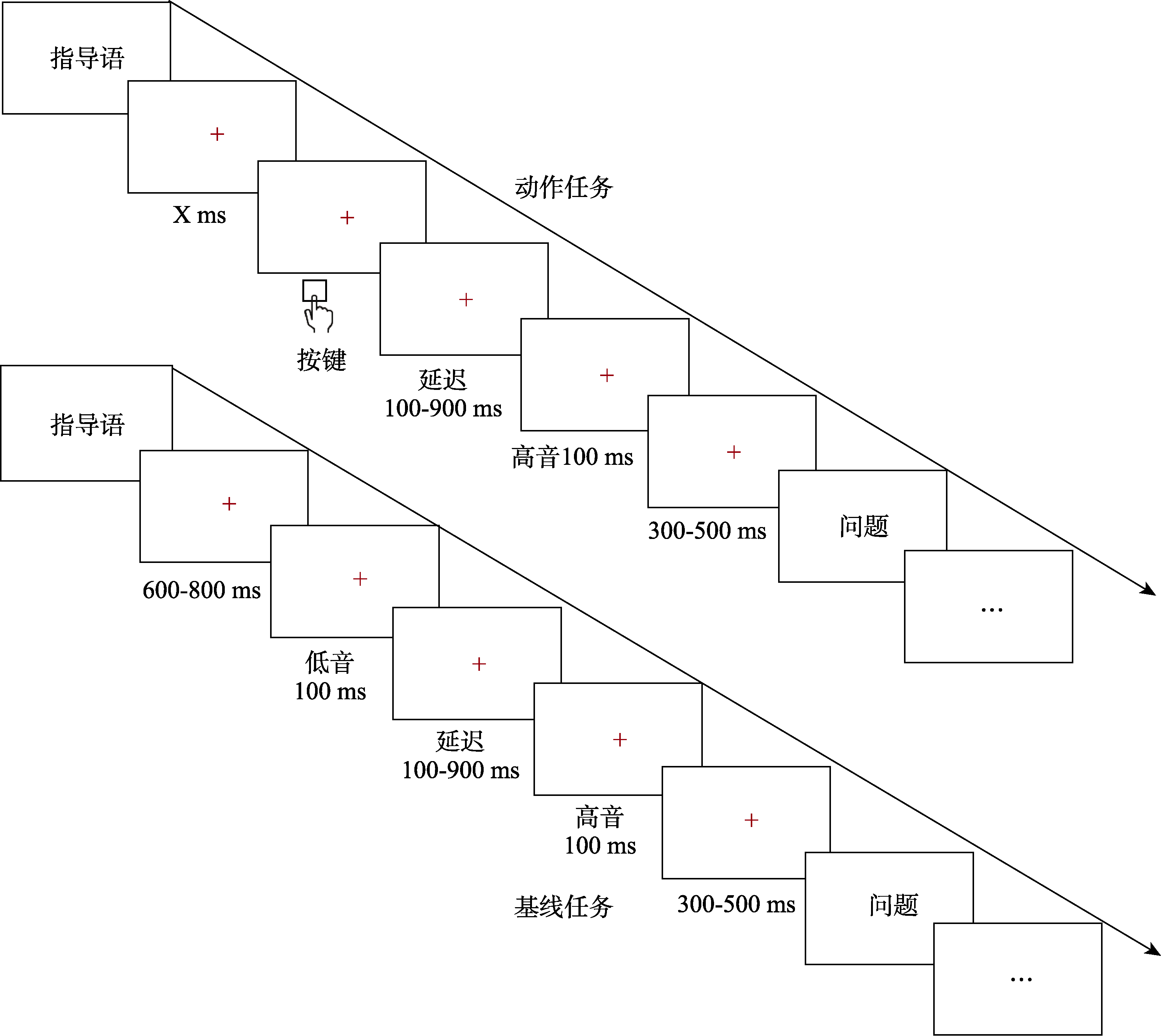
图1 时距估计范式中基线任务和动作任务的示意图
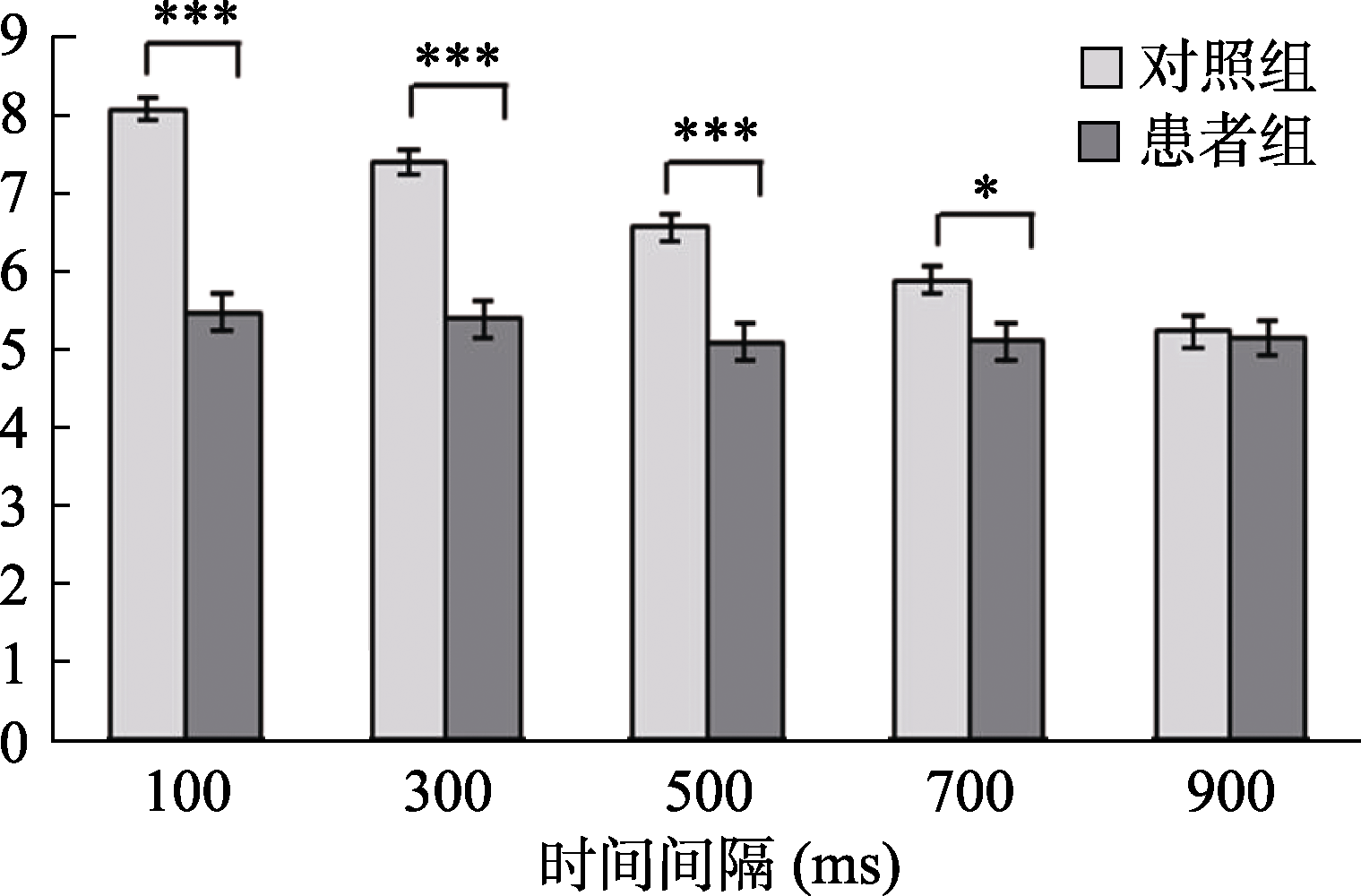
图2 两组被试的主动控制感评分 注:*表示p < 0.05, **表示p < 0.01, ***表示p < 0.001, 下同
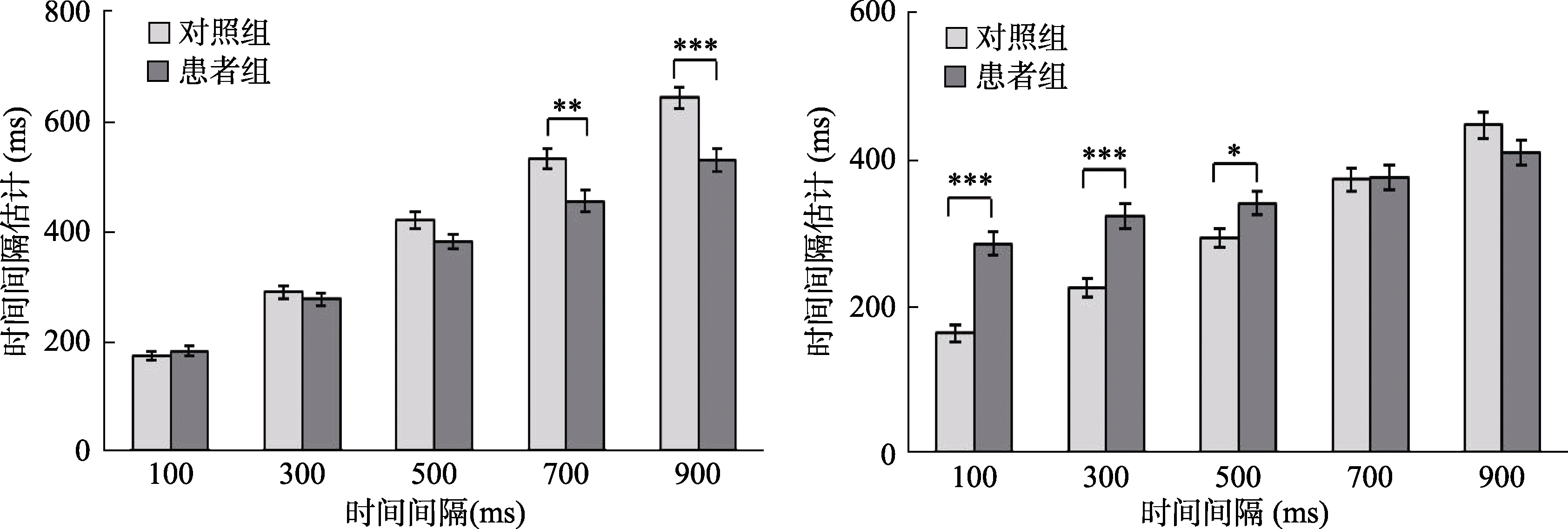
图3 基线任务和动作任务中的时间间隔估计
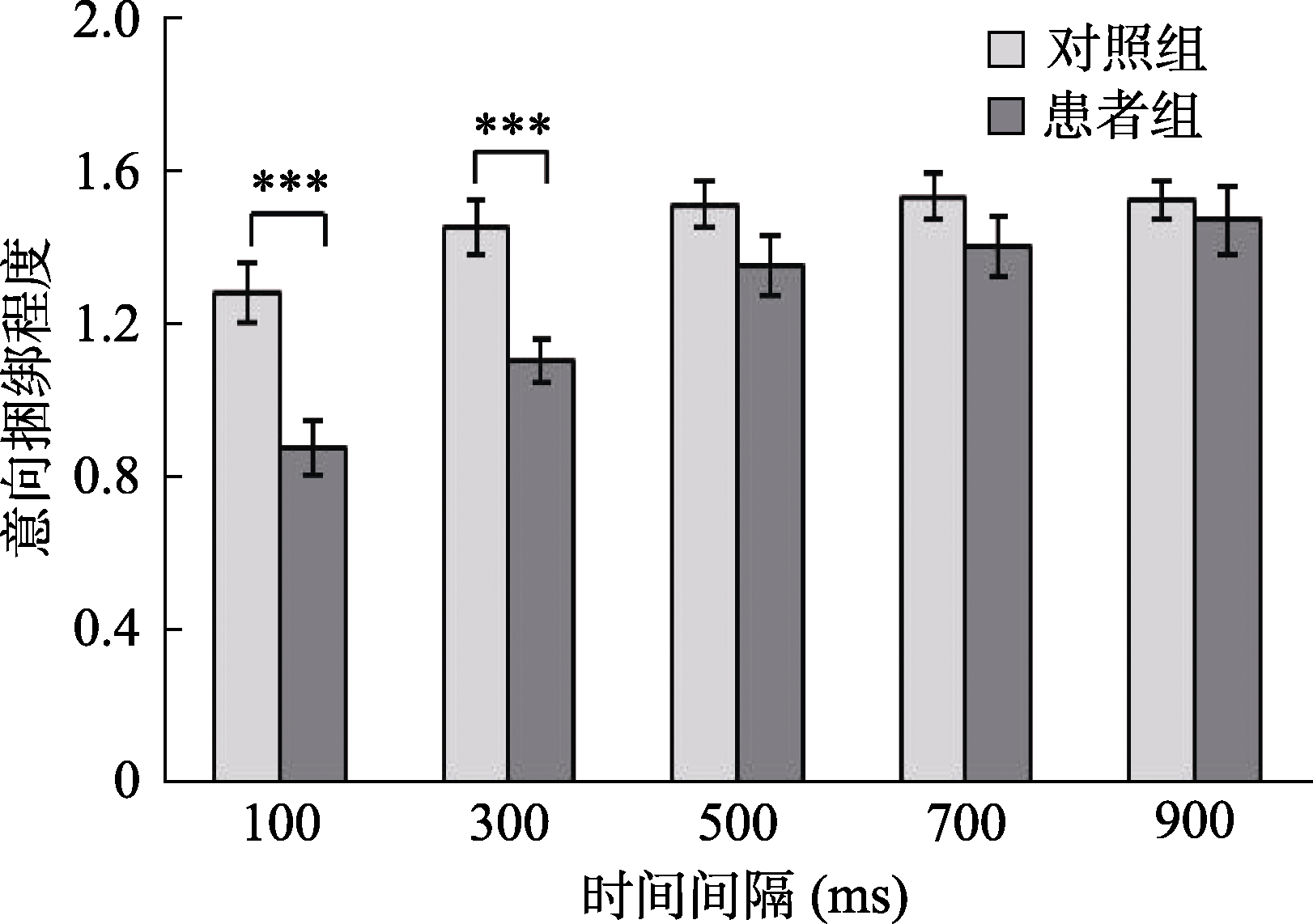
图4 两组被试在不同时间间隔中的意向捆绑程度

图5 不同时间间隔中的主动控制感评分、时间间隔估计和意向捆绑程度的相关图 注:B表示基线任务中的时间间隔估计, A表示动作任务中的时间间隔估计, R表示意向捆绑程度, AA表示主动控制感评分。
| 变量 | 自主感评分 | 精神病性症状 | |||||
|---|---|---|---|---|---|---|---|
| 100 ms | 300 ms | 500 ms | 700 ms | 900 ms | SAPS | SANS | |
| 100 ms | 1.00 | ||||||
| 300 ms | 0.92** | 1.00 | |||||
| 500 ms | 0.87** | 0.96** | 1.00 | ||||
| 700 ms | 0.78** | 0.91** | 0.96** | 1.00 | |||
| 900 ms | 0.73* | 0.87** | 0.93** | 0.96** | 1.00 | ||
| SAPS | −0.22* | −0.23* | −0.24** | −0.25** | −0.27** | 1.00 | |
| SANS | 0.02 | 0.06 | 0.03 | 0.02 | −0.01 | 0.33** | 1.00 |
表2 主动控制感评分与精神病性症状间的相关性分析表
| 变量 | 自主感评分 | 精神病性症状 | |||||
|---|---|---|---|---|---|---|---|
| 100 ms | 300 ms | 500 ms | 700 ms | 900 ms | SAPS | SANS | |
| 100 ms | 1.00 | ||||||
| 300 ms | 0.92** | 1.00 | |||||
| 500 ms | 0.87** | 0.96** | 1.00 | ||||
| 700 ms | 0.78** | 0.91** | 0.96** | 1.00 | |||
| 900 ms | 0.73* | 0.87** | 0.93** | 0.96** | 1.00 | ||
| SAPS | −0.22* | −0.23* | −0.24** | −0.25** | −0.27** | 1.00 | |
| SANS | 0.02 | 0.06 | 0.03 | 0.02 | −0.01 | 0.33** | 1.00 |
| 变量 | 时间间隔估计 | 精神病性症状 | |||||
|---|---|---|---|---|---|---|---|
| 100 ms | 300 ms | 500 ms | 700 ms | 900 ms | SAPS | SANS | |
| 100 ms | 1.00 | ||||||
| 300 ms | 0.83** | 1.00 | |||||
| 500 ms | 0.64** | 0.77** | 1.00 | ||||
| 700 ms | 0.49** | 0.66** | 0.89** | 1.00 | |||
| 900 ms | 0.26** | 0.44** | 0.72** | 0.85** | 1.00 | ||
| SAPS | 0.24** | 0.18* | 0.05 | 0.06 | −0.06 | 1.00 | |
| SANS | 0.04 | −0.05 | −0.09 | −0.09 | 0.03 | 0.33** | 1.00 |
表3 动作任务中的时间间隔估计与精神病性症状间的相关性分析表
| 变量 | 时间间隔估计 | 精神病性症状 | |||||
|---|---|---|---|---|---|---|---|
| 100 ms | 300 ms | 500 ms | 700 ms | 900 ms | SAPS | SANS | |
| 100 ms | 1.00 | ||||||
| 300 ms | 0.83** | 1.00 | |||||
| 500 ms | 0.64** | 0.77** | 1.00 | ||||
| 700 ms | 0.49** | 0.66** | 0.89** | 1.00 | |||
| 900 ms | 0.26** | 0.44** | 0.72** | 0.85** | 1.00 | ||
| SAPS | 0.24** | 0.18* | 0.05 | 0.06 | −0.06 | 1.00 | |
| SANS | 0.04 | −0.05 | −0.09 | −0.09 | 0.03 | 0.33** | 1.00 |
| 变量 | 意向捆绑程度 | 精神病性症状 | |||||
|---|---|---|---|---|---|---|---|
| 100 ms | 300 ms | 500 ms | 700 ms | 900 ms | SAPS | SANS | |
| 100 ms | 1.00 | ||||||
| 300 ms | 0.68** | 1.00 | |||||
| 500 ms | 0.53** | 0.58** | 1.00 | ||||
| 700 ms | 0.46** | 0.47** | 0.82** | 1.00 | |||
| 900 ms | 0.39** | 0.35** | 0.77** | 0.83** | 1.00 | ||
| SAPS | −0.22* | −0.07 | −0.01 | −0.00 | 0.03 | 1.00 | |
| SANS | −0.10 | −0.07 | −0.04 | −0.08 | −0.16 | 0.33** | 1.00 |
表4 意向捆绑程度与精神病性症状间的相关性分析表
| 变量 | 意向捆绑程度 | 精神病性症状 | |||||
|---|---|---|---|---|---|---|---|
| 100 ms | 300 ms | 500 ms | 700 ms | 900 ms | SAPS | SANS | |
| 100 ms | 1.00 | ||||||
| 300 ms | 0.68** | 1.00 | |||||
| 500 ms | 0.53** | 0.58** | 1.00 | ||||
| 700 ms | 0.46** | 0.47** | 0.82** | 1.00 | |||
| 900 ms | 0.39** | 0.35** | 0.77** | 0.83** | 1.00 | ||
| SAPS | −0.22* | −0.07 | −0.01 | −0.00 | 0.03 | 1.00 | |
| SANS | −0.10 | −0.07 | −0.04 | −0.08 | −0.16 | 0.33** | 1.00 |
| 变量 | 精神分裂症患者组 (n = 24) | 健康对照组 (n = 24) | t | p | Cohen's d |
|---|---|---|---|---|---|
| 性别(男/女) | 13/11 | 10/14 | 0.75 | 0.38 | 0.13 |
| 年龄 | 33.33 ± 8.84 | 35.00 ± 14.51 | 0.42 | 0.67 | 0.14 |
| 受教育年限 | 10.78 ± 2.32 | 12.31 ± 3.07 | 1.71 | 0.10 | 0.57 |
| SAPS | 35.14 ± 6.76 | ||||
| SANS | 37.65 ± 10.07 | ||||
| 药物剂量(mg) | 370.88 ± 152.43 |
表5 被试的人口统计学信息(M ± SD)
| 变量 | 精神分裂症患者组 (n = 24) | 健康对照组 (n = 24) | t | p | Cohen's d |
|---|---|---|---|---|---|
| 性别(男/女) | 13/11 | 10/14 | 0.75 | 0.38 | 0.13 |
| 年龄 | 33.33 ± 8.84 | 35.00 ± 14.51 | 0.42 | 0.67 | 0.14 |
| 受教育年限 | 10.78 ± 2.32 | 12.31 ± 3.07 | 1.71 | 0.10 | 0.57 |
| SAPS | 35.14 ± 6.76 | ||||
| SANS | 37.65 ± 10.07 | ||||
| 药物剂量(mg) | 370.88 ± 152.43 |
| 变量 | 精神分裂症患者组 | 健康对照组 | t | p | Cohen's d |
|---|---|---|---|---|---|
| 主动控制感评分 | 5.25 ± 2.29 | 6.63 ± 1.21 | 4.15 | < 0.001 | 1.25 |
| 意向捆绑程度 | 1.23 ± 0.53 | 1.46 ± 0.37 | 2.70 | 0.008 | 0.83 |
表6 两组被试在主动控制感评分和意向捆绑程度的描述性统计(M ± SD)
| 变量 | 精神分裂症患者组 | 健康对照组 | t | p | Cohen's d |
|---|---|---|---|---|---|
| 主动控制感评分 | 5.25 ± 2.29 | 6.63 ± 1.21 | 4.15 | < 0.001 | 1.25 |
| 意向捆绑程度 | 1.23 ± 0.53 | 1.46 ± 0.37 | 2.70 | 0.008 | 0.83 |
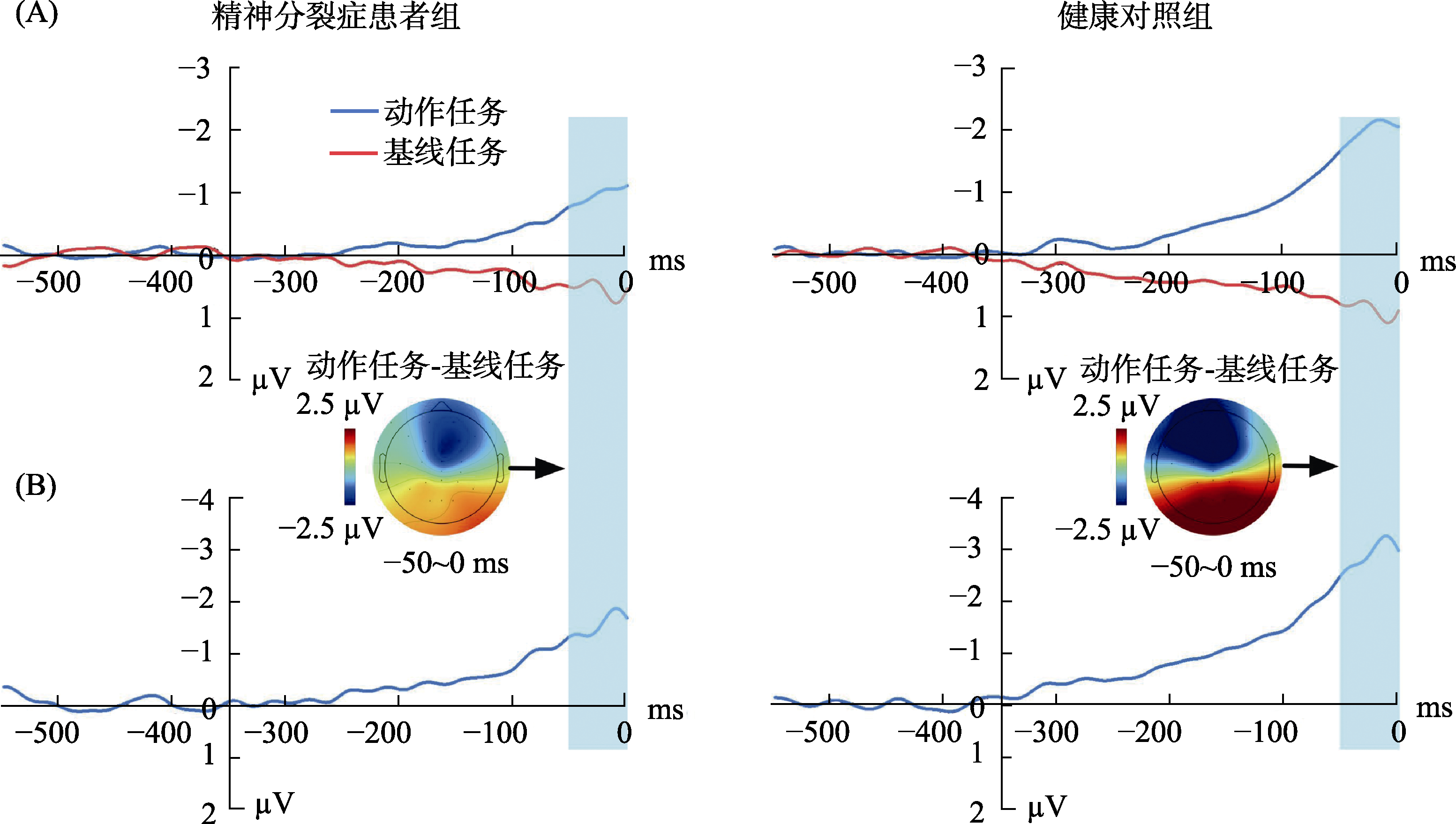
图6 两组被试在所选分析电极上诱发的准备电位波形图和地形图(−50~0 ms)
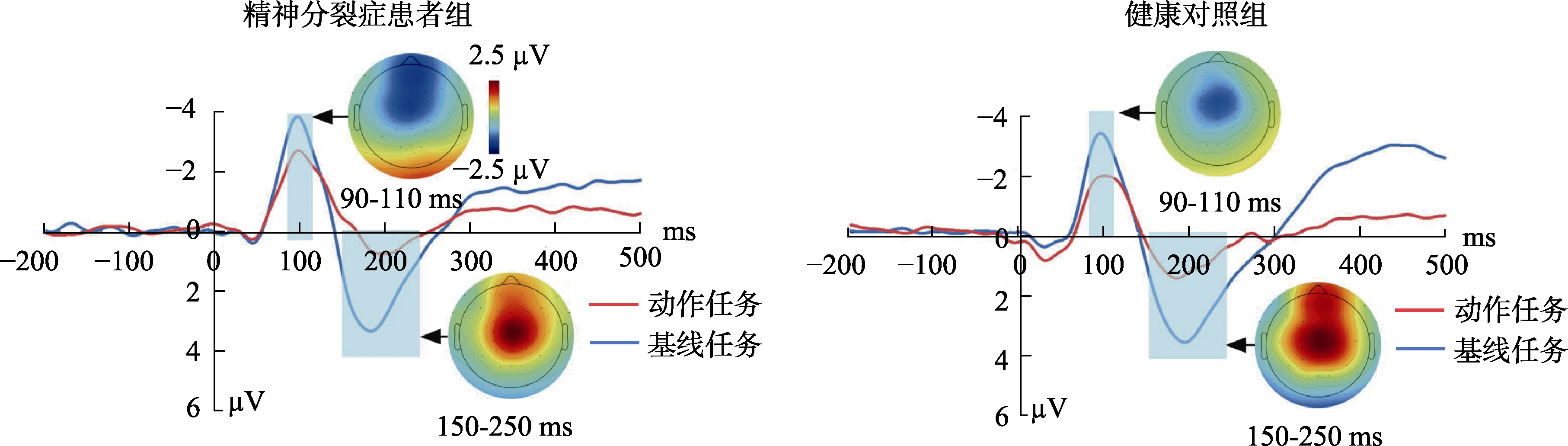
图7 两组被试在基线任务和动作任务中诱发的N1和P2的波形图和地形图
| 变量 | 精神分裂症患者组 (n = 20) | 健康对照组 (n = 22) | t | p |
|---|---|---|---|---|
| N1抑制 | −1.02 ± 1.26 | −1.22 ± 1.78 | −0.38 | 0.70 |
| P2抑制 | 1.82 ± 0.91 | 1.92 ± 1.14 | −0.26 | 0.79 |
表7 N1抑制和P2抑制的描述性统计(M ± SD)
| 变量 | 精神分裂症患者组 (n = 20) | 健康对照组 (n = 22) | t | p |
|---|---|---|---|---|
| N1抑制 | −1.02 ± 1.26 | −1.22 ± 1.78 | −0.38 | 0.70 |
| P2抑制 | 1.82 ± 0.91 | 1.92 ± 1.14 | −0.26 | 0.79 |
| [1] |
Adler, G., & Adler, J. (1989). Influence of stimulus intensity on AEP components in the 80- to 200-millisecond latency range. Audiology, 28(6), 316-324.
pmid: 2597095 |
| [2] |
Aliu, S. O., Houde, J. F., & Nagarajan, S. S. (2009). Motor-induced suppression of the auditory cortex. Journal of Cognitive Neuroscience, 21, 791-802.
doi: 10.1162/jocn.2009.21055 pmid: 18593265 |
| [3] | Asai, T., & Tanno, Y. (2008). Highly schizotypal students have a weaker sense of self-agency. Psychiatry and Clinical Neuroences, 62(1), 115-119. |
| [4] |
Baess, P., Horvath, J., Jacobsen, T., & Schröger, E. (2011). Selective suppression of self-initiated sounds in an auditory stream: An ERP study. Psychophysiology, 48(9), 1276-1283.
doi: 10.1111/j.1469-8986.2011.01196.x pmid: 21449953 |
| [5] |
Blakemore, S.-J., Smith, J., Steel, R., Johnstone, E. C., & Frith, C. D. (2000). The perception of self-produced sensory stimuli in patients with auditory hallucinations and passivity experiences: Evidence for a breakdown in self-monitoring. Psychological Medicine, 30(5), 1131-1139.
doi: 10.1017/s0033291799002676 pmid: 12027049 |
| [6] |
Carroll, C. A., O’Donnell, B. F., Shekhar, A., & Hetrick, W. P. (2009). Timing dysfunctions in schizophrenia span from millisecond to several-second durations. Brain and Cognition, 70(2), 181-190.
doi: 10.1016/j.bandc.2009.02.001 pmid: 19282082 |
| [7] |
Chen, K. C., Lee, I. H., Yeh, T. L., Chiu, N. T., Chen, P. S., Yang, Y. K., … Chen, C. C. (2012). Schizotypy trait and striatal dopamine receptors in healthy volunteers. Psychiatry Research - Neuroimaging, 201(3), 218-221.
doi: 10.1016/j.pscychresns.2011.07.003 URL |
| [8] |
Davalos, D. B., Kisley, M. A., & Ross, R. G. (2003). Effects of interval duration on temporal processing in schizophrenia. Brain and Cognition, 52(3), 295-301.
pmid: 12907174 |
| [9] | Dewey, J. A., & Knoblich, G. (2014). Do implicit and explicit measures of the sense of agency measure the same thing? PLoS One, 9(10), 110-118. |
| [10] |
Dodgson, G., & Gordon, S. (2009). Avoiding false negatives: Are some auditory hallucinations an evolved design flaw? Behavioural and Cognitive Psychotherapy, 37(3), 325-334.
doi: 10.1017/S1352465809005244 pmid: 19371459 |
| [11] | Donati, F. L., Fecchio, M., Maestri, D., Cornali, M., Derchi, C. C., Casetta, C.,... D’Agostino, A. (2021). Reduced readiness potential and post-movement beta synchronization reflect self-disorders in early course schizophrenia. Scientific Reports, 11(1), 15044. |
| [12] |
Dreher, J. C., Trapp, W., Banquet, J. P., Keil, M., W. Günther, & Burnod, Y. (1999). Planning dysfunction in schizophrenia: Impairment of potentials preceding fixed/free and single/ sequence of self-initiated finger movements. Experimental Brain Research, 124(2), 200-214.
doi: 10.1007/s002210050615 pmid: 9928843 |
| [13] |
Duzcu, H., Özkurt, T. E., Mapelli, I., & Hohenberger, A. (2019). N1-P2: Neural markers of temporal expectation and response discrimination in interval timing. Acta Neurobiologiae Experimentalis, 79(2), 193-204.
pmid: 31342955 |
| [14] |
Ebert, J. P., & Wegner, D. M. (2010). Time warp: Authorship shapes the perceived timing of actions and events. Consciousness and Cognition, 19(1), 481-489.
doi: 10.1016/j.concog.2009.10.002 pmid: 19896868 |
| [15] |
Elvevåg, B., Mccormack, T., Gilbert, A., Brown, G, Weinberger, D. R., & Goldberg, T. E. (2003). Duration judgements in patients with schizophrenia. Psychological Medicine, 33(7), 1249-1261.
pmid: 14580079 |
| [16] |
Exner, C., Weniger, G., Schmidt-Samoa, C., & Irle, E. (2006). Reduced size of the pre-supplementary motor cortex and impaired motor sequence learning in first-episode schizophrenia. Schizophrenia Research, 84(2-3), 386-396.
pmid: 16624528 |
| [17] |
Ford, J. M., Gray, M., Faustman, W. O., Roach, B. J., & Mathalon, D. H. (2007). Dissecting corollary discharge dysfunction in schizophrenia. Psychophysiology, 44(4), 522-529.
doi: 10.1111/j.1469-8986.2007.00533.x pmid: 17565658 |
| [18] |
Gallagher, S. (2000). Philosophical conceptions of the self: Implications for cognitive science. Trends in Cognitive Sciences, 4(1), 14-21.
doi: 10.1016/s1364-6613(99)01417-5 pmid: 10637618 |
| [19] | Garbarini, F., Mastropasqua, A., Sigaudo, M., Rabuffetti, M., Piedimonte, A., Pia, L., & Rocca, P. (2016). Abnormal sense of agency in patients with schizophrenia: Evidence from bimanual coupling paradigm. Frontiers in Behavioral Neuroscience, 10. https://doi.org/10.3389/fnbeh.2016.00043 |
| [20] |
Gentsch, A., Kathmann, N., & Schutz-Bosbach, S. (2012). Reliability of sensory predictions determines the experience of self-agency. Behavioural Brain Research, 228(2), 415-422.
doi: 10.1016/j.bbr.2011.12.029 pmid: 22212711 |
| [21] |
Gentsch, A., & Schutz-Bosbach, S. (2011). I did it: Unconscious expectation of sensory consequences modulates the experience of self-agency and its functional signature. Journal of Cognitive Neuroscience, 23(12), 3817-3828.
doi: 10.1162/jocn_a_00012 pmid: 21452945 |
| [22] |
Goldberg, M., Busch, N., & van der Meer, E. (2017). The amount of recent action-outcome coupling modulates the mechanisms of the intentional binding effect: A behavioral and ERP study. Consciousness and Cognition, 56, 135-149.
doi: S1053-8100(16)30229-X pmid: 28716392 |
| [23] |
Graham-Schmidt, K. T., Martin-Iverson, M. T., Holmes, N. P., & Waters, F. A. V. (2016). When one’s sense of agency goes wrong: Absent modulation of time perception by voluntary actions and reduction of perceived length of intervals in passivity symptoms in schizophrenia. Consciousness and Cognition, 45, 9-23.
doi: S1053-8100(16)30238-0 pmid: 27544689 |
| [24] |
Graham-Schmidt, K. T., Martin-Iverson, M. T., & Waters, F. A. V. (2017). Self- and other-agency in people with passivity (first rank) symptoms in schizophrenia. Schizophrenia Research, 192, 75-81.
doi: 10.1016/j.schres.2017.04.024 URL |
| [25] |
Gu, J. J., Zhao, K., & Fu, X. L. (2020). The sense of agency and the attribution of responsibility in human behavior. China Science Bulletin, 65(19), 1902-1911.
doi: 10.1360/TB-2019-0715 URL |
| [顾晶金, 赵科, 傅小兰. (2020). 行为中的主动控制感与责任归属. 科学通报, 65(19), 1902-1911.] | |
| [26] |
Haggard, P. (2017). Sense of agency in the human brain. Nature Reviews Neuroscience, 18(4), 196-207.
doi: 10.1038/nrn.2017.14 pmid: 28251993 |
| [27] |
Haggard, P. (2008). Human volition: Towards a neuroscience of will. Nature Reviews Neuroscience, 9(12), 934-946.
doi: 10.1038/nrn2497 pmid: 19020512 |
| [28] |
Han, N., Jack, B. N., Hughes, G., Elijah, R. B., & Whitford.T. J. (2021). Sensory attenuation in the absence of movement: Differentiating motor action from sense of agency. Cortex, 141, 436-448.
doi: 10.1016/j.cortex.2021.04.010 pmid: 34146742 |
| [29] |
Horváth, J. (2015). Action-related auditory ERP attenuation: Paradigms and hypotheses. Brain Research, 1626, 54-65.
doi: 10.1016/j.brainres.2015.03.038 pmid: 25843932 |
| [30] |
Howes, O. D., Shotbolt, P., Bloomfield, M., Daalman, K., Demjaha, A., Diederen, K. M. J., … Sommer, I. E. (2013). Dopaminergic function in the psychosis spectrum: An [18F]-DOPA imaging study in healthy individuals with auditory hallucinations. Schizophrenia Bulletin, 39(4), 807-814.
doi: 10.1093/schbul/sbr195 pmid: 22282457 |
| [31] |
Huang, Y. Q., Wang, Y., Wang, H., Liu, Z., Yu, Y., Kou, C., … Wu, Y. (2019). Prevalence of mental disorders in China: A cross- sectional epidemiological study. The Lancet Psychiatry, 6(3), 211-224.
doi: 10.1016/S2215-0366(18)30511-X URL |
| [32] |
Hughes, G. (2018). The role of the temporoparietal junction in implicit and explicit sense of agency. Neuropsychologia, 113, 1-5.
doi: S0028-3932(18)30113-1 pmid: 29567107 |
| [33] |
Hughes, G., Desantis, A., & Waszak, F. (2013). Attenuation of auditory N1 results from identity-specific action-effect prediction. European Journal of Neuroscience, 37(7), 1152-1158.
doi: 10.1111/ejn.12120 pmid: 23331545 |
| [34] |
Hughes, G., & Waszak, F. (2011). ERP correlates of action effect prediction and visual sensory attenuation in voluntary action. Neuroimage, 56(3), 1632-1640.
doi: 10.1016/j.neuroimage.2011.02.057 pmid: 21352924 |
| [35] |
Hur, J.-W., Kwon, J. S., Lee, T. Y., & Park, S. (2014). The crisis of minimal self-awareness in schizophrenia: A meta- analytic review. Schizophrenia Research, 152(1), 58-64.
doi: 10.1016/j.schres.2013.08.042 URL |
| [36] |
Imaizumi, S., & Tanno, Y. (2019). Intentional binding coincides with explicit sense of agency. Consciousness and Cognition, 67, 1-15.
doi: S1053-8100(18)30288-5 pmid: 30471470 |
| [37] |
Kapur, S. (2003). Psychosis as a state of aberrant salience: A framework linking biology, phenomenology, and pharmacology in schizophrenia. American Journal of Psychiatry, 160(1), 13-23.
doi: 10.1176/appi.ajp.160.1.13 pmid: 12505794 |
| [38] |
Khalighinejad, N., Di Costa, S., & Haggard, P. (2016). Endogenous action selection processes in dorsolateral prefrontal cortex contribute to sense of agency: A meta- analysis of tDCS studies of “intentional binding”. Brain Stimulation, 9(3), 372-379.
doi: S1935-861X(16)00009-7 pmid: 26896324 |
| [39] |
Kieling, C., Buchweitz, C., Caye, A., Silvani, J., Ameis, S. H., Brunoni, A. R.,... Szatmari, P. (2024). Worldwide prevalence and disability from mental disorders across childhood and adolescence: Evidence from the global burden of disease study. JAMA Psychiatry. 81(4), 347-356. https://doi.org/10.1001/jamapsychiatry.2023.5051
doi: 10.1001/jamapsychiatry.2023.5051 URL pmid: 38294785 |
| [40] |
Klaffehn, A. L., Baess, P., Kunde, W., & Pfister, R. (2019). Sensory attenuation prevails when controlling for temporal predictability of self- and externally generated tones. Neuropsychologia, 132, 107145-107145.
doi: 10.1016/j.neuropsychologia.2019.107145 URL |
| [41] |
Knolle, F., Schröger, E., & Kotz, S. A. (2013). Prediction errors in self- and externally-generated deviants. Biological Psychology, 92, 410-416.
doi: 10.1016/j.biopsycho.2012.11.017 pmid: 23246535 |
| [42] |
Lange, K. (2011). The reduced N1 to self-generated tones: An effect of temporal predictability? Psychophysiology, 48(8), 1088-1095.
doi: 10.1111/j.1469-8986.2010.01174.x pmid: 21261634 |
| [43] |
Lee, K.-H., Bhaker, R. S., Mysore, A., Parks, R. W., Birkett, P. B. L., & Woodruff, P. W. R. (2009). Time perception and its neuropsychological correlates in patients with schizophrenia and in healthy volunteers. Psychiatry Research, 166(2-3), 174-183.
doi: 10.1016/j.psychres.2008.03.004 URL |
| [44] |
Legaspi, R., & Toyoizumi, T. (2019). A Bayesian psychophysics model of sense of agency. Nature Communications, 10(1), 1-11.
doi: 10.1038/s41467-018-07882-8 |
| [45] | Li, Y. H., Wang, K., & Chen, X. W. (2010). Time perception in patients with Parkinson's disease. Chinese Journal of Neurology, 43(9), 622-625. |
| [李友海, 汪凯, 陈先文. (2010). 帕金森病患者的时间感知障碍. 中华神经科杂志, 43(9), 622-625.] | |
| [46] |
Maeda, T., Takahata, K., Muramatsu, T., Okimura, T., Koreki, A., & Iwashita, S., ⋅⋅⋅ Kato, M. (2013). Reduced sense of agency in chronic schizophrenia with predominant negative symptoms. Psychiatry Research, 209(3), 386-392.
doi: 10.1016/j.psychres.2013.04.017 pmid: 23680465 |
| [47] |
Mathalon, D. H., & Ford, J. M. (2008). Corollary discharge dysfunction in schizophrenia: Evidence for an elemental deficit. Clinical EEG and Neuroscience, 39(2), 82-86. https://doi.org/10.1177/155005940803900212
doi: 10.1177/155005940803900212 URL pmid: 18450174 |
| [48] |
Moccia, L., di Luzio, M., Conte, E., Modica, M., Ambrosecchia, M., Ardizzi, M.,... Sani, G. (2024). Sense of agency and its disturbances: A systematic review targeting the intentional binding effect in neuropsychiatric disorders. Psychiatry and Clinical Neurosciences, 78(1), 3-18.
doi: 10.1111/pcn.v78.1 URL |
| [49] | Oestreich, L. K. L., Mifsud, N. G., Ford, J. M., Roach, B. J., Mathalon, D. H., & Whitford, T. J. (2015). Cortical suppression to delayed self-initiated auditory stimuli in schizotypy: Neurophysiological evidence for a continuum of psychosis. Clinical EEG and Neuroscience, 3, 1-8. |
| [50] |
Ohata, R., Asai, T., Imaizumi, S., & Imamizu, H. (2022). I hear my voice; therefore I spoke: The sense of agency over speech is enhanced by hearing one’s own voice. Psychological Science, 33(8), 1226-1239. https://doi.org/10.1177/09567976211068880
doi: 10.1177/09567976211068880 URL pmid: 35787212 |
| [51] | Okimura, T., Maeda, T., Mimura, M., & Yamashita, Y. (2023). Aberrant sense of agency induced by delayed prediction signals in schizophrenia: A computational modeling study. Schizophrenia, 9(1), 72. |
| [52] | Pan, C. C. (2022). The effect of self-alienation on psychotic symptoms——Research perspective based on schizophrenia. Journal of Psychological Science, 45(5), 1251-1258. |
| [潘超超. (2022). 自我异常对精神病性症状的影响——基于精神分裂症的研究视角. 心理科学, 45(5), 1251-1258.] | |
| [53] |
Pan, C. C., Lu, H., Gong, J. X., Guo, Y., Li, Z. K., & Xie, P. (2021). High schizotypy conditionally have a weaker sense of agency. Current Psychology, 42, 5088-5094.
doi: 10.1007/s12144-021-01870-w |
| [54] |
Plana-Ripoll, O., Weye, N., Knudsen, A. K., Hakulinen, C., Madsen, K. B., Christensen, M. K.,... McGrath, J. J. (2023). The association between mental disorders and subsequent years of working life: A Danish population-based cohort study. The Lancet Psychiatry, 10(1), 30-39.
doi: 10.1016/S2215-0366(22)00376-5 URL |
| [55] |
Poonian, S. K., Mcfadyen, J., Ogden, J., & Cunnington, R. (2015). Implicit agency in observed actions: Evidence for N1 suppression of tones caused by self-made and observed actions. Journal of Cognitive Neuroscience, 27(4), 752-764.
doi: 10.1162/jocn_a_00745 pmid: 25321488 |
| [56] |
Prikken, M., van der Weiden, A., Renes, R. A., Koevoets, G. J. C., Heering, H. D., Kahn, R. S., Aarts, H., & van Haren, N. E. M. (2017). Abnormal agency experiences in schizophrenia patients: Examining the role of psychotic symptoms and familial risk. Psychiatry Research, 250, 270-276.
doi: S0165-1781(16)30486-3 pmid: 28189096 |
| [57] |
Rammsayer, T. (1990). Temporal discrimination in schizophrenic and affective disorders: Evidence for a dopamine dependent internal clock. International Journal of Neuroscience, 53(2-4), 111-120.
pmid: 2265930 |
| [58] | Rossetti, I., Musco, M. A., Sacheli, L. M., Capuzzi, E., Clerici, M., Caldiroli, A.,... Zapparoli, L. (2025). Dissecting sense of agency in schizophrenia: A predictive coding perspective. Schizophrenia Bulletin, 52(1), sbaf054. |
| [59] |
Roy, M., Grondin, S., & Roy, M.-A. (2012). Time perception disorders are related to working memory impairment in schizophrenia. Psychiatry Research, 200(2-3), 159-166.
doi: 10.1016/j.psychres.2012.06.008 pmid: 22862910 |
| [60] |
Salomon, R., Kannape, O. A., Debarba, H. G., Kaliuzhna, M., Schneider, M., Faivre, N.,... Blanke, O. (2022). Agency deficits in a human genetic model of schizophrenia: Insights from 22q11DS patients. Schizophrenia Bulletin, 48(2), 495-504.
doi: 10.1093/schbul/sbab143 URL |
| [61] |
Sato, A., & Yasuda, A. (2005). Illusion of sense of self-agency: Discrepancy between the predicted and actual sensory consequences of actions modulates the sense of self-agency, but not the sense of self-ownership. Cognition, 94(3), 241-255.
pmid: 15617673 |
| [62] | Shu, Q., Duan, Z. G., Hu, G., & Li, M. (2012). Psychological mechanisms of dopamine in psychotic symptoms of schizophrenia: Recent theoretical and empirical advances. Chinese Science Bulletin, 57(35), 3384-3398. |
| [束庆, 段直光, 胡刚, 李鸣. (2012). 多巴胺在精神分裂症阳性症状中的心理机制:新近理论和研究进展. 科学通报, 57(35), 3384-3398.] | |
| [63] |
Stekelenburg, J. J., & Vroomen, J. (2012). Electrophysiological correlates of predictive coding of auditory location in the perception of natural audiovisual events. Frontiers in Integrative Neuroscience, 6, 26.
doi: 10.3389/fnint.2012.00026 pmid: 22666195 |
| [64] | Subramaniam, K. (2021). The role of the medial prefrontal cortex in self-agency in schizophrenia. Journal of Psychiatry and Brain Science, 6, e210017. https://doi.org/10.20900/jpbs.20210017 |
| [65] |
Timm, J., Schönwiesner, M., Schröger, E., & SanMiguel, I. (2016). Sensory suppression of brain responses to self- generated sounds is observed with and without the perception of agency. Cortex, 80, 5-20.
doi: 10.1016/j.cortex.2016.03.018 URL |
| [66] |
Travers, E., Khalighinejad, N., Schurger, A., & Haggard, P. (2019). Do readiness potentials happen all the time? NeuroImage, 206, 116286. https://doi.org/10.1016/j.neuroimage.2019.116286
doi: 10.1016/j.neuroimage.2019.116286 URL |
| [67] |
Ueda, N., Maruo, K., & Sumiyoshi, T. (2018). Positive symptoms and time perception in schizophrenia: A meta- analysis. Schizophrenia Research: Cognition, 13, 3-6.
doi: 10.1016/j.scog.2018.07.002 URL |
| [68] |
Voss, M., Moore, J., Hauser, M., Gallinat, J., Heinz, A., & Haggard, P. (2010). Altered awareness of action in schizophrenia: A specific deficit in predicting action consequences. Brain, 133(10), 3104-3112.
doi: 10.1093/brain/awq152 pmid: 20685805 |
| [69] |
Whitford, T. J., Mathalon, D. H., Shenton, M. E., Roach, B. J., Bammer, R., Adcock, R. A., … Ford, J. M. (2011). Electrophysiological and diffusion tensor imaging evidence of delayed corollary discharges in patients with schizophrenia. Psychological Medicine, 41(5), 959-969.
doi: 10.1017/S0033291710001376 pmid: 20663254 |
| [70] |
Xie, X. L., Pan, W. Y., Zhang, C. C., Lin, J. Y., & Li, H. (2025). Sequential feedback influences the psychological and event-related potentials mechanism of sense of agency. Acta Psychologica Sinica, 57(3), 380-399.
doi: 10.3724/SP.J.1041.2025.0380 |
|
[谢晓玲, 潘文谊, 张纯纯, 林静远, 李红. (2025). 连续反馈影响主导感的心理与脑电机制. 心理学报, 57(3), 380-399.]
doi: 10.3724/SP.J.1041.2025.0380 |
|
| [71] |
Zhao, K., Gu, J. J., Huang, G. H., Zheng, S., & Fu, X. L. (2021). The spatiotemporal markers for the sense of agency in the human brain. Advances in Psychological Science, 29(10), 1901-1910.
doi: 10.3724/SP.J.1042.2021.01901 URL |
| [赵科, 顾晶金, 黄冠华, 郑爽, 傅小兰. (2021). 主动控制感在大脑表征中的时空标记. 心理科学进展, 29(10), 1901-1910.] | |
| [72] | Zhang, M. Q., Yi, P. C., & Dai, T. G. (2016). Time perception deficits in first-episode schizophrenia patients. Modern Practical Medicine, 28(4), 461-463. |
| [张敏桥, 易鹏程, 戴天刚. (2016). 首发精神分裂症患者时间感知障碍的研究. 现代实用医学, 28(4), 461-463.] | |
| [73] |
Zhong, Y. P., Niu, N. N., Fan, W., Ren, M. M., & Li, M. (2023). The influence of voluntary action and social distance on sense of agency: Evidence from behavioral and ERPs study. Acta Psychologica Sinica, 55(12), 1932-1948.
doi: 10.3724/SP.J.1041.2023.01932 |
|
[钟毅平, 牛娜娜, 范伟, 任梦梦, 李梅. (2023). 动作自主性与社会距离对主动控制感的影响:来自行为与ERPs的证据. 心理学报, 55(12), 1932-1948.]
doi: 10.3724/SP.J.1041.2023.01932 |
| [1] | 钟毅平, 牛娜娜, 范伟, 任梦梦, 李梅. 动作自主性与社会距离对主动控制感的影响:来自行为与ERPs的证据[J]. 心理学报, 2023, 55(12): 1932-1948. |
| [2] | 黄昕杰, 张弛, 万华根, 张灵聪. 情绪效价可预测性对时间捆绑效应的影响[J]. 心理学报, 2023, 55(1): 36-44. |
| [3] | 孟沛欣,郑日昌,蔡焯基,曹达宏,马良,刘军,刘羽. 精神分裂症患者团体绘画艺术干预[J]. 心理学报, 2005, 37(03): 403-412. |
| [4] | 徐向东,杨景泉,吕淑云. 精神分裂症病人对成人面部表情的辨别[J]. 心理学报, 1992, 24(3): 83-91. |
| 阅读次数 | ||||||
|
全文 |
|
|||||
|
摘要 |
|
|||||
