

ISSN 0439-755X
CN 11-1911/B
主办:中国心理学会
中国科学院心理研究所
出版:科学出版社
CN 11-1911/B
主办:中国心理学会
中国科学院心理研究所
出版:科学出版社
心理学报 ›› 2026, Vol. 58 ›› Issue (4): 590-602.doi: 10.3724/SP.J.1041.2026.0590 cstr: 32110.14.2026.0590
唐溢1( ), 赵亚军2, 曾清樟3, 张智君3, 吴圣楠1
收稿日期:2025-03-17
发布日期:2026-01-16
出版日期:2026-04-25
通讯作者:
唐溢, E-mail: tangy436@126.com基金资助:
TANG Yi1(), ZHAO Yajun2, ZENG Qingzhang3, ZHANG Zhijun3, WU Shengnan1
Received:2025-03-17
Online:2026-01-16
Published:2026-04-25
摘要:
统计学习是人类从环境中提取规律信息的关键认知能力, 其跨通道迁移的特性与机制仍存理论争议。本研究通过4个实验系统考察统计学习在视听通道间的迁移机制。实验1采用经典统计学习范式, 验证了个体基于动物图片的视觉统计学习能力; 实验2在单一视觉通道学习后, 分别以动物图片和动物声音进行测试, 发现两种条件下统计学习效果无显著差异, 表明存在从视觉到听觉的跨通道迁移; 实验3通过在视听双通道同步呈现动物图片与无意义音节刺激流, 发现无论听觉刺激流是否具有统计规律, 视觉向听觉的统计学习迁移效应均稳定存在; 实验4进一步在视听双通道同步呈现动物声音与无意义图形刺激流, 结果显示从听觉向视觉的跨通道迁移亦显著。本研究综合表明, 统计学习具备稳定的跨通道双向迁移能力, 支持统计学习具有通道一般性的理论观点, 存在多层平行的统计结构表征系统可能是其认知基础。
中图分类号:
唐溢, 赵亚军, 曾清樟, 张智君, 吴圣楠. (2026). 单通道和多通道下的统计学习跨通道迁移. 心理学报, 58(4), 590-602.
TANG Yi, ZHAO Yajun, ZENG Qingzhang, ZHANG Zhijun, WU Shengnan. (2026). Cross-modal transfer of statistical learning under unimodal and multimodal learning conditions. Acta Psychologica Sinica, 58(4), 590-602.
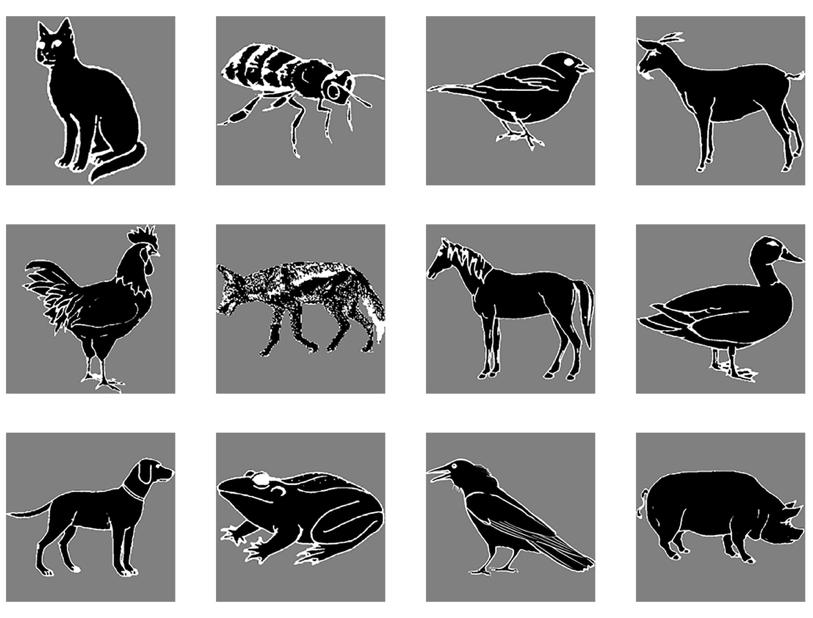
图1 实验1的动物图片材料
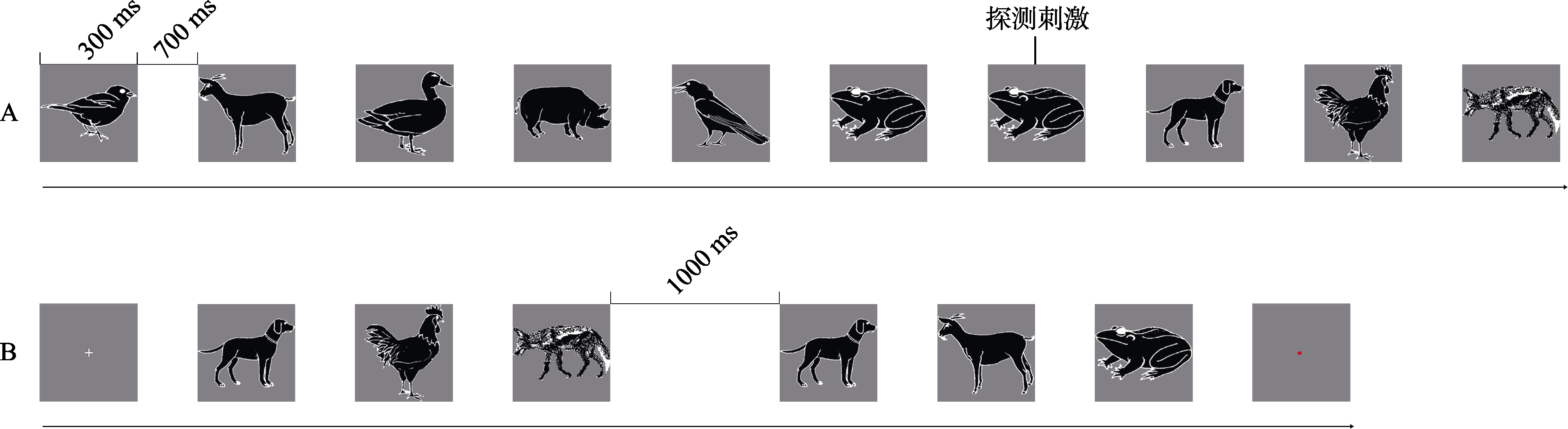
图2 实验1熟悉阶段(A)和测试阶段(B)的刺激示例
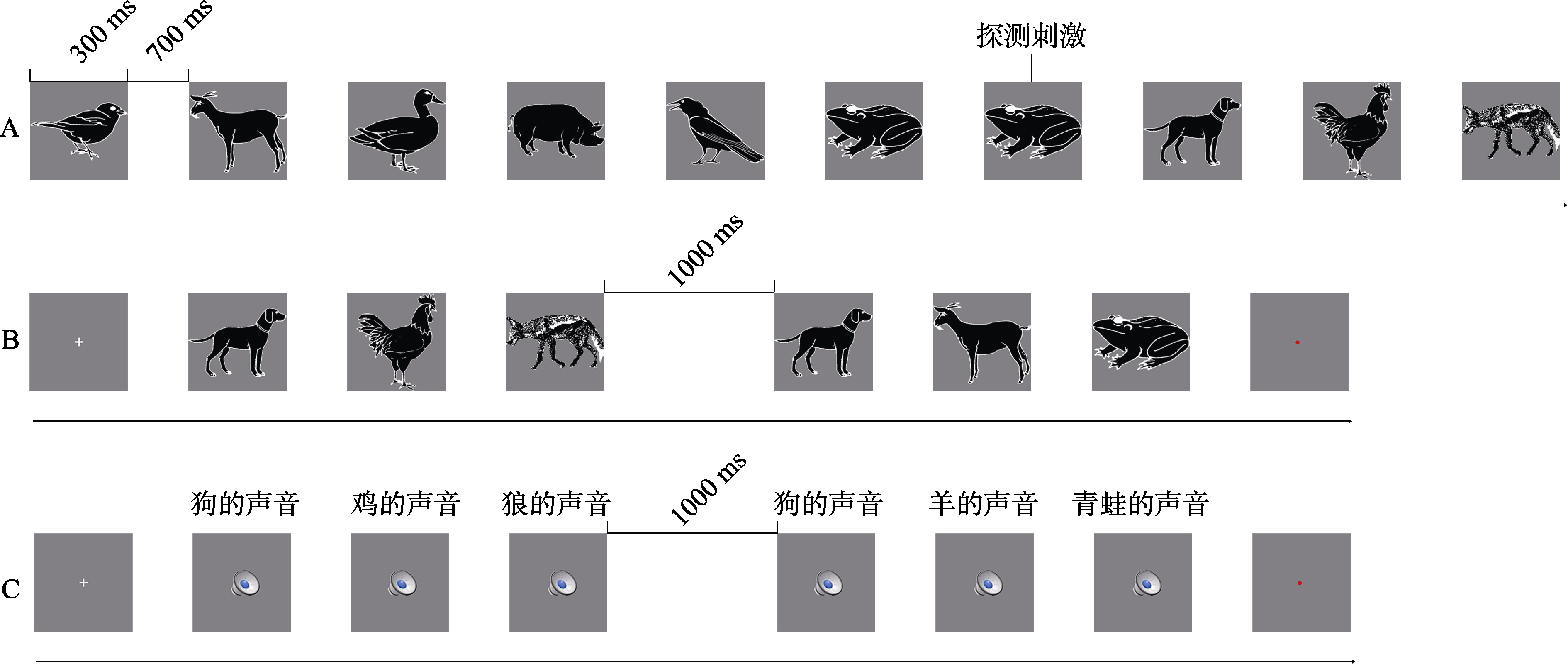
图3 实验2熟悉阶段(A)和测试阶段动物图片(B)与动物声音(C)测试的刺激示例
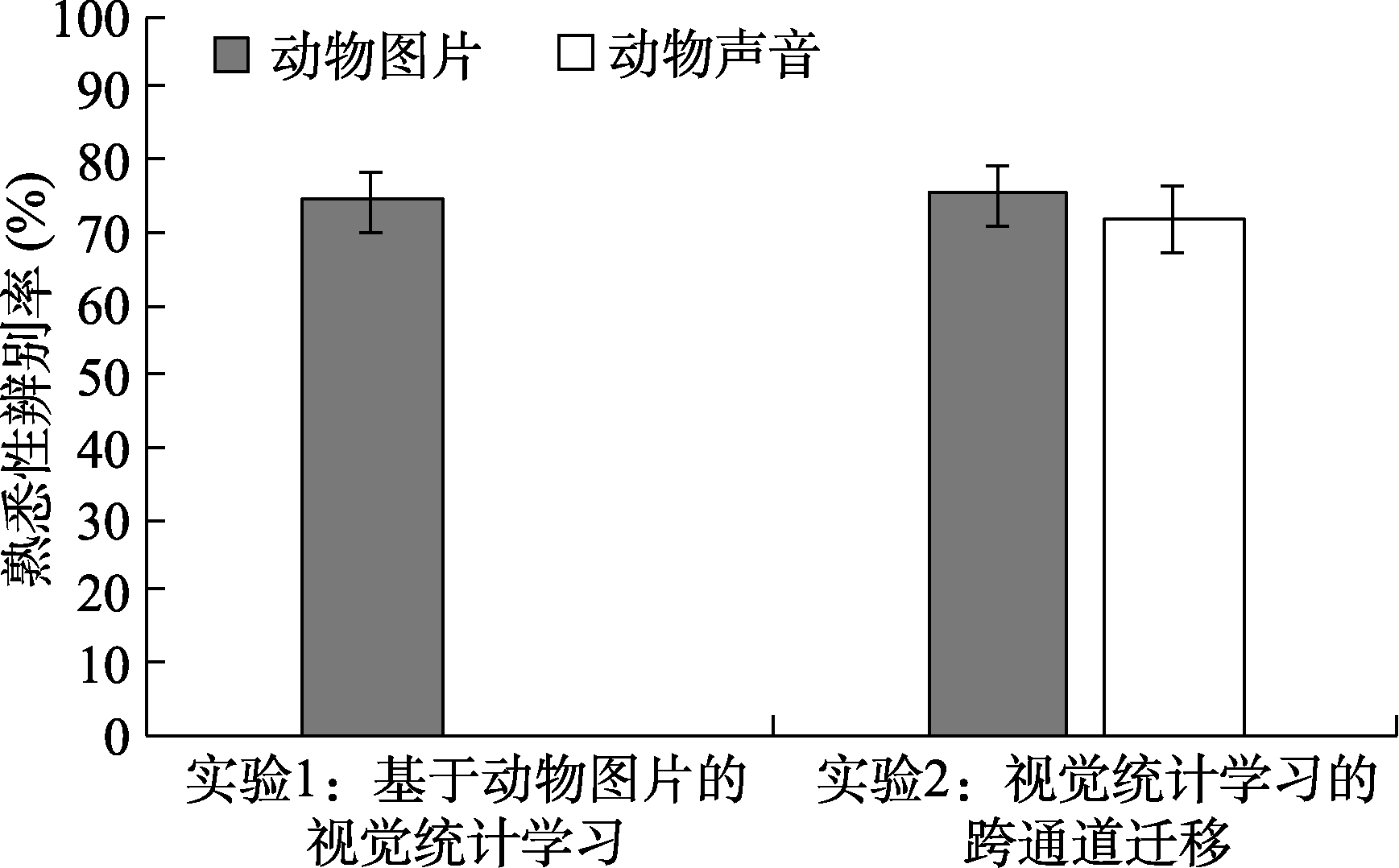
图4 实验1和实验2测试阶段三联体熟悉性判断情况(误差线:为标准误差值)
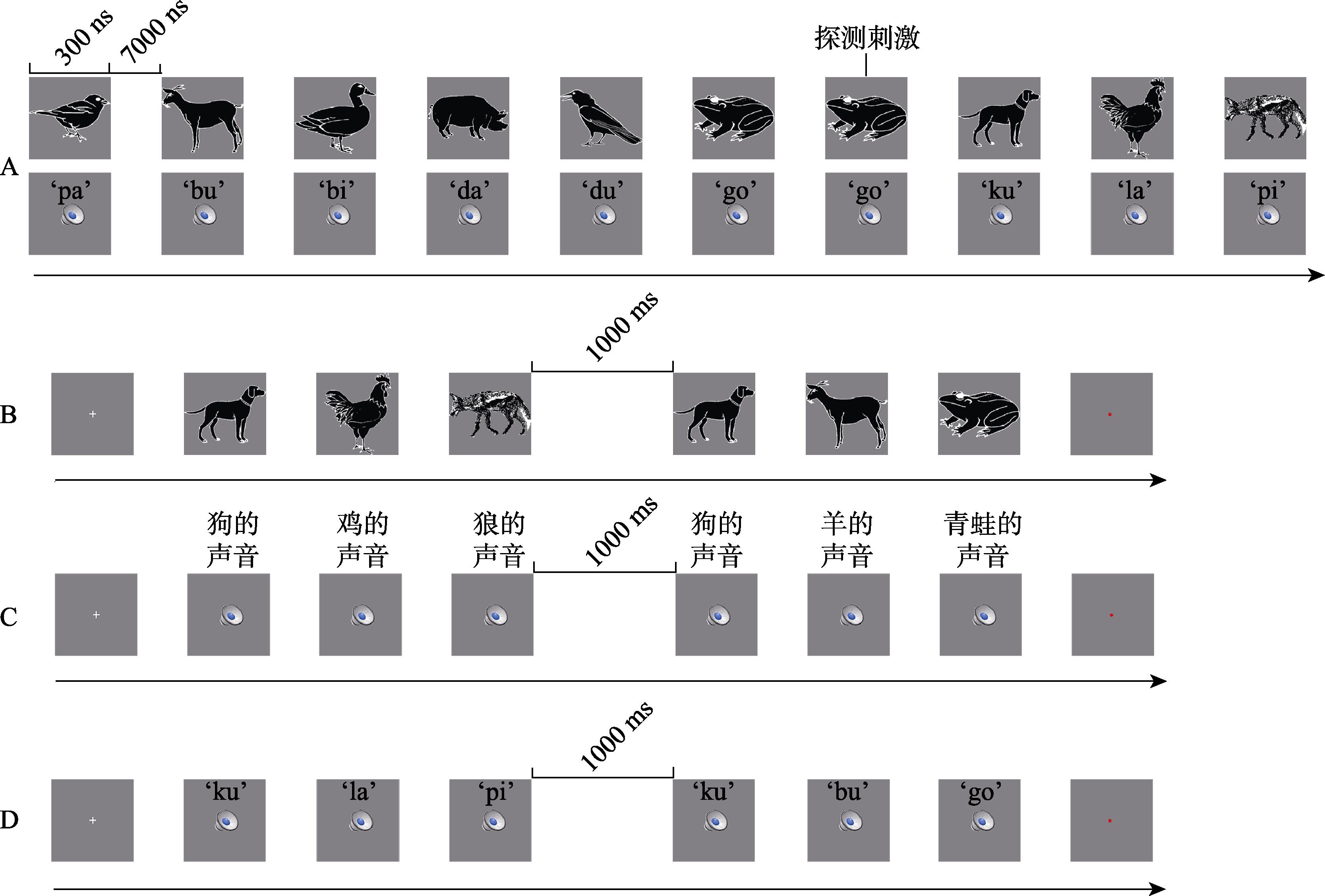
图5 实验3b熟悉阶段(A)和测试阶段动物图片(B)、动物声音(C)、无意义音节(D)测试的刺激示例
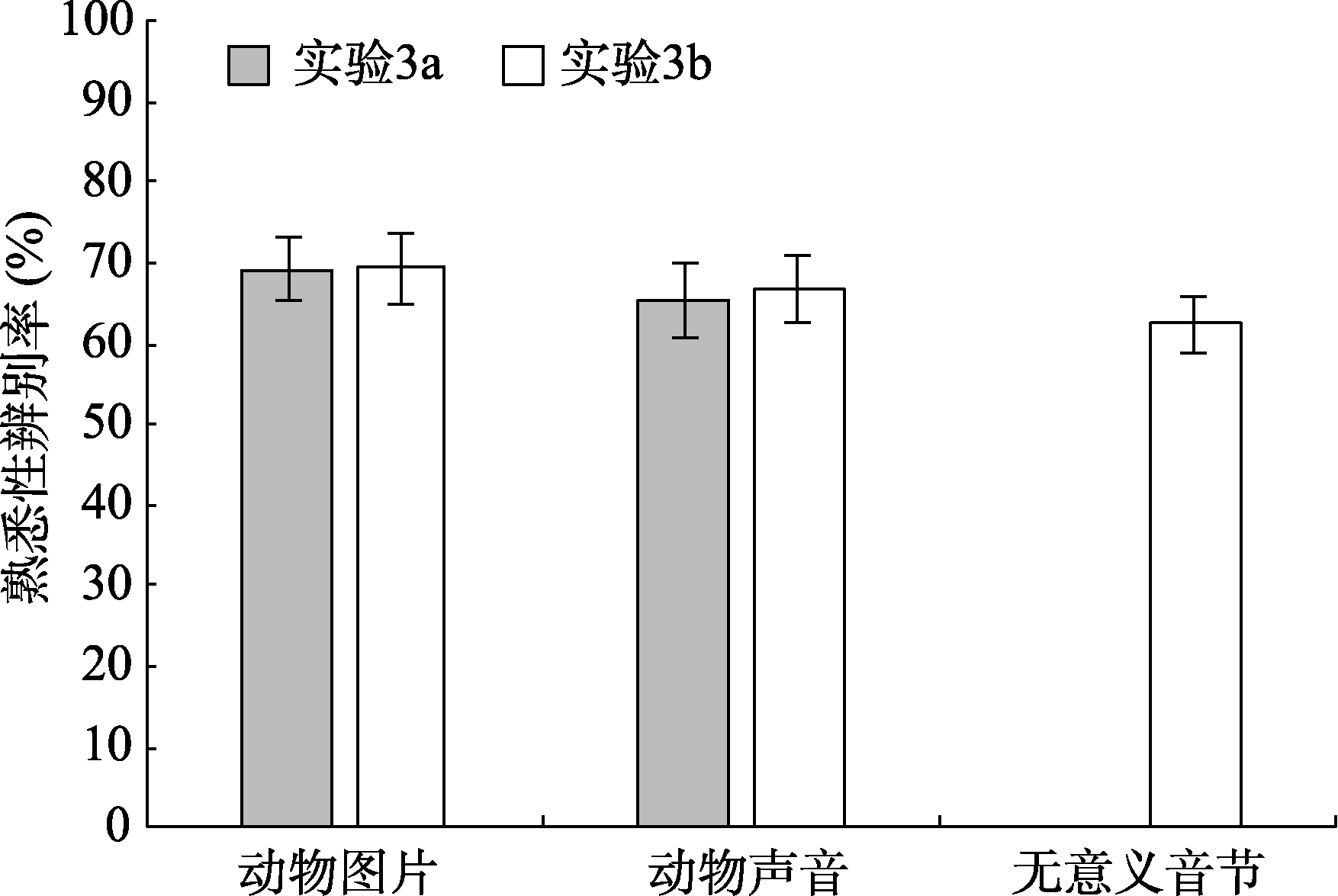
图6 实验3测试阶段三联体熟悉性判断情况(误差线:为标准误差值)

图7 实验4的无意义图形材料
| [1] |
Angelaki D. E., Gu Y., & DeAngelis G. C. (2009). Multisensory integration: Psychophysics, neurophysiology, and computation. Current Opinion in Neurobiology, 19(4), 452-458. https://doi.org/10.1016/j.conb.2009.06.008
doi: 10.1016/j.conb.2009.06.008 URL pmid: 19616425 |
| [2] |
Batterink L. J., Reber P. J., Neville H. J., & Paller K. A. (2015). Implicit and explicit contributions to statistical learning. Journal of Memory and Language, 83, 62-78. https://doi.org/10.1016/j.jml.2015.04.004
URL pmid: 26034344 |
| [3] |
Brady T. F., & Oliva A. (2008). Statistical learning using real-world scenes: Extracting categorical regularities without conscious intent. Psychological Science, 19(7), 678-685. https://doi.org/10.1111/j.1467-9280.2008.02142.x
doi: 10.1111/j.1467-9280.2008.02142.x URL pmid: 18727783 |
| [4] |
Casale M. B., Roeder J. L., & Ashby F. G. (2012). Analogical transfer in perceptual categorization. Memory & Cognition, 40(3), 434-449. https://doi.org/10.3758/s13421-011-0154-4
doi: 10.3758/s13421-011-0154-4 URL |
| [5] | Conway C. M., & Christiansen M. H. (2005). Modality- constrained statistical learning of tactile, visual, and auditory sequences. Journal of Experimental Psychology: Learning, Memory and Cognition, 31(1), 24-39. https://doi.org/10.1037/0278-7393.31.1.24 |
| [6] |
Conway C. M., & Christiansen M. H. (2006). Statistical learning within and between modalities: Pitting abstract against stimulus-specific representations. Psychological Science, 17(10), 905-912. https://doi.org/10.1111/j.1467-9280.2006.01801.x
URL pmid: 17100792 |
| [7] | Eberhardt S. P., Auer E. T., & Bernstein L. E. (2014). Multisensory training can promote or impede visual perceptual learning of speech stimuli: Visual-tactile vs. visual-auditory training. Frontiers in Human Neuroscience, 8, 829. https://doi.org/10.3389/fnhum.2014.00829 |
| [8] | Edmunds C. E. R., Inkster A. B., Jones P. M., Milton F., & Wills A. J. (2020). Absence of cross-modality analogical transfer in perceptual categorization. Open Journal of Experimental Psychology and Neuroscience, 1, 3-13. https://doi.org/10.46221/ojepn.2020.8639 |
| [9] |
Emberson L. L., & Rubinstein D. Y. (2016). Statistical learning is constrained to less abstract patterns in complex sensory input (but not the least). Cognition, 153, 63-78. https://doi.org/10.1016/j.cognition.2016.04.010
doi: 10.1016/j.cognition.2016.04.010 URL pmid: 27139779 |
| [10] |
Faul F., Erdfelder E., Lang A. G., & Buchner A. (2007). G*power 3: A flexible statistical power analysis program for the social, behavioral, and biomedical sciences. Behavior Research Methods, 39(2), 175-191. https://doi.org/10.3758/bf03193146
doi: 10.3758/bf03193146 URL pmid: 17695343 |
| [11] |
Fiser J., & Aslin R. N. (2001). Unsupervised statistical learning of higher-order spatial structures from visual scenes. Psychological Science, 12(6), 499-504. https://doi.org/10.1111/1467-9280.00392
URL pmid: 11760138 |
| [12] | Fiser J., & Aslin R. N. (2002). Statistical learning of higher- order temporal structure from visual shape sequences. Journal of Experimental Psychology: Learning, Memory, and Cognition, 28(3), 458-467. https://doi.org/10.1037//0278-7393.28.3.458 |
| [13] |
Fiser J., & Aslin R. N. (2005). Encoding multielement scenes: Statistical learning of visual feature hierarchies. Journal of Experimental Psychology: General, 134(4), 521-537. https://doi.org/10.1037/0096-3445.134.4.521
doi: 10.1037/0096-3445.134.4.521 URL |
| [14] |
Frost R., Armstrong B. C., Siegelman N., & Christiansen M. H. (2015). Domain generality versus modality specificity: The paradox of statistical learning. Trends in Cognitive Sciences, 19(3), 117-125. https://doi.org/10.1016/j.tics.2014.12.010
doi: 10.1016/j.tics.2014.12.010 URL pmid: 25631249 |
| [15] |
Han Y. C., & Reber P. J. (2022). Implicit sequence learning using auditory cues leads to modality-specific representations. Psychonomic Bulletin & Review, 29(2), 541-551. https:// doi.org/10.3758/s13423-021-02001-z
doi: 10.3758/s13423-021-02001-z URL |
| [16] |
Hocking J., Dzafic I., Kazovsky M., & Copland D. A. (2013). Nessti: Norms for environmental sound stimuli. PloS One, 8(9), e73382-e73382. https://doi.org/10.1371/journal.pone.0073382
doi: 10.1371/journal.pone.0073382 URL |
| [17] |
Jun J., & Chong S. C. (2018). Visual statistical learning at basic and subordinate category levels in real-world images. Attention Perception & Psychophysics, 80(8), 1946-1961. https://doi.org/10.3758/s13414-018-1566-z
doi: 10.3758/s13414-018-1566-z URL |
| [18] | Kirkham N. Z., Slemmer J. A., & Johnson S. P. (2002). Visual statistical learning in infancy: Evidence for a domain general learning mechanism. Cognition, 83(2), B35-B42. https://doi.org/10.1016/s0010-0277(02)00004-5 |
| [19] |
Kligler N., & Gabay Y. (2023). A cross-modal investigation of statistical learning in developmental dyslexia. Scientific Studies of Reading, 27(4), 334-354. https://doi.org/10.1080/10888438.2023.2166413
doi: 10.1080/10888438.2023.2166413 URL |
| [20] | Lengyel G., & Fiser J. (2019). The relationship between initial threshold, learning, and generalization in perceptual learning. Journal of Vision, 19(4), 28. https://doi.org/10.1167/19.4.28 |
| [21] |
Li X. J., Zhao X. D., Shi W. D., Lu Y., & Conway C. M. (2018). Lack of cross-modal effects in dual-modality implicit statistical learning. Frontiers in Psychology, 9, 146. https://doi.org/10.3389/fpsyg.2018.00146
doi: 10.3389/fpsyg.2018.00146 URL |
| [22] |
Liu Z. Y., Liao S. Y., & Seger C. A. (2023). Rule and exemplar-based transfer in category learning. Journal of Cognitive Neuroscience, 35(4), 628-644. https://doi.org/10.1162/jocn_a_01963
doi: 10.1162/jocn_a_01963 URL |
| [23] | Mitchel A. D., & Weiss D. J. (2011). Learning across senses: Cross-modal effects in multisensory statistical learning. Journal of Experimental Psychology: Learning, Memory, and Cognition, 37(5), 1081-1091. https://doi.org/10.1037/a0023700 |
| [24] |
Otsuka S., Nishiyama M., & Kawaguchi J. (2014). Constraint on the semantic flexibility in visual statistical learning. Visual Cognition, 22(7), 865-880. https://doi.org/10.1080/13506285.2014.923548
doi: 10.1080/13506285.2014.923548 URL |
| [25] | Otsuka S., Nishiyama M., Nakahara F., & Kawaguchi J. (2013). Visual statistical learning based on the perceptual and semantic information of objects. Journal of Experimental Psychology: Learning, Memory, and Cognition, 39(1), 196-207. https://doi.org/10.1037/a0028645 |
| [26] | Pascual-Leone A., & Hamilton R. (2001). Chapter 27 the metamodal organization of the brain. In Progress in brain research (Vol. 134, pp. 427-445). Elsevier. https://doi.org/10.1016/S0079-6123(01)34028-1 |
| [27] | Pavlovskaya M., & Hochstein S. (2011). Perceptual learning transfer between hemispheres and tasks for easy and hard feature search conditions. Journal of Vision, 11(1), 8. https://doi.org/10.1167/11.1.8 |
| [28] |
Ricciardi E., & Pietrini P. (2011). New light from the dark: What blindness can teach us about brain function. Current Opinion in Neurology, 24(4), 357-363. https://doi.org/10.1097/WCO.0b013e328348bdbf
doi: 10.1097/WCO.0b013e328348bdbf URL pmid: 21677583 |
| [29] |
Saffran J. R., Aslin R. N., & Newport E. L. (1996). Statistical learning by 8-month-old infants. Science, 274(5294), 1926-1928. https://doi.org/10.1126/science.274.5294.1926
doi: 10.1126/science.274.5294.1926 URL pmid: 8943209 |
| [30] |
Saffran J. R., Newport E. L., Aslin R. N., Tunick R. A., & Barrueco S. (1997). Incidental language learning: Listening (and learning) out of the corner of your ear. Psychological Science, 8(2), 101-105. https://doi.org/10.1111/j.1467-9280.1997.tb00690.x
doi: 10.1111/j.1467-9280.1997.tb00690.x URL |
| [31] |
Seitz A. R., Kim R., van Wassenhove V., & Shams L. (2007). Simultaneous and independent acquisition of multisensory and unisensory associations. Perception, 36(10), 1445-1453. https://doi.org/10.1068/p5843
URL pmid: 18265827 |
| [32] |
Shanks D. R., Johnstone T., & Staggs L. (1997). Abstraction processes in artificial grammar learning. Quarterly Journal of Experimental Psychology Section A, 50(1), 216-252. https://doi.org/10.1080/713755680
doi: 10.1080/713755680 URL |
| [33] |
Shi W. D., Li X. J., Wang W., & Yan W. H. (2013). Comparison of implicit learning effect between multisensory and unisensory. Acta Psychologica Sinica, 45(12), 1313-1323. https://doi.org/10.3724/SP.J.1041.2013.01313
doi: 10.3724/SP.J.1041.2013.01313 URL |
| [石文典, 李秀君, 王维, 严文华. (2013). 多通道与单通道的内隐学习效应比较. 心理学报, 45(12), 1313-1323.] | |
| [34] |
Siegelman N., & Frost R. (2015). Statistical learning as an individual ability: Theoretical perspectives and empirical evidence. Journal of Memory and Language, 81, 105-120. https://doi.org/10.1016/j.jml.2015.02.001
URL pmid: 25821343 |
| [35] |
Sun X. W., Yao L. S., Fu Q. F., & Fu X. L. (2023). Multisensory transfer effects in implicit and explicit category learning. Psychological Research-Psychologische Forschung, 87(5), 1353-1369. https://doi.org/10.1007/s00426-022-01754-z
doi: 10.1007/s00426-022-01754-z URL |
| [36] |
Tang Y., Zhang Z. J., Zeng M. M., Huang K., Liu W., & Zhao Y. J. (2015). Visual statistical learning based on the visual feature and semantic information of famous faces. Acta Psychologica Sinica, 47(7), 837-850. https://doi.org/10.3724/SP.J.1041.2015.00837
doi: 10.3724/SP.J.1041.2015.00837 URL |
| [唐溢, 张智君, 曾玫媚, 黄可, 刘炜, 赵亚军. (2015). 基于名人面孔视觉特征和语义信息的视觉统计学习. 心理学报, 47(7), 837-850.] | |
| [37] |
Thiessen E. D. (2010). Effects of visual information on adults' and infants' auditory statistical learning. Cognitive Science, 34(6), 1093-1106. https://doi.org/10.1111/j.1551-6709.2010.01118.x
doi: 10.1111/j.1551-6709.2010.01118.x URL pmid: 21564244 |
| [38] |
Tunney R. J., & Altmann G. T. M. (2001). Two modes of transfer in artificial grammar learning. Journal of Experimental Psychology: Learning Memory and Cognition, 27(3), 614-639. https://doi.org/10.1037//0278-7393.27.3.614
doi: 10.1037/0278-7393.27.3.614 URL |
| [39] | Turk-Browne N. B., Isola P. J., Scholl B. J., & Treat T. A. (2008). Multidimensional visual statistical learning. Journal of Experimental Psychology: Learning, Memory, and Cognition, 34(2), 399-407. https://doi.org/10.1037/0278-7393.34.2.399 |
| [40] |
Turk-Browne N. B., Junge J. A., & Scholl B. J. (2005). The automaticity of visual statistical learning. Journal of Experimental Psychology: General, 134(4), 552-564. https://doi.org/10.1037/0096-3445.134.4.552
doi: 10.1037/0096-3445.134.4.552 URL |
| [41] |
Turk-Browne N. B., & Scholl B. J. (2009). Flexible visual statistical learning: transfer across space and time. Journal of Experimental Psychology: Human Perception and Performance, 35(1), 195-202. https://doi.org/10.1037/0096-1523.35.1.195
doi: 10.1037/0096-1523.35.1.195 URL |
| [42] |
Uno K., Asano M., Kadowaki H., & Yokosawa K. (2020). Grapheme-color associations can transfer to novel graphemes when synesthetic colors function as grapheme "discriminating markers". Psychonomic Bulletin & Review, 27(4), 700-706. https://doi.org/10.3758/s13423-020-01732-9
doi: 10.3758/s13423-020-01732-9 URL |
| [43] |
von der Emde, G., & de Perera, T. B. 2020). Cross-modal sensory transfer: Bumble bees do it Stored sensory input permits two sensory channels to exchange and compare information. Science, 367(6480), 850-851. https://doi.org/10.1126/science.aba8519
doi: 10.1126/science.aba8519 URL pmid: 32079758 |
| [44] |
Xiong Y. Z., Guan S. C., & Yu C. (2022). A supramodal and conceptual representation of subsecond time revealed with perceptual learning of temporal interval discrimination. Scientific Reports, 12(1), 10668. https://doi.org/10.1038/s41598-022-14698-6
doi: 10.1038/s41598-022-14698-6 URL |
| [45] |
Xu G. P., Fan R. L., & Jin H. (2020). The cognitive and neural mechanisms of statistical learning and its relationship with language. Advances in Psychological Science, 28(9), 1525-1538. https://doi.org/10.3724/SP.J.1042.2020.01525
doi: 10.3724/SP.J.1042.2020.01525 URL |
|
[徐贵平, 范若琳, 金花. (2020). 统计学习的认知神经机制及其与语言的关系. 心理科学进展, 28(9), 1525-1538.]
doi: 10.3724/SP.J.1042.2020.01525 |
|
| [46] | Zaltz Y., Kishon-Rabin L., Karni A., & Ari-Even Roth D. (2020). Practice makes transfer imperfect: Evidence from auditory learning. Ear and Hearing, 41(6), 1470-1482. https://doi.org/10.1097/aud.0000000000000860 |
| [47] | Zhang Q. F., & Yang Y. F. (2003). The determiners of picture- naming latency. Acta Psychologica Sinica, 35(4), 447-454. https://journal.psych.ac.cn/xlxb/CN/ |
| [张清芳, 杨玉芳. (2003). 影响图画命名时间的因素. 心理学报, 35(4), 447-454.] | |
| [48] |
Zhao J., Al-Aidroos N., & Turk-Browne N. B. (2013). Attention is spontaneously biased toward regularities. Psychological Science, 24(5), 667-677. https://doi.org/10.1177/0956797612460407
doi: 10.1177/0956797612460407 URL pmid: 23558552 |
| [1] | 于文勃, 王璐, 瞿邢芳, 王天琳, 张晶晶, 梁丹丹. 转换概率和词长期待对语音统计学习的影响[J]. 心理学报, 2021, 53(6): 565-574. |
| [2] | 唐溢;张智君;曾玫媚;黄可;刘炜;赵亚军. 基于名人面孔视觉特征和语义信息的视觉统计学习[J]. 心理学报, 2015, 47(7): 837-850. |
| [3] | 于萍,袁水霞,李霞,于平,徐晖,尹文娟,顾凯,左洋凡,卢钦钦,代淑芬,郭春彦 . 记忆过程中海马CA1区神经元的集群放电特征[J]. 心理学报, 2011, 43(08): 917-928. |
| [4] | 梁立,王重鸣,白延强,马国庆. 多任务信息加工中的多道分时机制[J]. 心理学报, 1997, 29(4): 370-376. |
| 阅读次数 | ||||||
|
全文 |
|
|||||
|
摘要 |
|
|||||
