

ISSN 0439-755X
CN 11-1911/B
主办:中国心理学会
中国科学院心理研究所
出版:科学出版社
CN 11-1911/B
主办:中国心理学会
中国科学院心理研究所
出版:科学出版社
心理学报 ›› 2025, Vol. 57 ›› Issue (8): 1437-1451.doi: 10.3724/SP.J.1041.2025.1437 cstr: 32110.14.2025.1437
陈宇琦, 陆静怡( )
)
收稿日期:2024-04-07
发布日期:2025-05-22
出版日期:2025-08-25
通讯作者:
陆静怡, E-mail: jylu@psy.ecnu.edu.cn基金资助:
CHEN Yuqi, LU Jingyi()
Received:2024-04-07
Online:2025-05-22
Published:2025-08-25
摘要: 多样化观点有助于提高决策质量。然而, 当与他人意见相左时, 人常避免表达自己的观点。本研究(N = 2, 094)揭示一种全新的预测偏差: 提异议者高估异议接收者的消极反应。研究将被试随机分为提异议者和异议接收者, 提异议者预测自己提异议后接收者的反应, 接收者报告自己的实际反应。结果表明, 提异议者高估接收者的负性情绪、对提异议者的负性评价以及与提异议者的负性关系。研究通过测量被试的关注点揭示导致此错误预测的原因: 提异议者比接收者更多关注提异议伤害接收者自尊, 而非给接收者提供信息价值。提示提异议者更充分地考虑信息价值可以减轻这种错误预测。本研究拓展了人际交流中的预测偏差研究; 为鼓励谈话双方表达不同意见提供可行方法, 使人从多样化观点中获益。
中图分类号:
陈宇琦, 陆静怡. (2025). 提异议者高估异议接收者的消极反应. 心理学报, 57(8), 1437-1451.
CHEN Yuqi, LU Jingyi. (2025). Misunderstanding interpersonal costs from expressing opposing views. Acta Psychologica Sinica, 57(8), 1437-1451.
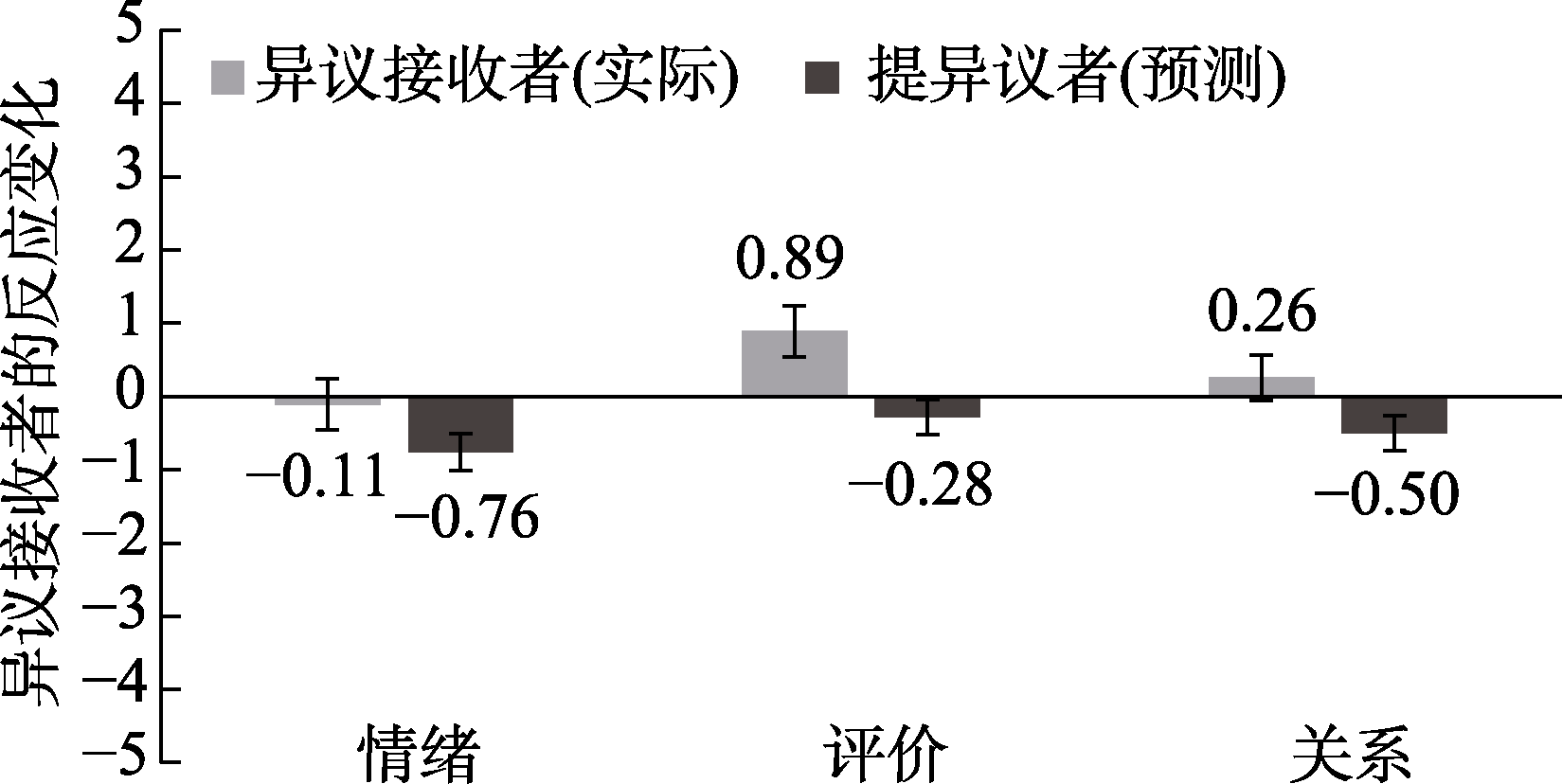
图1 角色对异议接收者反应变化的影响(研究1)
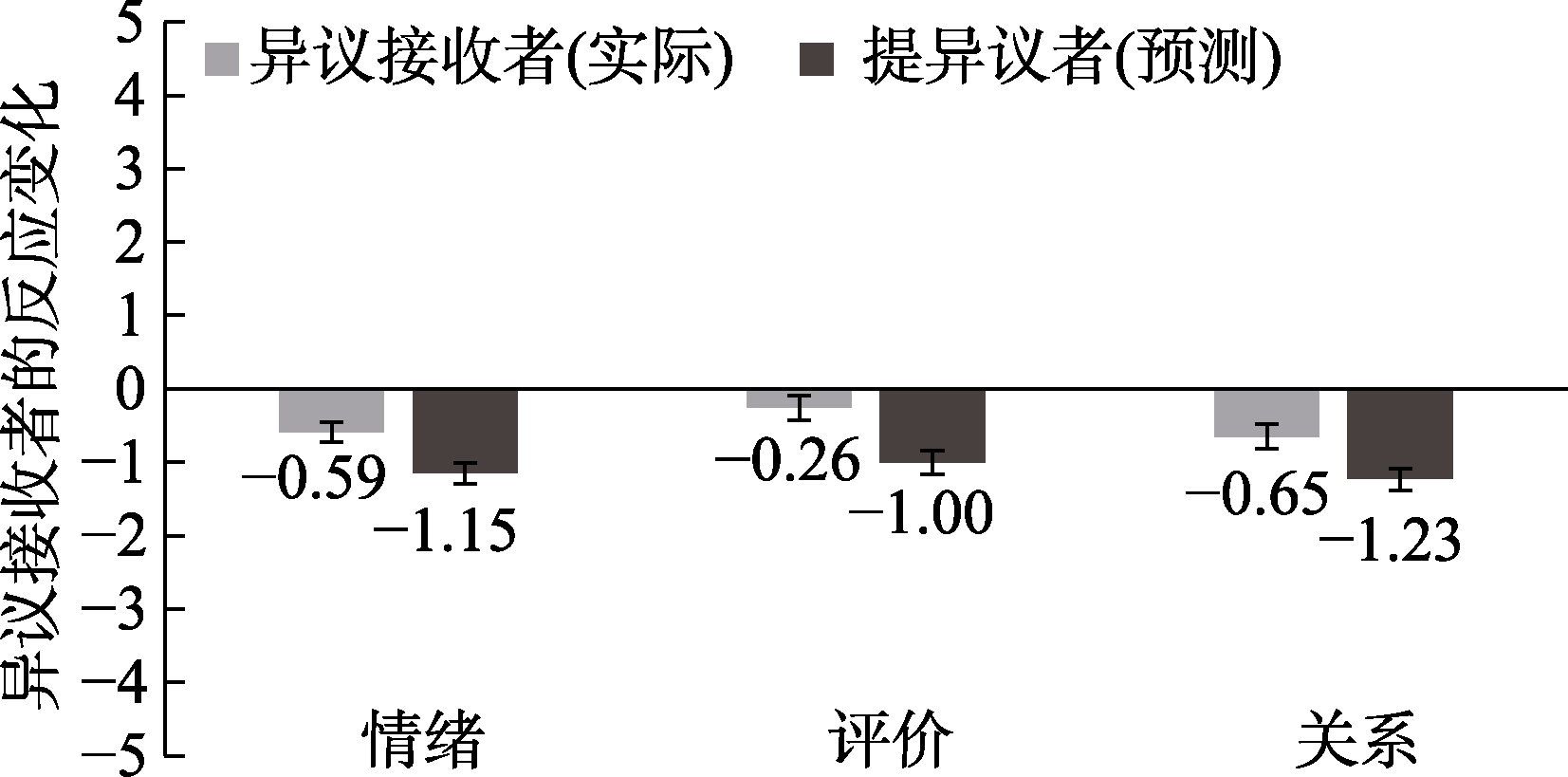
图2 不同角色报告的异议接收者的反应变化(研究2)
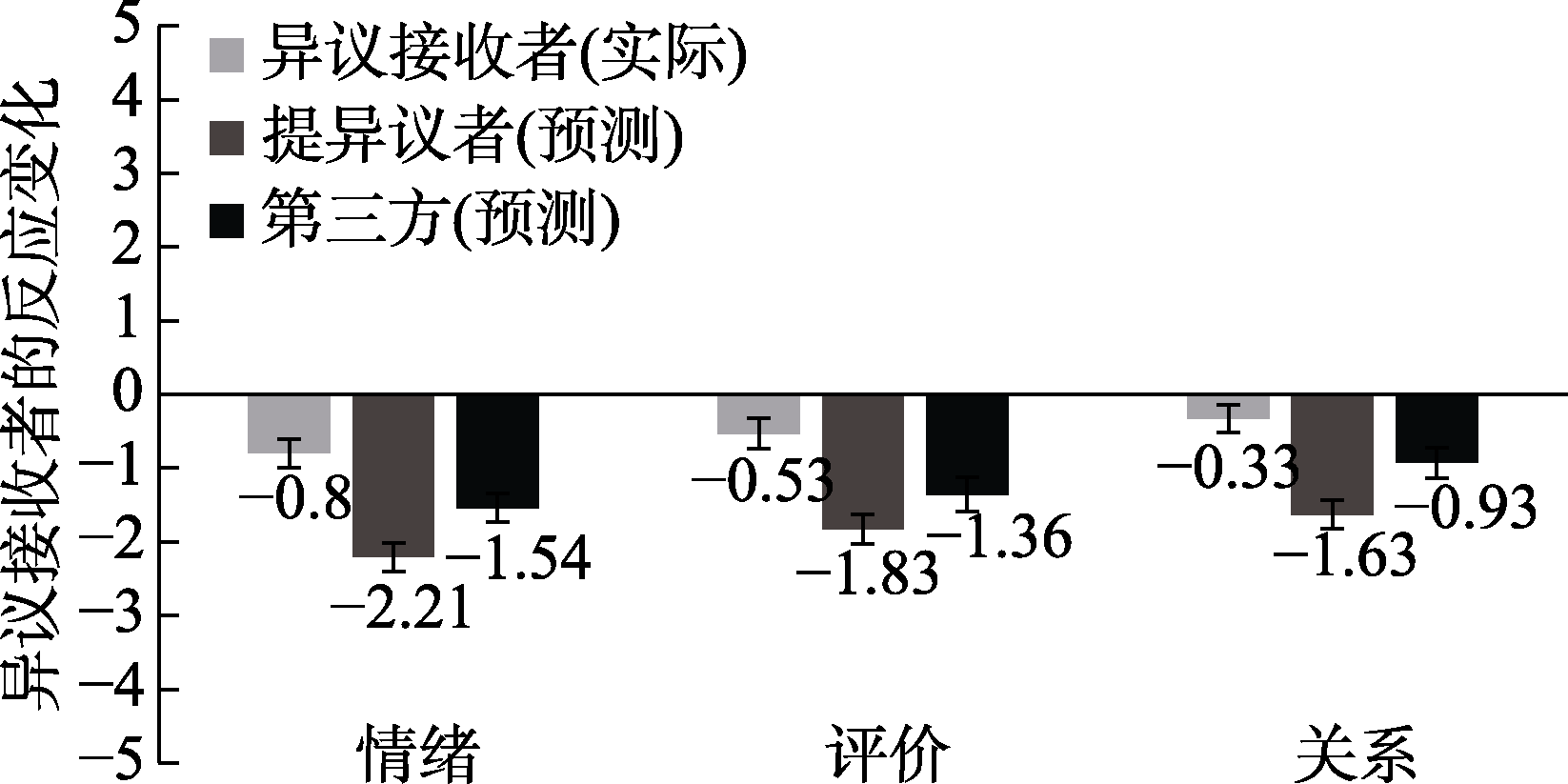
图3 不同角色报告的异议接收者的反应变化(研究3)
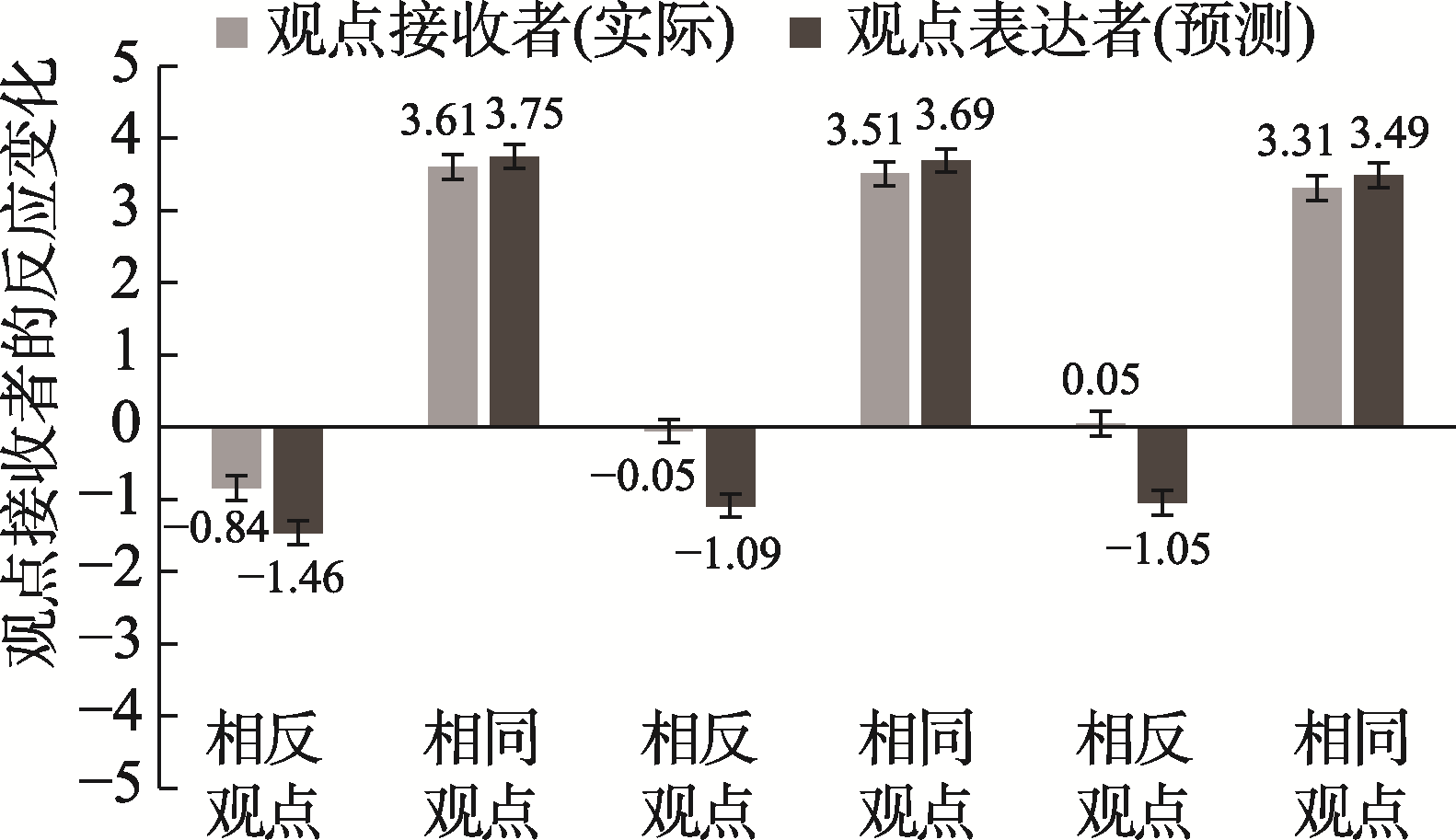
图4 角色和观点对观点接收者反应变化的影响(研究4a)
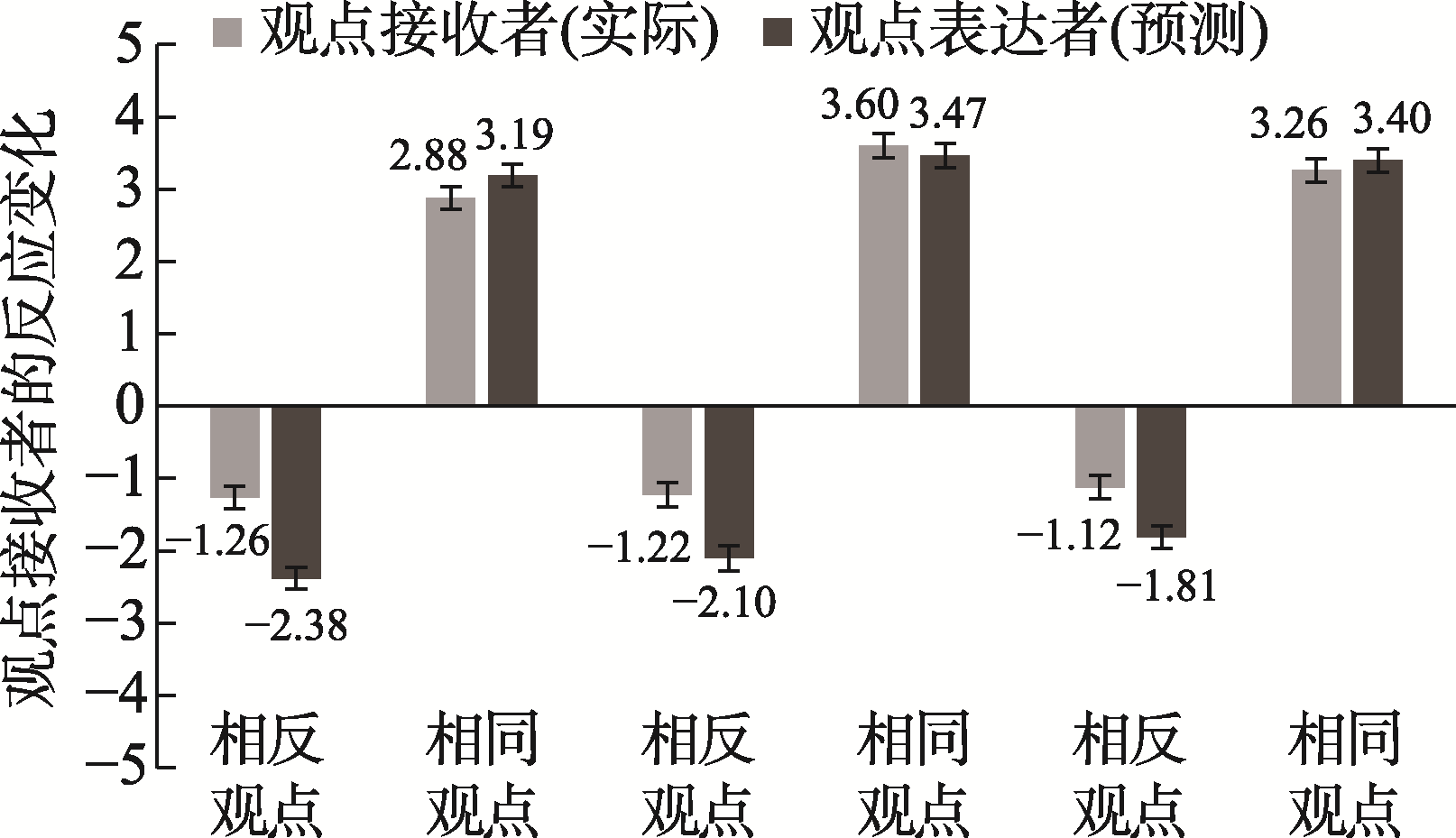
图5 角色和观点对观点接收者反应变化的影响(研究4b)
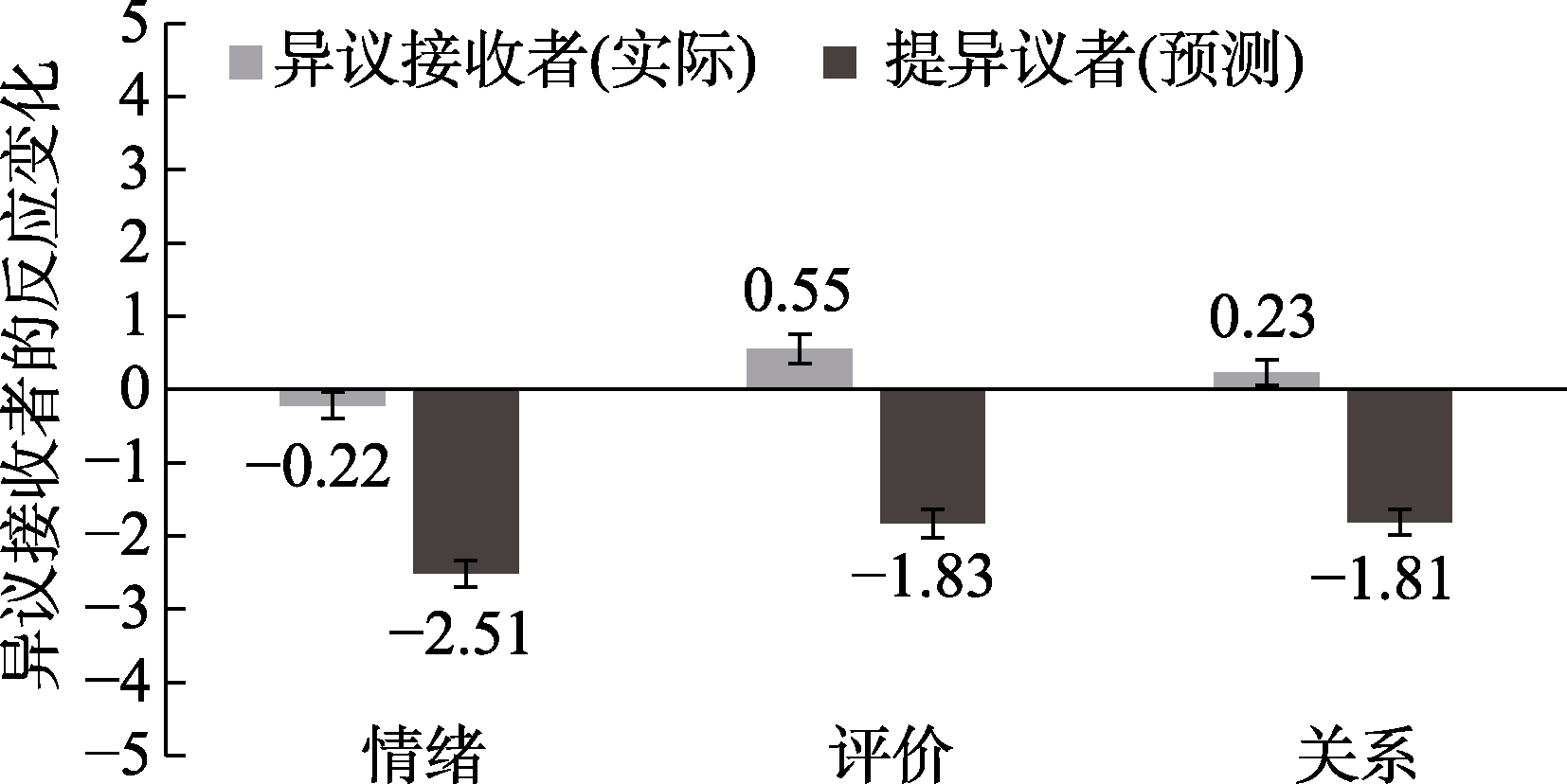
图6 不同角色报告的异议接收者的反应变化(研究5)
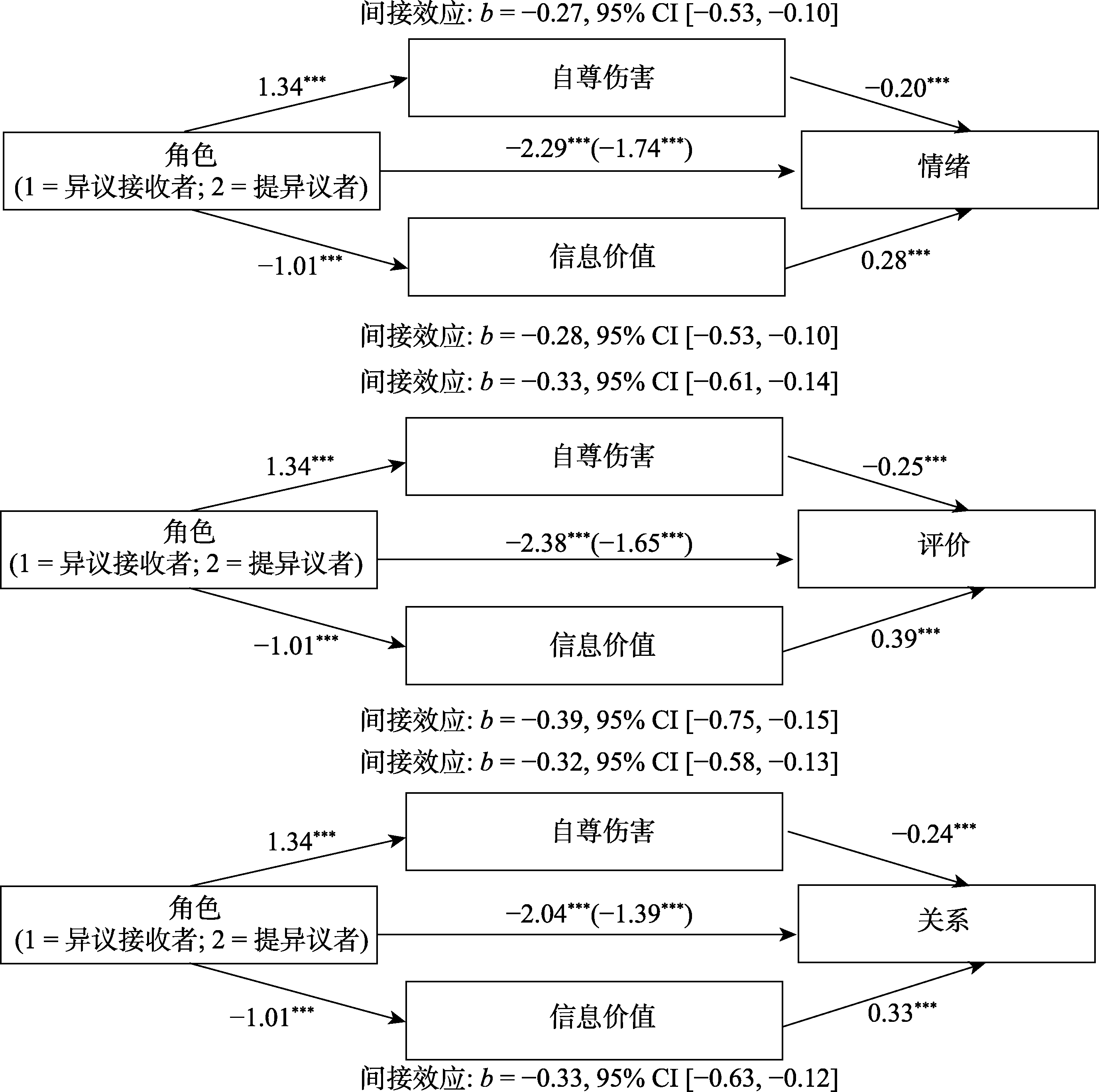
图7 自尊伤害和信息价值关注点的中介效应(研究5) 注: 图中系数为未标准化回归系数, ***表示p <.001
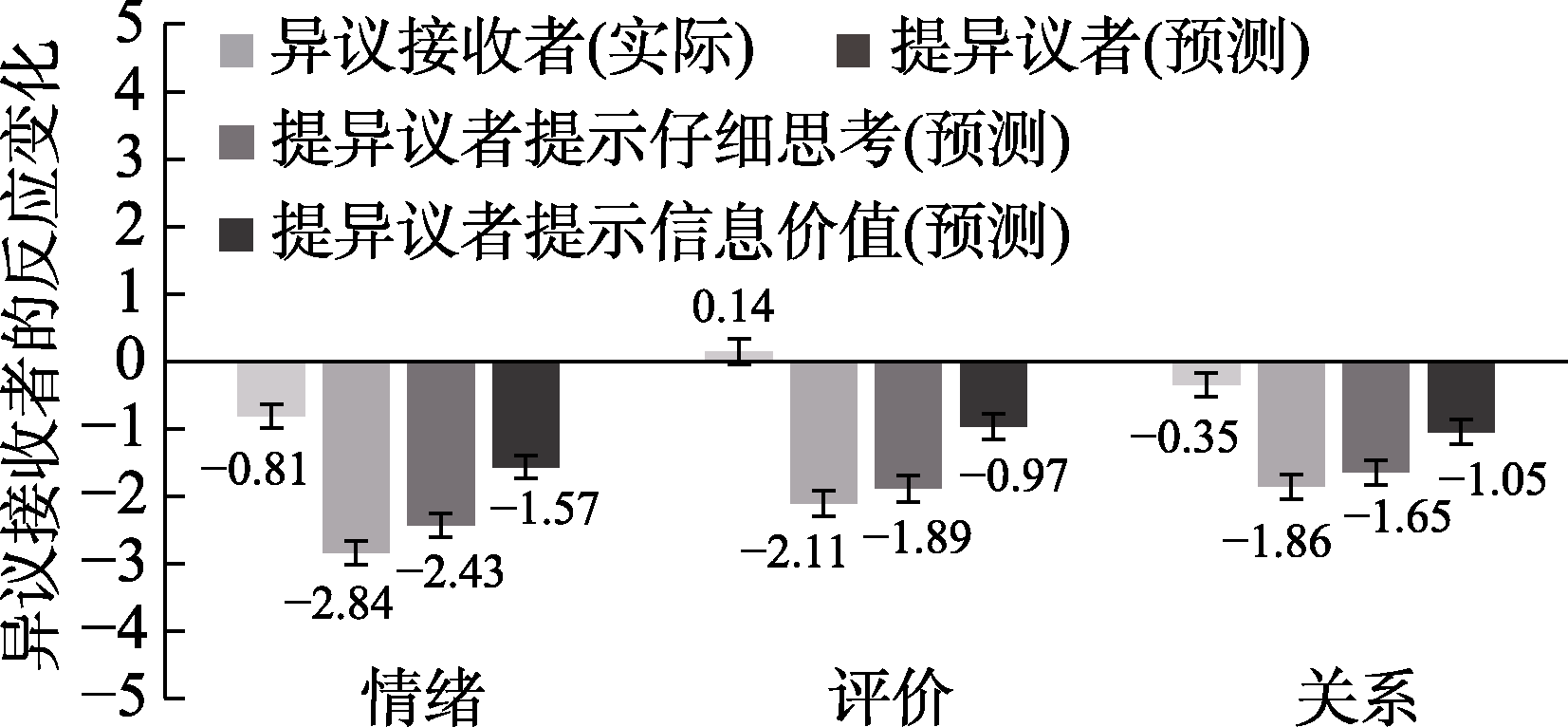
图8 组别对异议接收者反应变化的影响(研究6)
| [1] |
Afifi W. A., & Afifi T. D. (2020). The relative impacts of disclosure and secrecy: The role of (perceived) target response. Current Opinion in Psychology, 31, 94-98. https://doi.org/10.1016/j.copsyc.2019.08.015
doi: S2352-250X(19)30138-1 URL pmid: 31550636 |
| [2] | Alicke, M. D., & Govorun O. (2005). The better-than-average effect. In M. D.Alicke, D. A.Dunning & J. I.Krueger (Eds.), The self in social judgment (pp. 85-106). Psychology Press. https://doi.org/10.4324/9780203943250-8 |
| [3] | Baumeister R. F., Bratslavsky E., Finkenauer C., & Vohs K. D. (2001). Bad is stronger than good. Review of General Psychology, 5, 323-370. http://doi.org/10.1037/1089-2680.5.4.323 |
| [4] |
Birditt K. S., Fingerman K. L., & Almeida D. M. (2005). Age differences in exposure and reactions to interpersonal tensions: A daily diary study. Psychology and Aging, 20, 330-340. https://doi.org/10.1037/0882-7974.20.2.330
URL pmid: 16029096 |
| [5] | Blanton H., Köblitz A., & McCaul K. D. (2008). Misperceptions about norm misperceptions: Descriptive, injunctive, and affective 'social norming' efforts to change health behaviors. Social and Personality Psychology Compass, 2, 1379-1399. https://doi.org/10.1111/j.1751-9004.2008.00107.x |
| [6] | Bohns V. K. (2016). (Mis)understanding our influence over others: A review of the underestimation-of-compliance effect. Current Directions in Psychological Science, 25, 119-123. https://doi.org/10.1177/0963721415628011 |
| [7] | Bohns V. K., & Flynn F. J. (2010). “Why didn’t you just ask?” Underestimating the discomfort of help-seeking. Journal of Experimental Social Psychology, 46, 402-409. https://doi.org/10.1016/j.jesp.2009.12.015 |
| [8] | Boothby E. J., & Bohns V. K. (2021). Why a simple act of kindness is not as simple as it seems: Underestimating the positive impact of our compliments on others. Personality and Social Psychology Bulletin, 47, 826-840. https://doi.org/10.1177/0146167220949003 |
| [9] |
Boothby E. J., Cooney G., Sandstrom G. M., & Clark M. S. (2018). The liking gap in conversations: Do people like us more than we think? Psychological Science, 29, 1742-1756. https://doi.org/10.1177/0956797618783714
doi: 10.1177/0956797618783714 URL pmid: 30183512 |
| [10] | Bruce M. J., Chang A., Evans L., Streb M., Dehon J., & Handal P. J. (2024). Relationship of conflict, conflict avoidance, and conflict resolution to psychological adjustment. Psychological Reports, 127, 2324-2333. https://doi.org/10.1177/00332941221146708 |
| [11] |
Bruk A., Scholl S. G., & Bless H. (2018). Beautiful mess effect: Self-other differences in evaluation of showing vulnerability. Journal of Personality and Social Psychology, 115, 192-205. https://doi.org/10.1037/pspa0000120
doi: 10.1037/pspa0000120 URL pmid: 30024240 |
| [12] | Burris E. R. (2012). The risks and rewards of speaking up: Managerial responses to employee voice. Academy of Management Journal, 55, 851-875. http://doi.org/10.5465/amj.2010.0562 |
| [13] | Buysse A., De Clercq A., Verhofstadt L., Heene E., Roeyers H., & Van Oost P. (2000). Dealing with relational conflict: A picture in milliseconds. Journal of Social and Personal Relationships, 17, 574-597. https://doi.org/10.1177/0265407500174006 |
| [14] | Chen Y., Fu R., & Lu J. (2024). People overestimate how much gossiping encourages listeners’ self-disclosure. Personality and Social Psychology Bulletin. https://doi.org/10.1177/01461672241293832 |
| [15] |
Cortina L. M., & Magley V. J. (2009). Patterns and profiles of response to incivility in the workplace. Journal of Occupational Health Psychology, 14, 272-288.https://doi.org/10.1037/a0014934
doi: 10.1037/a0014934 URL pmid: 19586222 |
| [16] | Crant J. M., Kim T.-Y, & Wang J. (2010). Dispositional antecedents of demonstration and usefulness of voice behavior. Journal of Business and Psychology, 26, 285-97. https://doi.org/10.1007/s10869-010-9197-y |
| [17] | Crockett M. J., Kurth-Nelson Z., Siegel J. Z., Dayan P., & Dolan R. J. (2014). Harm to others outweighs harm to self in moral decision making. The Proceedings of the National Academy of Sciences, 111, 17320-17325.https://dx.doi.org/10.1073/pnas.1408988111 |
| [18] |
De Dreu, Carsten K. W., & West M. A. (2001). Minority dissent and team innovation: The importance of participation in decision making. Journal of Applied Psychology, 86, 1191-1201. https://doi.org/10.1037/0021-9010.86.6.1191
URL pmid: 11768061 |
| [19] | Detert J. R., & Trevino L. K. (2010). Speaking up to higher ups: How supervisors and skip-level leaders influence employee voice. Organization Science, 21, 249-270. http://doi.org/10.1287/orsc.1080.0405 |
| [20] | Dungan J. A., & Epley N. (2024). Surprisingly good talk: Misunderstanding others creates a barrier to constructive confrontation. Journal of Experimental Psychology: General, 153, 779-797. https://doi.org/10.1037/xge0001528 |
| [21] |
Dungan J. A., Munguia Gomez D. M., & Epley N. (2022). Too reluctant to reach out: Receiving social support is more positive than expressers expect. Psychological Science, 33, 1300-1312. https://doi.org/10.1177/09567976221082942
doi: 10.1177/09567976221082942 URL pmid: 35802611 |
| [22] |
Epley N., Keysar B., Van Boven L., & Gilovich T. (2004). Perspective taking as egocentric anchoring and adjustment. Journal of Personality and Social Psychology, 87, 327-339. http://doi.org/10.1037/0022-3514.87.3.327
URL pmid: 15382983 |
| [23] |
Flynn F. J., & Lake V. K. B. (2008). If you need help, just ask: Underestimating compliance with direct requests for help. Journal of Personality and Social Psychology, 95, 128-143. https://doi.org/10.1037/0022-3514.95.1.128
doi: 10.1037/0022-3514.95.1.128 URL pmid: 18605856 |
| [24] |
Fu R., Lin X., & Lu J. (2025). Do others value objective or subjective attributes more? Misprediction about others’ experiences. Acta Psychologica Sinica, 57(7), 1248-1261.
doi: 10.3724/SP.J.1041.2025.1248 |
|
[付若冰, 林心苗, 陆静怡. (2025). 他人更看重客观还是主观属性? 对他人体验的错误预测. 心理学报, 57(7), 1248-1261.]
doi: 10.3724/SP.J.1041.2025.1248 |
|
| [25] |
Gilovich T., Medvec V. H., & Savitsky K. (2000). The spotlight effect in social judgment: An egocentric bias in estimates of the salience of one’s own action and appearance. Journal of Personality and Social Psychology, 78, 211-222. http://doi.org/10.1037/0022-3514.78.2.211
URL pmid: 10707330 |
| [26] | Givi J., & Kirk C. P. (2024). Saying no: The negative ramifications from invitation declines are less severe than we think. Journal of Personality and Social Psychology, 126, 1103-1115. https://doi.org/10.1037/pspi0000443 |
| [27] | Golman R., Hagmann D., & Loewenstein G. (2017). Information avoidance. Journal of Economic Literature, 55, 96-135. https://doi.org/10.1257/jel.20151245 |
| [28] |
Gray K., Young L., & Waytz A. (2012). Mind perception is the essence of morality. Psychological Inquiry, 23, 101-124. http://doi.org/10.1080/1047840x.2012.651387
doi: 10.1080/1047840X.2012.651387 URL pmid: 22754268 |
| [29] | Greitemeyer T., Schulz-Hardt S., & Frey D. (2009). The effects of authentic and contrived dissent on escalation of commitment in group decision making. European Journal of Social Psychology, 39, 639-647. https://doi.org/10.1002/ejsp.578 |
| [30] | Hart E., VanEpps E. M., & Schweitzer M. E. (2021). The (better than expected) consequences of asking sensitive questions. Organizational Behavior and Human Decision Processes, 162, 136-154. https://doi.org/10.1016/j.obhdp.2020.10.014 |
| [31] |
Hart W., Albarracín D., Eagly A. H., Brechan I., Lindberg M. J., & Merrill L. (2009). Feeling validated versus being correct: A meta-analysis of selective exposure to information. Psychological Bulletin, 135, 555-588. https://doi.org/10.1037/a0015701
doi: 10.1037/a0015701 URL pmid: 19586162 |
| [32] | Higgins E. T. (1998). Promotion and prevention: Regulatory focus as a motivational principle. Advances in Experimental Social Psychology, 30, 1-46. https://doi.org/10.1016/S0065-2601(08)60381-0 |
| [33] | Iyengar S., & Westwood S. J. (2015). Fear and loathing across party lines: New evidence on group polarization. American Journal of Political Science, 59, 690-707. https://doi.org/10.1111/ajps.12152 |
| [34] |
Joel S., Teper R., & MacDonald G. (2014). People overestimate their willingness to reject potential romantic partners by overlooking their concern for other people. Psychological Science, 25, 2233-2240. https://doi.org/10.1177/0956797614552828
doi: 10.1177/0956797614552828 URL pmid: 25344347 |
| [35] | Kardas M., Kumar A., & Epley N. (2022). Overly shallow?: Miscalibrated expectations create a barrier to deeper conversation. Journal of Personality and Social Psychology, 122, 367-398. https://doi.org/10.1037/pspa0000281 |
| [36] |
Kumar A., & Epley N. (2018). Undervaluing gratitude: Expressers misunderstand the consequences of showing appreciation. Psychological Science, 29, 1423-1435. https://doi.org/10.1177/0956797618772506
doi: 10.1177/0956797618772506 URL pmid: 29949445 |
| [37] | Levine E. E., & Cohen T. R. (2018). You can handle the truth: Mispredicting the consequences of honest communication. Journal of Experimental Psychology: General, 147, 1400-1429. http://doi.org/10.1037/xge0000488 |
| [38] | Levine E. E., & Schweitzer M. E. (2015). Prosocial lies: When deception breeds trust. Organizational Behavior and Human Decision Processes, 126, 88-106. http://doi.org/10.1016/j.obhdp.2014.10.007 |
| [39] |
Levine E. E., Roberts A. R., & Cohen T. R. (2020). Difficult conversations: Navigating the tension between honesty and benevolence. Current Opinion in Psychology, 31, 38-43. https://doi.org/10.1016/j.copsyc.2019.07.034
doi: S2352-250X(19)30114-9 URL pmid: 31446340 |
| [40] |
Li J., Zhong Z., & Mo L. (2020). Negative deviation effect in interpersonal communication: Why people underestimate the positivity of impression they left on others. Psychology Research and Behavior Management, 13, 733-745. https://doi.org/10.2147/PRBM.S258057
doi: 10.2147/PRBM.S258057 URL pmid: 32982502 |
| [41] | Liu P. J., & Min K. E. (2020). Where do you want to go for dinner? A preference expression asymmetry in joint consumption. Journal of Marketing Research, 57, 1037-1054. https://doi.org/10.1177/0022243720949497 |
| [42] | Lu J., Fang Q., & Qiu T. (2023). Rejecters overestimate the negative consequences they will face from refusal. Journal of Experimental Psychology: Applied, 29, 280-291. https://doi.org/10.1037/xap0000457 |
| [43] | Masserman J. H., Wechkin S., & Terris W. (1964). “Altruistic” behavior in rhesus monkeys. The American Journal of Psychiatry, 121, 584-585. http://doi.org/10.1176/ajp.121.6.584 |
| [44] | Milliken F. J., Morrison E. W., & Hewlin P. F. (2003). An exploratory study of employee silence: Issues that employees don’t communicate upward and why. Journal of Management Studies, 40, 1453-1476. http://doi.org/10.1111/1467-6486.00387 |
| [45] | Morrison E. W. (2014). Employee voice and silence. Annual Review of Organizational Psychology and Organizational Behavior, 1, 173-197. http://doi.org/10.1146/annurev-orgpsych-031413-091328 |
| [46] |
Murray S. L., Holmes J. G., & Collins N. L. (2006). Optimizing assurance: The risk regulation system in relationships. Psychological Bulletin, 132, 641-666. https://doi.org/10.1037/0033-2909.132.5.641
URL pmid: 16910746 |
| [47] | Newark D. A., Bohns V. K., & Flynn F. J. (2017). A helping hand is hard at work: Help-seekers’ underestimation of helpers’ effort. Organizational Behavior and Human Decision Processes, 139, 18-29. https://doi.org/10.1016/j.obhdp.2017.01.001 |
| [48] | Pinder C. C., & Harlos K. P. (2001). Employee silence: Quiescence and acquiescence as responses to perceived injustice. Research in Personnel and Human Resources Management, 20, 331-369. |
| [49] |
Pronin E., Gilovich T., & Ross L. (2004). Objectivity in the eye of the beholder: Divergent perceptions of bias in self versus others. Psychological Review, 111, 781-799. https://doi.org/10.1037/0033-295X.111.3.781
URL pmid: 15250784 |
| [50] |
Qiu T., Jiang N., & Lu J. (2023). Undervaluing the advantages of displaying skills in front of an expert. Acta Psychologica Sinica, 55, 766-780. https://doi.org/10.3724/SP.J.1041.2023.00766
doi: 10.3724/SP.J.1041.2023.00766 URL |
|
[邱天, 江南, 陆静怡. (2023). 切忌班门弄斧? 低估在评价者擅长领域展现能力的好处. 心理学报, 55, 766-780. https://doi.org/10.3724/SP.J.1041.2023.00766 ]
doi: 10.3724/SP.J.1041.2023.00766 URL |
|
| [51] |
Rabinovich A., & Morton T. A. (2010). Who says we are bad people? The impact of criticism source and attributional content on responses to group-based criticism. Personality and Social Psychology Bulletin, 36, 524-536. https://doi.org/10.1177/0146167210362980
doi: 10.1177/0146167210362980 pmid: 20363906 |
| [52] |
Savitsky K., Epley N., & Gilovich T. (2001). Do others judge us as harshly as we think? Overestimating the impact of our failures, shortcomings, and mishaps. Journal of Personality and Social Psychology, 81, 44-56. http://doi.org/10.1037/0022-3514.81.1.44
URL pmid: 11474724 |
| [53] |
Schein C., & Gray K. (2018). The theory of dyadic morality: Reinventing moral judgment by redefining harm. Personality and Social Psychology Review, 22, 32-70. http://doi.org/10.1177/1088868317698288
doi: 10.1177/1088868317698288 URL pmid: 28504021 |
| [54] |
Schroeder J., Kardas M., & Epley N. (2017). The humanizing voice: Speech reveals, and text conceals, a more thoughtful mind in the midst of disagreement. Psychological Science, 28, 1745-1762. https://doi.org/10.1177/0956797617713798
doi: 10.1177/0956797617713798 URL pmid: 29068763 |
| [55] | Schulz-Hardt S., Jochims M., & Frey D. (2002). Productive conflict in group decision making: Genuine and contrived dissent as strategies to counteract biased information seeking. Organizational Behavior and Human Decision Processes, 88, 563-586. https://doi.org/10.1016/S0749-5978(02)00001-8 |
| [56] |
Scopelliti I., Loewenstein G., & Vosgerau J. (2015). You call it “self-exuberance”; I call it “bragging”: Miscalibrated predictions of emotional responses to self-promotion. Psychological Science, 26, 903-914. http://dx.doi.org/10.1177/0956797615573516
doi: 10.1177/0956797615573516 URL pmid: 25953948 |
| [57] |
Shang X., Chen Z., & Lu J. (2021). “Will I be judged harshly after trying to help but causing more troubles?” A misprediction about help recipients. Acta Psychologica Sinica, 53, 291-305. http://doi.org/10.3724/SP.J.1041.2021.00291
doi: 10.3724/SP.J.1041.2021.00291 URL |
|
[尚雪松, 陈卓, 陆静怡. (2021). 帮忙失败后我会被差评吗? 好心帮倒忙中的预测偏差. 心理学报, 53, 291-305. http://doi.org/10.3724/SP.J.1041.2021.00291 ]
doi: 10.3724/SP.J.1041.2021.00291 URL |
|
| [58] | Shin S. J., Kim T.-Y., Lee J.-Y., & Bian L. (2012). Cognitive team diversity and individual team member creativity: A cross-level interaction. Academy of Management Journal, 55, 197-212. http://doi.org/10.5465/amj.2010.0270 |
| [59] | Si K., Dai X., & Wyer Jr R. S. (2021). The friend number paradox. Journal of Personality and Social Psychology, 120, 84-98. http://dx.doi.org/10.1037/pspi0000244 |
| [60] | Silver I., & Shaw A. (2022). When and why “staying out of it” backfires in moral and political disagreements. Journal of Experimental Psychology: General, 151, 2542-2541. https://doi.org/10.1037/xge0001201 |
| [1] | 付若冰, 林心苗, 陆静怡. 他人更看重客观还是主观属性? 对他人体验的错误预测[J]. 心理学报, 2025, 57(7): 1248-1261. |
| [2] | 冯文婷, 薛舒允, 汪涛. 拟人的品牌更环保?拟人化沟通对促进绿色消费倾向的影响[J]. 心理学报, 2025, 57(4): 720-738. |
| [3] | 王天鸿, 金珊, 程子鹏, 娄宇, 谢晓非. 利他炫耀中的预测偏差:助人者低估来自旁观者的社会评价[J]. 心理学报, 2024, 56(9): 1210-1224. |
| [4] | 赵晨, 林晨, 周锦来, 高中华. 愿景沟通中负面反馈的解释水平对下属愿景追逐行为的影响[J]. 心理学报, 2024, 56(10): 1417-1430. |
| [5] | 邱天, 江南, 陆静怡. 切忌班门弄斧?低估在评价者擅长领域展现能力的好处[J]. 心理学报, 2023, 55(5): 766-780. |
| [6] | 尚雪松, 陈卓, 陆静怡. 帮忙失败后我会被差评吗?好心帮倒忙中的预测偏差[J]. 心理学报, 2021, 53(3): 291-305. |
| [7] | 孙琳, 段涛, 刘伟, 陈宁. 特质正念对初中生学业情绪预测偏差的影响[J]. 心理学报, 2021, 53(11): 1203-1214. |
| [8] | 王天鸿, 陈宇琦, 陆静怡. 差距知觉的泛化效应:我和你之间的差距有多大?[J]. 心理学报, 2020, 52(11): 1327-1339. |
| [9] | 刘圣明, 陈力凡, 王思迈. 满招损, 谦受益:团队沟通视角下谦卑型领导行为对团队创造力的影响[J]. 心理学报, 2018, 50(10): 1159-1168. |
| [10] | 云薏霏, 刘希平, 陈世平. 情绪在危机新闻框架和团体危机回应中的作用[J]. 心理学报, 2017, 49(6): 814-828. |
| [11] | 杨德锋;李清;赵平. 分享中社会联结、假想观众对品牌至爱的影响 —— 他人回应分歧性的调节作用[J]. 心理学报, 2014, 46(7): 1000-1013. |
| [12] | 蔡亚华;贾良定;尤树洋;张祎;陈艳露. 差异化变革型领导对知识分享与团队创造力的影响:社会网络机制的解释[J]. 心理学报, 2013, 45(5): 585-598. |
| [13] | 杨付;张丽华. 团队沟通、工作不安全氛围对创新行为的影响:创造力自我效能感的调节作用[J]. 心理学报, 2012, 44(10): 1383-1401. |
| [14] | Yoshihisa Kashima,and Victoria Wai-Lan Yeung. 系列再生法:实验模拟文化动态 [J]. 心理学报, 2010, 42(01): 56-71. |
| [15] | 张玲玲,张文新. 中晚期青少年的个人规划及其与亲子、朋友沟通的关系[J]. 心理学报, 2008, 40(05): 583-592. |
| 阅读次数 | ||||||
|
全文 |
|
|||||
|
摘要 |
|
|||||
