

ISSN 0439-755X
CN 11-1911/B
主办:中国心理学会
中国科学院心理研究所
出版:科学出版社
CN 11-1911/B
主办:中国心理学会
中国科学院心理研究所
出版:科学出版社
心理学报 ›› 2025, Vol. 57 ›› Issue (12): 2165-2176.doi: 10.3724/SP.J.1041.2025.2165 cstr: 32110.14.2025.2165
陈海德, 章横, 王佳, 高崚峰( )
)
收稿日期:2025-01-17
发布日期:2025-09-28
出版日期:2025-12-25
通讯作者:
高崚峰, E-mail: glfpsy@zjnu.edu.cn基金资助:
CHEN Haide, ZHANG Heng, WANG Jia, GAO Lingfeng()
Received:2025-01-17
Online:2025-09-28
Published:2025-12-25
摘要: 成瘾者对相关线索的解释偏向属于认知偏向的重要成分, 然而, 吸烟者对吸烟相关线索解释偏向的特征及其诱发机制还未探明。研究通过3个子研究分别考察吸烟者吸烟相关解释偏向的特征, 吸烟者身份认同对吸烟相关解释偏向的影响, 以及认知负荷在吸烟者身份认同影响吸烟相关解释偏向中的作用。研究采用模糊情境测验吸烟者解释偏向, 结果显示:(1)吸烟者的吸烟相关解释偏向显著高于非吸烟者; (2)高吸烟者身份认同吸烟者的吸烟相关解释偏向显著高于低吸烟者身份认同吸烟者; (3)随着认知负荷增加, 吸烟者身份认同对吸烟者吸烟相关解释偏向的影响减小。结果说明充足的认知资源促进了吸烟者身份认同对吸烟者吸烟相关解释偏向的诱发作用。研究扩充了对吸烟者认知偏向成分及其诱发机制的认识。
中图分类号:
陈海德, 章横, 王佳, 高崚峰. (2025). 身份认同对吸烟者解释偏向的影响:认知负荷的作用. 心理学报, 57(12), 2165-2176.
CHEN Haide, ZHANG Heng, WANG Jia, GAO Lingfeng. (2025). The effect of smoker identity on interpretive bias among smokers: The role of cognitive load. Acta Psychologica Sinica, 57(12), 2165-2176.
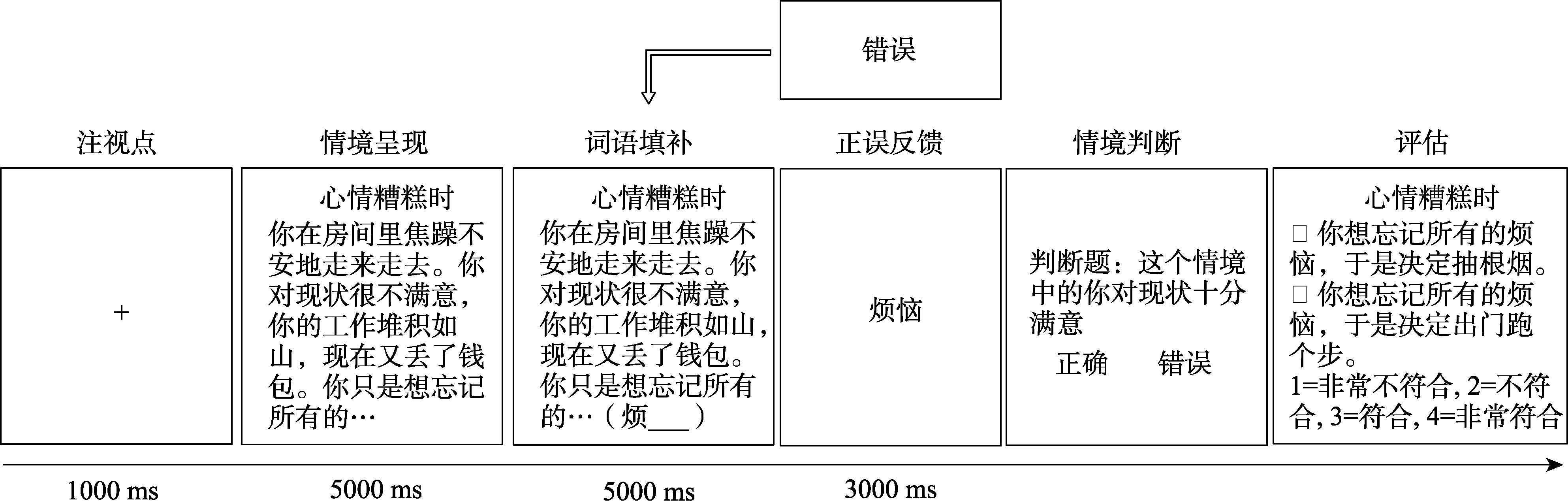
图1 实验流程图
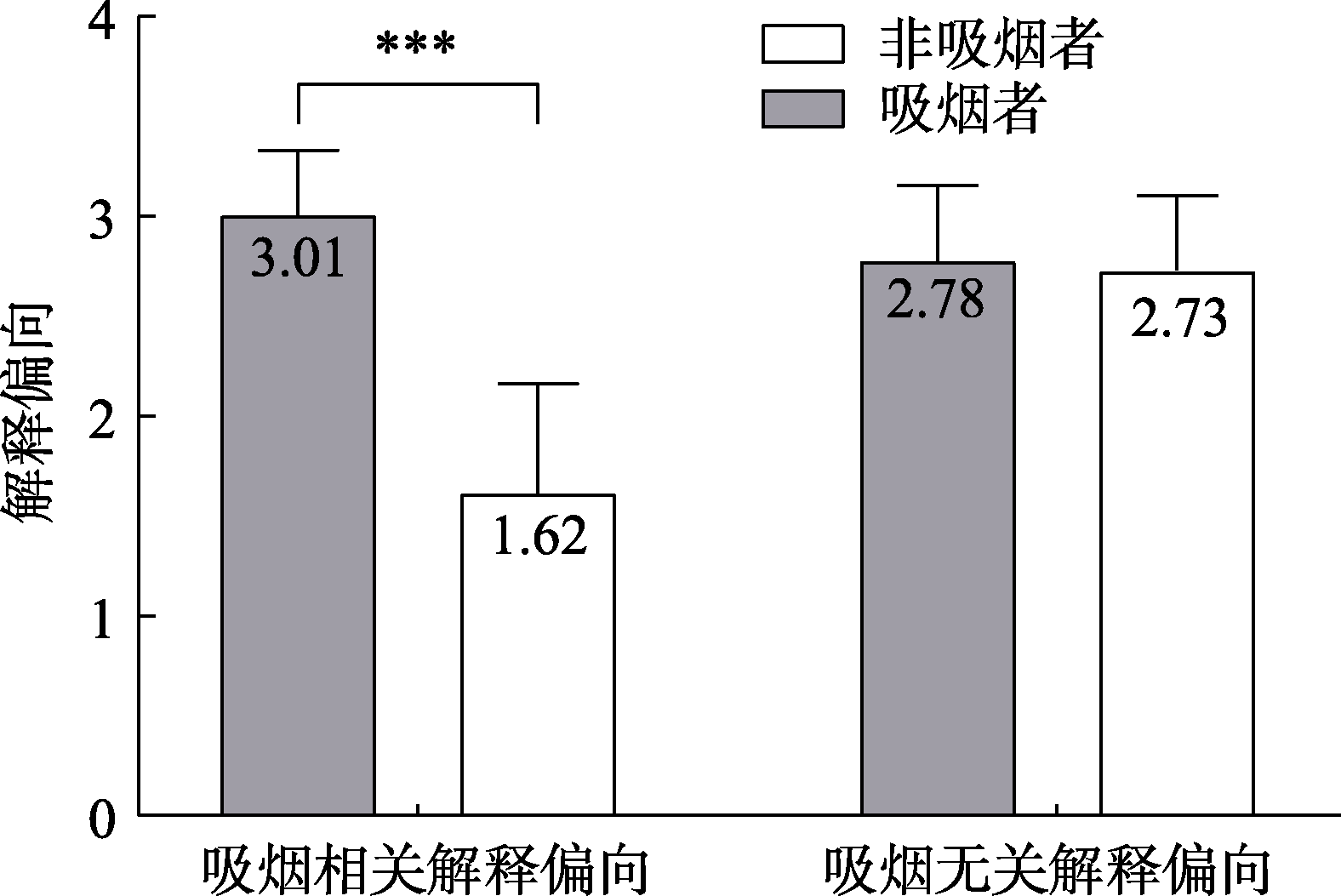
图2 研究1被试吸烟相关和吸烟无关解释偏向
注:* p < 0.05, *** p < 0.001, 下同。
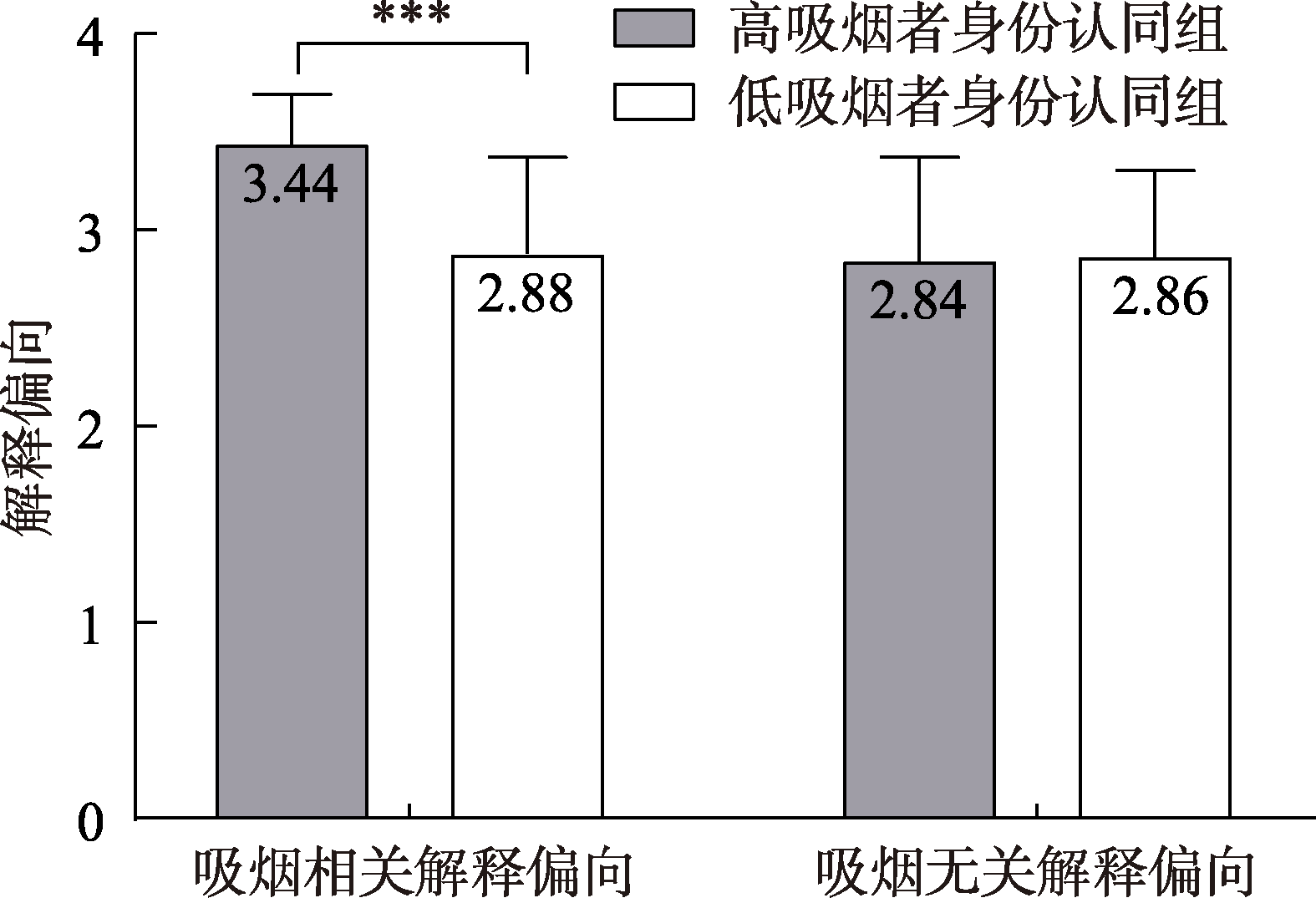
图3 研究2被试吸烟相关和吸烟无关解释偏向
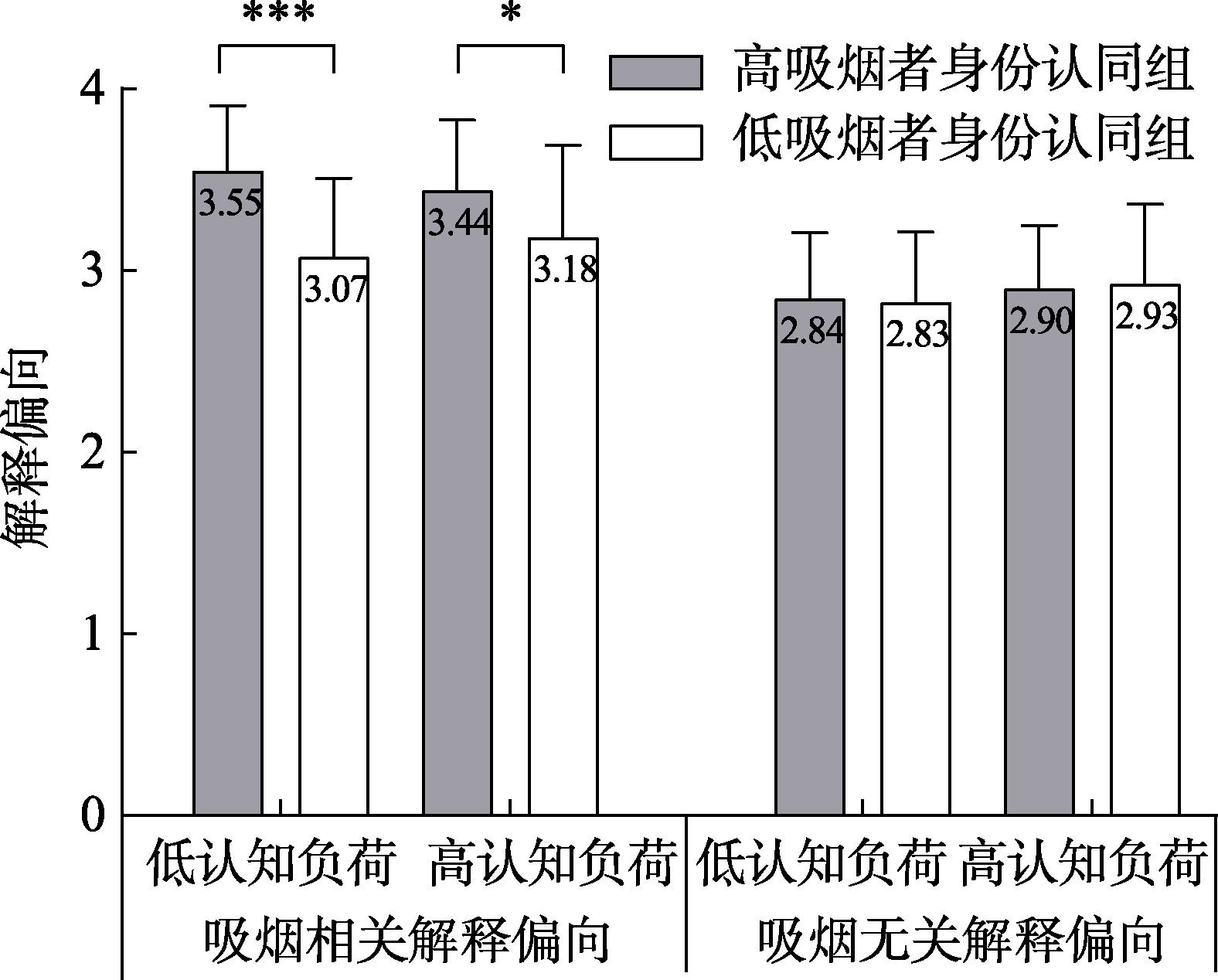
图4 研究3被试吸烟相关和吸烟无关的解释偏向
| [1] |
Albery I. P., Shove E., Bartlett G., Frings D., & Spada M. M. (2022). Individual differences in selective attentional bias for healthy and unhealthy food-related stimuli and social identity as a vegan/vegetarian dissociate "healthy" and "unhealthy" orthorexia nervosa. Appetite, 178, 106261.
doi: 10.1016/j.appet.2022.106261 URL |
| [2] |
Beck A. T., & Haigh E. A. (2014). Advances in cognitive theory and therapy: The generic cognitive model. Annual Review of Clinical Psychology, 10(1), 1-24.
doi: 10.1146/clinpsy.2014.10.issue-1 URL |
| [3] |
Callaghan L., Yong H. H., Borland R., Cummings K. M., Hitchman S. C., & Fong G. T. (2021). What kind of smoking identity following quitting would elevate smokers relapse risk? Addictive Behaviors, 112, 106654.
doi: 10.1016/j.addbeh.2020.106654 URL |
| [4] |
Cao M., Xie P., Sun L., Zhang J., Kong F., & Zhou Z. (2021). Processing priority for avatar reference in online games: Evidence from behavioral and ERPs studies. Acta Psychologica Sinica, 53(6), 639-650.
doi: 10.3724/SP.J.1041.2021.00639 |
|
[曹敏, 谢和平, 孙丽君, 张冬静, 孔繁昌, 周宗奎. (2021). 网络游戏中化身参照的加工优势:来自行为与ERPs的证据. 心理学报, 53(6), 639-650.]
doi: 10.3724/SP.J.1041.2021.00639 |
|
| [5] |
Chen H., Fan Y., Li X., Gao L., & Li W. (2022). The relationship between smoker identity and smoking cessation among young smokers: The role of smoking rationalization beliefs and cultural value of guanxi. Frontiers in Psychiatry, 13, 812982.
doi: 10.3389/fpsyt.2022.812982 URL |
| [6] | Chen H., Wang Y., Zhao B., Yao J., & Li W. (2023). Identity and smoking refusal self-efficacy in Chinese male smokers: The mediating role of smoking refusal outcome expectancies and the moderating role of social norms. Journal of Psychological Science, 46(6), 1504-1510. |
| [陈海德, 王逸文, 赵博强, 姚静静, 李伟健. (2023). 男性吸烟者身份认同对拒烟效能感的预测:结果预期和主观规范的作用. 心理科学, 46(6), 1504-1510.] | |
| [7] |
Chen H., Yang Y., Zheng E., Fan Y., & Gao L. (2024). Smokers’ “bulletproof vest”: The formation mechanism and interventions of self-exempting beliefs. Advances in Psychological Science, 32(4), 654-663.
doi: 10.3724/SP.J.1042.2024.00654 |
|
[陈海德, 杨逸星, 郑恩瑾, 范雨萌, 高崚峰. (2024). 吸烟者的“防弹衣”:自我豁免信念的形成机制及干预. 心理科学进展, 32(4), 654-663.]
doi: 10.3724/SP.J.1042.2024.00654 |
|
| [8] |
Cheng J., Guan Y., Zhang Y., Bi Y., Bu L., Li Y., … Yuan K. (2016). Electrophysiological mechanisms of biased response to smoking-related cues in young smokers. Neuroscience Letters, 629, 85-91.
doi: S0304-3940(16)30472-4 pmid: 27373532 |
| [9] | Chu J., Pink S. L., & Willer R. (2021). Religious identity cues increase vaccination intentions and trust in medical experts among American Christians. Proceedings of the National Academy of Sciences, 118(49), e2106481118. |
| [10] |
Copersino M. L. (2017). Cognitive mechanisms and therapeutic targets of addiction. Current Opinion in Behavioral Sciences, 13, 91-98.
doi: 10.1016/j.cobeha.2016.11.005 pmid: 28603756 |
| [11] |
Cox L. S., Tiffany S. T., & Christen A. G. (2001). Evaluation of the brief questionnaire of smoking urges (QSU-brief) in laboratory and clinical settings. Nicotine Tob Res, 3(1), 7-16.
doi: 10.1080/14622200020032051 pmid: 11260806 |
| [12] |
Drichoutis A. C., & Nayga Jr R. M. (2020). Economic rationality under cognitive load. The Economic Journal, 130(632), 2382-2409.
doi: 10.1093/ej/ueaa052 URL |
| [13] |
Dunham Y., & Emory J. (2014). Of affect and ambiguity: The emergence of preference for arbitrary ingroups. Journal of Social Issues, 70(1), 81-98.
doi: 10.1111/josi.2014.70.issue-1 URL |
| [14] |
Falomir-Pichastor J. M., Blondé J., Desrichard O., Felder M., Riedo G., & Folly L. (2020). Tobacco dependence and smoking cessation: The mediating role of smoker and ex-smoker self-concepts. Addictive Behaviors, 102, 106200.
doi: 10.1016/j.addbeh.2019.106200 URL |
| [15] |
Feng Z., Zhang D., & Yang G. (2008). Recalling, recognition, and priming processing in middle school students with depressive symptoms. Acta Psychologica Sinica, 40(2), 166-174.
doi: 10.3724/SP.J.1041.2008.00166 URL |
| [冯正直, 张大均, 杨国愉. (2008). 抑郁症状中学生自我相关生活事件的回忆、再认和启动效应特点. 心理学报, 40(2), 166-174.] | |
| [16] |
Frings D., & Albery I. P. (2015). The social identity model of cessation maintenance: Formulation and initial evidence. Addictive Behaviors, 44, 35-42.
doi: S0306-4603(14)00355-4 pmid: 25468675 |
| [17] |
Grigutsch L. A., Lewe G., Rothermund K., & Koranyi N. (2019). Implicit 'wanting' without implicit 'liking': A test of incentive-sensitization-theory in the context of smoking addiction using the wanting-implicit -association-test (W-IAT). Journal of Behavior Therapy and Experimental Psychiatry, 64, 9-14.
doi: S0005-7916(18)30176-9 pmid: 30711827 |
| [18] |
Haslam C., Haslam S. A., Jetten J., Cruwys T., & Steffens N. K. (2021). Life change, social identity, and health. Annual Review of Psychology, 72(1), 635-661.
doi: 10.1146/psych.2021.72.issue-1 URL |
| [19] |
Haslam S. A., Oakes P. J., Reynolds K. J., & Turner J. C. (1999). Social identity salience and the emergence of stereotype consensus. Personality and Social Psychology Bulletin, 25(7), 809-818.
doi: 10.1177/0146167299025007004 URL |
| [20] |
Heatherton T. F., Kozlowski L. T., Frecker R. C., & Fagerström K. O. (1991). The Fagerström test for nicotine dependence: A revision of the Fagerström Tolerance Questionnaire. British Journal of Addiction, 86(9), 1119-1127.
doi: 10.1111/j.1360-0443.1991.tb01879.x pmid: 1932883 |
| [21] |
Hehman E., Mania E. W., & Gaertner S. L. (2010). Where the division lies: Common ingroup identity moderates the cross-race facial-recognition effect. Journal of Experimental Social Psychology, 46(2), 445-448.
doi: 10.1016/j.jesp.2009.11.008 URL |
| [22] |
Hirsch C. R., Clark D. M., & Mathews A. (2006). Imagery and interpretations in social phobia: Support for the combined cognitive biases hypothesis. Behavior Therapy, 37(3), 223-236.
doi: 10.1016/j.beth.2006.02.001 pmid: 16942974 |
| [23] |
Hofmann W., Friese M., & Wiers R. W. (2008). Impulsive versus reflective influences on health behavior: A theoretical framework and empirical review. Health Psychology Review, 2(2), 111-137.
doi: 10.1080/17437190802617668 URL |
| [24] |
Huijding J., de Jong P. J., Wiers R. W., & Verkooijen K. (2005). Implicit and explicit attitudes toward smoking in a smoking and a nonsmoking setting. Addictive Behaviors, 30(5), 949-961.
doi: 10.1016/j.addbeh.2004.09.014 pmid: 15893091 |
| [25] | Jones, A., & Field M. (2021). CookeD., ConroyE. L., DaviesM. S., Eds.), The Palgrave handbook of psychological perspectives on alcohol consumption (pp. 527-550). Springer International Publishing. |
| [26] |
Kale D., Jackson S., Brown J., Garnett C., & Shahab L. (2024). Social smoker identity and associations with smoking and quitting behaviour: A cross-sectional study in England. Drug and Alcohol Dependence, 260, 111345.
doi: 10.1016/j.drugalcdep.2024.111345 URL |
| [27] | Lakritz C. (2023). When control over food spirals out of control: Investigating the cognitive mechanisms of food hyper-selectivity in individuals suffering from anorexia nervosa and orthorexia nervosa [Unpublished doctoral dissertation]. Université Claude Bernard Lyon 1. |
| [28] |
Li T., & Feng F. (2013). Interpretation bias in social anxiety: Research paradigms, characteristics and modification. Advances in Psychological Science, 21(12), 2196-2203.
doi: 10.3724/SP.J.1042.2013.02196 |
|
[李涛, 冯菲. (2013). 社交焦虑解释偏差:研究范式、特征及矫正. 心理科学进展, 21(12), 2196-2203.]
doi: 10.3724/SP.J.1042.2013.02196 |
|
| [29] | Liang M., Zhao Y., & Yin C. (2023). Common ingroup identity promotes ethnic psychological compatibility: The mediating role of positive interpretation bias. Journal of Psychological Science, 46(2), 386-393. |
| [梁芳美, 赵玉芳, 尹晨祖. (2023). 共同内群体认同促进民族心理融合:积极解释偏向的中介作用. 心理科学, 46(2), 386-393.] | |
| [30] |
Lindgren K. P., Neighbors C., Gasser M. L., Ramirez J. J., & Cvencek D. (2017). A review of implicit and explicit substance self-concept as a predictor of alcohol and tobacco use and misuse. The American Journal of Drug and Alcohol Abuse, 43(3), 237-246.
doi: 10.1080/00952990.2016.1229324 URL |
| [31] |
Moan I. S., & Rise J. (2005). Quitting smoking: Applying an extended version of the Theory of Planned Behavior to predict intention and behavior. Journal of Applied Biobehavioral Research, 10(1), 39-68.
doi: 10.1111/j.1751-9861.2005.tb00003.x URL |
| [32] |
Motschman C. A., & Tiffany S. T. (2016). Cognitive regulation of smoking behavior within a cigarette: Automatic and nonautomatic processes. Psychology of Addictive Behaviors, 30(4), 494-499.
doi: 10.1037/adb0000157 pmid: 26866781 |
| [33] |
Poole R., Carver H., Anagnostou D., Edwards A., Moore G., Smith P., … Brain K. (2022). Tobacco use, smoking identities and pathways into and out of smoking among young adults: A meta-ethnography. Substance Abuse Treatment, Prevention, and Policy, 17, 24.
doi: 10.1186/s13011-022-00451-9 |
| [34] |
Robinson T. E., & Berridge K. C. (1993). The neural basis of drug craving: An incentive-sensitization theory of addiction. Brain Research Reviews, 18(3), 247-291.
doi: 10.1016/0165-0173(93)90013-P URL |
| [35] |
Roccas S., & Brewer M. B. (2002). Social identity complexity. Personality and Social Psychology Review, 6(2), 88-106.
doi: 10.1207/S15327957PSPR0602_01 URL |
| [36] |
Salemink E., & Wiers R. W. (2012). Adolescent threat-related interpretive bias and its modification: The moderating role of regulatory control. Behaviour Research and Therapy, 50(1), 40-46.
doi: 10.1016/j.brat.2011.10.006 pmid: 22093764 |
| [37] |
Salemink E., Woud M. L., Roos M., Wiers R., & Lindgren K. P. (2019). Reducing alcohol-related interpretive bias in negative affect situations: Using a scenario-based Cognitive Bias Modification training paradigm. Addictive Behaviors, 88, 106-113.
doi: S0306-4603(18)30848-7 pmid: 30173074 |
| [38] |
Sritharan R., & Gawronski B. (2010). Changing implicit and explicit prejudice. Social Psychology, 41(3), 113-123.
doi: 10.1027/1864-9335/a000017 URL |
| [39] |
Wang X., Zhu J., Liu L., & Chen X. (2017). Cognitive- processing bias in Chinese student teachers with strong and weak professional identity. Frontiers in Psychology, 8, 784.
doi: 10.3389/fpsyg.2017.00784 URL |
| [40] |
Wilcockson T. D., Pothos E. M., Osborne A. M., & Crawford T. J. (2021). Top-down and bottom-up attentional biases for smoking-related stimuli: Comparing dependent and non-dependent smokers. Addictive Behaviors, 118, 106886.
doi: 10.1016/j.addbeh.2021.106886 URL |
| [41] |
Wittekind C. E., Schiebel T., & Kühn S. (2023). Reliability of and associations between cognitive bias measures and response inhibition in smoking. Journal of Behavior Therapy and Experimental Psychiatry, 81, 101853.
doi: 10.1016/j.jbtep.2023.101853 URL |
| [42] |
Woud M. L., Fitzgerald D. A., Wiers R. W., Rinck M., & Becker E. S. (2012). 'Getting into the spirit': Alcohol- related interpretation bias in heavy-drinking students. Psychology of Addictive Behaviors, 26(3), 627-632.
doi: 10.1037/a0029025 URL |
| [43] |
Woud M. L., Becker E. S., Rinck M., & Salemink E. (2015). The relationship between drinking motives and alcohol-related interpretation biases. Journal of Behavior Therapy and Experimental Psychiatry, 47, 102-110.
doi: 10.1016/j.jbtep.2014.11.012 pmid: 25525773 |
| [44] | Xia X., Wang D., Li Y., Zhu X., Tan X., & Wu Y. (2024). The trial-by-trial fluctuations in primary motor cortex excitability during attentional bias among smokers: A transcranial magnetic stimulation study. International Journal of Clinical and Health Psychology, 24(2), 100468. |
| [45] |
Xin C., Chen Y., Tian M., & Liu G. (2025). The self-reference effect in prospective memory and its cognitive mechanisms in elementary school students aged 7 to 11 years. Acta Psychologica Sinica, 57(5), 775-791.
doi: 10.3724/SP.J.1041.2025.0775 |
|
[辛聪, 陈幼贞, 田蜜, 刘国雄. (2025). 7-11岁小学生前瞻记忆的自我参照效应及其认知机制. 心理学报, 57(5), 775-791.]
doi: 10.3724/SP.J.1041.2025.0775 |
|
| [46] | Yang H., Wang F., Gu N., & Huang X. (2012). Processing Priority for Self-related Information: Evidence from Visual Search of Screen Names. Acta Psychologica Sinica, 44(4), 489-497. |
| [杨红升, 王芳, 顾念君, 黄希庭. (2012). 自我相关信息的加工优势:来自网名识别的证据. 心理学报, 44(4), 489-497.] | |
| [47] | Yu J., Cui Z., Pan L., Sun J., Cao Y., Wang Y., … Shan G. (2022). Smoking prevalence among 20-80 years old Han residents in urban and rural regions of Hebei province. Chinese Journal of Public Health, 38(1), 61-64. |
| [于继刚, 崔泽, 潘利, 孙纪新, 曹亚景, 王也, … 单广良. (2022). 河北省20-80岁城乡汉族居民吸烟状况调查. 中国公共卫生, 38(1), 61-64.] | |
| [48] | Zhao B., & Chen H. (2023). Effects of smoking social cues on inhibitory control in smokers: An event-related potential study. International Journal of Clinical and Health Psychology, 23(4), 100387. |
| [1] | 李雅雯, 蔡攀, 左世江, 王芳, 董煜, 周阳, 黄旎雯. “量化”爱情:关系流动性促进择偶计算心态[J]. 心理学报, 2025, 57(10): 1777-1790. |
| [2] | 刘德鹏, 李珏兴, 张生军, 庞旭宏, 王政. 为家所困还是弥补缺憾?负面家庭事件对有效领导行为的影响[J]. 心理学报, 2024, 56(5): 612-629. |
| [3] | 杜夏雨, 赖丽足, 史从戎, 郭子涵, 韩菁, 张涛, 任志洪. 健康焦虑的移动网络化解释偏向矫正: 一项随机对照试验[J]. 心理学报, 2024, 56(10): 1351-1366. |
| [4] | 张航, 冯晓慧, 张积家. 民族内隐观、身份认同对族际通婚子女的外群接触态度和中华民族共同体意识的影响[J]. 心理学报, 2023, 55(7): 1115-1132. |
| [5] | 刘德鹏, 李珏兴, 梁品, 庞旭宏. 组织政治环境如何影响领导者公正准则遵从?[J]. 心理学报, 2023, 55(3): 496-509. |
| [6] | 陈幼贞, 张曼曼, 林秋蓉. 认知负荷与编码方式影响小学数学学业不良生的前瞻记忆及其成分[J]. 心理学报, 2022, 54(12): 1491-1502. |
| [7] | 张积家, 陆禹同, 张启睿, 张金桥. 外语焦虑、紧张情绪与认知负荷对外语说谎的影响:来自中-英双语者的证据[J]. 心理学报, 2020, 52(7): 861-873. |
| [8] | 程家萍;罗跃嘉;崔芳. 认知负荷对疼痛共情的影响:来自ERP研究的证据[J]. 心理学报, 2017, 49(5): 622-630. |
| [9] | 周爱保;马小凤;李晶;崔丹. 提取练习在记忆保持与迁移中的优势效应:基于认知负荷理论的解释[J]. 心理学报, 2013, 45(8): 849-859. |
| [10] | 汪涛,张琴,张辉,周玲,刘洪深. 如何削弱产品来源国效应*—— 产品信息呈现方式的影响研究[J]. 心理学报, 2012, 44(6): 841-852. |
| [11] | 李金波,许百华,田学红. 人机交互中认知负荷变化预测模型的构建[J]. 心理学报, 2010, 42(05): 559-568. |
| [12] | 李金波,许百华. 人机交互过程中认知负荷的综合测评方法[J]. 心理学报, 2009, 41(01): 35-43. |
| 阅读次数 | ||||||
|
全文 |
|
|||||
|
摘要 |
|
|||||
