

ISSN 0439-755X
CN 11-1911/B
主办:中国心理学会
中国科学院心理研究所
出版:科学出版社
CN 11-1911/B
主办:中国心理学会
中国科学院心理研究所
出版:科学出版社
心理学报 ›› 2018, Vol. 50 ›› Issue (12): 1381-1389.doi: 10.3724/SP.J.1041.2018.01381 cstr: 32110.14.2018.01381
王志丹1, 周爱保2( ), 张荣华2, 卜梦瑾1, 李玉雯1, 王海静1, WilliamsonRebecca3
收稿日期:2017-07-10
发布日期:2018-10-30
出版日期:2018-11-30
基金资助:
WANG Zhidan1, ZHOU Aibao2(), ZHANG Ronghua2, BU Mengjin1, LI Yuwen1, WANG Haijing1, WILLIAMSON Rebecca3
Received:2017-07-10
Online:2018-10-30
Published:2018-11-30
摘要:
关于物体重量认知的研究是探讨儿童整个认知发展的重要途径之一。本文通过两个实验考察了美国和中国儿童利用语言标签基于重量进行归纳推理的发展特点及跨文化一致性。实验人员利用语言标签提示三个外部知觉特征完全相似物体中的一个物体, 随后要求儿童从剩余两个物体中选择一个他们认为和目标物体共享语言标签的物体。研究考察儿童是否能够基于物体的内在属性重量进行类别判断。结果显示:(1) 4岁和5岁儿童以重量进行归纳推理显著高于3岁儿童, 4岁和5岁儿童之间的差异不显著; (2) 美国和中国4岁和5岁儿童的表现均显著高于随机水平, 3岁儿童与随机水平没有显著差异; (3) 美国2岁儿童的表现边缘低于随机水平, 6岁儿童显著高于随机水平。总之, 儿童利用语言标签进行基于重量的归纳推理随年龄增长而发展; 美国和中国儿童在发展特点及年龄转折上具有跨文化一致性, 4岁儿童具备了利用语言标签进行基于物体内在属性归纳推理的能力。
中图分类号:
王志丹, 周爱保, 张荣华, 卜梦瑾, 李玉雯, 王海静, WilliamsonRebecca. (2018). 学前儿童基于物体重量归纳推理的发展:中美跨文化比较. 心理学报, 50(12), 1381-1389.
WANG Zhidan, ZHOU Aibao, ZHANG Ronghua, BU Mengjin, LI Yuwen, WANG Haijing, WILLIAMSON Rebecca. (2018). The development of preschool children’s inductive reasoning about weight: A cross-cultural comparison of Sino-US. Acta Psychologica Sinica, 50(12), 1381-1389.
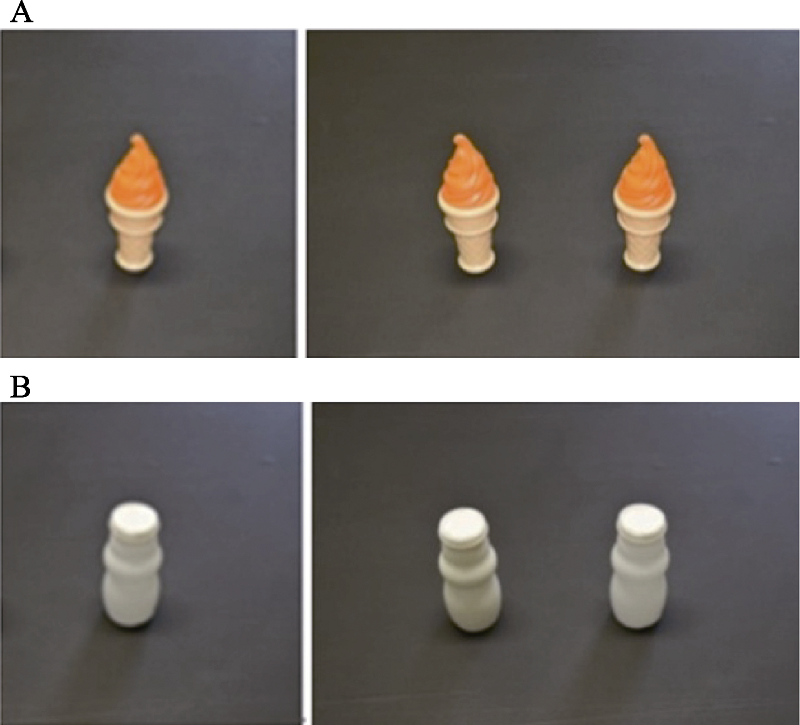
图1 实验中所使用的两组材料
| 选择匹配<BR/>重量的次数 | 年龄 | ||||
|---|---|---|---|---|---|
| 2岁 | 3岁 | 4岁 | 5岁 | 6岁 | |
| 0 | 8 (40%) | 2 (10%) | 2 (10%) | 1 (5%) | 0 (0%) |
| 1 | 10 (50%) | 12 (60%) | 6 (30%) | 2 (10%) | 1 (5%) |
| 2 | 2 (10%) | 6 (30%) | 12 (60%) | 17 (85%) | 19 (95%) |
表1 2~6岁美国儿童选择正确物体次数的人数及其百分比
| 选择匹配<BR/>重量的次数 | 年龄 | ||||
|---|---|---|---|---|---|
| 2岁 | 3岁 | 4岁 | 5岁 | 6岁 | |
| 0 | 8 (40%) | 2 (10%) | 2 (10%) | 1 (5%) | 0 (0%) |
| 1 | 10 (50%) | 12 (60%) | 6 (30%) | 2 (10%) | 1 (5%) |
| 2 | 2 (10%) | 6 (30%) | 12 (60%) | 17 (85%) | 19 (95%) |
| 选择正确<BR/>重量的次数 | 年龄 | ||
|---|---|---|---|
| 3岁 | 4岁 | 5岁 | |
| 0 | 7 (35%) | 0 (0%) | 1 (5%) |
| 1 | 11 (55%) | 10 (50%) | 5 (25%) |
| 2 | 2 (10%) | 10 (50%) | 14 (70%) |
表2 3~5岁中国儿童选择正确物体次数的人数及百分比
| 选择正确<BR/>重量的次数 | 年龄 | ||
|---|---|---|---|
| 3岁 | 4岁 | 5岁 | |
| 0 | 7 (35%) | 0 (0%) | 1 (5%) |
| 1 | 11 (55%) | 10 (50%) | 5 (25%) |
| 2 | 2 (10%) | 10 (50%) | 14 (70%) |
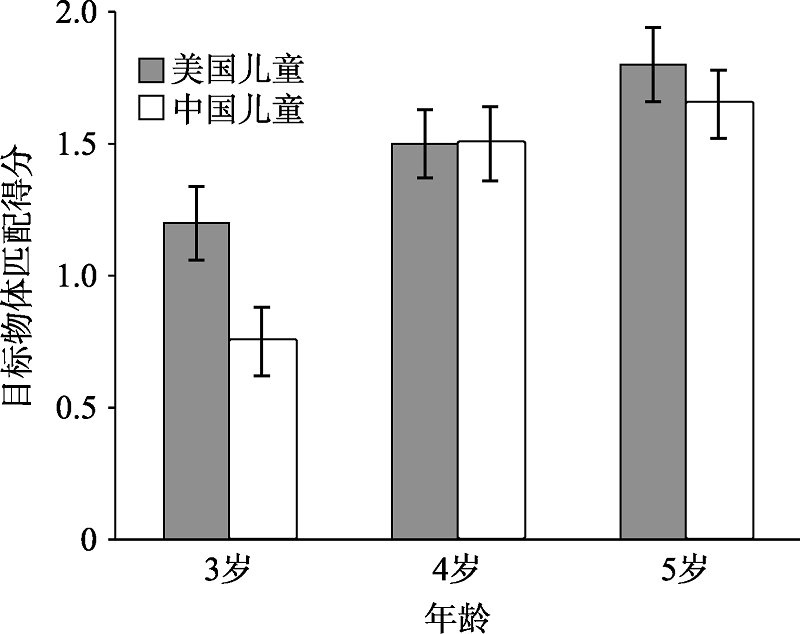
图2 美国和中国3~5岁组儿童选择重量匹配物体得分
| 1 |
Althaus N., &Westermann G. , ( 2016). Labels constructively shape object categories in 10-month-old infants. Journal of Experimental Child Psychology, 151, 5-17.
doi: 10.1016/j.jecp.2015.11.013 URL pmid: 26778468 |
| 2 |
Buchanan D.W., &Sobel , D. M . ( 2011). Mechanism-based causal reasoning in young children. Child Development, 82( 6), 2053-2066.
doi: 10.1111/j.1467-8624.2011.01646.x URL pmid: 21919900 |
| 3 | Chen L., Wei X. M., Zhong L. J., & Mo L . ( 2014). The role of causal relations between new property and prototype in induction. Psychological Exploration, 34( 5), 398-404. |
| 4 | [ 陈琳, 魏晓玛, 钟罗金, 莫雷 . ( 2014). 基于原型特征因果关系的归纳推理研究. 心理学探新, 34( 5), 398-404.] |
| 5 |
Chiu L-H.., ( 1972). A cross-cultural comparison of cognitive styles in Chinese and American children. International Journal of Psychology, 7( 4), 235-242.
doi: 10.1080/00207597208246604 URL |
| 6 |
Erb C. D., Buchanan D. W., & Sobel D. M . ( 2013). Children’s developing understanding of the relation between variable causal efficacy and mechanistic complexity. Cognition, 129( 3), 494-500.
doi: 10.1016/j.cognition.2013.08.002 URL pmid: 24041835 |
| 7 |
Erdfelder E., Faul F., & Buchner A . ( 1996). GPOWER: A general power analysis program. Behavior Research Methods, Instruments, & Computers, 28( 1), 1-11.
doi: 10.1016/S0167-9473(99)90014-2 URL |
| 8 |
Flavell J. H., Green F. L., Flavell E. R., Harris P. L., & Astington J. W . ( 1995). Young children’s knowledge about thinking. Monographs of the Society for Research in Child Development, 60( 1), 1-96.
doi: 10.2307/1166124 URL pmid: 7877641 |
| 9 | Fulkerson A. L., Waxman S. R. , & Seymour, J. M.( 2006) . .Linking object names and object categories:Words (but not tones) facilitate object categorization in 6- and 12-month- olds In Bamman, D, Magnitskaia, T, & Zaller, C (Eds) Supplement to the Proceedings of the 30th Boston University Conference on Language Development Cascadilla Press Words (but not tones) facilitate object categorization in 6- and 12-month- olds. In Bamman, D., Magnitskaia, T., & Zaller, C. (Eds.) Supplement to the Proceedings of the 30th Boston University Conference on Language Development. Cascadilla Press. |
| 10 |
Gelman. SA., &Markman , E. M . ( 1986). Categories and induction in young children. Cognition, 23( 3), 183-209.
doi: 10.1016/0010-0277(86)90034-X URL pmid: 3791915 |
| 11 | Gelman S.A., &Wellman , H. M . ( 1991). Insides and essences: Early understandings of the non-obvious. Cognition, 38( 3), 213-244. |
| 12 | Graham S. A., Kilbreath C. S., & Welder A. N . ( 2004). Thirteen-month-olds rely on shared labels and shape similarity for inductive inferences. Child Development, 75( 2), 409-427. |
| 13 |
Hauf P., &Paulus M. , ( 2011). Experience matters: 11-month- old infants can learn to use material information to predict the weight of novel objects. Infant Behavior and Development, 34( 3), 467-471.
doi: 10.1016/j.infbeh.2011.05.002 URL pmid: 21665284 |
| 14 |
Hauf P., Paulus M., & Baillargeon R . ( 2012). Infants use compression information to infer objects’ weights: examining cognition, exploration, and prospective action in a preferential-reaching task. Child Development, 83( 6), 1978-1995.
doi: 10.1111/j.1467-8624.2012.01824.x URL pmid: 3492508 |
| 15 |
Hochmann J-R., Mody S., & Carey S . ( 2016). Infants’ representations of same and different in match- and non-match-to-sample. Cognitive Psychology, 86, 87-111.
doi: 10.1016/j.cogpsych.2016.01.005 URL pmid: 26970605 |
| 16 |
Hochmann J-R., Tuerk A. S., Sanborn S., Zhu R., Long R., Dempster M., & Carey S . ( 2017). Children’s representation of abstract relations in relational/array match-to-sample tasks. Cognitive Psychology, 99, 17-43.
doi: 10.1016/j.cogpsych.2017.11.001 URL pmid: 29132016 |
| 17 |
Johansen M. K., Savage J., Fouquet N., & Shanks D. R . ( 2015). Salience not status: How category labels influence feature inference. Cognitive Science, 39( 7), 1594-1621.
doi: 10.1111/cogs.12206 URL pmid: 25430964 |
| 18 |
Kalish C.W., &Lawson , C. A . ( 2007). Negative evidence and inductive generalisation. Thinking & Reasoning, 13( 4), 394-425.
doi: 10.1080/13546780701273402 URL |
| 19 |
KemlerNelson D. G., Herron L., & Holt M. B . ( 2003). The sources of young children's name innovations for novel artifacts. Journal of Child Language, 30( 4), 823-843.
doi: 10.1017/S0305000903005798 URL pmid: 14686086 |
| 20 |
KemlerNelson D. G., Russell R., Duke N., & Jones K . ( 2000). Two-year-olds will name artifacts by their functions. Child Development, 71( 5), 1271-1288.
doi: 10.1111/1467-8624.00228 URL pmid: 11108096 |
| 21 |
Legare C.H . ( 2012). Exploring explanation: Explaining inconsistent evidence informs exploratory, hypothesis- testing behavior in young children. Child Development, 83( 1), 173-185.
doi: 10.1111/j.1467-8624.2011.01691.x URL pmid: 22172010 |
| 22 |
Legare C.H . ( 2014). The contribution of explanation and exploration to children's scientific reasoning. Child Development Perspectives, 8( 2), 101-106.
doi: 10.1111/cdep.12070 URL |
| 23 |
Li F., Xie L., Yang X., & Cao B . ( 2017). The effect of feedback and operational experience on children’s rule learning. Frontiers in Psychology, 8, 534.
doi: 10.3389/fpsyg.2017.00534 URL pmid: 5390043 |
| 24 |
Liu D., Wellman H. M., Tardif T., & Sabbagh M. A . ( 2008). Theory of mind development in Chinese children: A meta-analysis of false-belief understanding across cultures and languages. Developmental Psychology, 44( 2), 523-531.
doi: 10.1037/0012-1649.44.2.523 URL pmid: 18331141 |
| 25 | Long C. Q., Wu R. M., Li H., Chen A. T., Feng T. Y., & Li F. H . ( 2006). 3.5~5.5 years older’s inductive reasoning in similarity vs conception confliction condition. Acta Psychologica Sinica, 38( 1), 47-55. |
| 26 | [ 龙长权, 吴睿明, 李红, 陈安涛, 冯廷勇, 李富洪 . ( 2006). 3.5~5.5 岁儿童在知觉相似与概念冲突情形下的归纳推理. 心理学报, 38( 1), 47-55.] |
| 27 |
Nazzi T., &Gopnik A. ,( 2000). A shift in children’s use of perceptual and causal cues to categorization. Developmental Science, 3( 4), 389-396.
doi: 10.1111/1467-7687.00133 URL |
| 28 |
Nielsen M., &Haun D. , ( 2016). Why developmental psychology is incomplete without comparative and cross- cultural perspectives. Philosophical. Transactions. of the Royal. Society. B, 371( 1686), 20150071.
doi: 10.1098/rstb.2015.0071 URL pmid: 4685517 |
| 29 |
Nielsen M., Haun D., Kärtner J., & Legare C. H . ( 2017). The persistent sampling bias in developmental psychology: A call to action. Journal of Experimental Child Psychology, 162, 31-38
doi: 10.1016/j.jecp.2017.04.017 URL pmid: 28575664 |
| 30 |
Noles N., &Gelman S. , ( 2012). Effects of categorical labels on similarity judgments: A critical analysis of similarity- based approaches. Developmental Psychology, 48( 3), 890-896.
doi: 10.1037/a0026075 URL pmid: 22059447 |
| 31 | Patnaik A., . ( 2008). The physical discrimination and possible concept of object weight that exists in infants and toddlers (Unpublished Master’s thesis). Retrieved from 2008). The physical discrimination and possible concept of object weight that exists in infants and toddlers (Unpublished Master’s thesis). Retrieved from |
| 32 |
Paulus M., &Hauf P. , ( 2011). Infants’ use of material properties to guide their actions with differently weighted objects. Infant and Child Development, 20( 4), 423-436.
doi: 10.1002/icd.704 URL |
| 33 | Piaget J. ( 1952). The origins of intelligence in children. New York: International Universities Press. |
| 34 | Povinelli J. D. ( 2012). World without weight: Perspective on an alien mind. Oxford University Press. |
| 35 | Richland L. E., Chan T-K., Morrison R. G., & Au T. K-F . ( 2010). Young children’s analogical reasoning across cultures: Similarities and differences. Journal of Experimental Child Psychology, 105( 1-2), 146-153. |
| 36 |
Schrauf C., Call J., & Pauen S . ( 2011). The effect of plausible versus implausible balance scale feedback on the expectancies of 3- to 4-year-old children. Journal of Cognition and Development, 12( 4), 518-536.
doi: 10.1080/15248372.2011.571647 URL |
| 37 |
Siegler R.S., &Chen Z. , ( 1998). Developmental differences in rule learning: A microgenetic analysis. Cognitive Psychology, 36( 3), 273-310.
doi: 10.1006/cogp.1998.0686 URL pmid: 9729904 |
| 38 |
Sobel D. M., Yoachim C. M., Gopnik A., Meltzoff A. N., & Blumenthal E. J . ( 2007). The blicket within: Preschoolers’ inferences about insides and causes. Journal of Cognition and Development, 8( 2), 159-182.
doi: 10.1080/15248370701202356 URL pmid: 18458796 |
| 39 | Walker C., Lombrozo T., Legare C. H., & Gopnik A . ( 2014). Explaining prompts children to privilege inductivity rich properties. Cognition, 133( 2), 343-357. |
| 40 | Wang X. Y., Yu W. Y., Liang P. P., Long Z. J., Guo X. L., Zhong N., … Zhou H. Y . ( 2014). Influence of knowledge on label effect during adults’ inductive reasoning. Journal of Psychological Science, 37( 4), 845-850. |
| 41 | [ 王旭艳, 于伟艳, 梁佩鹏, 龙周军, 郭晓龙, 钟宁, 秦裕林, 周海燕 . ( 2014). 知识对成人归纳推理标签效应的影响. 心理科学, 37( 4), 845-850.] |
| 42 | Wang Z., ( 2014). Children’s imitation of a weight sorting rule (Unpublished Master’s thesis). Georgia State University.Retrieved from https://scholarworks.gsu.edu/psych_theses/126 |
| 43 |
Wang Z., Meltzoff A. N., & Williamson R. A . ( 2015). Social learning promotes understanding of the physical world: Preschool children’s imitation of weight sorting. Journal of Experimental Child Psychology, 136, 82-91.
doi: 10.1016/j.jecp.2015.02.010 URL pmid: 25866145 |
| 44 |
Wang Z., Williamson R. A., & Meltzoff A. N . ( 2015). Imitation as a mechanism in cognitive development: A cross-cultural investigation of 4-year-old children’s rule learning. Frontiers in Psychology, 6:562.
doi: 10.3389/fpsyg.2015.00562 URL pmid: 4429617 |
| 45 |
Wang Z., Williamson R. A., & Meltzoff A. N . ( 2018). Preschool physics: Using the invisible property of weight in causal reasoning tasks. PloS ONE, 13( 3), e0192054.
doi: 10.1371/journal.pone.0192054 URL |
| 46 |
Waxman S.R., &Klibanoff , R. S . ( 2000). The role of comparison in the extension of novel adjectives. Developmental Psychology, 36( 5), 571-581.
doi: 10.1037/0012-1649.36.5.571 URL pmid: 10976598 |
| 47 |
Welder A.N., &Graham , S. A . ( 2001). The influence of shape similarity and shared labels on infants’ inductive inferences about nonobvious object properties. Child Development, 72( 6), 1653-1673.
doi: 10.1111/1467-8624.00371 URL pmid: 11768138 |
| 48 | Wellman H.M., &Gelman , S. A . ( 1988). Children’s understanding of the nonobvious. In R. J. Sternberg (Ed.), Advances in the Psychology of Human Intelligence, Vol. 4, (pp. 99-135). Hillsdale, NJ, US: Lawrence Erlbaum Associates, Inc. |
| 49 |
Wellman H. M., Fang F., Liu D., Zhu L., & Liu G . ( 2006). Scaling of theory-of-mind understandings in Chinese children. Psychological Science, 17( 12), 1075-1081.
doi: 10.1111/j.1467-9280.2006.01830.x URL pmid: 17201790 |
| [1] | 陈旭燕, 李鹏, 闫志英. 焦虑对重量感知判断的影响[J]. 心理学报, 2023, 55(1): 66-78. |
| [2] | 张积家, 付雅, 王斌. 文化影响亲属词性别概念加工中的空间隐喻与重量隐喻——来自彝族、白族和摩梭人的证据[J]. 心理学报, 2020, 52(4): 440-455. |
| [3] | 汪新筱;严秀英;张积家;董方虹. 平辈亲属词语义加工中长幼概念的空间隐喻和重量隐喻——来自中国朝鲜族和汉族的证据[J]. 心理学报, 2017, 49(2): 174-185. |
| [4] | 钟罗金,莫雷,刘志雅,李倩雯,Lee, Myung Sook. 儿童在归纳推理中的多样性效应[J]. 心理学报, 2012, 44(1): 87-99. |
| [5] | 崔亚飞,李红,李富洪. 归纳推理属性效应中背景关系提取原则的探究[J]. 心理学报, 2010, 42(12): 1148-1155. |
| [6] | 蒋柯,熊哲宏. 利/害条件下归纳推理的心理效应分离[J]. 心理学报, 2010, 42(11): 1050-1059. |
| [7] | 梅,杨,梁佩鹏,吕胜富,杨延辉,钟,宁,李坤成. 图形型归纳推理的神经机制: 一项fMRI研究[J]. 心理学报, 2010, 42(04): 496-506. |
| [8] | 陈庆飞,雷怡,李红. 不同概念范畴和特征类别对儿童归纳推理多样性效应的影响[J]. 心理学报, 2010, 42(02): 241-250. |
| [9] | 马晓清, 冯廷勇, 李红, 龙长权. 主题关系在4~5岁儿童不同属性归纳推理发展中的作用[J]. 心理学报, 2009, 41(03): 249-258. |
| [10] | 王墨耘. 归纳推理的抽样理论[J]. 心理学报, 2008, 40(07): 800-808. |
| [11] | 张婷婷,李红,龙长权,冯廷勇,陈安涛,李富洪,王秀芳. 归纳推理中的属性中心性效应[J]. 心理学报, 2007, 39(05): 826-836. |
| [12] | 龙长权,吴睿明,李红,陈安涛,冯廷勇,李富洪 . 3.5~5.5岁儿童在知觉相似与概念冲突情形下的归纳推理[J]. 心理学报, 2006, 38(01): 47-55. |
| [13] | 李富洪,李红,陈安涛,冯廷勇,高雪梅,张仲明,龙长权. 物体颜色与质地相似度对幼儿归纳推理的影响[J]. 心理学报, 2005, 37(02): 199-209. |
| 阅读次数 | ||||||
|
全文 |
|
|||||
|
摘要 |
|
|||||
