



1 问题提出
伴随着大数据、云计算、物联网和人工智能技术等推动新一轮技术变革, 数字经济已上升为国家战略, 中国企业正加快数字化转型, 员工工作也面临着数字技术的冲击。以机器学习、算法为代表的人工智能技术不仅能自动化简单的事务性工作, 还能对复杂的认知类工作产生影响(Davenport & Kirby, 2016; Huang & Rust, 2018)。人工智能技术对人类工作的影响已由操作类岗位延伸至营销类、技术类和管理类岗位, 由生产车间延伸至营销、财务、研发和人力资源管理部门(Daugherty & Wilson, 2018)。例如, 万科集团数字员工“崔筱盼”以高于人类千百倍的效率处理各类应收/逾期提醒以及工作异常侦测任务, 浦发银行数字员工“小浦”不仅能有感情地与客户交流, 还能主动学习持续提高服务能力。鉴于此, 社会各界开始关注人工智能技术将如何影响人类工作。人类工作会被机器自动化吗?人类工作会被人工智能技术重塑吗?因此, 在中国企业数字化转型之际, 探讨员工感知其工作在未来的连续性和稳定性具有重要的现实意义。
工作不安全感(job insecurity)研究的是个体感知到的工作在未来缺乏连续性和稳定性的威胁(De Witte, 1999; Greenhalgh & Rosenblatt, 1984), 是国内外工作压力和职业健康领域的一个热点研究主题(Jiang & Lavaysse, 2018; Lee et al., 2018; 胡三嫚, 2007)。根据其定义, 工作不安全感反映了个体担心未来可能失去当前工作或当前工作中有价值的工作特征, 如挑战性的工作任务和晋升发展机会等(Greenhalgh & Rosenblatt, 1984; Hellgren et al., 1999)。以往研究虽然探讨了工作不安全感的组织影响因素和个体影响因素以及工作不安全感对员工身心健康、工作态度和工作行为等结果的影响(Jiang et al., 2021; Lee et al., 2018; Shoss, 2017), 但较少关注人工智能技术的发展和应用这一当前组织管理实践和研究中不容忽视的背景(罗文豪 等, 2022)。人工智能技术会对人类工作产生巨大冲击, 威胁员工当前工作的连续性和稳定性(Daugherty & Wilson, 2018; Davenport & Kirby, 2016), 然而目前人工智能背景下的工作不安全感理论研究却十分缺乏。
仅有为数不多的研究在人工智能背景下考察了工作不安全感的来源(员工智能技术知觉, Brougham & Haar, 2020; Lingmont & Alexiou, 2020; 职业替代风险, Dengler & Gundert, 2021; 机器人接触, Yam et al., 2022)以及工作不安全感对员工倦怠、工作行为和职业能力发展等结果的影响(Koo et al., 2021; Yam et al., 2022; 陈文晶 等, 2020)。遗憾的是, 这些研究关注的是个体的总体工作不安全感, 并未聚焦人工智能技术的发展和应用导致个体感知到的工作不安全感, 这阻碍了研究者深入揭示人工智能背景下的工作不安全感现象, 也不利于组织采取针对性的措施缓解和应对人工智能技术引发的员工消极工作体验。那么, 人工智能技术的发展和应用会导致个体感知到哪些方面的工作不安全感?它们的独特影响后果是什么?独特来源是什么?
本文的首要研究目的是界定人工智能背景下的工作不安全感, 提出技术型工作不安全感这一概念, 并探讨其维度结构。本文将技术型工作不安全感定义为人工智能技术的发展和应用导致个体感知到的工作在未来缺乏连续性和稳定性的威胁。鉴于人工智能技术可能自动化人类工作(替代人类)导致员工担心失去当前工作, 也可能重塑人类工作导致员工担心当前工作的工作内容、工作方式和工作技能要求等发生变化(Roos & Shroff, 2017; 邱玥, 何勤, 2020), 本文拟提炼出工作替代不安全感和工作转型不安全感两个技术型工作不安全感核心维度。本文的研究目的二是揭示技术型工作不安全感对员工工作结果和职业结果的影响。本文的研究目的三是探讨技术型工作不安全感的来源。
通过明确技术型工作不安全感的内涵和维度结构、揭示其影响后果和识别其来源, 本文构建了一个系统的技术型工作不安全感理论框架, 具有理论意义和实践意义。在理论意义方面, 本文创新性地提出技术型工作不安全感这一概念并区分工作替代和工作转型不安全感, 有利于深化人工智能背景下工作不安全感的概念研究。其次, 本文探讨技术型工作不安全感的影响后果和来源, 能够促进人工智能背景下工作不安全感的理论研究。通过识别技术型工作不安全感的独特影响后果和影响因素, 本文也有利于揭示以往研究所忽视的现象。在实践意义方面, 本文既能为有效管理技术型工作不安全感的影响后果提供启示, 又能为针对性应对技术变革引发的员工消极工作体验提供指导。
2 研究现状分析
2.1 传统背景下的工作不安全感研究
2.1.1 工作不安全感的概念和维度结构
表1列举了国内外学者对工作不安全感的定义。可以看出, 不同学者对工作不安全感的定义存在差异, 但总体而言工作不安全感具有三方面特征。第一, 工作不安全感是员工的主观感知。在相同的客观环境中, 不同员工的工作不安全感可能存在差异。第二, 工作不安全感是员工对工作损失的未来预期, 而不是已经发生的损失。第三, 工作不安全感是员工对当前雇佣组织和当前工作的感受。关于工作不安全感的维度结构, 有学者关注了总体工作不安全感(Greenhalgh & Rosenblatt, 1984), 也有学者区分了不同维度的工作不安全感, 如数量型和质量型工作不安全感(Hellgren et al., 1999)、认知型和情感型工作不安全感(Huang et al., 2010)与岗位焦点和人员焦点工作不安全感(马冰 等, 2022)。
表1 国内外学者对工作不安全感的定义
| 学者 | 概念 | 定义 |
|---|---|---|
| Greenhalgh & Rosenblatt (1984) | 工作不安全感 | 在威胁的工作情形中, 个体对维持所希望的工作连续性的一种无力感。 |
| Jacobson & Hartley (1991) | 工作不安全感 | 个体实际体验到的安全感与期望的安全感之间的差距。 |
| De Witte (1999) | 工作不安全感 | 个体对工作在未来持续存在与否的总体担忧。 |
| Hellgren et al. (1999) | 数量型和质量型工作不安全感 | 数量型工作不安全感指个体对现有工作未来存在与否的担忧; 质量型工作不安全感指个体感知到的雇佣关系质量受损的威胁, 包括工作条件的恶化、缺乏职业发展机会和薪资发展减缓等。 |
| Probst (2003) | 工作安全感 | 个体感知到的工作稳定性和连续性。 |
| 胡三嫚 (2007) | 工作不安全感 | 个体对工作或工作重要特征受到威胁的感知和担忧。 |
| Huang et al. (2010) | 认知型和情感型工作不安全感 | 认知型工作不安全感指个体对未来雇佣状况可能恶化的感知; 情感型工作不安全感指个体担心、害怕雇佣状况恶化的消极情感体验。 |
| Shoss (2017) | 工作不安全感 | 个体感知到的当前雇佣状况缺乏连续性和稳定性的威胁。 |
| 马冰等(2022) | 岗位焦点和人员焦点工作不安全感 | 岗位焦点工作不安全感指员工对未来一定时期内当前自己所从事的这个工作岗位将不复存在的主观感知; 人员焦点工作不安全感指员工对未来自己被迫不再从事现有工作岗位而由他人替代的主观感知。 |
2.1.2 工作不安全感研究的理论视角
在传统背景下, 研究者主要基于认知评价理论、资源保存理论、社会交换理论和社会身份理论等视角探讨了工作不安全感的影响因素和影响后果(如图1所示)。总体而言, 现有研究较多地探讨了工作不安全感的影响后果, 较少关注工作不安全感的影响因素。以下简要回顾现有研究。
图1
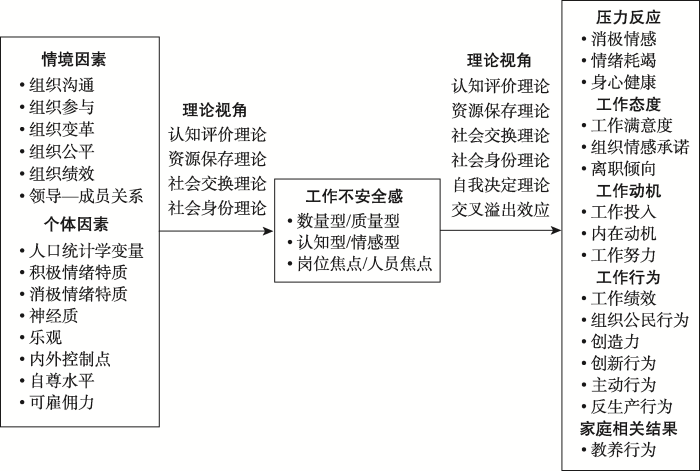
认知评价理论。认知评价理论(Lazarus & Folkman, 1984)认为, 个体是否感知到客观情境对自身福祉的影响以及个体是否有充足的资源应对这一影响共同决定了其认知评价和应对方式。根据认知评价理论, 消极的组织情境因素(较差的组织绩效, Debus et al., 2014; 频繁的组织变革, Çalışkan & Özkoç, 2020)会引发工作不安全感, 对消极刺激敏感或者缺乏应对资源的员工(高消极情绪特质、外控制点, Debus et al., 2014)不仅总体体验到更高的工作不安全感而且对消极情境或刺激的工作不安全感反应更强。另外, 工作不安全感也会引发消极评价, 进而损害员工积极的工作态度、工作行为和身心健康(Debus et al., 2012; Vander Elst et al., 2014)。
资源保存理论。资源保存理论(Hobfoll et al., 2018)认为, 个体致力于维持和保存现有资源, 并利用现有资源获取新资源。实际的资源损失和潜在的资源损失威胁会导致个体压力反应, 同时引发个体采取行动保护资源。另外, 资源的获得和损失呈现螺旋状态。当个体拥有充足的资源时, 倾向于获得更多的资源; 当个体缺乏资源或面临资源损失威胁时, 倾向于进一步损失资源。根据资源保存理论, 资源较少或处于资源损失状态的员工更倾向体验到工作不安全感(Jiang et al., 2021; Vander Elst et al., 2018)。同时, 工作不安全感是一种潜在的资源损失威胁, 会导致员工压力反应, 降低员工对工作的满意度、对组织的情感承诺和对工作的投入等(Jiang & Lavaysse, 2018; Jiang & Probst, 2017; Sender et al., 2017)。
社会交换理论。社会交换理论(Cropanzano & Mitchell, 2005; 邹文篪 等, 2012)认为, 在社会交换关系中, 如果一方从另一方获益, 就有义务回馈对方使双方的积极交换关系得以维持; 反之, 如果一方被另一方伤害, 也会报复对方以维持公平感。心理契约理论是典型的社会交换视角。一方面, 保障工作稳定是员工与组织之间心理契约的一部分。感知自己与组织之间的心理契约破裂会降低员工对工作环境的控制感, 使员工体验到工作不安全感(Keim et al., 2014)。另一方面, 当员工体验到工作不安全感时, 其倾向于认为组织破坏了双方互惠关系, 感知到自己与组织之间的心理契约破裂, 感到情绪耗竭, 降低对工作的满意度和对组织的情感承诺, 并降低工作投入和采取反生产行为等损害组织利益的行为(De Cuyper & De Witte, 2006; Huang et al., 2017; Piccoli & De Witte, 2015)。
2.2 人工智能背景下的工作变革和工作不安全感研究
人工智能技术会对未来的工作和雇佣状况产生深刻影响。在这一背景下, 学者们关注了人工智能技术对工作的客观影响(即工作变革), 以及这一影响导致员工感知到的人工智能技术对工作连续性和稳定性的威胁(即工作不安全感)。接下来, 本文将回顾这两部分内容。
2.2.1 人工智能背景下的工作变革
持智能自动化(AI automation)观点的学者认为人工智能技术通过自动化各类工作任务, 最终导致人类工作被机器取代(Tschang & Almirall, 2021)。Huang和Rust (2018)提出了工作替代理论来预测人工智能技术对人类工作的影响。Huang和Rust区分了机械类、分析类、直觉类和移情类四种智能类型, 并指出这四种智能类型对机器的难度依次增大。人工智能技术先自动化“较低”智能类型的任务, 然后升级到“更高”智能类型的任务, 最终完全替代人类。Frey和Osborne (2017)基于美国劳动力市场数据估计了702个职业被替代的风险, 发现未来10~20年美国大概47%的工作面临着因计算机化而消失的可能性。Arntz等(2016)通过对任务自动化程度的评估, 发现在21个经合组织国家中平均9%的工作具有较高的被自动化的风险。在韩国有6%的工作被认定为易受自动化的影响, 而在奥地利这一比例达12%。Zhou等(2020)基于中国劳动力市场估计了人工智能技术对不同职业的替代率, 发现截至2049年中国将有2.78亿劳动力被人工智能技术替代。
持智能增强(AI augmentation)观点的学者认为人工智能技术会自动化非核心工作任务, 协助人类完成核心工作任务, 最终实现人机协作和人机优势互补(Daugherty & Wilson, 2018)。Chui等(2015)基于美国劳动力市场数据指出人工智能技术会重塑人类工作, 不仅使人类更高效地工作, 而且将人类从重复、机械化的工作中解脱出来从事更复杂、更具创意的工作。例如, 营销人员使用人工智能技术获取潜在客户信息、识别潜在交叉销售和追加销售机会以提升销售效率。Malik等(2022)基于一家全球技术咨询跨国公司印度分公司的案例研究发现, 人工智能技术在人力资源管理中的应用促进了员工对人力资源管理实践的个性化体验, 增加了员工的工作满意度、组织承诺, 减少了员工的退缩倾向, 提升了人力资源管理实践的有效性。Upadhyay和Khandelwal (2018)指出将人工智能技术用于人员招聘可以提高招聘效率、削减招聘成本。随着人工智能技术自动化繁琐的简历筛选任务, 招聘人员将有更多时间专注于战略问题和开展长期规划。
2.2.2 人工智能背景下的工作不安全感
少数学者关注了员工感知到的人工智能技术对工作连续性和稳定性的威胁, 开始在人工智能背景下探讨工作不安全感的影响因素和作用效果。关于工作不安全感影响因素, Lingmont和Alexiou (2020)探讨了智能技术知觉对工作不安全感的影响以及组织学习文化和组织权威文化的调节作用。其研究发现智能技术知觉增加员工工作不安全感, 组织权威文化强化这一关系, 组织学习文化不影响这一关系。Brougham和Haar (2020)也发现智能技术知觉导致员工工作不安全感, 并且拥有更多工作选择的员工能更好地应对智能技术知觉的负面影响。然而Brougham和Haar (2018)发现智能技术知觉不影响员工工作不安全感。另外, Dengler和Gundert (2021)发现职业替代风险增加员工认知工作不安全感, 但不影响员工情感工作不安全感。Nam (2019)发现当前工作的人际互动要求降低员工工作不安全感, 而专业知识要求、创造力要求和任务重复性不影响员工工作不安全感。Yam等(2022)发现机器人接触会增加员工工作不安全感, 并进而导致员工耗竭和人际偏离行为。关于工作不安全感影响后果, 陈文晶等(2022)在人工智能背景下探讨了工作不安全感对员工职业能力发展的影响。其研究发现, 数量型工作不安全感与员工职业能力发展之间存在U型关系, 质量型工作不安全感与员工职业能力发展正相关。职业替代风险强化数量型工作不安全感对职业能力发展的U型效应, 缓解质量型工作不安全感与职业能力发展之间的正向关系。
2.3 人工智能背景下工作不安全感研究的挑战与机遇
工作不安全感的概念和维度结构。人工智能技术对工作连续性和稳定性的影响体现在多方面。一方面, 人工智能技术自动化人类工作可能导致员工失去工作(Roos & Shroff, 2017; 邱玥, 何勤, 2020)。例如, 自助收银系统的应用导致收银员失业。另一方面, 人工智能技术增强人类工作可能使员工面临工作转型(Roos & Shroff, 2017; 邱玥, 何勤, 2020)。例如, 人工智能技术重塑人力资源专家的工作使其更加聚焦于决策、战略和人际沟通任务。传统背景下的工作不安全感研究区分了数量型和质量型工作不安全感(Hellgren et al., 1999)、认知型和情感型工作不安全感(Huang et al., 2010)以及岗位焦点和人员焦点工作不安全感(马冰 等, 2022)。然而这些维度结构不能有效地反映人工智能技术的发展和应用导致个体感知到的工作在未来缺乏连续性和稳定性的威胁, 即工作被智能自动化使员工面临失业和工作被智能增强使员工面临工作转型。因此, 研究者有必要针对性地探讨人工智能背景下工作不安全感这一概念的内涵和维度结构。
工作不安全感的影响后果。传统背景下的工作不安全感主要反映员工对未来不能从事当前工作被他人替代的主观感知, 而人工智能背景下的工作不安全感主要反映员工对未来不能从事当前工作被技术替代或者不适应技术的主观感知。被他人替代和被技术替代会引发不同的心理反应。研究发现, 被他人替代更容易导致个体感知到自我价值受到威胁, 被技术替代更容易导致个体对未来的经济前景感到担忧(Granulo et al., 2019)。鉴于此, 人工智能技术引发的工作不安全感对员工的影响可能与传统背景下工作不安全感的影响不尽相同。另外, 人工智能技术既可能导致工作被智能自动化, 也可能导致工作被智能增强。由于员工对智能自动化和智能增强的心理反应不同(Einola & Khoreva, 2023), 这两种模式下的工作不安全感对员工的影响也可能存在差异。因此, 研究者有必要针对性地揭示人工智能背景下工作不安全感的影响后果以及其不同维度的差异化影响。
工作不安全感的来源。传统背景下的工作不安全感研究主要探讨了组织沟通、组织变革和组织绩效等组织相关情境因素以及员工人口统计学变量、情绪特质和自我评价特质等个人因素对工作不安全感的影响(Lee et al., 2018; Jiang et al., 2021)。人工智能背景下的工作不安全感主要来源于人工智能技术引发的工作变革。当前的工作特征和职业特征很多程度上决定了在人工智能背景下工作将经历何种程度、何种类型的变革, 以及员工将体验到何种程度、何种类型的工作不安全感(Dengler & Gundert, 2021; Nam, 2019)。同时, 智能技术知觉等技术相关的个人特征很可能影响员工是否感知到人工智能技术对工作的影响, 以及是否体验到工作不安全感(Brougham & Haar, 2020; Lingmont & Alexiou, 2020)。因此, 研究者有必要揭示人工智能背景下工作不安全感的独特影响因素, 如当前工作的工作特征和技术相关的个人特征等。
因此, 本文以人工智能背景下的工作不安全感为核心, 提出技术型工作不安全感这一概念, 重点探讨三方面的问题: 1)技术型工作不安全感的内涵和维度结构, 2)不同维度技术型工作不安全感对员工工作结果和职业结果的影响, 3)当前工作的工作特征和员工技术相关的个人特征对技术型工作不安全感的影响。
3 研究构思
3.1 研究目标与研究框架
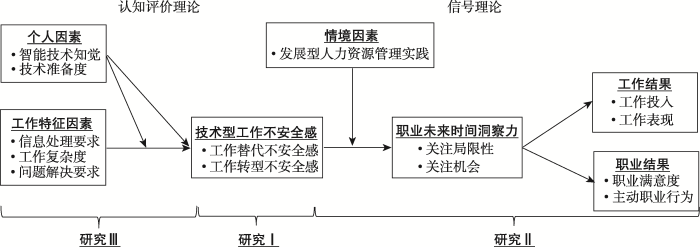
本文以人工智能背景下的工作不安全感为核心, 提出技术型工作不安全感这一概念, 首先探讨技术型工作不安全感的内涵和维度结构, 然后探讨其作用效果和来源。具体有三方面的研究目标:
(1)结合工作不安全感的研究和人工智能背景下的工作变革研究, 明确技术型工作不安全感的内涵, 剖析技术型工作不安全感的维度结构, 拟提炼出工作替代不安全感和工作转型不安全感两个维度。
(2)基于信号理论探讨技术型工作不安全感对员工工作结果和职业结果的影响, 以及上述影响的中介机制和边界条件。
(3)基于认知评价理论探讨当前工作的工作特征对技术型工作不安全感的影响, 员工技术相关的个人特征对技术型工作不安全感的影响, 以及工作特征和个人特征对技术型工作不安全感的联合影响。
与研究目标相对应, 本文共包括3个子研究, 总体研究框架如图2所示。
图2
3.2 研究 1: 人工智能背景下技术型工作不安全感的内涵和维度结构研究
本研究的核心问题: 人工智能背景下技术型工作不安全感的内涵是什么?技术型工作不安全感有哪些基本维度?以往研究虽然在人工智能背景下考察了工作不安全感的来源(员工智能技术知觉, Brougham & Haar, 2020; Lingmont & Alexiou, 2020; 职业替代风险, Dengler & Gundert, 2021)以及工作不安全感对员工倦怠、工作行为和职业能力发展等结果的影响(Koo et al., 2021; Yam et al., 2022; 陈文晶 等, 2020), 但并未聚焦于人工智能技术的发展和应用导致的工作不安全感。为了更有针对性地揭示人工智能背景下的工作不安全感现象, 本文提出技术型工作不安全感这一概念, 将技术型工作不安全感定义为: 人工智能技术的发展和应用导致个体感知到的工作在未来缺乏连续性和稳定性的威胁。围绕该定义, 本研究首先采用质性研究方法提炼技术型工作不安全感的核心维度, 然后开发测量工具。
第一, 核心维度。拟通过深度访谈的方式, 全面了解在管理实践中人工智能技术如何影响个体对工作在未来连续性和稳定性的感知。在充分收集信息的基础上, 构建技术型工作不安全感的理论模型。通过查阅文献可知, 人工智能技术对人类工作的影响主要有两种模式: 1)智能自动化, 即人工智能技术自动化人类工作的核心任务, 人类最终被机器替代, 比如自助收银系统替代收银员; 2)智能增强, 即人工智能技术自动化人类工作的非核心任务, 人类和机器密切协作完成核心任务, 如人工智能技术自动化简历筛选任务并协助人力资源专家更好地完成决策和战略规划任务。在智能自动化和智能增强模式下, 工作的连续性和稳定性都受到了威胁, 因此员工都倾向于感知到技术型工作不安全感, 但感知技术型工作不安全感的具体内容存在差异。智能自动化倾向于导致员工担心在未来机器可能替代人类而失去当前工作(即工作替代不安全感), 智能增强倾向于导致员工担心在未来智能技术可能使当前工作中重要的工作特征(如工作内容、工作模式和工作技能要求等)发生改变(即工作转型不安全感)。综上, 本研究认为: 人工智能背景下, 技术型工作不安全感有工作替代不安全感和工作转型不安全感两个核心维度。
第二, 测量工具。在上述研究的基础上, 结合以往的工作不安全感测量工具(Ashford et al., 1989; Hellgren et al., 1999), 本研究拟开发具有较高信效度的技术型工作不安全感量表, 并进行实证检验。本研究设想的工作替代不安全感的测量题目: “由于人工智能技术的发展和应用, 我担心在未来机器可能替代人类而失业”、“由于人工智能技术的发展和应用, 我担心在未来机器可能替代人类而被解雇”。本研究设想的工作转型不安全感的测量题目: “由于人工智能技术的发展和应用, 我担心在未来当前工作的技能要求可能发生改变”、“由于人工智能技术的发展和应用, 我担心在未来当前工作的工作模式可能发生改变”。
3.3 研究2: 人工智能背景下技术型工作不安全感的作用效果研究
研究1明确了技术型工作不安全感的内涵, 区分了工作替代和工作转型不安全感。在此基础上, 研究2探讨技术型工作不安全感对员工的影响并揭示不同维度技术型工作不安全感的差异化影响。研究的核心问题: 不同维度技术型工作不安全感如何影响员工工作结果和职业结果?影响机制和边界条件是什么?信号理论(Spence, 2002)认为, 个体与更大实体(通常不可观测)之间的信息是不对称的。由于缺乏足够的信息, 个体通过寻找和解读实体释放的信号来进行判断和决策(Taj, 2016)。员工在当前工作中的体验是反映职业生涯前景的重要信号(Chang & Busser, 2020)。基于信号理论, 本研究认为技术型工作不安全感通过影响员工对职业未来的感知(即职业未来时间洞察力)进而影响员工工作结果和职业结果。同时, 上述影响的强度取决于组织是否实施组织-员工协同发展的人力资源管理实践(即发展型人力资源管理实践)。研究模型图如图3所示。
图3
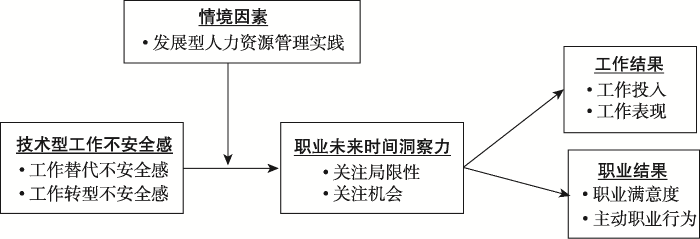
第一, 技术型工作不安全感对员工职业未来时间洞察力(关注局限性和关注机会)的影响。职业未来时间洞察力(occupational future time perspective)反映了个体对未来职业生涯的感知(Zacher & Frese, 2009)。本研究关注职业未来时间洞察力的两个维度: 关注局限性(focus on limitations)和关注机会(focus on opportunities)。关注局限性指个体感知到未来职业生涯中的约束和限制, 关注机会指个体感知到未来职业生涯中的目标、选择和可能性(Rudolph et al., 2018; Zacher & Frese, 2009)。作为员工在当前工作中的体验, 技术型工作不安全感是重要的信号, 传递着职业生涯前景的信息(Chang & Busser, 2020)。具体而言, 工作替代不安全感不仅意味着员工需要消耗资源应对工作和职业生涯的不连续性、不稳定性(局限性), 也向员工传递着当前的工作没有发展前景、缺乏职业机会的信息(机会)。工作转型不安全感虽然也意味着员工需要投入个人资源应对不确定性(局限性), 但也向员工传递着不断调整工作模式、更新工作技能和提高胜任力就能在未来的职业生涯中拥有更多选择和可能性的信息(机会)。因此, 本研究认为: 工作替代不安全感与关注局限性正相关、与关注机会负相关; 工作转型不安全感与关注局限性和关注机会均正相关。
第二, 职业未来时间洞察力(关注局限性和关注机会)对员工工作结果和职业结果的影响。当员工关注局限性时, 会专注于损失和消极结果(Zacher & Frese, 2009)。因此, 关注局限性激发员工在工作中的规避倾向, 导致员工难以全身心地投入工作, 抑制员工的工作表现和主动职业行为, 进而也会降低员工的职业满意度(Zacher & Rudolph, 2021)。当员工关注机会时, 会专注于可以获得的机会和可以实现的目标(Zacher & Frese, 2009)。因此, 关注机会激发员工在工作中的趋近倾向, 激励员工全身心投入工作、力争在工作中表现更好以及主动进行职业生涯管理, 进而也会增加员工的职业满意度(Zacher & Rudolph, 2021)。本研究认为: 关注局限性与工作投入、工作表现、主动职业行为和职业满意度负相关; 关注机会与工作投入、工作表现、主动职业行为和职业满意度正相关。
第三, 技术型工作不安全感通过职业未来时间洞察力(关注局限性和关注机会)对员工工作结果和职业结果的影响。工作替代和工作转型不安全感对职业未来时间洞察力(关注局限性和关注机会)的影响不同, 因此通过职业未来时间洞察力对员工工作投入、工作表现、主动职业行为和职业满意度的影响也不同。本研究认为: 工作替代不安全感通过关注局限性和关注机会对工作投入、工作表现、主动职业行为和职业满意度产生间接负向影响; 工作转型不安全感通过关注局限性对工作投入、工作表现、主动职业行为和职业满意度产生间接负向影响, 同时通过关注机会对工作投入、工作表现、主动职业行为和职业满意度产生间接正向影响。
第四, 发展型人力资源管理实践的调节作用。发展型人力资源管理实践将员工视为组织的合作伙伴, 通过多元培训、发展评估、工作设计和沟通反馈来促进员工的潜力开发与职业发展, 进而实现组织和员工的共同发展(唐春勇等, 2021)。如同技术型工作不安全感, 这一人力资源管理实践也是传递职业生涯前景信息的重要信号(Rodrigues et al., 2020)。具体而言, 发展型人力资源管理实践不仅能开发员工潜力、提升员工胜任力使员工感知到更多的未来职业生涯机会, 而且能提供资源帮助员工应对职业生涯的不确定性使员工感知到更少的未来职业生涯局限性。因此, 发展型人力资源管理实践提供的信息与技术型工作不安全感(工作转型不安全感)传递的未来职业生涯机会的信息一致, 与技术型工作不安全感(工作替代和工作转型不安全感)传递的未来职业生涯局限性的信息不一致。信号的一致性与否会影响个体对信号反应。当不同信号提供的信息一致时, 个体更加确信信号提供的信息, 信号的作用效果增强; 反之, 当不同信号提供的信息相互冲突时, 个体会感到困惑, 信号的作用效果减弱(Connelly et al., 2011; Ho & Kong, 2015)。因此, 发展型人力资源管理实践会强化技术型工作不安全感引发的员工对未来职业生涯机会的关注, 缓解技术型工作安全感导致的员工对未来职业生涯局限性的关注。具体表现为: 发展型人力资源管理实践缓解技术型工作不安全感(工作替代和工作转型不安全感)与关注局限性之间的正向关系, 缓解工作替代不安全感与关注机会之间的负向关系, 增强工作转型不安全感与关注机会之间的正向关系。
由于技术型工作不安全感通过职业未来时间洞察力影响员工工作结果和职业结果, 同时发展型人力资源管理实践调节技术型工作不安全感与职业未来时间洞察力之间的关系, 因此发展型人力资源管理实践调节技术型工作不安全感通过职业未来时间洞察力对员工工作结果和职业结果的影响。本研究认为: 发展型人力资源管理实践缓解技术型工作不安全感(工作替代和工作转型不安全感)通过关注局限性对工作投入、工作表现、主动职业行为和职业满意度的负向影响, 缓解工作替代不安全感通过关注机会对工作投入、工作表现、主动职业行为和职业满意度的负向影响, 增强工作转型不安全感通过关注机会对工作投入、工作表现、主动职业行为和职业满意度的正向影响。
3.4 研究3: 人工智能背景下技术型工作不安全感的来源研究
为了深入理解人工智能背景下的工作不安全感现象、构建完整的技术型工作不安全感理论框架, 研究者不仅需要揭示技术型工作不安全感的独特影响后果, 还需要识别其独特来源。同时, 研究2表明工作替代和工作转型不安全感对员工的影响不同, 那么识别这两种维度技术型工作不安全感的差异化影响因素也有助于指导管理实践者进行针对性的干预。研究3拓展研究2进一步探讨技术型工作不安全感的来源。
人工智能技术的发展和应用几乎会对所有工作产生影响, 然而影响程度和影响模式存在差异。人工智能技术通常自动化迭代和信息处理类任务, 协助人类完成复杂的问题解决类任务(Daugherty & Wilson, 2018)。因此, 当前工作的工作特征很大程度上决定了人工智能技术将对工作产生何种影响。另外, 员工能否意识到人工智能技术对工作的影响以及如何评价这一影响也可能导致其体验到不同程度的技术型工作不安全感(Brougham & Haar, 2020; Lingmont & Alexiou, 2020)。本研究拟从工作特征因素和员工个人因素两方面探讨技术型工作不安全感的来源。研究的核心问题: 员工当前工作的工作特征会影响其感知到的技术型工作不安全感吗?影响机制是什么?哪些特征的员工更倾向于感知到技术型工作不安全感?工作特征与个人特征会联合影响员工感知到的技术型工作不安全感吗?
认知评价理论(Lazarus & Folkman, 1984)认为, 当个体感知客观刺激会影响自身福祉时, 会进一步评价这一刺激是促进还是损害自身福祉以及自身是否有足够的应对资源。当客观刺激促进自身福祉时, 个体进行挑战评价; 当客观刺激损害自身福祉并且自身缺乏足够的应对资源时, 个体进行威胁评价。技术型工作不安全感指人工智能技术的发展和应用导致个体感知到的工作在未来缺乏连续性和稳定性的威胁, 是个体对工作情境的主观评价(Yam et al., 2022)。工作特征构成了重要的工作情境, 会影响员工的认知评价, 并进而影响其工作态度、工作行为和身心健康(Ohly & Fritz, 2010; 姜福斌, 王震, 2022)。基于认知评价理论, 本研究认为工作特征(信息处理要求、工作复杂性和问题解决要求)通过影响员工对智能技术影响工作的预期进而影响员工感知到的技术型工作不安全感。技术相关的个人特征(智能技术知觉和技术准备度)不仅直接影响员工感知到的技术型工作不安全感, 而且影响工作特征与技术型工作不安全感之间的关系。研究模型图如图4所示。
图4
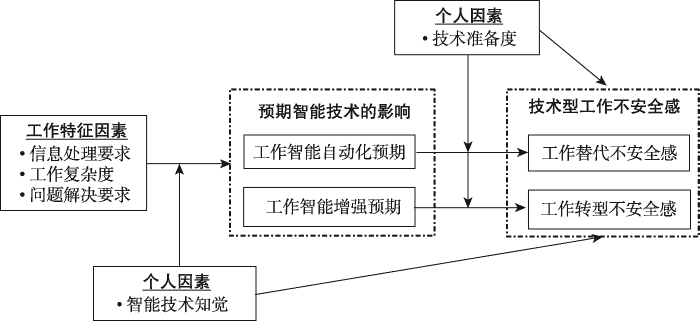
第一, 工作特征的直接作用。人工智能技术区别于以往技术的典型特征是能够替代人的脑力, 会影响知识类工作。因此, 本研究探讨信息处理要求、工作复杂性和问题解决要求三类知识性工作特征对技术型工作不安全感的影响。高信息处理要求的工作需要处理大量数据或其它信息; 高复杂性的工作需要应用多种高级技能、认知要求高; 高问题解决要求的工作需要产生创新性的想法和方案、发现和解决问题(Morgeson & Humphrey, 2006)。高信息处理要求、低复杂性、低问题解决要求的工作是机器擅长的, 倾向于被人工智能技术自动化, 使员工感知到未来会被机器替代, 因此引发员工的威胁评价和工作替代不安全感。低信息处理要求、高复杂性、高问题解决要求的工作暂时难以被人工智能技术自动化, 而需要人机协同工作引起工作模式和工作技能要求等的变化, 使员工感知到当前的工作方式和工作能力与未来的工作要求不匹配, 因此引发员工的威胁评价和工作转型不安全感。本研究认为: 信息处理要求与工作替代不安全感正相关、与工作转型不安全感负相关; 工作复杂性与工作替代不安全感负相关、与工作转型不安全感正相关; 问题解决要求与工作替代不安全感负相关、与工作转型不安全感正相关。
第二, 工作智能自动化/增强预期的中介作用。根据认知评价理论(Lazarus & Folkman, 1984), 认知评价起始于个体感知到自身福祉会受到影响。因此, 本研究认为客观的工作特征通过影响员工对智能技术影响工作的预期(工作智能自动化/增强预期)进而影响技术型工作不安全感。工作智能自动化意味着机器替代人类, 而工作智能增强意味着人机协同工作。高信息处理要求、低复杂性、低问题解决要求的工作容易被人工智能技术自动化, 而且其自动化能促进组织效率的提升(Brynjolfsson & McAfee, 2014; Daugherty & Wilson, 2018)。因此, 员工倾向于预期高信息处理要求、低复杂性、低问题解决要求的工作在未来会被智能技术自动化。反之, 低信息处理要求、高复杂性、高问题解决要求的工作暂时难以被人工智能技术自动化(Huang & Rust, 2018), 需要人机协同工作。因此, 员工倾向于预期低信息处理要求、高复杂性、高问题解决要求的工作在未来会被智能技术增强。当个体预期工作会被智能自动化/增强(自身福祉受到影响)后, 会进一步评价这一影响是积极还是消极的。工作智能自动化预期进而可能导致员工感知到机器替代人类而失业的威胁(工作替代不安全感); 工作智能增强预期进而可能导致员工感知到工作内容、工作模式和工作技能要求等发生变化的威胁(工作转型不安全感)。因此, 本研究认为: 信息处理要求、工作复杂性和问题解决要求通过工作智能自动化预期影响工作替代不安全感, 通过工作智能增强预期影响工作转型不安全感。
第三, 员工个人特征的直接作用。员工个人特征影响其对客观刺激的感知和认知评价(Lazarus & Folkman, 1984)。不同特征的个体对相同的客观刺激的感知和认知评价存在差异(Debus et al., 2014)。鉴于此, 本研究进一步探讨智能技术知觉和技术准备度这两种个人特征对技术型工作不安全感的影响。智能技术知觉反映了个体对智能技术在未来影响其工作的感知(Brougham & Haar, 2018)。高智能技术知觉的员工更能意识到人工智能技术的发展和应用对工作的影响, 因此总体而言更倾向于感知到技术型工作不安全感。本研究认为: 智能技术知觉与技术型工作不安全感(工作替代和工作转型不安全感)正相关。技术准备度指个体接受和使用新技术实现工作目标的倾向(Lin & Hsieh, 2012; Parasuraman, 2000)。高技术准备度的员工更积极地看待技术引发的工作变化, 并且有充足的资源应对该变化, 因此总体而言更不倾向于感知到技术型工作不安全感。本研究认为: 技术准备度与技术型工作不安全感(工作替代和工作转型不安全感)负相关。
第四, 员工个人特征的调节作用。根据认知评价理论(Lazarus & Folkman, 1984), 个体的认知评价首先取决于个体感知到自身福祉会受到影响, 然后取决于个体如何看待这种影响以及个体是否有资源应对不利影响。工作特征信息转化为工作智能自动化/增强预期的重要前提是员工能意识到人工智能技术在未来会对工作产生影响。高智能技术知觉的员工能够意识到这一影响, 倾向于加工工作特征信息并进一步判断人工智能技术将对工作产生何种影响; 反之, 低智能技术知觉的员工无法意识到人工智能技术对工作的影响, 不倾向于从人工智能技术角度加工工作特征信息(Brougham & Haar, 2018)。因此, 本研究认为: 智能技术知觉加强信息处理要求与工作智能自动化预期(正向)和工作智能增强预期(负向)之间的关系, 加强工作复杂性与工作智能自动化预期(负向)和工作智能增强预期(正向)之间的关系, 加强问题解决要求与工作智能自动化预期(负向)和工作智能增强预期(正向)之间的关系。另外, 工作智能自动化/增强预期是否转化为技术型工作不安全感很大程度上取决于员工对技术的态度以及员工是否有资源应对技术带来的变化和不确定性。高技术准备度的员工对技术持积极态度, 并且对技术具有高度掌控感(Lin & Hsieh, 2012; Parasuraman, 2000)。因此, 对高技术准备度的员工而言, 工作智能自动化预期更少使其感知到工作替代不安全感, 工作智能增强预期更少使其感知到工作转型不安全感。本研究认为: 技术准备度缓解工作智能自动化预期与工作替代不安全感之间的正向关系, 缓解工作智能增强预期与工作转型不安全感之间的正向关系。
最后, 结合上述中介作用和调节作用, 本研究还进一步认为智能技术知觉和技术准备度调节工作特征(信息处理要求、工作复杂性和问题解决要求)通过工作智能自动化/增强预期对技术型工作不安全感的影响。
4 理论构建
本文在人工智能背景下探讨了工作不安全感现象, 提出了技术型工作不安全感这一概念。通过明确技术型工作不安全感的内涵和维度结果、揭示其影响后果并识别其影响因素, 本文构建了一个系统的技术型工作不安全感理论框架, 有以下三方面的理论创新。
首先, 本文创新性地提出了技术型工作不安全感这一概念并剖析其维度结构, 深化了人工智能背景下的工作不安全感研究。以往研究主要在传统背景下探讨了工作不安全感的影响因素和影响后果(Jiang et al. 2021; Lee et al., 2018; Shoss, 2017)。只有少数研究在人工智能背景下探讨了工作不安全感现象(Brougham & Haar, 2020; Lingmont & Alexiou, 2020; Nam et al, 2019), 但并未聚焦人工智能技术的发展和应用导致个体感知到的工作不安全感。技术型工作不安全感这一概念的提出和内涵与维度结构的明确, 为后续深入探讨人工智能背景下的工作不安全感现象、揭示其独特来源和作用效果奠定了基础。另外, 以往研究根据工作不安全感的内容区分了数量型和质量型工作不安全感(Hellgren et al., 1999), 根据工作不安全感的性质区分了认知型和情感型工作不安全感(Huang et al., 2010), 根据威胁来源区分了岗位焦点和人员焦点工作不安全感(马冰 等, 2022)。本文根据人工智能技术引发的工作变革区分了工作替代和工作转型不安全感, 拓展了工作不安全感的概念和维度结构研究。
其次, 本文探讨了技术型工作不安全感对员工工作结果和职业结果的影响。传统背景下的工作不安全感研究主要基于认知评价理论、资源保存理论、社会交换理论和社会身份理论等探讨了工作不安全感对员工身心健康、工作态度、工作动机和工作行为的影响(Lee et al., 2018; Shoss, 2017)。本文基于信号理论认为技术型工作不安全感传递着职业生涯前景的信息, 会影响员工对职业未来的感知并进而影响员工工作结果和职业结果。因此, 本文不仅丰富了工作不安全感研究的理论视角, 也揭示了技术型工作不安全感的独特影响后果。另外, 少数人工智能背景下的研究探讨了工作不安全感对员工耗竭、工作行为和职业能力发展等结果的影响(Koo et al., 2021; Yam et al., 2022; 陈文晶 等, 2020), 但并未揭示影响机制。本文拓展以往研究探讨了不同维度技术型工作不安全感对员工结果的差异化影响, 并揭示了中介机制与边界条件。这为后续人工智能背景下工作不安全感作用效果的研究提供了理论指导。
最后, 本文探讨了工作特征因素和员工个人因素对技术型工作不安全感的影响。传统背景下的工作不安全感研究主要关注了组织沟通、组织变革和组织绩效等组织相关的情境因素以及员工人口统计学信息、情绪特质和自我评价特质等个人因素对工作不安全感的影响(Jiang et al., 2021; Lee et al., 2018)。不同于传统背景下的研究, 本文探讨了工作特征(信息处理要求、工作复杂性和问题解决要求)和技术相关的员工个人特征(智能技术知觉和技术准备度)对技术型工作不安全感的影响, 揭示了技术型工作不安全感的独特影响因素。另外, 以往研究表明, 机器人的应用会导致从事低技能工作的员工和从事高智力要求工作的员工都感知到工作不安全感(Yam et al., 2022)。本文拓展以往研究认为, 从事不同特征工作的员工会感知到不同类型的技术型工作不安全感。具体而言, 从事高信息处理要求、低复杂性和低问题解决要求工作的员工倾向于感知到工作替代不安全感, 从事低信息处理要求、高复杂性和高问题解决要求工作的员工倾向于感知到工作转型不安全感。同时, Nam (2019)在人工智能背景下探讨了工作特征对工作不安全感的影响, 发现工作的专业知识要求、创造力要求和任务重复性不影响员工感知到的工作不安全感。本文认为同一工作特征对工作替代和工作转型不安全感的作用效果相反, 作用强度取决于员工的个人特征(即智能技术知觉和技术准备度)。通过揭示同一种工作特征对工作替代和工作转型不安全感的差异化影响以及影响的边界条件, 本文加深了工作特征与技术型工作不安全感之间关系的理解。
本文也有一定的实践价值。人工智能技术会对人类工作产生巨大冲击、威胁员工工作的连续性和稳定性。在中国企业数字化转型之际缓解员工感知到的技术型工作不安全感以及帮助员工有效应对技术型工作不安全感对于构建和谐稳定的劳动关系具有重要意义。因此, 在组织行为领域, 探讨人工智能背景下技术型工作不安全感的内涵、作用效果和来源, 有助于组织采取有效措施提升转型期员工的工作幸福感和促进和谐稳定劳动关系的建立。
参考文献
工作不安全感的研究现状与展望
工作不安全感反映了一种雇员对工作或工作重要特性受到威胁时的感知和担忧。从上世纪80年代以来,它已逐步成为西方组织行为及职业心理健康研究领域中的一个重要构念。文章从5种视角厘清工作不安全感内涵及研究中存在的混淆之处,对其测量工具、研究取向进行介绍,并对有关其前因、后果和调节变量的实证研究成果进行系统性的总结,在此基础上指出未来研究的方向:(1)亟待开发统一的测量工具;(2)在区分组织情境的条件下开展更细化的研究;(3)对前因及后果的细致探索;(4)加强对调节变量的研究;(5)纵向研究的需要;(6)跨文化比较研究。
压力认知评价理论在管理心理学中的应用: 场景、方式与迷思
DOI:10.3724/SP.J.1042.2022.02825
[本文引用: 1]

工作场所中, 压力源无处不在; 面对压力源, 个体会如何反应?压力认知评价理论从认知评价和应对角度为这一问题提供了系统解释。在过去的40年里, 该理论已成为阐释个体压力反应的主流框架。然而, 由于提出时间较早, 该理论没有提供各理论要素间的精确关系, 这使得后续实证研究从各自研究问题出发, 对该理论的应用五花八门, 甚至因曲解理论观点而造成不当应用, 不利于对该理论的持续应用和深入发展。在系统回顾理论观点的基础上, 重点梳理了125篇以该理论作为核心理论基础的管理心理学实证研究。总体发现:在应用场景方面, 压力认知评价理论可以用来解释6种压力源对员工工作态度、行为、身心健康和工作-家庭关系的影响; 其应用形式可以从初级评价、次级评价和应对3个方面分别考虑; 一些研究在应用该理论时存在误区。未来研究需要优化理论要素的测量方式, 进一步拓展该理论的应用场景, 同时丰富认知评价过程的影响因素研究。
居危思变?工作不安全感对创新行为的差异化影响
DOI:10.3724/SP.J.1042.2022.02381
[本文引用: 4]
企业往往在员工管理和组织创新上处于“两难困境”——难以提供稳定工作但又不得不依赖员工实现组织创新, 这就使得研究员工工作不安全感对创新行为的影响至关重要。企业员工遭遇不同环境威胁带来的工作不安全感时, 创新行为存在差异。本文在威胁焦点下深化工作不安全感概念, 并基于“以变量为中心”和“以人为中心”的研究思路, 探讨其对创新行为的差异化影响过程。首先, 结合环境威胁来源与主观感知, 把工作不安全感分为岗位焦点工作不安全感和人员焦点工作不安全感两个维度, 并将编制测量量表。其次, 期望运用纵向研究设计, 通过分析多时点的员工-主管配对数据, 基于情境调节焦点和工作激情的链式中介作用, 来揭示岗位焦点工作不安全感对创新行为的负向影响, 以及人员焦点工作不安全感对创新行为的倒U型影响。最后, 将采取“以人为中心”的研究思路, 运用潜在剖面分析方法探讨工作不安全感潜在类型及其对创新行为的影响。研究结果将有助于推进工作不安全感的概念和效用研究, 也为企业如何有效促进创新提供对策建议。
“投桃报李”——互惠理论的组织行为学研究述评
DOI:10.3724/SP.J.1042.2012.01879
[本文引用: 1]
互惠是一种存在于各种社会文化中的人际交往规范。组织行为学中许多研究都是通过互惠理论来解释变量之间的内部作用机制。文章回顾并讨论了互惠的涵义, 不同互惠类型的特点及互惠的测量方式。此外, 还论述了不同类型互惠对社会交换方式产生的影响。依据现有的互惠研究成果, 分析了互惠发挥影响的内在作用机制是通过:互惠各方的价值观、互惠过程中各方感知到的风险、各方冲突的程度这三种途径来实现的。最后, 根据现有互惠理论的研究成果提出该领域的未来发展应从研究设计和研究内容两方面进行扩展。
Content, cause, and consequences of job insecurity: A theory-based measure and substantive test
DOI:10.2307/256569 URL [本文引用: 1]
Social identity theory and the organization
DOI:10.2307/258189 URL [本文引用: 1]
The contagion of stress across multiple roles
DOI:10.2307/352378 URL [本文引用: 1]
Smart technology, artificial intelligence, robotics, and algorithms (STARA): Employees’ perceptions of our future workplace
Technological disruption and employment: The influence on job insecurity and turnover intentions: A multi-country study
DOI:10.1016/j.techfore.2020.120276 URL [本文引用: 6]
Organizational change and job insecurity: The moderating role of employability
DOI:10.1108/IJCHM-05-2020-0387
URL
[本文引用: 1]
The purpose of this study is to examine the relationship between characteristics of change (frequency of change [FC], impact of change [IC], planning involved in change [PC]) and job insecurity (JIS), as well as the moderating role of employability (EMP) within these relationships.
Hospitality career retention: The role of contextual factors and thriving at work
DOI:10.1108/IJCHM-10-2018-0831
URL
[本文引用: 2]
This study aims to understand employee career retention in the hospitality industry. Building on the socially embedded model of thriving, signaling theory and social cognitive career theory (SCCT), the study examines a structural model of psychological contract fulfillment (PCF), perceived organizational support (POS), thriving, career satisfaction and career turnover intention.
Four fundamentals of workplace automation
Signaling theory: A review and assessment
DOI:10.1177/0149206310388419
URL
[本文引用: 1]
Signaling theory is useful for describing behavior when two parties (individuals or organizations) have access to different information. Typically, one party, the sender, must choose whether and how to communicate (or signal) that information, and the other party, the receiver, must choose how to interpret the signal. Accordingly, signaling theory holds a prominent position in a variety of management literatures, including strategic management, entrepreneurship, and human resource management. While the use of signaling theory has gained momentum in recent years, its central tenets have become blurred as it has been applied to organizational concerns. The authors, therefore, provide a concise synthesis of the theory and its key concepts, review its use in the management literature, and put forward directions for future research that will encourage scholars to use signaling theory in new ways and to develop more complex formulations and nuanced variations of the theory.
Social exchange theory: An interdisciplinary review
DOI:10.1177/0149206305279602
URL
[本文引用: 1]
Social exchange theory (SET) is one the most influential conceptual paradigms in organizational behavior. Despite its usefulness, theoretical ambiguities within SET remain. As a consequence, tests of the model, as well as its applications, tend to rely on an incompletely specified set of ideas. The authors address conceptual difficulties and highlight areas in need of additional research. In so doing, they pay special attention to four issues: (a) the roots of the conceptual ambiguities, (b) norms and rules of exchange, (c) nature of the resources being exchanged, and (d) social exchange relationships.
The impact of job insecurity and contract type on attitudes, well-being and behavioural reports: A psychological contract perspective
DOI:10.1348/096317905X53660 URL [本文引用: 1]
Job insecurity and psychological well-being: Review of the literature and exploration of some unresolved issues
DOI:10.1080/135943299398302 URL [本文引用: 2]
The building blocks of job insecurity: The impact of environmental and person-related variables on job insecurity perceptions
DOI:10.1111/joop.12049 URL [本文引用: 3]
Catch me if I fall! Enacted uncertainty avoidance and the social safety net as country-level moderators in the job insecurity-job attitudes link
DOI:10.1037/a0027832
PMID:22448808
[本文引用: 1]
Job insecurity is related to many detrimental outcomes, with reduced job satisfaction and affective organizational commitment being the 2 most prominent reactions. Yet, effect sizes vary greatly, suggesting the presence of moderator variables. On the basis of Lazarus's cognitive appraisal theory, we assumed that country-level enacted uncertainty avoidance and a country's social safety net would affect an individual's appraisal of job insecurity. More specifically, we hypothesized that these 2 country-level variables would buffer the negative relationships between job insecurity and the 2 aforementioned job attitudes. Combining 3 different data sources, we tested the hypotheses in a sample of 15,200 employees from 24 countries by applying multilevel modeling. The results confirmed the hypotheses that both enacted uncertainty avoidance and the social safety net act as cross-level buffer variables. Furthermore, our data revealed that the 2 cross-level interactions share variance in explaining the 2 job attitudes. Our study responds to calls to look at stress processes from a multilevel perspective and highlights the potential importance of governmental regulation when it comes to individual stress processes.(PsycINFO Database Record (c) 2012 APA, all rights reserved).
Digital transformation and subjective job insecurity in Germany
DOI:10.1093/esr/jcaa066
URL
[本文引用: 4]
The present study examines to what extent employees in Germany are afraid of losing their jobs, depending on the degree of computerization of their occupations. So far, empirical evidence on the relationship between digital transformation and subjective job insecurity is scarce. We distinguish three interrelated insecurity measures: cognitive job insecurity, i.e. the individual assessment of job loss probability, labour market insecurity, i.e. the perceived availability of job alternatives, and affective job insecurity, i.e. the extent to which individuals are worried about a potential job loss. The analysis is based on a large-scale panel study from Germany and refers to the period between 2013 and 2016. Computerization is measured by the occupation-specific substitution potential, i.e. the extent to which occupational tasks are substitutable by computers or computer-controlled machines. The results from multivariate panel analysis suggest that the digital transformation has a negative impact on cognitive job insecurity. We do not find effects on labour market insecurity and affective job insecurity.
Best friend or broken tool? Exploring the co-existence of humans and artificial intelligence in the workplace ecosystem
DOI:10.1002/hrm.v62.1 URL [本文引用: 1]
The future of employment: How susceptible are jobs to computerisation?
DOI:10.1016/j.techfore.2016.08.019 URL [本文引用: 1]
Psychological reactions to human versus robotic job replacement
DOI:10.1038/s41562-019-0670-y
PMID:31384025
[本文引用: 1]
Advances in robotics and artificial intelligence are increasingly enabling organizations to replace humans with intelligent machines and algorithms. Forecasts predict that, in the coming years, these new technologies will affect millions of workers in a wide range of occupations, replacing human workers in numerous tasks, but potentially also in whole occupations. Despite the intense debate about these developments in economics, sociology and other social sciences, research has not examined how people react to the technological replacement of human labour. We begin to address this gap by examining the psychology of technological replacement. Our investigation reveals that people tend to prefer workers to be replaced by other human workers (versus robots); however, paradoxically, this preference reverses when people consider the prospect of their own job loss. We further demonstrate that this preference reversal occurs because being replaced by machines, robots or software (versus other humans) is associated with reduced self-threat. In contrast, being replaced by robots is associated with a greater perceived threat to one's economic future. These findings suggest that technological replacement of human labour has unique psychological consequences that should be taken into account by policy measures (for example, appropriately tailoring support programmes for the unemployed).
Job insecurity: Toward conceptual clarity
DOI:10.2307/258284 URL [本文引用: 4]
A two- dimensional approach to job insecurity: Consequences for employee attitudes and well-being
DOI:10.1080/135943299398311 URL [本文引用: 6]
Exploring the signaling function of idiosyncratic deals and their interaction
DOI:10.1016/j.obhdp.2015.08.002 URL [本文引用: 1]
Conservation of resources in the organizational context: The reality of resources and their consequences
DOI:10.1146/orgpsych.2018.5.issue-1 URL [本文引用: 1]
Affective job insecurity: A mediator of cognitive job insecurity and employee outcomes relationships
Deviance and exit: The organizational costs of job insecurity and moral disengagement
DOI:10.1037/apl0000158 URL [本文引用: 1]
Artificial intelligence in service
DOI:10.1177/1094670517752459
URL
[本文引用: 4]
Artificial intelligence (AI) is increasingly reshaping service by performing various tasks, constituting a major source of innovation, yet threatening human jobs. We develop a theory of AI job replacement to address this double-edged impact. The theory specifies four intelligences required for service tasks—mechanical, analytical, intuitive, and empathetic—and lays out the way firms should decide between humans and machines for accomplishing those tasks. AI is developing in a predictable order, with mechanical mostly preceding analytical, analytical mostly preceding intuitive, and intuitive mostly preceding empathetic intelligence. The theory asserts that AI job replacement occurs fundamentally at the task level, rather than the job level, and for “lower” (easier for AI) intelligence tasks first. AI first replaces some of a service job’s tasks, a transition stage seen as augmentation, and then progresses to replace human labor entirely when it has the ability to take over all of a job’s tasks. The progression of AI task replacement from lower to higher intelligences results in predictable shifts over time in the relative importance of the intelligences for service employees. An important implication from our theory is that analytical skills will become less important, as AI takes over more analytical tasks, giving the “softer” intuitive and empathetic skills even more importance for service employees. Eventually, AI will be capable of performing even the intuitive and empathetic tasks, which enables innovative ways of human–machine integration for providing service but also results in a fundamental threat for human employment.
Mapping the context
In J. Hartley, D. Jacobson, B. Klandermans, & T. Van Vuuren (Eds.), Job insecurity: Coping with jobs at risk (pp. 1-22). London, England: Sage.
Cognitive and affective job insecurity: A meta-analysis and a primary study
DOI:10.1177/0149206318773853
URL
[本文引用: 2]
Job insecurity is one of the most common stressors in contemporary working life. Although research indicates that the job insecurity construct has cognitive (i.e., the perceived negative change to one’s job) and affective (i.e., the emotional reactions to the potential change to one’s job) components, scholars rarely apply this distinction between cognitive and affective job insecurity in their conceptualization and theory development. On the basis of 535 independent samples, a meta-analysis in Study 1 found that (1) job insecurity was significantly related to 51 out of 56 outcomes and correlates; (2) affective job insecurity had stronger relations with the majority of outcomes and correlates than did cognitive job insecurity as well as explained valid, unique variance in outcomes and correlates above and beyond cognitive job insecurity; and (3) in most cases, affective job insecurity mediated the relationships between cognitive job insecurity and its outcomes. Furthermore, Study 2 examines a moderator that may explain why individuals with the same level of cognitive job insecurity may display different levels of affective job insecurity. Specifically, we found a stronger relationship between cognitive job insecurity and affective job insecurity among individuals with high work centrality with two samples. Overall, results demonstrate that it is empirically meaningful to treat cognitive job insecurity and affective job insecurity as two separate constructs and that affective job insecurity is more closely related to employee outcomes than is cognitive job insecurity. Future research could further assess affective job insecurity and continue to explore moderators and mediators in the cognitive job insecurity–affective job insecurity relationship.
The rich get richer and the poor get poorer: Country-and state-level income inequality moderates the job insecurity-burnout relationship
DOI:10.1037/apl0000179 URL [本文引用: 1]
A resources- demands approach to sources of job insecurity: A multilevel meta-analytic investigation
DOI:10.1037/ocp0000267 URL [本文引用: 5]
Why do employees worry about their jobs? A meta-analytic review of predictors of job insecurity
DOI:10.1037/a0036743
PMID:24796228
[本文引用: 1]
We used psychological contract theory as a framework to meta-analytically review subjective and objective predictors of employees' perceived job insecurity. Seventy-six samples from 68 studies were included in our review. Results revealed that lower levels of job insecurity are associated with having an internal locus of control, lower amounts of role ambiguity and role conflict, greater amounts of organizational communication, less organizational change, younger employees, and white-collar and permanent work. Moderator analyses further revealed that relations between job insecurity and age, gender, education, and formal contracts are moderated by unemployment rates, countries of origin, and type of job insecurity measure. We discuss theoretical and practical implications for psychological contract theory and occupational health, and offer directions for future research.
Examining the impact of artificial intelligence on hotel employees through job insecurity perspectives
DOI:10.1016/j.ijhm.2020.102763 URL [本文引用: 3]
Job insecurity and the changing workplace: Recent developments and the future trends in job insecurity research
DOI:10.1146/orgpsych.2018.5.issue-1 URL [本文引用: 6]
Does parental job insecurity matter? Money anxiety, money motives, and work motivation
A structural model focusing on the spillover effect of parental perceived job insecurity on money anxiety was developed and tested. The crossover effect of parents' money anxiety on their children's money anxiety, money motives, and motivation to work was also examined. Data were collected from a sample of undergraduates and their parents. Results of structural equation modeling analyses supported a spillover effect of paternal perceived job insecurity on paternal money anxiety. However, maternal perceived job insecurity was not significantly associated with maternal money anxiety. Results also supported a crossover effect of parental money anxiety on youths' money anxiety. Youths' money anxiety was significantly related to youths' negative money motives. In turn, youths' negative money motives were associated with their intrinsic motivation to work. Implications of the findings are discussed.(c) 2006 APA, all rights reserved
Effects of parental job insecurity and parenting behaviors on youth’s self-efficacy and work attitudes
DOI:10.1016/S0001-8791(02)00020-9 URL [本文引用: 1]
Refinement of the technology readiness index scale: A replication and cross-validation in the self-service technology context
DOI:10.1108/09564231211208961
URL
[本文引用: 2]
The purpose of this paper is to replicate and refine Parasuraman's 36‐item technology readiness index (TRI) across contexts and cultures to enhance its applicability and generalizability for both researchers and practitioners.
The contingent effect of job automating technology awareness on perceived job insecurity: Exploring the moderating role of organizational culture
DOI:10.1016/j.techfore.2020.120302 URL [本文引用: 6]
May the bots be with you! Delivering HR cost- effectiveness and individualised employee experiences in an MNE
DOI:10.1080/09585192.2020.1859582 URL [本文引用: 1]
Job insecurity and innovative work behaviour: A moderated mediation model of intrinsic motivation and trait mindfulness
DOI:10.1002/smi.3034
PMID:33580914
[本文引用: 1]
Research has disregarded the processes and boundary conditions associated with the effects of job insecurity on innovative work behaviour. Combining the job demands-resources and the self-determination perspectives, the present study develops and tests a first-stage moderated mediation model that identifies intrinsic motivation as a key mechanism accounting for a negative effect of job insecurity on innovative behaviour and trait mindfulness as a buffer against the detrimental impact of job insecurity on intrinsic motivation and, indirectly, innovative work behaviour. Two time-lagged studies-a two-wave study of 138 employees from Canadian firms and a three-wave study of 157 employees from US firms-were conducted to test the hypothesized model. Supporting our predictions, intrinsic motivation mediated a negative relationship between job insecurity and innovative work behaviour. Moreover, high levels of trait mindfulness were observed to attenuate the negative relationship of job insecurity with intrinsic motivation and, indirectly, innovative behaviour. These findings contribute to the literature by disclosing the processes linking job insecurity with impaired work outcomes and help to elucidate how and when employee can keep their innovative potential alive in spite of insecure work conditions.© 2021 John Wiley & Sons Ltd.
The Work Design Questionnaire (WDQ): Developing and validating a comprehensive measure for assessing job design and the nature of work
DOI:10.1037/0021-9010.91.6.1321
PMID:17100487
[本文引用: 1]
Although there are thousands of studies investigating work and job design, existing measures are incomplete. In an effort to address this gap, the authors reviewed the work design literature, identified and integrated previously described work characteristics, and developed a measure to tap those work characteristics. The resultant Work Design Questionnaire (WDQ) was validated with 540 incumbents holding 243 distinct jobs and demonstrated excellent reliability and convergent and discriminant validity. In addition, the authors found that, although both task and knowledge work characteristics predicted satisfaction, only knowledge characteristics were related to training and compensation requirements. Finally, the results showed that social support incrementally predicted satisfaction beyond motivational work characteristics but was not related to increased training and compensation requirements. These results provide new insight into how to avoid the trade-offs commonly observed in work design research. Taken together, the WDQ appears to hold promise as a general measure of work characteristics that can be used by scholars and practitioners to conduct basic research on the nature of work or to design and redesign jobs in organizations.(c) 2006 APA, all rights reserved
Technology usage, expected job sustainability, and perceived job insecurity
DOI:10.1016/j.techfore.2018.08.017 URL [本文引用: 4]
Work characteristics, challenge appraisal, creativity, and proactive behavior: A multi-level study
DOI:10.1002/job.633 URL [本文引用: 1]
Technology Readiness Index (TRI) a multiple-item scale to measure readiness to embrace new technologies
DOI:10.1177/109467050024001
URL
[本文引用: 2]
The role of technology in customer-company interactions and the number of technology-based products and services have been growing rapidly. Although these developments have benefited customers, there is also evidence of increasing customer frustration in dealing with technology-based systems. Drawing on insights from the extant literature and extensive qualitative research on customer reactions to technology, this article first proposes the construct of technology readiness of people and discusses its conceptualization. It then describes a program of research that was undertaken to operationalize the construct, develop and refine a multiple-item scale to measure it, and assess the scale’s psychometric properties. The article concludes with a discussion of potential practical applications of the scale and an agenda for additional research aimed at deepening our understanding of technology’s role in marketing to and serving customers.
Job insecurity and performance: The mediating role of organizational identification
DOI:10.1108/PR-05-2016-0120
URL
[本文引用: 1]
The purpose of this paper is to extend knowledge about theoretical explanations of the job insecurity-performance relationship. Specifically, the authors examine how and why job insecurity is negatively associated with task and contextual performance (i.e. organizational citizenship behavior) and whether organizational identification may account for these relationships.
Job insecurity and emotional exhaustion: Testing psychological contract breach versus distributive injustice as indicators of lack of reciprocity
DOI:10.1080/02678373.2015.1075624 URL [本文引用: 1]
Development and validation of the Job Security Index and the Job Security Satisfaction scale: A classical test theory and IRT approach
DOI:10.1348/096317903322591587 URL [本文引用: 1]
Evaluating the employability paradox: When does organizational investment in human capital pay off?
DOI:10.1080/09585192.2019.1704825 URL [本文引用: 1]
What will happen to the jobs? Technology-enabled productivity improvement-good for some, bad for others
Occupational future time perspective: A meta- analysis of antecedents and outcomes
DOI:10.1002/job.2264 URL [本文引用: 1]
Self-determination theory and the facilitation of intrinsic motivation, social development, and well-being
DOI:10.1037//0003-066x.55.1.68
PMID:11392867
[本文引用: 1]
Human beings can be proactive and engaged or, alternatively, passive and alienated, largely as a function of the social conditions in which they develop and function. Accordingly, research guided by self-determination theory has focused on the social-contextual conditions that facilitate versus forestall the natural processes of self-motivation and healthy psychological development. Specifically, factors have been examined that enhance versus undermine intrinsic motivation, self-regulation, and well-being. The findings have led to the postulate of three innate psychological needs--competence, autonomy, and relatedness--which when satisfied yield enhanced self-motivation and mental health and when thwarted lead to diminished motivation and well-being. Also considered is the significance of these psychological needs and processes within domains such as health care, education, work, sport, religion, and psychotherapy.
Does job insecurity threaten who you are? Introducing a social identity perspective to explain well-being and performance consequences of job insecurity
DOI:10.1002/job.v38.6 URL [本文引用: 1]
Job security as a threatened resource: Reactions to job insecurity in culturally distinct regions
DOI:10.1080/09585192.2015.1137615 URL [本文引用: 1]
Job insecurity: An integrative review and agenda for future research
DOI:10.1177/0149206317691574
URL
[本文引用: 4]
Job insecurity reflects a threat to the continuity and stability of employment as it is currently experienced. Job insecurity has been the focus of increasing scholarly and popular attention in light of technological, economic, and political changes over the past few decades that have left many insecure about the future of their jobs. Yet, conceptual ambiguities exist; the literature remains fragmented; and there lacks an overarching framework through which to organize and reconcile findings. The goal of this article is to offer an integrative review and conceptual framework that addresses these challenges and provides the groundwork for future research. To that end, it proposes a definition of job insecurity that differentiates it from potential antecedents, moderators, and outcomes. The article addresses antecedents and introduces a typology of mechanisms and threat foci that links antecedents to job insecurity and suggests yet unexplored predictors. Furthermore, the framework developed here considers four overarching mechanisms—stress, social exchange, job preservation motivation, and proactive coping—through which job insecurity leads to various outcomes, and it highlights potential competing tensions inherent in individuals’ responses. Finally, the framework introduces threat features, economic vulnerabilities, and psychological vulnerabilities as three overarching categories of variables that moderate reactions to job insecurity, and it identifies factors that contribute to each. In doing so, it suggests important levers through which to influence reactions to job insecurity; it helps explain variability in past research; and it provides a foundation for future work.
Signaling in retrospect and the informational structure of markets
DOI:10.1257/00028280260136200 URL [本文引用: 1]
The relationship between qualitative job insecurity and OCB: Differences across age groups
DOI:10.1177/0143831X13510326
URL
[本文引用: 1]
Qualitative job insecurity may be associated with less (hindrance effect) and more (challenge effect) organizational citizenship behaviour (OCB). This article disentangles both effects by introducing an intermediate variable. The authors test whether basic need satisfaction explains the hindrance effect (i.e. less intrinsically motivated OCB); and whether there is a remaining, direct positive path to OCB reflecting the challenge effect (i.e. more instrumentally motivated OCB). In addition, they investigate whether these relationships vary with age. Multi-group path analysis on a Belgian sample (N = 3243) of young (18–30 years), prime age (31–49 years) and mature age workers (50 +) reveals that qualitative job insecurity frustrates basic needs across all age groups, but most strongly among mature age workers (i.e. hindrance effect). The authors find a remaining positive path (i.e. challenge effect) that is equally strong across all age groups. In sum, qualitative job insecurity is more hindering than challenging, in particular for older workers.
Application of signaling theory in management research: Addressing major gaps in theory
DOI:10.1016/j.emj.2016.02.001 URL [本文引用: 1]
Artificial intelligence as augmenting automation: Implications for employment
DOI:10.5465/amp.2019.0062 URL [本文引用: 1]
Applying artificial intelligence: Implications for recruitment
DOI:10.1108/SHR-07-2018-0051
URL
[本文引用: 1]
This paper aims to review the applications of artificial intelligence (AI) in the hiring process and its practical implications. This paper highlights the strategic shift in recruitment industry caused due to the adoption of AI in the recruitment process.
The mediating role of psychological needs in the relation between qualitative job insecurity and counterproductive work behavior
DOI:10.1108/CDI-05-2013-0063
URL
[本文引用: 1]
– The purpose of this paper is to add to the understanding of the qualitative job insecurity, i.e. the insecurity about the continuity of valued job aspects in future. Specifically, the paper examines whether qualitative job insecurity is related to counterproductive work behavior (CWB), both directed to the organization (i.e. CWB-O) and other individuals at work (i.e. CWB-I), and whether frustration of the basic psychological needs of autonomy, belongingness and competence, as defined in self-determination theory, may account for these relationships.
The reciprocal relationship between job insecurity and depressive symptoms: A latent transition analysis
DOI:10.1002/job.v39.9 URL [本文引用: 1]
Threat of losing valued job features: The role of perceived control in mediating the effect of qualitative job insecurity on job strain and psychological withdrawal
A social identity perspective on the association between leader-member exchange and job insecurity
DOI:10.1080/1359432X.2019.1653853 URL [本文引用: 1]
Stress and strain crossover
DOI:10.1177/0018726701546002
URL
[本文引用: 1]
Studies investigating the crossover of job stress and strain between partners have shown that job demands are transmitted from job incumbents to their partners, affecting their psychological and physical health. Based on the crossover literature and on models of job stress and the work-family interface, this study develops a comprehensive framework to integrate the literature conceptually, delineating the mechanisms that underlie the crossover process. Key constructs include job stress, life events, strain, personal attributes and interpersonal factors. The literature pertaining to each construct in the model is reviewed and summarized. Gaps in the literature are identified, recommendations for future research are proposed, and the implications for organizational theory and practice are discussed.
The rise of robots increases job insecurity and maladaptive workplace behaviors: Multimethod evidence
DOI:https://doi.org/10.1037/apl0001045 [本文引用: 7]
Remaining time and opportunities at work: Relationships between age, work characteristics, and occupational future time perspective
DOI:10.1037/a0015425
PMID:19485664
[本文引用: 4]
The authors adapted the concept of future time perspective (FTP) to the work context and examined its relationships with age and work characteristics (job complexity and control). Structural equation modeling of data from 176 employees of various occupations showed that age is negatively related to 2 distinct dimensions of occupational FTP: remaining time and remaining opportunities. Work characteristics (job complexity and control) were positively related to remaining opportunities and moderated the relationship between age and remaining opportunities, such that the relationship became weaker with increasing levels of job complexity and control.(c) 2009 APA, all rights reserved.
Relationships between psychological contract breach and employee well-being and career-related behavior: The role of occupational future time perspective
DOI:10.1002/job.v42.1 URL [本文引用: 2]
The effect of artificial intelligence on China’s labor market
DOI:10.1080/17538963.2019.1681201 URL [本文引用: 1]


