



1 问题提出
“明日复明日, 明日何其多, 我生待明日, 万事成蹉跎”。这首《明日歌》道出了拖延的危害, 也警示人们要谨防拖延。拖延(Procrastination)是指人们尽管预见到会带来不利后果, 仍自愿推迟开始或完成某一计划好的任务(Steel, 2007)。不同文化背景下的研究都一致表明, 拖延行为广泛存在于各类人群之中:15%~20%的成年人存在慢性拖延(Ferrari et al, 2005), 超过70%的学生承认自己存在学业拖延(Ferrari et al, 1995), 其中严重学业拖延约占16% (李玉华 等, 2021)。大量研究证实, 拖延不仅会损害个体的学业表现和工作成就(Kim & Seo, 2015; Steel & Ferrari, 2013), 而且还会带来很强的焦虑、自责、自我否定等负性情绪(Sirois, 2014), 进而对人们的身心健康造成危害, 例如, 加重心血管疾病、破坏免疫系统等(Sirois, 2015)。因此, 探明拖延行为产生的核心机制并开发有效的临床干预方案是国内外研究者广泛关注的重要问题。
近来研究者们对拖延的定义、成因、影响因素及干预等方面进行了较为广泛的探索, 但是对拖延产生的核心心理机制的理解仍然不够深入。为了解决此问题, 本项目团队原创性提出了拖延的时间决策模型(Zhang & Feng, 2020)和拖延的三重神经结构网络模型(Chen, Liu et al, 2020), 以上两个模型为理解拖延产生的认知机制和神经基础奠定了基本的理论框架。但是, 拖延是一个复杂的心理行为现象, 至少包括评估、决策和执行三个阶段, 而目前的研究仅从认知机制或神经基础的单一视角进行探究, 仍然缺乏一个整合性的认知神经模型来系统指导探究拖延产生的认知神经机制; 同时, 也缺乏因果或近因果操纵的研究视角来验证拖延的认知神经模型, 更没有形成针对拖延行为障碍的个性化精准治疗方案。因此, 本项目首先, 将整合拖延的时间决策模型和三重神经结构网络模型, 构建拖延的认知神经模型; 其次, 从认知干预和神经调控的因果(或近因果)视角系统地考察拖延行为的评估、决策和执行三阶段的认知神经机制, 验证和完善拖延的认知神经模型; 最后, 从临床应用的视角出发, 建立拖延行为障碍的临床筛查-诊断体系, 并制定精准化治疗方案。本项目的开展对于探明拖延产生的核心认知神经机制具有十分重要的理论贡献, 同时对于拖延行为的有效预防和精准治疗具有重要的现实意义。
2 国内外研究现状及分析
2.1 拖延的认知机制和神经基础
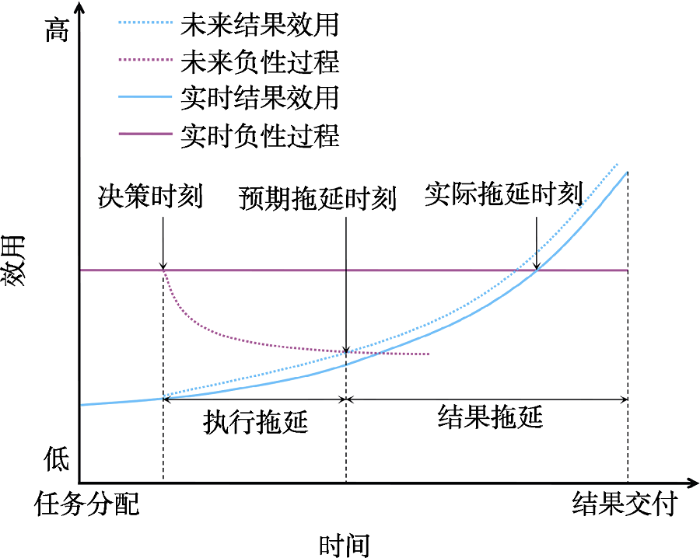
为什么明知拖延会带来不利后果, 但是人们仍自愿推迟开始或完成任务呢?人们又如何在立即行动和拖延任务之间进行权衡呢?为了解答这些问题, 不同研究者从不同角度进行了探究。其中, Sirois和Pychyl (2013)从情绪调节的角度出发, 提出了短期情绪修复理论(Short-term Mood Repair Theory, SMRT), 认为拖延是一种自我调控的失败, 即个体会优先考虑修复任务过程所引发的负性情绪从而放弃对远期结果的追求。Steel和König (2006)从时间取向出发, 提出了时间动机理论(Temporal Motivation Theory, TMT), 具体的公式为:
图1
决定
执行效用 结果效用
拖延的决策公式:E代表期望, V 代表价值, Г代表对延迟的敏感性, D代表延迟时间。D执行表示从现在到决定执行任务时间点之间的间隔, D结果表示从决定执行任务的时间点到任务奖励兑换时间之间的间隔(Zhang & Feng, 2020)。
拖延是一个复杂的心理与行为现象, 从过程上来讲, 至少有评估、决策和执行三个阶段Zhang, Liu & Feng, 2019), 但目前的研究主要集中于探索拖延的评估和决策过程, 较少涉及到拖延的执行阶段。个体在面对任务时做出立即行动的决策并不意味着行动的产生, 若个体最终未能坚持完成任务, 也属于拖延行为的范畴。因此, 对执行阶段的研究对于减少拖延行为来说同样极为重要。根据拖延的时间决策模型, 评估阶段主要涉及对任务负性过程(负性过程效用)和任务正性结果(正性结果效用)主观价值的评估。模型指出, 由负性过程诱发的任务厌恶情绪是引发拖延动机的主要因素。拖延的首要目的就是通过推迟任务, 使任务厌恶发生折扣, 即当人们距离执行任务的时间越远, 感受到的任务厌恶就越少, 从而导致拖延。与任务厌恶不同, 由奖励(或惩罚)引发的结果效用在完成任务后才能获得(或避免), 因此其兑现时间必然与当前存在一定的时间距离。随时间推移, 个体与“结果兑现”日之间的距离逐渐减少, 个体体验到的任务结果效用逐渐增加(Zhang & Feng, 2020)。而对未来过程或结果效用的表征都要依赖于预期想象能力的参与:先前研究发现, 对负性任务过程的预期想象会加剧拖延行为, 而对正性任务结果的想象则会减少拖延(魏佳明, 冯廷勇, 2019); 预期任务正性结果价值和预期任务负性过程两者一起能够最优预测个体的任务执行意愿(Yang et al, 2021)。以上结果提示, 预期想象可能是拖延任务评估过程中的核心心理机制之一。此外, TDM模型指出拖延动机主要来源于任务负性过程效用, 而行动动机则取决于任务正性结果效用, 个体通过比较不同时间点的两种效用来决定何时执行这项任务, 即当前体验到的任务正性结果效用超过任务负性过程效用时, 人们会做出立即行动的决策, 反之则做出拖延的决策, 然而当两种动机相持不下时, 自我控制能力则会在其中起调控作用(Zhang & Feng, 2020)。在决策阶段, 自我控制可以促进个体对远期奖赏的考量, 并产生有远见的行动(Berkman et al, 2017), 因此可以通过增加任务结果的价值或主观价值来减少拖延。然而, 个体做出立即行动的决策后仍然存在拖延的可能, 在执行阶段, 如何调节在执行任务时的厌恶情绪也是降低拖延的重要因素。研究发现, 情绪调节能力强的个体可以通过调整情绪调节策略, 使自己更加关注任务的积极结果, 从而下调厌恶情绪, 坚持执行任务(Hennecke et al, 2019), 因此情绪调节能力在任务执行阶段具有重要作用。总的来说, 全面探究拖延的评估、决策、执行三个阶段的发生发展, 以及每个阶段所涉及的核心认知能力的关键作用的是未来揭示拖延认知机制的新方向。
在探明拖延行为的神经基础的过程中, 大量的研究证据表明预期想象、自我控制、情绪调节能力分别在拖延评估、决策和执行阶段中发挥关键作用。首先, 预期想象是个体进行任务评估的核心:当个体越难想象任务和任务结果价值之间的联系时, 就越容易出现任务拖延行为, 且这一过程与海马-壳核之间的功能连接减弱有关。海马使个体能够提前感受延迟奖赏, 海马与价值评估相关脑区-壳核的功能连接减弱, 说明个体感受未来奖赏的可能性减少, 进而降低其执行动机, 导致拖延的增加(Zhang, Becker, et al, 2019)。进一步的研究发现, 预期想象分别通过自上而下的认知控制通路(背外侧前额叶-额下回、背外侧前额叶-楔前叶)和自下而上的情绪加工通路(海马-脑岛)共同影响拖延行为(Yang et al, 2021)。其次, 自我控制在拖延决策中同样起着关键作用:结构态的研究发现, 拖延与背外侧前额叶(dorsolateral Prefrontal Cortex, dlPFC)的灰质体积呈显著负相关关系, 这为“拖延是自我控制失败的一种表现形式”提供了实证支持(Liu & Feng, 2017); 静息态研究发现, 左背外侧前额叶-外侧眶额叶和左背外侧前额叶-右背侧额中回的功能连接与拖延呈显著负相关关系, 且能够中介自我控制与拖延之间的关系(Xu et al, 2021)。上述研究均说明, 自我控制缺失可能是拖延产生的重要认知机制。最后, 拖延与情绪调节脑区的功能异常同样存在密切关联。新近研究以情绪调节策略为焦点, 指出右侧dlPFC的灰质体积可以中介表达抑制策略的使用频率与拖延之间的关系, 为理解情绪调节在拖延中的作用提供了新的视角(Wang et al, 2022)。基于前人研究, Chen和Feng采用脑形态学技术(Voxel-Based Morphometry, VBM)系统考察了拖延行为的神经结构基础, 提出了拖延的三重神经结构网络模型:以背外侧前额叶(dlPFC)和前扣带回(Anterior Cingulate Cortex, ACC)为核心节点的自我控制网络, 以脑岛(insula)、眶额叶皮层(Orbital Frontal Cortex, OFC)为核心节点的情绪调节网络, 和以腹内侧前额叶(ventromedial Prefrontal Cortex, vmPFC)、旁海马(Para-hippocampal cortex, PHC)为核心的预期想象网络(如图2所示; Chen, Liu et al, 2020), 并提出了自我控制、情绪调节和预期想象能力与拖延之间可能存在密切关系。尽管先前研究在拖延产生的认知机制和神经基础方面进行一些探索, 但是目前仍然缺乏一个整合性的理论模型解释拖延产生的认知神经机制, 即系统考察预期想象、自我控制和情绪调节能力在拖延行为不同发生阶段(包括任务评估、决策和执行阶段)的认知神经机制。
图2
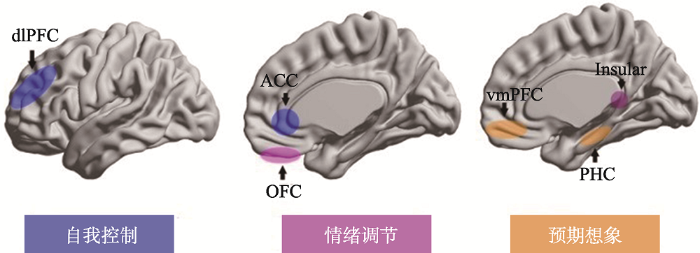
图2
拖延的三重神经结构网络模型
注:①自我控制网络(蓝色图例):核心脑区包括背外侧前额叶(dlPFC)和前扣带回(ACC); ②情绪调节网络(紫色图例):核心脑区包括眶额叶皮层(OFC)和脑岛(insula); ③预期想象网络(黄色图例):核心脑区包括腹内侧前额叶(vmPFC)和旁海马(PHC) (Chen, Liu et al, 2020)。
2.2 拖延行为的心理干预与神经调控
由于拖延的流行性和危害性, 研究者在拖延的心理干预方面开展了大量研究和探索:(1)使用情绪关注策略减少对于任务的负性情绪的关注来降低拖延(Eckert et al., 2016; Mirzaei et al., 2014); (2)改变不合理信念, 在树立对任务的正确认知的同时增强完成任务的内部动机(Hayes et al, 2013; Pychyl & Flett, 2012); (3)形成实施意向, 即围绕任务目标制定行动计划, 明确任务执行时间、地点、步骤等(Lin, 2017); (4)在任务执行过程中, 增强个体的自我管理和监控(Wäschle et al, 2014)。但是先前针对拖延的干预手段尚未建立在探明拖延成因的基础上, 因此其改善拖延行为的有效性和长期性受到很大限制。而根据新近提出的拖延的时间决策模型和三重神经结构网络模型, 预期想象、自我控制和情绪调节能力可能是参与拖延行为不同阶段(评估、决策和执行)的核心认知能力(Chen, Liu et al, 2020; Zhang & Feng, 2020)。因此, 首先基于拖延的时间动机理论(TMT)和时间决策模型(TDM), 增加个体对于远期结果价值的评估可能会提升个体执行任务的动机, 从而降低拖延行为(Steel, 2007; Zhang, Liu & Feng, 2019)。而预期想象是参与任务评估阶段对远期结果价值进行构建的重要能力。预期想象的2(预期想象指向性:任务过程 vs. 任务结果) × 2(预期想象内容效价:正性vs. 负性)模型指出, 预期想象任务正性结果(与执行意愿正相关)和预期想象任务负性过程(与执行意愿负相关)共同预测个体的任务执行意愿(Yang et al, 2021)。该研究结果提示, 改善拖延行为或许可以通过操纵个体预期想象的指向性(任务结果或任务过程)及其内容效价(正性或负性)来实现。此外, 拖延很大程度上是源于对于短期负性情绪修复的需要(Sirois & Pychyl, 2013), 而情绪调节能力在任务执行过程中对任务厌恶情绪的调控将决定任务执行的成败与否(Zhang, Liu & Feng, 2019)。最近一项情绪调节策略的研究表明, 采用“两害相权取其轻”的动机冲突选择策略能够有效调节个体的任务厌恶程度, 从而减少拖延行为(侯滔, 2021)。总的来说, 操纵预期想象和情绪调节等影响拖延的关键因素, 不仅可以进一步检验拖延行为产生的核心认知神经机制, 还可以为制定长期有效的拖延干预方案提供理论基础。
研究者不仅采用认知干预的方法来改善拖延, 神经调控技术(如Transcranial Magnetic Stimulation, TMS; transcranial Direct Current Stimulation, tDCS)因其无创、易操作以及在临床治疗方面具有独特的优势, 同样受到研究者们的广泛关注。例如, 将TMS技术与磁共振成像技术相结合, 能更好地探究大脑的网络和功能连接(Fox et al, 2012); 利用TMS或者tDCS技术改善背外侧前额叶区域的皮层兴奋性可以用于治疗抑郁症(Kiebs et al, 2019)。拖延的时间决策模型认为, 个体对于任务正性结果和任务负性过程的权衡决定了个体是否开始执行任务, 而自我控制在这二者之间的权衡起着重要的调控作用(Zhang & Feng, 2020)。本研究团队利用高精度tDCS刺激左侧背外侧前额叶能够通过提升任务结果价值来提高执行意愿, 进而降低拖延行为(Xu et al, 2022)。这一研究结果首次从神经调控的角度揭示自我控制调节拖延行为的因果机制。另外, 如前所述, 个体在执行任务时, 对任务厌恶情绪的调节会直接影响任务的顺利执行。有研究表明, 眶额叶皮层可能在调节个体焦虑、厌恶等情绪中起到重要作用(Rolls, 2004; Bechara et al., 2000)。目前, 虽然有研究者针对眶额叶皮层进行神经调控以维持目标导向的行为(Ouellet et al, 2015), 但是目前并无研究探索刺激眶额叶皮层对任务执行的作用机制。综上, 目前尚缺少利用无创神经调控技术, 进一步检验自我控制、情绪调节能力在拖延行为产生中的认知神经机制的因果性研究。
3 研究构想
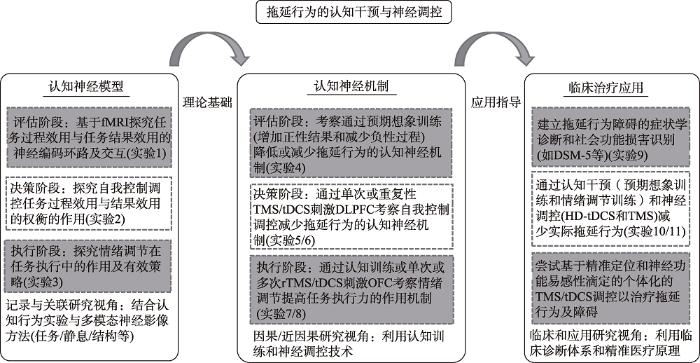
本研究将基于拖延的时间决策模型(Zhang & Feng, 2020)和三重神经结构网络模型(Chen, Liu et al, 2020), 构建拖延的认知神经模型, 并利用认知干预和非侵入性神经调控(如tDCS和TMS)等技术从因果视角检验和完善拖延的认知神经模型, 从而系统地探明拖延行为的认知神经机制及有效的干预措施。具体的研究目标如下:(1)基于拖延时间决策理论和三重神经结构网络模型构建拖延的认知神经模型, 从记录与关联研究视角探究拖延行为的认知机制和神经基础; (2)利用认知干预和神经调控技术, 从因果/近因果研究视角出发, 验证并完善拖延产生的认知神经模型, 进而探明拖延行为的认知神经机制; (3)从临床和应用研究视角出发, 建立拖延行为障碍的筛查-诊断体系, 基于认知干预(如预期想象训练、情绪调节训练等)和非侵入性神经调控(如tDCS和TMS)技术实现对拖延行为障碍的长效干预与治疗, 并尝试结合精准医疗对拖延障碍患者实现个体化精准治疗。总体的研究框架及技术路线如图3所示。
图3
3.1 研究1:拖延行为认知神经模型的构建
首先, 本研究将考察在评估阶段任务过程效用和任务结果效用的不同神经编码环路及可能的交互机制。研究将使用自由建构范式(Zhang et al, 2021), 测查被试在评估阶段对任务过程效用和任务结果效用的评估, 以及决策阶段测查任务执行意愿(例如“是否愿意在24小时内执行任务?”), 同时使用任务态磁共振技术记录被试在评估过程中的神经活动, 再基于认知神经计算建模建立起认知活动与神经活动(尤其是预期想象脑网络, 价值评估网络)之间的关联; 其次, 本研究将探究决策阶段自我控制调控任务过程效用和任务结果效用之间的权衡过程。在上一步的研究基础上, 在自由建构范式中测查被试在决策阶段的神经活动, 并使用神经计算建模方法验证自我控制脑网络(包括dlPFC核心脑区)是否以及如何在决策阶段对任务过程效用和结果效用之间起权衡作用的, 即自我控制脑网络的神经活动信号能否以及如何在决策阶段对评估阶段的结果起调节作用; 最后, 本研究将探究情绪调节在任务执行过程中的作用并探寻有效的调节策略。一方面, 我们将测量被试与情绪调节有关的能力和策略(情绪智力量表; Petrides, 2009); 情绪调节策略量表; Gross & John, 2003)以及神经网络特征(包括OFC、脑岛等情绪脑区, 使用静息态磁共振技术记录), 并利用这些与情绪调节有关的指标预测被试在真实生活场景中对任务的执行/完成情况, 以解释情绪调节策略和能力在拖延执行阶段的作用; 另一方面, 将使用任务态磁共振技术, 考察情绪调节在任务执行阶段中的作用及认知神经机制。
3.2 研究2:拖延行为认知神经模型的检验——基于认知干预与神经调控的视角
此研究将从拖延行为产生的评估、决策和执行阶段出发, 利用认知干预和神经调控技术从因果或近因果视角验证并完善拖延产生的认知神经模型, 进而探明拖延行为的认知神经机制。本研究团队在先前研究中尝试利用预期想象训练以及高精度经颅直流电刺激(High-Definition transcranial Direct Current Stimulation, HD-tDCS)背外侧前额叶(dlPFC)以干预拖延行为, 发现预期想象正性结果或提升自我控制脑区的皮层兴奋性后对拖延意愿减少具有重要作用, 但其具体改善机制尚不清楚(魏佳明, 冯廷勇, 2019; Xu et al, 2022)。因此, 本研究将进一步基于严格的实验组-控制组、前测-后测设计, 采用认知训练或神经调控技术操纵预期想象、自我控制和情绪调节等核心能力, 考察干预前后心理、行为和脑功能(预期想象、自我控制和情绪调节脑网络的功能连接、网络效率等指标)的变化, 进一步从因果或近因果的研究视角来检验拖延行为的认知神经模型。
首先, 预期想象的2指向性(任务过程 vs. 任务结果) × 2内容效价(正性vs. 负性)模型指出, 拖延过程中想象正性的任务结果会增加趋近动机, 想象负性的任务过程则会增加回避动机(Yang et al, 2021)。因此, 在探究预期想象在拖延评估阶段的作用及其认知神经机制时, 本研究计划采用实验组-控制组、前测-后测设计, 设立控制组和两组实验组(一组训练增加想象正性结果组, 另一组训练减少想象负性过程组), 检验实验组与控制组在训练前后的拖延意愿和实际拖延行为的变化。通过多重中介模型探查这一效应是否是通过两组被试的正性结果效用的增加或是负性过程效用的减少所产生; 同时, 探查预期想象脑网络与价值评估网络的功能连接及网络属性(例如全局拓扑属性, 如“小世界”属性, 网络效率; 局部拓扑属性, 如社群性、节点中心度)在训练前后的变化, 及这种变化是否能够中介预期想象训练减少拖延的效应。
其次, 本研究将探究自我控制在决策阶段对任务过程效用和任务结果效用权衡的调节作用及其认知神经机制。TDM模型指出, 自我控制可能通过抑制任务过程相关的负性情绪或提高任务结果的价值评估, 来减少拖延(Zhang & Feng, 2020)。大量神经机制的研究表明, dlPFC是自我控制的核心脑区, 其激活得增加可以提高个体对长期目标的价值评估(Cohen & Lieberman, 2010; Han et al, 2018)。其中, 左侧dlPFC的激活与个体负性情绪的感知与调节息息相关(Xie et al, 2019); 功能连接的研究进一步表明, dlPFC-OFC之间功能连接得减弱可能会使个体更多的关注任务相关的负面信息, 并阻碍情绪调节, 这可能会增加拖延(Han et al, 2016)。此外, 个体自我控制得失败可能与dlPFC-vmPFC之间功能连接障碍有关, 个体对于任务正性结果的评估受到影响, 可能会增加拖延倾向(Wu et al, 2016)。总体而言, 对于dlPFC的神经干预不仅会通过自我控制网络, 同时可能激活情绪调节网络、价值评估网络来减少个体的拖延行为。具体而言, 本研究将设立控制组(伪刺激)和实验组(对左侧dlPFC进行重复性阳极经颅直流电刺激提升自我控制能力), 先考察任务负性过程效用、正性结果效用、执行意愿和实际拖延率在神经调控前后的差异, 再构建结构方程模型检验任务负性过程效用和正性结果效用交互影响执行意愿和实际拖延率的效应, 以揭示自我控制影响拖延的认知机制; 同时, 检验自我控制脑网络的全局拓扑属性(如“小世界”属性, 网络效率)和局部拓扑属性(如社群性、节点中心度)在训练前后的变化, 及这种变化是否能够解释神经调控增强自我控制影响拖延的效应(贝叶斯结构方程推理模型);
最后, 本研究将探究情绪调节网络在执行阶段的调节作用及其具体的认知神经机制。在拖延的执行阶段, 及时有效调节任务过程相关的负性情绪是顺利完成任务的关键。已有研究表明, OFC是情绪调节网络的核心脑区, 它与杏仁核、纹状体、脑岛以及扣带回等与情绪密切相关的脑结构相连, 对情绪效价和唤醒度进行编码与调节(Guillory & Bujarski, 2014; Rolls, 2004; Rolls & Grabenhorst, 2008)。先前研究发现, 左侧 OFC 与杏仁核的连接增强与负性情绪体验降低有关(Pourtois et al, 2006)。因此通过神经干预激活OFC及相关情绪网络(如杏仁核、脑岛等)可能通过降低个体在执行任务过程中的负性情绪从而减少拖延。具体而言, 本研究同样将设立控制组(伪刺激)和实验组(对左侧OFC进行重复性阳极经颅直流电刺激提升情绪调节能力), 详细的分析思路与自我控制的调控基本一致, 以揭示情绪调节影响拖延的认知机制。
3.3 研究3:拖延行为的临床干预和精准治疗
首先, 在建立拖延行为障碍的筛查-诊断体系时, 本研究尝试基于临床和应用研究视角, 将精神病学症状诊断体系和心理社会功能损害标准应用在拖延行为障碍的临床筛查和诊断上, 制定临床拖延行为障碍患者的筛查-诊断体系, 以区分轻度、中度、重度拖延患者(即病理性拖延), 并以此为依据来制定精准化干预方案(Sheeran & Zimmerman, 2002; Zimmerman & Mattia, 2001)。其次, 在制定对于拖延行为障碍患者具有远迁移效应的有效干预方案时, 本研究将制定具体的认知干预(以预期想象训练和情绪调节训练为核心)和神经调控(HD-tDCS或TMS, 以自我控制能力和情绪调节能力为核心)治疗策略, 对经过筛选和诊断的拖延行为障碍患者进行长效的干预和治疗。最后, 在制定个性化干预或治疗方案以更有效地治疗拖延行为障碍, 本研究将利用精准医疗的思路和原理, 试图测查拖延行为障碍患者的认知-神经易感性, 为患者制定精准定位和个体化认知干预和神经调控方案, 以提升治疗效果, 增强研究的临床应用和转化价值。
4 理论构建
首先, 拖延行为是一个复杂的心理行为现象, 至少涉及评估、决策和执行等三个阶段。为了探究拖延产生的认知机制, 本课题组原创性提出了拖延的时间决策模型, 从任务评估、决策和执行三个阶段来阐释拖延产生的认知机制(Zhang & Feng, 2020); 而后, 又提出了拖延的三重神经结构网络模型:预期想象网络、自我控制网络和情绪调节网络(Chen, Liu et al, 2020)。尽管先前研究在拖延产生的认知机制和神经基础方面进行了一些探索, 但是目前仍然缺乏一个整合性的理论模型解释拖延行为产生的认知神经机制。具体而言, 在评估阶段, 主要涉及到任务过程效用和任务结果效用的价值评估, 此过程有赖于预期想象能力的参与。以腹内侧前额叶(vmPFC)和海马为核心脑区的预期想象网络参与自我相关的想象以及未来结果价值的表征(Addis et al, 2009; Atance & O’Neill, 2001; Mirzaei et al, 2014; Motzkin et al, 2014)。有研究发现, 当个体想象正性任务过程时, 会加剧拖延; 而当个体想象负性任务结果时, 会减少拖延(魏佳明, 冯廷勇, 2019)。在决策阶段, 当任务正性结果效用所引发的行动动机和任务负性过程效用引发的拖延动机相持不下时, 个体的自我控制能力将发挥关键作用(Zhang & Feng, 2020)。背外侧前额叶(dlPFC)和前扣带回(ACC)是自我控制网络的核心脑区, 此网络参与调节认知资源并促进个体对于未来结果价值的追求(Botvinick, 2007; Marco-Pallarés et al, 2010), 因而自我调控成功与否决定了个体会立即执行, 还是会选择拖延。在执行阶段, 有效的调节任务所诱发的负面情绪是保证任务是否顺利完成的关键因素。情绪调节网络的核心脑区是脑岛和眶额叶(OFC), 此网络与个体情感的编码、负面情绪的监控和调节息息相关(Kanai & Rees, 2011; Lindquist et al, 2012; Petrovic et al, 2016)。有研究发现, 情绪调节能力强的个体能及时有效的下调负性情绪, 从而减少拖延(Eckert et al, 2016)。综上, 本项目基于拖延的时间决策模型和三重神经结构网络模型, 整合构建拖延的认知神经模型(如图4所示), 并系统考察预期想象、自我控制和情绪调节能力在拖延行为的评估、决策和执行阶段的认知神经机制。
图4
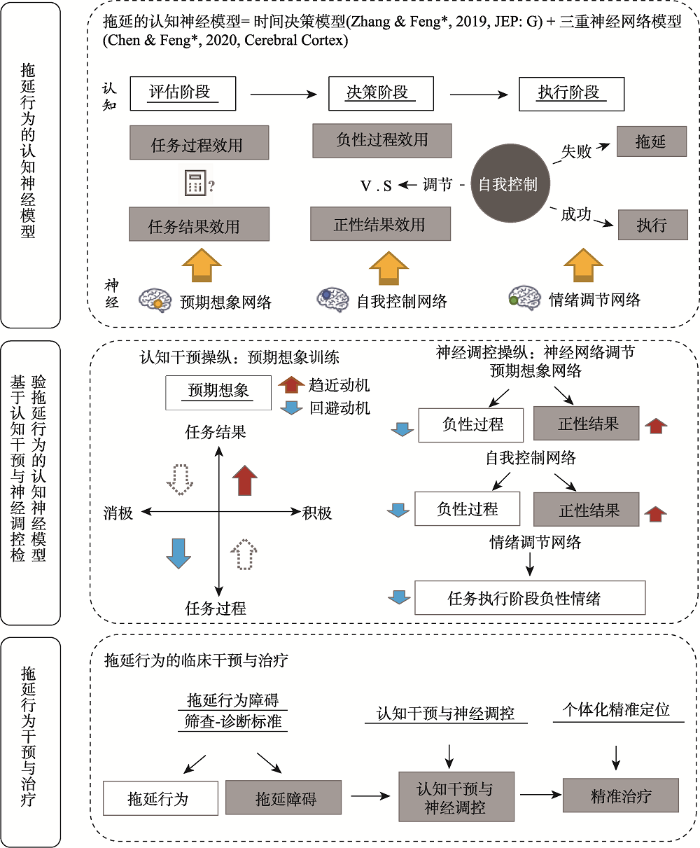
其次, 从研究视角而言, 根据拖延的时间决策模型和拖延的三重结构神经网络模型, 先前研究主要聚焦于从记录和关联的角度探究拖延与预期想象、自我控制和情绪调节能力之间存在密切联系(Chen, Zhang et al, 2020; Xu et al, 2021; Yang et al, 2021; Zhang, Liu & Feng, 2019; Zhang et al, 2021), 但是却缺乏因果操纵的实证证据来支持并验证这三种能力如何在拖延形成不同阶段(评估、决策、执行)的具体作用机制。鉴于此, 本项目拟利用认知干预(如, 预期想象训练;Yang et al, 2021)与神经调控技术(如tDCS)相结合的方式, 从因果操纵的角度探究预期想象、自我控制和情绪调节能力在拖延评估、决策和执行阶段作用机制, 进一步检验并完善拖延行为的认知神经模型。
最后, 从临床应用视角而言, 拖延行为会危害个体正常的社会功能, 包括工作、学习、身心健康发展等(Kim & Seo, 2015; Sirois, 2015; Steel & Ferrari, 2013), 也对社会及国家的发展产生不利影响, 例如削弱企业发展效率、延迟政府机构重要政策的制定及执行等。因此, 预防拖延的发生和干预拖延行为障碍具有重要的实践意义。而如前所述, 先前研究者主要从心理行为角度尝试对拖延行为进行干预, 然而目前国内外研究者却尚未建立针对拖延障碍患者的临床筛查体系, 并缺乏个性化、精准化且长效性的心理行为干预和神经调控方案。因此, 本项目基于拖延行为的认知神经模型, 建立拖延行为障碍的临床筛查-诊断体系(Zimmerman & Mattia, 2001), 并从认知干预和神经调控两条主线实现拖延行为障碍的有效临床干预和精准治疗。
综上所述, 从拖延产生的动态心理(评估、决策、执行)过程出发, 本项目构建了拖延的认知神经模型, 并通过认知干预与神经调控的因果操纵进行检验和完善, 这对于探明拖延产生的核心认知神经机制具有重要的科学价值, 对于拖延行为的有效预防和精准治疗具有重要的现实意义。
参考文献
Constructive episodic simulation of the future and the past: Distinct subsystems of a core brain network mediate imagining and remembering
DOI:10.1016/j.neuropsychologia.2008.10.026
PMID:19041331
[本文引用: 1]

Recent neuroimaging studies demonstrate that remembering the past and imagining the future rely on the same core brain network. However, findings of common core network activity during remembering and imagining events and increased activity during future event simulation could reflect the recasting of past events as future events. We experimentally recombined event details from participants' own past experiences, thus preventing the recasting of past events as imagined events. Moreover, we instructed participants to imagine both future and past events in order to disambiguate whether future-event-specific activity found in previous studies is related specifically to prospection or a general demand of imagining episodic events. Using spatiotemporal partial-least-squares (PLS), a conjunction contrast confirmed that even when subjects are required to recombine details into imagined events (and prevented from recasting events), significant neural overlap between remembering and imagining events is evident throughout the core network. However, the PLS analysis identified two subsystems within the core network. One extensive subsystem was preferentially associated with imagining both future and past events. This finding suggests that regions previously associated with future events, such as anterior hippocampus, medial prefrontal cortex and inferior frontal gyrus, support processes general to imagining events rather than specific to prospection. This PLS analysis also identified a subsystem, including hippocampus, parahippocampal gyrus and extensive regions of posterior visual cortex that was preferentially engaged when remembering past events rich in contextual and visuospatial detail.
Episodic future thinking
Thinking about the future is an integral component of human cognition - one that has been claimed to distinguish us from other species. Building on the construct of episodic memory, we introduce the concept of 'episodic future thinking': a projection of the self into the future to pre-experience an event. We argue that episodic future thinking has explanatory value when considering recent work in many areas of psychology: cognitive, social and personality, developmental, clinical and neuropsychology. Episodic future thinking can serve as a unifying concept, connecting aspects of diverse research findings and identifying key questions requiring further reflection and study.
Emotion, decision making and the orbitofrontal cortex
DOI:10.1093/cercor/10.3.295
PMID:10731224
[本文引用: 1]
The somatic marker hypothesis provides a systems-level neuroanatomical and cognitive framework for decision making and the influence on it by emotion. The key idea of this hypothesis is that decision making is a process that is influenced by marker signals that arise in bioregulatory processes, including those that express themselves in emotions and feelings. This influence can occur at multiple levels of operation, some of which occur consciously and some of which occur non-consciously. Here we review studies that confirm various predictions from the hypothesis. The orbitofrontal cortex represents one critical structure in a neural system subserving decision making. Decision making is not mediated by the orbitofrontal cortex alone, but arises from large-scale systems that include other cortical and subcortical components. Such structures include the amygdala, the somatosensory/insular cortices and the peripheral nervous system. Here we focus only on the role of the orbitofrontal cortex in decision making and emotional processing, and the relationship between emotion, decision making and other cognitive functions of the frontal lobe, namely working memory.
Self-control as value-based choice
DOI:10.1177/0963721417704394
PMID:29335665
[本文引用: 1]
Self-control is often conceived as a battle between "hot" impulsive processes and "cold" deliberative ones. Heeding the angel on one shoulder leads to success; following the demon on the other leads to failure. Self-control like a duality. What if that sensation is misleading, and, despite how they feel, self-control decisions are just like any other choice? We argue that self-control is a form of wherein options are assigned a subjective value and a decision is made through a dynamic integration process. We articulate how a value-based choice model of self-control can capture its phenomenology and account for relevant behavioral and neuroscientific data. This conceptualization of self-control links divergent scientific approaches, allows for more robust and precise hypothesis testing, and suggests novel pathways to improve self-control.
Conflict monitoring and decision making: Reconciling two perspectives on anterior cingulate function
Brain morphological dynamics of procrastination: The crucial role of the self-control, emotional, and episodic prospection network
DOI:10.1093/cercor/bhz278 URL [本文引用: 7]
Emotional attitudes towards procrastination in people: A large-scale sentiment-focused crawling analysis
DOI:10.1016/j.chb.2020.106391 URL [本文引用: 1]
Overcome procrastination: Enhancing emotion regulation skills reduce procrastination
DOI:10.1016/j.lindif.2016.10.001 URL [本文引用: 2]
Prevalence of procrastination in the United States, United Kingdom, and Australia: Arousal and avoidance delays among adults
Measuring and manipulating brain connectivity with resting state functional connectivity magnetic resonance imaging (fcMRI) and transcranial magnetic stimulation (TMS)
DOI:10.1016/j.neuroimage.2012.03.035
PMID:22465297
[本文引用: 1]
Both resting state functional magnetic resonance imaging (fcMRI) and transcranial magnetic stimulation (TMS) are increasingly popular techniques that can be used to non-invasively measure brain connectivity in human subjects. TMS shows additional promise as a method to manipulate brain connectivity. In this review we discuss how these two complimentary tools can be combined to optimally study brain connectivity and manipulate distributed brain networks. Important clinical applications include using resting state fcMRI to guide target selection for TMS and using TMS to modulate pathological network interactions identified with resting state fcMRI. The combination of TMS and resting state fcMRI has the potential to accelerate the translation of both techniques into the clinical realm and promises a new approach to the diagnosis and treatment of neurological and psychiatric diseases that demonstrate network pathology.Copyright © 2012 Elsevier Inc. All rights reserved.
Individual differences in two emotion regulation processes: Implications for affect, relationships, and well-being
DOI:10.1037/0022-3514.85.2.348
PMID:12916575
[本文引用: 1]
Five studies tested two general hypotheses: Individuals differ in their use of emotion regulation strategies such as reappraisal and suppression, and these individual differences have implications for affect, well-being, and social relationships. Study 1 presents new measures of the habitual use of reappraisal and suppression. Study 2 examines convergent and discriminant validity. Study 3 shows that reappraisers experience and express greater positive emotion and lesser negative emotion, whereas suppressors experience and express lesser positive emotion, yet experience greater negative emotion. Study 4 indicates that using reappraisal is associated with better interpersonal functioning, whereas using suppression is associated with worse interpersonal functioning. Study 5 shows that using reappraisal is related positively to well-being, whereas using suppression is related negatively.
Exploring emotions using invasive methods: Review of 60 years of human intracranial electrophysiology
DOI:10.1093/scan/nsu002
PMID:24509492
[本文引用: 1]
Over the past 60 years, human intracranial electrophysiology (HIE) has been used to characterize seizures in patients with epilepsy. Secondary to the clinical objectives, electrodes implanted intracranially have been used to investigate mechanisms of human cognition. In addition to studies of memory and language, HIE methods have been used to investigate emotions. The aim of this review is to outline the contribution of HIE (electrocorticography, single-unit recording and electrical brain stimulation) to our understanding of the neural representations of emotions. We identified 64 papers dating back to the mid-1950s which used HIE techniques to study emotional states. Evidence from HIE studies supports the existence of widely distributed networks in the neocortex, limbic/paralimbic regions and subcortical nuclei which contribute to the representation of emotional states. In addition, evidence from HIE supports hemispheric dominance for emotional valence. Furthermore, evidence from HIE supports the existence of overlapping neural areas for emotion perception, experience and expression. Lastly, HIE provides unique insights into the temporal dynamics of neural activation during perception, experience and expression of emotional states. In conclusion, we propose that HIE techniques offer important evidence which must be incorporated into our current models of emotion representation in the human brain. © The Author (2014). Published by Oxford University Press. For Permissions, please email: journals.permissions@oup.com.
Disruption of effective connectivity from the dorsolateral prefrontal cortex to the orbitofrontal cortex by negative emotional distraction in obsessive-compulsive disorder
DOI:10.1017/S0033291715002391
PMID:26619965
[本文引用: 1]
Obsessive-compulsive disorder (OCD) has been associated with abnormal cognitive and emotional functions and these dysfunctions may be dependent on the disruption of dynamic interactions within neuronal circuits associated with emotion regulation. Although several studies have shown the aberrant cognitive-affective processing in OCD patients, little is known about how to characterize effective connectivity of the disrupted neural interactions. In the present study, we applied effective connectivity analysis using dynamic causal modeling to explore the disturbed neural interactions in OCD patients.A total of 20 patients and 21 matched healthy controls performed a delayed-response working memory task under emotional or non-emotional distraction while undergoing functional magnetic resonance imaging.During the delay interval under negative emotional distraction, both groups showed similar patterns of activations in the amygdala. However, under negative emotional distraction, the dorsolateral prefrontal cortex (DLPFC) and the orbitofrontal cortex (OFC) exhibited significant differences between groups. Bayesian model averaging indicated that the connection from the DLPFC to the OFC was negatively modulated by negative emotional distraction in patients, when compared with healthy controls (p < 0.05, Bonferroni-corrected).Exaggerated recruitment of the DLPFC may induce the reduction of top-down prefrontal control input over the OFC, leading to abnormal cortico-cortical interaction. This disrupted cortico-cortical interaction under negative emotional distraction may be responsible for dysfunctions of cognitive and emotional processing in OCD patients and may be a component of the pathophysiology associated with OCD.
Neural correlates of dietary self-control in healthy adults: A meta-analysis of functional brain imaging studies
DOI:10.1016/j.physbeh.2018.02.037 URL [本文引用: 1]
Acceptance and commitment therapy and contextual behavioral science: Examining the progress of a distinctive model of behavioral and cognitive therapy
DOI:10.1016/j.beth.2009.08.002
PMID:23611068
[本文引用: 1]
A number of recent authors have compared acceptance and commitment therapy (ACT) and traditional cognitive behavior therapy (CBT). The present article describes ACT as a distinct and unified model of behavior change, linked to a specific strategy of scientific development, which we term "contextual behavioral science." We outline the empirical progress of ACT and describe its distinctive development strategy. A contextual behavioral science approach is an inductive attempt to build more adequate psychological systems based on philosophical clarity; the development of basic principles and theories; the development of applied theories linked to basic ones; techniques and components linked to these processes and principles; measurement of theoretically key processes; an emphasis on mediation and moderation in the analysis of applied impact; an interest in effectiveness, dissemination, and training; empirical testing of the research program across a broad range of areas and levels of analysis; and the creation of a more effective scientific and clinical community. We argue that this is a reasonable approach, focused on long-term progress, and that in broad terms it seems to be working. ACT is not hostile to traditional CBT, and is not directly buoyed by whatever weaknesses traditional CBT may have. ACT should be measured at least in part against its own goals as specified by its own developmental strategy.Copyright © 2011. Published by Elsevier Ltd.
Doing despite disliking: Self-regulatory strategies in everyday aversive activities
DOI:10.1002/per.2182
[本文引用: 1]
We investigated the self-regulatory strategies people spontaneously use in their everyday lives to regulate their persistence during aversive activities. In pilot studies (pooled N = 794), we identified self-regulatory strategies from self-reports and generated hypotheses about individual differences in trait self-control predicting their use. Next, deploying ambulatory assessment (N = 264, 1940 reports of aversive/challenging activities), we investigated predictors of the strategies' self-reported use and effectiveness (trait self-control and demand types). The popularity of strategies varied across demands. In addition, people higher in trait self-control were more likely to focus on the positive consequences of a given activity, set goals, and use emotion regulation. Focusing on positive consequences, focusing on negative consequences (of not performing the activity), thinking of the near finish, and emotion regulation increased perceived self-regulatory success across demands, whereas distracting oneself from the aversive activity decreased it. None of these strategies, however, accounted for the beneficial effects of trait self-control on perceived self-regulatory success. Hence, trait self-control and strategy use appear to represent separate routes to good self-regulation. By considering trait- and process-approaches these findings promote a more comprehensive understanding of self-regulatory success and failure during people's daily attempts to regulate their persistence. (c) 2018 European Association of Personality Psychology
The structural basis of inter-individual differences in human behaviour and cognition
DOI:10.1038/nrn3000
PMID:21407245
[本文引用: 1]
Inter-individual variability in perception, thought and action is frequently treated as a source of 'noise' in scientific investigations of the neural mechanisms that underlie these processes, and discarded by averaging data from a group of participants. However, recent MRI studies in the human brain show that inter-individual variability in a wide range of basic and higher cognitive functions - including perception, motor control, memory, aspects of consciousness and the ability to introspect - can be predicted from the local structure of grey and white matter as assessed by voxel-based morphometry or diffusion tensor imaging. We propose that inter-individual differences can be used as a source of information to link human behaviour and cognition to brain anatomy.
Repetitive transcranial magnetic stimulation in non-treatment- resistant depression
DOI:10.1192/bjp.2019.75 URL [本文引用: 1]
The relationship between procrastination and academic performance: A meta- analysis
DOI:10.1016/j.paid.2015.02.038 URL [本文引用: 2]
Integratin the theory of planned behavior and implementation intention to overcome procrastination
DOI:10.3724/SP.J.1041.2017.00953 URL [本文引用: 1]
The brain basis of emotion: A meta-analytic review
DOI:10.1017/S0140525X11000446 URL [本文引用: 1]
The overlapping brain region accounting for the relationship between procrastination and impulsivity: A voxel-based morphometry study
DOI:S0306-4522(17)30519-5
PMID:28757243
[本文引用: 1]
Procrastination is a prevalent problematic behavior that brings serious consequences, such as lower levels of health, wealth, and well-being. Previous research has verified that impulsivity is one of the traits most strongly correlated with procrastination. However, little is known about why there is a tight behavioral relationship between them. To address this question, we used voxel-based morphometry (VBM) to explore the common neural substrates between procrastination and impulsivity. In line with previous findings, the behavioral results showed a strong behavioral correlation between procrastination and impulsivity. Neuroimaging results showed impulsivity and procrastination shared the common neurobiological underpinnings in the dorsolateral prefrontal cortex (DLPFC) based on the data from 85 participants (sample 1). Furthermore, the mediation analysis revealed that impulsivity mediated the impact of gray matter (GM) volumes of this overlapping region in the DLPFC on procrastination on another independent 84 participants' data (sample 2). In conclusion, the overlapping brain region in the DLPFC would be responsible for the close relationship between procrastination and impulsivity. As a whole, the present study extends our knowledge on procrastination, and provides a novel perspective to explain the tight impulsivity - procrastination relationship.Copyright © 2017 IBRO. Published by Elsevier Ltd. All rights reserved.
Brain activations reflect individual discount rates in intertemporal choice
DOI:10.1016/j.brainres.2010.01.025
PMID:20083092
[本文引用: 1]
Humans discount the value of future rewards following a hyperbolic function and thus may prefer a smaller immediate reward over a larger delayed reward. Marked interindividual differences in the steepness of this discounting function can be observed which can be quantified by the parameter k of the discount function. Here, we asked how differences in delay discounting behaviour are reflected by brain activation patterns. Sixteen healthy participants were studied in a slow event-related functional magnetic resonance imaging experiment at 3T. In each trial, participants had to decide between a smaller but immediately available monetary reward (ranging between 14 and 84 Euro) and a larger delayed reward (26 to 89 Euro; delay 5 to 169days) by button press. Participants had the chance to receive the reward corresponding to one of their decisions at the end of the experiment. As expected, participants differed widely with respect to the steepness of their discount function. By contrasting decisions at or near the individual participant's indifference point (as determined by parameter k) with trials either well below or well above this point two different brain networks with opposing activation patterns were revealed: Trials below or above the indifference point were associated with activation in the ventral striatum and ventromedial prefrontal cortex, whereas decisions at the indifference point gave rise to activation in medial prefrontal cortex. The opposite effects in the two systems at individual indifference point were interpreted as a reflection of response conflict.Copyright 2010 Elsevier B.V. All rights reserved.
The role of positive and negative perfectionism, self-efficacy, worry and emotion regulation in predicting behavioral and decisional procrastination
Ventromedial prefrontal cortex lesions alter neural and physiological correlates of anticipation
DOI:10.1523/JNEUROSCI.1446-14.2014
PMID:25080601
[本文引用: 1]
Uncertainty is a ubiquitous feature of our daily lives. Although previous studies have identified a number of neural and peripheral physiological changes associated with uncertainty, there are limited data on the causal mechanisms underlying these responses in humans. In this study, we address this empirical gap through a novel application of fMRI in neurosurgical patients with focal, bilateral ventromedial prefrontal cortex (vmPFC) damage. The fMRI task involved cued anticipation of aversive and neutral picture stimuli; "certain" cues unambiguously indicated the upcoming picture valence, whereas "ambiguous" cues could precede either picture type. Healthy subjects exhibited robust bilateral insula responses to ambiguous cues, and this cue-related insula activity significantly correlated with heart rate variability during the task. By contrast, the vmPFC lesion patients exhibited altered cue-related insula activity and reduced heart rate variability. These findings suggest a role for vmPFC in coordinating neural and physiological responses during anticipation. Copyright © 2014 the authors 0270-6474/14/3410430-08$15.00/0.
Enhancing decision- making and cognitive impulse control with transcranial direct current stimulation (tDCS) applied over the orbitofrontal cortex (OFC): A randomized and sham- controlled exploratory study
DOI:10.1016/j.jpsychires.2015.07.018
PMID:26343591
[本文引用: 1]
Decision-making and impulse control (both cognitive and motor) are complex interrelated processes which rely on a distributed neural network that includes multiple cortical and subcortical regions. Among them, the orbitofrontal cortex (OFC) seems to be particularly relevant as demonstrated by several neuropsychological and neuroimaging investigations.In the present study we assessed whether transcranial direct current stimulation (tDCS) applied bilaterally over the OFC is able to modulate decision-making and cognitive impulse control. More specifically, 45 healthy subjects were randomized to receive a single 30-min session of active or sham anodal tDCS (1.5 mA) applied over either the left or the right OFC (coupled with contralateral cathodal tDCS). They were also assessed pre- and post-tDCS with a battery of computerized tasks.Our results show that participants who received active anodal tDCS (irrespective of laterality), vs. those who received sham tDCS, displayed more advantageous decision-making (i.e., increased Iowa Gambling Task "net scores" [p = 0.04]), as well as improved cognitive impulse control (i.e., decreased "interference" in the Stroop Word-Colour Task [p = 0.007]). However, we did not observe tDCS-related effects on mood (assessed by visual analogue scales), attentional levels (assessed by the Continuous Performance Task) or motor impulse control (assessed by the Stop-Signal Task).Our study potentially serves as a key translational step towards the development of novel non-invasive neuromodulation-based therapeutic interventions directly targeting vulnerability factors for psychiatric conditions such as suicidal behaviour and addiction.Copyright © 2015 Elsevier Ltd. All rights reserved.
Significant grey matter changes in a region of the orbitofrontal cortex in healthy participants predicts emotional dysregulation
DOI:10.1093/scan/nsv072
PMID:26078386
[本文引用: 1]
The traditional concept of 'categorical' psychiatric disorders has been challenged as many of the symptoms display a continuous distribution in the general population. We suggest that this is the case for emotional dysregulation, a key component in several categorical psychiatric disorder constructs. We used voxel-based magnetic resonance imaging morphometry in healthy human subjects (n = 87) to study how self-reported subclinical symptoms associated with emotional dysregulation relate to brain regions assumed to be critical for emotion regulation. To measure a pure emotional dysregulation, we also corrected for subclinical symptoms of non-emotional attentional dysregulation. We show that such subclinical emotional symptoms correlate negatively with the grey matter volume of lateral orbitofrontal cortex bilaterally-a region assumed to be critical for emotion regulation and dysfunctional in psychiatric disorders involving emotional dysregulation. Importantly, this effect is mediated both by a decrease in volume associated with emotional dysregulation and an increase in volume due to non-emotional attentional dysregulation. Exploratory analysis suggests that other regions involved in emotional processing such as insula and ventral striatum also show a similar reduction in grey matter volume mirroring clinical disorders associated with emotional dysregulation. Our findings support the concept of continuous properties in psychiatric symptomatology.© The Author (2015). Published by Oxford University Press. For Permissions, please email: journals.permissions@oup.com.
Neural systems for orienting attention to the location of threat signals: An event-related fMRI study
Attention may reflexively shift towards the location of perceived threats, but it is still unclear how these spatial biases recruit the distributed fronto-parietal cortical networks involved in other aspects of selective attention. We used event-related fMRI to determine how brain responses to a neutral visual target are influenced by the emotional expression of faces appearing at the same location during a covert orienting task. On each trial, two faces were briefly presented, one in each upper visual field (one neutral and one emotional, fearful or happy), followed by a unilateral target (a small horizontal or vertical bar) replacing one of the faces. Participants had to discriminate the target orientation, shown on the same (valid) or opposite (invalid) side as the emotional face. Trials with faces but no subsequent target (cue-only trials) were included to disentangle activation due to emotional cues from their effects on target detection. We found increased responses in bilateral temporo-parietal areas and right occipito-parietal cortex for fearful faces relative to happy faces, unrelated to the subsequent target and cueing validity. More critically, we found a selective modulation of intraparietal and orbitofrontal cortex for targets following an invalid fearful face, as well as an increased visual response in right lateral occipital cortex for targets following a valid fearful face. No such effects were observed with happy faces. These results demonstrate that fearful faces can act as exogenous cues by increasing sensory processing in extrastriate cortex for a subsequent target presented at the same location, but also produce a cost in disengaging towards another location by altering the response of IPS to invalidly cued targets. Neural mechanisms responsible for orienting attention towards emotional vs. non-emotional stimuli are thus partly shared in parietal and visual areas, but also partly distinct.
Procrastination and self-regulatory failure: an introduction to the special issue
The functions of the orbitofrontal cortex
DOI:10.1016/S0278-2626(03)00277-X
PMID:15134840
[本文引用: 2]
The orbitofrontal cortex contains the secondary taste cortex, in which the reward value of taste is represented. It also contains the secondary and tertiary olfactory cortical areas, in which information about the identity and also about the reward value of odours is represented. The orbitofrontal cortex also receives information about the sight of objects from the temporal lobe cortical visual areas, and neurons in it learn and reverse the visual stimulus to which they respond when the association of the visual stimulus with a primary reinforcing stimulus (such as taste) is reversed. This is an example of stimulus-reinforcement association learning, and is a type of stimulus-stimulus association learning. More generally, the stimulus might be a visual or olfactory stimulus, and the primary (unlearned) positive or negative reinforcer a taste or touch. A somatosensory input is revealed by neurons that respond to the texture of food in the mouth, including a population that responds to the mouth feel of fat. In complementary neuroimaging studies in humans, it is being found that areas of the orbitofrontal cortex are activated by pleasant touch, by painful touch, by taste, by smell, and by more abstract reinforcers such as winning or losing money. Damage to the orbitofrontal cortex can impair the learning and reversal of stimulus-reinforcement associations, and thus the correction of behavioural responses when there are no longer appropriate because previous reinforcement contingencies change. The information which reaches the orbitofrontal cortex for these functions includes information about faces, and damage to the orbitofrontal cortex can impair face (and voice) expression identification. This evidence thus shows that the orbitofrontal cortex is involved in decoding and representing some primary reinforcers such as taste and touch; in learning and reversing associations of visual and other stimuli to these primary reinforcers; and in controlling and correcting reward-related and punishment-related behavior, and thus in emotion. The approach described here is aimed at providing a fundamental understanding of how the orbitofrontal cortex actually functions, and thus in how it is involved in motivational behavior such as feeding and drinking, in emotional behavior, and in social behavior.
The orbitofrontal cortex and beyond: From affect to decision-making
DOI:10.1016/j.pneurobio.2008.09.001
PMID:18824074
[本文引用: 1]
The orbitofrontal cortex represents the reward or affective value of primary reinforcers including taste, touch, texture, and face expression. It learns to associate other stimuli with these to produce representations of the expected reward value for visual, auditory, and abstract stimuli including monetary reward value. The orbitofrontal cortex thus plays a key role in emotion, by representing the goals for action. The learning process is stimulus-reinforcer association learning. Negative reward prediction error neurons are related to this affective learning. Activations in the orbitofrontal cortex correlate with the subjective emotional experience of affective stimuli, and damage to the orbitofrontal cortex impairs emotion-related learning, emotional behaviour, and subjective affective state. With an origin from beyond the orbitofrontal cortex, top-down attention to affect modulates orbitofrontal cortex representations, and attention to intensity modulates representations in earlier cortical areas of the physical properties of stimuli. Top-down word-level cognitive inputs can bias affective representations in the orbitofrontal cortex, providing a mechanism for cognition to influence emotion. Whereas the orbitofrontal cortex provides a representation of reward or affective value on a continuous scale, areas beyond the orbitofrontal cortex such as the medial prefrontal cortex area 10 are involved in binary decision-making when a choice must be made. For this decision-making, the orbitofrontal cortex provides a representation of each specific reward in a common currency.
Screening for posttraumatic stress disorder in a general psychiatric outpatient setting
Posttraumatic stress disorder (PTSD) may affect survivors of a number of accidents and illnesses, in addition to violence victims and combat veterans. Prior research suggests that PTSD may be underdiagnosed when trauma is not the presenting problem. Thus, a PTSD screening scale might have utility in routine clinical settings. The authors evaluated the screening performance of the Posttraumatic Diagnostic Scale (PDS) in a general psychiatric setting. Results indicated that the PDS performed as well in this setting as it did in the original trauma-focused validation studies, independent of PTSD status as a primary, versus secondary, reason for presenting. A simple cutoff score was adequate for case identification. There were no gender effects, and the scale performed equally well among patients with, versus without, a depressive diagnosis.
Procrastination and stress: Exploring the role of self-compassion
DOI:10.1080/15298868.2013.763404 URL [本文引用: 1]
Is procrastination a vulnerability factor for hypertension and cardiovascular disease? Testing an extension of the procrastination-health model
DOI:10.1007/s10865-015-9629-2
PMID:25804373
[本文引用: 2]
Personality is an important epidemiological factor for understanding health outcomes. This study investigated the associations of trait procrastination with hypertension and cardiovascular disease (HT/CVD) and maladaptive coping by testing an extension of the procrastination-health model among individuals with and without HT/CVD. Individuals with self-reported HT/CVD (N = 182) and healthy controls (N = 564), from a community sample, completed an online survey including measures of personality, coping, and health outcomes. Logistic regression analysis controlling for demographic and higher order personality factors found that older age, lower education level and higher procrastination scores were associated with HT/CVD. Moderated mediation analyses with bootstrapping revealed that procrastination was more strongly associated with maladaptive coping behaviours in participants with HT/CVD than the healthy controls, and the indirect effects on stress through maladaptive coping were larger for the HT/CVD sample. Results suggest procrastination is a vulnerability factor for poor adjustment to and management of HT/CVD.
Procrastination and the priority of short-term mood regulation: Consequences for future self
DOI:10.1111/spc3.12011 URL [本文引用: 2]
The nature of procrastination: A meta- analytic and theoretical review of quintessential self- regulatory failure
DOI:10.1037/0033-2909.133.1.65 URL [本文引用: 2]
Sex, education and procrastination: An epidemiological study of procrastinators’ characteristics from a global sample
DOI:10.1002/per.1851 URL [本文引用: 2]
Integrating theories of motivation
DOI:10.5465/amr.2006.22527462 URL [本文引用: 1]
Neural basis underlying the association between expressive suppression and procrastination: The mediation role of the dorsolateral prefrontal cortex
DOI:10.1016/j.bandc.2021.105832 URL [本文引用: 1]
Procrastination and self-efficacy: Tracing vicious and virtuous circles in self-regulated learning
DOI:10.1016/j.learninstruc.2013.09.005 URL [本文引用: 1]
Individual differences in resting-state functional connectivity predict procrastination
DOI:10.1016/j.paid.2016.02.016 URL [本文引用: 1]
Different neural correlates of automatic emotion regulation at implicit and explicit perceptual level: A functional magnetic resonance imaging study
Neural basis responsible for self-control association with procrastination: Right MFC and bilateral OFC functional connectivity with left dlPFC
DOI:10.1016/j.jrp.2021.104064 URL [本文引用: 2]
Stimulation of left dorsolateral prefrontal cortex enhances willingness for task completion by amplifying task outcome value
Neural basis responsible for episodic future thinking effects on procrastination: The interaction between the cognitive control pathway and emotional processing pathway
DOI:10.1016/j.cortex.2021.09.013
PMID:34773842
[本文引用: 6]
Theories on procrastination have proposed that the trade-off between the episodic future thinking (EFT) of positive outcome and negative engagement determines whether to procrastinate. Yet, the neural substrates underlying EFT affects procrastination remain poorly understood. Thus, we adopt a free construction method to obtain individuals' EFT thoughts toward procrastination tasks, and coded these thoughts based on the 2 (emotional valence: positive vs negative) × 2 (imaginary direction: outcome vs engagement) model of EFT (2 × 2 model). Next, a regression analysis was utilized to test the relationship between each dimension in the 2 × 2 model and execution willingness. To explore the neuroanatomical structures underlying EFT, the voxel-based morphometry (VBM) analysis was conducted to find out brain regions responsible for EFT. In addition, the resting-state functional connectivity (RSFC) analysis was also utilized to examine the neural pathways underlying EFT affects procrastination. Behavioral results showed combine the anticipated positive outcome with anticipated negative engagement can best predict execution willingness. The VBM analysis revealed that the left dorsolateral prefrontal cortex (DLPFC) was positively correlated with anticipated positive outcome, while the right hippocampus was positively correlated with anticipated negative engagement. The RSFC results indicated that DLPFC functional connectivity with the right inferior frontal gyrus (RIFG) and left precuneus were positively associated with anticipated positive outcome, whereas the hippocampus connectivity with the left insula was positively associated with anticipated negative engagement. Structural equation model results suggest that EFT affects procrastination through the cognitive control pathway (DLPFC-IFG, DLPFC-precuneus) and emotional processing pathway (hippocampus-insula). Collectively, these findings suggest that task procrastination can be predicted by the interaction of the top-down cognitive control pathway and bottom-up emotional processing pathway.Copyright © 2021 Elsevier Ltd. All rights reserved.
Insufficient task-outcome association promotes task procrastination through a decrease of hippocampal-striatal interaction
DOI:10.1002/hbm.24397
PMID:30251755
[本文引用: 1]
Theories on procrastination propose that associating tasks with higher valued incentive outcomes results in less task procrastination. However, it remains unknown how representation of incentive outcomes and task-outcome association are mediated by the human brain. Using event-related functional magnetic resonance imaging, we scanned human participants while they were thinking about both tasks and the incentive outcomes each task can yield in an unconstrained way. Results showed that tasks that are more likely to be procrastinated are associated with less value in incentive outcomes. Interestingly, procrastination was more likely if it was more difficult for participants to associate a task with its valued incentives when thinking about the task (i.e., the decreased task-outcome association). On the neural level, higher value of rewarding outcomes was correlated with increased putamen activations, which further negatively predicted task procrastination. On the other hand, when participants were associating tasks with the incentive outcomes, the decreasing task-outcome association corresponded to decreasing activation in putamen, and a decreasing hippocampus-putamen coupling which further mediated the effect of the insufficient task-outcome association on procrastination. In particular, the current findings show that procrastination is more likely when people are less able to associate tasks with highly valued incentives, which is accompanied by reduced hippocampal-striatal interactions during task construction.© 2018 Wiley Periodicals, Inc.
Modeling procrastination: Asymmetric decisions to act between the present and the future
DOI:10.1037/xge0000643 URL [本文引用: 13]
To do it now or later: The cognitive mechanisms and neural substrates underlying procrastination
Outcome value and task aversiveness impact task procrastination through separate neural pathways
DOI:10.1093/cercor/bhab053 URL [本文引用: 2]
A self-report scale to help make psychiatric diagnoses: The psychiatric diagnostic screening questionnaire
The Psychiatric Diagnostic Screening Questionnaire (PDSQ) is a brief, psychometrically strong, self-report scale designed to screen for the most common DSM-IV Axis I disorders encountered in outpatient mental health settings. In the present report, we describe the diagnostic performance (sensitivity, specificity, and positive and negative predictive values) of the PDSQ in an outpatient setting.Six hundred thirty psychiatric outpatients presenting for treatment were evaluated with the Structured Clinical Interview for DSM-IV after completing the PDSQ. Patients arrived approximately 20 minutes before the scheduled time of the appointment to complete the scale. Diagnostic raters were blind to responses on the scale.The PDSQ's subscales' diagnostic performance varied in a predictable manner according to the cutoff score-as the threshold for case identification increased, subscale sensitivity decreased and specificity increased. Mean subscale sensitivities of 80%, 85%, and 90% resulted in mean subscale specificities of 78%, 73%, and 66%, respectively, and negative predictive values of 95%, 96%, and 97%. Receiver operating curves were determined for each subscale and all areas under the curve were significant.The PDSQ is a diagnostic aid designed to be used in clinical practice to facilitate the efficiency of conducting initial diagnostic evaluations. From a clinical perspective, it is most important that a diagnostic aid have good sensitivity, so that most cases are detected, and high negative predictive value, so that most noncases on the measure are indeed noncases. Our results indicate that most of the PDSQ subscales were able to achieve this goal.


