


1 引言
随着组织的权力变得越来越分散, 变革的步伐逐步加快, 员工需要改变以往被动、短期、静态的行为模式(赵欣 等, 2011), 发挥其主动性(e.g., Campbell, 2000), 自下而上的推动组织变革(Grant & Ashford, 2008)。由此, 个体的主动性已成为组织成功越来越重要的决定因素(Frese et al., 1997)。Parker等(2010)认为: 个体主动性行为(proactive behavior)是指采取掌控措施以“使事情发生” (making things happen), 而不是“观望事情发生” (watching things happen), 涉及个体有抱负并努力改善环境或改变自我的行为。不仅包括掌控(taking charge)、建言(voice)、个体创新(individual innovation)和问题防范(problem prevention)等积极主动的工作角色行为, 还包括反馈寻求(feedback inquiry)、反馈监控(feedback monitoring)、工作角色协商(Job change negotiation)和职业主动性(career initiative)等人与环境适应行为, 以及战略审视(strategic scanning)、上谏意愿(issue selling willingness)和上谏可信度(issue selling credibility)等积极主动的战略行为(Parker & Collins,2010)。它们都具有自我启动、面向未来和面向变革的特征, 只是所追求的目标各不相同(Bindl & Parker, 2009)。为此, 大多数研究认为个体主动性行为对组织长期发展有利(e.g., Grant et al., 2009)。
20世纪70年代, 工业心理学开始关注员工为了完成工作而主动调整工作结构, 以及工作自主性对个体主动性行为激发(Hackman & Oldham, 1976)方面的研究, 而后, 个体主动性行为的决定因素和形成机制一直被研究所关注。而个体主动性行为的结果或由个体主动性行为带来多重影响的研究, 近年来方受到部分学者的关注。研究发现, 个体主动性行为可以带来正向结果, 如创新(Seibert et al., 2001)、绩效(Pitt et al., 2002)、工作满意度(Ashforth et al., 2007)等。但个体主动性行为总是积极的吗?有少量学者注意到个体主动性行为的负向结果, 如遭致领导(Bateman & Crant, 1993)或同事(Van Dyne & Ellis, 2004)的负面反馈, 引发任务冲突(Spychala & Sonnentag, 2011), 及引起后续更低水平的个体主动性行为(Ouyang et al., 2016)等。
总体而言, 探究个体主动性行为正向与负向结果的研究已成为主动性行为领域的新兴热点。现有的研究综述主要从个体、团队和组织层面梳理个体主动性行为的结果效应及影响结果效应的因素(如表1)。其实, 个体主动性行为究竟会产生正向结果还是负向结果, 固然取决于主动性行为者个体的动机及其客观效果, 但更是一种权变的结果, 即主动性行为面对的是特定的组织、领导与同事, 因此, 主动性行为主观效果与客观效果既取决于行为者个体利己或利他的动机, 同时也取决于主动性行为与其所处的组织情境是否匹配; 以及领导与同事对个体主动性行为及其动机的感知与评价。鉴于此, 本研究从主动性行为类型, 主动性行为者和观察者特征, 以及组织情境特征三个方面探究主动性行为“利弊”效应的内在规律, 形成整合的理论机制, 以期进一步发挥个体主动性行为“利”的一面, 规避其“弊”的一面, 尤其是主观因素对之的干扰, 完善主动性行为的研究框架, 深化对主动性行为作用效果的规律性认识。
表1 个体主动性行为结果相关综述研究汇总
| 作者(年份) | 结果效应 |
|---|---|
| Crant (2000) | 高工作绩效、职业成功、工作态度、个人控制感和角色清晰。 |
| Bindl和Parker (2010) | 个体水平结果(如更高的收入、满意度与绩效评价)、团队水平结果(如团队学习和团队绩效)和组织水平结果(如公司财务业绩)。 |
| Chia和Sharon (2013) | 工作表现、职业成功和主观满意度。 |
| Parker等(2019) | 明确了影响个体主动性行为对结果的三类因素——不同形式的主动性行为、主动性行为个体特征、情境的各个方面。 |
| 蒋琳锋和袁登华(2009) | 提高个体表现和组织绩效。 |
| 胡青等(2011) | 个体结果(如绩效、职业发展、心理健康、认同感等); 团体结果(团体工作满意感、总体组织承诺、团队承诺等); 组织结果(组织绩效等)。 |
资料来源: 本文作者整理
2 个体主动性行为利弊效应
自20世纪80年代以来, 学界开始关注组织中个体主动性行为的积极影响。从研究层次视角看, 个体主动性行为不仅影响行为者本身, 也会影响其所处的组织情境。其中, 从个体角度来看, 主动性行为的个体通过不断尝试新的改进工作流程的方法, 参与更多的信息交流, 增加了工作的挑战性和丰富性, 促进个体的学习和社会化, 提升个体对工作的控制感、自我决定感和自我效能感, 并提升个体的创造力、绩效、工作投入和满意度, 最终获得更高的收入、职业成功和能力提升; 从组织情境角度来看, 主动性行为的个体, 能够建立积极的关系和人际网络, 并主动实施有利于组织变革、组织决策和组织绩效等行为, 进而对个体所处的组织情境带来有益的影响。
同时期, 也有少数研究关注到个体主动性行为带来的负向结果。从个体角度来看, 个体主动性行为会带来资源消耗, 从而产生工作压力, 也会导致易怒、工作反刍和退出行为, 持续的个体主动性行为在未获得恢复的情况下, 会产生工作-生活的冲突和情绪耗竭, 进而影响职业幸福感以及后续的主动性行为, 不仅如此, 个体主动性行为也会因挑战领导和同事工作, 从而遭到领导和同事的负面评价和反馈; 从组织情境角度来看, 个体主动性行为因导致领导-成员或团队-成员关系紧张, 最终将降低组织效能。下面则分别阐述之。
2.1 个体主动性行为正面效应(利)
2.1.1 对个体的有益影响
个体主动性行为有助于个体表现出积极的态度和行为, 赢得领导的积极评价, 并最终带来个体收入的增加、职业成功和能力的提升。
正向预测个体积极行为。第一, 有利于提升个体绩效和增加工作投入。员工的主动性行为可以提升其工作绩效(Ashforth et al., 2007; Pitt et al., 2002)。基于增量理论(incremental theory)的研究发现, 自我负面反馈寻求使得个体能够明确需要改进的地方, 学习他人的成功经验, 从而正向影响绩效(VandeWalle, 2003)。类似的研究也发现, 反馈寻求行为与绩效存在积极关系(Wu et al., 2014)。同时, 个体主动性行为也可以增加其工作投入, 不同研究者依据不同的理论, 得出一致的结论, 如基于社会资源理论(socialization resources theory, Cooper-Thomas et al., 2014)与社会认知理论(social cognitive theory, Mallin et al., 2014)的研究均发现主动性行为会增加员工的工作投入。
赢得领导的积极评价。领导如何评价员工主动性行为与行为者从主动性行为中获得的回报密切相关(Grant & Ashford, 2008)。一方面, 领导对个体主动性行为意图或效用的解释会影响领导的评价。借鉴归因理论(attribution theory)的研究发现, 当员工表现出强烈的亲社会价值观或当员工表现出很少的厌恶情绪(Grant et al., 2009), 又或是员工寻求反馈的动机是提升绩效时(Lam et al., 2007), 领导很可能会将他们的主动性行为归因于善意, 并会以更高的整体绩效评估来奖励他们。另一方面, 个体主动性行为的实施是否恰当也会影响领导的评价。基于归因理论的研究发现, 员工恰当的建言行为能够正向影响上级对其绩效评价(Whiting et al., 2012)。基于个体主动性理论(personal initiative theory)的研究发现, 社交机敏的个体能够解释环境氛围中的主动暗示, 并认识到展现主动性的机会, 在适当的情境中展现个体主动性行为, 从而积极影响上级的绩效评价结果(Wihler et al., 2014)。
个体获得丰厚的奖赏。一方面, 具有主动性行为的员工会获得更高的职业成功与薪水。高主动性的失业人员(unemployed people)有着明确的职业规划、更高的计划执行水平, 这将有助于他们更快的找到工作(find a job faster) (Frese et al., 1997)。当主动性行为员工的价值观与组织的价值观相一致, 且当员工的工作技能满足其工作要求时, 他们也会获得更大的职业成功(insrinsic career success) (Erdogan & Bauer, 2005)。同时, 他们因表现出更高的生产力, 从而获得更多的奖励, 有着更高的薪水(Van Dyne & Le Pine, 1998)。此外, 运用社会资本理论(social capital theory)的研究进一步发现, 在职业生涯初期, 积极寻求被指导和接触同事的员工, 在两年后更有可能获得更高的收入和更高的职位等级(Blickle et al., 2009)。另一方面, 主动性行为的员工会获得自身能力的提升。早期研究发现, 主动性行为(Ashford & Black, 1996)、建言行为(Hunton et al., 1998)能够增强个体对工作的控制。基于行动理论(action theory)的研究进一步发现, 主动性行为不仅增强了个体对工作的控制力, 还可以使员工获得更具挑战性的工作(Frese & Fay, 2001)。基于群体动力理论(group dynamics theory)的研究发现, 建言行为会增加员工的自我效能感(段锦云 等, 2007)。
2.1.2 对组织情境的有益影响
个体在实施主动性行为的过程中, 会与领导或同事保持联系, 在加强互动沟通的同时, 帮助领导或同事完成亟待解决的问题, 从而改善领导-成员关系、降低团队冲突、提升团队或组织绩效。总之, 个体主动性行为一定程度上会对个体所处的情境产生积极影响。
赢得高质量的领导-成员交换关系。多数研究认为, 高质量的领导-成员交换关系是给员工提供指导和支持(sponsorship)的一种重要形式(Wayne et al., 1999), 会营造一种信任的氛围, 从而促进员工的主动性行为(胡青 等, 2011)。然而有学者认为不是高质量的领导-成员交换关系引发了员工的主动性行为, 事实正好相反, 员工的主动性行为创造了良好的上下级关系。一方面, 积极主动的个体会主动采取措施与领导建立高质量的关系。研究表明, 主动性的员工更有可能进行有效的人际沟通, 从而产生有价值的信息或使他们获得更有效的政治地位(Thompson, 2005), 他们为了获得与新出现的问题和机遇相关的信息, 很可能与领导建立高质量的社会交流关系, 以便更好地履行职责(Li et al., 2010)。另一方面, 积极主动的个体因较好地完成了工作任务, 而与上级建立了高质量的关系。如Lam等(2007)认为具有主动性行为的员工通过主动征询绩效信息, 能够理清对工作角色的理解, 从而更好地完成工作任务, 这有利于与上级建立高质量的交换关系。
提升团队和组织效能。一方面, 当领导具有低外向型特征时, 员工的主动性行为有助于提升团队绩效(Grant et al., 2011); 另一方面, 积极主动的员工倾向于采取和实施对组织的积极变革(Bateman & Crant, 1993), 可降低组织约束(Li et al., 2014)。所以, 员工的主动性行为与组织变革(Rank et al., 2004)、组织绩效(Griffin et al., 2007)正相关。具体的, 员工建言行为会提高组织决策质量(Hunton et al., 1998)、组织创新绩效(梁建, 唐京, 2009)等。此外, 小规模企业主(bussiness owner)的主动性行为与创业成功(Lumpkin & Dess, 1996)正相关。
2.2 个体主动性行为负面效应(弊)
2.2.1 对个体的消极影响
引发个体的消极态度和行为。资源保存理论(conservation of resources theory)有助于我们理解个体主动性行为对其自身潜在的负面影响。员工主动性行为包括改变并要求其他人适应, 这可能会导致额外的工作, 消耗自身资源, 从而引起员工在工作中的社会压力(Dormann & Zapf, 2004)。尤其是外部激励的个体主动性行为可能会在更大程度上损害员工的心理资源(Pingel et al., 2019)。当员工受到高度控制, 而工作没有补偿性内在兴趣(compensatory intrinsic interest)或认同(即低自主动机)时, 主动性行为可能会耗尽员工的资源, 从而产生工作压力(Strauss et al., 2017)。基于自我损耗理论(ego depletion theory)的研究也发现, 当员工工作动机不强时, 员工每天的主动性行为, 会产生工作与生活冲突(work-life conflict) (Cangiano & Ouyang, 2017)。主动性行为也会因其是一种消耗资源的行为, 会导致易怒和与工作相关的反刍, 进而导致员工的退出行为(Pingel et al., 2019)。主动性行为还会因获得了不恰当的信息反馈负向影响员工绩效, 如自我正面反馈寻求与员工绩效负相关, 因为, 以此获得的信息不会促进学习和提高, 反而会导致自我满足(VandeWalle, 2003)。
持续的主动性行为会影响个体后续的主动性行为, 甚至会影响职业幸福感。基于自我调节资源理论(self-regulatory resource theory)的研究发现, 持续性的主动性行为会引起更高水平的疲劳, 从而减少个体后续的主动性行为, 且受到“休息”的调节(Ouyang et al.,2016)。基于行为调节理论(action regulation theory)的研究进一步发现, 当个体提高了主动性行为, 但没有被组织重视(即未感知到组织支持), 消极情绪也会随之增加, 持续或变化的主动性行为会引发个体情绪耗竭, 也会对职业幸福感产生不利影响(Zacher et al., 2019)。
遭到领导较低的绩效评价。由于人们倾向于不喜欢变革, 因此, 员工的主动性行为并不总是带来积极评价, 主管可能会给予行为者较低的绩效评价(Bateman & Crant, 1993; Chan, 2006; Grant & Ashford, 2008; Grant et al., 2009)。首先, 领导可能会经历一种“主动悖论”, 在这种悖论中, 他们会感受到员工主动性行为的讨好企图(Bolino,1999)、甚至威胁(Frese & Fay, 2001; Parker et al., 2006; Pingel et al., 2019), 从而不会过高地评价员工主动性行为。Fast等(2014)发现, “自我效能感较低”的领导更可能对员工的建言做出消极反应, 因为这种行为的挑战性会导致领导进入自我防御状态, 如消极评价、不采纳建议等。其次, 领导可能使用不同的标签来描述这种行为, 它们可能被贴上不良的标签, 从而导致负面评价。领导会给弱亲社会价值观、高度厌恶情绪(Grant et al., 2009)和提升形象动机(Dahling et al., 2015)的员工贴上“时机不当、执行不力或自私”的标签, 从而不太可能给予这些员工积极的绩效评价。
遭致同事的反感。由于个体主动性行为会挑战角色界限, 引入新的、有时更令人精疲力竭的任务执行方式, 对同事的任务和工作流程产生影响(Grant et al., 2009), 然而周围的同事可能并不喜欢去适应新的东西和被强迫放弃之前的习惯(蒋琳锋, 袁登华, 2009), 从而引起同事的不满甚至反感。较早的研究发现, 装配线上的主动性行为通常是不受欢迎的, 因为装配线是基于标准化的, 而个体主动性行为总是意味着某种程度的行为的非标准化(Frese & Fay, 2001)。在非装配线组织, 员工主动性行为的负面影响同样存在, 也会遭致同事的负面反馈(Chan, 2006; Van Dyne & Ellis, 2004), 甚至会遭遇同事的打击报复(Lapierre & Allen, 2006)。进一步的研究表明, 积极主动的员工有着较好的领导-成员交换关系和相对较高工作绩效排名, 会滋生同事嫉妒(Parker et al., 2019), 嫉妒代表了一种不愉快和痛苦的向上社会比较(Parrott & Smith, 1993)。Sun等(2020)运用社会比较理论(social comparison theory)进行的研究发现了主动性高的员工不仅容易被同事羡慕嫉妒, 而且更少获得同事的帮助(helping)。
2.2.2 对组织情境的不利影响
如前所述, 个体主动性行为会威胁到同事, 从而引发同事的反感甚至嫉妒, 不仅对主动性行为者带来不利影响, 也会进一步引发冲突。而由此引发的冲突最终会降低组织效能(Bolino et al., 2010)。相关研究有:“晋升导向的个体主动性行为” (promotion-oriented initiative)旨在改善内部组织环境, 员工往往会主动完成超出组织规定之外的任务, 势必影响团队成员的工作任务, 使得员工与同事和主管之间因角色界限和相关任务产生不同看法, 从而增加任务冲突, 导致员工与同事和主管之间的摩擦(Spychala & Sonnentag,2011)。不仅如此, 当领导具有高外向型特征时, 员工的主动性行为反而会对团队绩效产生消极影响(Grant et al., 2011)。
3 理论机制
本研究关注的关键问题是, 个体主动性行为为何既会产生正面效应, 又会产生负面效应, 这涉及到理论机制问题。并非所有的研究文献都有明确的理论依据, 且被用于解释个体主动性行为正面效应的理论, 则很难用以解释个体主动性行为的负面效应, 因此, 既能解释正面效应也能解释负面效应的理论较少。目前来看, 优势互补理论、自我决定理论及归因理论等可用于解释个体主动性行为“利弊”效应。
3.1 基于优势互补理论的解释
基于优势互补理论, 员工的主动性行为会对具有低外向型特征的领导者起补充作用, 但会对高外向型特征领导者构成挑战。所以, 当领导具有低外向型特征时, 员工的主动性行为有助于提升团队绩效; 当领导者更多地表现为外向型特征时, 即员工和领导者都以一种更具支配性的方式行事时, 员工的主动性行为对团队绩效产生消极影响(Grant et al., 2011)。
3.2 基于自我决定理论的解释
Campbell (2000)指出, 个体主动性行为是否有效取决于领导者的判断。领导者对建设性变革责任的感知(felt responsibility for constructive change, FRCC)反映了个体在多大程度上选择将有意义的建设性变革作为其工作的一部分(Morrison & Phelps, 1999)。从自我决定理论(self-determination theory)的角度来看, 如果领导者本身并不偏爱变革行为, 会认为个体主动性行为“无用”, 跟随者的主动性行为对高FRCC领导者具有效用, 因为这种行为有助于领导者履行其承担的实施建设性变革的责任, 在这种情况下, 领导者可能会将跟随者的主动性行为视为一种支持性行为, 认为其对人际或组织是有益的(Fuller et al.,2015), 从而使得受益的领导者会欢迎这种行为, 并对其进行奖励(Grant & Ashford, 2008)。
然而, 并非所有的领导者都认为建设性变革是他们工作的一部分, 当领导者对建设性变革不负责任时, 领导者不仅认为追随者的主动性行为不可能帮助其履行承担的责任或长期目标, 更有可能将追随者的主动性行为视为对其职责履行方式的挑战和批评。所以, 低FRCC领导者不会奖励跟随者的主动性行为, 因为他们认为主动性行为几乎没有效用(Fuller et al., 2015), 从而可能导致领导者对其的消极评价。
3.3 基于归因理论的解释
归因理论的一个核心前提是, 当事件偏离规范和期望时, 个体会寻求对这些偏离的解释(Pyszczynski & Greenberg, 1981)。由于个体主动性行为超出了最低要求, 并以意料之外的形式和情况出现, 它们常常偏离规范和领导者的期望(Grant & Ashford, 2008)。Grant等(2009)借鉴归因理论的研究发现, 领导对这种偏离规范的员工主动性行为进行解释时, 关注的是驱动员工主动性行为的意图是否善意, 而员工的价值观和情感会向领导者传递出他们潜在意图的信号, 从而影响领导者对员工主动性行为的评价归因。具体来讲, 当员工表现出强烈的亲社会价值观时, 领导者很可能会将他们的主动性行为归因于善意, 并会以更高的整体绩效评估来奖励他们, 反之, 当员工表现出弱亲社会价值观时, 会遭致领导的较低评价; 当员工表现出很少的厌恶情绪时, 领导者可能会推断员工愿意采取主动性行为, 并有使情况好转的建设性意图, 从而获得领导者较高的绩效评价, 反之, 当员工表现出高度厌恶情绪时, 可能会被解释为“抱怨”和“批评”, 这会导致领导者将其主动性行为归因于“不良态度”, 从而引致领导者较低的绩效评价。
3.4 理论机制的整合框架
尽管个体主动性行为正负面效应已引起了学者的关注, 并对其原理做出了初步的研究尝试, 但仍缺乏整合。如优势互补理论、自我决定理论和归因理论等, 从不同的理论视角解释了领导者或员工的不同特征对个体主动性行为结果的正负向影响。其实, 正如“一枚硬币有着正反两面”一样, 影响个体主动性行为结果的三类因素, 即不同形式的个体主动性行为、主动性行为的个体特征及情境的各个方面(Parker et al.,2019), 也有着内在的两面性。它们恰恰涵盖了前面三种理论(即优势互补理论、自我决定理论和归因理论)所解释的领导者或员工特征两面性的内容, 相对而言涉及更为全面, 可从一定程度上揭示个体主动性行为利弊结果的内在机制。所以, 本研究基于“影响个体主动性行为结果因素的两面性特征”视角, 试图从主动性行为类型、主动性行为者和观察者特征及组织情境三个方面对理论机制进行整合(如图1所示)。
图1
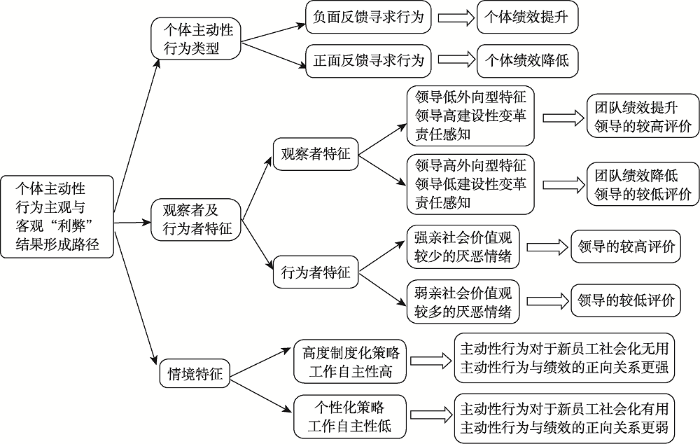
整合机制一: 个体主动性行为自身的不同类型会影响个体主动性行为产生不同的结果。Griffin等(2007)认为专注于单个任务和专注于团队成员或组织成员的主动性不同; Wu等(2018)根据个体主动性行为的不同导向, 提到了“职业导向的个体主动性行为”和“工作单位导向的个体主动性行为”。还有研究认为个体主动性行为的目的是不同的, 涉及增强自我发展的主动性(Porath & Bateman,2006)和组织成功的主动性(Belschak & Den Hartog, 2010)。总之, 现有研究已经注意到了个体主动性行为的不同分类, 并认为通过对个体主动性行为类型的研究, 有利于更好的认识个体主动性行为的结果效应, 包括与工作相关的态度、离职意向或员工的身心健康等(Spychala & Sonnentag, 2011), 以及领导或同事对其的评价, 进而影响领导-成员和团队-成员关系(Bateman & Crant, 1999)。这已被研究所证实, 如“自我负面反馈寻求”因会促进个体学习, 而“自我正面反馈寻求”会导致自我满足, 分别与绩效有着正、负相关的截然相反关系(VandeWalle,2003)。所以, 个体主动性行为利弊结果背后机制与个体主动性行为类型有关。
整合机制二: 个体主动性行为的利弊结果也与主动性行为者和观察者特征的两面性有关。其中, 观察者主要涉及领导者和同事。主动性行为者和观察者个体特征涉及能力、态度、价值观、人格特质、内部动机等个性心理特征, 以及认知加工、情绪情感等心理感知过程, 这些反映个体差异的个体特征具有两面性, 会影响观察者对个体主动性行为的评价、行为者个体及其团队绩效等。例如, 就主动性行为者特征而言, 员工较少的厌恶情绪和较多的厌恶情绪、较强与较弱的亲社会价值观(Grant et al., 2009), 以及员工以提升绩效为动机和以提升形象为动机(Dahling et al., 2015)分别会得到领导者的好评与差评, 且个体以问题防范为动机和以晋升为动机分别会对领导/团队-成员关系造成正向与负向两种截然不同的影响(Spychala & Sonnentag, 2011)。关于个体主动性行为观察者特征方面, 有研究发现, 无论员工的主动性行为是出于“亲社会的动机”还是“利己的动机”, 最终的评价结果取决于观察者的价值观, 即观察者认为什么最为重要(Frese & Fay,2001)。一些学者也呼吁, 应研究领导者特征(characteristics)在个体主动性行为与绩效评价关系中的调节作用(e.g., Bindl & Parker, 2010; Grant et al., 2009)。随后, 相关研究也证实, 具有高和低外向型特征的领导者在员工的主动性行为对团队绩效影响中分别起负向和正向作用(Grant et al., 2011); 高和低建设性变革责任感的领导者会分别觉得个体主动性行为“有用”和“无用”, 并分别做出较高和较低的评价(Fuller et al.,2015)。所以, 个体主动性行为利弊结果背后机制与个体主动性行为主体特征有关。
整合机制三: 从组织情境因素来看, 个体主动性行为的利弊结果还与个体所处组织情境特征的两面性有关。这些组织情境因素主要涉及工作和团队自主性、公平或创新氛围、阻碍性或挑战性压力源、感知到的组织支持等(Parker et al., 2019)。例如, 当工作自主性高时, 主动性行为(如反馈寻求行为等)与绩效结果的正向关系更强, 因为此情境为个体提供了利用主动性行为获得信息的自由; 反之, 当工作自主性低时, 主动性行为与绩效结果的正向关系更弱(Kim, et al., 2009)。在高度制度化策略(institutionalized tactics)的情境中, 新员工的主动性行为显得没那么必要, 因制度化策略已为员工提供了可遵循的详细工作流程, 所以其主动性行为对其社会化无帮助; 在采取个性化策略(individualized tactics)的情境中, 角色界定和工作期望要求不太清晰, 新员工需要通过主动性行为来降低不确定性。所以, 个体主动性行为利弊结果背后机制与组织情境特征有关。
总之, 本研究透过矛盾的两面性视角透视主动性行为, 无论是主动性行为的正向结果还是负向结果, 在组织中都是一种常态表现, 影响主动性行为结果的因素, 涉及主动性行为类型、主动性行为者和观察者及组织情境三个方面, 这些影响因素自身特征的两面性揭示了个体主动性行为“利弊”效应的内在机制。从长期来看, 矛盾双方可以部分或有条件的相互转化, 站在组织管理的视角去理解如何应对个体主动性行为内在的二元矛盾并对其进行有效管理也应纳入理论框架中。
4 未来研究展望
近年来, 个体主动性行为结果效应引发了学界的特别关注。随着研究的深入, 越来越多的正负向效应相继被揭示, 但作为一种新范式, 其背后的内在机制亟待未来的研究探讨。未来研究可进一步从影响个体主动性行为结果因素的双面效应方面进行静态研究, 揭示影响个体主动性行为正负向结果的内在机制, 这与个体主动性行为客体因素、主动性行为者和观察者主体因素及组织情境特征的两面性紧密相关。同时, 我们不应拘泥于某一时间点来探讨其中的矛盾, 要从事物发展的全过程来考察矛盾的形成过程(吕力 等, 2016)。个体动机、归因和情绪等不断影响个体主动性行为的全过程, 并可能导致个体主动性行为增加或减少, 从而带来或正面或负面的影响。所以, 本研究还将进一步提出个体主动性行为的动态研究方向, 以明晰个体主动性行为的动态影响过程。
4.1 个体主动性行为利弊效应的静态机制
4.1.1 从智慧主动性的视角进行静态研究
个体主动性行为实施存在“必要”与“不必要”的两面性, 从而影响个体主动性行为的作用结果。研究表明, 个体需要对在哪里展示和在哪里不展示个体主动性行为拥有良好的判断力, 并举出了负面影响的例子, 如航空公司的一名雇员超出了职责范围, 克服困难, 帮助客户到达目的地, 但为此付出了惨重的代价(Campbell,2000)。所以, 个体如若在不需要的工作领域采取主动或者当个体知识和技能不足时, 高个体主动性行为会带来相当负面的后果(Frese & Fay, 2001)等。类似的研究也发现, 组织是否对个体主动性行为做好准备, 也会影响组织对个体主动性行为是否必要的判断。Eby等(2000)提出如果组织或单位还没有为变革做好准备, 主动性可能是不必要的, 此时, 最好不要发起变革。Kotter (2009)提出如果变革是必要的, 那么发起的变革应符合任务和组织战略要求, 即它必须是“正确的改变”。Parker等(2019)根据智慧心理学理论(psychological theories of wisdom), 提出了智慧主动性(wise proactivity)的概念, 并进一步认为个体所选择的智慧主动变革目标应符合组织战略目标及个人的兴趣、专业知识和个人资源, 同时兼顾考虑他人的目标, 有待进一步实证研究。
4.1.2 从主动性行为者和观察者特征的视角进行静态研究
通过理论机制的整合框架(如图1)发现, 观察者和行为者特征的两面性, 会影响观察者的评价或者个体和团队绩效等, 也是个体主动性行为产生利弊结果的内在原因, 未来研究有待进一步实证检验。具体来讲, 主要涉及主动性行为者与观察者(领导或同事)互动过程中, “主动性行为者特征” (如价值观-工作导向与人际导向、情感-积极与消极、性格-A与B型、对待领导\同事-效忠\关心与不孝忠\不关心、睡眠-好与坏、意图-利己与为公)、“观察者特征” (如价值观-工作导向与人际导向、与行为者关系-亲与疏、对待他人-偏私与正直、自尊心-强与弱、情感支持-高与低)等, 它们内在的两面性, 如何影响“观察者对个体主动性行为的评价”、“个体后续的态度与行为”及“领导-成员关系或团队-成员关系”等。
此外, 还可借鉴Fiske等(2002)根据能力-热情(competence-warmth)理论, 认为能力与热情的不同组合, 可能会引起他人不同反应的观点, 进一步研究行为者内在不同特征之间的相互作用, 如“行为者情感-积极与消极”两面与“行为者性格-A型与B型”两面的四种组合, 或观察者内在不同特征之间的相互作用, 如“观察者自尊心-强与弱”两面与“观察者对待下属-偏私与正直”两面的四种组合, 如何影响主动性行为的结果。以及借鉴Parker等(2019)提出的员工与领导人格特质的契合(personality “fit”)也会影响主动性行为结果的观点, 行为者与观察者特征之间的交互作用, 如“行为者意图-利己与为公”两面与“观察者对待行为者-偏私和正直”两面的四种组合, 如何影响个体主动性行为的结果, 也有待进一步研究。
4.2 个体主动性行为利弊效应的动态机制
4.2.1 主动性行为自身的动态发展
研究表明, 个体主动性行为不仅仅是一个单一的行为, 而是一个涉及不同阶段的过程(Bindl & Parker, 2010), 基于一次观察来判断主动性是不合适的, 可能需要对整个目标过程进行观察(Parker et al., 2010), 且上级领导对个体主动性行为的认识需要一段时间(Frese & Fay, 2001)。虽然有个别研究提到, 个体主动性行为涉及预期、规划和影响行动几个阶段(Grant & Ashford, 2008)。Frese和Fay (2001)将任务的重新定义、信息收集和预测、计划和执行、监测和反馈确定为个体主动性行为的关键阶段。但到目前为止, 从这个角度进行的实证研究很少。因此, 可进一步研究个体主动性行为自身的前期、中期及后期发展阶段的不同表现形式及侧重点, 具体涉及前期个体主动性行为的正向或负向意图如何萌生, 中期如何恰当或不恰当的实施, 后期如何保持或不保持、发展或不发展均是未来的研究方向之一。
4.2.2 主动性行为者和观察者特征的动态发展
长期来看, 个体主动性行为可能产生积极影响, 如发现新的商机, 而短期和中期可能产生消极影响(e.g., Grant et al., 2009)。因为主动性行为的员工挑战现状, 可能被领导解雇(Peters & Waterman, 1982), 被视为对领导管理职责方式的批评(Burris, 2012)。既然如此, 动态研究个体主动性行为的长短期影响也有一定意义。本研究认为, 一方面行为者与观察者“资源消耗”与“资源补充”的两面可能会随时间的推移而相互转化, 需进一步研究“个体主动性行为利弊”如何随着资源消耗和补充的动态改变而改变。另一方面, 虽然许多组织研究仍然认为成年人的个性是“固定的” (e.g., Fugate et al.,2012)和“不容易改变的” (e.g., Luthans et al.,2005)。然而, 人格心理学家越来越认识到, 个性在成年后也具有适度的可塑性(e.g., Baltes, 1997; Caspi et al., 2005), 所以, 我们推断行为者或观察者特征的两面性, 也可能会随时间的推移相互转化、相互渗透。由此, 随着主动性行为者和观察者资源消耗和补充, 及其两面性特征的互相转化, 动态分析个体主动性行为利弊结果具有一定意义, 可作为未来研究方向。
总之, 本研究整合梳理了主动性行为主客体特征、情境特征及其利弊的主客观结果。确实, 良好的行为会带来良好的结果, 不管是对行为者个体还是对组织、领导和同事。但是, 还存在另外一个残酷的现实, 就是个体主动性行为究竟是“利”的, 还是“弊”的, 不仅仅是简单的与个体行为及其动机的好坏有关, 更多时候要视组织情境而定, 以及领导或同事的感知与评价而定。因此, 常常是, 个体立意甚好的行为却往往达不到预期的目的, 反而事与愿违, 不仅行为者个体得到负面的评价, 而且会对组织、同事与领导造成负面影响。这又反过来影响个体的主动性行为。因此, 对于行为者个体而言, 要善于审时度势智慧地运用其主动性行为, 对领导或同事而言, 加强彼此之间的相互沟通至关重要, 对组织而言, 善于营造激发个体主动性行为的情境, 及时予以适当的激励与引导, 对保护组织中良好的进取氛围有着举足轻重的作用。
参考文献
Proactivity during organizational entry: The role of desire for control
DOI:10.1037/0021-9010.81.2.199 URL [本文引用: 1]
Socialization tactics, proactive behavior, and newcomer learning: Integrating socialization models
DOI:10.1016/j.jvb.2007.02.001 URL [本文引用: 4]
On the incomplete architecture of human ontogeny: Selection, optimization, and compensation as foundation of developmental theory
Drawing on both evolutionary and ontogenetic perspectives, the basic biological-genetic and social-cultural architecture of human development is outlined. Three principles are involved. First, evolutionary selection pressure predicts a negative age correlation, and therefore, genome-based plasticity and biological potential decrease with age. Second, for growth aspects of human development to extend further into the life span, culture-based resources are required at ever-increasing levels. Third, because of age-related losses in biological plasticity, the efficiency of culture is reduced as life span development unfolds. Joint application of these principles suggests that the life span architecture becomes more and more incomplete with age. Degree of completeness can be defined as the ratio between gains and losses in functioning. Two examples illustrate the implications of the life span architecture proposed. The first is a general theory of development involving the orchestration of 3 component processes: selection, optimization, and compensation. The second considers the task of completing the life course in the sense of achieving a positive balance between gains and losses for all age levels. This goal is increasingly more difficult to attain as human development is extended into advanced old age.
The proactive component of organizational behavior: A measure and correlates
DOI:10.1002/(ISSN)1099-1379 URL [本文引用: 3]
Proactive behavior: Meaning, impact, recommendations
Pro-self, prosocial, and pro-organizational foci of proactive behaviour: Differential antecedents and consequences
DOI:10.1348/096317909X439208 URL [本文引用: 1]
Phases of proactivity: How do we actually go the extra mile?
Proactive work behavior:Forward-thinking and change-oriented action in organizations
In S. Zedeck (Ed.),
Self-initiated mentoring and career success: A predictive field study
DOI:10.1016/j.jvb.2008.10.008 URL [本文引用: 1]
Citizenship and impression management: Good soldiers or good actors?
DOI:10.5465/amr.1999.1580442 URL [本文引用: 1]
Employee, manage thyself: The potentially negative implications of expecting employees to behave proactively
DOI:10.1348/096317910X493134 URL [本文引用: 1]
The risks and rewards of speaking up: Managerial responses to employee voice
DOI:10.5465/amj.2010.0562 URL [本文引用: 1]
The proactive employee: Managing workplace initiative
Too proactive to switch off: When taking charge creates work-life conflict and impairs detachment
Personality development: Stability and change
DOI:10.1146/annurev.psych.55.090902.141913 URL [本文引用: 1]
Interactive effects of situational judgment effectiveness and proactive personality on work perceptions and work outcomes
DOI:10.1037/0021-9010.91.2.475 URL [本文引用: 2]
On zhongyong rationality: The confucian doctrine of the mean as a missing link between instrumental rationality and communicative rationality
DOI:10.1163/156853103764778559 URL [本文引用: 1]
Thinking and acting in anticipation: A review of research on proactive behavior
The relative importance of proactive behaviors and outcomes for predicting newcomer learning, well-being, and work engagement
DOI:10.1016/j.jvb.2014.02.007 URL [本文引用: 3]
Proactive behavior in organizations
DOI:10.1177/014920630002600304 URL [本文引用: 1]
Effects of feedback motives on inquiry and performance
DOI:10.1108/JMP-12-2012-0409 URL [本文引用: 2]
Customer-related social stressors and burnout
DOI:10.1037/1076-8998.9.1.61 URL [本文引用: 1]
Perceptions of organizational readiness for change: Factors related to employees' reactions to the implementation of team-based selling
DOI:10.1177/0018726700533006 URL [本文引用: 1]
Enhancing career benefits of employee proactive personality: The role of fit with jobs and organizations
DOI:10.1111/peps.2005.58.issue-4 URL [本文引用: 1]
Managing to stay in the dark: Managerial self-efficacy, ego defensiveness, and the aversion to employee voice
DOI:10.5465/amj.2012.0393 URL [本文引用: 1]
The concept of personal initiative: An overview of validity studies
DOI:10.1207/S15327043HUP1401_06 URL [本文引用: 1]
A model of (often mixed) stereotype content: Competence and warmth respectively follow from perceived status and competition
DOI:10.1037/0022-3514.82.6.878 URL [本文引用: 1]
Personal initiative: An active performance concept for work in the 21st century
DOI:10.1016/S0191-3085(01)23005-6 URL [本文引用: 9]
The concept of personal initiative: Operationalization, reliability and validity in two german samples
Managing employee withdrawal during organizational change: The role of threat appraisal
DOI:10.1177/0149206309352881 URL [本文引用: 1]
Leader reactions to follower proactive behavior: Giving credit when credit is due
DOI:10.1177/0018726714548235 URL [本文引用: 3]
Unfolding the proactive process for creativity: Integration of the employee proactivity, information exchange, and psychological safety perspectives
DOI:10.1177/0149206310380250 URL [本文引用: 1]
The dynamics of proactivity at work
DOI:10.1016/j.riob.2008.04.002 URL [本文引用: 6]
Reversing the extraverted leadership advantage: The role of employee proactivity
DOI:10.5465/amj.2011.61968043 URL [本文引用: 4]
Getting credit for proactive behavior: Supervisor reactions depend on what you value and how you feel
DOI:10.1111/peps.2009.62.issue-1 URL [本文引用: 9]
A new model of work role performance: Positive behavior in uncertain and interdependent contexts
DOI:10.5465/amj.2007.24634438 URL [本文引用: 2]
Motivation through the design of work: Test of a theory
DOI:10.1016/0030-5073(76)90016-7 URL [本文引用: 2]
The value of voice in participative decision making
Relying on concepts found in prospect theory (D. Kahneman & A. Tversky, 1979), the value function of voice-based participation (i.e., the relationship between the amount of voice received and the value attached to that quantity) was examined. In keeping with tenets of prospect theory, the value function of voice exhibited a nonlinear pattern. Points were identified in which voice displayed significant improvements and diminishing marginal returns on response measures of process fairness, decision control, and outcome satisfaction. Task meaningfulness, a moderator of voice-based participation, did not change the general shape of the value function but did influence the intensity of participant reactions at low and high levels of voice. Voice influence, a second moderator of voice-based participation, had minimal impact on participant responses.
Culture, control, and perception of relationships in the environment
The 1982 interpersonal circle: A tax-onomy for complementarity in human transactions
DOI:10.1037/0033-295X.90.3.185 URL [本文引用: 1]
Emotional competence and work performance: The mediating effect of proactivity and the moderating effect of job autonomy
DOI:10.1002/job.610 URL [本文引用: 1]
Leading change: Why transformation efforts fail
DOI:10.1109/EMR.46 URL [本文引用: 1]
Feedback-seeking behavior and leader-member exchange: Do supervisor-attributed motives matter?
DOI:10.5465/amj.2007.24634440 URL [本文引用: 2]
Work-supportive family, family-supportive supervision, use of organizational benefits, and problem-focused coping: Implications for work-family conflict and employee well-being
Employees (n = 230) from multiple organizations and industries were involved in a study assessing how work-family conflict avoidance methods stemming from the family domain (emotional sustenance and instrumental assistance from the family), the work domain (family-supportive supervision, use of telework and flextime), and the individual (use of problem-focused coping) independently relate to different dimensions of work-family conflict and to employees' affective and physical well-being. Results suggest that support from one's family and one's supervisor and the use of problem-focused coping seem most promising in terms of avoiding work-family conflict and/or decreased well-being. Benefits associated with the use of flextime, however, are relatively less evident, and using telework may potentially increase the extent to which family time demands interfere with work responsibilities.(c) 2006 APA, all rights reserved.
What is missing in chinese-western dialectical reasoning?
The role of proactive personality in job satisfaction and organizational citizenship behavior: A relational perspective
DOI:10.1037/a0018079 URL [本文引用: 1]
Reciprocal relationship between proactive personality and work characteristics: A latent change score approach
DOI:10.1037/a0036169 URL [本文引用: 1]
Clarifying the entrepreneurial orientation construct and linking it to performance
DOI:10.5465/amr.1996.9602161568 URL [本文引用: 1]
The psychological capital of Chinese workers: Exploring the relationship with performance
DOI:10.1111/j.1740-8784.2005.00011.x URL [本文引用: 1]
The proactive behavior of younger salespeople: Antecedents and outcomes
DOI:10.1080/1046669X.2014.945359 URL [本文引用: 1]
Taking charge at work: Extrarole efforts to initiate workplace change
A theory of work role transitions
DOI:10.2307/2393172 URL [本文引用: 1]
How do I stay proactive?. Examining proactive behavior from a self-regulatory resource perspective
Making things happen: A model of proactive motivation
DOI:10.1177/0149206310363732 URL [本文引用: 2]
Taking stock: Integrating and differentiating multiple proactive behaviors
DOI:10.1177/0149206308321554 URL [本文引用: 1]
When is proactivity wise? A review of factors that influence the individual outcomes of proactive behavior
DOI:10.1146/annurev-orgpsych-012218-015302 URL [本文引用: 6]
Modeling the antecedents of proactive behavior at work
DOI:10.1037/0021-9010.91.3.636 URL [本文引用: 1]
Distinguishing the experiences of envy and jealousy
This article describes the nature and significance of the distinction between the emotions of envy and jealousy and reports 2 experiments that empirically investigated it. In Experiment 1, Ss recalled a personal experience of either envy or jealousy. In Experiment 2, Ss read 1 of a set of stories in which circumstances producing envy and jealousy were manipulated independently in a factorial design. Both experiments introduced new methodologies to enhance their sensitivity, and both revealed qualitative differences between the 2 emotions. Envy was characterized by feelings of inferiority, longing, resentment, and disapproval of the emotion. Jealousy was characterized by fear of loss, distrust, anxiety, and anger. The practical importance of this distinction, the reasons for its confusion, and general issues regarding the empirical differentiation of emotions are discussed.
A resources perspective on when and how proactive work behaviour leads to employee withdrawal
DOI:10.1111/joop.12254
[本文引用: 3]

Previous organizational behaviour research has mainly focused on the benefits of proactivity while disregarding its possible drawbacks. The present study examines the ways in which proactive behaviour may foster counterproductive behaviour through increased emotional and cognitive strain. Drawing on conservation of resources theory, we propose that proactive behaviour is a resource-consuming activity that causes irritability and work-related rumination, which, in turn, leads to instrumentally driven employee withdrawal. Further, we hypothesize that external motivation towards proactivity amplifies its strain-eliciting effects. We conducted a longitudinal three-wave questionnaire study (N = 231) and tested hypotheses using an autoregressive, time-lagged model with latent variables. Results showed that when external motivation for proactivity was high, proactivity led to increased irritability and rumination; irritability was, in turn, related to higher levels of withdrawal. The moderated mediation analysis revealed that when external motivation towards proactive behaviour was high, proactive behaviour had an indirect effect on withdrawal behaviour via irritability. The direct effect of proactivity on work-related rumination was in the expected direction, but failed to reach conventional levels of significance (beta =.09, p =.08). Our results indicate that proactivity is not without costs, most clearly if motivated by external reasons.
Proactive behavior and industrial salesforce performance
DOI:10.1016/S0019-8501(01)00171-7 URL [本文引用: 2]
Self-regulation: From goal orientation to job performance
DOI:10.1037/0021-9010.91.1.185 URL [本文引用: 1]
Role of disconfirmed expectancies in the instigation of attributional processing
DOI:10.1037/0022-3514.40.1.31 URL [本文引用: 1]
Three avenues for future research on creativity, innovation, and initiative
DOI:10.1111/apps.2004.53.issue-4 URL [本文引用: 1]
What do proactive people do? A longitudinal model linking proactive personality and career success
DOI:10.1111/peps.2001.54.issue-4 URL [本文引用: 3]
Dominance as a factor in achievement and perception in cooperative problem solving interactions
The dark and the bright sides of proactive work behaviour and situational constraints: Longitudinal relationships with task conflicts
DOI:10.1080/1359432X.2010.487646 URL [本文引用: 5]
When does proactivity have a cost? Motivation at work moderates the effects of proactive work behavior on employee job strain
DOI:10.1016/j.jvb.2017.02.001 URL [本文引用: 1]
Unintended consequences of being proactive? Linking proactive personality to coworker envy, helping, and undermining, and the moderating role of prosocial motivation
Proactive personality and job performance: A social capital perspective
This study of 126 employee-supervisor dyads examined a mediated model of the relationship between proactive personality and job performance. The model, informed by the social capital perspective, suggests that proactive employees reap performance benefits by means of developing social networks that provide them the resources and latitude to pursue high-level initiatives. Structural equation modeling suggested that the relationship between proactive personality and job performance is mediated by network building and initiative taking on the part of the employee.Copyright 2005 APA, all rights reserved.
Job creep:A reactance theory perspective on organizational citizenship behavior as overfulfillment of obligations
In J. A. M. Coyle-Shapiro, L. M. Shore, M. S. Taylor, & L. E. Tetrick (Eds.),
Helping and voice extra-role behaviors: Evidence of construct and predictive validity
A goal orientation model of feedback-seeking behavior
DOI:10.1016/j.hrmr.2003.11.004 URL [本文引用: 3]
The role of human capital, motivation and supervisor sponsorship in predicting career success
DOI:10.1002/(ISSN)1099-1379 URL [本文引用: 1]
Effects of message, source, and context on evaluations of employee voice behavior
DOI:10.1037/a0024871
PMID:21842973
[本文引用: 1]
The article contained a production-related error. In Table 5, the four values in the rows for Study 1 Prosocial motives and Study 1 Constructive voice should have been shifted one column to the right, to the Direct and Total Performance evaluations columns. All versions of this article have been corrected.] Although employee voice behavior is expected to have important organizational benefits, research indicates that employees voicing their recommendations for organizational change may be evaluated either positively or negatively by observers. A review of the literature suggests that the perceived efficacy of voice behaviors may be a function of characteristics associated with the (a) source, (b) message, and (c) context of the voice event. In this study, we manipulated variables from each of these categories based on a model designed to predict when voice will positively or negatively impact raters' evaluations of an employee's performance. To test our model, we conducted 3 laboratory studies in which we manipulated 2 source factors (voicer expertise and trustworthiness), 2 message factors (recommending a solution and positively vs. negatively framing the message), and 2 context factors (timing of the voice event and organizational norms for speaking up vs. keeping quiet). We also examined the mediating effects of liking, prosocial motives, and perceptions that the voice behavior was constructive on the relationships between the source, message, and context factors and performance evaluations. Generally speaking, we found that at least one of the variables from each category had an effect on performance evaluations for the voicer and that most of these effects were indirect, operating through one or more of the mediators. Implications for theory and future research are discussed.
Personal initiative and job performance evaluations: Role of political skill in opportunity recognition and capitalization
DOI:10.1177/0149206314552451 URL [本文引用: 1]
Dominance complementarity and group creativity
Enhancing a sense of competence at work by engaging in proactive behavior: The role of proactive personality
DOI:10.1007/s10902-016-9827-9 URL [本文引用: 1]
Feedback seeking from peers: A positive strategy for insecurely attached team-workers
DOI:10.1177/0018726713496124 URL [本文引用: 1]
Dynamic effects of personal initiative on engagement and exhaustion: The role of mood, autonomy, and support
DOI:10.1002/job.v40.1 URL [本文引用: 1]


