

ISSN 1671-3710
CN 11-4766/R
主办:中国科学院心理研究所
出版:科学出版社
CN 11-4766/R
主办:中国科学院心理研究所
出版:科学出版社
Advances in Psychological Science ›› 2026, Vol. 34 ›› Issue (10): 1779-1794.doi: 10.3724/SP.J.1042.2026.1779
• Meta-Analysis • Previous Articles Next Articles
WAN Qianyi1,2( ), WEN Siqing1, MA Zaoming1,3(), HU Bo1
Received:2025-12-02
Online:2026-10-15
Published:2026-07-20
Contact:
WAN Qianyi, MA Zaoming
E-mail:wqy979@sasu.edu.cn;mazaoming@m.scnu.edu.cn
CLC Number:
WAN Qianyi, WEN Siqing, MA Zaoming, HU Bo. A Bayesian meta-analysis of the association between AI literacy and self-efficacy[J]. Advances in Psychological Science, 2026, 34(10): 1779-1794.
| 测量类型 | 代表量表 | 开发者 | 时间 | 核心定义 |
|---|---|---|---|---|
| 一般自我效能 | 一般自我效能量表 | Bandura et al. | 个体广泛生活情境完成任务的胜任信念, 不特定指向某一学科 | |
| 学习自我效能 | Academic Efficacy | Midgley et al. | 学业任务完成能力、课堂表现与学习成功信念 | |
| 技术自我效能 | 计算机自我效能 | Schwarzer & Jerusalem | 使用计算机完成任务, 对自身操作能力的技术判断 | |
| AI自我效能 | 人工智能自我效能 | Wang & Chuang | 测量个体对自身使用、互动AI技术能力的信念 | |
| AI学习自我效能 | AI学习自我效能 (常见后续研究) | 改编自Wang和Li的量表 | 更具体地指向学习者在AI支持学习任务时的能力信念 |
| 测量类型 | 代表量表 | 开发者 | 时间 | 核心定义 |
|---|---|---|---|---|
| 一般自我效能 | 一般自我效能量表 | Bandura et al. | 个体广泛生活情境完成任务的胜任信念, 不特定指向某一学科 | |
| 学习自我效能 | Academic Efficacy | Midgley et al. | 学业任务完成能力、课堂表现与学习成功信念 | |
| 技术自我效能 | 计算机自我效能 | Schwarzer & Jerusalem | 使用计算机完成任务, 对自身操作能力的技术判断 | |
| AI自我效能 | 人工智能自我效能 | Wang & Chuang | 测量个体对自身使用、互动AI技术能力的信念 | |
| AI学习自我效能 | AI学习自我效能 (常见后续研究) | 改编自Wang和Li的量表 | 更具体地指向学习者在AI支持学习任务时的能力信念 |
| 测量类型 | 代表量表 | 开发者 | 时间 | 核心定义 |
|---|---|---|---|---|
| 直接AI素养 | 人工智能素养量表(AILS) | Wang et al. | 2022 | 自陈式量表, 包括认知, 使用, 评估和伦理四个维度, 12题 |
| 直接AI素养 | AI素养评估量表(MAILS) | Carolus et al. | 2023 | 自陈式量表, 覆盖使用与应用、理解、等维度, 是当前常用的AI素养量表。 |
| 直接AI素养 | AI才能量表 | Koch et al. | 2024 | 以AI能力构建, 强调技术能力、批判思维、伦理意识与动机等。 |
| 直接AI素养 | 生成式人工智能素养量表 | Chaaban et al. | 2024 | 面向生成式AI情境的直接测量工具, 覆盖风险验证意识、使用能力等维度。 |
| 代理指标 | 感知人工智能 | Testa et al. | 2026 | 研究者自行采用替代指标, 反映个体对接触、采纳的状态, 不属于直接AI素养 |
| 测量类型 | 代表量表 | 开发者 | 时间 | 核心定义 |
|---|---|---|---|---|
| 直接AI素养 | 人工智能素养量表(AILS) | Wang et al. | 2022 | 自陈式量表, 包括认知, 使用, 评估和伦理四个维度, 12题 |
| 直接AI素养 | AI素养评估量表(MAILS) | Carolus et al. | 2023 | 自陈式量表, 覆盖使用与应用、理解、等维度, 是当前常用的AI素养量表。 |
| 直接AI素养 | AI才能量表 | Koch et al. | 2024 | 以AI能力构建, 强调技术能力、批判思维、伦理意识与动机等。 |
| 直接AI素养 | 生成式人工智能素养量表 | Chaaban et al. | 2024 | 面向生成式AI情境的直接测量工具, 覆盖风险验证意识、使用能力等维度。 |
| 代理指标 | 感知人工智能 | Testa et al. | 2026 | 研究者自行采用替代指标, 反映个体对接触、采纳的状态, 不属于直接AI素养 |
| 研究(年) | 样本量 | 样本 人群 | 性别 (male%) | AI素养量表 | 自我效能量表 | 研究设计 | 研究质量评价 | 国家 (多国) | 数据提取 |
|---|---|---|---|---|---|---|---|---|---|
| Maulana et al. ( | 698 | 综合 | 50.6 | AI素养量表 | 学业自我效能量表 | 横断研究 | 中等 | 印度尼 西亚 | 零阶相关 |
| Consoli & Petko ( | 1157 | 综合 | 40.8 | GenAI素养 | AI自我效能量表 | 横断研究 | 很好 | 意大利 | 零阶相关 |
| Duong ( | 504 | 综合 | 42.7 | GenAI素养 | AI自我效能量表 | 横断研究 | 很好 | 越南 | 零阶相关 |
| Gao et al. ( | 376 | 商管 | 50.8 | GenAI素养 | 学业自我效能量表 | 横断研究 | 中等 | 中国 | 零阶相关 |
| Zhang et al. ( | 947 | 综合 | 73.2 | AI素养量表 | 创业自我效能 | 横断研究 | 中等 | 中国 | 零阶相关 |
| Bewersdorff et al. ( | 1465 | 综合 | 45.5 | AI素养量表 | 学业自我效能量表 | 纵向研究 | 很好 | 美/英/德 | 零阶相关 |
| Urban et al. ( | 145 | 综合 | 46.2 | AI准备度 | 创业自我效能量表 | 横断研究 | 很好 | 捷克 | 零阶相关 |
| Ji et al. ( | 460 | 综合 | 44.2 | 人工智能能量表 | AI自我效能量表 | 横断研究 | 中等 | 中国 | 零阶相关 |
| Duong et al. ( | 604 | 商管 | 50.2 | AI素养量表 | 学业自我效能量表 | 横断研究 | 中等 | 越南 | 标准路径 |
| Jia & Tu ( | 637 | 理工 | 47.2 | AI素养量表 | AI自我效能量表 | 实验研究 | 很好 | 中国 | 零阶相关 |
| Zhu et al. ( | 385 | 综合 | 85.1 | AI素养量表 | AI自我效能量表 | 纵向研究 | 很好 | 中国 | 零阶相关 |
| Zhang et al. ( | 517 | 教传 | 53.1 | AI素养量表 | 创业自我效能 | 横断研究 | 中等 | 中国 | 零阶相关 |
| El-Sayed et al. ( | 596 | 医护 | 47.8 | AI素养量表 | AI自我效能量表 | 纵向研究 | 中等 | 埃及 | 零阶相关 |
| He et al. ( | 1650 | 医护 | 45.2 | AI素养量表 | AI自我效能量表 | 横断研究 | 很好 | 中国 | 零阶相关 |
| Li, Ouyang, & Lin ( | 455 | 综合 | — | AI素养量表 | 创造性自我效能 | 横断研究 | 很好 | 中国 | 零阶相关 |
| 林孔团, 王心杰 ( | 327 | 教传 | — | AI素养量表 | AI自我效能量表 | 横断研究 | 中等 | 中国 | 零阶相关 |
| Bećirović et al. ( | 286 | 医护 | 48.8 | AI素养量表 | 学业自我效能量表 | 横断研究 | 中等 | 奥地利 | 零阶相关 |
| Kong et al. ( | 1034 | 综合 | 48.5 | AI素养量表 | AI自我效能量表 | 横断研究 | 很好 | 中国 | 零阶相关 |
| Abreh et al. ( | 233 | 商管 | 48.7 | AI素养量表 | AI自我效能量表 | 横断研究 | 中等 | 加纳 | 零阶相关 |
| Lee & Tseng ( | 262 | 综合 | 48.8 | AI素养量表 | 学业自我效能量表 | 横断研究 | 很好 | 中国 | 零阶相关 |
| Duong ( | 1061 | 综合 | 48.6 | AI素养量表 | AI自我效能量表 | 横断研究 | 很好 | 越南 | 零阶相关 |
| Li, Zhang et al ( | 986 | 综合 | 58.6 | AI素养量表 | 创造性自我效能 | 横断研究 | 中等 | 中国 | 零阶相关 |
| Lan et al. ( | 589 | 商管 | — | AI智能准备度量表 | AI自我效能量表 | 纵向研究 | 中等 | 中国 | 零阶相关 |
| Gupta & Jaiswal ( | 526 | 综合 | — | AI素养量表 | AI学习自我效能 | 横断研究 | 很好 | 印度 | 零阶相关 |
| Asghar et al. ( | 427 | 综合 | 45.5 | 感知人工智能量表 | AI自我效能量表 | 横断研究 | 很好 | 印尼/ 加纳 | 零阶相关 |
| Yilmaz Soylu et al. ( | 309 | 教传 | 66.6 | AI素养量表 | AI自我效能量表 | 横断研究 | 中等 | 美国 | 标准路径 |
| Wang & Li ( | 1082 | 综合 | 62.3 | AI素养量表 | 学业自我效能量表 | 横断研究 | 中等 | 中国 | 零阶相关 |
| Wang et al. ( | 561 | 理工 | 59.4 | AI素养量表 | AI自我效能量表 | 横断研究 | 很好 | 中国 | 零阶相关 |
| Hornberger et al. ( | 1286 | 综合 | 55.4 | AI素养量表 | AI自我效能量表 | 横断研究 | 很好 | 德国 | 零阶相关 |
| Al-Abdullatif & Alsubaie ( | 676 | 综合 | 44.0 | AI素养量表 | 创造性自我效能 | 横断研究 | 中等 | 奥地利 | 零阶相关 |
| Mansoor et al. ( | 1800 | 综合 | 57.7 | AI素养量表 | 学业自我效能量表 | 横断研究 | 中等 | 印度马来 沙特埃及 | 零阶相关 |
| Asio ( | 1000 | 综合 | 46.3 | AI素养量表 | AI自我效能量表 | 横断研究 | 很好 | 菲律宾 | 零阶相关 |
| 郭姿辰, 欧阳霞 ( | 874 | 综合 | 58.4 | AI素养量表 | AI自我效能量表 | 横断研究 | 很好 | 中国 | 零阶相关 |
| Lee et al ( | 309 | 商管 | 66.8 | 感知人工智能量表 | AI自我效能量表 | 横断研究 | 中等 | 美国 | 零阶相关 |
| Pan & Zhang ( | 627 | 综合 | 31.42 | AI素养量表 | 学业自我效能 | 横断研究 | 中等 | 中国 | 零阶相关 |
| Lin ( | 400 | 综合 | 48.8 | AI素养量表 | 创业自我效能 | 横断研究 | 很好 | 中国 | 零阶相关 |
| 研究(年) | 样本量 | 样本 人群 | 性别 (male%) | AI素养量表 | 自我效能量表 | 研究设计 | 研究质量评价 | 国家 (多国) | 数据提取 |
|---|---|---|---|---|---|---|---|---|---|
| Maulana et al. ( | 698 | 综合 | 50.6 | AI素养量表 | 学业自我效能量表 | 横断研究 | 中等 | 印度尼 西亚 | 零阶相关 |
| Consoli & Petko ( | 1157 | 综合 | 40.8 | GenAI素养 | AI自我效能量表 | 横断研究 | 很好 | 意大利 | 零阶相关 |
| Duong ( | 504 | 综合 | 42.7 | GenAI素养 | AI自我效能量表 | 横断研究 | 很好 | 越南 | 零阶相关 |
| Gao et al. ( | 376 | 商管 | 50.8 | GenAI素养 | 学业自我效能量表 | 横断研究 | 中等 | 中国 | 零阶相关 |
| Zhang et al. ( | 947 | 综合 | 73.2 | AI素养量表 | 创业自我效能 | 横断研究 | 中等 | 中国 | 零阶相关 |
| Bewersdorff et al. ( | 1465 | 综合 | 45.5 | AI素养量表 | 学业自我效能量表 | 纵向研究 | 很好 | 美/英/德 | 零阶相关 |
| Urban et al. ( | 145 | 综合 | 46.2 | AI准备度 | 创业自我效能量表 | 横断研究 | 很好 | 捷克 | 零阶相关 |
| Ji et al. ( | 460 | 综合 | 44.2 | 人工智能能量表 | AI自我效能量表 | 横断研究 | 中等 | 中国 | 零阶相关 |
| Duong et al. ( | 604 | 商管 | 50.2 | AI素养量表 | 学业自我效能量表 | 横断研究 | 中等 | 越南 | 标准路径 |
| Jia & Tu ( | 637 | 理工 | 47.2 | AI素养量表 | AI自我效能量表 | 实验研究 | 很好 | 中国 | 零阶相关 |
| Zhu et al. ( | 385 | 综合 | 85.1 | AI素养量表 | AI自我效能量表 | 纵向研究 | 很好 | 中国 | 零阶相关 |
| Zhang et al. ( | 517 | 教传 | 53.1 | AI素养量表 | 创业自我效能 | 横断研究 | 中等 | 中国 | 零阶相关 |
| El-Sayed et al. ( | 596 | 医护 | 47.8 | AI素养量表 | AI自我效能量表 | 纵向研究 | 中等 | 埃及 | 零阶相关 |
| He et al. ( | 1650 | 医护 | 45.2 | AI素养量表 | AI自我效能量表 | 横断研究 | 很好 | 中国 | 零阶相关 |
| Li, Ouyang, & Lin ( | 455 | 综合 | — | AI素养量表 | 创造性自我效能 | 横断研究 | 很好 | 中国 | 零阶相关 |
| 林孔团, 王心杰 ( | 327 | 教传 | — | AI素养量表 | AI自我效能量表 | 横断研究 | 中等 | 中国 | 零阶相关 |
| Bećirović et al. ( | 286 | 医护 | 48.8 | AI素养量表 | 学业自我效能量表 | 横断研究 | 中等 | 奥地利 | 零阶相关 |
| Kong et al. ( | 1034 | 综合 | 48.5 | AI素养量表 | AI自我效能量表 | 横断研究 | 很好 | 中国 | 零阶相关 |
| Abreh et al. ( | 233 | 商管 | 48.7 | AI素养量表 | AI自我效能量表 | 横断研究 | 中等 | 加纳 | 零阶相关 |
| Lee & Tseng ( | 262 | 综合 | 48.8 | AI素养量表 | 学业自我效能量表 | 横断研究 | 很好 | 中国 | 零阶相关 |
| Duong ( | 1061 | 综合 | 48.6 | AI素养量表 | AI自我效能量表 | 横断研究 | 很好 | 越南 | 零阶相关 |
| Li, Zhang et al ( | 986 | 综合 | 58.6 | AI素养量表 | 创造性自我效能 | 横断研究 | 中等 | 中国 | 零阶相关 |
| Lan et al. ( | 589 | 商管 | — | AI智能准备度量表 | AI自我效能量表 | 纵向研究 | 中等 | 中国 | 零阶相关 |
| Gupta & Jaiswal ( | 526 | 综合 | — | AI素养量表 | AI学习自我效能 | 横断研究 | 很好 | 印度 | 零阶相关 |
| Asghar et al. ( | 427 | 综合 | 45.5 | 感知人工智能量表 | AI自我效能量表 | 横断研究 | 很好 | 印尼/ 加纳 | 零阶相关 |
| Yilmaz Soylu et al. ( | 309 | 教传 | 66.6 | AI素养量表 | AI自我效能量表 | 横断研究 | 中等 | 美国 | 标准路径 |
| Wang & Li ( | 1082 | 综合 | 62.3 | AI素养量表 | 学业自我效能量表 | 横断研究 | 中等 | 中国 | 零阶相关 |
| Wang et al. ( | 561 | 理工 | 59.4 | AI素养量表 | AI自我效能量表 | 横断研究 | 很好 | 中国 | 零阶相关 |
| Hornberger et al. ( | 1286 | 综合 | 55.4 | AI素养量表 | AI自我效能量表 | 横断研究 | 很好 | 德国 | 零阶相关 |
| Al-Abdullatif & Alsubaie ( | 676 | 综合 | 44.0 | AI素养量表 | 创造性自我效能 | 横断研究 | 中等 | 奥地利 | 零阶相关 |
| Mansoor et al. ( | 1800 | 综合 | 57.7 | AI素养量表 | 学业自我效能量表 | 横断研究 | 中等 | 印度马来 沙特埃及 | 零阶相关 |
| Asio ( | 1000 | 综合 | 46.3 | AI素养量表 | AI自我效能量表 | 横断研究 | 很好 | 菲律宾 | 零阶相关 |
| 郭姿辰, 欧阳霞 ( | 874 | 综合 | 58.4 | AI素养量表 | AI自我效能量表 | 横断研究 | 很好 | 中国 | 零阶相关 |
| Lee et al ( | 309 | 商管 | 66.8 | 感知人工智能量表 | AI自我效能量表 | 横断研究 | 中等 | 美国 | 零阶相关 |
| Pan & Zhang ( | 627 | 综合 | 31.42 | AI素养量表 | 学业自我效能 | 横断研究 | 中等 | 中国 | 零阶相关 |
| Lin ( | 400 | 综合 | 48.8 | AI素养量表 | 创业自我效能 | 横断研究 | 很好 | 中国 | 零阶相关 |
| Outcome category | k | n | r | 95% CI | Q | df(Q) | I2 | r (Bayes) | 95% CrI | 证据等级 |
|---|---|---|---|---|---|---|---|---|---|---|
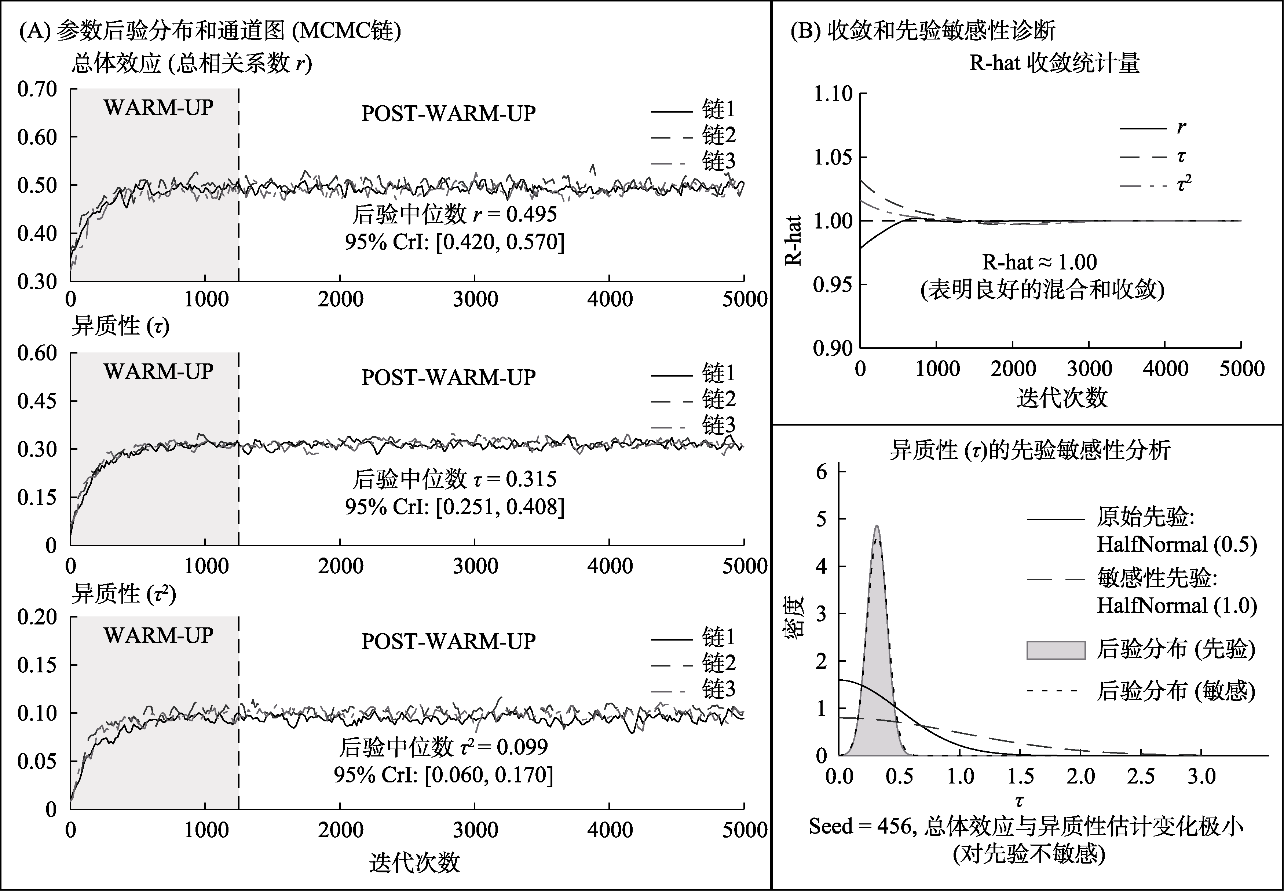
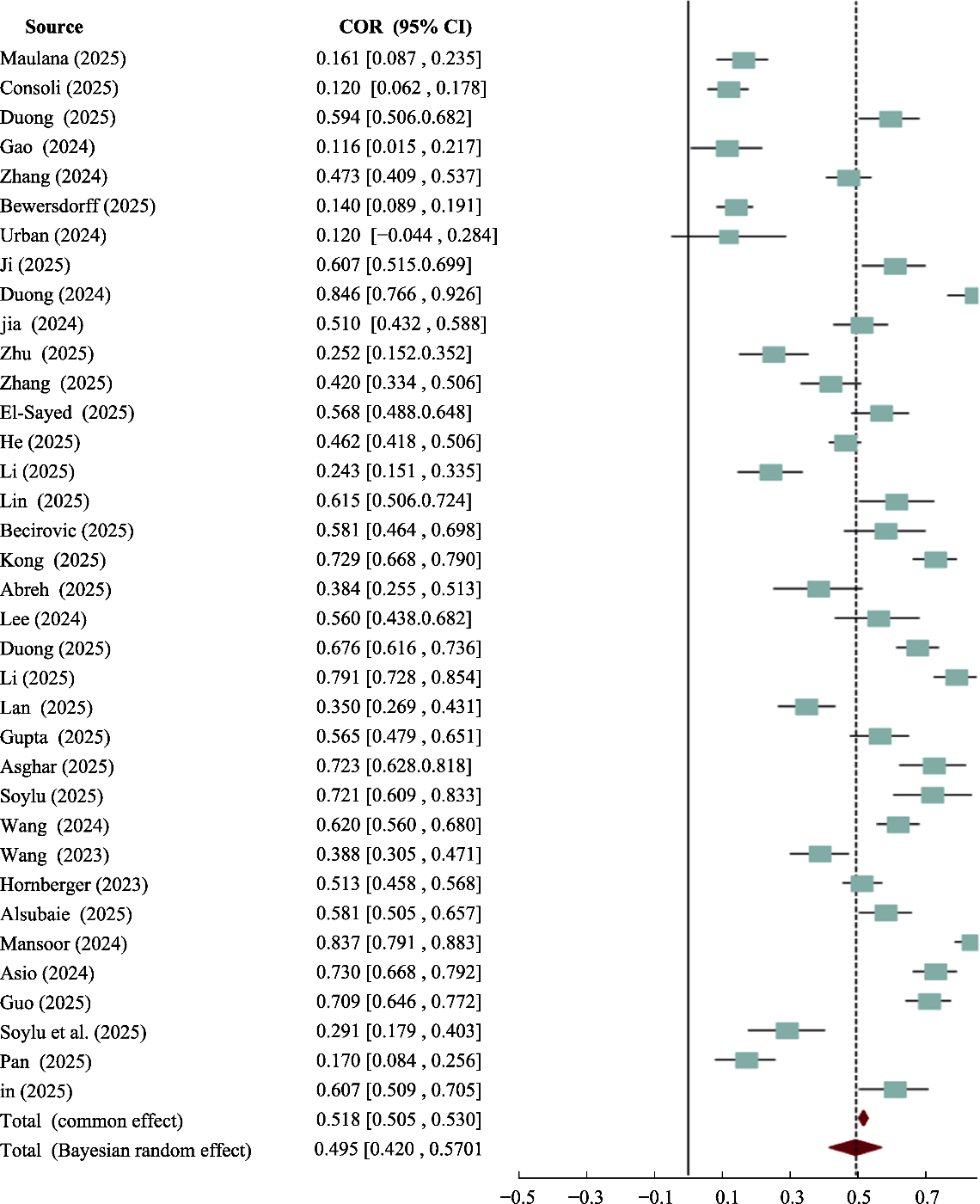
| Overall (总体) | 36 | 25, 251 | 0.52 | [0.51, 0.53] | 2751.00*** | 35 | 98.73% | 0.495 | [0.42, 0.57] | 高 |
| (AI特定自我效能) | 20 | 15, 851 | 0.51 | [0.39, 0.62] | 1935.48*** | 19 | 99.02% | — | — | 高 |
| (学业自我效能) | 9 | 4, 795 | 0.43 | [0.31, 0.53] | 179.69*** | 8 | 95.55% | — | — | 高 |
| (创业自我效能) | 4 | 2, 159 | 0.61 | [0.30, 0.80] | 267.80*** | 3 | 98.88% | — | — | 探索性 |
| (创造性自我效能) | 3 | 2, 446 | 0.71 | [0.59, 0.79] | 48.04*** | 2 | 95.84% | — | — | 探索性 |
| Outcome category | k | n | r | 95% CI | Q | df(Q) | I2 | r (Bayes) | 95% CrI | 证据等级 |
|---|---|---|---|---|---|---|---|---|---|---|
| Overall (总体) | 36 | 25, 251 | 0.52 | [0.51, 0.53] | 2751.00*** | 35 | 98.73% | 0.495 | [0.42, 0.57] | 高 |
| (AI特定自我效能) | 20 | 15, 851 | 0.51 | [0.39, 0.62] | 1935.48*** | 19 | 99.02% | — | — | 高 |
| (学业自我效能) | 9 | 4, 795 | 0.43 | [0.31, 0.53] | 179.69*** | 8 | 95.55% | — | — | 高 |
| (创业自我效能) | 4 | 2, 159 | 0.61 | [0.30, 0.80] | 267.80*** | 3 | 98.88% | — | — | 探索性 |
| (创造性自我效能) | 3 | 2, 446 | 0.71 | [0.59, 0.79] | 48.04*** | 2 | 95.84% | — | — | 探索性 |
| 调节变量 | 量表类别 | k | r | 95% CI | Qb | 证据等级 |
|---|---|---|---|---|---|---|
| 自我效能量表 | 372.65*** | |||||
| AI效能 | 20 | 0.53 | [0.41, 0.64] | 高 | ||
| 学业效能 | 9 | 0.37 | [0.24, 0.49] | 高 | ||
| 创业效能 | 4 | 0.61 | [0.30, 0.80] | 探索性 | ||
| 创造性 | 3 | 0.71 | [0.59, 0.79] | 探索性 | ||
| AI素养量表 | 573.13*** | |||||
| 直接AI素养 | 21 | 0.52 | [0.41, 0.61] | 高 | ||
| 代理指标 | 11 | 0.51 | [0.33, 0.65] | 高 | ||
| (自编、整合自陈) | 3 | 0.71 | [0.59, 0.79] | 探索性 | ||
| 成熟客观量表 | 1 | 0.14 | [0.09, 0.19] | 探索性 | ||
| 国家 | 0.76 (ns) | |||||
| 中国大陆、中国台湾 | 17 | 0.52 | [0.43, 0.60] | 高 | ||
| 非中国样本 | 19 | 0.53 | [0.38, 0.65] | 高 | ||
| 研究设计 | 37.21*** | |||||
| 横断面 | 31 | 0.53 | [0.44, 0.61] | 高 | ||
| 纵向 | 4 | 0.59 | [0.54, 0.64] | 探索性 | ||
| 实验 | 1 | 0.12 | [−0.04, 0.28] | 探索性 | ||
| 学生类别 | 100.48* | |||||
| 综合其他类(综合) | 22 | 0.55 | [0.43, 0.64] | 高 | ||
| 商管商科类(商管) | 6 | 0.41 | [0.06, 0.67] | 中等 | ||
| 医学护理类(医护) | 3 | 0.53 | [0.45, 0.61] | 探索性 | ||
| 教育/传媒/语言类(教传) | 3 | 0.60 | [0.39, 0.75] | 探索性 | ||
| 理工/计算机(理工) | 2 | 0.45 | [0.32, 0.56] | 探索性 |
| 调节变量 | 量表类别 | k | r | 95% CI | Qb | 证据等级 |
|---|---|---|---|---|---|---|
| 自我效能量表 | 372.65*** | |||||
| AI效能 | 20 | 0.53 | [0.41, 0.64] | 高 | ||
| 学业效能 | 9 | 0.37 | [0.24, 0.49] | 高 | ||
| 创业效能 | 4 | 0.61 | [0.30, 0.80] | 探索性 | ||
| 创造性 | 3 | 0.71 | [0.59, 0.79] | 探索性 | ||
| AI素养量表 | 573.13*** | |||||
| 直接AI素养 | 21 | 0.52 | [0.41, 0.61] | 高 | ||
| 代理指标 | 11 | 0.51 | [0.33, 0.65] | 高 | ||
| (自编、整合自陈) | 3 | 0.71 | [0.59, 0.79] | 探索性 | ||
| 成熟客观量表 | 1 | 0.14 | [0.09, 0.19] | 探索性 | ||
| 国家 | 0.76 (ns) | |||||
| 中国大陆、中国台湾 | 17 | 0.52 | [0.43, 0.60] | 高 | ||
| 非中国样本 | 19 | 0.53 | [0.38, 0.65] | 高 | ||
| 研究设计 | 37.21*** | |||||
| 横断面 | 31 | 0.53 | [0.44, 0.61] | 高 | ||
| 纵向 | 4 | 0.59 | [0.54, 0.64] | 探索性 | ||
| 实验 | 1 | 0.12 | [−0.04, 0.28] | 探索性 | ||
| 学生类别 | 100.48* | |||||
| 综合其他类(综合) | 22 | 0.55 | [0.43, 0.64] | 高 | ||
| 商管商科类(商管) | 6 | 0.41 | [0.06, 0.67] | 中等 | ||
| 医学护理类(医护) | 3 | 0.53 | [0.45, 0.61] | 探索性 | ||
| 教育/传媒/语言类(教传) | 3 | 0.60 | [0.39, 0.75] | 探索性 | ||
| 理工/计算机(理工) | 2 | 0.45 | [0.32, 0.56] | 探索性 |
| 国家/地区组 | k | Q | df | p | I2 | 证据等级 |
|---|---|---|---|---|---|---|
| 东亚国家组(含东亚/东南亚样本) | 22 | 1178.68 | 21 | <0.001 | 98.22% | 高 |
| 欧美国家组 | 8 | 282.53 | 7 | <0.001 | 97.52% | 高 |
| 国家/地区组 | k | Q | df | p | I2 | 证据等级 |
|---|---|---|---|---|---|---|
| 东亚国家组(含东亚/东南亚样本) | 22 | 1178.68 | 21 | <0.001 | 98.22% | 高 |
| 欧美国家组 | 8 | 282.53 | 7 | <0.001 | 97.52% | 高 |
| [1] | 冯永刚, 吕鑫源. (2025). 生成式人工智能嵌入教育的伦理检视. 中国电化教育, (11), 18-25. |
| [2] | 郭颢, 江楠, 江宏, 刘忠骅, 邓辉映. (2024). 人工智能驱动教育变革的伦理风险及其解蔽之路. 中国电化教育, (4), 25-31. |
| [3] | *郭姿辰, 欧阳霞. (2025). 大学生数字素养对智慧课堂自我效能感的影响. 湘南学院学报, 58(2), 101-106. |
| [4] | 何珊云, 沈演. (2025). 学会提问: 大学生与生成式人工智能协同学习模式的研究. 华东师范大学学报(教育科学版), 43(2), 34-48. |
| [5] | *林孔团, 王心杰. (2025). 人工智能素养与高校学生创新能力的关系--自我效能感的中介作用. 创新与创业教育, 16(5), 24-32. |
| [6] | 倪闽景. (2023). 从学习进化的视角看ChatGPT/生成式人工智能对学习的影响. 华东师范大学学报(教育科学版), 41(7), 151-161. |
| [7] | 魏显勇, 刘珈宏. (2025). 生成式人工智能赋能教师跨学科教学素养提升: 价值、挑战及进路. 教育理论与实践, 45(26), 24-29. |
| [8] | 吴河江, 吴砥. (2024). 生成式人工智能教育应用: 发展历史、国际态势与未来展望. 比较教育研究, 46(6), 13-23. |
| [9] | 武松, 安富海, 张仁杰. (2025). 功能论视角下人工智能赋能教育的边界与协同机制研究. 教育理论与实践, 45(34), 25-30. |
| [10] | 尹开国. (2024). 人工智能素养: 提出背景、概念界定与构成要素. 图书与情报, 44(3), 60-68. |
| [11] | 钟柏昌, 刘晓凡, 杨明欢. (2024). 何谓人工智能素养: 本质、构成与评价体系. 华东师范大学学报(教育科学版), 42(1), 71-84. |
| [12] | 中华人民共和国国务院. (2026). 政府工作报告. 新华社. https://www.gov.cn/yaowen/liebiao/202603/content_7062625.htm |
| [13] | 宗树伟, 杨付, 龙立荣, 韩翼. (2025). 促进还是抑制?生成式人工智能建议采纳对创造力的双刃剑效应. 心理科学进展, 33(6), 905-915. |
| [14] | *Abreh, M. K., Arthur, F., Akwetey, F. A., & Nortey, S. A. (2025). Modelling STEM students’ intention to learn artificial intelligence (AI) in ghana: A PLS-SEM and fsQCA approach. Discover Artificial Intelligence, 5, 223. |
| [15] | *Al-Abdullatif, A. M., & Alsubaie, M. A. (2025). ChatGPT in learning: Assessing students’ use intentions through the lens of perceived value and the influence of AI literacy. Behavioral Sciences, 14(9), 845. |
| [16] | Almatrafi, O., Johri, A., & Lee, H. (2024). A systematic review of AI literacy conceptualization, constructs, and implementation and assessment efforts (2019-2023). Computers and Education Open, 6, 100173. |
| [17] | *Asghar, M. Z., Duah, K. A., Iqbal, J., & Järvenoja, H. (2025). Evidence from West Africa on the interplay of affective behavioral cognitive and ethical dimensions of AI literacy in Ghanaian and Nigerian Universities. Discover Computing, 28, 169. |
| [18] | *Asio, J. M. R. (2024). AI literacy, self-efficacy, and self-competence among college students: Variances and interrelationships among variables. Malaysian Online Journal of Educational Sciences (MOJES), 12(3), 44-60. |
| [19] | Atchley, P., Pannell, H., Wofford, K., Hopkins, M., & Atchley, R. A. (2024). Human and AI collaboration in the higher education environment: Opportunities and concerns. Cognitive Research Principles and Implications, 9, 20. |
| [20] | Bandura, A. (1986). Social foundations of thought and action: A social cognitive theory. Prentice-Hall. |
| [21] | Bandura, A. (1993). Perceived self-efficacy in cognitive development and functioning. Educational Psychologist, 28(2), 117-148. |
| [22] | Bandura, A., Freeman, W. H., & Lightsey, R. (1999). Self- Efficacy: The exercise of control. Journal of Cognitive Psychotherapy, 13(2), 158-166. |
| [23] | *Bećirović, S., Polz, E., & Tinkel, I. (2025). Exploring students’ AI literacy and its effects on their AI output quality, self-efficacy, and academic performance. Smart Learning Environments, 12, 29. |
| [24] | *Bewersdorff, A., Hornberger, M., Nerdel, C., & Schiff, D. (2025). AI advocates and cautious critics: How AI attitudes, AI interest, use of AI, and AI literacy build university students’ AI self-efficacy. Computers and Education: Artificial Intelligence, 8, 100340. |
| [25] | Booth, A., Clarke, M., Dooley, G., Ghersi, D., Moher, D., Petticrew, M., & Stewart, L. (2012). The nuts and bolts of PROSPERO: An international prospective register of systematic reviews. Systematic Reviews, 1, 2. |
| [26] | Borenstein, M., Hedges, L. V., Higgins, J. P., & Rothstein, H. R. (2021). Introduction to meta-analysis. John Wiley & Sons, Ltd. |
| [27] | Carolus, A., Koch, M. J., Straka, S., Latoschik, M. E., & Wienrich, C. (2023). MAILS - Meta AI literacy scale: Development and testing of an AI literacy questionnaire based on well-founded competency models and psychological change- and meta-competencies. Computers in Human Behavior: Artificial Humans, 1(2), 100014. |
| [28] | Chaaban, Y., Qadhi, S., Chen, J., & Du, X. (2024). Understanding researchers’ AI readiness in a higher education context: Q methodology research. Education Sciences, 14(7), 709. |
| [29] | Chiu, T. K. F., & Sanusi, I. T. (2024). Define, foster, and assess student and teacher AI literacy and competency for all: Current status and future research direction. Computers and Education Open, 7, 100182. |
| [30] | *Consoli, T., & Petko, D. (2025). Which educational approaches predict students’ generative AI confidence and responsibility? Computers and Education: Artificial Intelligence, 9, 100431. |
| [31] | Cooper, H., Hedges, L. V., & Valentine, J. C. (2019). The handbook of research synthesis and meta-analysis. Russell Sage Foundation eBooks. |
| [32] | Cuijpers, P., Griffin, J. W., Furukawa, T. A., Cuijpers, P., Griffin, J. W., & Furukawa, T. A. (2021). The lack of statistical power of subgroup analyses in meta-analyses: A cautionary note. Epidemiology and Psychiatric Sciences, 30, e78. |
| [33] | Curaj, A., Hâj, C. M., & Pricopie, R. (2025). European higher education area 2030: Bridging realities for tomorrow’s higher education. Springer Nature. |
| [34] | Dekkers, R., Carey, L., & Langhorne, P. (2022). Making literature reviews work: A multidisciplinary guide to systematic approaches. Springer Nature. |
| [35] | *Duong, D. C. (2025a). AI literacy and e-entrepreneurial intention: A serial mediation model of e-entrepreneurial self-efficacy and e-entrepreneurial identity aspiration. International Journal of Information Management Data Insights, 5(2), 100349. |
| [36] | *Duong, C. D. (2025b). AI literacy and higher education students’ digital entrepreneurial intention: A moderated mediation model of AI self-efficacy and digital entrepreneurial self-efficacy. Industry and Higher Education, 40(2), 242-255. |
| [37] | *Duong, C. D., Nguyen, T. H., Chu, T. V., Pham, T. V., & Do, N. D. (2024). Whether ChatGPT adoption inspires higher education students’ digital entrepreneurial intention? An integrated model of the SCCT and the TPB. International Journal of Innovation Science, 17(5), 1210-1234. |
| [38] | Egger, M., Smith, G. D., Schneider, M., & Minder, C. (1997). Bias in meta-analysis detected by a simple, graphical test. BMJ, 315(7109), 629-634. |
| [39] | *El-Sayed, B. K. M., El-Sayed, A. A. I., Alsenany, S. A., & Asal, M. G. R. (2025). The role of artificial intelligence literacy and innovation mindset in shaping nursing students’ career and talent self-efficacy. Nurse Education in Practice, 82, 104208. |
| [40] | Feng, S., & Carolus, A. (2026). Artificial intelligence literacy at school: A systematic review with a focus on psychological foundations. Computers and Education: Artificial Intelligence, 10, 100551. |
| [41] | Frandsen, T. F., Nielsen, M. F. B., & Eriksen, M. B. (2022). Avoiding searching for outcomes called for additional search strategies: A study of Cochrane review searches. Journal of Clinical Epidemiology, 149, 137-144. |
| [42] | *Gao, Z., Cheah, J.-H., Lim, X.-J., & Luo, X. (2024). Enhancing academic performance of business students using generative AI: An interactive-constructive-active-passive (ICAP) self-determination perspective. The International Journal of Management Education, 22(2), 100958. |
| [43] | Getenet, S., Cantle, R., Redmond, P., & Albion, P. (2024). Students’ digital technology attitude, literacy and self- efficacy and their effect on online learning engagement. International Journal of Educational Technology in Higher Education, 21(1), 3. |
| [44] | *Gupta, S., & Jaiswal, R. (2025). A deep learning-based hybrid PLS-SEM-ANN approach for predicting factors improving AI-driven decision-making proficiency for future leaders. Journal of International Education in Business, 18(2), 234-268. |
| [45] | Hamamoto, R., Komatsu, M., Yamada, M., Kobayashi, K., Takahashi, M., Miyake, M., … Kaneko, S. (2024). Current status and future direction of cancer research using artificial intelligence for clinical application. Cancer Science, 116(2), 297-307. |
| [46] | *He, T., Huang, J., Li, Y., Wang, L., Liu, J., Zhang, F., Fu, S., & Gong, S. (2025). The mediation effect of AI self-efficacy between AI literacy and learning engagement in college nursing students: A cross-sectional study. Nurse Education in Practice, 87, 104499. |
| [47] | Heath, M. K., & Segal, P. (2021). What pre-service teacher technology integration conceals and reveals: “Colorblind” technology in schools. Computers & Education, 170, 104225. |
| [48] | Hedges, L. V., & Olkin, I. (1985). Statistical methods for meta-analysis. Academic Press. |
| [49] | Higgins, J. P. T., Thompson, S. G., Deeks, J. J., & Altman, D. G. (2003). Measuring inconsistency in meta-analyses. BMJ, 327(7414), 327-557. |
| [50] | *Hornberger, M., Bewersdorff, A., & Nerdel, C. (2023). What do university students know about artificial intelligence? Development and validation of an AI literacy test. Computers and Education: Artificial Intelligence, 5, 100165. |
| [51] | Huang, K., & Ball, C. (2024). The influence of AI literacy on user’s trust in AI in practical scenarios: A digital divide pilot study. Proceedings of the Association for Information Science and Technology, 61(1), 937-939. |
| [52] | *Ji, Y., Zhong, M., Lyu, S., Li, T., Niu, S., & Zhan, Z. (2025). How does AI literacy affect individual innovative behavior: The mediating role of psychological need satisfaction, creative self-efficacy, and self-regulated learning. Education and Information Technologies, 30, 16133-16162. |
| [53] | *Jia, X.-H., & Tu, J.-C. (2024). Towards a new conceptual model of AI-enhanced learning for college students: The roles of artificial intelligence capabilities, general self-efficacy, learning motivation, and critical thinking awareness. Systems, 12(3), 74. |
| [54] | Kallioinen, N., Paananen, T., Bürkner, P.-C., & Vehtari, A. (2024). Detecting and diagnosing prior and likelihood sensitivity with power-scaling. Statistics and Computing, 34, 57. |
| [55] | Kim, D., & Song, H. (2024). Designing an age-friendly conversational AI agent for mobile banking: The effects of voice modality and lip movement. International Journal of Human-Computer Studies, 187, 103262. |
| [56] | Koch, M. J., Carolus, A., Wienrich, C., & Latoschik, M. E. (2024). Meta AI literacy scale: Further validation and development of a short version. Heliyon, 10(21), e39686. |
| [57] | *Kong, J., Liu, J., Chen, G., & Shang, W. (2025). Assessing AI literacy in college students: The mediating role of self-efficacy in motivational commitment pathways. Education and Information Technologies, 30, 23957-23979. |
| [58] | Koo, T. K., & Li, M. Y. (2016). A guideline of selecting and reporting intraclass correlation coefficients for reliability research. Journal of Chiropractic Medicine, 15(2), 155-163. |
| [59] | *Lan, Y., Liu, S., & Xia, L. (2025). How mindfulness shapes AI competence: A structural equation modeling analysis of mindfulness, AI literacy and behavioral intention in Chinese media students. Frontiers in Psychology, 16, 1652934. |
| [60] | *Lee, J., Hung, J.-T., Yilmaz Soylu, M., Popescu, D., Cui, C. Z., Grigoryan, G., Joyner, D. A., & Harmon, S. W. (2025). Socratic mind: Impact of a novel GenAI-powered assessment tool on student learning and higher-order thinking. arXiv preprint. |
| [61] | *Lee, K.-W., & Tseng, Y.-F. (2024). Driving the dual learning process of management knowledge: A social cognitive theory perspective. The International Journal of Management Education, 22(1), 100940. |
| [62] | *Li, H., Zhang, Y., Chen, M., Zhao, T., & Jou, M. (2025). Creative personal identity in the age of generative AI: A social-cognitive pathway of AI literacy, self-efficacy, and mindset. Computers in Human Behavior, 175, 108838. |
| [63] | *Li, R., Ouyang, J., & Lin, J. (2025). Mediating effect of AI attitudes and AI literacy on the relationship between career self-efficacy and job-seeking anxiety. BMC Psychology, 13, 454. |
| [64] | Lilienthal, J., Sturtz, S., Schürmann, C., Maiworm, M., Röver, C., Friede, T., & Bender, R. (2024). Bayesian random‐effects meta‐analysis with empirical heterogeneity priors for application in health technology assessment with very few studies. Research Synthesis Methods, 15(2), 275-287. |
| [65] | *Lin, C.-S. (2025). Co-creating with AI: How communication students learn, think, and rely on intelligent systems. Journal of Educational Computing Research, 64(1), 155-179. |
| [66] | Lintner, S. (2024). A systematic review of AI literacy scales. NPJ Science of Learning, 9, Article 50. |
| [67] | Long, D., & Magerko, B. (2020). What is AI Literacy? Competencies and design considerations. CHI’20: Proceedings of the 2020 CHI Conference on Human Factors in Computing Systems (pp. 1-16), Association for Computing Machinery. https://doi.org/10.1145/3313831.3376727 |
| [68] | *Mansoor, H., Ala, Bawazir, Alsabri, M. A., Alharbi, A., & Okela, A. H. (2024). Artificial intelligence literacy among university students-A comparative transnational survey. Frontiers in Communication, 9, 1478476. |
| [69] | *Maulana, A., Fenitra, R. M., & Sutrisno, S. (2025). Artificial intelligence, job seeker, and career trajectory: How AI-based learning experiences affect commitment of fresh graduates to be an accountant? Computers and Education: Artificial Intelligence, 8, 100413. |
| [70] | Miao, F., & Cukurova, M. (2024). AI competency framework for teachers. UNESCO. |
| [71] | Midgley, C., Maehr, M. L., Hruda, L. Z., Anderman, E. M., Anderman, L. H., Freeman, K. E., ... Urdan, T. (2000). Manual for the Patterns of Adaptive Learning Scales (PALS). University of Michigan. |
| [72] | Montgomery, P., & Morton, M. (2010). Meta-analysis: Oxford Bibliographies Online Research Guide. Oxford University Press. |
| [73] | Ng, D. T. K., Leung, J. K. L., Chu, S. K. W., & Qiao, M. S. (2021). AI literacy: Definition, teaching, evaluation, and ethical issues. Proceedings of the Association for Information Science and Technology, 58(1), 504-509. |
| [74] | Page, M. J., McKenzie, J. E., Bossuyt, P. M., Boutron, I., Hoffmann, T. C., Mulrow, C. D., ... Moher, D. (2021). The PRISMA 2020 statement: An updated guideline for reporting systematic reviews. International Journal of Surgery, 88, 105906. |
| [75] | Pan, X. (2020). Technology acceptance, technological self-efficacy, and attitude toward technology-based self-directed learning: Learning motivation as a mediator. Frontiers in Psychology, 11, 564294. |
| [76] | *Pan, Z., & Zhang, Y. (2025). Exploring L2 writing motivation in AI-mediated EFL contexts: The role of teacher affective support, AI literacy, and self-efficacy through the lens of self-determination theory. Learning and Motivation, 92, 102214. |
| [77] | Park, J. (2025). A systematic literature review of generative artificial intelligence (GenAI) literacy in schools. Computers and Education: Artificial Intelligence, 9, 100487. |
| [78] | Schwarzer, R., & Jerusalem, M. (1995). Generalized self-efficacy scale. In J. Weinman, S. Wright, & M. Johnston (Eds.), Measures in health psychology: A user’s portfolio. Causal and control beliefs (pp. 35-37). NFER- NELSON. |
| [79] | Sperling, K., Stenberg, C.-J., McGrath, C., Åkerfeldt, A., Heintz, F., & Stenliden, L. (2024). In search of artificial intelligence (AI) literacy in teacher education: A scoping review. Computers and Education Open, 6, 100169. |
| [80] | Sterne, J. A., & Egger, M. (2001). Funnel plots for detecting bias in meta-analysis: Guidelines on choice of axis. Journal of Clinical Epidemiology, 54(10), 1046-1055. |
| [81] | Testa, M., Apuzzo, A., & Pittaway, L. (2026). AI literacy alone is not enough: Student AI readiness and career adaptability in business and management education. The International Journal of Management Education, 24(2), 101394. |
| [82] | *Urban, M., Děchtěrenko, F., Lukavský, J., Hrabalová, V., Svacha, F., Brom, C., & Urban, K. (2024). ChatGPT improves creative problem-solving performance in university students: An experimental study. Computers & Education, 215, 105031. |
| [83] | Viechtbauer, W., & Cheung, M. W.-L. (2010). Outlier and influence diagnostics for meta-analysis. Research Synthesis Methods, 1(2), 112-125. |
| [84] | Wang, B., Rau, P. P., & Yuan, T. (2022). Measuring user competence in using artificial intelligence: Validity and reliability of artificial intelligence literacy scale. Behaviour and Information Technology, 42(9), 1324-1337. |
| [85] | *Wang, S., Sun, Z., & Chen, Y. (2023). Effects of higher education institutes’ artificial intelligence capability on students’ self-efficacy, creativity and learning performance. Education and Information Technologies, 28(5), 4919-4939. |
| [86] | *Wang, X., & Li, P. (2024). Assessment of the relationship between music students’ self‐efficacy, academic performance and their artificial intelligence readiness. European Journal of Education, 59(4), 482-497. |
| [87] | Wang, Y.-Y., & Chuang, Y.-W. (2024). Artificial intelligence self-efficacy: Scale development and validation. Education and Information Technologies, 29, 4785-4808. |
| [88] | Wei, H., Dong, C., Zhu, Y., & Ma, H. (2020). Analysis of two minimally invasive procedures for osteoporotic vertebral compression fractures with intravertebral cleft: A systematic review and meta-analysis. Journal of Orthopaedic Surgery and Research, 15(1), 401. |
| [89] | *Yilmaz Soylu, M., Lee, J., Hung, J.-T., Cui, C. Z., & Joyner, D. (2025). AI literacy as a key driver of user experience in AI-powered assessment: Insights from Socratic mind. Interactive Learning Environments, 1-17. https://doi.org/10.1080/10494820.2025.2564739 |
| [90] | *Zhang, C., Rice, R. E., & Wang, L. H. (2024). College students’ literacy, ChatGPT activities, educational outcomes, and trust from a digital divide perspective. New Media & Society, 28(2), 673-695. |
| [91] | *Zhang, Q., Nie, H., Fan, J., & Liu, H. (2025). Exploring the dynamics of artificial intelligence literacy on English as a foreign language learners’ willingness to communicate: The critical mediating roles of artificial intelligence learning self-efficacy and classroom anxiety. Behavioral Sciences, 15(4), 523-536. |
| [92] | Zimmerman, B. J. (2002). Becoming a self-regulated learner: An overview. Theory Into Practice, 41(2), 64-70. |
| [93] | *Zhu, C., Ning, Y., Chen, J., & Wijaya, T. T. (2025). Exploring the interplay among artificial intelligence literacy, creativity, self-efficacy, and academic achievement in college students: Findings from PLS-SEM and FsQCA. Education and Information Technologies, 30, 21283-21316. |
| [1] | HONG Aoran, FENG Ziyu, WANG Yonggui. The influence of optimal distinctiveness of multi-modal sponsored content on influencer marketing effectiveness based on generative AI [J]. Advances in Psychological Science, 2026, 34(5): 836-855. |
| [2] | WANG Xuefeng, MA Zengguang. The dual-edged sword impact of generative AI product usage on consumer memory efficacy and behavior [J]. Advances in Psychological Science, 2026, 34(12): 2219-2238. |
| [3] | WU Jiahui, FU Hailun. A meta-analysis of the relationship between achievement goal orientation and academic achievement: The mediating role of self-efficacy and student engagement [J]. Advances in Psychological Science, 2024, 32(7): 1104-1125. |
| [4] | ZENG Runxi, LI You. The Relationship between self-efficacy and online health information seeking: A meta-analysis [J]. Advances in Psychological Science, 2023, 31(4): 535-551. |
| [5] | XU Yi, LIU Yixuan. The impact of trust in technology and trust in leadership on the adoption of new technology from employee's perspective [J]. Advances in Psychological Science, 2021, 29(10): 1711-1723. |
| [6] | ZHAO Chen, GAO Zhonghua. The dynamic evolution and mechanism of newcomer’s political self-efficacy: An interactionist perspective of organizational socialization [J]. Advances in Psychological Science, 2017, 25(9): 1456-1468. |
| [7] | GU Jiani; MENG Hui; FAN Jinyan. Social Self-Efficacy: Dimension, Measurement and Its Mechanism [J]. Advances in Psychological Science, 2014, 22(11): 1791-1800. |
| [8] | LI Yang;ZHANG Liwei;ZHANG Liancheng. The Theory of Challenge and Threat States in Athletes and Self-Control in Competition [J]. Advances in Psychological Science, 2013, 21(9): 1696-1710. |
| [9] | GAO Wen;YANG Li-Zhu;LI Xiao-Xi. The Health Action Process Approach: Its Development and Future [J]. Advances in Psychological Science, 2012, 20(10): 1651-1662. |
| [10] | JIA Feng-Xiang;SHI Wei. A Review of Self-expansion Model [J]. , 2012, 20(1): 137-148. |
| [11] | LI Xi-Ying;ZHANG Li;LU Yong-Li;ZHANG Heng-Sheng;ZHANG Long-Ping. Creative Self-efficacy: Concept, Influencing Factors and Intervention [J]. , 2012, 20(1): 108-114. |
| [12] | (1江苏大学工商管理学院, 江苏 镇江 212013) (2南京大学商学院, 南京 210002). The Motivation of Employee Creativity: Employee Creative Self-efficacy [J]. , 2011, 19(9): 1363-1370. |
| [13] | TANG Dong-Ling; DONG Yan; YU Guo-Liang; WEN Shu-Feng. The Regulatory Emotional Self-Efficacy: A New Research Topic [J]. , 2010, 18(4): 598-604. |
| [14] | Sun Xiaomin;Xue Gang. A Review of Study on Self-managemen [J]. , 2008, 16(1): 106-113. |
| [15] | Chen Zhixia;Wu Hao. Intrinsic Motivation and Its Antecedents [J]. , 2008, 16(1): 98-105. |
| Viewed | ||||||
|
Full text |
|
|||||
|
Abstract |
|
|||||
