

ISSN 1671-3710
CN 11-4766/R
主办:中国科学院心理研究所
出版:科学出版社
CN 11-4766/R
主办:中国科学院心理研究所
出版:科学出版社
Advances in Psychological Science ›› 2026, Vol. 34 ›› Issue (8): 1351-1370.doi: 10.3724/SP.J.1042.2026.1351
• Meta-Analysis • Previous Articles Next Articles
WANG Dan1, CHEN Wenfeng2( ), WANG Hui3, FU Yujia3, LIU Junye3, LIU Zhengkui4
Received:2025-09-28
Online:2026-08-15
Published:2026-06-03
Contact:
CHEN Wenfeng
E-mail:wfchen@cityu.edu.mo
CLC Number:
WANG Dan, CHEN Wenfeng, WANG Hui, FU Yujia, LIU Junye, LIU Zhengkui. The shared neural mechanisms of emotional contagion and bodily self-representation[J]. Advances in Psychological Science, 2026, 34(8): 1351-1370.
| 研究 | 样本量 | 平均 年龄(岁) | 坐标 数量 | 坐标空间 | 对比条件 |
|---|---|---|---|---|---|
| 情绪感染 | |||||
| Tamm et al., 2020 | 69 | 20~75 | 8 | MNI | Passive observing: Angry vs Neutral |
| 1 | Passive observing: Happy vs Neutral | ||||
| 14 | Passive observing: Happy vs Baseline (blank screen, fixation cross etc.) | ||||
| 33 | Passive observing: Angry vs Baseline | ||||
| 20 | Passive observing: Neutral vs Baseline | ||||
| 30 | Passive observing: Happy & Angry & Neutral vs Baseline | ||||
| Hsu et al., 2022 | 44 | 22.82 | 10 | MNI | Passive observing: Emotional vs Mosaic |
| Alkan Härtwig et al., 2020 | 26 | 34.69 | 1 | MNI | Emotional empathy vs Age/Gender estimation |
| Krautheim et al., | 178 | 24.04 | 38 | MNI | Emotional imitation vs Observing |
| Numata et al., 2020 | 39 | 21.49 | 14 | MNI | Emotional imitation vs No imitation |
| Krautheim et al., 2019 | 178 | 24 | 12 | MNI | Production-perception: Emotional face vs Neutral face |
| Rymarczyk et al., | 46 | 23.7 | 66 | MNI | Passive observing: Emotional vs Neutral |
| Oliver et al., 2018 | 36 | 21.5 | 14 | MNI | Emotional empathy vs Age estimation |
| Rymarczyk et al., 2019 | 46 | 23.8 | 61 | MNI | Passive observing: Emotional vs Neutral |
| Pohl et al., 2017 | 13 | NA | 9 | MNI | Emotional imitation vs Observing |
| Seara-Cardoso et al., 2016 | 30 | 26.9 | 11 | MNI | Emotional empathy vs Observing fixation cross |
| Budell et al., 2015 | 23 | 18~33 | 29 | Talairach | Emotional imitation vs Observing |
| Mazza et al., 2015 | 10 | 30 | 2 | Talairach | Implicit empathy: Emotional vs Neutral |
| 2 | Explicit empathy: Emotional vs Neutral | ||||
| 情绪感染 | |||||
| Braadbaart et al., 2014 | 20 | 26.3 | 4 | MNI | Emotional imitation vs Mouth movement |
| Hadjikhani et al., 2014 | 31 | 22.5 | 41 | MNI | Passive observing: Emotional vs Mosaic |
| Pohl et al., 2013 | 27 | 24.6 | 1 | MNI | Emotional imitation vs Observing |
| Vrticka et al., 2013 | 20 | 33.5 | 7 | MNI | Emotional imitation vs No imitation |
| de Greck et al., 2012 | 20 | 37 | 29 | Talairach | Emotional empathy vs Unrecognizable content |
| Schulte-Rüther et al., 2011 | 18 | 25.1 | 17 | MNI | Emotional empathy vs Evaluating picture’s width |
| Nomi et al., 2008 | 14 | 28.6 | 6 | MNI | Emotional empathy vs Viewing scrambled faces |
| Nummenmaa et al., | 10 | 26 | 10 | MNI | Emotional empathy vs Cognitive empathy |
| 8 | Passive observing: Emotional vs Neutral | ||||
| 18 | Passive observing: Emotional vs Mosaic | ||||
| van der Gaag et al., 2007 | 17 | 23.3 | 57 | MNI | Emotional imitation vs Rest |
| 35 | Emotional imitation vs No imitation | ||||
| Dapretto et al., | 10 | 12.38 | 36 | Talairach | Emotional imitation vs Rest |
| 14 | Observing vs Rest | ||||
| Lee et al., | 18 | 26 | 7 | MNI | Passive observing: Emotional vs Neutral |
| Carr et al., 2003 | 11 | 29 | 39 | Talairach | Emotional imitation vs Observing |
| 生理自我表征 | |||||
| Wang et al., 2023 | 30 | 20.9 | 24 | MNI | Self vs Unfamiliar people |
| Guan et al., 2020 | 69 | 20.75 | 7 | MNI | Self vs Friend |
| Morita et al., 2020 | 50 | 21.6 | 17 | MNI | Self vs Unfamiliar people |
| Morita et al., | 20 | 20.9 | 24 | MNI | Self vs Unfamiliar people |
| Morita et al., | 22 | 18~47 | 25 | MNI | Self vs Unfamiliar people |
| Morita et al., 2014 | 32 | 21.3 | 17 | MNI | Self vs Unfamiliar people |
| Sugiura et al., 2015 | 27 | 19~25 | 15 | MNI | Self vs Unfamiliar people |
| Scheepers et al., 2013 | 41 | 21 | 11 | MNI | Self vs Familiar people |
| Apps et al., 2012 | 16 | 24.31 | 19 | MNI | Self vs Familiar people |
| Herwig et al., 2012 | 25 | 23~41 | 7 | Talairach | Self vs Unfamiliar & Familiar people |
| Ma & Han, | 20 | 22.4 | 3 | MNI | Self vs Friend |
| Oikawa et al., 2012 | 28 | 20.8 | 6 | MNI | Self vs Friend |
| Sugiura et al., | 23 | 18~24 | 7 | MNI | Self vs Friend |
| Morita et al., 2012 | 15 | 23.3 | 29 | MNI | Self vs Unfamiliar people |
| Ramasubbu et al., 2011 | 10 | 25 | 5 | MNI | Self vs Familiar people |
| Arzy et al., 2009 | 12 | 33.7 | 15 | MNI | Self vs Familiar people |
| Platek & Kemp, 2009 | 12 | 27.58 | 12 | MNI | Self vs Familiar people |
| Taylor et al., 2009 | 10 | 35.4 | 7 | MNI | Self vs Unfamiliar people |
| Kaplan et al., 2008 | 12 | 26.6 | 3 | MNI | Self vs Familiar people |
| Morita et al., 2008 | 19 | 26 | 9 | MNI | Self vs Unfamiliar people |
| Sugiura et al., 2008 | 29 | 18~24 | 3 | MNI | Self vs Friend |
| 生理自我表征 | |||||
| Devue et al., 2007 | 20 | 22.1 | 7 | MNI | Self vs Colleague |
| Sui & Han, 2007 | 12 | 24.3 | 2 | Talairach | Self vs Familiar people |
| Platek et al., 2006 | 12 | 19.36 | 7 | MNI | Self vs Familiar people |
| Sugiura et al., 2006 | 31 | 18~24 | 10 | Talairach | Self vs Friend |
| Sugiura et al., 2005 | 34 | 18~26 | 3 | Talairach | Self vs Unfamiliar people |
| Uddin et al., | 10 | 26.9 | 8 | MNI | Self vs Familiar people |
| Platek et al., | 5 | NA | 3 | Talairach | Self vs Famous people |
| Kircher et al., 2001 | 20 | 31 | 8 | Talairach | Self vs Partner |
| Kircher et al., 2000 | 6 | NA | 17 | Talairach | Self vs Unknown people |
| 研究 | 样本量 | 平均 年龄(岁) | 坐标 数量 | 坐标空间 | 对比条件 |
|---|---|---|---|---|---|
| 情绪感染 | |||||
| Tamm et al., 2020 | 69 | 20~75 | 8 | MNI | Passive observing: Angry vs Neutral |
| 1 | Passive observing: Happy vs Neutral | ||||
| 14 | Passive observing: Happy vs Baseline (blank screen, fixation cross etc.) | ||||
| 33 | Passive observing: Angry vs Baseline | ||||
| 20 | Passive observing: Neutral vs Baseline | ||||
| 30 | Passive observing: Happy & Angry & Neutral vs Baseline | ||||
| Hsu et al., 2022 | 44 | 22.82 | 10 | MNI | Passive observing: Emotional vs Mosaic |
| Alkan Härtwig et al., 2020 | 26 | 34.69 | 1 | MNI | Emotional empathy vs Age/Gender estimation |
| Krautheim et al., | 178 | 24.04 | 38 | MNI | Emotional imitation vs Observing |
| Numata et al., 2020 | 39 | 21.49 | 14 | MNI | Emotional imitation vs No imitation |
| Krautheim et al., 2019 | 178 | 24 | 12 | MNI | Production-perception: Emotional face vs Neutral face |
| Rymarczyk et al., | 46 | 23.7 | 66 | MNI | Passive observing: Emotional vs Neutral |
| Oliver et al., 2018 | 36 | 21.5 | 14 | MNI | Emotional empathy vs Age estimation |
| Rymarczyk et al., 2019 | 46 | 23.8 | 61 | MNI | Passive observing: Emotional vs Neutral |
| Pohl et al., 2017 | 13 | NA | 9 | MNI | Emotional imitation vs Observing |
| Seara-Cardoso et al., 2016 | 30 | 26.9 | 11 | MNI | Emotional empathy vs Observing fixation cross |
| Budell et al., 2015 | 23 | 18~33 | 29 | Talairach | Emotional imitation vs Observing |
| Mazza et al., 2015 | 10 | 30 | 2 | Talairach | Implicit empathy: Emotional vs Neutral |
| 2 | Explicit empathy: Emotional vs Neutral | ||||
| 情绪感染 | |||||
| Braadbaart et al., 2014 | 20 | 26.3 | 4 | MNI | Emotional imitation vs Mouth movement |
| Hadjikhani et al., 2014 | 31 | 22.5 | 41 | MNI | Passive observing: Emotional vs Mosaic |
| Pohl et al., 2013 | 27 | 24.6 | 1 | MNI | Emotional imitation vs Observing |
| Vrticka et al., 2013 | 20 | 33.5 | 7 | MNI | Emotional imitation vs No imitation |
| de Greck et al., 2012 | 20 | 37 | 29 | Talairach | Emotional empathy vs Unrecognizable content |
| Schulte-Rüther et al., 2011 | 18 | 25.1 | 17 | MNI | Emotional empathy vs Evaluating picture’s width |
| Nomi et al., 2008 | 14 | 28.6 | 6 | MNI | Emotional empathy vs Viewing scrambled faces |
| Nummenmaa et al., | 10 | 26 | 10 | MNI | Emotional empathy vs Cognitive empathy |
| 8 | Passive observing: Emotional vs Neutral | ||||
| 18 | Passive observing: Emotional vs Mosaic | ||||
| van der Gaag et al., 2007 | 17 | 23.3 | 57 | MNI | Emotional imitation vs Rest |
| 35 | Emotional imitation vs No imitation | ||||
| Dapretto et al., | 10 | 12.38 | 36 | Talairach | Emotional imitation vs Rest |
| 14 | Observing vs Rest | ||||
| Lee et al., | 18 | 26 | 7 | MNI | Passive observing: Emotional vs Neutral |
| Carr et al., 2003 | 11 | 29 | 39 | Talairach | Emotional imitation vs Observing |
| 生理自我表征 | |||||
| Wang et al., 2023 | 30 | 20.9 | 24 | MNI | Self vs Unfamiliar people |
| Guan et al., 2020 | 69 | 20.75 | 7 | MNI | Self vs Friend |
| Morita et al., 2020 | 50 | 21.6 | 17 | MNI | Self vs Unfamiliar people |
| Morita et al., | 20 | 20.9 | 24 | MNI | Self vs Unfamiliar people |
| Morita et al., | 22 | 18~47 | 25 | MNI | Self vs Unfamiliar people |
| Morita et al., 2014 | 32 | 21.3 | 17 | MNI | Self vs Unfamiliar people |
| Sugiura et al., 2015 | 27 | 19~25 | 15 | MNI | Self vs Unfamiliar people |
| Scheepers et al., 2013 | 41 | 21 | 11 | MNI | Self vs Familiar people |
| Apps et al., 2012 | 16 | 24.31 | 19 | MNI | Self vs Familiar people |
| Herwig et al., 2012 | 25 | 23~41 | 7 | Talairach | Self vs Unfamiliar & Familiar people |
| Ma & Han, | 20 | 22.4 | 3 | MNI | Self vs Friend |
| Oikawa et al., 2012 | 28 | 20.8 | 6 | MNI | Self vs Friend |
| Sugiura et al., | 23 | 18~24 | 7 | MNI | Self vs Friend |
| Morita et al., 2012 | 15 | 23.3 | 29 | MNI | Self vs Unfamiliar people |
| Ramasubbu et al., 2011 | 10 | 25 | 5 | MNI | Self vs Familiar people |
| Arzy et al., 2009 | 12 | 33.7 | 15 | MNI | Self vs Familiar people |
| Platek & Kemp, 2009 | 12 | 27.58 | 12 | MNI | Self vs Familiar people |
| Taylor et al., 2009 | 10 | 35.4 | 7 | MNI | Self vs Unfamiliar people |
| Kaplan et al., 2008 | 12 | 26.6 | 3 | MNI | Self vs Familiar people |
| Morita et al., 2008 | 19 | 26 | 9 | MNI | Self vs Unfamiliar people |
| Sugiura et al., 2008 | 29 | 18~24 | 3 | MNI | Self vs Friend |
| 生理自我表征 | |||||
| Devue et al., 2007 | 20 | 22.1 | 7 | MNI | Self vs Colleague |
| Sui & Han, 2007 | 12 | 24.3 | 2 | Talairach | Self vs Familiar people |
| Platek et al., 2006 | 12 | 19.36 | 7 | MNI | Self vs Familiar people |
| Sugiura et al., 2006 | 31 | 18~24 | 10 | Talairach | Self vs Friend |
| Sugiura et al., 2005 | 34 | 18~26 | 3 | Talairach | Self vs Unfamiliar people |
| Uddin et al., | 10 | 26.9 | 8 | MNI | Self vs Familiar people |
| Platek et al., | 5 | NA | 3 | Talairach | Self vs Famous people |
| Kircher et al., 2001 | 20 | 31 | 8 | Talairach | Self vs Partner |
| Kircher et al., 2000 | 6 | NA | 17 | Talairach | Self vs Unknown people |
| VOI | 实验数量 | 样本量 | 位点数量 |
|---|---|---|---|
| R额下回 | 20 | 312 | 372 |
| L 脑岛 | 49 | 816 | 1087 |
| R 脑岛/屏状核 | 18 | 278 | 380 |
| VOI | 实验数量 | 样本量 | 位点数量 |
|---|---|---|---|
| R额下回 | 20 | 312 | 372 |
| L 脑岛 | 49 | 816 | 1087 |
| R 脑岛/屏状核 | 18 | 278 | 380 |

| 团块 | 位置 | BA | MNI 坐标 | 体素(mm3) | ALE(10-3) | 研究贡献数量 | FSN的预定义边界 | FSN | ||
|---|---|---|---|---|---|---|---|---|---|---|
| X | Y | Z | ||||||||
| 1 | R 额下回 | 13 | 48 | 30 | -2 | 4656 | 36 | 15 | [8, 135] | 95 |
| R中央前回 | 44 | 56 | 16 | 0 | 32 | |||||
| R 额下回 | 44 | 56 | 8 | 16 | 24 | |||||
| 2 | L中央前回 | 44 | -50 | 10 | 8 | 3784 | 33 | 13 | [8, 117] | 73 |
| L 颞上回 | 22 | -56 | 14 | -2 | 30 | |||||
| L 额下回 | 47 | -44 | 24 | -12 | 30 | |||||
| L 额下回 | 47 | -40 | 30 | -16 | 29 | |||||
| L 脑岛 | 13 | -40 | 22 | -4 | 26 | |||||
| L 脑岛 | 13 | -44 | 16 | 0 | 22 | |||||
| 3 | R 额上回 | 6 | 8 | 12 | 64 | 2080 | 48 | 10 | [8, 90] | 43 |
| R 额上回 | 6 | 8 | 8 | 66 | 47 | |||||
| 4 | R 顶下小叶 | 40 | 58 | -30 | 26 | 1880 | 51 | 9 | [8, 81] | 53 |
| R 中央后回 | 40 | 66 | -28 | 22 | 29 | |||||
| 5 | R中央前回 | 6 | 52 | 2 | 48 | 1712 | 48 | 8 | [8, 72] | 30 |
| R中央前回 | 6 | 42 | -10 | 36 | 25 | |||||
| 6 | R 海马旁回 | 20 | -4 | -16 | 1672 | 48 | 9 | [8, 81] | 31 | |
| R 海马旁回 | 34 | -4 | -18 | 20 | ||||||
| 7 | R 顶丘 | 42 | -58 | -24 | 1544 | 32 | 8 | [8, 72] | 20 | |
| R 枕下回 | 19 | 44 | -76 | -8 | 21 | |||||
| R 小脑后叶 | 38 | -56 | -14 | 21 | ||||||
| R 梭状回 | 19 | 42 | -72 | -12 | 20 | |||||
| 8 | L 海马旁回 | -20 | -6 | -16 | 1456 | 51 | 8 | [8, 72] | 43 | |
| 9 | R 颞上回 | 41 | 50 | -36 | 4 | 1264 | 34 | 6 | [8, 54] | 20 |
| R 颞上回 | 22 | 56 | -38 | 8 | 22 | |||||
| 10 | L 扣带回 | 24 | -6 | 10 | 40 | 920 | 34 | 7 | [8, 63] | 114 |
| 11 | L 梭状回 | 19 | -34 | -86 | -12 | 816 | 26 | 5 | [8, 52] | 8 |
| L 枕下回 | 18 | -34 | -88 | -4 | 25 | |||||
| L 枕下回 | 18 | -30 | -92 | -2 | 22 | |||||
| 12 | R 内侧额回 | 9 | 6 | 60 | 30 | 792 | 33 | 6 | [8, 54] | 8 |
| 团块 | 位置 | BA | MNI 坐标 | 体素(mm3) | ALE(10-3) | 研究贡献数量 | FSN的预定义边界 | FSN | ||
|---|---|---|---|---|---|---|---|---|---|---|
| X | Y | Z | ||||||||
| 1 | R 额下回 | 13 | 48 | 30 | -2 | 4656 | 36 | 15 | [8, 135] | 95 |
| R中央前回 | 44 | 56 | 16 | 0 | 32 | |||||
| R 额下回 | 44 | 56 | 8 | 16 | 24 | |||||
| 2 | L中央前回 | 44 | -50 | 10 | 8 | 3784 | 33 | 13 | [8, 117] | 73 |
| L 颞上回 | 22 | -56 | 14 | -2 | 30 | |||||
| L 额下回 | 47 | -44 | 24 | -12 | 30 | |||||
| L 额下回 | 47 | -40 | 30 | -16 | 29 | |||||
| L 脑岛 | 13 | -40 | 22 | -4 | 26 | |||||
| L 脑岛 | 13 | -44 | 16 | 0 | 22 | |||||
| 3 | R 额上回 | 6 | 8 | 12 | 64 | 2080 | 48 | 10 | [8, 90] | 43 |
| R 额上回 | 6 | 8 | 8 | 66 | 47 | |||||
| 4 | R 顶下小叶 | 40 | 58 | -30 | 26 | 1880 | 51 | 9 | [8, 81] | 53 |
| R 中央后回 | 40 | 66 | -28 | 22 | 29 | |||||
| 5 | R中央前回 | 6 | 52 | 2 | 48 | 1712 | 48 | 8 | [8, 72] | 30 |
| R中央前回 | 6 | 42 | -10 | 36 | 25 | |||||
| 6 | R 海马旁回 | 20 | -4 | -16 | 1672 | 48 | 9 | [8, 81] | 31 | |
| R 海马旁回 | 34 | -4 | -18 | 20 | ||||||
| 7 | R 顶丘 | 42 | -58 | -24 | 1544 | 32 | 8 | [8, 72] | 20 | |
| R 枕下回 | 19 | 44 | -76 | -8 | 21 | |||||
| R 小脑后叶 | 38 | -56 | -14 | 21 | ||||||
| R 梭状回 | 19 | 42 | -72 | -12 | 20 | |||||
| 8 | L 海马旁回 | -20 | -6 | -16 | 1456 | 51 | 8 | [8, 72] | 43 | |
| 9 | R 颞上回 | 41 | 50 | -36 | 4 | 1264 | 34 | 6 | [8, 54] | 20 |
| R 颞上回 | 22 | 56 | -38 | 8 | 22 | |||||
| 10 | L 扣带回 | 24 | -6 | 10 | 40 | 920 | 34 | 7 | [8, 63] | 114 |
| 11 | L 梭状回 | 19 | -34 | -86 | -12 | 816 | 26 | 5 | [8, 52] | 8 |
| L 枕下回 | 18 | -34 | -88 | -4 | 25 | |||||
| L 枕下回 | 18 | -30 | -92 | -2 | 22 | |||||
| 12 | R 内侧额回 | 9 | 6 | 60 | 30 | 792 | 33 | 6 | [8, 54] | 8 |
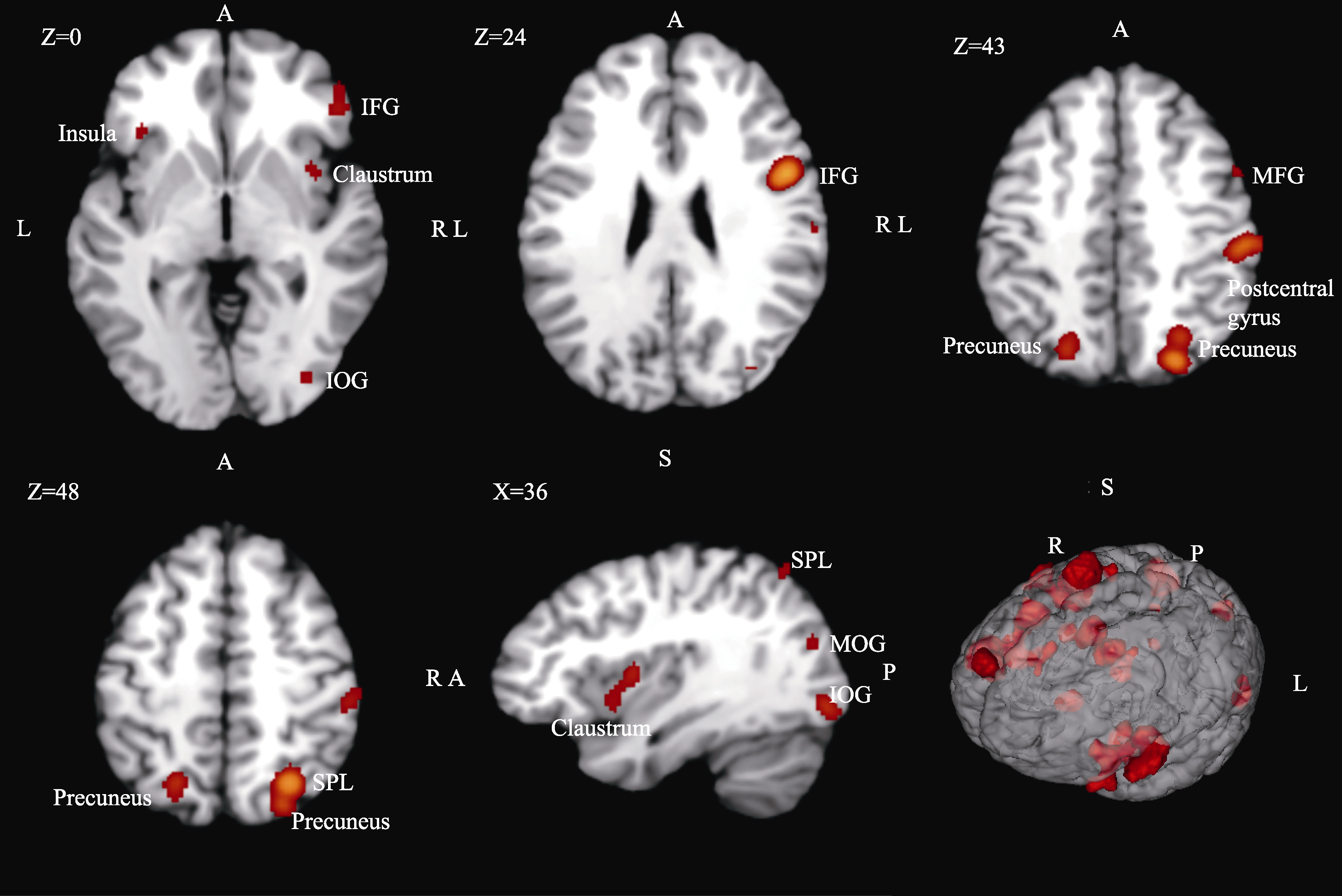
| 团块 | 位置 | BA | MNI坐标 | 体素(mm3) | ALE(10-3) | 研究贡献数量 | FSN的预定义边界 | FSN | ||
|---|---|---|---|---|---|---|---|---|---|---|
| X | Y | Z | ||||||||
| 1 | R 顶上小叶 | 7 | 28 | -62 | 48 | 5704 | 39 | 15 | [10, 121] | 35 |
| R 楔前叶 | 7 | 24 | -72 | 44 | 36 | |||||
| R 枕中回 | 19 | 38 | -76 | 22 | 18 | |||||
| R 楔前叶 | 31 | 32 | -76 | 22 | 15 | |||||
| 2 | R 额中回 | 46 | 44 | 36 | 10 | 4616 | 57 | 16 | [10, 131] | 72 |
| R 枕下回 | 47 | 52 | 34 | -6 | 16 | |||||
| 40 | 24 | 16 | 15 | |||||||
| 3 | R 梭状回 | 37 | 48 | -56 | -12 | 3544 | 38 | 15 | [10, 121] | 27 |
| 4 | R 额下回 | 9 | 50 | 8 | 24 | 3296 | 43 | 12 | [10, 91] | 35 |
| R 中央前回 | 6 | 52 | 8 | 44 | 18 | |||||
| 5 | R 中央后回 | 2 | 54 | -24 | 42 | 3008 | 32 | 9 | [10, 61] | 15 |
| R 中央后回 | 2 | 58 | -24 | 40 | 31 | |||||
| 6 | L 楔前叶 | 7 | -20 | -68 | 44 | 1424 | 23 | 7 | [10, 41] | < 10 |
| L 楔前叶 | 7 | -20 | -62 | 46 | 23 | |||||
| 7 | R 屏状核 | 38 | 0 | 8 | 1256 | 23 | 8 | [10, 51] | < 10 | |
| R 屏状核 | 36 | 8 | -2 | 17 | ||||||
| 8 | L 脑岛 | 13 | -36 | 16 | -6 | 816 | 20 | 4 | [10, 11] | < 10 |
| L 脑岛 | 13 | -36 | 24 | 0 | 16 | |||||
| 9 | R 枕下回 | 18 | 36 | -82 | -4 | 720 | 23 | 5 | [10, 21] | < 10 |
| 团块 | 位置 | BA | MNI坐标 | 体素(mm3) | ALE(10-3) | 研究贡献数量 | FSN的预定义边界 | FSN | ||
|---|---|---|---|---|---|---|---|---|---|---|
| X | Y | Z | ||||||||
| 1 | R 顶上小叶 | 7 | 28 | -62 | 48 | 5704 | 39 | 15 | [10, 121] | 35 |
| R 楔前叶 | 7 | 24 | -72 | 44 | 36 | |||||
| R 枕中回 | 19 | 38 | -76 | 22 | 18 | |||||
| R 楔前叶 | 31 | 32 | -76 | 22 | 15 | |||||
| 2 | R 额中回 | 46 | 44 | 36 | 10 | 4616 | 57 | 16 | [10, 131] | 72 |
| R 枕下回 | 47 | 52 | 34 | -6 | 16 | |||||
| 40 | 24 | 16 | 15 | |||||||
| 3 | R 梭状回 | 37 | 48 | -56 | -12 | 3544 | 38 | 15 | [10, 121] | 27 |
| 4 | R 额下回 | 9 | 50 | 8 | 24 | 3296 | 43 | 12 | [10, 91] | 35 |
| R 中央前回 | 6 | 52 | 8 | 44 | 18 | |||||
| 5 | R 中央后回 | 2 | 54 | -24 | 42 | 3008 | 32 | 9 | [10, 61] | 15 |
| R 中央后回 | 2 | 58 | -24 | 40 | 31 | |||||
| 6 | L 楔前叶 | 7 | -20 | -68 | 44 | 1424 | 23 | 7 | [10, 41] | < 10 |
| L 楔前叶 | 7 | -20 | -62 | 46 | 23 | |||||
| 7 | R 屏状核 | 38 | 0 | 8 | 1256 | 23 | 8 | [10, 51] | < 10 | |
| R 屏状核 | 36 | 8 | -2 | 17 | ||||||
| 8 | L 脑岛 | 13 | -36 | 16 | -6 | 816 | 20 | 4 | [10, 11] | < 10 |
| L 脑岛 | 13 | -36 | 24 | 0 | 16 | |||||
| 9 | R 枕下回 | 18 | 36 | -82 | -4 | 720 | 23 | 5 | [10, 21] | < 10 |
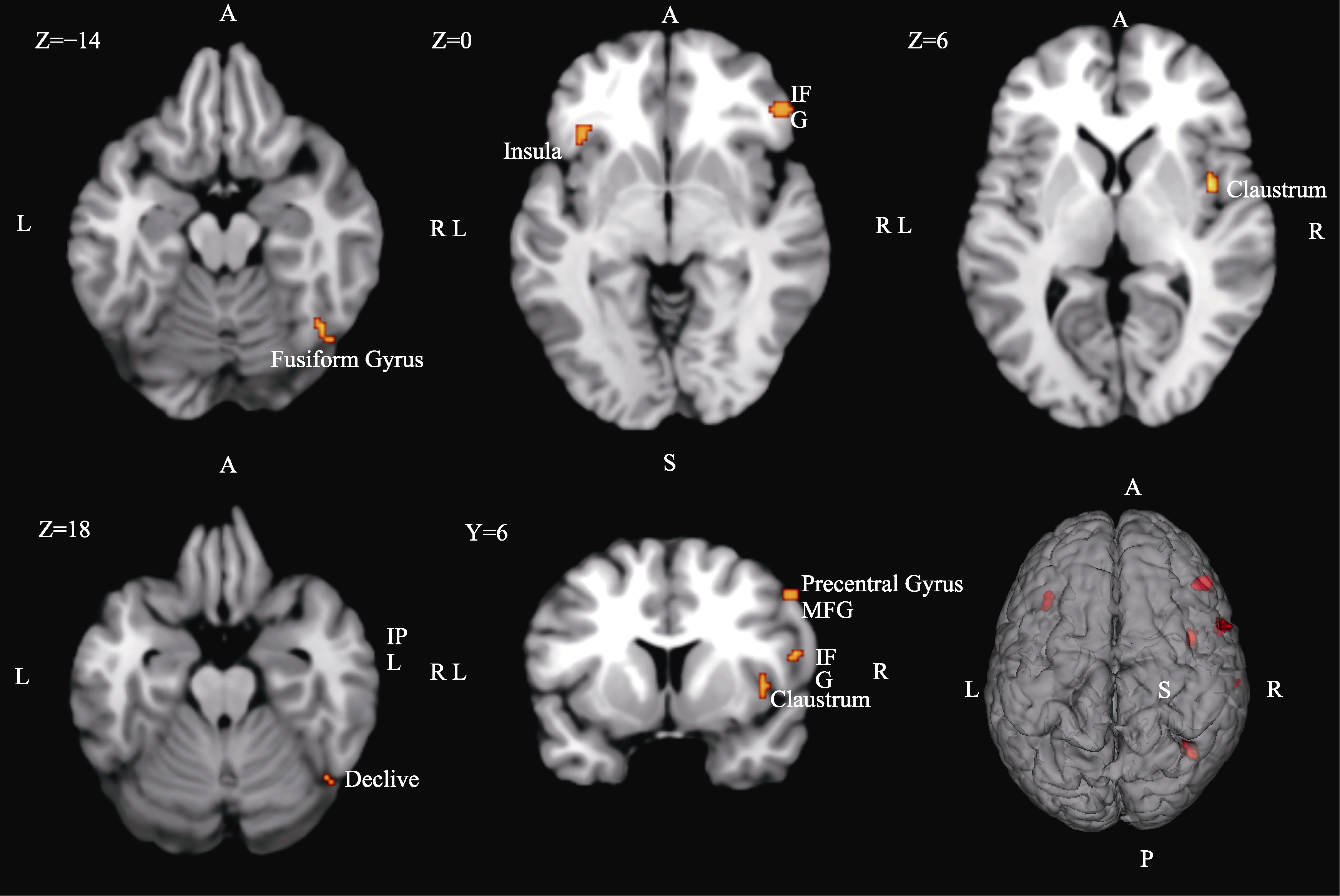
| 团块 | 位置 | BA | MNI坐标 | 体素(mm3) | ALE(10-3) | ||
|---|---|---|---|---|---|---|---|
| X | Y | Z | |||||
| 1 | R 额下回 | 46 | 48 | 34 | 2 | 336 | 22 |
| R 额下回 | 45 | 52 | 34 | -4 | 15 | ||
| 2 | L 脑岛、额下回 | 13、45 | -38 | 20 | -4 | 208 | 17 |
| L 脑岛 | 13 | -36 | 24 | 0 | 16 | ||
| 3 | R 脑岛、屏状核 | 13 | 40 | 2 | 6 | 176 | 21 |
| 4 | R 额下回 | 9 | 54 | 8 | 18 | 88 | 21 |
| 5 | R 中央前回、额中回 | 6 | 52 | 8 | 44 | 64 | 18 |
| 6 | R 梭状回 | 37 | 40 | -56 | -12 | 32 | 14 |
| 7 | R 小脑后叶 | 46 | -62 | -18 | 8 | 13 | |
| 8 | R 梭状回 | 37 | 44 | -60 | -18 | 8 | 15 |
| 9 | R 梭状回 | 37 | 44 | -62 | -16 | 8 | 16 |
| 10 | R 梭状回 | 37 | 42 | -60 | -16 | 8 | 15 |
| 11 | R 梭状回 | 37 | 44 | -64 | -14 | 8 | 14 |
| 12 | R 额下回 | 45 | 52 | 32 | -6 | 8 | 13 |
| 13 | R 额中回 | 6 | 50 | 8 | 46 | 8 | 13 |
| 团块 | 位置 | BA | MNI坐标 | 体素(mm3) | ALE(10-3) | ||
|---|---|---|---|---|---|---|---|
| X | Y | Z | |||||
| 1 | R 额下回 | 46 | 48 | 34 | 2 | 336 | 22 |
| R 额下回 | 45 | 52 | 34 | -4 | 15 | ||
| 2 | L 脑岛、额下回 | 13、45 | -38 | 20 | -4 | 208 | 17 |
| L 脑岛 | 13 | -36 | 24 | 0 | 16 | ||
| 3 | R 脑岛、屏状核 | 13 | 40 | 2 | 6 | 176 | 21 |
| 4 | R 额下回 | 9 | 54 | 8 | 18 | 88 | 21 |
| 5 | R 中央前回、额中回 | 6 | 52 | 8 | 44 | 64 | 18 |
| 6 | R 梭状回 | 37 | 40 | -56 | -12 | 32 | 14 |
| 7 | R 小脑后叶 | 46 | -62 | -18 | 8 | 13 | |
| 8 | R 梭状回 | 37 | 44 | -60 | -18 | 8 | 15 |
| 9 | R 梭状回 | 37 | 44 | -62 | -16 | 8 | 16 |
| 10 | R 梭状回 | 37 | 42 | -60 | -16 | 8 | 15 |
| 11 | R 梭状回 | 37 | 44 | -64 | -14 | 8 | 14 |
| 12 | R 额下回 | 45 | 52 | 32 | -6 | 8 | 13 |
| 13 | R 额中回 | 6 | 50 | 8 | 46 | 8 | 13 |
| VOI | 团块 | 位置 | BA | MNI 坐标 | 体素(mm3) | ALE(10-3) | ||
|---|---|---|---|---|---|---|---|---|
| X | Y | Z | ||||||
| R 额下回 | 1 | R 额下回 | 13 | 48 | 32 | 0 | 4816 | 90 |
| 2 | L 额下回 | 13 | -38 | 28 | 2 | 1288 | 18 | |
| L 额下回 | 47 | -44 | 28 | -6 | 18 | |||
| L 额下回 | 46 | -46 | 30 | 10 | 15 | |||
| 3 | L 顶上小叶 | 7 | -28 | -60 | 48 | 1016 | 22 | |
| 4 | R 额下回 | 44 | 54 | 16 | 10 | 872 | 22 | |
| L 脑岛 | 1 | L 脑岛 | 13 | -36 | 24 | 0 | 13640 | 224 |
| L 脑岛 | 13 | -46 | 16 | 16 | 44 | |||
| L 额中回 | 46 | -46 | 22 | 24 | 43 | |||
| L 脑岛 | 13 | -50 | 12 | 0 | 35 | |||
| 2 | L 额中回 | 6 | -4 | 20 | 46 | 9600 | 50 | |
| L 额中回 | 6 | 2 | 22 | 48 | 46 | |||
| R 扣带回 | 32 | 6 | 20 | 40 | 39 | |||
| R 扣带回 | 32 | 10 | 28 | 32 | 35 | |||
| L 内侧额回 | 6 | -2 | 4 | 60 | 32 | |||
| 3 | R 脑岛 | 40 | 22 | -4 | 7952 | 64 | ||
| R 脑岛 | 13 | 34 | 24 | 0 | 51 | |||
| R 额下回 | 13 | 46 | 30 | 4 | 27 | |||
| 4 | L 顶上小叶 | 7 | -24 | -64 | 48 | 3352 | 40 | |
| L 顶下小叶 | 7 | -32 | -54 | 50 | 35 | |||
| 5 | R 中央前回 | 6 | 52 | 6 | 28 | 2264 | 36 | |
| R 额中回 | 6 | 54 | 6 | 40 | 27 | |||
| R 中央前回 | 9 | 44 | 12 | 32 | 24 | |||
| R 中央前回 | 6 | 44 | 4 | 38 | 24 | |||
| 6 | L 枕中回 | 37 | -46 | -70 | -4 | 1184 | 34 | |
| L 小脑后叶 | -38 | -68 | -14 | 28 | ||||
| 7 | L 中央前回 | 6 | -44 | 4 | 30 | 1000 | 36 | |
| 8 | R 楔前叶 | 7 | 34 | -44 | 46 | 976 | 27 | |
| R 顶下小叶 | 7 | 38 | -56 | 48 | 27 | |||
| R脑岛/屏状核 | 1 | R 屏状核 | 40 | 2 | 6 | 5496 | 99 | |
| R 中央前回 | 44 | 56 | 10 | 6 | 22 | |||
| L 脑岛 | 13 | -40 | 0 | 8 | 2512 | 29 | ||
| 2 | L 屏状核 | -40 | -8 | -4 | 21 | |||
| R 脑岛 | 40 | 60 | -18 | 18 | 2456 | 20 | ||
| 3 | R 顶下小叶 | 40 | 56 | -28 | 26 | 18 | ||
| R 顶下小叶 | 40 | 64 | -22 | 30 | 17 | |||
| R 脑岛 | 13 | 62 | -30 | 18 | 16 | |||
| 4 | L 中央后回 | 40 | -60 | -20 | 16 | 1232 | 26 | |
| L 顶下小叶 | 40 | -58 | -18 | 28 | 13 | |||
| 5 | L 中央后回 | 2 | -50 | -24 | 36 | 1128 | 19 | |
| L 中央后回 | 2 | -44 | -22 | 38 | 18 | |||
| VOI | 团块 | 位置 | BA | MNI 坐标 | 体素(mm3) | ALE(10-3) | ||
|---|---|---|---|---|---|---|---|---|
| X | Y | Z | ||||||
| R 额下回 | 1 | R 额下回 | 13 | 48 | 32 | 0 | 4816 | 90 |
| 2 | L 额下回 | 13 | -38 | 28 | 2 | 1288 | 18 | |
| L 额下回 | 47 | -44 | 28 | -6 | 18 | |||
| L 额下回 | 46 | -46 | 30 | 10 | 15 | |||
| 3 | L 顶上小叶 | 7 | -28 | -60 | 48 | 1016 | 22 | |
| 4 | R 额下回 | 44 | 54 | 16 | 10 | 872 | 22 | |
| L 脑岛 | 1 | L 脑岛 | 13 | -36 | 24 | 0 | 13640 | 224 |
| L 脑岛 | 13 | -46 | 16 | 16 | 44 | |||
| L 额中回 | 46 | -46 | 22 | 24 | 43 | |||
| L 脑岛 | 13 | -50 | 12 | 0 | 35 | |||
| 2 | L 额中回 | 6 | -4 | 20 | 46 | 9600 | 50 | |
| L 额中回 | 6 | 2 | 22 | 48 | 46 | |||
| R 扣带回 | 32 | 6 | 20 | 40 | 39 | |||
| R 扣带回 | 32 | 10 | 28 | 32 | 35 | |||
| L 内侧额回 | 6 | -2 | 4 | 60 | 32 | |||
| 3 | R 脑岛 | 40 | 22 | -4 | 7952 | 64 | ||
| R 脑岛 | 13 | 34 | 24 | 0 | 51 | |||
| R 额下回 | 13 | 46 | 30 | 4 | 27 | |||
| 4 | L 顶上小叶 | 7 | -24 | -64 | 48 | 3352 | 40 | |
| L 顶下小叶 | 7 | -32 | -54 | 50 | 35 | |||
| 5 | R 中央前回 | 6 | 52 | 6 | 28 | 2264 | 36 | |
| R 额中回 | 6 | 54 | 6 | 40 | 27 | |||
| R 中央前回 | 9 | 44 | 12 | 32 | 24 | |||
| R 中央前回 | 6 | 44 | 4 | 38 | 24 | |||
| 6 | L 枕中回 | 37 | -46 | -70 | -4 | 1184 | 34 | |
| L 小脑后叶 | -38 | -68 | -14 | 28 | ||||
| 7 | L 中央前回 | 6 | -44 | 4 | 30 | 1000 | 36 | |
| 8 | R 楔前叶 | 7 | 34 | -44 | 46 | 976 | 27 | |
| R 顶下小叶 | 7 | 38 | -56 | 48 | 27 | |||
| R脑岛/屏状核 | 1 | R 屏状核 | 40 | 2 | 6 | 5496 | 99 | |
| R 中央前回 | 44 | 56 | 10 | 6 | 22 | |||
| L 脑岛 | 13 | -40 | 0 | 8 | 2512 | 29 | ||
| 2 | L 屏状核 | -40 | -8 | -4 | 21 | |||
| R 脑岛 | 40 | 60 | -18 | 18 | 2456 | 20 | ||
| 3 | R 顶下小叶 | 40 | 56 | -28 | 26 | 18 | ||
| R 顶下小叶 | 40 | 64 | -22 | 30 | 17 | |||
| R 脑岛 | 13 | 62 | -30 | 18 | 16 | |||
| 4 | L 中央后回 | 40 | -60 | -20 | 16 | 1232 | 26 | |
| L 顶下小叶 | 40 | -58 | -18 | 28 | 13 | |||
| 5 | L 中央后回 | 2 | -50 | -24 | 36 | 1128 | 19 | |
| L 中央后回 | 2 | -44 | -22 | 38 | 18 | |||

| [1] | 邓沁丽, 陈俊. (2015). 基于坐标的脑成像元分析方法: 激活似然性评估. 心理科学, 38(1), 216-220. |
| [2] | 孙亚斌, 王锦琰, 罗非. (2014). 共情中的具身模拟现象与神经机制. 中国临床心理学杂志, 22(1), 53-57. |
| [3] |
Acar, F., Seurinck, R., Eickhoff, S. B., & Moerkerke, B. (2018). Assessing robustness against potential publication bias in Activation Likelihood Estimation (ALE) meta-analyses for fMRI. PLOS ONE, 13(11), e0208177.
doi: 10.1371/journal.pone.0208177 URL |
| [4] |
Ashton-James, C., van Baaren, R. B., Chartrand, T. L., Decety, J., & Karremans, J. (2007). Mimicry and me: The impact of mimicry on self-construal. Social Cognition, 25(4), 518-535. https://doi.org/10.1521/soco.2007.25.4.518
doi: 10.1521/soco.2007.25.4.518 URL |
| [5] |
Beckes, L., Coan, J. A., & Hasselmo, K. (2013). Familiarity promotes the blurring of self and other in the neural representation of threat. Social Cognitive and Affective Neuroscience, 8(6), 670-677. https://doi.org/10.1093/scan/nss046
doi: 10.1093/scan/nss046 URL pmid: 22563005 |
| [6] |
Blom, S. S. A. H., Aarts, H., & Semin, G. R. (2020). Lateralization of facial emotion processing and facial mimicry. Laterality, 25(3), 259-274. https://doi.org/10.1080/1357650X.2019.1657127
doi: 10.1080/1357650X.2019.1657127 URL pmid: 31464163 |
| [7] |
Bottiroli, S., Matamala-Gomez, M., Allena, M., Guaschino, E., Ghiotto, N., De Icco, R., Sances, G., & Tassorelli, C. (2022). The virtual “enfacement illusion” on pain perception in patients suffering from chronic migraine: A study protocol for a randomized controlled trial. Journal of Clinical Medicine, 11(22), 6876. https://doi.org/10.3390/jcm11226876
doi: 10.3390/jcm11226876 URL |
| [8] |
Brewer, M. B., & Gardner, W. (1996). Who is this "We"? Levels of collective identity and self representations. Journal of Personality and Social Psychology, 71(1), 83-93. https://doi.org/10.1037/0022-3514.71.1.83
doi: 10.1037/0022-3514.71.1.83 URL |
| [9] |
Cerri, G., Cabinio, M., Blasi, V., Borroni, P., Iadanza, A., Fava, E., … Bello, L. (2015). The mirror neuron system and the strange case of Broca’s area. Human Brain Mapping, 36(3), 1010-1027. https://doi.org/10.1002/hbm.22682
doi: 10.1002/hbm.v36.3 URL |
| [10] |
Cheng, Y., Chen, C., Lin, C. -P., Chou, K. -H., & Decety, J. (2010). Love hurts: An fMRI study. NeuroImage, 51(2), 923-929. https://doi.org/10.1016/j.neuroimage.2010.02.047
doi: 10.1016/j.neuroimage.2010.02.047 URL pmid: 20188182 |
| [11] |
Craig, A. D. B. (2009). How do you feel—now? The anterior insula and human awareness. Nature Reviews. Neuroscience, 10(1), 59-70. https://doi.org/10.1038/nrn2555
doi: 10.1038/nrn2555 URL pmid: 19096369 |
| [12] |
Critchley, H. D., Wiens, S., Rotshtein, P., Ohman, A., & Dolan, R. J. (2004). Neural systems supporting interoceptive awareness. Nature Neuroscience, 7(2), 189-195. https://doi.org/10.1038/nn1176
doi: 10.1038/nn1176 URL pmid: 14730305 |
| [13] |
Dapretto, M., Davies, M. S., Pfeifer, J. H., Scott, A. A., Sigman, M., Bookheimer, S. Y., & Iacoboni, M. (2006). Understanding emotions in others: Mirror neuron dysfunction in children with autism spectrum disorders. Nature Neuroscience, 9(1), 28-30. https://doi.org/10.1038/nn1611
URL pmid: 16327784 |
| [14] |
Dary, Z., & Lopez, C. (2023). Understanding the neural bases of bodily self-consciousness: Recent achievements and main challenges. Frontiers in Integrative Neuroscience, 17, Article 1145924. https://doi.org/10.3389/fnint.2023.1145924
doi: 10.3389/fnint.2023.1145924 URL |
| [15] |
de Waal, F. B. M., & Preston, S. D. (2017). Mammalian empathy: Behavioural manifestations and neural basis. Nature Reviews. Neuroscience, 18(8), 498-509. https://doi.org/10.1038/nrn.2017.72
doi: 10.1038/nrn.2017.72 URL pmid: 28655877 |
| [16] |
Decety, J., & Sommerville, J. A. (2003). Shared representations between self and other: A social cognitive neuroscience view. Trends in Cognitive Sciences, 7(12), 527-533. https://doi.org/10.1016/j.tics.2003.10.004
doi: 10.1016/j.tics.2003.10.004 URL pmid: 14643368 |
| [17] |
Eickhoff, S. B., Bzdok, D., Laird, A. R., Kurth, F., & Fox, P. T. (2012). Activation likelihood estimation meta-analysis revisited. NeuroImage, 59(3), 2349-2361. https://doi.org/10.1016/j.neuroimage.2011.09.017
doi: 10.1016/j.neuroimage.2011.09.017 URL pmid: 21963913 |
| [18] |
Eickhoff, S. B., Nichols, T. E., Laird, A. R., Hoffstaedter, F., Amunts, K., Fox, P. T., Bzdok, D., & Eickhoff, C. R. (2016). Behavior, sensitivity, and power of activation likelihood estimation characterized by massive empirical simulation. NeuroImage, 137, 70-85. https://doi.org/10.1016/j.neuroimage.2016.04.072
doi: 10.1016/j.neuroimage.2016.04.072 URL pmid: 27179606 |
| [19] |
Ernst, J., Northoff, G., Böker, H., Seifritz, E., & Grimm, S. (2012). Interoceptive awareness enhances neural activity during empathy. Human Brain Mapping, 34(7), 1615-1624. https://doi.org/10.1002/hbm.22014
doi: 10.1002/hbm.v34.7 URL |
| [20] |
Ferrari, P. F., Gerbella, M., Coudé, G., & Rozzi, S. (2017). Two different mirror neuron networks: The sensorimotor (hand) and limbic (face) pathways. Neuroscience, 358, 300-315. https://doi.org/10.1016/j.neuroscience.2017.06.052
doi: S0306-4522(17)30457-8 URL pmid: 28687313 |
| [21] |
Gainotti, G. (2021). Emotions and the right hemisphere: Editorial. Brain Sciences, 11(12), 1579. https://doi.org/10.3390/brainsci11121579
doi: 10.3390/brainsci11121579 URL |
| [22] | Gallagher, S. (2001). The practice of mind: Theory, simulation or primary interaction. Journal of Consciousness Studies, 8(5-7), 83-108. |
| [23] |
Gillihan, S. J., & Farah, M. J. (2005). Is self special? A critical review of evidence from experimental psychology and cognitive neuroscience. Psychological Bulletin, 131(1), 76-97. https://doi.org/10.1037/0033-2909.131.1.76
URL pmid: 15631554 |
| [24] |
Golby, A. J., Gabrieli, J. D., Chiao, J. Y., & Eberhardt, J. L. (2001). Differential responses in the fusiform region to same-race and other-race faces. Nature Neuroscience, 4(8), 845-850. https://doi.org/10.1038/90565
URL pmid: 11477432 |
| [25] |
Gu, R., Huang, W., Camilleri, J., Xu, P., Wei, P., Eickhoff, S. B., & Feng, C. (2019). Love is analogous to money in human brain: Coordinate-based and functional connectivity meta-analyses of social and monetary reward anticipation. Neuroscience & Biobehavioral Reviews, 100, 108-128. https://doi.org/10.1016/j.neubiorev.2019.02.017
doi: 10.1016/j.neubiorev.2019.02.017 URL |
| [26] |
Harada, T., Hayashi, A., Sadato, N., & Iidaka, T. (2016). Neural correlates of emotional contagion induced by happy and sad expressions. Journal of Psychophysiology, 30(3), 114-123. https://doi.org/10.1027/0269-8803/a000160
doi: 10.1027/0269-8803/a000160 URL |
| [27] |
Hatfield, E., Bensman, L., Thornton, P. D., & Rapson, R. L. (2014). New perspectives on emotional contagion: A review of classic and recent research on facial mimicry and contagion. Interpersona: An International Journal on Personal Relationships, 8(2), 159-179. https://doi.org/10.5964/ijpr.v8i2.162
doi: 10.5964/ijpr.v8i2.162 URL |
| [28] | Hatfield, E., Cacioppo, J., & Rapson, R. (1994). Emotional contagion: Studies in emotion and social interaction. Editions de la Maison des Sciences de L’homme. Cambridge University Press. |
| [29] | Hatfield, E., Rapson, R. L., & Le, Y. -C. L. (2009). Emotional contagion and empathy. In J.Decety & W.Ickes (Eds.), The Social Neuroscience of Empathy (pp. 19-30). Boston Review. https://doi.org/10.7551/mitpress/9780262012973.003.0003 |
| [30] |
Hu, C., Di, X., Eickhoff, S. B., Zhang, M., Peng, K., Guo, H., & Sui, J. (2016). Distinct and common aspects of physical and psychological self-representation in the brain: A meta-analysis of self-bias in facial and self-referential judgements. Neuroscience & Biobehavioral Reviews, 61, 197-207. https://doi.org/10.1016/j.neubiorev.2015.12.003
doi: 10.1016/j.neubiorev.2015.12.003 URL |
| [31] |
Iacoboni, M. (2009). Imitation, Empathy, and Mirror Neurons. Annual Review of Psychology, 60(1), 653-670. https://doi.org/10.1146/annurev.psych.60.110707.163604
doi: 10.1146/psych.2009.60.issue-1 URL |
| [32] |
Iannaccone, F., Pizzanelli, C., Lorenzini, F., Turco, F., Milano, C., Scarpitta, C., ... Siciliano, G. (2025). Exploring the role of epileptic focus lateralization on facial emotion recognition in the spectrum of mesial temporal lobe epilepsy. Frontiers in Systems Neuroscience, 18, 1491791. https://doi.org/10.3389/fnsys.2024.1491791
doi: 10.3389/fnsys.2024.1491791 URL |
| [33] |
Janowska, A., Balugas, B., Pardillo, M., Mistretta, V., Chavarria, K., Brenya, J., … Keenan, J. P. (2021). The neurological asymmetry of self-face recognition. Symmetry, 13(7), 1135.
doi: 10.3390/sym13071135 URL |
| [34] | Joby, N. E., & Umemuro, H. (2022). Effect of group identity on emotional contagion in dyadic human agent interaction. In Proceedings of the 10th International Conference on Human-Agent Interaction (Christchurch, New Zealand) (HAI '22). Association for Computing Machinery, New York, NY, USA, 157-166. https://doi.org/10.1145/3527188.3561939 |
| [35] |
Kilner, J. M. (2011). More than one pathway to action understanding. Trends in Cognitive Sciences, 15(8), 352-357. https://doi.org/10.1016/j.tics.2011.06.005
doi: 10.1016/j.tics.2011.06.005 URL pmid: 21775191 |
| [36] | Kobayakawa, M. (2018). Left and right hemispheric contribution to social cognition. Brain and nerve = Shinkei kenkyū no shinpo, 70(10), 1067-1073. https://doi.org/10.11477/mf.1416201138 |
| [37] |
Krautheim, J. T., Steines, M., Dannlowski, U., Neziroğlu, G., Acosta, H., Sommer, J., Straube, B., & Kircher, T. (2020). Emotion specific neural activation for the production and perception of facial expressions. Cortex, 127, 17-28. https://doi.org/10.1016/j.cortex.2020.01.026
doi: S0010-9452(20)30051-4 URL pmid: 32155474 |
| [38] | Krueger, D. W. (2013). Integrating body self & psychological self. Routledge. https://doi.org/10.4324/9780203890202 |
| [39] |
Lamm, C., Bukowski, H., & Silani, G. (2016). From shared to distinct self-other representations in empathy: Evidence from neurotypical function and socio-cognitive disorders. Philosophical Transactions of the Royal Society B: Biological Sciences, 371(1686), 20150083. https://doi.org/10.1098/rstb.2015.0083
doi: 10.1098/rstb.2015.0083 URL |
| [40] | Langner, R., & Camilleri, J. A. (2021). Meta-analytic connectivity modelling (MACM): A tool for assessing region-specific functional connectivity patterns in task-constrained states. Brain Network Dysfunction in Neuropsychiatric Illness, 93-104. https://doi.org/10.1007/978-3-030-59797-9_5 |
| [41] |
Lee, T. -W., Josephs, O., Dolan, R. J., & Critchley, H. D. (2006). Imitating expressions: Emotion-specific neural substrates in facial mimicry. Social Cognitive and Affective Neuroscience, 1(2), 122-135. https://doi.org/10.1093/scan/nsl012
doi: 10.1093/scan/nsl012 URL |
| [42] |
Likowski, K. U., Mühlberger, A., Gerdes, A. B., Wieser, M. J., Pauli, P., & Weyers, P. (2012). Facial mimicry and the mirror neuron system: Simultaneous acquisition of facial electromyography and functional magnetic resonance imaging. Frontiers in human neuroscience, 6, 214. https://doi.org/10.3389/fnhum.2012.00214
doi: 10.3389/fnhum.2012.00214 URL pmid: 22855675 |
| [43] |
Lin, D., Zhu, T., & Wang, Y. (2024). Emotion contagion and physiological synchrony: The more intimate relationships, the more contagion of positive emotions. Physiology & Behavior, 275, 114434. https://doi.org/10.1016/j.physbeh.2023.114434
doi: 10.1016/j.physbeh.2023.114434 URL |
| [44] |
Lindblom, J. (2020). A radical reassessment of the body in social cognition. Frontiers in Psychology, 11, 987. https://doi.org/10.3389/fpsyg.2020.00987
doi: 10.3389/fpsyg.2020.00987 URL pmid: 32581915 |
| [45] |
Lischke, A., Weippert, M., Mau-Moeller, A., Jacksteit, R., & Pahnke, R. (2020). Interoceptive accuracy is associated with emotional contagion in a valence- and sex-dependent manner. Social Neuroscience, 15(2), 227-233. https://doi.org/10.1080/17470919.2019.1690573
doi: 10.1080/17470919.2019.1690573 URL pmid: 31693866 |
| [46] |
Liu, J., Ran, G., & Zhang, Q. (2022). The neural activities of different emotion carriers and their similarities and differences: A meta-analysis of functional neuroimaging studies. Advances in Psychological Science, 30(3), 536-555. https://doi.org/10.3724/SP.J.1042.2022.00536
doi: 10.3724/SP.J.1042.2022.00536 URL |
| [47] |
Lombardo, M. V., Chakrabarti, B., Lai, M. -C., MRC, AIMS Consortium, & Baron-Cohen, S. (2012). Self-referential and social cognition in a case of autism and agenesis of the corpus callosum. Molecular Autism, 3(1), 14. https://doi.org/10.1186/2040-2392-3-14
doi: 10.1186/2040-2392-3-14 URL pmid: 23171505 |
| [48] | Luo, W., Zhang, S., & Geng, H. (2022). Embodied processing during social interactions: From a perspective of self-other shared representation. Chinese Science Bulletin, 67(35), 4236-4250. https://doi.org/10.1360/tb-2022-0746 |
| [49] |
Ma, Y., & Han, S. (2012). Functional dissociation of the left and right fusiform gyrus in self-face recognition. Human Brain Mapping, 33(10), 2255-2267. https://doi.org/10.1002/hbm.21356
doi: 10.1002/hbm.21356 URL pmid: 21761508 |
| [50] |
Meng, M., Singal, G., Cherian, T., & Sinha, P. (2008). Neural correlates of categorical face perception. Journal of Vision, 8(6), 407. https://doi.org/10.1167/8.6.407
doi: 10.1167/8.6.407 URL |
| [51] |
Menon, V., & Uddin, L. Q. (2010). Saliency, switching, attention and control: A network model of insula function. Brain Structure and Function, 214(5-6), 655-667. https://doi.org/10.1007/s00429-010-0262-0
doi: 10.1007/s00429-010-0262-0 URL |
| [52] |
Meyer, M. L., Masten, C. L., Ma, Y., Wang, C., Shi, Z., Eisenberger, N. I., & Han, S. (2013). Empathy for the social suffering of friends and strangers recruits distinct patterns of brain activation. Social Cognitive and Affective Neuroscience, 8(4), 446-454. https://doi.org/10.1093/scan/nss019
doi: 10.1093/scan/nss019 URL pmid: 22355182 |
| [53] |
Milrod, D. (2002). The concept of the self and the self representation. Neuropsychoanalysis, 4(1), 7-23. https://doi.org/10.1080/15294145.2002.10773372
doi: 10.1080/15294145.2002.10773372 URL |
| [54] |
Minio-Paluello, I., Porciello, G., Gandolfo, M., Boukarras, S., & Aglioti, S. M. (2020). The enfacement illusion boosts facial mimicry. Cortex, 123, 113-123. https://doi.org/10.1016/j.cortex.2019.10.001
doi: S0010-9452(19)30350-8 URL pmid: 31765877 |
| [55] | Molnar-Szakacs, I., & Uddin, L. Q. (2013). Self-processing and the default mode network: Interactions with the mirror neuron system. Frontiers in Human Neuroscience, 7. https://doi.org/10.3389/fnhum.2013.00571 |
| [56] |
Molnar-Szakacs, I., & Uddin, L. Q. (2023). Laterality and hemispheric specialization of self-face recognition. Neuropsychologia, 186, 108586. https://doi.org/10.1016/j.neuropsychologia.2023.108586
doi: 10.1016/j.neuropsychologia.2023.108586 URL |
| [57] |
Morita, T., Saito, D. N., Ban, M., Shimada, K., Okamoto, Y., Kosaka, H., ... Naito, E. (2017). Self-face recognition shares brain regions active during proprioceptive illusion in the right inferior fronto-parietal superior longitudinal fasciculus III network. Neuroscience, 348, 288-301. https://doi.org/10.1016/J.NEUROSCIENCE.2017.02.031
doi: S0306-4522(17)30114-8 URL pmid: 28238849 |
| [58] |
Morita, T., Saito, D. N., Ban, M., Shimada, K., Okamoto, Y., Kosaka, H., … Naito, E. (2018). Self-face recognition begins to share active region in right inferior parietal lobule with proprioceptive illusion during adolescence. Cerebral Cortex, 28(4), 1532-1548. https://doi.org/10.1093/cercor/bhy027
doi: 10.1093/cercor/bhy027 URL |
| [59] |
Na, Y., Zhao, Y., & Guan, L. (2021). The neural mechanism of self-face recognition: An ALE meta-analysis of fMRI studies. Advances in Psychological Science, 29(10), 1783-1795. https://doi.org/10.3724/sp.j.1042.2021.01783
doi: 10.3724/SP.J.1042.2021.01783 URL |
| [60] |
Namkung, H., Kim, S. -H., & Sawa, A. (2017). The insula: An underestimated brain area in clinical neuroscience, psychiatry, and neurology. Trends in Neurosciences, 40(4), 200-207. https://doi.org/10.1016/j.tins.2017.02.002
doi: S0166-2236(17)30017-6 URL pmid: 28314446 |
| [61] |
Nichols, T., Brett, M., Andersson, J., Wager, T., & Poline, J. -B. (2005). Valid conjunction inference with the minimum statistic. NeuroImage, 25(3), 653-660. https://doi.org/10.1016/j.neuroimage.2004.12.005
doi: 10.1016/j.neuroimage.2004.12.005 URL pmid: 15808966 |
| [62] |
Nummenmaa, L., Hirvonen, J., Parkkola, R., & Hietanen, J. K. (2008). Is emotional contagion special? An fMRI study on neural systems for affective and cognitive empathy. NeuroImage, 43(3), 571-580. https://doi.org/10.1016/j.neuroimage.2008.08.014
doi: 10.1016/j.neuroimage.2008.08.014 URL pmid: 18790065 |
| [63] |
Nummenmaa, L., Smirnov, D., Lahnakoski, J. M., Glerean, E., Jääskeläinen, I. P., Sams, M., & Hari, R. (2014). Mental action simulation synchronizes action-observation circuits across individuals. The Journal of Neuroscience, 34(3), 748-757. https://doi.org/10.1523/jneurosci.0352-13.2014
doi: 10.1523/JNEUROSCI.0352-13.2014 URL |
| [64] | Page, M. J., Moher, D., Bossuyt, P. M., Boutron, I., Hoffmann, T. C., Mulrow, C. D., … McKenzie, J. E. (2021). PRISMA 2020 explanation and elaboration: Updated guidance and exemplars for reporting systematic reviews. BMJ. 372, n160. https://doi.org/10.1136/bmj.n160 |
| [65] |
Palagi, E., Celeghin, A., Tamietto, M., Winkielman, P., & Norscia, I. (2020). The neuroethology of spontaneous mimicry and emotional contagion in human and non-human animals. Neuroscience & Biobehavioral Reviews, 111, 149-165. https://doi.org/10.1016/j.neubiorev.2020.01.020
doi: 10.1016/j.neubiorev.2020.01.020 URL |
| [66] |
Pfeifer, J. H., Iacoboni, M., Mazziotta, J. C., & Dapretto, M. (2008). Mirroring others’ emotions relates to empathy and interpersonal competence in children. NeuroImage, 39(4), 2076-2085. https://doi.org/10.1016/j.neuroimage.2007.10.032
doi: 10.1016/j.neuroimage.2007.10.032 URL |
| [67] |
Platek, S. M., Critton, S. R., Myers, T. E., & Gallup, G. G. (2003). Contagious yawning: The role of self-awareness and mental state attribution. Cognitive Brain Research, 17(2), 223-227. https://doi.org/10.1016/s0926-6410(03)00109-5
URL pmid: 12880893 |
| [68] |
Platek, S. M., Keenan, J. P., Gallup, G. G., & Mohamed, F. B. (2004). Where am I? The neurological correlates of self and other. Cognitive Brain Research, 19(2), 114-122. https://doi.org/10.1016/j.cogbrainres.2003.11.014
URL pmid: 15019708 |
| [69] |
Platek, S. M., Krill, A. L., & Kemp, S. M. (2008). The neural basis of facial resemblance. Neuroscience Letters, 437(2), 76-81. https://doi.org/10.1016/j.neulet.2008.03.040
doi: 10.1016/j.neulet.2008.03.040 URL pmid: 18436378 |
| [70] |
Preston, S. D., & de Waal, F. B. M. (2002). Empathy: Its ultimate and proximate bases. Behavioral and Brain Sciences, 25(1), 1-20. https://doi.org/10.1017/s0140525x02000018
doi: 10.1017/s0140525x02000018 URL pmid: 12625087 |
| [71] |
Rauchbauer, B., Majdandžić, J., Hummer, A., Windischberger, C., & Lamm, C. (2015). Distinct neural processes are engaged in the modulation of mimicry by social group-membership and emotional expressions. Cortex, 70, 49-67. https://doi.org/10.1016/j.cortex.2015.03.007
doi: 10.1016/j.cortex.2015.03.007 URL pmid: 25929599 |
| [72] |
Rizzolatti, G., Cattaneo, L., Fabbri-Destro, M., & Rozzi, S. (2014). Cortical mechanisms underlying the organization of goal-directed actions and mirror neuron-based action understanding. Physiological Reviews, 94(2), 655-706. https://doi.org/10.1152/physrev.00009.2013
doi: 10.1152/physrev.00009.2013 URL pmid: 24692357 |
| [73] |
Rueckert, L., & Naybar, N. (2008). Gender differences in empathy: The role of the right hemisphere. Brain and Cognition, 67(2), 162-167. https://doi.org/10.1016/j.bandc.2008.01.002
doi: 10.1016/j.bandc.2008.01.002 URL pmid: 18295950 |
| [74] |
Rymarczyk, K., Żurawski, Ł., Jankowiak-Siuda, K., & Szatkowska, I. (2018). Neural correlates of facial mimicry: Simultaneous measurements of EMG and BOLD responses during perception of dynamic compared to static facial expressions. Frontiers in Psychology, 9, 52. https://doi.org/10.3389/fpsyg.2018.00052
doi: 10.3389/fpsyg.2018.00052 URL pmid: 29467691 |
| [75] |
Singer, T., Critchley, H. D., & Preuschoff, K. (2009). A common role of insula in feelings, empathy and uncertainty. Trends in Cognitive Sciences, 13(8), 334-340. https://doi.org/10.1016/j.tics.2009.05.001
doi: 10.1016/j.tics.2009.05.001 URL pmid: 19643659 |
| [76] |
Singer, T., Seymour, B., O’doherty, J., Kaube, H., Dolan, R. J., & Frith, C. D. (2004). Empathy for pain involves the affective but not sensory components of pain. Science, 303(5661), 1157-1162. https://doi.org/10.1126/science.1093535
doi: 10.1126/science.1093535 URL pmid: 14976305 |
| [77] |
Sugiura, M., Sassa, Y., Jeong, H., Wakusawa, K., Horie, K., Sato, S., & Kawashima, R. (2012). Self-face recognition in social context. Human Brain Mapping, 33(6), 1364-1374. https://doi.org/10.1002/hbm.21290
doi: 10.1002/hbm.21290 URL pmid: 21567659 |
| [78] | Tamietto, M., Castelli, L., Vighetti, S., Perozzo, P., Geminiani, G., Weiskrantz, L., & de Gelder, B. (2009). Unseen facial and bodily expressions trigger fast emotional reactions. Proceedings of the National Academy of Sciences, 106(42), 17662-17666. https://doi.org/10.1073/pnas.0908994106 |
| [79] |
Tavory, I. (2023). A theory of intersubjectivity: Experience, interaction and the anchoring of meaning. Theory and Society, 52(5), 865-884. https://doi.org/10.1007/s11186-022-09507-y
doi: 10.1007/s11186-022-09507-y URL |
| [80] |
Tsakiris, M., Hesse, M. D., Boy, C., Haggard, P., & Fink, G. R. (2007). Neural signatures of body ownership: A sensory network for bodily self-consciousness. Cerebral Cortex, 17(10), 2235-2244. https://doi.org/10.1093/cercor/bhl131
URL pmid: 17138596 |
| [81] |
Turkeltaub, P. E., Eickhoff, S. B., Laird, A. R., Fox, M., Wiener, M., & Fox, P. (2012). Minimizing within-experiment and within-group effects in activation likelihood estimation meta-analyses. Human Brain Mapping, 33(1), 1-13. https://doi.org/10.1002/hbm.21186
doi: 10.1002/hbm.21186 URL pmid: 21305667 |
| [82] |
Uddin, L. Q., Kaplan, J. T., Molnar-Szakacs, I., Zaidel, E., & Iacoboni, M. (2005). Self-face recognition activates a frontoparietal “mirror” network in the right hemisphere: An event-related fMRI study. NeuroImage, 25(3), 926-935. https://doi.org/10.1016/J.NEUROIMAGE.2004.12.018
doi: 10.1016/j.neuroimage.2004.12.018 URL |
| [83] |
Van Bavel, J. J., Packer, D. J., & Cunningham, W. A. (2008). The neural substrates of in-group bias: A functional magnetic resonance imaging investigation. Psychological Science, 19(11), 1131-1139. https://doi.org/10.1111/j.1467-9280.2008.02214.x
doi: 10.1111/j.1467-9280.2008.02214.x URL pmid: 19076485 |
| [84] |
Wang, D., Liu, C., & Chen, W. (2024). The role of self- representation in emotional contagion. Frontiers in Human Neuroscience, 18, 1361368. https://doi.org/10.3389/fnhum.2024.1361368
doi: 10.3389/fnhum.2024.1361368 URL |
| [85] |
Wang, H., Gao, X., Xu, C., & Chen, W. (2025). The enhancement effect of social interaction on emotional contagion: An EEG-Based hyperscanning study. Social Neuroscience, 20(3), 180-194. https://doi.org/10.1080/17470919.2025.2535011
doi: 10.1080/17470919.2025.2535011 URL pmid: 40767038 |
| [86] |
Wu, J., Wang, Y., Chen, H., & Huang, J. (2015). From self to social cognition: The default mode network and mirror- neuron system. Advances in Psychological Science, 23(10), 1808-1817. https://doi.org/10.3724/sp.j.1042.2015.01808
doi: 10.3724/SP.J.1042.2015.01808 URL |
| [87] |
Zeugin, D., Notter, M. P., Knebel, J. -F., & Ionta, S. (2020). Temporo-parietal contribution to the mental representations of self/other face. Brain and Cognition, 143, 105600. https://doi.org/10.1016/j.bandc.2020.105600
doi: 10.1016/j.bandc.2020.105600 URL |
| [1] | WU Jingyu, JIN Xin. Algorithm-mediated emotional convergence: The emotional contagion mechanisms of artificial intelligence generated content [J]. Advances in Psychological Science, 2026, 34(1): 123-133. |
| [2] | SUN Luwen, ZHOU Yue, JIANG Zhongqing. The functional brain networks of intergroup empathy bias: A meta-analysis based on fMRI studies [J]. Advances in Psychological Science, 2025, 33(8): 1306-1320. |
| [3] | LIU Kaihang, PIAO Zhongshu, TIAN Ying, WANG Liyan, WANG Hongbiao. From action imitation to predictive processing: The dynamic neural mechanism and practical application prospect of motor contagion [J]. Advances in Psychological Science, 2025, 33(11): 1942-1956. |
| [4] | LIU Chunxiao, LIU Lizhi, Wang Dan, CHEN Wenfeng. The mechanism of collective ritual promoting group emotional contagion [J]. Advances in Psychological Science, 2022, 30(8): 1870-1882. |
| [5] | LIU Juncai, RAN Guangming, ZHANG Qi. The neural activities of different emotion carriers and their similarities and differences: A meta-analysis of functional neuroimaging studies [J]. Advances in Psychological Science, 2022, 30(3): 536-555. |
| [6] | HE Xinyu, HE Qinghua. The structural and functional changes of the insula in people with addiction [J]. Advances in Psychological Science, 2021, 29(8): 1438-1449. |
| [7] | NA Yuting, ZHAO Yuwen, GUAN Lili. The neural mechanism of self-face recognition: An ALE meta-analysis of fMRI studies [J]. Advances in Psychological Science, 2021, 29(10): 1783-1795. |
| [8] | FU Yuling, DENG Fumin, YANG Shuai, XU Jiuping. A bite of “masochism”: The psychological issues of eating spicy food [J]. Advances in Psychological Science, 2018, 26(9): 1651-1660. |
| [9] | Tao SUO, Yan YANG, Zeng FAN, Mengmeng WANG, Guoxiang ZHAO. The near-miss effect in gambling games [J]. Advances in Psychological Science, 2018, 26(9): 1689-1699. |
| [10] | WANG Yanzhi, YAO Tang, LU Hongliang. The mechanism of consumer impulsive buying in the context of shopping with others [J]. Advances in Psychological Science, 2018, 26(11): 1915-1927. |
| [11] | SU Lin; YANG Zhou; JACKSON Todd ; CHEN Hong; HUANG Cheng-zhi. The formulation of fear of pain and its influence on pain perception [J]. Advances in Psychological Science, 2016, 24(8): 1228-1236. |
| [12] | ZHANG Jianxin; TANG Dan; ZHA Dehua; HUANG Jianping; LIU Dianzhi. Embodied mechanisms of implicit sequence learning consciousness [J]. Advances in Psychological Science, 2016, 24(2): 203-216. |
| [13] | CHEN Bo; CHEN Wei; ZHANG Jing; YUAN Tifei. Connotations and Extensions of “Mirrorness”: The Controversies on Mirror Neurons [J]. Advances in Psychological Science, 2015, 23(3): 405-418. |
| [14] | LENG Bingbing, WANG Xiangling, GAO Heming, LI Fuhong. Cognitive and Emotional Activities of Guilt and the Corresponding Brain Network [J]. Advances in Psychological Science, 2015, 23(12): 2064-2071. |
| [15] | ZUO Shijiang;WANG Fang;SHI Xiafei;ZHANG Xiao. Primitive Emotional Contagion and the Challenge of Current Research [J]. Advances in Psychological Science, 2014, 22(5): 791-801. |
| Viewed | ||||||
|
Full text |
|
|||||
|
Abstract |
|
|||||
