

ISSN 1671-3710
CN 11-4766/R
主办:中国科学院心理研究所
出版:科学出版社
CN 11-4766/R
主办:中国科学院心理研究所
出版:科学出版社
Advances in Psychological Science ›› 2026, Vol. 34 ›› Issue (6): 971-991.doi: 10.3724/SP.J.1042.2026.0971
• Conceptual Framework • Previous Articles Next Articles
XIAO Haowen1, WU Yuying1, WU Tong2( )
)
Received:2025-12-20
Online:2026-06-15
Published:2026-04-17
Contact:
WU Tong
E-mail:tong.wu@gdufs.edu.cn
CLC Number:
XIAO Haowen, WU Yuying, WU Tong. The impact of residential mobility on consumer behavior: An identity management perspective[J]. Advances in Psychological Science, 2026, 34(6): 971-991.
| 操作化定义 | 文献来源 | |
|---|---|---|
| 个体微观层面 | 历史性的搬家次数: 自我报告或者二手数据 | Cheng et al., |
| 实验操控:造句任务和情景想象任务 | Cheng et al., | |
| 社会宏观层面 | 人口普查数据, 计算人口流出和流入的比例作为区域居住流动性指标 | Zuo et al., |
| 计算5年内为搬家人口的比例 | Oishi et al., |
| 操作化定义 | 文献来源 | |
|---|---|---|
| 个体微观层面 | 历史性的搬家次数: 自我报告或者二手数据 | Cheng et al., |
| 实验操控:造句任务和情景想象任务 | Cheng et al., | |
| 社会宏观层面 | 人口普查数据, 计算人口流出和流入的比例作为区域居住流动性指标 | Zuo et al., |
| 计算5年内为搬家人口的比例 | Oishi et al., |
| 影响机制 | 消费结果变量 | 文献来源 | |
|---|---|---|---|
| 情绪和认知路径 | 焦虑 | 全国连锁店偏好(熟悉事物的偏好) | Oishi, Miao, et al., |
| 控制感 | 怀旧消费 | 何柳, | |
| 不确定性 | 损失厌恶; 时间折扣 | Yu et al., | |
| 寻求变化的思维模式; 新体验的开放性 | 提高多样化寻求; 促进新产品采用 | Cheng et al., | |
| 自我与群体影响路径 | 个体身份独特性 | 独特产品偏好; 小众源地信息分享意愿 | 陈洁 等, |
| 归属感需求 | 极端语言信息分享意愿 | 施婷 等, | |
| 集体利益偏好 | 降低私人领域的亲环境行为 | Zuo et al., | |
| 全球身份认同 | 增加远距离捐赠 | Wang et al., |
| 影响机制 | 消费结果变量 | 文献来源 | |
|---|---|---|---|
| 情绪和认知路径 | 焦虑 | 全国连锁店偏好(熟悉事物的偏好) | Oishi, Miao, et al., |
| 控制感 | 怀旧消费 | 何柳, | |
| 不确定性 | 损失厌恶; 时间折扣 | Yu et al., | |
| 寻求变化的思维模式; 新体验的开放性 | 提高多样化寻求; 促进新产品采用 | Cheng et al., | |
| 自我与群体影响路径 | 个体身份独特性 | 独特产品偏好; 小众源地信息分享意愿 | 陈洁 等, |
| 归属感需求 | 极端语言信息分享意愿 | 施婷 等, | |
| 集体利益偏好 | 降低私人领域的亲环境行为 | Zuo et al., | |
| 全球身份认同 | 增加远距离捐赠 | Wang et al., |
| 补偿策略 | 定义 | 举例 |
|---|---|---|
| 直接解决 | 通过行为直接解决身份威胁的来源 | 智力上的身份威胁会导致消费者购买和阅读书籍, 希望变得更聪明 |
| 象征性解决策略 | 通过行为在身份威胁的相关领域表现自己的掌控力 | 智力上的身份威胁导致消费者购买非常醒目的边框将自己的学位证书装裱起来, 展示在桌上 |
| 解离策略 | 通过行为远离身份威胁的相关的产品或者服务 | 智力上的身份威胁导致消费者取消订阅《经济学人》 |
| 逃避策略 | 通过行为分散自己的注意力, 从而不去想身份威胁 | 智力上的身份威胁导致消费者去看场电影以避免想起自我差异 |
| 灵活补偿策略 | 通过行为强调自己其他方面的优势 | 智力上的身份威胁导致消费者购买劳力士手表以此来彰显财富上的成功 |
| 补偿策略 | 定义 | 举例 |
|---|---|---|
| 直接解决 | 通过行为直接解决身份威胁的来源 | 智力上的身份威胁会导致消费者购买和阅读书籍, 希望变得更聪明 |
| 象征性解决策略 | 通过行为在身份威胁的相关领域表现自己的掌控力 | 智力上的身份威胁导致消费者购买非常醒目的边框将自己的学位证书装裱起来, 展示在桌上 |
| 解离策略 | 通过行为远离身份威胁的相关的产品或者服务 | 智力上的身份威胁导致消费者取消订阅《经济学人》 |
| 逃避策略 | 通过行为分散自己的注意力, 从而不去想身份威胁 | 智力上的身份威胁导致消费者去看场电影以避免想起自我差异 |
| 灵活补偿策略 | 通过行为强调自己其他方面的优势 | 智力上的身份威胁导致消费者购买劳力士手表以此来彰显财富上的成功 |
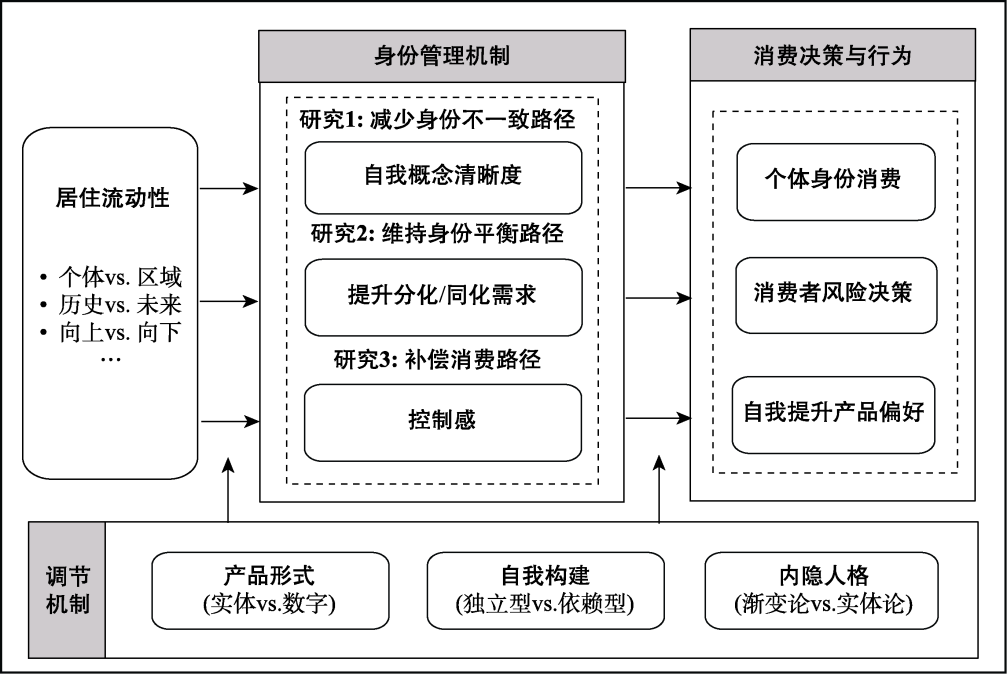

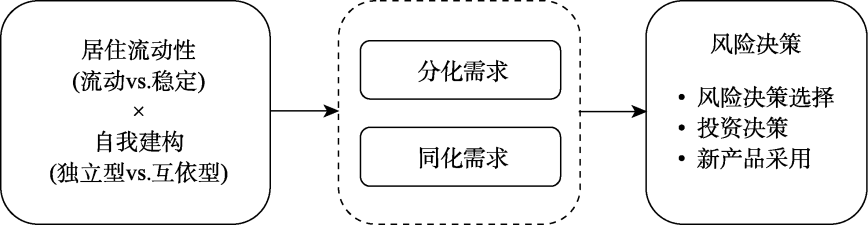
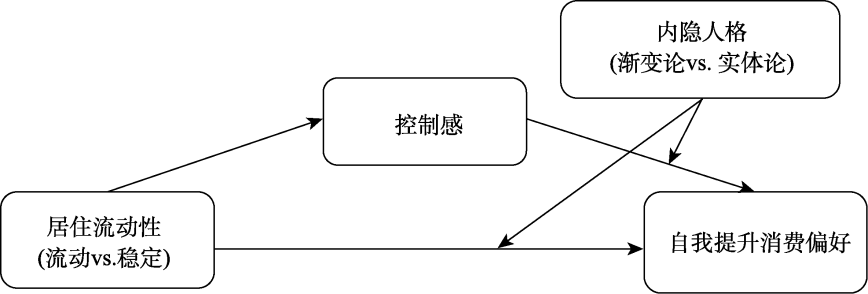
| [1] | 陈洁, 范雯健, 李庆, 钟佳玲. (2023). 越漂泊越爱分享小众信息?——居住流动性和数值源地位对在线信息分享意愿的影响研究. 营销科学学报, 3(2), 78-95. |
| [2] | 何柳. (2020). 居住流动性对怀旧消费倾向的影响:控制感的中介作用和自主性的调节作用[硕士学位论文]. 南京大学. |
| [3] | 黄静, 许新宇, 肖皓文, 刘洪亮, 廖欢欢. (2023). 控制感缺失对创造体验型消费意愿的影响研究. 南开管理评论, 26(1), 239-250. |
| [4] | 李林竹, 王丹, 李艳军. (2022). 居住流动性对他乡地理标志品牌购买意愿的影响. 珞珈管理评论, (2), 122-135. |
| [5] | 柳武妹, 王海忠, 陈增祥. (2014). 补偿性消费研究回顾与展望. 外国经济与管理, 36(9), 20-28. |
| [6] |
柳武妹, 肖海谊, 王雪枫. (2022). 居住流动性与消费:基于调节定向理论的阐释. 心理科学进展, 30(11), 2595-2606.
doi: 10.3724/SP.J.1042.2022.02595 |
| [7] | 施婷, 陈洁, 钟佳玲. (2021). 居住流动性、语言极端性与信息分享意愿. 管理评论, 33(8), 139-147+159. |
| [8] |
肖皓文, 林荫. (2025). 一举多得:个人控制感对多功能产品偏好的影响及机制研究. 心理与行为研究, 23(1), 138-144.
doi: 10.12139/j.1672-0628.2025.01.018 |
| [9] |
郑晓莹, 彭泗清. (2014). 补偿性消费行为:概念、类型与心理机制. 心理科学进展, 22(9), 1513-1520.
doi: 10.3724/SP.J.1042.2014.01513 |
| [10] |
Allard, T., & White, K. (2015). Cross-domain effects of guilt on desire for self-improvement products. Journal of Consumer Research, 42(3), 401-419.
doi: 10.1093/jcr/ucv024 URL |
| [11] |
Amiot, C. E., De la Sablonniere, R., Terry, D. J., & Smith, J. R. (2007). Integration of social identities in the self: Toward a cognitive-developmental model. Personality and Social Psychology Review, 11(4), 364-388.
doi: 10.1177/1088868307304091 pmid: 18453468 |
| [12] |
Armenta, C. N., Fritz, M. M., & Lyubomirsky, S. (2017). Functions of positive emotions: Gratitude as a motivator of self-improvement and positive change. Emotion Review, 9(3), 183-190.
doi: 10.1177/1754073916669596 URL |
| [13] |
Arnett, J. J. (2002). The psychology of globalization. American Psychologist, 57(10), 774-783.
doi: 10.1037/0003-066X.57.10.774 pmid: 12369500 |
| [14] |
Atasoy, O., & Morewedge, C. K. (2018). Digital goods are valued less than physical goods. Journal of Consumer Research, 44(6), 1343-1357.
doi: 10.1093/jcr/ucx102 URL |
| [15] |
Barberis, N., Mukherjee, A., & Wang, B. (2016). Prospect theory and stock returns: An empirical test. The Review of Financial Studies, 29(11), 3068-3107.
doi: 10.1093/rfs/hhw049 URL |
| [16] |
Bardhi, F., & Eckhardt, G. M. (2017). Liquid consumption. Journal of Consumer Research, 44(3), 582-597.
doi: 10.1093/jcr/ucx050 URL |
| [17] |
Bartels, J., & Onwezen, M. C. (2014). Consumers' willingness to buy products with environmental and ethical claims: The roles of social representations and social identity. International Journal of Consumer Studies, 38(1), 82-89.
doi: 10.1111/ijcs.2014.38.issue-1 URL |
| [18] |
Beck, J. T., Rahinel, R., & Bleier, A. (2020). Company worth keeping: Personal control and preferences for brand leaders. Journal of Consumer Research, 46(5), 871-886.
doi: 10.1093/jcr/ucz040 URL |
| [19] |
Belk, R. W. (2013). Extended self in a digital world. Journal of Consumer Research, 40(3), 477-500.
doi: 10.1086/671052 URL |
| [20] |
Borschel, E., Zimmermann, J., Crocetti, E., Meeus, W., Noack, P., & Neyer, F. J. (2019). Me and you in a mobile world: The development of regional identity and personal relationships in young adulthood. Developmental Psychology, 55(5), 1072-1087.
doi: 10.1037/dev0000677 pmid: 30702311 |
| [21] |
Brewer, M. B., & Gardner, W. (1996). Who is this “We”? Levels of collective identity and self representations. Journal of Personality and Social Psychology, 71(1), 83-93.
doi: 10.1037/0022-3514.71.1.83 URL |
| [22] |
Burger, J. M. (1989). Negative reactions to increases in perceived personal control. Journal of Personality and Social Psychology, 56(2), 246-256.
doi: 10.1037/0022-3514.56.2.246 URL |
| [23] |
Burnette, J. L., O’boyle, E. H., VanEpps, E. M., Pollack, J. M., & Finkel, E. J. (2013). Mind-sets matter: A meta-analytic review of implicit theories and self-regulation. Psychological Bulletin, 139(3), 655-701.
doi: 10.1037/a0029531 pmid: 22866678 |
| [24] |
Campbell, J. D., Trapnell, P. D., Heine, S. J., Katz, I. M., Lavallee, L. F., & Lehman, D. R. (1996). Self-concept clarity: Measurement, personality correlates, and cultural boundaries. Journal of Personality and Social Psychology, 70(1), 141-156.
doi: 10.1037/0022-3514.70.1.141 URL |
| [25] |
Campbell, M. C., & Goodstein, R. C. (2001). The moderating effect of perceived risk on consumers’ evaluations of product incongruity: Preference for the norm. Journal of Consumer Research, 28(3), 439-449.
doi: 10.1086/323731 URL |
| [26] |
Cantarella, M., & Desrichard, O. (2020). The uniqueness of risk: The link between need for uniqueness and risk-taking. Personality and Individual Differences, 159, 109885.
doi: 10.1016/j.paid.2020.109885 URL |
| [27] |
Catapano, R., Shennib, F., & Levav, J. (2022). Preference reversals between digital and physical goods. Journal of Marketing Research, 59(2), 353-373.
doi: 10.1177/00222437211065020 URL |
| [28] | Chen, C. Y., Lee, L., & Yap, A. J. (2017). Control deprivation motivates acquisition of utilitarian products. Journal of Consumer Research, 43(6), 1031-1047. |
| [29] |
Cheng, J., Chi, Y., & Bao, Y. (2024). Seeking variety on the move: The effect of residential mobility on variety seeking. Psychology & Marketing, 41(2), 227-239.
doi: 10.1002/mar.v41.2 URL |
| [30] |
Choi, H., & Oishi, S. (2020). The psychology of residential mobility: A decade of progress. Current Opinion in Psychology, 32, 72-75.
doi: S2352-250X(19)30079-X pmid: 31401423 |
| [31] | Consiglio, I., De Angelis, M., & Costabile, M. (2018). The effect of social density on word of mouth. Journal of Consumer Research, 45(3), 511-528. |
| [32] |
Cutright, K. M., & Samper, A. (2014). Doing it the hard way: How low control drives preferences for high-effort products and services. Journal of Consumer Research, 41(3), 730-745.
doi: 10.1086/677314 URL |
| [33] |
Dweck, C. S. (1986). Motivational processes affecting learning. American Psychologist, 41(10), 1040-1048.
doi: 10.1037/0003-066X.41.10.1040 URL |
| [34] |
Dweck, C. S., & Leggett, E. L. (1988). A social-cognitive approach to motivation and personality. Psychological Review, 95(2), 256-273.
doi: 10.1037/0033-295X.95.2.256 URL |
| [35] |
Exeter, D. J., Sabel, C. E., Hanham, G., Lee, A. C., & Wells, S. (2015). Movers and stayers: The geography of residential mobility and CVD hospitalisations in Auckland, New Zealand. Social Science & Medicine, 133, 331-339.
doi: 10.1016/j.socscimed.2014.11.056 URL |
| [36] |
Forehand, M., Reed, A., & Saint Clair, J. K. (2021). Identity interplay: The importance and challenges of consumer research on multiple identities. Consumer Psychology Review, 4(1), 100-120.
doi: 10.1002/arcp.v4.1 URL |
| [37] |
Fuligni, A. J., & Tsai, K. M. (2015). Developmental flexibility in the age of globalization: Autonomy and identity development among immigrant adolescents. Annual Review of Psychology, 66(1), 411-431.
doi: 10.1146/psych.2015.66.issue-1 URL |
| [38] |
Furchheim, P., Martin, C., & Morhart, F. (2020). Being green in a materialistic world: Consequences for subjective well- being. Psychology & Marketing, 37(1), 114-130.
doi: 10.1002/mar.v37.1 URL |
| [39] |
Gao, L., Wheeler, S. C., & Shiv, B. (2009). The “shaken self”: Product choices as a means of restoring self-view confidence. Journal of Consumer Research, 36(1), 29-38.
doi: 10.1086/596028 URL |
| [40] |
Goldfarb, A., & Tucker, C. (2019). Digital economics. Journal of economic literature, 57(1), 3-43.
doi: 10.1257/jel.20171452 |
| [41] |
Grewal, L., Wu, E. C., & Cutright, K. M. (2022). Loved as-is: How God salience lowers interest in self-improvement products. Journal of Consumer Research, 49(1), 154-174.
doi: 10.1093/jcr/ucab055 URL |
| [42] |
Hendriks, M., Ludwigs, K., & Veenhoven, R. (2016). Why are locals happier than internal migrants? The role of daily life. Social Indicators Research, 125(2), 481-508.
doi: 10.1007/s11205-014-0856-7 URL |
| [43] |
Hirsh, J. B., & Kang, S. K. (2016). Mechanisms of identity conflict: Uncertainty, anxiety, and the behavioral inhibition system. Personality and Social Psychology Review, 20(3), 223-244.
doi: 10.1177/1088868315589475 pmid: 26048875 |
| [44] |
Hodges, A. J., & Park, B. (2013). Oppositional identities: Dissimilarities in how women and men experience parent versus professional roles. Journal of Personality and Social Psychology, 105(2), 193-216.
doi: 10.1037/a0032681 pmid: 23713699 |
| [45] |
Ito, K., Su-May Tan, T., Lee, A., & Li, L. M. W. (2019). Low residential mobility and novelty-seeking consumption. Journal of Cross-Cultural Psychology, 50(10), 1242-1252.
doi: 10.1177/0022022119886107 |
| [46] |
Jami, A. (2019). Having control over and above situations: The influence of elevated viewpoints on risk taking. Journal of Marketing Research, 56(2), 230-244.
doi: 10.1177/0022243718813544 |
| [47] |
Kahneman, D., & Tversky, A. (1984). Choices, values, and frames. American Psychologist, 39(4), 341-350.
doi: 10.1037/0003-066X.39.4.341 URL |
| [48] | Kahneman, D., & Tversky, A. (2013). Prospect theory:An analysis of decision under risk. In L. C. MacLean, & W. T. Ziemba (Eds.), Handbook of the fundamentals of financial decision making: Part I (pp. 99-127). World Scientific Publishing Co. Pte. Ltd. |
| [49] |
Kay, A. C., Gaucher, D., Napier, J. L., Callan, M. J., & Laurin, K. (2008). God and the government: Testing a compensatory control mechanism for the support of external systems. Journal of Personality and Social Psychology, 95(1), 18-35.
doi: 10.1037/0022-3514.95.1.18 pmid: 18605849 |
| [50] |
Koo, M. (2022). Residential mobility and consumer psychology through a cultural lens. Journal of Consumer Psychology, 32(3), 541-546.
doi: 10.1002/jcpy.v32.3 URL |
| [51] | Koo, M., Ng, A. H., & Oishi, S. (2016). Residential mobility and uniqueness seeking. Advances in Consumer Research, 44, 514-515. |
| [52] |
Kray, L. J., & Haselhuhn, M. P. (2007). Implicit negotiation beliefs and performance: Experimental and longitudinal evidence. Journal of Personality and Social Psychology, 93(1), 49-64.
pmid: 17605588 |
| [53] |
Kupor, D. M., Liu, W., & Amir, O. (2018). The effect of an interruption on risk decisions. Journal of Consumer Research, 44(6), 1205-1219.
doi: 10.1093/jcr/ucx092 URL |
| [54] |
Ladge, J. J., Clair, J. A., & Greenberg, D. (2012). Cross-domain identity transition during liminal periods: Constructing multiple selves as professional and mother during pregnancy. Academy of Management Journal, 55(6), 1449-1471.
doi: 10.5465/amj.2010.0538 URL |
| [55] |
Landau, M. J., Kay, A. C., & Whitson, J. A. (2015). Compensatory control and the appeal of a structured world. Psychological Bulletin, 141(3), 694-722.
doi: 10.1037/a0038703 pmid: 25688696 |
| [56] | Lascu, D.-N., & Zinkhan, G. (1999). Consumer conformity: Review and applications for marketing theory and practice. Journal of Marketing Theory and Practice, 7(3), 1-12. |
| [57] | Leonardelli, G., J., Pickett, C. L., & Brewer, M. B. (2010). Chapter 2-Optimal distinctiveness theory:A framework for social identity, social cognition, and intergroup relations. In M. P. Zanna & J. M. Olson (Eds.), Advances in experimental social psychology (Vol. 43, pp. 63-113). Academic Press. |
| [58] |
Leung, E., Cito, M. C., Paolacci, G., & Puntoni, S. (2022). Preference for material products in identity‐based consumption. Journal of Consumer Psychology, 32(4), 672-679.
doi: 10.1002/jcpy.v32.4 URL |
| [59] |
Leung, E., Paolacci, G., & Puntoni, S. (2018). Man versus machine: Resisting automation in identity-based consumer behavior. Journal of Marketing Research, 55(6), 818-831.
doi: 10.1177/0022243718818423 URL |
| [60] |
Li, H., Yang, Y., Liu, D., & Xie, X. (2021). Risk preferences in self-other decisions: The effect of payoff allocation framing. Journal of Behavioral Decision Making, 34(2), 247-260.
doi: 10.1002/bdm.v34.2 URL |
| [61] |
Li, W. Q., Li, L. M. W., & Li, M. (2019). Residential mobility reduces ingroup favouritism in prosocial behaviour. Asian Journal of Social Psychology, 22(1), 3-17.
doi: 10.1111/ajsp.2019.22.issue-1 URL |
| [62] |
Li, W. Q., Li, L. M. W., & Lou, N. M. (2022). Who moved with you? The companionship of significant others reduces movers’ motivation to make new friends. Asian Journal of Social Psychology, 25(2), 319-335.
doi: 10.1111/ajsp.v25.2 URL |
| [63] |
Li, Z., Choi, S., & Forrest, J. Y. L. (2021). Sociability and interdependent self‐construal on consumer choice for group: A moderated mediation model. Journal of Consumer Behaviour, 20(4), 942-958.
doi: 10.1002/cb.v20.4 URL |
| [64] |
Light, A. E., & Visser, P. S. (2013). The ins and outs of the self: Contrasting role exits and role entries as predictors of self-concept clarity. Self and Identity, 12(3), 291-306.
doi: 10.1080/15298868.2012.667914 URL |
| [65] |
Liu, Y., Zhang, F., Wu, F., Liu, Y., & Li, Z. (2017). The subjective wellbeing of migrants in Guangzhou, China: The impacts of the social and physical environment. Cities, 60, 333-342.
doi: 10.1016/j.cities.2016.10.008 URL |
| [66] |
Lun, J., Oishi, S., & Tenney, E. R. (2012). Residential mobility moderates preferences for egalitarian versus loyal helpers. Journal of Experimental Social Psychology, 48(1), 291-297.
doi: 10.1016/j.jesp.2011.09.002 URL |
| [67] |
Lun, J., Roth, D., Oishi, S., & Kesebir, S. (2013). Residential mobility, social support concerns, and friendship strategy. Social Psychological and Personality Science, 4(3), 332-339.
doi: 10.1177/1948550612453345 URL |
| [68] |
Mandel, N. (2003). Shifting selves and decision making: The effects of self-construal priming on consumer risk-taking. Journal of Consumer Research, 30(1), 30-40.
doi: 10.1086/374700 URL |
| [69] |
Mandel, N., Rucker, D. D., Levav, J., & Galinsky, A. D. (2017). The compensatory consumer behavior model: How self-discrepancies drive consumer behavior. Journal of Consumer Psychology, 27(1), 133-146.
doi: 10.1016/j.jcps.2016.05.003 URL |
| [70] |
Markus, H. R., & Kitayama, S. (1991). Culture and the self: Implications for cognition, emotion, and motivation. Psychological Review, 98(2), 224-253.
doi: 10.1037/0033-295X.98.2.224 URL |
| [71] |
Mathur, P., Jain, S. P., & Maheswaran, D. (2012). Consumers’ implicit theories about personality influence their brand personality judgments. Journal of Consumer Psychology, 22(4), 545-557.
doi: 10.1016/j.jcps.2012.01.005 URL |
| [72] |
Montford, W. J., Leary, R. B., & Nagel, D. M. (2019). The impact of implicit self-theories and loss salience on financial risk. Journal of Business Research, 99, 1-11.
doi: 10.1016/j.jbusres.2019.02.015 |
| [73] |
Morrison, K. R., & Johnson, C. S. (2011). When what you have is who you are: Self-uncertainty leads individualists to see themselves in their possessions. Personality and Social Psychology Bulletin, 37(5), 639-651.
doi: 10.1177/0146167211403158 pmid: 21487114 |
| [74] |
Ng, S., Faraji-Rad, A., & Batra, R. (2021). Uncertainty evokes consumers’ preference for brands incongruent with their global-local citizenship identity. Journal of Marketing Research, 58(2), 400-415.
doi: 10.1177/0022243720972956 URL |
| [75] |
Oishi, S., Ishii, K., & Lun, J. (2009). Residential mobility and conditionality of group identification. Journal of Experimental Social Psychology, 45(4), 913-919.
doi: 10.1016/j.jesp.2009.04.028 URL |
| [76] |
Oishi, S., & Kesebir, S. (2012). Optimal social-networking strategy is a function of socioeconomic conditions. Psychological Science, 23(12), 1542-1548.
doi: 10.1177/0956797612446708 pmid: 23129061 |
| [77] |
Oishi, S., Kesebir, S., Miao, F. F., Talhelm, T., Endo, Y., Uchida, Y., & Norasakkunkit, V. (2013). Residential mobility increases motivation to expand social network: But why? Journal of Experimental Social Psychology, 49(2), 217-223.
doi: 10.1016/j.jesp.2012.10.008 URL |
| [78] |
Oishi, S., Krochik, M., Roth, D., & Sherman, G. D. (2012). Residential mobility, personality, and subjective and physical well-being: An analysis of cortisol secretion. Social Psychological and Personality Science, 3(2), 153-161.
doi: 10.1177/1948550611412395 URL |
| [79] |
Oishi, S., Lun, J., & Sherman, G. D. (2007). Residential mobility, self-concept, and positive affect in social interactions. Journal of Personality and Social Psychology, 93(1), 131-141.
doi: 10.1037/0022-3514.93.1.131 pmid: 17605594 |
| [80] |
Oishi, S., Miao, F. F., Koo, M., Kisling, J., & Ratliff, K. A. (2012). Residential mobility breeds familiarity-seeking. Journal of Personality and Social Psychology, 102(1), 149-162.
doi: 10.1037/a0024949 pmid: 21843015 |
| [81] |
Oishi, S., & Schimmack, U. (2010). Residential mobility, well-being, and mortality. Journal of Personality and Social Psychology, 98(6), 980-994.
doi: 10.1037/a0019389 pmid: 20515253 |
| [82] |
Oishi, S., & Talhelm, T. (2012). Residential mobility: What psychological research reveals. Current Directions in Psychological Science, 21(6), 425-430.
doi: 10.1177/0963721412460675 URL |
| [83] |
Oishi, S., Talhelm, T., Lee, M., Komiya, A., & Akutsu, S. (2015). Residential mobility and low-commitment groups. Archives of Scientific Psychology, 3(1), 54-61.
doi: 10.1037/arc0000013 URL |
| [84] |
Oishi, S., & Tsang, S. (2022). The socio‐ecological psychology of residential mobility. Journal of Consumer Psychology, 32(3), 519-536.
doi: 10.1002/jcpy.v32.3 URL |
| [85] |
Okada, E. M., & Hoch, S. J. (2004). Spending time versus spending money. Journal of Consumer Research, 31(2), 313-323.
doi: 10.1086/422110 URL |
| [86] |
Paksarian, D., Eaton, W. W., Mortensen, P. B., & Pedersen, C. B. (2015). Childhood residential mobility, schizophrenia, and bipolar disorder: A population-based study in Denmark. Schizophrenia Bulletin, 41(2), 346-354.
doi: 10.1093/schbul/sbu074 pmid: 24903417 |
| [87] |
Paley, A., Tully, S. M., & Sharma, E. (2019). Too constrained to converse: The effect of financial constraints on word of mouth. Journal of Consumer Research, 45(5), 889-905.
doi: 10.1093/jcr/ucy040 |
| [88] |
Reed, A. (2004). Activating the self-importance of consumer selves: Exploring identity salience effects on judgments. Journal of Consumer Research, 31(2), 286-295.
doi: 10.1086/422108 URL |
| [89] |
Reed, A., Forehand, M. R., Puntoni, S., & Warlop, L. (2012). Identity-based consumer behavior. International Journal of Research in Marketing, 29(4), 310-321.
doi: 10.1016/j.ijresmar.2012.08.002 URL |
| [90] |
Rios, K., Wheeler, S. C., & Miller, D. T. (2012). Compensatory nonconformity: Self-uncertainty and low implicit self- esteem increase adoption and expression of minority opinions. Journal of Experimental Social Psychology, 48(6), 1300-1309.
doi: 10.1016/j.jesp.2012.07.005 URL |
| [91] |
Rippé, C. B., Weisfeld-Spolter, S., Yurova, Y., & Kemp, A. (2021). Pandemic pedagogy for the new normal: Fostering perceived control during COVID-19. Journal of Marketing Education, 43(2), 260-276.
doi: 10.1177/0273475320987287 URL |
| [92] |
Roccas, S., & Brewer, M. B. (2002). Social identity complexity. Personality and Social Psychology Review, 6(2), 88-106.
doi: 10.1207/S15327957PSPR0602_01 URL |
| [93] |
Rose, R. L., & Wood, S. L. (2005). Paradox and the consumption of authenticity through reality television. Journal of Consumer Research, 32(2), 284-296.
doi: 10.1086/432238 URL |
| [94] |
Saad, C. S., Damian, R. I., Benet-Martínez, V., Moons, W. G., & Robins, R. W. (2013). Multiculturalism and creativity: Effects of cultural context, bicultural identity, and ideational fluency. Social Psychological and Personality Science, 4(3), 369-375.
doi: 10.1177/1948550612456560 URL |
| [95] |
Saint Clair, J. K., & Forehand, M. R. (2020). The many- faced consumer: Consumption consequences of balancing multiple identities. Journal of Consumer Research, 46(6), 1011-1030.
doi: 10.1093/jcr/ucz046 URL |
| [96] |
Savary, J., & Dhar, R. (2020). The uncertain self: How self-concept structure affects subscription choice. Journal of Consumer Research, 46(5), 887-903.
doi: 10.1093/jcr/ucz022 URL |
| [97] |
Schmitt, B. (2019). From atoms to bits and back: A research curation on digital technology and agenda for future research. Journal of Consumer Research, 46(4), 825-832.
doi: 10.1093/jcr/ucz038 |
| [98] |
Schubach, E., Zimmermann, J., Noack, P., & Neyer, F. J. (2016). Me, myself, and mobility: The relevance of region for young adults’ identity development. European Journal of Personality, 30(2), 189-200.
doi: 10.1002/per.2048 URL |
| [99] | Sedikides, C. (2009). On self-protection and self-enhancement regulation:The role of self-improvement and social norms. In J. P. Forgas, R. F. Baumeister, & D. M. Tice (Eds.), Psychology of self-regulation: Cognitive, affective, and motivational processes (pp. 73-92). Psychology Press. |
| [100] |
Shrum, L. (2022). Residential mobility: Implications for consumer psychology. Journal of Consumer Psychology, 32(3), 517-518.
doi: 10.1002/jcpy.v32.3 URL |
| [101] |
Singelis, T. M. (1994). The measurement of independent and interdependent self-construals. Personality and Social Psychology Bulletin, 20(5), 580-591.
doi: 10.1177/0146167294205014 URL |
| [102] |
Sitkin, S. B., & Pablo, A. L. (1992). Reconceptualizing the determinants of risk behavior. Academy of Management Review, 17(1), 9-38.
doi: 10.2307/258646 URL |
| [103] |
Slotter, E. B., Gardner, W. L., & Finkel, E. J. (2010). Who am I without you? The influence of romantic breakup on the self-concept. Personality and Social Psychology Bulletin, 36(2), 147-160.
doi: 10.1177/0146167209352250 pmid: 20008964 |
| [104] |
Stuppy, A., Mead, N. L., & Van Osselaer, S. M. (2020). I am, therefore I buy: Low self-esteem and the pursuit of self- verifying consumption. Journal of Consumer Research, 46(5), 956-973.
doi: 10.1093/jcr/ucz029 URL |
| [105] |
Su, L., Jiang, Y., Chen, Z., & DeWall, C. N. (2017). Social exclusion and consumer switching behavior: A control restoration mechanism. Journal of Consumer Research, 44(1), 99-117.
doi: 10.1093/jcr/ucw075 URL |
| [106] |
Su, L., Monga, A. B., & Jiang, Y. (2021). How life-role transitions shape consumer responses to brand extensions. Journal of Marketing Research, 58(3), 579-594.
doi: 10.1177/0022243720986546 URL |
| [107] |
Tseliou, F., Maguire, A., Donnelly, M., & O’Reilly, D. (2015). The impact of childhood residential mobility on mental health outcomes in adolescence and early adulthood: A record linkage study. Journal of Epidemiol Community Health, 70(3), 278-285.
doi: 10.1136/jech-2015-206123 URL |
| [108] |
Tversky, A., & Kahneman, D. (1979). Prospect theory: An analysis of decision under risk. Econometrica, 47(2), 263.
doi: 10.2307/1914185 URL |
| [109] |
Wang, Y. (2022). Residential mobility or mobile residentiality? Exploring the effects of place stability and variety in consumer psychology. Journal of Consumer Psychology, 32(3), 537-540.
doi: 10.1002/jcpy.v32.3 URL |
| [110] |
Wang, Y., Kirmani, A., & Li, X. (2021). Not too far to help: Residential mobility, global identity, and donations to distant beneficiaries. Journal of Consumer Research, 47(6), 878-889.
doi: 10.1093/jcr/ucaa053 URL |
| [111] |
Wang, Y., Wang, X., Chen, H. A., & Ouyang, Q. (2024). Effect of status threat on preference for cross-domain self- improvement products: The moderation of trade-off beliefs. Journal of Business Research, 172, 114400.
doi: 10.1016/j.jbusres.2023.114400 URL |
| [112] |
Wang, Y., Zuo, S., & Wang, F. (2024). Residential mobility and psychological transformation in China: From relational to institutional trust. PsyCh Journal, 13(1), 90-101.
doi: 10.1002/pchj.693 |
| [113] |
Ward, M. K., & Broniarczyk, S. M. (2011). It’s not me, it’s you: How gift giving creates giver identity threat as a function of social closeness. Journal of Consumer Research, 38(1), 164-181.
doi: 10.1086/658166 URL |
| [114] |
Webb, E. C., & Shu, S. B. (2018). The effect of perceived similarity on sequential risk taking. Journal of Marketing Research, 55(6), 916-933.
doi: 10.1177/0022243718810800 URL |
| [115] |
Weber, E. U., Blais, A. R., & Betz, N. E. (2002). A domain‐specific risk‐attitude scale: Measuring risk perceptions and risk behaviors. Journal of Behavioral Decision Making, 15(4), 263-290.
doi: 10.1002/bdm.v15:4 URL |
| [116] |
Wood, S. (2010). The comfort food fallacy: Avoiding old favorites in times of change. Journal of Consumer Research, 36(6), 950-963.
doi: 10.1086/644749 URL |
| [117] |
Wood, S. L. (2002). Future fantasies: A social change perspective of retailing in the 21st century. Journal of Retailing, 78(1), 77-83.
doi: 10.1016/S0022-4359(01)00069-0 URL |
| [118] |
Yang, H., Stamatogiannakis, A., & Chattopadhyay, A. (2015). Pursuing attainment versus maintenance goals: The interplay of self-construal and goal type on consumer motivation. Journal of Consumer Research, 42(1), 93-108.
doi: 10.1093/jcr/ucv008 URL |
| [119] |
Yu, M., Duan, Q., Wu, X., & Luo, S. (2021). Effect of uncertainty-dependent residential mobility on loss aversion. PsyCh Journal, 10(5), 777-793.
doi: 10.1002/pchj.v10.5 URL |
| [120] |
Yu, M., Wu, X., Huang, L., & Luo, S. (2020). Residential mobility mindset enhances temporal discounting in the loss framework. Physiology & Behavior, 225, 113107.
doi: 10.1016/j.physbeh.2020.113107 URL |
| [121] |
Zeng, F., He, Q., Li, S., & Luo, A. (2023). Residential mobility boosts new product adoption. Psychology & Marketing, 40(5), 1012-1025.
doi: 10.1002/mar.v40.5 URL |
| [122] |
Zheng, L., Miao, M., & Gan, Y. (2020). Perceived control buffers the effects of the COVID-19 pandemic on general health and life satisfaction: The mediating role of psychological distance. Applied Psychology: Health and Well-Being, 12(4), 1095-1114.
doi: 10.1111/aphw.v12.4 URL |
| [123] |
Zuo, S., Cai, P., Huang, N., Wang, F., & Wang, P. (2023). Population migration damages the natural environment: A multilevel investigation of the relationship between residential mobility and pro-environmental behaviors. Personality and Social Psychology Bulletin, 49(5), 758-772.
doi: 10.1177/01461672221079451 URL |
| [1] | LI Ting, KONG Xiangbo, WANG Fenghua. The influence of loneliness on consumption behavior and its theoretical explanations [J]. Advances in Psychological Science, 2023, 31(6): 1078-1093. |
| [2] | LIU Wumei, XIAO Haiyi, WANG Xuefeng. Residential mobility and consumption: Explanation based on regulatory focus theory [J]. Advances in Psychological Science, 2022, 30(11): 2595-2606. |
| [3] | SUN Hongjie, LIU Feifei, FENG Wenting, CUI Bingqun. How do individuals cope self-threats with consuming behaviors? Analysis based on the orientation-path integration model [J]. Advances in Psychological Science, 2021, 29(5): 921-935. |
| [4] | YAN Lei, ZUO Bin, ZHANG Yanhong, WU Yang, YANG Linchuan. Cross-categorization and its influence on stereotyping [J]. Advances in Psychological Science, 2018, 26(7): 1272-1283. |
| [5] | ZHENG Xiaoying; PENG Siqing. Consumption as Psychological Compensation: A Review of Compensatory Consumption [J]. Advances in Psychological Science, 2014, 22(9): 1513-1520. |
| Viewed | ||||||
|
Full text |
|
|||||
|
Abstract |
|
|||||
