

ISSN 1671-3710
CN 11-4766/R
主办:中国科学院心理研究所
出版:科学出版社
CN 11-4766/R
主办:中国科学院心理研究所
出版:科学出版社
Advances in Psychological Science ›› 2026, Vol. 34 ›› Issue (6): 1084-1096.doi: 10.3724/SP.J.1042.2026.1084
• Regular Articles • Previous Articles Next Articles
TANG Wei1, ZHONG Wenrui2, LEI Zhen2, ZHANG Dandan2,3( )
)
Received:2026-02-13
Online:2026-06-15
Published:2026-04-17
Contact:
ZHANG Dandan
E-mail:zhangdd05@gmail.com
CLC Number:
TANG Wei, ZHONG Wenrui, LEI Zhen, ZHANG Dandan. The moral impact of delegating to artificial intelligence[J]. Advances in Psychological Science, 2026, 34(6): 1084-1096.
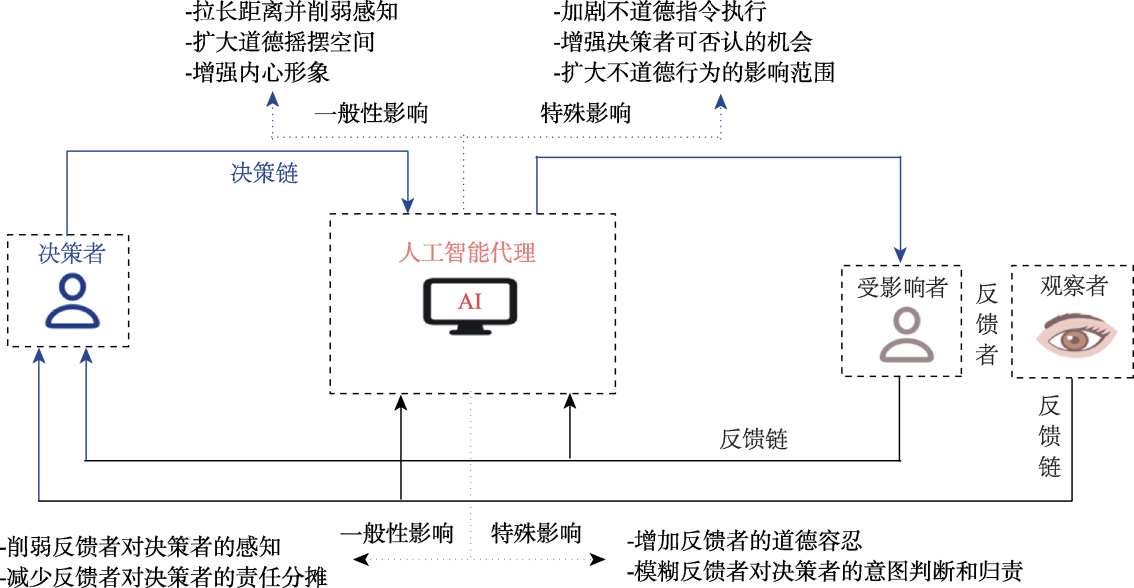
| 关键机制 | 人工智能特征 | 支持该观点的代表性文献 | 证据类型 |
|---|---|---|---|
| 加剧不道德指令的执行 | 高遵从性、无道德/声誉成本、强学习能力 | Bozdag, | 存在直接证据 |
| 增强决策者可否认的机会 | 强学习能力、黑箱性 | Babic et al., | 仅有间接证据 |
| 扩大不道德行为的影响范围 | 低增量成本的可复制性、个性化与跨场景迁移性 | Babic et al., | 存在直接证据 |
| 增加反馈者对不道德行为的道德容忍 | 工具性、低社会预期性、低社会存在性、前沿与试验性 | Bartling & Fischbacher, | 存在直接证据 |
| 模糊反馈者对决策者的意图判断和归责 | 弱社会规范性、多主体参与性、黑箱性 | Bartling & Fischbacher, | 仅有间接证据 |
| 关键机制 | 人工智能特征 | 支持该观点的代表性文献 | 证据类型 |
|---|---|---|---|
| 加剧不道德指令的执行 | 高遵从性、无道德/声誉成本、强学习能力 | Bozdag, | 存在直接证据 |
| 增强决策者可否认的机会 | 强学习能力、黑箱性 | Babic et al., | 仅有间接证据 |
| 扩大不道德行为的影响范围 | 低增量成本的可复制性、个性化与跨场景迁移性 | Babic et al., | 存在直接证据 |
| 增加反馈者对不道德行为的道德容忍 | 工具性、低社会预期性、低社会存在性、前沿与试验性 | Bartling & Fischbacher, | 存在直接证据 |
| 模糊反馈者对决策者的意图判断和归责 | 弱社会规范性、多主体参与性、黑箱性 | Bartling & Fischbacher, | 仅有间接证据 |
| [1] |
杜传晨, 郑远霞, 郭倩倩, 刘国雄. (2025). 大语言模型的人工心理理论: 证据、界定与挑战. 心理科学进展, 33(12), 2027-2042.
doi: 10.3724/SP.J.1042.2025.2027 |
| [2] |
蒋路远, 曹李梅, 秦昕, 谭玲, 陈晨, 彭小斐. (2022). 人工智能决策的公平感知. 心理科学进展, 30(5), 1078-1092.
doi: 10.3724/SP.J.1042.2022.01078 |
| [3] |
谭美丽, 殷向洲, 张光磊, 熊普臻. (2025). 工作场所人工智能角色划分: 对员工心理与行为的影响及应对策略. 心理科学进展, 33(6), 933-947.
doi: 10.3724/SP.J.1042.2025.0933 |
| [4] | 王涛, 占小军, 余薇. (2024). AI感知对员工心理和行为的影响及理论解释. 心理科学进展, 32(7), 1195-1208. |
| [5] |
许丽颖, 喻丰, 彭凯平. (2022). 算法歧视比人类歧视引起更少道德惩罚欲. 心理学报, 54(9), 1076-1092.
doi: 10.3724/SP.J.1041.2022.01076 |
| [6] |
Abeler, J., Nosenzo, D., & Raymond, C. (2019). Preferences for truth-telling. Econometrica, 87(4), 1115-1153.
doi: 10.3982/ECTA14673 |
| [7] |
Agrawal, A., Gans, J. S., & Goldfarb, A. (2019). Exploring the impact of artificial intelligence: Prediction versus judgment. Information Economics and Policy, 47, 1-6.
doi: 10.1016/j.infoecopol.2019.05.001 |
| [8] | Alnattah, A., Jajroudi, M., Fadafen, S. A. N., Manzari, M. N., & Eslami, S. (2025). Artificial intelligence in clinical decision-making: A scoping review of rule-based systems and their applications in medicine. Cureus, 17(8), e91333. |
| [9] |
Alt, M., & Gallier, C. (2022). Incentives and intertemporal behavioral spillovers: A two-period experiment on charitable giving. Journal of Economic Behavior & Organization, 200, 959-972.
doi: 10.1016/j.jebo.2022.05.028 URL |
| [10] |
Andreoni, J. (1990). Impure altruism and donations to public goods: A theory of warm-glow giving. The Economic Journal, 100(401), 464-477.
doi: 10.2307/2234133 URL |
| [11] |
Babšek, M., Ravšelj, D., Umek, L., & Aristovnik, A. (2025). Artificial intelligence adoption in public administration: An overview of top-cited articles and practical applications. AI, 6(3), 44.
doi: 10.3390/ai6030044 URL |
| [12] |
Bandura, A. (1999). Moral disengagement in the perpetration of inhumanities. Personality and Social Psychology Review, 3(3), 193-209.
doi: 10.1207/s15327957pspr0303_3 pmid: 15661671 |
| [13] |
Bankins, S., & Formosa, P. (2023). The ethical implications of artificial intelligence (AI) for meaningful work. Journal of Business Ethics, 185(4), 725-740.
doi: 10.1007/s10551-023-05339-7 |
| [14] |
Bartling, B., & Fischbacher, U. (2012). Shifting the blame: On delegation and responsibility. Review of Economic Studies, 79(1), 67-87.
doi: 10.1093/restud/rdr023 URL |
| [15] |
Babic, B., Gerke, S., Evgeniou, T., & Cohen, I. G. (2021). Beware explanations from AI in health care. Science, 373(6552), 284-286.
doi: 10.1126/science.abg1834 pmid: 34437144 |
| [16] |
Bazerman, M. H., & Sezer, O. (2016). Bounded awareness: Implications for ethical decision making. Organizational Behavior and Human Decision Processes, 136, 95-105.
doi: 10.1016/j.obhdp.2015.11.004 URL |
| [17] |
Becker, G. S. (1974). A theory of social interactions. Journal of Political Economy, 82(6), 1063-1093.
doi: 10.1086/260265 URL |
| [18] |
Bednar, J. S., Sommerfeldt, R. D., Zimbelman, A. F., & Zimbelman, M. F. (2025). Don’t sweat the small stuff: The tolerance spillover effect in ethical decision-making. Journal of Business Ethics, 202, 727-747.
doi: 10.1007/s10551-024-05902-w |
| [19] |
Bénabou, R., & Tirole, J. (2006). Incentives and prosocial behavior. American Economic Review, 96(5), 1652-1678.
doi: 10.1257/aer.96.5.1652 URL |
| [20] | Bender, E. M., Gebru, T., McMillan-Major, A., & Shmitchell, S. (2021, March). On the dangers of stochastic parrots: Can language models be too big? In Proceedings of the 2021 ACM conference on fairness, accountability, and transparency (pp. 610-623). Association for Computing Machinery. |
| [21] |
Bigman, Y. E., & Gray, K. (2018). People are averse to machines making moral decisions. Cognition, 181, 21-34.
doi: S0010-0277(18)30208-7 pmid: 30107256 |
| [22] | Bigman, Y. E., Wilson, D., Arnestad, M. N., Waytz, A., & Gray, K. (2023). Algorithmic discrimination causes less moral outrage than human discrimination. Journal of Experimental Psychology: General, 152(1), Article 4. |
| [23] | Bommasani, R., Hudson, D. A., Adeli, E., Altman, R., Arora, S., von Arx, S., & Liang, P. (2021). On the opportunities and risks of foundation models. Stanford Institute for Human-Centered Artificial Intelligence. |
| [24] |
Bolton, G. E., & Ockenfels, A. (2000). ERC: A theory of equity, reciprocity, and competition. American Economic Review, 90(1), 166-193.
doi: 10.1257/aer.90.1.166 URL |
| [25] |
Bozdag, E. (2013). Bias in algorithmic filtering and personalization. Ethics and Information Technology, 15(3), 209-227.
doi: 10.1007/s10676-013-9321-6 URL |
| [26] |
Butler, O. (2025). Algorithmic decision-making, delegation and the modern machinery of government. Oxford Journal of Legal Studies, 45(3), 727-752.
doi: 10.1093/ojls/gqaf018 pmid: 40896406 |
| [27] |
Cadario, R., Longoni, C., & Morewedge, C. K. (2021). Understanding, explaining, and utilizing medical artificial intelligence. Nature Human Behaviour, 5(12), 1636-1642.
doi: 10.1038/s41562-021-01146-0 pmid: 34183800 |
| [28] |
Caldwell, M., Andrews, J. T., Tanay, T., & Griffin, L. D. (2020). AI-enabled future crime. Crime Science, 9(1), 1-13.
doi: 10.1186/s40163-019-0110-3 |
| [29] |
Calvano, E., Calzolari, G., Denicolò, V., Harrington, J. E., Jr., & Pastorello, S. (2020). Protecting consumers from collusive prices due to AI. Science, 370(6520), 1040-1042.
doi: 10.1126/science.abe3796 pmid: 33243879 |
| [30] | Candrian, C., & Scherer, A. (2022). Rise of the machines: Delegating decisions to autonomous AI. Computers in Human Behavior, 134, Article 107308. |
| [31] | Cath, C. (2018). Governing artificial intelligence: Ethical, legal and technical opportunities and challenges. Philosophical Transactions of the Royal Society A: Mathematical, Physical and Engineering Sciences, 376(2133), Article 20180080. |
| [32] | Chevrier, M., & Teixeira, V. (2024). Algorithm delegation and responsibility: Shifting blame to the programmer? (Working paper No. 2024-04). Groupe de REcherche en Droit, Economie, Gestion (GREDEG CNRS), Université Côte d'Azur. |
| [33] |
Coffman, L. C. (2011). Intermediation reduces punishment (and reward). American Economic Journal: Microeconomics, 3(4), 77-106.
doi: 10.1257/mic.3.4.77 URL |
| [34] |
Cohn, A., Maréchal, M. A., Tannenbaum, D., & Zünd, C. L. (2019). Civic honesty around the globe. Science, 365(6448), 70-73.
doi: 10.1126/science.aau8712 pmid: 31221770 |
| [35] |
Constantinescu, M., & Kaptein, M. (2025). Responsibility gaps, LLMs & organisations: Many agents, many levels, and many interactions. Science and Engineering Ethics, 31(6), 36.
doi: 10.1007/s11948-025-00560-1 |
| [36] |
Cushman, F. (2008). Crime and punishment: Distinguishing the roles of causal and intentional analyses in moral judgment. Cognition, 108(2), 353-380.
doi: 10.1016/j.cognition.2008.03.006 pmid: 18439575 |
| [37] |
Dai, Z., Galeotti, F., & Villeval, M. C. (2018). Cheating in the lab predicts fraud in the field: An experiment in public transportation. Management Science, 64(3), 1081-1100.
doi: 10.1287/mnsc.2016.2616 URL |
| [38] |
Dana, J., Weber, R. A., & Kuang, J. X. (2007). Exploiting moral wiggle room: Experiments demonstrating an illusory preference for fairness. Economic Theory, 33, 67-80.
doi: 10.1007/s00199-006-0153-z URL |
| [39] | De Groot, J. I., Bondy, K., & Schuitema, G. (2021). Listen to others or yourself? The role of personal norms on the effectiveness of social norm interventions to change pro-environmental behavior. Journal of Environmental Psychology, 78, Article 101688. |
| [40] |
de Melo, C. M., Marsella, S., & Gratch, J. (2019). Human cooperation when acting through autonomous machines. Proceedings of the National Academy of Sciences, 116(9), 3482-3487.
doi: 10.1073/pnas.1817656116 URL |
| [41] | Diaferia, L., Blohm, I., De Rossi, L. M., & Salviotti, G. (2022). When standard is not enough: A conceptualization of AI systems’ customization and its antecedents. In Proceedings of ICIS 2022. Copenhagen. |
| [42] | Dobbe, R., Gilbert, T. K., & Mintz, Y. (2021). Hard choices in artificial intelligence. Artificial Intelligence, 300, Article 103555. |
| [43] | Dvorak, F., Stumpf, R., Fehrler, S., & Fischbacher, U. (2024). Generative AI triggers welfare-reducing decisions in humans. arXiv. https://arxiv.org/abs/2401.12773. |
| [44] |
Dzindolet, M. T., Peterson, S. A., Pomranky, R. A., Pierce, L. G., & Beck, H. P. (2003). The role of trust in automation reliance. International Journal of Human-Computer Studies, 58(6), 697-718.
doi: 10.1016/S1071-5819(03)00038-7 URL |
| [45] |
Engl, F., Riedl, A., & Weber, R. (2021). Spillover effects of institutions on cooperative behavior, preferences, and beliefs. American Economic Journal: Microeconomics, 13(4), 261-299.
doi: 10.1257/mic.20180336 URL |
| [46] |
Erat, S. (2013). Avoiding lying: The case of delegated deception. Journal of Economic Behavior & Organization, 93, 273-278.
doi: 10.1016/j.jebo.2013.03.035 URL |
| [47] |
Fehr, E., & Fischbacher, U. (2004). Third-party punishment and social norms. Evolution and Human Behavior, 25(2), 63-87.
doi: 10.1016/S1090-5138(04)00005-4 URL |
| [48] |
Fehr, E., Kirchsteiger, G., & Riedl, A. (1993). Does fairness prevent market clearing? An experimental investigation. Quarterly Journal of Economics, 108(2), 437-459.
doi: 10.2307/2118338 URL |
| [49] |
Fehr, E., & Schmidt, K. M. (1999). A theory of fairness, competition, and cooperation. The Quarterly Journal of Economics, 114(3), 817-868.
doi: 10.1162/003355399556151 URL |
| [50] |
Fehr, E., & Gächter, S. (2002). Altruistic punishment in humans. Nature, 415(6868), 137-140.
doi: 10.1038/415137a |
| [51] |
Feier, T., Gogoll, J., & Uhl, M. (2022). Hiding behind machines: Artificial agents may help to evade punishment. Science and Engineering Ethics, 28(2), 19.
doi: 10.1007/s11948-022-00372-7 pmid: 35377086 |
| [52] | Fernández Domingos, E., Terrucha, I., Suchon, R., Grujić, J., Burguillo, J. C., Santos, F. C., & Lenaerts, T. (2022). Delegation to artificial agents fosters prosocial behaviors in the collective risk dilemma. Scientific Reports, 12(1), Article 8492. |
| [53] |
Feuerriegel, S., Shrestha, Y. R., von Krogh, G., & Zhang, C. (2022). Bringing artificial intelligence to business management. Nature Machine Intelligence, 4(7), 611-613.
doi: 10.1038/s42256-022-00512-5 |
| [54] |
Fischbacher, U., & Föllmi-Heusi, F. (2013). Lies in disguise: An experimental study on cheating. Journal of the European Economic Association, 11(3), 525-547.
doi: 10.1111/jeea.12014 URL |
| [55] |
Fischbacher, U., & Gächter, S. (2010). Social preferences, beliefs, and the dynamics of free riding in public goods experiments. American Economic Review, 100(1), 541-556.
doi: 10.1257/aer.100.1.541 URL |
| [56] | Floridi, L. (2019). Translating principles into practices of digital ethics: Five risks of being unethical. Philosophy & Technology, 32(2), 185-193. |
| [57] |
Floridi, L., & Sanders, J. W. (2004). On the morality of artificial agents. Minds and Machines, 14(3), 349-379.
doi: 10.1023/B:MIND.0000035461.63578.9d |
| [58] |
Glikson, E., & Woolley, A. W. (2020). Human trust in artificial intelligence: Review of empirical research. Academy of Management Annals, 14(2), 627-660.
doi: 10.5465/annals.2018.0057 URL |
| [59] |
Giroux, M., Kim, J., Lee, J. C., & Park, J. (2022). Artificial intelligence and declined guilt: Retailing morality comparison between human and AI. Journal of Business Ethics, 178(4), 1027-1041.
doi: 10.1007/s10551-022-05056-7 |
| [60] | Gratch, J., & Fast, N. J. (2022). The power to harm: AI assistants pave the way to unethical behavior. Current Opinion in Psychology, 47, Article 101382. |
| [61] |
Gravert, C., & Collentine, L. O. (2021). When nudges aren’t enough: Norms, incentives and habit formation in public transport usage. Journal of Economic Behavior & Organization, 190, 1-14.
doi: 10.1016/j.jebo.2021.07.012 URL |
| [62] |
Greene, J. D. (2007). Why are VMPFC patients more utilitarian? A dual-process theory of moral judgment explains. Trends in Cognitive Sciences, 11(8), 322-323.
pmid: 17625951 |
| [63] |
Hamman, J. R., Loewenstein, G., & Weber, R. A. (2010). Self-interest through delegation: An additional rationale for the principal-agent relationship. American Economic Review, 100(4), 1826-1846.
doi: 10.1257/aer.100.4.1826 URL |
| [64] |
Haenlein, M., & Kaplan, A. (2019). A brief history of artificial intelligence. California Management Review, 61(4), 5-14.
doi: 10.1177/0008125619864925 |
| [65] |
Hertwig, R., & Engel, C. (2016). Homo ignorans: Deliberately choosing not to know. Perspectives on Psychological Science, 11(3), 359-372.
doi: 10.1177/1745691616635594 pmid: 27217249 |
| [66] |
Holmes, W., & Tuomi, I. (2022). State of the art and practice in AI in education. European Journal of Education, 57(4), 542-570.
doi: 10.1111/ejed.v57.4 URL |
| [67] |
Holzmeister, F., Holmén, M., Kirchler, M., Stefan, M., & Wengström, E. (2023). Delegation decisions in finance. Management Science, 69(8), 4828-4844.
doi: 10.1287/mnsc.2022.4555 URL |
| [68] | Hong, J. W., Cruz, I., & Williams, D. (2021). AI, you can drive my car: How we evaluate human drivers vs. self- driving cars. Computers in Human Behavior, 125, Article 106944. |
| [69] |
Igdalova, A., & Chamberlain, R. (2025). Slow looking at still art: The effect of manipulating audio context and image category on mood and engagement during an online slow looking exercise. Psychology of Aesthetics, Creativity, and the Arts, 19(3), 522-534.
doi: 10.1037/aca0000546 URL |
| [70] |
Ishowo-Oloko, F., Bonnefon, J.-F., Soroye, Z., Crandall, J., Rahwan, I., & Rahwan, T. (2019). Behavioural evidence for a transparency-efficiency tradeoff in human-machine cooperation. Nature Machine Intelligence, 1(11), 517-521.
doi: 10.1038/s42256-019-0113-5 |
| [71] | Ivcevic, Z., Menges, J., & Miller, A. (2020, March 20). How common is unethical behavior in U.S. organizations? Harvard Business Review. https://hbr.org/2020/03/how-common-is-unethical-behavior-in-u-s-organizations |
| [72] | Jago, A. S., Raveendhran, R., Fast, N., & Gratch, J. (2024). Algorithmic management diminishes status: An unintended consequence of using machines to perform social roles. Journal of Experimental Social Psychology, 110, Article 104553. |
| [73] |
Jones, T. M. (1991). Ethical decision making by individuals in organizations: An issue-contingent model. Academy of Management Review, 16(2), 366-395.
doi: 10.2307/258867 URL |
| [74] | Karpus, J., Krüger, A., Verba, J. T., Bahrami, B., & Deroy, O. (2021). Algorithm exploitation: Humans are keen to exploit benevolent AI. iScience, 24(6), Article 102521. |
| [75] |
Keding, C. (2021). Understanding the interplay of artificial intelligence and strategic management: Four decades of research in review. Management Review Quarterly, 71(1), 91-134.
doi: 10.1007/s11301-020-00181-x |
| [76] |
Köbis, N., Bonnefon, J. F., & Rahwan, I. (2021). Bad machines corrupt good morals. Nature Human Behaviour, 5(6), 679-685.
doi: 10.1038/s41562-021-01128-2 pmid: 34083752 |
| [77] |
Köbis, N., Rahwan, Z., Rilla, R., Supriyatno, B. I., Bersch, C., Ajaj, T., & Rahwan, I. (2025). Delegation to artificial intelligence can increase dishonest behaviour. Nature, 646, 126-134.
doi: 10.1038/s41586-025-09505-x |
| [78] |
Kocher, M. G., Schudy, S., & Spantig, L. (2018). I lie? We lie! Why? Experimental evidence on a dishonesty shift in groups. Management Science, 64(9), 3995-4008.
doi: 10.1287/mnsc.2017.2800 URL |
| [79] |
Kouchaki, M., & Smith, I. H. (2025). Moral decision-making in organizations. Annual Review of Organizational Psychology and Organizational Behavior, 12, 45-72.
doi: 10.1146/orgpsych.2025.12.issue-1 URL |
| [80] |
Laakasuo, M., Palomäki, J., & Köbis, N. (2021). Moral uncanny valley: A robot’s appearance moderates how its decisions are judged. International Journal of Social Robotics, 13(7), 1679-1688.
doi: 10.1007/s12369-020-00738-6 |
| [81] | Li, J., Song, T., Xue, B., & Lee, Y. C. (2025). We shape AI, and thereafter AI shape us: Humans align with AI through social influences. In Proceedings of the ICLR 2025 Workshop on Bidirectional Human-AI Alignment. International Conference on Learning Representations (ICLR). |
| [82] |
Liehner, G. L., Brauner, P., Schaar, A. K., & Ziefle, M. (2021). Delegation of moral tasks to automated agents- The impact of risk and context on trusting a machine to perform a task. IEEE Transactions on Technology and Society, 3(1), 46-57.
doi: 10.1109/TTS.2021.3118355 URL |
| [83] |
Liu, Y., Dai, C., & Cao, Y. (2025). Cognitive load and moral decision-making in moral dilemmas under virtual reality: The role of empathy for pain. Current Psychology, 44(6), 5279-5297.
doi: 10.1007/s12144-025-07585-6 |
| [84] | Makovi, K., Bonnefon, J. F., Oudah, M., Sargsyan, A., & Rahwan, T. (2025). Rewards and punishments help humans overcome biases against cooperation partners assumed to be machines. iScience, 28(7), Article 112833. |
| [85] |
Malik, N., Tripathi, S. N., Kar, A. K., & Gupta, S. (2022). Impact of artificial intelligence on employees working in industry 4.0 led organizations. International Journal of Manpower, 43(2), 334-354.
doi: 10.1108/IJM-03-2021-0173 URL |
| [86] |
Malle, B. F. (2021). Moral judgments. Annual Review of psychology, 72(1), 293-318.
doi: 10.1146/psych.2021.72.issue-1 URL |
| [87] | Malle, B. F., Scheutz, M., Arnold, T., Voiklis, J., & Cusimano, C. (2015). Sacrifice one for the good of many? People apply different moral norms to human and robot agents. In Proceedings of the 10th Annual ACM/IEEE International Conference on Human-Robot Interaction (pp. 117-124). Association for Computing Machinery. |
| [88] | Maninger, T., & Shank, D. B. (2022). Perceptions of violations by artificial and human actors across moral foundations. Computers in Human Behavior Reports, 5, Article 100154. |
| [89] |
Mazar, N., Amir, O., & Ariely, D. (2008). The dishonesty of honest people: A theory of self-concept maintenance. Journal of Marketing Research, 45(6), 633-644.
doi: 10.1509/jmkr.45.6.633 URL |
| [90] | Milgram, S. (1974). Obedience to authority: An experimental view. Harper & Row. |
| [91] | Mittelstadt, B. D., Allo, P., Taddeo, M., Wachter, S., & Floridi, L. (2016). The ethics of algorithms: Mapping the debate. Big Data & Society, 3(2), Article 2053951716679679. |
| [92] | Moser, C., Den Hond, F., & Lindebaum, D. (2022). Morality in the age of artificially intelligent algorithms. Academy of Management Learning & Education, 21(1), 139-155. |
| [93] |
Nass, C., & Moon, Y. (2000). Machines and mindlessness: Social responses to computers. Journal of Social Issues, 56(1), 81-103.
doi: 10.1111/josi.2000.56.issue-1 URL |
| [94] |
Oexl, R., & Grossman, Z. J. (2013). Shifting the blame to a powerless intermediary. Experimental Economics, 16(3), 306-312.
doi: 10.1007/s10683-012-9335-7 URL |
| [95] |
Paharia, N., Kassam, K. S., Greene, J. D., & Bazerman, M. H. (2009). Dirty work, clean hands: The moral psychology of indirect agency. Organizational Behavior and Human Decision Processes, 109(2), 134-141.
doi: 10.1016/j.obhdp.2009.03.002 URL |
| [96] |
Parasuraman, R., Sheridan, T. B., & Wickens, C. D. (2000). A model for types and levels of human interaction with automation. IEEE Transactions on Systems, Man, and Cybernetics - Part A: Systems and Humans, 30(3), 286-297.
doi: 10.1109/3468.844354 URL |
| [97] |
Pillutla, M. M., & Murnighan, J. K. (1996). Unfairness, anger, and spite: Emotional rejections of ultimatum offers. Organizational Behavior and Human Decision Processes, 68(3), 208-224.
doi: 10.1006/obhd.1996.0100 URL |
| [98] | Qin, X., Lu, J. G., Chen, C., Zhou, X., Gan, Y., Li, W., & Song, L. L. (2024). Artificial intelligence quotient (AIQ). Available at SSRN 4787320. |
| [99] | Rabin, M. (1993). Incorporating fairness into game theory and economics. The American Economic Review, 83(5), 1281-1302. |
| [100] |
Rahwan, I., Cebrian, M., Obradovich, N., Bongard, J., Bonnefon, J.-F., Breazeal, C., & Wellman, M. (2019). Machine behaviour. Nature, 568(7753), 477-486.
doi: 10.1038/s41586-019-1138-y |
| [101] | Ram, J. (2025). Moral decision-making in AI: A comprehensive review and recommendations. Technological Forecasting and Social Change, 217, Article 124150. |
| [102] | Ross, S. A. (1973). The economic theory of agency: The principal's problem. The American Economic Review, 63(2), 134-139. |
| [103] |
Russell, S., Hauert, S., Altman, R., & Veloso, M. (2015). Ethics of artificial intelligence. Nature, 521(7553), 415-418.
doi: 10.1038/521415a |
| [104] |
Salminen, J., Kaate, I., Kamel, A., M. S., Jung, S. G., & Jansen, B. J. (2021). How does personification impact ad performance and empathy? An experiment with online advertising. International Journal of Human-Computer Interaction, 37(2), 141-155.
doi: 10.1080/10447318.2020.1809246 URL |
| [105] | Santoni, de Sio, F., & Mecacci, G. (2021). Four responsibility gaps with artificial intelligence: Why they matter and how to address them. Philosophy & Technology, 34(4), 1057-1084. |
| [106] | Sapkota, R., Roumeliotis, K. I., & Karkee, M. (2026). AI agents vs. agentic AI: A conceptual taxonomy, applications and challenges. Information Fusion, 126, Article 103599. https://doi.org/10.1016/j.inffus.2025.103599 |
| [107] |
Schneider, S., & Leyer, M. (2019). Me or information technology? Adoption of artificial intelligence in the delegation of personal strategic decisions. Managerial and Decision Economics, 40(3), 223-231.
doi: 10.1002/mde.2982 |
| [108] |
Shortliffe, E. H., & Sepúlveda, M. J. (2018). Clinical decision support in the era of artificial intelligence. JAMA, 320(21), 2199-2200.
doi: 10.1001/jama.2018.17163 pmid: 30398550 |
| [109] | Simon, H. A. (1997). Models of bounded rationality: Empirically grounded economic reason (Vol. 3). MIT Press. |
| [110] |
Steffel, M., Williams, E. F., & Perrmann-Graham, J. (2016). Passing the buck: Delegating choices to others to avoid responsibility and blame. Organizational Behavior and Human Decision Processes, 135, 32-44.
doi: 10.1016/j.obhdp.2016.04.006 URL |
| [111] | Sundar, S., S. (2008). The MAIN model:A heuristic approach to understanding technology effects on credibility. In M. J. Metzger & A. J. Flanagin (Eds.), Digital media, youth, and credibility (pp. 73-100). MIT Press. |
| [112] |
Sullivan, Y. W., & Fosso Wamba, S. (2022). Moral judgments in the age of artificial intelligence. Journal of Business Ethics, 178(4), 917-943.
doi: 10.1007/s10551-022-05053-w |
| [113] |
Tversky, A., & Kahneman, D. (1974). Judgment under uncertainty: Heuristics and biases: Biases in judgments reveal some heuristics of thinking under uncertainty. Science, 185(4157), 1124-1131.
doi: 10.1126/science.185.4157.1124 pmid: 17835457 |
| [114] | von Bieberstein, F., Feess, E., & Packham, N. (2026). Multi-step delegation and the frequency of immoral decisions: Theory and experiment. European Economic Review, 181, Article 105159. |
| [115] | Villegas-Galaviz, C., & Martin, K. (2024). Moral distance, AI, and the ethics of care. AI & Society, 39(4), 1695-1706. |
| [116] |
Vu, L., Soraperra, I., Leib, M., van der Weele, J., & Shalvi, S. (2023). Ignorance by choice: A meta-analytic review of willful ignorance. Psychological Bulletin, 149(9-10), 611-635.
doi: 10.1037/bul0000398 URL |
| [117] | Wallach, W., & Allen, C. (2009). Moral machines: Teaching robots right from wrong. Oxford University Press. |
| [118] | Wang, X., & Qiu, X. (2024). The positive effect of artificial intelligence technology transparency on digital endorsers: Based on the theory of mind perception. Journal of Retailing and Consumer Services, 78, Article 103777. |
| [119] | Wang, X., Xie, H., Wang, Y., Xiao, C., Chen, H., Sargeant, H., ... Sun, M. (2025). Large language models' complicit responses to illicit instructions across socio-legal contexts. arXiv. https://arxiv.org/abs/2511.20736 |
| [120] | Weiss, A., & Forstmann, M. (2024). Religiosity predicts the delegation of decisions between moral and self-serving immoral outcomes. Journal of Experimental Social Psychology, 113, Article 104605. |
| [121] | Zhai, X., Chu, X., Chai, C. S., Jong, M. S. Y., Istenic, A., Spector, M., ... Li, Y. (2021). A review of artificial intelligence (AI) in education from 2010 to 2020. Complexity, 2021(1), Article 8812542. |
| [122] | Zhang, C., Zhu, W., Ding, J., Wu, Y., & Chen, X. (2023). Ethical impact of artificial intelligence in managerial accounting. International Journal of Accounting Information Systems, 49, Article 100619. |
| [123] | Zhao, W., Su, K., Zhu, H., Kaiser, M., Fan, M., Zou, Y., ... Yin, D. (2024). Activity flow under the manipulation of cognitive load and training. Neuroimage, 297, Article 120761. |
| [124] | Zhou, J., Corbett, F., Byun, J., Porat, T., & van Zalk, N. (2025). Psychological and behavioural responses in human-agent vs. human-human interactions: A systematic review and meta-analysis. arXiv. https://doi.org/10.48550/arXiv.2509.21542 |
| [1] | LIU Chuanjun, LIAO Jiangqun. The development of empirical paradigms and their theoretical values in moral dilemma research [J]. Advances in Psychological Science, 2021, 29(8): 1508-1520. |
| Viewed | ||||||
|
Full text |
|
|||||
|
Abstract |
|
|||||
