

ISSN 1671-3710
CN 11-4766/R
主办:中国科学院心理研究所
出版:科学出版社
CN 11-4766/R
主办:中国科学院心理研究所
出版:科学出版社
Advances in Psychological Science ›› 2026, Vol. 34 ›› Issue (10): 1876-1886.doi: 10.3724/SP.J.1042.2026.1876
• Regular Articles • Previous Articles Next Articles
ZHOU Shujin, ZHU Jingyi, TU Hongyue, Li Yan( )
Received:2025-12-17
Online:2026-10-15
Published:2026-07-20
Contact:
Li Yan
E-mail:liyan@shnu.edu.cn
CLC Number:
ZHOU Shujin, ZHU Jingyi, TU Hongyue, Li Yan. From self-serving to harm-seeking: Evolutionary pathways from negative to malevolent creativity and intervention[J]. Advances in Psychological Science, 2026, 34(10): 1876-1886.
| 层级 | 概念 | 新颖性 | 适用性 | 社会价值结果 | 动机本质 |
|---|---|---|---|---|---|
| 上位概念 | 创造力 | 高 | 高 | 中性 | 中立 |
| 结果效价类型 | 积极创造力 | 高 | 高 | 正向 | 建设性 |
| 结果效价类型 | 消极创造力 | 高 | 高 | 负向 | 可多样 |
| 消极创造力亚型 | 负创造力 | 高 | 高 | 负向 | 无伤害动机(利己, 伤害为副产品) |
| 消极创造力亚型 | 恶意创造力 | 高 | 高 | 负向 | 故意伤害(伤害为核心动机) |
| 消极创造力亚型 | 混合型消极创造力 | 高 | 高 | 负向 | 利己与伤害动机交织 |
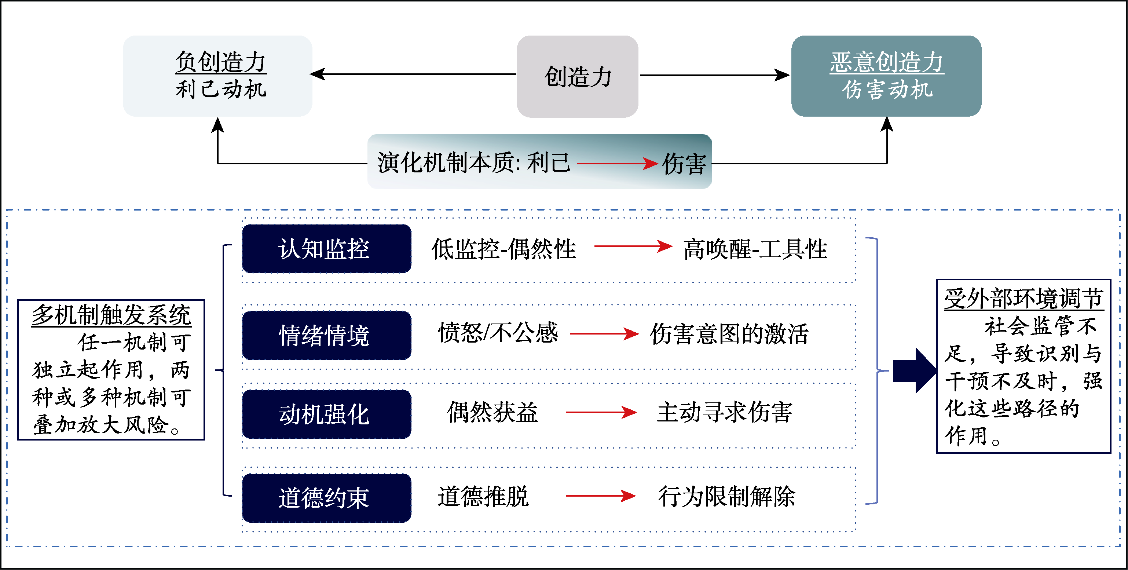
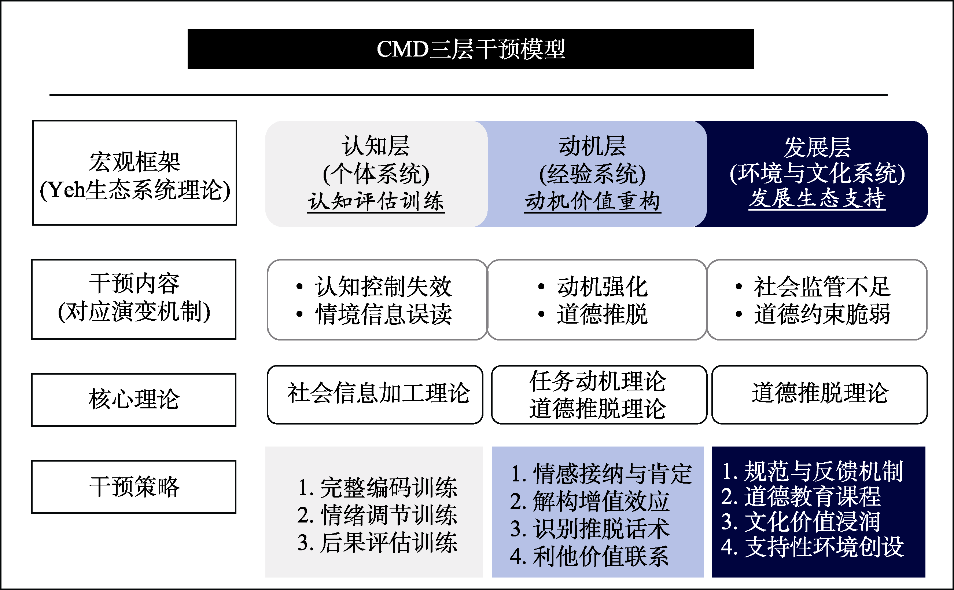
| [1] | 程瑞, 卢克龙, 郝宁. (2021). 愤怒情绪对恶意创造力的影响及调节策略. 心理学报, 53(7), 847-860. |
| [2] | 林崇德. (1992). 智力活动中的非智力因素. 华东师范大学学报: 教育科学版, (4), 8. |
| [3] | 裘指挥, 张丽. (2006). 利己与利他的博弈论分析--幼儿德育研究的新视角. 学前教育研究, (6), 18-20. |
| [4] | 叶平枝, 马倩茹. (2012). 2-6岁儿童创造性思维发展的特点及规律. 学前教育研究, (8), 36-41. |
| [5] | 周淑金, 韩宪国, 李丹, 陈欣银, 周佳茜, 陈小鹏, 罗俊龙. (2024). 农村儿童创造力与内、外化问题行为的关系. 心理与行为研究, 22(4), 486-493. |
| [6] | 周淑金, 刘萍, 罗俊龙, 王静, 李丹. (2020). 新颖性与适用性在广告再认中的提取模式差异. 心理科学, 43(4), 6. |
| [7] | Acar, O. A., & Fuchs, C. (2024). Novelty-seeking might underlie curiosity and the novelty dimension of creativity, but not the usefulness dimension. Behavioral and Brain Sciences, 47, e90. |
| [8] | Amabile, T. M. (1983). The social psychology of creativity: A componential conceptualization. Journal of Personality and Social Psychology, 45(2), 357-376. |
| [9] | Amabile, T. M. (1993). Motivational synergy: Toward new conceptualizations of intrinsic and extrinsic motivation in the workplace. Human Resource Management Review, 3(3), 185-201. |
| [10] | Amabile, T. M. (1996). Creativity in context: Update to the social psychology of creativity. Westview Press. |
| [11] | Bandura, A. (1991). Social cognitive theory of self-regulation. Organizational Behavior and Human Decision Processes, 50(2), 248-287. |
| [12] | Bandura, A. (1999). Moral disengagement in the perpetration of inhumanities. Personality and Social Psychology Review, 3(3), 193-209. |
| [13] | Barbot, B., Cerda, K., & Teo, T. (2020). Negative ideation in creative problem-solving is task-specific too: Evidences from a sample of incarcerated juveniles. Thinking Skills and Creativity, 38, Article 100740. |
| [14] | Bochkova, V. N., & Meshkova, N. (2019). Behavioral features of negative and malevolent creativity in adolescents. Psychological-Educational Studies, 11, 93-106. |
| [15] | Boles, R. E., Roberts, M. C., Brown, K. J., & Mayes, S. (2005). Children’s risk taking behaviors: The role of child-based perceptions of vulnerability and temperament. Journal of Pediatric Psychology, 30(7), 562-570. |
| [16] | Bridgers, S., Parece, K., Iwasaki, I., Broski, A., Schulz, L., & Ullman, T. (2025). Learning loopholes: The development of intentional misunderstandings in children. Child Development, 96(3), 1066-1087. |
| [17] | Clark, K., & James, K. (1999). Justice and positive and negative creativity. Creativity Research Journal, 12, 311-320. |
| [18] | Crick, N. R., & Dodge, K. A. (1994). A review and reformulation of social information-processing mechanisms in children's social adjustment. Psychological Bulletin, 115(1), 74-101. |
| [19] | Cropley, D., H. (2010). Summary - The dark side of creativity:A differentiated model. In D. H. Cropley, A. J. Cropley, J. C. Kaufman, & M. A. Runco (Eds.), The dark side of creativity (pp. 360-374). Cambridge University Press. |
| [20] | Cropley, D. H., Kaufman, J. C., & Cropley, A. J. (2008). Malevolent creativity: A functional model of creativity in terrorism and crime. Creativity Research Journal, 20(2), 105-115. |
| [21] | Cropley, D. H., Kaufman, J. C., White, A. E., & Chiera, B. A. (2014). Layperson perceptions of malevolent creativity: The good, the bad, and the ambiguous. Psychology of Aesthetics, Creativity, and the Arts, 8, 400-412. |
| [22] | Diedrich, J., Benedek, M., Jauk, E., & Neubauer, A. C. (2015). Are creative ideas novel and useful? Psychology of Aesthetics, Creativity, and the Arts, 9(1), 35-40. |
| [23] | Dou, X., Dou, X., & Jia, L. (2022). Interactive association of negative creative thinking and malevolent creative thinking. Frontiers in Psychology, 13, 939672. |
| [24] | Gao, Z., Cheng, L., Li, J., Chen, Q., & Hao, N. (2022). The dark side of creativity: Neural correlates of malevolent creative idea generation. Neuropsychologia, 167, 108164. |
| [25] | Gutworth, M. B., Cushenbery, L., & Hunter, S. T. (2018). Creativity for deliberate harm: Malevolent creativity and social information processing theory. The Journal of Creative Behavior, 52(4), 305-322. |
| [26] | Hansen Sandseter, E. B. (2007). Categorising risky play-How can we identify risk‐taking in children's play?. European Early Childhood Education Research Journal, 15(2), 237-252. |
| [27] | Hansika, K. (2015). The creative side of the dark triad. Creativity Research Journal, 27(1), 58-67. |
| [28] | Hao, N., Tang, M., Yang, J., Wang, Q., & Runco, M. A. (2016). A new tool to measure malevolent creativity: The malevolent creativity behavior scale. Frontiers in Psychology, 7, 682. |
| [29] | Harris, D. J., & Reiter-Palmon, R. (2015). Fast and furious: The influence of implicit aggression, premeditation, and provoking situations on malevolent creativity. Psychology of Aesthetics, Creativity, and the Arts, 9(1), 54-64. |
| [30] | Harris, D. J., Reiter-Palmon, R., & Kaufman, J. C. (2013). The effect of emotional intelligence and task type on malevolent creativity. Psychology of Aesthetics, Creativity, and the Arts, 7(3), 237-244. |
| [31] | Harvey, T., Davoodi, T., & Blake, P. R. (2018). Young children will lie to prevent a moral transgression. Journal of Experimental Child Psychology, 165, 51-65. |
| [32] | Kapoor, H. (2015). The creative side of the Dark Triad. Creativity Research Journal, 27, 58-67. |
| [33] | Kapoor, H. (2025). Shining a light on dark creativity. Creativity Research Journal, 37(2), 236-241. |
| [34] | Kapoor, H., & Khan, A. (2016). The measurement of negative creativity: Metrics and relationships. Creativity Research Journal, 28(4), 407-416. |
| [35] | Kapoor, H., & Khan, A. (2019). Creativity in context: Presses and task effects in negative creativity. Psychology of Aesthetics, Creativity, and the Arts, 13(3), 314-321. |
| [36] | Kaufman, J. C., & Beghetto, R. A. (2009). Beyond big and little: The four C model of creativity. Review of General Psychology, 13, 1-12. |
| [37] | Khessina, O., Goncalo, J., & Krause, V. (2018). It’s time to sober up: The direct costs, side effects and long-term consequences of creativity and innovation. Research in Organizational Behavior, 38(8), 107-135. |
| [38] | Kleinmintz, O. M., Ivancovsky, T., & Shamay-Tsoory, S. G. (2019). The two-fold model of creativity: The neural underpinnings of the generation and evaluation of creative ideas. Current Opinion in Behavioral Sciences, 27, 131-138. |
| [39] | Kohlberg, L. (1984). The psychology of moral development: The nature and validity of moral stages. (Vol. 2). Harper & Row. |
| [40] | Lee, S. A., & Dow, G. T. (2011). Malevolent creativity: Does personality influence malicious divergent thinking?. Creativity Research Journal, 23(2), 73-82. |
| [41] | Lloyd-Cox, J., Pickering, A., & Bhattacharya, J. (2022). Evaluating creativity: How idea context and rater personality affect considerations of novelty and usefulness. Creativity Research Journal, 34(4), 373-390. |
| [42] | Mayer, R., E. (1999). Fifty years of creativity research. In R. J. Sternberg (Eds.), Handbook of creativity (pp. 449-460). Cambridge University Press. |
| [43] | McCarthy, M., Chen, C. C., & McNamee, R. C. (2018). Novelty and usefulness trade-off: Cultural cognitive differences and creative idea evaluation. Journal of Cross- Cultural Psychology, 49(2), 171-198. |
| [44] | Meshkova, N., Enikolopov, S., Kudryavtsev, V. T., Bochkova, M. N., & Meshkov, I. A. (2021). Predictors of negative creativity in adults on the example of cadets. Psychology and Law, 11(4), 90-108. |
| [45] | Perchtold-Stefan, C., Fink, A., Rominger, C., & Papousek, I. (2021). Motivated to harm others? Prefrontal-posterior coupling in response to other’s despair and anger is linked to malevolent creativity. Psychophysiology, 58, S54. |
| [46] | Plucker, J. A., Beghetto, R. A., & Dow, G. T. (2004). Why isn't creativity more important to educational psychologists? potentials, pitfalls, and future directions in creativity research. Educational Psychologist, 39(2), 83-96. |
| [47] | Qin, X., Dust, S. B., DiRenzo, M. S., & Wang, S. (2020). Negative creativity in leader-follower relations: A daily investigation of leaders’ creative mindset, moral disengagement, and abusive supervision. Journal of Business and Psychology, 35(5), 665-682. |
| [48] | Reiter-Palmon, R. (2018). Are the outcomes of creativity always positive?. Creativity Theories-Research-Application, 5(2), 177-181. |
| [49] | Runco, M., A. (2010). Creativity has no dark side. In D. H. Cropley, A. J. Cropley, J. C. Kaufman, & M. A. Runco (Eds.), The dark side of creativity (pp. 15-32). Cambridge University Press. |
| [50] | Runco, M., A. (2018). Authentic creativity: Mechanisms, definitions, and empirical efforts. In R. J. Sternberg & J. C. Kaufman (Eds.), The nature of human creativity (pp. 246-263). Cambridge University Press. |
| [51] | Runco, M. A., & Acar, S. (2012). Divergent thinking as an indicator of creative potential. Creativity Research Journal, 24(1), 66-75. |
| [52] | Runco, M. A., & Jaeger, G. J. (2012). The standard definition of creativity. Creativity Research Journal, 24(1), 92-96. |
| [53] | Talwar, V., & Lavoie, J. (2022). Lie-telling for personal gain in children with and without externalizing behavior problems. Journal of Experimental Child Psychology, 219, 105385. |
| [54] | Turiel, E. (2006). The development of morality. In N. Eisenberg, W. Damon, & R. M. Lerner (Eds.), Handbook of child psychology: Social, emotional, and personality development (6th ed., pp. 789-857). John Wiley & Sons. |
| [55] | Yeh, Y. C. (2004). The interactive influences of three ecological systems on R & D employees' technological creativity. Creativity Research Journal, 16(1), 11-25. |
| [56] | Zhao, J., Xu, X., & Pang, W. (2022). When do creative people engage in malevolent behaviors? The moderating role of moral reasoning. Personality and Individual Differences, 186, 111386. |
| [57] | Zhou, S., Xu, X., Li, D., Luo, J., & Zhang, M. (2024). Joint developmental trajectories of novelty and usefulness in Chinese children’s creativity. Journal of Youth and Adolescence, 53(3), 609-620. |
| [58] | Zhou, S., Zhang, Y., Zhang, M., & Li, D. (2025). The role of peer relationship on children's creativity during cooperative and competitive interactions: An fNIRS-based hyperscanning study. Developmental Cognitive Neuroscience, 75, 101592. |
| [1] | WANG Botao, WEI Ping. Moral emotion: A new perspective on the relationship between morality and creativity [J]. Advances in Psychological Science, 2021, 29(2): 268-275. |
| Viewed | ||||||
|
Full text |
|
|||||
|
Abstract |
|
|||||
