

ISSN 1671-3710
CN 11-4766/R
主办:中国科学院心理研究所
出版:科学出版社
CN 11-4766/R
主办:中国科学院心理研究所
出版:科学出版社
Advances in Psychological Science ›› 2025, Vol. 33 ›› Issue (6): 965-983.doi: 10.3724/SP.J.1042.2025.0965
• Academic Papers of the 27th Annual Meeting of the China Association for Science and Technology • Previous Articles Next Articles
XIANG Diandian1,2, YIN Yule1( ), GE Mengqi1, WANG Zihan1
Received:2024-10-24
Online:2025-06-15
Published:2025-04-09
Contact:
YIN Yule
E-mail:yuleyyle@163.com
CLC Number:
XIANG Diandian, YIN Yule, GE Mengqi, WANG Zihan. The impact of brand-developing versus collaborative virtual influencer endorsement selection strategies on consumer engagement[J]. Advances in Psychological Science, 2025, 33(6): 965-983.
| 代表文献 | 术语 | 定义描述 |
|---|---|---|
| Byun & Ahn, | 虚拟影响者 Virtual influencer | 一类数字化实体, 具有拟人化的外观、类似真人的社会角色和独立的身份特质, 借助人工智能技术能够与其他人类在社交媒体中展开高质量互动, 其控制者可以是人类或算法。 |
| Ham et al., | 虚拟品牌代言人 Virtual brand endorser | 在社交媒体中拥有粉丝基础并能和粉丝互动, 旨在服务于品牌代言工作的一类虚拟数字人。 |
| 晏青,何丽敏, | 虚拟明星/偶像 Virtual celebrity/idol | 具有人类、动物、拟人化生物等形象, 能够在计算机、互联网及人工智能技术搭建的场景中进行演艺活动(如歌手), 企业能够将其用于产品推广和品牌传播。 |
| Baudier et al., | 社交媒体中的机器人影响者 Social media robot influencer | 运用人工智能情感技术, 机器人影响者能够在社交媒体中识别、理解和表达情感, 以此增强它们与人类的互动效果, 从而服务于传递信息和建立关系的功能。 |
| Sands, Campbell et al., | 人工智能影响者 Artificial intelligence (AI) influencers | 依托机器学习技术驱动, 能与真人影响者一样在多个社交媒体的内容板块中生成内容; 其拥有多种不同类型的外观。 |
| Chen & Hu, | 虚拟主播 Virtual uploader/Vtuber | 通常拥有卡通外观, 主要在社交媒体中(如哔哩哔哩)进行各式各样的直播活动, 由真人穿戴设备并依托实时捕捉技术和虚拟直播系统来实现角色扮演。 |
| 代表文献 | 术语 | 定义描述 |
|---|---|---|
| Byun & Ahn, | 虚拟影响者 Virtual influencer | 一类数字化实体, 具有拟人化的外观、类似真人的社会角色和独立的身份特质, 借助人工智能技术能够与其他人类在社交媒体中展开高质量互动, 其控制者可以是人类或算法。 |
| Ham et al., | 虚拟品牌代言人 Virtual brand endorser | 在社交媒体中拥有粉丝基础并能和粉丝互动, 旨在服务于品牌代言工作的一类虚拟数字人。 |
| 晏青,何丽敏, | 虚拟明星/偶像 Virtual celebrity/idol | 具有人类、动物、拟人化生物等形象, 能够在计算机、互联网及人工智能技术搭建的场景中进行演艺活动(如歌手), 企业能够将其用于产品推广和品牌传播。 |
| Baudier et al., | 社交媒体中的机器人影响者 Social media robot influencer | 运用人工智能情感技术, 机器人影响者能够在社交媒体中识别、理解和表达情感, 以此增强它们与人类的互动效果, 从而服务于传递信息和建立关系的功能。 |
| Sands, Campbell et al., | 人工智能影响者 Artificial intelligence (AI) influencers | 依托机器学习技术驱动, 能与真人影响者一样在多个社交媒体的内容板块中生成内容; 其拥有多种不同类型的外观。 |
| Chen & Hu, | 虚拟主播 Virtual uploader/Vtuber | 通常拥有卡通外观, 主要在社交媒体中(如哔哩哔哩)进行各式各样的直播活动, 由真人穿戴设备并依托实时捕捉技术和虚拟直播系统来实现角色扮演。 |
| 代表文献 | 关键机制检验 | 代言人选择策略研究 | 边界条件 |
|---|---|---|---|
| 脉络1:对虚拟影响者属性的分析 | |||
| Kim & Park, | 吸引力→模仿欲望, 品牌依恋→购买意愿 | × | 产品类型的匹配 |
| Li et al., | 拟人化(外表, 行为)→产品真实性, 产品关联性→代言态度 | × | 产品类型 |
| El Hedhli et al., | 拟人化→温暖感知, 能力感知→采纳意愿, 购买意愿 | × | × |
| Alboqami, | 吸引力(外表等), 可信度(真实性等), 一致性(影响者−产品/消费者)→信任 | × | × |
| 王颖 等, | 真实性感知→虚拟依恋→旅游意愿 | × | 熟悉度; 代言人发展预期 |
| 脉络2:对虚拟影响者的比较分析 | |||
| 姜凌,冯源, | 虚拟影响者 vs. 真人影响者→积极情绪→广告说服力 | × | 独特需求 |
| 朱华伟 等, | 虚拟影响者vs. 真人影响者→加工流畅性→购买意愿 | × | 创新产品类型(突破式vs. 渐进式) |
| Franke et al., | 虚拟影响者 vs. 真人影响者→专业性感知→广告态度, 购买意愿等 | × | 产品类型; 影响者类型披露 |
| Ozdemir et al., | 虚拟影响者 vs. 真人影响者→可信度感知→品牌态度 | × | 语言类型(感性 vs.理性) |
| Sands, Campbell et al., | 虚拟影响者 vs. 真人影响者→心理距离→关注意愿, 口碑等 | × | 独特化需求; 影响者代理(自主 vs.管理) |
| Thomas & Fowler, | 虚拟影响者 vs. 真人影响者→责任感知→品牌态度, 购买意愿 | × | × |
| Wang & Qiu, | 类人虚拟影响者 vs. 动漫虚拟影响者→感知社会价值→购买意愿 | × | 广告信息框架(防御型 vs. 促进型) |
| Zhou, Li et al., | 虚拟影响者 vs. 真人影响者→情感投入, 准社会关系→品牌代言有效性 | × | 帖子类型(视频 vs.图片) |
| Zhou, Yan et al., | 虚拟影响者 vs. 真人影响者→意象难度, 感官能力感知→购买意愿 | × | 感官体验 |
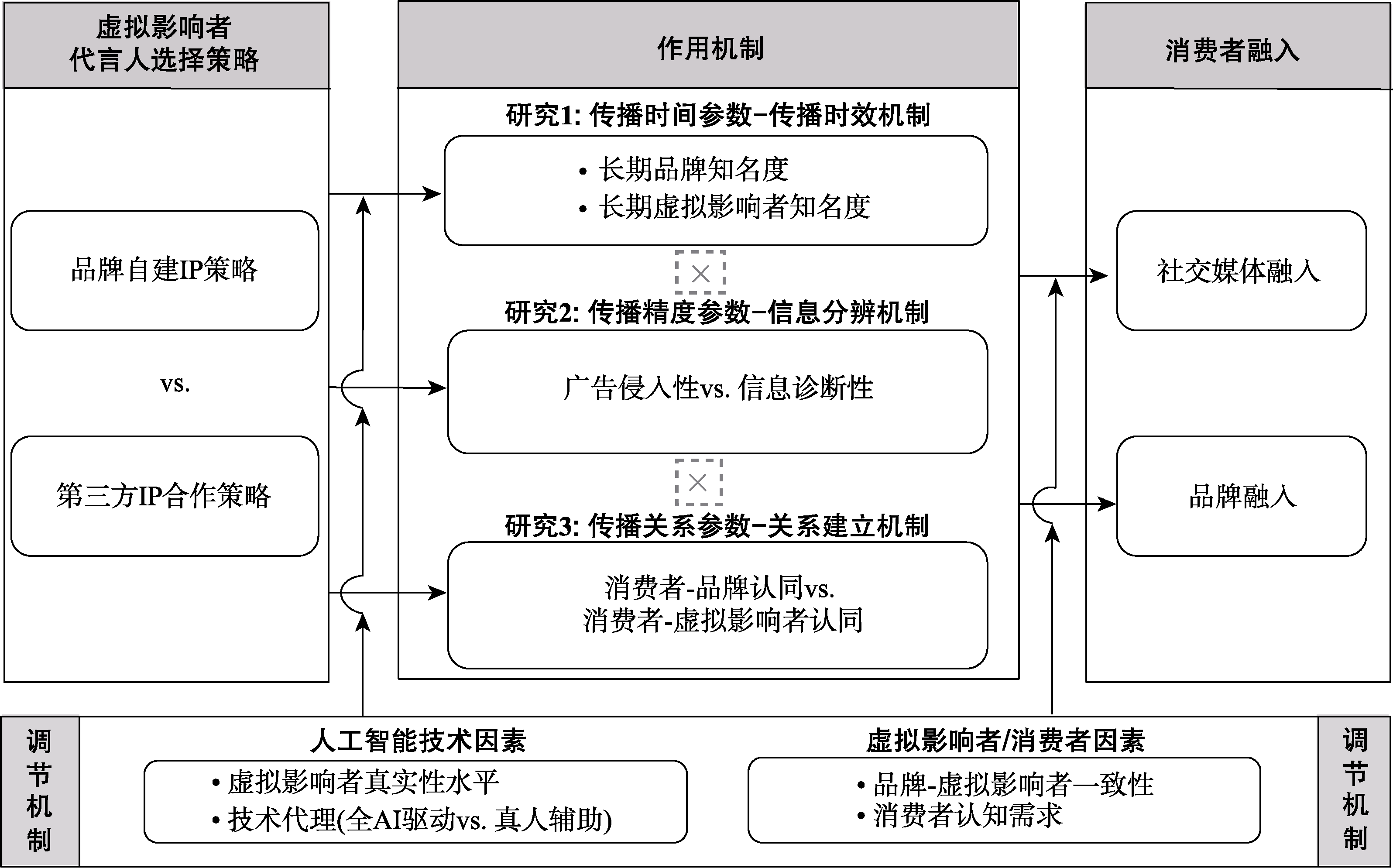
| 本文 | 虚拟影响者代言人选择策略(自建vs.合作)→传播时效机制、信息分辨机制、关系建立机制→消费者融入 | √ | 人工智能技术因素, 虚拟影响者/消费者因素 |
| 代表文献 | 关键机制检验 | 代言人选择策略研究 | 边界条件 |
|---|---|---|---|
| 脉络1:对虚拟影响者属性的分析 | |||
| Kim & Park, | 吸引力→模仿欲望, 品牌依恋→购买意愿 | × | 产品类型的匹配 |
| Li et al., | 拟人化(外表, 行为)→产品真实性, 产品关联性→代言态度 | × | 产品类型 |
| El Hedhli et al., | 拟人化→温暖感知, 能力感知→采纳意愿, 购买意愿 | × | × |
| Alboqami, | 吸引力(外表等), 可信度(真实性等), 一致性(影响者−产品/消费者)→信任 | × | × |
| 王颖 等, | 真实性感知→虚拟依恋→旅游意愿 | × | 熟悉度; 代言人发展预期 |
| 脉络2:对虚拟影响者的比较分析 | |||
| 姜凌,冯源, | 虚拟影响者 vs. 真人影响者→积极情绪→广告说服力 | × | 独特需求 |
| 朱华伟 等, | 虚拟影响者vs. 真人影响者→加工流畅性→购买意愿 | × | 创新产品类型(突破式vs. 渐进式) |
| Franke et al., | 虚拟影响者 vs. 真人影响者→专业性感知→广告态度, 购买意愿等 | × | 产品类型; 影响者类型披露 |
| Ozdemir et al., | 虚拟影响者 vs. 真人影响者→可信度感知→品牌态度 | × | 语言类型(感性 vs.理性) |
| Sands, Campbell et al., | 虚拟影响者 vs. 真人影响者→心理距离→关注意愿, 口碑等 | × | 独特化需求; 影响者代理(自主 vs.管理) |
| Thomas & Fowler, | 虚拟影响者 vs. 真人影响者→责任感知→品牌态度, 购买意愿 | × | × |
| Wang & Qiu, | 类人虚拟影响者 vs. 动漫虚拟影响者→感知社会价值→购买意愿 | × | 广告信息框架(防御型 vs. 促进型) |
| Zhou, Li et al., | 虚拟影响者 vs. 真人影响者→情感投入, 准社会关系→品牌代言有效性 | × | 帖子类型(视频 vs.图片) |
| Zhou, Yan et al., | 虚拟影响者 vs. 真人影响者→意象难度, 感官能力感知→购买意愿 | × | 感官体验 |
| 本文 | 虚拟影响者代言人选择策略(自建vs.合作)→传播时效机制、信息分辨机制、关系建立机制→消费者融入 | √ | 人工智能技术因素, 虚拟影响者/消费者因素 |
| [1] | 董伶俐, 马来坤. (2018). 拟人化对革新型创新产品消费意愿的影响研究——认知需求的调节作用. 商业经济与管理, (8), 59-68. |
| [2] | 郭锐, 罗杨, 周敏, 陶岚, 陈佳佳, 肖紫涵. (2024). 品牌标识的中国文化象征性对品牌资产的影响——以英国市场为例. 系统管理学报, 网络首发. http://kns.cnki.net/kcms/detail/31.1977.n.20240405.1534.002.html |
| [3] | 姜凌, 冯源. (2020). 独特化需求对虚拟代言人说服效果影响研究. 商业经济与管理, (6), 66-77. |
| [4] | 孟陆, 刘凤军, 陈斯允, 段珅, 李巧. (2021). 广告景深与产品类别相匹配对产品评价的影响机制. 管理科学, 34(2), 129-143. |
| [5] | 王翠翠, 徐静, 尚倩. (2023). 电商直播中虚拟主播互动性对消费者购买行为的影响. 经济与管理, 37(2), 84-92. |
| [6] | 王颖, 黄燕玲, 伍进. (2024). 虚实有度: Z世代的虚拟代言人真实性感知对其旅游意愿的影响研究. 旅游科学, 1-18. |
| [7] | 王永贵, 项典典. (2023). 数字营销——新时代市场营销学. 北京: 高等教育出版社, 2023. |
| [8] | 徐鹏, 徐向艺. (2020). 人工智能时代企业管理变革的逻辑与分析框架. 管理世界, 36(1), 122-129+238. |
| [9] | 宣长春. (2021). 广告侵入性对社交媒体广告态度的影响: 不同文化紧密度的差异化表现. 现代传播(中国传媒大学学报), 43, 135-140. |
| [10] | 晏青, 何丽敏. (2023). 从猎奇到疗愈:虚拟偶像崇拜的技术取向. 新闻与传播评论, 76(5), 78-88. |
| [11] | 袁登华, 高丽丹. (2020). 社交媒体中的准社会互动与营销效能研究. 外国经济与管理, 42(7), 21-35. |
| [12] | 张红霞, 刘雪楠. (2010). 广告代言人参与度研究:深层代言还是浅层代言? 心理学报, 42(5), 587-598. |
| [13] | 周飞, 冉茂刚, 陈春琴. (2018). 虚拟代言人感知真实性与消费者品牌依恋关系的实证研究. 软科学, 32(5), 112-115. |
| [14] | 朱华伟, 苏羽, 冯靖元. (2022). 代言人类型和产品创新类型对创新产品购买意愿的交互影响. 南开管理评论, 25(6), 118-127+158+128-129. |
| [15] | Alboqami H. (2023). Trust me, I'm an influencer! - Causal recipes for customer trust in artificial intelligence influencers in the retail industry. Journal of Retailing and Consumer Services, 72, 103242. |
| [16] | Algesheimer R., Dholakia U. M., & Herrmann A. (2005). The social influence of brand community: Evidence from European car clubs. Journal of Marketing, 69(3), 19-34. |
| [17] | Andrews D. (2013). The interplay of information diagnosticity and need for cognitive closure in determining choice confidence. Psychology and Marketing, 30(9), 749-764. |
| [18] |
Appel G., Grewal L., Hadi R., & Stephen A. T. (2020). The future of social media in marketing. Journal of the Academy of Marketing Science, 48(1), 79-95.
doi: 10.1007/s11747-019-00695-1 pmid: 32431463 |
| [19] | Arsenyan J., & Mirowska A. (2021). Almost human? A comparative case study on the social media presence of virtual influencers. International Journal of Human-Computer Studies, 155, 102694. |
| [20] | Baudier P., de Boissieu E., & Duchemin M. H. (2023). Source credibility and emotions generated by robot and human influencers: The perception of luxury brand representatives. Technological Forecasting and Social Change, 187, 122255. |
| [21] | Belanche D., Casaló L. V., & Flavián M. (2024). Human versus virtual influences, a comparative study. Journal of Business Research, 173, 114493. |
| [22] | Byun K. J., & Ahn S. J. (Grace). (2023). A systematic review of virtual influencers: Similarities and differences between human and virtual influencers in interactive advertising. Journal of Interactive Advertising, 23(4), 293-306. |
| [23] | Cacioppo J. T., Petty R. E., Feinstein J. A., & Jarvis W. B. G. (1996). Dispositional differences in cognitive motivation: The life and times of individuals varying in need for cognition. Psychological Bulletin, 119(2), 197-253. |
| [24] |
Cacioppo J. T., Petty R. E., & Quintanar L. R. (1982). Individual differences in relative hemispheric alpha abundance and cognitive responses to persuasive communications. Journal of Personality and Social Psychology, 43(3), 623-636.
pmid: 7131245 |
| [25] | Chen M., & Hu R. J. (2024). The host in the shell: Constructing female identity in the embodied animated media. New Media and Society, 14614448231226213. |
| [26] | Chevalier J. A., & Mayzlin D. (2006). The effect of word of mouth on sales: Online book reviews. Journal of Marketing Research, 43(3), 345-354. |
| [27] | Choi M., Choi Y., & Lee H. (2024). Gen Z travelers in the instagram marketplace: Trust, influencer type, post type, and purchase intention. Journal of Hospitality and Tourism Research, 48(6), 1020-1034. |
| [28] | Dabiran E., Farivar S., Wang F., & Grant G. (2024). Virtually human: Anthropomorphism in virtual influencer marketing. Journal of Retailing and Consumer Services, 79, 103797. |
| [29] | Davenport T., Guha A., Grewal D., & Bressgott T. (2020). How artificial intelligence will change the future of marketing. Journal of the Academy of Marketing Science, 48, 24-42. |
| [30] | Davlembayeva D., Chari S., & Papagiannidis S. (2024). Virtual influencers in consumer behaviour: A social influence theory perspective. British Journal of Management, 36(1), 202-222. |
| [31] | Delbaere M., Michael B., & Phillips B. J. (2021). Social media influencers: A route to brand engagement for their followers. Psychology and Marketing, 38(1), 101-112. |
| [32] | Dong B., Zhuang M., Fang E., & Huang M. (2024). Tales of two channels: Digital advertising performance between AI recommendation and user subscription channels. Journal of Marketing, 88(2), 141-162. |
| [33] | El Hedhli K., Zourrig H., Al Khateeb A., & Alnawas I. (2023). Stereotyping human-like virtual influencers in retailing: Does warmth prevail over competence? Journal of Retailing and Consumer Services, 75, 103459. |
| [34] | Foroudi P. (2019). Influence of brand signature, brand awareness, brand attitude, brand reputation on hotel industry's brand performance. International Journal of Hospitality Management, 76, 271-285. |
| [35] | Franke C., Groeppel-Klein A., & Müller K. (2023). Consumers' responses to virtual influencers as advertising endorsers: Novel and effective or uncanny and deceiving? Journal of Advertising, 52(4), 523-539. |
| [36] | Goodrich K., Schiller S. Z., & Galletta D. (2015). Consumer reactions to intrusiveness of online-video advertisements: Do length, informativeness, and humor help (or hinder) marketing outcomes? Journal of Advertising Research, 55(1), 37-50. |
| [37] | Hall S. R. (1924). Retail advertising and selling: Advertising, merchandise display, sales-planning, salesmanship, turnover and profit-figuring in modern retailing, including" principles of typography as applied to retail advertising". McGraw-Hill Book Company, Incorporated. |
| [38] | Ham J., Li S., Shah P., & Eastin M. S. (2023). The "mixed" reality of virtual brand endorsers: Understanding the effect of brand engagement and social cues on technological perceptions and advertising effectiveness. Journal of Interactive Advertising, 23(2), 98-113. |
| [39] | Hartmann T., & Goldhoorn C. (2011). Horton and Wohl revisited: Exploring viewers' experience of parasocial interaction. Journal of Communication, 61(6), 1104-1121. |
| [40] | Holiday S., Hayes J. L., Park H., Lyu Y., & Zhou Y. (2023). A multimodal emotion perspective on social media influencer marketing: The effectiveness of influencer emotions, network size, and branding on consumer brand engagement using facial expression and linguistic analysis. Journal of Interactive Marketing, 58(4), 414-439. |
| [41] |
Hollebeek L. D., Srivastava R. K., & Chen T. (2019). S-D logic-informed customer engagement: Integrative framework, revised fundamental propositions, and application to CRM. Journal of the Academy of Marketing Science, 47, 161-185.
doi: 10.1007/s11747-016-0494-5 |
| [42] | Horton D., & Wohl R. R. (1956). Mass communication and para-social interaction: Observations on intimacy at a distance. Psychiatry, 19(3), 215-229. |
| [43] | Hoyer W. D., & Brown S. P. (1990). Effects of brand awareness on choice for a common, repeat-purchase product. Journal of Consumer Research, 17(2), 141-148. |
| [44] | Hughes C., Swaminathan V., & Brooks G. (2019). Driving brand engagement through online social influencers: An empirical investigation of sponsored blogging campaigns. Journal of Marketing, 83(5), 78-96. |
| [45] | Jin S. A. A., & Phua J. (2014). Following celebrities' tweets about brands: The impact of twitter-based electronic word- of-mouth on consumers' source credibility perception, buying intention, and social identification with celebrities. Journal of Advertising, 43(2), 181-195. |
| [46] | Kamins M. A., & Gupta K. (1994). Congruence between spokesperson and product type: A matchup hypothesis perspective. Psychology and Marketing, 11(6), 569-586. |
| [47] | Kietzmann J., Paschen J., & Treen E. (2018). Artificial intelligence in advertising: How marketers can leverage artificial intelligence along the consumer journey. Journal of Advertising Research, 58(3), 263-267. |
| [48] | Kim H., & Park M. (2023). Virtual influencers' attractiveness effect on purchase intention: A moderated mediation model of the Product-Endorser fit with the brand. Computers in Human Behavior, 143, 107703. |
| [49] | Kim M., & Baek T. H. (2024). Are virtual influencers friends or foes? Uncovering the perceived creepiness and authenticity of virtual influencers in social media marketing in the United States. International Journal of Human-Computer Interaction, 40(18), 5042-5055. |
| [50] | Koles B., Audrezet A., Moulard J. G., Ameen N., & McKenna B. (2024). The authentic virtual influencer: Authenticity manifestations in the metaverse. Journal of Business Research, 170, 114325. |
| [51] | Kumar V., Choi J. B., & Greene M. (2017). Synergistic effects of social media and traditional marketing on brand sales: Capturing the time-varying effects. Journal of the Academy of Marketing Science, 45, 268-288. |
| [52] | Laszkiewicz A., & Kalinska-Kula M. (2023). Virtual influencers as an emerging marketing theory: A systematic literature review. International Journal of Consumer Studies, 47(6), 2479-2494. |
| [53] | Li J., Huang J., & Li Y. (2023). Examining the effects of authenticity fit and association fit: A digital human avatar endorsement model. Journal of Retailing and Consumer Services, 71, 103230. |
| [54] | Li J., & Ma Y. (2024). Virtual influencers in advertisements: Examining the role of authenticity and identification. Journal of Interactive Advertising, 24(1), 1-12. |
| [55] | Lim R. E., & Lee S. Y. (2023). "You are a virtual influencer!": Understanding the impact of origin disclosure and emotional narratives on parasocial relationships and virtual influencer credibility. Computers in Human Behavior, 148, 107897. |
| [56] | Lord K. R., & Putrevu S. (2006). Exploring the dimensionality of the need for cognition scale. Psychology and Marketing, 23(1), 11-34. |
| [57] | Lou C., Kiew S. T. J., Chen T., Lee T. Y. M., Ong J. E. C., & Phua Z. (2023). Authentically fake? How consumers respond to the influence of virtual influencers. Journal of Advertising, 52(4), 540-557. |
| [58] | MacKenzie S. B., & Lutz R. J. (1989). An empirical examination of the structural antecedents of attitude toward the ad in an advertising pretesting context. Journal of Marketing, 53(2), 48-65. |
| [59] | McCormick K. (2016). Celebrity endorsements: Influence of a product-endorser match on Millennials attitudes and purchase intentions. Journal of Retailing and Consumer Services, 32, 39-45. |
| [60] | Miao F., Kozlenkova I. V., Wang H., Xie T., & Palmatier R. W. (2022). An emerging theory of avatar marketing. Journal of Marketing, 86(1), 67-90. |
| [61] | Mirowska A., & Arsenyan J. (2023). Sweet escape: The role of empathy in social media engagement with human versus virtual influencers. International Journal of Human-Computer Studies, 174, 103008. |
| [62] | Mouritzen S. L. T., Penttinen V., & Pedersen S. (2024). Virtual influencer marketing: The good, the bad and the unreal. European Journal of Marketing, 58(2), 410-440. |
| [63] | Muniz F., Stewart K., & Magalhães L. (2024). Are they humans or are they robots? The effect of virtual influencer disclosure on brand trust. Journal of Consumer Behaviour, 23(3), 1234-1250. |
| [64] | Naik P. A., Prasad A., & Sethi S. P. (2008). Building brand awareness in dynamic oligopoly markets. Management Science, 54(1), 129-138. |
| [65] | Ndhlovu T., & Maree T. (2022). Consumer brand engagement: Refined measurement scales for product and service contexts. Journal of Business Research, 146, 228-240. |
| [66] | Nick B. (2019) The Top Instagram Virtual Influencers in 2019. Retrieved March 14, 2024, from https://hypeauditor.com/blog/the-top-instagram-virtual-influencers-in-2019/ |
| [67] | Ozdemir O., Kolfal B., Messinger P. R., & Rizvi S. (2023). Human or virtual: How influencer type shapes brand attitudes. Computers in Human Behavior, 145, 107771. |
| [68] | Pieters R., & Wedel M. (2004). Attention capture and transfer in advertising: Brand, pictorial, and text-size effects. Journal of Marketing, 68(2), 36-50. |
| [69] | Raman K., Mantrala M. K., Sridhar S., & Tang Y. (2012). Optimal resource allocation with time-varying marketing effectiveness, margins and costs. Journal of Interactive Marketing, 26(1), 43-52. |
| [70] | Rice D. H., Kelting K., & Lutz R. J. (2012). Multiple endorsers and multiple endorsements: The influence of message repetition, source congruence and involvement on brand attitudes. Journal of Consumer Psychology, 22(2), 249-259. |
| [71] | Roccapriore A. Y., & Pollock T. G. (2023). I don't need a degree, I've got abs: Influencer warmth and competence, communication mode, and stakeholder engagement on social media. Academy of Management Journal, 66(3), 979-1006. |
| [72] | Sands S., Campbell C. L., Plangger K., & Ferraro C. (2022). Unreal influence: Leveraging AI in influencer marketing. European Journal of Marketing, 56(6), 1721-1747. |
| [73] | Sands S., Ferraro C., Demsar V., & Chandler G. (2022). False idols: Unpacking the opportunities and challenges of falsity in the context of virtual influencers. Business Horizons, 65(6), 777-788. |
| [74] | Schumann D. W., Petty R. E., & Clemons D. S. (1990). Predicting the effectiveness of different strategies of advertising variation: A test of the repetition-variation hypotheses. Journal of Consumer Research, 17(2), 192-202. |
| [75] | Shi W. (2023). Virtual human influencer and its impact on consumer purchase intention. Advances in Economics, Management and Political Sciences, 47, 80-87. |
| [76] | Shen Z. (2024). Shall brands create their own virtual influencers? A comprehensive study of 33 virtual influencers on Instagram. Humanities and Social Sciences Communications, 11(1), 1-14. |
| [77] | Stein J. P., Linda Breves P., & Anders N. (2024). Parasocial interactions with real and virtual influencers: The role of perceived similarity and human-likeness. New Media and Society, 26(6), 3433-3453. |
| [78] | Steils N., Martin A., & Toti J. F. (2022). Managing the transparency paradox of social-media influencer disclosures: How to improve authenticity and engagement when disclosing influencer-sponsor relationships. Journal of Advertising Research, 62(2), 148-166. |
| [79] | Swaminathan V., Gupta S., Keller K. L., & Lehmann D. (2022). Brand actions and financial consequences: A review of key findings and directions for future research. Journal of the Academy of Marketing Science, 50(4), 639-664. |
| [80] | Tashchian A., White J. D., & Pak S. (1988). Signal detection analysis and advertising recognition: An introduction to measurement and interpretation issues. Journal of Marketing Research, 25(4), 397-404. |
| [81] | Thomas V. L., & Fowler K. (2021). Close encounters of the AI kind: Use of AI influencers as brand endorsers. Journal of Advertising, 50(1), 11-25. |
| [82] | Tripp C., Jensen T. D., & Carlson L. (1994). The effects of multiple product endorsements by celebrities on consumers' attitudes and intentions. Journal of Consumer Research, 20(4), 535-547. |
| [83] | Vaitonytė J., Blomsma P. A., Alimardani M., & Louwerse M. M. (2021). Realism of the face lies in skin and eyes: Evidence from virtual and human agents. Computers in Human Behavior Reports, 3, 100065. |
| [84] | Verplanken B., Hazenberg P. T., & Palenewen G. R. (1992). Need for cognition and external information search effort. Journal of Research in Personality, 26(2), 128-136. |
| [85] | Wang X., & Qiu X. (2023). The influence of image realism of digital endorsers on the purchase intention of gift products for the elderly. Behavioral Sciences, 13(1), 74. |
| [86] | Xiang D., Zhang L., Tao Q., Wang Y., & Ma S. (2019). Informational or emotional appeals in crowdfunding message strategy: An empirical investigation of backers' support decisions. Journal of the Academy of Marketing Science, 47, 1046-1063. |
| [87] | Xu X., & Stephen P. (2018). Social media influencers as endorsers to promote travel destinations: An application of self-congruence theory to the Chinese Generation Y. Journal of Travel and Tourism Marketing, 35(7), 958-972. |
| [88] | Yang D., Zhang J., Sun Y., & Huang Z. (2024). Showing usage behavior or not? The effect of virtual influencers' product usage behavior on consumers. Journal of Retailing and Consumer Services, 79, 103859. |
| [89] | Ye G., & Van Raaij W. F. (2004). Brand equity: Extending brand awareness and liking with signal detection theory. Journal of Marketing Communications, 10(2), 95-114. |
| [90] | Yu J., Dickinger A., So K. K. F., & Egger R. (2024). Artificial intelligence-generated virtual influencer: Examining the effects of emotional display on user engagement. Journal of Retailing and Consumer Services, 76, 103560. |
| [91] | Zhou Q., Li B., Li H., & Lei Y. (2024). Mere copycat? The effects of human versus human-like virtual influencers on brand endorsement effectiveness: A moderated serial-mediation model. Journal of Retailing and Consumer Services, 76, 103610. |
| [92] | Zhou X., Yan X., & Jiang Y. (2024). Making sense? The sensory-specific nature of virtual influencer effectiveness. Journal of Marketing, 88(4), 84-106. |
| [1] | LI Yan, CHEN Wei, WU Ruijuan. Marketing effect of virtual influencers and its mechanisms in the context of AI technology [J]. Advances in Psychological Science, 2025, 33(8): 1425-1442. |
| Viewed | ||||||
|
Full text |
|
|||||
|
Abstract |
|
|||||
