

ISSN 1671-3710
CN 11-4766/R
主办:中国科学院心理研究所
出版:科学出版社
CN 11-4766/R
主办:中国科学院心理研究所
出版:科学出版社
心理科学进展 ›› 2026, Vol. 34 ›› Issue (3): 527-541.doi: 10.3724/SP.J.1042.2026.0527 cstr: 32111.14.2026.0527
孔繁聪1, 孙鑫龙1, 靳宇倡1( ), 朱泓锦2
收稿日期:2025-06-24
出版日期:2026-03-15
发布日期:2026-01-07
通讯作者:
靳宇倡, E-mail: jinyuchang@gmail.com基金资助:
KONG Fancong1, SUN Xinlong1, JIN Yuchang1(), ZHU Hongjin2
Received:2025-06-24
Online:2026-03-15
Published:2026-01-07
摘要:
单身在现代社会日益普遍, 但学术研究仍多基于同质化假设, 忽视了单身群体在动机来源与身份认同上的差异, 因而难以揭示其心理异质性与动态性。为回应这一不足, 本研究整合自我决定理论与社会认同理论, 从“动机自主性”与“身份认同”两个维度提出二维分类模型, 将单身者划分为自主型、身份型、被动型与适应型, 并探讨了不同类型在心理特征、社会行为及潜在转化机制上的差异。该模型不仅为理解单身现象提供了新的理论视角, 也为未来实证研究与实践应用提供了可操作的框架。
中图分类号:
孔繁聪, 孙鑫龙, 靳宇倡, 朱泓锦. (2026). 单身再分类:个体动机与社会认同双视角的探索. 心理科学进展 , 34(3), 527-541.
KONG Fancong, SUN Xinlong, JIN Yuchang, ZHU Hongjin. (2026). Reclassification of singlehood: An exploration from dual perspectives of personal motivation and group identity. Advances in Psychological Science, 34(3), 527-541.
| 分类视角 | 代表学者 | 分类维度 | 分类类型 | 主要贡献与局限 |
|---|---|---|---|---|
| 意愿×稳定性 | Stein ( | 单身的主观意愿与持续状态 | 自愿临时、自愿稳定、非自愿临时、非自愿稳定 | 首创性地强调了单身背后的“意愿”差异; 但动机表述模糊。 |
| 依恋理论视角 | Pepping ( | 成人依恋风格(回避/焦虑) | 安全型、焦虑型、回避型、恐惧−回避型 | 揭示个体亲密需求与情感反应差异, 可预测单身满意度; 但对于成年单身状态解释力有限。 |
| 社会动机视角 | Park ( | 社会动机取向(目标导向) | 独立性型、社会聚焦型、低安全聚焦型 | 从多元社会目标出发, 刻画单身行为策略差异; 但强调外部行为结果, 忽视身份意义建构。 |
| 社会认同视角 | Kislev ( | 单身身份内化程度(污名接受 vs. 认同) | 污名化单身、边缘单身、核心身份单身 | 强调社会标签与身份内化过程, 突出单身的认同层面; 但视角较为单一, 不足以解释单身动机。 |
| 本土经验视角 | 陈雯( | 时间、空间与价值取向 | 过渡/终身单身、独居/同居单身、主动/被动单身 | 体现中国女性单身的现实处境与多重维度差异, 具有文化适应性; 但分类依据多为社会结构和行为状态, 缺乏心理机制的系统建构。 |
表1 以往研究学者对单身的分类
| 分类视角 | 代表学者 | 分类维度 | 分类类型 | 主要贡献与局限 |
|---|---|---|---|---|
| 意愿×稳定性 | Stein ( | 单身的主观意愿与持续状态 | 自愿临时、自愿稳定、非自愿临时、非自愿稳定 | 首创性地强调了单身背后的“意愿”差异; 但动机表述模糊。 |
| 依恋理论视角 | Pepping ( | 成人依恋风格(回避/焦虑) | 安全型、焦虑型、回避型、恐惧−回避型 | 揭示个体亲密需求与情感反应差异, 可预测单身满意度; 但对于成年单身状态解释力有限。 |
| 社会动机视角 | Park ( | 社会动机取向(目标导向) | 独立性型、社会聚焦型、低安全聚焦型 | 从多元社会目标出发, 刻画单身行为策略差异; 但强调外部行为结果, 忽视身份意义建构。 |
| 社会认同视角 | Kislev ( | 单身身份内化程度(污名接受 vs. 认同) | 污名化单身、边缘单身、核心身份单身 | 强调社会标签与身份内化过程, 突出单身的认同层面; 但视角较为单一, 不足以解释单身动机。 |
| 本土经验视角 | 陈雯( | 时间、空间与价值取向 | 过渡/终身单身、独居/同居单身、主动/被动单身 | 体现中国女性单身的现实处境与多重维度差异, 具有文化适应性; 但分类依据多为社会结构和行为状态, 缺乏心理机制的系统建构。 |
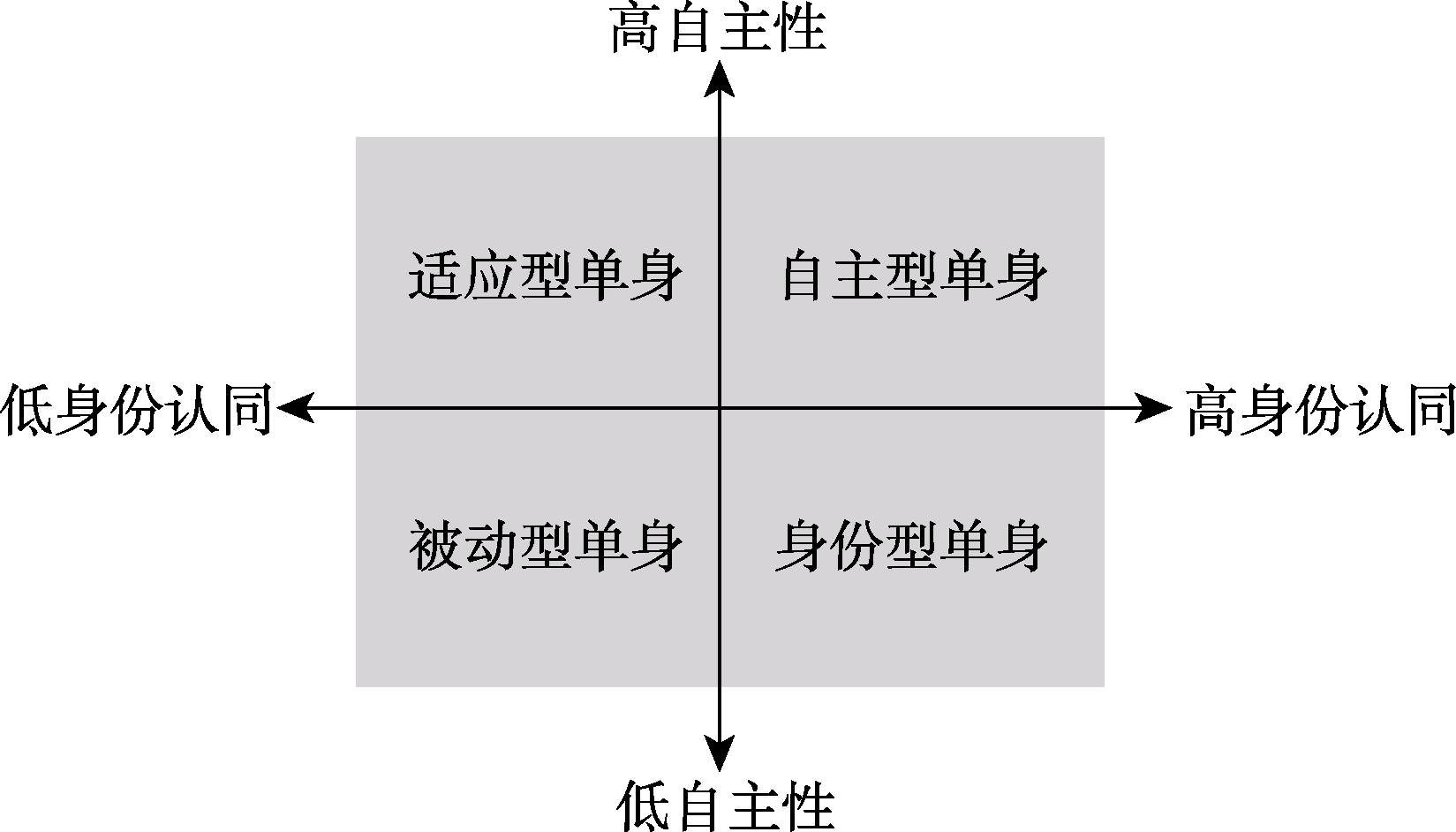
图1 单身二维分类模型图:基于动机自主性与身份认同的四类划分
| [1] |
阿尔升·海达别克, 周同, 喻洁, 王计悦意, 陈飞, 丁雪辰. (2024). 毕生发展视角下独处的适应功能:益处与代价的五轮比较. 心理科学进展, 32(2), 330-341.
doi: 10.3724/SP.J.1042.2024.00330 |
| [2] | 陈雯. (2023). 解放的烦恼:单身女性的生成机制与风险挑战. 中国青年研究, 35(9), 25-31+41. https://doi.org/10.19633/j.cnki.11-2579/d.2023.0098. |
| [3] | 陈雯, 韩若辰. (2020). 独立与羁绊: 白领未婚女性婚恋选择的二重性矛盾研究. 中国青年社会科学, 39(4), 118-125. https://doi.org/10.16034/j.cnki.10-1318/c.2020.04.018. |
| [4] | 国家统计局. (2023). 《中国统计年鉴2023》[China statistical yearbook 2023]. 中国统计出版社. |
| [5] | 何雨. (2023). 理解“单身社会”:演变轨迹、生成逻辑与应对策略. 中国青年研究, 35(9), 16-24. https://doi.org/10.19633/j.cnki.11-2579/d.2023.0097. |
| [6] |
侯佳雯, 刘风军, 孟陆. (2024). 独处及其在营销领域的表现与心理机制. 心理科学进展, 32(4), 677-688.
doi: 10.3724/SP.J.1042.2024.00677 |
| [7] | 李芳芳, 朱冬亮. (2024). 从“结婚难”到“独居”:单身现象的变迁、影响及反思. 中国青年研究, 36(5), 61-69. https://doi.org/10.19633/j.cnki.11-2579/d.2024.0061. |
| [8] | 刘敏, 熊琼. (2023). 应对被动单身:县域体制内大龄女青年的行动策略及其影响——基于中部Y县的实地调研. 中国青年研究, 35(5), 78-86. https://doi.org/10.19633/j.cnki.11-2579/d.2023.0066. |
| [9] | 李婷, 郑叶昕. (2023). 中国单身青年的规模、特征及其演进态势. 中国青年研究, 35(9), 5-15. https://doi.org/10.19633/j.cnki.11-2579/d.2023.0105. |
| [10] |
Adamczyk, K. (2017). Voluntary and involuntary singlehood and young adults’ mental health: An investigation of mediating role of romantic loneliness. Current Psychology, 36(4), 888-904. https://doi.org/10.1007/s12144-016-9478-3
doi: 10.1007/s12144-016-9478-3 URL |
| [11] | Adamczyk, K. (2021). Current and future paths in research on singlehood. In R. J. Coplan & J. C. Bowker (Eds.), The handbook of solitude: Psychological perspectives on social isolation, social withdrawal, and being alone (pp. 163-177). Wiley-Blackwell. (pp. 163-177). Wiley-Blackwell. https://doi.org/10.1002/9781119576457.ch12 |
| [12] |
Adamczyk, K., & Segrin, C. (2015). Direct and indirect effects of young adults’ relationship status on life satisfaction through loneliness and perceived social support. Psychological Belgica, 55(4), 196-211. https://doi.org/10.5334/pb.bn
doi: 10.5334/pb.bn URL |
| [13] |
Apostolou, M. (2017). Why people stay single: An evolutionary perspective. Personality and Individual Differences, 111, 263-271. https://doi.org/10.1016/j.paid.2017.02.034
doi: 10.1016/j.paid.2017.02.034 URL |
| [14] |
Apostolou, M., Kagialis, A., & Lajunen, T. J. (2024). An investigation of the direct and indirect effects of desire for independence and perceived level of achievement on singlehood status. Scientific Reports, 14(1), 23803. https://doi.org/10.1038/s41598-024-75086-w
doi: 10.1038/s41598-024-75086-w URL |
| [15] | Apostolou, M., & Michaelidou, E. (2022). Why people prefer to be single: Voluntary singlehood and experiences with relationships. Studia Psychologica. 22(2), 27-35. https://doi.org/10.21697/sp.2022.22.2.03 |
| [16] |
Beauparlant, E. T., & Machia, L. V. (2024). Why are you single? Examining the influence of reasons for being single on the stereotypes associated with single adults. Current Psychology, 43(35), 28475-28487. https://doi.org/10.1007/s12144-024-06466-8
doi: 10.1007/s12144-024-06466-8 URL |
| [17] |
Beckmeyer, J. J., & Jamison, T. B. (2024). Contextualizing singlehood among young adults: Exploring the meanings and perceived reasons for being single. Family Relations, 73(3), 1607-1624. https://doi.org/10.1111/fare.12975
doi: 10.1111/fare.v73.3 URL |
| [18] | Bergström, M., & Brée, S. (2023). Not a single meaning: Definition and evolution of singlehood in France and the United States. Journal of Family Theory & Review, 15(3), 465-484. https://doi.org/10.1111/jftr.12519 |
| [19] | Brüderl, J., Drobnič, S., Hank, K., Neyer, F. J., Walper, S., Alt, P., ... Wilhelm, B. (2019). The German family panel (pairfam). GESIS Data Archive, Cologne. ZA 5678 Data file Version, 10.0.0, https://doi.org/10.4232/pairfam.5678.12.0.0 |
| [20] |
Budgeon, S. (2016). The ‘problem’ with single women: Choice, accountability and social change. Journal of Social and Personal Relationships, 33(3), 401-418. https://doi.org/10.1177/0265407515607647
doi: 10.1177/0265407515607647 URL |
| [21] |
Burke, P. J. (1991). Identity processes and social stress. American Sociological Review, 56(6), 836-849. https://doi.org/10.2307/2096259
doi: 10.2307/2096259 URL |
| [22] |
Burrow, A. L., & Rainone, N. (2017). How many likes did I get? Purpose moderates links between positive social media feedback and self-esteem. Journal of Experimental Social Psychology, 69, 232-236. https://doi.org/10.1016/j.jesp.2016.09.005
doi: 10.1016/j.jesp.2016.09.005 URL |
| [23] |
Byrne, A., & Carr, D. (2005). Caught in the cultural lag: The stigma of singlehood. Psychological Inquiry, 16(2-3), 84-91. https://www.jstor.org/stable/20447267
doi: 10.1207/s15327965pli162&3_02 URL |
| [24] | Cave, S., & Dihal, K. (2020). The whiteness of AI. Philosophy & Technology, 33(4), 685-703. https://doi.org/10.1007/s13347-020-00415-6 |
| [25] | Cave, S., & Dihal, K. (2021). AI will always love you: Three contradictions in imaginings of intimate relations with machines. In B. Dainton, W. Slocombe, & A. Tanyi (Eds.), Minding the future: Artificial intelligence, philosophical visions and science fiction (pp.107-125). Springer International Publishing. https://doi.org/10.17863/CAM.76732 |
| [26] |
Crocetti, E., Albarello, F., Meeus, W., & Rubini, M. (2023). Identities: A developmental social-psychological perspective. European Review of Social Psychology, 34(1), 161-201. https://doi.org/10.1080/10463283.2022.2104987
doi: 10.1080/10463283.2022.2104987 URL pmid: 38504829 |
| [27] |
Deci, E. L., & Ryan, R. M. (2000). The “What” and “Why” of goal pursuits: Human needs and the self-determination of behavior. Psychological Inquiry, 11(4), 227-268. https://doi.org/10.1207/S15327965PLI1104_01
doi: 10.1207/S15327965PLI1104_01 URL |
| [28] | Deci, E. L., & Ryan, R. M. (2014). Autonomy and need satisfaction in close relationships: Relationships motivation theory. In N. Weinstein (Ed.), Human motivation and interpersonal relationships: Theory, research, and application (pp. 53-76). Springer. https://doi.org/10.1007/978-94-017-8542-6_3 |
| [29] | DePaulo, B. (2023). Single and flourishing: Transcending the deficit narratives of single life. Journal of Family Theory & Review, 15(3), 389-411. https://doi.org/10.1111/jftr.12525 |
| [30] |
DePaulo, B., & Morris, W. (2006). The unrecognized stereotyping and discrimination against singles. Current Directions in Psychological Science, 15(5), 251-254. https://doi.org/10.1111/j.1467-8721.2006.00446.x
doi: 10.1111/j.1467-8721.2006.00446.x URL |
| [31] |
Dupuis, H. E., & Girme, Y. U. (2024). “Cat Ladies” and “Mama’s Boys”: A mixed-methods analysis of the gendered discrimination and stereotypes of single women and single men. Personality and Social Psychology Bulletin, 50(2), 314-328. https://doi.org/10.1177/01461672231203123
doi: 10.1177/01461672231203123 URL |
| [32] |
Eastwick, P. W., Finkel, E. J., Mochon, D., & Ariely, D. (2007). Selective versus unselective romantic desire: Not all reciprocity is created equal. Psychological Science, 18(4), 317-319. https://doi.org/10.1111/j.1467-9280.2007.01897.x
URL pmid: 17470256 |
| [33] |
Ellemers, N., Spears, R., & Doosje, B. (2002). Self and social identity. Annual Review of Psychology, 53(1), 161-186. https://doi.org/10.1146/annurev.psych.53.100901.135228
doi: 10.1146/psych.2002.53.issue-1 URL |
| [34] |
Finkel, E. J., Hui, C. M., Carswell, K. L., & Larson, G. M. (2014). The suffocation of marriage: Climbing mount maslow without enough oxygen. Psychological Inquiry, 25(1), 1-41. https://doi.org/10.1080/1047840X.2014.863723
doi: 10.1080/1047840X.2014.863723 URL |
| [35] |
Fisher, A. N., & Sakaluk, J. K. (2020). Are single people a stigmatized ‘group’? Evidence from examinations of social identity, entitativity, and perceived responsibility. Journal of Experimental Social Psychology, 86, 103844. https://doi.org/10.1111/fare.12975
doi: 10.1016/j.jesp.2019.103844 URL |
| [36] |
Fraley, R. C., & Roisman, G. I. (2019). The development of adult attachment styles: Four lessons. Current Opinion in Psychology, 25, 26-30. https://doi.org/10.1016/j.copsyc.2018.02.008
doi: S2352-250X(18)30011-3 URL pmid: 29510301 |
| [37] |
Girme, Y. U., Park, Y., & MacDonald, G. (2023). Coping or thriving? Reviewing intrapersonal, interpersonal, and societal factors associated with well-being in singlehood from a within-group perspective. Perspectives on Psychological Science, 18(5), 1097-1120. https://doi.org/10.1177/17456916221136119
doi: 10.1177/17456916221136119 URL |
| [38] | Gonzalez Avilés, T., Bühler, J. L., Brandt, N. D., & Neyer, F. J. (2024). Today’s adolescents are more satisfied with being single: Findings from a German cohort-sequential study among 14-to 40-year-olds. Personality and Social Psychology Bulletin, https://doi.org/10.1177/01461672241257139 |
| [39] |
Greitemeyer, T. (2009). Stereotypes of singles: Are singles what we think? European Journal of Social Psychology, 39(3), 368-383. https://doi.org/10.1002/ejsp.542
doi: 10.1002/ejsp.v39:3 URL |
| [40] |
Gui, T. (2020). “Leftover women” or single by choice: Gender role negotiation of single professional women in contemporary China. Journal of Family Issues, 41(2), 1956-1978. https://doi.org/10.1177/0192513X20943919
doi: 10.1177/0192513X20943919 URL |
| [41] | Gulrez, T., Neftimeziani, S., Mc Evoy, P., & Hodgson, A. (2016). Loneliness kills: Can autonomous systems and robotics assist in providing solutions. International Journal of Swarm Intelligence and Evolutionary Computation, 5(1), e113. http://dx.doi.org/10.4172/2090-4908.1000e113 |
| [42] |
Heuveline, P., Timberlake, J. M., & Furstenberg, F. F., Jr. (2003). Shifting childrearing to single mothers: Results from 17 western countries. Population and Development Review, 29(1), 47-71. https://doi.org/10.1111/j.1728-4457.2003.00047.x
doi: 10.1111/j.1728-4457.2003.00047.x URL pmid: 24563562 |
| [43] | Himawan, K. K., Bambling, M., & Edirippulige, S. (2017). Modernization and singlehood in Indonesia: Psychological and social impacts. Kasetsart Journal of Social Sciences, 40(2), 499-506. https://so04.tci-thaijo.org/index.php/kjss/article/view/242197 |
| [44] | Himawan, K. K., Bambling, M., & Edirippulige, S. (2018). What does it mean to be single in Indonesia? Religiosity, social stigma, and marital status among never-married Indonesian adults. Sage Open, 8(3), 1-9. https://doi.org/10.1177/2158244018803132 |
| [45] |
Hogg, M. A., & Smith, J. R. (2007). Attitudes in social context: A social identity perspective. European Review of Social Psychology, 18(1), 89-131. https://doi.org/10.1080/10463280701592070
doi: 10.1080/10463280701592070 URL |
| [46] |
Hostetler, A. J. (2009). Single by choice? Assessing and understanding voluntary singlehood among mature gay men. Journal of Homosexuality, 56(4), 499-531. https://doi.org/10.1080/00918360902821486
doi: 10.1080/00918360902821486 URL pmid: 19418337 |
| [47] | Kislev, E. (2019). Happy singlehood: The rising acceptance and celebration of solo living. University of California Press. |
| [48] |
Kislev, E. (2020). How do relationship desire and sociability relate to each other among singles? Longitudinal analysis of the pairfam survey. Journal of Social and Personal Relationships, 37(8-9), 2634-2650. https://doi.org/10.1177/02654075211005024
doi: 10.1177/0265407520933000 URL |
| [49] |
Kislev, E. (2021). Reduced relationship desire is associated with better life satisfaction for singles in Germany: An analysis of pairfam data. Journal of Social and Personal Relationships, 38(7), 2073-2083. https://doi.org/10.1177/02654075211005024
doi: 10.1177/02654075211005024 URL |
| [50] |
Kislev, E. (2023). Singlehood as an identity, European Review of Social Psychology, 35(2), 258-292. https://doi.org/10.1080/10463283.2023.2241937
doi: 10.1080/10463283.2023.2241937 URL |
| [51] | Kislev, E. (2024). Being single in the 21st century:Reasons and consequences. In M.Hojjat & A.Moyer (Eds.), Modern relationships: Romance, friendship, and family in the 21st century (pp. 55-69). Oxford University Press. https://doi.org/10.1093/oso/9780197655504.003.0004 |
| [52] | Kislev, E., & Marsh, K. (2023). Intersectionality in studying and theorizing singlehood. Journal of Family Theory & Review, 15(3), 412-427. https://doi.org/10.1111/jftr.12522 |
| [53] |
Knee, C. R., Lonsbary, C., Canevello, A., & Patrick, H. (2005). Self-determination and conflict in romantic relationships. Journal of Personality and Social Psychology, 89(6), 997-1009. https://doi.org/10.1037/0022-3514.89.6.997
URL pmid: 16393030 |
| [54] |
Lahad, K. (2012). Singlehood, waiting, and the sociology of time. Sociological Forum, 27(1), 163-186. https://doi.org/10.1111/j.1573-7861.2011.01306.x
doi: 10.1111/socf.2012.27.issue-1 URL |
| [55] | Lahad, K. (2017). A table for one: A critical reading of singlehood, gender and time. Manchester University Press. http://library.oapen.org/handle/20.500.12657/31183 |
| [56] |
Leach, C. W., Van Zomeren, M., Zebel, S., Vliek, M. L., Pennekamp, S. F., Doosje, B., ... Spears, R. (2008). Group-level self-definition and self-investment: A hierarchical (multicomponent) model of in-group identification. Journal of Personality and Social Psychology, 95(1), 144-165. https://doi.org/10.1037/0022-3514.95.1.144
doi: 10.1037/0022-3514.95.1.144 URL pmid: 18605857 |
| [57] |
Lehmann, V., Tuinman, M. A., Braeken, J., Vingerhoets, A., J. J. M., Sanderman, R., & Hagedoorn, M. (2015). Satisfaction with relationship status: Development of a new scale and the role in predicting well-being. Journal of Happiness Studies, 16(1), 169-184. https://doi.org/10.1007/s10902-014-9503-x
doi: 10.1007/s10902-014-9503-x URL |
| [58] |
Luhmann, M., Hofmann, W., Eid, M., & Lucas, R. E. (2012). Subjective well-being and adaptation to life events: A meta-analysis. Journal of Personality and Social Psychology, 102(3), 592-615. https://doi.org/10.1037/a0025948
doi: 10.1037/a0025948 URL pmid: 22059843 |
| [59] |
MacDonald, G., & Park, Y. (2022). Associations of attachment avoidance and anxiety with life satisfaction, satisfaction with singlehood, and desire for a romantic partner. Personal Relationships, 29(1), 163-176. https://doi.org/10.1111/pere.12416
doi: 10.1111/pere.v29.1 URL |
| [60] |
Moore, J. A., & Radtke, H. L. (2015). Starting “real” life: Women negotiating a successful midlife single identity. Psychology of Women Quarterly, 39(3), 305-319. https://doi.org/10.1177/0361684315573244
doi: 10.1177/0361684315573244 URL |
| [61] | Morris, W.L., DePaulo, B. M., Hertel, J., & Taylor, L. C. (2008). Singlism-Another problem that has no name: Prejudice, stereotypes, and discrimination against singles. In T. G. Morrison & M. A. Morrison (Eds.), TThe psychology of modern prejudice (pp. 165-194). Nova Science. https://psycnet.apa.org/record/2010-22179-008 |
| [62] |
Mukherjee, S., Kumar, P., & Mukherjee, A. (2025). Reimagining singlehood in Urban India through intersectional narratives and support systems: An ethnographic study. Journal of Marital and Family Therapy, 51(3), e70049. https://doi.org/10.1111/jmft.70049
doi: 10.1111/jmft.v51.3 URL |
| [63] |
Nix, G., Ryan, R. M., Manly, J. B., & Deci, E. L. (1999). Revitalization through self-regulation: The effects of autonomous and controlled motivation on happiness and vitality. Journal of Experimental Social Psychology, 35(3), 266-284. https://doi.org/10.1006/jesp.1999.1382
doi: 10.1006/jesp.1999.1382 URL |
| [64] |
Oh, J., Chopik, W. J., & Lucas, R. E. (2022). Happiness singled out: Bidirectional associations between singlehood and life satisfaction. Personality and Social Psychology Bulletin, 48(11), 1597-1613. https://doi.org/10.1177/01461672211049049
doi: 10.1177/01461672211049049 URL |
| [65] |
Park, Y., MacDonald, G., Impett, E. A., & Neel, R. (2023). What social lives do single people want? A person- centered approach to identifying profiles of social motives among singles. Journal of Personality and Social Psychology, 125(1), 219-236. https://doi.org/10.1037/pspp0000455
doi: 10.1037/pspp0000455 URL |
| [66] |
Pepping, C. A., Girme, Y. U., Cronin, T. J., & MacDonald, G. (2025). Diversity in singlehood experiences: Testing an attachment theory model of sub-groups of singles. Journal of Personality, 93(2), 275-295. https://doi.org/10.1111/jopy.12929
doi: 10.1111/jopy.v93.2 URL |
| [67] |
Pepping, C. A., MacDonald, G., & Davis, P. J. (2018). Toward a psychology of singlehood: An attachment-theory perspective on long-term singlehood. Current Directions in Psychological Science, 27(5), 324-331. https://doi.org/10.1177/0963721417752106
doi: 10.1177/0963721417752106 URL |
| [68] |
Prescott, T. J., & Robillard, J. M. (2021). Are friends electric? The benefits and risks of human-robot relationships. Iscience, 24(1), 101993. https://doi.org/10.1016/j.isci.2020.101993
doi: 10.1016/j.isci.2020.101993 URL |
| [69] |
Purol, M., Keller, V. N., Oh, J., Chopik, W. J., & Lucas, R. E. (2020). Loved and lost or never loved at all? Lifelong marital histories and their links with subjective well-being. The Journal of Positive Psychology, 16(5), 651-659. https://doi.org/10.1080/17439760.2020.1791946
doi: 10.1080/17439760.2020.1791946 URL |
| [70] | Quayle, M. (2025). Social identity networks: People holding attitudes are a collective social identity information system and bipartite networks are a useful way to represent them. European Review of Social Psychology. https://doi.org/10.1080/10463283.2025.2514433 |
| [71] |
Raymo, J. M., Park, H., Xie, Y., & Yeung, W. J. J.(2015). Marriage and family in East Asia: Continuity and change. Annual Review of Sociology, 41(1), 471-492. https://doi.org/10.1146/annurev-soc-073014-112428.
doi: 10.1146/soc.2015.41.issue-1 URL |
| [72] |
Reynolds, J., Wetherell, M., & Taylor, S. (2007). Choice and chance: Negotiating agency in narratives of singleness. The Sociological Review, 55(2), 331-351. https://doi.org/10.1111/j.1467-954x.2007.00708.x
doi: 10.1111/j.1467-954X.2007.00708.x URL |
| [73] | Ruberg, B., & Ruelos, S. (2020). Data for queer lives: How LGBTQ gender and sexuality identities challenge norms of demographics. Big Data & Society, 7(1), 1-12. https://doi.org/10.1177/2053951720933286 |
| [74] |
Ryan, R. M., & Deci, E. L. (2006). Self-regulation and the problem of human autonomy: Does psychology need choice, self-determination, and will? Journal of Personality, 74(6), 1557-1586. https://doi.org/10.1111/j.1467-6494.2006.00420.x
URL pmid: 17083658 |
| [75] |
Ryan, R. M., & Deci, E. L. (2020). Intrinsic and extrinsic motivation from a self-determination theory perspective: Definitions, theory, practices, and future directions. Contemporary Educational Psychology, 61, 101860. https://doi.org/10.1016/j.cedpsych.2020.101860
doi: 10.1016/j.cedpsych.2020.101860 URL |
| [76] |
Sakallı Uğurlu, N., Türkoğlu, B., Kuzlak, A., & Gupta, A. (2021). Stereotypes of single and married women and men in Turkish culture. Current Psychology, 40(1), 213-225. https://doi.org/10.1007/s12144-018-9920-9
doi: 10.1007/s12144-018-9920-9 URL |
| [77] |
Schoen, R., & Canudas-Romo, V. (2006). Timing effects on divorce: 20th century experience in the United States. Journal of Marriage and Family, 68(3), 749-758. https://doi.org/10.1111/j.1741-3737.2006.00287.x
doi: 10.1111/jomf.2006.68.issue-3 URL |
| [78] |
Slonim, G., Gur-Yaish, N., & Katz, R. (2015). By choice or by circumstance?: Stereotypes of and feelings about single people. Studia Psychologica, 57(1), 35-48. https://doi.org/10.21909/sp.2015.01.672
doi: 10.21909/sp URL |
| [79] |
Spielmann, S. S., MacDonald, G., Maxwell, J. A., Joel, S., Peragine, D., Muise, A., & Impett, E. A. (2013). Settling for less out of fear of being single. Journal of Personality and Social Psychology, 105(6), 1049-1073. https://doi.org/10.1037/a0034628
doi: 10.1037/a0034628 URL pmid: 24128187 |
| [80] |
Spielmann, S. S., Maxwell, J. A., MacDonald, G., Peragine, D., & Impett, E. A. (2020). The predictive effects of fear of being single on physical attractiveness and less selective partner selection strategies. Journal of Social and Personal Relationships, 37(1), 100-123. https://doi.org/10.1177/0265407519856701
doi: 10.1177/0265407519856701 URL |
| [81] | Stein, P. (1978). The lifestyles and life chances of the never- married. Marriage & Family Review, 1(4), 1-11. https://doi.org/10.1300/J002v01n04_01 |
| [82] |
Tajfel, H. (1979). Individuals and groups in social psychology. British Journal of Social and Clinical Psychology, 18(2), 183-190. https://doi.org/10.1111/j.2044-8260.1979.tb00324.x
doi: 10.1111/bjc.1979.18.issue-2 URL |
| [83] |
Thomson, R., Yuki, M., Talhelm, T., Schug, J., Kito, M., Ayanian, A. H., ... Visserman, M. L. (2018). Relational mobility predicts social behaviors in 39 countries and is tied to historical farming and threat. Proceedings of the National Academy of Sciences, 115(29), 7521-7526. https://doi.org/10.1073/pnas.1713191115
doi: 10.1073/pnas.1713191115 URL |
| [84] | Timonen, V., & Doyle, M. (2014). Life-long singlehood: Intersections of the past and the present. Ageing & Society, 34(10), 1749-1770. https://doi.org/10.1017/S0144686X13000500 |
| [85] | Turner, J.C., & Onorato, R. S. (2014). Social identity, personality, and the self-concept:A self-categorization perspective. In T. R. Tyler, R. M. Kramer, & O. P. John (Eds.), The psychology of the social self (pp. 11-46). Psychology Press. https://doi.org/10.4324/9781315805689 |
| [86] |
Watkins, N. K., Beckmeyer, J. J., & Jamison, T. B. (2024). Exploring the associations between being single, romantic importance, and positive well-being in young adulthood. Family Relations, 73(1), 484-501. https://doi.org/10.1111/fare.12981
doi: 10.1111/fare.v73.1 URL |
| [87] |
Weller, B. E., Bowen, N. K., & Faubert, S. J. (2020). Latent class analysis: A guide to best practice. Journal of Black Psychology, 46(4), 287-311. https://doi.org/10.1177/0095798420930932
doi: 10.1177/0095798420930932 URL |
| [88] |
Wildschut, T., Sedikides, C., Arndt, J., & Routledge, C. (2006). Nostalgia: Content, triggers, functions. Journal of Personality and Social Psychology, 91(5), 975-993. https://doi.org/10.1037/0022-3514.91.5.975
doi: 10.1037/0022-3514.91.5.975 URL pmid: 17059314 |
| [89] |
Yuki, M., & Schug, J. (2020). Psychological consequences of relational mobility. Current Opinion in Psychology, 32, 129-132. https://doi.org/10.1016/j.copsyc.2019.07.029
doi: S2352-250X(19)30109-5 URL pmid: 31491705 |
| [90] | Zhang, C. (2020). "Leftover? I am a victorious woman!"— The potential for the emergence of a new womanhood. Asian Journal of Women’s Studies, 26(1), 36-54. https://doi.org/10.1080/12259276.2020.1718867 |
| [91] | Zhang, S., & Li, S. (2025). The real her? Exploring whether young adults accept human-AI love. arXiv preprint. https://doi.org/10.48550/arXiv.2503.03067 |
| [1] | 陈乐妮, 黄旭, 许寒华. 榜样与感染:父母身份认同增益职场母亲的工作动力[J]. 心理科学进展, 2025, 33(11): 1870-1890. |
| [2] | 邓巍, 宋芮, 周雯昕. 女性社会创业:身份认同策略、合法性获取及绩效影响[J]. 心理科学进展, 2024, 32(4): 579-593. |
| [3] | 贺淇, 刘晓明. 正念对实现型幸福感的影响及其理论解释[J]. 心理科学进展, 2023, 31(10): 1937-1951. |
| [4] | 马昕玥, 崔丽莹. 人际同步对合作行为的促进机制及解释模型[J]. 心理科学进展, 2022, 30(6): 1317-1326. |
| [5] | 刘小浪, 刘善仕, 赵瑜, 秦传燕, 陆文珠. 临时知识型员工自主性动机激发:关系导向人力资源管理建构及其作用机理[J]. 心理科学进展, 2021, 29(9): 1534-1550. |
| [6] | 尹奎, 赵景, 李璨, 王宏蕾, 王崇锋. 领导授权行为的形成机制[J]. 心理科学进展, 2021, 29(6): 1097-1110. |
| [7] | 王海侠, 贾汇源, 孙海龙, 李爱梅. 互联网连接性降低自主性的机制与后效[J]. 心理科学进展, 2019, 27(11): 1802-1811. |
| [8] | 杨 莹;寇 彧. 亲社会互动中的幸福感:自主性的作用[J]. 心理科学进展, 2015, 23(7): 1226-1235. |
| [9] | 于海涛;张雁军;乔亲才. 全球化时代的国家认同:认同内容及其对群际行为的影响[J]. 心理科学进展, 2014, 22(5): 857-865. |
| [10] | 李琬予;寇彧. 孝道信念的形成与发展:不同文化下亲子互动的视角[J]. 心理科学进展, 2011, 19(7): 1069-1075. |
| [11] | 李锋;王二平. 团队作业特征研究现状与展望[J]. 心理科学进展, 2008, 16(5): 753-759. |
| [12] | 张秀春,邹晓燕. 青少年的个人事务自主观念研究述评[J]. 心理科学进展, 2004, 12(6): 883-883~890. |
| 阅读次数 | ||||||
|
全文 |
|
|||||
|
摘要 |
|
|||||
