

ISSN 1671-3710
CN 11-4766/R
主办:中国科学院心理研究所
出版:科学出版社
CN 11-4766/R
主办:中国科学院心理研究所
出版:科学出版社
心理科学进展 ›› 2025, Vol. 33 ›› Issue (8): 1321-1339.doi: 10.3724/SP.J.1042.2025.1321 cstr: 32111.14.2025.1321
胡静怡, 白朵, 雷旭( )
)
收稿日期:2024-10-16
出版日期:2025-08-15
发布日期:2025-05-15
通讯作者:
雷旭, E-mail: xlei@swu.edu.cn基金资助:
HU Jingyi, BAI Duo, LEI Xu()
Received:2024-10-16
Online:2025-08-15
Published:2025-05-15
摘要:
功率谱分析是EEG/MEG数据处理中的常用方法, 近年来越来越多的研究者认识到功率谱的非周期性成分具有独特的生理意义与应用价值。随着国际上以频谱参数拟合算法(SpecParam)为代表的工具包的推广使用, 静息态EEG/MEG的非周期分析受到广泛关注。本文首先介绍了在高密度EEG/MEG中进行非周期分析的常规流程。之后总结应用上的两个主要进展: 在发展神经科学方面, 老年人的频谱平坦化与认知表现下降、睡眠质量变差高度相关。在临床应用方面, 非周期性参数可以作为多种神经精神疾病的电生理标志物。目前, 非周期分析还缺少对全脑空间分布的关注, 其神经生理生成机制尚处于探索期, 未来需要结合多模态脑成像技术、实验设计等创新方向进一步筑牢理论基础, 拓展应用范围。
中图分类号:
胡静怡, 白朵, 雷旭. (2025). 静息态EEG/MEG的非周期性成分: 分析流程、应用进展和未来前景. 心理科学进展 , 33(8), 1321-1339.
HU Jingyi, BAI Duo, LEI Xu. (2025). Aperiodic components of resting-state EEG/MEG: Analysis procedures, application advances and future prospects. Advances in Psychological Science, 33(8), 1321-1339.
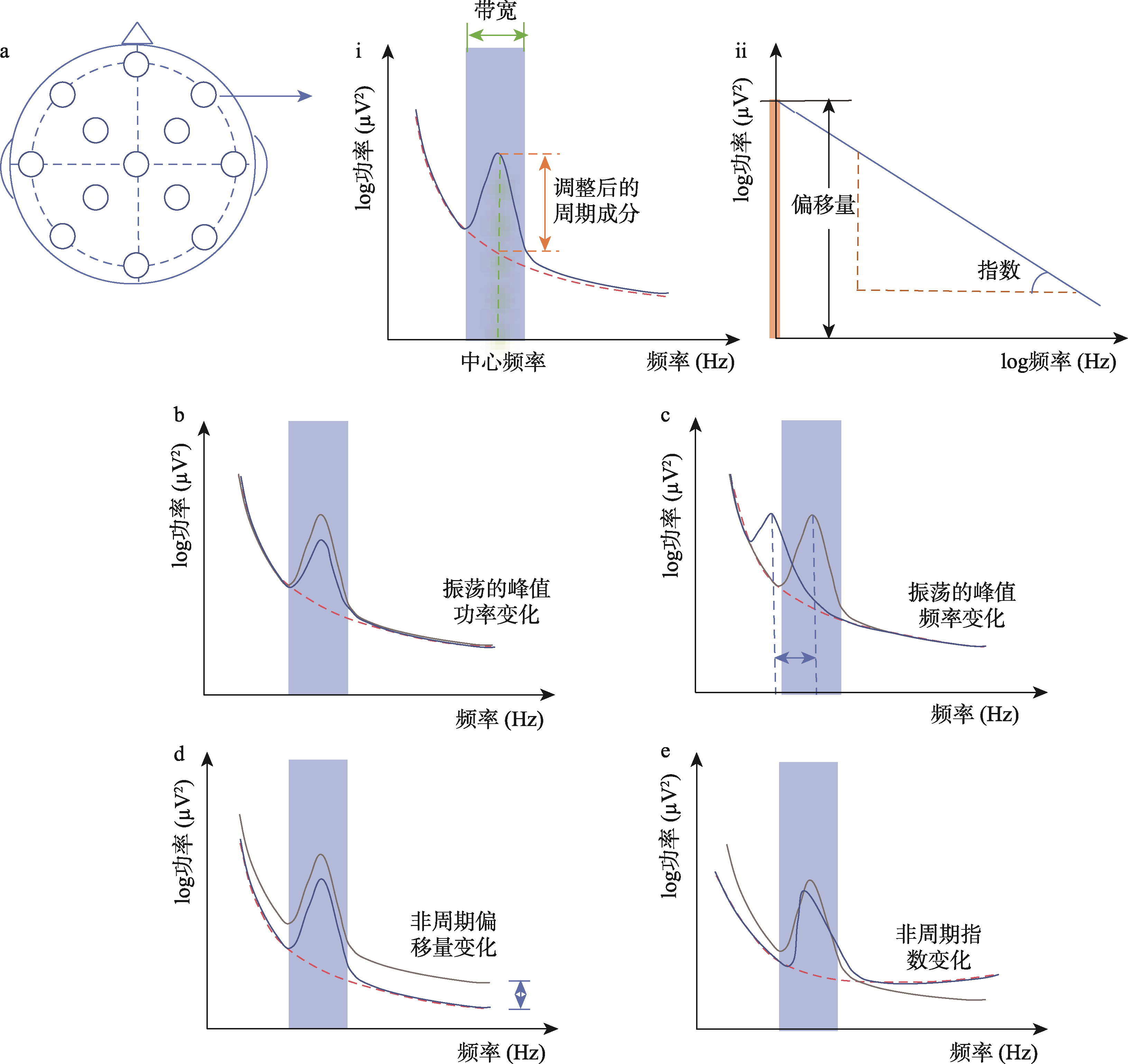
图1 频谱分析中区分非周期与周期性成分的必要性: 非周期分析将某个电极的信号转换为频谱(蓝色实线), 在窄带内(蓝色阴影)提取(a.i)周期性成分(频谱在虚线上方的部分)与非周期性成分(虚线), 其中非周期性成分主要有(a.ii)指数和偏移量两个参数。传统频谱分析判断窄带内频谱能量有无差异时, 以下情况可能会错误认为与(b)振荡功率降低产生类似的总功率变化: (c)周期活动仅改变峰值频率; 仅有非周期活动变化如(d)偏移量或(e)指数的改变。彩图见电子版, 下同。
| 工具包名称 | 频谱分离参数化情况 | 算法基础 | 拟合空间 | 优点 | 缺点 | 参考文献 | |
|---|---|---|---|---|---|---|---|
| 非周期 性成分 | 周期性 成分 | ||||||
| SpecParam (FOOOF) | √ | √ | 高斯拟合、 幂律函数 | 对数功率−频率 | 不需要预先定义特定的感兴趣频带和控制非周期性成分。 | ①拟合频率范围局限在窄带的低频或高频时性能较差 ②模型驱动, 受预设参数影响大 ③难以表征无法明确区分的振荡峰值(重叠峰) ④跨频率范围边界的振荡会导致指数误差增大 | Donoghue et al., |
| SPRiNT | √ | √ | 高斯拟合、 幂律函数 | 对数功率−频率 | 将Specparam与短时傅里叶变换相结合, 实现了时间分辨频谱参数化 | ①高估峰值带宽, 低估峰值数量 ②存在非周期性拐点(knee)时, 性能下降 | Wilson et al., |
| PAPTO | √ | √ | 高斯拟合、 幂律函数 | 对数功率−频率 | 对皮层瞬时β节律活动敏感 | - | Brady & Bardouille, |
| IRASA/MRCSA | √ | × | 重采样 | 对数功率−对数频率 | ①可估计频率范围边界上的周期性成分 ②MRCSA可用于分析两个同时记录的神经信号的交叉频谱 | ①缺乏明确的参数化以便进一步分析 ②受到重采样因子大小影响 ③难以表征无法明确区分的振荡峰值(重叠峰) ④存在大带宽峰值或非周期性拐点(knee)时, 性能下降 | Wen & Liu, Racz et al., |
| BOSC | √ | × | 卡方分布 | 对数功率−对数频率 | 能够正确拒绝非振荡的瞬态事件 | ①通常假设非周期分量是不变的 ②缺乏去除频谱峰值干扰的系统预处理步骤 | Whitten et al., |
| MODAL | × | √ | 频率滑动法 | 对数功率−对数频率 | 确保仅在感兴趣频带中功率增加的时间段内获得相位和频率估计。 | 通常假设非周期分量是不变的 | Watrous et al., |
| ξ-α | √ | × | t检验 | 原始数据 | 关注α节律峰值 | - | Pascual-marqui et al., |
| ξ-π | √ | √ | 单模态与多模态 | 原始数据 | ①对不规则频谱形状具有较好鲁棒性 ②对所有类型周期信号进行无偏识别 | - | Hu et al., |
表1 常用的非周期分析工具包和主要特点
| 工具包名称 | 频谱分离参数化情况 | 算法基础 | 拟合空间 | 优点 | 缺点 | 参考文献 | |
|---|---|---|---|---|---|---|---|
| 非周期 性成分 | 周期性 成分 | ||||||
| SpecParam (FOOOF) | √ | √ | 高斯拟合、 幂律函数 | 对数功率−频率 | 不需要预先定义特定的感兴趣频带和控制非周期性成分。 | ①拟合频率范围局限在窄带的低频或高频时性能较差 ②模型驱动, 受预设参数影响大 ③难以表征无法明确区分的振荡峰值(重叠峰) ④跨频率范围边界的振荡会导致指数误差增大 | Donoghue et al., |
| SPRiNT | √ | √ | 高斯拟合、 幂律函数 | 对数功率−频率 | 将Specparam与短时傅里叶变换相结合, 实现了时间分辨频谱参数化 | ①高估峰值带宽, 低估峰值数量 ②存在非周期性拐点(knee)时, 性能下降 | Wilson et al., |
| PAPTO | √ | √ | 高斯拟合、 幂律函数 | 对数功率−频率 | 对皮层瞬时β节律活动敏感 | - | Brady & Bardouille, |
| IRASA/MRCSA | √ | × | 重采样 | 对数功率−对数频率 | ①可估计频率范围边界上的周期性成分 ②MRCSA可用于分析两个同时记录的神经信号的交叉频谱 | ①缺乏明确的参数化以便进一步分析 ②受到重采样因子大小影响 ③难以表征无法明确区分的振荡峰值(重叠峰) ④存在大带宽峰值或非周期性拐点(knee)时, 性能下降 | Wen & Liu, Racz et al., |
| BOSC | √ | × | 卡方分布 | 对数功率−对数频率 | 能够正确拒绝非振荡的瞬态事件 | ①通常假设非周期分量是不变的 ②缺乏去除频谱峰值干扰的系统预处理步骤 | Whitten et al., |
| MODAL | × | √ | 频率滑动法 | 对数功率−对数频率 | 确保仅在感兴趣频带中功率增加的时间段内获得相位和频率估计。 | 通常假设非周期分量是不变的 | Watrous et al., |
| ξ-α | √ | × | t检验 | 原始数据 | 关注α节律峰值 | - | Pascual-marqui et al., |
| ξ-π | √ | √ | 单模态与多模态 | 原始数据 | ①对不规则频谱形状具有较好鲁棒性 ②对所有类型周期信号进行无偏识别 | - | Hu et al., |
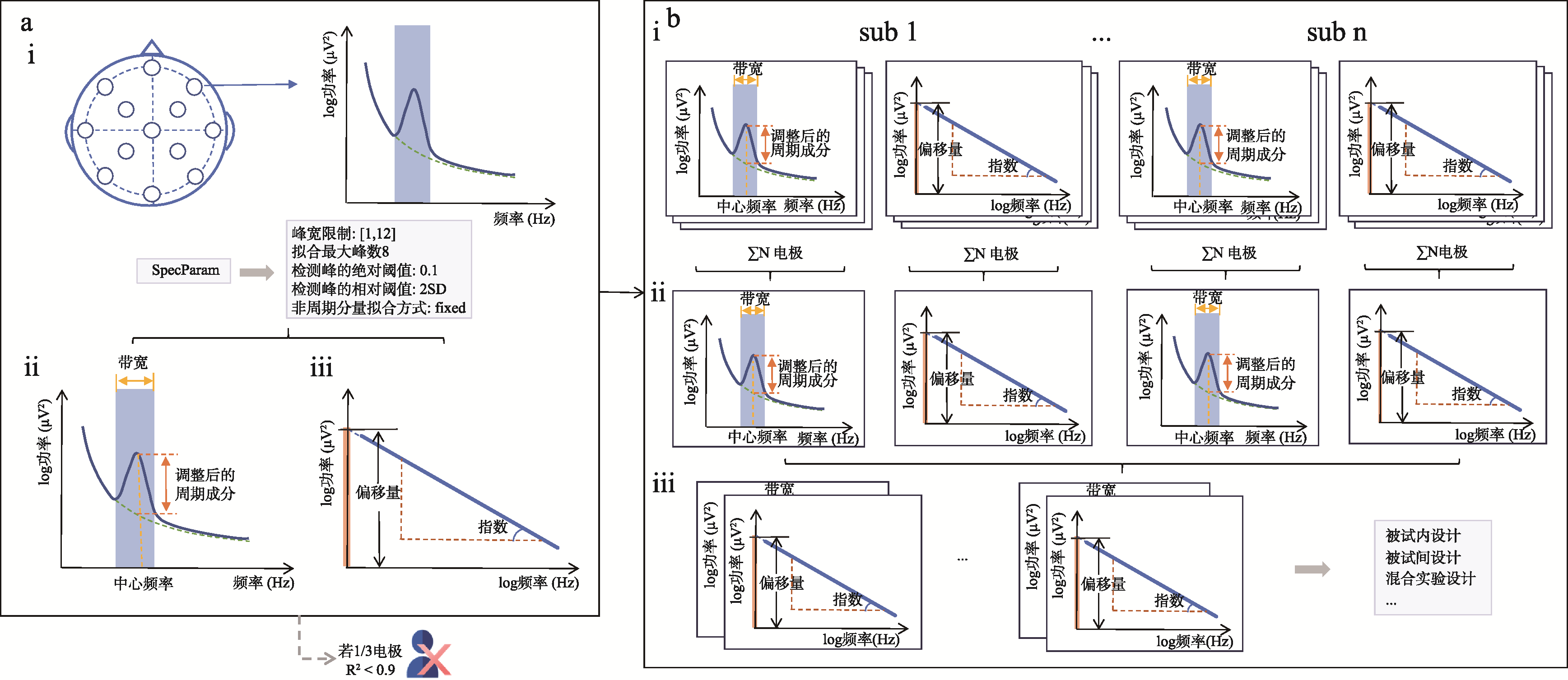
图2 标准化的高密度EEG/MEG非周期/周期分析流程框架。步骤1: (a.i)使用SpecParam工具包进行单个电极水平的估计, 每个电极将得到(a.ii)周期性参数、(a.iii)非周期性参数、拟合优度R2与残差error, 其中周期性参数从每个电极的所有拟合峰中选择最大功率的作为每个电极的代表值。步骤2: 被试水平的评估, 对拟合度达不到要求的电极数过多的被试进行剔除。(b.i-ii)将所有电极的非周期性参数及代表周期性参数取平均值作为该被试的参数化结果。步骤3: (b.iii)组水平的统计。由于每个被试都得到了非周期性成分和周期性成分, 可采用描述性统计或假设检验进行统计。
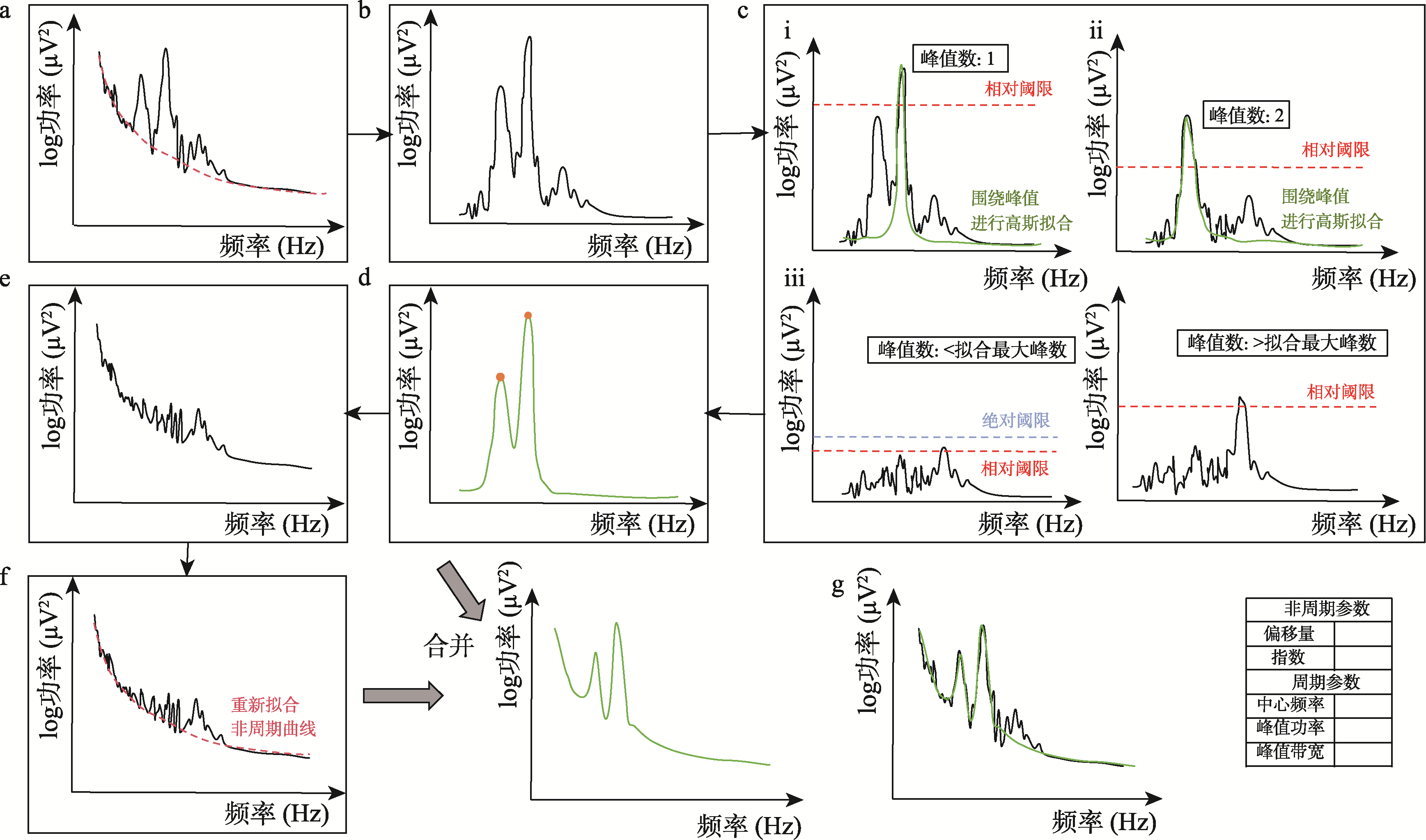
图3 单电极水平上SpecParam的算法步骤: (a)初始非周期拟合: 对原始功率谱密度拟合估计非周期性成分; (b)扁平化频谱: 从原始PSD中减去非周期估计成分, 残差被假设为多个周期性成分和噪声的混合; (c.i)检测峰: 使用迭代过程来查找扁平化频谱中的峰值。找到残差最大值并围绕该峰值拟合高斯曲线, (c.ii)减去拟合的高斯曲线并继续拟合, (c.iii)当下一个识别点低于绝对/相对阈限或拟合峰数超过拟合最大峰值数时迭代停止; (d)创建全峰拟合: 根据高于噪声阈值的峰值数确定振荡的数量后, 对来自(b)的扁平化频谱执行多高斯拟合, 得到所有周期性成分的联合功率(图中橘色圆点标记), 包括每个峰的3个参数: 中心频率、能量和宽度; (e)创建去全峰频谱: 从原始功率谱密度中减去(d)计算的联合功率得到去全峰频谱; (f)重新拟合非周期分量: 在去全峰频谱中重新拟合非周期性成分, 得到指数和偏移量;将(d)联合功率与(f)非周期性成分的重新拟合相结合获得最终拟合(g)。
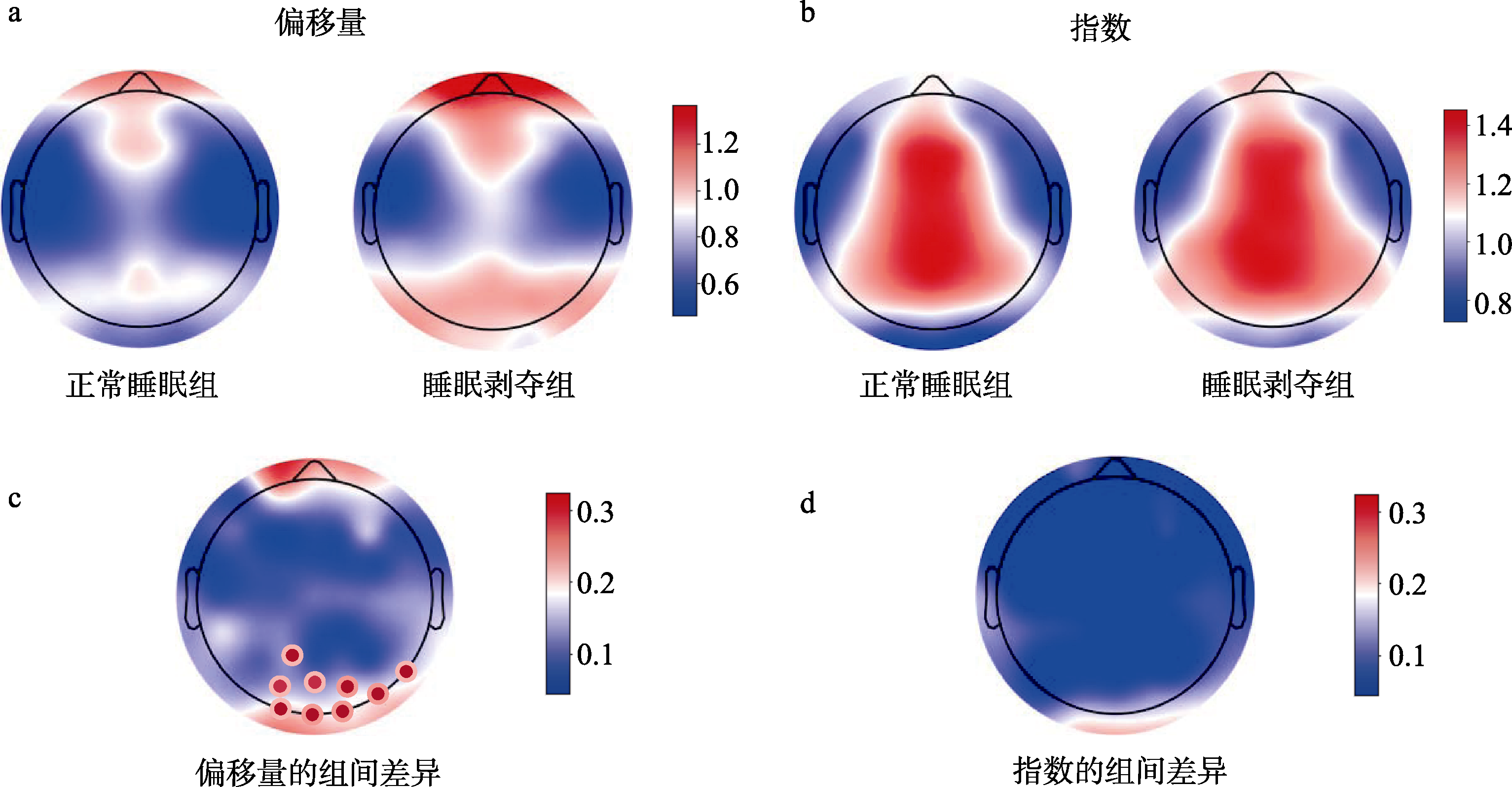
图4 正常睡眠与睡眠剥夺后的头表地形图分布。其中(a)分别展示了两组偏移量的地形图分布, (b)分别展示了两组指数的地形图分布。(c) (d)对正常睡眠和睡眠剥夺条件下头表的每个电极进行配对样本t检验, 其中p < 0.05的电极使用红点标记。(资料来源: Bai et al., 2024)
| 实验 条件 | 分析 工具 | 被试与涉及疾病 | 主要结果 | 参考文献 | ||
|---|---|---|---|---|---|---|
| 非周期 性指数 | 非周期 性偏移量 | 调整后的周期性成分 | ||||
| 静息态 睁眼 | 线性 回归 | 雷特综合征(n = 57)、健康对照组(n = 37) | ↑ | - | 增加的δ功率与较低的认知评估相关 | Roche et al., |
| SpecParam | 小儿脆性X染色体综合征(n = 11)、年龄匹配组(n = 12)、认知匹配组(n = 12) | ↓ | - | 小儿脆性X染色体综合征个体额叶γ功率增加 | Wilkinson & Nelson, | |
| 帕金森病(分为用药与停药; n = 15)、健康对照组(n = 16) | ↑ | ↑ | 帕金森病组θ范围的混合功率高于健康对照组 | Wang et al., | ||
| 注意力缺陷与多动障碍(n = 33)、健康对照组(n = 33) | ↑ | - | 注意力缺陷与多动障碍组的β功率高于健康对照组 | Dakwar-kawar et al., | ||
| 首发精神分裂症谱系障碍(n = 43)、健康对照组(n = 28) | - | ↓ | - | Earl et al., | ||
| 静息态 闭眼 | 阿尔茨海默症(n = 36)、额颞叶痴呆(n = 23)、健康对照组(n = 29) | ↑ | ↑ | 与额颞叶痴呆组相比, 阿尔茨海默症组的θ功率更高 | Wang et al., | |
| 阿尔茨海默症(n = 43)、健康对照组(n = 33) | - | - | 阿尔茨海默症组功率显著降低; 阿尔茨海默症与非周期性脑电活动的变化无关 | Kopčanová et al., | ||
| 全面发作性癫痫(n = 51)、健康对照组(n = 49) | ↑ | - | 全面发作性癫痫组频谱指数与α功率的负相关程度下降 | Kopf et al., | ||
| IRASA | 路易体痴呆(n = 21)、帕金森病(n = 28)、轻度认知障碍(n = 27)、健康对照组(n = 22) | ↑ | - | 与健康对照、轻度认知障碍与帕金森病组相比, 路易体痴呆个体表现出更高的θ功率 | Rosenblum et al., | |
表2 神经精神疾病中的非周期分析
| 实验 条件 | 分析 工具 | 被试与涉及疾病 | 主要结果 | 参考文献 | ||
|---|---|---|---|---|---|---|
| 非周期 性指数 | 非周期 性偏移量 | 调整后的周期性成分 | ||||
| 静息态 睁眼 | 线性 回归 | 雷特综合征(n = 57)、健康对照组(n = 37) | ↑ | - | 增加的δ功率与较低的认知评估相关 | Roche et al., |
| SpecParam | 小儿脆性X染色体综合征(n = 11)、年龄匹配组(n = 12)、认知匹配组(n = 12) | ↓ | - | 小儿脆性X染色体综合征个体额叶γ功率增加 | Wilkinson & Nelson, | |
| 帕金森病(分为用药与停药; n = 15)、健康对照组(n = 16) | ↑ | ↑ | 帕金森病组θ范围的混合功率高于健康对照组 | Wang et al., | ||
| 注意力缺陷与多动障碍(n = 33)、健康对照组(n = 33) | ↑ | - | 注意力缺陷与多动障碍组的β功率高于健康对照组 | Dakwar-kawar et al., | ||
| 首发精神分裂症谱系障碍(n = 43)、健康对照组(n = 28) | - | ↓ | - | Earl et al., | ||
| 静息态 闭眼 | 阿尔茨海默症(n = 36)、额颞叶痴呆(n = 23)、健康对照组(n = 29) | ↑ | ↑ | 与额颞叶痴呆组相比, 阿尔茨海默症组的θ功率更高 | Wang et al., | |
| 阿尔茨海默症(n = 43)、健康对照组(n = 33) | - | - | 阿尔茨海默症组功率显著降低; 阿尔茨海默症与非周期性脑电活动的变化无关 | Kopčanová et al., | ||
| 全面发作性癫痫(n = 51)、健康对照组(n = 49) | ↑ | - | 全面发作性癫痫组频谱指数与α功率的负相关程度下降 | Kopf et al., | ||
| IRASA | 路易体痴呆(n = 21)、帕金森病(n = 28)、轻度认知障碍(n = 27)、健康对照组(n = 22) | ↑ | - | 与健康对照、轻度认知障碍与帕金森病组相比, 路易体痴呆个体表现出更高的θ功率 | Rosenblum et al., | |
| [1] | 雷旭, 尧德中. (2014). 同步脑电-功能磁共振(EEG-fMRI)原理与技术. 北京: 科学出版社. |
| [2] |
Aleman, A., Nieuwenstein, M. R., Böcker, K. B., & de Haan, E. H. (2000). Music training and mental imagery ability. Neuropsychologia, 38(12), 1664-1668.
pmid: 11074089 |
| [3] |
Atallah, B. V., & Scanziani, M. (2009). Instantaneous modulation of gamma oscillation frequency by balancing excitation with inhibition. Neuron, 62(4), 566-577.
doi: 10.1016/j.neuron.2009.04.027 pmid: 19477157 |
| [4] | Bai, D., Hu, J., Jülich, S., & Lei, X. (2024). Impact of sleep deprivation on aperiodic activity: A resting-state EEG study. Journal of Neurophysiology, 132(5), 1577-1588. |
| [5] | Barron, H. C., Vogels, T. P., Behrens, T. E., & Ramaswami, M. (2017). Inhibitory engrams in perception and memory. Proceedings of the National Academy of Sciences, 114(26), 6666-6674. |
| [6] | Belova, E. M., Semenova, U., Gamaleya, A. A., Tomskiy, A. A., & Sedov, A. (2021). Voluntary movements cause beta oscillations increase and broadband slope decrease in the subthalamic nucleus of parkinsonian patients. European Journal of Neuroscience, 53(7), 2205-2213. |
| [7] |
Benchenane, K., Tiesinga, P. H., Battaglia, F. P. (2011). Oscillations in the prefrontal cortex: A gateway to memory and attention. Current Opinion in Neurobiology, 21(3), 475-485.
doi: 10.1016/j.conb.2011.01.004 pmid: 21429736 |
| [8] |
Bódizs, R., Szalárdy, O., Horváth, C., Ujma, P. P., Gombos, F., Simor, P., ... Dresler, M. (2021). A set of composite, non-redundant EEG measures of NREM sleep based on the power law scaling of the Fourier spectrum. Scientific Reports, 11(1), 2041.
doi: 10.1038/s41598-021-81230-7 pmid: 33479280 |
| [9] | Brady, B., & Bardouille, T. (2022). Periodic/Aperiodic parameterization of transient oscillations (PAPTO)- Implications for healthy ageing. NeuroImage, 251, 118974. |
| [10] |
Brown, M. S., Singel, D., Hepburn, S., & Rojas, D. C. (2013). Increased glutamate concentration in the auditory cortex of persons with autism and first‐degree relatives: A 1H‐MRS study. Autism Research, 6(1), 1-10.
doi: 10.1002/aur.1260 pmid: 23166003 |
| [11] |
Buchanan, T. W. (2007). Retrieval of emotional memories. Psychological Bulletin, 133(5), 761-779.
doi: 10.1037/0033-2909.133.5.761 pmid: 17723029 |
| [12] | Candelaria-Cook, F. T., Solis, I., Schendel, M. E., Wang, Y. P., Wilson, T. W., Calhoun, V. D., & Stephen, J. M. (2022). Developmental trajectory of MEG resting-state oscillatory activity in children and adolescents: A longitudinal reliability study. Cerebral Cortex, 32(23), 5404-5419. |
| [13] |
Cassady, K., Gagnon, H., Lalwani, P., Simmonite, M., Foerster, B., Park, D., ... Polk, T. A. (2019). Sensorimotor network segregation declines with age and is linked to GABA and to sensorimotor performance. Neuroimage, 186, 234-244.
doi: S1053-8119(18)32078-0 pmid: 30414983 |
| [14] | Chaoul, A. I., & Siegel, M. (2021). Cortical correlation structure of aperiodic neuronal population activity. NeuroImage, 245, 118672. |
| [15] | Clark, D. L., Khalil, T., Kim, L. H., Noor, M. S., Luo, F., & Kiss, Z. H. (2023). Aperiodic subthalamic activity predicts motor severity and stimulation response in Parkinson disease. Parkinsonism & Related Disorders, 110, 105397. |
| [16] | Cohen, J., Boshes, L. D., Snider, R. S. (1961). Electroencephalographic changes following retrolental fibroplasia. Electroencephalography and Clinical Neurophysiology, 13(6), 914-922. |
| [17] |
Colombo, M. A., Napolitani, M., Boly, M., Gosseries, O., Casarotto, S., Rosanova, M., ... Sarasso, S. (2019). The spectral exponent of the resting EEG indexes the presence of consciousness during unresponsiveness induced by propofol, xenon, and ketamine. NeuroImage, 189, 631-644.
doi: S1053-8119(19)30024-2 pmid: 30639334 |
| [18] | Dakwar-Kawar, O., Mentch-Lifshits, T., Hochman, S., Mairon, N., Cohen, R., Balasubramani, P., ... Nahum, M. (2024). Aperiodic and periodic components of oscillatory brain activity in relation to cognition and symptoms in pediatric ADHD. Cerebral Cortex, 34(6), bhae236. https://doi.org/10.1093/cercor/bhae236. |
| [19] |
Dave, S., Brothers, T. A., & Swaab, T. Y. (2018). 1/f neural noise and electrophysiological indices of contextual prediction in aging. Brain Research, 1691, 34-43.
doi: S0006-8993(18)30187-2 pmid: 29679544 |
| [20] |
Dennison, M., Whittle, S., Yücel, M., Vijayakumar, N., Kline, A., Simmons, J., & Allen, N. B. (2013). Mapping subcortical brain maturation during adolescence: Evidence of hemisphere‐and sex‐specific longitudinal changes. Developmental Science, 16(5), 772-791.
doi: 10.1111/desc.12057 pmid: 24033581 |
| [21] | Di, X., & Biswal, B. B. (2013). Modulatory interactions of resting-state brain functional connectivity. PLoS One, 8(8), e71163. |
| [22] |
Ding, L., Duan, W., Wang, Y., & Lei, X. (2022). Test-retest reproducibility comparison in resting and the mental task states: A sensor and source-level EEG spectral analysis. International Journal of Psychophysiology, 173, 20-28.
doi: 10.1016/j.ijpsycho.2022.01.003 pmid: 35017028 |
| [23] |
Donoghue, T., Haller, M., Peterson, E. J., Varma, P., Sebastian, P., Gao, R., ... Voytek, B. (2020). Parameterizing neural power spectra into periodic and aperiodic components. Nature Neuroscience, 23(12), 1655-1665.
doi: 10.1038/s41593-020-00744-x pmid: 33230329 |
| [24] |
Drenthen, G. S., Barendse, E. M., Aldenkamp, A. P., van Veenendaal, T. M., Puts, N. A., Edden, R. A., ... Jansen, J. F. (2016). Altered neurotransmitter metabolism in adolescents with high-functioning autism. Psychiatry Research: Neuroimaging, 256, 44-49.
doi: S0925-4927(15)30163-3 pmid: 27685800 |
| [25] | Earl, R. J., Ford, T. C., Lum, J. A., Enticott, P. G., & Hill, A. T. (2024). Exploring aperiodic activity in first episode schizophrenia spectrum psychosis: A resting-state EEG analysis. Brain Research, 1840, 149052. |
| [26] | Euler, M. J., Vehar, J. V., Guevara, J. E., Geiger, A. R., Deboeck, P. R., & Lohse, K. R. (2024). Associations between the resting EEG aperiodic slope and broad domains of cognitive ability. Psychophysiology, 61(6), e14543. |
| [27] | Favaro, J., Colombo, M. A., Mikulan, E., Sartori, S., Nosadini, M., Pelizza, M. F., ... Toldo, I. (2023). The maturation of aperiodic EEG activity across development reveals a progressive differentiation of wakefulness from sleep. NeuroImage, 277, 120264. |
| [28] | Finley, A. J., Angus, D. J., Knight, E. L., van Reekum, C. M., Lachman, M. E., Davidson, R. J., & Schaefer, S. M. (2024). Resting EEG periodic and aperiodic components predict cognitive decline over 10 years. The Journal of Neuroscience, 44(13). https://doi.org/10.1523/JNEUROSCI.1332-23.2024 |
| [29] | Frenda, S. J., & Fenn, K. M. (2016). Sleep less, think worse: The effect of sleep deprivation on working memory. Journal of Applied Research in Memory and Cognition, 5(4), 463-469. |
| [30] | Gaižauskaitė, R., Gladutytė, L., Zelionkaitė, I., Čėsnaitė, E., Busch, N. A., & Grikšienė, R. (2024). The search for the relationship between female hormonal status, alpha oscillations, and aperiodic features of resting state EEG. International Journal of Psychophysiology, 198, 112312. |
| [31] |
Gao, R. D., Peterson, E. J., & Voytek, B. (2017). Inferring synaptic excitation/inhibition balance from field potentials. NeuroImage, 158, 70-78.
doi: S1053-8119(17)30562-1 pmid: 28676297 |
| [32] |
Gatev, P., Darbin, O., & Wichmann, T. (2006). Oscillations in the basal ganglia under normal conditions and in movement disorders. Movement Disorders, 21(10), 1566-1577.
doi: 10.1002/mds.21033 pmid: 16830313 |
| [33] |
Gerster, M., Waterstraat, G., Litvak, V., Lehnertz, K., Schnitzler, A., Florin, E., ... Nikulin, V. (2022). Separating neural oscillations from aperiodic 1/f activity: Challenges and recommendations. Neuroinformatics, 20(4), 991-1012.
doi: 10.1007/s12021-022-09581-8 pmid: 35389160 |
| [34] |
Girardeau, G., & Lopes-dos-Santos, V. (2021). Brain neural patterns and the memory function of sleep. Science, 374(6567), 560-564.
doi: 10.1126/science.abi8370 pmid: 34709916 |
| [35] |
Gómez, C. M., Rodríguez-Martínez, E. I., Fernández, A., Maestú, F., Poza, J., & Gómez, C. (2017). Absolute power spectral density changes in the magnetoencephalographic activity during the transition from childhood to adulthood. Brain Topography, 30(1), 87-97.
doi: 10.1007/s10548-016-0532-0 pmid: 27766459 |
| [36] |
Gómez-Laberge, C., Smolyanskaya, A., Nassi, J. J., Kreiman, G., & Born, R. T. (2016). Bottom-up and top-down input augment the variability of cortical neurons. Neuron, 91(3), 540-547.
doi: 10.1016/j.neuron.2016.06.028 pmid: 27427459 |
| [37] | González-Ramírez, L. R., Ahmed, O. J., Cash, S. S., Wayne, C. E., & Kramer, M. A. (2015). A biologically constrained, mathematical model of cortical wave propagation preceding seizure termination. PLoS Computational Biology, 11(2), e1004065. |
| [38] |
Haegens, S., Osipova, D., Oostenveld, R., & Jensen, O. (2010). Somatosensory working memory performance in humans depends on both engagement and disengagement of regions in a distributed network. Human Brain Mapping, 31(1), 26-35.
doi: 10.1002/hbm.20842 pmid: 19569072 |
| [39] | Hassin-Baer, S., Cohen, O. S., Israeli-Korn, S., Yahalom, G., Benizri, S., Sand, D., ... Peremen, Z. (2022). Identification of an early-stage Parkinson’s disease neuromarker using event-related potentials, brain network analytics and machine-learning. Plos One, 17(1), e0261947. |
| [40] |
He, B. J. (2014). Scale-free brain activity: Past, present, and future. Trends in Cognitive Sciences, 18(9), 480-487.
doi: 10.1016/j.tics.2014.04.003 pmid: 24788139 |
| [41] |
He, B. J., Zempel, J. M., Snyder, A. Z., & Raichle, M. E. (2010). The temporal structures and functional significance of scale-free brain activity. Neuron, 66(3), 353-369.
doi: 10.1016/j.neuron.2010.04.020 pmid: 20471349 |
| [42] | Helfrich, R. F., Mander, B. A., Jagust, W. J., Knight, R. T., & Walker, M. P. (2017). Old brains come uncoupled in sleep: Slow wave-spindle synchrony, brain atrophy, and forgetting. Neuron, 97(1), 221-230. |
| [43] | Hill, A. T., Clark, G. M., Bigelow, F. J., Lum, J. A. G., & Enticott, P. G. (2022). Periodic and aperiodic neural activity displays age-dependent changes across early-to-middle childhood. Developmental Cognitive Neuroscience, 54, 101076. |
| [44] | Hommel, B. (2015). Between persistence and flexibility: The Yin and Yang of action control. In A. J. Elliot (Ed.), Advances in motivation science(Vol. 2, pp. 33-67). Elsevier. |
| [45] |
Hong, S. L., & Rebec, G. V. (2012). A new perspective on behavioral inconsistency and neural noise in aging: Compensatory speeding of neural communication. Frontiers in Aging Neuroscience, 4, 27.
doi: 10.3389/fnagi.2012.00027 pmid: 23055970 |
| [46] |
Horváth, C. G., Szalárdy, O., Ujma, P. P., Simor, P., Gombos, F., Kovács, I., ... Bódizs, R. (2022). Overnight dynamics in scale-free and oscillatory spectral parameters of NREM sleep EEG. Scientific Reports, 12(1), 18409.
doi: 10.1038/s41598-022-23033-y pmid: 36319742 |
| [47] | Hu, S., Zhang, Z., Zhang, X., Wu, X., & Valdes-Sosa, P. A. (2024). ξ-π: A nonparametric model for neural power spectra decomposition. IEEE Journal of Biomedical and Health Informatics, 28(5), 2624-2635. |
| [48] | Jach, H. K., Feuerriegel, D., & Smillie, L. D. (2020). Decoding personality trait measures from resting EEG: An exploratory report. Cortex, 130, 158-171. |
| [49] | Jacob, M. S., Roach, B. J., Sargent, K. S., Mathalon, D. H., & Ford, J. M. (2021). Aperiodic measures of neural excitability are associated with anticorrelated hemodynamic networks at rest: A combined EEG-fMRI study. NeuroImage, 245, 118705. |
| [50] |
Kahana, M. J. (2006). The cognitive correlates of human brain oscillations. Journal of Neuroscience, 26(6), 1669-1672.
doi: 10.1523/JNEUROSCI.3737-05c.2006 pmid: 16467513 |
| [51] | Kałamała, P., Gyurkovics, M., Bowie, D. C., Clements, G. M., Low, K. A., Dolcos, F., ... Gratton, G. (2024). Event- induced modulation of aperiodic background EEG: Attention-dependent and age-related shifts in E:I balance, and their consequences for behavior. Imaging Neuroscience, 2, 1-18. |
| [52] |
Kehrer, C., Maziashvili, N., Dugladze, T., & Gloveli, T. (2008). Altered excitatory-inhibitory balance in the NMDA-hypofunction model of schizophrenia. Frontiers in Molecular Neuroscience, 1, 6.
doi: 10.3389/neuro.02.006.2008 pmid: 18946539 |
| [53] |
Klinzing, J. G., Niethard, N., & Born, J. (2019). Mechanisms of systems memory consolidation during sleep. Nature Neuroscience, 22(10), 1598-1610.
doi: 10.1038/s41593-019-0467-3 pmid: 31451802 |
| [54] | Kluger, D. S., Balestrieri, E., Busch, N. A., & Gross, J. (2021). Respiration aligns perception with neural excitability. Elife, 10, e70907. |
| [55] |
Kluger, D. S., Forster, C., Abbasi, O., Chalas, N., Villringer, A., & Gross, J. (2023). Modulatory dynamics of periodic and aperiodic activity in respiration-brain coupling. Nature Communications, 14(1), 4699.
doi: 10.1038/s41467-023-40250-9 pmid: 37543697 |
| [56] | Kluger, D. S., & Gross, J. (2021). Respiration modulates oscillatory neural network activity at rest. PLoS Biology, 19(11), e3001457. |
| [57] |
Knudsen, E. I. (2004). Sensitive periods in the development of the brain and behavior. Journal of Cognitive Neuroscience, 16(8), 1412-1425.
doi: 10.1162/0898929042304796 pmid: 15509387 |
| [58] |
Koolschijn, R. S., Emir, U. E., Pantelides, A. C., Nili, H., Behrens, T. E., & Barron, H. C. (2019). The hippocampus and neocortical inhibitory engrams protect against memory interference. Neuron, 101(3), 528-541.
doi: S0896-6273(18)31051-1 pmid: 30581011 |
| [59] | Kopčanová, M., Tait, L., Donoghue, T., Stothart, G., Smith, L., Flores-Sandoval, A. A., ... Benwell, C. S. (2024). Resting-state EEG signatures of Alzheimer's disease are driven by periodic but not aperiodic changes. Neurobiology of Disease, 190, 106380. |
| [60] | Kopf, M., Martini, J., Stier, C., Ethofer, S., Braun, C., Li Hegner, Y., … Helfrich, R. F. (2024). Aperiodic activity Indexes neural hyperexcitability in generalized epilepsy. ENeuro, 11(9). https://doi.org/10.1523/ENEURO.0242-24.2024 |
| [61] |
Kriegseis, A., Hennighausen, E., Rösler, F., & Röder, B. (2006). Reduced EEG alpha activity over parieto-occipital brain areas in congenitally blind adults. Clinical Neurophysiology, 117(7), 1560-1573.
pmid: 16759908 |
| [62] | Laufs, H., Krakow, K., Sterzer, P., Eger, E., Beyerle, A., Salek-Haddadi, A., & Kleinschmidt, A. (2003). Electroencephalographic signatures of attentional and cognitive default modes in spontaneous brain activity fluctuations at rest. Proceedings of the National Academy of Sciences, 100(19), 11053-11058. |
| [63] | Lendner, J. D., Helfrich, R. F., Mander, B. A., Romundstad, L., Lin, J. J., Walker, M. P., ... Knight, R. T. (2020). An electrophysiological marker of arousal level in humans. Elife, 9, e55092. |
| [64] | Lendner, J. D., Niethard, N., Mander, B. A., van Schalkwijk, F. J., Schuh-Hofer, S., Schmidt, H., ... Helfrich, R. F. (2023). Human REM sleep recalibrates neural activity in support of memory formation. Science Advances, 9(34), eadj1895. |
| [65] |
Levin, A. R., Naples, A. J., Scheffler, A. W., Webb, S. J., Shic, F., Sugar, C. A., ... Şentürk, D. (2020). Day-to-day test-retest reliability of EEG profiles in children with autism spectrum disorder and typical development. Frontiers in Integrative Neuroscience, 14, 21.
doi: 10.3389/fnint.2020.00021 pmid: 32425762 |
| [66] |
Li, N., Yang, J., Long, C., & Lei, X. (2024). Test-retest reliability of EEG aperiodic components in resting and mental task states. Brain Topography, 37(6), 961-971.
doi: 10.1007/s10548-024-01067-x pmid: 39017780 |
| [67] | Lubinus, C., Orpella, J., Keitel, A., Gudi-Mindermann, H., Engel, A. K., Roeder, B., & Rimmele, J. M. (2021). Data-driven classification of spectral profiles reveals brain region-specific plasticity in blindness. Cerebral Cortex, 31(5), 2505-2522. |
| [68] |
Mahjoory, K., Cesnaite, E., Hohlefeld, F. U., Villringer, A., & Nikulin, V. V. (2019). Power and temporal dynamics of alpha oscillations at rest differentiate cognitive performance involving sustained and phasic cognitive control. NeuroImage, 188, 135-144.
doi: S1053-8119(18)32145-1 pmid: 30517844 |
| [69] | Mahjoory, K., Schoffelen, J. M., Keitel, A., & Gross, J. (2020). The frequency gradient of human resting-state brain oscillations follows cortical hierarchies. Elife, 9, e53715. |
| [70] |
Mander, B. A., Rao, V., Lu, B., Saletin, J. M., Lindquist, J. R., Ancoli-Israel, S., ... Walker, M. P. (2013). Prefrontal atrophy, disrupted NREM slow waves and impaired hippocampal-dependent memory in aging. Nature Neuroscience, 16(3), 357-364.
doi: 10.1038/nn.3324 pmid: 23354332 |
| [71] | Maquet, P., & Phillips, C. (1998). Functional brain imaging of human sleep. Journal of Sleep Research, 7(S1), 42-47. |
| [72] | Mariani, J., Coppola, G., Zhang, P., Abyzov, A., Provini, L., Tomasini, L., ... Vaccarino, F. M. (2015). FOXG1- dependent dysregulation of GABA/glutamate neuron differentiation in autism spectrum disorders. Cell, 162(2), 375-390. |
| [73] | Martin, S., Iturrate, I., Chavarriaga, R., Leeb, R., Sobolewski, A., Li, A. M., ... Millán, J. D. R. (2018). Differential contributions of subthalamic beta rhythms and 1/f broadband activity to motor symptoms in Parkinson's disease. NPJ Parkinson's Disease, 4(1), 32. |
| [74] |
Mazard, A., Laou, L., Joliot, M., & Mellet, E. (2005). Neural impact of the semantic content of visual mental images and visual percepts. Cognitive Brain Research, 24(3), 423-435.
pmid: 16099355 |
| [75] | McKeown, D. J., Finley, A. J., Kelley, N. J., Cavanagh, J. F., Keage, H. A., Baumann, O., ... Angus, D. J. (2024). Test-retest reliability of spectral parameterization by 1/f characterization using SpecParam. Cerebral Cortex, 34(1), bhad482. https://doi.org/10.1093/cercor/bhad482. |
| [76] | McSweeney, M., Morales, S., Valadez, E. A., Buzzell, G. A., & Fox, N. A. (2021). Longitudinal age- and sex-related change in background aperiodic activity during early adolescence. Developmental Cognitive Neuroscience, 52, 101035. |
| [77] | Meghdadi, A. H., Stevanović Karić, M., McConnell, M., Rupp, G., Richard, C., Hamilton, J., ... Berka, C. (2021). Resting state EEG biomarkers of cognitive decline associated with Alzheimer’s disease and mild cognitive impairment. PloS One, 16(2), e0244180. |
| [78] | Merkin, A., Sghirripa, S., Graetz, L., Smith, A. E., Hordacre, B., Harris, R., ... Goldsworthy, M. (2023). Do age-related differences in aperiodic neural activity explain differences in resting EEG alpha? Neurobiology of Aging, 121, 78-87. |
| [79] | Miskovic, V., Macdonald, K. J., Rhodes, L. J., & Cote, K. A. (2019). Changes in EEG multiscale entropy and power- law frequency scaling during the human sleep cycle. Human Brain Mapping, 40(2), 538-551. |
| [80] | Motokawa, K. (1949). Energy of brain waves and energetics of the brain. The Tohoku Journal of Experimental Medicine, 51(1-2), 119-129. |
| [81] | Neufang, S., Specht, K., Hausmann, M., Güntürkün, O., Herpertz-Dahlmann, B., Fink, G. R., & Konrad, K. (2009). Sex differences and the impact of steroid hormones on the developing human brain. Cerebral Cortex, 19(2), 464-473. |
| [82] |
Newbury, C. R., Crowley, R., Rastle, K., & Tamminen, J. (2021). Sleep deprivation and memory: Meta-analytic reviews of studies on sleep deprivation before and after learning. Psychological Bulletin, 147(11), 1215-1240.
doi: 10.1037/bul0000348 pmid: 35238586 |
| [83] | Newson, J. J., & Thiagarajan, T. C. (2019). EEG frequency bands in psychiatric disorders: A review of resting state studies. Frontiers in Human Neuroscience, 12, 521. |
| [84] | Ossandón, J. P., Stange, L., Gudi-Mindermann, H., Rimmele, J. M., Sourav, S., Bottari, D., ... Röder, B. (2023). The development of oscillatory and aperiodic resting state activity is linked to a sensitive period in humans. NeuroImage, 275, 120171. |
| [85] | Ostlund, B., Donoghue, T., Anaya, B., Gunther, K. E., Karalunas, S. L., Voytek, B., & Pérez-Edgar, K. E. (2022). Spectral parameterization for studying neurodevelopment: How and why. Developmental Cognitive Neuroscience, 54, 101073. |
| [86] | Ott, L. R., Penhale, S. H., Taylor, B. K., Lew, B. J., Wang, Y. P., Calhoun, V. D., ... Wilson, T. W. (2021). Spontaneous cortical MEG activity undergoes unique age- and sex-related changes during the transition to adolescence. NeuroImage, 244, 118552. |
| [87] | Ouyang, G., Hildebrandt, A., Schmitz, F., & Herrmann, C. (2020). Decomposing alpha and 1/f brain activities reveals their differential associations with cognitive processing speed. NeuroImage, 205, 116304. |
| [88] | Pacheco, L. B., Feuerriegel, D., Jach, H. K., Robinson, E., Duong, V. N., Bode, S., & Smillie, L. D. (2024). Disentangling periodic and aperiodic resting EEG correlates of personality. NeuroImage, 293, 120628. |
| [89] |
Pascual-marqui, R. D., Valdes-sosa, P. A., & Alvarez-amador, A. (1988). A parametric model for multichannel EEG spectra. International Journal of Neuroscience, 40(1-2), 89-99.
pmid: 3397250 |
| [90] | Pathania, A., Euler, M. J., Clark, M., Cowan, R. L., Duff, K., & Lohse, K. R. (2022). Resting EEG spectral slopes are associated with age-related differences in information processing speed. Biological Psychology, 168, 108261. |
| [91] | Pi, Y., Yan, J., Pscherer, C., Gao, S., Mückschel, M., Colzato, L., ... Beste, C. (2024). Interindividual aperiodic resting- state EEG activity predicts cognitive-control styles. Psychophysiology, 61(8), e14576. |
| [92] |
Podvalny, E., Noy, N., Harel, M., Bickel, S., Chechik, G., Schroeder, C. E., ... Malach, R. (2015). A unifying principle underlying the extracellular field potential spectral responses in the human cortex. Journal of Neurophysiology, 114(1), 505-519.
doi: 10.1152/jn.00943.2014 pmid: 25855698 |
| [93] |
Pótári, A., Ujma, P. P., Konrad, B. N., Genzel, L., Simor, P., Körmendi, J., ... Bódizs, R. (2017). Age-related changes in sleep EEG are attenuated in highly intelligent individuals. Neuroimage, 146, 554-560.
doi: S1053-8119(16)30519-5 pmid: 27670234 |
| [94] | Racz, F. S., Czoch, A., Kaposzta, Z., Stylianou, O., Mukli, P., & Eke, A. (2022). Multiple-resampling cross-spectral analysis: An unbiased tool for estimating fractal connectivity with an application to neurophysiological signals. Frontiers in Physiology, 13, 817239. |
| [95] | Raichle, M. E., MacLeod, A. M., Snyder, A. Z., Powers, W. J., Gusnard, D. A., & Shulman, G. L. (2001). A default mode of brain function. Proceedings of the National Academy of Sciences, 98(2), 676-682. |
| [96] |
Robertson, M. M., Furlong, S., Voytek, B., Donoghue, T., Boettiger, C. A., & Sheridan, M. A. (2019). EEG power spectral slope differs by ADHD status and stimulant medication exposure in early childhood. Journal of Neurophysiology, 122(6), 2427-2437.
doi: 10.1152/jn.00388.2019 pmid: 31619109 |
| [97] |
Roche, K. J., LeBlanc, J. J., Levin, A. R., O’Leary, H. M., Baczewski, L. M., & Nelson, C. A. (2019). Electroencephalographic spectral power as a marker of cortical function and disease severity in girls with Rett syndrome. Journal of Neurodevelopmental Disorders, 11(1), 15.
doi: 10.1186/s11689-019-9275-z pmid: 31362710 |
| [98] |
Rosenblum, Y., Shiner, T., Bregman, N., Giladi, N., Maidan, I., Fahoum, F., & Mirelman, A. (2023). Decreased aperiodic neural activity in Parkinson’s disease and dementia with Lewy bodies. Journal of Neurology, 270(8), 3958-3969.
doi: 10.1007/s00415-023-11728-9 pmid: 37138179 |
| [99] |
Saby, J. N., & Marshall, P. J. (2012). The utility of EEG band power analysis in the study of infancy and early childhood. Developmental Neuropsychology, 37(3), 253-273.
doi: 10.1080/87565641.2011.614663 pmid: 22545661 |
| [100] |
Salinas, E., & Sejnowski, T. J. (2001). Correlated neuronal activity and the flow of neural information. Nature Reviews Neuroscience, 2(8), 539-550.
doi: 10.1038/35086012 pmid: 11483997 |
| [101] |
Samaha, J., Iemi, L., Haegens, S., & Busch, N. A. (2020). Spontaneous brain oscillations and perceptual decision- making. Trends in Cognitive Sciences, 24(8), 639-653.
doi: S1364-6613(20)30116-9 pmid: 32513573 |
| [102] |
Samuel, I. B. H., Wang, C., Hu, Z., & Ding, M. (2018). The frequency of alpha oscillations: Task-dependent modulation and its functional significance. Neuroimage, 183, 897-906.
doi: S1053-8119(18)30761-4 pmid: 30176369 |
| [103] |
Sarlo, G. L., & Holton, K. F. (2021). Brain concentrations of glutamate and GABA in human epilepsy: A review. Seizure, 91, 213-227.
doi: 10.1016/j.seizure.2021.06.028 pmid: 34233236 |
| [104] | Schaworonkow, N., & Voytek, B. (2021). Longitudinal changes in aperiodic and periodic activity in electrophysiological recordings in the first seven months of life. Developmental Cognitive Neuroscience, 47, 100895. |
| [105] | Schneider, B., Szalárdy, O., Ujma, P. P., Simor, P., Gombos, F., Kovács, I., ... Bódizs, R. (2022). Scale-free and oscillatory spectral measures of sleep stages in humans. Frontiers in Neuroinformatics, 16, 989262. |
| [106] |
Smesny, S., Gussew, A., Biesel, N. J., Schack, S., Walther, M., Rzanny, R., ... Reichenbach, J. R. (2015). Glutamatergic dysfunction linked to energy and membrane lipid metabolism in frontal and anterior cingulate cortices of never treated first-episode schizophrenia patients. Schizophrenia Research, 168(1-2), 322-329.
doi: 10.1016/j.schres.2015.07.013 pmid: 26255566 |
| [107] |
Tran, T. T., Rolle, C. E., Gazzaley, A., & Voytek, B. (2020). Linked sources of neural noise contribute to age-related cognitive decline. Journal of Cognitive Neuroscience, 32(9), 1813-1822.
doi: 10.1162/jocn_a_01584 pmid: 32427069 |
| [108] | Tröndle, M., Popov, T., Dziemian, S., & Langer, N. (2022). Decomposing the role of alpha oscillations during brain maturation. Elife, 11, e77571. |
| [109] |
Turrigiano, G. G., & Nelson, S. B. (2004). Homeostatic plasticity in the developing nervous system. Nature Reviews Neuroscience, 5(2), 97-107.
doi: 10.1038/nrn1327 pmid: 14735113 |
| [110] |
Ujma, P. P., Konrad, B. N., Gombos, F., Simor, P., Pótári, A., Genzel, L., ... Dresler, M. (2017). The sleep EEG spectrum is a sexually dimorphic marker of general intelligence. Scientific Reports, 7(1), 18070.
doi: 10.1038/s41598-017-18124-0 pmid: 29273758 |
| [111] |
Ujma, P. P., Simor, P., Steiger, A., Dresler, M., & Bódizs, R. (2019). Individual slow-wave morphology is a marker of aging. Neurobiology of Aging, 80, 71-82.
doi: S0197-4580(19)30108-3 pmid: 31103634 |
| [112] |
Vogels, T. P., & Abbott, L. F. (2009). Gating multiple signals through detailed balance of excitation and inhibition in spiking networks. Nature Neuroscience, 12(4), 483-491.
doi: 10.1038/nn.2276 pmid: 19305402 |
| [113] |
Voytek, B., & Knight, R. T. (2015). Dynamic network communication as a unifying neural basis for cognition, development, aging, and disease. Biological Psychiatry, 77(12), 1089-1097.
doi: 10.1016/j.biopsych.2015.04.016 pmid: 26005114 |
| [114] | Wan, W., Gao, Z., Zhang, Q., Gu, Z., Chang, C., Peng, C. K., & Cui, X. (2023). Resting state EEG complexity as a predictor of cognitive performance. Physica A: Statistical Mechanics and its Applications, 624, 128952. |
| [115] | Wang, Z., Liu, A., Yu, J., Wang, P., Bi, Y., Xue, S., ... Zhang, W. (2024). The effect of aperiodic components in distinguishing Alzheimer’s disease from frontotemporal dementia. Geroscience, 46(1), 751-768. |
| [116] | Wang, Z., Mo, Y., Sun, Y., Hu, K., Peng, C., Zhang, S., & Xue, S. (2022). Separating the aperiodic and periodic components of neural activity in Parkinson's disease. European Journal of Neuroscience, 56(6), 4889-4900. |
| [117] |
Waschke, L., Kloosterman, N. A., Obleser, J., & Garrett, D. D. (2021). Behavior needs neural variability. Neuron, 109(5), 751-766.
doi: 10.1016/j.neuron.2021.01.023 pmid: 33596406 |
| [118] | Watrous, A. J., Miller, J., Qasim, S. E., Fried, I., & Jacobs, J. (2018). Phase-tuned neuronal firing encodes human contextual representations for navigational goals. Elife, 7, e32554. |
| [119] | Weisz, N., Wühle, A., Monittola, G., Demarchi, G., Frey, J., Popov, T., & Braun, C. (2014). Prestimulus oscillatory power and connectivity patterns predispose conscious somatosensory perception. Proceedings of the National Academy of Sciences of the United States of America, 111(4), E417-E425. |
| [120] | Wen, H., & Liu, Z. (2016a). Broadband electrophysiological dynamics contribute to global resting-state fMRI signal. Journal of Neuroscience, 36(22), 6030-6040. |
| [121] | Wen, H., & Liu, Z. (2016b). Separating fractal and oscillatory components in the power spectrum of neurophysiological signal. Brain Topography, 29(1), 13-26. |
| [122] | Weng, Y., Liu, X., Hu, H., Huang, H., Zheng, S., Chen, Q., ... Huang, R. (2020). Open eyes and closed eyes elicit different temporal properties of brain functional networks. Neuroimage, 222, 117230. |
| [123] |
Whitten, T. A., Hughes, A. M., Dickson, C. T., & Caplan, J. B. (2011). A better oscillation detection method robustly extracts EEG rhythms across brain state changes: The human alpha rhythm as a test case. Neuroimage, 54(2), 860-874.
doi: 10.1016/j.neuroimage.2010.08.064 pmid: 20807577 |
| [124] |
Wilkinson, C. L., & Nelson, C. A. (2021). Increased aperiodic gamma power in young boys with Fragile X Syndrome is associated with better language ability. Molecular Autism, 12(1), 17.
doi: 10.1186/s13229-021-00425-x pmid: 33632320 |
| [125] | Wilson, L. E., da Silva Castanheira, J., & Baillet, S. (2022). Time-resolved parameterization of aperiodic and periodic brain activity. Elife, 11, e77348. |
| [126] | Wilt, J., & Revelle, W. (2015). Affect, behavior, cognition and desire in the Big Five: An analysis of item content and structure. European Journal of Personality, 29(4), 478-497. |
| [127] |
Winawer, J., Kay, K. N., Foster, B. L., Rauschecker, A. M., Parvizi, J., & Wandell, B. A. (2013). Asynchronous broadband signals are the principal source of the bold response in human visual cortex. Current Biology, 23(13), 1145-1153.
doi: 10.1016/j.cub.2013.05.001 pmid: 23770184 |
| [128] |
Xiang, C., Fan, X., Bai, D., Lv, K., & Lei, X. (2024). A resting-state EEG dataset for sleep deprivation. Scientific Data, 11(1), 427.
doi: 10.1038/s41597-024-03268-2 pmid: 38658675 |
| [129] | Xu, J. (2015). Implications of cortical balanced excitation and inhibition, functional heterogeneity, and sparseness of neuronal activity in fMRI. Neuroscience & Biobehavioral Reviews, 57, 264-270. |
| [130] | Yizhar, O., Fenno, L. E., Prigge, M., Schneider, F., Davidson, T. J., O’shea, D. J., ... Deisseroth, K. (2011). Neocortical excitation/inhibition balance in information processing and social dysfunction. Nature, 477(7363), 171-178. |
| [131] |
Zarahn, E., Aguirre, G. K., & D'Esposito, M. (1997). Empirical analyses of BOLD fMRI statistics. Neuroimage, 5(3), 179-197.
pmid: 9345548 |
| [132] |
Zelano, C., Jiang, H., Zhou, G., Arora, N., Schuele, S., Rosenow, J., & Gottfried, J. A. (2016). Nasal respiration entrains human limbic oscillations and modulates cognitive function. Journal of Neuroscience, 36(49), 12448-12467.
pmid: 27927961 |
| [133] |
Zempel, J. M., Politte, D. G., Kelsey, M., Verner, R., Nolan, T. S., Babajani-Feremi, A., ... Larson-Prior, L. J. (2012). Characterization of scale-free properties of human electrocorticography in awake and slow wave sleep states. Frontiers in Neurology, 3, 76.
doi: 10.3389/fneur.2012.00076 pmid: 22701446 |
| [134] | Zhang, C., Stock, A. K., Mückschel, M., Hommel, B., & Beste, C. (2023). Aperiodic neural activity reflects metacontrol. Cerebral Cortex, 33(12), 7941-7951. |
| [1] | 郭亚彤, 胡静怡, 雷旭. 高密度静息态EEG数据的开放获取:现状、挑战与展望[J]. 心理科学进展, 2025, 33(9): 1575-1591. |
| [2] | 雷旭, 翁琳曼, 喻婧. 清醒静息过程的记忆巩固: 来自脑电和功能磁共振的证据[J]. 心理科学进展, 2025, 33(5): 729-743. |
| [3] | 李谷静, 张丽蓉, 米莉, 贺辉, 卢竞, 罗程, 尧德中. 舞动治疗:一种自下而上的精神分裂症干预探索[J]. 心理科学进展, 2021, 29(8): 1371-1380. |
| [4] | 王潇, 吴国榕, 吴欣然, 邱江, 陈红. 语言功能偏侧化及其与利手、功能连接的关系[J]. 心理科学进展, 2020, 28(5): 778-789. |
| [5] | 秦海霞, 赵文瑞, 喻婧, 雷旭. 失眠患者静息态脑网络的改变:网络内与网络间的功能连接异常[J]. 心理科学进展, 2019, 27(2): 289-300. |
| [6] | 岳童;黄希庭. 共情特质的神经生物学基础[J]. 心理科学进展, 2016, 24(9): 1368-1376. |
| [7] | 樊东琼;李锐;雷旭;喻婧. 阿尔兹海默症及轻度认知障碍静息态大尺度脑网络功能连接的改变[J]. 心理科学进展, 2016, 24(2): 217-227. |
| [8] | 冯小霞;李乐;丁国盛. 发展性阅读障碍的脑区连接异常[J]. 心理科学进展, 2016, 24(12): 1864-1872. |
| 阅读次数 | ||||||
|
全文 |
|
|||||
|
摘要 |
|
|||||
