

ISSN 1671-3710
CN 11-4766/R
主办:中国科学院心理研究所
出版:科学出版社
CN 11-4766/R
主办:中国科学院心理研究所
出版:科学出版社
心理科学进展 ›› 2025, Vol. 33 ›› Issue (7): 1140-1154.doi: 10.3724/SP.J.1042.2025.1140 cstr: 32111.14.2025.1140
邓年奇1,2, 唐一凡1, 范秀成1( ), 蒋欣羽3
收稿日期:2025-01-12
出版日期:2025-07-15
发布日期:2025-04-27
通讯作者:
范秀成, E-mail: xcfan@fudan.edu.cn基金资助:
DENG Nianqi1,2, TANG Yifan1, FAN Xiucheng1(), JIANG Xinyu3
Received:2025-01-12
Online:2025-07-15
Published:2025-04-27
摘要:
虚拟现实赋能服务重构了营销者和消费者的交互和联结方式, 但相关研究尚未明确揭示虚拟空间中用户具身参与的心理联结机制。本研究探讨虚拟现实服务体验中营销者和消费者的具身参与对数字共情及福祉的影响。研究从三个方面展开:第一, 探讨在虚拟空间中营销者−消费者数字共情的形成条件和表现维度; 第二, 揭示虚拟空间中营销者−消费者具身参与对数字共情的影响机制; 第三, 从交互特征、用户特征和服务场景特征三个方面揭示营销者−消费者具身参与对数字共情及福祉影响的边界条件。本研究将有助于营销科技与福祉研究, 同时对虚拟现实技术赋能服务提供一定实践指导。
中图分类号:
邓年奇, 唐一凡, 范秀成, 蒋欣羽. (2025). 虚拟现实服务中具身参与对数字共情的影响. 心理科学进展 , 33(7), 1140-1154.
DENG Nianqi, TANG Yifan, FAN Xiucheng, JIANG Xinyu. (2025). Effects of embodiment on digital empathy in virtual reality-enabled servicescape. Advances in Psychological Science, 33(7), 1140-1154.

图1 研究的逻辑关系
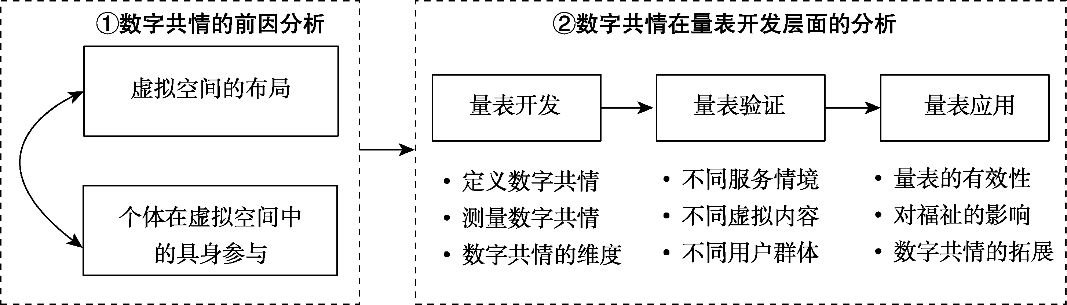
图2 研究1理论框架图
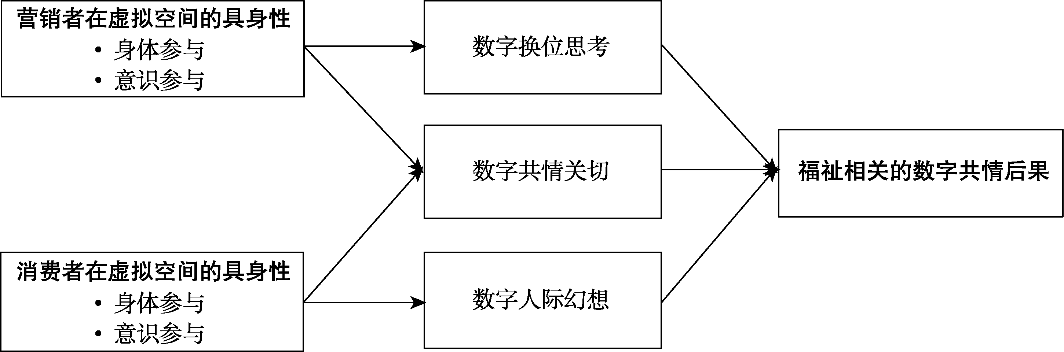
图3 研究2的理论框架图

图4 研究3的理论框架图
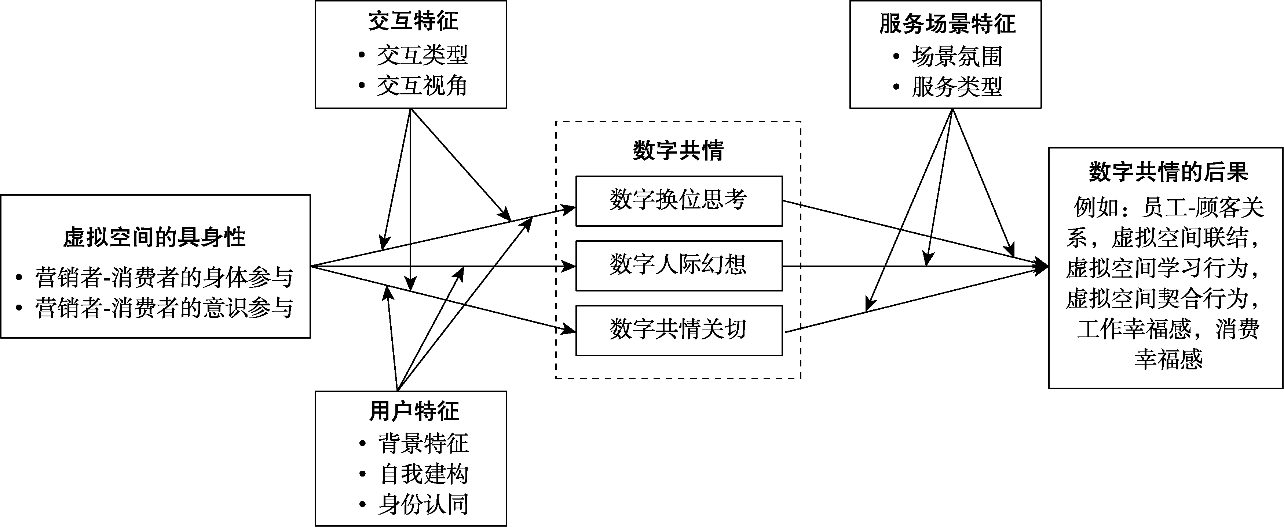
图5 研究的总体框架图
| [1] | 曹忠鹏, 靳成雯, 马菁, 李雁晨. (2020). 自助服务技术中虚拟代理人呈现对顾客准备的影响研究. 南开管理评论, 23(4), 73-83. |
| [2] |
昌思琴, 黄辰, 戴元富, 蒋长好. (2025). VR训练对轻度认知障碍老年人认知功能的影响及神经机制. 心理科学进展, 33(2), 322-335.
doi: 10.3724/SP.J.1042.2025.0322 |
| [3] | 陈国青, 任明, 卫强, 郭迅华, 易成. (2022). 数智赋能:信息系统研究的新跃迁. 管理世界, 38(1), 180-196. |
| [4] | 陈娟, 奚楠楠, 宁昌会, Hamari, J. (2019). 虚拟现实营销研究综述和展望. 外国经济与管理, 41(10), 17-30. |
| [5] | 陈诺亚, 黎俊显, 李少波, 范秀成. (2022). 孤独感与消费者决策研究:述评与展望. 外国经济与管理, 44(11), 29-48. |
| [6] | 陈斯允, 卫海英, 冉雅璇, 孟陆. (2020). “重振旗鼓”还是“重蹈覆辙”——新起点思维与品牌危机类型对消费者宽恕的影响. 南开管理评论, 23(4), 49-59+83. |
| [7] | 杜建刚, 赵欢, 苏九如, 张宇. (2022). 服务智能化下的顾客行为:研究述评与展望. 外国经济与管理, 44(3), 19-35. |
| [8] | 范秀成, 陈晓, 阮艳雯. (2023). 消费者幸福感:理论框架与未来展望. 营销科学学报, 3(1), 78-97. |
| [9] | 李飞. (2021). 幸福营销:一个新的管理框架. 北京工商大学学报(社会科学版), 36(1), 1-13. |
| [10] | 李倩倩, 范雅雯, 宋文静. (2021). 社交情境对体验型消费参与兴趣的影响研究. 南开管理评论, 24(3), 4-17. |
| [11] | 刘建新, 范秀成. (2020). 心之所有, 言予他人? 心理所有权对消费者口碑推荐的影响研究. 南开管理评论, 23(1), 144-157. |
| [12] | 马瑞婧, 凡文强, 刘静文. (2021). 纯文字还是加“表情”?道歉形式对消费者宽恕意愿的影响——移情的中介视角. 南开管理评论, 24(6), 187-196. |
| [13] |
彭晨明, 屈奕帆, 郭晓凌, 陈增祥. (2025). 人工智能服务对消费者道德行为的双刃剑效应. 心理科学进展, 33(2), 236-255.
doi: 10.3724/SP.J.1042.2025.0236 |
| [14] | 任之光. (2021). 营销科学学科回顾、展望与未来方向. 营销科学学报, 1(1), 31-42. |
| [15] | 任之光, 赵海川, 杨凯. (2022). 营销科技的发展、应用及研究现状评述与展望. 营销科学学报, 2(1), 1-11. |
| [16] | 沈鹏熠, 万德敏, 许基南. (2021). 在线零售情境下人机交互感知如何影响消费者幸福感——基于自主性的视角. 南开管理评论, 24(6), 26-40. |
| [17] | 唐玉生, 张小溪, 邓秋迎, 刘健. (2021). 儒家缘分关系视角下品牌资产量表开发与验证. 南开管理评论, 24(2), 37-45+47+105+148-149. |
| [18] | 妥艳媜, 白长虹, 王琳. (2020). 旅游者幸福感:概念化及其量表开发. 南开管理评论, 23(6), 166-178. |
| [19] | 王海忠, 谢涛, 詹纯玉. (2021). 服务失败情境下智能客服化身拟人化的负面影响:厌恶感的中介机制. 南开管理评论, 24(4), 194-206. |
| [20] | 王希, 董蕊, 李思佳, 倪士光. (2017). 虚拟现实暴露疗法在社交焦虑中的应用:效果、机制及展望. 心理科学, 40(6), 1504-1510. |
| [21] | 王新新, 高俊, 冯林燕, 汤筱晓. (2021). 弱主动服务行为的概念、影响及机制研究. 管理世界, 37(1), 150-169+ 110. |
| [22] | 王永贵, 焦冠哲, 洪傲然. (2021). 服务营销研究在中国:过去、现在和未来. 营销科学学报, 1(1), 127-153. |
| [23] | 魏江, 杨洋, 杨佳铭. (2021). 数智时代营销战略理论重构的思考. 营销科学学报, 1(1), 114-126. |
| [24] | 叶浩生. (2014). 具身涵义的理论辨析. 心理学报, 46(7), 1032-1042. |
| [25] | 郑春晖, 张佳, 温淑盈. (2022). 虚与实:虚拟旅游中的人地情感依恋与实地旅游意愿. 旅游学刊, 37(4), 104-115. |
| [26] | 周忠, 周颐, 肖江剑. (2015). 虚拟现实增强技术综述. 中国科学:信息科学, 45(2), 157-180. |
| [27] |
Abdullah, J., Mohd-Isa, W. N., & Samsudin, M. A. (2019). Virtual reality to improve group work skill and self-directed learning in problem-based learning narratives. Virtual Reality, 23(4), 461-471.
doi: 10.1007/s10055-019-00381-1 |
| [28] | Abdulrahman, A., Richards, D., Ranjbartabar, H., & Mascarenhas, S. (2021). Verbal empathy and explanation to encourage behaviour change intention. Journal on Multimodal User Interfaces, 15(2), 189-199. |
| [29] | Aitamurto, T., Aymerich-Franch, L., Saldivar, J., Kircos, C., Sadeghi, Y., & Sakshuwong, S. (2022). Examining augmented reality in journalism: Presence, knowledge gain, and perceived visual authenticity. New Media & Society, 24(6), 1281-1302. |
| [30] | Andrejevic, M., & Volcic, Z. (2020). Virtual empathy. Communication, Culture and Critique, 13(3), 295-310. |
| [31] | Barasch, A., Zauberman, G., & Diehl, K. (2018). How the intention to share can undermine enjoyment: Photo-taking goals and evaluation of experiences. Journal of Consumer Research, 44(6), 1220-1237. |
| [32] | Barr, N. B., & Johnson, J. E. (2021). Trajectories in turmoil: A case study of engineering students’ reactions to disruptions in their community of practice. IEEE Transactions on Professional Communication, 64(1), 38-51. |
| [33] | Batson, C. D., Early, S., & Salvarani, G. (1997). Perspective taking: Imagining how another feels versus imagining how you would feel. Personality and Social Psychology Bulletin, 23(7), 751-758. |
| [34] | Bitner, M. J. (1992). Servicescapes: The impact of physical surroundings on customers and employees. Journal of Marketing, 56(2), 57-71. |
| [35] | Bogicevic, V., Liu, S. Q., Seo, S., Kandampully, J., & Rudd, N. A. (2021). Virtual reality is so cool! How technology innovativeness shapes consumer responses to service preview modes. International Journal of Hospitality Management, 93, 102806. |
| [36] |
Bogicevic, V., Seo, S., Kandampully, J. A., Liu, S. Q., & Rudd, N. A. (2019). Virtual reality presence as a preamble of tourism experience: The role of mental imagery. Tourism Management, 74, 55-64.
doi: 10.1016/j.tourman.2019.02.009 |
| [37] | Bove, L. L. (2019). Empathy for service: Benefits, unintended consequences, and future research agenda. Journal of Services Marketing, 33(1), 31-43. |
| [38] | Buchi, M. (2024). Digital well-being theory and research. New Media & Society, 26 (1), 172-189. |
| [39] | Bujić, M., Salminen, M., Macey, J., & Hamari, J. (2020). “Empathy machine”: How virtual reality affects human rights attitudes. Internet Research, 30(5), 1407-1425. |
| [40] | Chan, S. H. M., Qiu, L., Esposito, G., Mai, K. P., Tam, K. P., & Cui, J. (2023). Nature in virtual reality improves mood and reduces stress: Evidence from young adults and senior citizens. Virtual Reality, 27(4), 3285-3300. |
| [41] | Chang, C.-T., & Cheng, Z.-H. (2015). Tugging on heartstrings: Shopping orientation, mindset, and consumer responses to cause-related marketing. Journal of Business Ethics, 127(2), 337-350. |
| [42] | Colbert, A., Yee, N., & George, G. (2016). The digital workforce and the workplace of the future. Academy of Management Journal, 59(3), 731-739. |
| [43] | Cowan, K., & Ketron, S. (2019). A dual model of product involvement for effective virtual reality: The roles of imagination, co-creation, telepresence, and interactivity. Journal of Business Research, 100, 483-492. |
| [44] | Cowan, K., Spielmann, N., Horn, E., & Griffart, C. (2021). Perception is reality... how digital retail environments influence brand perceptions through presence. Journal of Business Research, 123, 86-96. |
| [45] | Cummings, J. J., & Bailenson, J. N. (2015). How immersive is enough? A meta-analysis of the effect of immersive technology on user presence. Media Psychology, 19(2), 272-309. |
| [46] | Daassi, M., & Debbabi, S. (2021). Intention to reuse AR-based apps: The combined role of the sense of immersion, product presence and perceived realism. Information & Management, 58(4), 103453. |
| [47] | Davis, M. H. (1980). A multidimensional approach to individual differences in empathy. JSAS Catalog of Selected Documents in Psychology, 10, 85-104. |
| [48] | Davis, M. H. (1983). Measuring individual differences in empathy: Evidence for a multidimensional approach. Journal of Personality and Social Psychology, 44(1), 113-126. |
| [49] | de Kervenoael, R., Hasan, R., Schwob, A., & Goh, E. (2020). Leveraging human-robot interaction in hospitality services: Incorporating the role of perceived value, empathy, and information sharing into visitors’ intentions to use social robots. Tourism Management, 78, 104042. |
| [50] | Depow, G. J., Francis, Z., & Inzlicht, M. (2021). The experience of empathy in everyday life. Psychological Science, 32(8), 1198-1213. |
| [51] | Fan, X. J., Jiang, X. Y., & Deng, N. Q. (2022). Immersive technology: A meta-analysis of augmented/virtual reality applications and their impact on tourism experience. Tourism Management, 91, 104534. |
| [52] | Fan, X. J., Jiang, X. Y., & Deng, N. Q. (2023). Imagination versus telepresence: Consumer patronage intention toward peer-to-peer accommodations in photo-enhanced imaginative conditions and virtual reality contexts. Journal of Travel Research, 62(8), 1647-1666. |
| [53] | Flavián, C., Ibáñez-Sánchez, S., & Orús, C. (2019). The impact of virtual, augmented and mixed reality technologies on the customer experience. Journal of Business Research, 100, 547-560. |
| [54] | Flavián, C., Ibáñez-Sánchez, S., & Orús, C. (2021). The influence of scent on virtual reality experiences: The role of aroma-content congruence. Journal of Business Research, 123, 289-301. |
| [55] | Fox, J., Ahn, S. J., Janssen, J. H., Yeykelis, L., Segovia, K. Y., & Bailenson, J. N. (2015). Avatars versus agents: A meta-analysis quantifying the effect of agency on social influence. Human-Computer Interaction, 30(5), 401-432. |
| [56] | Foxman, M., Markowitz, D. M., & Davis, D. Z. (2021). Defining empathy: Interconnected discourses of virtual reality’s prosocial impact. New Media & Society, 23(8), 2167-2188. |
| [57] | García-Pérez, R., Santos-Delgado, J. M., & Buzón-García, O. (2016). Virtual empathy as digital competence in education 3.0. International Journal of Educational Technology in Higher Education, 13, 1-10. |
| [58] | Gatter, S., Hüttl-Maack, V., & Rauschnabel, P. A. (2022). Can augmented reality satisfy consumers’ need for touch? Psychology & Marketing, 39(3), 508-523. |
| [59] | Hadi, R., & Valenzuela, A. (2020). Good vibrations: Consumer responses to technology-mediated haptic feedback. Journal of Consumer Research, 47(2), 256-271. |
| [60] |
Harari, H., Shamay-Tsoory, S. G., Ravid, M., & Levkovitz, Y. (2010). Double dissociation between cognitive and affective empathy in borderline personality disorder. Psychiatry Research, 175(3), 277-279.
doi: 10.1016/j.psychres.2009.03.002 pmid: 20045198 |
| [61] | Hoffman, D. L., Moreau, C. P., Stremersch, S., & Wedel, M. (2022). The rise of new technologies in marketing: A framework and outlook. Journal of Marketing, 86(1), 1-6. |
| [62] | Holzwarth, M., Janiszewski, C., & Neumann, M. M. (2006). The influence of avatars on online consumer shopping behavior. Journal of Marketing, 70(4), 19-36. |
| [63] | Howard, M. C., & Van Zandt, E. C. (2021). A meta-analysis of the virtual reality problem: Unequal effects of virtual reality sickness across individual differences. Virtual Reality, 25(4), 1221-1246. |
| [64] | Hoyer, W. D., Kroschke, M., Schmitt, B., Kraume, K., & Shankar, V. (2020). Transforming the customer experience through new technologies. Journal of Interactive Marketing, 51, 57-71. |
| [65] | Huang, F. X., Huang, J. P., & Wan, X. A. (2019). Influence of virtual color on taste: Multisensory integration between virtual and real worlds. Computers in Human Behavior, 95, 168-174. |
| [66] | Huang, W., Roscoe, R., Craig, S. D., & Johnson-Glenberg, M. C. (2022). Extending the cognitive-affective theory of learning with media in virtual reality learning: A structural equation modeling approach. Journal of Educational Computing Research, 60(4), 807-842. |
| [67] |
Hudson, S., Matson-Barkat, S., Pallamin, N., & Jegou, G. (2019). With or without you? Interaction and immersion in a virtual reality experience. Journal of Business Research, 100, 459-468.
doi: 10.1016/j.jbusres.2018.10.062 |
| [68] | Jiao, J. F., & Wang, J. (2018). Can lonely people behave morally? The joint influence of loneliness and empathy on moral identity. Journal of Consumer Psychology, 28(4), 597-611. |
| [69] |
Kandaurova, M., & Lee, S. H. M. (2019). The effects of Virtual Reality (VR) on charitable giving: The role of empathy, guilt, responsibility, and social exclusion. Journal of Business Research, 100, 571-580.
doi: 10.1016/j.jbusres.2018.10.027 |
| [70] | Kang, H. J., Shin, J. H., & Ponto, K. (2020). How 3D virtual reality stores can shape consumer purchase decisions: The roles of informativeness and playfulness. Journal of Interactive Marketing, 49, 70-85. |
| [71] | Kang, Y. G., Song, H. D., Yun, H., & Jo, Y. (2022). The effect of virtual reality media characteristics on flow and learning transfer in job training: The moderating effect of presence. Journal of Computer Assisted Learning, 38(6), 1674-1685. |
| [72] | Kilteni, K., Groten, R., & Slater, M. (2012). The sense of embodiment in virtual reality. Presence: Teleoperators and Virtual Environments, 21(4), 373-387. |
| [73] |
Kristofferson, K., Daniels, M. E., & Morales, A. C. (2022). Using virtual reality to increase charitable donations. Marketing Letters, 33(1), 75-87.
doi: 10.1007/s11002-021-09601-8 pmid: 35075330 |
| [74] | Kruzan, K. P., & Won, A. S. (2019). Embodied well-being through two media technologies: Virtual reality and social media. New Media & Society, 21(8), 1734-1749. |
| [75] |
Kunstman, J. W., & Plant, E. A. (2008). Racing to help: Racial bias in high emergency helping situations. Journal of Personality and Social Psychology, 95(6), 1499-1510.
doi: 10.1037/a0012822 pmid: 19025298 |
| [76] | Lavoie, R., Main, K., King, C., & King, D. (2020). Virtual experience, real consequences: The potential negative emotional consequences of virtual reality gameplay. Virtual Reality, 25(1), 69-81. |
| [77] | Lee, H., Jung, T. H., Dieck, M. C. T., & Chung, N. (2020). Experiencing immersive virtual reality in museums. Information & Management, 57(5), 103229. |
| [78] | Lee, K. C., & Chung, N. (2008). Empirical analysis of consumer reaction to the virtual reality shopping mall. Computers in Human Behavior, 24(1), 88-104. |
| [79] | Lemon, K. N., & Verhoef, P. C. (2016). Understanding customer experience throughout the customer journey. Journal of Marketing, 80(6), 69-96. |
| [80] | Li, B. J., & Kim, H. K. (2021). Experiencing organ failure in virtual reality: Effects of self- versus other-embodied perspective taking on empathy and prosocial outcomes. New Media & Society, 23(8), 2144-2166. |
| [81] | Liu-Thompkins, Y., Okazaki, S., & Li, H. R. (2022). Artificial empathy in marketing interactions: Bridging the human-AI gap in affective and social customer experience. Journal of the Academy of Marketing Science, 50(6), 1198-1218. |
| [82] | Luangrath, A. W., Peck, J., Hedgcock, W., & Xu, Y. X. (2022). Observing product touch: The vicarious haptic effect in digital marketing and virtual reality. Journal of Marketing Research, 59(2), 306-326. |
| [83] | McLean, G., & Barhorst, J. B. (2022). Living the experience before you go... but did it meet expectations? The role of virtual reality during hotel bookings. Journal of Travel Research, 61(6), 1233-1251. |
| [84] | Miao, F., Kozlenkova, I. V., Wang, H. Z., Xie, T., & Palmatier, R. W. (2022). An emerging theory of avatar marketing. Journal of Marketing, 86(1), 67-90. |
| [85] | Moriuchi, E., & Murdy, S. (2022). Increasing donation intentions toward endangered species: An empirical study on the mediating role of psychological and technological elements of VR. Psychology & Marketing, 39(7), 1302-1321. |
| [86] | Pala, E., Kapitan, S., & Esch, P. (2021). Simulated satiation through reality-enhancing technology. Psychology & Marketing, 39(3), 483-494. |
| [87] | Pallud, J. (2017). Impact of interactive technologies on stimulating learning experiences in a museum. Information & Management, 54(4), 465-478. |
| [88] | Peña, J., Wolff, G., & Wojcieszak, M. (2021). Virtual reality and political outgroup contact: Can avatar customization and common ingroup identity reduce social distance? Social Media and Society, 7(1), 2056305121993765. |
| [89] | Peukert, C., Pfeiffer, J., Meißner, M., Pfeiffer, T., & Weinhardt, C. (2019). Shopping in virtual reality stores: The influence of immersion on system adoption. Journal of Management Information Systems, 36(3), 755-788. |
| [90] | Pfeiffer, J., Pfeiffer, T., Meißner, M., & Weiß, E. (2020). Eye-tracking-based classification of information search behavior using machine learning: Evidence from experiments in physical shops and virtual reality shopping environments. Information Systems Research, 31(3), 675-691. |
| [91] | Pizzi, G., Scarpi, D., Pichierri, M., & Vannucci, V. (2019). Virtual reality, real reactions?: Comparing consumers’ perceptions and shopping orientation across physical and virtual-reality retail stores. Computers in Human Behavior, 96, 1-12. |
| [92] | Riva, G., Mantovani, F., Capideville, C. S., Preziosa, A., Morganti, F., Villani, D.,... Alcaniz, M. (2007). Affective interactions using virtual reality: The link between presence and emotions. Cyberpsychology & Behavior, 10(1), 45-56. |
| [93] | Seeger, A. M., Pfeiffer, J., & Heinzl, A. (2021). Texting with humanlike conversational agents: Designing for anthropomorphism. Journal of the Association for Information Systems, 22(4), 931-967. |
| [94] | Shin, D. H. (2017). Conceptualizing and measuring quality of experience of the Internet of Things: Exploring how quality is perceived by users. Information & Management, 54(8), 998-1011. |
| [95] | Song, H., Kim, J., Nguyen, T. P. H., Lee, K. M., & Park, N. (2021). Virtual reality advertising with brand experiences: The effects of media devices, virtual representation of the self, and self-presence. International Journal of Advertising, 40(7), 1096-1114. |
| [96] | Sparavec, A., March, E., & Grieve, R. (2022). The dark triad, empathy, and motives to use social media. Personality and Individual Differences, 194, 111647. |
| [97] | Steverink, N., Lindenberg, S., Spiegel, T., & Nieboer, A. P. (2020). The associations of different social needs with psychological strengths and subjective well-being: An empirical investigation based on social production function theory. Journal of Happiness Studies, 21(3), 799-824. |
| [98] | Tan, Y.-C., Chandukala, S. R., & Reddy, S. K. (2022). Augmented reality in retail and its impact on sales. Journal of Marketing, 86(1), 48-66. |
| [99] | Tham, J., Duin, A. H., Gee, L., Ernst, N., Abdelqader, B., & McGrath, M. (2018). Understanding virtual reality: Presence, embodiment, and professional practice. IEEE Transactions on Professional Communication, 61(2), 178-195. |
| [100] | Tian, Q., & Robertson, J. L. (2019). How and when does perceived CSR affect employees’ engagement in voluntary pro-environmental behavior? Journal of Business Ethics, 155(2), 399-412. |
| [101] | Tussyadiah, I. P., Wang, D., Jung, T. H., & Dieck, M. C. T. (2018). Virtual reality, presence, and attitude change: Empirical evidence from tourism. Tourism Management, 66, 140-154. |
| [102] | Van Kerrebroeck, H., Brengman, M., & Willems, K. (2017). Escaping the crowd: An experimental study on the impact of a virtual reality experience in a shopping mall. Computers in Human Behavior, 77, 437-450. |
| [103] | Ventura, S., Badenes-Ribera, L., Herrero, R., Cebolla, A., Galiana, L., & Baños, R. (2020). Virtual reality as a medium to elicit empathy: a meta-analysis. Cyberpsychology, Behavior, and Social Networking, 23(10), 667-676. |
| [104] | von Helversen, B., Abramczuk, K., Kopeć, W., & Nielek, R. (2018). Influence of consumer reviews on online purchasing decisions in older and younger adults. Decision Support Systems, 113, 1-10. |
| [105] | Wedel, M., Bigne, E., & Zhang, J. (2020). Virtual and augmented reality: Advancing research in consumer marketing. International Journal of Research in Marketing, 37(3), 443-465. |
| [106] | Welker, C., Wheatley, T., Cason, G., Gorman, C., & Meyer, M. (2024). Self-views converge during enjoyable conversations. Proceedings of the National Academy of Sciences, 121(43), 2321652121. |
| [107] | Wiederhold, B. K. (2018). Virtual reality enhances seniors’ health and well-being. Cyberpsychology Behavior and Social Networking, 21(12), 739-740. |
| [108] | Wiederhold, B. K. (2020). Embodiment empowers empathy in virtual reality. Cyberpsychology Behavior and Social Networking, 23(11), 725-726. |
| [109] | Wijma, E. M., Veerbeek, M. A., Prins, M., Pot, A. M., & Willemse, B. M. (2018). A virtual reality intervention to improve the understanding and empathy for people with dementia in informal caregivers: Results of a pilot study. Aging & Mental Health, 22(9), 1115-1123. |
| [110] |
Willems, K., Brengman, M., & Van Kerrebroeck, H. (2019). The impact of representation media on customer engagement in tourism marketing among millennials. European Journal of Marketing, 53(9), 1988-2017.
doi: 10.1108/EJM-10-2017-0793 |
| [111] | Xu, W. G., Liang, H. N., Yu, K. Y., Wen, S. Y., Baghaei, N., & Tu, H. W. (2022). Acceptance of virtual reality exergames among Chinese older adults. International Journal of Human-Computer Interaction, 39(5), 1134-1148. |
| [112] |
Zhou, C., Han, M., Liang, Q., Hui, Y.-F., & Kuai, S.-G. (2019). A social interaction field model accurately identifies static and dynamic social groupings. Nature Human Behaviour, 3(8), 847-855.
doi: 10.1038/s41562-019-0618-2 pmid: 31182793 |
| [113] | Zhou, Z. Y., Fang, Y. L., Vogel, D. R., Jin, X.-L., & Zhang, X. (2012). Attracted to or locked in? Predicting continuance intention in social virtual world services. Journal of Management Information Systems, 29(1), 273-306. |
| [114] | Zhou, Z. Y., Jin, X.-L., & Fang, Y. L. (2014). Moderating role of gender in the relationships between perceived benefits and satisfaction in social virtual world continuance. Decision Support Systems, 65, 69-79. |
| [1] | 卫海英, 王颖, 冉雅璇, 张逸石, 舒丽芳. 小事情、大幸福:互动仪式链理论视角下服务仪式对品牌福祉的影响[J]. 心理科学进展, 2018, 26(7): 1141-1151. |
| 阅读次数 | ||||||
|
全文 |
|
|||||
|
摘要 |
|
|||||
