

ISSN 1671-3710
CN 11-4766/R
主办:中国科学院心理研究所
出版:科学出版社
CN 11-4766/R
主办:中国科学院心理研究所
出版:科学出版社
心理科学进展 ›› 2026, Vol. 34 ›› Issue (5): 875-889.doi: 10.3724/SP.J.1042.2026.0875 cstr: 32111.14.2026.0875
欧阳哲1,2, 程鹏3, 徐祖辉1,2( )
)
收稿日期:2025-09-15
出版日期:2026-05-15
发布日期:2026-03-20
通讯作者:
徐祖辉, E-mail: xuzuhui1990@163.com基金资助:
OUYANG Zhe1,2, CHENG Peng3, XU Zuhui1,2()
Received:2025-09-15
Online:2026-05-15
Published:2026-03-20
摘要:
企业不当行为溢出效应是指未直接参与不当行为的旁观企业的股价、声誉、资源和机会因其他企业的不当行为而产生正面或负面变化。当前理论多集中于行业或产品相似性, 用相同特征解释正负溢出效应, 且鲜有研究同时考虑两者, 造成文献中理论整合的缺失。本研究从归因认知过程视角出发, 构建一个统一的理论框架, 以解释和整合企业不当行为的正面与负面溢出效应。具体地, 本研究提出溢出的方向取决于利益相关者对行为原因的归因轨迹:若将原因锁定于肇事者本身(孤立归因), 则产生正面溢出; 若将原因视为更广泛组织群体共有的系统性问题(系统性归因), 则导致负面溢出。本研究还进一步指出不当行为的性质及其多维属性会影响利益相关者的归因选择。此外, 研究进一步探讨了企业声誉与行为的多维属性在归因过程中的调节作用, 为预判和管理不当行为溢出效应提供了跨行业适用的理论工具。
中图分类号:
欧阳哲, 程鹏, 徐祖辉. (2026). 企业不当行为何以产生溢出效应?基于归因认知过程的解释. 心理科学进展 , 34(5), 875-889.
OUYANG Zhe, CHENG Peng, XU Zuhui. (2026). The spillover effects of corporate misconduct: An attributional cognitive process perspective. Advances in Psychological Science, 34(5), 875-889.
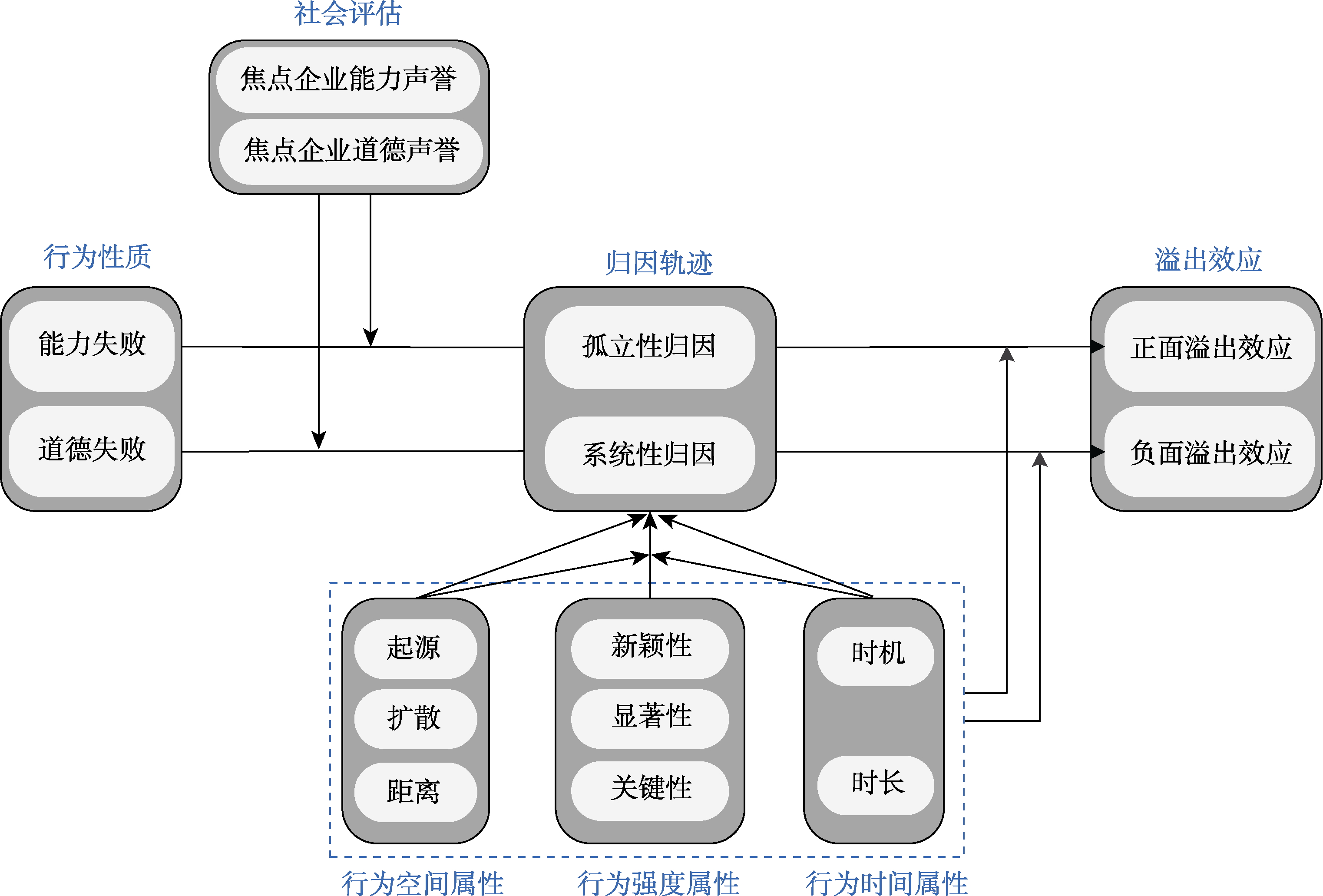
图1 组织不当行为溢出效应的概念模型
| [1] | 范琳珊, 吕长江, 陈皓雪. (2022). 新媒体能缓解信息传染效应吗——基于环境污染曝光的事件研究. 会计研究, (3), 28-46. |
| [2] | 方正, 杨洋, 李蔚, 蔡静. (2013). 产品伤害危机溢出效应的发生条件和应对策略研究——预判和应对其它品牌引发的产品伤害危机. 南开管理评论, 16(6), 19-27. |
| [3] | 费显政, 李陈微, 周舒华. (2010). 一损俱损还是因祸得福? ——企业社会责任声誉溢出效应研究. 管理世界, (4), 74-82. |
| [4] | 郭峰, 吕晓亮, 林致远, 龚志强. (2023). 池鱼之殃: 上市公司社交媒体联结与股价溢出效应——基于中国监管处罚的事件研究. 管理科学学报, 26(4), 111-131. |
| [5] | 韩冰, 王良燕. (2017). 品牌负面事件的溢出效应及影响因素述评. 心理科学, 40(1), 193-199. |
| [6] | 贾明, 孙向坤, 张喆. (2021). 社交媒体在企业应对危机事件中的作用. 管理评论, 33(5), 295-304. |
| [7] | 靳明, 赵敏, 杨波, 张英. (2015). 食品安全事件影响下的消费替代意愿分析——以肯德基食品安全事件为例. 中国农村经济, (12), 75-92. |
| [8] | 刘海建. (2016). 捐赠行为的信号机制与投资者解读——基于负溢出情境中波及者的研究. 中国工业经济, (11), 144-160. |
| [9] | 刘丽华, 徐艳萍, 饶品贵, 陈玥. (2019). 一损俱损: 违规事件在企业集团内的传染效应研究. 金融研究, (6), 113-131. |
| [10] | 纳鹏杰, 雨田木子, 纳超洪. (2017). 企业集团风险传染效应研究——来自集团控股上市公司的经验证据. 会计研究, (3), 53-60. |
| [11] | 青平, 徐莹莹, 孙山, 肖邦明, 廖芬. (2019). 品牌危机网络外溢机理的实验研究. 管理学报, 16(4), 561-568. |
| [12] | 王思敏, 朱玉杰. (2010). 公司危机的传染效应与竞争效应——以国美事件为例的小样本实证研究. 中国软科学, (7), 134-141. |
| [13] | 王新刚, 周玲, 周南. (2017). 品牌丑闻跨国非对称溢出效应研究——国家形象构成要素视角. 经济管理, 39(4), 128-142. |
| [14] | 王永钦, 刘思远, 杜巨澜. (2014). 信任品市场的竞争效应与传染效应: 理论和基于中国食品行业的事件研究. 经济研究, (2), 141-154. |
| [15] |
Adut A. (2005). A theory of scandal: Victorians, homosexuality, and the fall of Oscar Wilde. American Journal of Sociology, 111(1), 213-248.
pmid: 16240549 |
| [16] | Bachman G. F., & Guerrero L. K. (2006). Relational quality and communicative responses following hurtful events in dating relationships: An expectancy violations analysis. Journal of Social and Personal Relationships, 23(6), 847-871. |
| [17] |
Bansal P., & Clelland I. (2004). Talking trash: Legitimacy, impression management, and unsystematic risk in the context of the natural environment. Academy of Management Journal, 47(1), 93-103.
doi: 10.2307/20159562 URL |
| [18] |
Barnett M. L. (2014). Why stakeholders ignore firm misconduct: A cognitive view. Journal of Management, 40(3), 676-702.
doi: 10.1177/0149206311433854 URL |
| [19] |
Barnett M. L., & King A. A. (2008). Good fence make good neighbors: A longitudinal analysis of an industry self-regulatory institution. Academy of Management Journal, 51(6), 1150-1170.
doi: 10.5465/amj.2008.35732609 URL |
| [20] | Barsalou L. W. (1991). Deriving categories to achieve goals. In Bower, G. H. (Ed.), The psychology of learning and motivation: Advances in research and theory (Vol. 27, pp. 1-64). Academic Press. |
| [21] |
Bundy J., & Pfarrer M. D. (2015). A burden of responsibility: The role of social approval at the onset of a crisis. Academy of Management Review, 40(3), 345-369.
doi: 10.5465/amr.2013.0027 URL |
| [22] |
Burgoon J. K., & Le Poire B. A. (1993). Effects of communication expectancies, actual communication, and expectancy disconfirmation on evaluations of communicators and their communication behavior. Human Communication Research, 20(1), 67-96.
doi: 10.1111/hcre.1993.20.issue-1 URL |
| [23] |
Chen Z. F., & Tao W. (2020). The association spillover mechanism of CSR crises: Evidence from the Uber case. Journal of Public Relations Research, 32(5-6), 178-197.
doi: 10.1080/1062726X.2020.1861949 URL |
| [24] |
Cleeren K., Van Heerde H. J., & Dekimpe M. G. (2013). Rising from the ashes: How brands and categories can overcome product-harm crises. Journal of Marketing, 77(2), 58-77.
doi: 10.1509/jm.10.0414 URL |
| [25] |
Connelly B. L., Ketchen D. J., Gangloff K. A., & Shook C. L. (2016). Investor perceptions of CEO successor selection in the wake of integrity and competence failures: A policy capturing study. Strategic Management Journal, 37(10), 2135-2151.
doi: 10.1002/smj.2016.37.issue-10 URL |
| [26] |
Deephouse D. L. (2000). Media reputation as a strategic resource: An integration of mass communication and resource-based theories. Journal of Management, 26(6), 1091-1112.
doi: 10.1177/014920630002600602 URL |
| [27] |
Desai V. M. (2011). Mass media and massive failures: Determining organizational efforts to defend field legitimacy following crises. Academy of Management Journal, 54(2), 263-278.
doi: 10.5465/amj.2011.60263082 URL |
| [28] |
Dewan Y., & Jensen M. (2020). Catching the big fish: The role of scandals in making status a liability. Academy of Management Journal, 63(5), 1652-1678.
doi: 10.5465/amj.2018.0685 URL |
| [29] |
Diestre L., & Rajagopalan N. (2014). Toward an input- based perspective on categorization: Investor reactions to chemical accidents. Academy of Management Journal, 57(4), 1130-1153.
doi: 10.5465/amj.2011.1096 URL |
| [30] |
Durand R., & Paolella L. (2013). Category stretching: Reorienting research on categories in strategy, entrepreneurship, and organization theory. Journal of Management Studies, 50(6), 1100-1123.
doi: 10.1111/joms.2013.50.issue-6 URL |
| [31] |
Fiske S. T., Cuddy A. J. C., & Glick P. (2007). Universal dimensions of social cognition: Warmth and competence. Trends in Cognitive Sciences, 11(2), 77-83.
doi: 10.1016/j.tics.2006.11.005 pmid: 17188552 |
| [32] | Fombrun C. J. (1996). Reputation: Realizing value from the corporate image. Harvard University Press. |
| [33] |
Galloway T. L., Miller D. R., & Liu K. (2023). Guilty by association: Spillover of regulative violations and repair efforts to alliance partners. Journal of Business Ethics, 182(3), 805-818.
doi: 10.1007/s10551-021-05006-9 |
| [34] |
Goins S., & Gruca T. S. (2008). Understanding competitive and contagion effects of layoff announcements. Corporate Reputation Review, 11(1), 12-34.
doi: 10.1057/crr.2008.3 URL |
| [35] |
Graffin S. D., Haleblian J., & Kiley J. T. (2016). Ready, AIM, acquire; Impression offsetting and acquisitions. Academy of Management Journal, 59(1), 232-252.
doi: 10.5465/amj.2013.0288 URL |
| [36] |
Greve H. R., Palmer D., & Pozner J.-E. (2010). Organizations gone wild: The causes, processes, and consequences of organizational misconduct. Academy of Management Annals, 4(1), 53-107.
doi: 10.5465/19416521003654186 URL |
| [37] |
Han J.-H., & Pollock T. G. (2021). The two towers (or somewhere in between): The behavioral consequences of positional inconsistency across status hierarchies. Academy of Management Journal, 64(1), 86-113.
doi: 10.5465/amj.2018.1091 URL |
| [38] | Han, J.-H., Pollock T. G., & Paruchuri S. (2023). Goofus or Gallant? An attribution-based theory of misconduct spillover valence. In M. Clemente, C. Gabbioneta, & R. Greenwood (Eds.), Research in the sociology of organizations (Vol. 85, pp. 35-51). Emerald. |
| [39] |
Han J.-H., Pollock T., & Graffin S. D. (2024). Now you see me: How status and categorical proximity shape misconduct scandalization. Academy of Management Journal, 67(1), 208-231.
doi: 10.5465/amj.2022.0365 URL |
| [40] |
Harmon D. J. (2019). When the Fed speaks: Arguments, emotions, and the microfoundations of institutions. Administrative Science Quarterly, 64(3), 542-575.
doi: 10.1177/0001839218777475 |
| [41] |
Iqbal F., Pfarrer M. D., & Bundy J. (2024). How crisis management strategies address stakeholders’ sociocognitive concerns and organizations’ social evaluations. Academy of Management Review, 49(2), 299-321.
doi: 10.5465/amr.2020.0371 URL |
| [42] |
Jia M., & Zhang Z. (2016). What influences the duration of negative impacts from organizational deviance on other innocent firms? Journal of Business Research, 69(7), 2517-2530.
doi: 10.1016/j.jbusres.2015.10.009 URL |
| [43] |
Jonsson S., Greve H. R., & Fujiwara-Greve T. (2009). Undeserved loss: The spread of legitimacy loss to innocent organizations in response to reported corporate deviance. Administrative Science Quarterly, 54(2), 195-228.
doi: 10.2189/asqu.2009.54.2.195 URL |
| [44] |
Kang E. (2008). Director interlocks and spillover effects of reputational penalties from financial reporting fraud. Academy of Management Journal, 51(3), 537-555.
doi: 10.5465/amj.2008.32626007 URL |
| [45] |
Kashmiri S., Nicol C. D., & Hsu L. (2017). Birds of a feather: Intra-industry spillover of the target customer data breach and the shielding role of it, marketing, and CSR. Journal of the Academy of Marketing Science, 45(2), 208-228.
doi: 10.1007/s11747-016-0486-5 URL |
| [46] |
Klein J. G., & Dawar N. (2004). Corporate social responsibility and consumers’ attributions and brand evaluations in a product-harm crisis. International Journal of Research in Marketing, 21(3), 203-217.
doi: 10.1016/j.ijresmar.2003.12.003 URL |
| [47] | Kim S. (2014). The role of prior expectancies and relational satisfaction in crisis. Journalism & Mass Communication Quarterly, 91(1), 139-158. |
| [48] |
Lange D., & Washburn N. T. (2012). Understanding attributions of corporate social irresponsibility. Academy of Management Review, 37(2), 300-326.
doi: 10.5465/amr.2010.0522 URL |
| [49] |
Laufer D., & Wang Y. (2018). Guilty by association: The risk of crisis contagion. Business Horizons, 61(2), 173-179.
doi: 10.1016/j.bushor.2017.09.005 URL |
| [50] | Lei J., Dawar N., & Lemmink, J. G. A. M. (2006). The impact of information characteristics on negative spillover effects in brand portfolios. Advances in Consumer Research, 33(1), 324-325. |
| [51] |
Mishina Y., Block E. S., & Mannor M. J. (2012). The path dependence of organizational reputation: How social judgment influences assessments of capability and character. Strategic Management Journal, 33(5), 459-477.
doi: 10.1002/smj.v33.5 URL |
| [52] |
Morgeson F. P., Mitchell T. R., & Liu D. (2015). Event system theory: An event-oriented approach to the organizational sciences. Academy of Management Review, 40(4), 515-537.
doi: 10.5465/amr.2012.0099 URL |
| [53] |
Naumovska I., & Lavie D. (2021). When an industry peer is accused of financial misconduct: Stigma versus competition effects on non-accused firms. Administrative Science Quarterly, 66(4), 1130-1172.
doi: 10.1177/00018392211020662 URL |
| [54] | Naumovska I., & Zajac E. J. (2022). How inductive and deductive generalization shape the guilt-by-association phenomenon among firms: Theory and evidence. Organization Science, 33(1), 373-392. |
| [55] |
Nigam A., & Ocasio W. (2010). Event attention, environmental sensemaking, and change in institutional logics: An inductive analysis of the effects of public attention to Clinton’s health care reform initiative. Organization Science, 21(4), 823-841.
doi: 10.1287/orsc.1090.0490 URL |
| [56] |
Ouyang Z., Yao C. N., & Hu X. (2020). Crisis spillover of corporate environmental misconducts: The roles of perceived similarity, familiarity, and corporate environmental responsibility in determining the impact on oppositional behavioral intention. Business Strategy and the Environment, 29(4), 1797-1808.
doi: 10.1002/bse.v29.4 URL |
| [57] | Palmer, D., Smith-Crowe K., & Greenwood R. (2016). The imbalances and limitations of theory and research on organizational wrongdoing. In D. Palmer, K. Smith-Crowe, & R. Greenwood (Eds.), Organizational wrongdoing: Key perspectives and new directions (pp. 1-13). Cambridge University Press. |
| [58] |
Park B., & Rogan M. (2019). Capability reputation, character reputation, and exchange partners’ reactions to adverse events. Academy of Management Journal, 62(2), 553-578.
doi: 10.5465/amj.2016.0445 URL |
| [59] |
Paruchuri S., Han J.-H., & Prakash P. (2021). Salient expectations? Incongruence across capability and integrity signals and investor reactions to organizational misconduct. Academy of Management Journal, 64(2), 562-586.
doi: 10.5465/amj.2018.0698 URL |
| [60] |
Paruchuri S., & Misangyi V. F. (2015). Investor perceptions of financial misconduct: The heterogeneous contamination of bystander firms. Academy of Management Journal, 58(1), 169-194.
doi: 10.5465/amj.2012.0704 URL |
| [61] |
Paruchuri S., Pollock T. G., & Kumar N. (2019). On the tip of the brain: Understanding when negative reputational events can have positive reputation spillovers, and for how long. Strategic Management Journal, 40(12), 1965-1983.
doi: 10.1002/smj.3043 |
| [62] |
Pfarrer M. D., Pollock T. G., & Rindova V. P. (2010). A tale of two assets: The effects of firm reputation and celebrity on earnings surprises and investors’ reactions. Academy of Management Journal, 53(5), 1131-1152.
doi: 10.5465/amj.2010.54533222 URL |
| [63] |
Piazza A., & Jourdan J. (2018). When the dust settles: The consequences of scandals for organizational competition. Academy of Management Journal, 61(1), 165-190.
doi: 10.5465/amj.2015.1325 URL |
| [64] |
Pollock T. G., Lashley K., Rindova V. P., & Han J.-H. (2019). Which of these things are not like the others? Comparing the rational, emotional, and moral aspects of reputation, status, celebrity, and stigma. Academy of Management Annals, 13(2), 444-478.
doi: 10.5465/annals.2017.0086 URL |
| [65] |
Pontikes E., Negro G., & Rao H. (2010). Stained red: A study of stigma by association to blacklisted artists during the “red scare” in Hollywood, 1945 to 1960. American Sociological Review, 75(3), 456-478.
doi: 10.1177/0003122410368929 URL |
| [66] | Quamina L. T., & Singh J. (2023). Negative spill over effects in brand alliance crises. Public Relations Review, 49(5), Article, 10239. https://doi.org/10.1016/j.pubrev.2023.102394 |
| [67] |
Quinn R. E., & Cameron K. (1983). Organizational life cycles and shifting criteria of effectiveness: Some preliminary evidence. Management Science, 29(1), 33-51.
doi: 10.1287/mnsc.29.1.33 URL |
| [68] | Rehder B. (2003). Categorization as causal reasoning. Cognitive Science, 27(5), 709-748. |
| [69] |
Roehm M. L., & Tybout A. M. (2006). When will a brand scandal spill over, and how should competitors respond? Journal of Marketing Research, 43(3), 366-373.
doi: 10.1509/jmkr.43.3.366 URL |
| [70] |
Rosch E., & Mervis C. B. (1975). Family resemblances: Studies in the internal structure of categories. Cognitive Psychology, 7(4), 573-605.
doi: 10.1016/0010-0285(75)90024-9 URL |
| [71] |
Shi W., Wajda D., & Aguilera R. V. (2022). Interorganizational spillover: A review and a proposal for future research. Journal of Management, 48(1), 185-210.
doi: 10.1177/01492063211040554 URL |
| [72] | Spatareanu M., Manole V., Kabiri A., & Roland I. (2023). Bank default risk propagation along supply chains: Evidence from the U. K. International Review of Economics & Finance, 84, 813-831. |
| [73] |
Wang Y., Laufer D., & Ding J. (2024). Assessing crisis spillover risks: The role of perceived severity and corporate response effectiveness in China. Journal of Contingencies and Crisis Management, 32(3), Article, e12621. https://doi.org/10.1111/1468-5973.12621
doi: 10.1111/jccm.v32.3 URL |
| [74] | Weick K. E. (1995). Sensemaking in organizations (Vol. 3, No. 10.1002). Thousand Oaks, CA: Sage publications. |
| [75] | Weiner B. (2006). Social motivation, justice, and the moral emotions: An attributional approach. Psychology Press. |
| [76] |
Xu J., Guo D., Zhao Z., & Liu S. (2024). How social media expedites the crisis spillover effect: A case study of Tesla’s recall event. Public Relations Review, 50(1), Article, 102432. https://doi.org/10.1016/j.pubrev.2024.102432
doi: 10.1016/j.pubrev.2024.102432 URL |
| [77] |
Yu T., & Lester R. H. (2008). Moving beyond firm boundaries: A social network perspective on reputation spillover. Corporate Reputation Review, 11(1), 94-108.
doi: 10.1057/crr.2008.6 URL |
| [78] |
Zhang J., & Lim J. S. (2024). Efficacy of response strategies in brand spillover crises: The roles of perceived attribute similarity, blame attribution and attitude towards response messages. Journal of Contingencies and Crisis Management, 32(1), Article, e12548. https://doi.org/10.1111/1468-5973.12548
doi: 10.1111/jccm.v32.1 URL |
| [79] |
Zuckerman E. W. (2012). Construction, concentration, and (dis)continuities in social valuations. Annual Review of Sociology, 38, 223-245.
doi: 10.1146/soc.2012.38.issue-1 URL |
| [1] | 陈欢, 王震, 姜福斌. 缺钱还能上好班吗?财务压力职场溢出效应的表现、机制与条件[J]. 心理科学进展, 2024, 32(8): 1366-1378. |
| [2] | 晋向东, 范秀成, 朱华伟, 袁靖波. 传统媒体上强势品牌广告竞争溢出效应的作用机制及分布规律[J]. 心理科学进展, 2020, 28(12): 1989-1999. |
| [3] | 严瑜, 衷敬红. 职场网络不文明行为:现实与虚拟的溢出和反溢出机制[J]. 心理科学进展, 2018, 26(12): 2204-2215. |
| [4] | 严瑜;王轶鸣. 工作场所无礼行为的溢出和交叉效应:超越职场范围的负性作用机制[J]. 心理科学进展, 2016, 24(12): 1934-1945. |
| [5] | 李爱梅;华涛;高文. 辱虐管理研究的“特征-过程-结果”理论框架[J]. 心理科学进展, 2013, 21(11): 1901-1912. |
| 阅读次数 | ||||||
|
全文 |
|
|||||
|
摘要 |
|
|||||
