

ISSN 1671-3710
CN 11-4766/R
主办:中国科学院心理研究所
出版:科学出版社
CN 11-4766/R
主办:中国科学院心理研究所
出版:科学出版社
心理科学进展 ›› 2026, Vol. 34 ›› Issue (5): 856-874.doi: 10.3724/SP.J.1042.2026.0856 cstr: 32111.14.2026.0856
陈亚硕1, 陈奥博2, 许嘉琦3, 杨春江3( )
)
收稿日期:2025-11-02
出版日期:2026-05-15
发布日期:2026-03-20
通讯作者:
杨春江, E-mail: chunjiang.yang@nwu.edu.cn基金资助:
CHEN Yashuo1, CHEN Aobo2, XU Jiaqi3, YANG Chunjiang3()
Received:2025-11-02
Online:2026-05-15
Published:2026-03-20
摘要:
组织扁平化与去中心化等变革趋势正挑战传统组织伦理理论与实践, 并催生出以员工为主体的道德权威这一组织管理新议题。作为一种非正式权威, 道德权威突破了正式权威在层级、方向与范围上的局限, 实现了跨层级、全方向和无边界的伦理重塑效应。然而, 道德权威尚未在管理学中获得充分重视。对此, 本研究基于“建构概念−形成机理−跨层演化−多层影响”研究框架, 建构和检验道德权威理论。首先, 界定“道德权威”和“道德权威团队泛化”概念, 并开发相应的测量工具; 其次, 检验道德权威的形成机制, 并揭示其如何通过“社会判断−社会认同−社会影响”路径影响团队集体, 从而实现团队层面的泛化; 最后, 实证检验道德权威团队泛化对个体心理、团队效率和组织系统的多层影响、作用机理与边界条件。本研究在理论上拓展了组织伦理研究的新领域, 在实践上为企业提供了以微见著、撬动全局的新型伦理治理思路。
中图分类号:
陈亚硕, 陈奥博, 许嘉琦, 杨春江. (2026). 员工主体视角下道德权威的概念、形成、跨层演进与多层影响. 心理科学进展 , 34(5), 856-874.
CHEN Yashuo, CHEN Aobo, XU Jiaqi, YANG Chunjiang. (2026). The concept, formation, cross-level evolution, and multilevel impacts of employee moral authority. Advances in Psychological Science, 34(5), 856-874.
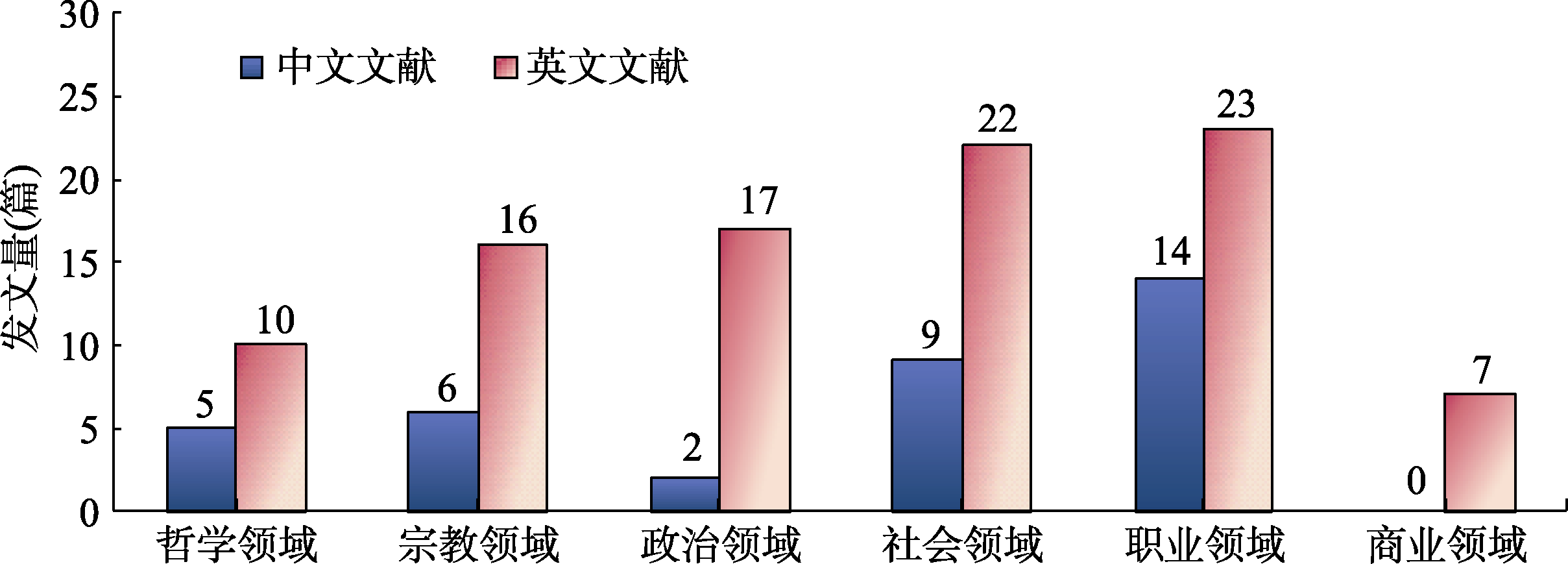
图1 道德权威中英文文献分布
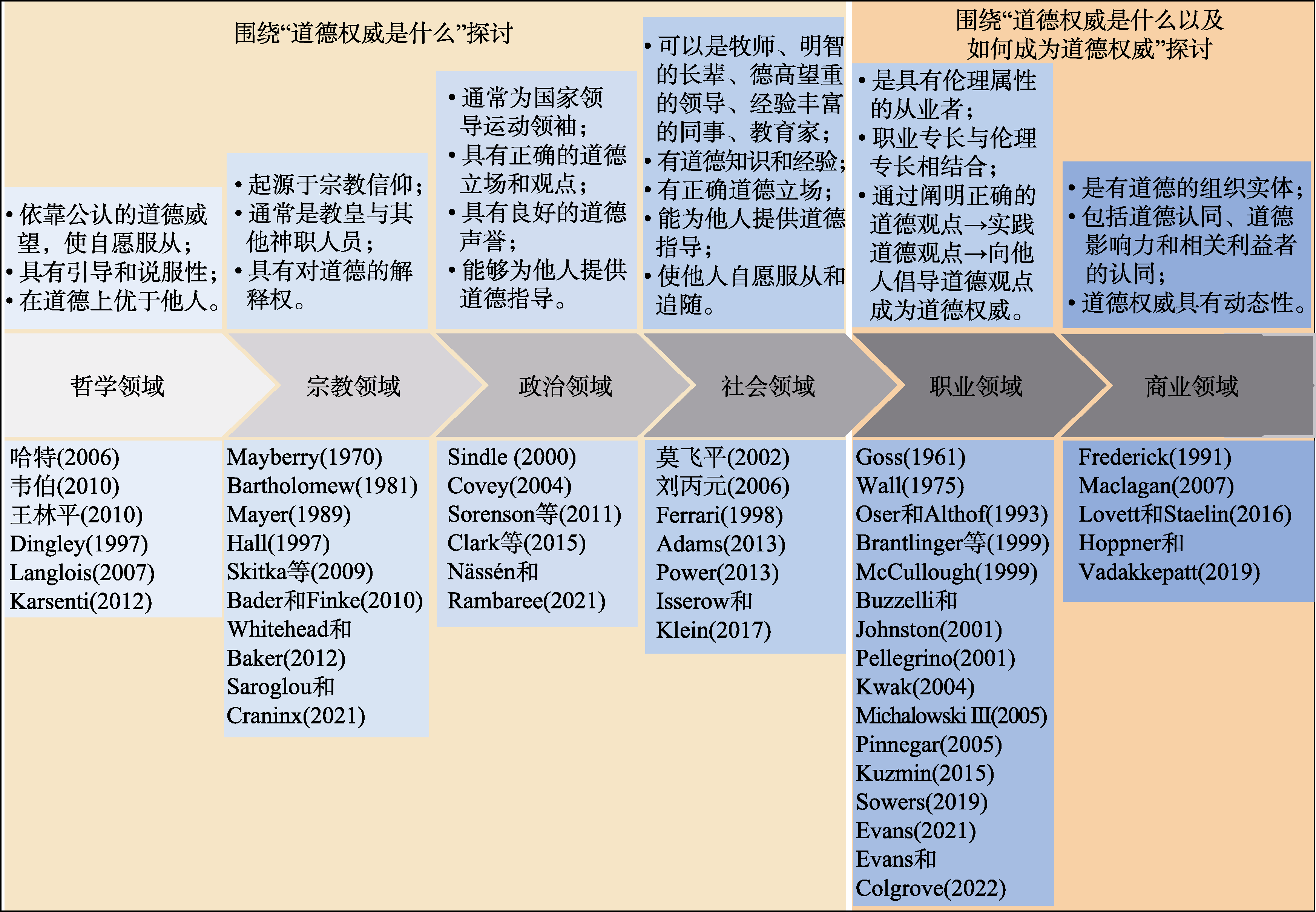
图2 跨学科领域下的道德权威研究
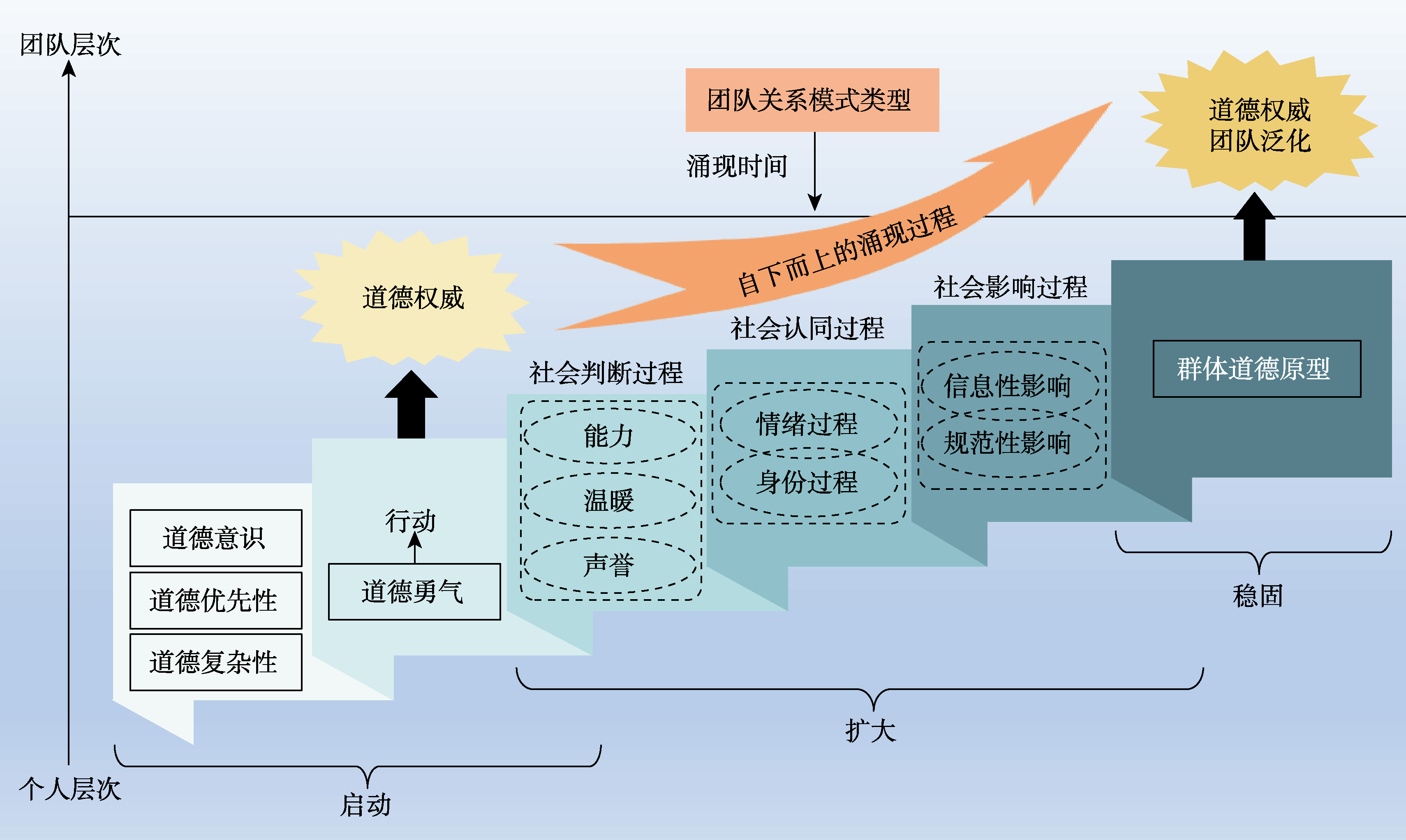
图3 研究2的理论框架
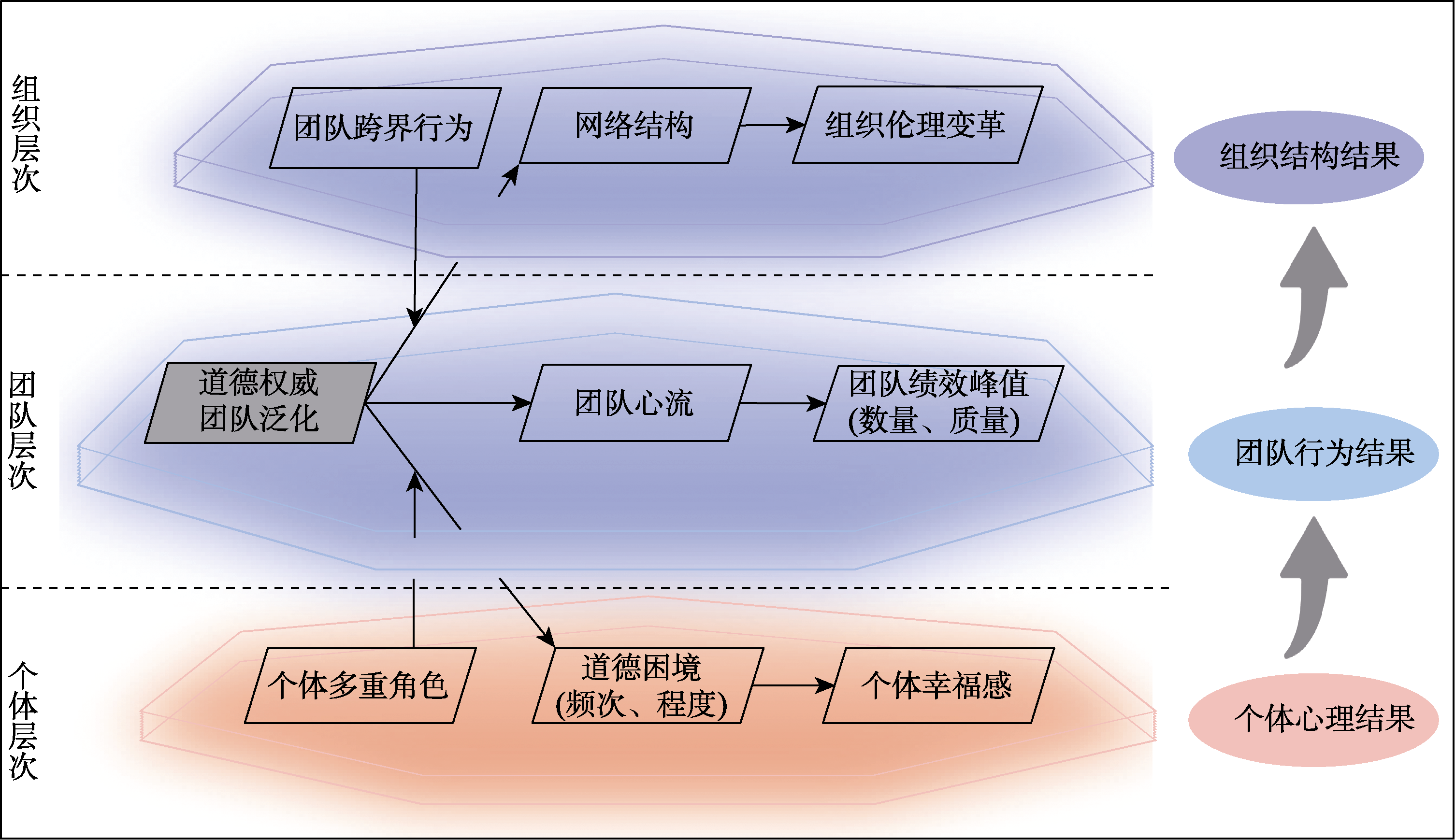
图4 研究3的理论模型
| [1] | 邓伟生. (2012). 斯坎伦论道德动机与道德的优先性. 现代哲学, 6, 72-80. |
| [2] | 哈特, H. L. A. (2006). 法、自由和道德 (支振锋译). 北京: 法律出版社. |
| [3] | 刘丙元. (2006). 教师道德权威及其重构. 教育导刊, 6, 8-11. |
| [4] | 莫飞平. (2002). 论道德权威. 江西社会科学, 4, 48-50. |
| [5] | 涂尔干, E. (2000). 社会分工论 (渠东译). 北京: 生活·读书·新知三联书店. |
| [6] | 王林平. (2010). 道德教化与职业团体的集体表象——迪尔凯姆对现代性问题的解决方式论析. 学习与探索, 6, 113-115. |
| [7] | 韦伯, M. (2010). 经济与社会 (闫克文译). 上海: 上海人民出版社. |
| [8] | Adams D. M. (2013). Ethics expertise and moral authority: Is there a difference?. The American Journal of Bioethics, 13(2), 27-28. |
| [9] |
Agarwal U. A., Gupta M., & Cooke F. L. (2022). Knowledge hide and seek: Role of ethical leadership, self-enhancement and job-involvement. Journal of Business Research, 141, 770-781.
doi: 10.1016/j.jbusres.2021.11.074 URL |
| [10] | Ancona D., Bresman H. & Kaeufer K. (2002). The comparative advantage of X-teams. MIT Sloan Management Review, 43, 33-40. |
| [11] |
Aquino K., & Reed II A. (2002). The self-importance of moral identity. Journal of Personality and Social Psychology, 83(6). 1423-1440.
pmid: 12500822 |
| [12] | Arendt, H. (2006). What is authority? In H. Arendt, & J. Kohn (Eds.), Between past and future: Eight essays in political thought (pp. 91-141).Penguin Books. |
| [13] | Bader, C. D., & Finke R. (2010). What does God require? Understanding religious context and morality. In S. Hitlin & S. Vaisey (Eds.), Handbook of the sociology of morality (pp. 241-254). Springer. |
| [14] |
Bartholomew J. N. (1981). A sociological view of authority in religious organizations. Review of Religious Research, 23(2), 118-132.
doi: 10.2307/3511923 URL |
| [15] |
Brantlinger E., Morton M. L., & Washburn S. (1999). Teachers' moral authority in classrooms:(Re) Structuring social interactions and gendered power. The Elementary School Journal, 99(5), 491-504.
doi: 10.1086/461937 URL |
| [16] |
Brink D. (1997). Moral motivation. Ethics, 108, 4-32.
doi: 10.1086/233786 URL |
| [17] |
Buzzelli C., & Johnston B. (2001). Authority, power, and morality in classroom discourse. Teaching and Teacher Education, 17(8), 873-884.
doi: 10.1016/S0742-051X(01)00037-3 URL |
| [18] | Clark K., Duckham M., Guillemin M., Hunter A., McVernon J., O’Keefe C., Warr D., & Waycott J. (2015). Guidelines for the ethical use of digital data in human research. Retrieved March 15, 2015, from https://apo.org.au/sites/default/files/resource-files/2015-03/apo-nid75590.pdf |
| [19] | Covey S. R. (2004). The 7 habits of highly effective people. New York, NY: Simon and Schuster. |
| [20] |
Cseh G. M., Phillips L. H., & Pearson D. G. (2015). Flow, affect and visual creativity. Cognition and Emotion, 29(2), 281-291.
doi: 10.1080/02699931.2014.913553 URL |
| [21] | Csikszentmihalyi M. (1990). Flow: The psychology of optimal experience. New York, NY: Harper & Row. |
| [22] |
Dingley J. C. (1997). Durkheim, Mayo, morality and management. Journal of Business Ethics, 16, 1117-1129.
doi: 10.1023/A:1005728102482 |
| [23] |
Duncan J., & West R. E. (2018). Conceptualizing group flow: A framework. Educational Research and Reviews, 13(1), 1-11.
doi: 10.5897/ERR URL |
| [24] |
Evans J. (2021). How professionals construct moral authority: Expanding boundaries of expert authority in stem cell science. Administrative Science Quarterly, 66(4), 989-1036.
doi: 10.1177/00018392211011441 URL |
| [25] |
Evans K. K., & Colgrove N. (2022). How to spot a usurper: Clinical ethics consultation and (true) moral authority. Christian Bioethics: Non-ecumenical Studies in Medical Morality, 28(2), 143-156.
doi: 10.1093/cb/cbac003 URL |
| [26] | Ferrari L. L. (1998). The influence of moral authority in international relations: A case study of the Catholic church under John Paul II [Unpublished doctoral dissertation]. Georgetown University. |
| [27] |
Fiske A. P., & Haslam N. (1996). Social cognition is thinking about relationships. Current Directions in Psychological Science, 5(5), 143-148.
doi: 10.1111/1467-8721.ep11512349 URL |
| [28] |
Frederick W. C. (1991). The moral authority of transnational corporate codes. Journal of Business Ethics, 10(3), 165-177.
doi: 10.1007/BF00383154 URL |
| [29] |
Gawronski B. (2022). Moral impressions and presumed moral choices: Perceptions of how moral exemplars resolve moral dilemmas. Journal of Experimental Social Psychology, 99, 104265.
doi: 10.1016/j.jesp.2021.104265 URL |
| [30] |
Gonzalez R. V. D. (2022). Innovative performance of project teams: The role of organizational structure and knowledge-based dynamic capability. Journal of Knowledge Management, 26(5), 1164-1186.
doi: 10.1108/JKM-03-2021-0259 URL |
| [31] |
Goodwin G. P., Piazza J., & Rozin P. (2014). Moral character predominates in person perception and evaluation. Journal of Personality and Social Psychology, 106(1), 148-168.
doi: 10.1037/a0034726 pmid: 24274087 |
| [32] |
Goss M. E. (1961). Influence and authority among physicians in an outpatient clinic. American Sociological Review, 26(1), 39-50.
doi: 10.2307/2090511 URL |
| [33] |
Hall R. B. (1997). Moral authority as a power resource. International Organization, 51(4), 591-622.
doi: 10.1162/002081897550465 URL |
| [34] |
Hansen M. T. (1999). The search-transfer problem: The role of weak ties in sharing knowledge across organization subunits. Administrative Science Quarterly, 44(1), 82-111.
doi: 10.2307/2667032 URL |
| [35] |
Hardy S. A., & Carlo G. (2005). Identity as a source of moral motivation. Human Development, 48(4), 232-256.
doi: 10.1159/000086859 URL |
| [36] |
Hargadon A. B. (1998). Firms as knowledge brokers: Lessons in pursuing continuous innovation. California Management Review, 40(3), 209-227.
doi: 10.2307/41165951 URL |
| [37] |
Hill R. P., & Watkins A. (2007). A simulation of moral behavior within marketing exchange relationships. Journal of the Academy of Marketing Science, 35, 417-429.
doi: 10.1007/s11747-007-0025-5 URL |
| [38] |
Hogg M. A., & Terry D. I. (2000). Social identity and self- categorization processes in organizational contexts. Academy of Management Review, 25(1), 121-140.
doi: 10.2307/259266 URL |
| [39] |
Hoppner J. J., & Vadakkepatt G. G. (2019). Examining moral authority in the marketplace: A conceptualization and framework. Journal of Business Research, 95, 417-427.
doi: 10.1016/j.jbusres.2018.07.045 URL |
| [40] |
Isserow J., & Klein C. (2017). Hypocrisy and moral authority. Journal of Ethics and Social Philosophy, 12(2), 191-222.
doi: 10.26556/jesp.v12i2 URL |
| [41] |
Jackson S. A., Thomas P. R., Marsh H. W., & Smethurst C. J. (2001). Relationships between flow, self-concept, psychological skills, and performance. Journal of Applied Sport Psychology, 13(2), 129-153.
doi: 10.1080/104132001753149865 URL |
| [42] | Karsenti B. (2012). Durkheim and the moral fact. In D. Fassin (Ed.), A companion to moral anthropology (pp. 19-36). John Wiley & Sons. |
| [43] |
Kouchaki M., & Smith I. H. (2024). Moral decision-making in organizations. Annual Review of Organizational Psychology and Organizational Behavior, 12, 45-72.
doi: 10.1146/orgpsych.2025.12.issue-1 URL |
| [44] | Kuzmin N. V. (2015). The moral authority of teacher in preparing students for patriotic education. Mediterranean Journal of Social Sciences, 6(3), 11-16. |
| [45] | Kwak D. J. (2004). Indoctrination revisited: In search of a new source of teachers' moral authority. Philosophy of Education Yearbook, 92-100. |
| [46] | Lakshman C. (2007). Organizational knowledge leadership: A grounded theory approach. Leadership & Organization Development Journal, 28(1), 51-75. |
| [47] |
Langlois A. J. (2007). Reciprocity in the justification of rights. Australian Journal of Human Rights, 13(1), 63-77.
doi: 10.1080/1323238X.2007.11910825 URL |
| [48] |
Lin C. S., Jin M., Huang P. C., & Xiao R. (2023). Does it take two to tango? The joint role of high-performance work systems and ethical leadership. Journal of Business Research, 156, 113536.
doi: 10.1016/j.jbusres.2022.113536 URL |
| [49] |
Lovett M. J., & Staelin R. (2016). The role of paid, earned, and owned media in building entertainment brands: Reminding, informing, and enhancing enjoyment. Marketing Science, 35(1), 142-157.
doi: 10.1287/mksc.2015.0961 URL |
| [50] |
Maclagan P. (2007). Hierarchical control or individuals' moral autonomy? Addressing a fundamental tension in the management of business ethics. Business Ethics: A European Review, 16(1), 48-61.
doi: 10.1111/beer.2007.16.issue-1 URL |
| [51] |
Marks M. A., DeChurch L. A., Mathieu J. E., Panzer F. J., & Alonso A. (2005). Teamwork in multiteam systems. Journal of Applied Psychology, 90(5), 964-971.
doi: 10.1037/0021-9010.90.5.964 pmid: 16162068 |
| [52] |
Mayberry T. C. (1970). God and moral authority. The Monist, 54(1), 106-123.
doi: 10.5840/monist19705415 URL |
| [53] | Mayer R. C. (1989). The crisis of authority: The nature of authority in liberal society [Unpublished doctoral dissertation]. Princeton University. |
| [54] | McCullough L. B. (1999). Moral authority, power, and trust in clinical ethics. The Journal of Medicine and Philosophy, 24(1), 3-10. |
| [55] | Michalowski III R. J. (2005). Teachers' moral authority: An undervalued resource for school order and safety [Unpublished doctoral dissertation]. City University of New York. |
| [56] |
Minton E. A., Johnson K. A., & Liu R. L. (2019). Religiosity and special food consumption: The explanatory effects of moral priorities. Journal of Business Research, 95, 442-454.
doi: 10.1016/j.jbusres.2018.07.041 URL |
| [57] |
Mulder L. B. (2008). The difference between punishments and rewards in fostering moral concerns in social decision making. Journal of Experimental Social Psychology, 44(6), 1436-1443.
doi: 10.1016/j.jesp.2008.06.004 URL |
| [58] | Nässén N., & Rambaree K. (2021). Greta Thunberg and the generation of moral authority: A systematic literature review on the characteristics of Thunberg’s leadership. Sustainability, 13(20), 11326. |
| [59] |
O'Reilly C. A., & Caldwell D. F. (1979). Informational influence as a determinant of perceived task characteristics and job satisfaction. Journal of Applied Psychology, 64(2), 157-165.
doi: 10.1037/0021-9010.64.2.157 URL |
| [60] |
Oser F., & Althof W. (1993). Trust in advance: On the professional morality of teachers. Journal of Moral Education, 22(3), 253-275.
doi: 10.1080/0305724930220306 URL |
| [61] |
Pellegrino E. D. (2001). The internal morality of clinical medicine: a paradigm for the ethics of the helping and healing professions. The Journal of Medicine and Philosophy, 26(6), 559-579.
doi: 10.1076/jmep.26.6.559.2998 URL |
| [62] | Pinnegar S. (2005). Identity development, moral authority and the teacher educator. In G. F. Hoban (Ed.), The missing links in teacher education design: Developing a multi-linked conceptual framework (pp. 259-279). Dordrecht. |
| [63] | Power, C. (2013). Democratic schools and the problem of moral authority. In W. M. Kurtines, J. Gewirtz & J. B. Lamb (Eds.), Handbook of moral behavior and development (pp. 317-333). Psychology Press. |
| [64] |
Reynolds S. J. (2006). A neurocognitive model of the ethical decision making process: Implications for study and practice. Journal of Applied Psychology, 91(4), 737-748.
pmid: 16834502 |
| [65] |
Saroglou V., & Craninx M. (2021). Religious moral righteousness over care: A review and a meta-analysis. Current Opinion in Psychology, 40, 79-85.
doi: 10.1016/j.copsyc.2020.09.002 pmid: 33039946 |
| [66] |
Schaumberg R. L., & Wiltermuth S. S. (2014). Desire for a positive moral self-regard exacerbates escalation of commitment to initiatives with prosocial aims. Organizational Behavior and Human Decision Processes, 123(2), 110-123.
doi: 10.1016/j.obhdp.2013.10.012 URL |
| [67] |
Schwartz M. S. (2005). Universal moral values for corporate codes of ethics. Journal of Business Ethics, 59, 27-44.
doi: 10.1007/s10551-005-3403-2 URL |
| [68] |
Seeman M. (1953). Role conflict and ambivalence in leadership. American Sociological Review, 18(4), 373-380.
doi: 10.2307/2087549 URL |
| [69] |
Sekerka L. E., Bagozzi R. P., & Charnigo R. (2009). Facing ethical challenges in the workplace: Conceptualizing and measuring professional moral courage. Journal of Business Ethics, 89, 565-579.
doi: 10.1007/s10551-008-0017-5 URL |
| [70] | Sindle J. L. (2000). Moral authority as a power resource [Unpublished doctoral dissertation]. University of Toronto. |
| [71] |
Skitka L. J., Bauman C. W., & Lytle B. L. (2009). Limits on legitimacy: Moral and religious convictions as constraints on deference to authority. Journal of Personality and Social Psychology, 97(4), 567-578.
doi: 10.1037/a0015998 pmid: 19785478 |
| [72] |
Solinger O. N., Jansen P., & Cornelissen J. P. (2020). The emergence of moral leadership. Academy of Management Review, 45(3), 504-527.
doi: 10.5465/amr.2016.0263 URL |
| [73] |
Sonenshein S. (2007). The role of construction, intuition, and justification in responding to ethical issues at work: The sensemaking-intuition model. Academy of Management Review, 32(4), 1022-1040.
doi: 10.5465/amr.2007.26585677 URL |
| [74] | Sorenson, G., Goethals G., & Haber P. (2011). The enduring and elusive quest for a general theory of leadership:Initial efforts and new horizons. In A. Bryman, D. Collinson, K. Grint, B. Jackson, & M. Uhl-Bien (Eds.), The Sage handbook of leadership (pp. 29-36). Sage. |
| [75] |
Sosik J. J., Kahai S. S., & Avolio B. J. (1999). Leadership style, anonymity, and creativity in group decision support systems: The mediating role of optimal flow. The Journal of Creative Behavior, 33(4), 227-256.
doi: 10.1002/jocb.1999.33.issue-4 URL |
| [76] | Sowers E. (2019). Moral authority in scientific research (Bachelor's thesis). Carroll College. |
| [77] |
Sussman S. W., & Siegal W. S. (2003). Informational influence in organizations: An integrated approach to knowledge adoption. Information Systems Research, 14(1), 47-65.
doi: 10.1287/isre.14.1.47.14767 URL |
| [78] |
Swann C., Crust L., Jackman P., Vella S. A., Allen M. S., & Keegan R. (2017). Psychological states underlying excellent performance in sport: Toward an integrated model of flow and clutch states. Journal of Applied Sport Psychology, 29(4), 375-401.
doi: 10.1080/10413200.2016.1272650 URL |
| [79] |
van den Hout, J. J., Davis, O. C., & Weggeman, M. C. (2018). The conceptualization of team flow. The Journal of Psychology, 152(6), 388-423.
doi: 10.1080/00223980.2018.1449729 URL |
| [80] |
Wall G. (1975). Moral authority and moral éducation. Journal of Moral Education, 4(2), 95-99.
doi: 10.1080/0305724750040201 URL |
| [81] | Werhane P. H. (1999). Moral imagination and management decision-making. New York, NY: Oxford University Press. |
| [82] |
Whitehead A. L., & Baker J. O. (2012). Homosexuality, religion, and science: Moral authority and the persistence of negative attitudes. Sociological Inquiry, 82(4), 487-509.
doi: 10.1111/soin.2012.82.issue-4 URL |
| [83] | Zagzebski, L. T. (2012). The moral authority of exemplars. In J. A. Van Slyke, G. Peterson, W. S. Brown, K. S. Reimer, & M. Spezio (Eds.), Theology and the science of moral action (pp. 117-129). Routledge. |
| [1] | 欧阳哲, 程鹏, 徐祖辉. 企业不当行为何以产生溢出效应?基于归因认知过程的解释[J]. 心理科学进展, 2026, 34(5): 875-889. |
| [2] | 王海江, 邹浩云, 何宇恒. 薪酬倒挂与组织社会化:一个多视角整合的框架[J]. 心理科学进展, 2026, 34(4): 608-625. |
| [3] | 韩翼, 马朝翊, 宗树伟. 领导对员工−生成式人工智能建议的反应机制:基于社会比较视角多层次研究[J]. 心理科学进展, 2026, 34(4): 626-646. |
| [4] | 赵红丹, 马允硕. 年长员工向年轻同事知识寻求的驱动机制[J]. 心理科学进展, 2026, 34(4): 742-760. |
| [5] | 张剑, 彭帅, 付瑞冰. 组织情绪能力对工作不安全感驱动后效的影响机制[J]. 心理科学进展, 2026, 34(3): 381-403. |
| [6] | 宋一晓, 曾铭灼, 苏涛. 机会抑或威胁? 人与AI协作系统对员工工作效能影响的元分析[J]. 心理科学进展, 2026, 34(3): 461-486. |
| [7] | 冯娇娇, 刘轶, 刘军. 知识颠覆的概念内涵、形成与影响机制[J]. 心理科学进展, 2026, 34(2): 210-226. |
| [8] | 聂琦, 张捷. 工间微休息的双刃剑效应及其调节机制[J]. 心理科学进展, 2026, 34(1): 29-43. |
| [9] | 孙芳, 李绍龙, 龙立荣, 雷宣, 曾祥麟, 黄夏虹. 人工智能反馈寻求行为的驱动机制及其影响效应[J]. 心理科学进展, 2025, 33(10): 1647-1662. |
| [10] | 侯楠, 高中华, 杨皎平, 李豪. 年长员工数字技术工作不安全感的来源与影响后效[J]. 心理科学进展, 2025, 33(9): 1514-1525. |
| [11] | 张莹, 张剑. 挑战性和阻碍性评价的职业冲击对可持续职业生涯的影响及其诱发机制[J]. 心理科学进展, 2025, 33(9): 1526-1540. |
| [12] | 钟杰, 郑晓明. 数智化背景下的谦逊型领导对职业可持续性的影响[J]. 心理科学进展, 2025, 33(8): 1292-1305. |
| [13] | 岳思怡, 孙宇, 战祥平, 马红宇, 王怀勇. 权力的动态化体验:权力波动的影响效应及理论解释[J]. 心理科学进展, 2025, 33(8): 1379-1394. |
| [14] | 吴一丹, 李斌. 员工网络知识寻求:概念、前因及形成机制[J]. 心理科学进展, 2025, 33(8): 1395-1407. |
| [15] | 姜平, 宗宽道, 赵琛徽, 龙立荣. 化阻力为助力:企业数字化转型中反向师徒制的有效性及作用机制[J]. 心理科学进展, 2025, 33(7): 1120-1139. |
| 阅读次数 | ||||||
|
全文 |
|
|||||
|
摘要 |
|
|||||
