

ISSN 1671-3710
CN 11-4766/R
主办:中国科学院心理研究所
出版:科学出版社
CN 11-4766/R
主办:中国科学院心理研究所
出版:科学出版社
心理科学进展 ›› 2026, Vol. 34 ›› Issue (5): 836-855.doi: 10.3724/SP.J.1042.2026.0836 cstr: 32111.14.2026.0836
洪傲然1, 冯梓煜1, 王永贵2( )
)
收稿日期:2025-10-17
出版日期:2026-05-15
发布日期:2026-03-20
通讯作者:
王永贵, E-mail: ygwang@zjsu.edu.cn基金资助:
HONG Aoran1, FENG Ziyu1, WANG Yonggui2()
Received:2025-10-17
Online:2026-05-15
Published:2026-03-20
摘要:
生成式AI的发展显著提升了营销从业者的内容创作能力。但网红种草营销作为扩大内需、促进消费的重要引擎, 正因内容创作同质化问题而陷入销售转化率低迷的现实困境。本研究提出, 识别多模态商业内容的最优区分阈值, 并应用生成式AI实现最优区分创作, 是破解这一困境的关键路径。为此, 本研究基于社交媒体可供性理论和最优区分理论, 创新性地运用多模态机器学习、量化营销及行为实验等混合研究方法, 致力于:(1)识别多模态商业内容的特征维度, 测量多模态商业内容相似性; (2)厘清多模态商业内容相似性对网红种草营销效果的影响机制, 进而确定相似性的最优区分阈值; (3)探究如何利用生成式AI创作具备最优区分性的多模态商业内容。研究成果将完善网红种草营销效果的理论分析框架, 为破解实践难题提供切实可行的科学方案, 不仅契合当下数字经济时代“AI+消费”商业生态发展的核心需求, 更对扩大内需和提振居民消费具有显著的实践价值。
中图分类号:
洪傲然, 冯梓煜, 王永贵. (2026). 基于生成式AI的多模态商业内容最优区分性对网红种草营销效果的影响. 心理科学进展 , 34(5), 836-855.
HONG Aoran, FENG Ziyu, WANG Yonggui. (2026). The influence of optimal distinctiveness of multi-modal sponsored content on influencer marketing effectiveness based on generative AI. Advances in Psychological Science, 34(5), 836-855.

图1 人工创作的相似商业内容
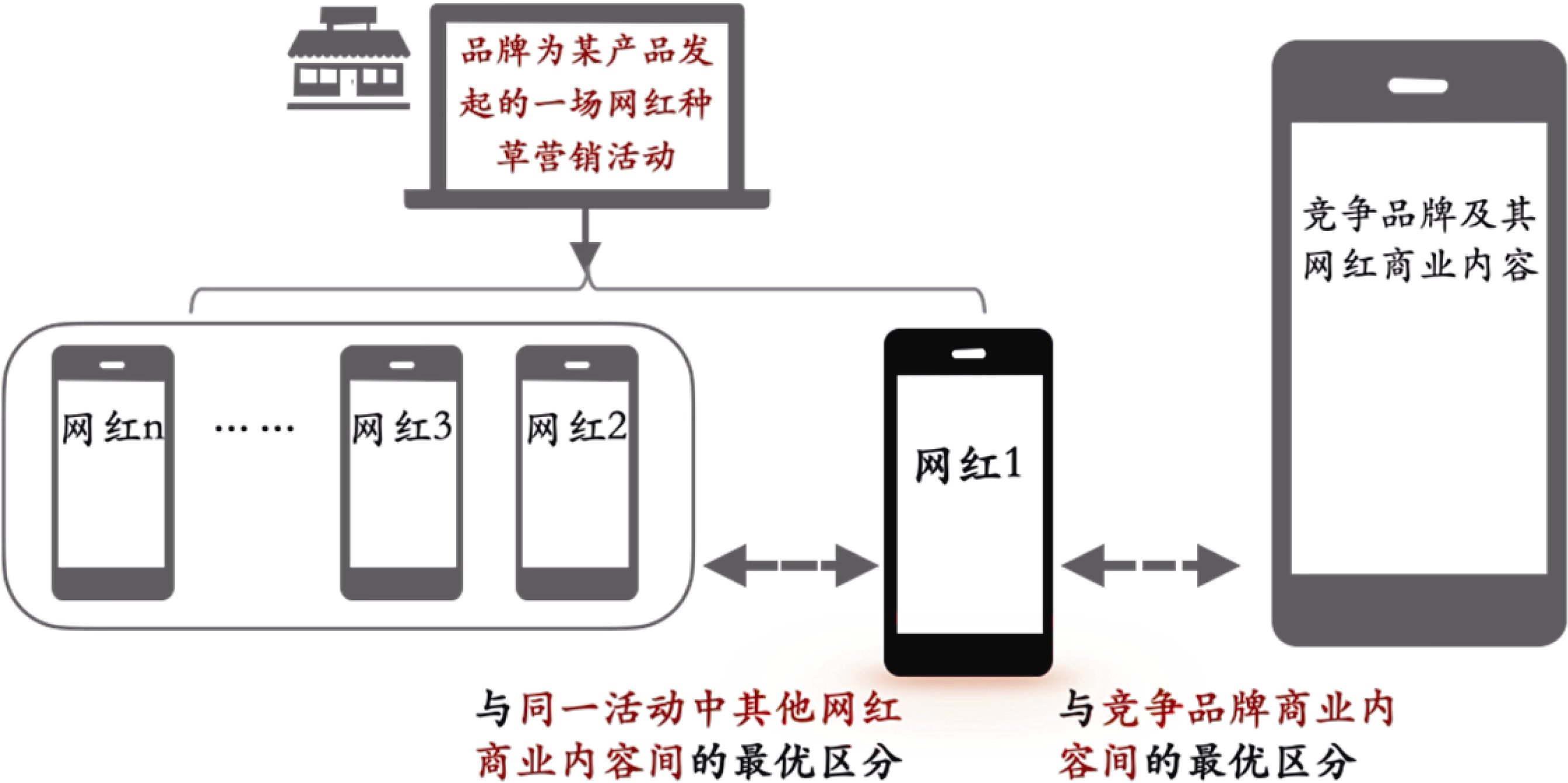
图2 网红种草营销活动中商业内容最优区分
| 参考文献 | 品牌因素 | 网红因素 | 内容因素 | 是否采用自然语言处理 | 研究方法 | 主要结论 |
|---|---|---|---|---|---|---|
| (2021) | √ | 否 | 问卷法 | 网红吸引力、声望和专业知识促进准社会关系建立, 从而提升用户购买意愿。 | ||
| (2019) | √ | 否 | 实验法、问卷法 | 网红与品牌的契合度对用户行为具有正向影响。 | ||
| (2023) | √ | 是, 文本模态 | 平台二手数据和实验法 | 感官语言增加了消费者的社交媒体参与及赞助产品购买意愿。 | ||
| (2024) | √ | √ | 是, 文本模态 | 平台二手数据和实验法 | 高唤醒性语言增加了对低粉丝量网红的内容参与, 但降低了高粉丝量网红的内容参与。 | |
| (2025) | √ | √ | 否 | 实验数据 | 网红的粉丝量正向调节消费者对更知名品牌的购买意愿。 | |
| (2023) | √ | 是, 对多模态进行人工赋值 | 平台多模态二手数据的人工编码 | 赞助披露促进用户参与, 品牌出现阶段、内容定制程度、内容中的主观感受都会损害赞助视频的数字参与。 | ||
| (2019) | √ | √ | 否 | 平台二手数据数量特征 | 赞助目的为提高知名度时, 网红专业知识促进用户参与, 赞助目的为增加试用率时, 享乐内容与用户参与正相关。 | |
| (2022) | √ | √ | √ | 否 | 平台二手数据数量特征 | 内容原创性、粉丝数量和赞助披露会提高网红营销效果, 新产品发布、发文频率和内容情感都对网红营销效果产生倒u型调节作用 |
| (2023) | √ | √ | 否 | 实验法 | 消费者对虚拟网红代言的品牌态度小于真人网红, 理性语言可以减弱其与真人网红的差别。 | |
| (2023) | √ | √ | 否 | 抖音数据平台 | 信息型网红在品牌竞争力较强时, 比娱乐型网红产生更多的在线销售。 | |
| (2023) | √ | 是, 文本模态 | 平台二手数据 | 信息双边性影响了消费者对种草产品的购买行为和对网红的关注行为。 | ||
| (2024) | √ | 是, 对多模态进行人工赋值 | 平台多模态二手数据的人工编码 | 内容模态(图文还是视频)、内容享乐价值、推广激励及推广意图对消费者参与行为有显著的正向影响。 | ||
| 本研究 | √ | √ | √ | 是, 应用多模态机器学习方法 | 平台二手数据、访谈法、实验法 | 商业内容相似性对网红种草营销效果存在倒U型作用。 |
表1 网红种草营销效果影响因素的文献汇总
| 参考文献 | 品牌因素 | 网红因素 | 内容因素 | 是否采用自然语言处理 | 研究方法 | 主要结论 |
|---|---|---|---|---|---|---|
| (2021) | √ | 否 | 问卷法 | 网红吸引力、声望和专业知识促进准社会关系建立, 从而提升用户购买意愿。 | ||
| (2019) | √ | 否 | 实验法、问卷法 | 网红与品牌的契合度对用户行为具有正向影响。 | ||
| (2023) | √ | 是, 文本模态 | 平台二手数据和实验法 | 感官语言增加了消费者的社交媒体参与及赞助产品购买意愿。 | ||
| (2024) | √ | √ | 是, 文本模态 | 平台二手数据和实验法 | 高唤醒性语言增加了对低粉丝量网红的内容参与, 但降低了高粉丝量网红的内容参与。 | |
| (2025) | √ | √ | 否 | 实验数据 | 网红的粉丝量正向调节消费者对更知名品牌的购买意愿。 | |
| (2023) | √ | 是, 对多模态进行人工赋值 | 平台多模态二手数据的人工编码 | 赞助披露促进用户参与, 品牌出现阶段、内容定制程度、内容中的主观感受都会损害赞助视频的数字参与。 | ||
| (2019) | √ | √ | 否 | 平台二手数据数量特征 | 赞助目的为提高知名度时, 网红专业知识促进用户参与, 赞助目的为增加试用率时, 享乐内容与用户参与正相关。 | |
| (2022) | √ | √ | √ | 否 | 平台二手数据数量特征 | 内容原创性、粉丝数量和赞助披露会提高网红营销效果, 新产品发布、发文频率和内容情感都对网红营销效果产生倒u型调节作用 |
| (2023) | √ | √ | 否 | 实验法 | 消费者对虚拟网红代言的品牌态度小于真人网红, 理性语言可以减弱其与真人网红的差别。 | |
| (2023) | √ | √ | 否 | 抖音数据平台 | 信息型网红在品牌竞争力较强时, 比娱乐型网红产生更多的在线销售。 | |
| (2023) | √ | 是, 文本模态 | 平台二手数据 | 信息双边性影响了消费者对种草产品的购买行为和对网红的关注行为。 | ||
| (2024) | √ | 是, 对多模态进行人工赋值 | 平台多模态二手数据的人工编码 | 内容模态(图文还是视频)、内容享乐价值、推广激励及推广意图对消费者参与行为有显著的正向影响。 | ||
| 本研究 | √ | √ | √ | 是, 应用多模态机器学习方法 | 平台二手数据、访谈法、实验法 | 商业内容相似性对网红种草营销效果存在倒U型作用。 |
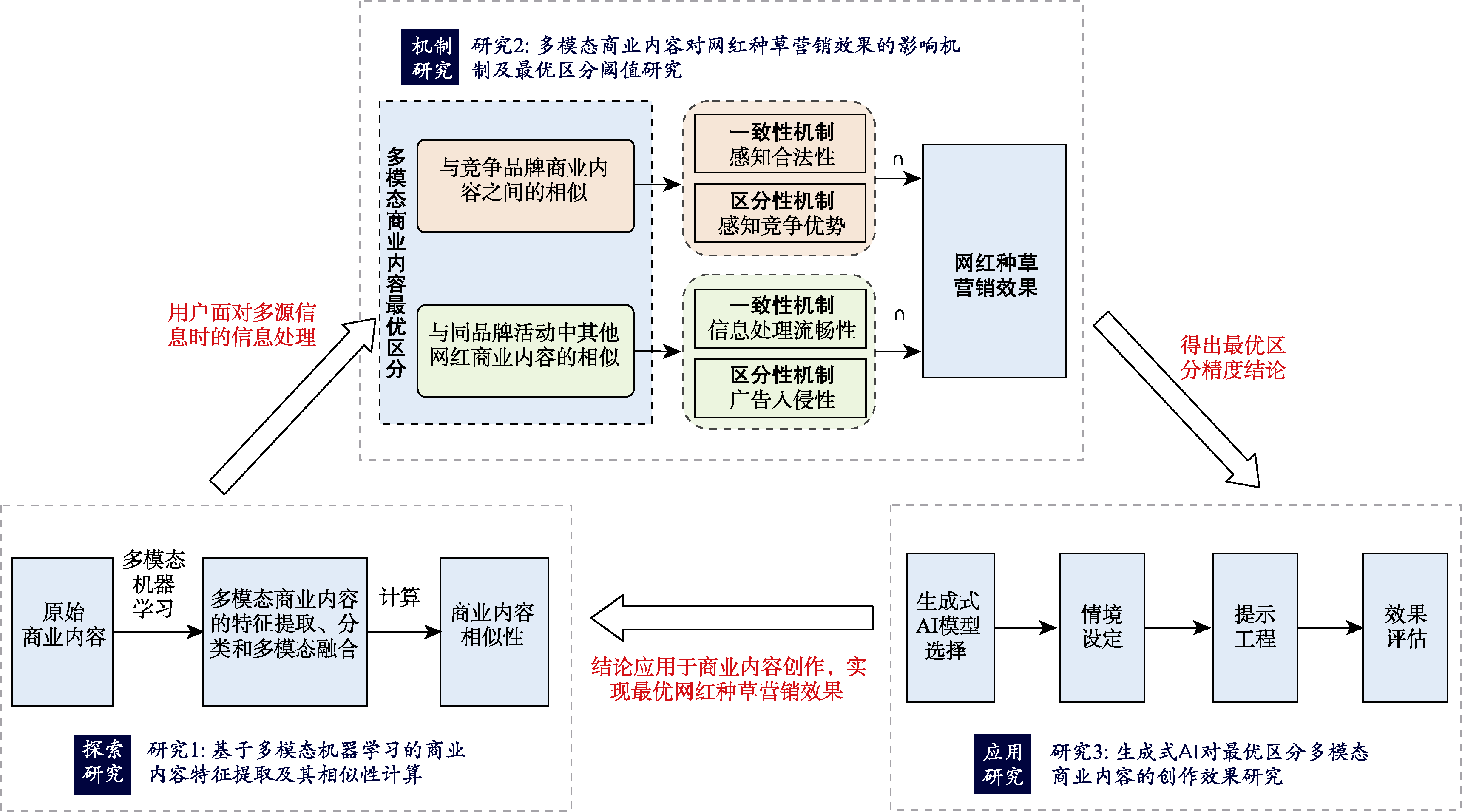
图3 整体研究框架
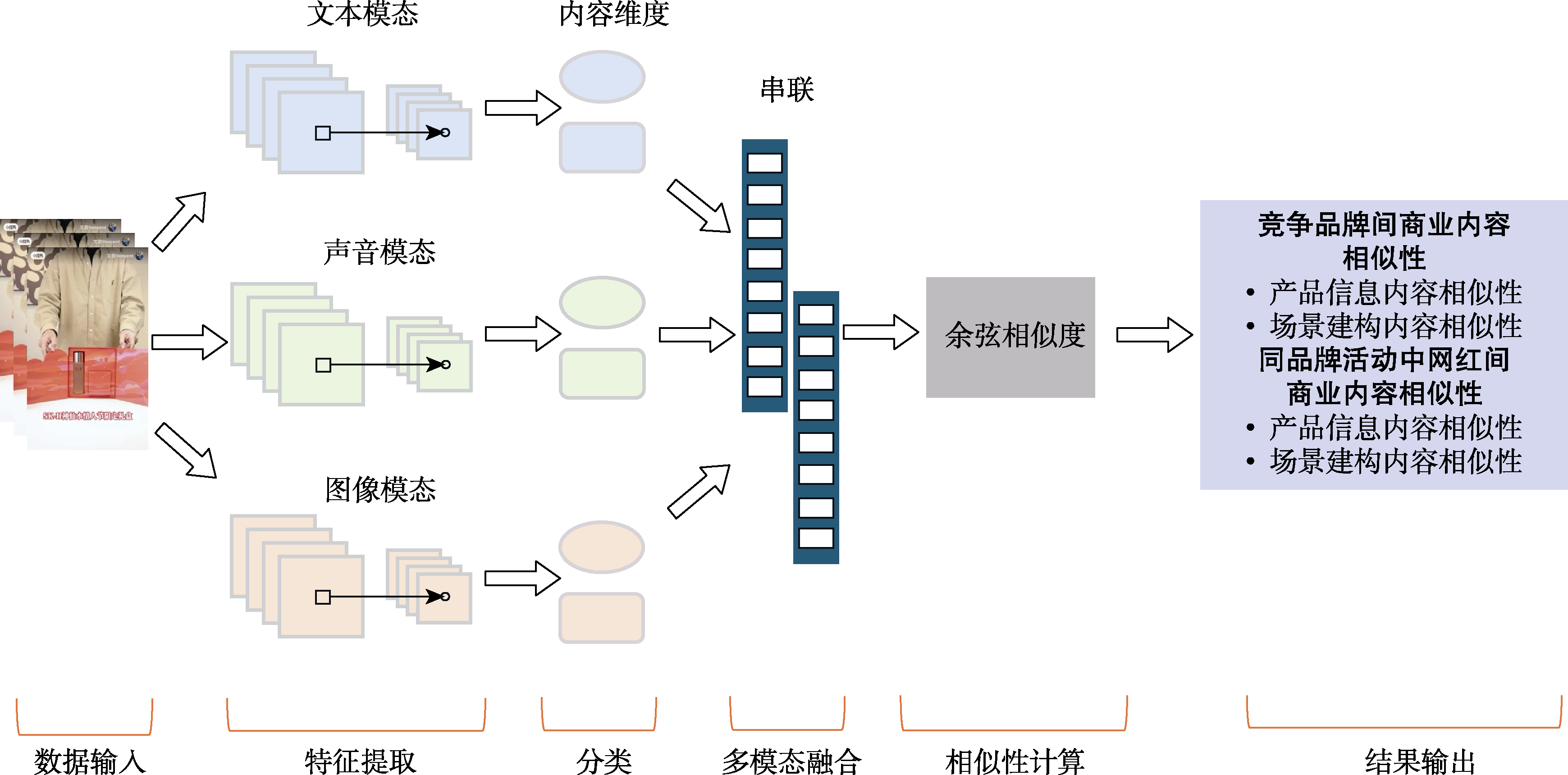
图4 研究1的关键步骤概述
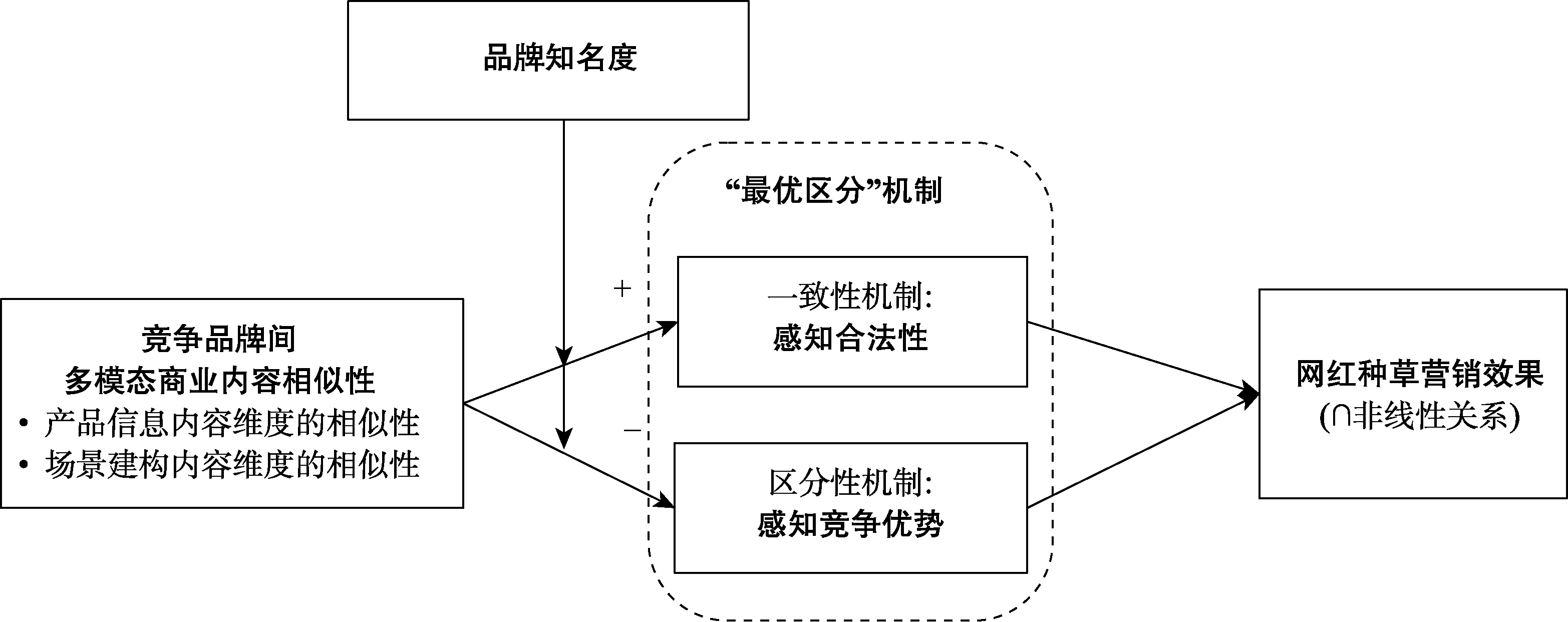
图5 研究2a的理论框架
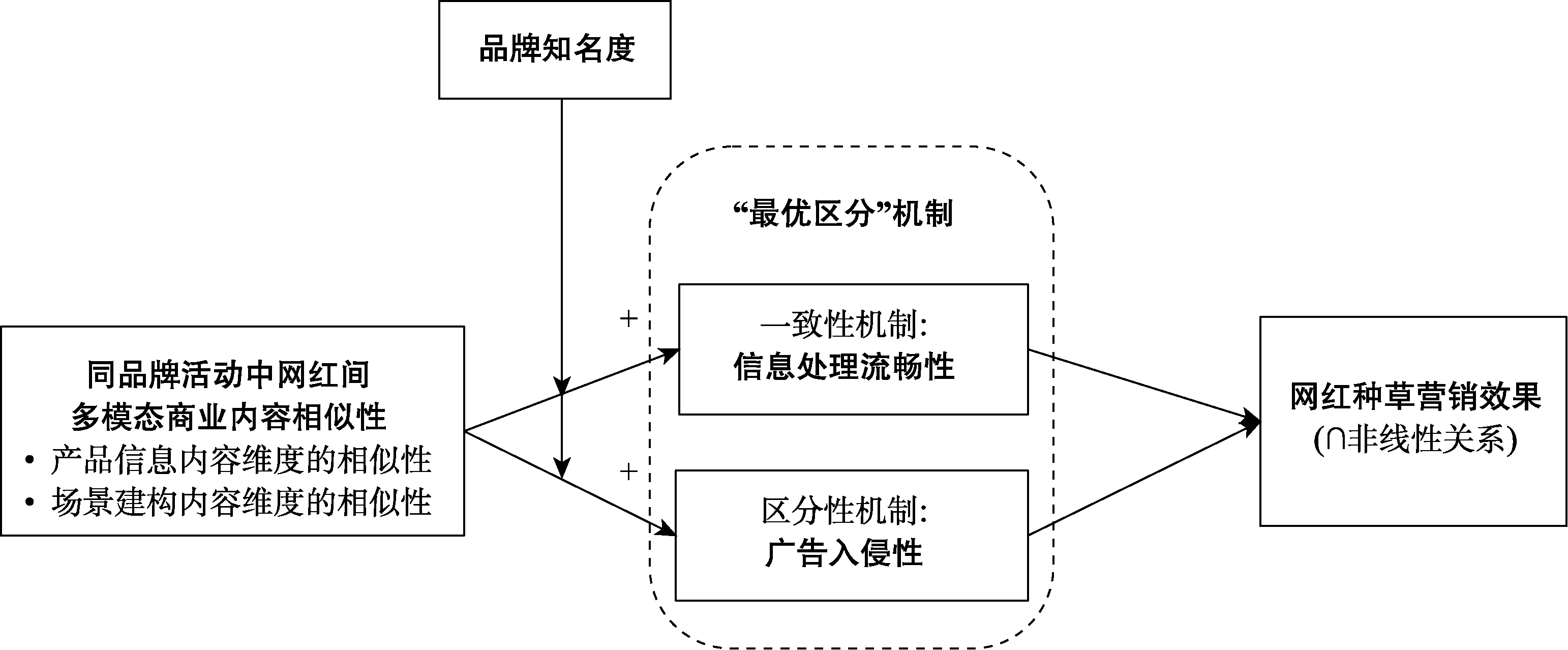
图6 研究2b的理论框架
| [1] | 郭海, 沈睿, 王栋晗, 陈叙同. (2018). 组织合法性对企业成长的“双刃剑”效应研究. 南开管理评论, 21(5), 16-29. |
| [2] | 贾微微, 别永越. (2021). 网红经济视域下的影响者营销:研究述评与展望. 外国经济与管理, 43(1), 23-43. |
| [3] | 廖俊云, 黄敏学, 彭捷. (2017). 企业虚拟品牌社区参与对消费者社区承诺的影响研究. 管理评论, 29(10), 73-83. |
| [4] | 刘德文, 高维和, 闵凉宇. (2022). 声音特征和文本策略的说服效应研究. 管理学报, 19(9), 1373-1381+1408. |
| [5] | 刘凤军, 孟陆, 陈斯允, 段珅. (2020). 网红直播对消费者购买意愿的影响及其机制研究. 管理学报, 17(1), 94-104. |
| [6] | 柳武妹, 黄河清, 叶富荣. (2020). 消费者行为研究中的田野实验:概念、操作介绍与开展建议. 外国经济与管理, 42(3), 35-56. |
| [7] | 孟陆, 刘凤军, 陈斯允, 段珅. (2020). 我可以唤起你吗——不同类型直播网红信息源特性对消费者购买意愿的影响机制研究. 南开管理评论, 23(1), 131-143. |
| [8] | 冉雅璇, 董林康, 黄雨婷, 向力子. (2024). “声”入人心:声音的营销效应、机制与自动提取技术. 外国经济与管理, 46(11), 85-102. |
| [9] | 沈鹏熠, 聂烜, 童聪聪, 许基南. (2024). “真心实意”还是“虚情假意”?网红隐性广告赞助披露对消费者品牌态度的双刃剑效应. 南开管理评论, 27(7), 15-26+38. |
| [10] | 汪旭晖, 陈鑫. (2018). 用户生成内容的图文匹配对消费者感知有用性的影响. 管理科学, 31(01), 101-115. |
| [11] | 徐婕, 肖莉. (2022). 一画胜千言:图像数据在营销领域的应用. 外国经济与管理, 44(9), 51-69. |
| [12] | 杨强, 霍佳乐, 江燕伶, 丰超, 肖久灵. (2023). 如何讲述产品缺点——“种草”短视频的信息双边性对消费者关注行为和购买行为的不对称影响. 南开管理评论, 26(6), 48-62. |
| [13] | 张红红, 宫秀双, 陆佳雯. (2024). 影响者生成内容对消费者参与行为的影响研究. 管理评论, 36(5), 126-136. |
| [14] |
Adaval R., & Wyer R. S., Jr. (1998). The role of narratives in consumer information processing. Journal of Consumer Psychology, 7(3), 207-245.
doi: 10.1207/s15327663jcp0703_01 URL |
| [15] | Alina J. M., & Ioan P. (2013). Schema congruity-a basis for evaluating ambient advertising effectiveness. Annals of the University of Oradea: Economic Science, 22(1), 1765-1774. |
| [16] |
Arora N., Chakraborty I., & Nishimura Y. (2025). AI-human hybrids for marketing research: Leveraging large language models (LLMs) as collaborators. Journal of Marketing, 89(2), 43-70.
doi: 10.1177/00222429241276529 URL |
| [17] |
Aw E. C., & Chuah S. H. (2021). “Stop the unattainable ideal for an ordinary me!” Fostering parasocial relationships with social media influencers: The role of self-discrepancy. Journal of Business Research, 132, 146-157.
doi: 10.1016/j.jbusres.2021.04.025 URL |
| [18] | Bloomberg Intelligence. (2023, June 9). Generative AI to become a $1.3 trillion market by 2032, research finds. Bloomberg L.P. https://www.newfortunetimes.com/generative-ai-to-become-a-1-3-trillion-market-by-2032-bloomberg-intelligence. |
| [19] |
Boughanmi K., & Ansari A. (2021). Dynamics of musical success: A machine learning approach for multimedia data fusion. Journal of Marketing Research, 58(6), 1034-1057.
doi: 10.1177/00222437211016495 URL |
| [20] |
Boulongne R., & Durand R. (2021). Evaluating ambiguous offerings. Organization Science, 32(2), 257-272.
doi: 10.1287/orsc.2020.1402 URL |
| [21] |
Breves P. L., Liebers N., Abt M., & Kunze A. (2019). The perceived fit between Instagram influencers and the endorsed brand. Journal of Advertising Research, 59(4), 440-454.
doi: 10.2501/JAR-2019-030 URL |
| [22] |
Brewer M. B. (1991). The social self on being the same and different at the same time. Personality and Social Psychology Bulletin, 17(5), 475-482.
doi: 10.1177/0146167291175001 URL |
| [23] |
Brouthers L. E., O’Donnell E., & Hadjimarcou J. (2005). Generic product strategies for emerging market exports into triad nation markets: A mimetic isomorphism approach. Journal of Management Studies, 42(1), 225-245.
doi: 10.1111/joms.2005.42.issue-1 URL |
| [24] |
Brynjolfsson E., Hui X., & Liu M. (2019). Does machine translation affect international trade? Evidence from a large digital platform. Management Science, 65(12), 5449-5460.
doi: 10.1287/mnsc.2019.3388 URL |
| [25] |
Bu J., Zhao E. Y., Li K. J., & Li J. (2021). Multilevel optimal distinctiveness: Examining the impact of within- and between-organization distinctiveness of product design on market performance. Strategic Management Journal, 43(9), 1793-1822.
doi: 10.1002/smj.v43.9 URL |
| [26] |
Cascio Rizzo G. L., Berger J., De Angelis M., & Pozharliev R. (2023). How sensory language shapes influencer’s impact. Journal of Consumer Research, 50(4), 810-825.
doi: 10.1093/jcr/ucad017 URL |
| [27] |
Cascio Rizzo G. L., Villarroel Ordenes F., Pozharliev R., De Angelis M., & Costabile M. (2024). How high-arousal language shapes micro-versus macro-influencers’ impact. Journal of Marketing, 88(4), 107-128.
doi: 10.1177/00222429231207636 URL |
| [28] | Cashion F, O’Brien J. (2024, December 12). Generative AI takes off with marketers. American Marketing Association (AMA) Marketing News. https://www.ama.org/marketing-news/generative-ai-takes-off-with-marketers |
| [29] |
Cennamo C., & Santalo J. (2013). Platform competition: Strategic trade-offs in platform markets. Strategic Management Journal, 34(11), 1331-1350.
doi: 10.1002/smj.2013.34.issue-11 URL |
| [30] |
Ceylan M., & Hayran C. (2025). Social media influencer marketing: The role of influencer type, brand popularity, and consumers' need for uniqueness. International Journal of Advertising, 44(7), 1366-1393.
doi: 10.1080/02650487.2024.2449311 URL |
| [31] |
Chan C., Berger J., & Van Boven L. (2012). Identifiable but not identical: Combining social identity and uniqueness motives in choice. Journal of Consumer Research, 39(3), 561-573.
doi: 10.1086/664804 URL |
| [32] |
Chan J. (2025). AI-generated imagery in sustainable gastronomy tourism: A study from bottom-up to top-down processing. Tourism Management, 108, 105093.
doi: 10.1016/j.tourman.2024.105093 URL |
| [33] |
Chen Y., Wang H., Rao Hill S., & Li B. (2023). Consumer attitudes toward AI-generated ads: Appeal types, self-efficacy and AI’s social role. Journal of Business Research, 185, 114867.
doi: 10.1016/j.jbusres.2024.114867 URL |
| [34] |
Chen Z., & Chan J. (2024). Large language model in creative work: The role of collaboration modality and user expertise. Management Science, 70(12), 9101-9117.
doi: 10.1287/mnsc.2023.03014 URL |
| [35] |
Chung J. J., Ding Y., & Kalra A. (2023). I really know you: How influencers can increase audience engagement by referencing their close social ties. Journal of Consumer Research, 50(4), 683-703.
doi: 10.1093/jcr/ucad019 URL |
| [36] |
Deephouse D. L. (1999). To be different, or to be the same? It’s a question (and theory) of strategic balance. Strategic Management Journal, 20(2), 147-166.
doi: 10.1002/(ISSN)1097-0266 URL |
| [37] | Dell’Acqua F., Ayoubi C., Lifshitz H., Sadun R., Mollick E., Mollick L.,... Lakhani K. R. (2023). Navigating the jagged technological frontier: Field experimental evidence of the effects of AI on knowledge worker productivity and quality. Harvard Business School Working Paper No. 24-013. |
| [38] | De Pelsmacker P., Geuens M., & Anckaert P. (2002). Media context and advertising effectiveness: The role of context appreciation and context-ad similarity. Journal of Advertising, 31(2), 49-61. |
| [39] |
Dong B., Zhuang M., Fang E. E., & Huang M. (2024). Tales of two channels: Digital advertising performance between AI recommendation and user subscription channels. Journal of Marketing, 88(2), 141-162.
doi: 10.1177/00222429231190021 URL |
| [40] | Ducoffe R. H. (1996). Advertising value and advertising on the web. Journal of Advertising Research, 36(5), 21-35. |
| [41] |
Durand R., & Kremp P.-A. (2016). Classical deviation: Organizational and individual status as antecedents of conformity. Academy of Management Journal, 59(1), 65-89.
doi: 10.5465/amj.2013.0767 URL |
| [42] | Esser P., Chiu J., Atighehchian P., Granskog J., & Germanidis A. (2023). Structure and content-guided video synthesis with diffusion models. 2023 IEEE/CVF International Conference on Computer Vision (ICCV), 7312-7322. |
| [43] |
Farace S., Ordenes F. V., Herhausen D., Grewal D., & De Ruyter K. (2026). Standing out while fitting in: Visual design of text overlays in social media communication. Journal of Marketing, 90(1), 132-151.
doi: 10.1177/00222429251322773 URL |
| [44] | Gamage T. C., & Ashill N. J. (2022). Sponsored-influencer marketing: Effects of the commercial orientation of influencer-created content on followers' willingness to search for information. Journal of Product & Brand Management, 32(2), 316-329. |
| [45] |
Haans R. F. J. (2019). What’s the value of being different when everyone is? The effects of distinctiveness on performance in homogeneous versus heterogeneous categories. Strategic Management Journal, 40(1), 3-27.
doi: 10.1002/smj.2019.40.issue-1 URL |
| [46] |
He L., Cong F., Liu Y., & Zhou X. (2010). The pursuit of optimal distinctiveness and consumer preferences. Scandinavian Journal of Psychology, 51(5), 411-417.
doi: 10.1111/j.1467-9450.2009.00802.x pmid: 20146774 |
| [47] |
Hekkert P., Snelders D., & van Wieringen, P. C. W. (2003). “Most advanced, yet acceptable”: Typicality and novelty as joint predictors of aesthetic preference in industrial design. British Journal of Psychology, 94(1), 111-124.
doi: 10.1348/000712603762842147 URL |
| [48] |
Hughes C., Swaminathan V., & Brooks G. (2019). Driving brand engagement through online social influencers: An empirical investigation of sponsored blogging campaigns. Journal of Marketing, 83(5), 78-96.
doi: 10.1177/0022242919854374 URL |
| [49] |
Jacobson J., Hodson J., & Mittelman R. (2022). Pup-ularity contest: The advertising practices of popular animal influencers on Instagram. Technological Forecasting and Social Change, 174, 121226.
doi: 10.1016/j.techfore.2021.121226 URL |
| [50] |
Jennings J. E., Jennings P. D., & Greenwood R. (2009). Novelty and new firm performance: The case of employment systems in knowledge‐intensive service organizations. Journal of Business Venturing, 24(4), 338-359.
doi: 10.1016/j.jbusvent.2008.03.003 URL |
| [51] |
Jiménez-Castillo D., & Sánchez-Fernández R. (2019). The role of digital influencers in brand recommendation: Examining their impact on engagement, expected value and purchase intention. International Journal of Information Management, 49, 366-376.
doi: 10.1016/j.ijinfomgt.2019.07.009 URL |
| [52] | Kamins M. A. (1990). An investigation into the “match-up” hypothesis in celebrity advertising: When beauty may be only skin deep. Journal of Advertising, 19(1), 4-13. |
| [53] |
Kozinets R. V., De Valck K., Wojnicki A. C., & Wilner S. J. (2010). Networked narratives: Understanding word- of-mouth marketing in online communities. Journal of Marketing, 74(2), 71-89.
doi: 10.1509/jm.74.2.71 URL |
| [54] |
Lee A. Y., & Labroo A. A. (2004). The effect of conceptual and perceptual fluency on brand evaluation. Journal of Marketing Research, 41(2), 151-165.
doi: 10.1509/jmkr.41.2.151.28665 URL |
| [55] |
Leung F. F., Gu F. F., Li Y., Zhang J. Z., & Palmatier R. W. (2022). Influencer marketing effectiveness. Journal of Marketing, 86(6), 93-115.
doi: 10.1177/00222429221102889 URL |
| [56] |
Leung F. F., Gu F. F., & Palmatier R. W. (2022). Online influencer marketing. Journal of the Academy of Marketing Science, 50(2), 226-251.
doi: 10.1007/s11747-021-00829-4 |
| [57] | Lysyakov M., Kannan P. K., Viswanathan S., & Zhang K. (2025). Retailer differentiation in social media: An investigation of firm-generated content on Twitter. Journal of Marketing, 89(4), 39-58. |
| [58] | McKinsey & Company. (2023, August 1). The state of AI in 2023: Generative AI’s breakout year. https://www.mckinsey.com/capabilities/quantumblack/our-insights |
| [59] |
McNamara G., Deephouse D. L., & Luce R. A. (2003). Competitive positioning within and across a strategic group structure: The performance of core, secondary, and solitary firms. Strategic Management Journal, 24(2), 161-181.
doi: 10.1002/smj.v24:2 URL |
| [60] |
Munnukka J., Maity D., Reinikainen H., & Luoma-aho V. (2019). “Thanks for watching”: The effectiveness of YouTube vlogendorsements. Computers in Human Behavior, 93, 226-234.
doi: 10.1016/j.chb.2018.12.014 |
| [61] |
Naderer B., Matthes J., & Schäfer S. (2021). Effects of disclosing ads on Instagram: The moderating impact of similarity to the influencer. International Journal of Advertising, 40(5), 686-707.
doi: 10.1080/02650487.2021.1930939 URL |
| [62] | Niu Y., Wu J., Jiang S., & Jiang Z. (2024). The bullwhip effect in servitized manufacturers. Management Science, 71(1), 1-20. |
| [63] |
Noy S., & Zhang W. (2023). Experimental evidence on the productivity effects of generative artificial intelligence. Science, 381(6654), 187-192.
doi: 10.1126/science.adh2586 pmid: 37440646 |
| [64] |
Ozdemir O., Kolfal B., Messinger P. R., & Rizvi S. (2023). Human or virtual: How influencer type shapes brand attitudes. Computers in Human Behavior, 145, 107771.
doi: 10.1016/j.chb.2023.107771 URL |
| [65] |
Paul I., Parker J., & Dommer S. (2023). Role integration increases the fungibility of mentally accounted funds. Journal of Marketing Research, 60(2), 263-277.
doi: 10.1177/00222437221112058 URL |
| [66] | Petty R. E., & Cacioppo J. T. (1986). Communication and persuasion: Central and peripheral routes to attitude change. Springer. |
| [67] |
Pogacar R., Shrum L. J., & Lowrey T. M. (2018). The effects of linguistic devices on consumer information processing and persuasion: A language complexity × processing mode framework. Journal of Consumer Psychology, 28(4), 689-711.
doi: 10.1002/jcpy.2018.28.issue-4 URL |
| [68] |
Qin X., & Jiang Z. (2019). The impact of AI on the advertising process: The Chinese experience. Journal of Advertising, 48(4), 338-346.
doi: 10.1080/00913367.2019.1652122 |
| [69] |
Ren S., Karimi S., Bravo Velázquez A., & Cai J. (2023). Endorsement effectiveness of different social media influencers: The moderating effect of brand competence and warmth. Journal of Business Research, 156, 113476.
doi: 10.1016/j.jbusres.2022.113476 URL |
| [70] |
Spörl-Wang K., Krause F., & Henkel S. (2025). Predictors of social media influencer marketing effectiveness: A comprehensive literature review and meta-analysis. Journal of Business Research, 186, 114991.
doi: 10.1016/j.jbusres.2024.114991 URL |
| [71] | Strauss A., & Corbin J. (1998). Basics of qualitative research: Techniques and procedures for developing grounded theory (2nd ed.). Sage Publications, Inc. |
| [72] |
Taeuscher K., & Rothe H. (2021). Optimal distinctiveness in platform markets: Leveraging complementors as legitimacy buffers. Strategic Management Journal, 42(2), 435-461.
doi: 10.1002/smj.v42.2 URL |
| [73] |
Tang Q., Zhang K., & Huang X. I. (2022). Indulgent consumption signals interpersonal warmth. Journal of Marketing Research, 59(6), 1179-1196.
doi: 10.1177/00222437221097089 URL |
| [74] |
Valsesia F., & Diehl K. (2022). Let me show you what I did versus what I have: Sharing experiential versus material purchases alters authenticity and liking of social media users. Journal of Consumer Research, 49(3), 430-449.
doi: 10.1093/jcr/ucab068 URL |
| [75] |
Veryzer R. W., Jr., & Hutchinson J. W. (1998). The influence of unity and prototypicality on aesthetic responses to new product designs. Journal of Consumer Research, 24(4), 374-394.
doi: 10.1086/jcr.1998.24.issue-4 URL |
| [76] |
Wang X., Bendle N., & Pan Y. (2024). Beyond text: Marketing strategy in a world turned upside down. Journal of the Academy of Marketing Science, 52(4), 939-954.
doi: 10.1007/s11747-023-01000-x |
| [77] |
Wu Z., & Salomon R. (2016). Does imitation reduce the liability of foreignness? Linking distance, isomorphism, and performance. Strategic Management Journal, 37(12), 2441-2462.
doi: 10.1002/smj.2016.37.issue-12 URL |
| [78] |
Zhao E. Y., Fisher G., Lounsbury M., & Miller D. (2017). Optimal distinctiveness: Broadening the interface between institutional theory and strategic management. Strategic Management Journal, 38(1), 93-113.
doi: 10.1002/smj.2017.38.issue-1 URL |
| [79] | Zhao E. Y., & Glynn M. A. (2022). Optimal distinctiveness: On being the same and different. Organization Theory, 3(1), 1-15. |
| [80] |
Zhou Y., Yuan Y., Huang K., & Hu X. (2024). Can ChatGPT perform a grounded theory approach to do risk analysis? An empirical study. Journal of Management Information Systems, 41(4), 982-1015.
doi: 10.1080/07421222.2024.2415772 URL |
| [81] |
Zott C., & Amit R. (2007). Business model design and the performance of entrepreneurial firms. Organization Science, 18(2), 181-199.
doi: 10.1287/orsc.1060.0232 URL |
| [1] | 肖婷文, 卫海英, 陈斯允, 刘福. 品牌名称视听形式表征对消费者心理的影响及作用机制[J]. 心理科学进展, 2023, 31(9): 1756-1774. |
| [2] | 邱琪;郑秋莹; 姚唐. 顾客间互动影响服务品牌象征价值的心理机制[J]. 心理科学进展, 2015, 23(6): 937-945. |
| 阅读次数 | ||||||
|
全文 |
|
|||||
|
摘要 |
|
|||||
