

ISSN 1671-3710
CN 11-4766/R
主办:中国科学院心理研究所
出版:科学出版社
CN 11-4766/R
主办:中国科学院心理研究所
出版:科学出版社
心理科学进展 ›› 2026, Vol. 34 ›› Issue (1): 44-59.doi: 10.3724/SP.J.1042.2026.0044 cstr: 32111.14.2026.0044
关新华1( ), 谢礼珊2, 马许静1
收稿日期:2025-06-06
出版日期:2026-01-15
发布日期:2025-11-10
通讯作者:
关新华, E-mail: guanxinhua2015@gdufe.edu.cn基金资助:
GUAN Xinhua1(), XIE Lishan2, MA Xujing1
Received:2025-06-06
Online:2026-01-15
Published:2025-11-10
摘要:
人工智能和机器人技术的迅速发展使得企业应用机器人为顾客创造价值成为现实, 但机器人导致服务失败, 被迫下岗或被闲置的现象也屡见不鲜。现有研究重点分析了服务机器人对顾客和员工的影响机制, 鲜少关注其与所处工作环境的匹配关系。本研究以个人−环境匹配理论为基础, 提出服务机器人−工作环境匹配的概念, 尝试探讨其内涵结构以及测量方法; 从不同角度研究服务机器人−工作环境匹配的前置条件, 以及匹配对员工价值和顾客价值创造的双路径影响机制。预期研究成果有助于推动服务机器人理论研究的发展, 为人机协同、价值共创、智能化转型等企业在智能时代面临的具体管理问题提供指导。
中图分类号:
关新华, 谢礼珊, 马许静. (2026). 服务机器人−工作环境匹配的形成及影响机制. 心理科学进展 , 34(1), 44-59.
GUAN Xinhua, XIE Lishan, MA Xujing. (2026). The formation and impact mechanism of service robot-work environment fit. Advances in Psychological Science, 34(1), 44-59.

图1 服务接触的三元组合与组织引入服务机器人所带来的新关系
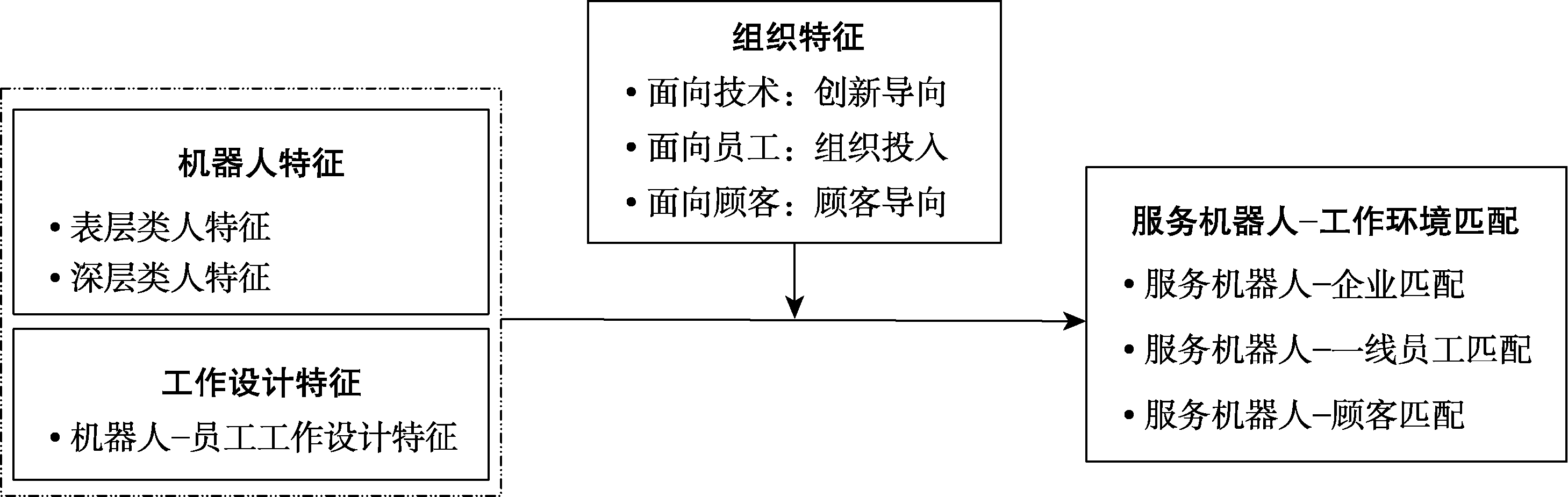
图2 服务机器人−工作环境匹配的前因研究模型

图3 服务机器人−工作环境匹配对员工和顾客价值创造的双路径效应研究模型

图4 理论框架
| [1] |
黄心语, 李晔. (2024). 人机信任校准的双途径:信任抑制与信任提升. 心理科学进展, 32(3), 527-542.
doi: 10.3724/SP.J.1042.2024.00527 |
| [2] |
姜福斌, 王震. (2022). 压力认知评价理论在管理心理学中的应用: 场景, 方式与迷思. 心理科学进展, 30(12), 2825-2845.
doi: 10.3724/SP.J.1042.2022.02825 |
| [3] | 刘欣, 谢礼珊. (2025). 是喜还是忧?服务机器人角色对员工幸福感的双路径影响机制——基于服务接待业人机互动情境的定性和定量研究. 南开管理评论, 28(3), 124-135+160. |
| [4] | 唐春勇, 李亚莉, 赵曙明. (2021). 发展型人力资源管理实践研究: 概念内涵, 量表开发及检验. 南开管理评论, 24(4), 85-95. |
| [5] | 谢小云, 左玉涵, 胡琼晶. (2021). 数字化时代的人力资源管理:基于人与技术交互的视角. 管理世界, 37(1), 200-216. |
| [6] | 姚唐, 邱琪, 穆琳, 郑秋莹, 肖为群. (2017). 社会支持视角下顾客在线互助心理和行为机制. 心理科学进展, 25(06), 912-922. |
| [7] | 张志学, 赵曙明, 连汇文, 谢小云. (2021). 数智时代的自我管理和自我领导:现状与未来. 外国经济与管理, 43(11), 3-14. |
| [8] | Ali F., Dogan S., Chen X., Cobanoglu C., & Limayem M. (2023). Friend or a foe: Understanding generation Z employees' intentions to work with service robots in the hotel industry. International Journal of Human-Computer Interaction, 39(1), 111-122. |
| [9] | Ayyildiz A. Y., Baykal M., & Koc E. (2022). Attitudes of hotel customers towards the use of service robots in hospitality service encounters. Technology in Society, 70, 101995. |
| [10] | Bandura A., Barbaranelli C., Caprara G. V., & Pastorelli C. (1996). Mechanisms of moral disengagement in the exercise of moral agency. Journal of Personality and Social Psychology, 71(2), 364-374. |
| [11] | Beane M. (2019). Learning to work with intelligent machines. Harvard Business Review, 97(5), 140-148. |
| [12] | Belanche D., Casaló L. V., Schepers J. J. L., & Flavián C. (2021). Examining the effects of robots’ physical appearance, warmth, and competence in frontline services: The humanness-value-loyalty model. Psychology & Marketing, 38(12), 2357-2376. |
| [13] | Bieler M., Maas P., Fischer L., & Rietmann N. (2022). Enabling cocreation with transformative interventions: An interdisciplinary conceptualization of consumer boosting. Journal of Service Research, 25(1), 29-47. |
| [14] | Bitner M. J. (1995). Building service relationships: It's all about promises. Journal of the Academy of Marketing Science, 23(4), 246-251. |
| [15] |
Bliese P. D., Edwards J. R., & Sonnentag S. (2017). Stress and well-being at work: A century of empirical trends reflecting theoretical and societal influences. Journal of Applied Psychology, 102(3), 389-402.
doi: 10.1037/apl0000109 pmid: 28125263 |
| [16] | Borghi M., & Mariani M. M. (2021). Service robots in online reviews: Online robotic discourse. Annals of Tourism Research, 87, 103036. |
| [17] | Brockner J., & Higgins E. T. (2001). Regulatory focus theory: Implications for the study of emotions at work. Organizational Behavior and Human Decision Processes, 86(1), 35-66. |
| [18] | Cameron D., de Saille S., Collins E. C., Aitken J. M., Cheung H., Chua A., Law J. (2021). The effect of social- cognitive recovery strategies on likability, capability and trust in social robots. Computers in Human Behavior, 114, 106561. |
| [19] | Cavanaugh M. A., Boswell W. R., Roehling M. V., & Boudreau J. W. (2000). An empirical examination of self-reported work stress among US managers. Journal of Applied Psychology, 85(1), 65-74. |
| [20] | Cha S. S. (2020). Customers' intention to use robot-serviced restaurants in Korea: Relationship of coolness and MCI factors. International Journal of Contemporary Hospitality Management, 32(9), 2947-2968. |
| [21] | Chen C. B., & Cai R. (2025). Are robots stealing our jobs? Examining robot-phobia as a job stressor in the hospitality workplace. International Journal of Contemporary Hospitality Management, 37 (1), 94-112. |
| [22] | Choi S., Liu S. X., & Choi C. (2022). Robot-brand fit the influence of brand personality on consumer reactions to service robot adoption. Marketing Letters, 33(1), 129-142. |
| [23] | Choi S., Liu S. Q., & Mattila A. S. (2019). “How may I help you?” Says a robot: Examining language styles in the service encounter. International Journal of Hospitality Management, 82, 32-38. |
| [24] | Choi S., Mattila A. S., & Bolton L. E. (2021). To err is human (-oid): How do consumers react to robot service failure and recovery? Journal of Service Research, 24(3), 354-371. |
| [25] | Chu P. S., Saucier D. A., & Hafner E. (2010). Meta- analysis of the relationships between social support and well-being in children and adolescents. Journal of Social and Clinical Psychology, 29(6), 624-645. |
| [26] | Cohen S. G., Chang L., & Ledford Jr G. E. (1997). A hierarchical construct of self-management leadership and its relationship to quality of work life and perceived work group effectiveness. Personnel Psychology, 50(2), 275-308. |
| [27] |
Cohen S., & Wills T,A. (1985). Stress, social support, and the buffering hypothesis. Psychological Bulletin, 98(2), 310-357.
pmid: 3901065 |
| [28] | de Kervenoael R., Hasan R., Schwob A., & Goh E. (2020). Leveraging human-robot interaction in hospitality services: Incorporating the role of perceived value, empathy, and information sharing into visitors’ intentions to use social robots. Tourism Management, 78, 104042. |
| [29] | Deshpandé R., Farley J. U., & Webster Jr F. E. (1993). Corporate culture, customer orientation, and innovativeness in Japanese firms: A quadrad analysis. Journal of Marketing, 57(1), 23-37. |
| [30] | El Halabi M., & Trendel O. (2025). Just name it: The act of naming humanoid service robots decreases perceived eeriness and increases repurchase intent. Journal of Service Research, 28(1), 131-149. |
| [31] | Epley N. (2018). A mind like mine: The exceptionally ordinary underpinnings of anthropomorphism. Journal of the Association for Consumer Research, 3(4), 591-598. |
| [32] |
Fiske S. T., Cuddy A. J., Glick P., & Xu J. (2002). A model of (often mixed) stereotype content: Competence and warmth respectively follow from perceived status and competition. Journal of Personality and Social Psychology, 82(6), 878-902.
pmid: 12051578 |
| [33] | Förster J., Higgins E. T., & Bianco A. T. (2003). Speed/ accuracy decisions in task performance: Built-in trade-off or separate strategic concerns? Organizational Behavior and Human Decision Processes, 90(1), 148-164. |
| [34] | Fu S., Zheng X., & Wong I. A. (2022). The perils of hotel technology: The robot usage resistance model. International Journal of Hospitality Management, 102, 103174. |
| [35] | George J. M. (1992). Extrinsic and intrinsic origins of perceived social loafing in organizations. Academy of Management Journal, 35(1), 191-202. |
| [36] | Gong T. (2025). The effect of service robots on employees’ customer service performance and service-oriented organizational citizenship behavior. Journal of Service Theory and Practice, 35(2), 319-347. |
| [37] | Grant A. M., & Parker S. K. (2009). Redesigning work design theories: The rise of relational and proactive perspectives. The Academy of Management Annals, 3(1), 317-375. |
| [38] | Gray H. M., Gray K., & Wegner D. M. (2007). Dimensions of mind perception. Science, 315(5812), 619. |
| [39] | Guan X., Yeh S. S., Chiang T. Y., & Huan T. C. T. (2020). Does organizational inducement foster work engagement in hospitality industry? Perspectives from a moderated mediation model. Journal of Hospitality and Tourism Management, 43, 259-268. |
| [40] | Guan X., Gong J., Li M., & Huan T. C. (2022). Exploring key factors influencing customer behavioral intention in robot restaurants. International Journal of Contemporary Hospitality Management, 34(9), 3482-3501. |
| [41] | Guan X., Xu X., Gong J., & Liu X. (2025). Facing AI with knowledge: An investigative study on the utilisation of service robots and employee knowledge management behaviours. Current Issues in Tourism, 28(20), 3302-3318. |
| [42] | Guan X., Zhang L., Liu X., & Liu Q. (2025). An eye for an eye: Exploring how human-robot service attributes affect customers’ negative electronic word-of-mouth. International Journal of Hospitality Management, 127, 104104. |
| [43] | Guan X., Zheng Y., Zhang L., & Liu X. (2025). The impact of service robot compatibility on hospitality employee learning behaviors: A transformative learning perspective. Journal of Hospitality Marketing & Management, 34(2), 257-280. |
| [44] | Hackman J. R., & Oldham G. R. (1975). Development of the job diagnostic survey. Journal of Applied Psychology, 60(2), 159-170. |
| [45] | Han B., Deng X., & Fan H. (2023). Partners or opponents? How mindset shapes consumers’ attitude toward anthropomorphic artificial intelligence service robots. Journal of Service Research, 26(3), 441-458. |
| [46] | Higgins T., & Tykocinski O. (1992). Seff-discrepancies and biographical memory: Personality and cognition at the level of psychological situation. Personality and Social Psychology Bulletin, 18(5), 527-535. |
| [47] | Ho T. H., Tojib D., & Tsarenko Y. (2020). Human staff vs. service robot vs. fellow customer: Does it matter who helps your customer following a service failure incident. International Journal of Hospitality Management, 87, 102501. |
| [48] | Hobfoll S. E. (2011). Conservation of resource caravans and engaged settings. Journal of Occupational and Organizational Psychology, 84(1), 116-122. |
| [49] | Houghton J. D., & Neck C. P. (2002). The revised self-leadership questionnaire: Testing a hierarchical factor structure for self-leadership. Journal of Managerial Psychology, 17(8), 672-691. |
| [50] |
Humphrey S. E., Nahrgang J. D., & Morgeson F. P. (2007). Integrating motivational, social, and contextual work design features: A meta-analytic summary and theoretical extension of the work design literature. Journal of Applied Psychology, 92(5), 1332-1356.
pmid: 17845089 |
| [51] | Hurley R. F., & Hult G. T. M. (1998). Innovation, market orientation, and organizational learning: An integration and empirical examination. Journal of Marketing, 62(3), 42-54. |
| [52] | Hwang J., Park S., & Kim I. (2020). Understanding motivated consumer innovativeness in the context of a robotic restaurant: The moderating role of product knowledge. Journal of Hospitality and Tourism Management, 44, 272-282. |
| [53] | Jia L., Shaw J. D., Tsui A. S., & Park T. Y. (2014). A social-structural perspective on employee-organization relationships and team creativity. Academy of Management Journal, 57(3), 869-891. |
| [54] |
Jörling M., Böhm R., & Paluch S. (2019). Service robots: Drivers of perceived responsibility for service outcomes. Journal of Service Research, 22(4), 404-420.
doi: 10.1177/1094670519842334 |
| [55] | Jung Y., & Takeuchi N. (2018). A lifespan perspective for understanding career self-management and satisfaction: The role of developmental human resource practices and organizational support. Human Relations, 71(1), 73-102. |
| [56] | Karahanna E., Agarwal R., & Angst C. M. (2006). Reconceptualizing compatibility beliefs in technology acceptance research. MIS Quarterly, 30(4), 781-804. |
| [57] | Kim H., So K. K. F., & Wirtz J. (2022). Service robots: Applying social exchange theory to better understand human-robot interactions. Tourism Management, 92, 104537. |
| [58] | Kim J. J., Choe J. Y. J., & Hwang J. (2021). Application of consumer innovativeness to the context of robotic restaurants. International Journal of Contemporary Hospitality Management, 33(1), 224-242. |
| [59] | Kristof A. L. (1996). Person-organization fit: An integrative review of its conceptualizations, measurement, and implications. Personnel Psychology, 49(1), 1-49. |
| [60] | Kuvaas B. (2008). An exploration of how the employee- organization relationship affects the linkage between perception of developmental human resource practices and employee outcomes. Journal of Management Studies, 45(1), 1-25. |
| [61] | Lazarus R. S., & Folkman S. (1984). Stress, appraisal, and coping. New York: Springer. |
| [62] | Lee K. H., & Yen C. L. A. (2023). Implicit and explicit attitudes toward service robots in the hospitality industry: Gender differences. Cornell Hospitality Quarterly, 64(2), 212-225. |
| [63] | Lee Y., Lee S., & Kim D. (2021). Exploring hotel guests' perceptions of using robot assistants. Tourism Management Perspectives, 37, 100781. |
| [64] | Li J. J., Bonn M. A., & Ye B. H. (2019). Hotel employee's artificial intelligence and robotics awareness and its impact on turnover intention: The moderating roles of perceived organizational support and competitive psychological climate. Tourism Management, 73, 172-181. |
| [65] | Li J. M., Zhang R. X., Wu T. J., & Mao M. (2024). How does work autonomy in human-robot collaboration affect hotel employees’ work and health outcomes? Role of job insecurity and person-job fit. International Journal of Hospitality Management, 117, 103654. |
| [66] | Liang X., Guo G., Shu L., Gong Q., & Luo P. (2022). Investigating the double-edged sword effect of AI awareness on employee's service innovative behavior. Tourism Management, 92, 104564. |
| [67] | Liao H., & Chuang A. (2004). A multilevel investigation of factors influencing employee service performance and customer outcomes. Academy of Management Journal, 47(1), 41-58. |
| [68] | Lin M., Cui X., Wang J., Wu G., & Lin J. (2022). Promotors or inhibitors? Role of task type on the effect of humanoid service robots on consumers' use intention. Journal of Hospitality Marketing & Management, 31(6), 710-729. |
| [69] | Lin M., Zhang Z., & Wu G. (2024). Determinants of employees’ willingness to seek help from robots. International Journal of Hospitality Management, 119, 103703. |
| [70] | Liu C., & Li H. (2018). Stressors and stressor appraisals: The moderating effect of task efficacy. Journal of Business and Psychology, 33, 141-154. |
| [71] | Liu X., Yin C., & Li M. (2024). The power of voice! The impact of robot receptionists’ voice pitch and communication style on customer value cocreation intention. International Journal of Hospitality Management, 122, 103819. |
| [72] | Liu X., Zhang L., Lin Z., & Guan X. (2025). Robots make me feel more like a human! Investigating how employee- robot engagement reduces workplace depersonalization. Tourism Management, 109, 105149. |
| [73] | Liu X., Zhang L., Xie L., & Guan X. (2024). What happens after the arrival of service robots?Investigating how robotic usage experience facilitates employees’ exploitative and exploratory learning behaviors. International Journal of Hospitality Management, 123, 103936. |
| [74] |
Lockwood P., Jordan C. H., & Kunda Z. (2002). Motivation by positive or negative role models: Regulatory focus determines who will best inspire us. Journal of Personality and Social Psychology, 83(4), 854-864.
pmid: 12374440 |
| [75] | Loureiro S. M. C., Japutra A., Molinillo S., & Bilro R. G. (2021). Stand by me: Analyzing the tourist-intelligent voice assistant relationship quality. International Journal of Contemporary Hospitality Management, 33(11), 3840-3859. |
| [76] | Lu L., Zhang P., & Zhang T. C. (2021). Leveraging “human-likeness” of robotic service at restaurants. International Journal of Hospitality Management, 94, 102823. |
| [77] | Luo X., Tong S., Fang Z., & Qu Z. (2019). Frontiers: Machines vs. humans: The impact of artificial intelligence chatbot disclosure on customer purchases. Marketing Science, 38(6), 937-947. |
| [78] | Luo Z., Qu H., & Marnburg E. (2013). Justice perceptions and drives of hotel employee social loafing behavior. International Journal of Hospitality Management, 33, 456-464. |
| [79] | Lv X., Liu Y., Luo J., Liu Y., & Li C. (2021). Does a cute artificial intelligence assistant soften the blow? The impact of cuteness on customer tolerance of assistant service failure. Annals of Tourism Research, 87, 103114. |
| [80] |
Marescaux E., De Winne S., & Forrier A. (2019). Developmental HRM, employee well-being and performance: The moderating role of developing leadership. European Management Review, 16(2), 317-331.
doi: 10.1111/emre.12168 |
| [81] | McLeay F., Osburg V. S., Yoganathan V., & Patterson A. (2021). Replaced by a robot: Service implications in the age of the machine. Journal of Service Research, 24(1), 104-121. |
| [82] | Mende M., Scott M. L., van Doorn J., Grewal D., & Shanks I. (2019). Service robots rising: How humanoid robots influence service experiences and elicit compensatory consumer responses. Journal of Marketing Research, 56(4), 535-556. |
| [83] | Menguc B., Auh S., & Wang F. (2020). Customer participation variation and its impact on customer service performance: Underlying process and boundary conditions. Journal of Service Research, 23(3), 299-320. |
| [84] | Milman A., Tasci A., & Zhang T. C. (2020). Perceived robotic server qualities and functions explaining customer loyalty in the theme park context. International Journal of Contemporary Hospitality Management, 32(12), 3895-3923. |
| [85] | Mingotto E., Montaguti F., & Tamma M. (2021). Challenges in re-designing operations and jobs to embody AI and robotics in services. Findings from a case in the hospitality industry. Electronic Markets, 31(3), 493-510. |
| [86] |
Mitchell M. S., Greenbaum R. L., Vogel R. M., Mawritz M. B., & Keating D. J. (2019). Can you handle the pressure? The effect of performance pressure on stress appraisals, self-regulation, and behavior. Academy of Management Journal, 62(2), 531-552.
doi: 10.5465/amj.2016.0646 |
| [87] |
Nahum-Shani I., Bamberger P. A., & Bacharach S. B. (2011). Social support and employee well-being: The conditioning effect of perceived patterns of supportive exchange. Journal of Health and Social Behavior, 52(1), 123-139.
doi: 10.1177/0022146510395024 pmid: 21362616 |
| [88] | Odekerken-Schröder G., Mennens K., Steins M., & Mahr D. (2021). The service triad: An empirical study of service robots, customers and frontline employees. Journal of Service Management, 33(2), 246-292. |
| [89] | Ordanini A., & Parasuraman A. (2011). Service innovation viewed through a service-dominant logic lens: A conceptual framework and empirical analysis. Journal of Service Research, 14(1), 3-23. |
| [90] | Pan S. Y., Lin Y., & Wong J. W. C. (2025). The dark side of robot usage for hotel employees: An uncertainty management perspective. Tourism Management, 106, 104994. |
| [91] |
Prem R., Ohly S., Kubicek B., & Korunka C. (2017). Thriving on challenge stressors? Exploring time pressure and learning demands as antecedents of thriving at work. Journal of Organizational Behavior, 38(1), 108-123.
doi: 10.1002/job.2115 pmid: 28133415 |
| [92] |
Price K. H., Harrison D. A., & Gavin J,H. (2006). Withholding inputs in team contexts: Member composition, interaction processes, evaluation structure, and social loafing. Journal of Applied Psychology, 91(6), 1375-1384.
pmid: 17100491 |
| [93] | Qiu H., Li M., Shu B., & Bai B. (2020). Enhancing hospitality experience with service robots: The mediating role of rapport building. Journal of Hospitality Marketing & Management, 29(3), 247-268. |
| [94] | Raisch S., & Krakowski S. (2021). Artificial intelligence and management: The automation-augmentation paradox. Academy of Management Review, 46(1), 192-210. |
| [95] | Renn R. W., Allen D. G., & Huning T. M. (2011). Empirical examination of the individual-level personality- based theory of self-management failure. Journal of Organizational Behavior, 32(1), 25-43. |
| [96] | Santiago J., Borges-Tiago M. T., & Tiago F. (2024). Embracing RAISA in restaurants: Exploring customer attitudes toward robot adoption. Technological Forecasting and Social Change, 199, 123047. |
| [97] | Schepers J., Belanche D., Casaló L. V., & Flavián C. (2022). How smart should a service robot be? Journal of Service Research, 25(4), 565-582. |
| [98] | Searle B. J., & Auton J. C. (2015). The merits of measuring challenge and hindrance appraisals. Anxiety, Stress, & Coping, 28(2), 121-143. |
| [99] | Seo S. (2022). When female (male) robot is talking to me: Effect of service robots’ gender and anthropomorphism on customer satisfaction. International Journal of Hospitality Management, 102, 103166. |
| [100] | Shi Y., Zhang R., & Ma C. (2022). A process mechanism study of the impact of service robot anthropomorphic features on users' continuous usage intention. Science Journal of Business and Management, 10(2), 99-106. |
| [101] | Siguaw J. A., Simpson P. M., & Enz C. A. (2006). Conceptualizing innovation orientation: A framework for study and integration of innovation research. Journal of Product Innovation Management, 23(6), 556-574. |
| [102] | Simon O., Neuhofer B., & Egger R. (2020). Human-robot interaction: Conceptualising trust in frontline teams through LEGO® Serious Play®. Tourism Management Perspectives, 35, 100692. |
| [103] | Söderlund M., & Oikarinen E. L. (2021). Service encounters with virtual agents: An examination of perceived humanness as a source of customer satisfaction. European Journal of Marketing, 55(13), 94-121. |
| [104] | Song Y., & Luximon Y. (2021). The face of trust: The effect of robot face ratio on consumer preference. Computers in Human Behavior, 116, 106620. |
| [105] | Song Y., Zhang M., Hu J., & Cao X. (2022). Dancing with service robots: The impacts of employee-robot collaboration on hotel employees’ job crafting. International Journal of Hospitality Management, 103, 103220. |
| [106] | Tojib D., Sujan R., Ma J., & Tsarenko Y. (2023). How does service robot anthropomorphism affect human co-workers? Journal of Service Management, 34(4), 750-769. |
| [107] | Tuomi A., Tussyadiah I. P., & Stienmetz J. (2021). Applications and implications of service robots in hospitality. Cornell Hospitality Quarterly, 62(2), 232-247. |
| [108] | Tuominen S., Reijonen H., Nagy G., Buratti A., & Laukkanen T. (2023). Customer-centric strategy driving innovativeness and business growth in international markets. International Marketing Review, 40(3), 479-496. |
| [109] | Tussyadiah I. P., Zach F. J., & Wang J. (2020). Do travelers trust intelligent service robots? Annals of Tourism Research, 81, 102886. |
| [110] | Vargo S. L., & Lusch R. F. (2016). Institutions and axioms: An extension and update of service-dominant logic. Journal of the Academy of Marketing Science, 44(1), 5-23. |
| [111] | Wang Y. C., & Papastathopoulos A. (2024). Cross-segment validation of customer support for AI-based service robots at luxury, fine-dining, casual, and quick-service restaurants. International Journal of Contemporary Hospitality Management, 36(6), 1744-1765. |
| [112] | Wirtz J., Patterson P. G., Kunz W. H., Gruber T., Lu V. N., Paluch S., & Martins A. (2018). Brave new world: Service robots in the frontline. Journal of Service Management, 29(5), 907-931. |
| [113] | Wu L. Z., Sun Z., Ye Y., Kwan H. K., & Yang M. (2021). The impact of exploitative leader p on frontline hospitality employees’ service performance: A social exchange perspective. International Journal of Hospitality Management, 96, 102954. |
| [114] | Wu T., & Zhang R. (2024). Exploring the impacts of intention towards human-robot collaboration on frontline hotel employees’ positive behavior: An integrative model. International Journal of Hospitality Management, 123, 103912. |
| [115] | Xiao L., & Kumar V. (2021). Robotics for customer service: A useful complement or an ultimate substitute? Journal of Service Research, 24(1), 9-29. |
| [116] | Xie L., & Lei S. (2022). The nonlinear effect of service robot anthropomorphism on customers’ usage intention: A privacy calculus perspective. International Journal of Hospitality Management, 107, 103312. |
| [117] | Xie L., Liu C., & Li D. (2022). Proactivity or passivity? An investigation of the effect of service robots’ proactive behaviour on customer co-creation intention. International Journal of Hospitality Management, 106, 103271. |
| [118] | Xie L., Liu X., & Li D. (2022). The mechanism of value co-creation in robotic services: Customer inspiration from robotic service novelty. Journal of Hospitality Marketing & Management, 31(8), 962-983. |
| [119] | Yan J., Luo B., & Zhang T. (2025). Can cuteness soften my anxiety? The impact of conversational styles of service robots on consumer service acceptance. International Journal of Contemporary Hospitality Management, 37(3), 763-782. |
| [120] | Yang Y., Chi M., Bi X., & Xu Y. (2024). How does the anthropomorphism of service robots impact employees’ role service behavior in the workplace? International Journal of Hospitality Management, 122, 103857. |
| [121] | Yoganathan V., & Osburg V. (2024). The mind in the machine: Estimating mind perception's effect on user satisfaction with voice-based conversational agents. Journal of Business Research, 175, 114573. |
| [122] | Yoganathan V., Osburg V., Kunz W. H., & Toporowski W. (2021). Check-in at the Robo-desk:Effects of automated social presence on social cognition and service implications. Tourism Management, 85, 104309. |
| [123] | Yu H., Shum C., Alcorn M., Sun J., & He Z. (2022). Robots can’t take my job: Antecedents and outcomes of gen Z employees’ service robot risk awareness. International Journal of Contemporary Hospitality Management, 34(8), 2971-2988. |
| [124] | Zhang L. X., Li J. M., Wang L. L., Mao M. Y., & Zhang R. X. (2023). How does the usage of robots in hotels affect employees’ turnover intention? A double-edged sword study. Journal of Hospitality and Tourism Management, 57, 74-83. |
| [1] | 罗莉娟, 王康, 胡金淼, 徐四华. 当人工智能面对人类情感:服务机器人情感表达对用户体验的影响机制[J]. 心理科学进展, 2025, 33(6): 1006-1026. |
| [2] | 彭家敏, 谢礼珊, 关新华. 虚拟健康社区医生贡献行为的形成机制[J]. 心理科学进展, 2021, 29(6): 978-989. |
| 阅读次数 | ||||||
|
全文 |
|
|||||
|
摘要 |
|
|||||
