

ISSN 1671-3710
CN 11-4766/R
主办:中国科学院心理研究所
出版:科学出版社
CN 11-4766/R
主办:中国科学院心理研究所
出版:科学出版社
心理科学进展 ›› 2025, Vol. 33 ›› Issue (9): 1592-1603.doi: 10.3724/SP.J.1042.2025.1592 cstr: 32111.14.2025.1592
陈艺林,†, 谭青松,†, 龚梦园( )
)
收稿日期:2024-06-07
出版日期:2025-09-15
发布日期:2025-06-26
通讯作者:
龚梦园, E-mail: gongmy426@zju.edu.cn作者简介:†为共同第一作者
基金资助:
CHEN Yilin,†, TAN Qingsong,†, GONG Mengyuan()
Received:2024-06-07
Online:2025-09-15
Published:2025-06-26
摘要:
选择性注意是大脑筛选外部信息的关键机制。传统理论认为, 个体主要会依据刺激的特征值来引导注意选择。然而, 近期研究发现, 在很多情境下, 个体的注意分配会依赖于刺激间的相对特征关系。这种“基于特征关系”的注意选择机制适用于关联性注意捕获和经验驱动的注意选择, 与“基于特征值”的注意机制在时间动态和空间全局性方面存在区别。未来研究应整合多维度证据, 揭示“基于特征关系”的认知神经机制, 将其研究范畴拓展至其他关系属性(如空间关系、社会关系), 并深入探索该机制在临床和工程等实际场景中的应用潜力。
中图分类号:
陈艺林, 谭青松, 龚梦园. (2025). 基于特征关系的注意选择机制. 心理科学进展 , 33(9), 1592-1603.
CHEN Yilin, TAN Qingsong, GONG Mengyuan. (2025). Selective attention based on feature relationship. Advances in Psychological Science, 33(9), 1592-1603.
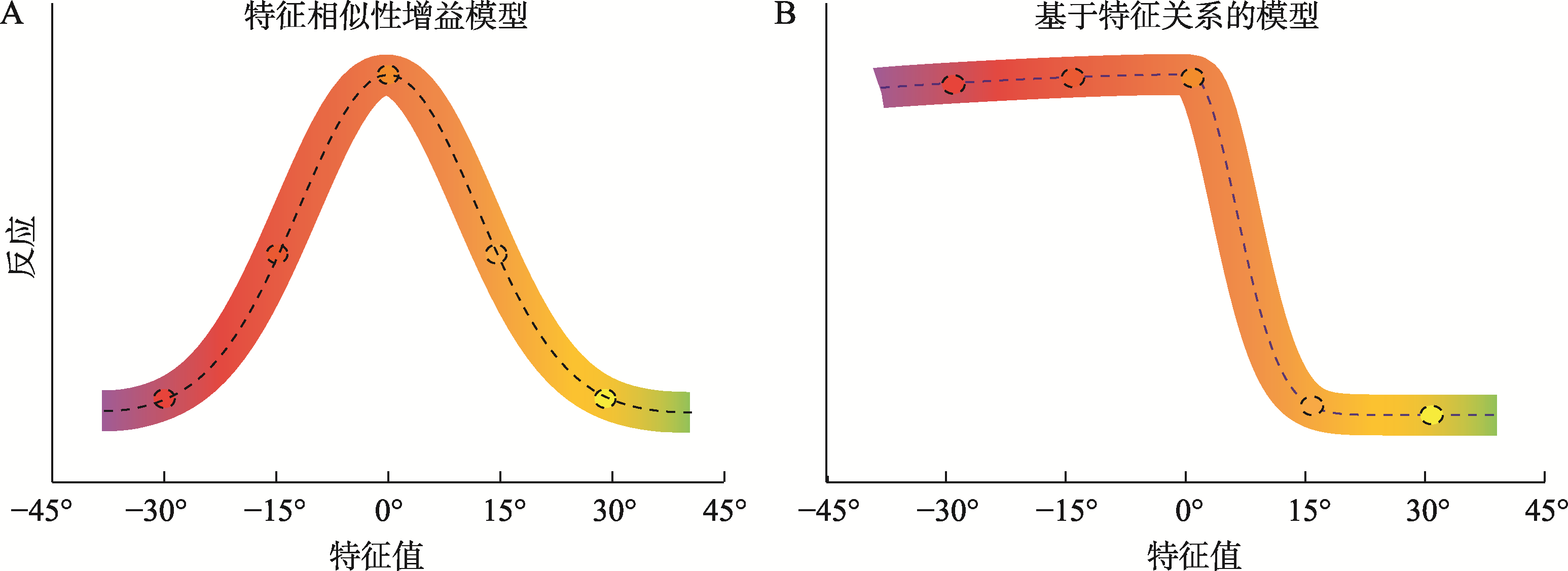
图1 注意调谐曲线。在该模拟情境中, 目标特征设定为橙色(0°), 横轴代表实际呈现刺激与目标特征之间的差异, 纵轴则表示为可测量的注意变化指标(行为或神经活动均可)。(A)特征相似性增益模型。根据该模型的预测, 刺激与目标特征值越相似(差异越接近0°), 其引发的注意增益就越强。(B)特征关系模型。假设干扰物刺激为正值(大于0°), 目标的相对关系为“更红”。根据该模型的预测, 当刺激的相对关系与目标的相对关系匹配(即刺激也相对更红)时, 注意效应会相应增强(如右图曲线中−45°至0°的部分所示)。彩图见电子版, 下同。
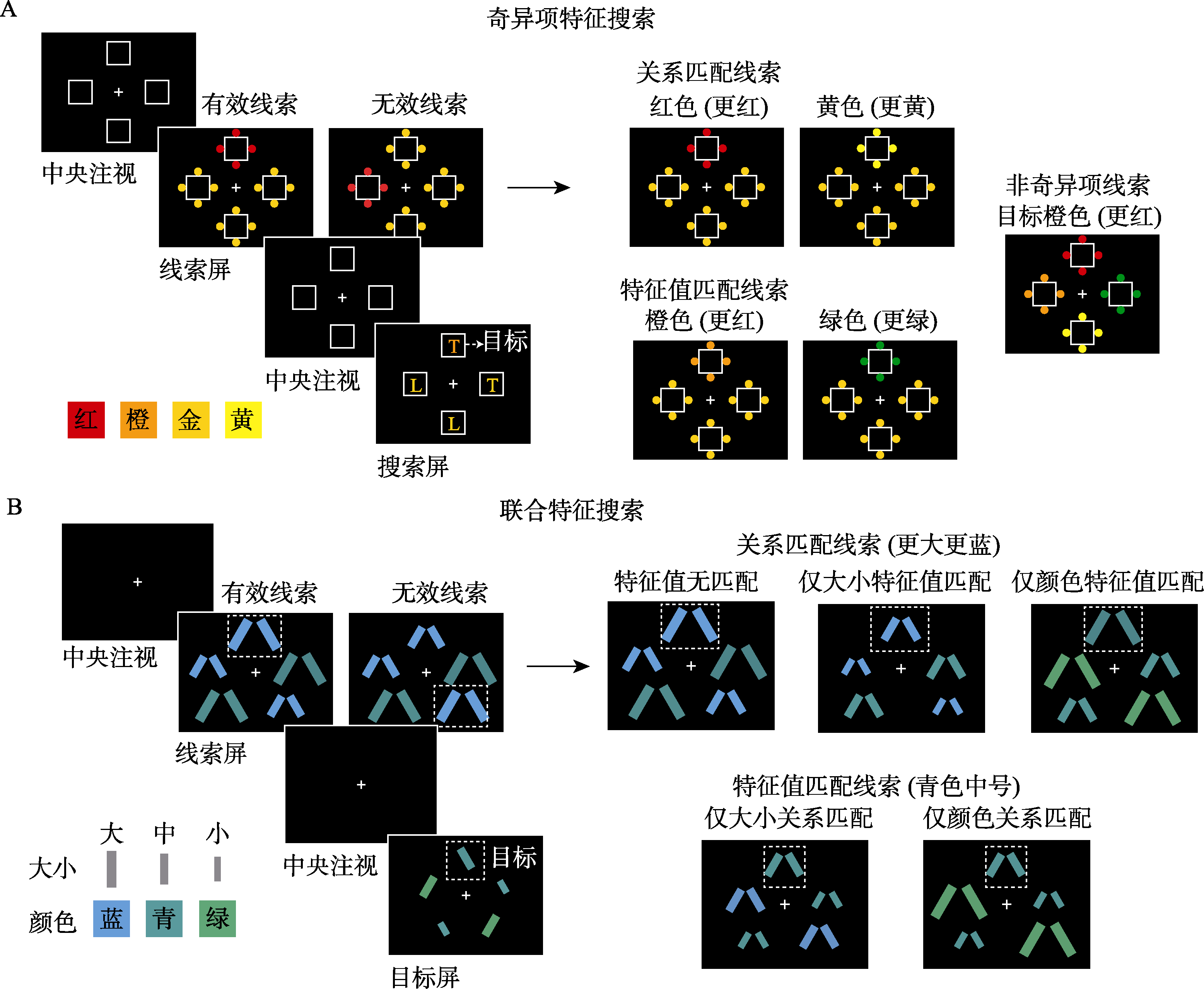
图2 特征注意的线索化范式。(A)在奇异项特征搜索任务中, 被试的任务是在搜索屏寻找奇异项特征(橙色)。(B)在联合特征搜索任务中, 被试的任务是寻找具有特定特征组合的目标(如青色且中号)。在两个任务中, 均通过比较有效线索与无效线索条件下的行为表现, 测量线索引发的注意效应量。进一步对比特征关系和特征值匹配条件下的注意效应量, 考察线索引发的注意效应更符合“基于特征值”还是“基于特征关系”注意理论的预测。该图改编自Becker等人(2010, 2017)的研究。
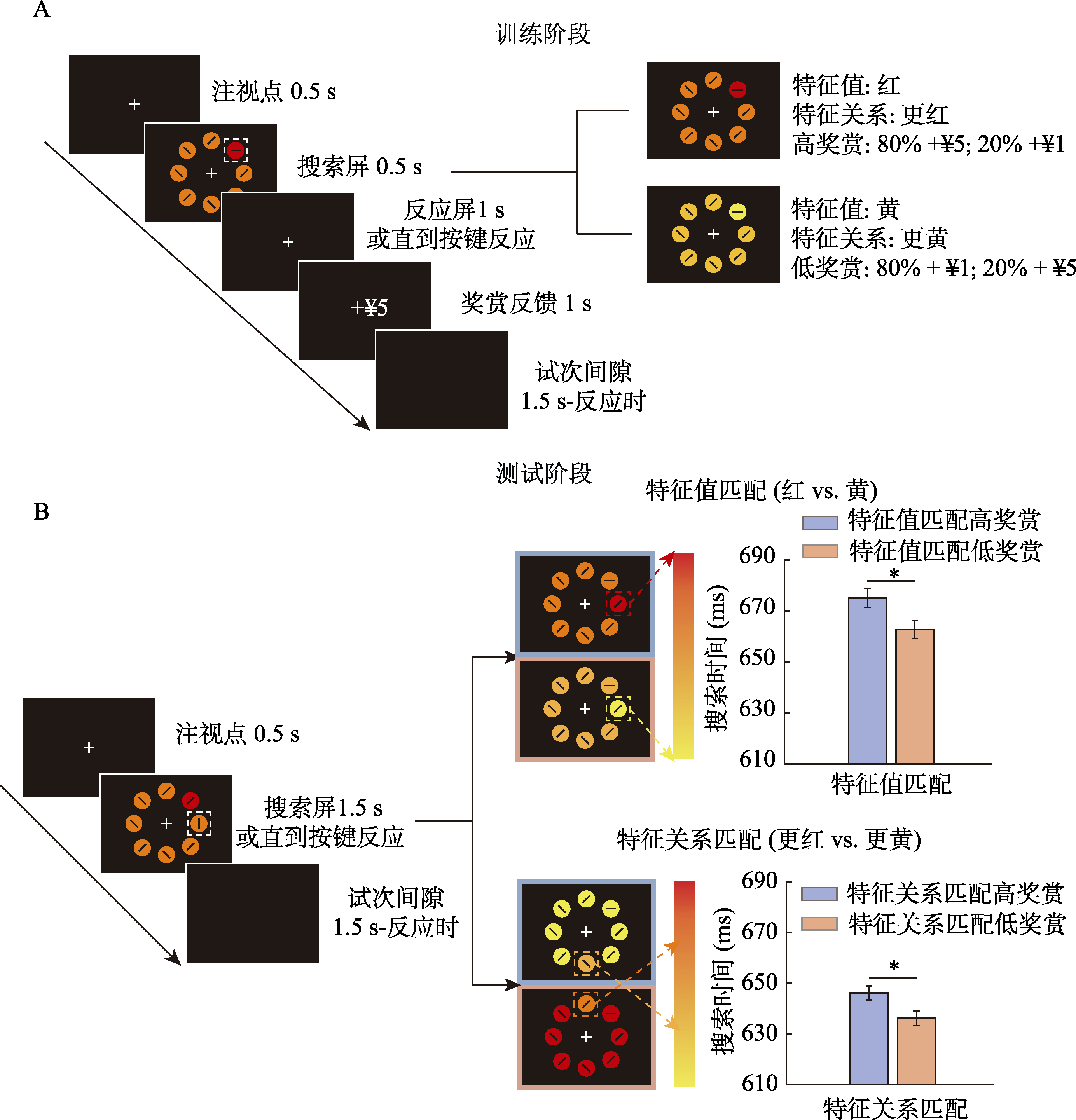
图3 奖赏(金钱)对基于特征关系注意的调控作用。(A)在训练阶段, 采用视觉搜索任务建立奖赏与特征的联结(如高奖励—红色, 低奖励—黄色)。(B)在测试阶段, 采用额外奇异项范式, 分别操控奇异项的特征值(如红橙色和黄橙色)和特征关系(更黄或更红)。右侧柱状图中, 蓝色和橙色分别表示在特征值与特征关系匹配条件下, 高、低奖赏条件对应的行为表现(反应时)。该图改编自Chen等人(2023)的研究。
| [1] | 龚梦园, 贾珂, 李晟. (2018). 奖赏学习对视觉注意的调控. 应用心理学, 24(2), 99-112. |
| [2] | 黄玲, 李梦莎, 王丽娟, 张喜淋. (2019). 视觉选择性注意的神经机制. 生理学报, 71(1), 11-21. |
| [3] |
黄子立, 丁玉珑, 曲折. (2020). 特征注意的全局性调制作用——增强还是抑制? . 心理科学进展, 28(4), 566-578.
doi: 10.3724/SP.J.1042.2020.00566 |
| [4] |
Akram, U. M., & Khan, S. A. (2012). Automated detection of dark and bright lesions in retinal images for early detection of diabetic retinopathy. Journal of Medical Systems, 36(5), 3151-3162. https://doi.org/10.1007/s10916-011-9802-2
doi: 10.1007/s10916-011-9802-2 URL pmid: 22090037 |
| [5] | Alon, Y., Azriel, O., Pine, D. S., & Bar-Haim, Y. (2023). A randomized controlled trial of supervised remotely-delivered attention bias modification for posttraumatic stress disorder. Psychological Medicine, 53(8), 3601-3610. https://doi.org/10.1017/S003329172200023X |
| [6] |
Alvares, G. A., Chen, N. T., Notebaert, L., Granich, J., Mitchell, C., & Whitehouse, A. J. (2019). Brief social attention bias modification for children with autism spectrum disorder. Autism Research, 12(3), 527-535. https://doi.org/10.1002/aur.2067
doi: 10.1002/aur.2067 URL pmid: 30632321 |
| [7] |
Anderson, B. A., Kim, H., Kim, A. J., Liao, M., Mrkonja, L., Clement, A., & Grégoire, L. (2021). The past, present, and future of selection history. Neuroscience and Biobehavioral Reviews, 130, 326-350. https://doi.org/10.1016/j.neubiorev.2021.09.004
doi: 10.1016/j.neubiorev.2021.09.004 URL pmid: 34499927 |
| [8] | Anderson, B. A., Laurent, P. A., & Yantis, S. (2011). Value-driven attentional capture. Proceedings of the National Academy of Sciences, 108(25), 10367-10371. https://doi.org/10.1073/pnas.1104047108 |
| [9] | Ayzenberg, V., & Behrmann, M. (2022). The dorsal visual pathway represents object-centered spatial relations for object recognition. The Journal of Neuroscience, 42(23), 4693-4710. https://doi.org/10.1523/JNEUROSCI.2257-21.2022 |
| [10] | Becker, S. I. (2008). Can intertrial effects of features and dimensions be explained by a single theory? Journal of Experimental Psychology: Human Perception and Performance, 34(6), 1417-1440. https://doi.org/10.1037/a0011386 |
| [11] | Becker, S. I. (2010). The role of target-distractor relationships in guiding attention and the eyes in visual search. Journal of Experimental Psychology: General, 139(2), 247-265. https://doi.org/10.1037/a0018808 |
| [12] | Becker, S. I., Atalla, M., & Folk, C. L. (2020). Conjunction search: Can we simultaneously bias attention to features and relations? Attention, Perception, & Psychophysics, 82(1), 246-268. https://doi.org/10.3758/s13414-019-01807-3 |
| [13] |
Becker, S. I., Folk, C. L., & Remington, R. W. (2010). The role of relational information in contingent capture. Journal of Experimental Psychology: Human Perception and Performance, 36(6), 1460-1476. https://doi.org/10.1037/a0020370
doi: 10.1037/a0020370 URL pmid: 20919781 |
| [14] |
Becker, S. I., Folk, C. L., & Remington, R. W. (2013). Attentional capture does not depend on feature similarity, but on target-nontarget relations. Psychological Science, 24(5), 634-647. https://doi.org/10.1177/0956797612458528
doi: 10.1177/0956797612458528 URL pmid: 23558547 |
| [15] |
Becker, S. I., Harris, A. M., Venini, D., & Retell, J. D. (2014). Visual search for color and shape: When is the gaze guided by feature relationships, when by feature values? Journal of Experimental Psychology: Human Perception and Performance, 40(1), 264-291. https://doi.org/10.1037/a0033489
doi: 10.1037/a0033489 URL pmid: 23875572 |
| [16] |
Becker, S. I., Harris, A. M., York, A., & Choi, J. (2017). Conjunction search is relational: Behavioral and electrophysiological evidence. Journal of Experimental Psychology: Human Perception and Performance, 43(10), 1828-1842. https://doi.org/10.1037/xhp0000371
doi: 10.1037/xhp0000371 URL pmid: 28967786 |
| [17] |
Bisley, J. W., & Mirpour, K. (2019). The neural instantiation of a priority map. Current Opinion in Psychology, 29, 108-112. https://doi.org/10.1016/j.copsyc.2019.01.002
doi: S2352-250X(18)30164-7 URL pmid: 30731260 |
| [18] | Bowler, D. M., Gaigg, S. B., & Lind, S. (2011). Memory in autism: Binding, self and brain. In I. Roth & P. Rezaie (Eds.), Researching the autism spectrum: Contemporary perspectives (pp. 316-346). Cambridge: Cambridge University Press. |
| [19] | Bucker, B., & Theeuwes, J. (2017). Pavlovian reward learning underlies value driven attentional capture. Attention, Perception, & Psychophysics, 79( 2), 415-428. https://doi.org/10.3758/s13414-016-1241-1 |
| [20] | Chen, Y., Chen, S., Zhang, X., Zhang, S., Jia, K., Anderson, B. A., & Gong, M. (2023). Reward history modulates attention based on feature relationship. Journal of Experimental Psychology: General, 152(7), 1937-1950. https://doi.org/10.1037/xge0001384 |
| [21] | Chen, Y., Liu, T., Jia, K., Theeuwes, J., & Gong, M. (2024). Dual-format attentional template during preparation in human visual cortex. eLife, 13, Article RP103425. |
| [22] | Conway, B. R. (2001). Spatial structure of cone inputs to color cells in alert macaque primary visual cortex (V-1). The Journal of Neuroscience, 21(8), 2768-2783. https://doi.org/10.1523/JNEUROSCI.21-08-02768.2001 |
| [23] | Cowan, N., Bao, C., Bishop-Chrzanowski, B. M., Costa, A. N., Greene, N. R., Guitard, D., … Ünal, Z. E. (2024). The relation between attention and memory. Annual Review of Psychology, 75(1), 183-214. https://doi.org/10.1146/annurev-psych-040723-012736 |
| [24] | Cutting, J., & Deterding, S. (2022). The task-attention theory of game learning: A theory and research agenda. Human- Computer Interaction, 39(5-6), 257-287. https://doi.org/10.1080/07370024.2022.2047971 |
| [25] | De Valois, R. L., Cottaris, N. P., Elfar, S. D., Mahon, L. E., & Wilson, J. A. (2000). Some transformations of color information from lateral geniculate nucleus to striate cortex. Proceedings of the National Academy of Sciences, 97(9), 4997-5002. https://doi.org/10.1073/pnas.97.9.4997 |
| [26] |
Ding, X., Gao, Z., & Shen, M. (2017). Two equals one: Two human actions during social interaction are grouped as one unit in working memory. Psychological Science, 28(9), 1311-1320. https://doi.org/10.1177/0956797617707318
doi: 10.1177/0956797617707318 URL pmid: 28719763 |
| [27] |
Du, F., & Jiao, J. (2016). Feature-based attention is functionally distinct from relation-based attention: The double dissociation between color-based capture and color-relation-based capture of attention. Journal of Experimental Psychology: Human Perception and Performance, 42(4), 480-493. https://doi.org/10.1037/xhp0000165
doi: 10.1037/xhp0000165 URL pmid: 26523490 |
| [28] | Du, F., Yin, Y., Qi, Y., & Zhang, K. (2014). Contingent orienting or contingent capture: A size singleton matching the target-distractor size relation cannot capture attention. Psychonomic Bulletin & Review, 21(4), 1011-1018. https://doi.org/10.3758/s13423-013-0567-0 |
| [29] |
Epstein, R. A., Patai, E. Z., Julian, J. B., & Spiers, H. J. (2017). The cognitive map in humans: Spatial navigation and beyond. Nature Neuroscience, 20(11), 1504-1513. https://doi.org/10.1038/nn.4656
doi: 10.1038/nn.4656 URL pmid: 29073650 |
| [30] |
Esteva, A., Robicquet, A., Ramsundar, B., Kuleshov, V., DePristo, M., Chou, K., … Dean, J. (2019). A guide to deep learning in healthcare. Nature Medicine, 25(1), 24-29. https://doi.org/10.1038/s41591-018-0316-z
doi: 10.1038/s41591-018-0316-z URL pmid: 30617335 |
| [31] | Failing, M., & Theeuwes, J. (2018). Selection history: How reward modulates selectivity of visual attention. Psychonomic Bulletin and Review, 25(2), 514-538. https://doi.org/10.3758/s13423-017-1380-y |
| [32] | Folk, C. L., Leber, A. B., & Egeth, H. E. (2008). Top-down control settings and the attentional blink: Evidence for nonspatial contingent capture. Visual Cognition, 16(5), 616-642. https://doi.org/10.1080/13506280601134018 |
| [33] | Folk, C. L., & Remington, R. (1998). Selectivity in distraction by irrelevant featural singletons: Evidence for two forms of attentional capture. Journal of Experimental Psychology: Human Perception and Performance, 24(3), 847-858. https://doi.org/10.1037//0096-1523.24.3.847 |
| [34] | Folk, C. L., Remington, R. W., & Johnston, J. C. (1992). Involuntary covert orienting is contingent on attentional control settings. Journal of Experimental Psychology: Human Perception and Performance, 18(4), 1030-1044. https://doi.org/10.1037/0096-1523.18.4.1030 |
| [35] |
Gaigg, S. B., Gardiner, J. M., & Bowler, D. M. (2008). Free recall in autism spectrum disorder: The role of relational and item-specific encoding. Neuropsychologia, 46(4), 983-992. https://doi.org/10.1016/j.neuropsychologia.2007.11.011
doi: 10.1016/j.neuropsychologia.2007.11.011 URL pmid: 18164320 |
| [36] | Gentner, D., Shao, R., Simms, N. K., & Hespos, S. J. (2021). Learning same and different relations: Cross-species comparisons. Current Opinion in Behavioral Sciences, 37, 84-89. https://doi.org/10.1016/j.cobeha.2020.11.013 |
| [37] | Goddu, M. K., Lombrozo, T., & Gopnik, A. (2020). Transformations and transfer: Preschool children understand abstract relations and reason analogically in a causal task. Child Development, 91(6), 1898-1915. https://doi.org/10.1111/cdev.13412 |
| [38] |
Gong, M., Jia, K., & Li, S. (2017). Perceptual competition promotes suppression of reward salience in behavioral selection and neural representation. Journal of Neuroscience, 37(26), 6242-6252. https://doi.org/10.1523/JNEUROSCI.0217-17.2017
doi: 10.1523/JNEUROSCI.0217-17.2017 URL pmid: 28539425 |
| [39] | Gong, M., & Liu, T. (2018). Reward differentially interacts with physical salience in feature-based attention. Journal of Vision, 18(11), Article 12. https://doi.org/10.1167/18.11.12 |
| [40] |
Gong, M., & Liu, T. (2020). Biased neural representation of feature-based attention in the human frontoparietal network. Journal of Neuroscience, 40(43), 8386-8395. https://doi.org/10.1523/JNEUROSCI.0690-20.2020
doi: 10.1523/JNEUROSCI.0690-20.2020 URL pmid: 33004380 |
| [41] | Goupil, N., Rayson, H., Serraille, É., Massera, A., Ferrari, P. F., Hochmann, J. R., & Papeo, L. (2024). Visual preference for socially relevant spatial relations in humans and monkeys. Psychological Science, 35(6), 681-693. https://doi.org/10.1177/09567976241242995 |
| [42] |
Guez, J., Naveh‐Benjamin, M., Yankovsky, Y., Cohen, J., Shiber, A., & Shalev, H. (2011). Traumatic stress is linked to a deficit in associative episodic memory. Journal of Traumatic Stress, 24(3), 260-267. https://doi.org/10.1002/jts.20635
doi: 10.1002/jts.20635 URL pmid: 21523830 |
| [43] |
Hafri, A., & Firestone, C. (2021). The perception of relations. Trends in Cognitive Sciences, 25(6), 475-492. https://doi.org/10.1016/j.tics.2021.01.006
doi: 10.1016/j.tics.2021.01.006 URL pmid: 33812770 |
| [44] |
Halford, G. S., Wilson, W. H., & Phillips, S. (2010). Relational knowledge: The foundation of higher cognition. Trends in Cognitive Sciences, 14(11), 497-505. https://doi.org/10.1016/j.tics.2010.08.005
doi: 10.1016/j.tics.2010.08.005 URL pmid: 20884275 |
| [45] | Hamblin-Frohman, Z., & Becker, S. I. (2021). The attentional template in high and low similarity search: Optimal tuning or tuning to relations? Cognition, 212, Article 104732. https://doi.org/10.1016/j.cognition.2021.104732 |
| [46] | Harris, A. M., Remington, R. W., & Becker, S. I. (2013). Feature specificity in attentional capture by size and color. Journal of Vision, 13(3), Article 12. https://doi.org/10.1167/13.3.12 |
| [47] | Hua, H., Zhang, J., Li, Y., & Du, F. (2019). Color- relation-based capture occurs globally. Psychonomic Bulletin & Review, 26(2), 515-521. https://doi.org/10.3758/s13423-019-01573-1 |
| [48] | Ji, H., Yin, J., Huang, Y., & Ding, X. (2020). Selective attention operates on the group level for interactive biological motion. Journal of Experimental Psychology: Human Perception and Performance, 46(12), 1434-1442. https://doi.org/10.1037/xhp0000866 |
| [49] | Jia, K., Goebel, R., & Kourtzi, Z. (2023). Ultra-high field imaging of human visual cognition. Annual Review of Vision Science, 9(1), 479-500. https://doi.org/10.1146/annurev-vision-111022-123830 |
| [50] | Jia, K., Zamboni, E., Rua, C., Goncalves, N. R., Kemper, V., Ng, A. K. T.,... Kourtzi, Z. (2021). A protocol for ultra-high field laminar fMRI in the human brain. STAR Protocols, 2(2), Article 100415. https://doi.org/10.1016/j.xpro.2021.100415 |
| [51] |
Jiang, Y. V., & Sisk, C. A. (2019). Habit-like attention. Current Opinion in Psychology, 29, 65-70. https://doi.org/10.1016/j.copsyc.2018.11.014
doi: S2352-250X(18)30173-8 URL pmid: 30537679 |
| [52] |
Kerzel, D. (2020). Direct evidence for the optimal tuning of attention. Journal of Experimental Psychology: Human Perception and Performance, 46(7), 716-728. https://doi.org/10.1037/xhp0000744
doi: 10.1037/xhp0000744 URL pmid: 32271080 |
| [53] |
Kim, H., & Anderson, B. A. (2019). Dissociable components of experience-driven attention. Current Biology, 29(5), 841-845. https://doi.org/10.1016/j.cub.2019.01.030
doi: S0960-9822(19)30032-6 URL pmid: 30773366 |
| [54] | Lerebourg, M., de Lange, F. P., & Peelen, M. V. (2024). Attentional guidance through object associations in visual cortex. Science Advances, 10(41), Article eado6226. https://doi.org/10.1126/sciadv.ado6226 |
| [55] | Liao, M. R., Britton, M. K., & Anderson, B. A. (2020). Selection history is relative. Vision Research, 175, 23-31. https://doi.org/10.1016/j.visres.2020.06.004 |
| [56] |
Litjens, G., Kooi, T., Bejnordi, B. E., Adiyoso Setio, A. A., Ciompi, F., Ghafoorian, M., … Sánchez, C. I. (2017). A survey on deep learning in medical image analysis. Medical Image Analysis, 42, 60-88. https://doi.org/10.1016/j.media.2017.07.005
doi: S1361-8415(17)30113-5 URL pmid: 28778026 |
| [57] |
Liu, T. (2019). Feature-based attention: Effects and control. Current Opinion in Psychology, 29, 187-192. https://doi.org/10.1016/j.copsyc.2019.03.013
doi: S2352-250X(18)30165-9 URL pmid: 31015180 |
| [58] | Maljkovic, V., & Nakayama, K. (1994). Priming of pop-out: I. Role of features. Memory & Cognition, 22(6), 657-672. https://doi.org/10.3758/BF03209251 |
| [59] |
Martin, A., & Becker, S. I. (2018). How feature relationships influence attention and awareness: Evidence from eye movements and EEG. Journal of Experimental Psychology: Human Perception and Performance, 44(12), 1865-1883. https://doi.org/10.1037/xhp0000574
doi: 10.1037/xhp0000574 URL pmid: 30211593 |
| [60] |
Martin, A., & Becker, S. I. (2021). A relational account of visual short-term memory (VSTM). Cortex, 144, 151-167. https://doi.org/10.1016/j.cortex.2021.08.013
doi: 10.1016/j.cortex.2021.08.013 URL pmid: 34666299 |
| [61] |
Martinez-Trujillo, J. C., & Treue, S. (2004). Feature-based attention increases the selectivity of population responses in primate visual cortex. Current Biology, 14(9), 744-751. https://doi.org/10.1016/j.cub.2004.04.028
doi: 10.1016/j.cub.2004.04.028 URL pmid: 15120065 |
| [62] |
McMahon, E., & Isik, L. (2023). Seeing social interactions. Trends in Cognitive Sciences, 27(12), 1165-1179. https://doi.org/10.1016/j.tics.2023.09.001
doi: 10.1016/j.tics.2023.09.001 URL pmid: 37805385 |
| [63] | Milner, A. E., MacLean, M. H., & Giesbrecht, B. (2023). The persistence of value-driven attention capture is task- dependent. Attention, Perception, & Psychophysics, 85(2), 315-341. https://doi.org/10.3758/s13414-022-02621-0 |
| [64] |
Navalpakkam, V., & Itti, L. (2007). Search goal tunes visual features optimally. Neuron, 53(4), 605-617. https://doi.org/10.1016/j.neuron.2007.01.018
doi: 10.1016/j.neuron.2007.01.018 URL pmid: 17296560 |
| [65] |
Papeo, L., & Abassi, E. (2019). Seeing social events: The visual specialization for dyadic human-human interactions. Journal of Experimental Psychology: Human Perception and Performance, 45(7), 877-888. https://doi.org/10.1037/xhp0000646
doi: 10.1037/xhp0000646 URL pmid: 30998069 |
| [66] |
Ring, M., Gaigg, S. B., & Bowler, D. M. (2016). Relational memory processes in adults with autism spectrum disorder. Autism Research, 9(1), 97-106. https://doi.org/10.1002/aur.1493
doi: 10.1002/aur.1493 URL pmid: 25952759 |
| [67] | Ristic, J., & Capozzi, F. (2022). Mechanisms for individual, group-based and crowd-based attention to social information. Nature Reviews Psychology, 1(12), 721-732. https://doi.org/10.1038/s44159-022-00118-z |
| [68] | Scolari, M., Ester, E. F., & Serences, J. T. (2014). Feature- and object-based attentional modulation in the human visual system. In A. C. Nobre & S. Kastner (Eds.), The Oxford handbook of attention. Oxford University Press. https://doi.org/10.1093/oxfordhb/9780199675111.013.009 |
| [69] | Summerfield, C., Luyckx, F., & Sheahan, H. (2020). Structure learning and the posterior parietal cortex. Progress in Neurobiology, 184, Article 101717. https://doi.org/10.1016/j.pneurobio.2019.101717 |
| [70] | Tan, Q., Jia, O., Anderson, B. A., Jia, K., & Gong, M. (2025). Reward history alters priority map based on spatial relationship, but not absolute location. Psychonomic Bulletin & Review. Advance online publication. https://doi.org/10.3758/s13423-025-02682-w |
| [71] |
Treisman, A. M., & Gelade, G. (1980). A feature-integration theory of attention. Cognitive Psychology, 12(1), 97-136. https://doi.org/10.1016/0010-0285(80)90005-5
doi: 10.1016/0010-0285(80)90005-5 URL pmid: 7351125 |
| [72] | Wallgrün, J. O., Bagher, M. M., Sajjadi, P., & Klippel, A. (2020). A comparison of visual attention guiding approaches for 360° image-based VR tours. In 2020 IEEE Conference on Virtual Reality and 3D User Interfaces (VR) (pp.83-91). Atlanta, GA, USA. https://doi.org/10.1109/VR46266.2020.00026 |
| [73] | Wolfe, J. M. (2021). Guided Search 6.0: An updated model of visual search. Psychonomic Bulletin & Review, 28(4), 1060-1092. https://doi.org/10.3758/s13423-020-01859-9 |
| [74] | Wu, J., Guo, Y., Chen, Z., Shen, M., & Gao, Z. (2024). Dual routes of chunking social interaction: Insights from grouping two agent actions in working memory. Journal of Experimental Psychology: General, 153(4), 982-993. https://doi.org/10.1037/xge0001539 |
| [75] |
Xu, J., Xu, H., Chen, J., Gu, C., Zhou, J., Chen, H., & Shen, M. (2024). Integrated encoding of relations and objects in visual working memory. Journal of Experimental Psychology: Human Perception and Performance, 50(12), 1154-1166. https://doi.org/10.1037/xhp0001248
doi: 10.1037/xhp0001248 URL pmid: 39388102 |
| [76] | Yu, X., Hanks, T. D., & Geng, J. J. (2022). Attentional guidance and match decisions rely on different template information during visual search. Psychological Science, 33(1), 105-120. https://doi.org/10.1177/09567976211032225 |
| [77] |
Yu, X., Zhou, Z., Becker, S. I., Boettcher, S. E., & Geng, J. J. (2023). Good-enough attentional guidance. Trends in Cognitive Sciences, 27(4), 391-403. https://doi.org/10.1016/j.tics.2023.01.007
doi: 10.1016/j.tics.2023.01.007 URL pmid: 36841692 |
| [1] | 何嘉梅, 金磊. 目标概念的辨析及其对决策的影响[J]. 心理科学进展, 2021, 29(8): 1410-1419. |
| [2] | 刘文娟, 董及美, 崔梦舒, 陈功香. 成人在语境中的母语词汇意义学习[J]. 心理科学进展, 2019, 27(9): 1574-1584. |
| [3] | 李杨卓, 杨旭成, 高虹, 高湘萍. 工作记忆表征对视觉注意的影响:基于非目标模板的视角[J]. 心理科学进展, 2018, 26(9): 1608-1616. |
| [4] | 臧学莲, 张笑笑, 贾丽娜, 李根强, 李红. 选择性注意机制在情景线索效应中的作用[J]. 心理科学进展, 2017, 25(9): 1503-1511. |
| [5] | 蔡頠;吴嵩;寇彧. 权力对亲社会行为的影响:机制及相关因素[J]. 心理科学进展, 2016, 24(1): 120-131. |
| [6] | 魏萍;康冠兰. 奖赏性线索启动和调控视觉搜索额顶网络的神经机制[J]. 心理科学进展, 2012, 20(6): 798-804. |
| [7] | 魏萍;周晓林. 任务维度和任务无关维度干扰信息的同质性影响视觉搜索的神经机制[J]. 心理科学进展, 2011, 19(6): 794-802. |
| [8] | 徐李娟;黄莹;吴玺宏;吴艳红;李量. “鸡尾酒会”环境中的知觉线索的去掩蔽作用[J]. 心理科学进展, 2009, 17(2): 261-267. |
| [9] | 张明;张阳. 工作记忆与选择性注意的交互关系[J]. 心理科学进展, 2007, 15(1): 8-15. |
| [10] | 魏萍,周晓林. 从知觉负载理论来理解选择性注意[J]. 心理科学进展, 2005, 13(4): 413-420. |
| [11] | 罗跃嘉;魏景汉. 跨感觉通道注意ERP研究现状与争论[J]. 心理科学进展, 1996, 4(4): 7-11. |
| [12] | 傅世敏;魏景汉. 支持早期选择学说的注意痕迹理论及生理指标──加工负波[J]. 心理科学进展, 1995, 3(3): 6-10. |
| 阅读次数 | ||||||
|
全文 |
|
|||||
|
摘要 |
|
|||||
