

ISSN 1671-3710
CN 11-4766/R
主办:中国科学院心理研究所
出版:科学出版社
CN 11-4766/R
主办:中国科学院心理研究所
出版:科学出版社
心理科学进展 ›› 2025, Vol. 33 ›› Issue (9): 1575-1591.doi: 10.3724/SP.J.1042.2025.1575 cstr: 32111.14.2025.1575
郭亚彤, 胡静怡, 雷旭( )
)
收稿日期:2025-02-17
出版日期:2025-09-15
发布日期:2025-06-26
通讯作者:
雷旭, E-mail: xlei@swu.edu.cn基金资助:
GUO Yatong, HU Jingyi, LEI Xu()
Received:2025-02-17
Online:2025-09-15
Published:2025-06-26
摘要:
本研究系统分析了高密度静息态脑电(resting-state EEG)开放获取的基本现状、典型应用和未来前景。静息态脑电因其实验简便、成本低廉、无创和高时间分辨率而被广泛使用。目前, 国际共享数据集主要来自欧美, 以中青年健康人群为主, 这些数据集在神经发育、精神疾病识别等基础研究和临床应用领域发挥了重要作用, 并在精神疾病的生物标志物研究中取得显著成果。然而, 现有数据库在地域、人群、采集范式和队列建设上存在局限。未来, 需扩大样本范围, 开展多时间点、多生理心理指标的队列研究, 发展多中心大样本数据处理工具, 充分结合人工智能技术, 并注重数据共享的可查找、可访问、可互操作和可重用原则。高密度静息态EEG的开放获取将为脑功能精准评估提供强有力的数据支持。
中图分类号:
郭亚彤, 胡静怡, 雷旭. (2025). 高密度静息态EEG数据的开放获取:现状、挑战与展望. 心理科学进展 , 33(9), 1575-1591.
GUO Yatong, HU Jingyi, LEI Xu. (2025). High-density resting-state EEG open-access data: Current status, challenges, and future perspectives. Advances in Psychological Science, 33(9), 1575-1591.
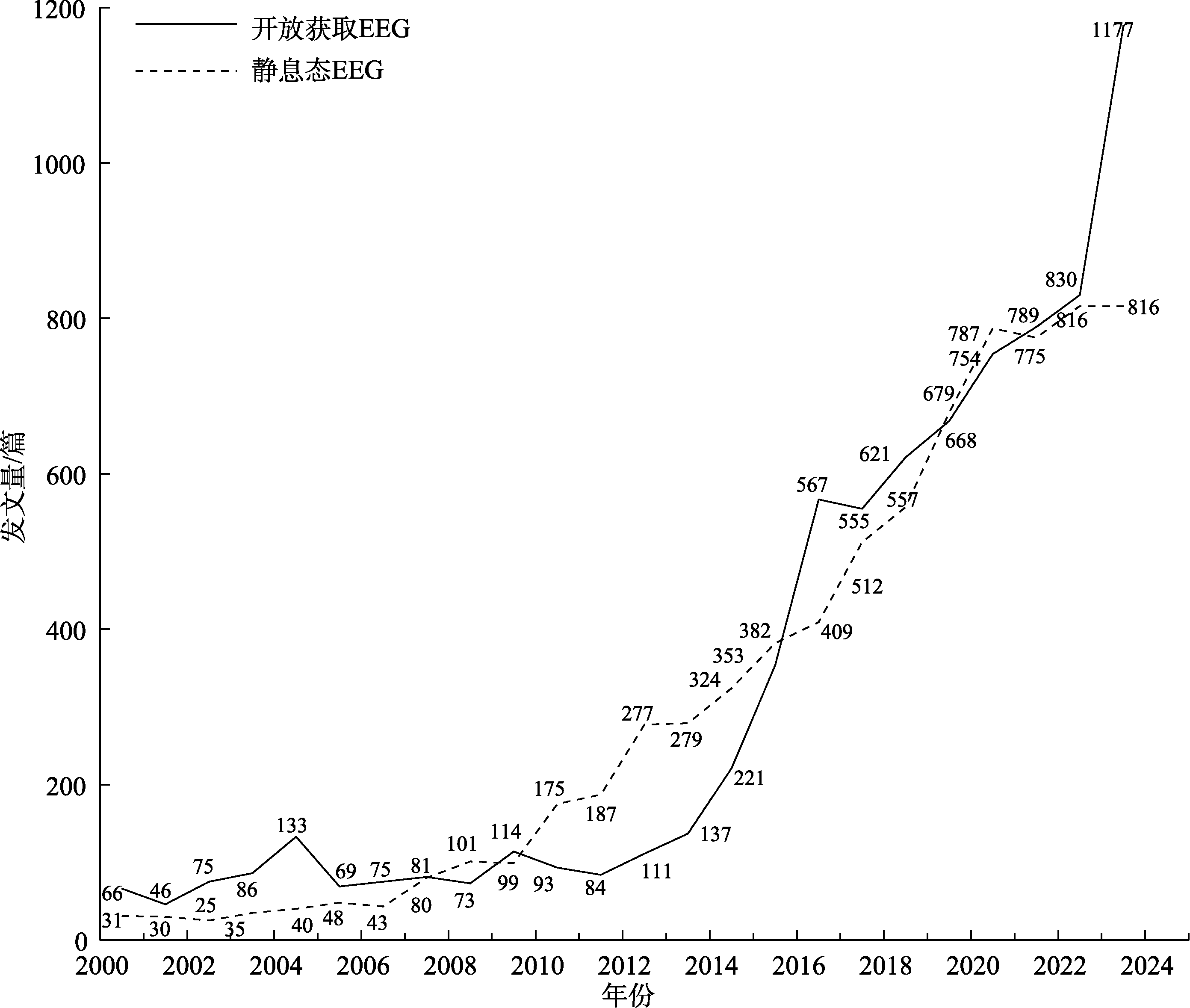
图1 从2000年到2024年静息态EEG和开放获取EEG的论文发表量。
| 序号 | 数据库名称 | 网址 | 被试信息 | 其他数据采集模态 | 静息态EEG实验参数 | 任务态EEG | 关键词 | 采集 国家或地区 | 有无数据说明文章 | 数据库&数据介绍文章被引量 | ||||||
|---|---|---|---|---|---|---|---|---|---|---|---|---|---|---|---|---|
| 人数 | 性别 | 年龄 | 导联 | 采样率(Hz) | 范式 | |||||||||||
| 男 | 女 | 范围 | 均值 | |||||||||||||
| 1 | 多种自发思维状态下的EEG重测数据集 | https://openneuro.org/datasets/ds004148/versions/1.0.1 | 60 | 28 | 32 | 18~28 | 20.0 | 量表 | 63或64 | 500 | 睁闭眼 | √ | 重测, 自发思维 | 中国 | 有 | 21 |
| 2 | 睡眠剥夺的静息态EEG数据集 | https://openneuro.org/datasets/ds004902/versions/1.0.5 | 71 | 37 | 34 | 17~23 | 20.0 | 量表 | 61 | 500 | 睁闭眼 | 睡眠剥夺 | 中国 | 有 | 20 | |
| 3 | 刺激选择性反应调节的静息态EEG | https://openneuro.org/datasets/ds003775/versions/1.2.1 | 111 | 42 | 69 | 17~71 | 37.6 | 行为数据 | 64 | 1024 | 闭眼 | √ | 刺激选择性反应调节 | 挪威 | 有 | 15 |
| 4 | 首发精神病的静息态EEG | https://openneuro.org/datasets/ds003944/versions/1.0.1; | 62 | 39 | 23 | 20~38 | 23.8 | 量表, 临床评估结果, MEG | 60 | 1000 | 睁眼 | √ | 首发 精神病 | 美国 | 有 | 25 |
| 5 | 发育过程大脑信息处理的多模态资源数据集 | https://fcon_1000.projects.nitrc.org/indi/cmi_eeg/eeg.html | 126 | 69 | 57 | 6~44 | 行为数据, 眼动追踪数据 | 128 | 500 | 睁闭眼 | √ | 儿童 | 美国 | 有 | 86 | |
| 6 | 儿童心理研究所健康 大脑网络数据库 | https://fcon_1000.projects.nitrc.org/indi/cmi_healthy_brain_network/MRI_EEG.html | 5~21 | 量表, MRI | 128 | 500 | 睁闭眼 | √ | 多模态 | 美国 | 有 | 567 | ||||
| 7 | 莱比锡心脑身数据库 | https://fcon_1000.projects.nitrc.org/indi/retro/MPI_LEMON/downloads/download_EEG.html | 228 | 146 | 82 | 20~35; 59~77 | 38.9 | 量表, MRI, 生理数据(血压、心率、脉搏、呼吸) | 62 | 2500 | 睁闭眼 | 身−脑− 心交互 | 德国 | 有 | 360 | |
| 8 | 波兰Nencki-Symfonia EEG/ERP 数据集 | http://gigadb.org/dataset/100990 | 42 | 20 | 22 | 20~34 | 24.6 | 行为数据 | 128 | 1000 | 睁眼 | √ | 注意力; 认知控制 | 波兰 | 有 | 6 |
| 9 | 抑郁症静息态EEG 数据集 | https://openneuro.org/datasets/ds003478/versions/1.1.0 | 122 | 74 | 47 | 18~24 | 18.9 | 行为数据, 部分被试有临床访谈记录 | 64 | 500 | 睁闭眼 | 抑郁 | 美国 | 无 | 23 | |
| 10 | 帕金森病患者Oddball任务和静息态EEG数据集 | https://openneuro.org/datasets/ds003490/versions/1.1.0 | 50 | 32 | 18 | 48~84 | 69.5 | 行为数据 | 64 | 500 | 睁闭眼 | √ | 帕金森 | 美国 | 无 | 5 |
| 11 | 英国EEG, fMRI和 NODDI数据集 | https://osf.io/94c5t/wiki/home/ | 17 | 11 | 6 | 32.8 | 同步fMRI, 神经突方向离散度和密度成像 | 64 | 1000 | 睁眼 | 同步 EEG-fMRI | 英国 | 有 | 179 | ||
| 12 | 土耳其信号处理与信息系统静息状态数据集 | https://github.com/mastaneht/SPIS-Resting-State-Dataset | 10 | 4 | 6 | 22~45.5 | 30.3 | 行为数据 | 64 | 2048 | 睁闭眼 | 脑机接口 | 土耳其 | 有 | 47 | |
| 13 | 美国德克萨斯州立大学数据集 | https://dataverse.tdl.org/dataset.xhtml?persistentId=doi:10.18738/T8/EG0LJI | 22 | 11 | 11 | 18~26 | 21.1 | 量表 | 72 | 2048 | 睁闭眼 | √ | 美国 | 有 | 58 | |
| 14 | 运动想象脑机接口 数据集 | https://gigadb.org/dataset/100295 | 52 | 33 | 19 | 24.8 | 行为数据, 量表, MEG | 64 | 512 | 睁闭眼 | √ | 运动想象, 脑机接口 | 韩国 | 有 | 362 | |
| 15 | 高γ频段数据集 | https://github.com/robintibor/high-gamma-dataset | 20 | 11 | 9 | 27.5 | 128 | 500 | 睁眼 | √ | 脑机接口, 运动想象 | 德国 | 有 | 2139 | ||
| 16 | 注意力缺陷多动障碍静息态数据集 | https://osf.io/azkhs/ | 43 | 35 | 8 | 9~16 | 12.4 | 人口学信息 | 128 | 500 | 睁闭眼 | 注意力缺 陷多动症 | 英国 | 有 | 46 | |
| 17 | 运动想象的EEG数据集 | https://archive.physionet.org/pn4/eegmmidb/ | 109 | 59 | 42 | 19~67 | 38.8 | 64 | 160 | 睁闭眼 | √ | 脑机接口 | 美国 | 有 | 3659 | |
| 18 | 英国丙泊酚静息态EEG数据集 | https://www.repository.cam.ac.uk/items/b7817912-50b5-423b-882e-978fb39a49df | 20 | 9 | 11 | 30.9 | 行为数据 | 128 | 250 | 闭眼 | 丙泊酚 | 英国 | 有 | 134 | ||
| 19 | 自闭症的亚稳态大脑研究的EEG数据集 | https://osf.io/29qb5/ | 132 | 83 | 79 | 20~47 | 24.2 | 量表, 访谈 | 63 | 1000 | 闭眼 | 自闭症 | 日本 | 无 | 未提供 | |
| 20 | 抑郁症青少年的静息态EEG数据集 | https://doi.org/10.17605/OSF.IO/4HQ3Y | 85 | 30 | 55 | 13~22 | 量表, 访谈 | 64 | 1000 | 睁闭眼 | 青少年, 抑郁症 | 泰国 | 有 | 7 | ||
| 21 | 波兰PEARL神经影像数据库 | https://openneuro.org/datasets/ds004796/versions/1.0.9 | 192 | 96 | 96 | 50~63 | 55.1 | 行为数据, 量表, fMRI, 基因 | 128 | 1000 | 睁闭眼 | √ | 阿兹海默易感性, 大脑衰老, 遗传 | 波兰 | 有 | 6 |
| 22 | EEG微状态与执行功能的相关性数据集 | https://openneuro.org/datasets/ds005305/versions/1.0.1 | 192 | 89 | 103 | 18~35 | 24.8 | 量表 | 64 | 512 | 睁闭眼 | √ | 执行功能, 微状态 | 法国 | 有 | 0 |
| 23 | 数字广度与休息状态下的EEG、眼动、心电和血容量变化及行为数据 | https://openneuro.org/datasets/ds003838/versions/1.0.6 | 86 | 12 | 74 | 18~44 | 20.5 | 行为数据, 量表 | 64 | 1000 | 闭眼 | √ | 认知负荷识别, 认知过载检测算法 | 德国 | 有 | 3 |
| 24 | 古巴人脑图谱项目 | https://chbmp-open.loris.ca/ | 282 | 195 | 87 | 18~68 | 31.9 | 行为数据, 量表, 血液样本, MRI | 64或120 | 200 | √ | 神经发育, 健康衰老 | 古巴 | 有 | 51 | |
| 25 | 美国爱荷华帕金森睁眼静息数据库 | https://openneuro.org/datasets/ds004584/versions/1.0.0 | 149 | 94 | 55 | 48~86 | 69.3 | 量表 | 64 | 500 | 睁眼 | 帕金森 | 美国 | 有 | 17 | |
| 26 | 认知任务态前后5年重测静息态EEG数据集 | https://openneuro.org/datasets/ds005385/versions/1.0.2 | 608 | 232 | 376 | 20~70 | 44.1 | 行为数据 | 64 | 1000 | 睁闭眼 | √ | 认知功能 | 德国 | 有 | 5 |
| 27 | 赌博任务数据集 | https://openneuro.org/datasets/ds004511/versions/1.0.2 | 44 | 23 | 21 | 20~43 | 25.2 | 行为数据 | 128 | 3000 | 闭眼 | √ | 认知控制 | 新加坡 | 无 | 1 |
| 28 | 催眠技术的安慰剂效应研究1数据集 | https://openneuro.org/datasets/ds004572/versions/1.2.1 | 52 | 13 | 39 | 24.5 | 行为数据 | 64 | 1000 | 闭眼 | √ | 催眠 | 匈牙利 | 无 | 未提供 | |
| 29 | 精神障碍分析中多模态开放数据集 | https://modma.lzu.edu.cn/data/application/#data_1 | 53 | 33 | 20 | 16~56 | 人口学信息, 心理评估数据, 行为数据 | 128 | 250 | 闭眼 | √ | 抑郁症 | 中国 | 有 | 211 | |
| 30 | ABC-CT数据集 | https://nda.nih.gov/edit_collection.html?id=2288 | 399 | 6~11 | 行为数据, 临床诊断 | 128 | 1000 | 睁闭眼 | √ | 自闭症 | 美国 | 有 | 125 | |||
表1 高密度静息态EEG的已有公开数据库情况
| 序号 | 数据库名称 | 网址 | 被试信息 | 其他数据采集模态 | 静息态EEG实验参数 | 任务态EEG | 关键词 | 采集 国家或地区 | 有无数据说明文章 | 数据库&数据介绍文章被引量 | ||||||
|---|---|---|---|---|---|---|---|---|---|---|---|---|---|---|---|---|
| 人数 | 性别 | 年龄 | 导联 | 采样率(Hz) | 范式 | |||||||||||
| 男 | 女 | 范围 | 均值 | |||||||||||||
| 1 | 多种自发思维状态下的EEG重测数据集 | https://openneuro.org/datasets/ds004148/versions/1.0.1 | 60 | 28 | 32 | 18~28 | 20.0 | 量表 | 63或64 | 500 | 睁闭眼 | √ | 重测, 自发思维 | 中国 | 有 | 21 |
| 2 | 睡眠剥夺的静息态EEG数据集 | https://openneuro.org/datasets/ds004902/versions/1.0.5 | 71 | 37 | 34 | 17~23 | 20.0 | 量表 | 61 | 500 | 睁闭眼 | 睡眠剥夺 | 中国 | 有 | 20 | |
| 3 | 刺激选择性反应调节的静息态EEG | https://openneuro.org/datasets/ds003775/versions/1.2.1 | 111 | 42 | 69 | 17~71 | 37.6 | 行为数据 | 64 | 1024 | 闭眼 | √ | 刺激选择性反应调节 | 挪威 | 有 | 15 |
| 4 | 首发精神病的静息态EEG | https://openneuro.org/datasets/ds003944/versions/1.0.1; | 62 | 39 | 23 | 20~38 | 23.8 | 量表, 临床评估结果, MEG | 60 | 1000 | 睁眼 | √ | 首发 精神病 | 美国 | 有 | 25 |
| 5 | 发育过程大脑信息处理的多模态资源数据集 | https://fcon_1000.projects.nitrc.org/indi/cmi_eeg/eeg.html | 126 | 69 | 57 | 6~44 | 行为数据, 眼动追踪数据 | 128 | 500 | 睁闭眼 | √ | 儿童 | 美国 | 有 | 86 | |
| 6 | 儿童心理研究所健康 大脑网络数据库 | https://fcon_1000.projects.nitrc.org/indi/cmi_healthy_brain_network/MRI_EEG.html | 5~21 | 量表, MRI | 128 | 500 | 睁闭眼 | √ | 多模态 | 美国 | 有 | 567 | ||||
| 7 | 莱比锡心脑身数据库 | https://fcon_1000.projects.nitrc.org/indi/retro/MPI_LEMON/downloads/download_EEG.html | 228 | 146 | 82 | 20~35; 59~77 | 38.9 | 量表, MRI, 生理数据(血压、心率、脉搏、呼吸) | 62 | 2500 | 睁闭眼 | 身−脑− 心交互 | 德国 | 有 | 360 | |
| 8 | 波兰Nencki-Symfonia EEG/ERP 数据集 | http://gigadb.org/dataset/100990 | 42 | 20 | 22 | 20~34 | 24.6 | 行为数据 | 128 | 1000 | 睁眼 | √ | 注意力; 认知控制 | 波兰 | 有 | 6 |
| 9 | 抑郁症静息态EEG 数据集 | https://openneuro.org/datasets/ds003478/versions/1.1.0 | 122 | 74 | 47 | 18~24 | 18.9 | 行为数据, 部分被试有临床访谈记录 | 64 | 500 | 睁闭眼 | 抑郁 | 美国 | 无 | 23 | |
| 10 | 帕金森病患者Oddball任务和静息态EEG数据集 | https://openneuro.org/datasets/ds003490/versions/1.1.0 | 50 | 32 | 18 | 48~84 | 69.5 | 行为数据 | 64 | 500 | 睁闭眼 | √ | 帕金森 | 美国 | 无 | 5 |
| 11 | 英国EEG, fMRI和 NODDI数据集 | https://osf.io/94c5t/wiki/home/ | 17 | 11 | 6 | 32.8 | 同步fMRI, 神经突方向离散度和密度成像 | 64 | 1000 | 睁眼 | 同步 EEG-fMRI | 英国 | 有 | 179 | ||
| 12 | 土耳其信号处理与信息系统静息状态数据集 | https://github.com/mastaneht/SPIS-Resting-State-Dataset | 10 | 4 | 6 | 22~45.5 | 30.3 | 行为数据 | 64 | 2048 | 睁闭眼 | 脑机接口 | 土耳其 | 有 | 47 | |
| 13 | 美国德克萨斯州立大学数据集 | https://dataverse.tdl.org/dataset.xhtml?persistentId=doi:10.18738/T8/EG0LJI | 22 | 11 | 11 | 18~26 | 21.1 | 量表 | 72 | 2048 | 睁闭眼 | √ | 美国 | 有 | 58 | |
| 14 | 运动想象脑机接口 数据集 | https://gigadb.org/dataset/100295 | 52 | 33 | 19 | 24.8 | 行为数据, 量表, MEG | 64 | 512 | 睁闭眼 | √ | 运动想象, 脑机接口 | 韩国 | 有 | 362 | |
| 15 | 高γ频段数据集 | https://github.com/robintibor/high-gamma-dataset | 20 | 11 | 9 | 27.5 | 128 | 500 | 睁眼 | √ | 脑机接口, 运动想象 | 德国 | 有 | 2139 | ||
| 16 | 注意力缺陷多动障碍静息态数据集 | https://osf.io/azkhs/ | 43 | 35 | 8 | 9~16 | 12.4 | 人口学信息 | 128 | 500 | 睁闭眼 | 注意力缺 陷多动症 | 英国 | 有 | 46 | |
| 17 | 运动想象的EEG数据集 | https://archive.physionet.org/pn4/eegmmidb/ | 109 | 59 | 42 | 19~67 | 38.8 | 64 | 160 | 睁闭眼 | √ | 脑机接口 | 美国 | 有 | 3659 | |
| 18 | 英国丙泊酚静息态EEG数据集 | https://www.repository.cam.ac.uk/items/b7817912-50b5-423b-882e-978fb39a49df | 20 | 9 | 11 | 30.9 | 行为数据 | 128 | 250 | 闭眼 | 丙泊酚 | 英国 | 有 | 134 | ||
| 19 | 自闭症的亚稳态大脑研究的EEG数据集 | https://osf.io/29qb5/ | 132 | 83 | 79 | 20~47 | 24.2 | 量表, 访谈 | 63 | 1000 | 闭眼 | 自闭症 | 日本 | 无 | 未提供 | |
| 20 | 抑郁症青少年的静息态EEG数据集 | https://doi.org/10.17605/OSF.IO/4HQ3Y | 85 | 30 | 55 | 13~22 | 量表, 访谈 | 64 | 1000 | 睁闭眼 | 青少年, 抑郁症 | 泰国 | 有 | 7 | ||
| 21 | 波兰PEARL神经影像数据库 | https://openneuro.org/datasets/ds004796/versions/1.0.9 | 192 | 96 | 96 | 50~63 | 55.1 | 行为数据, 量表, fMRI, 基因 | 128 | 1000 | 睁闭眼 | √ | 阿兹海默易感性, 大脑衰老, 遗传 | 波兰 | 有 | 6 |
| 22 | EEG微状态与执行功能的相关性数据集 | https://openneuro.org/datasets/ds005305/versions/1.0.1 | 192 | 89 | 103 | 18~35 | 24.8 | 量表 | 64 | 512 | 睁闭眼 | √ | 执行功能, 微状态 | 法国 | 有 | 0 |
| 23 | 数字广度与休息状态下的EEG、眼动、心电和血容量变化及行为数据 | https://openneuro.org/datasets/ds003838/versions/1.0.6 | 86 | 12 | 74 | 18~44 | 20.5 | 行为数据, 量表 | 64 | 1000 | 闭眼 | √ | 认知负荷识别, 认知过载检测算法 | 德国 | 有 | 3 |
| 24 | 古巴人脑图谱项目 | https://chbmp-open.loris.ca/ | 282 | 195 | 87 | 18~68 | 31.9 | 行为数据, 量表, 血液样本, MRI | 64或120 | 200 | √ | 神经发育, 健康衰老 | 古巴 | 有 | 51 | |
| 25 | 美国爱荷华帕金森睁眼静息数据库 | https://openneuro.org/datasets/ds004584/versions/1.0.0 | 149 | 94 | 55 | 48~86 | 69.3 | 量表 | 64 | 500 | 睁眼 | 帕金森 | 美国 | 有 | 17 | |
| 26 | 认知任务态前后5年重测静息态EEG数据集 | https://openneuro.org/datasets/ds005385/versions/1.0.2 | 608 | 232 | 376 | 20~70 | 44.1 | 行为数据 | 64 | 1000 | 睁闭眼 | √ | 认知功能 | 德国 | 有 | 5 |
| 27 | 赌博任务数据集 | https://openneuro.org/datasets/ds004511/versions/1.0.2 | 44 | 23 | 21 | 20~43 | 25.2 | 行为数据 | 128 | 3000 | 闭眼 | √ | 认知控制 | 新加坡 | 无 | 1 |
| 28 | 催眠技术的安慰剂效应研究1数据集 | https://openneuro.org/datasets/ds004572/versions/1.2.1 | 52 | 13 | 39 | 24.5 | 行为数据 | 64 | 1000 | 闭眼 | √ | 催眠 | 匈牙利 | 无 | 未提供 | |
| 29 | 精神障碍分析中多模态开放数据集 | https://modma.lzu.edu.cn/data/application/#data_1 | 53 | 33 | 20 | 16~56 | 人口学信息, 心理评估数据, 行为数据 | 128 | 250 | 闭眼 | √ | 抑郁症 | 中国 | 有 | 211 | |
| 30 | ABC-CT数据集 | https://nda.nih.gov/edit_collection.html?id=2288 | 399 | 6~11 | 行为数据, 临床诊断 | 128 | 1000 | 睁闭眼 | √ | 自闭症 | 美国 | 有 | 125 | |||
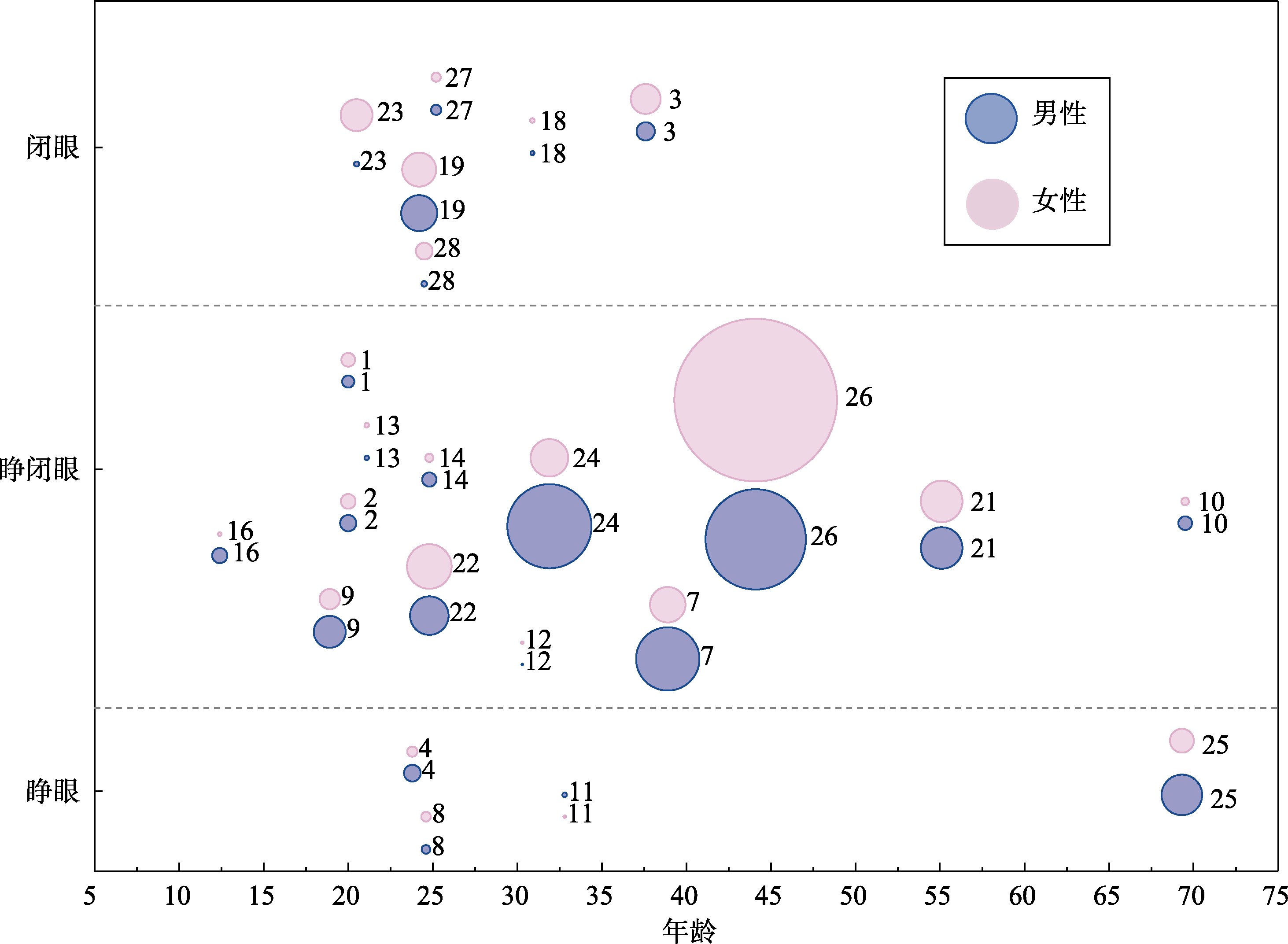
图2 高密度静息态EEG已有公开数据库的指导语、年龄和被试量构成情况。图示旁数字代表表1中数据库的编号, 圆圈半径与被试人数成线性关系。彩图见电子版。
| 分析层次 | 具体方法 | 电极数 | 描述 | |
|---|---|---|---|---|
| 时域分析 | 波幅分析 | 单电极 | 直接从时域中提取相关波形特征 | |
| 峰值检测 | ||||
| 频域分析 | 功率谱 分析 | 单电极 | 通过把波幅随时间变化的信号转换为EEG功率随频率变化的谱图, 得到EEG信号中各个节律的分布与变化情况 | |
| 非周期功 率谱分析 | 提取和分析信号中的非周期性成分, 这些成分反映了信号的非平稳特性和复杂性。 | |||
| 时频变换 | 将信号从时域或频域转换为时频域, 从而同时捕捉信号的时间和频率信息。 | |||
| 小波分析 | 将信号分解为不同时间尺度和频率成分的小波基函数, 能够同时捕捉信号的时间和频率信息。 | |||
| 空间分析 | 微状态分析 | 全脑电极 | 通过分析EEG信号的头皮电位场配置, 识别出一系列离散、短暂且相对稳定的大脑功能状态 | |
| 源定位分析 | 全脑电极 | 将头皮电极记录到的EEG信号通过计算识别到产生电活动的大脑皮层或脑内的特定区域 | ||
| 连接分析 | 功能连接分析 | 相干性分析 | 两个电极 | 评估两个信号在特定频率下的线性相关性。 |
| 同步性分析 | 两个电极 | 关注相位锁定值、相位滞后指数和相位一致性等指标, 用于评估功能连接, 即不同脑区的活动是否同步 | ||
| 有效连接分析 | 动态因果模型 | 多电极 | 用于评估大脑区域之间的有效连接, 描述脑区之间的动态交互和因果关系的强度和方向。 | |
| 转移熵 | 多电极 | 评估一个信号对另一个信号的预测能力, 揭示信号间的信息流动。 | ||
| 因果分析 | 两个电极 | 评估一个脑区对另一个脑区的因果影响, 适用于分析EEG信号中的因果关系 | ||
| 复杂网络分析 | 无标度分析 | 多电极 | 探讨脑网络的拓扑特性, 尤其是其是否具有无标度网络的特性 | |
| 小世界分析 | 多电极 | 一种基于图论的方法, 用于评估脑网络的拓扑特性, 表明网络在局部连接和远程连接之间取得了平衡 | ||
表2 静息态EEG的主要分析方法
| 分析层次 | 具体方法 | 电极数 | 描述 | |
|---|---|---|---|---|
| 时域分析 | 波幅分析 | 单电极 | 直接从时域中提取相关波形特征 | |
| 峰值检测 | ||||
| 频域分析 | 功率谱 分析 | 单电极 | 通过把波幅随时间变化的信号转换为EEG功率随频率变化的谱图, 得到EEG信号中各个节律的分布与变化情况 | |
| 非周期功 率谱分析 | 提取和分析信号中的非周期性成分, 这些成分反映了信号的非平稳特性和复杂性。 | |||
| 时频变换 | 将信号从时域或频域转换为时频域, 从而同时捕捉信号的时间和频率信息。 | |||
| 小波分析 | 将信号分解为不同时间尺度和频率成分的小波基函数, 能够同时捕捉信号的时间和频率信息。 | |||
| 空间分析 | 微状态分析 | 全脑电极 | 通过分析EEG信号的头皮电位场配置, 识别出一系列离散、短暂且相对稳定的大脑功能状态 | |
| 源定位分析 | 全脑电极 | 将头皮电极记录到的EEG信号通过计算识别到产生电活动的大脑皮层或脑内的特定区域 | ||
| 连接分析 | 功能连接分析 | 相干性分析 | 两个电极 | 评估两个信号在特定频率下的线性相关性。 |
| 同步性分析 | 两个电极 | 关注相位锁定值、相位滞后指数和相位一致性等指标, 用于评估功能连接, 即不同脑区的活动是否同步 | ||
| 有效连接分析 | 动态因果模型 | 多电极 | 用于评估大脑区域之间的有效连接, 描述脑区之间的动态交互和因果关系的强度和方向。 | |
| 转移熵 | 多电极 | 评估一个信号对另一个信号的预测能力, 揭示信号间的信息流动。 | ||
| 因果分析 | 两个电极 | 评估一个脑区对另一个脑区的因果影响, 适用于分析EEG信号中的因果关系 | ||
| 复杂网络分析 | 无标度分析 | 多电极 | 探讨脑网络的拓扑特性, 尤其是其是否具有无标度网络的特性 | |
| 小世界分析 | 多电极 | 一种基于图论的方法, 用于评估脑网络的拓扑特性, 表明网络在局部连接和远程连接之间取得了平衡 | ||
| 软件名称 | 语言 | 参考文献 | 主要功能 |
|---|---|---|---|
| EEGLAB | MATLAB | Delorme & Makeig, | 预处理, 频谱分析 |
| BrainStorm | Tadel et al., | ||
| Fieldtrip | Oostenveld et al., | ||
| SPM | Ashburner, | 频谱分析, 源定位 | |
| MICROSTATELAB | Nagabhushan Kalburgi et al., | 微状态分析 | |
| EMEGS (electromagnetic encephalography software) | Peyk et al., | 预处理, 源定位, 频谱分析 | |
| DISCOVER-EEG | Gil Ávila et al., | 预处理, 神经标志物识别 | |
| MNE-Python | Python | Gramfort et al., | 源定位 |
| FOOOF | Donoghue et al., | 非周期功率谱分析 | |
| LORETA | C++ | Pascual-Marqui et al., | 源定位 |
表3 静息态EEG常用的分析软件
| 软件名称 | 语言 | 参考文献 | 主要功能 |
|---|---|---|---|
| EEGLAB | MATLAB | Delorme & Makeig, | 预处理, 频谱分析 |
| BrainStorm | Tadel et al., | ||
| Fieldtrip | Oostenveld et al., | ||
| SPM | Ashburner, | 频谱分析, 源定位 | |
| MICROSTATELAB | Nagabhushan Kalburgi et al., | 微状态分析 | |
| EMEGS (electromagnetic encephalography software) | Peyk et al., | 预处理, 源定位, 频谱分析 | |
| DISCOVER-EEG | Gil Ávila et al., | 预处理, 神经标志物识别 | |
| MNE-Python | Python | Gramfort et al., | 源定位 |
| FOOOF | Donoghue et al., | 非周期功率谱分析 | |
| LORETA | C++ | Pascual-Marqui et al., | 源定位 |
| [1] |
胡静怡, 白朵, 雷旭. (2025). 静息态EEG/MEG的非周期成分: 分析流程、应用进展和未来前景. 心理科学进展, 33(8), 1321-1339.
doi: 10.3724/SP.J.1042.2025.1321 |
| [2] | 雷旭, 尧德中. (2014). 同步脑电-功能磁共振(EEG-fMRI)原理与技术. 北京: 科学出版社. |
| [3] |
陆林, 刘晓星, 袁凯. (2022). 中国脑科学计划进展. 北京大学学报(医学版), 54(5), 791-795. https://doi.org/10.19723/j.issn.1671-167X.2022.05.002
doi: 10.19723/j.issn.1671-167X.2022.05.002 URL |
| [4] | 覃慧怡, 汪玉林, 雷旭. (2024). 头皮脑电重测信度的研究进展. 中国生物医学工程学报, 43(1), 106-116. |
| [5] |
Ashburner, J. (2012). SPM: A history. NeuroImage, 62(2), 791-800.
doi: 10.1016/j.neuroimage.2011.10.025 pmid: 22023741 |
| [6] | Babayan, A., Erbey, M., Kumral, D., Reinelt, J. D., Reiter, A. M., Röbbig, J.,... Bazin, P.-L. (2019). A mind-brain-body dataset of MRI, EEG, cognition, emotion, and peripheral physiology in young and old adults. Scientific Data, 6(1), 1-21. |
| [7] | Berger, H. (1930). Electroencephalogram of humans. Journal fur Psychologie und Neurologie, 40, 160-179. |
| [8] |
Bigdely-Shamlo, N., Mullen, T., Kothe, C., Su, K.-M., & Robbins, K. A. (2015). The PREP pipeline: Standardized preprocessing for large-scale EEG analysis. Frontiers in Neuroinformatics, 9, 16.
doi: 10.3389/fninf.2015.00016 pmid: 26150785 |
| [9] |
Birn, R. M. (2012). The role of physiological noise in resting-state functional connectivity. NeuroImage, 62(2), 864-870.
doi: 10.1016/j.neuroimage.2012.01.016 pmid: 22245341 |
| [10] | Bosch-Bayard, J., Biscay, R. J., Fernandez, T., Otero, G. A., Ricardo-Garcell, J., Aubert-Vazquez, E., Evans, A. C., & Harmony, T. (2022). EEG effective connectivity during the first year of life mirrors brain synaptogenesis, myelination, and early right hemisphere predominance. NeuroImage, 252, 119035. |
| [11] | Cai, H., Yuan, Z., Gao, Y., Sun, S., Li, N., Tian, F.,... Li, X. (2022). A multi-modal open dataset for mental-disorder analysis. Scientific Data, 9(1), 178. |
| [12] | Cao, Q., Wang, Y., Ji, Y., He, Z., & Lei, X. (2024). Resting- state EEG reveals abnormal microstate characteristics of Depression with Insomnia. Brain Topography, 37(3), 388-396. |
| [13] | Carrle, F. P., Hollenbenders, Y., & Reichenbach, A. (2023). Generation of synthetic EEG data for training algorithms supporting the diagnosis of major depressive disorder. Frontiers in Neuroscience, 17, 1219133. |
| [14] | Cecchetti, G., Agosta, F., Basaia, S., Cividini, C., Cursi, M., Santangelo, R.,... Filippi, M. (2021). Resting-state electroencephalographic biomarkers of Alzheimer’s disease. NeuroImage: Clinical, 31, 102711. |
| [15] | Chu, C. J. (2014). High density EEG—What do we have to lose? Clinical Neurophysiology, 126(3), 433-434. |
| [16] | de Aguiar Neto, F. S., & Rosa, J. L. G. (2019). Depression biomarkers using non-invasive EEG: A review. Neuroscience & Biobehavioral Reviews, 105, 83-93. |
| [17] |
Deco, G., Jirsa, V. K., & McIntosh, A. R. (2011). Emerging concepts for the dynamical organization of resting-state activity in the brain. Nature Reviews Neuroscience, 12(1), 43-56.
doi: 10.1038/nrn2961 pmid: 21170073 |
| [18] |
Delorme, A., & Makeig, S. (2004). EEGLAB: An open source toolbox for analysis of single-trial EEG dynamics including independent component analysis. Journal of Neuroscience Methods, 134(1), 9-21.
doi: 10.1016/j.jneumeth.2003.10.009 pmid: 15102499 |
| [19] |
Ding, L., Duan, W., Wang, Y., & Lei, X. (2022). Test-retest reproducibility comparison in resting and the mental task states: A sensor and source-level EEG spectral analysis. International Journal of Psychophysiology, 173, 20-28.
doi: 10.1016/j.ijpsycho.2022.01.003 pmid: 35017028 |
| [20] |
Dong, L., Li, F., Liu, Q., Wen, X., Lai, Y., Xu, P., & Yao, D. (2017). MATLAB toolboxes for reference electrode standardization technique (REST) of scalp EEG. Frontiers in Neuroscience, 11, 601.
doi: 10.3389/fnins.2017.00601 pmid: 29163006 |
| [21] |
Donoghue, T., Haller, M., Peterson, E. J., Varma, P., Sebastian, P., Gao, R.,... Knight, R. T. (2020). Parameterizing neural power spectra into periodic and aperiodic components. Nature Neuroscience, 23(12), 1655-1665.
doi: 10.1038/s41593-020-00744-x pmid: 33230329 |
| [22] |
Duan, L., Duan, H., Qiao, Y., Sha, S., Qi, S., Zhang, X.,... Wang, C. (2020). Machine learning approaches for MDD detection and emotion decoding using EEG signals. Frontiers in Human Neuroscience, 14, 284.
doi: 10.3389/fnhum.2020.00284 pmid: 33173472 |
| [23] | Duan, W., Chen, X., Wang, Y.-J., Zhao, W., Yuan, H., & Lei, X. (2021). Reproducibility of power spectrum, functional connectivity and network construction in resting-state EEG. Journal of Neuroscience Methods, 348, 108985. |
| [24] | Dzianok, P., Wojciechowski, J., Wolak, T., & Kublik, E. (2025). Alzheimer's disease-like features in resting state EEG/fMRI of cognitively intact and healthy middle-aged APOE/PICALM risk carriers. Journal of Alzheimer's Disease, 104(2), 509-524. https://doi.org/10.1177/13872877251317489 |
| [25] | Farahzadi, Y., Ansarinia, M., & Kekecs, Z. (2025). YARE- GAN: Yet another resting state EEG-GAN. arXiv. https://doi.org/10.48550/arxiv.2503.02636 |
| [26] |
Ferrari, M., & Quaresima, V. (2012). A brief review on the history of human functional near-infrared spectroscopy (fNIRS) development and fields of application. NeuroImage, 63(2), 921-935.
doi: 10.1016/j.neuroimage.2012.03.049 pmid: 22510258 |
| [27] | Fraschini, M., La Cava, S. M., Rodriguez, G., Vitale, A., & Demuru, M. (2022). Scorepochs: A computer-aided scoring tool for resting-state M/EEG epochs. Sensors, 22(8), 2853. |
| [28] | Gemein, L. A., Schirrmeister, R. T., Boedecker, J., & Ball, T. (2024). Brain age revisited: Investigating the state vs. trait hypotheses of EEG-derived brain-age dynamics with deep learning. Imaging Neuroscience, 2, 1-22. |
| [29] | Gil Ávila, C., Bott, F. S., Tiemann, L., Hohn, V. D., May, E. S., Nickel, M. M., Zebhauser, P. T., Gross, J., & Ploner, M. (2023). Discover-EEG: An open, fully automated EEG pipeline for biomarker discovery in clinical neuroscience. Scientific Data, 10(1), 613. |
| [30] | Gorgolewski, K. J., Auer, T., Calhoun, V. D., Craddock, R. C., Das, S., Duff, E. P.,... Poldrack, R. A. (2016). The brain imaging data structure, a format for organizing and describing outputs of neuroimaging experiments. Scientific Data, 3(1), 16004. |
| [31] | Gramfort, A., Luessi, M., Larson, E., Engemann, D. A., Strohmeier, D., Brodbeck, C.,... Hämäläinen, M. (2013). MEG and EEG data analysis with MNE-Python. Frontiers in Neuroinformatics, 7, 267. |
| [32] |
Hatz, F., Hardmeier, M., Bousleiman, H., Rüegg, S., Schindler, C., & Fuhr, P. (2015). Reliability of fully automated versus visually controlled pre-and post- processing of resting-state EEG. Clinical Neurophysiology, 126(2), 268-274.
doi: 10.1016/j.clinph.2014.05.014 pmid: 24996926 |
| [33] | Heunis, T.-M., Aldrich, C., & de Vries, P. J. (2016). Recent advances in resting-state electroencephalography biomarkers for autism spectrum disorder—A review of methodological and clinical challenges. Pediatric Neurology, 61, 28-37. |
| [34] |
Huberty, S., Carter Leno, V., van Noordt, S. J., Bedford, R., Pickles, A., Desjardins, J. A.,... Elsabbagh, M. (2021). Association between spectral electroencephalography power and autism risk and diagnosis in early development. Autism Research, 14(7), 1390-1403.
doi: 10.1002/aur.2518 pmid: 33955195 |
| [35] |
Ingber, L., & Nunez, P. L. (2011). Neocortical dynamics at multiple scales: EEG standing waves, statistical mechanics, and physical analogs. Mathematical Biosciences, 229(2), 160-173.
doi: 10.1016/j.mbs.2010.12.003 pmid: 21167841 |
| [36] | Jiang, Y., Mu, Y., Xu, Z., Liu, Q., Wang, S., Wang, H., & Feng, J. (2024). Identifying individual brain development using multimodality brain network. Communications Biology, 7(1), 1163. |
| [37] | Jones, D. (2010). A WEIRD view of human nature skews psychologists' studies. Science, 328(5986), 1627. https://doi.org/10.1126/science.328.5986.1627 |
| [38] | Kabbara, A., Robert, G., Khalil, M., Verin, M., Benquet, P., & Hassan, M. (2022). An electroencephalography connectome predictive model of major depressive disorder severity. Scientific Reports, 12(1), 6816. |
| [39] | Khan, S., Umar Saeed, S. M., Frnda, J., Arsalan, A., Amin, R., Gantassi, R., & Noorani, S. H. (2024). A machine learning based depression screening framework using temporal domain features of the electroencephalography signals. PloS One, 19(3), e0299127. |
| [40] | Khanna, A., Pascual-Leone, A., Michel, C. M., & Farzan, F. (2015). Microstates in resting-state EEG: Current status and future directions. Neuroscience & Biobehavioral Reviews, 49, 105-113. |
| [41] | Khayretdinova, M., Zakharov, I., Pshonkovskaya, P., Adamovich, T., Kiryasov, A., Zhdanov, A., & Shovkun, A. (2024). Prediction of brain sex from EEG: Using large- scale heterogeneous dataset for developing a highly accurate and interpretable ML model. NeuroImage, 285, 120495. |
| [42] | Koenig, T., Studer, D., Hubl, D., Melie, L., & Strik, W. (2005). Brain connectivity at different time-scales measured with EEG. Philosophical Transactions of the Royal Society B: Biological Sciences, 360(1457), 1015-1024. |
| [43] | Kurbatskaya, A., Jaramillo-Jimenez, A., Ochoa-Gomez, J. F., Brønnick, K., & Fernandez-Quilez, A. (2023). Machine learning-based detection of Parkinson’s disease from resting-state EEG: A multi-center study. In Proceedings of the Annual International Conference of the IEEE Engineering in Medicine and Biology Society (pp. 1-4). IEEE Engineering in Medicine and Biology Society. |
| [44] |
Lantz, G., De Peralta, R. G., Spinelli, L., Seeck, M., & Michel, C. (2003). Epileptic source localization with high density EEG: How many electrodes are needed? Clinical Neurophysiology, 114(1), 63-69.
pmid: 12495765 |
| [45] |
Lee, M. H., Smyser, C. D., & Shimony, J. S. (2013). Resting- state fMRI: A review of methods and clinical applications. American Journal of Neuroradiology, 34(10), 1866-1872.
doi: 10.3174/ajnr.A3263 pmid: 22936095 |
| [46] | Lee, S., Hussein, R., Ward, R., Wang, Z. J., & McKeown, M. J. (2021). A convolutional-recurrent neural network approach to resting-state EEG classification in Parkinson’s disease. Journal of Neuroscience Methods, 361, 109282. |
| [47] |
Li, N., Yang, J., Long, C., & Lei, X. (2024). Test-retest reliability of EEG aperiodic components in resting and mental task states. Brain Topography, 37(6), 961-971.
doi: 10.1007/s10548-024-01067-x pmid: 39017780 |
| [48] | Li, Z., Zhang, L., Zhang, F., Gu, R., Peng, W., & Hu, L. (2020). Demystifying signal processing techniques to extract resting-state EEG features for psychologists. Brain Science Advances, 6(3), 189-209. |
| [49] | Lin, H., Fang, J., Zhang, J., Zhang, X., Piao, W., & Liu, Y. (2024). Resting-state electroencephalogram depression diagnosis based on traditional machine learning and deep learning: A comparative analysis. Sensors, 24(21), 6815. |
| [50] | Martinek, R., Ladrova, M., Sidikova, M., Jaros, R., Behbehani, K., Kahankova, R., & Kawala-Sterniuk, A. (2021). Advanced bioelectrical signal processing methods: Past, present and future approach—Part II: Brain signals. Sensors, 21(19), 6343. |
| [51] | Meghdadi, A. H., Stevanović Karić, M., McConnell, M., Rupp, G., Richard, C., Hamilton, J., Salat, D., & Berka, C. (2021). Resting state EEG biomarkers of cognitive decline associated with Alzheimer’s disease and mild cognitive impairment. PloS One, 16(2), e0244180. |
| [52] | Nagabhushan Kalburgi, S., Kleinert, T., Aryan, D., Nash, K., Schiller, B., & Koenig, T. (2024). MICROSTATELAB: The EEGLAB toolbox for resting-state microstate analysis. Brain Topography, 37(4), 621-645. |
| [53] | Newson, J. J., & Thiagarajan, T. C. (2019). EEG frequency bands in psychiatric disorders: A review of resting state studies. Frontiers in Human Neuroscience, 12, 521. |
| [54] | Nour, M., Senturk, U., & Polat, K. (2024). A novel hybrid model in the diagnosis and classification of Alzheimer's disease using EEG signals: Deep ensemble learning (DEL) approach. Biomedical Signal Processing and Control, 89, 105751. |
| [55] | O’Donnell, A., Pauli, R., Banellis, L., Sokoliuk, R., Hayton, T., Sturman, S.,... Cruse, D.(2021). The prognostic value of resting-state EEG in acute post-traumatic unresponsive states. Brain Communications, 3(2), fcab017. |
| [56] | Olateju, E., Ayodele, K., & Mosaku, S. (2023). Nigerian schizophrenia EEG dataset (NSzED) towards data-driven psychiatry in Africa. arXiv. https://doi.org/10.48550/arxiv.2311.18484 |
| [57] | Oostenveld, R., Fries, P., Maris, E., & Schoffelen, J.-M. (2011). FieldTrip: Open source software for advanced analysis of MEG, EEG, and invasive electrophysiological data. Computational Intelligence and Neuroscience, 2011(1), 156869. |
| [58] | O'reilly, C., Gosselin, N., Carrier, J., & Nielsen, T. (2014). Montreal Archive of Sleep Studies: An open‐access resource for instrument benchmarking and exploratory research. Journal of Sleep Research, 23(6), 628-635. |
| [59] | Pan, Y., Li, N., Zhang, Y., Xu, P., & Yao, D. (2024). Short- length SSVEP data extension by a novel generative adversarial networks based framework. Cognitive Neurodynamics, 18(5), 2925-2945. https://doi.org/10.1007/s11571-024-10134-9 |
| [60] | Park, S. M., Jeong, B., Oh, D. Y., Choi, C.-H., Jung, H. Y., Lee, J.-Y., Lee, D., & Choi, J.-S. (2021). Identification of major psychiatric disorders from resting-state electroencephalography using a machine learning approach. Frontiers in Psychiatry, 12, 707581. |
| [61] | Pascual-Marqui, R. D., Esslen, M., Kochi, K., & Lehmann, D. (2002). Functional imaging with low-resolution brain electromagnetic tomography (LORETA): A review. Methods and Findings in Experimental and Clinical Pharmacology, 24(Suppl C), 91-95. |
| [62] |
Pedroni, A., Bahreini, A., & Langer, N. (2019). Automagic: Standardized preprocessing of big EEG data. NeuroImage, 200, 460-473.
doi: S1053-8119(19)30543-9 pmid: 31233907 |
| [63] | Peyk, P., De Cesarei, A., & Junghöfer, M. (2011). ElectroMagnetoEncephalography software: Overview and integration with other EEG/MEG toolboxes. Computational Intelligence and Neuroscience, 2011(1), 861705. |
| [64] | Sargent, K., Chavez-Baldini, U., Master, S. L., Verweij, K. J., Lok, A., Sutterland, A. L.,... Nieman, D. H. (2021). Resting-state brain oscillations predict cognitive function in psychiatric disorders: A transdiagnostic machine learning approach. NeuroImage: Clinical, 30, 102617. |
| [65] | Shi, Y., Ji, M., Zhong, F., Jiang, R., Chen, Z., Zhang, C.,... Wang, W. (2024). Resting-state EEG microstate analysis reveals potential biomarkers for subclinical insomnia. Brain-Apparatus Communication: A Journal of Bacomics, 3(1), 2388106. |
| [66] | Shoka, A., Dessouky, M., El-Sherbeny, A., & El-Sayed, A. (2019). Literature review on EEG preprocessing, feature extraction, and classifications techniques. Menoufia Journal of Electronic Engineering Research, 28(1), 292-299. |
| [67] |
Sohrabpour, A., Lu, Y., Kankirawatana, P., Blount, J., Kim, H., & He, B. (2015). Effect of EEG electrode number on epileptic source localization in pediatric patients. Clinical Neurophysiology, 126(3), 472-480.
doi: 10.1016/j.clinph.2014.05.038 pmid: 25088733 |
| [68] |
Stam, C., Tewarie, P., Van Dellen, E., Van Straaten, E., Hillebrand, A., & Van Mieghem, P. (2014). The trees and the forest: Characterization of complex brain networks with minimum spanning trees. International Journal of Psychophysiology, 92(3), 129-138.
doi: 10.1016/j.ijpsycho.2014.04.001 pmid: 24726900 |
| [69] | Sterpenich, V., van Schie, M. K., Catsiyannis, M., Ramyead, A., Perrig, S., Yang, H.-D., Van De Ville, D., & Schwartz, S. (2021). Reward biases spontaneous neural reactivation during sleep. Nature Communications, 12(1), 4162. |
| [70] |
Stoyell, S. M., Wilmskoetter, J., Dobrota, M.-A., Chinappen, D. M., Bonilha, L., Mintz, M.,... Chu, C. J. (2021). High-density EEG in current clinical practice and opportunities for the future. Journal of Clinical Neurophysiology, 38(2), 112-123.
doi: 10.1097/WNP.0000000000000807 pmid: 33661787 |
| [71] | Sun, S. T., Chen, H. Y., Luo, G., Yan, C., Dong, Q. X., Shao, X. X., Li, X. W., & Hu, B. (2023). Clustering-fusion feature selection method in identifying major depressive disorder based on resting state EEG signals. IEEE Journal of Biomedical and Health Informatics, 27(7), 3152-3163. |
| [72] |
Tadel, F., Bock, E., Niso, G., Mosher, J. C., Cousineau, M., Pantazis, D., Leahy, R. M., & Baillet, S. (2019). MEG/EEG group analysis with brainstorm. Frontiers in Neuroscience, 13, 76.
doi: 10.3389/fnins.2019.00076 pmid: 30804744 |
| [73] | Tai, Y. F., & Piccini, P. (2004). Applications of positron emission tomography (PET) in neurology. Journal of Neurology, Neurosurgery & Psychiatry, 75(5), 669-676. |
| [74] | Tang, T., Li, C., Zhang, S., Chen, Z., Yang, L., Mu, Y.,... Zhu, Y. (2024). A hybrid graph network model for ASD diagnosis based on resting-state EEG signals. Brain Research Bulletin, 206, 110826. |
| [75] | Tegon, A., Ingolfsson, T. M., Wang, X., Benini, L., & Li, Y. (2025). FEMBA: Efficient and scalable EEG analysis with a bidirectional mamba foundation model. arXiv. https://doi.org/10.48550/arxiv.2502.06438 |
| [76] | Tzimourta, K. D., Christou, V., Tzallas, A. T., Giannakeas, N., Astrakas, L. G., Angelidis, P., Tsalikakis, D., & Tsipouras, M. G. (2021). Machine learning algorithms and statistical approaches for Alzheimer’s disease analysis based on resting-state EEG recordings: A systematic review. International Journal of Neural Systems, 31(5), 2130002. |
| [77] | Van Den Heuvel, M. P., & Pol, H. E. H. (2010). Exploring the brain network: A review on resting-state fMRI functional connectivity. European Neuropsychopharmacology, 20(8), 519-534. |
| [78] |
Van Diessen, E., Numan, T., Van Dellen, E., Van Der Kooi, A., Boersma, M., Hofman, D.,... Stam, C. J. (2015). Opportunities and methodological challenges in EEG and MEG resting state functional brain network research. Clinical Neurophysiology, 126(8), 1468-1481.
doi: 10.1016/j.clinph.2014.11.018 pmid: 25511636 |
| [79] | Varatharajah, Y., Berry, B., Joseph, B., Balzekas, I., Kremen, V., Brinkmann, B., Worrell, G., & Iyer, R. (2020). Electrophysiological correlates of brain health help diagnose epilepsy and lateralize seizure focus. In Proceedings of the Annual International Conference of the IEEE Engineering in Medicine and Biology Society (pp. 3460-3464). IEEE Engineering in Medicine and Biology Society. |
| [80] | Wan, Z., Huang, J., Zhang, H., Zhou, H., Yang, J., & Zhong, N. (2020). HybridEEGNet: A convolutional neural network for EEG feature learning and depression discrimination. IEEE Access, 8, 30332-30342. |
| [81] | Wang, Y., Huang, N., Mammone, N., Cecchi, M., & Zhang, X. (2025). LEAD: Large foundation model for EEG-Based Alzheimer's disease detection. arXiv. https://doi.org/10.48550/arxiv.2502.01678 |
| [82] | Wilkinson, M. D., Dumontier, M., Aalbersberg, I. J., Appleton, G., Axton, M., Baak, A.,... Mons, B. (2016). The FAIR guiding principles for scientific data management and stewardship. Scientific Data, 3(1), 160018. |
| [83] | Xiang, C., Fan, X., Bai, D., Lv, K., & Lei, X. (2024). A resting-state EEG dataset for sleep deprivation. Scientific Data, 11(1), 427. |
| [84] | Xu, Y., Zhong, H., Ying, S., Liu, W., Chen, G., Luo, X., & Li, G. (2023). Depressive disorder recognition based on frontal EEG signals and deep learning. Sensors, 23(20), 8639. |
| [85] | Yuan, Z., Shen, F., Li, M., Yu, Y., Tan, C., & Yang, Y. (2024). BrainWave: A brain signal foundation model for clinical applications. arXiv. https://doi.org/10.48550/arxiv.2402.10251 |
| [86] | Yue, T., Xue, S., Gao, X., Tang, Y., Guo, L., Jiang, J., & Liu, J. (2024). EEGPT: Unleashing the potential of EEG generalist foundation model by autoregressive pre-training. arXiv. https://doi.org/10.48550/arxiv.2410.19779 |
| [87] | Zhang, H., Xu, D., Wang, Y., & Lei, X. (2023). The relation between the power of prefrontal gamma in rest-state EEG under normal sleep and reactive aggression behaviour after sleep deprivation. Brain Topography, 36(1), 42-51. |
| [1] | 石绍华;. 《中国儿童发展教育心理学文献数据库》(《CCDEP》)简介[J]. 心理科学进展, 1993, 1(4): 37-43. |
| [2] | 韩布新;. 《汉字属性信息数据库》在汉字识别研究中的应用[J]. 心理科学进展, 1993, 1(4): 31-37. |
| 阅读次数 | ||||||
|
全文 |
|
|||||
|
摘要 |
|
|||||
