

ISSN 1671-3710
CN 11-4766/R
主办:中国科学院心理研究所
出版:科学出版社
CN 11-4766/R
主办:中国科学院心理研究所
出版:科学出版社
心理科学进展 ›› 2025, Vol. 33 ›› Issue (9): 1483-1497.doi: 10.3724/SP.J.1042.2025.1483 cstr: 32111.14.2025.1483
王慧1,2( ), 韩卓2
收稿日期:2025-01-02
出版日期:2025-09-15
发布日期:2025-06-26
通讯作者:
韩卓, E-mail: rachhan@bnu.edu.cn基金资助:
WANG Hui1,2(), HAN Zhuo2
Received:2025-01-02
Online:2025-09-15
Published:2025-06-26
摘要:
社交沟通障碍是孤独症谱系障碍的核心症状。以往研究多从社会性注意或共情能力缺陷等个体因素来理解这一核心症状, 忽视了社交沟通的人际互动本质。人际同步性理论认为, 互动双方的行为和生理同步是维持和促进人际交流的重要因素。因此, 本研究拟结合人工智能和近红外光谱超扫描技术, 探究孤独症亲子同步性的特征与神经生理机制, 并分析其与儿童社交沟通障碍的关系。这一构想为从亲子同步新视角阐释社交沟通障碍的病理机制提供理论解释, 并为孤独症的早期筛查提供技术支持。
中图分类号:
王慧, 韩卓. (2025). 孤独症儿童社交沟通障碍的神经生理机制:基于亲子同步性的视角. 心理科学进展 , 33(9), 1483-1497.
WANG Hui, HAN Zhuo. (2025). The neurophysiological mechanism of social communication impairments in children with autism: A perspective from parent-child synchrony. Advances in Psychological Science, 33(9), 1483-1497.
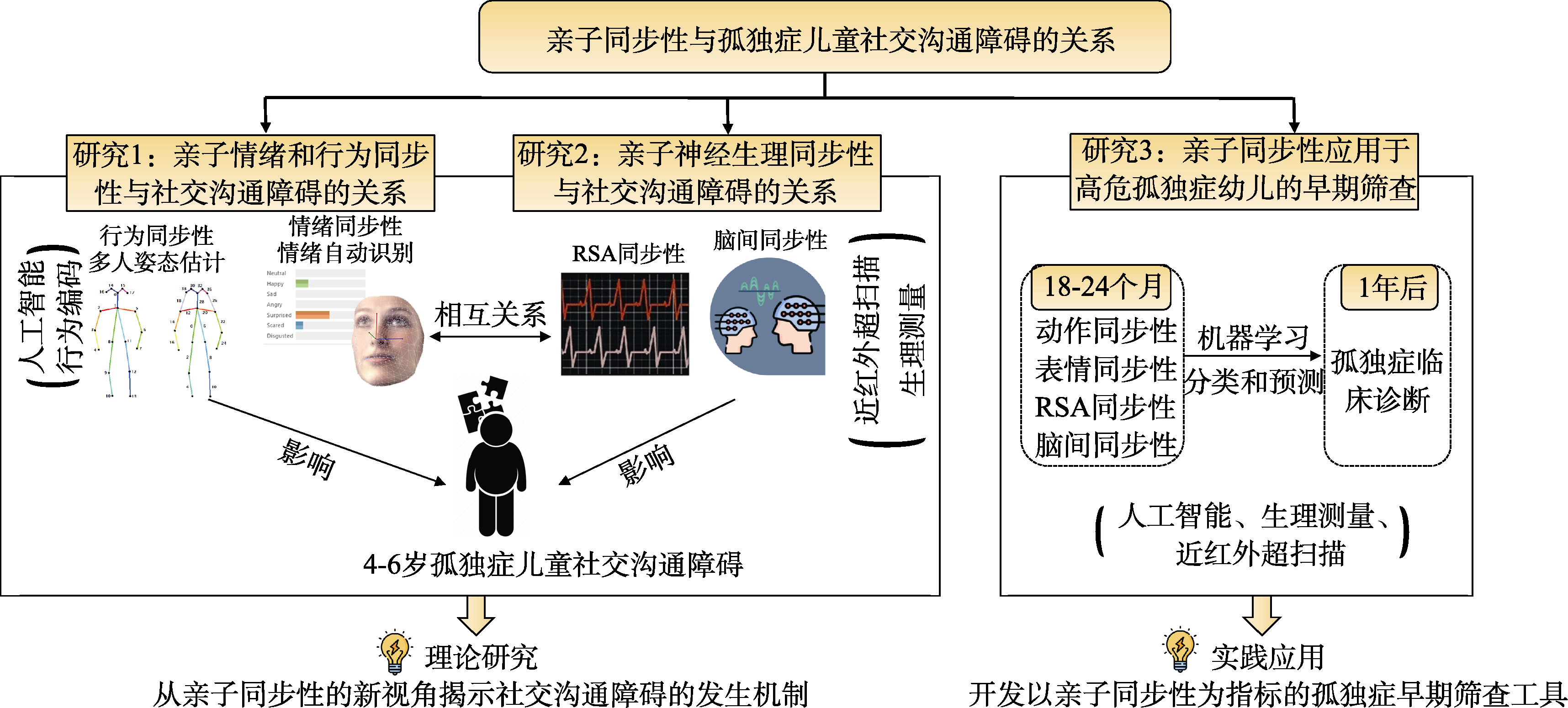
图1 本研究的整体研究框架
| [1] |
蔡郑婷, 胡连信, 王泽峰, 谢广东, 林贤伟. (2022). 几种常见儿童孤独症谱系障碍筛查及诊断量表的比较研究. 中国全科医学, 25(24), 2998-3004.
doi: 10.12114/j.issn.1007-9572.2022.0231 |
| [2] | 常天怡, 孟凡超, 田音, 陈旭, 郑毅. (2024). 机器学习联合眼动注视模式在孤独症早期诊断中的应用. 中华精神科杂志, 57(9), 623-628. |
| [3] | 龚郁杏, 刘靖, 郭延庆, 宋文红, 贾美香, 李长璟. (2015). 改良婴幼儿孤独症量表中文简化版的效度和信度. 中国心理卫生杂志, 29(2), 121-124. |
| [4] | 李廷玉. (2017). 孤独症谱系障碍儿童早期识别筛查和早期干预专家共识. 中华儿科杂志, 55(12), 890-897. |
| [5] | 李西, 田真玲, 姜孟. (2022). 机器学习在孤独症筛查与诊断中的应用研究进展. 中国特殊教育, 267(9), 47-54. |
| [6] | 李先春, 卑力添, 袁涤, 丁雅娜, 冯丹阳. (2018). 超扫描视角下的社会互动脑机制. 心理科学, 41(6), 1484-1491. |
| [7] | 卢建平, 杨志伟, 舒明耀, 苏林雁. (2004). 儿童孤独症量表评定的信度、效度分析. 中国现代医学杂志, 14(13), 119-121, 123. |
| [8] | 施聪莺, 李晶. (2018). FaceReader 7.0对国内常见表情图片库识别的有效性研究. 心理技术于应用, 6(2), 100-108. |
| [9] |
王磊, 贺荟中, 毕小彬, 周丽, 范晓壮. (2021). 社会动机理论视角下自闭症谱系障碍者的社交缺陷. 心理科学进展, 29(12), 2209-2223.
doi: 10.3724/SP.J.1042.2021.02209 |
| [10] | 赵亚楠, 李智文, 李琳, 关春荣, 殷玉芳, 杨逸凡, … 贾美香. (2023). 中国0-6 岁儿童孤独症谱系障碍筛查患病现状. 中国生育健康杂志, 34(5), 423-428. |
| [11] | 朱宏锐, 张华, 任珊, 梅媛, 肖归. (2024). 机器学习在婴幼儿孤独症谱系障碍早期筛查中的应用进展. 教育生物学杂志, 12(2), 149-159. |
| [12] | American Psychiatric Association. (2013). Diagnostic and statistical manual of mental disorders (5th ed.). American Psychiatric Publishing. https://doi.org/10.1176/appi.books.9780890425596 |
| [13] |
Auyeung, B., Baron-Cohen, S., Wheelwright, S., & Allison, C. (2008). The autism spectrum quotient: Children’s version (AQ-Child). Journal of Autism and Developmental Disorders, 38(7), 1230-1240. https://doi.org/10.1007/s10803-007-0504-z.
doi: 10.1007/s10803-007-0504-z URL pmid: 18064550 |
| [14] |
Baker, J. K., Fenning, R. M., Erath, S. A., Baucom, B. R., Messinger, D. S., Moffitt, J.,... Bailey, A. (2020). Respiratory sinus arrhythmia, parenting, and externalizing behavior in children with autism spectrum disorder. Autism, 24(1), 109-120. https://doi.org/10.1177/136236131984852
doi: 10.1177/1362361319848525 URL pmid: 31122030 |
| [15] | Baron-Cohen, S., Allen, J., & Gillberg, C. (1992). Can autism be detected at 18 months? The needle, the haystack, and the CHAT. The British Journal of Psychiatry, 161(6), 839-843. https://doi.org/10.1192/bjp.161.6.839 |
| [16] | Bolis, D., Balsters, J., Wenderoth, N., Becchio, C., & Schilbach, L. (2018). Beyond autism: Introducing the dialectical misattunement hypothesis and a Bayesian account of intersubjectivity. Psychopathology, 50(6), 355-372. https://doi.org/10.1159/000484353 |
| [17] | Bowsher-Murray, C., Gerson, S., Von dem Hagen, E., & Jones, C. R. (2022). The components of interpersonal synchrony in the typical population and in autism: A conceptual analysis. Frontiers in Psychology, 13, 897015. https://doi.org/10.3389/fpsyg.2022.897015 |
| [18] | Centers for Disease Control and Prevention. (2024). Data and statistics on autism spectrum disorder. https://www.cdc.gov/autism/data-research/index.html |
| [19] | Chen, X., Chen, J., Liao, M., & Wang, G. (2023). Early onset of impairments of interpersonal motor synchrony in preschool-aged children with autism spectrum disorder. Journal of Autism and Developmental Disorders, 53(6), 2314-2327. https://doi.org/10.1007/s10803-022-05472-8 |
| [20] |
Chevallier, C., Kohls, G., Troiani, V., Brodkin, E. S., & Schultz, R. T. (2012). The social motivation theory of autism. Trends in Cognitive Sciences, 16(4), 231-239. https://doi.org/10.1016/j.tics.2012.02.007.
doi: 10.1016/j.tics.2012.02.007 URL pmid: 22425667 |
| [21] | Clancy, H., Dugdale, A., & Rendle‐Short, J. (1969). The diagnosis of infantile autism. Developmental Medicine & Child Neurology, 11(4), 432-442. https://doi.org/10.1111/j.1469-8749.1969.tb01461.x |
| [22] |
Condy, E. E., Scarpa, A., & Friedman, B. H. (2017). Respiratory sinus arrhythmia predicts restricted repetitive behavior severity. Journal of Autism and Developmental Disorders, 47(9), 2795-2804. https://doi.org/10.1007/s10803-017-3193-2
doi: 10.1007/s10803-017-3193-2 URL pmid: 28616855 |
| [23] | Constantino, J. N., & Gruber, C. P. (2012). Social responsiveness scale (2nd ed.). Western Psychological Services. |
| [24] |
Corbett, B. A., Muscatello, R. A., & Baldinger, C. (2019). Comparing stress and arousal systems in response to different social contexts in children with ASD. Biological Psychology, 140, 119-130. https://doi.org/10.1016/j.biopsycho.2018.12.010
doi: S0301-0511(18)30400-9 URL pmid: 30557600 |
| [25] |
Davis, M., West, K., Bilms, J., Morelen, D., & Suveg, C. (2018). A systematic review of parent-child synchrony: It is more than skin deep. Developmental Psychobiology, 60(6), 674-691. https://doi.org/10.1002/dev.21743
doi: 10.1002/dev.21743 URL pmid: 29900545 |
| [26] | Deák, G. O., Krasno, A. M., Jasso, H., & Triesch, J. (2018). What leads to shared attention? Maternal cues and infant responses during object play. Infancy, 23(1), 4-28. https://doi.org/10.1111/infa.12204 |
| [27] |
Del Bianco, T., Mason, L., Charman, T., Tillman, J., Loth, E., Hayward, H.,... Zwiers, M. P. (2021). Temporal profiles of social attention are different across development in autistic and neurotypical people. Biological Psychiatry: Cognitive Neuroscience and Neuroimaging, 6(8), 813-824. https://doi.org/10.1016/j.bpsc.2020.09.004
doi: 10.1016/j.bpsc.2020.09.004 URL pmid: 33191160 |
| [28] |
DePasquale, C. E. (2020). A systematic review of caregiver-child physiological synchrony across systems: Associations with behavior and child functioning. Development and Psychopathology, 32(5), 1754-1777. https://doi.org/10.1017/S0954579420001236
doi: 10.1017/S0954579420001236 URL pmid: 33427185 |
| [29] | Fang, H. S., Li, J., Tang, H., Xu, C., Zhu, H., Xiu, Y.,... Lu, C. (2022). Alphapose: Whole-body regional multi-person pose estimation and tracking in real-time. IEEE Transactions on Pattern Analysis and Machine Intelligence, 45(6), 7157-7173. https://doi.org/10.1109/TPAMI.2022.3222784 |
| [30] | Fang, H. S., Xie, S., Tai, Y. W., & Lu, C. (2017). Rmpe: Regional multi-person pose estimation. Proceedings of the IEEE international conference on computer vision (pp. 2334-2343). |
| [31] |
Feldman, R. (2007). Parent-infant synchrony and the construction of shared timing; physiological precursors, developmental outcomes, and risk conditions. Journal of Child Psychology and Psychiatry, 48(3-4), 329-354. https://doi.org/10.1111/j.1469-7610.2006.01701.x
doi: 10.1111/j.1469-7610.2006.01701.x URL pmid: 17355401 |
| [32] | Feldman, R. (2012). Parent-infant synchrony: A biobehavioral model of mutual influences in the formation of affiliative bonds. Monographs of the Society for Research in Child Development, 77(2), 42-51. https://www.jstor.org/stable/23256638 |
| [33] |
Feldman, R. (2015). Mutual influences between child emotion regulation and parent-child reciprocity support development across the first 10 years of life: Implications for developmental psychopathology. Development and Psychopathology, 27(4 Pt 1), 1007-1023. https://doi.org/10.1017/S0954579415000656.
doi: 10.1017/S0954579415000656 URL pmid: 26439059 |
| [34] |
Fenning, R. M., Baker, J. K., & Moffitt, J. (2018). Intrinsic and extrinsic predictors of emotion regulation in children with autism spectrum disorder. Journal of Autism and Developmental Disorders, 48(11), 3858-3870. https://doi.org/10.1007/s10803-018-3647-1
doi: 10.1007/s10803-018-3647-1 URL pmid: 29926292 |
| [35] |
Fitzpatrick, P., Romero, V., Amaral, J. L., Duncan, A., Barnard, H., Richardson, M. J., & Schmidt, R. (2017). Evaluating the importance of social motor synchronization and motor skill for understanding autism. Autism Research, 10(10), 1687-1699. https://doi.org/10.1002/aur.1808
doi: 10.1002/aur.1808 URL pmid: 28590041 |
| [36] | Fuchs, T., & De Jaegher, H. (2009). Enactive intersubjectivity: Participatory sense-making and mutual incorporation. Phenomenology and the Cognitive Sciences, 8(4), 465-486. https://doi.org/10.1007/s11097-009-9136-4 |
| [37] |
Fulceri, F., Tonacci, A., Lucaferro, A., Apicella, F., Narzisi, A., Vincenti, G.,... Contaldo, A. (2018). Interpersonal motor coordination during joint actions in children with and without autism spectrum disorder: The role of motor information. Research in Developmental Disabilities, 80, 13-23. https://doi.org/10.1016/j.ridd.2018.05.018
doi: S0891-4222(18)30131-8 URL pmid: 29879613 |
| [38] | Georgescu, A. L., Koeroglu, S., Hamilton, A. D. C., Vogeley, K., Falter-Wagner, C. M., & Tschacher, W. (2020). Reduced nonverbal interpersonal synchrony in autism spectrum disorder independent of partner diagnosis: A motion energy study. Molecular Autism, 11(1), 1-14. https://doi.org/10.1186/s13229-019-0305-1 |
| [39] | Goldstein, P., Weissman-Fogel, I., Dumas, G., & Shamay- Tsoory, S. G. (2018). Brain-to-brain coupling during handholding is associated with pain reduction. Proceedings of the National Academy of Sciences, 115(11), E2528-E2537. https://doi.org/10.1073/pnas.1703643115 |
| [40] |
Griffin, J. W., Bauer, R., & Scherf, K. S. (2021). A quantitative meta-analysis of face recognition deficits in autism: 40 years of research. Psychological Bulletin, 147(3), 268-292. https://doi.org/10.1037/bul0000310
doi: 10.1037/bul0000310 URL pmid: 33104376 |
| [41] | Grinsted, A., Moore, J. C., & Jevrejeva, S. (2004). Application of the cross wavelet transform and wavelet coherence to geophysical time series. Nonlinear Processes in Geophysics, 11(5/6), 561-566. https://doi.org/10.5194/npg-11-561-2004 |
| [42] | Gvirts, H. Z., & Perlmutter, R. (2020). What guides us to neurally and behaviorally align with anyone specific? A neurobiological model based on fNIRS hyperscanning studies. The Neuroscientist, 26(2), 108-116. https://doi.org/10.1177/1073858419861912 |
| [43] | Harrist, A. W., & Waugh, R. M. (2002). Dyadic synchrony: Its structure and function in children’s development. Developmental Review, 22(4), 555-592. https://doi.org/10.1016/S0273-2297(02)00500-2 |
| [44] |
Haskins, A. J., Mentch, J., Botch, T. L., Garcia, B. D., Burrows, A. L., & Robertson, C. E. (2022). Reduced social attention in autism is magnified by perceptual load in naturalistic environments. Autism Research, 15(12), 2310-2323. https://doi.org/10.1002/aur.2829
doi: 10.1002/aur.2829 URL pmid: 36207799 |
| [45] | Hazlett, H. C., Gu, H., Munsell, B. C., Kim, S. H., Styner, M., Wolff, J. J., … The IBIS, Network. . (2017). Early brain development in infants at high risk for autism spectrum disorder. Nature, 542, 348-351. https://doi.org/10.1038/nature21369 |
| [46] |
Hirsch, J., Zhang, X., Noah, J. A., & Ono, Y. (2017). Frontal temporal and parietal systems synchronize within and across brains during live eye-to-eye contact. NeuroImage, 157, 314-330. https://doi.org/10.1016/j.neuroimage.2017.06.018
doi: S1053-8119(17)30487-1 URL pmid: 28619652 |
| [47] |
Hoehl, S., Fairhurst, M., & Schirmer, A. (2021). Interactional synchrony: Signals, mechanisms and benefits. Social Cognitive and Affective Neuroscience, 16(1-2), 5-18. https://doi.org/10.1093/scan/nsaa024
doi: 10.1093/scan/nsaa024 URL pmid: 32128587 |
| [48] |
Jaisle, E. M., Groves, N. B., Black, K. E., & Kofler, M. J. (2023). Linking ADHD and ASD symptomatology with social impairment: The role of emotion dysregulation. Research on Child and Adolescent Psychopathology, 51(1), 3-16. https://doi.org/10.1007/s10802-022-00982-6
doi: 10.1007/s10802-022-00982-6 URL pmid: 36326970 |
| [49] | Kang, J., Han, X., Song, J., Niu, Z., & Li, X. (2020). The identification of children with autism spectrum disorder by SVM approach on EEG and eye-tracking data. Computers in Biology and Medicine, 120, 103722. https://doi.org/10.1016/j.compbiomed.2020.103722 |
| [50] |
Kaur, M., Srinivasan, S. M., & Bhat, A. N. (2018). Comparing motor performance, praxis, coordination, and interpersonal synchrony between children with and without Autism Spectrum Disorder (ASD). Research in Developmental Disabilities, 72, 79-95. https://doi.org/10.1016/j.ridd.2017.10.025
doi: S0891-4222(17)30294-9 URL pmid: 29121516 |
| [51] | Krug, D. A., Arick, J., & Almond, P. (1980). Behavior checklist for identifying severely handicapped individuals with high levels of autistic behavior. Child Psychology & Psychiatry & Allied Disciplines. https://doi.org/10.1111/j.1469-7610.1980.tb01797.x |
| [52] |
Kruppa, J. A., Reindl, V., Gerloff, C., Oberwelland Weiss, E., Prinz, J., Herpertz-Dahlmann, B.,... Schulte-Rüther, M. (2021). Brain and motor synchrony in children and adolescents with ASD—A fNIRS hyperscanning study. Social Cognitive and Affective Neuroscience, 16(1-2), 103-116. https://doi.org/10.1093/scan/nsaa092
doi: 10.1093/scan/nsaa092 URL pmid: 32685971 |
| [53] | Kwon, M. K., Moore, A., Barnes, C. C., Cha, D., & Pierce, K. (2019). Typical levels of eye-region fixation in toddlers with autism spectrum disorder across multiple contexts. Journal of the American Academy of Child & Adolescent Psychiatry, 58(10), 1004-1015. https://doi.org/10.1016/j.jaac.2018.12.011 |
| [54] | Li, M., Zhou, Z., & Liu, X. (2019). Multi-person pose estimation using bounding box constraint and LSTM. IEEE Transactions on Multimedia, 21(10), 2653-2663. https://doi.org/10.1109/TMM.2019.2903455 |
| [55] |
Liu, W., Li, M., & Yi, L. (2016). Identifying children with autism spectrum disorder based on their face processing abnormality: A machine learning framework. Autism Research, 9(8), 888-898. https://doi.org/10.1002/aur.1615
doi: 10.1002/aur.1615 URL pmid: 27037971 |
| [56] | Lord, C., Rutter, M., DiLavore, P., Risi, S., Gotham, K., & Bishop, S. (2012). Autism Diagnostic Observation Schedule, Second Edition (ADOS-2) Manual (Part 1): Modules 1-4. Western Psychological Services. |
| [57] |
Lord, C., Rutter, M., & Le Couteur, A. (1994). Autism Diagnostic Interview-Revised: A revised version of a diagnostic interview for caregivers of individuals with possible pervasive developmental disorders. Journal of Autism and Developmental Disorders, 24(5), 659-685. https://doi.org/10.1007/BF02172145
doi: 10.1007/BF02172145 URL pmid: 7814313 |
| [58] | Lougheed, J. P., & Keskin, G. (2021). Parent‐adolescent emotion dynamics at multiple time scales. Child Development Perspectives, 15(2), 125-131. https://doi.org/10.1111/cdep.12409 |
| [59] | McNaughton, K. A., & Redcay, E. (2020). Interpersonal synchrony in autism. Current Psychiatry Reports, 22(3), 1-11. https://doi.org/10.1007/s11920-020-1135-8 |
| [60] | Miller, J. G., Armstrong‐Carter, E., Balter, L., & Lorah, J. (2023). A meta-analysis of mother-child synchrony in respiratory sinus arrhythmia and contextual risk. Developmental Psychobiology, 65(1), e22355. https://doi.org/10.1002/dev.22355 |
| [61] |
Miller, J. G., Vrtička, P., Cui, X., Shrestha, S., Hosseini, S. H., Baker, J. M., & Reiss, A. L. (2019). Inter-brain synchrony in mother-child dyads during cooperation: An fNIRS hyperscanning study. Neuropsychologia, 124, 117-124. https://doi.org/10.1016/j.neuropsychologia.2018.12.021
doi: S0028-3932(18)30357-9 URL pmid: 30594570 |
| [62] | Milton, D. E. (2012). On the ontological status of autism: The ‘double empathy problem’. Disability & Society, 27(6), 883-887. https://doi.org/10.1080/09687599.2012.710008 |
| [63] |
Monier, F., & Droit-Volet, S. (2019). Development of sensorimotor synchronization abilities: Motor and cognitive components. Child Neuropsychology, 25(8), 1043-1062. https://doi.org/10.1080/09297049.2019.1569607
doi: 10.1080/09297049.2019.1569607 URL pmid: 30714466 |
| [64] |
Montague, P. R., Berns, G. S., Cohen, J. D., McClure, S. M., Pagnoni, G., Dhamala, M.,... Fisher, R. E. (2002). Hyperscanning: Simultaneous fMRI during linked social interactions. Neuroimage, 16(4), 1159-1164. https://doi.org/10.1006/nimg.2002.1150.
URL pmid: 12202103 |
| [65] | Moore, A., Wozniak, M., Yousef, A., Barnes, C. C., Cha, D., Courchesne, E., & Pierce, K. (2018). The geometric preference subtype in ASD: Identifying a consistent, early-emerging phenomenon through eye tracking. Molecular Autism, 9, 1-13. https://doi.org/10.1186/s13229-018-0202-z |
| [66] |
Murat Baldwin, M., Xiao, Z., & Murray, A. (2022). Temporal synchrony in autism: A systematic review. Review Journal of Autism and Developmental Disorders, 9(4), 596-617. https://doi.org/10.1007/s40489-021-00276-5
doi: 10.1007/s40489-021-00276-5 URL |
| [67] | Neuhaus, E., Bernier, R., & Beauchaine, T. P. (2014). Brief report: Social skills, internalizing and externalizing symptoms, and respiratory sinus arrhythmia in autism. Journal of Autism and Developmental Disorders, 44(3), 730-737. https://doi.org/10.1007/s10803-013-1923-7 |
| [68] |
Neuhaus, E., Bernier, R. A., & Beauchaine, T. P. (2016). Children with autism show altered autonomic adaptation to novel and familiar social partners. Autism Research, 9(5), 579-591. https://doi.org/10.1002/aur.1543
doi: 10.1002/aur.1543 URL pmid: 26305051 |
| [69] |
Nguyen, T., Bánki, A., Markova, G., & Hoehl, S. (2020). Studying parent-child interaction with hyperscanning. Progress in Brain Research, 254, 1-24. https://doi.org/10.1016/bs.pbr.2020.05.003
doi: S0079-6123(20)30045-5 URL pmid: 32859283 |
| [70] | Nguyen, T., Schleihauf, H., Kungl, M., Kayhan, E., Hoehl, S., & Vrtička, P. (2021). Interpersonal neural synchrony during father-child problem solving: An fNIRS hyperscanning study. Child Development, 92(4), e565-e580. https://doi.org/10.1111/cdev.13510 |
| [71] | Pacia, C., Holloway, J., Gunning, C., & Lee, H. (2022). A systematic review of family-mediated social communication interventions for young children with autism. Review Journal of Autism and Developmental Disorders, 9(2), 208-234. https://doi.org/10.1007/s40489-021-00249-8 |
| [72] |
Pierce, K., Marinero, S., Hazin, R., McKenna, B., Barnes, C. C., & Malige, A. (2016). Eye tracking reveals abnormal visual preference for geometric images as an early biomarker of an autism spectrum disorder subtype associated with increased symptom severity. Biological Psychiatry, 79(8), 657-666. https://doi.org/10.1016/j.biopsych.2015.03.032
doi: 10.1016/j.biopsych.2015.03.032 URL pmid: 25981170 |
| [73] |
Porges, S. W. (2007). The polyvagal perspective. Biological Psychology, 74(2), 116-143. https://doi.org/10.1016/j.biopsycho.2006.06.009
doi: 10.1016/j.biopsycho.2006.06.009 URL pmid: 17049418 |
| [74] |
Porges, S. W., & Furman, S. A. (2011). The early development of the autonomic nervous system provides a neural platform for social behavior: A polyvagal perspective. Infant and Child Development, 20(1), 106-118. https://doi.org/10.1002/icd.688
URL pmid: 21516219 |
| [75] |
Quiñones-Camacho, L. E., Fishburn, F. A., Belardi, K., Williams, D. L., Huppert, T. J., & Perlman, S. B. (2021). Dysfunction in interpersonal neural synchronization as a mechanism for social impairment in autism spectrum disorder. Autism Research, 14(8), 1585-1596. https://doi.org/10.1002/aur.2513
doi: 10.1002/aur.2513 URL pmid: 33847461 |
| [76] | Quiñones-Camacho, L. E., Fishburn, F. A., Camacho, M. C., Hlutkowsky, C. O., Huppert, T. J., Wakschlag, L. S., & Perlman, S. B. (2020). Parent-child neural synchrony: A novel approach to elucidating dyadic correlates of preschool irritability. Journal of Child Psychology and Psychiatry, 61(11), 1213-1223. https://doi.org/10.1111/jcpp.13165 |
| [77] |
Ratliff, E. L., Kerr, K. L., Cosgrove, K. T., Simmons, W. K., & Morris, A. S. (2022). The role of neurobiological bases of dyadic emotion regulation in the development of psychopathology: Cross-brain associations between parents and children. Clinical Child and Family Psychology Review, 25(1), 5-18. https://doi.org/10.1007/s10567-022-00380-w
doi: 10.1007/s10567-022-00380-w URL pmid: 35113318 |
| [78] | Reiter, M. A., Jahedi, A., Fredo, A. J., Fishman, I., Bailey, B., & Müller, R. A. (2021). Performance of machine learning classification models of autism using resting-state fMRI is contingent on sample heterogeneity. Neural Computing and Applications, 33, 3299-3310. https://doi.org/10.1007/s00521-020-05193-y |
| [79] |
Robins, D. L., Fein, D., Barton, M. L., & Green, J. A. (2001). The Modified Checklist for Autism in Toddlers: An initial study investigating the early detection of autism and pervasive developmental disorders. Journal of Autism and Developmental Disorders, 31(2), 131-144. https://doi.org/10.1023/A:1010738829569
doi: 10.1023/a:1010738829569 URL pmid: 11450812 |
| [80] |
Scholkmann, F., Spichtig, S., Muehlemann, T., & Wolf, M. (2010). How to detect and reduce movement artifacts in near-infrared imaging using moving standard deviation and spline interpolation. Physiological Measurement, 31(5), 649-662. https://doi.org/10.1088/0967-3334/31/5/004.
doi: 10.1088/0967-3334/31/5/004 URL pmid: 20308772 |
| [81] | Scholtes, C. M., Lyons, E. R., & Skowron, E. A. (2021). Dyadic synchrony and repair processes are related to preschool children’s risk exposure and self-control. Development and Psychopathology, 33(3), 1072-1084. https://doi.org/10.1017/S0954579420000358 |
| [82] | Shen, M. D., Nordahl, C. W., Li, D. D., Lee, A., Angkustsiri, K., Emerson, R. W.,... Amaral, D. G. (2018). Extra-axial cerebrospinal fluid in high-risk and normal-risk children with autism aged 2-4 years: A case-control study. The Lancet Psychiatry, 5(11), 895-904. https://doi.org/10.1016/S2215-0366(18)30294-3. |
| [83] |
Stöckli, S., Schulte-Mecklenbeck, M., Borer, S., & Samson, A. C. (2018). Facial expression analysis with AFFDEX and FACET: A validation study. Behavior Research Methods, 50(4), 1446-1460. https://doi.org/10.3758/s13428-017-0996-1
doi: 10.3758/s13428-017-0996-1 URL pmid: 29218587 |
| [84] | Stone, W. L., Coonrod, E. E., & Ousley, O. Y. (2000). Brief report: Screening tool for autism in two-year-olds (STAT): Development and preliminary data. Journal of Autism and Developmental Disorders, 30(6), 607-612. https://doi.org/10.1023/A:1005647629002. |
| [85] | Sun, J. W., Fan, R., Wang, Q., Wang, Q. Q., Jia, X. Z., & Ma, H. B. (2021). Identify abnormal functional connectivity of resting state networks in autism spectrum disorder and apply to machine learning-based classification. Brain Research, 1757, 147299. https://doi.org/10.1016/j.brainres.2021.147299 |
| [86] | Task force of the European society of cardiology the North American society of pacing electrophysiology. (1996). Heart rate variability: Standards of measurement, physiological interpretation, and clinical use. Circulation, 93(5), 1043-1065. https://doi.org/10.1161/01.CIR.93.5.1043 |
| [87] |
Ting, V., & Weiss, J. A. (2017). Emotion regulation and parent co-regulation in children with autism spectrum disorder. Journal of Autism and Developmental Disorders, 47(3), 680-689. https://doi.org/10.1007/s10803-016-3009-9
doi: 10.1007/s10803-016-3009-9 URL pmid: 28070784 |
| [88] |
Valentovich, V., Goldberg, W. A., Garfin, D. R., & Guo, Y. (2018). Emotion coregulation processes between mothers and their children with and without autism spectrum disorder: Associations with children’s maladaptive behaviors. Journal of Autism and Developmental Disorders, 48(4), 1235-1248. https://doi.org/10.1007/s10803-017-3375-y
doi: 10.1007/s10803-017-3375-y URL pmid: 29234932 |
| [89] |
Van Heijst, B. F., & Geurts, H. M. (2015). Quality of life in autism across the lifespan: A meta-analysis. Autism, 19(2), 158-167. https://doi.org/10.1177/1362361313517053
doi: 10.1177/1362361313517053 URL pmid: 24443331 |
| [90] |
Wan, G., Kong, X., Sun, B., Yu, S., Tu, Y., Park, J.,... Kong, J. (2019). Applying eye tracking to identify autism spectrum disorder in children. Journal of Autism and Developmental Disorders, 49(1), 209-215. https://doi.org/10.1007/s10803-018-3690-y
doi: 10.1007/s10803-018-3690-y URL pmid: 30097760 |
| [91] | Wang, H., Suveg, C., West, K. B., Han, Z. R., Zhang, X., Hu, X., & Yi, L. (2021). Synchrony of respiratory sinus arrhythmia in parents and children with autism spectrum disorder: Moderation by interaction quality and child behavior problems. Autism Research, 14(3), 512-522. https://doi.org/10.1002/aur.2401 |
| [92] |
Wang, Q., Han, Z., Hu, X., Feng, S., Wang, H., Liu, T., & Yi, L. (2020). Autism symptoms modulate interpersonal neural synchronization in children with autism spectrum disorder in cooperative interactions. Brain Topography, 33(1), 112-122. https://doi.org/10.1007/s10548-019-00731-x
doi: 10.1007/s10548-019-00731-x URL pmid: 31560088 |
| [93] | Wen, T. H., Cheng, A., Andreason, C., Zahiri, J., Xiao, Y., Xu, R.,... Pierce, K. (2022). Large scale validation of an early-age eye-tracking biomarker of an autism spectrum disorder subtype. Scientific Reports, 12(1), 4253. https://doi.org/10.1038/s41598-022-08102-6 |
| [94] | Wong, V., Hui, L. H. S., Lee, W. C., Leung, L. S. J., Ho, P. K. P., Lau, W. L. C.,... Chung, B. (2004). A modified screening tool for autism (Checklist for Autism in Toddlers [CHAT-23]) for Chinese children. Pediatrics, 114(2), e166-e176. https://doi.org/10.1542/peds.114.2.e166 |
| [95] | World Health Organization. (2024). Autism. https://www.who.int/news-room/fact-sheets/detail/autism-spectrum-disorders |
| [96] | Yi, L., Wang, Q., Song, C., & Han, Z. R. (2022). Hypo‐or hyperarousal? The mechanisms underlying social information processing in autism. Child Development Perspectives, 16(4), 215-222. https://doi.org/10.1111/cdep.12466 |
| [97] |
Yu, C., & Smith, L. B. (2017). Hand-eye coordination predicts joint attention. Child Development, 88(6), 2060-2078. https://doi.org/10.1111/cdev.12730
doi: 10.1111/cdev.12730 URL pmid: 28186339 |
| [98] |
Zampella, C. J., Csumitta, K. D., Simon, E., & Bennetto, L. (2020). Interactional synchrony and its association with social and communication ability in children with and without autism spectrum disorder. Journal of Autism and Developmental Disorders, 50(9), 3195-3206. https://doi.org/10.1007/s10803-020-04412-8
doi: 10.1007/s10803-020-04412-8 URL pmid: 32065341 |
| [99] |
Zhou, H., Xu, X., Yan, W., Zou, X., Wu, L., Luo, X.,... LATENT-NHC, Study Team. (2020). Prevalence of autism spectrum disorder in China: A nationwide multi-center population-based study among children aged 6 to 12 years. Neuroscience Bulletin, 36(9), 961-971. https://doi.org/10.1007/s12264-020-00530-6
doi: 10.1007/s12264-020-00530-6 URL pmid: 32607739 |
| [1] | 谢婷婷, 王丽娟. 动作编码促进孤独症谱系障碍学龄儿童记忆的影响因素及机制[J]. 心理科学进展, 2025, 33(6): 1067-1076. |
| [2] | 单晓龙, 陈华富, 段旭君. 孤独症谱系障碍多模态磁共振脑影像模式识别[J]. 心理科学进展, 2025, 33(4): 548-564. |
| [3] | 杨平, 方润秋, 翁旭初. 孤独症谱系障碍儿童非典型面部表情特征及其在早期筛查中的应用[J]. 心理科学进展, 2025, 33(4): 588-597. |
| [4] | 田仁霞, 杨平, 郭园园, 吴瑕. 治疗孤独症谱系障碍:重复经颅磁刺激的潜在作用[J]. 心理科学进展, 2025, 33(4): 598-610. |
| [5] | 范桂容, 翁旭初, 耿红岩. 炎症性肠病与儿童孤独症谱系障碍的关系[J]. 心理科学进展, 2025, 33(4): 611-619. |
| [6] | 周爱保, 袁月. 高功能孤独症自我加工的机制与干预[J]. 心理科学进展, 2025, 33(2): 212-222. |
| [7] | 付春野, 李艾馨, 吕小康, 王崇颖. 孤独症谱系障碍者的视觉感知:基于贝叶斯和预测编码视角[J]. 心理科学进展, 2024, 32(7): 1164-1178. |
| [8] | 高丽梅, 汪凯, 李丹丹. 社交机器人在孤独症谱系障碍儿童中的应用[J]. 心理科学进展, 2024, 32(5): 834-844. |
| [9] | 荆伟, 陈琦, 薛云卿, 杨苗, 张婕. 孤独症者的预测编码缺陷:前馈联结异常还是反馈联结异常?[J]. 心理科学进展, 2024, 32(5): 813-833. |
| [10] | 陈雁, 李晶. 人际同步对孤独症儿童合作行为的影响及干预促进[J]. 心理科学进展, 2024, 32(4): 639-653. |
| [11] | 卜晓鸥, 王耀, 杜亚雯, 王沛. 机器学习在发展性阅读障碍儿童早期筛查中的应用[J]. 心理科学进展, 2023, 31(11): 2092-2105. |
| [12] | 刘敏, 胡洋, 刘巧云. 孤独症儿童潜在早期识别标志——发声异常及原因探析[J]. 心理科学进展, 2022, 30(3): 635-647. |
| [13] | 袁玉琢, 骆方. 人工智能辅助的自闭症早期患者的筛查与诊断[J]. 心理科学进展, 2022, 30(10): 2303-2320. |
| [14] | 王琳, 王志丹, 王泓婧. 孤独症儿童动作发展障碍的神经机制[J]. 心理科学进展, 2021, 29(7): 1239-1250. |
| [15] | 毕小彬, 范晓壮, 米文丽, 贺荟中. 高风险婴儿前瞻性纵向研究与孤独症谱系障碍早期识别[J]. 心理科学进展, 2020, 28(3): 443-455. |
| 阅读次数 | ||||||
|
全文 |
|
|||||
|
摘要 |
|
|||||
