

ISSN 1671-3710
CN 11-4766/R
主办:中国科学院心理研究所
出版:科学出版社
CN 11-4766/R
主办:中国科学院心理研究所
出版:科学出版社
心理科学进展 ›› 2025, Vol. 33 ›› Issue (9): 1472-1482.doi: 10.3724/SP.J.1042.2025.1472 cstr: 32111.14.2025.1472
肖风1( ), 郑秀辰1, 肖娜1, 陈庆飞2, 武晓菲3, 张頔1
收稿日期:2024-11-26
出版日期:2025-09-15
发布日期:2025-06-26
通讯作者:
肖风, E-mail: xiaofeng19850328@gmail.com基金资助:
XIAO Feng1(), ZHENG Xiuchen1, XIAO Na1, CHEN Qingfei2, WU Xiaofei3, ZHANG Di1
Received:2024-11-26
Online:2025-09-15
Published:2025-06-26
摘要:
多人交互情境的数学归纳推理存在有限理性, 但现有研究尚未阐明社会情境下数学归纳推理过程中快速直觉的系统1和慢速慎思的系统2是如何相互作用的。社会性数学归纳推理是指在多人交互的社会情境中, 个体进行数学归纳时, 不仅要识别数列本身的规律, 还要考虑这些规律会如何因他人的决策而发生变化或受到影响。本研究旨在探究社会性数学归纳推理中推理和心理理论双系统的神经机制, 特别是两类双系统如何相互作用以实现对社会环境的动态适应。结合行为、事件相关电位(ERP)和功能性磁共振成像(fMRI)技术, 本研究将分为三个部分: 首先, 探究非社会性数学归纳推理中双系统的证据; 其次, 全面比较社会性和非社会性数学归纳推理中双系统的神经机制, 重点分析推理过程中的双系统协同作用; 最后, 深入调查社会情境如何调节社会性数学归纳推理的神经基础, 探索社会情境对推理过程的影响及其神经机制。本研究将拓展双系统理论框架以探究复杂经济学的认知神经基础, 为理解个体在多人社会互动中的推理认知过程提供新理论视角, 并为数学教育、人工智能等领域的实践应用提供启示。
中图分类号:
肖风, 郑秀辰, 肖娜, 陈庆飞, 武晓菲, 张頔. (2025). 牛顿为什么炒股失败?社会性数学归纳推理中双系统的认知神经机制. 心理科学进展 , 33(9), 1472-1482.
XIAO Feng, ZHENG Xiuchen, XIAO Na, CHEN Qingfei, WU Xiaofei, ZHANG Di. (2025). Why did Newton fail at stock trading: The cognitive neural mechanisms of dual systems in social numerical inductive reasoning. Advances in Psychological Science, 33(9), 1472-1482.

图1 酒吧问题出席人数数列预测的推理和心理理论双系统的理论构想图。左侧为推理双系统的可能神经机制, 右侧为心理理论双系统的可能神经机制。蓝色背景和箭头表示系统1的可能神经活动模式, 黄色背景和箭头表示系统2的可能神经活动模式。IPL: 顶下叶; DLPFC: 背外侧前额叶; FPC: 额极皮层; TPJ: 颞顶联合区; mPFC: 内侧前额叶。彩图见电子版。
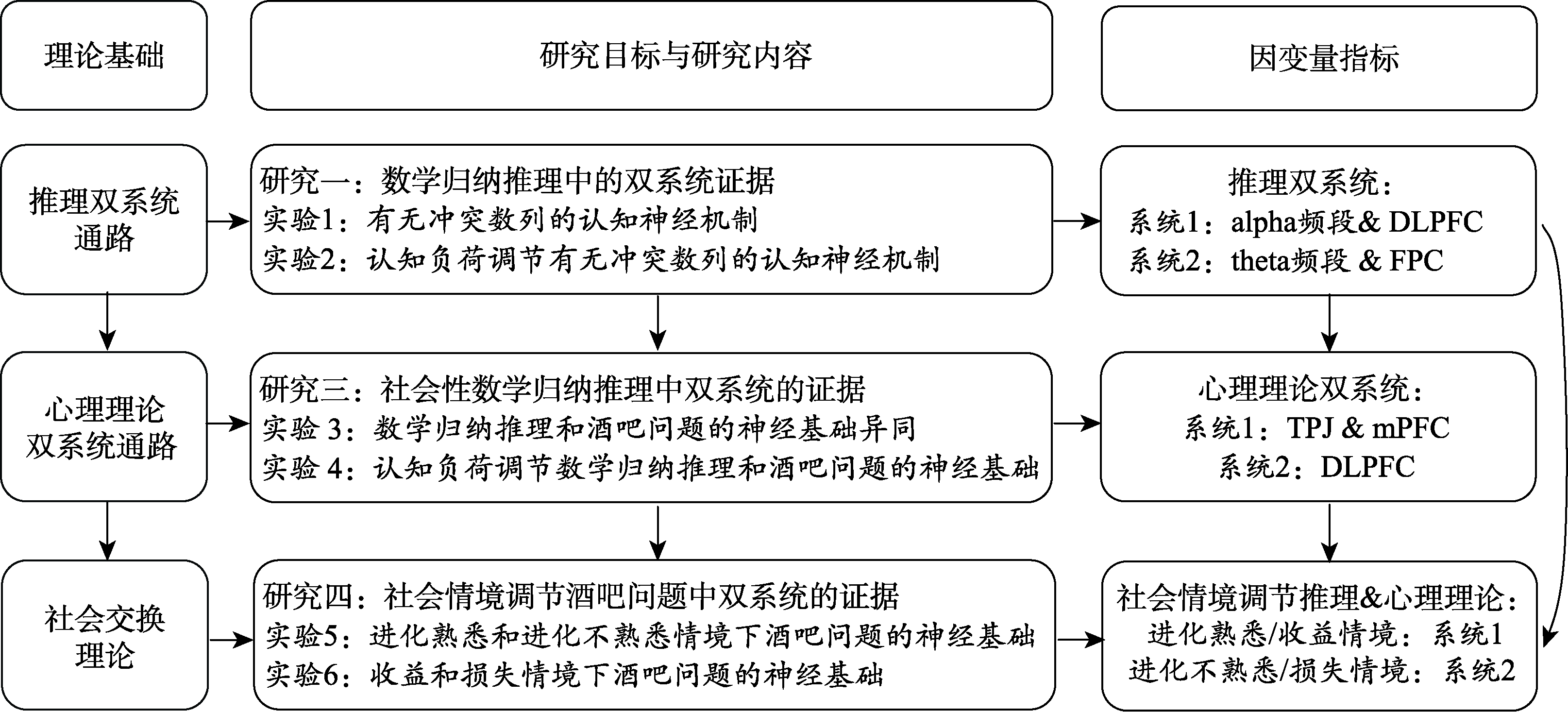
图2 总体的研究框架及技术路线
| [1] | 艾炎, 胡竹菁. (2018). 推理判断中偏差反应的加工机制: 冲突探查失败, 还是抑制失败? 心理科学, 41(4), 869-875. |
| [2] |
刘永芳. (2022). 有限理性的本质辨析与价值之争. 心理学报, 54(11), 1293-1309.
doi: 10.3724/SP.J.1041.2022.01293 |
| [3] | 孙铁, 袁上清, 李艺, 肖风. (2020). 推理偏差: 冲突察觉还是冲突抑制的失败? 心理学探新, 40(1), 221-227. |
| [4] | 钟宁, 梁佩鹏, 秦裕林, 吕胜富, 杨延辉, 李坤成. (2009). 数据驱动的科学发现的神经机制: 一项fMRI研究. 中国科学: C辑, 39(3), 271-278. |
| [5] |
Apperly, I. A., & Butterfill, S. A. (2009). Do humans have two systems to track beliefs and belief-like states? Psychological Review, 116(4), 953-970.
doi: 10.1037/a0016923 pmid: 19839692 |
| [6] |
Apperly, I. A., Samson, D., Chiavarino, C., & Humphreys, G. W. (2004). Frontal and temporo-parietal lobe contributions to theory of mind: Neuropsychological evidence from a false-belief task with reduced language and executive demands. Journal of Cognitive Neuroscience, 16(10), 1773-1784.
doi: 10.1162/0898929042947928 pmid: 15701227 |
| [7] | Arthur, W. B. (1994). Inductive reasoning and bounded rationality (The El Farol problem). The American Economic Review, 84(2), 406-411. |
| [8] | Arthur, W. B. (1999). Complexity and the economy. Science, 284(5411), 107-109. |
| [9] | Arthur, W. B. (2021). Foundations of complexity economics. Nature Review Physics, 3(2), 136-145. |
| [10] | Baccan, D., Macedo, L., & Sbruzzi, E. (2014, October). Is the El Farol more efficient when cognitive rational agents have a larger memory size? In 2014 IEEE International Conference on Systems, Man, and Cybernetics (SMC) (pp. 39-44). IEEE. |
| [11] | Birnbaum, D., Deeb, I., Segall, G., Ben-Eliyahu, A., & Diesendruck, G. (2010). The development of social essentialism: The case of Israeli children’s inferences about Jews and Arabs. Child Development, 81(3), 757-777. |
| [12] |
Butler, L. P., & Tomasello, M. (2016). Two-and 3-year-olds integrate linguistic and pedagogical cues in guiding inductive generalization and exploration. Journal of Experimental Child Psychology, 145, 64-78.
doi: 10.1016/j.jecp.2015.12.001 pmid: 26826468 |
| [13] |
Canessa, N., Gorini, A., Cappa, S. F., Piattelli‐Palmarini, M., Danna, M., Fazio, F., & Perani, D. (2005). The effect of social content on deductive reasoning: An fMRI study. Human Brain Mapping, 26(1), 30-43.
pmid: 15852469 |
| [14] | Chen, S. H., Duffy, J., & Yeh, C. H. (2005). Equilibrium selection via adaptation: Using genetic programming to model learning in a coordination game. In S. Jørgensen, M. Quincampoix, & T. L. Vincent (Eds.), Advances in dynamic games: Applications to economics, finance, optimization, and stochastic control (Vol. 7, pp. 571-598). Birkhäuser Boston. |
| [15] | Chen, S. H., & Gostoli, U. (2017). Coordination in the El Farol Bar problem: The role of social preferences and social networks. Journal of Economic Interaction and Coordination, 12, 59-93. |
| [16] | Cosmides, L., Barrett, H. C., & Tooby, J. (2010). Adaptive specializations, social exchange, and the evolution of human intelligence. Proceedings of the National Academy of Sciences, 107(S2), 9007-9014. |
| [17] |
Crescentini, C., Seyed-Allaei, S., De Pisapia, N., Jovicich, J., Amati, D., & Shallice, T. (2011). Mechanisms of rule acquisition and rule following in inductive reasoning. Journal of Neuroscience, 31(21), 7763-7774.
doi: 10.1523/JNEUROSCI.4579-10.2011 pmid: 21613489 |
| [18] | Cross, R., Grinfeld, M., Lamba, H., & Pittock, A. (2004). Rationality, frustration minimization, hysteresis, and the El Farol problem. In P. Bourgine & J.-P. Nadal (Eds.), Cognitive economics: An interdisciplinary approach (pp. 245-274). Springer. |
| [19] |
Delazer, M., Girelli, L., & Benke, T. (1999). Arithmetic reasoning and implicit memory: A neuropsychological study on amnesia. Cortex, 35(5), 615-627.
pmid: 10656631 |
| [20] |
De Neys, W. (2006). Dual processing in reasoning: Two systems but one reasoner. Psychological Science, 17(5), 428-433.
pmid: 16683931 |
| [21] |
De Neys, W., & Glumicic, T. (2008). Conflict monitoring in dual process theories of thinking. Cognition, 106(3), 1248-1299.
pmid: 17631876 |
| [22] | De Neys, W., Moyens, E., & Vansteenwegen, D. (2010). Feeling we're biased: Autonomic arousal and reasoning conflict. Cognitive Affective & Behavioral Neuroscience, 10(2), 208-216. |
| [23] |
DiDonato, T. E., Ullrich, J., & Krueger, J. I. (2011). Social perception as induction and inference: An integrative model of intergroup differentiation, ingroup favoritism, and differential accuracy. Journal of Personality and Social Psychology, 100(1), 66-83.
doi: 10.1037/a0021051 pmid: 20939650 |
| [24] |
Donoso, M., Collins, A. G., & Koechlin, E. (2014). Foundations of human reasoning in the prefrontal cortex. Science, 344(6191), 1481-1486.
doi: 10.1126/science.1252254 pmid: 24876345 |
| [25] | Edmonds, B. (1999). Modelling bounded rationality in agent- based simulations using the evolution of mental models. In T. Brenner (Ed.), Computational techniques for modelling learning in economics (pp. 305-332). Springer US. |
| [26] |
Ermer, E., Guerin, S. A., Cosmides, L., Tooby, J., & Miller, M. B. (2006). Theory of mind broad and narrow: Reasoning about social exchange engages ToM areas, precautionary reasoning does not. Social Neuroscience, 1(3-4), 196-219.
doi: 10.1080/17470910600989771 pmid: 18633788 |
| [27] |
Evans, J. S. B. (2003). In two minds: Dual-process accounts of reasoning. Trends in Cognitive Sciences, 7(10), 454-459.
doi: 10.1016/j.tics.2003.08.012 pmid: 14550493 |
| [28] |
Evans, J. S. B. (2008). Dual-processing accounts of reasoning, judgment, and social cognition. Annual Review of Psychology, 59, 255-278.
pmid: 18154502 |
| [29] | Felix, J. N., Luca, M. L., Nils, L., & Tobias, K. (2022). On the reliability of individual economic rationality measurements. Proceedings of the National Academy of Sciences of the United States of America, 119(31), e2202070119. |
| [30] | Fiddick, L., Brase, G. L., Cosmides, L., & Tooby, J. (2017). Rethinking relevance: Repetition priming reveals the psychological reality of adaptive specializations for reasoning. Evolution and Human Behavior, 38(3), 366-375. |
| [31] | Franke, R. (2003). Reinforcement learning in the El Farol model. Journal of Economic Behavior & Organization, 51(3), 367-388. |
| [32] | Gale, M., & Ball, L. J. (2009). Exploring the determinants of dual goal facilitation in a rule discovery task. Thinking & Reasoning, 15(3), 294-315. |
| [33] |
Heyman, G. D., & Gelman, S. A. (2000). Preschool children's use of trait labels to make inductive inferences. Journal of Experimental Child Psychology, 77(1), 1-19.
pmid: 10964456 |
| [34] | Holzman, T. G., Pellegrino, J. W., & Glaser, R. (1983). Cognitive variables in series completion. Journal of Educational Psychology, 75(4), 603-618. |
| [35] |
Ji, L. J., Peng, K., & Nisbett, R. E. (2000). Culture, control, and perception of relationships in the environment. Journal of Personality and Social Psychology, 78(5), 943-955.
doi: 10.1037//0022-3514.78.5.943 pmid: 10821200 |
| [36] |
Jia, X., Liang, P., Lu, J., Yang, Y., Zhong, N., & Li, K. (2011). Common and dissociable neural correlates associated with component processes of inductive reasoning. NeuroImage, 56(4), 2292-2299.
doi: 10.1016/j.neuroimage.2011.03.020 pmid: 21406238 |
| [37] | Jin, Y., Jensen, G., Gottlieb, J., & Ferrera, V. (2022). Superstitious learning of abstract order from random reinforcement. Proceedings of the National Academy of Sciences of the United States of America, 119(35), e2202789119. |
| [38] | Kahneman, D. (2011). Thinking, fast and slow. Macmillan. |
| [39] | Kaufman, S. B., DeYoung, C. G., Reis, D. L., & Gray, J. R. (2011). General intelligence predicts reasoning ability even for evolutionarily familiar content. Intelligence, 39(5), 311-322. |
| [40] | Kumar, S., & Gonzalez, C. (2017). Heterogeneity of memory decay and collective learning in the El Farol Bar Problem. In 2017 International Conference on Social Computing, Behavioral-Cultural Modeling, & Prediction and Behavior Representation in Modeling and Simulation (SBP-BRiMS) (pp. 231-238). Washington, DC, USA: IEEE Computer Society. |
| [41] | Leady, J. R. (2007, August 21). If nobody is going there anymore because it's too crowded, then who is going? Experimental Evidence of Learning and Imitation in the El Farol Coordination Game. Paper presented at the First International Congress of Behavioral Medicine, Uppsala, Sweden. |
| [42] |
Li, M., Lu, Y., & Zhou, X. (2023). The involvement of the semantic neural network in rule identification of mathematical processing. Cortex, 164, 11-20.
doi: 10.1016/j.cortex.2023.03.010 pmid: 37148824 |
| [43] | Merritt, D. J., Maclean, E. L., Crawford, J. C., & Brannon, E. M. (2011). Numerical rule-learning in ring-tailed lemurs (lemur catta). Frontiers in Psychology, 2, 8493-8502. |
| [44] | Pronovost, M. A., & Scott, R. M. (2021). 20-month-olds use social categories to make inductive inferences about agents’ preferences. Journal of Cognition and Development, 22(2), 328-342. |
| [45] | Radziszewska, W., Kowalczyk, R., & Nahorski, Z. (2014). El Farol bar problem, potluck problem and electric energy balancing-on the importance of communication. In 2014 Federated Conference on Computer Science and Information Systems (pp. 1515-1523). IEEE. |
| [46] | Rakoczy, H. (2022). Foundations of theory of mind and its development in early childhood. Nature Reviews Psychology, 1, 223-235. |
| [47] | Rand, W., & Stonedahl, F. (2007). The El Farol bar problem and computational effort: Why people fail to use bars efficiently. Northwestern University. |
| [48] |
Reis, D. L., Brackett, M. A., Shamosh, N. A., Kiehl, K. A., Salovey, P., & Gray, J. R. (2007). Emotional intelligence predicts individual differences in social exchange reasoning. NeuroImage, 35(3), 1385-1391.
pmid: 17331743 |
| [49] | Rhodes, M., Leslie, S. J., & Tworek, C. M. (2012). Cultural transmission of social essentialism. Proceedings of the National Academy of Sciences, 109(34), 13526-13531. |
| [50] | Sloman, S. A. (1996). The empirical case for two systems of reasoning. Psychological Bulletin, 119(1), 3-22. |
| [51] |
Tavoni, G., Doi, T., Pizzica, C., Balasubramanian, V., & Gold, J. I. (2022). Human inference reflects a normative balance of complexity and accuracy. Nature Human Behaviour, 6(8), 1153-1168.
doi: 10.1038/s41562-022-01357-z pmid: 35637296 |
| [52] | Trinh, T. H., Wu, Y., Le, Q. V., He, H., & Thang, L. (2024). Solving olympiad geometry without human demonstrations. Nature, 625(7995), 476-482. |
| [53] |
Wang, L., Uhrig, L., Jarraya, B., & Dehaene, S. (2015). Representation of numerical and sequential patterns in macaque and human brains. Current Biology, 25(15), 1966-1974.
doi: 10.1016/j.cub.2015.06.035 pmid: 26212883 |
| [54] |
Williams, C. C., Hassall, C. D., & Krigolson, O. E. (2023). Stabilizing expectations when shifting from analytical to intuitive reasoning: The role of prediction errors in reasoning. Cortex, 161, 145-153.
doi: 10.1016/j.cortex.2023.02.005 pmid: 36934583 |
| [55] |
Williams, C. C., Kappen, M., Hassall, C. D., Wright, B., & Krigolson, O. E. (2019). Thinking theta and alpha: Mechanisms of intuitive and analytical reasoning. NeuroImage, 189, 574-580.
doi: S1053-8119(19)30050-3 pmid: 30682537 |
| [56] |
Xiao, F., Li, P., Long, C. Q., Lei, Y., & Li, H. (2014). Relational complexity modulates activity in the prefrontal cortex during numerical inductive reasoning: An fMRI study. Biological Psychology, 101, 61-68.
doi: 10.1016/j.biopsycho.2014.06.005 pmid: 24995915 |
| [57] | Xiao, F., Sun, T., Cai, X. -L., & Chen, Q. -F. (2020). Task relevance effect on number/shape conflict detection in the number-matching task: An ERP study. Acta Psychologica, 208, 103126. |
| [58] | Xiao, F., Sun, T., Qi, S., & Chen, Q. (2019). Common and distinct brain responses to detecting top-down and bottom- up conflicts underlying numerical inductive reasoning. Psychophysiology, 56(12), e13455. |
| [59] | Xiao, F., Wang, Z. D., Yuan, S. Q., Liang, K., & Chen, Q. (2022). Relational integration predicted numerical inductive reasoning: ERP Evidence from the N400 and LNC. Psychophysiology, 59(9), e14046. |
| [60] |
Yoshida, W., Seymour, B., Friston, K. J., & Dolan, R. J. (2010). Neural mechanisms of belief inference during cooperative games. Journal of Neuroscience, 30(32), 10744-10751.
doi: 10.1523/JNEUROSCI.5895-09.2010 pmid: 20702705 |
| [61] | Zambrano, E. (2004). The interplay between analytics and computation in the study of congestion externalities: The case of the El Farol problem. Journal of Public Economic Theory, 6(2), 375-395. |
| [62] | Zhang, H., Zhen, Y., Yu, S., Long, T., Zhang, B., Jiang, X., … Wang, L. (2022). Working memory for spatial sequences: Developmental and evolutionary factors in encoding ordinal and relational structures. Journal of Neuroscience, 42(5), 850-864. |
| [63] | Zhou, X., Li, M., Li, L., Zhang, Y., Cui, J., Liu, J., & Chen, C. (2017). The semantic system is involved in mathematical problem solving. NeuroImage, 166, 360-370. |
| [1] | 明晓东, 付静宇, 白新文, 杨建锋. 正念何以减少非伦理行为?双系统理论的视角[J]. 心理科学进展, 2023, 31(10): 1785-1799. |
| [2] | 张玮玮, 朱莉琪. 同伴对青少年冒险行为的影响及其作用机制[J]. 心理科学进展, 2021, 29(8): 1462-1471. |
| [3] | 褚昕宇, 王泽军, 肖焕禹. 身体活动的双系统理论:一种强化学习的视角[J]. 心理科学进展, 2020, 28(8): 1337-1350. |
| [4] | 刘毅, 王君起, 邬辛佳. 双系统模型视角下的罪犯自我控制[J]. 心理科学进展, 2020, 28(8): 1379-1391. |
| [5] | 刘永芳, 范雯健, 侯日霞. 从理论到研究, 再到应用:塞勒及其贡献[J]. 心理科学进展, 2019, 27(3): 381-393. |
| [6] | 张慧, 马红宇, 徐富明, 刘燕君, 史燕伟. 最后通牒博弈中的公平偏好:基于双系统理论的视角[J]. 心理科学进展, 2018, 26(2): 319-330. |
| [7] | 李爱梅;谭磊;孙海龙; 熊冠星;潘集阳. 睡眠剥夺影响风险决策的双系统模型探讨[J]. 心理科学进展, 2016, 24(5): 804-814. |
| [8] | 张剑心;黄颀;张润来;刘电芝. 内隐序列学习意识的理论、测量和影响因素[J]. 心理科学进展, 2015, 23(5): 793-805. |
| [9] | 张慧;徐富明;李彬;罗寒冰;郑秋强. 基于气候变化的风险认知[J]. 心理科学进展, 2013, 21(9): 1677-1685. |
| [10] | 孙慧明;傅小兰. 直觉在军事决策中的应用[J]. 心理科学进展, 2013, 21(5): 893-904. |
| [11] | 朱冬青;谢晓非. 最优化与满意型决策风格孰优孰劣?[J]. 心理科学进展, 2013, 21(2): 309-316. |
| [12] | 肖凤;李红;龙长权;陈庆飞;王荣燕;李富洪. 归纳推理的认知神经机制[J]. 心理科学进展, 2012, 20(8): 1268-1276. |
| [13] | 周正;辛自强. 数学能力与决策的关系:个体差异的视角[J]. 心理科学进展, 2012, 20(4): 542-551. |
| [14] | 胡诚; 刘志雅; 陈琳; 莫雷. 儿童归纳推理中的标签作用[J]. 心理科学进展, 2010, 18(2): 244-252. |
| [15] | 陈庆飞;雷怡;欧阳含璐;李红. 归纳推理多样性效应的发展及其争论[J]. 心理科学进展, 2009, 17(5): 901-908. |
| 阅读次数 | ||||||
|
全文 |
|
|||||
|
摘要 |
|
|||||
