

ISSN 1671-3710
CN 11-4766/R
主办:中国科学院心理研究所
出版:科学出版社
CN 11-4766/R
主办:中国科学院心理研究所
出版:科学出版社
心理科学进展 ›› 2025, Vol. 33 ›› Issue (8): 1306-1320.doi: 10.3724/SP.J.1042.2025.1306 cstr: 32111.14.2025.1306
孙路闻, 周月, 蒋重清( )
)
收稿日期:2024-11-08
出版日期:2025-08-15
发布日期:2025-05-15
基金资助:
SUN Luwen, ZHOU Yue, JIANG Zhongqing()
Received:2024-11-08
Online:2025-08-15
Published:2025-05-15
摘要:
群际共情偏差(Intergroup Empathy Bias)是指个体对内群体和外群体共情不平等的现象。目前, 关于群际共情偏差的神经机制, 尤其是其背后的脑功能网络及神经调控机制尚未明确。本研究利用激活似然性估计法(Activation Likelihood Estimation, ALE)对19篇群际共情偏差文献中报告的脑区坐标进行分析, 得到两组显著激活簇, 分别位于左侧前脑岛(left anterior insula, lAI)和内侧前额皮层(medial prefrontal cortex, mPFC)。进一步借助脑连通性元分析模型(Meta-Analytic Connectivity Modeling, MACM)与Neurosynth功能解码, 研究发现两组显著激活簇不仅在群际共情偏差中起着关键作用, 其所在的脑功能网络还与中央执行网络(Central Executive Network, CEN)存在功能重叠。该发现不仅深化了群际共情的神经科学理论基础, 还为制定教育干预策略提供了重要的神经科学依据。未来研究应着重探讨这些关键脑区的具体功能特征及其神经调控机制, 并致力于将神经科学发现转化为实际有效的共情偏差干预方案, 以促进群际和谐, 减少社会偏见和冲突。
中图分类号:
孙路闻, 周月, 蒋重清. (2025). 群际共情偏差的脑功能网络:基于fMRI研究的元分析. 心理科学进展 , 33(8), 1306-1320.
SUN Luwen, ZHOU Yue, JIANG Zhongqing. (2025). The functional brain networks of intergroup empathy bias: A meta-analysis based on fMRI studies. Advances in Psychological Science, 33(8), 1306-1320.
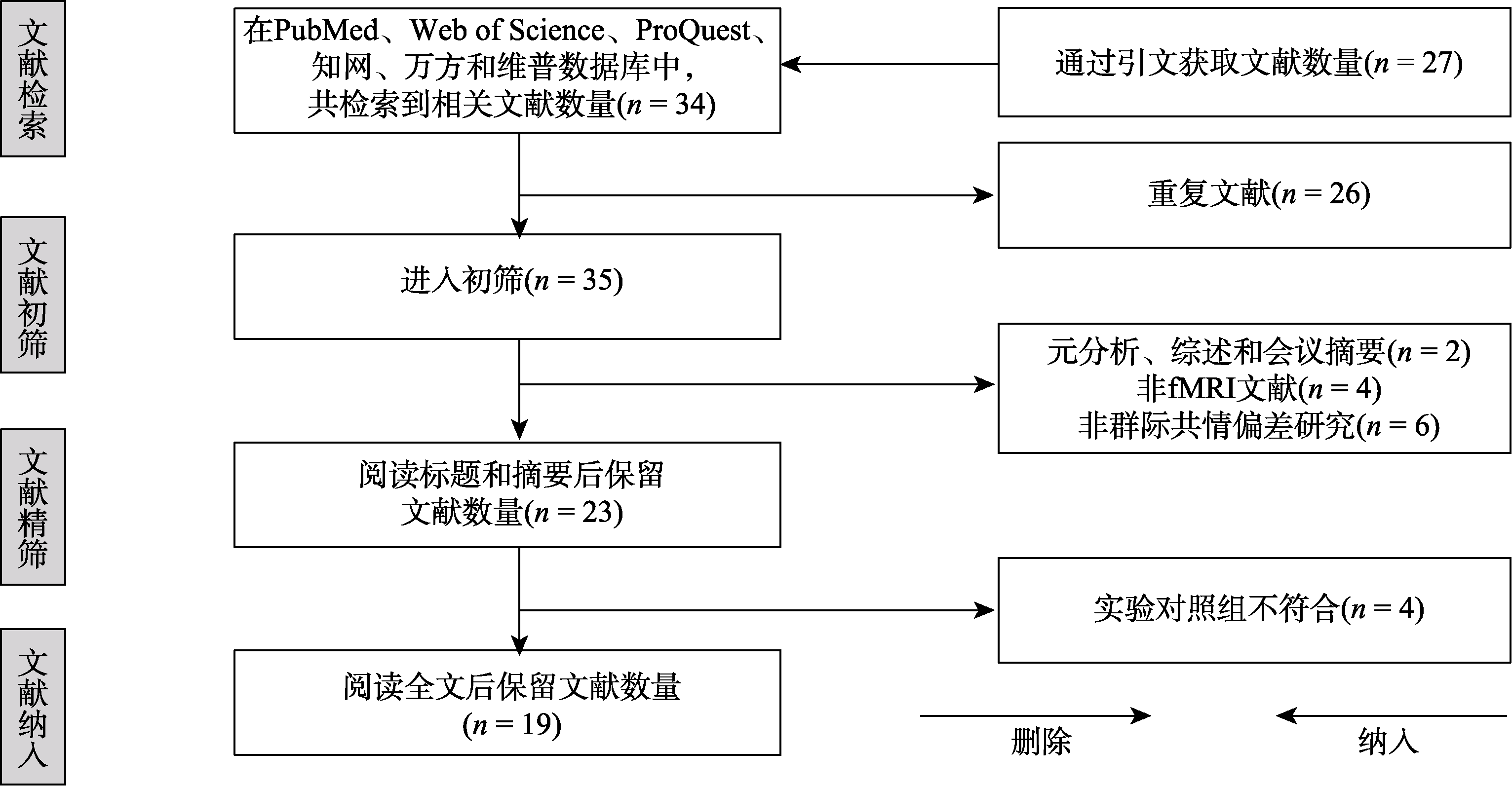
图1 文献筛选流程图
| 序号 | 第一作者 年份 | 样本量(男) | 年龄M (SD) | 坐标空间 | 实验对比 | 任务类型 | 提取 坐标数 |
|---|---|---|---|---|---|---|---|
| 1 | Azevedo et al., | 27(11) | 23.9 (4.11) | MNI | 疼痛共情:内种族>外种族 | 疼痛判断(外显) | 1 |
| 2 | Berlingeri et al., | 25(12) | 25.3 (4.8) | MNI | 疼痛共情:内种族>外种族 | 疼痛评分(外显) | 2 |
| 3 | Cao et al., | 30(12) | 23.17 (1.8) | MNI | 疼痛共情:内种族>外种族 | 疼痛评分(外显) | 1 |
| 4 | Cao et al., | 29(13) | 21.42(2.36) | MNI | 疼痛共情:内群体>外群体 | 疼痛评分(外显) | 5 |
| 5 | Cheon et al., | 27(15) | 23.08(4.35) | MNI | 疼痛共情:内种族>外种族 | 疼痛评分(外显) | 16 |
| 6 | Contreras-Huerta et al., | 20(8) | 22.5 (1.06) | MNI | 疼痛共情:内种族>外种族 | 疼痛评分(外显) | 5 |
| 7 | Fourie et al., | 38(17) | 40.79 (5.01) | Talairach | 疼痛共情:内种族>外种族 | 疼痛判断(外显) | 4 |
| 38(17) | 40.79 (5.01) | Talairach | 情绪共情:内种族>外种族 | 共情评分(外显) | 8 | ||
| 8 | Fox et al., | 19(19) | 22.0 (3.5) | Talairach | 疼痛共情:内种族>外种族 | 疼痛评分(外显) | 20 |
| 9 | Hein et al., | 16(16) | 29.8(1.6) | MNI | 疼痛共情:内群体>外群体 | 疼痛评分(外显) | 9 |
| 10 | Hein et al., | 40(40) | 22.7 (0.41) | MNI | 疼痛共情:内种族>外种族 | 疼痛评分(外显) | 16 |
| 40(40) | 22.7 (0.41) | MNI | 疼痛共情:内种族>外种族 | 疼痛评分(外显) | 15 | ||
| 11 | Jie et al., | 38(19) | 20.58(1.9) | MNI | 疼痛共情:共情(内群体)> 反共情(外群体) | 疼痛评分(外显) | 3 |
| 12 | Li et al., | 16(12) | 22.38 (2.7) | MNI | 疼痛共情:内种族>外种族 | 疼痛判断(外显) | 3 |
| 20(11) | 23.15 (2.35) | MNI | 疼痛共情:内种族>外种族 | 疼痛判断(外显) | 3 | ||
| 13 | Luo et al., | 30(16) | 20.2 (1.45) | MNI | 疼痛共情:内种族>外种族 | 疼痛判断(外显) | 2 |
| 30(16) | 20.33 (1.65) | MNI | 疼痛共情:内种族>外种族 | 疼痛判断(外显) | 2 | ||
| 14 | Mathur et al., | 28(5) | 23.7(0.8) | MNI | 疼痛共情:内种族>外种族 | 疼痛评分(外显) | 12 |
| 15 | Pluta et al., | 30(12) | 23.7 (4.28) | MNI | 疼痛共情:内种族>外种族 | 疼痛评分(外显) | 1 |
| 16 | Ruckmann et al., | 30(15) | 24.5 (3.36) | MNI | 疼痛共情:内群体>外群体 | 疼痛评分(外显) | 7 |
| 17 | Sheng et al., | 21(10) | 22.0 (1.8) | MNI | 疼痛共情:内种族>外种族 | 种族判断(内隐) | 1 |
| 18 | Wang et al., | 30(16) | 22.6(2.4) | MNI | 疼痛共情:内群体>外群体 | 疼痛判断(外显) | 3 |
| 19 | Xu et al., | 17(8) | 23.0 (2.0) | MNI | 疼痛共情:内种族>外种族 | 疼痛判断(外显) | 1 |
| 16(8) | 23.0 (2.0) | MNI | 疼痛共情:内种族>外种族 | 疼痛判断(外显) | 1 | ||
| 共计141 |
表1 元分析文献基本信息(按作者首字母排序)
| 序号 | 第一作者 年份 | 样本量(男) | 年龄M (SD) | 坐标空间 | 实验对比 | 任务类型 | 提取 坐标数 |
|---|---|---|---|---|---|---|---|
| 1 | Azevedo et al., | 27(11) | 23.9 (4.11) | MNI | 疼痛共情:内种族>外种族 | 疼痛判断(外显) | 1 |
| 2 | Berlingeri et al., | 25(12) | 25.3 (4.8) | MNI | 疼痛共情:内种族>外种族 | 疼痛评分(外显) | 2 |
| 3 | Cao et al., | 30(12) | 23.17 (1.8) | MNI | 疼痛共情:内种族>外种族 | 疼痛评分(外显) | 1 |
| 4 | Cao et al., | 29(13) | 21.42(2.36) | MNI | 疼痛共情:内群体>外群体 | 疼痛评分(外显) | 5 |
| 5 | Cheon et al., | 27(15) | 23.08(4.35) | MNI | 疼痛共情:内种族>外种族 | 疼痛评分(外显) | 16 |
| 6 | Contreras-Huerta et al., | 20(8) | 22.5 (1.06) | MNI | 疼痛共情:内种族>外种族 | 疼痛评分(外显) | 5 |
| 7 | Fourie et al., | 38(17) | 40.79 (5.01) | Talairach | 疼痛共情:内种族>外种族 | 疼痛判断(外显) | 4 |
| 38(17) | 40.79 (5.01) | Talairach | 情绪共情:内种族>外种族 | 共情评分(外显) | 8 | ||
| 8 | Fox et al., | 19(19) | 22.0 (3.5) | Talairach | 疼痛共情:内种族>外种族 | 疼痛评分(外显) | 20 |
| 9 | Hein et al., | 16(16) | 29.8(1.6) | MNI | 疼痛共情:内群体>外群体 | 疼痛评分(外显) | 9 |
| 10 | Hein et al., | 40(40) | 22.7 (0.41) | MNI | 疼痛共情:内种族>外种族 | 疼痛评分(外显) | 16 |
| 40(40) | 22.7 (0.41) | MNI | 疼痛共情:内种族>外种族 | 疼痛评分(外显) | 15 | ||
| 11 | Jie et al., | 38(19) | 20.58(1.9) | MNI | 疼痛共情:共情(内群体)> 反共情(外群体) | 疼痛评分(外显) | 3 |
| 12 | Li et al., | 16(12) | 22.38 (2.7) | MNI | 疼痛共情:内种族>外种族 | 疼痛判断(外显) | 3 |
| 20(11) | 23.15 (2.35) | MNI | 疼痛共情:内种族>外种族 | 疼痛判断(外显) | 3 | ||
| 13 | Luo et al., | 30(16) | 20.2 (1.45) | MNI | 疼痛共情:内种族>外种族 | 疼痛判断(外显) | 2 |
| 30(16) | 20.33 (1.65) | MNI | 疼痛共情:内种族>外种族 | 疼痛判断(外显) | 2 | ||
| 14 | Mathur et al., | 28(5) | 23.7(0.8) | MNI | 疼痛共情:内种族>外种族 | 疼痛评分(外显) | 12 |
| 15 | Pluta et al., | 30(12) | 23.7 (4.28) | MNI | 疼痛共情:内种族>外种族 | 疼痛评分(外显) | 1 |
| 16 | Ruckmann et al., | 30(15) | 24.5 (3.36) | MNI | 疼痛共情:内群体>外群体 | 疼痛评分(外显) | 7 |
| 17 | Sheng et al., | 21(10) | 22.0 (1.8) | MNI | 疼痛共情:内种族>外种族 | 种族判断(内隐) | 1 |
| 18 | Wang et al., | 30(16) | 22.6(2.4) | MNI | 疼痛共情:内群体>外群体 | 疼痛判断(外显) | 3 |
| 19 | Xu et al., | 17(8) | 23.0 (2.0) | MNI | 疼痛共情:内种族>外种族 | 疼痛判断(外显) | 1 |
| 16(8) | 23.0 (2.0) | MNI | 疼痛共情:内种族>外种族 | 疼痛判断(外显) | 1 | ||
| 共计141 |
| 激活簇 | 脑区 | 半球 | BA区 | 中心坐标(Talairach) | 体积 (mm3) | ALE值 (×10-2) | ||
|---|---|---|---|---|---|---|---|---|
| x | y | z | ||||||
| 1 | 屏状核、脑岛、豆状核、中央前回 | 左 | 13、44 | -32.7 | 12.9 | 3 | 1192 | 1.76 |
| 2 | 额内侧回、额上回 | 左、右 | 8、6 | -2.1 | 27.9 | 45.3 | 696 | 1.75 |
表2 ALE元分析激活簇结果
| 激活簇 | 脑区 | 半球 | BA区 | 中心坐标(Talairach) | 体积 (mm3) | ALE值 (×10-2) | ||
|---|---|---|---|---|---|---|---|---|
| x | y | z | ||||||
| 1 | 屏状核、脑岛、豆状核、中央前回 | 左 | 13、44 | -32.7 | 12.9 | 3 | 1192 | 1.76 |
| 2 | 额内侧回、额上回 | 左、右 | 8、6 | -2.1 | 27.9 | 45.3 | 696 | 1.75 |
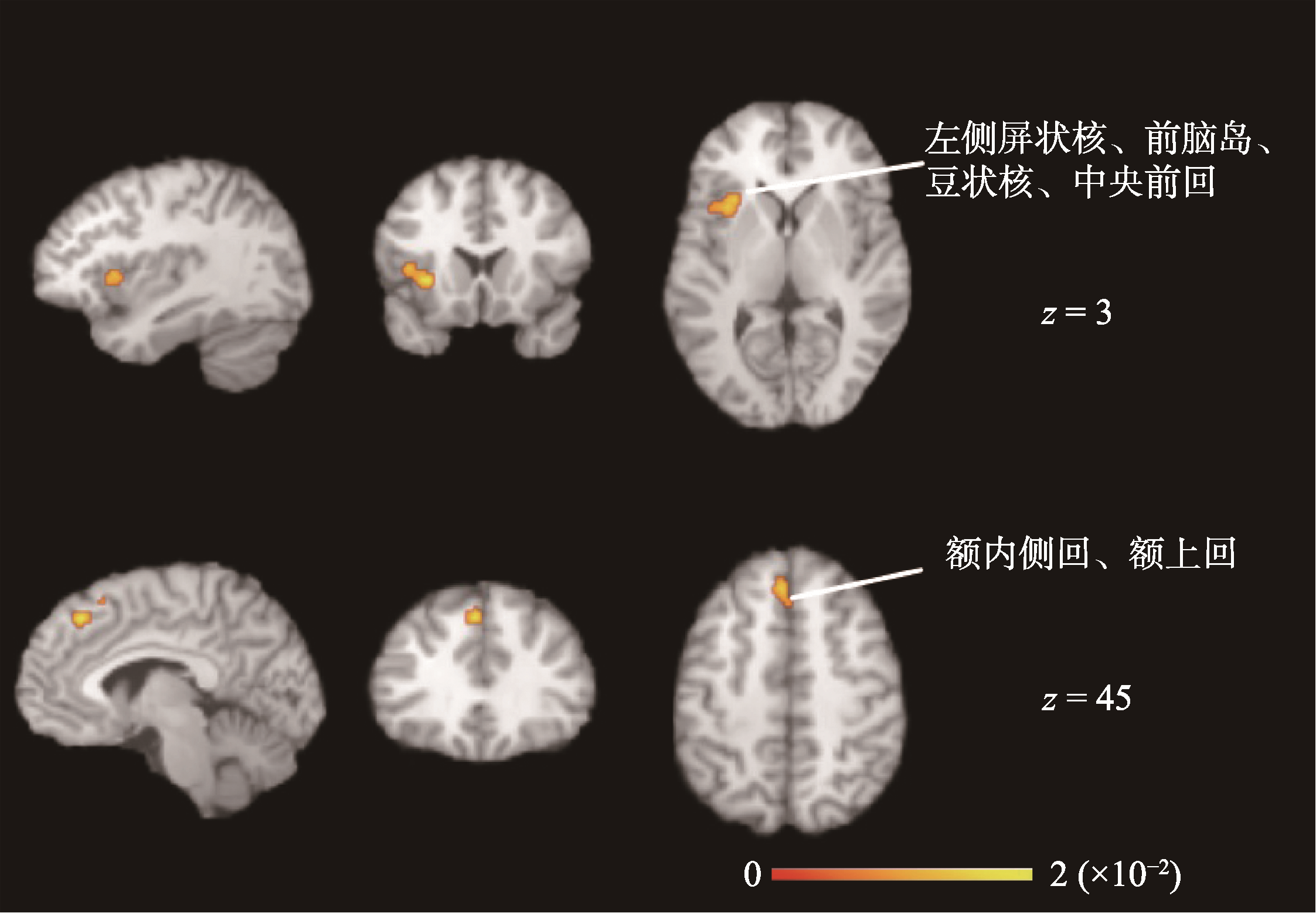
图2 ALE元分析结果成像图 注:图中黄色标注的脑区达到了显著激活水平。第一行为激活簇1, 涵盖大脑左半球的屏状核、前脑岛、豆状核、中央前回; 第二行为激活簇2, 涵盖大脑左右半球的额内侧回、额上回。彩图见电子版, 下同。
| 群际共情 偏差激活簇 | 共同激活区域 | 半球 | BA区 | 中心坐标(MNI) | 体积 (mm3) | ALE值 (×10-2) | |||
|---|---|---|---|---|---|---|---|---|---|
| 激活簇 | 脑区 | x | y | z | |||||
| 1 | 1-1 | 丘脑、豆状核、额中回、中央前回、脑岛、额下回、尾状核、屏状核、额上回 | 左、右 | 6、13、9、44、47、10、46、45、22 | -1.6 | 14.1 | 8.4 | 84792 | 45.62 |
| 1-2 | 扣带回、额内侧回、额上回 | 左、右 | 6、32、24、8 | 1.2 | 17.3 | 44.5 | 22416 | 12.75 | |
| 1-3 | 顶下小叶、楔前叶、顶上小叶、缘上回、脑岛 | 左 | 40、7、19、13、39 | -38 | -50.6 | 45.3 | 11648 | 8.41 | |
| 1-4 | 顶下小叶、顶上小叶、楔前叶、缘上回、颞上回 | 右 | 40、7、13、19、39 | 41.1 | -51.1 | 45.1 | 10448 | 8.14 | |
| 1-5 | 小脑前叶、小脑后叶 | 左 | -32.9 | -63.5 | -27 | 1792 | 6.44 | ||
| 1-6 | 小脑前叶、小脑后叶 | 右 | 31.2 | -62 | -27.2 | 1520 | 6.08 | ||
| 2 | 2-1 | 前扣带回 | 左、右 | 24、32 | -0.4 | 33.9 | -0.6 | 4464 | 4.05 |
| 2-2 | 脑岛、屏状核 | 左 | 13 | -36.1 | 8.8 | 5.3 | 1072 | 1.46 | |
表3 MACM分析结果具体信息
| 群际共情 偏差激活簇 | 共同激活区域 | 半球 | BA区 | 中心坐标(MNI) | 体积 (mm3) | ALE值 (×10-2) | |||
|---|---|---|---|---|---|---|---|---|---|
| 激活簇 | 脑区 | x | y | z | |||||
| 1 | 1-1 | 丘脑、豆状核、额中回、中央前回、脑岛、额下回、尾状核、屏状核、额上回 | 左、右 | 6、13、9、44、47、10、46、45、22 | -1.6 | 14.1 | 8.4 | 84792 | 45.62 |
| 1-2 | 扣带回、额内侧回、额上回 | 左、右 | 6、32、24、8 | 1.2 | 17.3 | 44.5 | 22416 | 12.75 | |
| 1-3 | 顶下小叶、楔前叶、顶上小叶、缘上回、脑岛 | 左 | 40、7、19、13、39 | -38 | -50.6 | 45.3 | 11648 | 8.41 | |
| 1-4 | 顶下小叶、顶上小叶、楔前叶、缘上回、颞上回 | 右 | 40、7、13、19、39 | 41.1 | -51.1 | 45.1 | 10448 | 8.14 | |
| 1-5 | 小脑前叶、小脑后叶 | 左 | -32.9 | -63.5 | -27 | 1792 | 6.44 | ||
| 1-6 | 小脑前叶、小脑后叶 | 右 | 31.2 | -62 | -27.2 | 1520 | 6.08 | ||
| 2 | 2-1 | 前扣带回 | 左、右 | 24、32 | -0.4 | 33.9 | -0.6 | 4464 | 4.05 |
| 2-2 | 脑岛、屏状核 | 左 | 13 | -36.1 | 8.8 | 5.3 | 1072 | 1.46 | |

图3 MACM分析结果成像图 注:图3为MACM分析结果图, 反映群际共情偏差任务中脑区间的功能连通性情况。a图为激活簇1所在的脑功能网络, 涵盖丘脑、豆状核、尾状核、屏状核、中央前回、脑岛、额中回、额下回、额上回、顶下小叶、顶上小叶、楔前叶和小脑; b图为激活簇2所在脑功能网络, 涵盖前扣带回、脑岛和屏状核。
| 激活簇1所在脑功能网络关键词 | 相关性 | 激活簇2所在脑功能网络关键词 | 相关性 |
|---|---|---|---|
| 任务(Task) | 0.4 | 疼痛(Pain) | 0.235 |
| 获得(Gain) | 0.332 | 获得(Gain) | 0.189 |
| 工作记忆(Working Memory) | 0.309 | 奖励(Reward) | 0.172 |
| 需求(Demands) | 0.239 | 有害的(Noxious) | 0.139 |
| 音韵学的(phonological) | 0.247 | 价值(Value) | 0.137 |
| 情绪(Mood) | 0.226 | 情绪(Mood) | 0.135 |
| 负荷(Load) | 0.22 | 创伤后应激障碍(PTSD) | 0.132 |
| 疼痛的(Painful) | 0.123 | 钱(Money) | 0.123 |
| 单词(Word) | 0.122 | 情感的(Affective) | 0.122 |
| 语言(Language) | 0.122 | 期待(Anticipation) | 0.122 |
表4 Neurosynth分析结果
| 激活簇1所在脑功能网络关键词 | 相关性 | 激活簇2所在脑功能网络关键词 | 相关性 |
|---|---|---|---|
| 任务(Task) | 0.4 | 疼痛(Pain) | 0.235 |
| 获得(Gain) | 0.332 | 获得(Gain) | 0.189 |
| 工作记忆(Working Memory) | 0.309 | 奖励(Reward) | 0.172 |
| 需求(Demands) | 0.239 | 有害的(Noxious) | 0.139 |
| 音韵学的(phonological) | 0.247 | 价值(Value) | 0.137 |
| 情绪(Mood) | 0.226 | 情绪(Mood) | 0.135 |
| 负荷(Load) | 0.22 | 创伤后应激障碍(PTSD) | 0.132 |
| 疼痛的(Painful) | 0.123 | 钱(Money) | 0.123 |
| 单词(Word) | 0.122 | 情感的(Affective) | 0.122 |
| 语言(Language) | 0.122 | 期待(Anticipation) | 0.122 |
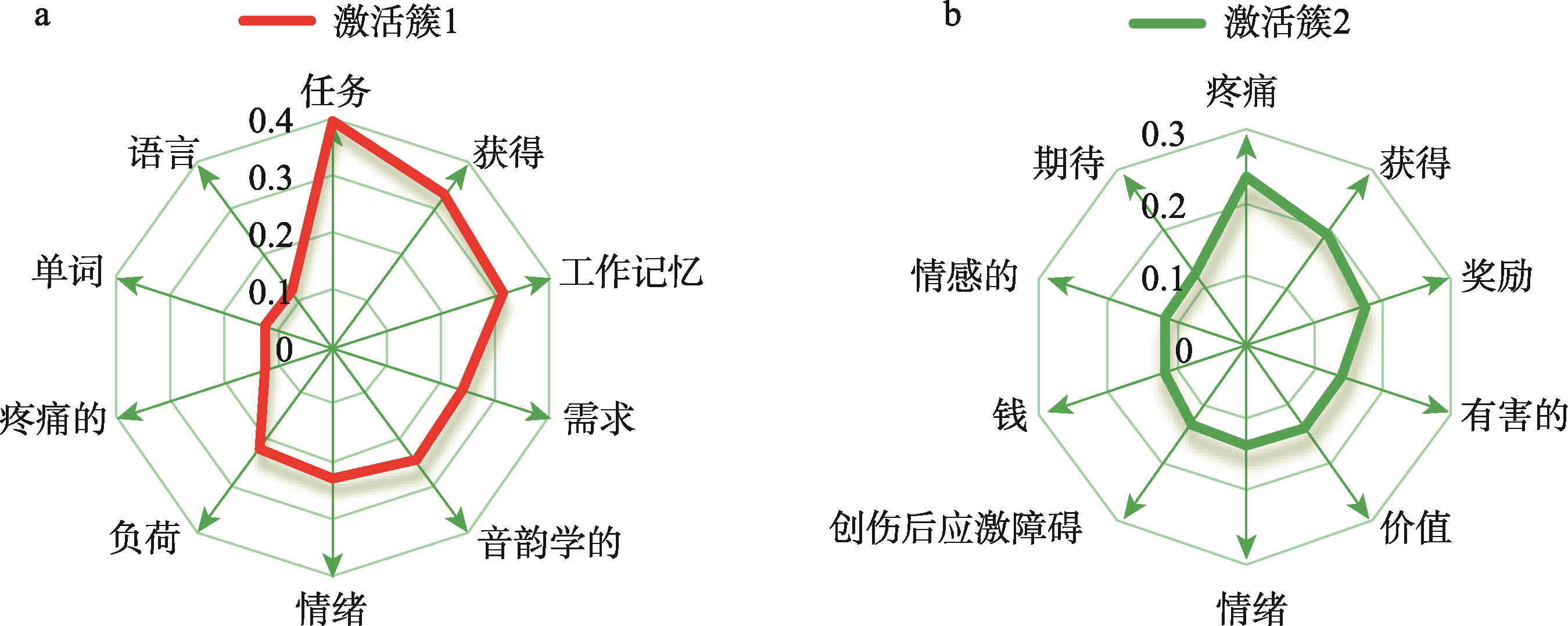
图4 Neurosynth分析结果雷达图 注:该图结果按相关性系数大小展示。a图为激活簇1所在功能网络对应的关键词及其相关性大小; b图为激活簇2所在功能网络对应的关键词及其相关性大小。
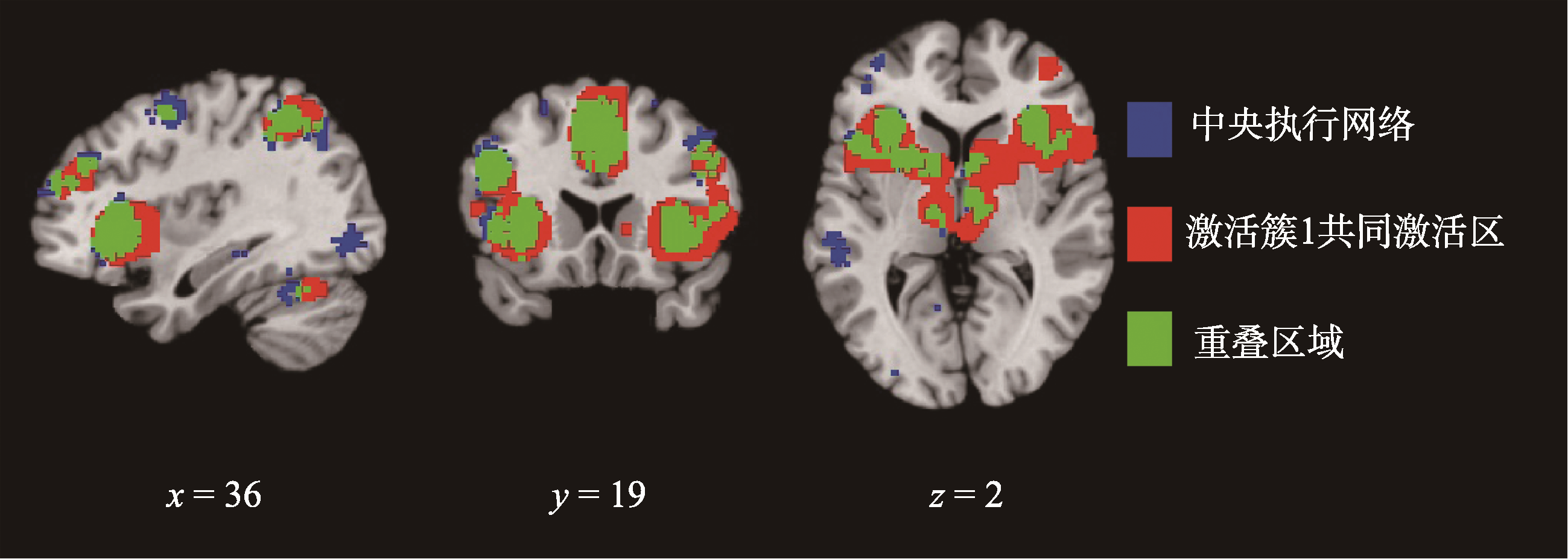
图5 群际共情偏差的脑功能网络与中央执行网络(CEN)基于Neurosynth分析结果对照图
| *代表元分析用到的文献 | |
| [1] |
胡传鹏, 邸新, 李佳蔚, 隋洁, 彭凯平. (2015). 神经成像数据的元分析. 心理科学进展, 23(7), 1118-1129.
doi: 10.3724/SP.J.1042.2015.01118 |
| [2] |
岳童, 黄希庭. (2016). 认知神经研究中的积极共情. 心理科学进展, 24(3), 402-409.
doi: 10.3724/SP.J.1042.2016.00402 |
| [3] |
卓利楠, 曾祥玉, 吴冰, 牛荣荣, 于萍, 王玮文. (2023). 内侧前额皮层-伏隔核环路在决策冲动中的作用: 基于动物模型的研究. 心理学报, 55(4), 556-571.
doi: 10.3724/SP.J.1041.2023.00556 |
| [4] |
* Azevedo, R. T., Macaluso, E., Avenanti, A., Santangelo, V., Cazzato, V., & Aglioti, S. M. (2013). Their pain is not our pain: Brain and autonomic correlates of empathic resonance with the pain of same and different race individuals. Human Brain Mapping, 34(12), 3168-3181.
doi: 10.1002/hbm.22133 pmid: 22807311 |
| [5] |
Banks, S., Eddy, K., Angstadt, M., Nathan, P., & Phan, K. (2007). Amygdala-frontal connectivity during emotion regulation. Social Cognitive and Affective Neuroscience, 2(4), 303-312.
doi: 10.1093/scan/nsm029 pmid: 18985136 |
| [6] |
* Berlingeri, M., Gallucci, M., Danelli, L., Forgiarini, M., Sberna, M., & Paulesu, E. (2016). Guess who’ s coming to dinner: Brain signatures of racially biased and politically correct behaviors. Neuroscience, 332, 231-241.
doi: 10.1016/j.neuroscience.2016.06.048 pmid: 27378559 |
| [7] |
Bullmore, E., & Sporns, O. (2009). Complex brain networks: Graph theoretical analysis of structural and functional systems. Nature Reviews Neuroscience, 10(3), 186-198.
doi: 10.1038/nrn2575 pmid: 19190637 |
| [8] | Cameron, C. D. (2018). Motivating empathy: Three methodological recommendations for mapping empathy. Social and Personality Psychology Compass, 12(11), 1-13. |
| [9] |
* Cao, Y., Contreras-Huerta, L. S., McFadyen, J., & Cunnington, R. (2015). Racial bias in neural response to others' pain is reduced with other-race contact. Cortex, 70, 68-78.
doi: 10.1016/j.cortex.2015.02.010 pmid: 25798570 |
| [10] |
* Cao, Y., Yusri, N. M., Powell, T., & Cunnington, R. (2019). Neural and behavioral markers of observed pain of older adults. Neuropsychologia, 131, 84-90.
doi: S0028-3932(19)30085-5 pmid: 31026475 |
| [11] | Caspar, E. A., Pech, G. P., Gishoma, D., & Kanazayire, C. (2023). On the impact of the genocide on the intergroup empathy bias between former perpetrators, survivors, and their children in Rwanda. American Psychologist, 78(7), 825-841. |
| [12] | Cikara, M., Bruneau, E. G., & Saxe, R. R. (2011). Us and them: Intergroup failures of empathy. Current Directions in Psychological Science, 20(3), 149-153. |
| [13] |
Cikara, M., Bruneau, E., Van Bavel, J. J., & Saxe, R. (2014). Their pain gives us pleasure: How intergroup dynamics shape empathic failures and counter-empathic responses. Journal of Experimental Social Psychology, 55, 110-125.
pmid: 25082998 |
| [14] |
Cikara, M., & Van Bavel, J. J. (2014). The neuroscience of intergroup relations: An integrative review. Perspectives on Psychological Science, 9(3), 245-274.
doi: 10.1177/1745691614527464 pmid: 26173262 |
| [15] |
* Cheon, B. K., Im, D. M., Harada, T., Kim, J. S., Mathur, V. A., Scimeca, J. M., ... Chiao, J. Y. (2011). Cultural influences on neural basis of intergroup empathy. NeuroImage, 57(2), 642-650.
doi: 10.1016/j.neuroimage.2011.04.031 pmid: 21549201 |
| [16] | Cheriyan, J., & Sheets, P. (2018). Altered excitability and local connectivity of mPFC-PAG neurons in a mouse model of neuropathic pain. The Journal of Neuroscience, 38(20), 4829-4839. |
| [17] | * Contreras-Huerta, L. S., Baker, K. S., Reynolds, K. J., Batalha, L., & Cunnington, R. (2013). Racial bias in neural empathic responses to pain. PloS One, 8(12), e84001. |
| [18] |
Correll, J., & Park, B. (2005). A model of the ingroup as a social resource. Personality and Social Psychology Review, 9(4), 341-359.
pmid: 16223356 |
| [19] |
Cox, C., Uddin, L., Martino, A., Castellanos, F., Milham, M., & Kelly, C. (2012). The balance between feeling and knowing: Affective and cognitive empathy are reflected in the brain's intrinsic functional dynamics. Social Cognitive and Affective Neuroscience, 7(6), 727-737.
doi: 10.1093/scan/nsr051 pmid: 21896497 |
| [20] | Decety, J. (2011). Dissecting the neural mechanisms mediating empathy. Emotion Review, 3(1), 92-108. |
| [21] | Decety, J. (2015). The neural pathways, development and functions of empathy. Current Opinion in Behavioral Sciences, 3, 1-6. |
| [22] |
Drwecki, B. B., Moore, C. F., Ward, S. E., & Prkachin, K. M. (2011). Reducing racial disparities in pain treatment: The role of empathy and perspective-taking. Pain, 152(5), 1001-1006.
doi: 10.1016/j.pain.2010.12.005 pmid: 21277087 |
| [23] |
Efferson, C., Lalive, R., & Fehr, E. (2008). The coevolution of cultural groups and ingroup favoritism. Science, 321, 1844-1849.
doi: 10.1126/science.1155805 pmid: 18818361 |
| [24] |
Eickhoff, S. B., Bzdok, D., Laird, A. R., Kurth, F., & Fox, P. T. (2012). Activation likelihood estimation meta-analysis revisited. NeuroImage, 59(3), 2349-2361.
doi: 10.1016/j.neuroimage.2011.09.017 pmid: 21963913 |
| [25] |
Eickhoff, S. B., Laird, A. R., Fox, P. M., Lancaster, J. L., & Fox, P. T. (2017). Implementation errors in the GingerALE software: Description and recommendations. Human Brain Mapping, 38(1), 7-11.
doi: 10.1002/hbm.23342 pmid: 27511454 |
| [26] |
Eickhoff, S. B., Laird, A. R., Grefkes, C., Wang, L. E., Zilles, K., & Fox, P. T. (2009). Coordinate-based activation likelihood estimation metaanalysis of neuroimaging data: A randomeffects approach based on empirical estimates of spatial uncertainty. Human Brain Mapping, 30(9), 2907-2926.
doi: 10.1002/hbm.20718 pmid: 19172646 |
| [27] |
Eickhoff, S. B., Nichols, T. E., Laird, A. R., Hoffstaedter, F., Amunts, K., Fox, P. T., ... Eickhoff, C. R. (2016). Behavior, sensitivity, and power of activation likelihood estimation characterized by massive empirical simulation. NeuroImage, 137, 70-85.
doi: 10.1016/j.neuroimage.2016.04.072 pmid: 27179606 |
| [28] |
FeldmanHall, O., Dalgleish, T., Evans, D., & Mobbs, D. (2015). Empathic concern drives costly altruism. NeuroImage, 105, 347-356.
doi: 10.1016/j.neuroimage.2014.10.043 pmid: 25462694 |
| [29] | Floresco, S. B. (2015). The nucleus accumbens: An interface between cognition, emotion, and action. Annual Review Psychology, 66, 25-52. |
| [30] |
* Fourie, M. M., Stein, D. J., Solms, M., Gobodo-Madikizela, P., & Decety, J. (2017). Empathy and moral emotions in post-apartheid South Africa: an fMRI investigation. Social Cognitive and Affective Neuroscience, 12(6), 881-892.
doi: 10.1093/scan/nsx019 pmid: 28338783 |
| [31] |
* Fox, G. R., Sobhani, M., & Aziz-Zadeh, L. (2013). Witnessing hateful people in pain modulates brain activity in regions associated with physical pain and reward. Frontiers in Psychology, 4, 772.
doi: 10.3389/fpsyg.2013.00772 pmid: 24167496 |
| [32] | Fox, P. T., & Lancaster, J. L. (2002). Mapping context and content: The BrainMap model. Nature Reviews Neuroscience, 3(4), 319-321. |
| [33] |
Genevsky, A., & Knutson, B. (2015). Neural affective mechanisms predict market-level microlending. Psychological Science, 26(9), 1411-1422.
doi: 10.1177/0956797615588467 pmid: 26187248 |
| [34] |
Gu, X., Hof, P. R., Friston, K. J., & Fan, J. (2013). Anterior insular cortex and emotional awareness. Journal of Comparative Neurology, 521(15), 3371-3388.
doi: 10.1002/cne.23368 pmid: 23749500 |
| [35] |
Gutsell, J., & Inzlicht, M. (2012). Intergroup differences in the sharing of emotive states: neural evidence of an empathy gap. Social Cognitive and Affective Neuroscience, 7(5), 596-603.
doi: 10.1093/scan/nsr035 pmid: 21705345 |
| [36] |
Han, S. (2018). Neurocognitive basis of racial ingroup bias in empathy. Trends in Cognitive Sciences, 22(5), 400-421.
doi: S1364-6613(18)30049-4 pmid: 29563059 |
| [37] | * Hein, G., Engelmann, J. B., Vollberg, M. C., & Tobler, P. N. (2016). How learning shapes the empathic brain. Proceedings of the National Academy of Sciences, 113(1), 80-85. |
| [38] |
* Hein, G., Silani, G., Preuschoff, K., Batson, C. D., & Singer, T. (2010). Neural responses to ingroup and outgroup members' suffering predict individual differences in costly helping. Neuron, 68(1), 149-160.
doi: 10.1016/j.neuron.2010.09.003 pmid: 20920798 |
| [39] | Influs, M., Pratt, M., Masalha, S., Zagoory-Sharon, O., & Feldman, R. (2018). A social neuroscience approach to conflict resolution: Dialogue intervention to Israeli and Palestinian youth impacts oxytocin and empathy. Social Neuroscience, 14(4), 378-389. |
| [40] |
Jackson, P. L., Brunet, E., Meltzoff, A. N., & Decety, J. (2006). Empathy examined through the neural mechanisms involved in imagining how I feel versus how you feel pain. Neuropsychologia, 44(5), 752-761.
doi: 10.1016/j.neuropsychologia.2005.07.015 pmid: 16140345 |
| [41] | Jenni, N. L., Larkin, J. D., & Floresco, S. B. (2017). Prefrontal dopamine D1 and D2 receptors regulate dissociable aspects of decision making via distinct ventral striatal and amygdalar circuits. The Journal of Neuroscience, 37(26), 6200-6213. |
| [42] |
Ji, J. L., Spronk, M., Kulkarni, K., Repovš, G., Anticevic, A., & Cole, M. W. (2019). Mapping the human brain's cortical-subcortical functional network organization. NeuroImage, 185, 35-57.
doi: S1053-8119(18)31965-7 pmid: 30291974 |
| [43] | * Jie, J., Fan, M., Yang, Y., Luo, P., Wang, Y., Li, J., ... Zheng, X. (2022). Establishing a counter-empathy processing model: Evidence from functional magnetic resonance imaging. Social Cognitive and Affective Neuroscience, 17(3), 273-289. |
| [44] |
Laird, A. R., Eickhoff, S. B., Li, K., Robin, D. A., Glahn, D. C., & Fox, P. T. (2009). Investigating the functional heterogeneity of the default mode network using coordinate-based meta-analytic modeling. Journal of Neuroscience, 29(46), 14496-14505.
doi: 10.1523/JNEUROSCI.4004-09.2009 pmid: 19923283 |
| [45] |
Laird, A. R., Fox, P. M., Price, C. J., Glahn, D. C., Uecker, A. M., Lancaster, J. L., ... Fox, P. T. (2005). ALE meta-analysis: Controlling the false discovery rate and performing statistical contrasts. Human Brain Mapping, 25(1), 155-164.
doi: 10.1002/hbm.20136 pmid: 15846811 |
| [46] |
* Li, X., Liu, Y., Luo, S., Wu, B., Wu, X., & Han, S. (2015). Mortality salience enhances racial in-group bias in empathic neural responses to others' suffering. NeuroImage, 118, 376-385.
doi: 10.1016/j.neuroimage.2015.06.023 pmid: 26074201 |
| [47] | Lieberman, M. D., Straccia, M. A., Meyer, M. L., Du, M., & Tan, K. M. (2019). Social, self,(situational), and affective processes in medial prefrontal cortex (MPFC): Causal, multivariate, and reverse inference evidence. Neuroscience & Biobehavioral Reviews, 99, 311-328. |
| [48] |
Losin, E. A. R., Woo, C. W., Medina, N. A., Andrews-Hanna, J. R., Eisenbarth, H., & Wager, T. D. (2020). Neural and sociocultural mediators of ethnic differences in pain. Nature Human Behaviour, 4(5), 517-530.
doi: 10.1038/s41562-020-0819-8 pmid: 32015488 |
| [49] |
* Luo, S., Li, B., Ma, Y., Zhang, W., Rao, Y., & Han, S. (2015). Oxytocin receptor gene and racial ingroup bias in empathy-related brain activity. NeuroImage, 110, 22-31.
doi: 10.1016/j.neuroimage.2015.01.042 pmid: 25637390 |
| [50] | Marsh, A. A. (2018). The neuroscience of empathy. Current Opinion in Behavioral Sciences, 19, 110-115. |
| [51] | Masten, C. L., Morelli, S. A., & Eisenberger, N. I. (2011). An fMRI investigation of empathy for ‘social pain’ and subsequent prosocial behavior. NeuroImage, 55(1), 381-388. |
| [52] |
* Mathur, V. A., Harada, T., Lipke, T., & Chiao, J. Y. (2010). Neural basis of extraordinary empathy and altruistic motivation. NeuroImage, 51(4), 1468-1475.
doi: 10.1016/j.neuroimage.2010.03.025 pmid: 20302945 |
| [53] | Mitchell, J. P. (2009). Inferences about mental states. Philosophical Transactions of the Royal Society B: Biological Sciences, 364(1521), 1309-1316. |
| [54] |
Mitchell, T., Haw, R., Pfeifer, J., & Meissner, C. (2005). Racial bias in mock juror decision-making: A meta- analytic review of defendant treatment. Law and Human Behavior, 29, 621-637.
doi: 10.1007/s10979-005-8122-9 pmid: 16382353 |
| [55] |
Morelli, S. A., Rameson, L. T., & Lieberman, M. D. (2014). The neural components of empathy: Predicting daily prosocial behavior. Social Cognitive and Affective Neuroscience, 9(1), 39-47.
doi: 10.1093/scan/nss088 pmid: 22887480 |
| [56] | Müller, V. I., Cieslik, E. C., Laird, A. R., Fox, P. T., Radua, J., Mataix-Cols, D., ... Eickhoff, S. B. (2018). Ten simple rules for neuroimaging meta-analysis. Neuroscience & Biobehavioral Reviews, 84, 151-161. |
| [57] | Niendam, T., Laird, A., Ray, K., Dean, Y., Glahn, D., & Carter, C. (2012). Meta-analytic evidence for a superordinate cognitive control network subserving diverse executive functions. Cognitive, Affective, & Behavioral Neuroscience, 12( 2), 241-268. |
| [58] |
Ochsner, K., Ray, R., Cooper, J., Robertson, E., Chopra, S., Gabrieli, J., & Gross, J. (2004). For better or for worse: Neural systems supporting the cognitive down- and up-regulation of negative emotion. NeuroImage, 23(2), 483-499.
doi: 10.1016/j.neuroimage.2004.06.030 pmid: 15488398 |
| [59] | Perri, R. L., Berchicci, M., Bianco, V., Spinelli, D., & Di Russo, F. (2018). Brain waves from an “isolated” cortex: contribution of the anterior insula to cognitive functions. Brain Structure and Function, 223(3), 1343-1355. |
| [60] |
Phan, L., Fitzgerald, D., Nathan, P., Moore, G., Uhde, T., & Tancer, M. (2005). Neural substrates for voluntary suppression of negative affect: A functional magnetic resonance imaging study. Biological Psychiatry, 57(3), 210-219.
doi: 10.1016/j.biopsych.2004.10.030 pmid: 15691521 |
| [61] | * Pluta, A., Mazurek, J., Wojciechowski, J., Wolak, T., Soral, W., & Bilewicz, M. (2023). Exposure to hate speech deteriorates neurocognitive mechanisms of the ability to understand others’ pain. Scientific Reports, 13(1), 4127. |
| [62] |
Rameson, L. T., Morelli, S. A., & Lieberman, M. D. (2012). The neural correlates of empathy: Experience, automaticity, and prosocial behavior. Journal of Cognitive Neuroscience, 24(1), 235-245.
doi: 10.1162/jocn_a_00130 pmid: 21878057 |
| [63] | Raschle, N. M., Menks, W. M., Fehlbaum, L. V., Steppan, M., Smaragdi, A., Gonzalez-Madruga, K., ... Stadler, C. (2018). Callous-unemotional traits and brain structure: Sex- specific effects in anterior insula of typically-developing youths. NeuroImage: Clinical, 17, 856-864. |
| [64] | Robbins, T. W., & Dalley, J. W. (2017). Impulsivity, risky choice, and impulse control disorders: Animal models. In J-C. Dreher & L. Tremblay (Eds.), Decision neuroscience (pp. 81-93). Academic Press. |
| [65] | * Ruckmann, J., Bodden, M., Jansen, A., Kircher, T., Dodel, R., & Rief, W. (2015). How pain empathy depends on ingroup/outgroup decisions: A functional magnet resonance imaging study. Psychiatry Research: NeuroImaging, 234(1), 57-65. |
| [66] |
Seeley, W. W., Menon, V., Schatzberg, A. F., Keller, J., Glover, G. H., Kenna, H., ... Greicius, M. D. (2007). Dissociable intrinsic connectivity networks for salience processing and executive control. Journal of Neuroscience, 27(9), 2349-2356.
doi: 10.1523/JNEUROSCI.5587-06.2007 pmid: 17329432 |
| [67] |
Shamay-Tsoory, S., Abu-Akel, A., Palgi, S., Sulieman, R., Fischer-Shofty, M., Levkovitz, Y., & Decety, J. (2013). Giving peace a chance: Oxytocin increases empathy to pain in the context of the Israeli-Palestinian conflict. Psychoneuroendocrinology, 38(12), 3139-3144.
doi: 10.1016/j.psyneuen.2013.09.015 pmid: 24099859 |
| [68] |
* Sheng, F., Liu, Q., Li, H., Fang, F., & Han, S. (2014). Task modulations of racial bias in neural responses to others' suffering. NeuroImage, 88, 263-270.
doi: 10.1016/j.neuroimage.2013.10.017 pmid: 24135167 |
| [69] |
Smith, R., Lane, R. D., Alkozei, A., Bao, J., Smith, C., Sanova, A., ... Killgore, W. D. (2017). Maintaining the feelings of others in working memory is associated with activation of the left anterior insula and left frontal- parietal control network. Social Cognitive and Affective Neuroscience, 12(5), 848-860.
doi: 10.1093/scan/nsx011 pmid: 28158779 |
| [70] | Sridharan, D., Levitin, D. J., & Menon, V. (2008). A critical role for the right fronto-insular cortex in switching between central-executive and default-mode networks. Proceedings of the National Academy of Sciences, 105(34), 12569-12574. |
| [71] |
Starkweather, C. K., Gershman, S. J., & Uchida, N. (2018). The medial prefrontal cortex shapes dopamine reward prediction errors under state uncertainty. Neuron, 98(3), 616-629.
doi: S0896-6273(18)30242-3 pmid: 29656872 |
| [72] | Thompson, N. M., Uusberg, A., Gross, J. J., & Chakrabarti, B. (2019). Empathy and emotion regulation: An integrative account. Emotion and Cognition, 247, 273-304. |
| [73] | Tompkins, R., Vasquez, K., Gerdin, E., Dunham, Y., & Liberman, Z. (2024). Expectations of intergroup empathy bias emerge by early childhood. Journal of Experimental Psychology: General, 153(11), 2700-2714. |
| [74] |
Turkeltaub, P. E., Eickhoff, S. B., Laird, A. R., Fox, M., Wiener, M., & Fox, P. (2012). Minimizing within- experiment and within-group effects in activation likelihood estimation meta-analyses. Human Brain Mapping, 33(1), 1-13.
doi: 10.1002/hbm.21186 pmid: 21305667 |
| [75] | Vanman, E. (2016). The role of empathy in intergroup relations. Current Opinion in Psychology, 11, 59-63. |
| [76] |
Varela, F., Lachaux, J. P., Rodriguez, E., & Martinerie, J. (2001). The brainweb: Phase synchronization and large- scale integration. Nature Reviews Neuroscience, 2(4), 229-239.
pmid: 11283746 |
| [77] | Vaughn, I. A., Terry, E. L., Bartley, E. J., Schaefer, N., & Fillingim, R. B. (2019). Racial-ethnic differences in osteoarthritis pain and disability: A meta-analysis. The Journal of Pain, 20(6), 629-644. |
| [78] | * Wang, C., Wu, B., Liu, Y., Wu, X., & Han, S. (2015). Challenging emotional prejudice by changing self-concept: Priming independent self-construal reduces racial in-group bias in neural responses to other’s pain. Social Cognitive and Affective Neuroscience, 10(9), 1195-1201. |
| [79] |
Wang, Y., Zou, Q., Ao, Y., Liu, Y., Ouyang, Y., Wang, X., ... Chen, H. (2020). Frequency-dependent circuits anchored in the dorsal and ventral left anterior insula. Scientific Reports, 10(1), 16394.
doi: 10.1038/s41598-020-73192-z pmid: 33020498 |
| [80] |
Wen, X., Liu, Y., Yao, L., & Ding, M. (2013). Top-down regulation of default mode activity in spatial visual attention. Journal of Neuroscience, 33(15), 6444-6453.
doi: 10.1523/JNEUROSCI.4939-12.2013 pmid: 23575842 |
| [81] |
* Xu, X., Zuo, X., Wang, X., & Han, S. (2009). Do you feel my pain? Racial group membership modulates empathic neural responses. Journal of Neuroscience, 29(26), 8525-8529.
doi: 10.1523/JNEUROSCI.2418-09.2009 pmid: 19571143 |
| [82] |
Yarkoni, T., Poldrack, R. A., Nichols, T. E., Van Essen, D. C., & Wager, T. D. (2011). Large-scale automated synthesis of human functional neuroimaging data. Nature Methods, 8(8), 665-670.
doi: 10.1038/nmeth.1635 pmid: 21706013 |
| [83] |
Zaki, J., & Ochsner, K. N. (2012). The neuroscience of empathy: Progress, pitfalls and promise. Nature Neuroscience, 15(5), 675-680.
doi: 10.1038/nn.3085 pmid: 22504346 |
| [1] | 刘俊材, 冉光明, 张琪. 不同情绪载体的神经活动及其异同——脑成像研究的ALE元分析[J]. 心理科学进展, 2022, 30(3): 536-555. |
| [2] | 那宇亭, 赵宇雯, 关丽丽. 自我面孔识别的神经机制:基于fMRI研究的ALE元分析[J]. 心理科学进展, 2021, 29(10): 1783-1795. |
| [3] | 胡传鹏;邸新;李佳蔚;隋洁;彭凯平. 神经成像数据的元分析[J]. 心理科学进展, 2015, 23(7): 1118-1129. |
| 阅读次数 | ||||||
|
全文 |
|
|||||
|
摘要 |
|
|||||
