

ISSN 0439-755X
CN 11-1911/B
CN 11-1911/B
Acta Psychologica Sinica ›› 2026, Vol. 58 ›› Issue (7): 1312-1324.doi: 10.3724/SP.J.1041.2026.1312
• Reports of Empirical Studies • Previous Articles Next Articles
WANG Da, YANG Zhihao, MEI Gaoxing( )
)
Published:2026-07-25
Online:2026-05-15
Contact:
MEI Gaoxing
E-mail:meigx1014@jsnu.edu.cn
WANG Da, YANG Zhihao, MEI Gaoxing. (2026). Serial dependence for same-category and cross-category stimuli in social attention. Acta Psychologica Sinica, 58(7), 1312-1324.
Add to citation manager EndNote|Ris|BibTeX
URL: https://journal.psych.ac.cn/acps/EN/10.3724/SP.J.1041.2026.1312

Figure 1. Examples of facial stimuli used in Experiments 1-2. (A) Examples of facial stimuli in Experiments 1a, 2a, and 2b. The facial images included a total of 7 gaze direction levels, ranging from ?40% (extreme left) to +40% (extreme right), in steps of 13.3%. In Experiment 1a, the face images with gaze directions of ?40% and +40% were used as inducer stimuli, while the images with all 7 gaze directions were used as probe stimuli; the image with a gaze direction of 0% (straight gaze) was used as the reference stimulus. The reference and probe stimuli used in Experiments 2a and 2b were the same as those in Experiment 1a. (B) Examples of facial stimuli in Experiment 1b. The inducer, reference, and probe stimuli were generated in the same manner as in Experiment 1a, except that two emotional versions (happy and angry) were included.
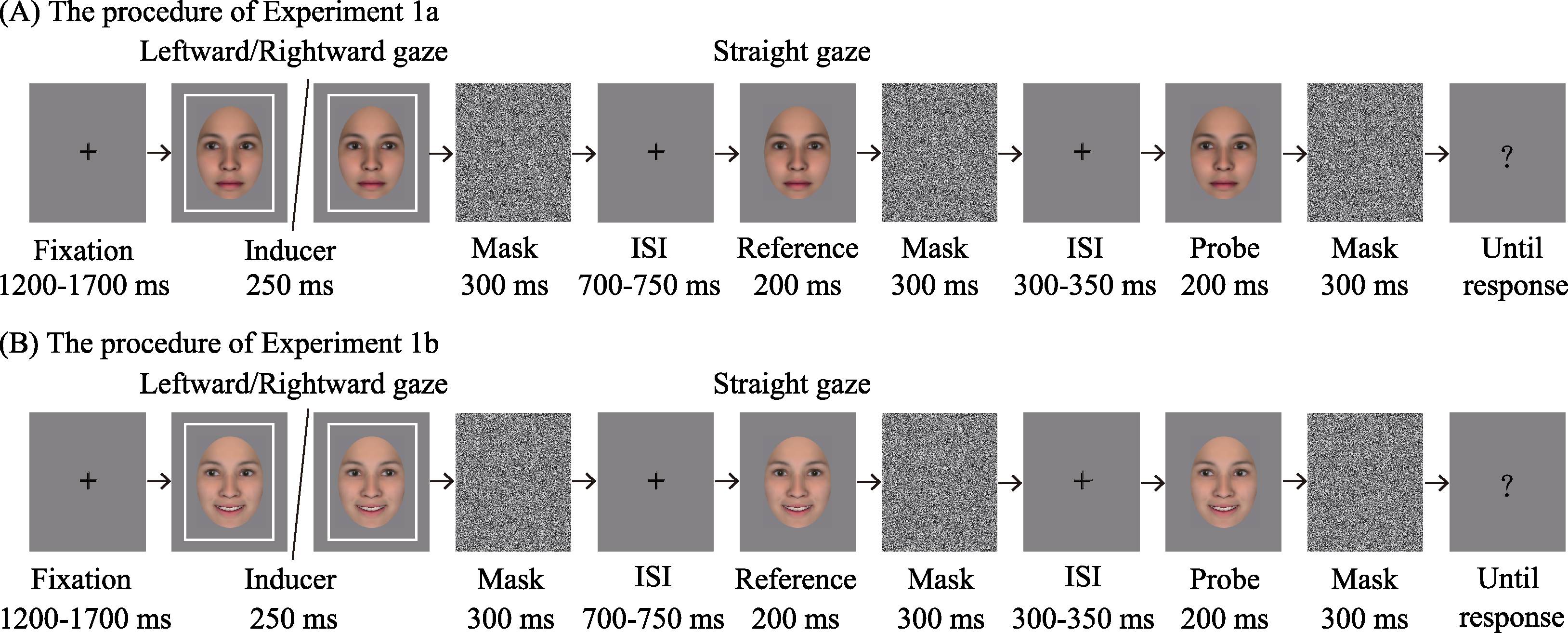
Figure 2. Procedures of Experiment 1. (A) The procedure of Experiment 1a. After a fixation was presented for 1200-1700 ms, an inducer stimulus (with extreme leftward or extreme rightward gaze direction) surrounded by a white rectangular frame was shown for 250 ms, followed by a 300-ms mask. Following an inter-stimulus interval (ISI) of 700-750 ms, a reference stimulus with a direct gaze was presented for 200 ms, followed by another 300-ms mask. After an ISI of 300-350 ms, a probe stimulus randomly selected from the seven gaze direction levels was shown for 200 ms, followed again by a 300-ms mask. When a question mark appeared in the center of the screen, participants were instructed to press the “up” or “down” key to indicate whether the gaze direction of the reference or the probe stimulus was more leftward or more rightward (leftward or rightward perception was counterbalanced across participants). (B) The procedure of Experiment 1b. The procedure of Experiment 1b was identical to that of Experiment 1a, except that all stimuli (inducer, reference, and probe) included two emotional versions (happy and angry). Within each trial, the emotional valence (happy or angry) was consistent across the inducer, reference, and probe stimuli, and the valence was randomized across trials.
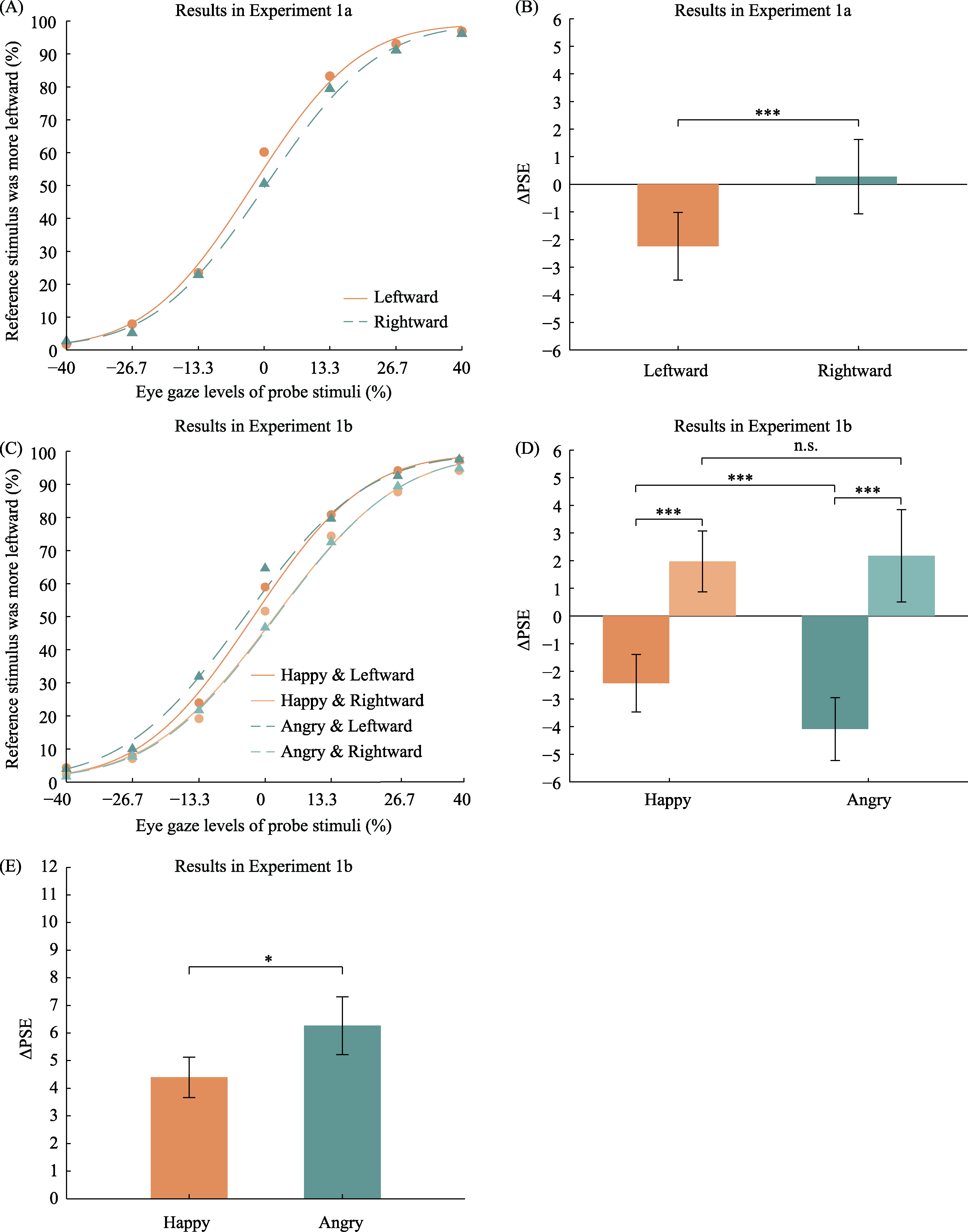
Figure 3. Results of Experiment 1. (A) Fitted curves to positive responses under the leftward (orange) and rightward (green) gaze inducer conditions in Experiment 1a. (B) Mean PSE values for the leftward and rightward gaze inducer conditions in Experiment 1a. (C) Fitted curves to positive responses under the four inducer conditions for Experiment 1b: the happy face with leftward gaze (orange), happy face with rightward gaze (light orange), angry face with leftward gaze (green) and angry face with rightward gaze (light green) conditions. (D) Mean PSE values for the four inducer conditions in Experiment 1b. (E) The ΔPSE for different emotional inducer conditions in Experiment 1b. Error bars indicate ±1 standard error. *p < 0.05, ***p < 0.001, n.s. indicates no significant difference.
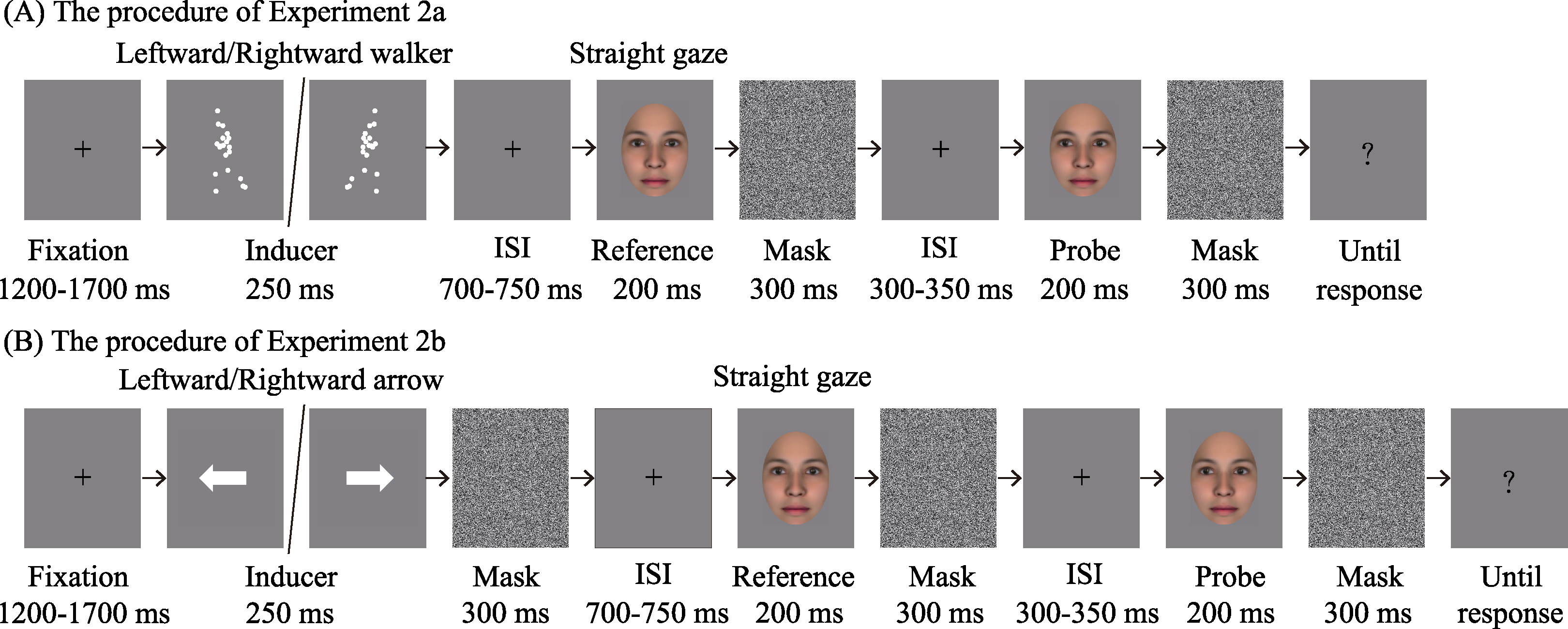
Figure 4. Procedures of Experiment 2. The procedures of Experiment 2a and 2b were identical to those of Experiment 1a, except that the inducer stimuli in Experiment 2a and 2b were changed to biological motion stimuli (leftward or rightward) and arrow stimuli (leftward or rightward), respectively.
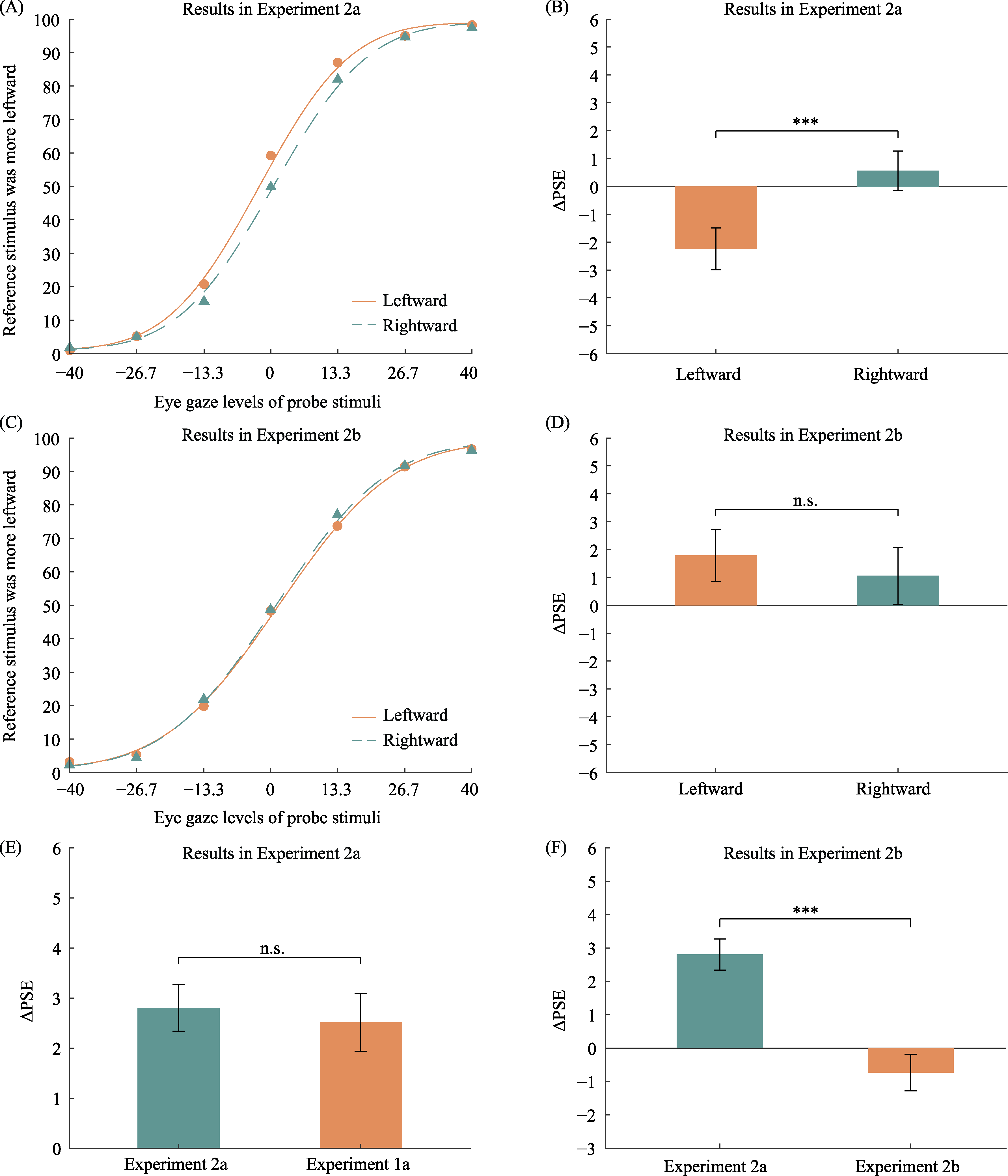
Figure 5. Results of Experiment 2. (A) Fitted curves to positive responses under the leftward (orange) and rightward (green) biological motion inducer conditions in Experiment 2a. (B) Mean PSE values for the leftward and rightward biological motion inducer conditions in Experiment 2a. (C) Fitted curves to positive responses under the leftward (orange) and rightward (green) arrow inducer conditions in Experiment 2b. (D) Mean PSE values for the leftward and rightward arrow inducer conditions in Experiment 2b. (E) The ΔPSE for the Experiment 2a and the Experiment 1a. (F) The ΔPSE for the Experiment 2a and the Experiment 2b. Error bars indicate ±1 standard error. ***p < 0.001; n.s. indicates not significant.
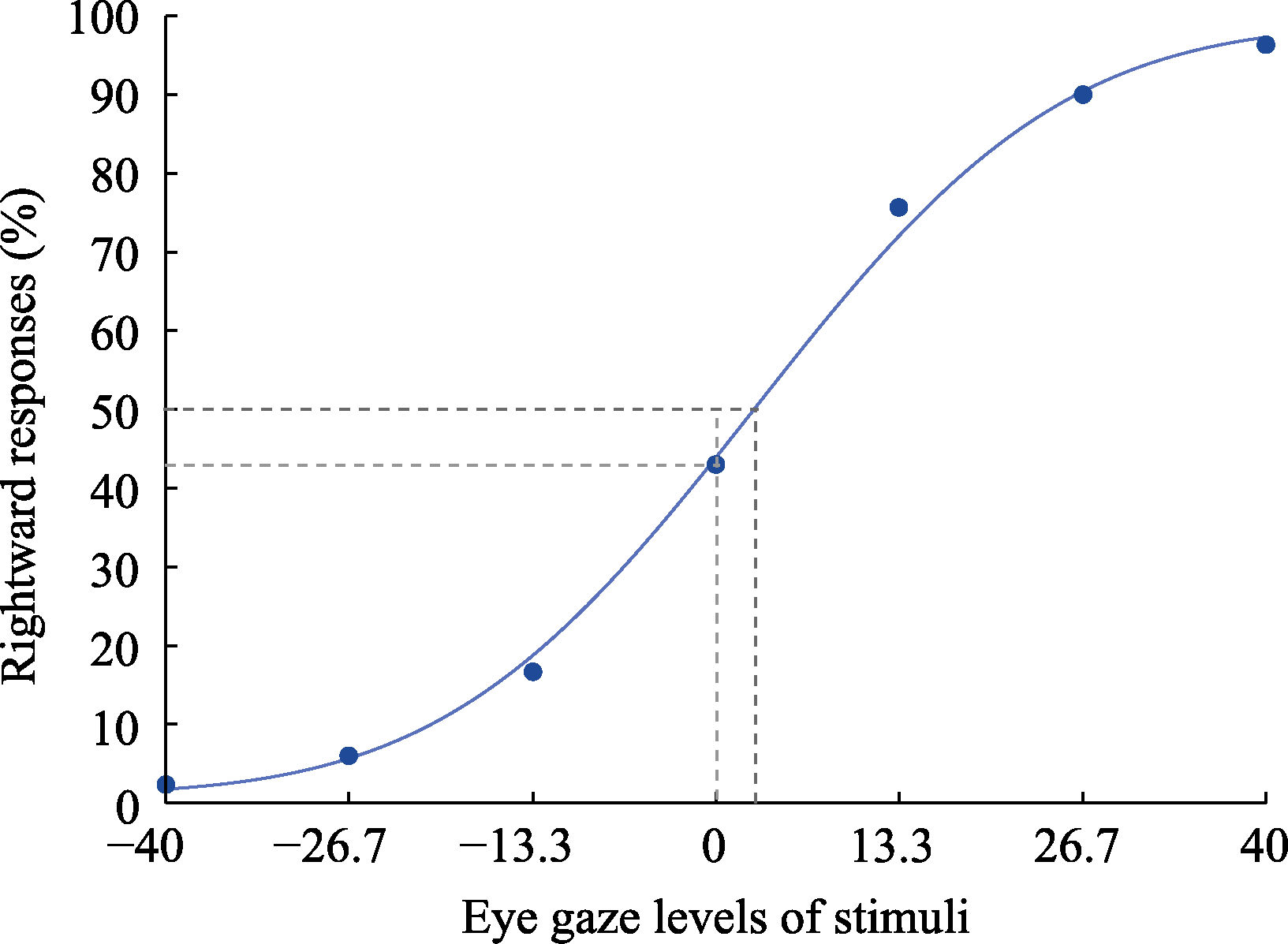
Figure A1. Results of the eye gaze direction assessment task. The vertical axis represents the proportion of rightward responses; the horizontal axis represents the gaze direction (from ?40% to +40%). The dark gray dashed line indicates the point of subjective equality (PSE); the light gray dashed line indicates the proportion of rightward responses for direct gaze (0%).
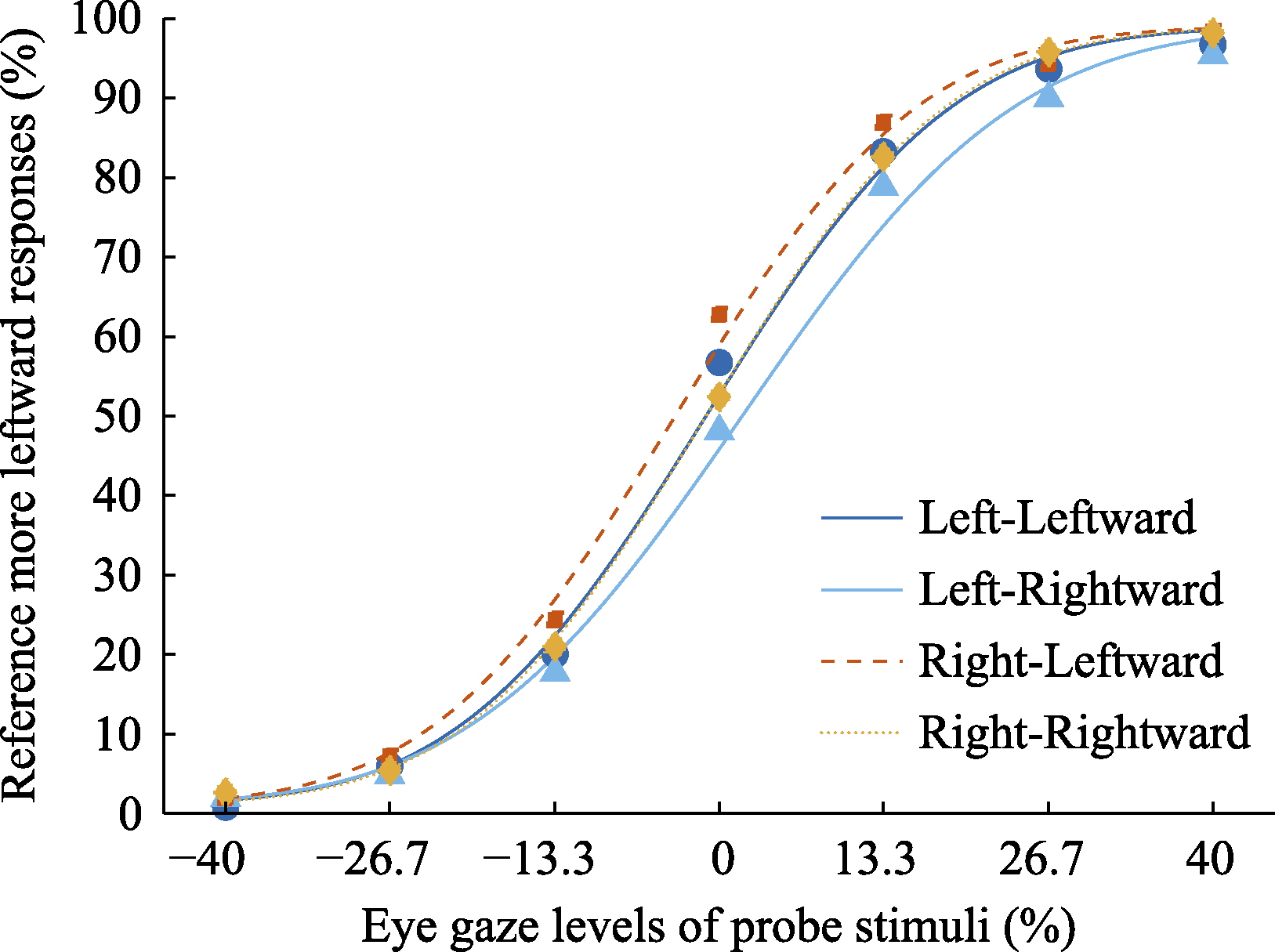
Figure A2. Psychometric function curves for the left- judgment group and the right-judgment group.
| [1] |
Alais, D., Kong, G., Palmer, C., & Clifford, C. (2018). Eye gaze direction shows a positive serial dependency. Journal of Vision, 18(4), 11. https://doi.org/10.1167/18.4.11
doi: 10.1167/18.4.11 URL pmid: 29710301 |
| [2] | Becker, D. V., Rheem, H., Pick, C. M., Ko, A., & Lafko, S. R. (2019). Angry faces hold attention: Evidence of attentional adhesion in two paradigms. In N. Srinivasan (Ed.), Progress in brain research (Vol. 247, pp. 89-110). Elsevier Academic Press. https://doi.org/10.1016/bs.pbr.2019.03.033 |
| [3] | Birmingham, E., & Kingstone, A. (2009). Human social attention. In N. Srinivasan (Ed.), Progress in brain research (Vol. 176, pp. 309-320). Elsevier. https://doi.org/10.1016/S0079-6123(09)17618-5 |
| [4] |
Borghi, A. M., Barca, L., Binkofski, F., & Tummolini, L. (2018). Varieties of abstract concepts: Development, use and representation in the brain. Philosophical Transactions of the Royal Society B: Biological Sciences, 373(1752), 20170121. https://doi.org/10.1098/rstb.2017.0121
doi: 10.1098/rstb.2017.0121 URL |
| [5] |
Brainard, D. H. (1997). The psychophysics toolbox. Spatial Vision, 10(4), 433-436. https://doi.org/10.1163/156856897X00357
URL pmid: 9176952 |
| [6] |
Brooks, R., & Meltzoff, A. N. (2005). The development of gaze following and its relation to language. Developmental Science, 8(6), 535-543. https://doi.org/10.1111/j.1467-7687.2005.00445.x
doi: 10.1111/j.1467-7687.2005.00445.x URL pmid: 16246245 |
| [7] |
Burra, N., Barras, C., Coll, S. Y., & Kerzel, D. (2016). Electrophysiological evidence for attentional capture by irrelevant angry facial expressions. Biological Psychology, 120, 69-80. https://doi.org/10.1016/j.biopsycho.2016.08.008
doi: S0301-0511(16)30274-5 URL pmid: 27568328 |
| [8] |
Cicchini, G. M., Mikellidou, K., & Burr, D. C. (2018). The functional role of serial dependence. Proceedings of the Royal Society B: Biological Sciences, 285(1890), 20181722. https://doi.org/10.1098/rspb.2018.1722
doi: 10.1098/rspb.2018.1722 URL |
| [9] |
Cicchini, G. M., Mikellidou, K., & Burr, D. C. (2024). Serial dependence in perception. Annual Review of Psychology, 75(1), 129-154. https://doi.org/10.1146/annurev-psych-021523-104939
doi: 10.1146/psych.2024.75.issue-1 URL |
| [10] |
Cortês, A. B., Duarte, J. V., & Castelo-Branco, M. (2023). Hysteresis reveals a happiness bias effect in dynamic emotion recognition from ambiguous biological motion. Journal of Vision, 23(13), 5. https://doi.org/10.1167/jov.23.13.5
doi: 10.1167/jov.23.13.5 URL pmid: 37962533 |
| [11] |
Engell, A. D., Nummenmaa, L., Oosterhof, N. N., Henson, R. N., Haxby, J. V., & Calder, A. J. (2010). Differential activation of frontoparietal attention networks by social and symbolic spatial cues. Social Cognitive and Affective Neuroscience, 5(4), 432-440. https://doi.org/10.1093/scan/nsq008
doi: 10.1093/scan/nsq008 URL pmid: 20304864 |
| [12] |
Faul, F., Erdfelder, E., Lang, A.-G., & Buchner, A. (2007). G*power 3: A flexible statistical power analysis program for the social, behavioral, and biomedical sciences. Behavior Research Methods, 39(2), 175-191. https://doi.org/10.3758/BF03193146
doi: 10.3758/bf03193146 URL pmid: 17695343 |
| [13] |
Fischer, J., & Whitney, D. (2014). Serial dependence in visual perception. Nature Neuroscience, 17(5), 738-743. https://doi.org/10.1038/nn.3689
doi: 10.1038/nn.3689 URL pmid: 24686785 |
| [14] |
Fornaciai, M., & Park, J. (2018). Serial dependence in numerosity perception. Journal of Vision, 18(9), 15. https://doi.org/10.1167/18.9.15
doi: 10.1167/18.9.15 URL pmid: 30242385 |
| [15] |
Fornaciai, M., & Park, J. (2019). Serial dependence generalizes across different stimulus formats, but not different sensory modalities. Vision Research, 160, 108-115. https://doi.org/10.1016/j.visres.2019.04.011
doi: S0042-6989(19)30104-X URL pmid: 31078663 |
| [16] |
Fornaciai, M., & Park, J. (2022). The effect of abstract representation and response feedback on serial dependence in numerosity perception. Attention, Perception, & Psychophysics, 84(5), 1651-1665. https://doi.org/10.3758/s13414-022-02518-y
doi: 10.3758/s13414-022-02518-y URL |
| [17] |
Friesen, C. K., & Kingstone, A. (1998). The eyes have it! Reflexive orienting is triggered by nonpredictive gaze. Psychonomic Bulletin & Review, 5(3), 490-495. https://doi.org/10.3758/BF03208827
doi: 10.3758/BF03208827 URL |
| [18] |
Frischen, A., Bayliss, A. P., & Tipper, S. P. (2007). Gaze cueing of attention: Visual attention, social cognition, and individual differences. Psychological Bulletin, 133(4), 694-724. https://doi.org/10.1037/0033-2909.133.4.694
doi: 10.1037/0033-2909.133.4.694 URL |
| [19] |
Itier, R. J., & Batty, M. (2009). Neural bases of eye and gaze processing: The core of social cognition. Neuroscience & Biobehavioral Reviews, 33(6), 843-863. https://doi.org/10.1016/j.neubiorev.2009.02.004
doi: 10.1016/j.neubiorev.2009.02.004 URL |
| [20] |
Jackson, M. C., Linden, D. E. J., & Raymond, J. E. (2014). Angry expressions strengthen the encoding and maintenance of face identity representations in visual working memory. Cognition and Emotion, 28(2), 278-297. https://doi.org/10.1080/02699931.2013.816655
doi: 10.1080/02699931.2013.816655 URL |
| [21] |
Kingstone, A., Tipper, C., Ristic, J., & Ngan, E. (2004). The eyes have it!: An fMRI investigation. Brain and Cognition, 55(2), 269-271. https://doi.org/10.1016/j.bandc.2004.02.037
URL pmid: 15177792 |
| [22] |
Kiyonaga, A., Scimeca, J. M., Bliss, D. P., & Whitney, D. (2017). Serial dependence across perception, attention, and memory. Trends in Cognitive Sciences, 21(7), 493-497. https://doi.org/10.1016/j.tics.2017.04.011
doi: S1364-6613(17)30084-0 URL pmid: 28549826 |
| [23] |
Lawson, R. P., & Calder, A. J. (2016). The “where” of social attention: Head and body direction aftereffects arise from representations specific to cue type and not direction alone. Cognitive Neuroscience, 7(1-4), 103-113. https://doi.org/10.1080/17588928.2015.1049993
doi: 10.1080/17588928.2015.1049993 URL |
| [24] |
Liberman, A., Fischer, J., & Whitney, D. (2014). Serial dependence in the perception of faces. Current Biology, 24(21), 2569-2574. https://doi.org/10.1016/j.cub.2014.09.025
doi: 10.1016/j.cub.2014.09.025 URL pmid: 25283781 |
| [25] |
Liberman, A., Manassi, M., & Whitney, D. (2018). Serial dependence promotes the stability of perceived emotional expression depending on face similarity. Attention, Perception, & Psychophysics, 80(6), 1461-1473. https://doi.org/10.3758/s13414-018-1533-8
doi: 10.3758/s13414-018-1533-8 URL |
| [26] |
Linares, D., Aguilar-Lleyda, D., & López-Moliner, J. (2019). Decoupling sensory from decisional choice biases in perceptual decision making. eLife, 8, e43994. https://doi.org/10.7554/eLife.43994
doi: 10.7554/eLife.43994 URL |
| [27] |
Little, Z., Palmer, C., & Susilo, T. (2022). Normal gaze processing in developmental prosopagnosia. Cortex, 154, 46-61. https://doi.org/10.1016/j.cortex.2022.05.011
doi: 10.1016/j.cortex.2022.05.011 URL pmid: 35749966 |
| [28] |
Liu, Y., Liu, C., Zhou, L., & Zhou, K. (2024). The effect of task relevance on serial dependence in numerosity. Acta Psychologica Sinica, 56(3), 255-267.
doi: 10.3724/SP.J.1041.2024.00255 |
| [29] | Luo, X., Zhao, D., Gao, Y., Yang, Z., Wang, D., & Mei, G. (2024). Implicit weight bias: Shared neural substrates for overweight and angry facial expressions revealed by cross-adaptation. Cerebral Cortex, 34(4), bhae128. https://doi.org/10.1093/cercor/bhae128 |
| [30] |
Manassi, M., Liberman, A., Kosovicheva, A., Zhang, K., & Whitney, D. (2018). Serial dependence in position occurs at the time of perception. Psychonomic Bulletin & Review, 25(6), 2245-2253. https://doi.org/10.3758/s13423-018-1454-5
doi: 10.3758/s13423-018-1454-5 URL |
| [31] |
Manassi, M., Murai, Y., & Whitney, D. (2023). Serial dependence in visual perception: A meta-analysis and review. Journal of Vision, 23(8), 18. https://doi.org/10.1167/jov.23.8.18
doi: 10.1167/jov.23.8.18 URL pmid: 37642639 |
| [32] |
Mei, G., Chen, S., & Dong, B. (2019). Working memory maintenance modulates serial dependence effects of perceived emotional expression. Frontiers in Psychology, 10, 1610. https://doi.org/10.3389/fpsyg.2019.01610
doi: 10.3389/fpsyg.2019.01610 URL pmid: 31354595 |
| [33] |
Morgan, M., Dillenburger, B., Raphael, S., & Solomon, J. A. (2012). Observers can voluntarily shift their psychometric functions without losing sensitivity. Attention, Perception, & Psychophysics, 74(1), 185-193. https://doi.org/10.3758/s13414-011-0222-7
doi: 10.3758/s13414-011-0222-7 URL |
| [34] |
Öhman, A., & Mineka, S. (2001). Fears, phobias, and preparedness: Toward an evolved module of fear and fear learning. Psychological Review, 108(3), 483-522. https://doi.org/10.1037/0033-295X.108.3.483
URL pmid: 11488376 |
| [35] |
Pascucci, D., Tanrikulu, Ö. D., Ozkirli, A., Houborg, C., Ceylan, G., Zerr, P., Rafiei, M., & Kristjánsson, Á. (2023). Serial dependence in visual perception: A review. Journal of Vision, 23(1), 9. https://doi.org/10.1167/jov.23.1.9
doi: 10.1167/jov.23.1.9 URL pmid: 36648418 |
| [36] |
Pelli, D. G. (1997). The VideoToolbox software for visual psychophysics: Transforming numbers into movies. Spatial Vision, 10(4), 437-442. https://doi.org/10.1163/156856897X00366
URL pmid: 9176953 |
| [37] |
Qiu, S., & Mei, G. (2021). Spontaneous recovery of adaptation aftereffects of natural facial categories. Vision Research, 188, 202-210. https://doi.org/10.1016/j.visres.2021.07.015
doi: 10.1016/j.visres.2021.07.015 URL pmid: 34365177 |
| [38] |
Salera, C., Boccia, M., & Pecchinenda, A. (2024). Segregation of neural circuits involved in social gaze and non-social arrow cues: Evidence from an activation likelihood estimation meta-analysis. Neuropsychology Review, 34(2), 496-510. https://doi.org/10.1007/s11065-023-09593-4
doi: 10.1007/s11065-023-09593-4 URL |
| [39] | Shepherd. (2010). Following gaze: Gaze-following behavior as a window into social cognition. Frontiers in Integrative Neuroscience. 4, Article 5. https://doi.org/10.3389/fnint.2010.00005 |
| [40] |
Shi, J., Weng, X., He, S., & Jiang, Y. (2010). Biological motion cues trigger reflexive attentional orienting. Cognition, 117(3), 348-354. https://doi.org/10.1016/j.cognition.2010.09.001
doi: 10.1016/j.cognition.2010.09.001 URL pmid: 20883983 |
| [41] |
Sun, Q., Gong, X.-M., Zhan, L.-Z., Wang, S.-Y., & Dong, L.-L. (2023). Serial dependence bias can predict the overall estimation error in visual perception. Journal of Vision, 23(13), 2. https://doi.org/10.1167/jov.23.13.2
doi: 10.1167/jov.23.13.2 URL pmid: 37917052 |
| [42] |
Sweeny, T. D., & Whitney, D. (2017). The center of attention: Metamers, sensitivity, and bias in the emergent perception of gaze. Vision Research, 131, 67-74. https://doi.org/10.1016/j.visres.2016.10.014
doi: S0042-6989(16)30205-X URL pmid: 28057579 |
| [43] |
Tipples, J. (2002). Eye gaze is not unique: Automatic orienting in response to uninformative arrows. Psychonomic Bulletin & Review, 9(2), 314-318. https://doi.org/10.3758/BF03196287
doi: 10.3758/BF03196287 URL |
| [44] | Van Boxtel, J. J. A., & Lu, H. (2013). A biological motion toolbox for reading, displaying, and manipulating motion capture data in research settings. Journal of Vision, 13(12), 7. https://doi.org/10.1167/13.12.7 |
| [45] |
Wang, B., Chen, C., Hu, X., Wang, D., & Li, B. (2024). Spatial generalization of serial dependence in visual duration perception. Acta Psychologica Sinica, 56(4), 394-411.
doi: 10.3724/SP.J.1041.2024.00394 |
| [46] |
Wang, D., Luo, X., Xiao, N., & Mei, G. (2025). Positive effects of recent history on the ensemble perception of facial attractiveness. Attention, Perception, & Psychophysics, 87(6), 1904-1914. https://doi.org/10.3758/s13414-025-03122-6
doi: 10.3758/s13414-025-03122-6 URL |
| [47] |
Wang, R., Yuan, T., Wang, L., & Jiang, Y. (2024). A common and specialized neural code for social attention triggered by eye gaze and biological motion. NeuroImage, 301, 120889. https://doi.org/10.1016/j.neuroimage.2024.120889
doi: 10.1016/j.neuroimage.2024.120889 URL |
| [48] | Yu, J.-M., Yang, W., & Ying, H. (2023). Modeling facial perception in group context from a serial perception perspective. Journal of Vision, 23(3), 4. https://doi.org/10.1167/jov.23.3.4 |
| [49] |
Zhang, H., & Luo, H. (2023). Feature-specific reactivations of past information shift current neural encoding thereby mediating serial bias behaviors. PLOS Biology, 21(3), e3002056.
doi: 10.1371/journal.pbio.3002056 URL |
| [50] |
Zhang, S., Wang, L., & Jiang, Y. (2025). Visual mental imagery of nonpredictive central social cues triggers automatic attentional orienting. Cognition, 254, 105968. https://doi.org/10.1016/j.cognition.2024.105968
doi: 10.1016/j.cognition.2024.105968 URL |
| [1] | LU Xiaoman, DU Yike, YE Wenlong, WANG Haifei, MENG Lu, ZHOU Liang. Roles of Global Configuration and Local Motion in Beat Synchronization with Biological Motion [J]. Acta Psychologica Sinica, 2026, 58(6): 1015-1027. |
| [2] | WANG Biyao, CHEN Chen, HU Xiaofei, WANG Di, LI Baolin. Spatial generalization of serial dependence in visual duration perception [J]. Acta Psychologica Sinica, 2024, 56(4): 394-411. |
| [3] | Chengzhi Feng-,Mowei Shen. Task Efficiency of Different Arrangements of Objects in an Eye-movement Based User Interface [J]. , 2006, 38(04): 515-522. |
| Viewed | ||||||
|
Full text |
|
|||||
|
Abstract |
|
|||||
