

ISSN 0439-755X
CN 11-1911/B
CN 11-1911/B
Acta Psychologica Sinica ›› 2026, Vol. 58 ›› Issue (6): 1042-1058.doi: 10.3724/SP.J.1041.2026.1042
• Reports of Empirical Studies • Previous Articles Next Articles
KOU Congchao, LI Baolin( ), ZHAI Xiaofei
Published:2026-06-25
Online:2026-04-28
Contact:
LI Baolin
E-mail:lblpsy@snnu.edu.cn
KOU Congchao, LI Baolin, ZHAI Xiaofei. (2026). The duration reproduction task facilitates cross-modal serial dependence in duration perception. Acta Psychologica Sinica, 58(6), 1042-1058.
Add to citation manager EndNote|Ris|BibTeX
URL: https://journal.psych.ac.cn/acps/EN/10.3724/SP.J.1041.2026.1042
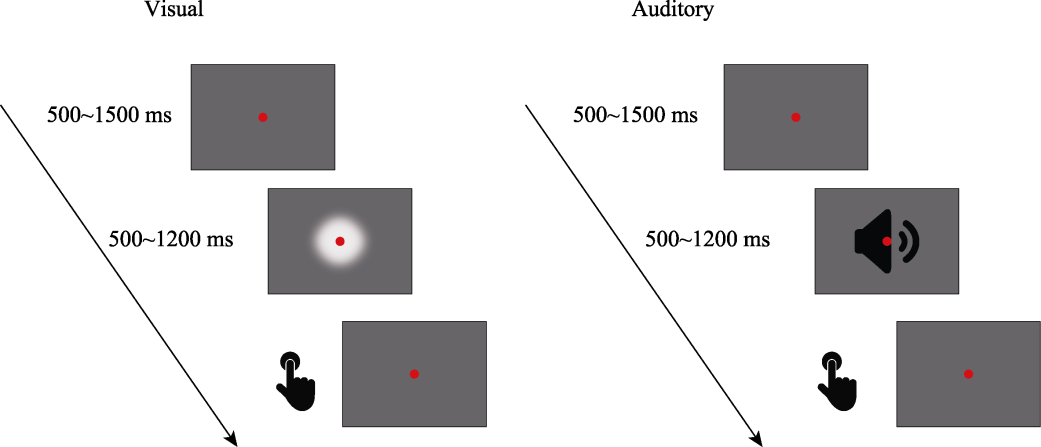
Figure 1. Schematic procedure of Experiment 1. Experiment 1 consisted of visual and auditory duration reproduction tasks. In each trial, a red fixation point was presented for 500-1500 ms, and participants were required to maintain their gaze on it throughout the experiment. Subsequently, a white Gaussian blob (visual task) or white noise (auditory task) stimulus was presented for 500-1200 ms. After the stimulus disappeared, participants reproduced the duration by pressing and holding a key (matching the duration of the right arrow key press to the stimulus duration). See the electronic version for the color figure; the same applies below.
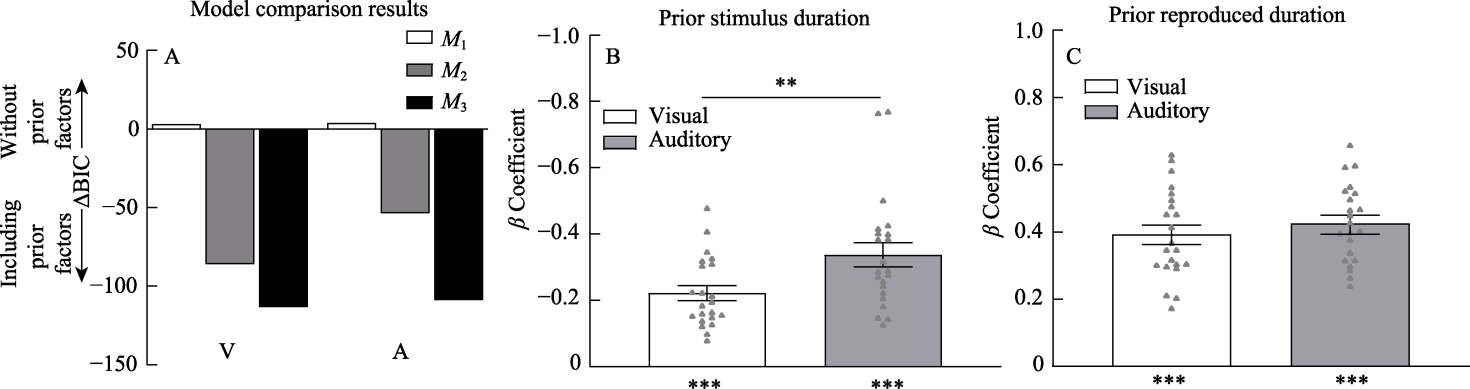
Figure 2. Model analysis results for Experiment 1. (A) Model comparison results under different experimental conditions. The horizontal axis represents different experimental conditions, and the vertical axis represents the BIC difference (ΔBIC) between models incorporating prior factors (white bars for M1, dark gray bars for M2, and black bars for M3) and the baseline model (M0). (B) Magnitude of β coefficients for the prior stimulus duration under different conditions. (C) Magnitude of β coefficients for the prior reproduction duration under different conditions. White open bars represent visual stimuli, and gray solid bars represent auditory stimuli. Gray triangles represent individual data points for each participant under each condition; error bars represent the standard error. **p < 0.01, ***p < 0.001.
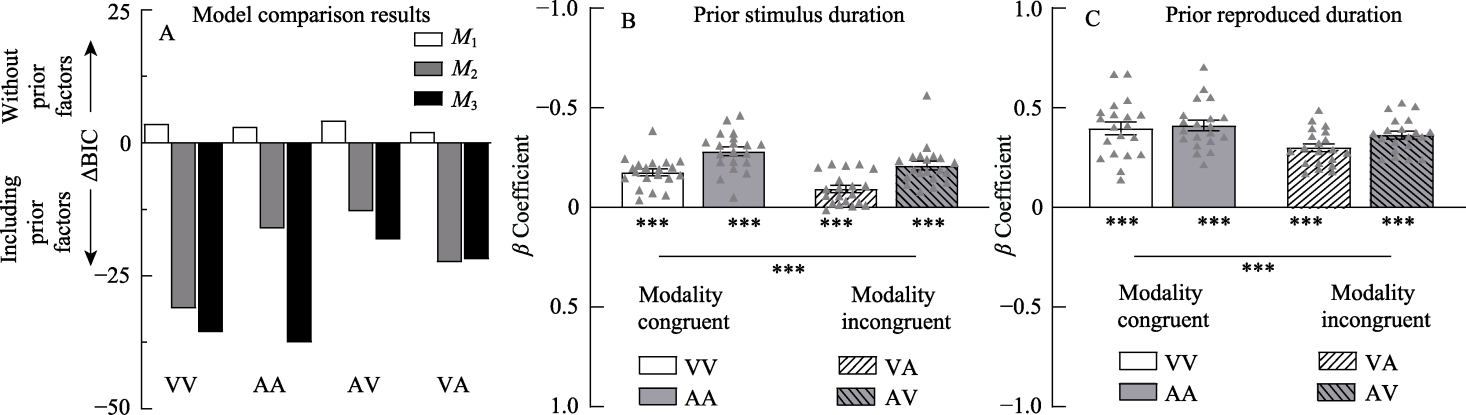
Figure 3. Model analysis results for Experiment 2. (A) Model comparison results under different experimental conditions. The horizontal axis represents different experimental conditions, and the vertical axis represents the BIC difference (ΔBIC) between models incorporating prior factors (white bars for M1, dark gray bars for M2, and black bars for M3) and the baseline model (M0). (B) Magnitude of β coefficients for the prior stimulus duration under different conditions. (C) Magnitude of β coefficients for the prior reproduced duration under different conditions. White open bars (VV) represent that both prior and current stimuli were visual; gray solid bars (AA) represent that both prior and current stimuli were auditory; right-slanted light-striped bars (VA) represent that the prior stimulus was visual and the current stimulus was auditory; left-slanted dark-striped bars (AV) represent that the prior stimulus was auditory and the current stimulus was visual. Gray triangles represent individual data points for each participant under each condition; error bars represent the standard error. ***p < 0.001.

Figure 4. Model analysis results for the duration reproduction task in Experiment 3. (A) Model comparison results under different experimental conditions. The horizontal axis represents different experimental conditions, and the vertical axis represents the BIC difference (ΔBIC) between models incorporating prior factors (white bars for M1, dark gray bars for M2, and black bars for M3) and the baseline model (M0). (B) Magnitude of β coefficients for the prior stimulus duration under different conditions. (C) Magnitude of β coefficients for the prior reproduced duration under different conditions. White open bars (VV) represent that both prior and current stimuli were visual; gray solid bars (AA) represent that both prior and current stimuli were auditory; right-slanted light-striped bars (VA) represent that the prior stimulus was visual and the current stimulus was auditory; left-slanted dark-striped bars (AV) represent that the prior stimulus was auditory and the current stimulus was visual. Gray triangles represent individual data points for each participant under each condition; error bars represent the standard error. ***p < 0.001.

Figure 5. Model analysis results for the duration bisection task in Experiment 3. (A) Model comparison results under different experimental conditions. The horizontal axis represents different experimental conditions, and the vertical axis represents the BIC difference (ΔBIC) between models incorporating prior factors (white bars for M1, dark gray bars for M2, and black bars for M3) and the baseline model (M0). (B) Magnitude of β coefficients for the prior stimulus duration under different conditions. (C) Magnitude of β coefficients for the prior decision response under different conditions. White open bars (VV) represent that both prior and current stimuli were visual; gray solid bars (AA) represent that both prior and current stimuli were auditory; right-slanted light-striped bars (VA) represent that the prior stimulus was visual and the current stimulus was auditory; left-slanted dark-striped bars (AV) represent that the prior stimulus was auditory and the current stimulus was visual. Gray triangles represent individual data points for each participant under each condition; error bars represent the standard error. ***p < 0.001.
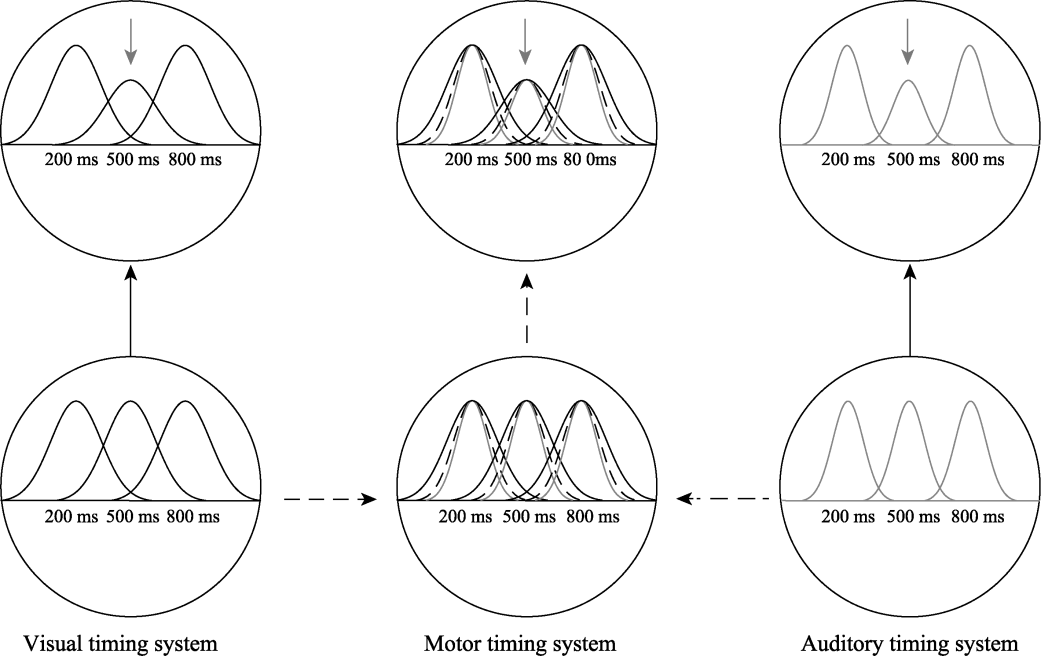
Figure 6. Proposed underlying mechanism of how the reproduction task facilitates cross-modal stimulus serial dependence. The bottom row represents the normal response of duration channels, while the top row represents the response after adaptation to a specific duration (e.g., 500 ms). Black (Gaussian) solid lines represent tuning curves in the visual modality; gray (Gaussian) solid lines represent tuning curves in the auditory modality; black (Gaussian) dashed lines represent unified tuning curves after visual and auditory durations are integrated into the motor timing system. Black solid arrows indicate duration processing pathways in the duration bisection task; black dashed arrows indicate duration processing pathways in the duration reproduction task. In the duration bisection task, the visual and auditory timing systems independently represent visual and auditory stimulus durations, resulting in the modality specificity of the stimulus serial dependence effect. In contrast, in the duration reproduction task, the motor timing system can represent both visual and auditory duration information, thereby facilitating the cross-modal stimulus serial dependence effect.

Figure S1. Magnitude of β coefficients (β0and βcurrS) based on baseline bias and current stimulus duration under different stimulus conditions (A and B represent results of Experiment 1; C and D represent results of Experiment 2; E and F represent reproduction task results of Experiment 3; G and H represent bisection task results of Experiment 3). In Experiment 1, white open bars represent the visual condition, and gray solid bars represent the auditory condition. In Experiments 2 and 3, white open bars (VV) represent that both prior and current stimuli were visual; gray solid bars (AA) represent that both prior and current stimuli were auditory; right-slanted light-striped bars (VA) represent that the prior stimulus was visual and the current stimulus was auditory; and left-slanted dark-striped bars (AV) represent that the prior stimulus was auditory and the current stimulus was visual. Gray triangles represent individual data points for each participant under each condition; error bars represent the standard error. *p < 0.05, ***p < 0.001.

Figure S2. Joint duration reproduction plots under different sensory modalities in Experiment 1. (A) Two-dimensional reproduced duration plots for the visual (top) and auditory (bottom) modalities. The horizontal axis represents seven prior reproduced duration intervals, and the vertical axis represents prior stimulus durations. The dependent variable is the participants' current reproduced duration under each condition, where white represents shorter and black represents longer durations. (B) Trends of the participants' current reproduced duration as a function of prior stimulus duration under fixed prior reproduced duration conditions. (C) Trends of the participants' current reproduced duration as a function of prior reproduced duration under fixed prior stimulus duration conditions. The data in Figures B and C are derived from the three prior reproduced duration intervals with the highest trial counts in Figure A (indicated by red boxes). The stimulus and reproduced durations in the figures are log-transformed values, and error bars represent the standard error.

Figure S3. Joint duration reproduction plots under different conditions in Experiment 2. (A) Two-dimensional reproduced duration plots under four conditions (VV: both prior and current stimuli were visual; AA: both prior and current stimuli were auditory; AV: the prior stimulus was auditory and the current stimulus was visual; VA: the prior stimulus was visual and the current stimulus was auditory). The horizontal axis represents seven prior reproduced duration intervals, and the vertical axis represents prior stimulus durations. The dependent variable is the participants' current trial reproduced duration under each condition, where white represents shorter and black represents longer durations. (B) Trends of the participants' current reproduced duration as a function of prior stimulus duration (top) and prior reproduced duration (bottom) under fixed prior reproduced duration (top) and prior stimulus duration (bottom) conditions, respectively. The data are derived from the three prior reproduced duration intervals with the highest trial counts in Figure A (indicated by red boxes). The stimulus and reproduced durations in the figures are log-transformed values, and error bars represent the standard error.

Figure S4. Joint duration reproduction plots under different conditions in the reproduction task of Experiment 3. (A) Two-dimensional reproduced duration plots under four conditions (VV: both prior and current stimuli were visual; AA: both prior and current stimuli were auditory; AV: the prior stimulus was auditory and the current stimulus was visual; VA: the prior stimulus was visual and the current stimulus was auditory). The horizontal axis represents seven prior reproduced duration intervals, and the vertical axis represents prior stimulus durations. The dependent variable is the current trial reproduced duration under each condition, with white representing shorter and black representing longer durations. (B) Curves showing the current reproduced duration as a function of prior stimulus duration (top) and prior reproduced duration (bottom) under fixed prior reproduced duration (top) and prior stimulus duration (bottom) conditions. The data are derived from the three prior reproduced duration intervals with the highest trial counts in Figure A (indicated by red boxes). The stimulus and reproduced durations in the figures are log-transformed values, and error bars represent the standard error.

Figure S5. Joint duration decision plots under different conditions in the bisection task of Experiment 3. (A) Two-dimensional joint decision plots under four conditions (VV: both prior and current stimuli were visual; AA: both prior and current stimuli were auditory; AV: the prior stimulus was auditory and the current stimulus was visual; VA: the prior stimulus was visual and the current stimulus was auditory). The horizontal axis represents the decision response of the prior trial, including “longer” and “shorter”; the vertical axis represents the prior stimulus duration. The dependent variable is the proportion of “longer” judgments in the current trial under each condition, with white representing lower proportions and black representing higher proportions. (B) Curves showing the proportion of “longer” judgments in the current trial as a function of prior stimulus duration (top) and prior decision response (bottom) under fixed prior decision response (top) and prior stimulus duration (bottom) conditions. Data were derived from all columns in Figure A without null values. Stimulus durations in the figure are log-transformed values, and error bars represent the standard error.
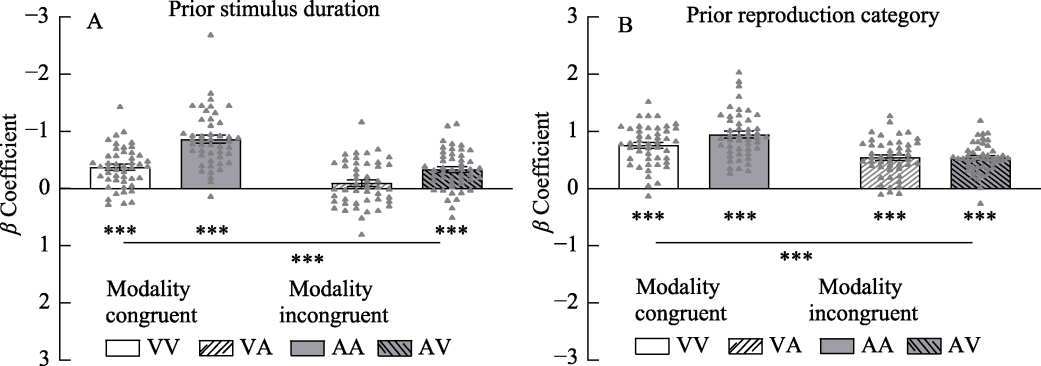
Figure S6. Results of the analysis converting reproduced variables into binary variables. We used the median of each participant's overall reproduced duration as the reference duration, classifying trials with reproduced durations below this value as “shorter” and those above as “longer.” Data from the reproduction tasks of Experiments 2 and 3 were pooled, and the transformed data were subjected to the same model analysis as that used for the bisection task. (A) Magnitude of β coefficients for the prior stimulus duration under different conditions. (B) Magnitude of β coefficients for the prior reproduction category under different conditions. White open bars (VV) represent that both prior and current stimuli were visual; gray solid bars (AA) represent that both prior and current stimuli were auditory; right-slanted light-striped bars (VA) represent that the prior stimulus was visual and the current stimulus was auditory; and left-slanted dark-striped bars (AV) represent that the prior stimulus was auditory and the current stimulus was visual. Gray triangles represent individual data points for each participant under each condition; error bars represent the standard error. ***p < 0.001.
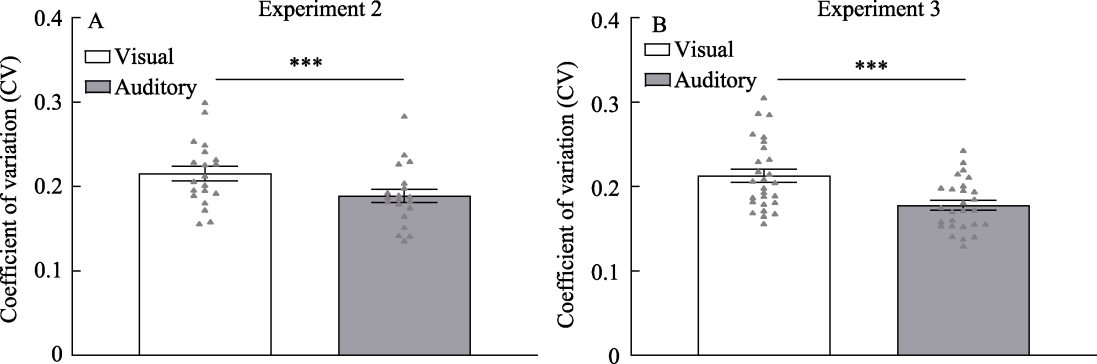
Figure S7. Results of the variability analysis of reproduced durations. (A) Magnitude of the coefficients of variation for reproduced durations in the visual and auditory modalities of Experiment 2. (B) Magnitude of the coefficients of variation for reproduced durations in the visual and auditory modalities of Experiment 3. For each experiment, we first calculated the coefficient of variation for each stimulus duration (500 ms, 622 ms, 775 ms, 964 ms, and 1200 ms) under both visual and auditory conditions, and subsequently averaged the five CVs for the visual and auditory modalities, respectively. Paired-samples t-tests were then used to examine the differences in the coefficients of variation between the visual and auditory modalities. The results showed that participants' perceptual uncertainty and internal noise were higher for visual durations. Therefore, in perceptual integration, the reliability of visual duration information was lower than that of auditory duration information, which was manifested by the fact that the response serial dependence effect in the AV condition was significantly higher than that in the VA condition. In the figure, white open bars represent the visual condition, and gray solid bars represent the auditory condition. Gray triangles represent individual data points for each participant under each condition; error bars represent the standard error. ***p < 0.001.
| [1] |
Akaishi, R., Umeda, K., Nagase, A., & Sakai, K. (2014). Autonomous mechanism of internal choice estimate underlies decision inertia. Neuron, 81(1), 195-206.
doi: 10.1016/j.neuron.2013.10.018 pmid: 24333055 |
| [2] |
Bausenhart, K. M., Dyjas, O., & Ulrich, R. (2014). Temporal reproductions are influenced by an internal reference: Explaining the Vierordt effect. Acta Psychologica, 147, 60-67.
doi: 10.1016/j.actpsy.2013.06.011 pmid: 23896562 |
| [3] | Bosch, E., Fritsche, M., Ehinger, B. V., & de Lange, F. P. (2020). Opposite effects of choice history and evidence history resolve a paradox of sequential choice bias. Journal of Vision, 20(12), 9. |
| [4] |
Brainard, D. H. (1997). The psychophysics toolbox. Spatial Vision, 10(4), 433-436.
pmid: 9176952 |
| [5] |
Brimijoin, W. O., & O’Neill, W. E. (2010). Patterned tone sequences reveal non-linear interactions in auditory spectrotemporal receptive fields in the inferior colliculus. Hearing Research, 267(1-2), 96-110.
doi: 10.1016/j.heares.2010.04.005 pmid: 20430078 |
| [6] |
Bueti, D., Walsh, V., Frith, C., & Rees, G. (2008). Different brain circuits underlie motor and perceptual representations of temporal intervals. Journal of Cognitive Neuroscience, 20(2), 204-214.
doi: 10.1162/jocn.2008.20017 pmid: 18275329 |
| [7] | Burnham, K. P., & Anderson, D. R. (2004). Multimodel inference: Understanding AIC and BIC in model selection. Sociological Methods & Research, 33(2), 261-304. |
| [8] |
Burr, D., Banks, M. S., & Morrone, M. C. (2009). Auditory dominance over vision in the perception of interval duration. Experimental Brain Research, 198(1), 49-57.
doi: 10.1007/s00221-009-1933-z pmid: 19597804 |
| [9] | Burr, D., & Cicchini, G. M. (2014). Vision: Efficient adaptive coding. Current Biology, 24(22), R1096-R1098. |
| [10] |
Chen, K.-M., & Yeh, S.-L. (2009). Asymmetric cross-modal effects in time perception. Acta Psychologica, 130(3), 225-234.
doi: 10.1016/j.actpsy.2008.12.008 URL |
| [11] |
Chen, S., Wang, T., & Bao, Y. (2023). Serial dependence in timing at the perceptual level being modulated by working memory. PsyCh Journal, 12(6), 774-786.
doi: 10.1002/pchj.653 pmid: 37528541 |
| [12] | Cheng, S., Chen, S., Glasauer, S., Keeser, D., & Shi, Z. (2024). Neural mechanisms of sequential dependence in time perception: The impact of prior task and memory processing. Cerebral Cortex, 34(1), bhad453. |
| [13] |
Cheng, S., Chen, S., & Shi, Z. (2024). Opposing sequential biases in direction and time reproduction: Influences of task relevance and working memory. British Journal of Psychology, 115(4), 825-842.
doi: 10.1111/bjop.12728 pmid: 39133516 |
| [14] |
Cheng, S., Chen, S., Yang, X., & Shi, Z. (2024). The impact of task measurements on sequential dependence: A comparison between temporal reproduction and discrimination tasks. Psychological Research, 88(8), 2346-2359.
doi: 10.1007/s00426-024-02023-x pmid: 39190157 |
| [15] |
Cicchini, G. M., Benedetto, A., & Burr, D. C. (2021). Perceptual history propagates down to early levels of sensory analysis. Current Biology, 31(6), 1245-1250.e2.
doi: 10.1016/j.cub.2020.12.004 URL |
| [16] | Cicchini, G. M., Mikellidou, K., & Burr, D. (2017). Serial dependencies act directly on perception. Journal of Vision, 17(14), 6. |
| [17] | Cicchini, G. M., Mikellidou, K., & Burr, D. C. (2018). The functional role of serial dependence. Proceedings of the Royal Society B: Biological Sciences, 285(1890), 20181722. |
| [18] |
Dyjas, O., Bausenhart, K. M., & Ulrich, R. (2012). Trial-by-trial updating of an internal reference in discrimination tasks: Evidence from effects of stimulus order and trial sequence. Attention, Perception, & Psychophysics, 74(8), 1819-1841.
doi: 10.3758/s13414-012-0362-4 URL |
| [19] |
Ernst, M. O., & Banks, M. S. (2002). Humans integrate visual and haptic information in a statistically optimal fashion. Nature, 415(6870), 429-433.
doi: 10.1038/415429a |
| [20] |
Faul, F., Erdfelder, E., Lang, A.-G., & Buchner, A. (2007). G*Power 3: A flexible statistical power analysis program for the social, behavioral, and biomedical sciences. Behavior Research Methods, 39(2), 175-191.
doi: 10.3758/bf03193146 pmid: 17695343 |
| [21] | Feigin, H., Shalom-Sperber, S., Zachor, D. A., & Zaidel, A. (2021). Increased influence of prior choices on perceptual decisions in autism. eLife, 10, e61595. |
| [22] |
Fetsch, C. R., Pouget, A., DeAngelis, G. C., & Angelaki, D. E. (2012). Neural correlates of reliability-based cue weighting during multisensory integration. Nature Neuroscience, 15(1), 146-154.
doi: 10.1038/nn.2983 |
| [23] |
Fischer, J., & Whitney, D. (2014). Serial dependence in visual perception. Nature Neuroscience, 17(5), 738-743.
doi: 10.1038/nn.3689 pmid: 24686785 |
| [24] |
Fornaciai, M., & Park, J. (2019). Serial dependence generalizes across different stimulus formats, but not different sensory modalities. Vision Research, 160, 108-115.
doi: S0042-6989(19)30104-X pmid: 31078663 |
| [25] |
Fritsche, M., Mostert, P., & de Lange, F. P. (2017). Opposite effects of recent history on perception and decision. Current Biology, 27(4), 590-595.
doi: S0960-9822(17)30006-4 pmid: 28162897 |
| [26] | Fulvio, J. M., Green, C. S., & Schrater, P. R. (2014). Task-specific response strategy selection on the basis of recent training experience. PLOS Computational Biology, 10(1), e1003425. |
| [27] |
Goldstone, S., & Lhamon, W. T. (1974). Studies of auditory-visual differences in human time judgment: 1. Sounds are judged longer than lights. Perceptual and Motor Skills, 39(1), 63-82.
pmid: 4415924 |
| [28] | Green, C. S., Kattner, F., Siegel, M. H., Kersten, D., & Schrater, P. R. (2015). Differences in perceptual learning transfer as a function of training task. Journal of Vision, 15(10), 5. |
| [29] |
Heron, J., Aaen-Stockdale, C., Hotchkiss, J., Roach, N. W., McGraw, P. V., & Whitaker, D. (2012). Duration channels mediate human time perception. Proceedings of the Royal Society B: Biological Sciences, 279(1729), 690-698.
doi: 10.1098/rspb.2011.1131 URL |
| [30] | Huang, X. T., Guo, X. Y., & Nie, J. (2003). The relationship between temporal and non-temporal information in cognitive processing. Journal of Psychological Science, 26(5), 770-774. |
| [31] | Huang, X. T., Li, B. Y., & Zhang, Z. J. (2003). The research of the range-synthetic model of temporal cognition. Journal of Southwest China Normal University (Humanities and Social Sciences Edition), 29(2), 5-9. |
| [32] | Kattner, F., Cox, C. R., & Green, C. S. (2016). Transfer in rule-based category learning depends on the training task. PLOS ONE, 11(10), e0165260. |
| [33] |
Klink, P. C., Montijn, J. S., & van Wezel, R. J. (2011). Crossmodal duration perception involves perceptual grouping, temporal ventriloquism, and variable internal clock rates. Attention, Perception, & Psychophysics, 73(1), 219-236.
doi: 10.3758/s13414-010-0010-9 URL |
| [34] |
Lewis, P. A., & Miall, R. C. (2003). Distinct systems for automatic and cognitively controlled time measurement: Evidence from neuroimaging. Current Opinion in Neurobiology, 13(2), 250-255.
doi: 10.1016/s0959-4388(03)00036-9 pmid: 12744981 |
| [35] |
Leys, C., Ley, C., Klein, O., Bernard, P., & Licata, L. (2013). Detecting outliers: Do not use standard deviation around the mean, use absolute deviation around the median. Journal of Experimental Social Psychology, 49(4), 764-766.
doi: 10.1016/j.jesp.2013.03.013 URL |
| [36] |
Li, B., Chen, L., & Fang, F. (2019). Somatotopic representation of tactile duration: Evidence from tactile duration aftereffect. Behavioural Brain Research, 371, 111954.
doi: 10.1016/j.bbr.2019.111954 URL |
| [37] | Li, B., Wang, B., & Zaidel, A. (2023). Modality-specific sensory and decisional carryover effects in duration perception. BMC Biology, 21(1), 48. |
| [38] |
Li, B., Xiao, L., Yin, H., Liu, P., & Huang, X. (2017). Duration aftereffect depends on the duration of adaptation. Frontiers in Psychology, 8, 491.
doi: 10.3389/fpsyg.2017.00491 pmid: 28424646 |
| [39] |
Li, B., Yuan, X., Chen, Y., Liu, P., & Huang, X. (2015). Visual duration aftereffect is position invariant. Frontiers in Psychology, 6, 1536.
doi: 10.3389/fpsyg.2015.01536 pmid: 26500591 |
| [40] |
Li, B., Yuan, X., & Huang, X. (2015). The aftereffect of perceived duration is contingent on auditory frequency but not visual orientation. Scientific Reports, 5, 10124.
doi: 10.1038/srep10124 pmid: 26054927 |
| [41] | Li, B. L., Zhai, X. F., Wang, B. Y., & Wang, K. (2025). Spatial and ear generalizations of serial dependence in auditory duration perception. Journal of Psychological Science, 48(1), 11-20. |
| [42] | Luo, M., Zhang, H., Fang, F., & Luo, H. (2025). Reactivation of previous decisions repulsively biases sensory encoding but attractively biases decision-making. PLOS Biology, 23(4), e3003150. |
| [43] |
Manassi, M., Liberman, A., Kosovicheva, A., Zhang, K., & Whitney, D. (2018). Serial dependence in position occurs at the time of perception. Psychonomic Bulletin & Review, 25(6), 2245-2253.
doi: 10.3758/s13423-018-1454-5 |
| [44] |
Matthews, W. J., & Meck, W. H. (2016). Temporal cognition: Connecting subjective time to perception, attention, and memory. Psychological Bulletin, 142(8), 865-907.
doi: 10.1037/bul0000045 pmid: 27196725 |
| [45] |
Merchant, H., Harrington, D. L., & Meck, W. H. (2013). Neural basis of the perception and estimation of time. Annual Review of Neuroscience, 36, 313-336.
doi: 10.1146/annurev-neuro-062012-170349 pmid: 23725000 |
| [46] |
Merchant, H., Pérez, O., Zarco, W., & Gámez, J. (2013). Interval tuning in the primate medial premotor cortex as a general timing mechanism. Journal of Neuroscience, 33(21), 9082-9096.
doi: 10.1523/JNEUROSCI.5513-12.2013 pmid: 23699519 |
| [47] | Moon, J., & Kwon, O.-S. (2022). Attractive and repulsive effects of sensory history concurrently shape visual perception. BMC Biology, 20(1), 247. |
| [48] |
Murai, Y., & Whitney, D. (2021). Serial dependence revealed in history-dependent perceptual templates. Current Biology, 31(14), 3185-3191.e3.
doi: 10.1016/j.cub.2021.05.006 URL |
| [49] |
O'Regan, J. K., & Noë, A. (2001). A sensorimotor account of vision and visual consciousness. Behavioral and Brain Sciences, 24(5), 939-973.
pmid: 12239892 |
| [50] | Pascucci, D., Mancuso, G., Santandrea, E., Della Libera, C., Plomp, G., & Chelazzi, L. (2019). Laws of concatenated perception: Vision goes for novelty, decisions for perseverance. PLOS Biology, 17(3), e3000144. |
| [51] | Pascucci, D., Tanrikulu, Ö. D., Ozkirli, A., Houborg, C., Ceylan, G., Zerr, P.,... Kristjánsson, Á. (2023). Serial dependence in visual perception: A review. Journal of Vision, 23(1), 9. |
| [52] |
Pelli, D. G. (1997). The VideoToolbox software for visual psychophysics: Transforming numbers into movies. Spatial Vision, 10(4), 437-442.
pmid: 9176953 |
| [53] |
Penney, T. B., Gibbon, J., & Meck, W. H. (2000). Differential effects of auditory and visual signals on clock speed and temporal memory. Journal of Experimental Psychology: Human Perception and Performance, 26(6), 1770-1787.
doi: 10.1037/0096-1523.26.6.1770 URL |
| [54] | Prinz,, W. (1990). A common coding approach to perception and action. In O. Neumann & W. Prinz (Eds.), Relationships between perception and action: Current approaches (pp. 167-201). Springer, Berlin, Heidelberg. |
| [55] | Protopapa, F., Hayashi, M. J., Kulashekhar, S., Van Der Zwaag, W., Battistella, G., Murray, M. M.,... Bueti, D. (2019). Chronotopic maps in human supplementary motor area. PLOS Biology, 17(3), e3000026. |
| [56] |
Roach, N. W., McGraw, P. V., Whitaker, D. J., & Heron, J. (2017). Generalization of prior information for rapid Bayesian time estimation. Proceedings of the National Academy of Sciences, 114(2), 412-417.
doi: 10.1073/pnas.1610706114 URL |
| [57] |
Sadil, P., Cowell, R. A., & Huber, D. E. (2024). The push-pull of serial dependence effects: Attraction to the prior response and repulsion from the prior stimulus. Psychonomic Bulletin & Review, 31(1), 259-273.
doi: 10.3758/s13423-023-02320-3 |
| [58] | Schneider, K. A., & Komlos, M. (2008). Attention biases decisions but does not alter appearance. Journal of Vision, 8(15), 3. |
| [59] |
Schubotz, R. I., Friederici, A. D., & von Cramon, D. Y. (2000). Time perception and motor timing: A common cortical and subcortical basis revealed by fMRI. NeuroImage, 11(1), 1-12.
pmid: 10686112 |
| [60] | Sheehan, T. C., & Serences, J. T. (2022). Attractive serial dependence overcomes repulsive neuronal adaptation. PLOS Biology, 20(9), e3001711. |
| [61] | Urai, A. E., de Gee, J. W., Tsetsos, K., & Donner, T. H. (2019). Choice history biases subsequent evidence accumulation. eLife, 8, e46331. |
| [62] | Van der Burg, E., Toet, A., Brouwer, A.-M., & Van Erp, J. B. F. (2021). Serial dependence of emotion within and between stimulus sensory modalities. Multisensory Research, 1-12. |
| [63] |
Walker, J. T., & Scott, K. J. (1981). Auditory-visual conflicts in the perceived duration of lights, tones, and gaps. Journal of Experimental Psychology: Human Perception and Performance, 7(6), 1327-1339.
doi: 10.1037/0096-1523.7.6.1327 URL |
| [64] |
Wang, B. Y., Chen, C., Hu, X. F., Wang, D., & Li, B. L. (2024). Spatial generalization of serial dependence in visual duration perception. Acta Psychologica Sinica, 56(4), 394-411.
doi: 10.3724/SP.J.1041.2024.00394 |
| [65] | Wearden, J. H., Edwards, H., Fakhri, M., & Percival, A. (1998). Why ''sounds are judged longer than lights'': Application of a model of the internal clock in humans. The Quarterly Journal of Experimental Psychology B: Comparative and Physiological Psychology, 51(2), 97-120. |
| [66] |
Wehrman, J. J., Wearden, J. H., & Sowman, P. (2018). Short-term effects on temporal judgement: Sequential drivers of interval bisection and reproduction. Acta Psychologica, 185, 87-95.
doi: S0001-6918(17)30299-8 pmid: 29432991 |
| [67] |
Wehrman, J. J., Wearden, J., & Sowman, P. (2020). Decisional carryover effects in interval timing: Evidence of a generalized response bias. Attention, Perception & Psychophysics, 82(4), 2147-2164.
doi: 10.3758/s13414-019-01922-1 |
| [68] | Wiener, M., Thompson, J. C., & Coslett, H. B. (2014). Continuous carryover of temporal context dissociates response bias from perceptual influence for duration. PLOS ONE, 9(6), e100803. |
| [69] |
Wiener, M., Turkeltaub, P., & Coslett, H. B. (2010). The image of time: A voxel-wise meta-analysis. NeuroImage, 49(2), 1728-1740.
doi: 10.1016/j.neuroimage.2009.09.064 pmid: 19800975 |
| [70] |
Wilson, M. (2002). Six views of embodied cognition. Psychonomic Bulletin & Review, 9(4), 625-636.
doi: 10.3758/BF03196322 URL |
| [71] | Zhang, H., & Luo, H. (2023). Feature-specific reactivations of past information shift current neural encoding thereby mediating serial bias behaviors. PLOS Biology, 21(3), e3002056. |
| [72] |
Zhou, L., Liu, Y., Jiang, Y., Wang, W., Xu, P., & Zhou, K. (2024). The distinct development of stimulus and response serial dependence. Psychonomic Bulletin & Review, 31(5), 2137-2147.
doi: 10.3758/s13423-024-02474-8 |
| [73] | Zimmermann, E., & Cicchini, G. M. (2020). Temporal context affects interval timing at the perceptual level. Scientific Reports, 10(1), 8767. |
| [1] | WANG Da, YANG Zhihao, MEI Gaoxing. Serial dependence for same-category and cross-category stimuli in social attention [J]. Acta Psychologica Sinica, 2026, 58(7): 1312-1324. |
| [2] | ZHANG Wenjie, LONG Ruyi, LI Miaoqing, FAN Wei, FU Xiaolan. The Impact of Emotional Valence and Response Orientation on Helping Behavior in Young Children: Evidence from Behavior and fNIRS [J]. Acta Psychologica Sinica, 2026, 58(6): 1143-1159. |
| [3] | WANG Aijun, HUANG Jie, ZHAO Danna, LI Xin, ZHANG Ming. Stimulus similarity modulated sensory dominance effects in cross-modal conflicts [J]. Acta Psychologica Sinica, 2026, 58(4): 571-589. |
| [4] | TANG Yi, ZHAO Yajun, ZENG Qingzhang, ZHANG Zhijun, WU Shengnan. Cross-modal transfer of statistical learning under unimodal and multimodal learning conditions [J]. Acta Psychologica Sinica, 2026, 58(4): 590-602. |
| [5] | XU Honghui, XU Yiran, YANG Guochun, NAN Weizhi, LIU Xun. Behavioral Theta Oscillations in Cross-modal Stimulus Conflict and Response Conflict Processing [J]. Acta Psychologica Sinica, 2026, 58(3): 467-479. |
| [6] | ZHOU Heng, WANG Ai-Jun, YUAN Xiang-Yong, JIANG Yi. Object category differences regulate the sensory dominance of the response level in an audiovisual cross-modal conflict [J]. Acta Psychologica Sinica, 2025, 57(6): 1001-1012. |
| [7] | LI Bin, RUI Jianxi, YU Weinan, LI Aimei, YE Maolin. When design meets AI: The impact of AI design products on consumers’ response patterns [J]. Acta Psychologica Sinica, 2025, 57(11): 1914-1932. |
| [8] | YANG Zijian, ZHAO Xiaolin, GUO Kaige, LUO Jiahao, DU Tengfei, ZHANG Yajie, HU Yueqin, YANG Juan. Variability in cortisol awakening response related to sleep efficiency and its relationship with trait anxiety and psychological resilience [J]. Acta Psychologica Sinica, 2025, 57(1): 84-99. |
| [9] | WANG Biyao, CHEN Chen, HU Xiaofei, WANG Di, LI Baolin. Spatial generalization of serial dependence in visual duration perception [J]. Acta Psychologica Sinica, 2024, 56(4): 394-411. |
| [10] | GUO Xiaojun, BAI Xiaoyun, LUO Zhaosheng. Modeling the dependence between response and response time: A bifactor model approach [J]. Acta Psychologica Sinica, 2024, 56(3): 352-362. |
| [11] | WANG Chengcheng, ZHAO Yufei, SHENG Yingying, ZHAO Qingbai, XIAO Mengshi, HAN Lei. Occurrence stage of SNARC effect [J]. Acta Psychologica Sinica, 2024, 56(12): 1706-1717. |
| [12] | ZU Guangyao, LI Shuqi, ZHANG Tianyang, WANG Aijun, ZHANG Ming. Effect of inhibition of return on audiovisual cross-modal correspondence [J]. Acta Psychologica Sinica, 2023, 55(8): 1220-1233. |
| [13] | FU Yanbin, CHEN Qipeng, ZHAN Peida. Binary modeling of action sequences in problem-solving tasks: One- and two-parameter action sequence model [J]. Acta Psychologica Sinica, 2023, 55(8): 1383-1396. |
| [14] | YUAN Bo, WANG Xiaoping, YIN Jun, LI Weiqiang. The role of cross-situational stimulus generalization in the formation of trust towards face: A perspective based on direct and observational learning [J]. Acta Psychologica Sinica, 2023, 55(7): 1099-1114. |
| [15] | JIA Chenglong, WU Ting, SUN Li, QIN Jinliang. The effects of attachment figure’s response pattern on the support-giving expectation revision of young children with different attachment styles [J]. Acta Psychologica Sinica, 2023, 55(3): 455-468. |
| Viewed | ||||||
|
Full text |
|
|||||
|
Abstract |
|
|||||
