

ISSN 0439-755X
CN 11-1911/B
CN 11-1911/B
Acta Psychologica Sinica ›› 2026, Vol. 58 ›› Issue (5): 840-852.doi: 10.3724/SP.J.1041.2026.0840
• Reports of Empirical Studies • Previous Articles Next Articles
LI Sijin1,2, TANG Yuyao1, LI Qi1, WANG Tingdong1, ZHANG Dandan1( )
)
Published:2026-05-25
Online:2026-03-05
Contact:
ZHANG Dandan, E-mail: Supported by:LI Sijin, TANG Yuyao, LI Qi, WANG Tingdong, ZHANG Dandan. (2026). Make your emotions heard: How emotion sharing boosts interpersonal emotion regulation across various interpersonal distances. Acta Psychologica Sinica, 58(5), 840-852.
Add to citation manager EndNote|Ris|BibTeX
URL: https://journal.psych.ac.cn/acps/EN/10.3724/SP.J.1041.2026.0840
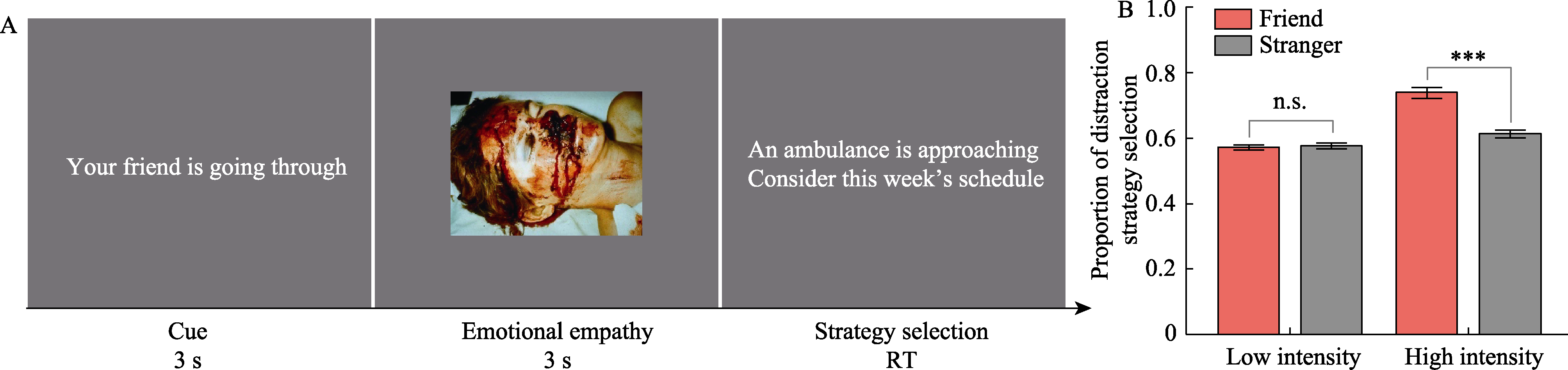
Figure 1. Procedure and main results of Experiment 1. (A) Schematic diagram of a single trial. During the experiment, participants were asked to imagine either a friend or a stranger viewing negative emotional images. After image presentation, participants selected one of two emotion regulation strategies—cognitive reappraisal (e.g., An ambulance is approaching) or distraction (e.g., Consider this week's schedule)—with no time limit, to help the imagined individual improve their emotional experience. RT = reaction time. (B) Proportion of distraction strategy selection. Higher scores indicate a greater tendency to select distraction strategies for regulating negative emotions in friends or strangers. Error bars represent standard errors. *** p < 0.001; n.s., not significant.

Figure 2. Procedure for a single trial in Experiment 2. Taking the “emotion sharing” condition as an example, during the emotion identification phase, participants were shown the target's negative emotion intensity rating after viewing the image (actually a pre-programmed value). Subsequently, participants selected a strategy and verbalized a specific regulation plan. After approximately every five trials, participants reported the difficulty of strategy output on a 9-point rating scale, with 1 indicating “very easy” and 9 indicating “very difficult”.
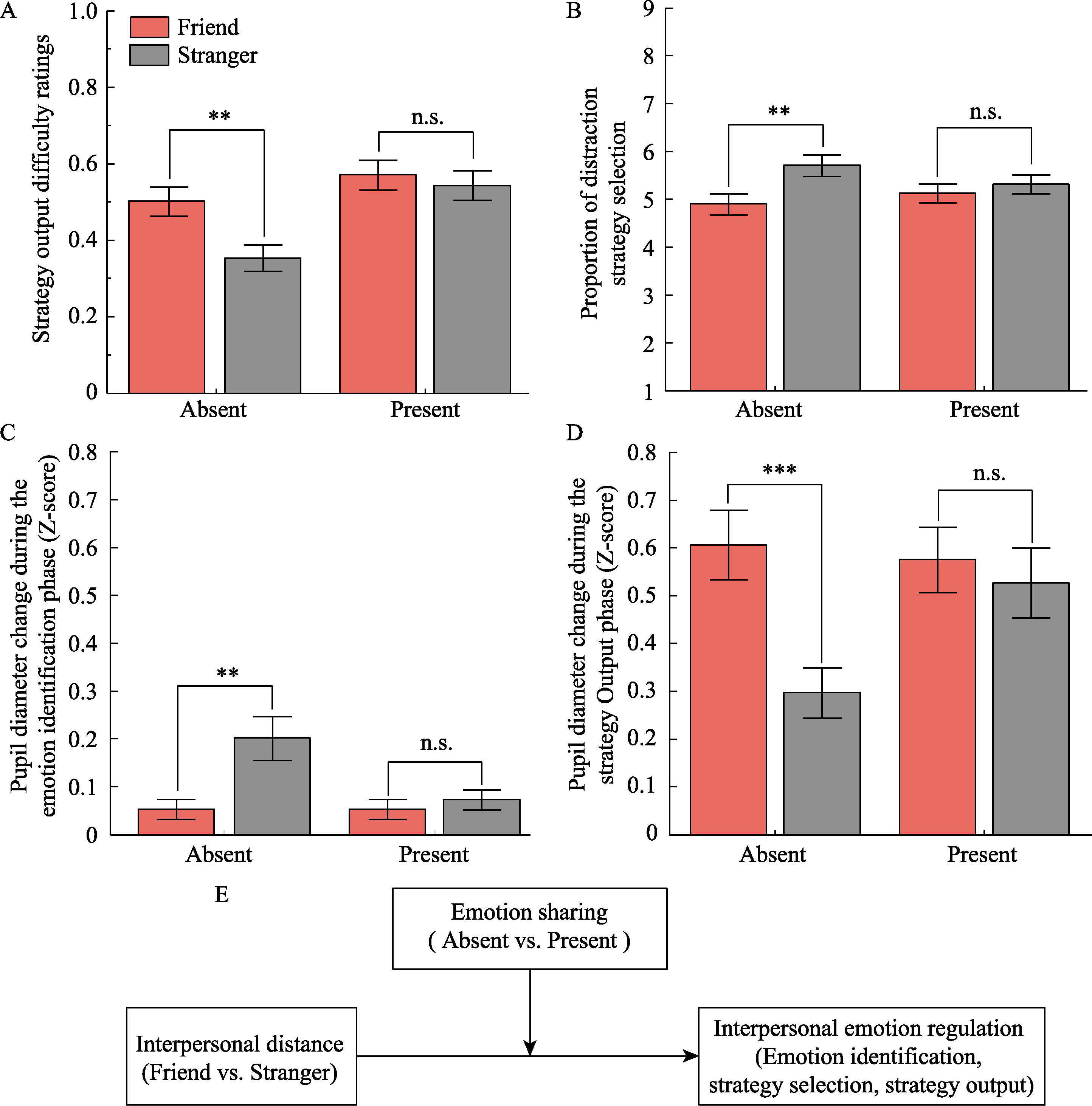
Figure 3. Subjective ratings and pupil diameter results. (A) Proportion of distraction strategy selection. Higher scores indicate a greater tendency for participants to select distraction strategies to regulate negative emotions in friends/strangers. (B) Strategy output difficulty ratings. Higher scores indicate greater difficulty. (C) Pupil diameter change during the emotion identification phase. (D) Pupil diameter change during the strategy output phase. (E) The moderating effect of emotion sharing on the relationship between interpersonal distance and interpersonal emotion regulation. Interpersonal distance (0 = friend, 1 = stranger) and emotion sharing (0 = absent, 1 = present) are categorical variables, while all indicators of interpersonal emotion regulation are continuous variables. ** p < 0.01, *** p < 0.001; n.s. denotes no significant difference.
| [1] |
Aron, A., Aron, E. N., & Smollan, D. (1992). Inclusion of other in the self scale and the structure of interpersonal closeness. Journal of Personality and Social Psychology, 63, 596-612. https://doi.org/10.1037/0022-3514.63.4.596
doi: 10.1037/0022-3514.63.4.596 URL |
| [2] | Bates, D., Maechler, M., Bolker, B., Walker, S. (2014). lme4: Linear mixed effects models using Eigen and S4. R Package Version 1.0-6. http://CRAN.R-project.org/package=lme4 |
| [3] |
Bo, K., Kraynak, T. E., Kwon, M., Sun, M., Gianaros, P. J., & Wager, T. D. (2024). A systems identification approach using Bayes factors to deconstruct the brain bases of emotion regulation. Nature Neuroscience, 27(5), 975-987. https://doi.org/10.1038/s41593-024-01605-7
doi: 10.1038/s41593-024-01605-7 URL |
| [4] |
Brudner, E. G., Fareri, D. S., Shehata, S. G., & Delgado, M. R. (2023). Social feedback promotes positive social sharing, trust, and closeness. Emotion, 23(6), 1536-1548. https:// doi.org/10.1037/emo0001182
doi: 10.1037/emo0001182 URL |
| [5] |
Cameron, L. D., & Overall, N. C. (2018). Suppression and expression as distinct emotion-regulation processes in daily interactions: Longitudinal and meta-analyses. Emotion, 18(4), 465-480. https://doi.org/10.1037/emo0000334
doi: 10.1037/emo0000334 URL pmid: 28569538 |
| [6] |
Castellotti, S., Castaldi, E., Blini, E., & Arrighi, R. (2025). Pupil size as a biomarker of cognitive (dys)functions: Toward a physiologically informed screening of mental states. Acta Psychologica, 253, 104720. https://doi.org/10.1016/j.actpsy.2025.104720
doi: 10.1016/j.actpsy.2025.104720 URL |
| [7] |
Cheng, Y., Chen, C., Lin, C.-P., Chou, K.-H., & Decety, J. (2010). Love hurts: An fMRI study. NeuroImage, 51(2), 923-929. https:// doi.org/10.1016/j.neuroimage.2010.02.047
doi: 10.1016/j.neuroimage.2010.02.047 URL pmid: 20188182 |
| [8] |
Chervonsky, E., & Hunt, C. (2017). Suppression and expression of emotion in social and interpersonal outcomes: A meta-analysis. Emotion, 17(4), 669-683. https://doi.org/10.1037/emo0000270
doi: 10.1037/emo0000270 URL pmid: 28080085 |
| [9] |
Clark, M. S., & Lemay, E. P. (2024). When emotion expression will (and will not) enhance listening and responsiveness. Current Opinion in Psychology, 55, 101695. https://doi.org/10.1016/j.copsyc.2023.101695
doi: 10.1016/j.copsyc.2023.101695 URL |
| [10] | Dong, W., Yu, W., Xie, H., Zhang, D. (2024). Neurocognitive basis underlying interpersonal emotion regulation. Advances in Psychological Science, 32(1), 131-137. |
| [11] |
Double, K. S., MacCann, C., Kunst, H., & Pinkus, R. T. (2024). Regulating others’ emotions: An exploratory study of everyday extrinsic emotion regulation in university students. Personality and Individual Differences, 226, 112687. https://doi.org/10.1016/j.paid.2024.112687
doi: 10.1016/j.paid.2024.112687 URL |
| [12] |
Gao, K., Wong, A. B., Li, S., Zhang, Y., & Zhang, D. (2024). The ventromedial prefrontal cortex plays an important role in implicit emotion regulation: A focality‐optimized multichannel tDCS study in anxiety individuals. Human Brain Mapping, 45(13), e26812. https://doi.org/10.1002/hbm.26812
doi: 10.1002/hbm.v45.13 URL |
| [13] |
Graham, S. M., Huang, J. Y., Clark, M. S., & Helgeson, V. S. (2008). The positives of negative emotions: Willingness to express negative emotions promotes relationships. Personality and Social Psychology Bulletin, 34(3), 394-406. https://doi.org/10.1177/0146167207311281
doi: 10.1177/0146167207311281 URL pmid: 18272807 |
| [14] |
Grujic, N., Polania, R., & Burdakov, D. (2024). Neurobehavioral meaning of pupil size. Neuron, 112(20), 3381-3395. https://doi.org/10.1016/j.neuron.2024.05.029
doi: 10.1016/j.neuron.2024.05.029 URL |
| [15] |
Guendelman, S., Bayer, M., Prehn, K., & Dziobek, I. (2022). Regulating negative emotions of others reduces own stress: Neurobiological correlates and the role of individual differences in empathy. NeuroImage, 254, 119134. https://doi.org/10.1016/j.neuroimage.2022.119134
doi: 10.1016/j.neuroimage.2022.119134 URL |
| [16] |
He, Z., Ao, X., Muhlert, N., Elliott, R., & Zhang, D. (2022). Neural substrates of expectancy violation associated with social feedback in individuals with subthreshold depression. Psychological Medicine, 52(11), 2043-2051. https://doi.org/10.1017/S0033291720003864
doi: 10.1017/S0033291720003864 URL |
| [17] |
Hershman, R., Henik, A., & Cohen, N. (2018). A novel blink detection method based on pupillometry noise. Behavior Research Methods, 50(1), 107-114. https://doi.org/10.3758/s13428-017-1008-1
doi: 10.3758/s13428-017-1008-1 URL pmid: 29340968 |
| [18] |
Hodges, S. D., & Kezer, M. (2021). It is hard to read minds without words: Cues to use to achieve empathic accuracy. Journal of Intelligence, 9(2), 27. https://doi.org/10.3390/jintelligence9020027
doi: 10.3390/jintelligence9020027 URL |
| [19] |
Hogervorst, M. A., Brouwer, A. M., & van Erp, J. B. (2014). Combining and comparing EEG, peripheral physiology and eye-related measures for the assessment of mental workload. Frontiers in Neuroscience, 8, 322. https://doi.org/10.3389/fnins.2014.00322
doi: 10.3389/fnins.2014.00322 URL pmid: 25352774 |
| [20] |
Hsu, D. T., Sanford, B. J., Meyers, K. K., Love, T. M., Hazlett, K. E., Walker, S. J.,... Zubieta, J. K. (2015). It still hurts: Altered endogenous opioid activity in the brain during social rejection and acceptance in major depressive disorder. Molecular Psychiatry, 20(2), 193-200. https://doi.org/10.1038/mp.2014.185
doi: 10.1038/mp.2014.185 URL pmid: 25600108 |
| [21] |
Kinley, I., & Levy, Y. (2022). PuPl: An open-source tool for processing pupillometry data. Behavior Research Methods, 54(4), 2046-2069. https://doi.org/10.3758/s13428-021-01717-z
doi: 10.3758/s13428-021-01717-z URL |
| [22] | Lang, P. J., Bradley, M. M., & Cuthbert, B. N. (2005). International affective picture system (IAPS): Digitized photographs, instruction manual, and affective ratings (Tech. Rep. No. A-6). Gainesville: University of Florida, Center for Research in Psychophysiology. |
| [23] |
Lange, J., Heerdink, M. W., & van Kleef, G. A. (2022). Reading emotions, reading people: Emotion perception and inferences drawn from perceived emotions. Current Opinion in Psychology, 43, 85-90. https://doi.org/10.1016/j.copsyc.2021.06.008
doi: 10.1016/j.copsyc.2021.06.008 URL |
| [24] |
Li, J., Sun, Y., Li, M., Li, H., Fan, W., & Zhong, Y. (2020). Social distance modulates prosocial behaviors in the gain and loss contexts: An event-related potential (ERP) study. International Journal of Psychophysiology, 150, 83-91. https://doi.org/10.1016/j.ijpsycho.2020.02.003
doi: S0167-8760(20)30033-7 URL pmid: 32035872 |
| [25] |
Li, S., Chen, J., Gao, K., Xu, F., & Zhang, D. (2023). Excitatory brain stimulation over the left dorsolateral prefrontal cortex enhances voluntary distraction in depressed patients. Psychological Medicine, 53(14), 6646-6655. https://doi.org/10.1017/S0033291723000028
doi: 10.1017/S0033291723000028 URL |
| [26] |
Li, S., Cheng, S., Shangguan, C., Su, X., & Li, X. (2023). Forgive or complain: Interpersonal distance modulates reactive attitudes and neural responses toward wrongdoers. Biological Psychology, 183, 108653. https://doi.org/10.1016/j.biopsycho.2023.108653
doi: 10.1016/j.biopsycho.2023.108653 URL |
| [27] |
Li, S., Xie, H., Zheng, Z., Chen, W., Xu, F., Hu, X., & Zhang, D. (2022). The causal role of the bilateral ventrolateral prefrontal cortices on emotion regulation of social feedback. Human Brain Mapping, 43(9), 2898-2910. https://doi.org/10.1002/hbm.25824
doi: 10.1002/hbm.25824 URL pmid: 35261115 |
| [28] | Lin, C., Lin, X., Lian, W., Zhang, W., & Peng, W. (2024). Brains in sync, friends in empathy: Interbrain neural mechanisms underlying the impact of interpersonal closeness on mutual empathy. Proceedings. Biological Sciences, 291(2032), 20241326. https://doi.org/10.1098/rspb.2024.1326 |
| [29] |
Liu, D. Y., Strube, M. J., & Thompson, R. J. (2021). Interpersonal emotion regulation: An experience sampling study. Affective Science, 2(3), 273-288. https://doi.org/10.1007/s42761-021-00044-y
doi: 10.1007/s42761-021-00044-y URL pmid: 36059902 |
| [30] |
Liu, Z., Lu, K., Hao, N., & Wang, Y. (2023). Cognitive reappraisal and expressive suppression evoke distinct neural connections during interpersonal emotion regulation. The Journal of Neuroscience, 43(49), 8456-8471. https:// doi.org/10.1523/JNEUROSCI.0954-23.2023
doi: 10.1523/JNEUROSCI.0954-23.2023 URL |
| [31] |
MacCann, C., Double, K. S., Olderbak, S., Austin, E. J., Pinkus, R. T., Walker, S. A., Kunst, H., & Niven, K. (2025). What do we do to help others feel better? The eight strategies of the regulating others' emotions scale (ROES). Emotion, 25(2), 410-429. https://doi.org/10.1037/emo0001459
doi: 10.1037/emo0001459 URL pmid: 39928487 |
| [32] |
Maister, L., & Tsakiris, M. (2016). Intimate imitation: Automatic motor imitation in romantic relationships. Cognition, 152, 108-113. https://doi.org/10.1016/j.cognition.2016.03.018
doi: S0010-0277(16)30073-7 URL pmid: 27045464 |
| [33] | Ma-Kellams, C., & Blascovich, J. (2012). Inferring the emotions of friends versus strangers: The role of culture and self-construal. Personality & Social Psychology Bulletin, 38(7), 933-945. https://doi.org/10.1177/0146167212440291 |
| [34] | Matthews, M., Webb, T. L., Shafir, R., Snow, M., & Sheppes, G. (2021). Identifying the determinants of emotion regulation choice: A systematic review with meta-analysis. Cognition & Emotion, 35(6), 1056-1084. https://doi.org/10.1080/02699931.2021.1945538 |
| [35] |
Matthews, M., Webb, T. L., & Sheppes, G. (2022). Do people choose the same strategies to regulate other people’s emotions as they choose to regulate their own? Emotion, 22(8), 1723-1738. https:// doi.org/10.1037/emo0001008
doi: 10.1037/emo0001008 URL |
| [36] |
Meyer, M. L., Masten, C. L., Ma, Y., Wang, C., Shi, Z., Eisenberger, N. I., & Han, S. (2013). Empathy for the social suffering of friends and strangers recruits distinct patterns of brain activation. Social Cognitive and Affective Neuroscience, 8(4), 446-454. https://doi.org/10.1093/scan/nss019
doi: 10.1093/scan/nss019 URL pmid: 22355182 |
| [37] |
Morawetz, C., Berboth, S., & Bode, S. (2021). With a little help from my friends: The effect of social proximity on emotion regulation-related brain activity. NeuroImage, 230, 117817. https://doi.org/10.1016/j.neuroimage.2021.117817
doi: 10.1016/j.neuroimage.2021.117817 URL |
| [38] |
Overall, N. C., Clark, M. S., Fletcher, G. J. O., Peters, B. J., & Chang, V. T. (2020). Does expressing emotions enhance perceptual accuracy of negative emotions during relationship interactions? Emotion, 20(3), 353-367. https://doi.org/10.1037/emo0000653
doi: 10.1037/emo0000653 URL pmid: 31368745 |
| [39] |
Pauw, L. S., Sauter, D. A., Van Kleef, G. A., & Fischer, A. H. (2019). Stop crying! The impact of situational demands on interpersonal emotion regulation. Cognition and Emotion, 33(8), 1587-1598. https://doi.org/10.1080/02699931.2019.1585330
doi: 10.1080/02699931.2019.1585330 URL |
| [40] |
Preston, S. D., & de Waal, F. B. M. (2002). Empathy: Its ultimate and proximate bases. The Behavioral and Brain Sciences, 25(1), 1-20. https://doi.org/10.1017/s0140525x02000018
doi: 10.1017/S0140525X02000018 URL |
| [41] |
Reeck, C., Ames, D. R., & Ochsner, K. N. (2016). The social regulation of emotion: An integrative, cross-disciplinary model. Trends in Cognitive Sciences, 20(1), 47-63. https://doi.org/10.1016/j.tics.2015.09.003
doi: S1364-6613(15)00227-2 URL pmid: 26564248 |
| [42] | Saulin, A., Baumgartner, T., Gianotti, L. R., Hofmann, W., & Knoch, D. (2019). Frequency of helping friends and helping strangers is explained by different neural signatures. Cognitive, Affective, & Behavioral Neuroscience, 19(1), 177-186. |
| [43] | Schreuders, E., Klapwijk, E. T., Will, G.-J., & Güroğlu, B. (2018). Friend versus foe: Neural correlates of prosocial decisions for liked and disliked peers. Cognitive, Affective & Behavioral Neuroscience, 18(1), 127-142. https:// doi.org/10.3758/s13415-017-0557-1 |
| [44] |
Shafir, R., Thiruchselvam, R., Suri, G., Gross, J. J., & Sheppes, G. (2016). Neural processing of emotional-intensity predicts emotion regulation choice. Social Cognitive and Affective Neuroscience, 11(12), 1863-1871. https://doi.org/10.1093/scan/nsw114
doi: 10.1093/scan/nsw114 URL pmid: 27522091 |
| [45] |
Sheppes, G., Scheibe, S., Suri, G., & Gross, J. J. (2011). Emotion-regulation choice. Psychological Science, 22(11), 1391-1396. https://doi.org/10.1177/0956797611418350
doi: 10.1177/0956797611418350 URL pmid: 21960251 |
| [46] |
Sheppes, G., Scheibe, S., Suri, G., Radu, P., Blechert, J., & Gross, J. J. (2014). Emotion regulation choice: A conceptual framework and supporting evidence. Journal of Experimental Psychology: General, 143(1), 163-181. https://doi.org/10.1037/a0030831
doi: 10.1037/a0030831 URL |
| [47] |
Sinaceur, M., Kopelman, S., Vasiljevic, D., & Haag, C. (2015). Weep and get more: When and why sadness expression is effective in negotiations. Journal of Applied Psychology, 100(6), 1847-1871. https://doi.org/10.1037/a0038783
doi: 10.1037/a0038783 URL pmid: 26030298 |
| [48] |
Sprecher, S., Treger, S., Wondra, J. D., Hilaire, N., & Wallpe, K. (2013). Taking turns: Reciprocal self-disclosure promotes liking in initial interactions. Journal of Experimental Social Psychology, 49(5), 860-866. https://doi.org/10.1016/j.jesp.2013.03.017
doi: 10.1016/j.jesp.2013.03.017 URL |
| [49] |
Stolk, A., Noordzij, M. L., Verhagen, L., Volman, I., Schoffelen, J.-M., Oostenveld, R., Hagoort, P., & Toni, I. (2014). Cerebral coherence between communicators marks the emergence of meaning. Proceedings of the National Academy of Sciences of the United States of America, 111(51), 18183-18188. https://doi.org/10.1073/pnas.1414886111
doi: 10.1073/pnas.1414886111 URL pmid: 25489093 |
| [50] |
Sweijen, S. W., van de Groep, S., Te Brinke, L. W., Fuligni, A. J., & Crone, E. A. (2023). Neural mechanisms underlying trust to friends, community members, and unknown peers in adolescence. Journal of Cognitive Neuroscience, 35(12), 1936-1959. https://doi.org/10.1162/jocn_a_02055
doi: 10.1162/jocn_a_02055 URL |
| [51] |
Tanna, V. J., & MacCann, C. (2023). I know you so I will regulate you: Closeness but not target’s emotion type affects all stages of extrinsic emotion regulation. Emotion, 23(5), 1501-1505. https://doi.org/10.1037/emo0001073
doi: 10.1037/emo0001073 URL |
| [52] |
Tekin, S., Sager, M., Bushey, A., Deng, Y., & Uluğ, Ö. M. (2021). How do people support each other in emergencies? A qualitative exploration of altruistic and prosocial behaviours during the COVID‐ 19 pandemic. Analyses of Social Issues and Public Policy, 21(1), 1113-1140. https://doi.org/10.1111/asap.12277
doi: 10.1111/asap.v21.1 URL |
| [53] |
Van Bockstaele, B., Atticciati, L., Hiekkaranta, A. P., Larsen, H., & Verschuere, B. (2020). Choose change: Situation modification, distraction, and reappraisal in mild versus intense negative situations. Motivation and Emotion, 44(4), 583-596. https://doi.org/10.1007/s11031-019-09811-8
doi: 10.1007/s11031-019-09811-8 URL |
| [54] |
van der Wel, P., & van Steenbergen, H. 2018). Pupil dilation as an index of effort in cognitive control tasks: A review. Psychonomic Bulletin & Review, 25(6), 2005-2015. https://doi.org/10.3758/s13423-018-1432-y
doi: 10.3758/s13423-018-1432-y URL |
| [55] |
Warnick, B. J., Davis, B. C., Allison, T. H., & Anglin, A. H. (2021). Express yourself: Facial expression of happiness, anger, fear, and sadness in funding pitches. Journal of Business Venturing, 36(4), 106109. https://doi.org/10.1016/j.jbusvent.2021.106109
doi: 10.1016/j.jbusvent.2021.106109 URL |
| [56] |
Wheatley, T., Boncz, A., Toni, I., & Stolk, A. (2019). Beyond the isolated brain: The promise and challenge of interacting minds. Neuron, 103(2), 186-188. https://doi.org/10.1016/j.neuron.2019.05.009
doi: S0896-6273(19)30434-9 URL pmid: 31319048 |
| [57] |
Xu, X., Zuo, X., Wang, X., & Han, S. (2009). Do you feel my pain? Racial group membership modulates empathic neural responses. The Journal of Neuroscience, 29(26), 8525-8529. https://doi.org/10.1523/JNEUROSCI.2418-09.2009
doi: 10.1523/JNEUROSCI.2418-09.2009 URL |
| [58] | Yang, Y., Zhao, J., Zhang, H., Bi, T., Tian, J., Li, Q., & Guo, C. (2024). The mutual influences between working memory and empathy for pain: The role of social distance. Social Cognitive and Affective Neuroscience, 19(1), nsae061. https://doi.org/10.1093/scan/nsae061 |
| [59] |
Yu, W., Li, Y., Cao, X., Mo, L., Chen, Y., & Zhang, D. (2023). The role of ventrolateral prefrontal cortex on voluntary emotion regulation of social pain. Human Brain Mapping, 44(13), 4710-4721. https:// doi.org/10.1002/hbm.26411
doi: 10.1002/hbm.v44.13 URL |
| [60] |
Yuan, M. L., Wu, J. H., Jin, S. X., Lin, J., Kou, Y., & Van Lange, P. A. M. (2024). The changes in cooperation among strangers in China: A cross-temporal meta-analysis of social dilemmas (1999-2019). Acta Psychologica Sinica, 56(9), 1159-1175.
doi: 10.3724/SP.J.1041.2024.01159 URL |
| [61] |
Zaki, J., & Williams, W. C. (2013). Interpersonal emotion regulation. Emotion, 13(5), 803-810. https://doi.org/10.1037/a0033839
doi: 10.1037/a0033839 URL pmid: 24098929 |
| [62] |
Zhao, J., Mo, L., Bi, R., He, Z., Chen, Y., Xu, F., Xie, H., & Zhang, D. (2021). The VLPFC versus the DLPFC in downregulating social pain using reappraisal and distraction strategies. The Journal of Neuroscience, 41(6), 1331-1339. https://doi.org/10.1523/JNEUROSCI.1906-20.2020
doi: 10.1523/JNEUROSCI.1906-20.2020 URL |
| [1] | HE Conglian, YUAN Jiajin. The Influence of Emotional Motivation on Interpersonal Emotion Regulation Strategy Choice: Evidence from Behavioral and Hyperscanning [J]. Acta Psychologica Sinica, 2025, 57(9): 1589-1608. |
| [2] | SONG Juan; GUO Fengbo; ZHANG Zhen; YUAN Sheng; JIN Hua; WANG Yiwen. Interpersonal distance influences on pain empathy: Friends priming effect [J]. Acta Psychologica Sinica, 2016, 48(7): 833-844. |
| [3] | DENG Lin;LUO Pinchao;WANG Junfang;FANG Juncong;ZHENG Xiaochun;LI Yue;ZHENG Xifu. The Enhancement of Self-orientation on Counterempathy [J]. Acta Psychologica Sinica, 2014, 46(8): 1103-1111. |
| [4] | YANG Shuai;HUANG Xiting;CHEN Youguo;FU Yuling;LIU Mengchao. Effect of Interpersonal Distance on Neural Basis of Self- and Other Representation: Evidence from the oFRN Component [J]. Acta Psychologica Sinica, 2014, 46(5): 666-676. |
| [5] | Lu Jiamei,Sun Juncai,Liu Wei. The Impacts of Interpersonal and Intrapersonal Emotion Regulation on Negative-Emotion-Induced Prospective Memory [J]. , 2008, 40(12): 1258-1265. |
| Viewed | ||||||
|
Full text |
|
|||||
|
Abstract |
|
|||||
