

ISSN 0439-755X
CN 11-1911/B
CN 11-1911/B
Acta Psychologica Sinica ›› 2025, Vol. 57 ›› Issue (3): 349-362.doi: 10.3724/SP.J.1041.2025.0349
• Original article • Next Articles
ZHANG Huan1,2,3, QIN Xiquan2, LIU Yu2, LIN Lin1,2,3, WU Jie1,2,3( )
)
Published:2025-03-25
Online:2025-01-24
Contact:
WU Jie
E-mail:babaluosha@163.com
ZHANG Huan, QIN Xiquan, LIU Yu, LIN Lin, WU Jie. (2025). The influence of positive emotion with varying intensities of approach motivation on false memory and its neural mechanisms: A study based on semantic-related false memory. Acta Psychologica Sinica, 57(3), 349-362.
Add to citation manager EndNote|Ris|BibTeX
URL: https://journal.psych.ac.cn/acps/EN/10.3724/SP.J.1041.2025.0349
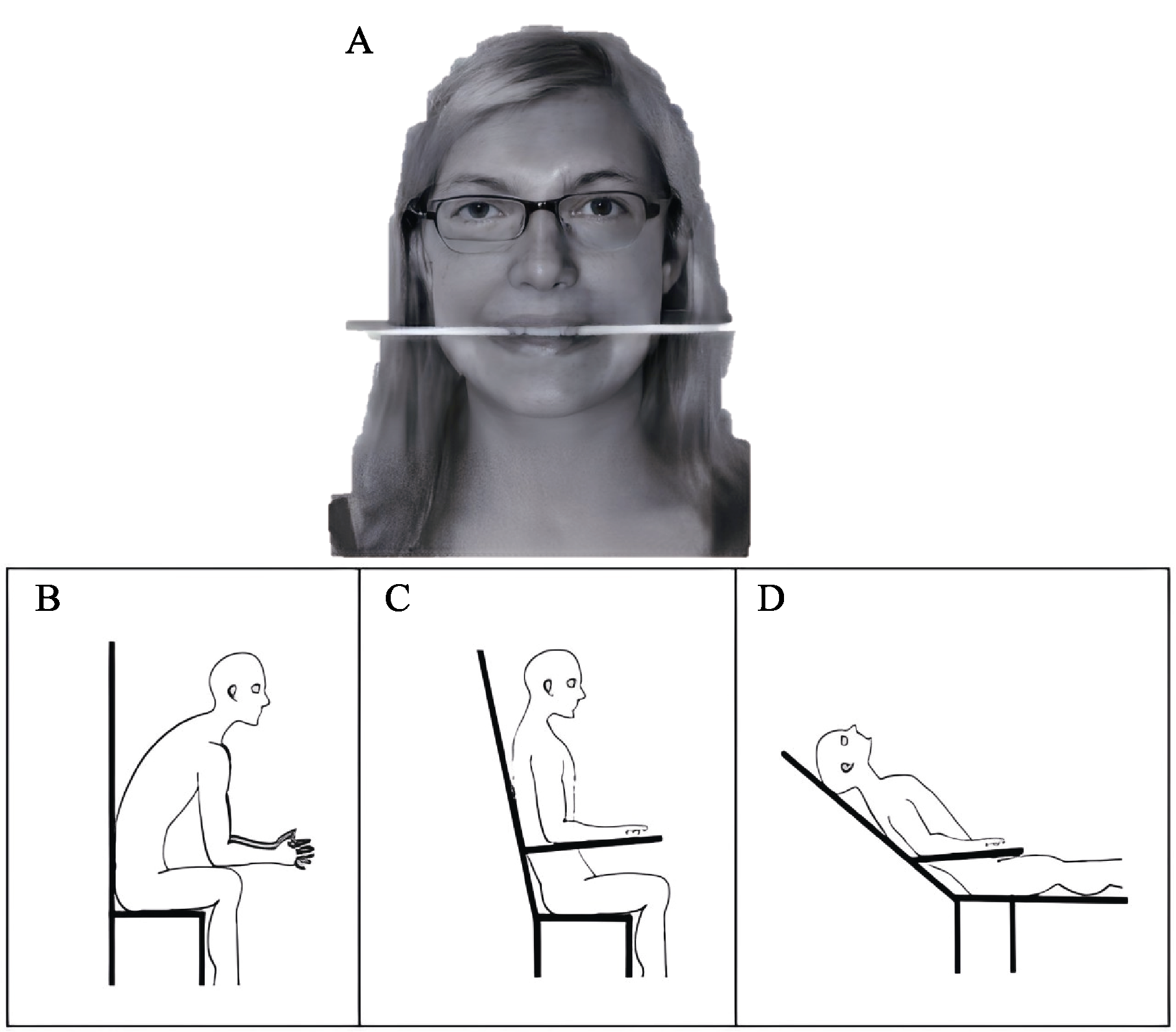
Figure 1. Schematic diagram of emotional motivation induction operations, where A) Positive emotion induction - smiling expression, B) High approach motivation positive emotion induction, C) Medium approach motivation positive emotion induction, D) Low approach motivation positive emotion induction (Note: The image is cited from Price & Harmon-Jones, 2011).

Figure 2. Distribution of fNIRS channels (CH) and the optode cap channel layout, where red circles represent the transmit electrodes, blue circles represent the receiving electrodes, yellow indicates channels, and numbers correspond to channel IDs.
| Conditions | Study words Hit | Critical lures False Alarm | Irrelevant words False Alarm |
|---|---|---|---|
| High Approach | 0.76 (0.12) | 0.75 (0.15) | 0.17 (0.19) |
| Medium Approach | 0.73 (0.11) | 0.73 (0.19) | 0.22 (0.19) |
| Low Approach | 0.74 (0.16) | 0.62 (0.22) | 0.17 (0.22) |
Table 1 Descriptive statistical results of individuals’ “studied” response under different experimental conditions (M (SD))
| Conditions | Study words Hit | Critical lures False Alarm | Irrelevant words False Alarm |
|---|---|---|---|
| High Approach | 0.76 (0.12) | 0.75 (0.15) | 0.17 (0.19) |
| Medium Approach | 0.73 (0.11) | 0.73 (0.19) | 0.22 (0.19) |
| Low Approach | 0.74 (0.16) | 0.62 (0.22) | 0.17 (0.22) |
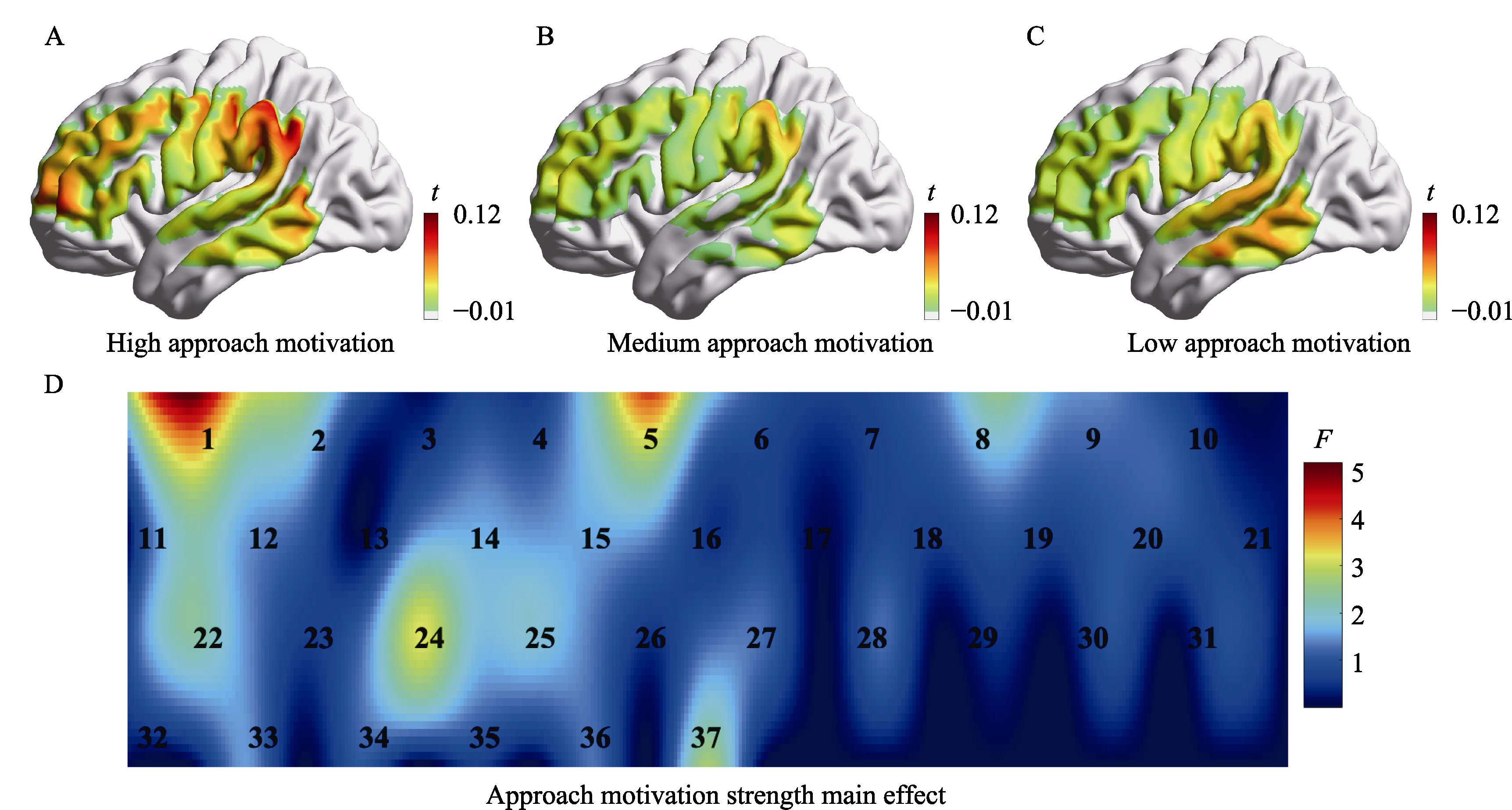
Figure 3. Channel Activation and Main Effect F-value Test Chart under Different Intensities of Approach Motivation Positive Emotional Conditions for Individuals, where A) represents the brain activation of individuals under high approach motivation conditions, B) represents the brain activation of individuals under medium approach motivation conditions, C) represents the brain activation of individuals under low approach motivation conditions, D) represents the main effect F-value plot of approach motivation intensity (Note: The closer the color in the figure to red, the more significant the activation; the numbers in Figure D represent the corresponding channels.)
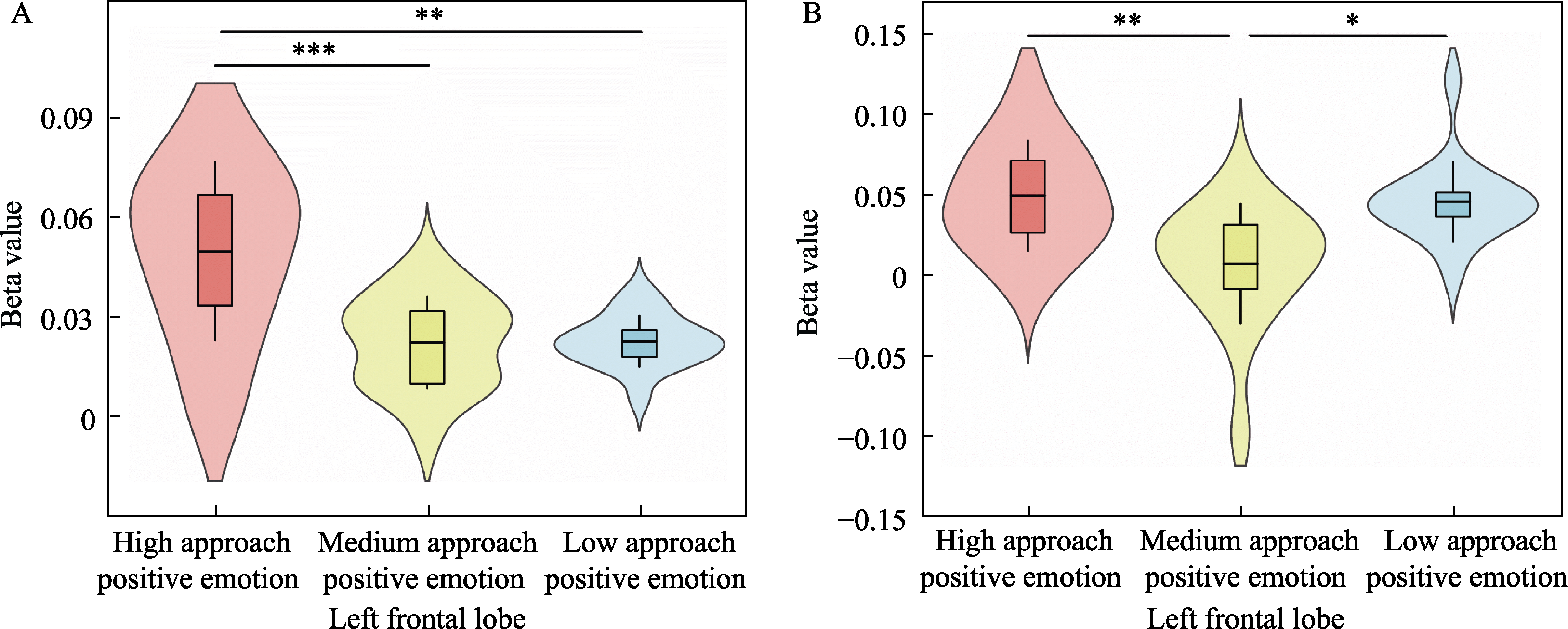
Figure 4. Brain activation differences in individuals across different regions of interest under various intensities of approach motivation positive emotional conditions, where A) represents the brain activation differences in the left frontal lobe, and B) represents the brain activation differences in the left temporal lobe. The values on the coordinate axes in the figure are magnified by a factor of 10,000, and the same applies to the subsequent figures.
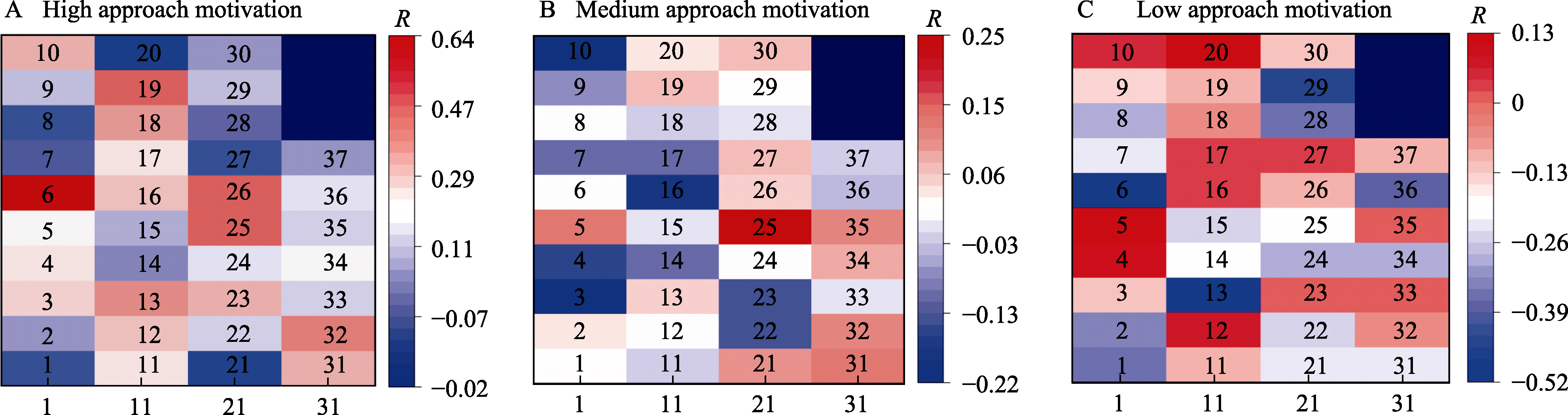
Figure 5. Heatmaps of correlation values between beta values of each channel and the rate of false alarms for critical lures under three intensities of approach motivation positive emotional conditions, where A) represents the high approach motivation positive emotional condition, B) represents the medium approach motivation positive emotional condition, and C) represents the low approach motivation positive emotional condition. The numbers in the figure correspond to the respective channels.
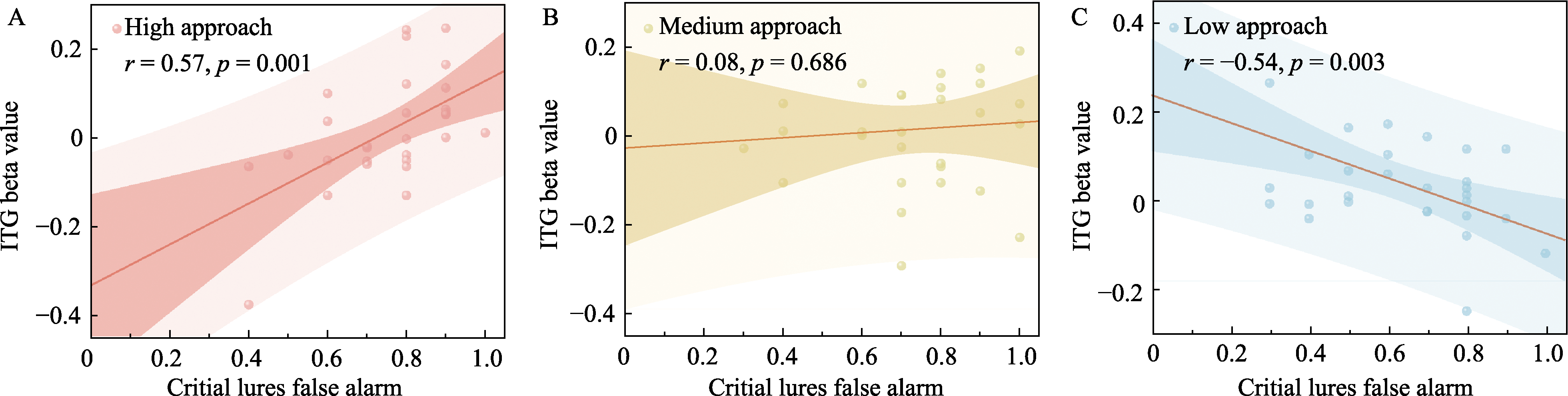
Figure 6. Correlation between the activation values of the inferior temporal gyrus and the rate of false alarms for critical lures under different intensities of approach motivation positive emotional conditions, where A) represents the high approach motivation positive emotional condition, B) represents the medium approach motivation positive emotional condition, and C) represents the low approach motivation positive emotional condition.
| [1] | Alonso, M. A., Díez, E., Díez-Álamo, A. M., Fernandez, A., & Gómez-Ariza, C. J. (2024). Transcranial direct current stimulation over the left posterior temporal lobe modulates semantic control: Evidence from episodic memory distortions. Brain and Cognition, 175, 106130. |
| [2] |
Badre, D., Poldrack, R. A., Paré-Blagoev, E. J., Insler, R. Z., & Wagner, A. D. (2005). Dissociable controlled retrieval and generalized selection mechanisms in ventrolateral prefrontal cortex. Neuron, 47(6), 907-918.
doi: 10.1016/j.neuron.2005.07.023 pmid: 16157284 |
| [3] |
Bai, X. J., Zhang, Q. H., Zhang, P., Zhou, S., Liu, Y., Song, X., & Peng, G. H. (2016). Comparison of motor execution and motor imagery brain activation patterns: A fNIRS study. Acta Psychologica Sinica, 48(5), 495-508.
doi: 10.3724/SP.J.1041.2016.00495 |
| [4] | Balconi, M., Falbo, X., & Conte, V. A. (2012). BIS and BAS correlates with psychophysiological and cortical response systems during aversive and appetitive emotional stimuli processing. Motivation and Emotion, 36, 218-231. |
| [5] |
Bookbinder, S, H., & Brainerd, C. J. (2016). Emotion and false memory: The context-content paradox. Psychological Bulletin, 142(12), 1315-1351.
pmid: 27748610 |
| [6] |
Bookbinder, S. H., & Brainerd, C. J. (2017). Emotionally negative pictures enhance gist memory. Emotion, 17(1), 102-119.
doi: 10.1037/emo0000171 pmid: 27454002 |
| [7] | Boggio, P. S., Fregni, F., Valasek, C., Ellwood, S., Chi, R., Gallate, J., … Snyder, A. (2009). Temporal lobe cortical electrical stimulation during the encoding and retrieval phase reduces false memories. PloS One, 4(3), e4959. |
| [8] |
Binder, J. R., & Desai, R. H. (2011). The neurobiology of semantic memory. Trends in Cognitive Sciences, 15(11), 527-536.
doi: 10.1016/j.tics.2011.10.001 pmid: 22001867 |
| [9] |
Buss, K. A., Schumacher, J. R., Dolski, I., Kalin, N. H., Goldsmith, H. H., & Davidson, R. J. (2003). Right frontal brain activity, cortisol, and withdrawal behavior in 6-month-old infants. Behavioral Neuroscience, 117(1), 11-20.
pmid: 12619903 |
| [10] | Brigadoi, S., Ceccherini, L., Cutini, S., Scarpa, F., Scatturin, P., Selb, J., … Cooper, R. J. (2014). Motion artifacts in functional near-infrared spectroscopy: A comparison of motion correction techniques applied to real cognitive data. NeuroImage, 85, 181-191. |
| [11] |
Cabeza, R., Rao, S. M., Wagner, A. D., Mayer, A. R., & Schacter, D. L. (2001). Can medial temporal lobe regions distinguish true from false? An event-related functional MRI study of veridical and illusory recognition memory. Proceedings of the National Academy of Sciences of the United States of America, 98(8), 4805-4810.
doi: 10.1073/pnas.081082698 pmid: 11287664 |
| [12] |
Cui, L. X., Zhang, Y. J., Xiao, J., & Zhang, Q. (2013). The influence of positive affect on mental rotation of compound stimuli: The moderating role of approch motivation. Acta Psychologica Sinica, 45(11), 1228-1241.
doi: 10.3724/SP.J.1041.2013.01228 |
| [13] |
Chadwick, M. J., Anjum, R. S., Kumaran, D., Schacter, D. L., Spiers, H. J., & Hassabis, D. (2016). Semantic representations in the temporal pole predict false memories. Proceedings of the National Academy of Sciences of the United States of America, 113(36), 10180-10185.
doi: 10.1073/pnas.1610686113 pmid: 27551087 |
| [14] |
Cooper, R. A., & Ritchey, M. (2020). Progression from feature-specific brain activity to hippocampal binding during episodic encoding. Journal of Neuroscience, 40(8), 1701-1709.
doi: 10.1523/JNEUROSCI.1971-19.2019 pmid: 31826947 |
| [15] |
Deese, J. (1959). On the prediction of occurrence of particular verbal intrusions in immediate recall. Journal of Experimental Psychology, 58, 17-22.
pmid: 13664879 |
| [16] |
Díez, E., Gómez-Ariza, C. J., Díez-Álamo, A. M., Alonso, M. A., & Fernandez, A. (2017). The processing of semantic relatedness in the brain: Evidence from associative and categorical false recognition effects following transcranial direct current stimulation of the left anterior temporal lobe. Cortex, 93, 133-145.
doi: S0010-9452(17)30159-4 pmid: 28647325 |
| [17] | Frenda, S. J., Nichls, R. M., & Loftus, E. F. (2011). Current issues and advances in misinformation research. Current Directions in Psychological Sciences, 20(1), 20-23. |
| [18] |
Ferrari, M., & Quaresima, V. (2012). A brief review on the history of human functional near-infrared spectroscopy development and fields of application. NeuroImage, 63(2), 921-935.
doi: 10.1016/j.neuroimage.2012.03.049 pmid: 22510258 |
| [19] | Förster, J., Friedman, R.S., Özelsel, A., & Denzler, M. (2006). Enactment of approach and avoidance behavior influences the scope of perceptual and conceptual attention. Journal of Experimental Social Psychology, 42(2), 133-146. |
| [20] | Förster, J. (2012). Glomosysr: The how and why of global and local processing. Current Directions in Psychological Science, 21(1), 15-19. |
| [21] |
Gable, P. A., & Harmon-Jones, E. (2008). Approach-motivated positive affect reduces breadth of attention. Psychological Science, 19, 476-482.
doi: 10.1111/j.1467-9280.2008.02112.x pmid: 18466409 |
| [22] |
Gallate, J., Chi, R., Ellwood, S., & Snyder, A. (2009). Reducing false memories by magnetic pulse stimulation. Neuroscience Letters, 449, 151-154.
doi: 10.1016/j.neulet.2008.11.021 pmid: 19022348 |
| [23] | Gable, P. A., & Harmon-Jones, E. (2010a). The motivational dimensional model of affect: Implications for breadth of attention, memory, and cognitive categorisation. Cognition and Emotion, 24(2), 322-337. |
| [24] | Gable, P. A., & Harmon-Jones, E. (2010b). The blues broaden, but the nasty narrows: Attentional consequences of negative affects low and high in motivational intensity. Psychological Science, 21, 211-215. |
| [25] | Gable, P. A., & Harmon-Jones, E. (2010c). The effect of low versus high approach-motivated positive affect on memory for peripherally versus centrally presented information. Emotion, 10, 599-603. |
| [26] |
Gainotti, G. (2011). What the study of voice recognition in normal subjects and brain-damaged patients tells us about models of familiar people recognition. Neuropsychologia, 49, 2273-2282.
doi: 10.1016/j.neuropsychologia.2011.04.027 pmid: 21569784 |
| [27] |
Harmon-Jones, E. (2007). Trait anger predicts relative left frontal cortical activation to anger-inducing stimuli. International Journal of Psychophysiology, 66(2), 154-160.
pmid: 17561297 |
| [28] |
Hoshi, Y., Kobayashi, N., & Tamura, M. (2001). Interpretation of near-infrared spectroscopy signals: A study with a newly developed perfused rat brain model. Journal of Applied Physiology, 90(5), 1657-662.
doi: 10.1152/jappl.2001.90.5.1657 pmid: 11299252 |
| [29] | Jang, K. E., Tak, S., Jung, J., Jang, J., Jeong, Y., & Ye, J. C. (2009). Wavelet minimum description length detrending for near-infrared spectroscopy. Journal of Biomedical Optics, 14(3), 034004. |
| [30] | Knott, L. M., & Thorley, C. E. (2014). Mood-congruent false memories persist over time. Cognition & Emotion, 28(5), 903-912. |
| [31] | Kubota, Y., Toichi, M., Shimizu, M., Mason, R. A., Findling, R. L., Yamamoto, K., & Calabrese, J. R. (2006). Pref-rontal hemodynamic activity predicts false memory--A near-infrared spectroscopy study. NeuroImage, 31(4), 1783-1789. |
| [32] |
Leff, D. R., Orihuela-Espina, F., Elwell, C. E., Athanasiou, T., Delpy, D.T., Darzi, A. W., & Yang, G. Z. (2011). Assessment of the cerebral cortex during motor task behaviours in adults: A systematic review of functional near infrared spectroscopy (fNIRS) studies. NeuroImage, 54(4), 2922-2936.
doi: 10.1016/j.neuroimage.2010.10.058 pmid: 21029781 |
| [33] | Li, T. (2015). Affective state and DRM paradigm: An investigation of valence and arousal on false memory. (Unpublished master’s thesis). Shaanxi Normal University, China. |
| [34] | Li, X. X. (2020). The influence of motivation of affect for acene memory. (Unpublished master’s thesis). Hebei University, China. |
| [35] |
Liu, F., Ding, J. H., & Zhang, Q. (2016). Positive affect and selective attention: Approach-motivation intensity influences the early and late attention processing stages. Acta Psychologica Sinica, 48(7), 794-803.
doi: 10.3724/SP.J.1041.2016.00794 |
| [36] | Liu, L. T. (2018). The effects of mood on spontaneous false memory and its underlying mechanism. (Unpublished doctoral dissertation). Zhejiang University, China. |
| [37] | Liu, Y. L., Guo, C. Y., & Jin, Z. (2015). The effects of different motivational emotions on word working memory. Chinese Journal of Behavioral Medicine and Brain Science, 24(2), 176-177. |
| [38] | Lu, C. M., Zhang, Y. J., Biswal, B. B., Zang, Y. F., Peng, D. L., & Zhu, C. Z. (2010). Use of fNIRS to assess resting state functional connectivity. Journal of Neuroscience Methods, 186(2), 242-249. |
| [39] | Ni, S. B., Li, Y., Zhao, Y. G., Yang, S., & Yin, N. (2021). Research on the influence of mixed emotional factors on false memory based on brain functional network. Journal of Biomedical Engineering, 38(5), 828-837. |
| [40] | Oliver, M. C., Bays, R. B., & Zabrucky, K. M. (2016). False memories and the DRM paradigm: Effects of imagery, list, and test type. The Journal of General Psychology, 143, 33-48. |
| [41] | Pierce, B. H., Gallo, D. A., Weiss, J. A., & Schacter, D. L. (2005). The modality effect in false recognition: Evidence for test-based monitoring. Memory & Cognition, 33(8), 1407-1413. |
| [42] | Price, T. F., & Harmon-Jones, E. (2010). The effect of embodied emotive states on cognitive categorization. Emotion (Washington, D.C.), 10(6), 934-938. |
| [43] |
Price, T. F., & Harmon-Jones, E. (2011). Approach motivational body postures lean toward left frontal brain activity. Psychophysiology, 48, 718-722.
doi: 10.1111/j.1469-8986.2010.01127.x pmid: 21457272 |
| [44] |
Poole, B. D., & Gable, P. A. (2014). Affective motivational direction drives asymmetric frontal hemisphere activation. Experimental Brain Research, 232(7), 2121-2130.
doi: 10.1007/s00221-014-3902-4 pmid: 24658634 |
| [45] | Roediger, H., & McDermott, K. B. (1995). Creating false memories: Remembering words not presented in lists. Journal of Experimental Psychology: Learning, Memory and Cognition, 21(4), 803-814. |
| [46] |
Schutter, D. J., de Weijer, A. D., Meuwese, J. D., Morgan, B., & van Honk, J. (2008). Interrelations between motivational stance, cortical excitability, and the frontal electroencephalogram asymmetry of emotion: A transcranial magnetic stimulation study. Human Brain Mapping, 29, 574-80.
pmid: 17557298 |
| [47] |
Singh, A. K., Okamoto, M., Dan, H., Jurcak, V., & Dan, I. (2005). Spatial registration of multichannel multi-subject fNIRS data to MNI space without MRI. NeuroImage, 27(4), 842-851.
doi: 10.1016/j.neuroimage.2005.05.019 pmid: 15979346 |
| [48] |
Spalding, K. N., Jones, S. H., Duff, M. C., Tranel, D., & Warren, D. E. (2015). Investigating the neural correlates of schemas: Ventromedial prefrontal cortex is necessary for normal schematic influence on memory. Journal of Neuroscience, 35(47), 15746-15751.
doi: 10.1523/JNEUROSCI.2767-15.2015 pmid: 26609165 |
| [49] | Stadler, M. A., Roediger, H. L., & McDermott, K. B. (1999). Norms for word lists that create false memories. Memory and Cognition, 27(3), 495-500. |
| [50] |
Storbeck, J., & Clore, G. L. (2005). With sadness comes accuracy; with happiness, false memory mood and the false memory effect. Psychological Science, 16(10), 785-791.
doi: 10.1111/j.1467-9280.2005.01615.x pmid: 16181441 |
| [51] |
Storbeck, J., & Clore, G. L. (2011). Affect influences false memories at encoding: Evidence from recognition date. Emotion, 11(4), 981-989.
doi: 10.1037/a0022754 pmid: 21517165 |
| [52] |
Wagner, U., Schlechter, P., & Echterhoff, G. (2022). Socially induced false memories in the absence of misinformation. Scientific Reports, 12, 7725.
doi: 10.1038/s41598-022-11749-w pmid: 35545651 |
| [53] | Wang, A. Q., Zhu, H. D., Zhu, X., &. Qiao, Q. C. (2019). Electroencephalogram mechanism of asymmetric activation of frontal cortex induced by emotional motivation. Acta Universitatis Medicinalis Anhui, 54(10), 1632-1636. |
| [54] | Wang, C. M., & Lv, Y. (2016). Review of the emotional motivation effect on cognitive processing. Psychological Research, 9(1), 15-21. |
| [55] | Wang, T. T., Mo, L., & Shu, S. Y. (2009). The brain mechanism of memory encoding and retrieval: A review on the fMRI studies. Acta Physiological Sinica, 61(5), 395-403. |
| [56] | Wang, X. M., Ma, Y. H., & Song, G. W. (2010). The effects of priming emotion and presentation mode on false memory. Studies of Psychology and Behavior, 8(3), 208-212. |
| [57] |
Wang, Z. H., Liu, Y., & Jiang, C. H. (2013). The effect of low versus high approach-motivated positive affect on cognitive control. Acta Psychologica Sinica, 45(5), 546-555.
doi: 10.3724/SP.J.1041.2013.00546 |
| [58] |
Xia, M., Li, X. L., Li, H., & Yang, K. (2015). The relationship between left frontal and approach motivation process. Advances in Psychological Science, 23(5), 815-821.
doi: 10.3724/SP.J.1042.2015.00815 |
| [59] | Xia, M., Wang, J., & He, Y. (2013). BrainNet Viewer: A network visualization tool for human brain connectomics. PloS One, 8(7), e68910. |
| [60] |
Xiao, H. R., Huang, Y. F., Gong, X. M., & Wang, D. H. (2015). Age alters the effects of emotional valence on false memory: Using the simplified conjoint recognition paradigm. Acta Psychologica Sinica, 47(1), 19-28.
doi: 10.3724/SP.J.1041.2015.00019 |
| [61] | Yang, M. X., & Zhang, J. K. (2019). The effects of image encoding on false memory created by word List. Journal of Psychological Science, 45(5), 1033-1038. |
| [62] | Yang, Z. L., Wang, S. R., & Tang, Q. H. (2006). Sources of false memories: Encoding stage/retention stage. Chinese Journal of Applied Psychology, (2), 99-106. |
| [63] | Ye, J. C., Tak, S., Jang, K. E., Jung, J., & Jang, J. (2009). NIRS_SPM: Statistical parametric mapping for near-infrared spectroscopy. NeuroImage, 44(2), 428-447. |
| [64] | Zhang, J. Y. (2014). The effect of different approach motivational intensity of positive emotions on working memory. (Unpublished master’s thesis). East China Normal University. |
| [65] | Zhang, Y. J. (2020). The influence of positive affect on the scope of mental rotation in high school students: The moderating role of approach motivation. Journal of Psychological Science, 43(4), 850-856. |
| [66] | Zhang, Z. X., Guo, X. Y., Li, L., & Zheng, L. (2017). A study on false memory and true memory in blind students. Journal of Psychological Science, 40(4), 844-849. |
| [67] |
Zhu, B., Chen, C., Shao, X., Liu, W., Ye, Z., Zhuang, L., … Xue, G. (2019). Multiple interactive memory representations underlie the induction of false memory. Proceedings of the National Academy of Sciences of the United States of America, 116(9), 3466-3475.
doi: 10.1073/pnas.1817925116 pmid: 30765524 |
| [68] | Zou, J. L., Zhang, X. C., Zhang, H., Yu, L., & Zhou, R. L. (2011). Beyond dichotomy of valence and arousal: Review of the motivational dimensional model of affect. Advances in Psychological Science, 19(9), 1339-1346. |
| [1] | ZHU Yi, HU Yi. Chunking feedback in instructor-learner interaction facilities long-term learning transfer: Behavioral and fNIRS hyperscanning studies [J]. Acta Psychologica Sinica, 2024, 56(5): 555-576. |
| [2] | CHEN Fakun, CHEN Tian, CAI Wenqi, WANG Xiaojuan, YANG Jianfeng. fNIRS evidence for left middle frontal gyrus involved in visual-spatial analysis of Chinese characters [J]. Acta Psychologica Sinica, 2023, 55(5): 685-695. |
| [3] | XU Chuyan, ZHU Lin, WANG Yunping, WANG Ruibing, LIU Conghui. The effect of foreign language speaking anxiety on the quality of verbal interaction: A fNIRS-based hyperscanning study [J]. Acta Psychologica Sinica, 2023, 55(12): 1949-1965. |
| [4] | JIANG Yuan-Ping, JIANG Cheng-Ming, HU Tian-Yi, SUN Hong-Yue. Effects of emotion on intertemporal decision-making: Explanation from the single dimension priority model [J]. Acta Psychologica Sinica, 2022, 54(2): 122-140. |
| [5] | CHEN Xiaoyu, DU Yuanyuan, LIU Qiang. Positive emotions enhance adaptability to contextual-cueing learning [J]. Acta Psychologica Sinica, 2022, 54(12): 1481-1490. |
| [6] | CHENG Xiaojun, LIU Meihuan, PAN Yafeng. Shared responsibility promotes the benefit of interactive decision-making in novices: A hyperscanning study [J]. Acta Psychologica Sinica, 2022, 54(11): 1391-1402. |
| [7] | YIN Keli, LAN Miaosen, LI Hui, ZHAO Ziwen. How ritual actions, symbolic meanings, and positive emotions enhance perceived control: A dual path way mechanism [J]. Acta Psychologica Sinica, 2022, 54(1): 54-65. |
| [8] | CHEN Shi, LIANG Zheng, LI Xianglan, CHEN Yanran, ZHAO Qingbai, YU Quanlei, LI Songqing, ZHOU Zhijin, LIU Lizhong. The role of novel semantic association in the promoting effect of insight on memory [J]. Acta Psychologica Sinica, 2021, 53(8): 837-846. |
| [9] | ZHANG Ruqian, LIU Jieqiong, LI Xianchun. Neural mechanisms of fairness formation in the perspective of social interactions [J]. Acta Psychologica Sinica, 2019, 51(9): 1007-1017. |
| [10] | YANG Haibo,LIU Hejun,ZHANG Peng,LI Liang. The role of masking stimulation in target recognition processing: Evidence from fNIRS [J]. Acta Psychologica Sinica, 2019, 51(11): 1187-1197. |
| [11] | Yiping ZHONG, Wenjie ZHANG, Yalei LI, Wei FAN. Influence of time stress on mood-congruent false memories [J]. Acta Psychologica Sinica, 2018, 50(9): 929-939. |
| [12] | ZHOU Chu, SU Man, ZHOU Chong, YANG Yan, XI Yaqi, DONG Qun. Imagination inflation effect in older adults [J]. Acta Psychologica Sinica, 2018, 50(12): 1369-1380. |
| [13] | DOU Kai, LIU Yaozhong, WANG Yujie, NIE Yangang. Willingness to cooperate: Emotion enhancement mechanism of perceived social mindfulness on cooperative behaviour [J]. Acta Psychologica Sinica, 2018, 50(1): 101-114. |
| [14] | GONG Shaoying, SHANGGUAN Chenyu, ZHAI Kuihu, GUO Yawei. The effects of emotional design on multimedia learning [J]. Acta Psychologica Sinica, 2017, 49(6): 771-782. |
| [15] | FENG Biao, XU Liang, ZHANG Weixing, CHEN Ting, WANG Wenqing, ZHENG Xifu. The inhibitive effect of positive emotions on fear generalization [J]. Acta Psychologica Sinica, 2017, 49(3): 317-328. |
| Viewed | ||||||
|
Full text |
|
|||||
|
Abstract |
|
|||||
