ISSN 0439-755X
CN 11-1911/B

Acta Psychologica Sinica ›› 2026, Vol. 58 ›› Issue (4): 683-697.doi: 10.3724/SP.J.1041.2026.0683

• Reports of Empirical Studies • Previous Articles     Next Articles

Coming in second: Influence mechanism of alternative choice on employee taking charge and time theft behaviors

ZHAN Xiaojun1, WU Keying1, WANG Tao2, MA Jun3, ZHU Yanghao4, ZHOU Wenjun1   

  1. 1School of Business Administration, Jiangxi University of Finance and Economics, Nanchang 330013, China;
    2School of Economic Management and Law, Jiangxi Science and Technology Normal University, Nanchang 330036, China;
    3School of Management, Shanghai University, Shanghai 200444, China;
    4School of Management, Huazhong University of Science and Technology, Wuhan 430074, China
  • Received:2024-11-05 Published:2026-04-25 Online:2026-01-16

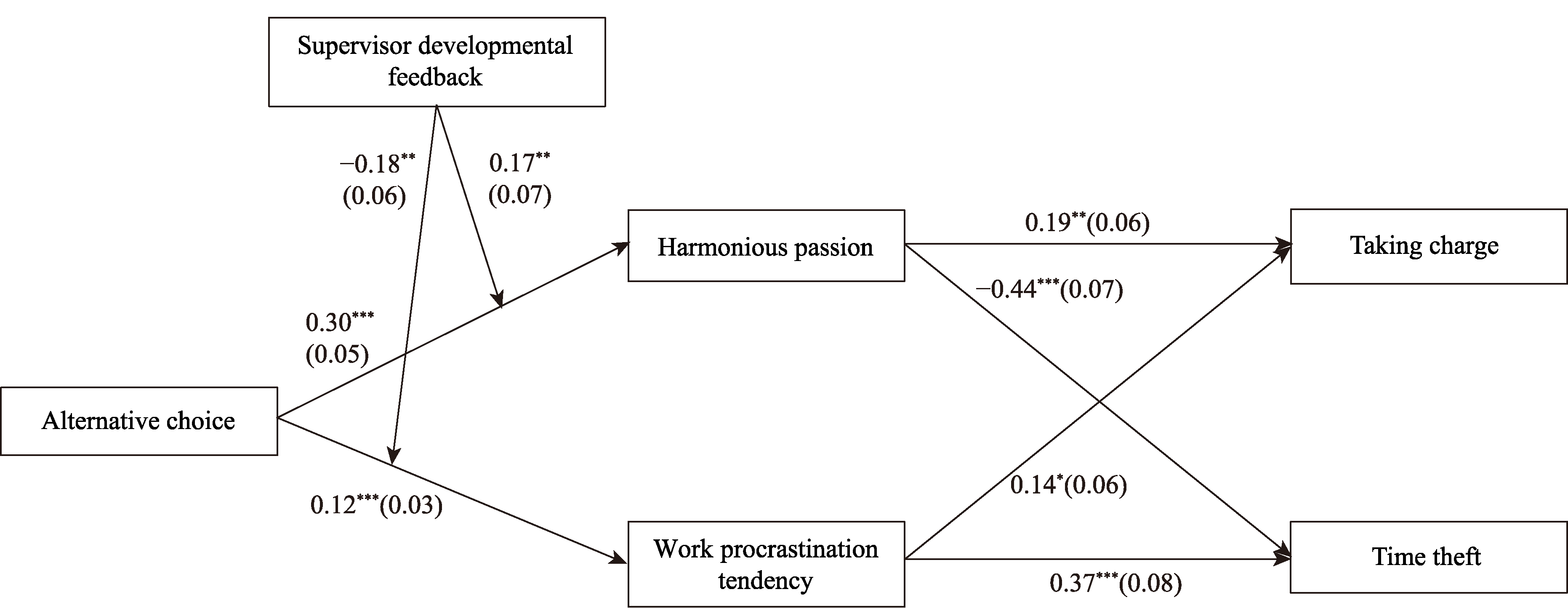
Abstract: Alternative choice—employees who are ultimately selected to complete tasks but were not the first choice to do so—have garnered increasing scholarly attention in recent years. Some studies have revealed the psychological effects of being compared to the first choice, as well as the behaviors of alternative employees in various contexts, such as those involving employee rewards and recruitment. However, these studies overlook how being an alternative choice impacts employees’ attitudes and behaviors specifically in task allocation contexts. To address this research gap, we drew on the social information processing (SIP) and associated proposition evaluation (AP-E) theories to examine the interaction between the alternative choice and supervisor developmental feedback and its effects on employees’ taking charge and time theft behaviors within task contexts. We also explored the mediating effects of harmonious passion and work procrastination tendency, constructing a moderated mediation model.
Our hypotheses were tested through a scenario-based experimental study (Study 1; N = 232) and a three-stage survey (Study 2; N = 332). For Study 1, we designed a 2 × 2 between-subject experiment with four scenarios depicting a leader selecting a suitable project manager for a new task. We recruited 234 participants from the Credamo platform and randomly assigned each to one of the four scenarios. Each participant read the scenario and took on the role of a project manager candidate. Following this, participants reported their levels of harmonious passion and work procrastination tendency, completed a manipulation check, and provided demographic information. Finally, 232 participants who passed the attention test were retained. In Study 2, we collected empirical data from 332 employees in China using a three-stage questionnaire survey. Before completing the questionnaire, the participants were asked a screening question: “Have you had any alternative choice experience in the past six months?” Only those who responded “yes” were instructed to proceed with the questionnaire. At Time 1, employees reported their alternative choice experience, supervisor developmental feedback, and demographic information. At Time 2, they reported their levels of harmonious passion and work procrastination tendency. At Time 3, they reported their taking charge and time theft behaviors.
We employed an analysis of variance, a confirmatory factor analysis, the bootstrap method, and Harman’s single-factor test to analyze the data. The results showed that when supervisor developmental feedback was high, the alternative choice was positively associated with employees’ harmonious passion, which, in turn, enhanced their taking charge behaviors and reduced their time theft behaviors. Conversely, when supervisor developmental feedback was low, the alternative choice was positively associated with employees’ work procrastination tendency, which subsequently increased their time theft behaviors.
This study has both theoretical and practical implications. First, it enriches the research on “alternative choice” by examining the context of task allocation, revealing employees’ perceptions and responses to being an alternative choice for performing a task and enhancing the research framework on diverse employee groups within organizations. Second, it transcends the traditional social comparison perspective by integrating SIP and AP-E theories to explore the underlying mechanisms through which being an alternative employee influences psychological and behavioral outcomes. Third, it validates the moderating role of supervisory developmental feedback in the double-edged sword effect of alternative choice on employees’ work behavior, thereby extending the boundary conditions of the alternative choice phenomenon. Moreover, the findings offer valuable practical implications for managers and policymakers.

Key words: alternative choice, harmonious passion, work procrastination tendency, taking charge behaviors, time theft behaviors, supervisor developmental feedback