ISSN 0439-755X
CN 11-1911/B

Acta Psychologica Sinica ›› 2026, Vol. 58 ›› Issue (4): 634-650.doi: 10.3724/SP.J.1041.2026.0634

• Reports of Empirical Studies • Previous Articles     Next Articles

The micro-dynamic neural processing model of insight problem-solving

CHEN Yan1, LI Ying1, LIU Guanxiong1, YU Quanlei1, LIANG Zheng1,2, CHEN Shi3,4, ZHAO Qingbai1   

  1. 1Key Laboratory of Adolescent Cyberpsychology and Behavior (CCNU), Ministry of Education; Key Laboratory of Human Development and Mental Health of Hubei Province; School of Psychology, Central China Normal University, Wuhan 430079, China;
    2Department of Psychological and Cognitive Sciences, Tsinghua University, Beijing 100084, China;
    3Hubei Health Industry Development Research Center, School of Medical Humanities, Hubei University of Chinese Medicine, Wuhan 430065, China;
    4Hubei Shizhen Laboratory, Wuhan 430000, China
  • Received:2025-05-20 Published:2026-04-25 Online:2026-01-16

Abstract: Creative problem-solving relies upon distinct processes of reasoning and insight. Accumulating empirical evidence has demonstrated that insight, rather than manifesting as a transient ‘eureka!’ moment, constitutes a dynamic cognitive sequence. While descriptions of the ‘eureka moment’ itself provide information about potential neural markers present at the time of a problem is solved, our understanding of how multiple cognitive processes interact during insight problem-solving remains limited. Furthermore, unconscious processing is considered crucial for solving insight problems, yet due to its elusive nature, few studies have directly investigated this process.
Based on this, the present research investigated insight problem-solving in a simple random sample of 37 right-handed participants (average age 21.2 years old, 17 females) who spoke Chinese as their mother tongue and English as their second language, and English language proficiency was standardized as IELTS ≥ 7 / TOEFL ≥ 95 / the major of study at the university is English, and TEM4≥80 to participate in this experiment. The experiment employed the Compound Remote Associates (CRA) test, a classic verbal insight problem-solving paradigm. In this task, three words were simultaneously presented on the screen, requiring participants to generate a single word that could form a meaningful compound word or phrase with each of the three stimulus words. Electroencephalographic (EEG) activity was continuously recorded throughout task performance. In data analysis, the problem-solving process was artificially divided into three distinct stages: initial problem presentation, the process of problem solving, and response execution stage. Statistical comparisons of the microstates (derived from cluster-based topographic maps that reveal cognitive processes occurring at millisecond resolution) were conducted across these stages under insight, non-insight, and unresolved conditions. This approach aimed to characterize the neural response patterns associated with insight problem-solving.
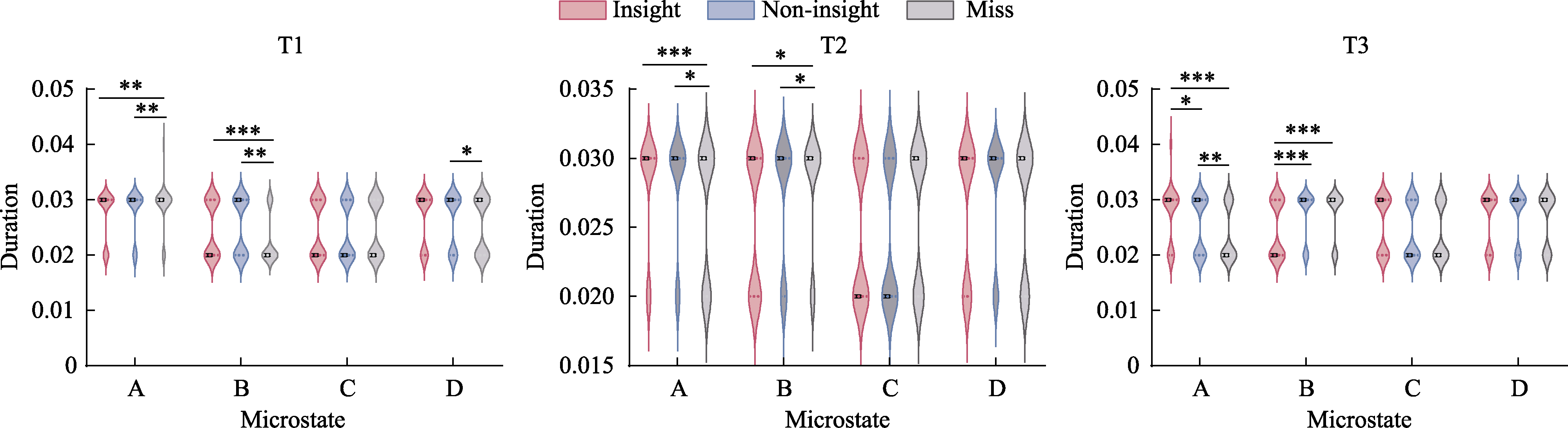
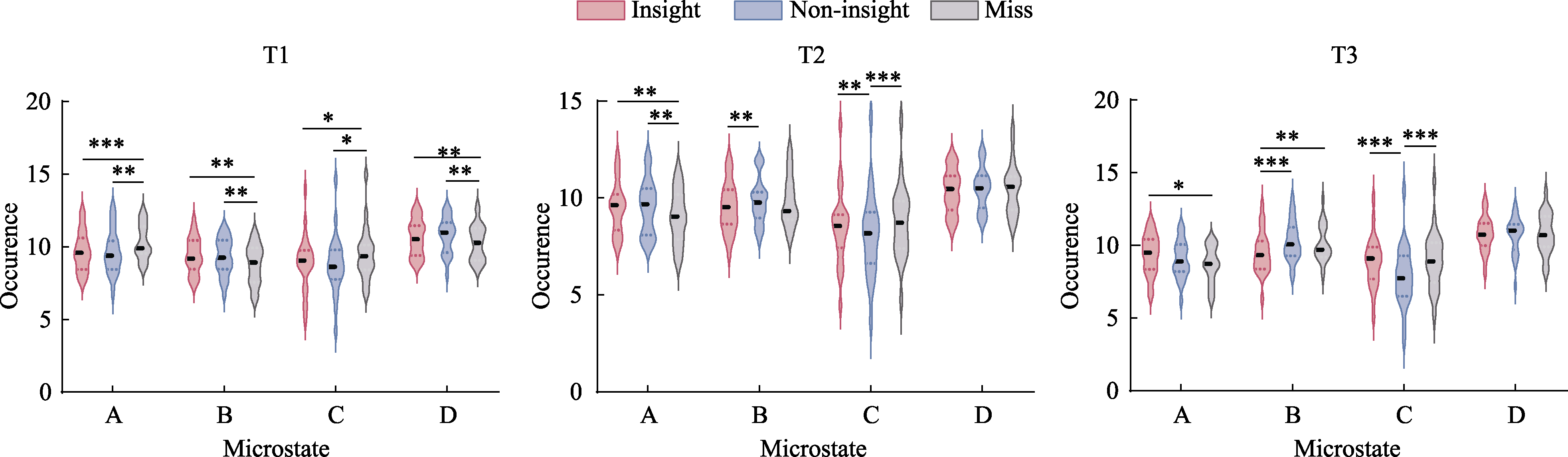
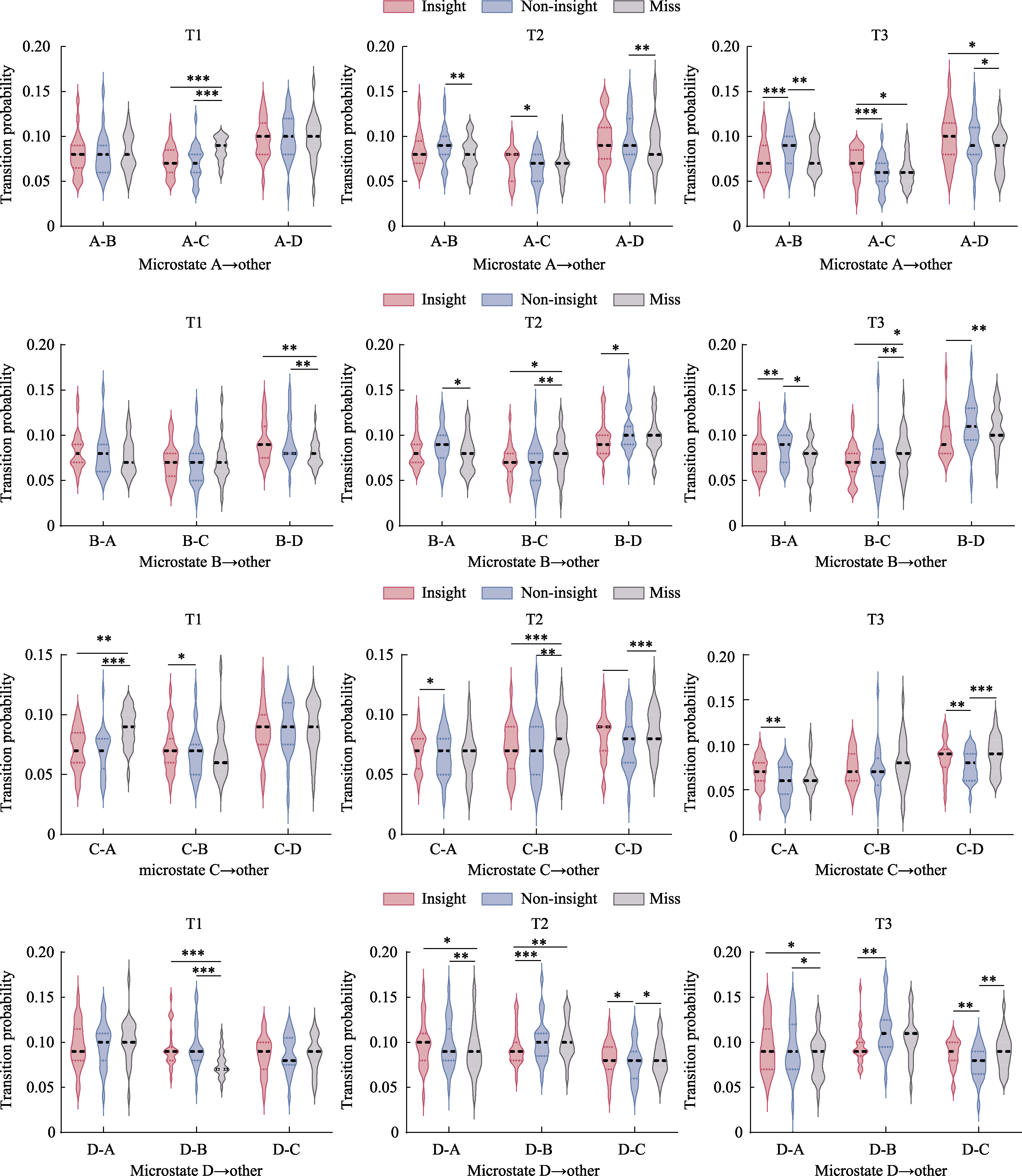
The main results show that: (1) Microstate C, which reflects components of the default mode network, demonstrated a significantly higher rate of occurrence under the insight condition and exhibited more frequent transitions with both Microstate A (associated with speech information processing) and Microstate D (linked to attentional processes and executive functions); (2) Microstate B, associated with visual processing, showed a significantly increased rate of occurrence during the initial stage of both insight and non-insight problem-solving conditions. However, its presence persisted across all three processing stages exclusively in the non-insight condition; (3) In the unresolved condition, Microstate C displayed a significantly elevated rate of occurrence, with its dominance progressively increasing throughout the problem-solving process; (4) Microstate D exhibited significantly more frequent transitions to both Microstate B and Microstate A across successful problem-solving conditions. Furthermore, Microstate D demonstrated a significantly higher rate of occurrence during the initial problem presentation stage.
The experimental results revealed distinct neural response patterns across different problem-solving conditions at the electrophysiological level. Successful problem-solving was found to depend on both the comprehensive representation of information and the active engagement of executive functions. Notably, the microstate associated with the default mode network (DMN) exhibited significant activation exclusively during the insight condition. This suggests that unconscious cognitive processes may play a crucial role in insight problem-solving.

Key words: insight problem-solving, microstate, unconscious processing