

ISSN 0439-755X
CN 11-1911/B
CN 11-1911/B
Acta Psychologica Sinica ›› 2026, Vol. 58 ›› Issue (11): 2308-2321.doi: 10.3724/SP.J.1041.2026.2308
Previous Articles Next Articles
QI Yun, CAI Wenqi, LI Zhilin, YANG Jianfeng( ), WANG Xiaojuan()
Published:2026-11-25
Online:2026-09-11
Contact:
YANG Jianfeng, E-mail: QI Yun, CAI Wenqi, LI Zhilin, YANG Jianfeng, WANG Xiaojuan. (2026). The joint modulation of language distance and task demands on the neural mechanisms underlying bilingual lexical processing. Acta Psychologica Sinica, 58(11), 2308-2321.

Figure 1. Brain activation maps for bilinguals during phonological tasks. Note. The figure shows brain regions activated in the two groups of bilinguals during phonological tasks. All activated clusters reached the significance threshold. Left panel: Chinese-English bilinguals; right panel: alphabetic-script bilinguals. Yellow regions indicate areas commonly activated by both L1 and L2; orange regions indicate areas showing greater activation for L2 than for L1. IPL: inferior parietal lobule.
| Activation type | Brain region | Hemi | BA | Peak coordinates | Volume/mm3 | ALE (×10?2) | ||
|---|---|---|---|---|---|---|---|---|
| X | Y | Z | ||||||
| Chinese-English bilinguals | ||||||||
| L1 ∩ L2 | Precentral gyrus | L | 9/6 | ?43.1 | 6.4 | 31.1 | 3520 | 1.81 |
| Precuneus | L | 39/19/7 | ?27.8 | ?60.3 | 37.3 | 2224 | 2.26 | |
| Medial frontal gyrus | B | 6 | ?3.3 | 4.6 | 51.9 | 1984 | 2.05 | |
| Lingual gyrus | R | 18/17 | 18.6 | ?85.2 | ?6.8 | 1256 | 1.93 | |
| Inferior occipital gyrus | L | 18 | ?25.5 | ?86.7 | ?6.5 | 248 | 1.00 | |
| L2 > L1 | Inferior parietal lobule | L | 40 | ?42.8 | ?41.8 | 39.9 | 1040 | 2.19 |
| Alphabetic-script bilinguals | ||||||||
| L1 ∩ L2 | Inferior frontal gyrus | L | 9/6 | ?44.2 | 7.7 | 28.4 | 1448 | 1.39 |
| Medial frontal gyrus | B | 6 | ?2.9 | ?2.6 | 55.6 | 1344 | 1.75 | |
| Fusiform gyrus | L | 37/19 | ?43.5 | ?61.7 | ?11.5 | 1232 | 1.37 | |
| Superior parietal lobule | L | 7 | ?25.6 | ?63.3 | 43 | 904 | 1.40 | |
Table 1 Brain activation regions in phonological tasks
| Activation type | Brain region | Hemi | BA | Peak coordinates | Volume/mm3 | ALE (×10?2) | ||
|---|---|---|---|---|---|---|---|---|
| X | Y | Z | ||||||
| Chinese-English bilinguals | ||||||||
| L1 ∩ L2 | Precentral gyrus | L | 9/6 | ?43.1 | 6.4 | 31.1 | 3520 | 1.81 |
| Precuneus | L | 39/19/7 | ?27.8 | ?60.3 | 37.3 | 2224 | 2.26 | |
| Medial frontal gyrus | B | 6 | ?3.3 | 4.6 | 51.9 | 1984 | 2.05 | |
| Lingual gyrus | R | 18/17 | 18.6 | ?85.2 | ?6.8 | 1256 | 1.93 | |
| Inferior occipital gyrus | L | 18 | ?25.5 | ?86.7 | ?6.5 | 248 | 1.00 | |
| L2 > L1 | Inferior parietal lobule | L | 40 | ?42.8 | ?41.8 | 39.9 | 1040 | 2.19 |
| Alphabetic-script bilinguals | ||||||||
| L1 ∩ L2 | Inferior frontal gyrus | L | 9/6 | ?44.2 | 7.7 | 28.4 | 1448 | 1.39 |
| Medial frontal gyrus | B | 6 | ?2.9 | ?2.6 | 55.6 | 1344 | 1.75 | |
| Fusiform gyrus | L | 37/19 | ?43.5 | ?61.7 | ?11.5 | 1232 | 1.37 | |
| Superior parietal lobule | L | 7 | ?25.6 | ?63.3 | 43 | 904 | 1.40 | |

Figure 2. Brain activation maps for bilinguals during semantic tasks. Note. The figure shows brain regions activated in the two groups of bilinguals during semantic tasks. All activated clusters reached the significance threshold. Left panel: Chinese-English bilinguals; right panel: alphabetic-script bilinguals. Yellow regions indicate areas commonly activated by both L1 and L2; blue regions indicate areas showing greater activation for L1 than for L2; orange regions indicate areas showing greater activation for L2 than for L1. MFG: middle frontal gyrus; STG: superior temporal gyrus.
| Activation type | Brain region | Hemi | BA | Peak coordinates | Volume/mm3 | ALE (×10?2) | ||
|---|---|---|---|---|---|---|---|---|
| X | Y | Z | ||||||
| Chinese-English bilinguals | ||||||||
| L1 ∩ L2 | Superior frontal gyrus | B | 8/32/6 | ?1.5 | 20.7 | 44.1 | 2888 | 2.19 |
| Precuneus | L | 19/7 | ?27 | ?67.4 | 40.4 | 1704 | 1.24 | |
| Precentral gyrus | L | 9 | ?38.2 | 10.2 | 30.9 | 1384 | 1.47 | |
| Fusiform gyrus | L | 37/19 | ?42.6 | ?58.8 | ?13.2 | 944 | 1.30 | |
| Medial frontal gyrus | L | 32 | ?2 | 6 | 46 | 8 | 0.77 | |
| L1 > L2 | Middle frontal gyrus | L | 9/46 | ?43.6 | 21.4 | 26.3 | 1608 | 2.49 |
| Precuneus | L | 7 | ?23.8 | ?66.8 | 37 | 104 | 1.82 | |
| Alphabetic-script bilinguals | ||||||||
| L1 ∩ L2 | Medial frontal gyrus | B | 6 | ?3.4 | ?4 | 51.6 | 528 | 1.37 |
| Inferior parietal lobule | L | 40 | ?30.8 | ?48.9 | 37.5 | 520 | 1.01 | |
| L1 > L2 | Superior temporal gyrus | L | 41/42 | ?55.4 | ?18.6 | 6.8 | 656 | 2.33 |
| L2 > L1 | Inferior frontal gyrus | L | 9/46 | ?46.4 | 16.2 | 26.5 | 1176 | 2.19 |
| Inferior parietal lobule | L | 40 | ?42.4 | ?44.3 | 39.7 | 320 | 2.34 | |
| Insula | L | 13/47 | ?42.1 | 9.9 | ?3.5 | 240 | 1.77 | |
| Medial frontal gyrus | L | 32 | ?13.3 | 13.5 | 41.9 | 128 | 2.11 | |
Table 2 Brain activation regions in semantic tasks.
| Activation type | Brain region | Hemi | BA | Peak coordinates | Volume/mm3 | ALE (×10?2) | ||
|---|---|---|---|---|---|---|---|---|
| X | Y | Z | ||||||
| Chinese-English bilinguals | ||||||||
| L1 ∩ L2 | Superior frontal gyrus | B | 8/32/6 | ?1.5 | 20.7 | 44.1 | 2888 | 2.19 |
| Precuneus | L | 19/7 | ?27 | ?67.4 | 40.4 | 1704 | 1.24 | |
| Precentral gyrus | L | 9 | ?38.2 | 10.2 | 30.9 | 1384 | 1.47 | |
| Fusiform gyrus | L | 37/19 | ?42.6 | ?58.8 | ?13.2 | 944 | 1.30 | |
| Medial frontal gyrus | L | 32 | ?2 | 6 | 46 | 8 | 0.77 | |
| L1 > L2 | Middle frontal gyrus | L | 9/46 | ?43.6 | 21.4 | 26.3 | 1608 | 2.49 |
| Precuneus | L | 7 | ?23.8 | ?66.8 | 37 | 104 | 1.82 | |
| Alphabetic-script bilinguals | ||||||||
| L1 ∩ L2 | Medial frontal gyrus | B | 6 | ?3.4 | ?4 | 51.6 | 528 | 1.37 |
| Inferior parietal lobule | L | 40 | ?30.8 | ?48.9 | 37.5 | 520 | 1.01 | |
| L1 > L2 | Superior temporal gyrus | L | 41/42 | ?55.4 | ?18.6 | 6.8 | 656 | 2.33 |
| L2 > L1 | Inferior frontal gyrus | L | 9/46 | ?46.4 | 16.2 | 26.5 | 1176 | 2.19 |
| Inferior parietal lobule | L | 40 | ?42.4 | ?44.3 | 39.7 | 320 | 2.34 | |
| Insula | L | 13/47 | ?42.1 | 9.9 | ?3.5 | 240 | 1.77 | |
| Medial frontal gyrus | L | 32 | ?13.3 | 13.5 | 41.9 | 128 | 2.11 | |
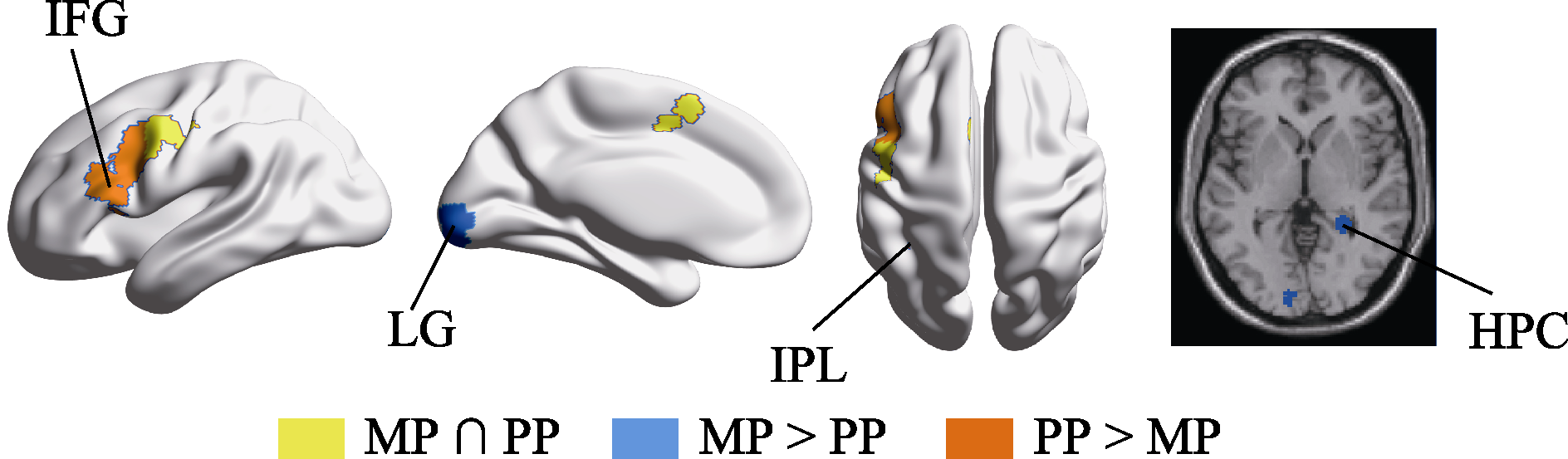
Figure 3. Comparison of brain activation between the two bilingual groups in language-switching tasks. Note. The figure shows the activation contrast between the two bilingual groups during language-switching tasks. All activated clusters reached the significance threshold. MP denotes Chinese-English bilinguals (morphogram & phonogram), and PP denotes alphabetic-script bilinguals (phonogram & phonogram). Yellow regions indicate areas commonly activated by both groups; blue regions indicate areas showing greater activation for Chinese-English bilinguals; orange regions indicate areas showing greater activation for alphabetic-script bilinguals. IFG: inferior frontal gyrus; LG: lingual gyrus; IPL: inferior parietal lobule; HPC: hippocampus.
| Activation type | Brain region | Hemi | BA | Peak coordinates | Volume/mm3 | ALE (×10?2) | ||
|---|---|---|---|---|---|---|---|---|
| X | Y | Z | ||||||
| MP ∩ PP | Precentral gyrus | L | 6/4 | ?47.6 | ?2.6 | 39.4 | 648 | 1.07 |
| Superior frontal gyrus | B | 6 | ?2.4 | 7.8 | 50.8 | 520 | 0.97 | |
| Cingulate gyrus | L | 24 | ?10.7 | ?0.3 | 46.6 | 48 | 0.83 | |
| MP > PP | Caudate nucleus / Hippocampus | R | 19 | 27 | ?42.6 | 4.2 | 1632 | 2.59 |
| Lingual gyrus | L | 17 | ?12.9 | ?93.7 | ?4.8 | 848 | 1.96 | |
| PP > MP | Middle frontal gyrus | L | 9/6 | ?42.1 | 8.4 | 31.3 | 2408 | 2.93 |
| Inferior frontal gyrus | L | 45/44/46 | ?46 | 23 | 16.4 | 720 | 2.11 | |
| Inferior parietal lobule | L | 40 | ?33.5 | ?47.6 | 36.5 | 184 | 1.77 | |
Table 3 Activation contrasts between MP and PP in language-switching tasks.
| Activation type | Brain region | Hemi | BA | Peak coordinates | Volume/mm3 | ALE (×10?2) | ||
|---|---|---|---|---|---|---|---|---|
| X | Y | Z | ||||||
| MP ∩ PP | Precentral gyrus | L | 6/4 | ?47.6 | ?2.6 | 39.4 | 648 | 1.07 |
| Superior frontal gyrus | B | 6 | ?2.4 | 7.8 | 50.8 | 520 | 0.97 | |
| Cingulate gyrus | L | 24 | ?10.7 | ?0.3 | 46.6 | 48 | 0.83 | |
| MP > PP | Caudate nucleus / Hippocampus | R | 19 | 27 | ?42.6 | 4.2 | 1632 | 2.59 |
| Lingual gyrus | L | 17 | ?12.9 | ?93.7 | ?4.8 | 848 | 1.96 | |
| PP > MP | Middle frontal gyrus | L | 9/6 | ?42.1 | 8.4 | 31.3 | 2408 | 2.93 |
| Inferior frontal gyrus | L | 45/44/46 | ?46 | 23 | 16.4 | 720 | 2.11 | |
| Inferior parietal lobule | L | 40 | ?33.5 | ?47.6 | 36.5 | 184 | 1.77 | |
| (* For inclusion in the meta-analysis literature) | |
| [1] |
* Abou-Ghazaleh A., Khateb A., & Nevat M. (2020). Language control in diglossic and bilingual contexts: An event-related fmri study using picture naming tasks. Brain Topography, 33(1), 60-74.
doi: 10.1007/s10548-019-00735-7 pmid: 31578645 |
| [2] |
* Abutalebi J., Annoni J. M., Zimine I., Pegna A. J., Seghier M. L., Lee-Jahnke H.,... Khateb A. (2008). Language control and lexical competition in bilinguals: An event-related fMRI study. Cerebral Cortex, 18(7), 1496-1505.
doi: 10.1093/cercor/bhm182 URL |
| [3] |
Abutalebi J., Della Rosa P. A., Ding G. S., Weekes B., Costa A., & Green D. W. (2013). Language proficiency modulates the engagement of cognitive control areas in multilinguals. Cortex, 49(3), 905-911.
doi: 10.1016/j.cortex.2012.08.018 pmid: 23021069 |
| [4] |
* Abutalebi J., Della Rosa P. A., Green D. W., Hernandez M., Scifo P., Keim R.,... Costa A. (2012). Bilingualism tunes the anterior cingulate cortex for conflict monitoring. Cerebral Cortex, 22(9), 2076-2086.
doi: 10.1093/cercor/bhr287 URL |
| [5] |
Badre D., & Wagner A. D. (2004). Selection, integration, and conflict monitoring: Assessing the nature and generality of prefrontal cognitive control mechanisms. Neuron, 41(3), 473-487.
doi: 10.1016/S0896-6273(03)00851-1 URL |
| [6] |
* Bartolotti J., Bradley K., Hernandez A. E., & Marian V. (2017). Neural signatures of second language learning and control. Neuropsychologia, 98, 130-138.
doi: S0028-3932(16)30115-4 pmid: 27068064 |
| [7] |
* Boukrina O., Hanson S. J., & Hanson C. (2014). Modeling activation and effective connectivity of vwfa in same script bilinguals. Human Brain Mapping, 35(6), 2543-2560.
doi: 10.1002/hbm.v35.6 URL |
| [8] |
Braun M., Hutzler F., Ziegler J. C., Dambacher M., & Jacobs A. M. (2009). Pseudohomophone effects provide evidence of early lexico-phonological processing in visual word recognition. Human Brain Mapping, 30(7), 1977-1989.
doi: 10.1002/hbm.20643 pmid: 18726911 |
| [9] |
Brennan C., Cao F., Pedroarena-Leal N., McNorgan C., & Booth J. R. (2013). Reading acquisition reorganizes the phonological awareness network only in alphabetic writing systems. Human Brain Mapping, 34(12), 3354-3368.
doi: 10.1002/hbm.22147 pmid: 22815229 |
| [10] |
Brignoni-Pérez E., Jamal N., & Eden G. F. (2022). Functional neuroanatomy of English word reading in early bilingual and monolingual adults. Human Brain Mapping, 43(14), 4310-4325.
doi: 10.1002/hbm.25955 pmid: 35607841 |
| [11] |
Brignoni-Perez E., Jamal N. I., & Eden G. F. (2020). An fMRI study of English and Spanish word reading in bilingual adults. Brain and Language, 202, 104725.
doi: 10.1016/j.bandl.2019.104725 URL |
| [12] |
* Buchweitz A., Shinkareva S. V., Mason R. A., Mitchell T. M., & Just M. A. (2012). Identifying bilingual semantic neural representations across languages. Brain and Language, 120(3), 282-289.
doi: 10.1016/j.bandl.2011.09.003 pmid: 21978845 |
| [13] |
* Cao F., Khalid K., Lee R., Brennan C., Yang Y. H., Li K. C.,... Booth J. R. (2011). Development of brain networks involved in spoken word processing of Mandarin Chinese. Neuroimage, 57(3), 750-759.
doi: 10.1016/j.neuroimage.2010.09.047 pmid: 20884355 |
| [14] |
* Cao F., Tao R., Liu L., Perfetti C. A., & Booth J. R. (2013). High proficiency in a second language is characterized by greater involvement of the first language network: Evidence from Chinese learners of English. Journal of Cognitive Neuroscience, 25(10), 1649-1663.
doi: 10.1162/jocn_a_00414 pmid: 23654223 |
| [15] | Cargnelutti E., Tomasino B., & Fabbro F. (2019). Language brain representation in bilinguals with different age of appropriation and proficiency of the second language: A meta-analysis of functional imaging studies. Frontiers in Human Neuroscience, 13, 445658. |
| [16] |
Cargnelutti E., Tomasino B., & Fabbro F. (2022). Effects of linguistic distance on second language brain activations in bilinguals: An exploratory coordinate-based meta-analysis. Frontiers in Human Neuroscience, 15, 744489.
doi: 10.3389/fnhum.2021.744489 URL |
| [17] | * Chan A. H. D., Luke K. K., Li P., Yip V., Li G., Weekes B., & Tan L. H. (2008). Neural correlates of nouns and verbs in early bilinguals. Annals of the New York Academy of Sciences, 1145(1), 30-40. |
| [18] | * Chee M. W. L., Hon N., Lee H. L., & Soon C. S. (2001). Relative language proficiency modulates BOLD signal change when bilinguals perform semantic judgments. Neuroimage, 13(6), 1155-1163. |
| [19] |
* Chee M. W. L., Weekes B., Lee K. M., Soon C. S., Schreiber A., Hoon J. J., & Chee M. (2000). Overlap and dissociation of semantic processing of Chinese characters, English words, and pictures: Evidence from fMRI. Neuroimage, 12(4), 392-403.
doi: 10.1006/nimg.2000.0631 pmid: 10988033 |
| [20] | * Chen X. Z., Zhou L. J., Yang Q., Xu S. J., Wang X. Y., Zhao C.,... Li K. C. (2012). Functional MRI analysis of semantics processing in skilled Mongolian-Chinese bilingual people. Chinese Journal of Medical Imaging Technology, 28(8), 1475-1478. |
| [21] |
* Coderre E. L., Smith J. F., Van Heuven W. J. B., & Horwitz B. (2016). The functional overlap of executive control and language processing in bilinguals. Bilingualism-Language and Cognition, 19(3), 471-488.
pmid: 27695385 |
| [22] |
Coderre E. L., & van Heuven W. J. B. (2014). The effect of script similarity on executive control in bilinguals. Frontiers in Psychology, 5, 1070.
doi: 10.3389/fpsyg.2014.01070 pmid: 25400594 |
| [23] | Comstock L., & Oliver B. (2021). A meta-analysis of task-based differences in bilingual L1 and L2 language networks. bioRxiv, https://doi.org/10.1101/2021.12.28.474335. |
| [24] |
Costa A., Albareda B., & Santesteban M. (2008). Assessing the presence of lexical competition across languages: Evidence from the Stroop task. Bilingualism-Language and Cognition, 11(1), 121-131.
doi: 10.1017/S1366728907003252 URL |
| [25] |
Crinion J., Turner R., Grogan A., Hanakawa T., Noppeney U., Devlin J. T.,... Price C. J. (2006). Language control in the bilingual brain. Science, 312(5779), 1537-1540.
doi: 10.1126/science.1127761 pmid: 16763154 |
| [26] |
Dang M., Cai W. Q., Chen F. K., Wang X. J., & Yang J. F. (2024). Dynamic collaboration of reading neural pathways driven by the processing demands. Advances in Psychological Science, 32(1), 118-130.
doi: 10.3724/SP.J.1042.2024.00118 |
| [27] |
* Das T., Padakannaya P., Pugh K. R., & Singh N. C. (2011). Neuroimaging reveals dual routes to reading in simultaneous proficient readers of two orthographies. Neuroimage, 54(2), 1476-1487.
doi: 10.1016/j.neuroimage.2010.09.022 pmid: 20854914 |
| [28] |
* De Baene W., Duyck W., Brass M., & Carreiras M. (2015). Brain circuit for cognitive control is shared by task and language switching. Journal of Cognitive Neuroscience, 27(9), 1752-1765.
doi: 10.1162/jocn_a_00817 pmid: 25901448 |
| [29] |
* de Bruin A., Roelofs A., Dijkstra T., & Fitzpatrick I. (2014). Domain-general inhibition areas of the brain are involved in language switching: fMRI evidence from trilingual speakers. Neuroimage, 90, 348-359.
doi: 10.1016/j.neuroimage.2013.12.049 pmid: 24384153 |
| [30] |
* De Grauwe S., Willems R. M., Rueschemeyer S. A., Lemhöfer K., & Schriefers H. (2014). Embodied language in first- and second-language speakers: Neural correlates of processing motor verbs. Neuropsychologia, 56, 334-349.
doi: 10.1016/j.neuropsychologia.2014.02.003 pmid: 24524912 |
| [31] |
* Ding G. S., Perry C., Peng D. L., Ma L., Li D. J., Xu S. Y.,... Yang J. (2003). Neural mechanisms underlying semantic and orthographic processing in Chinese-English bilinguals. Neuroreport, 14(12), 1557-1562.
pmid: 14502075 |
| [32] |
Dong J., Li A. Q., Chen C. S., Qu J., Jiang N., Sun Y.,... Mei L. L. (2021). Language distance in orthographic transparency affects cross-language pattern similarity between native and non-native languages. Human Brain Mapping, 42(4), 893-907.
doi: 10.1002/hbm.25266 pmid: 33112483 |
| [33] | * Dong Q., Xue G., Jin Z., & Zeng Y. W. (2004). Brain response is shaped by language experience: Evidence from an fmri study on beginning second language learners. Acta Psychologica Sinica, 36(4), 448-454. |
| [34] |
Dräger B., Jansen A., Bruchmann S., Förster A. F., Pleger B., P'Zwitserlood, & Knecht, S. (2004). How does the brain accommodate to increased task difficulty in word finding?: A functional MRI study. Neuroimage, 23(3), 1152-1160.
pmid: 15528114 |
| [35] |
Eickhoff S. B., Bzdok D., Laird A. R., Kurth F., & Fox P. T. (2012). Activation likelihood estimation meta-analysis revisited. Neuroimage, 59(3), 2349-2361.
doi: 10.1016/j.neuroimage.2011.09.017 pmid: 21963913 |
| [36] |
Eickhoff S. B., Laird A. R., Grefkes C., Wang L. E., Zilles K., & Fox P. T. (2009). Coordinate-based activation likelihood estimation meta-analysis of neuroimaging data: A random-effects approach based on empirical estimates of spatial uncertainty. Human Brain Mapping, 30(9), 2907-2926.
doi: 10.1002/hbm.20718 pmid: 19172646 |
| [37] |
Feng G. Y., Chen H. C., Zhu Z. D., He Y., & Wang S. P. (2015). Dynamic brain architectures in local brain activity and functional network efficiency associate with efficient reading in bilinguals. Neuroimage, 119, 103-118.
doi: 10.1016/j.neuroimage.2015.05.100 pmid: 26095088 |
| [38] |
Feng X. X., Altarelli I., Monzalvo K., Ding G. S., Ramus F., Shu H.,... Dehaene-Lambertz G. (2020). A universal reading network and its modulation by writing system and reading ability in French and Chinese children. eLife, 9, e54591.
doi: 10.7554/eLife.54591 URL |
| [39] |
* Ferreira R. A., Vinson D., Dijkstra T., & Vigliocco G. (2021). Word learning in two languages: Neural overlap and representational differences. Neuropsychologia, 150, 107703.
doi: 10.1016/j.neuropsychologia.2020.107703 URL |
| [40] |
Finkbeiner M., Gollan T. H., & Caramazza A. (2006). Lexical access in bilingual speakers: What’s the (hard) problem? Bilingualism-Language and Cognition, 9(2), 153-166.
doi: 10.1017/S1366728906002501 URL |
| [41] |
Fox P. T., Parsons L. M., & Lancaster J. L. (1998). Beyond the single study: Function/location metanalysis in cognitive neuroimaging. Current Opinion in Neurobiology, 8(2), 178-187.
pmid: 9635200 |
| [42] |
* Frenck-Mestre C., Anton J. L., Roth M., Vaid J., & Viallet F. (2005). Articulation in early and late bilinguals' two languages: Evidence from functional magnetic resonance imaging. Neuroreport, 16(7), 761-765.
pmid: 15858421 |
| [43] |
* Fu Y. B., Lu D., Kang C. Y., Wu J. J., Ma F. Y., Ding G. S., & Guo T. M. (2017). Neural correlates for naming disadvantage of the dominant language in bilingual word production. Brain and Language, 175, 123-129.
doi: S0093-934X(16)30043-8 pmid: 29102823 |
| [44] |
* Gao Y., Wei N., Wang Z. K., Jian J., Ding G. S., Meng X. Z., & Liu L. (2015). Interaction between native and second language processing: Evidence from a functional magnetic resonance imaging study of chinese-english bilingual children. Acta Psychologica Sinica, 47(12), 1419-1432.
doi: 10.3724/SP.J.1041.2015.01419 |
| [45] |
* Garbin G., Costa A., Sanjuan A., Forn C., Rodriguez-Pujadas A., Ventura N.,... Avila C. (2011). Neural bases of language switching in high and early proficient bilinguals. Brain and Language, 119(3), 129-135.
doi: 10.1016/j.bandl.2011.03.011 pmid: 21550652 |
| [46] |
* Golestani N., Alario F. X., Meriaux S., Le Bihan D., Dehaene S., & Pallier C. (2006). Syntax production in bilinguals. Neuropsychologia, 44(7), 1029-1040.
pmid: 16427099 |
| [47] |
Grant A. M., Fang S. Y., & Li P. (2015). Second language lexical development and cognitive control: A longitudinal fMRI study. Brain and Language, 144, 35-47.
doi: 10.1016/j.bandl.2015.03.010 pmid: 25899988 |
| [48] |
* Guo T. M., Liu H. Y., Misra M., & Kroll J. F. (2011). Local and global inhibition in bilingual word production: fMRI evidence from Chinese-English bilinguals. Neuroimage, 56(4), 2300-2309.
doi: 10.1016/j.neuroimage.2011.03.049 pmid: 21440072 |
| [49] |
Gurunandan K., Carreiras M., & Paz-Alonso P. M. (2019). Functional plasticity associated with language learning in adults. Neuroimage, 201, 116040.
doi: 10.1016/j.neuroimage.2019.116040 URL |
| [50] |
Han Z. Z., & Bi Y. C. (2009). Reading comprehension without phonological mediation: Further evidence from a Chinese aphasic individual. Science in China Series C-Life Sciences, 52(5), 492-499.
doi: 10.1007/s11427-009-0048-x URL |
| [51] |
* Hernandez A. E. (2009). Language switching in the bilingual brain: What’s next? Brain and Language, 109(2-3), 133-140.
doi: 10.1016/j.bandl.2008.12.005 pmid: 19250662 |
| [52] |
* Hernandez A. E., Dapretto M., Mazziotta J., & Bookheimer S. (2001). Language switching and language representation in Spanish-English bilinguals: An fMRI study. Neuroimage, 14(2), 510-520.
doi: 10.1006/nimg.2001.0810 pmid: 11467923 |
| [53] |
* Hernandez A. E., Woods E. A., & Bradley K. A. L. ,(2015). Neural correlates of single word reading in bilingual children and adults. Brain and Language, 143, 11-19.
doi: 10.1016/j.bandl.2015.01.010 pmid: 25728012 |
| [54] | Hickok, G. (2022). The dual stream model of speech and language processing. In A. E. Hillis & J. Fridriksson (Eds.), Handbook of clinical neurology (Vol. 185, pp. 57-69). Elsevier. |
| [55] |
Hou Z. Q., Li H. H., Gao L., Ou J., & Xu M. (2024). Differential neural representations of syntactic and semantic information across languages in Chinese-English bilinguals. Neuroimage, 303, 120928.
doi: 10.1016/j.neuroimage.2024.120928 URL |
| [56] |
Hsieh M. C., Jeong H., Kawata K. H. D., Sasaki Y., Lee H. C., Yokoyama S.,... Kawashima R. (2017). Neural correlates of bilingual language control during interlingual homograph processing in a logogram writing system. Brain and Language, 174, 72-85.
doi: 10.1016/j.bandl.2017.06.006 URL |
| [57] | * Jiang M., Jia W. X., & Yang L. X. (2010). Cerebral activation patterns of fMRI in Uygur-Chinese bilinguals. Journal of Clinical Radiology, 29(12), 1688-1692. |
| [58] |
* Jung J., Nam K., Cho H., & Kim S. (2018). Mapping the neural dynamics of Korean-English bilinguals with medium proficiency during auditory word processing. Frontiers in Psychology, 9, 983.
doi: 10.3389/fpsyg.2018.00983 pmid: 29967589 |
| [59] |
* Kang C. Y., Fu Y. B., Wu J. J., Ma F. Y., Lu C. M., & Guo T. M. (2017). Short-term language switching training tunes the neural correlates of cognitive control in bilingual language production. Human Brain Mapping, 38(12), 5859-5870.
doi: 10.1002/hbm.23765 pmid: 28868623 |
| [60] |
* Kim S. Y., Liu L., & Cao F. (2017). How does first language (L1) influence second language (L2) reading in the brain? Evidence from Korean-English and Chinese-English bilinguals. Brain and Language, 171, 1-13.
doi: S0093-934X(16)30273-5 pmid: 28437658 |
| [61] |
Kim S. Y., Qi T., Feng X. X., Ding G. S., Liu L., & Cao F. (2016). How does language distance between L1 and L2 affect the L2 brain network? An fMRI study of Korean-Chinese-English trilinguals. Neuroimage, 129, 25-39.
doi: S1053-8119(15)01105-2 pmid: 26673115 |
| [62] |
* Klein D., Milner B., Zatorre R. J., Meyer E., & Evans A. C. (1995). The neural substrates underlying word generation: A bilingual functional-imaging study. Proceedings of the National Academy of Sciences, 92(7), 2899-2903.
doi: 10.1073/pnas.92.7.2899 URL |
| [63] |
* Klein D., Milner B., Zatorre R. J., Zhao V., & Nikelski J. (1999). Cerebral organization in bilinguals: A PET study of Chinese-English verb generation. Neuroreport, 10(13), 2841-2845.
doi: 10.1097/00001756-199909090-00026 pmid: 10511450 |
| [64] |
* Klein D., Watkins K. E., Zatorre R. J., & Milner B. (2006). Word and nonword repetition in bilingual subjects: A PET study. Human Brain Mapping, 27(2), 153-161.
doi: 10.1002/hbm.20174 pmid: 16035048 |
| [65] |
* Köpke B., Howells R. K. R., Cortelazzo F., Péran P., de Boissezon X., & Lubrano V. (2021). Functional and structural differences in brain networks involved in language processing and control in highly proficient early and late bilinguals. Journal of Neurolinguistics, 59, 100988.
doi: 10.1016/j.jneuroling.2021.100988 URL |
| [66] |
* Koyama M. S., Stein J. F., Stoodley C. J., & Hansen P. C. (2013). Cerebral mechanisms for different second language writing systems. Neuropsychologia, 51(11), 2261-2270.
doi: 10.1016/j.neuropsychologia.2013.08.002 pmid: 23938321 |
| [67] |
* Kumar U., Das T., Bapi R. S., Padakannaya P., Joshi R. M., & Singh N. C. (2010). Reading different orthographies: An fMRI study of phrase reading in Hindi-English bilinguals. Reading and Writing, 23(2), 239-255.
doi: 10.1007/s11145-009-9176-8 URL |
| [68] |
Law S. P., Wong W., & Kong A. (2006). Direct access from meaning to orthography in Chinese: A case study of superior written to oral naming. Aphasiology, 20(6), 565-578.
doi: 10.1080/02687030600591799 URL |
| [69] |
Li H. H., Zhang J., & Ding G. S. (2021). Reading across writing systems: A meta-analysis of the neural correlates for first and second language reading. Bilingualism-Language and Cognition, 24(3), 537-548.
doi: 10.1017/S136672892000070X URL |
| [70] |
Li H. L., Cao Y., Chen C. S., Liu X. Y., Zhang S., & Mei L. L. (2023). The depth of semantic processing modulates cross-language pattern similarity in Chinese-English bilinguals. Human Brain Mapping, 44(5), 2085-2098.
doi: 10.1002/hbm.v44.5 URL |
| [71] |
Li X. S., Huang L. J. Q., Yao P. P., & Hyönä J. (2022). Universal and specific reading mechanisms across different writing systems. Nature Reviews Psychology, 1(3), 133-144.
doi: 10.1038/s44159-022-00022-6 |
| [72] | Lin Z. L., Li X. J., Qi G. Q., Yang J. J., Sun H. Z., Guo Q. Y.,... Xu M. (2024). Phonological properties of logographic words modulate brain activation in bilinguals: A comparative study of Chinese characters and Japanese Kanji. Cerebral Cortex, 34(4), bhae 150. |
| [73] |
Linck J. A., Hoshino N., & Kroll J. F. (2008). Cross-language lexical processes and inhibitory control. The Mental Lexicon, 3(3), 349-374.
doi: 10.1075/ml.3.3.06lin pmid: 19907674 |
| [74] |
Liu H. H., Kong C., de Bruin A., Wu J. J., & He Y. Y. (2020). Interactive influence of self and other language behaviors: Evidence from switching between bilingual production and comprehension. Human Brain Mapping, 41(13), 3720-3736.
doi: 10.1002/hbm.25044 pmid: 32445238 |
| [75] |
Liu H. S., & Cao F. (2016). L1 and L2 processing in the bilingual brain: A meta-analysis of neuroimaging studies. Brain and Language, 159, 60-73.
doi: 10.1016/j.bandl.2016.05.013 pmid: 27295606 |
| [76] |
* Liu L. Y., Margoni F., He Y. Y., & Liu H. H. (2021). Neural substrates of the interplay between cognitive load and emotional involvement in bilingual decision making. Neuropsychologia, 151, 107721.
doi: 10.1016/j.neuropsychologia.2020.107721 URL |
| [77] |
Luk G., Green D. W., Abutalebi J., & Grady C. (2011). Cognitive control for language switching in bilinguals: A quantitative meta-analysis of functional neuroimaging studies. Language and Cognitive Processes, 27(10), 1479-1488.
doi: 10.1080/01690965.2011.613209 pmid: 24795491 |
| [78] |
* Luke K. K., Liu H. L., Wai Y. Y., Wan Y. L., & Tan L. H. (2002). Functional anatomy of syntactic and semantic processing in language comprehension. Human Brain Mapping, 16(3), 133-145.
doi: 10.1002/hbm.v16:3 URL |
| [79] |
* Ma H. F., Hu J. H., Xi J., Shen W., Ge J. Q., Geng F.,... Yao D. Z. (2014). Bilingual cognitive control in language switching: An fMRI study of English-Chinese late bilinguals. Plos One, 9(9), e106468.
doi: 10.1371/journal.pone.0106468 URL |
| [80] |
Matsuo K., Chen, S. H. A., Hue C. W., Wu C. Y., Bagarinao E., Tseng W. Y. I., & Nakai T. (2010). Neural substrates of phonological selection for Japanese character Kanji based on fMRI investigations. Neuroimage, 50(3), 1280-1291.
doi: 10.1016/j.neuroimage.2009.12.099 pmid: 20056159 |
| [81] |
Mei L. L., Xue G., Lu Z. L., He Q. H., Wei M., Zhang M. X.,... Chen C. S. (2015). Native language experience shapes neural basis of addressed and assembled phonologies. Neuroimage, 114, 38-48.
doi: 10.1016/j.neuroimage.2015.03.075 pmid: 25858447 |
| [82] |
Mei L. L., Xue G., Lu Z. L., He Q. H., Zhang M. X., Wei M.,... Dong Q. (2014). Artificial language training reveals the neural substrates underlying addressed and assembled phonologies. Plos One, 9(3), e93548.
doi: 10.1371/journal.pone.0093548 URL |
| [83] |
* Meng X. Z., You H. L., Song M. X., Desroches A. S., Wang Z. K., Wei N.,... Ding G. S. (2016). Neural deficits in auditory phonological processing in Chinese children with English reading impairment. Bilingualism-Language and Cognition, 19(2), 331-346.
doi: 10.1017/S1366728915000073 URL |
| [84] |
* Meschyan G., & Hernandez A. E. (2006). Impact of language proficiency and orthographic transparency on bilingual word reading: An fMRI investigation. Neuroimage, 29(4), 1135-1140.
pmid: 16242351 |
| [85] |
Mouthon M., Khateb A., Lazeyras F., Pegna A. J., Lee-Jahnke H., Lehr C., & Annoni J. M. (2020). Second-language proficiency modulates the brain language control network in bilingual translators: An event-related fMRI study. Bilingualism-Language and Cognition, 23(2), 251-264.
doi: 10.1017/S1366728918001141 URL |
| [86] |
Nakamura K., Kuo W. J., Pegado F., Cohen L., Tzeng O. J. L., & Dehaene S. (2012). Universal brain systems for recognizing word shapes and handwriting gestures during reading. Proceedings of the National Academy of Sciences, 109(50), 20762-20767.
doi: 10.1073/pnas.1217749109 URL |
| [87] | * Ni C. B., Lu G. M., Zhang Z. Q., Wang Z. Q., Xu X. D., & Zhang Z. Y. (2010). Brain areas activated and cognitive approaches adopted in L2 phonological process. Acta Psychologica Sinica, 42(12), 1156-1165. |
| [88] |
Nichols E. S., & Joanisse M. F. (2016). Functional activity and white matter microstructure reveal the independent effects of age of acquisition and proficiency on second-language learning. Neuroimage, 143, 15-25.
doi: S1053-8119(16)30445-1 pmid: 27570106 |
| [89] | Oliver M., Carreiras M., & Paz-Alonso P. M. (2017). Functional dynamics of dorsal and ventral reading networks in bilinguals. Cerebral Cortex, 27(12), 5431-5443. |
| [90] |
Pattamadilok C., Chanoine V., Pallier C., Anton J. L., Nazarian B., Belin P., & Ziegler J. C. (2017). Automaticity of phonological and semantic processing during visual word recognition. Neuroimage, 149, 244-255.
doi: S1053-8119(17)30107-6 pmid: 28163139 |
| [91] |
Perani D., & Abutalebi J. (2005). The neural basis of first and second language processing. Current Opinion in Neurobiology, 15(2), 202-206.
doi: 10.1016/j.conb.2005.03.007 pmid: 15831403 |
| [92] | * Pierce L. J., Chen J. K., Delcenserie A., Genesee F., & Klein D. (2015). Past experience shapes ongoing neural patterns for language. Nature Communications, 6(1), 10073. |
| [93] |
* Pierce L. J., Klein D., Chen J. K., Delcenserie A., & Genesee F. (2014). Mapping the unconscious maintenance of a lost first language. Proceedings of the National Academy of Sciences, 111(48), 17314-17319.
doi: 10.1073/pnas.1409411111 URL |
| [94] |
* Price C. J., Green D. W., & von Studnitz R. (1999). A functional imaging study of translation and language switching. Brain, 122(12), 2221-2235.
doi: 10.1093/brain/122.12.2221 URL |
| [95] | Radman N., Jost L., Dorood S., Mancini C., & Annoni J. M. (2021). Language distance modulates cognitive control in bilinguals. Scientific Reports, 11(1), 24131. |
| [96] |
* Rao C., Mathur A., & Singh N. C. (2013). ‘Cost in Transliteration’: The neurocognitive processing of romanized writing. Brain and Language, 124(3), 205-212.
doi: 10.1016/j.bandl.2012.12.004 URL |
| [97] |
* Reverberi C., Kuhlen A., Abutalebi J., Greulich R. S., Costa A., Seyed-Allaei S., & Haynes J. D. (2015). Language control in bilinguals: Intention to speak vs. execution of speech. Brain and Language, 144, 1-9.
doi: 10.1016/j.bandl.2015.03.004 pmid: 25868150 |
| [98] |
* Rodriguez-Fornells A., Rotte M., Heinze H. J., Nösselt T., & Münte T. F. (2002). Brain potential and functional MRI evidence for how to handle two languages with one brain. Nature, 415(6875), 1026-1029.
doi: 10.1038/4151026a |
| [99] |
Rueckl J. G., Paz-Alonso P. M., Molfese P. J., Kuo W. J., Bick A., Frost S. J.,... Frost R. (2015). Universal brain signature of proficient reading: Evidence from four contrasting languages. Proceedings of the National Academy of Sciences, 112(50), 15510-15515.
doi: 10.1073/pnas.1509321112 URL |
| [100] |
* Sebastian R., Kiran S., & Sandberg C. (2012). Semantic processing in Spanish-English bilinguals with aphasia. Journal of Neurolinguistics, 25(4), 240-262.
doi: 10.1016/j.jneuroling.2012.01.003 URL |
| [101] |
Sebastian R., Laird A. R., & Kiran S. (2011). Meta-analysis of the neural representation of first language and second language. Applied Psycholinguistics, 32(4), 799-819.
doi: 10.1017/S0142716411000075 URL |
| [102] |
Shen Y., & Del Tufo S. N. (2022). The influence of orthographic depth on multilinguals’ neural networks. Neuropsychologia, 164, 108095.
doi: 10.1016/j.neuropsychologia.2021.108095 URL |
| [103] |
* Stasenko A., Hays C., Wierenga C. E., & Gollan T. H. (2020). Cognitive control regions are recruited in bilinguals' silent reading of mixed-language paragraphs. Brain and Language, 204, 104754.
doi: 10.1016/j.bandl.2020.104754 URL |
| [104] |
* Stein M., Federspiel A., Koenig T., Wirth M., Lehmann C., Wiest R.,... Dierks T. (2009). Reduced frontal activation with increasing 2nd language proficiency. Neuropsychologia, 47(13), 2712-2720.
doi: 10.1016/j.neuropsychologia.2009.05.023 pmid: 19501603 |
| [105] |
Sulpizio S., Del Maschio N., Fedeli D., & Abutalebi J. (2020). Bilingual language processing: A meta-analysis of functional neuroimaging studies. Neuroscience and Biobehavioral Reviews, 108, 834-853.
doi: S0149-7634(19)30781-X pmid: 31838193 |
| [106] |
Sun Y. F., Peng D. L., Ding G. S., Qi T., Desroches A. S., & Liu L. (2015). The dynamic nature of assimilation and accommodation procedures in the brains of Chinese-English and English-Chinese bilinguals. Human Brain Mapping, 36(10), 4144-4157.
doi: 10.1002/hbm.22904 pmid: 26189500 |
| [107] |
Tan L. H., Laird A. R., Li K., & Fox P. T. (2005). Neuroanatomical correlates of phonological processing of Chinese characters and alphabetic words: A meta-analysis. Human Brain Mapping, 25(1), 83-91.
doi: 10.1002/hbm.20134 pmid: 15846817 |
| [108] |
Tan L. H., Liu H. L., Perfetti C. A., Spinks J. A., Fox P. T., & Gao J. H. (2001). The neural system underlying Chinese logograph reading. Neuroimage, 13(5), 836-846.
doi: 10.1006/nimg.2001.0749 pmid: 11304080 |
| [109] |
Tan L. H., & Perfetti C. A. (1999). Phonological and associative inhibition in the early stages of English word identification: Evidence from backward masking. Journal of Experimental Psychology: Human Perception and Performance, 25(1), 59-69.
doi: 10.1037/0096-1523.25.1.59 URL |
| [110] | * Tan L. H., Rajapakse J., Hong W. T., Lee W. L., & Sitoh Y. Y. (2004, December). Different hemodynamic responses in Chinese, Romanised Chinese and English reading tasks. In IEEE International Workshop on Biomedical Circuits & Systems. Singapore. |
| [111] |
* Tan L. H., Spinks J. A., Feng C. M., Siok W. T., Perfetti C. A., Xiong J. H.,... Gao J. H. (2003). Neural systems of second language reading are shaped by native language. Human Brain Mapping, 18(3), 158-166.
pmid: 12599273 |
| [112] |
Tan L. H., Spinks J. A., Gao J. H., Liu H. L., Perfetti C. A., Xiong J. H.,... Fox P. T. (2000). Brain activation in the processing of Chinese characters and words: A functional MRI study. Human Brain Mapping, 10(1), 16-27.
pmid: 10843515 |
| [113] |
Tao L., Wang G. T., Zhu M. M., & Cai Q. (2021). Bilingualism and domain-general cognitive functions from a neural perspective: A systematic review. Neuroscience and Biobehavioral Reviews, 125, 264-295.
doi: 10.1016/j.neubiorev.2021.02.029 pmid: 33631315 |
| [114] |
* Tham W. W. P., Liow S. J. R., Rajapakse J. C., Leong T. C., Ng, S. E. S., Lim W. E. H., & Ho L. G. (2005). Phonological processing in Chinese-English bilingual biscriptals: An fMRI study. Neuroimage, 28(3), 579-587.
pmid: 16126414 |
| [115] |
* Tian M. Y., Chen B. G., Yang H. Y., & Bi H. Y. (2019). Chinese phonological consistency effect in native and second language learners of Chinese: An fMRI study. Journal of Neurolinguistics, 49, 202-213.
doi: 10.1016/j.jneuroling.2018.07.005 URL |
| [116] |
Ullman M. T. (2001). A neurocognitive perspective on language: The declarative/procedural model. Nature Reviews Neuroscience, 2(10), 717-726.
doi: 10.1038/35094573 pmid: 11584309 |
| [117] |
van Heuven W. J. B., Schriefers H., Dijkstra T., & Hagoort P. (2008). Language conflict in the bilingual brain. Cerebral Cortex, 18(11), 2706-2716.
doi: 10.1093/cercor/bhn030 URL |
| [118] |
Vigneau M., Beaucousin V., Hervé P. Y., Duffau H., Crivello F., Houdé O., Mazoyer B., & Tzourio-Mazoyer N. (2006). Meta-analyzing left hemisphere language areas: Phonology, semantics, and sentence processing. Neuroimage, 30(4), 1414-1432.
doi: 10.1016/j.neuroimage.2005.11.002 pmid: 16413796 |
| [119] |
* Vingerhoets G., Van Borsel J., Tesink C., van den Noort M., Deblaere K., Seurinck R.,... Achten E. (2003). Multilingualism: An fMRI study. Neuroimage, 20(4), 2181-2196.
pmid: 14683721 |
| [120] |
Wager T. D., Sylvester, C. Y. C., Lacey S. C., Nee D. E., Franklin M., & Jonides J. (2005). Common and unique components of response inhibition revealed by fMRI. Neuroimage, 27(2), 323-340.
pmid: 16019232 |
| [121] | * Wang Q. (2004). Word frequency modulates BOLD signal change when bilinguals perform semantic judgments [Unpublished master’s thesis]. Tianjin Medical University. |
| [122] |
* Wang X. D., Wang M. T., & Lee D. J. (2010). Neuroimaging study of numbers, Chinese words, and English words reading in brain. Journal of the Taiwan Institute of Chemical Engineers, 41(1), 73-80.
doi: 10.1016/j.jtice.2009.06.005 URL |
| [123] |
Wang X. J., Yang J. F., Yang J., Mencl W. E., Shu H., & Zevin J. D. (2015). Language differences in the brain network for reading in naturalistic story reading and lexical decision. Plos One, 10(5), e0124388.
doi: 10.1371/journal.pone.0124388 URL |
| [124] |
* Wang Y., Lin L., Kuhl P., & Hirsch J. (2007). Mathematical and linguistic processing differs between native and second languages: An fMRI study. Brain Imaging and Behavior, 1(3), 68-82.
doi: 10.1007/s11682-007-9007-y URL |
| [125] |
* Wang Y. P., Kuhl P. K., Chen C. H., & Dong Q. (2009). Sustained and transient language control in the bilingual brain. Neuroimage, 47(1), 414-422.
doi: 10.1016/j.neuroimage.2008.12.055 pmid: 19167507 |
| [126] |
* Wang Y. P., Xue G., Chen C. S., Xue F., & Dong Q. (2007). Neural bases of asymmetric language switching in second-language learners: An ER-fMRI study. Neuroimage, 35(2), 862-870.
doi: 10.1016/j.neuroimage.2006.09.054 pmid: 17324590 |
| [127] |
* Weissberger G. H., Gollan T. H., Bondi M. W., Clark L. R., & Wierenga C. E. (2015). Language and task switching in the bilingual brain: Bilinguals are staying, not switching, experts. Neuropsychologia, 66, 193-203.
doi: 10.1016/j.neuropsychologia.2014.10.037 pmid: 25446970 |
| [128] |
Wu C. Y., Ho M. H. R., & Chen S. H. A. ,(2012). A meta-analysis of fMRI studies on Chinese orthographic, phonological, and semantic processing. Neuroimage, 63(1), 381-391.
doi: 10.1016/j.neuroimage.2012.06.047 URL |
| [129] |
Wu J. J., Yang J., Chen M., Li S. H., Zhang Z. Q., Kang C. Y.,... Guo T. M. (2019). Brain network reconfiguration for language and domain-general cognitive control in bilinguals. Neuroimage, 199, 454-465.
doi: S1053-8119(19)30513-0 pmid: 31200066 |
| [130] |
Xia M. R., Wang J. H., & He Y. (2013). Brainnet viewer: A network visualization tool for human brain connectomics. Plos One, 8(7), e68910.
doi: 10.1371/journal.pone.0068910 URL |
| [131] |
Xu M., Baldauf D., Chang C. Q., Desimone R., & Tan L. H. (2017). Distinct distributed patterns of neural activity are associated with two languages in the bilingual brain. Science Advances, 3(7), e1603309.
doi: 10.1126/sciadv.1603309 URL |
| [132] |
* Xue G., Dong Q., Jin Z., Zhang L., & Wang Y. (2004). An fMRI study with semantic access in low profciency second language learners. Neuroreport, 15(5), 791-796.
doi: 10.1097/00001756-200404090-00010 URL |
| [133] |
Xue H. L., Zhao L. B., Wang Y. P., Dong Q., Chen C. S., & Xue G. (2017). Anodal transcranial direct current stimulation over the left temporoparietal cortex facilitates assembled phonology. Trends in Neuroscience and Education, 8-9, 10-17.
doi: 10.1016/j.tine.2017.08.001 URL |
| [134] |
Yang J. F., Shu H., McCandliss B. D., & Zevin J. D. (2013). Orthographic influences on division of labor in learning to read Chinese and English: Insights from computational modeling. Bilingualism-Language and Cognition, 16(2), 354-366.
doi: 10.1017/S1366728912000296 URL |
| [135] |
Yang J. F., Wang X. J., Shu H., & Zevin J. D. (2012). Task by stimulus interactions in brain responses during Chinese character processing. Neuroimage, 60(2), 979-990.
doi: 10.1016/j.neuroimage.2012.01.036 pmid: 22248577 |
| [136] |
* You H. L., Gaab N., Wei N., Cheng-Lai A., Wang Z. K., Jian J.,... Ding G. S. (2011). Neural deficits in second language reading: fMRI evidence from Chinese children with English reading impairment. Neuroimage, 57(3), 760-770.
doi: 10.1016/j.neuroimage.2010.12.003 pmid: 21146615 |
| [137] | * Youn Y. C., & Shim J. (2011). The differences of cerebral response to the Korean and English word stimuli. The Jungang Journal of English Language and Literature, 53(2), 199-216. |
| [138] |
* Yu A. Y., Chen, M. S. Y., Cherodath S., Hung D. L., Tzeng O. J. L., & Wu D. H. (2019). Neuroimaging evidence for sensitivity to orthography-to-phonology conversion in native readers and foreign learners of Chinese. Journal of Neurolinguistics, 50, 53-70.
doi: 10.1016/j.jneuroling.2018.07.002 URL |
| [139] | Zhan M. Y., Pallier C., Agrawal A., Dehaene S., & Cohen L. (2023). Does the visual word form area split in bilingual readers? A millimeter-scale 7-T fMRI study. Science Advances, 9(14), eadf6140. |
| [140] |
* Zhang Y., Huang P. Y., Song Z., Fang L., Shen T., Li Y.,... Xie P. (2014). In-context language control with production tasks in bilinguals: An fMRI study. Brain Research, 1585, 131-140.
doi: 10.1016/j.brainres.2014.08.027 pmid: 25148704 |
| [141] |
* Zhang Y., Wang K. C., Yue C., Gao S., Huang P. Y., Wang T.,... Wu Y. J. (2019). Prefrontal sensitivity to changes in language form and semantic content during speech production. Brain and Language, 194, 23-34.
doi: S0093-934X(18)30213-X pmid: 30991263 |
| [142] | * Zhang Y., Wang T., Huang P. Y., Li D., Qiu J., Shen T., & Xie P. (2015). Free language selection in the bilingual brain: An event-related fMRI study. Scientific Reports, 5(1), 11704. |
| [143] |
* Zhao J., Li Q. L., Wang J. J., Yang Y., Deng Y., & Bi H. Y. (2012). Neural basis of phonological processing in second language reading: An fMRI study of Chinese regularity effect. Neuroimage, 60(1), 419-425.
doi: 10.1016/j.neuroimage.2011.12.074 pmid: 22245646 |
| [144] |
Zhao J. J., Wang X. Y., Frost S. J., Sun W., Fang S. Y., Mencl W. E.,... Rueckl J. G. (2014). Neural division of labor in reading is constrained by culture: A training study of reading Chinese characters. Cortex, 53, 90-106.
doi: 10.1016/j.cortex.2014.01.003 pmid: 24607883 |
| Viewed | ||||||
|
Full text |
|
|||||
|
Abstract |
|
|||||
