

ISSN 0439-755X
CN 11-1911/B
CN 11-1911/B
Acta Psychologica Sinica ›› 2025, Vol. 57 ›› Issue (6): 1001-1012.doi: 10.3724/SP.J.1041.2025.1001
• Reports of Empirical Studies • Previous Articles Next Articles
ZHOU Heng3,4, WANG Ai-Jun1,2,5( ), YUAN Xiang-Yong3,4, JIANG Yi3,4()
Published:2025-06-25
Online:2025-04-15
Contact:
WANG Ai-Jun, E-mail: ZHOU Heng, WANG Ai-Jun, YUAN Xiang-Yong, JIANG Yi. (2025). Object category differences regulate the sensory dominance of the response level in an audiovisual cross-modal conflict. Acta Psychologica Sinica, 57(6), 1001-1012.
Add to citation manager EndNote|Ris|BibTeX
URL: https://journal.psych.ac.cn/acps/EN/10.3724/SP.J.1041.2025.1001
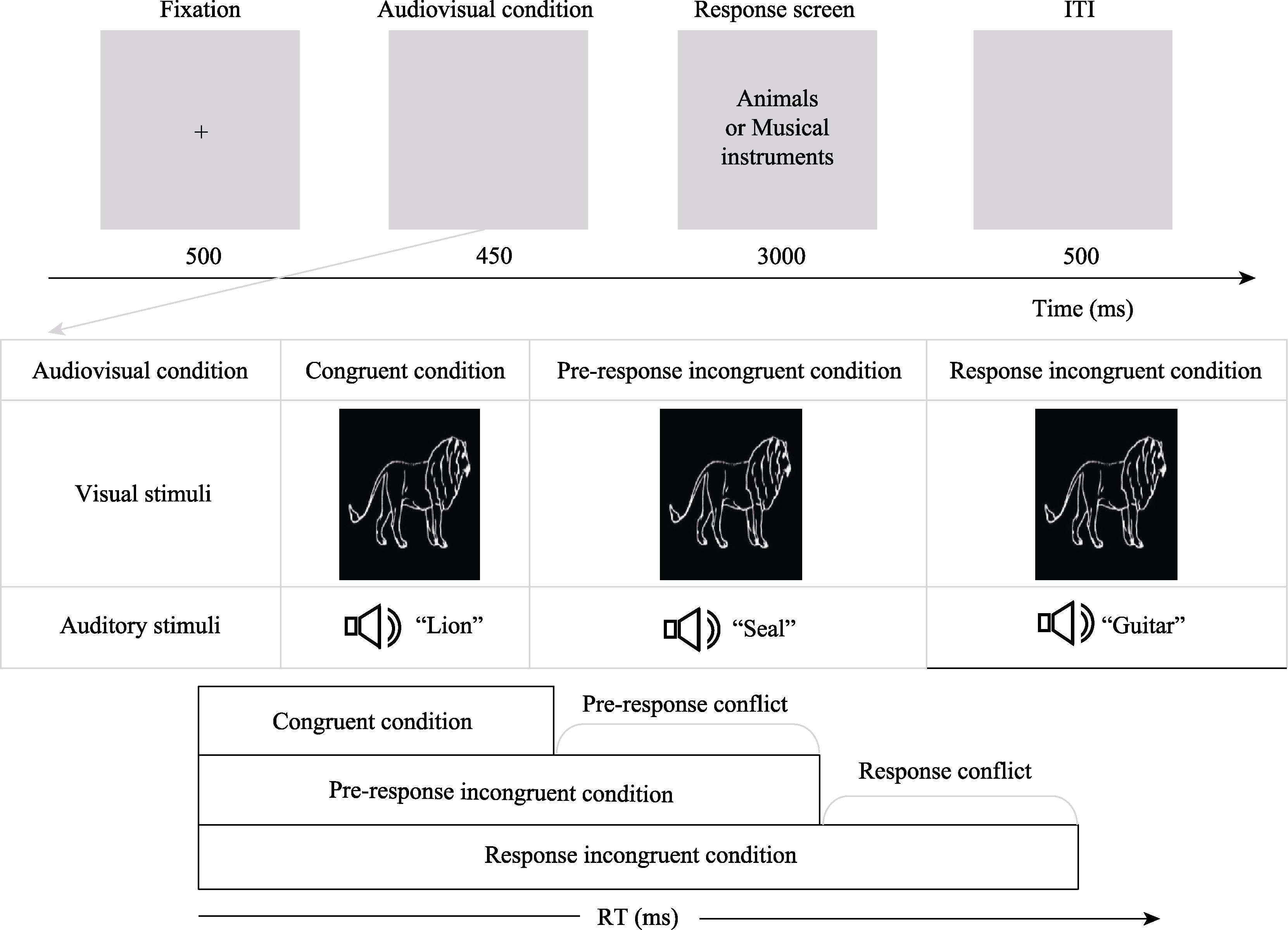
Figure 1. Illustrates the stimulus examples and experimental procedure for Experiment 1c. The audiovisual stimuli were composed of three conditions: congruent condition: the audiovisual stimuli were identical. Pre-response incongruent condition: the audiovisual stimuli were not consistent, but the corresponding key presses were the same. Response incongruent condition: the audiovisual stimuli and corresponding key presses were mismatched. Pre-response conflict was defined as the difference between the reaction time in the pre-response incongruent condition and the reaction time in the congruent condition. Response conflict was calculated as the difference between the reaction time in the response incongruent condition and the reaction time in the pre-response inconsistent condition.
| Attended to the visual | Attended to the auditory | |||||
|---|---|---|---|---|---|---|
| Congruent | Pre-response incongruent | Response incongruent | Congruent | Pre-response incongruent | Response incongruent | |
| Ex 1a | 494 ± 20 | 542 ± 29 | 539 ± 29 | 756 ± 25 | 850 ± 29 | 884 ± 32 |
| Ex 1b | 522 ± 32 | 571 ± 40 | 602 ± 45 | 787 ± 26 | 873 ± 339 | 907 ± 34 |
| Ex 1c | 496 ± 30 | 529 ± 37 | 562 ± 45 | 777 ± 27 | 862 ± 30 | 867 ± 30 |
| Ex 2 | 503 ± 27 | 535 ± 33 | 559 ± 36 | 791 ± 24 | 874 ± 26 | 880 ± 29 |
| Ex 3-sham | 520 ± 22 | 522 ± 25 | 591 ± 28 | 704 ± 34 | 761 ± 38 | 807 ± 33 |
| Ex 3-cathodal | 510 ± 24 | 539 ± 27 | 580 ± 38 | 679 ± 26 | 734 ± 29 | 773 ± 27 |
Table 1 The mean reaction times and standard errors of the participants across all experiments. (ms)
| Attended to the visual | Attended to the auditory | |||||
|---|---|---|---|---|---|---|
| Congruent | Pre-response incongruent | Response incongruent | Congruent | Pre-response incongruent | Response incongruent | |
| Ex 1a | 494 ± 20 | 542 ± 29 | 539 ± 29 | 756 ± 25 | 850 ± 29 | 884 ± 32 |
| Ex 1b | 522 ± 32 | 571 ± 40 | 602 ± 45 | 787 ± 26 | 873 ± 339 | 907 ± 34 |
| Ex 1c | 496 ± 30 | 529 ± 37 | 562 ± 45 | 777 ± 27 | 862 ± 30 | 867 ± 30 |
| Ex 2 | 503 ± 27 | 535 ± 33 | 559 ± 36 | 791 ± 24 | 874 ± 26 | 880 ± 29 |
| Ex 3-sham | 520 ± 22 | 522 ± 25 | 591 ± 28 | 704 ± 34 | 761 ± 38 | 807 ± 33 |
| Ex 3-cathodal | 510 ± 24 | 539 ± 27 | 580 ± 38 | 679 ± 26 | 734 ± 29 | 773 ± 27 |
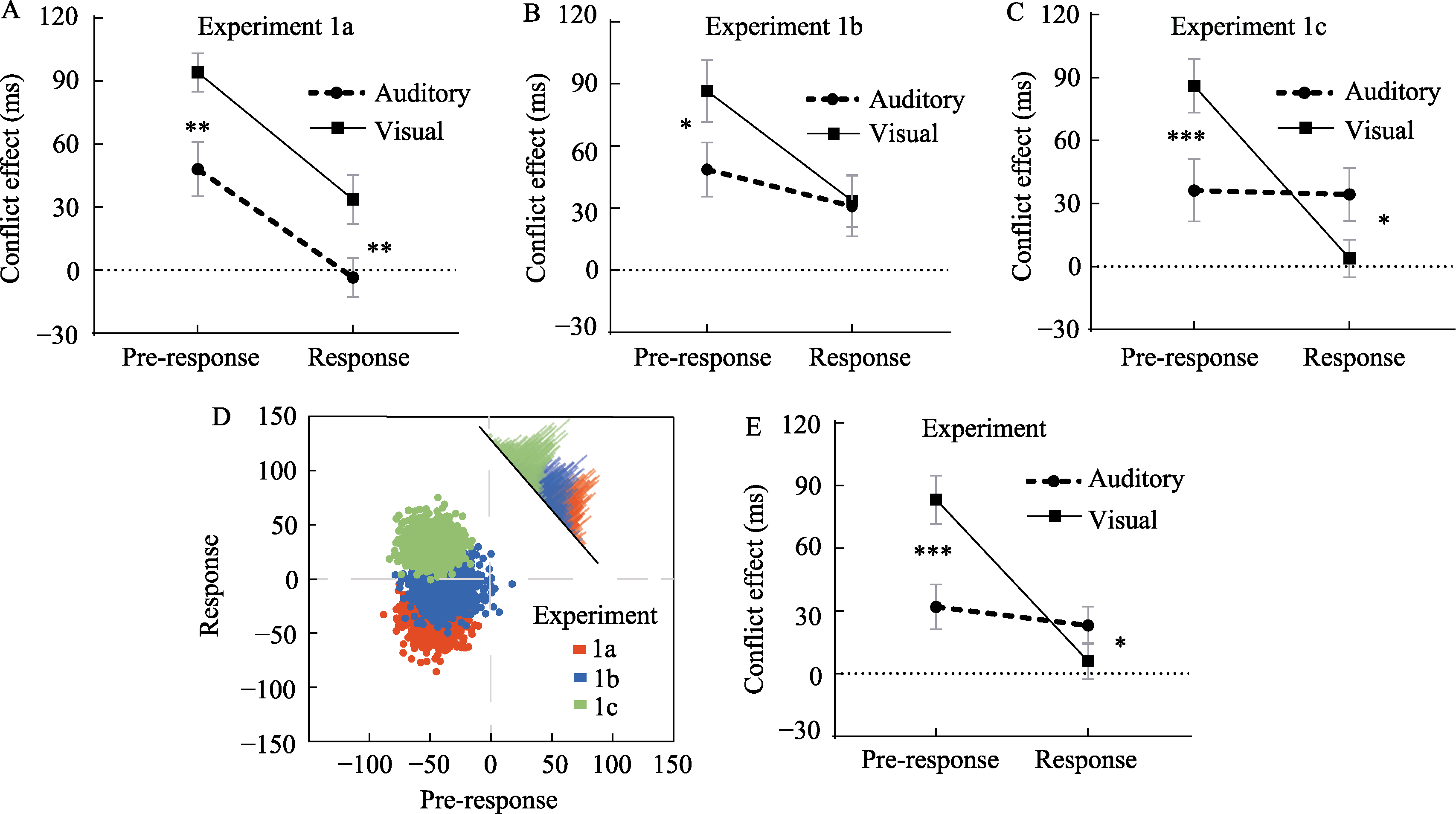
Figure 2. presents the results of Experiments 1 and 2. A to C depict the outcomes of Experiments 1a to 1c, respectively; D illustrates the distribution of sample mean values obtained by resampling the sensory dominance indices (the difference between auditory conflict and visual conflict) from each condition of Experiment 1; E shows the results of Experiment 2. Note: ***p < 0.001, **p < 0.01, and *p < 0.05. Error bars indicate standard errors. Color figures are available in the electronic version.
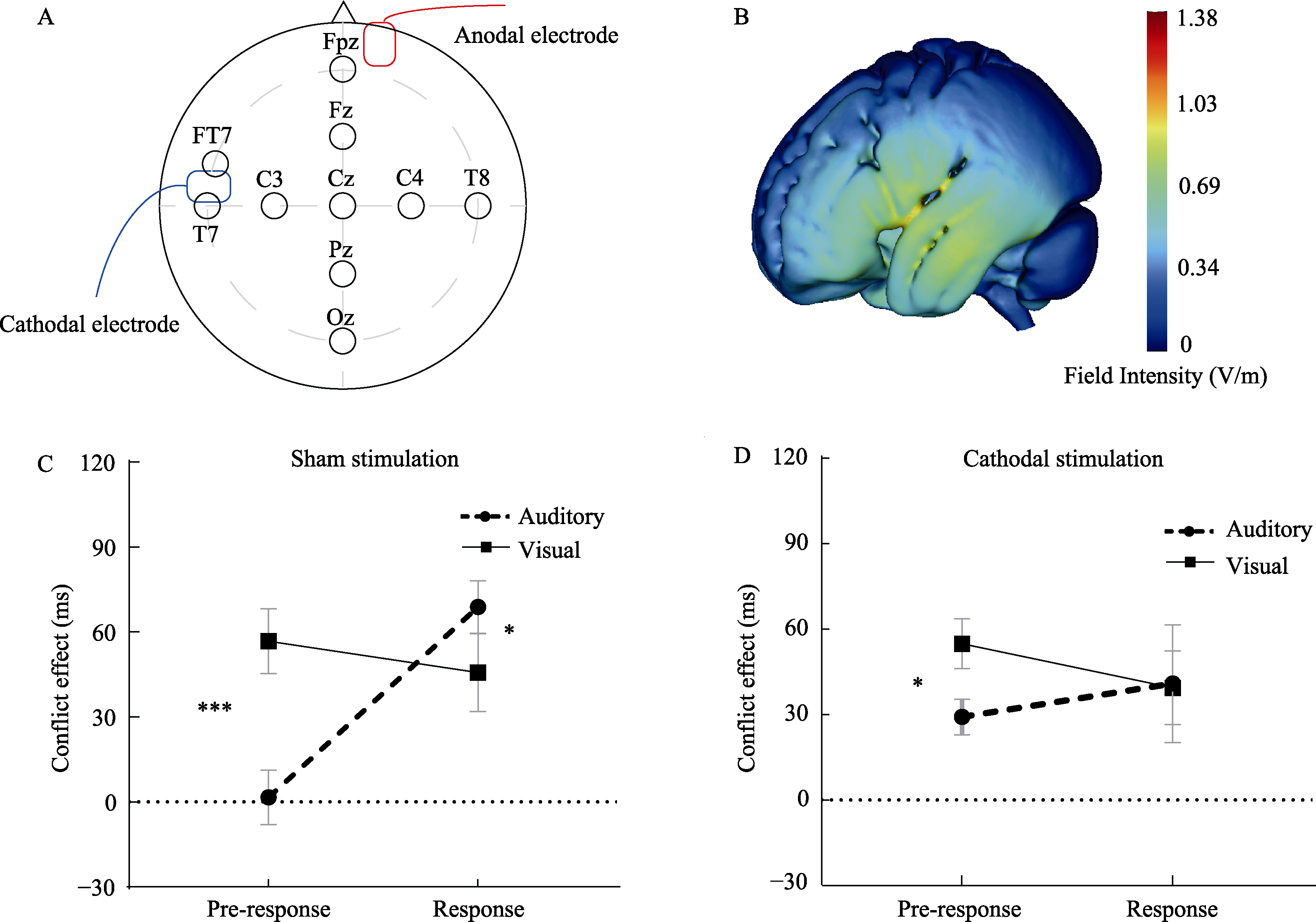
Figure 3. A. Diagram showing the localization of the left anterior temporal lobe cortex on the international 10-20 EEG system, situated between T7 and FT7. B. Electrode field model of the left anterior temporal lobe cortex simulated in the HD-explore software on a standard brain model. C. Experimental results under the pseudo-stimulation condition. D. Experimental results under the cathodal stimulation condition. Note: ***p < 0.001, *p < 0.05. Error bars represent the standard error of the mean. Color figures are available in the electronic version.
| [1] |
Akbıyık, S., Goksun, T., & Balcı, F. (2020). Cathodal tDCS stimulation of left anterior temporal lobe eliminates cross-category color discrimination response time advantage. Behavioural Brain Research, 391, 112682.
doi: 10.1016/j.bbr.2020.112682 pmid: 32445777 |
| [2] |
Amedi, A., Hofstetter, S., Maidenbaum, S., & Heimler, B. (2017). Task selectivity as a comprehensive principle for brain organization. Trends in Cognitive Sciences, 21(5), 307-310.
doi: S1364-6613(17)30050-5 pmid: 28385460 |
| [3] | Baddeley, A. D., & Hitch, G. J. (2017). Is the levels of processing effect language-limited? Journal of Memory and Language, 92, 1-13. |
| [4] |
Bi, Y. C., Wang, X. Y., & Caramazza, A. (2016). Object domain and modality in the ventral visual pathway. Trends in Cognitive Sciences, 20(4), 282-290.
doi: S1364-6613(16)00043-7 pmid: 26944219 |
| [5] |
Binney, R. J., Ashaie, S. A., Zuckerman, B. M., Hung, J. Y., & Reilly, J. (2018). Frontotemporal stimulation modulates semantically-guided visual search during confrontation naming: A combined tDCS and eye tracking investigation. Brain and Language, 180-182, 14-23.
doi: S0093-934X(17)30362-0 pmid: 29655024 |
| [6] | Butera, I. M., Stevenson, R. A., Gifford, R. H., & Wallace, M. T. (2023). Visually biased perception in cochlear implant users: A study of the McGurk and Sound-induced flash illusions. Trends in Hearing, 27, 23312165221076681. |
| [7] | Callan, A., Callan, D., & Ando, H. (2015). An fMRI study of the ventriloquism effect. Cerebral Cortex, 25(11), 4248-4258. |
| [8] | Chen, A. T., Liu, Q., Chen, C. M., & Li, H. (2010). The effect of Intermediate processing level on response conflict in Stroop- like tasks. Journal of Psychological Science, 33(3), 569-572. |
| [9] |
Chen, Q., & Zhou, X. L. (2013). Vision dominates at the preresponse level and audition dominates at the response level in cross-modal interaction: Behavioral and neural evidence. Journal of Neuroscience, 33(17), 7109-7121.
doi: 10.1523/JNEUROSCI.1985-12.2013 pmid: 23616521 |
| [10] | Colavita, F. B. (1974). Human sensory dominance. Perception & Psychophysics, 16(2), 409-412. |
| [11] | Dietze, N., & Poth, C. H. (2023). Vision rivals audition in alerting humans for fast action. Acta Psychologica, 238, 103991. |
| [12] | Dirani, J., & Pylkkänen, L. (2023). The time course of cross-modal representations of conceptual categories. NeuroImage, 277, 120254. |
| [13] |
Donohue, S. E., Todisco, A. E., & Woldorff, M. G. (2013). The rapid distraction of attentional resources toward the source of incongruent stimulus input during multisensory conflict. Journal of Cognitive Neuroscience, 25(4), 623-635.
doi: 10.1162/jocn_a_00336 pmid: 23249355 |
| [14] |
Faul, F., Erdfelder, E., Buchner, A., & Lang, A.-G. (2009). Statistical power analyses using G*Power 3.1: Tests for correlation and regression analyses. Behavior Research Methods, 41(4), 1149-1160.
doi: 10.3758/BRM.41.4.1149 pmid: 19897823 |
| [15] |
Faul, F., Erdfelder, E., Lang, A.-G., & Buchner, A. (2007). G*Power 3: A flexible statistical power analysis program for the social, behavioral, and biomedical sciences. Behavior Research Methods, 39, 175-191.
doi: 10.3758/bf03193146 pmid: 17695343 |
| [16] |
Haselton, M. G., & Buss, D. M. (2000). Error management theory: A new perspective on biases in cross-sex mind reading. Journal of personality and social psychology, 78(1), 81-91.
pmid: 10653507 |
| [17] | Hockley, W. E., & Bancroft, T. (2011). Extensions of the picture superiority effect in as-sociative recognition. Canadian Journal of Experimental Psychology, 65(4), 236-244. |
| [18] | Higdon, K. F., Neath, I., Surprenant, A. M., & Ensor, T. M. (2024). Distinctiveness, not dual coding, explains the picture-superiority effect. Quarterly Journal of Experimental Psychology. https://doi.org/10.1177/17470218241235520 |
| [19] | Hirst, R. J., Cragg, L., & Allen, H. A. (2018). Vision dominates audition in adults but not children: A meta-analysis of the Colavita effect. Neuroscience & Biobehavioral Reviews, 94, 286-301. |
| [20] | Hirst, R. J., McGovern, D. P., Setti, A., Shams, L., & Newell, F. N. (2020). What you see is what you hear: Twenty years of research using the sound-induced flash illusion. Neuroscience & Biobehavioral Reviews, 118, 759-774. |
| [21] | Kang, G. L., & Luo, X. X. (2020). The integration and conflict control in audiovisual processing. Journal of Psychological Science, 43(5), 1072-1078. |
| [22] |
Kato, M., & Konishi, Y. (2006). Auditory dominance in the error correction process: A synchronized tapping study. Brain Research, 1084(1), 115-122.
pmid: 16556436 |
| [23] |
Keil, J. (2020). Double flash illusions: Current findings and future directions. Frontiers in Neuroscience, 14, 298-304.
doi: 10.3389/fnins.2020.00298 pmid: 32317920 |
| [24] |
Koppen, C., Levitan, C. A., & Spence, C. (2009). A signal detection study of the Colavita visual dominance effect. Experimental Brain Research, 196(3), 353-360.
doi: 10.1007/s00221-009-1853-y pmid: 19488743 |
| [25] | Lambon Ralph, M. A., & Patterson, K. (2008). Generalization and differentiation in semantic memory:Insights from semantic dementia. Annals of the New York Academy of Sciences, 1124(1), 61-76. |
| [26] |
Laws, K. R. (2000). Category-specific naming errors in normal subjects: The influence of evolution and experience. Brain and Language, 75(1), 123-133.
pmid: 11023642 |
| [27] | Li, X., Cai, S. Z., Chen, Y., Tian, X. M., & Wang, A. J. (2024). Enhancement of visual dominance effects at the response level in children with attention-deficit/hyperactivity disorder. Journal of Experimental Child Psychology. 242, 105897. |
| [28] |
Li, Z., Gu, R., Qi, M., Cen, J., Zhang, S., Gu, J., Zeng, X., & Chen, Q. (2019). Loss of vision dominance at the preresponse level in tinnitus patients: Preliminary behavioral evidence. Frontiers in Neuroscience, 13, 482.
doi: 10.3389/fnins.2019.00482 pmid: 31139048 |
| [29] |
Martin, A. (2007). The representation of object concepts in the brain. Annual Review of Psychology, 58, 25-45.
pmid: 16968210 |
| [30] |
Martin, A., & Chao, L. (2001). Semantic memory and the brain: Structure and processes. Current Opinion in Neurobiology, 11(2), 194-201.
doi: 10.1016/s0959-4388(00)00196-3 pmid: 11301239 |
| [31] | Mayer, A. R., Franco, A. R., Canive, J., & Harrington, D. L. (2009). The effects of stimulus modality and frequency of stimulus presentation on cross-modal distraction. Cerebral Cortex, 19(5), 993-1007. |
| [32] | Mesulam, M. M., Wieneke, C., Hurley, R., Rademaker, A., Thompson, C. K., Weintraub, S., & Rogalski, E. J. (2013). Words and objects at the tip of the left temporal lobe in primary progressive aphasia. Brain, 136(2), 601-618. |
| [33] |
Molholm, S., Ritter, W., Javitt, D. C., & Foxe, J. J. (2004). Multisensory visual-auditory object recognition in humans: A high-density electrical mapping study. Cerebral Cortex, 14(4), 452-465.
doi: 10.1093/cercor/bhh007 pmid: 15028649 |
| [34] | Morgenstern, Y., Storrs, K. R., Schmidt, F., Hartmann, F., Tiedemann, H., Wagemans, J., & Fleming, R. W. (2024). High-level aftereffects reveal the role of statistical features in visual shape encoding. Current Biology, 34(5), 1098-1106. |
| [35] | Nieznański, M. (2020). Levels-of-processing effects on context and target recollection for words and pictures. Acta Psychologica, 209, 103127. |
| [36] | Odegaard, B., Wozny, D. R., & Shams, L. (2016). The effects of selective and divided attention on sensory precision and integration. Neurosciences Letters, 614, 24-28. |
| [37] | Potter, M. C., & Fox, L. F. (2009). Detecting and remembering simultaneous pictures in a rapid serial visual presentation. Journal of Experimental Psychology-Human Perception and Pertypyance, 35(1), 28-38. |
| [38] | Roberts, B. R. T., MacLeod, C. M., & Fernandes, M. A. (2023). Symbol superiority: Why $ is better remembered than ‘dollar’. Cognition, 238, 105435. |
| [39] | Robinson, C. W., Chandra, M., & Sinnett, S. (2016). Existence of competing modality dominances. Attention, Perception, & Psychophysics, 78(4), 1104-1114. |
| [40] | Schubert, E. (2021). Creativity is optimal novelty and maximal positive affect: A new definition based on the spreading activation model. Frontiers in Neuroscience, 15, 612379. |
| [41] | Shams, L., Kamitani, Y., & Shimojo, S. (2000). What you see is what you hear. Nature, 408(6814), 788-788. |
| [42] | Snodgrass, J. G., & Vanderwart, M. (1980). A standardized set of 260 picture: Norms for name agreement, image agreement, familiarity, and visual complexity. Journal of Experimental Psychology: Learning, Memory, and Cognition, 6(2), 174-215. |
| [43] |
Stein, B. E., & Stanford, T. R. (2008). Multisensory integration: Current issues from the perspective of the single neuron. Nature Reviews Neuroscience, 9(4), 255-266.
doi: 10.1038/nrn2331 pmid: 18354398 |
| [44] | Tang, X. Y., Wu, J. L., & Shen, Y. (2016). The interactions of multisensory integration with endogenous and exogenous attention. Neuroscience & Biobehavioral Reviews, 61, 208-224. |
| [45] |
Ubaldi, S., & Fairhall, S. L. (2021). fMRI response to automatic and purposeful familiar-face processing in perceptual and nonperceptual cortical regions. Journal of Neurophysiology, 125(4), 1058-1067.
doi: 10.1152/jn.00481.2020 pmid: 33596739 |
| [46] | Velasquez, A. G., Gazzaley, A., Toyoda, H., Ziegler, D. A., & Morsella, E. (2021). The generation of involuntary mental imagery in an ecologically-valid task. Frontiers in Psychology. 12, 759685. |
| [47] | Visconti di Oleggio Castello, M., Haxby, J. V., & Gobbini, M. I. (2021). Shared neural codes for visual and semantic information about familiar faces in a common representational space. Proceedings of the National Academy of Sciences, 118(45), e2110474118. |
| [48] |
Vogler, J. N., & Titchener, K. (2011). Cross-modal conflicts in object recognition: Determining the influence of object category. Experimental Brain Research, 214, 597-605.
doi: 10.1007/s00221-011-2858-x pmid: 21912929 |
| [49] |
Wang, A. J., Huang, J., Lu, F. F. He, J. Y., Tang, X. Y., & Zhang, M. (2020). Sound-induced flash illusion in multisensory integration. Advances in Psychological Science, 28(10), 1662-1677.
doi: 10.3724/SP.J.1042.2020.01662 |
| [50] |
Wang, A. J., Sang, H. B., He, J. Y., Sava-Segal, C., Tang, X. Y., & Zhang, M. (2019). Effects of cognitive expectation on sound-induced flash illusion. Perception, 48(12), 1214-1234.
doi: 10.1177/0301006619885796 pmid: 31808371 |
| [51] | Wang, A., Zhou, H., Zhang, F., Sang, H., Yu, W., Tang, X., Zhang, T., & Zhang, M. (2021). Repetition suppression in visual and auditory modalities affects the sound-induced flash illusion. Perception, 50(6), 489-507. |
| [52] | Wang, Y. H., Wang, Y. F., & Zhou, X. L. (2006). Conflict Control at different periods of processing in children with two subtypes of ADHD. Acta Psychologica Sinica, 38(2), 181-188. |
| [53] |
Wiggett, A. T., Pritchard, R. C., & Downing, P. E. (2009). Animate and inanimate objects in human visual cortex: Evidence for task-independent category effects. Neuropsychologia, 47(14), 3111-3117.
doi: 10.1016/j.neuropsychologia.2009.07.008 pmid: 19631673 |
| [54] |
Wong, C., & Gallate, J. (2012). The function of the anterior temporal lobe: A review of the empirical evidence. Brain Research, 1449, 94-116.
doi: 10.1016/j.brainres.2012.02.017 pmid: 22421014 |
| [55] | Wozny, D. R., Beierholm, U. R., & Shams, L. (2008). Human trimodal perception follows optimal statistical inference. Journal of Vision, 8(3), 1-11. |
| [56] | Zhou, H., Li, S., Huang, J., Yang, J., Wang, A., & Zhang, M. (2022). Sound-induced flash illusions at different spatial locations were affected by personality traits. Attention, Perception, & Psychophysics, 85(2), 463-473. |
| [1] | LI Yaojin, ZHANG Wei, FU Bei, ZHOU Bingping. Adult attention deficit hyperactivity disorder in internal and external conflicts: Evidence from Saccade task [J]. Acta Psychologica Sinica, 2020, 52(6): 777-785. |
| [2] | Ming ZHANG,Xiaoyu TANG,Wei YU,Bo NING,Zhinan WANG,Aijun WANG. The Effects of modal-based endogenous attention on sound-induced flash illusion [J]. Acta Psychologica Sinica, 2018, 50(11): 1212-1221. |
| [3] | YU Wei, WANG Aijun, ZHANG Ming. Effect of selective and divided attentions on auditory dominance in multisensory integration [J]. Acta Psychologica Sinica, 2017, 49(2): 164-173. |
| Viewed | ||||||
|
Full text |
|
|||||
|
Abstract |
|
|||||
