

ISSN 0439-755X
CN 11-1911/B
CN 11-1911/B
Acta Psychologica Sinica ›› 2025, Vol. 57 ›› Issue (9): 1512-1528.doi: 10.3724/SP.J.1041.2025.1512
• Reports of Empirical Studies • Previous Articles Next Articles
XIANG Ying1,2, HE Fei4, FENG Linlin1,2, LONG Mengling5, BAI Xuejun1,2,3, LIANG Feifei1,2,3( )
)
Published:2025-09-25
Online:2025-06-26
Contact:
LIANG Feifei
E-mail:feifeiliang_329@126.com
XIANG Ying, HE Fei, FENG Linlin, LONG Mengling, BAI Xuejun, LIANG Feifei. (2025). Processing strategies in focus: How highly-efficient and less-efficient learners navigate novel word learning in Chinese reading. Acta Psychologica Sinica, 57(9), 1512-1528.
Add to citation manager EndNote|Ris|BibTeX
URL: https://journal.psych.ac.cn/acps/EN/10.3724/SP.J.1041.2025.1512

Figure 1. Focus-Enrichment Model (Rieder, 2002).
| Condition | Semantic transparency | Right-radicals familiarity | Stroke |
|---|---|---|---|
| Transparent | 4.64(0.23) | 2.43(0.86) | 8.88(1.55) |
| Opaque | 1.22(0.35) | 2.73(1.14) | 8.38(1.06) |
Table 1 Descriptive Characteristics of Novel Words (Mean (SD))
| Condition | Semantic transparency | Right-radicals familiarity | Stroke |
|---|---|---|---|
| Transparent | 4.64(0.23) | 2.43(0.86) | 8.88(1.55) |
| Opaque | 1.22(0.35) | 2.73(1.14) | 8.38(1.06) |
| Sentence number | |
|---|---|
| 1 | 全身长着白毛的新生  /坺都是胖乎乎的样子,很招人喜欢。 /坺都是胖乎乎的样子,很招人喜欢。Newborn NW covered entirely in white fur are all chubby in appearance, very adorable. |
| 2 | 长大后,变黑的爪子和尾巴就是  /坺最特别的地方。 /坺最特别的地方。As they grow up, their blackened paws and tails become the most distinctive features of NW. |
| 3 | 雪地上的四个独特的爪印是发现  /坺活动轨迹的主要线索。 /坺活动轨迹的主要线索。The four unique paw prints in the snow are the primary clues for tracking NW activity. |
| 4 | 探险家说,灵活的四肢足以保证  /坺在树枝间安全爬行。 /坺在树枝间安全爬行。Explorers say that flexible limbs are enough to ensure NW can safely crawl among tree branches. |
| 5 | 靠闻气味找到食物是幼小  /坺天生就有的强大本领。 /坺天生就有的强大本领。Relying on scent to locate food is an innate and powerful ability of young NW. |
| 6 | 寒潮来临,群居的弱小雌性  /坺经常会挤在一起取暖。 /坺经常会挤在一起取暖。When cold waves arrive, weaker female NW living in groups often huddle together for warmth. |
Table 2 Example stimuli and sentence frames
| Sentence number | |
|---|---|
| 1 | 全身长着白毛的新生 /坺都是胖乎乎的样子,很招人喜欢。 Newborn NW covered entirely in white fur are all chubby in appearance, very adorable. |
| 2 | 长大后,变黑的爪子和尾巴就是 /坺最特别的地方。 As they grow up, their blackened paws and tails become the most distinctive features of NW. |
| 3 | 雪地上的四个独特的爪印是发现 /坺活动轨迹的主要线索。 The four unique paw prints in the snow are the primary clues for tracking NW activity. |
| 4 | 探险家说,灵活的四肢足以保证 /坺在树枝间安全爬行。 Explorers say that flexible limbs are enough to ensure NW can safely crawl among tree branches. |
| 5 | 靠闻气味找到食物是幼小 /坺天生就有的强大本领。 Relying on scent to locate food is an innate and powerful ability of young NW. |
| 6 | 寒潮来临,群居的弱小雌性 /坺经常会挤在一起取暖。 When cold waves arrive, weaker female NW living in groups often huddle together for warmth. |
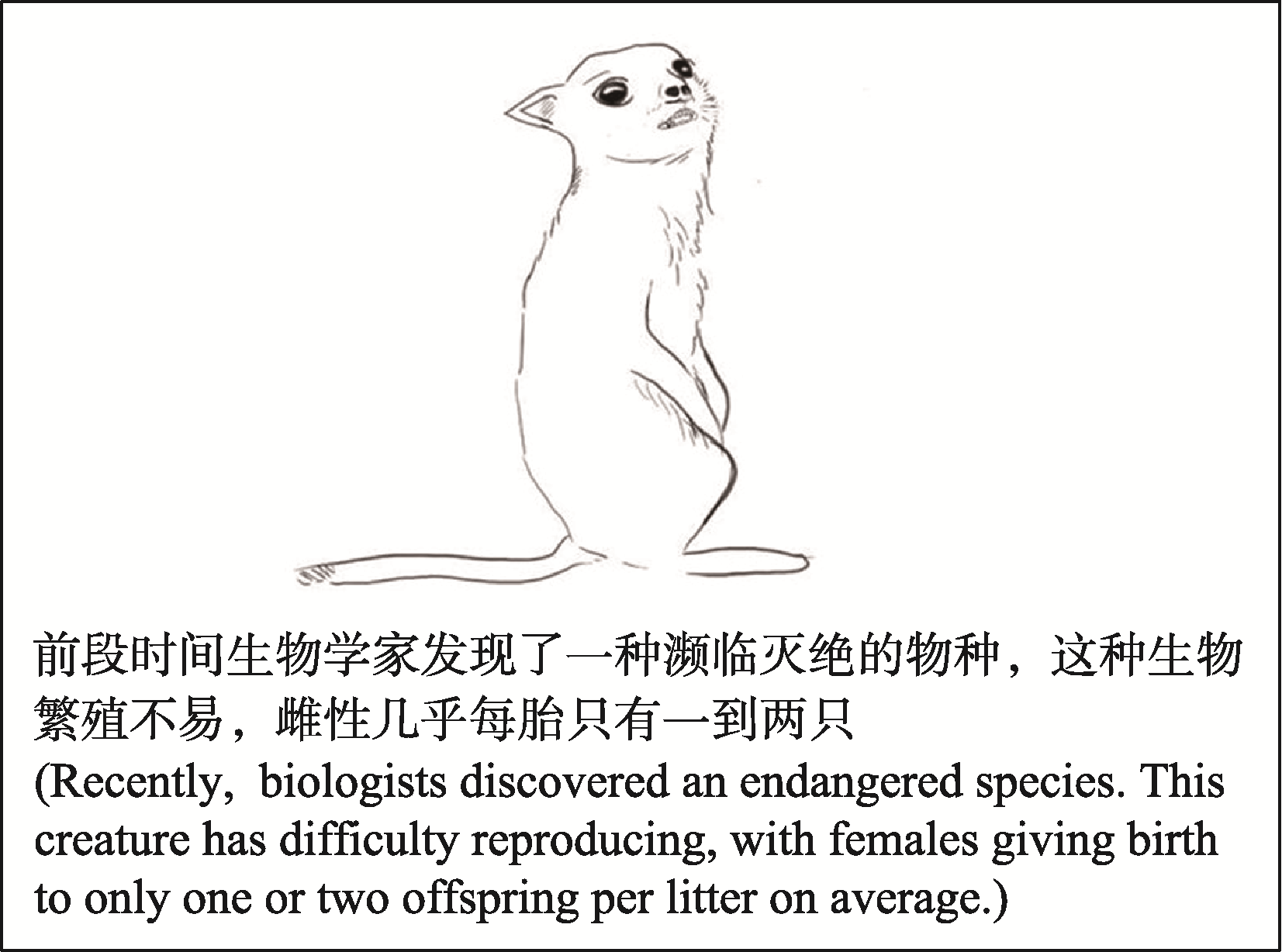
Figure 2. Example of semantic activation materials.
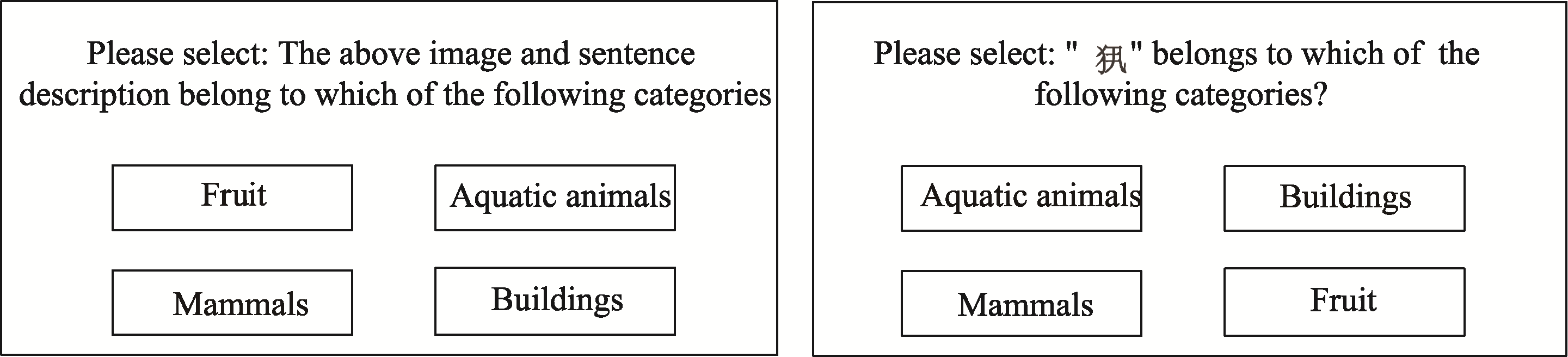
Figure 3. Example of semantic category selection questions.

Figure 4. Procedure.
| E | FFD | GD | RPD | ROP | RR | TFD | TFC | SRT | SFC | FTR | FCR |
|---|---|---|---|---|---|---|---|---|---|---|---|
| 1 | −0.009 | 0.10 | 0.22* | 0.31* | 0.61** | 0.61** | 0.59** | 0.45** | 0.40** | 0.36** | 0.32** |
| 2 | −0.006 | 0.03 | 0.09 | 0.04 | 0.25* | 0.36** | 0.40** | 0.38** | 0.34** | −0.006 | −0.05 |
| 3 | 0.12 | 0.15 | 0.10 | 0.19 | 0.49** | 0.53** | 0.47** | 0.40** | 0.35** | 0.07 | 0.04 |
| 4 | −0.05 | 0.05 | 0.22* | 0.22 | −0.07 | 0.28** | 0.39** | 0.36** | 0.34** | −0.13 | −0.07 |
| 5 | 0.14 | 0.14 | 0.07 | 0.17 | 0.07 | 0.34** | 0.26** | 0.37** | 0.35** | −0.07 | −0.14 |
| 6 | −0.08 | −0.04 | 0.08 | 0.30** | 0.26** | 0.20* | 0.22* | 0.39** | 0.36** | −0.23* | −0.25** |
Table 3 Correlation coefficients between orthographic discrimination Index and eye movement measures
| E | FFD | GD | RPD | ROP | RR | TFD | TFC | SRT | SFC | FTR | FCR |
|---|---|---|---|---|---|---|---|---|---|---|---|
| 1 | −0.009 | 0.10 | 0.22* | 0.31* | 0.61** | 0.61** | 0.59** | 0.45** | 0.40** | 0.36** | 0.32** |
| 2 | −0.006 | 0.03 | 0.09 | 0.04 | 0.25* | 0.36** | 0.40** | 0.38** | 0.34** | −0.006 | −0.05 |
| 3 | 0.12 | 0.15 | 0.10 | 0.19 | 0.49** | 0.53** | 0.47** | 0.40** | 0.35** | 0.07 | 0.04 |
| 4 | −0.05 | 0.05 | 0.22* | 0.22 | −0.07 | 0.28** | 0.39** | 0.36** | 0.34** | −0.13 | −0.07 |
| 5 | 0.14 | 0.14 | 0.07 | 0.17 | 0.07 | 0.34** | 0.26** | 0.37** | 0.35** | −0.07 | −0.14 |
| 6 | −0.08 | −0.04 | 0.08 | 0.30** | 0.26** | 0.20* | 0.22* | 0.39** | 0.36** | −0.23* | −0.25** |

Figure 5. Comparison of eye-movement fixation patterns on novel words between highly- and less-efficient readers.
| b | SE | t/z | p | 95% CI | ||
|---|---|---|---|---|---|---|
| First fixation duration | Intercept | 5.56 | 0.02 | 347.71 | < 0.001 | [5.53, 5.59] |
| Group | −0.06 | 0.02 | −2.31 | 0.02 | [−0.10, −0.008] | |
| Exposure | −0.03 | 0.005 | −5.17 | < 0.001 | [−0.04, −0.02] | |
| Group×Exposure | 0.005 | 0.008 | 0.60 | 0.55 | [−0.01, 0.02] | |
| Gaze duration | Intercept | 5.62 | 0.03 | 212.01 | < 0.001 | [5.57, 5.68] |
| Group | −0.09 | 0.05 | −1.92 | 0.06 | [−0.18, 0.002] | |
| Exposure | −0.03 | 0.005 | −6.05 | < 0.001 | [−0.04, −0.02] | |
| Group×Exposure | 0.009 | 0.008 | 1.16 | 0.25 | [−0.006, 0.02] | |
| Regression path duration | Intercept | 6.03 | 0.03 | 191.02 | < 0.001 | [5.96, 6.09] |
| Group | −0.28 | 0.04 | −7.25 | < 0.001 | [−0.36, −0.21] | |
| Exposure | −0.06 | 0.009 | −6.18 | < 0.001 | [−0.08, −0.04] | |
| Group×Exposure | 0.05 | 0.01 | 3.43 | < 0.001 | [0.02, 0.07] | |
| Regression-out probability | Intercept | −0.84 | 0.14 | −6.09 | < 0.001 | [−1.10, −0.57] |
| Group | −0.59 | 0.22 | −2.72 | 0.006 | [−1.01, −0.17] | |
| Exposure | −0.10 | 0.03 | −3.21 | 0.001 | [−0.16, −0.04] | |
| Group×Exposure | 0.10 | 0.04 | 2.35 | 0.02 | [0.02, 0.18] | |
| Re-reading time | Intercept | 5.90 | 0.04 | 155.69 | < 0.001 | [5.83, 5.98] |
| Group | −0.41 | 0.06 | −6.79 | < 0.001 | [−0.53, −0.29] | |
| Exposure | −0.07 | 0.01 | −6.09 | < 0.001 | [−0.09, −0.04] | |
| Group×Exposure | 0.07 | 0.02 | 3.66 | < 0.001 | [0.03, 0.10] | |
| Total fixation count | Intercept | 1.46 | 0.07 | 21.36 | < 0.001 | [1.33, 1.60] |
| Group | −0.48 | 0.11 | −4.47 | < 0.001 | [−0.69, −0.27] | |
| Exposure | −0.10 | 0.01 | −7.27 | < 0.001 | [−0.13, −0.07] | |
| Group×Exposure | 0.06 | 0.02 | 3.53 | < 0.001 | [0.03, 0.10] | |
| Total fixation duration | Intercept | 6.02 | 0.04 | 161.23 | < 0.001 | [5.94, 6.09] |
| Group | −0.29 | 0.06 | −4.93 | < 0.001 | [−0.40, −0.17] | |
| Exposure | −0.07 | 0.008 | −8.66 | < 0.001 | [−0.08, −0.05] | |
| Group×Exposure | 0.04 | 0.01 | 4.03 | < 0.001 | [0.02, 0.06] |
Table 4 Results of mixed-effects linear model analysis on eye-movement measures for novel words in highly- and less-efficient readers
| b | SE | t/z | p | 95% CI | ||
|---|---|---|---|---|---|---|
| First fixation duration | Intercept | 5.56 | 0.02 | 347.71 | < 0.001 | [5.53, 5.59] |
| Group | −0.06 | 0.02 | −2.31 | 0.02 | [−0.10, −0.008] | |
| Exposure | −0.03 | 0.005 | −5.17 | < 0.001 | [−0.04, −0.02] | |
| Group×Exposure | 0.005 | 0.008 | 0.60 | 0.55 | [−0.01, 0.02] | |
| Gaze duration | Intercept | 5.62 | 0.03 | 212.01 | < 0.001 | [5.57, 5.68] |
| Group | −0.09 | 0.05 | −1.92 | 0.06 | [−0.18, 0.002] | |
| Exposure | −0.03 | 0.005 | −6.05 | < 0.001 | [−0.04, −0.02] | |
| Group×Exposure | 0.009 | 0.008 | 1.16 | 0.25 | [−0.006, 0.02] | |
| Regression path duration | Intercept | 6.03 | 0.03 | 191.02 | < 0.001 | [5.96, 6.09] |
| Group | −0.28 | 0.04 | −7.25 | < 0.001 | [−0.36, −0.21] | |
| Exposure | −0.06 | 0.009 | −6.18 | < 0.001 | [−0.08, −0.04] | |
| Group×Exposure | 0.05 | 0.01 | 3.43 | < 0.001 | [0.02, 0.07] | |
| Regression-out probability | Intercept | −0.84 | 0.14 | −6.09 | < 0.001 | [−1.10, −0.57] |
| Group | −0.59 | 0.22 | −2.72 | 0.006 | [−1.01, −0.17] | |
| Exposure | −0.10 | 0.03 | −3.21 | 0.001 | [−0.16, −0.04] | |
| Group×Exposure | 0.10 | 0.04 | 2.35 | 0.02 | [0.02, 0.18] | |
| Re-reading time | Intercept | 5.90 | 0.04 | 155.69 | < 0.001 | [5.83, 5.98] |
| Group | −0.41 | 0.06 | −6.79 | < 0.001 | [−0.53, −0.29] | |
| Exposure | −0.07 | 0.01 | −6.09 | < 0.001 | [−0.09, −0.04] | |
| Group×Exposure | 0.07 | 0.02 | 3.66 | < 0.001 | [0.03, 0.10] | |
| Total fixation count | Intercept | 1.46 | 0.07 | 21.36 | < 0.001 | [1.33, 1.60] |
| Group | −0.48 | 0.11 | −4.47 | < 0.001 | [−0.69, −0.27] | |
| Exposure | −0.10 | 0.01 | −7.27 | < 0.001 | [−0.13, −0.07] | |
| Group×Exposure | 0.06 | 0.02 | 3.53 | < 0.001 | [0.03, 0.10] | |
| Total fixation duration | Intercept | 6.02 | 0.04 | 161.23 | < 0.001 | [5.94, 6.09] |
| Group | −0.29 | 0.06 | −4.93 | < 0.001 | [−0.40, −0.17] | |
| Exposure | −0.07 | 0.008 | −8.66 | < 0.001 | [−0.08, −0.05] | |
| Group×Exposure | 0.04 | 0.01 | 4.03 | < 0.001 | [0.02, 0.06] |

Figure 6. Interactions between group and exposure for eye movement measures.
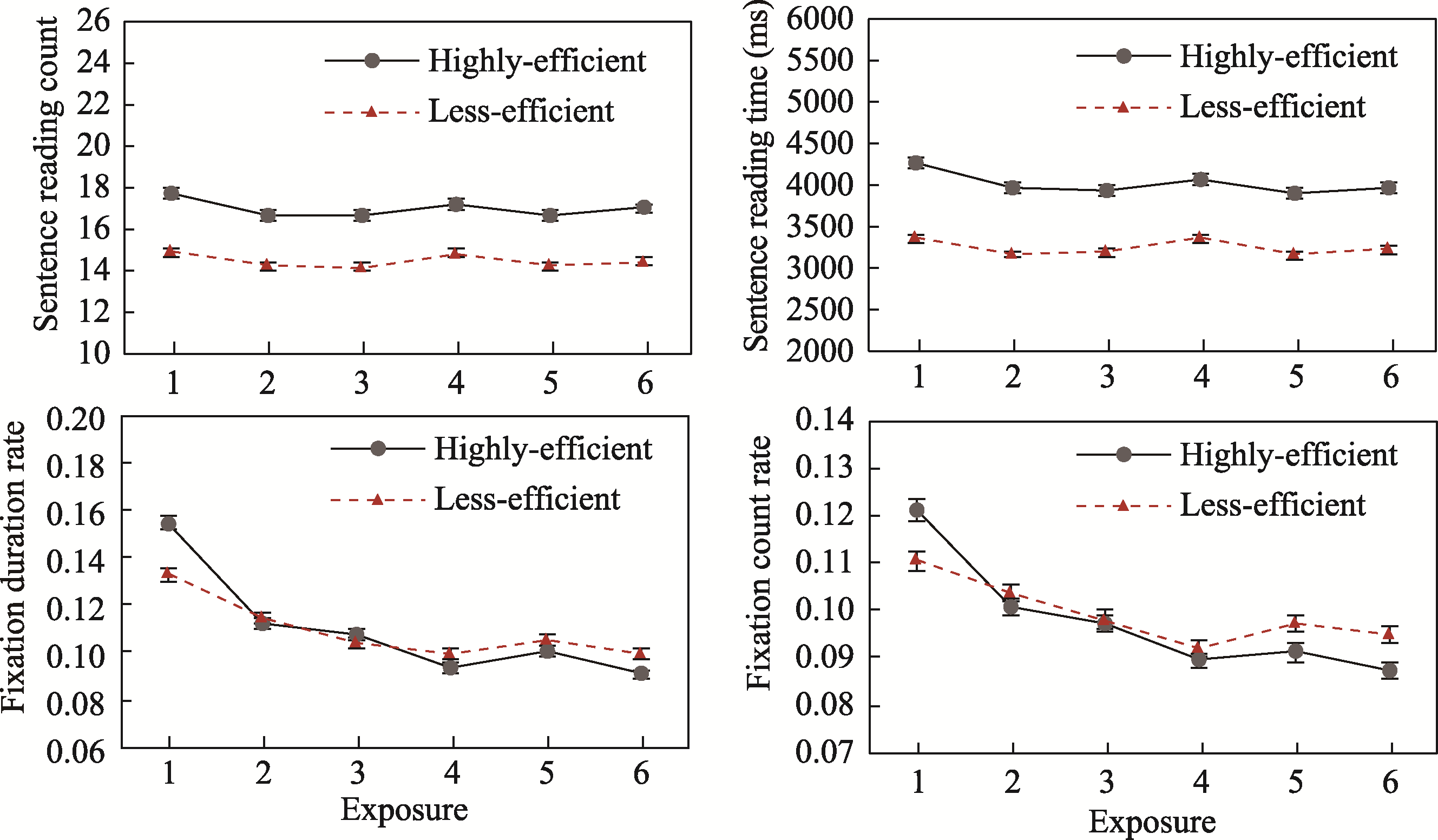
Figure 7. Processing differences between highly- and less-efficient readers for sentences and the relative fixation of novel words in sentences.
| b | SE | t | p | 95% CI | ||
|---|---|---|---|---|---|---|
| Sentence reading time | Intercept | 8.11 | 0.04 | 200.63 | < 0.001 | [8.03, 8.19] |
| Group | −0.23 | 0.06 | −3.97 | < 0.001 | [−0.34, −0.12] | |
| Exposure | −0.009 | 0.008 | −1.16 | 0.25 | [−0.02, 0.006] | |
| Group*Exposure | 0.006 | 0.004 | 1.42 | 0.16 | [−0.002, 0.01] | |
| Sentence reading count | Intercept | 15.93 | 0.43 | 37.28 | < 0.001 | [15.09, 16.76] |
| Group | −2.65 | 0.23 | −11.67 | < 0.001 | [−3.10, −2.21] | |
| Exposure | −0.07 | 0.14 | −0.48 | 0.63 | [−0.35, 0.21] | |
| Group*Exposure | 0.04 | 0.20 | 0.22 | 0.83 | [−0.34, 0.43] | |
| Fixation time ratio | Intercept | 0.14 | 0.005 | 28.26 | < 0.001 | [0.13, 0.15] |
| Group | −0.02 | 0.007 | −2.33 | 0.02 | [−0.03, −0.003] | |
| Exposure | −0.008 | 0.001 | −7.31 | < 0.001 | [−0.01, −0.006] | |
| Group*Exposure | 0.005 | 0.001 | 3.78 | < 0.001 | [0.002, 0.007] | |
| Fixation count ratio | Intercept | 0.11 | 0.003 | 35.72 | < 0.001 | [0.11, 0.12] |
| Group | −0.008 | 0.004 | −2.04 | 0.04 | [−0.02, −0.0003] | |
| Exposure | −0.004 | 0.0007 | −5.91 | < 0.001 | [−0.006, −0.003] | |
| Group*Exposure | 0.003 | 0.0006 | 5.10 | < 0.001 | [0.002, 0.004] |
Table 5 Results of mixed-effects linear model analysis on eye-movement measures for sentences and relative fixation for highly- and less-efficient readers
| b | SE | t | p | 95% CI | ||
|---|---|---|---|---|---|---|
| Sentence reading time | Intercept | 8.11 | 0.04 | 200.63 | < 0.001 | [8.03, 8.19] |
| Group | −0.23 | 0.06 | −3.97 | < 0.001 | [−0.34, −0.12] | |
| Exposure | −0.009 | 0.008 | −1.16 | 0.25 | [−0.02, 0.006] | |
| Group*Exposure | 0.006 | 0.004 | 1.42 | 0.16 | [−0.002, 0.01] | |
| Sentence reading count | Intercept | 15.93 | 0.43 | 37.28 | < 0.001 | [15.09, 16.76] |
| Group | −2.65 | 0.23 | −11.67 | < 0.001 | [−3.10, −2.21] | |
| Exposure | −0.07 | 0.14 | −0.48 | 0.63 | [−0.35, 0.21] | |
| Group*Exposure | 0.04 | 0.20 | 0.22 | 0.83 | [−0.34, 0.43] | |
| Fixation time ratio | Intercept | 0.14 | 0.005 | 28.26 | < 0.001 | [0.13, 0.15] |
| Group | −0.02 | 0.007 | −2.33 | 0.02 | [−0.03, −0.003] | |
| Exposure | −0.008 | 0.001 | −7.31 | < 0.001 | [−0.01, −0.006] | |
| Group*Exposure | 0.005 | 0.001 | 3.78 | < 0.001 | [0.002, 0.007] | |
| Fixation count ratio | Intercept | 0.11 | 0.003 | 35.72 | < 0.001 | [0.11, 0.12] |
| Group | −0.008 | 0.004 | −2.04 | 0.04 | [−0.02, −0.0003] | |
| Exposure | −0.004 | 0.0007 | −5.91 | < 0.001 | [−0.006, −0.003] | |
| Group*Exposure | 0.003 | 0.0006 | 5.10 | < 0.001 | [0.002, 0.004] |

Figure 8. Interactions between group and exposure for relative fixation.

Figure 9. Eye movements on semantically transparent and opaque novel words over exposures for highly- and less-efficient readers.
| b | SE | t | p | 95% CI | ||
|---|---|---|---|---|---|---|
| First fixation duration | Intercept | 5.59 | 0.02 | 279.48 | < 0.001 | [5.55, 5.63] |
| Transparency | 0.04 | 0.03 | 1.15 | 0.25 | [−0.03, 0.11] | |
| Exposure | −0.03 | 0.007 | −4.10 | < 0.001 | [−0.04, −0.01] | |
| Transparency * Exposure | −0.006 | 0.009 | −0.69 | 0.49 | [−0.02, 0.01] | |
| Gaze duration | Intercept | 5.66 | 0.04 | 145.11 | < 0.001 | [5.58, 5.74] |
| Transparency | 0.08 | 0.04 | 2.15 | 0.03 | [0.007, 0.15] | |
| Exposure | −0.03 | 0.007 | −5.10 | < 0.001 | [−0.05, −0.02] | |
| Transparency * Exposure | −0.01 | 0.01 | −1.25 | 0.21 | [−0.03, 0.007] | |
| Re-reading time | Intercept | 6.10 | 0.05 | 125.90 | < 0.001 | [6.00, 6.19] |
| Transparency | 0.22 | 0.08 | 2.72 | 0.007 | [0.06, 0.38] | |
| Exposure | −0.10 | 0.01 | −7.01 | < 0.001 | [−0.13, −0.07] | |
| Transparency * Exposure | −0.04 | 0.02 | −1.65 | 0.10 | [−0.08, 0.007] | |
| Total fixation count | Intercept | 1.72 | 0.06 | 27.57 | < 0.001 | [1.60, 1.84] |
| Transparency | 0.17 | 0.07 | 2.62 | 0.009 | [0.04, 0.31] | |
| Exposure | −0.13 | 0.02 | −6.99 | < 0.001 | [−0.17, −0.10] | |
| Transparency * Exposure | −0.01 | 0.02 | −0.87 | 0.39 | [−0.05, 0.02] | |
| Total fixation duration | Intercept | 6.19 | 0.03 | 178.26 | < 0.001 | [6.12, 6.26] |
| Transparency | 0.10 | 0.04 | 2.39 | 0.02 | [0.02, 0.18] | |
| Exposure | −0.09 | 0.01 | −8.83 | < 0.001 | [−0.11, −0.07] | |
| Transparency * Exposure | −0.006 | 0.01 | −0.60 | 0.55 | [−0.03, 0.01] |
Table 6 Fixed effect estimates for highly-efficient readers
| b | SE | t | p | 95% CI | ||
|---|---|---|---|---|---|---|
| First fixation duration | Intercept | 5.59 | 0.02 | 279.48 | < 0.001 | [5.55, 5.63] |
| Transparency | 0.04 | 0.03 | 1.15 | 0.25 | [−0.03, 0.11] | |
| Exposure | −0.03 | 0.007 | −4.10 | < 0.001 | [−0.04, −0.01] | |
| Transparency * Exposure | −0.006 | 0.009 | −0.69 | 0.49 | [−0.02, 0.01] | |
| Gaze duration | Intercept | 5.66 | 0.04 | 145.11 | < 0.001 | [5.58, 5.74] |
| Transparency | 0.08 | 0.04 | 2.15 | 0.03 | [0.007, 0.15] | |
| Exposure | −0.03 | 0.007 | −5.10 | < 0.001 | [−0.05, −0.02] | |
| Transparency * Exposure | −0.01 | 0.01 | −1.25 | 0.21 | [−0.03, 0.007] | |
| Re-reading time | Intercept | 6.10 | 0.05 | 125.90 | < 0.001 | [6.00, 6.19] |
| Transparency | 0.22 | 0.08 | 2.72 | 0.007 | [0.06, 0.38] | |
| Exposure | −0.10 | 0.01 | −7.01 | < 0.001 | [−0.13, −0.07] | |
| Transparency * Exposure | −0.04 | 0.02 | −1.65 | 0.10 | [−0.08, 0.007] | |
| Total fixation count | Intercept | 1.72 | 0.06 | 27.57 | < 0.001 | [1.60, 1.84] |
| Transparency | 0.17 | 0.07 | 2.62 | 0.009 | [0.04, 0.31] | |
| Exposure | −0.13 | 0.02 | −6.99 | < 0.001 | [−0.17, −0.10] | |
| Transparency * Exposure | −0.01 | 0.02 | −0.87 | 0.39 | [−0.05, 0.02] | |
| Total fixation duration | Intercept | 6.19 | 0.03 | 178.26 | < 0.001 | [6.12, 6.26] |
| Transparency | 0.10 | 0.04 | 2.39 | 0.02 | [0.02, 0.18] | |
| Exposure | −0.09 | 0.01 | −8.83 | < 0.001 | [−0.11, −0.07] | |
| Transparency * Exposure | −0.006 | 0.01 | −0.60 | 0.55 | [−0.03, 0.01] |
| b | SE | t/z | p | 95% CI | ||
|---|---|---|---|---|---|---|
| First fixation duration | Intercept | 5.53 | 0.02 | 270.81 | < 0.001 | [5.49, 5.57] |
| Transparency | −0.01 | 0.03 | −0.36 | 0.72 | [−0.08, 0.05] | |
| Exposure | −0.02 | 0.006 | −3.69 | < 0.001 | [−0.03, −0.01] | |
| Transparency * Exposure | 0.008 | 0.009 | 0.87 | 0.38 | [−0.009, 0.02] | |
| Gaze duration | Intercept | 5.61 | 0.02 | 235.54 | < 0.001 | [5.56, 5.65] |
| Transparency | −0.005 | 0.04 | −0.15 | 0.88 | [−0.08, 0.07] | |
| Exposure | −0.03 | 0.007 | −4.55 | < 0.001 | [−0.05, −0.02] | |
| Transparency * Exposure | 0.008 | 0.009 | 0.87 | 0.39 | [−0.01, 0.03] | |
| Re-reading time | Intercept | 5.71 | 0.04 | 130.53 | < 0.001 | [5.62, 5.79] |
| Transparency | 0.02 | 0.08 | 0.28 | 0.78 | [−0.14, 0.19] | |
| Exposure | −0.03 | 0.01 | −2.57 | 0.01 | [−0.06, −0.008] | |
| Transparency * Exposure | 0.002 | 0.02 | 0.07 | 0.95 | [−0.04, 0.05] | |
| Total fixation count | Intercept | 1.23 | 0.06 | 20.42 | < 0.001 | [1.11, 1.35] |
| Transparency | 0.07 | 0.05 | 1.20 | 0.23 | [−0.04, 0.17] | |
| Exposure | −0.07 | 0.01 | −6.03 | < 0.001 | [−0.09, −0.05] | |
| Transparency * Exposure | −0.003 | 0.01 | −0.25 | 0.81 | [−0.03, 0.02] | |
| Total fixation duration | Intercept | 5.88 | 0.04 | 153.93 | < 0.001 | [5.80, 5.95] |
| Transparency | 0.05 | 0.04 | 1.34 | 0.18 | [−0.02, 0.12] | |
| Exposure | −0.05 | 0.008 | −6.20 | < 0.001 | [−0.06, −0.03] | |
| Transparency * Exposure | −0.002 | 0.01 | −0.21 | 0.83 | [−0.02, 0.02] |
Table 7 Fixed effect estimates for less-efficient readers.
| b | SE | t/z | p | 95% CI | ||
|---|---|---|---|---|---|---|
| First fixation duration | Intercept | 5.53 | 0.02 | 270.81 | < 0.001 | [5.49, 5.57] |
| Transparency | −0.01 | 0.03 | −0.36 | 0.72 | [−0.08, 0.05] | |
| Exposure | −0.02 | 0.006 | −3.69 | < 0.001 | [−0.03, −0.01] | |
| Transparency * Exposure | 0.008 | 0.009 | 0.87 | 0.38 | [−0.009, 0.02] | |
| Gaze duration | Intercept | 5.61 | 0.02 | 235.54 | < 0.001 | [5.56, 5.65] |
| Transparency | −0.005 | 0.04 | −0.15 | 0.88 | [−0.08, 0.07] | |
| Exposure | −0.03 | 0.007 | −4.55 | < 0.001 | [−0.05, −0.02] | |
| Transparency * Exposure | 0.008 | 0.009 | 0.87 | 0.39 | [−0.01, 0.03] | |
| Re-reading time | Intercept | 5.71 | 0.04 | 130.53 | < 0.001 | [5.62, 5.79] |
| Transparency | 0.02 | 0.08 | 0.28 | 0.78 | [−0.14, 0.19] | |
| Exposure | −0.03 | 0.01 | −2.57 | 0.01 | [−0.06, −0.008] | |
| Transparency * Exposure | 0.002 | 0.02 | 0.07 | 0.95 | [−0.04, 0.05] | |
| Total fixation count | Intercept | 1.23 | 0.06 | 20.42 | < 0.001 | [1.11, 1.35] |
| Transparency | 0.07 | 0.05 | 1.20 | 0.23 | [−0.04, 0.17] | |
| Exposure | −0.07 | 0.01 | −6.03 | < 0.001 | [−0.09, −0.05] | |
| Transparency * Exposure | −0.003 | 0.01 | −0.25 | 0.81 | [−0.03, 0.02] | |
| Total fixation duration | Intercept | 5.88 | 0.04 | 153.93 | < 0.001 | [5.80, 5.95] |
| Transparency | 0.05 | 0.04 | 1.34 | 0.18 | [−0.02, 0.12] | |
| Exposure | −0.05 | 0.008 | −6.20 | < 0.001 | [−0.06, −0.03] | |
| Transparency * Exposure | −0.002 | 0.01 | −0.21 | 0.83 | [−0.02, 0.02] |
| [1] | Apel, K. (2009). The acquisition of mental orthographic representations for reading and spelling development. Communication Disorders Quarterly, 31(1), 42-52. |
| [2] |
Bai, X. J., Ma, J., Li, X., Lian, K. Y., Tan, K., Yang, Y., & Liang, F. F. (2019). The efficiency and improvement of novel word’s learning in Chinese children with developmental dyslexia during natural reading. Acta Psychologica Sinica, 51(4), 471-483.
doi: 10.3724/SP.J.1041.2019.00471 |
| [3] | Barr, D. J., Levy, R., Scheepers, C., & Tily, H. J. (2013). Random effects structure for confirmatory hypothesis testing: Keep it maximal. Journal of Memory and Language, 68(3), 255-278. |
| [4] | Bates, D., Mächler, M., Bolker, B., & Walker, S. (2015). Fitting linear mixed-effects models using lme4. Journal of Statistical Software, 67(1), 1-48. |
| [5] | Bisson, M. J., van Heuven, W. J., Conklin, K., & Tunney, R. J. (2013). Incidental acquisition of foreign language vocabulary through brief multi-modal exposure. PLOS ONE, 8(4), e60912. |
| [6] | Blythe, H. I., Liang, F. F., Zang, C. L., Wang, J. X., Yan, G. L., Bai, X. J., & Liversedge, S. P. (2012). Inserting spaces into Chinese text helps readers to learn new words: An eye movement study. Journal of Memory and Language, 67(2), 241-254. |
| [7] |
Borovsky, A., Elman, J., & Kutas, M. (2012). Once is enough: N400 indexes semantic integration of novel word meanings from a single exposure in context. Language Learning and Development, 8(3), 278-302.
doi: 10.1080/15475441.2011.614893 pmid: 23125559 |
| [8] |
Borovsky, A., Kutas, M., & Elman, J. (2010). Learning to use words: Event-related potentials index single-shot contextual word learning. Cognition, 116(2), 289-296.
doi: 10.1016/j.cognition.2010.05.004 pmid: 20621846 |
| [9] |
Bowey, J. A., & Muller, D. (2005). Phonological recoding and rapid orthographic learning in third-graders' silent reading: A critical test of the self-teaching hypothesis. Journal of Experimental Child Psychology, 92(3), 203-219.
pmid: 16095604 |
| [10] | Castles, A., & Nation, K. (2006). How does orthographic learning happen? In S. Andrews (Ed.), From inkmarks to ideas: Challenges and controversies about word recognition and reading (pp. 151-179). Psychology Press. |
| [11] | Chambrè, S. J., Ehri, L. C., & Ness, M. (2020). Phonological decoding enhances orthographic facilitation of vocabulary learning in first graders. Reading and Writing, 33(5), 1133-1162. |
| [12] | Chen, T. X., & Feng, Y. L. (2020). Nontransparent compound character learning in L2 Chinese: Does radical awareness always work? Sage Open, 10(4), 1-10. |
| [13] | Dutilh, G., Vandekerckhove, J., Tuerlinckx, F., & Wagenmakers, E. J. (2009). A diffusion model decomposition of the practice effect. Psychonomic Bulletin & Review, 16(6), 1026-1036. |
| [14] | Eskenazi, M. A., & Nix, B. (2021). Individual differences in the desirable difficulty effect during lexical acquisition. Journal of Experimental Psychology: Learning, Memory, and Cognition, 47(1), 45-52. |
| [15] | Eskenazi, M. A., Swischuk, N. K., Folk, J. R., & Abraham, A. N. (2018). Uninformative contexts support word learning for high-skill spellers. Journal of Experimental Psychology: Learning, Memory, and Cognition, 44(12), 2019-2025. |
| [16] | He, F., Liang, F. F., & Bai, X. J. (in press). Semantic radical transparency significantly affects incidental vocabulary learning of Chinese: Evidence from eye-movement tracking. Reading and Writing. |
| [17] | Ho, C., Yau, P., & Au, A. (2003). Development of orthographic knowledge and its relationship with reading and spelling among Chinese kindergarten and primary school children. In C. McBride-Chang & H.-C. Chen (Eds.), Reading development in Chinese children (pp. 51-71). Westport, CT: Praeger. |
| [18] | Hulme, R. C., Barsky, D., & Rodd, J. M. (2019). Incidental learning and long‐term retention of new word meanings from stories: The effect of number of exposures. Language Learning, 69(1), 18-43. |
| [19] |
Joseph, H., & Nation, K. (2018). Examining incidental word learning during reading in children: The role of context. Journal of Experimental Child Psychology, 166, 190-211.
doi: S0022-0965(16)30239-9 pmid: 28942127 |
| [20] |
Joseph, H. S. S. L., Wonnacott, E., Forbes, P., & Nation, K. (2014). Becoming a written word: Eye movements reveal order of acquisition effects following incidental exposure to new words during silent reading. Cognition, 133(1), 238-248.
doi: 10.1016/j.cognition.2014.06.015 pmid: 25058413 |
| [21] | Kamienkowski, J. E., Carbajal, M. J., Bianchi, B., Sigman, M., & Shalom, D. E. (2018). Cumulative repetition effects across multiple readings of a word: Evidence from eye movements. Discourse Processes, 55(3), 256-271. |
| [22] | Liang, F. F., Blythe, H. I., Bai, X. J., Yan, G. L., Li, X., Zang, C. L., & Liversedge, S. P. (2017). The role of character positional frequency on Chinese word learning during natural reading. PLOS ONE, 12(11), e0187656. |
| [23] | Liang, F. F., Ma, J., Bai, X. J., & Liversedge, S. P. (2021). Initial landing position effects on Chinese word learning in children and adults. Journal of Memory and Language, 116(4), 104183. |
| [24] |
Liang, F. F., Ma, J., Li, X., Lian, K. Y., Tan, K., & Bai, X. J. (2019). Saccadic targeting deficits of Chinese children with developmental dyslexia: Evidence from novel word learning in reading. Acta Psychologica Sinica, 51(7), 805-815.
doi: 10.3724/SP.J.1041.2019.00805 |
| [25] | Liang, F. F., Xiang, Y., Feng, L. L., Bai, X. J., & Liversedge, S. P. (2025). Sub-lexical semantic decoding on incidental novel word learning during natural Chinese reading. Cognitive Psychology, in revision. |
| [26] | Liang, F. F., Zhang, P., Zhang, Q. H., Wang, Y. S., & Bai, X. J. (2017). Different performance of word learning capability between children and adults in natural reading: Evidence from eye movements. Journal of Psychological Science, 40(4), 863-869. |
| [27] | McKeown, M. G. (1985). The acquisition of word meaning from context by children of high and low ability. Reading Research Quarterly, 20(4), 482-496. |
| [28] | Meteyard, L., & Davies, R. A. I. (2020). Best practice guidance for linear mixed-effects models in psychological science. Journal of Memory and Language, 112, 104092. |
| [29] | Murre, J. M. (2014). S-shaped learning curves. Psychonomic Bulletin & Review, 21(2), 344-356. |
| [30] | Nagy, W. E., & Herman, P. A. (1987). Breadth and depth of vocabulary knowledge:Implications for acquisition and instruction. In M. G. McKeown & M. E. Curtis (Eds.), The nature of vocabulary acquisition (pp. 19-35). Hillsdale, NJ: Erlbaum. |
| [31] | Nagy, W. E., & Scott, J. A. (2000). Vocabulary processes. In M. L. Kamil, P. B. Mosenthal, P. D. Pearson, & R. Barr (Eds.), Handbook of reading research (Vol. 3, pp. 269-284). Lawrence Erlbaum Associates Publishers. |
| [32] |
Nation, K., Angell, P., & Castles, A. (2007). Orthographic learning via self-teaching in children learning to read English: Effects of exposure, durability, and context. Journal of Experimental Child Psychology, 96(1), 71-84.
pmid: 16904123 |
| [33] | Nelson, J. R., Balass, M., & Perfetti, C. A. (2005). Differences between written and spoken input in learning new words. Written Language and Literacy, 8(2), 25-44. |
| [34] | Perfetti, C. A., Wlotko, E. W., & Hart, L. A. (2005). Word learning and individual differences in word learning reflected in event-related potentials. Journal of Experimental Psychology: Learning, Memory, and Cognition, 31(6), 1281-1292. |
| [35] |
Reichle, E. D., Liversedge, S. P., Drieghe, D., Blythe, B. I., Joseph, H. S. S. L., White, S. J., & Rayner, K. (2013). Using E-Z Reader to examine the concurrent development of eye-movement control and reading skill. Developmental Review, 33(2), 110-149.
pmid: 24058229 |
| [36] | Rieder, A. (2002). A cognitive view of incidental vocabulary acquisition: From text meaning to word meaning. Views, 11(1&2), 53-71. |
| [37] |
Share, D. L. (2004). Orthographic learning at a glance: On the time course and developmental onset of self-teaching. Journal of Experimental Child Psychology, 87(4), 267-298.
pmid: 15050455 |
| [38] | Share, D. L. (2008). On the Anglocentricities of current reading research and practice: The perils of overreliance on an “outlier” orthography. Psychological Bulletin, 134(4), 584-615. |
| [39] | Shu, H., & Anderson, R. C. (1997). Role of radical awareness in the character and word acquisition of Chinese children. Reading Research Quarterly, 32(1), 78-89. |
| [40] |
Tamura, N., Castles, A., & Nation, K. (2017). Orthographic learning, fast and slow: Lexical competition effects reveal the time course of word learning in developing readers. Cognition, 163, 93-102.
doi: S0010-0277(17)30060-4 pmid: 28314178 |
| [41] | Taylor, J. N., & Perfetti, C. A. (2016). Eye movements reveal readers’ lexical quality and reading experience. Reading and Writing, 29(6), 1069-1103. |
| [42] |
Tversky, A., & Kahneman, D. (1974). Judgment under uncertainty: Heuristics and biases. Science, 185(4157), 1124-1131.
doi: 10.1126/science.185.4157.1124 pmid: 17835457 |
| [43] |
Uchihara, T., Webb, S., & Yanagisawa, A. (2019). The effects of repetition on incidental vocabulary learning: A meta‐analysis of correlational studies. Language Learning, 69(3), 559-599.
doi: 10.1111/lang.12343 |
| [44] | van Viersen, S., Protopapas, A., Georgiou, G. K., Parrila, R., Ziaka, L., & de Jong, P. F. (2022). Lexicality effects on orthographic learning in beginning and advanced readers of Dutch: An eye-tracking study. Quarterly Journal of Experimental Psychology, 75(6), 1135-1154. |
| [45] |
Wang, J., & Zhang, J. J. (2016). The effects of category consistency and neighborhood size of the semantic radical on the semantic processing of Chinese character. Acta Psychologica Sinica, 48(11), 1390-1400.
doi: 10.3724/SP.J.1041.2016.01390 |
| [46] | Wang, J., Zhang, J. J., & Hu, H. Z. (2015). The developmental study of semantic radicals’ consistency awareness of primary school children. Journal of Psychological Science, 38(5), 1136-1140. |
| [47] | Wang, X. X., Ma, X., Tao, Y., Tao, Y. C., & Li, H. (2018). How semantic radicals in Chinese characters facilitate hierarchical category-based induction. Scientific Reports, 8(1), 5577. |
| [48] |
Weighall, A. R., Henderson, L. M., Barr, D. J., Cairney, S. A., & Gaskell, M. G. (2017). Eye-tracking the time-course of novel word learning and lexical competition in adults and children. Brain and Language, 167, 13-27.
doi: S0093-934X(15)30161-9 pmid: 27562102 |
| [49] | Zang, C. L., Zhang, M. M., Bai, X. J., Yan, G. L., Angele, B., & Liversedge, S. P. (2018). Skipping of the very-high-frequency structural particle de in Chinese reading. Quarterly Journal of Experimental Psychology, 71(1), 1-10. |
| [50] | Zhou, L., Peng, G., Zheng, H. Y., Su, I. F., & Wang, W. S. Y. (2013). Sub-lexical phonological and semantic processing of semantic radicals: A primed naming study. Reading and Writing, 26(6), 967-989. |
| [1] | LIANG Feifei, FENG Linlin, LIU Ying, LI Xin, BAI Xuejun. Different roles of initial and final character positional probabilities on incidental word learning during Chinese reading [J]. Acta Psychologica Sinica, 2024, 56(3): 281-294. |
| [2] | LIANG Feifei, LIU Ying, HE Fei, FENG Linlin, WANG Zheng, BAI Xuejun. Visual complexity effect in Chinese incidental word learning: Evidence from number of strokes and word length [J]. Acta Psychologica Sinica, 2024, 56(12): 1734-1750. |
| [3] | LIU ZhiQiang, XU YuPing, XU JianWei, ZHOU Rong, LONG LiRong. Innovation expectation discrepancy and team radical innovation: A self-regulatory perspective [J]. Acta Psychologica Sinica, 2023, 55(2): 272-285. |
| [4] | WANG Juan,MA Xuemei,LI Bingbing,ZHANG Jijia. The neighborhood effect of semantic and phonetic radicals in phonogram recognition [J]. Acta Psychologica Sinica, 2019, 51(8): 857-868. |
| [5] | WANG Dan,WANG Ting,QIN Song,ZHANG Jijia. Location effect of Chinese wordable components in the component priming paradigm [J]. Acta Psychologica Sinica, 2019, 51(2): 163-176. |
| [6] | WANG Bin,LI Zhirui,WU Limei,ZHANG Jijia. Effects of embodied simulation on understanding Chinese body action verbs [J]. Acta Psychologica Sinica, 2019, 51(12): 1291-1305. |
| [7] | ZHANG Yuzhi, ZHANG Jijia. Effects of task type, family size, and grammatical consistency on the activation of grammatical information of semantic radicals [J]. Acta Psychologica Sinica, 2019, 51(10): 1091-1101. |
| [8] | ZHANG Yuzhi, ZHANG Jijia. The effects of neighborhood size and category consistency of the semantic radical on semantic radical’s semantic activation under radical priming paradigm [J]. Acta Psychologica Sinica, 2017, 49(8): 1041-1052. |
| [9] | ZHANG Jijia; ZHANG Yuzhi. The time course of semantic radical’s semantic and syntax activation under radical priming paradigm [J]. Acta Psychologica Sinica, 2016, 48(9): 1070-1081. |
| [10] | WU Yan; MO Deyuan; WANG Haiying; YU Yiyang; CHEN Hsuan-Chih; ZHANG Ming. ERP effects of position-specific radicals in Chinese character recognition: Evidence from semantic categorization [J]. Acta Psychologica Sinica, 2016, 48(6): 599-606. |
| [11] | WANG Xieshun; WU Yan; ZHAO Simin; NI Chao; ZHANG Ming. The effects of semantic radicals and phonetic radicals in Chinese phonogram recognition [J]. Acta Psychologica Sinica, 2016, 48(2): 130-140. |
| [12] | WANGJuan; ZHANG Jijia. The effects of category consistency and neighborhood size of the semantic radical on the semantic processing of Chinese character [J]. Acta Psychologica Sinica, 2016, 48(11): 1390-1400. |
| [13] | WANG Yuqing, YOU Xuqun, JIAO Jian, CHEN Pengfei. Perspective Taking: Making Inferences Based on Oneself and Related Individual Differences [J]. Acta Psychologica Sinica, 2015, 47(8): 1039-1049. |
| [14] | WU Yan; WANG Xieshun; CHEN Hsuan-chih. ERP effects of Radical Combinability in Chinese Character Recognition [J]. Acta Psychologica Sinica, 2015, 47(2): 157-166. |
| [15] | CHI Hui;YAN Guoli;XU Xiaolu;XIA Ying;CUI Lei;BAI Xuejun. The Effect of Phonetic Radicals on Identification of Chinese Phonograms: Evidence from Eye Movement [J]. Acta Psychologica Sinica, 2014, 46(9): 1242-1260. |
| Viewed | ||||||
|
Full text |
|
|||||
|
Abstract |
|
|||||
