

ISSN 0439-755X
CN 11-1911/B
CN 11-1911/B
Acta Psychologica Sinica ›› 2025, Vol. 57 ›› Issue (10): 1701-1714.doi: 10.3724/SP.J.1041.2025.1701
• Reports of Empirical Studies • Previous Articles Next Articles
ZHOU Linshu1( ), ZHANG Yuqing1, CAI Dan-Chao2()
Published:2025-10-25
Online:2025-08-15
Contact:
ZHOU Linshu,CAI Dan-Chao
E-mail:zhouls@shnu.edu.cn;danchao.cai@outlook.com
ZHOU Linshu, ZHANG Yuqing, CAI Dan-Chao. (2025). Musical training enhances the interaction between pitch and time dimensions in auditory working memory. Acta Psychologica Sinica, 57(10), 1701-1714.
| Musicians (n = 36) | Nonmusicians (n = 36) | t | p | Cohen's d | 95% CI | |
|---|---|---|---|---|---|---|
| Age | 23.58 (1.96) | 23.25 (1.36) | 0.84 | 0.405 | 0.20 | [?0.46, 1.13] |
| Sex | 24 females, 12 males | 24 females, 12 males | — | — | — | — |
| Handedness | All right-handed | All right-handed | — | — | — | — |
| Years of Education | 17.00 (1.27) | 16.92 (0.91) | 0.32 | 0.749 | 0.08 | [?0.43, 0.60] |
| Raven's SPM | 64.31 (5.33) | 64.58 (3.82) | ?0.25 | 0.800 | ?0.06 | [?2.46, 1.90] |
| Gold-MSI | 183.72 (13.66) | 143.22 (12.11) | 13.31 | < 0.001 | 3.14 | [34.43, 46.57] |
Table 1 Demographic and Background Characteristics of Musicians and Nonmusicians
| Musicians (n = 36) | Nonmusicians (n = 36) | t | p | Cohen's d | 95% CI | |
|---|---|---|---|---|---|---|
| Age | 23.58 (1.96) | 23.25 (1.36) | 0.84 | 0.405 | 0.20 | [?0.46, 1.13] |
| Sex | 24 females, 12 males | 24 females, 12 males | — | — | — | — |
| Handedness | All right-handed | All right-handed | — | — | — | — |
| Years of Education | 17.00 (1.27) | 16.92 (0.91) | 0.32 | 0.749 | 0.08 | [?0.43, 0.60] |
| Raven's SPM | 64.31 (5.33) | 64.58 (3.82) | ?0.25 | 0.800 | ?0.06 | [?2.46, 1.90] |
| Gold-MSI | 183.72 (13.66) | 143.22 (12.11) | 13.31 | < 0.001 | 3.14 | [34.43, 46.57] |
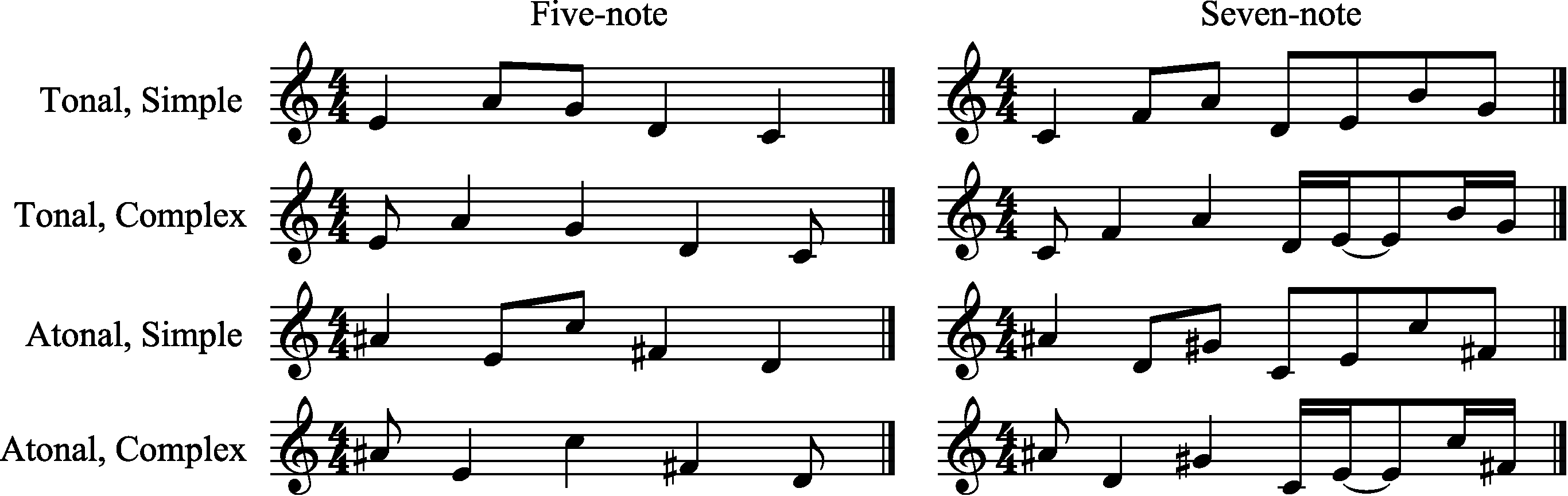
Figure 1. Examples of melodic stimuli illustrating combinations of pitch and rhythmic structures in five-note and seven-note sequences.

Figure 2. Detection sensitivity (d′) in Experiment 1 as a function of group, pitch structure, and rhythmic structure. Note. The horizontal line within each box represents the median; box length reflects the interquartile range. The violin plots illustrate the distribution of individual data points, with gray dots representing each participant. A significant interaction was observed only in the musician group; no interaction was found in the nonmusician group. * p < 0.05, *** p < 0.001
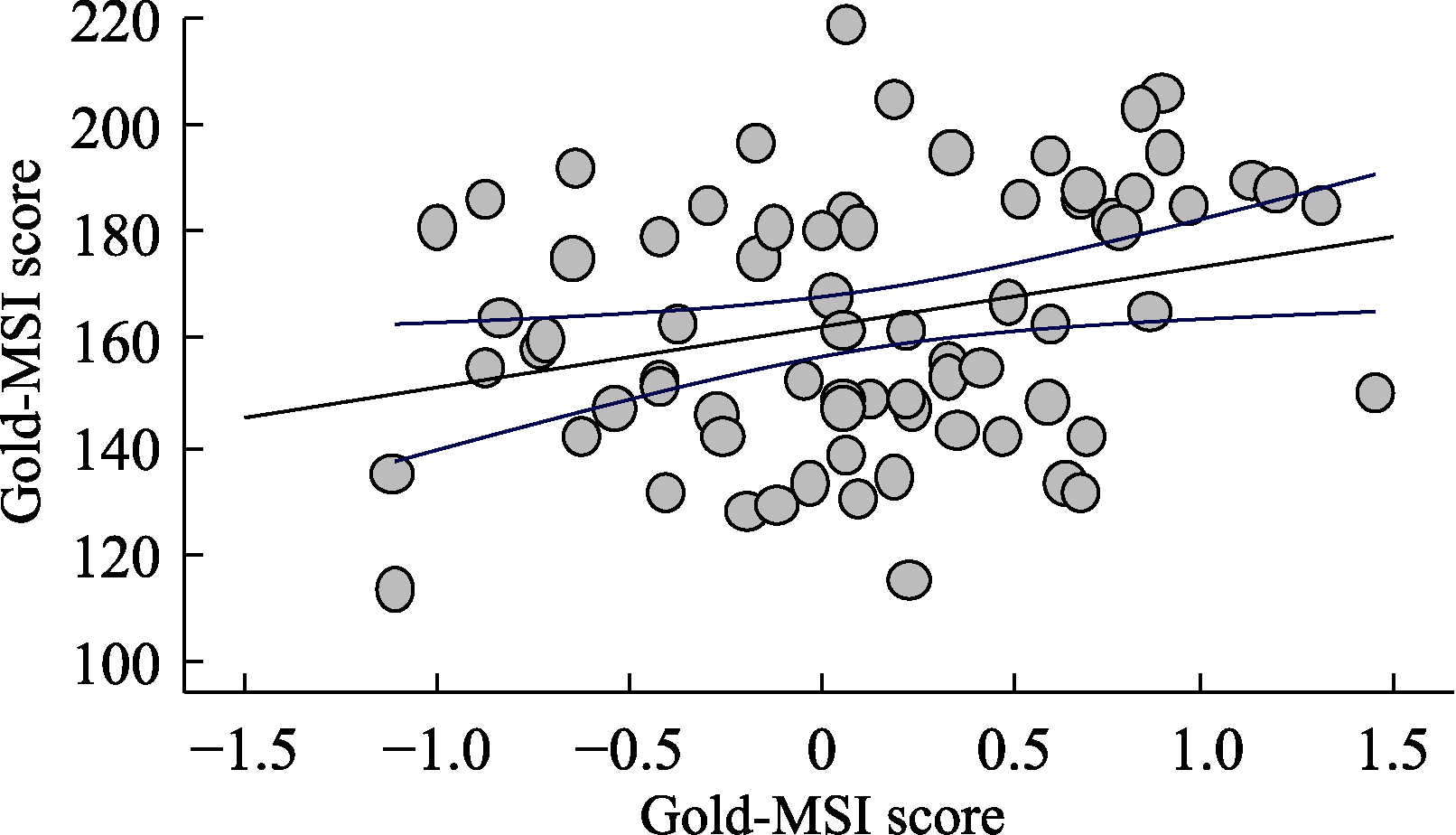
Figure 3. Correlation between the pitch-rhythm interaction effect and musical sophistication scores in Experiment 1. Note. Gray dots represent individual participants; the straight line indicates the linear regression trend, and the two curves the 95% confidence interval.

Figure 4. Detection sensitivity (d′) in Experiment 1 as a function of sequence length, pitch structure, and rhythmic structure. Note. The horizontal line within each box represents the median; box length indicates the interquartile range. The violin plots illustrate the distribution of participant data, with gray dots representing individual participants. A significant interaction was observed only in the five-note condition; no interaction was found in the seven-note condition. ** p < 0.01
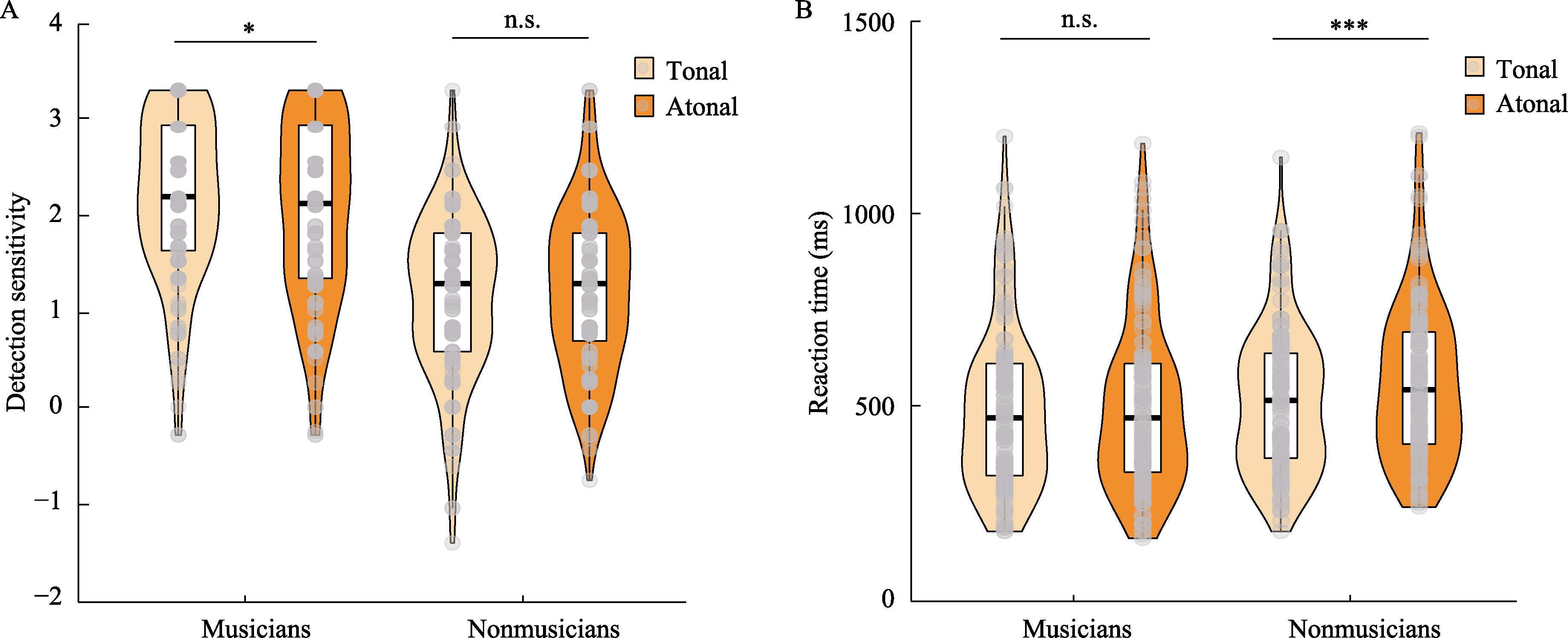
Figure 5. (A) Detection sensitivity and (B) reaction time for tonal and atonal conditions in musicians and nonmusicians in Experiment 2. Note. The horizontal line within each box represents the median; box length indicates the interquartile range. The violin plots illustrate the distribution of participant data, with gray dots representing individual participants. * p < 0.05, *** p < 0.001
| [1] | Albouy, P., Schulze, K., Caclin, A., & Tillmann, B. (2013). Does tonality boost short-term memory in congenital amusia. Brain Research, 1537, 224-232. https://doi.org/10.1016/j.brainres.2013.09.003 |
| [2] |
Bharucha, J., & Krumhansl, C. L. (1983). The representation of harmonic structure in music: Hierarchies of stability as a function of context. Cognition, 13(1), 63-102. https://doi.org/10.1016/0010-0277(83)90003-3
URL pmid: 6681743 |
| [3] |
Chen, J. L., Penhune, V. B., & Zatorre, R. J. (2008). Moving on time: Brain network for auditory-motor synchronization is modulated by rhythm complexity and musical training. Journal of Cognitive Neuroscience, 20(2), 226-239. https://doi.org/10.1162/jocn.2008.20018
doi: 10.1162/jocn.2008.20018 URL pmid: 18275331 |
| [4] | Cowan, N. (2000). The magical number 4 in short-term memory: A reconsideration of mental storage capacity. Behavioural and Brain Sciences, 24(1), 87-185. https://doi.org/10.1017/s0140525x01003922 |
| [5] | Dowling, W. J. (1991). Tonal strength and melody recognition after long and short delays. Perception & Psychophysics, 50(4), 305-313. https://doi.org/10.3758/bf03212222 |
| [6] | Essens, P. J., & Povel, D. J. (1985). Metrical and nonmetrical representations of temporal patterns. Perception & Psychophysics, 37(1), 1-7. https://doi.org/10.3758/BF03207132 |
| [7] |
Faul, F., Erdfelder, E., Buchner, A., & Lang, A.-G. (2009). Statistical power analyses using G*Power 3.1: Tests for correlation and regression analyses. Behavior Research Methods, 41(4), 1149-1160. https://doi.org/10.3758/BRM.41.4.1149
doi: 10.3758/BRM.41.4.1149 URL pmid: 19897823 |
| [8] | Fitch, W. T. (2013). Rhythmic cognition in humans and animals: Distinguishing meter and pulse perception. Frontiers in Systems Neuroscience, 7, Article 68. https://doi.org/10.3389/fnsys.2013.00068 |
| [9] |
Jentschke, S., & Koelsch, S. (2009). Musical training modulates the development of syntax processing in children. NeuroImage, 47(2), 735-744. https://doi.org/10.1016/j.neuroimage.2009.04.090
doi: 10.1016/j.neuroimage.2009.04.090 URL pmid: 19427908 |
| [10] |
Jerde, T. A., Childs, S. K., Handy, S. T., Nagode, J. C., & Pardo, J. V. (2011). Dissociable systems of working memory for rhythm and melody. NeuroImage, 57(4), 1572-1579. https://doi.org/10.1016/j.neuroimage.2011.05.061
doi: 10.1016/j.neuroimage.2011.05.061 URL pmid: 21645625 |
| [11] |
Jones, M. R., & Boltz, M. (1989). Dynamic attending and responses to time. Psychological Review, 96(3), 459-491. https://doi.org/ 10.1037/0033-295X.96.3.459
doi: 10.1037/0033-295x.96.3.459 URL pmid: 2756068 |
| [12] |
Jones, M. R. (1976). Time, our lost dimension: Toward a new theory of perception, attention, and memory. Psychological Review, 83(5), 323-355. https://doi.org/10.1037/0033-295X.83.5.323
URL pmid: 794904 |
| [13] |
Koelsch, S., Gunter, T. C., Friederici, A. D., & Schröger, E. (2000). Brain indices of music processing: “Nonmusicians” are musical. Journal of Cognitive Neuroscience, 12(3), 520-541. https://doi.org/10.1162/089892900562183
URL pmid: 10931776 |
| [14] |
Koelsch, S., Jentschke, S., Sammler, D., & Mietchen, D. (2007). Untangling syntactic and sensory processing: An ERP study of music perception. Psychophysiology, 44(3), 476-490. https://doi.org/10.1111/j.1469-8986.2007.00517.x
URL pmid: 17433099 |
| [15] |
Koelsch, S., Schmidt, B. H., & Kansok, J. (2002). Effects of musical expertise on the early right anterior negativity: An event-related brain potential study. Psychophysiology, 39(5), 657-663. https://doi.org/10.1111/1469-8986.3950657
URL pmid: 12236333 |
| [16] | Krumhansl, C. L. (1990). Cognitive foundations of musical pitch. New York: Oxford University Press. https://doi.org/10.1093/acprof:oso/9780195148367.001.0001 |
| [17] |
Krumhansl, C. L. (2000). Rhythm and pitch in music cognition. Psychological Bulletin, 126(1), 159-179. https://doi.org/10.1037/0033-2909.126.1.159
URL pmid: 10668354 |
| [18] | Lartillot,, O., Toiviainen, P., & Eerola, T. (2008). A matlab toolbox for music information retrieval. In C.Preisach, H.Burkhardt, L.Schmidt-Thieme, R.Decker (Eds.), Data analysis, machine learning and applications (pp. 261-268). Springer-Verlag. |
| [19] | Lévêque, Y., Lalitte, P., Fornoni, L., Pralus, A., Albouy, P., Bouchet, P., ... Tillmann, B. (2022). Tonal structures benefit short-term memory for real music: Evidence from non-musicians and individuals with congenital amusia. Brain and Cognition, 161, Article 105881. https://doi.org/10.1016/j.bandc.2022.105881 |
| [20] | Lin, H. R., Kopiez, R., Müllensiefen, D., & Wolf, A. (2021). The Chinese version of the Gold-MSI: Adaptation and validation of an inventory for the measurement of musical sophistication in a Taiwanese sample. Musicae Scientiae, 25(2), 226-251. https://doi.org/10.1177/1029864919871987 |
| [21] | Macmillan, N. A., & Creelman, C. D. (2004). Detection theory: A user’s guide (2nd ed.). London: Lawrence Erlbaum Associates. |
| [22] | Martin, T., Egly, R., Houck, J. M., Bish, J. P., Barrera, B. D., Lee, D. C., & Tesche, C. D. (2005). Chronometric evidence for entrained attention. Perception & Psychophysics, 67(1), 168-184. https://doi.org/10.3758/BF03195020 |
| [23] | Müllensiefen, D., Gingras, B., Musil, J., & Stewart, L. (2014). The musicality of non-musicians: An index for assessing musical sophistication in the general population. PLOS ONE, 9(2), Article e89642. https://doi.org/10.1371/journal.pone.0089642 |
| [24] | Povel, D.-J., & Essens, P. (1985). Perception of temporal patterns. Music Perception, 2(4), 411-440. https://doi.org/10.2307/40285311 |
| [25] | Prince, J. B. (2011). The integration of stimulus dimensions in the perception of music. Quarterly Journal of Experimental Psychology, 64(11), 2125-2152. https://doi.org/10.1080/17470218.2011.573080 |
| [26] |
Prince, J. B., & Pfordresher, P. Q. (2012). The role of pitch and temporal diversity in the perception and production of musical sequences. Acta Psychologica, 141(2), 184-198. https://doi.org/10.1016/j.actpsy.2012.07.013
doi: 10.1016/j.actpsy.2012.07.013 URL pmid: 22968192 |
| [27] | Prince, J. B., Schmuckler, M. A., & Thompson, W. F. (2009). The effect of task and pitch structure on pitch-time interactions in music. Memory & Cognition, 37(3), 368-381. https://doi.org/10.3758/MC.37.3.368 |
| [28] |
Prince, J. B., Thompson, W. F., & Schmuckler, M. A. (2009). Pitch and time, tonality and meter: How do musical dimensions combine. Journal of Experimental Psychology: Human Perception and Performance, 35(5), 1598-1617. https://doi.org/10.1037/a0016456
doi: 10.1037/a0016456 URL pmid: 19803659 |
| [29] |
Raven, J. (2000). The Raven’s progressive matrices: Change and stability over culture and time. Cognitive Psychology, 41(1), 1-48. https://doi.org/10.1006/cogp.1999.0735
doi: 10.1006/cogp.1999.0735 URL pmid: 10945921 |
| [30] |
Sakai, K., Hikosaka, O., Miyauchi, S., Takino, R., Tamada, T., Iwata, N. K., & Nielsen, M. (1999). Neural representation of a rhythm depends on its interval ratio. Journal of Neuroscience, 19(22), 10074-10081. https://doi.org/10.1523/JNEUROSCI.19-22-10074.1999
URL pmid: 10559415 |
| [31] | Schulze, K., Dowling, W. J., & Tillmann, B. (2012). Working memory for tonal and atonal sequences during a forward and a backward recognition task. Music Perception, 29(3), 255-267. https://doi.org/10.1525/mp.2012.29.3.255 |
| [32] |
Schulze, K., Müller, K., & Koelsch, S. (2011). Neural correlates of strategy use during auditory working memory in musicians and non-musicians. European Journal of Neuroscience, 33(1), 189-196. https://doi.org/10.1111/j.1460-9568.2010.07470.x
doi: 10.1111/j.1460-9568.2010.07470.x URL pmid: 21073548 |
| [33] | Schwartze, M., & Kotz, S. A. (2013). A dual-pathway neural architecture for specific temporal prediction. Neuroscience & Biobehavioral Reviews, 37(10), 2587-2596. https://doi.org/10.1016/j.neubiorev.2013.08.005 |
| [34] | Sun, L., Liu, F., Zhou, L., & Jiang, C. (2018). Musical training modulates the early but not the late stage of rhythmic syntactic processing. Psychophysiology, 55(2), Article e12983. https://doi.org/10.1111/psyp.12983 |
| [35] | Sun, L., Thompson, W. F., Liu, F., Zhou, L., & Jiang, C. (2020). The human brain processes hierarchical structures of meter and harmony differently: Evidence from musicians and nonmusicians. Psychophysiology, 57(9) Article e13598. https://doi.org/10.1111/psyp.13598 |
| [36] | Tillmann, B., & Lebrun-Guillaud, G. (2006). Influence of tonal and temporal expectations on chord processing and on completion judgments of chord sequences. Psychological Research, 70(5), 345-358. https://doi.org/10.1007/s00426-005-0222-0 |
| [37] | Thompson, W. F., Hall, M. D., & Pressing, J. (2001). Illusory conjunctions of pitch and duration in unfamiliar tone sequences. Journal of Experimental Psychology: Human Perception and Performance, 27(1), 128-140. https://doi.org/10.1037//0096-1523.27.1.128 |
| [38] | Yang, X., Shen, X., Zhang, Q., Wang, C., Zhou, L., & Chen, Y. (2022). Music training is associated with better clause segmentation during spoken language processing. Psychonomic Bulletin & Review, 29(4), 1472-1479. https://doi.org/10.3758/s13423-022-02076-2 |
| [39] | Zhang, J., Che, X., & Yang, Y. (2019). Event-related brain potentials suggest a late interaction of pitch and time in music perception. Neuropsychologia, 132, 107118. https://doi.org/10.1016/j.neuropsychologia.2019.107118 |
| [40] |
Zhang. J., Jiang,. C., Zhou,. L., & Yang,. Y. (2016). Perception of hierarchical boundaries in music and its modulation by expertise. Neuropsychologia, 91, 490-498. https://doi.org/10.1016/j.neuropsychologia.2016.09.013
doi: S0028-3932(16)30350-5 URL pmid: 27659874 |
| [41] | Zhou, L., Zhao, H., & Jiang, C. (2017). Neural plasticity to musical performance training: A meta-analysis study. Advances in Psychological Science, 25(11), 1877-1887. https://doi.org/10.3724/SP.J.1042.2017.01877 |
| [1] | HUA Shan, JIANG Xintong, GAO Yangzhenyu, MU Yan, DU Yi. The impacts of music training and music sophistication on empathy [J]. Acta Psychologica Sinica, 2025, 57(4): 544-558. |
| [2] | ZHANG Zhenghua, HAN Mei, ZHANG Fang, LI Weijun. Musical training improves rhythm integrative processing of classical Chinese poem [J]. Acta Psychologica Sinica, 2020, 52(7): 847-860. |
| Viewed | ||||||
|
Full text |
|
|||||
|
Abstract |
|
|||||
