


1 引言
稀缺状态下人们的慷慨行为是更多还是更少呢?资源消耗理论认为资源稀缺限制了个体做出慷慨行为的可能性。从该理论出发, 研究认为资源稀缺的个体竞争取向更高(Roux et al., 2015)、主动捐款行为较少(Penner et al., 2005)、捐款额度也更低(Korndörfer et al., 2015)。然而, 以社会情境理论出发的替代性假设认为:资源稀缺的个体由于经常面临生活压力, 导致他们更具有情境主义的认知风格、更依赖他人(Keltner et al., 2014)。基于此, 研究认为, 资源稀缺的个体与他人建立社会关系的意愿更强、更能关注到他人的福祉, 表现出更多的慷慨行为(Durante et al., 2017; Piff et al., 2010)。针对上述二者矛盾的关系, 当前研究已初步从稀缺的测量标准(Malika et al., 2023)、亲社会行为的目标对象差异(Kuang et al., 2021; Madsen et al., 2023)、亲社会行为的类型(Han et al., 2023)、经济社会不平等情境(Schmukle et al., 2019; Stéphane et al., 2015)等方面进行了探讨。但整体来说, 当前对稀缺与慷慨行为之间的作用机制仍缺乏清晰的认知。
慷慨行为具有社会互动的属性(Thielmann et al., 2020)。人际互动中的因素对慷慨行为复杂性的影响值得关注。面子作为一种普遍的社会心理现象, 是了解人们生活方式的关键, 对人际行为有重要影响(李艺敏, 赵娜, 2013; Tsang et al., 2013)。面子是社会互动过程中的微妙准则, 对互动行为存在维持、提升或减损的可能性(Chan et al., 2009)。因此, 为更好地回应上述问题, 本研究拟从自我建构的视角切入, 探讨面子意识在资源稀缺与慷慨行为之间的作用。通过对本问题的探讨, 可以帮助我们更好地厘清资源稀缺与慷慨行为之间关系的矛盾性, 丰富已有稀缺领域的理论研究。同时, 对于乡村振兴道路上相对贫困个体的稀缺心态如何影响慷慨行为及促进关系和谐等有重要的实践意义。
1.1 自我建构视角下的面子
社会心理学中, 面子是指个体在某个特定情境中的身份, 也是个体对其在特定情境中行为的社会评价的认知反应(Hwang, 2006; 魏新东 等, 2023)。人们会因为积极的社会评价感觉到有面子, 也会因为消极的社会评价而感到丢面子(Han, 2016; Ho, 1976)。尽管有研究者认为面子是人类的基本需要, 但其在中国文化下尤为复杂(魏新东 等, 2023; Hwang & Han, 2010)。有研究者将面子分为社会面子(面)和道德面子(脸), 前者是通过个人努力、天分或者能力获得的身份, 如学识、美貌和能力, 或者财富与社会关系等; 后者则是对个体道德品质的社会评价(Ho, 1976; Hwang, 2006; Qi, 2011)。个体在社会互动中容易受到群体期望和社交规范的影响, 社会面子与这些行为有更直接的关联(Zhang, Tian, & Grigoriou, 2011)。基于此, 本研究仅聚焦于社会面子(面)这一层面。面子既可以是人格特质, 也可以是一种随情境而变化的状态。当把面子看作是人格特质时, 通常被描述为“脸皮厚”或“脸皮薄”, “脸皮厚”的个体通常有较少的消极情绪, 而“脸皮薄”的人在有不当行为时通常更容易感到丢面子(Hwang & Han, 2010)。当面子是一种状态时, 它是动态变化的, 个体是丢面子还是挣面子与他所处的情境有关。依照于自我建构理论, 资源充裕者有更高的“唯我主义”认知、资源稀缺者有较高的“情境主义”认知, 可以看出对于面子意识较强的资源稀缺者来说, 在面子情境的启动下, 他们的行为方式也会有不同的表现。
1.2 面子在资源稀缺与慷慨行为中的调节作用
慷慨行为(generosity)是指个体愿意给他人提供比平时或预期更多的帮助或支持, 如时间、金钱等(Park et al., 2017)。人类受益于他人的慷慨行为, 但是需要他人付出资源, 因此标准的经济理论无法解释该行为(Park et al., 2017)。当前, 稀缺感与慷慨行为之间的关系研究结果存在不一致。如有研究认为, 由资源稀缺引发的竞争导向会使人们将更多的时间和精力放在与他人竞争上, 而减少慷慨行为(Nhim et al., 2019), 稀缺的个体分享行为也显著减少(Petersen et al., 2014)。Korndörfer等(2015)采用具有代表性样本的8个研究发现, 低社会阶层个体的亲社会行为显著低于高社会阶层个体。然而, 也有研究结果相反, 发现“穷大方”现象(having less, giving more)。有数据显示, 美国低于25000美元收入的家庭将其收入的4.2%捐给了慈善机构, 而收入100000美元及以上的家庭仅贡献了2.7% (Louie & Rieta, 2018)。还有研究发现, 收入较高的个体对于困境中的陌生人给予的帮助更少(Piff et al., 2010)。
研究认为, 面子是解释社会互动复杂性的关键(Kim & Nam, 1998)。在稀缺的情况下, 面子意识水平不同的个体的慷慨行为表现也可能不同。慷慨行为与他人或社会的利益直接相关, 涉及到社会关系敏感性, 而面子意识强的个体对社会关系的敏感性更强, 因此他们更容易受到社会情境的影响(Zhang & Zhou, 2023)。面子意识会驱使人们按照被认可的社会规范和价值观行事, 甚至会牺牲个人利益以获得声望和好印象(Hardy & Van Vugt, 2006)。如有研究发现, 面子意识高的个体更遵守社会规范, 做出更多的亲环境行为(Wu et al., 2022; Shi et al., 2018)。在社交策略上, 面子意识高的个体多采用社交回报策略, 通过帮助他人来换取别人的认可和支持(Brañas-Garza et al., 2017; Leimgruber, 2018)。面子意识高的个体更多是通过他人的认可和支持来获得自尊心的满足和愉悦感(Jiang & Shan, 2016; Jin & Kang, 2010)。Xie和Shi (2021)采用中国的贫困者作为被试, 结果发现财务贫困的个体表现出更多的亲社会行为, 特别是在公共环境中, 突出了中国人面子意识在其中的作用。
基于以上分析, 我们认为即使在物质资源稀缺的情况下, 面子意识强的个体仍然有可能会做出慷慨行为, 即常说的“穷大方”。与之相反, 对于面子意识较低的个体来说, 由于外部的评价和认可并不是主要的动力来源, 他们在决策上更加理性、客观, 也能更好地处理社交评价所带来的压力, 不受消极情绪和生理成本的影响(Kesebir, 2017)。换句话说, 面子意识低的个体, 在物质稀缺的情况下能更加理性地考量自身的经济状态, 为应对物质资源的有限性而做出较少的慷慨行为。基于以上分析, 我们提出假设1:
假设1: 面子意识在稀缺与慷慨行为的关系中起调节作用。对于面子意识高的个体来说, 资源稀缺情境下他们有更多的慷慨行为, 与资源丰富的个体无显著差异; 而对于面子意识低的个体, 其慷慨行为则显著低于资源丰富的个体。
1.3 慷慨:挣面子还是护面子?
当前研究把面子分为挣面子(gaining face)和护面子(avoid losing face)两个维度(Hwang, 2006)。当个体受到积极或消极的社会评价时, 挣面子和丢面子两种过程有截然不同的感受(Hwang, 2006)。如果个人的行为符合社会角色的要求, 就可以“挣面子”, 享受有面子带来的积极感受; 否则, 就会“丢面子”, 承担丢面子在情绪和生理上带来消极影响(Kim & Nam, 1998)。评价挣面子和丢面子的标准不同, 以学业水平为例, 当自己的学业水平超过平均标准时, 就能为自己挣面子, 但是低于平均标准时并不一定会丢面子(Ho, 1976)。只有个体的表现低于他所处地位的最低水平, 才会丢面子(Zhang, Cao, & Grigoriou, 2011)。
面子管理理论(face management theory)认为, 当个体受到面子威胁时, 他们对于护面子的需求就构成了一种极其强烈的社会动机(Goffman & Newill, 1967)。这是因为丢面子所带来的消极后果远远大于挣面子所带来的积极后果, 如丢面子会让个体在情绪上感到愧疚、尴尬, 人们可以不挣面子, 但是一定会避免丢面子(Liao & Bond, 2011; Wang et al., 2021)。从心理学的视角来看, 与挣面子不同, 护面子与个体的防御机制有关(Cupach & Carson, 2002)。当个体面临丢面子时, 护面子对于保护个体的自尊与社会认同感有积极的作用。整体上来看, 尽管个体必须展示超预期的社会表现才能让自己获得面子, 但是为了避免失去面子, 个体还需要保持他们的社会表现要在一定可接受的水平上(Ho, 1976)。基于以上分析, 我们认为在物质稀缺的情况下, 人们更多地因为护面子(而非挣面子)做出慷慨行为。提出假设2:
假设2: 护面子在物质稀缺与慷慨行为之间起中介作用。
1.4 研究概览
本研究共采用3个研究(5个子研究)来验证上述假设。研究1通过研究1a和研究1b 两项子研究来完成。通过操纵个体的稀缺感知, 研究1a设置常见的“随份子”生活情境、研究1b设置“请客吃饭”对饭店选择的情境, 探讨面子意识在稀缺与慷慨行为之间所起的作用。研究2 (研究2a、研究2b)在研究1的基础上, 通过设置遵规/公益性慷慨行为, 同时测量个体的稀缺心态, 并操纵面子的重要性感知来进一步探讨三者之间的关系。研究3采用问卷测量的方式, 探讨挣面子和护面子在稀缺与慷慨行为倾向之间所起的作用。
2 研究1:关系性慷慨行为
2.1 研究1a:“随份子”场景下的慷慨行为
2.1.1 被试
本研究为单因素实验设计, 包括物质稀缺组与物质充裕组。采用G*Power 3.1, 设置效应量(f2 = 0.25), 统计检验力(1 − β)为0.80时, 计算出本研究计划样本量为128人。正式实验通过见数(Credamo)平台收集数据, 该平台的数据可信度在以往研究中验证良好(宋琪 等, 2023)。在问卷中, 我们添加了2道探测题目, 以筛选不认真作答的被试。最终, 实验共有有效被试198名, 其中男性67人(33.8%), 女性131人(66.2%)。平均年龄为30.58岁(SD = 8.25), 年龄分布从19岁到56岁。被试被随机分配到两个实验组(每组各99人)。
2.1.2 研究程序
首先, 我们采用以往研究中采用的稀缺操纵方式, 操纵被试的物质稀缺感(Bickel et al., 2016)。稀缺组被试将阅读到一段关于“自己面临失业, 在找到新工作之前没有任何收入”的文字材料; 而充裕组被试则阅读到一段关于“自己工作调动, 并且工资涨薪2%”的文字材料。材料阅读结束后, 被试需描述在该情境下的生活状态与感受并书写下来, 要求他们书写的内容越多越好。随后被试需回答问题“目前而言, 如果我的收入不增加, 生活很难维持下去”, 作为操纵性检验。
其次, 被试需要完成慷慨行为的情境测验。本研究设置的慷慨行为情境为“居住在同城的宿舍舍友乔迁新居需要随份子”。指导语中明确“随份子的数额没有统一标准, 但是一般会在100元−500元之间”。阅读情境后需要回答“你最终决定随份子的金额数为____?” 我们将被试最终愿意随份子的额度作为慷慨的测量指标。
再次, 被试需要完成面子需要量表(Zhang, Cao, & Grigoriou, 2011)。该量表共包含11道题目, 代表性题目有“我尽力隐瞒自己的缺陷不让他人知道”。量表的内部一致性系数α为0.90。
最后, 被试完成一系列人口统计学变量, 包括性别、年龄、收入等。
2.1.3 研究结果
(1)操纵检验
采用独立样本t检验对操作性检验题项进行检验, 结果显示稀缺组被试的稀缺感(M = 4.37, SD = 0.84)显著高于充裕组被试(M = 2.55, SD = 1.12), t(196) = 13.01, p < 0.01, Cohen’s d = 1.84。表明本研究中稀缺感的操纵是成功的。
(2)面子意识在物质稀缺与慷慨行为之间的调节作用
首先, 我们对本研究中的随份子金额进行了正态性检验, 结果发现, 随份子金额的偏度(skewness)为0.59, 峰度(Kurtosis)为−0.32, 依据偏态小于2, 峰态小于7, 即可视为正态分布(Finney & Distefano, 2006)。因此, 本数据适合进行下一步的数据分析。
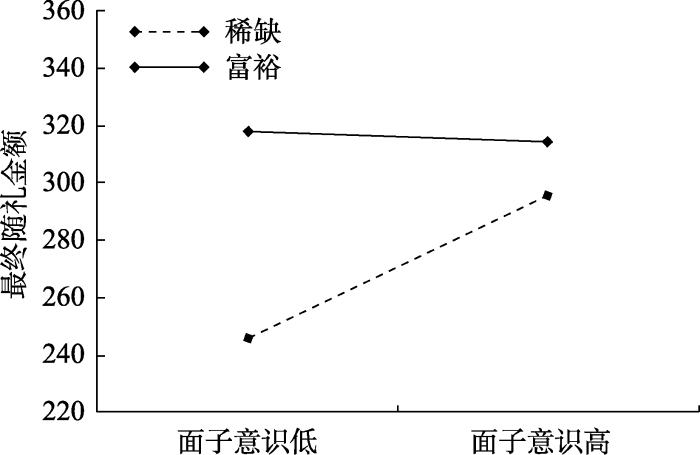
为了探讨面子意识在稀缺与慷慨行为之间的调节机制, 我们采用process 3.2插件中的模型1, 将稀缺作为自变量(稀缺组编码为0, 富裕组编码为1), 面子意识作为调节变量, 随份子的具体金额作为因变量进行调节作用分析。研究结果表明, 在控制掉性别、年龄、婚姻状况、教育水平和月收入之后, 面子意识在稀缺与慷慨行为之间的调节作用显著, β = −0.29, t = −2.01, p < 0.05, 95% CI = [−0.5682, −0.0055]。进一步的简单斜率分析表明, 对于稀缺组的个体来说, 面子意识显著正向预测他们的最终随礼金额, β = 0.63, t = 3.35, p < 0.01, 95% CI = [0.2581,0.9945]; 然而对于富裕组的个体来说, 面子意识对他们的最终随礼金额没有显著影响, β = 0.07, t = 0.38, p = 0.70, 95% CI = [0.2581,0.9945], 见图1。该研究结果验证了假设1。
图1
2.2 研究1b:“请客”场景下的慷慨行为
2.2.1 被试
同研究1a, 本研究为单因素实验设计。采用G*Power 3.1计算, 本研究计划样本量为128人。通过见数平台共招募有效被试188名(男性57人, 30.3%), 被试平均年龄为29.99岁(SD = 8.04), 年龄分布范围从20岁到59岁。被试被随机分配到稀缺组(95人)和充裕组(93人)。
2.2.2 研究程序
首先, 被试需要接受稀缺感的操纵, 具体操纵同研究1a。紧接着, 被试完成慷慨行为的情境测验。本研究中的慷慨行为情境改编自以往的研究范式(Jeong et al., 2019), 通过设置“请客吃饭”的情境进行。具体为“在此阶段的某一天, 你和你同事一起去吃饭。你决定今天由你来买单。目前有两家饭店符合你的要求, 请你在以下两家饭店中选择”。
针对以上情境, 被试接下来要回答以下问题:(1)你在多大程度上愿意选择第一家饭店?(2)你在多大程度上愿意选择第二家饭店?接着, 被试需要完成面子意识量表的测量。为了从不同的角度来测量面子, 本研究采用Chan等人(2009)的面子意识量表, 共包含8道题目, 代表性题目如“我讨厌被轻视”。量表采用7点计分, 得分越高, 代表个体的面子意识越强。在本研究中, 该量表的内部一致性系数α为0.85。完成量表的测量后, 被试需要完成人口统计学变量的填写, 具体包括年龄、性别、婚姻状况和月收入。
2.2.3 研究结果
(1)操纵检验
采用独立样本t检验对操作性检验题项进行检验, 结果显示稀缺组被试的稀缺感(M = 4.36, SD = 0.70)显著高于充裕组被试(M = 2.48, SD = 0.88), t(186) = 16.27, p < 0.001, Cohen’s d = 2.38。表明本研究对稀缺的操纵是成功的。
(2)面子意识在物质稀缺与慷慨行为之间的调节作用
以稀缺与否、面子意识高低及饭店类型为自变量, 被试选择饭店的意愿为因变量, 人口统计学变量为控制变量, 对所得数据进行混合因素协方差分析。数据分析结果表明, 稀缺的主效应显著, 稀缺组个体选择119元饭店的意向(M = 5.49, SD = 0.17)显著高于选择149元饭店(M = 3.22, SD = 0.17), F(1, 179) = 10.56, p < 0.01, 偏η² = 0.09; 面子意识的主效应显著, 面子意识低的个体选择119元饭店的意向(M = 5.55, SD = 0.18)显著高于面子意识高的个体(M = 3.50, SD = 0.18), F(1, 179) = 5.39, p < 0.05, 偏η² = 0.03。
同时研究结果还发现, 稀缺与否、面子意识高低与饭店类型之间的三重交互作用显著, F(1, 179) = 5.98, p < 0.05, 偏η² = 0.03。接下来我们分别分析不同面子意识水平下稀缺与饭店选择之间的交互作用。
对于面子意识低的个体来说, 稀缺与饭店类型的交互作用显著, F(1, 79) = 15.37, p < 0.01, 偏η² = 0.16。具体来看, 对于面子意识低的个体来说, 稀缺组被试选择119元饭店的意向(M = 5.88, SD = 1.47)边缘显著高于富裕组被试(M = 5.26, SD = 1.61), t(79) = 1.95, p = 0.05, 但是在149元饭店上, 稀缺组被试的选择意向(M = 2.69, SD = 1.48)的意向显著低于富裕组被试(M = 4.31, SD = 1.75), t(79) = −4.66, p < 0.01 (见图2左)。
图2
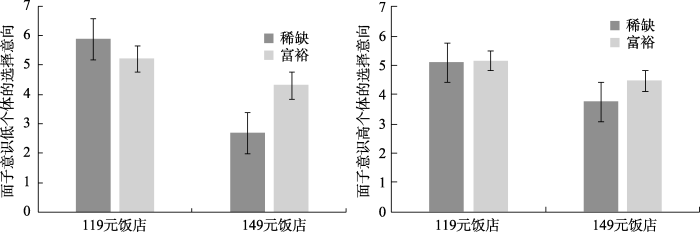
对于面子意识高的个体说, 稀缺与饭店类型之间不存在交互作用, F(1, 95) = 1.17, p = 0.28。具体来说, 稀缺组被试选择119元饭店的意向(M = 5.11, SD = 1.92)与富裕组被组被试(M = 5.17, SD = 1.67)没有显著差异, t(95) = −0.17, p = 0.86; 同样, 在149元饭店的选择上, 稀缺组个体的选择意向(M = 3.95, SD = 1.92)与富裕组被试(M = 4.38, SD = 1.67)无显著差异, t(95) = −1.69, p = 0.11 (见图2右)。
2.3 研究小结
研究1采用2项子研究(研究1a和研究1b), 分别用中国常见的人际互动行为“随份子”和“请客”两个场景作为关系性慷慨行为, 探讨了稀缺和面子意识与在人际交往情境下的慷慨行为的关系。研究结果发现, 在物质稀缺组, 对于面子需要强、面子意识高的个体来说, 他们“随份子”的金额和请客所选择饭店的价位与充裕组的个体并无显著差异。此研究结果验证了假设1。基于研究1所设置的情境均为人际情境, 考虑这些场景涉及到了人际关系的圈层问题(都限于朋友), 研究2将把慷慨行为扩展到遵规/公益性慷慨行为的情境, 分别采用“财务分配”和“公益捐助”两个场景, 同时操纵被试对面子重要性的感知, 进一步拓展探讨物质稀缺、面子意识与慷慨行为之间的关系。
3 研究2:遵规/公益性慷慨行为
3.1 研究2a:“财务分配”场景下的慷慨行为
3.1.1 被试
本研究同样为单因素实验设计。个体的稀缺心理通过问卷测量来完成, 同时启动面子重要性(高 vs. 低)。同样按照研究1a使用的方法, 采用G*Power 3.1计算研究所用的样本量, 计划采用样本量为128人。正式实验通过见数平台共招募有效被试190名(男性68人, 35.8%)。被试平均年龄为 29.23岁(SD = 7.27), 年龄分布范围从19岁到52岁。被试被随机分配到面子重要组(96人)和面子不重要组(94人)。
3.1.2 研究程序
被试首先需要完成稀缺感的测量。本研究把个体的稀缺心态作为一种特质, 采用贫困心态量表来测量(Sharma & Alter, 2012)。贫困心态量表共包含11道题目, 代表性题目如“由于缺钱, 家庭日常消费也会给我带来很大压力”。采用7点计分, 1代表“一点也不符合”, 7代表“非常符合”, 得分越高代表个体的贫困心态水平越强。该量表在本研究中内部一致性系数α为0.95。
随后被试被随机分配到面子重要和面子不重要两组。两组被试将分别阅读一段文字材料“词典中对面子的解释为:面子是个人在社会上有所成就而获得的社会地位和评价。面子对人们来说很重要/ 一点也不重要。请您至少写出5条面子重要/不重要的理由, 并给予尽可能详细的解释”, 以此来启动面子的重要性感知。随后被试需要回答“你在多大程度上认可面子是非常重要的?”, 作为面子启动是否成功的操纵检验。题目采用5点计分(1 = 一点也不重要, 5 = 非常重要), 数字越大代表个体越认为面子重要。
其次, 被试需要完成慷慨行为倾向的测量。本研究采用改编自以往的研究范式(Clobert et al., 2015)。具体内容为:请想象一下, 如果你在彩票游戏中赢得10万人民币, 你会怎么分配这笔钱?请具体说明你将要分配的资金比例, 并简要描述它们。向被试呈现资金分配比例表, 请他们分别填写分配给自己、家人、朋友、慈善机构的资金百分比。
最后被试需要完成人口统计学变量的填写, 包括性别、年龄、婚姻状态和月收入等。
3.1.3 研究结果
(1)操纵检验
采用独立样本t检验对操作性检验题项进行分析, 结果显示面子重要组被试的面子重要性感知(M = 5.23, SD = 0.64)显著高于面子不重要组被试(M = 2.27, SD = 1.04), t(188) = 23.72, p < 0.01, Cohen’s d = 3.45, 表明本研究对面子的操纵是成功的。
(2)稀缺、面子重要性对金额分配的交互影响
接下来, 我们以稀缺水平(稀缺vs. 充裕)和面子重要性(重要vs. 不重要)为自变量, 资金的分配比例为因变量, 性别、年龄、婚姻状态、教育水平、月收入等人口统计学变量为协变量, 对所得数据进行协方差分析。与前人研究相同, 本研究将分配给他人的资金数量(除自己之外)作为慷慨行为, 具体包括分配给家人、朋友、慈善机构和其它四个部分。
研究结果发现, 在分配给他人的比例上, 稀缺的主效应显著。稀缺组的个体分配给他人的比例(M = 37.05, SD = 1.74)显著低于充裕组个体分配给他人的比例(M = 47.21, SD = 1.79), F(1, 181) = 15.13, p < 0.05, 偏η² = 0.08; 面子重要性的主效应不显著, 面子重要组分配给他人的比例(M = 42.51, SD = 1.69)与面子不重要组分配给他人的比例(M = 41.75, SD = 1.66)之间无显著差异, F(1, 181) = 0.15, p = 0.74。
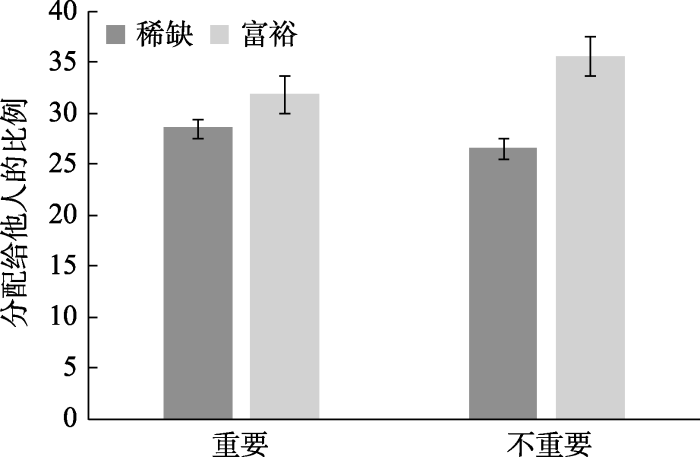
稀缺与面子重要性同样具有显著的交互作用, F(1, 181) = 4.38, p < 0.05, 偏η² = 0.07。简单效应分析结果显示, 对于面子不重要的个体来说, 稀缺组被试分配给他人的比例(M = 35.41, SD = 15.11)显著低于充裕组被试(M = 49.70, SD = 18.66), t(92) = −4.07, p < 0.01, Cohen’d = −0.38 ; 而对于面子重要的个体来说, 稀缺组被试分配给他人的比例(M = 40.25, SD = 16.89)与充裕组被试(M = 43.24, SD = 13.95)无显著差异, t(94) = −0.94, p = 0.35。具体见图3。
图3
3.2 研究2b:“公益捐助”场景下的慷慨行为
3.1.1 被试
本研究中个体通过问卷来测量稀缺, 同时通过操纵来启动面子, 为单因素实验设计, 通过G*Power 3.1计算研究所用的样本量, 计划采用样本量为128人。本研究通过见数平台共招募被试192名(男性79人, 41.14%)。被试平均年龄为 30.48岁(SD = 8.60), 被试年龄范围从20岁到56岁。被试被随机分配到面子重要组(95人)和面子不重要组(97人)。
3.1.2 研究程序
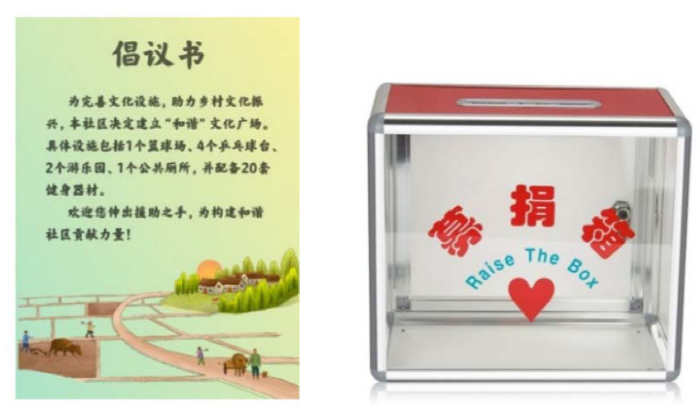
被试首先需要完成稀缺感的测量以及面子的操纵(同研究2a)。与研究2a不同的是, 本研究更改了慷慨行为的测量情境。被试首先会看到一则倡议书(如图4左), 倡议居民为建设广场贡献力量。随后, 为验证被试是否认真阅读倡议书, 请他们回答“倡议书中所涉及到的具体设施包含几套健身器材?”, 如果被试回答错误, 则该被试的数据作废。随后被试需要围绕倡议书中的内容回答:(1)您在多大程度上支持倡议书中的内容?(2)您在本次募捐活动中的捐款意愿为?以上均为1−7点计分, 得分越高, 代表个体愿意捐助的意愿越强。(3)假如您是该社区的一员, 您在本次募捐活动中愿意捐助的金额为 元(请您在0−500元之间进行选择)。最后, 被试需要完成一系列的人口统计变量的填写, 具体包括性别、年龄、婚姻状况、教育水平和月收入。
图4
3.1.3 研究结果
(1)操纵检验结果
本研究同样采用独立样本t检验对面子重要性的操纵进行检验。结果显示, 面子重要组被试的面子重要性感知(M = 5.35, SD = 0.63)显著高于面子不重要组被试(M = 2.18, SD = 1.03), t(190) = 25.64, p < 0.01, Cohen’s d = 3.72, 表明本研究对面子的操纵成功。
(2)稀缺与面子重要性感知对个体捐款意愿的作用
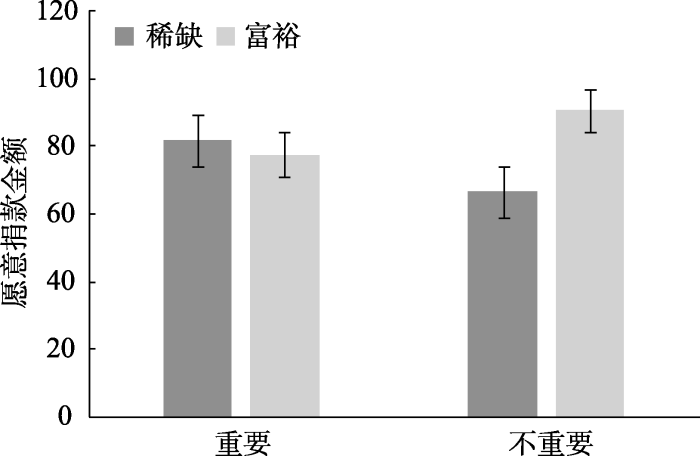
首先, 我们对本研究中的捐款金额进行了正态性检验, 结果发现, 捐款金额的偏度(skewness)为0.64, 峰度(Kurtosis)为−0.21, 依据偏态小于2, 峰态小于7, 即可视为正态分布。接下来, 为探讨稀缺与面子重要性对个体捐款意愿的影响, 我们以稀缺水平和面子重要性为自变量, 个体愿意捐款的金额为因变量, 性别、年龄、婚姻状态、教育水平和月收入等人口统计学变量等为协变量, 对所得的数据进行了协方差分析。数据分析结果表明, 稀缺和面子重要性对个体的捐款金额主效应均不显著, 然而二者在个体的捐款意愿上具有显著的交互作用, F(1, 177) = 3.57, p < 0.05, 偏η² = 0.02 。简单效应分析结果显示, 对于面子不重要的个体来说, 稀缺组被试愿意捐款的平均金额(M = 66.62, SD = 6.86)显著低于充裕组被试(M = 90.69, SD = 8.14), t(93) = −2.83, p < 0.01, Cohen’s d = −0.84; 然而, 对于面子重要的个体来说, 稀缺组被试愿意捐款的平均金额(M = 81.97, SD = 7.80)与充裕组被试 (M = 77.58, SD = 7.26)无显著差异, t(95) = 1.30, p = 0.21。具体见图5。
图5
3.3 研究小结
本研究通过2项情境实验(研究2a和研究2b), 以资金分配和社区捐助为实验情境, 并通过操纵面子的重要性进一步探讨了稀缺和面子重要性对慷慨行为的交互作用。研究结果支持了我们的研究假设, 对面子需要高的个体来说, 资源稀缺的个体与资源充裕的个体在分配给他人的资金比例(研究2a)以及平均捐款金额(研究2b)上并没有显著差异; 但是对面子需要低的个体来说, 资源稀缺的个体无论在分配给他人的资金比例上还是在平均捐款金额上都显著低于资金充裕组的个体。研究3将进一步探讨稀缺影响慷慨行为的路径。
4 研究3:挣面子还是护面子:稀缺影响慷慨行为的路径
在研究1和研究2的基础上, 本研究采用问卷测量的方法, 探讨挣面子和护面子两个面子的维度在稀缺影响慷慨行为中的作用。
4.1 被试
同样使用G*power计算样本量, 中等效应量为f2= 0.25, 统计检验力(1 − β)为0.80, 计算得共需要被试210人。本研究通过见数平台招募被试300名, 回收到299份有效问卷(男性86人, 28.8%), 被试平均年龄为31.27岁(SD = 6.88), 年龄范围从19岁到58岁。未婚81人(27.10%), 已婚217人(72.60%), 离异1人(0.3%); 初中及以下18人(6%), 本科生211人(70.6%), 研究生以及以上学历70人(23.4%); 月收入在5000元以下的有53人(17.7%), 5000~10000元的108人(36.1%), 10000~20000元的107人(35.8%), 20000元及以上31人(10.40%)。
4.2 测量工具
稀缺感。本研究采用贫困心态量表来测量个体的稀缺感(同研究2a)。
面子意识。采用面子需要量表(Zhang, Cao, & Grigoriou, 2011)。该量表共包括挣面子和护面子两个维度。其中挣面子分量表包括6道题目, 代表性题目如“我希望在别人眼里, 我比大多数过的好”。护面子分量表包括5道题目, 代表性题目如“我尽力隐瞒自己的缺陷不让他人知道”。量表采用7点计分, 1代表“一点也不符合”, 7代表“非常符合”, 总分越高, 代表个体挣面子和护面子的意愿越强。该量表在本研究中的内部一致性α系数为0.90, 其中挣面子分量表的内部一致性α系数为0.89, 护面子分量表的内部一致性α系数为0.91。
慷慨行为。使用Smith和Hill (2009)编制的人际慷慨量表(interpersonal generosity scale, IGS)。该量表共有10道题目, 代表性题目如“在我与他人的关系上, 我是一个非常慷慨的人”, “我在做决策时, 经常会考虑到其他人”。量表采用7点计分, 1代表“一点也不同意”, 7代表“非常同意”, 总分越高说明个体慷慨行为意向越强。在本研究中, 该量表的内部一致性系数α为0.85。
4.3 研究结果
4.3.1 共同方法检验偏差
本研究采用Harman单因子检验进行共同方法偏差检验。结果发现, 最大公因子解释总变异量的28.28%, 小于临界标准40%, 表明本研究数据并不存在严重的共同方法偏差。
4.3.2 描述性分析
本研究中所有涉及变量的描述性结果见表1。从表中可知, 贫困心态与挣面子和护面都呈中等程度的相关(r = 0.20, r = 0.36, ps < 0.01); 贫困心态与人际慷慨存在中等程度负相关(r = −0.18, p < 0.01), 挣面子与人际慷慨相关不显著(r = −0.06, p = 0.42),然而护面子与人际慷慨行为呈显著正相关(r = 0.30, p < 0.01)。
表1 本研究中的描述性统计数据(n = 299)
| 变量 | M (SD) | 1 | 2 | 3 | 4 | 5 | 6 | 7 | 8 | 9 |
|---|---|---|---|---|---|---|---|---|---|---|
| 1 性别 | — | 1 | ||||||||
| 2 年龄 | 31.27(6.88) | — | 1 | |||||||
| 3 学历 | 5.19(0.58) | — | — | 1 | ||||||
| 4 婚姻 | 1.74(0.46) | — | — | — | 1 | |||||
| 5 月收入 | 2.39(0.90) | −0.06 | 0.41** | 0.27** | 0.49** | 1 | ||||
| 6 贫困心态 | 3.03(1.30) | 0.13* | −0.26** | −0.06 | −0.26** | −0.34** | 1 | |||
| 7 挣面子 | 4.81(1.31) | 0.08 | −0.19** | 0.06 | −0.06 | 0.04 | 0.20** | 1 | ||
| 8 护面子 | 3.60(1.48) | −0.03 | −0.33** | −0.06 | −0.32** | −0.31** | 0.36** | 0.46** | 1 | |
| 9 人际慷慨 | 5.84(0.66) | 0.04 | 0.21** | −0.11 | 0.25** | 0.29** | −0.18** | −0.06 | 0.30** | 1 |
注:性别:“1”男, “2”女; 学历: “1” 小学及以下、“2” 初中、“3” 普高/中专/技术/职高、“4” 专科、“5”本科及以上; 婚姻状况:“1” 未婚、“2”已婚、“3”离异; 月收入:“1” 5000元以下、“2” 5000~10000元、“3” 10000~20000元、“4” 20000元及上。
*p < 0.05, **p < 0.01
4.3.3 挣面子和护面子在稀缺与慷慨行为中的中介作用
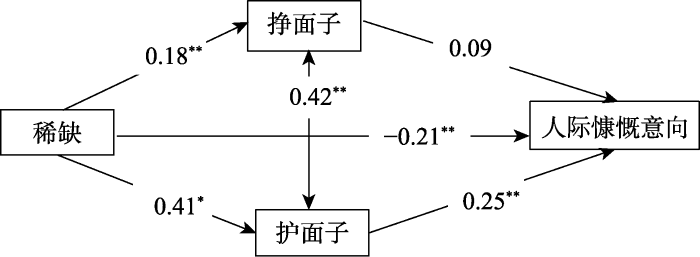
采用统计软件Mplus 7.0, 以贫困心态为自变量, 人际慷慨水平为因变量, 挣面子和护面子为中介变量, 人口统计学变量为控制变量, 对所得数据进行了结构方程模型分析。对样本采用bootstrap 1000次, 并采用95%和99%的置信区间。数据结果显示, 模型为饱和模型。模型的总体中介效应显著β = 0.12, p < 0.01, 99% CI = [−0.19, 0.01]。中介效应占总效应比为0.12 / [−0.21 + 0.12] = −130% 。具体到两条路径来说, 稀缺通过挣面子对人际慷慨意向的影响不显著, β = 0.02, 95% CI = [−0.01, 0.05]。然而, 稀缺通过护面子对慷慨行为的影响显著, β = 0.11, p < 0.01, 95% CI = [0.02,0.21],见图6。
图6
4.4 研究小结
本研究通过问卷测量的方法, 通过对299名样本进行测量, 探讨了挣面子和护面子在物质稀缺与人际慷慨行为之间的作用。研究发现, 对于物质资源稀缺的个体, 他们并不会为了挣面子而做出慷慨行为, 但是他们会为了维护自己的面子而做出慷慨行为。该研究结果验证了我们的假设2。
5 讨论
当前有关物质稀缺与慷慨行为的关系, 相关研究结果还是不一致的。本研究以自我建构视角下的面子为出发点, 通过3项研究(5个子研究)探讨了面子意识在物质稀缺与慷慨行为之间的关系。该研究丰富了已有的研究视角, 为更好地理解不同社会情境下人们的慷慨行为提供新的理论支撑。
5.1 资源消耗导向vs社会情境导向
在资源有限的条件下, 人们在做出慷慨行为时是更看重自己的资源消耗还是会更依赖于当时所处的社会情境?本研究结果显示, 在不考虑个体面子需要的前提下, 资源稀缺对个体的慷慨行为具有显著的负向预测作用。然而, 基于情境认知差异, 稀缺与慷慨行为的关系也会随着个体的自我建构的不同而发生改变。
资源消耗理论认为只有拥有丰富资源的人才会做出亲社会行为, 因此资源的稀缺会限制亲社会行为的发生(Penner et al., 2005)。研究认为, 即使个体有很强的利他倾向, 但是当做出与金钱有关的决策时, 资源的限制使得个体在资源分配上有更高的权衡成本, 需要做出更多的评估(Shah et al., 2018; Dolan et al., 2021)。本研究结果认为, 在资源稀缺客观存在的条件下, 慷慨行为仍然不会消失。按照以往研究, 这可能因为稀缺经历会增加个体的同理心(Cui et al., 2022); 也有可能是因为资源稀缺的人们更愿意通过共享资源的方式期待回报(Raihani & Bshary, 2015)。更为重要的是, 在中国文化情境下, 由于“关系”在人际交往中的重要性, 从自我建构的视角出发去理解资源稀缺对慷慨行为的影响显得尤为重要。若要正确理解物质稀缺与慷慨行为的关系, 需要同时考虑到资源消耗与个体所处的社会情境。尽管面子在各个国家存在, 但是在以集体主义为主导文化的地域, 这种依赖性的文化使面子的重要性更加突出(魏新东 等, 2023)。个体的自身价值、表现与社会形象都需要接受他人的检验, 而个体亲社会行为的展现是得到他人中肯评价的重要手段之一。当然, 随着中国现代化的进程, 城乡社会结构开始从二元到一元转变, 个体的居住流动性增强, 使得人际关系网也开始逐渐变得疏浅(Zhang & Zhao, 2023; Zhao et al., 2021)。面子这一受文化情境影响变量也会随着现代化的进程发生改变。在这种情况下, 对于资源稀缺的个体来说, 他们的慷慨行为是否也会发生改变?
5.2 穷大方:一种心理防御机制
“穷大方”是指拥有物质财富较少的人比拥有更多的人更有可能参与到慷慨或捐赠的行为。目前已有学者从经济学角度解释“穷大方”现象。如Novemsky和Kahneman (2005)从损失厌恶(loss aversion)的观点出发, 认为资源稀缺的人由于自己有物质困难的经历, 因此他们更愿意通过表现出慷慨行为以减轻失去的痛苦。基于以往的研究基础, 本研究从心理学的视角认为, “穷大方”更多是个体通过做出慷慨行为来维护自尊水平、社会认同等心理感受的一种方式, 是个体防御机制的表现。
面子管理理论(face management theory)认为, 当个体在受到面子的威胁时, 他们对于挣面子、防止丢面子的需求构成一种极其强烈的社会动机(Goffman & Newill, 1967)。通过努力防止丢面子(也即护面子)来保证自己免受由消极情绪带来的心理困扰。研究指出, 那些对消极评价比较敏感、倾向于自我保护的个体会更加竭力地避免丢面子(张新安, 2012)。挣面子并不是人人都需要, 但是丢面子却是人人都努力避免的。这是因为丢面子带来的后果更严重, 因此护面子作为一种防御功能来维持个体社会关系得以正常进行(Cupach & Carson, 2002)。本研究为以上结论提供了理论支撑, 我们的研究结果同样发现, 物质稀缺的个体会因为护面子而做出慷慨行为, 该研究结果为以往的研究提供了证据支持。从此角度上来说, 个体由于爱面子而做出的慷慨行为即是用以维护自尊和社会认同, 从而反映出个体对自我价值的感知并完成与他人建立连接的需求。物质稀缺情况下, 个体通过做出慷慨行为来呈现积极形象以降低社会评价的负面影响。当然, 过度追求面子会引起严重的消极后果, 如攀比心理、虚荣心理等。如何在面子维护自尊与带来消极影响之间做好平衡, 并进一步探讨面子作为防御机制的心理机制和影响, 是未来应该关注的方向, 具有重要的理论和现实意义。
5.3 稀缺心态与个体的心理与行为
Shah等(2018)在认知资源有限理论的基础上, 通过整合认知心理学与经济学的观点来解释个体在面临资源稀缺时的行为决策模式(De Bruijn & Antonides, 2022)。资源稀缺导致个体形成稀缺心态(scarcity mindset), 稀缺心态会进一步影响人们的判断和决策(Huijsmans et al., 2019)。然而, 当前有关稀缺的相关研究主要依赖于国外的研究成果, 我国对稀缺及其影响的研究还处在起步阶段(雷亮 等, 2020)。当前, 中国的脱贫攻坚已取得胜利, 绝对贫困消失, 但是相对贫困在一段时间内仍将依然存在。相对贫困个体的亲社会行为(如慷慨行为、合作行为)尤其值得研究者的关注。相对贫困者的亲社会行为意识还比较薄弱, 在很多合作行为中存在严重的“机会主义”和“搭便车”现象(许增巍 等, 2016)。对相对贫困个体的稀缺心态以及亲社会的相关研究可以促进社会和谐, 科学治理相对贫困。
有关相对贫困个体的亲社会行为, 有研究以中国的农民为样本发现, 长期资源稀缺的中国农民的亲社会意识很强, 他们更愿意合作(Yang et al., 2020)。Banerjee和Duflo (2007)的调查结果显示, 那些较为贫穷的个体, 通常会在购买赠与朋友节日礼物上花费更多的金钱, 财富匮乏和资源稀缺的个体反而更乐于捐赠(Kraus et al., 2010)。也有研究从宏观层面发现, 在资源相对稀缺的集体主义文化背景下的个体的合作行为更多(Henrich et al., 2001)。针对这些研究结果, 当前研究认为, 这是因为稀缺的个体对他人有更强的依赖性(Samu et al., 2020)。但是总体来看, 这些研究目前还停留在现象描述层面, 对其相应的心理机制以及相应的边界条件研究较少。从文化的视角探索哪些文化元素在二者关系中起作用, 是值得关注的课题。
5.4 研究局限与思考
首先, 研究需充分考虑稀缺、慷慨行为以及稀缺与慷慨行为关系的复杂性。本研究以“随份子”和“请客吃饭”的场景作为关系性慷慨行为, 以 “资金分配”和“社会捐助”的场景作为遵规/公益性慷慨行为作为因变量的测量, 然而这些情境均采用的是实验室模拟的方法。有研究认为, 从实验范式上来说, 个体在实验室模拟情境中与现实生活的真实情境中做出决策时所采用的策略是不同的(Dolan et al., 2021)。当前也有研究采用了真实的指标来测量个体的稀缺水平, 如拥有的汽车数量(Paul & Rana, 2012)。但是大部分研究仍然采用的是实验室情境启动及自我报告的结果(如:阶级标签选择)。同时稀缺的类型也非常复杂, 如从时间维度上可以分为长期稀缺和短期稀缺(Shah et al., 2018), 从类型上物质、时间和心理稀缺, 不同类别的稀缺对个体心理及行为影响的机制也不尽相同(Cannon et al., 2019)。未来研究可以同时考虑不同稀缺类型对慷慨行为的影响。
其次, 本研究为横断面研究, 无法验证面子意识高的个体在做出慷慨行为之后的心理与行为。俗话说“打肿脸充胖子”、“死要面子活受罪”, 都表明了稀缺个体在做出慷慨行为之后的主观体验, 那么如何看待由于面子意识驱动而做出慷慨行为?同时, 受客观因素的影响, 本研究收集数据在2022年11月份左右, 受客观条件限制, 本研究的数据全部来自于线上收集。未来研究可以尝试通过线下收取的样本来进一步验证本研究结果。总之, 尽管本研究得出了一些有价值的研究成果, 但仍然存在一些研究局限需要后续研究加以改进, 尤其是一些潜在的边界条件和心理机制需要进一步的挖掘和探讨。
最后, 未来实践中需要思考面子在慈善助推及社会治理中扮演的角色。资源稀缺的情况下, 面子可以激发慷慨行为, 从此角度来看, 可以充分发挥面子的角色以助推个体的慷慨行为。然而, 如果个体过分受面子的影响, 又会给个体带来较大的社会压力和心理压力, 不利于个体的身心健康。如何平衡面子发挥作用的火候显得尤为重要。同时本研究给乡村振兴下的社会治理提供了一些重要的启示。乡村地区作为人口较为稠密的区域, 社会交往与互动频繁, 适度的慷慨行为可以促进社会信任、减轻紧张情绪, 增进人际关系质量, 形成更加和谐稳定的社会环境。此外, 适度的慷慨行为也可以帮助贫困地区的人们获得必要的支持与帮助, 促进社会公正, 促进社会经济发展。乡村地区经常面临资源短缺的问题, 例如水资源、土地和劳动力匮乏。了解稀缺心态的不同方面可以帮助我们更好地理解乡村地区居民的行为模式。如果能够在政策制定和实施中考虑到稀缺心态的因素, 那么能更好地促进慷慨行为和互助精神的发展。
6 结论
以自我建构视角下的面子意识为切入点, 采用问卷调查、实验模拟相结合的3个研究(5个子研究), 本研究探讨了面子意识在物质资源稀缺与慷慨行为之间的作用。研究发现, 对于资源稀缺的个体来说, 高面子意识的人表现出更多的慷慨行为; 资源稀缺个体做出慷慨行为的动机不在于挣面子, 而在于护面子。本研究首次从面子视角来解释“穷大方”这一日常现象, 有利于帮助厘清当前研究中资源稀缺与慷慨行为关系的矛盾性。同时, 对于乡村振兴道路上如何促进相对贫困个体的亲社会行为有重要的实践启示。
参考文献
The economic lives of the poor
DOI:10.1257/jep.21.1.141 PMID:19212450 [本文引用: 1]
Children's altruistic behavior in the dictator game
Stuck in time: Negative income shock constricts the temporal window of valuation spanning the future and the past
Humans expect generosity
A self-regulatory model of resource scarcity
DOI:10.1002/jcpy.1035
[本文引用: 1]

Academics have shown a growing interest in the effects of resource scarcity-a discrepancy between one's current resource levels and a higher, more desirable reference point. However, the existing literature lacks an overarching theory to explain the breadth of findings across different types of resources. To address this, we introduce a self-regulatory model of resource scarcity. In it, we propose that consumers respond to resource scarcity through two distinct psychological pathways: a scarcity-reduction route aimed at reducing the discrepancy in resources and a control-restoration route aimed at reestablishing diminished personal control by attaining security in other domains. We explain how a key determinant of which route the consumer will pursue is the perceived mutability of the resource discrepancy. We also specify moderators, based on our proposed model, to identify when each of the two routes is pursued. This model is assessed in the context of alternative theoretical perspectives, including commodity theory, life history theory, and models of compensatory behavior. Finally, we provide a research agenda for those interested in studying the psychology of resource scarcity from a self-regulatory perspective.
The contrasting effects of culture on consumer tolerance: Interpersonal face and impersonal fate
Buddhist concepts as implicitly reducing prejudice and increasing prosociality
DOI:10.1177/0146167215571094
PMID:25676193
[本文引用: 1]
Does Buddhism really promote tolerance? Based on cross-cultural and cross-religious evidence, we hypothesized that Buddhist concepts, possibly differing from Christian concepts, activate not only prosociality but also tolerance. Subliminally priming Buddhist concepts, compared with neutral or Christian concepts, decreased explicit prejudice against ethnic, ideological, and moral outgroups among Western Buddhists who valued universalism (Experiment 1, N = 116). It also increased spontaneous prosociality, and decreased, among low authoritarians or high universalists, implicit religious and ethnic prejudice among Westerners of Christian background (Experiment 2, N = 128) and Taiwanese of Buddhist/Taoist background (Experiment 3, N = 122). Increased compassion and tolerance of contradiction occasionally mediated some of the effects. The general idea that religion promotes (ingroup) prosociality and outgroup prejudice, based on research in monotheistic contexts, lacks cross-cultural sensitivity; Buddhist concepts activate extended prosociality and tolerance of outgroups, at least among those with socio-cognitive and moral openness. © 2015 by the Society for Personality and Social Psychology, Inc.
How resource sharing resists scarcity: The role of cognitive empathy and its neurobiological mechanisms
Characteristics and consequences of interpersonal complaints associated with perceived face threat
Poverty and economic decision making: A review of scarcity theory
Evaluating the economic impact of water scarcity in a changing world
Poor but warm, rich but cold (and competent): Social classes in the stereotype content model
Non-normal and categorical data in structural equation modeling
Communication and epidemic processes
Are they giving scarce resources away?: Types of prosocial behavior modulate the prosocial effects of target social class on others
The feeling of “face” in confucian society: From a perspective of psychosocial equilibrium
Nice guys finish first: The competitive altruism hypothesis
Three experimental studies examined the relationship between altruistic behavior and the emergence of status hierarchies within groups. In each study, group members were confronted with a social dilemma in which they could either benefit themselves or their group. Study 1 revealed that in a reputation environment when contributions were public, people were more altruistic. In both Studies 1 and 2, the most altruistic members gained the highest status in their group and were most frequently preferred as cooperative interaction partners. Study 3 showed that as the costs of altruism increase, the status rewards also increase. These results support the premise at the heart of competitive altruism: Individuals may behave altruistically for reputation reasons because selective benefits (associated with status) accrue to the generous.
In search of homo economicus: Behavioral experiments in 15 small-scale societies
A scarcity mindset alters neural processing underlying consumer decision making
Moral face and social face: Contingent self-esteem in Confucian society
Face and morality in Confucian society
In
What makes you select a higher price option? Price-quality heuristics, cultures, and travel group compositions
Counterfeits or Shanzhai? The role of face and brand consciousness in luxury copycat consumption
DOI:10.1177/0033294116659316
PMID:27444656
[本文引用: 1]
This study responds to the emergence of the Shanzhai phenomenon in the international marketplace and introduces the Shanzhai phenomenon into the consumer behavior literature by defining it and comparing it with well-known concepts like luxury counterfeits. More specifically, it examines how consumers' face and brand consciousness influence their willingness to buy luxury counterfeits rather than Shanzhai products. The results show that consumers who are more face conscious are more likely to choose luxury counterfeits than Shanzhai products. In addition, consumers' face consciousness elicits a high concern for well-known brands, which also in turn leads to a more favorable attitude toward luxury counterfeits than Shanzhai products. These findings enable researchers to better understand consumers' responses toward both Shanzhai and counterfeit products and help companies that are protecting their original brands to tailor their consumer-directed measures more effectively. © The Author(s) 2016.
Face or subjective norm? Chinese college students’ purchase behaviors toward foreign brand jeans
The sociocultural appraisals, values, and emotions (SAVE) framework of prosociality: Core processes from gene to meme
DOI:10.1146/annurev-psych-010213-115054
PMID:24405363
[本文引用: 1]
The study of prosocial behavior--altruism, cooperation, trust, and the related moral emotions--has matured enough to produce general scholarly consensus that prosociality is widespread, intuitive, and rooted deeply within our biological makeup. Several evolutionary frameworks model the conditions under which prosocial behavior is evolutionarily viable, yet no unifying treatment exists of the psychological decision-making processes that result in prosociality. Here, we provide such a perspective in the form of the sociocultural appraisals, values, and emotions (SAVE) framework of prosociality. We review evidence for the components of our framework at four levels of analysis: intrapsychic, dyadic, group, and cultural. Within these levels, we consider how phenomena such as altruistic punishment, prosocial contagion, self-other similarity, and numerous others give rise to prosocial behavior. We then extend our reasoning to chart the biological underpinnings of prosociality and apply our framework to understand the role of social class in prosociality.
Word order denotes relevance differences: The case of conjoined phrases with lexical gender
DOI:10.1037/pspi0000094
PMID:28414481
[本文引用: 1]
This work explores the order of linguistic references to the two genders (e.g., men and women vs. women and men). It argues that a gender is more likely to be mentioned first when it is perceived to have higher relevance in a context rather than lower relevance, and audiences assign stronger relevance to a party when the party is mentioned first rather than second. Studies 1-3 document the current prevalence of male-first conjoined phrases in the public (but not family) domain and link the pattern to historical changes in women's public presence over the 20th century. Study 4 shows that contextual relevance cues affect the odds of first mention, such that people are more likely to refer to a woman before a man, when the two are in a primary school classroom rather than a corporate office. At the same time, Studies 4 and 5 find that people often choose to reproduce collectively preferred word order patterns (e.g., men and women). Studies 6 and 7 show that these choices matter because people assign more relevance to a party when it comes first rather than second in a conjoined phrase. Overall, this work offers theoretical grounding and empirical evidence for word order as a means of expressing and perpetuating gender stereotypes. (PsycINFO Database Record(c) 2017 APA, all rights reserved).
The concept and dynamics of face: Implications for organizational behavior in Asia
A large scale test of the effect of social class on prosocial behavior
Social class, contextualism, and empathic accuracy
DOI:10.1177/0956797610387613
PMID:20974714
[本文引用: 1]
Recent research suggests that lower-class individuals favor explanations of personal and political outcomes that are oriented to features of the external environment. We extended this work by testing the hypothesis that, as a result, individuals of a lower social class are more empathically accurate in judging the emotions of other people. In three studies, lower-class individuals (compared with upper-class individuals) received higher scores on a test of empathic accuracy (Study 1), judged the emotions of an interaction partner more accurately (Study 2), and made more accurate inferences about emotion from static images of muscle movements in the eyes (Study 3). Moreover, the association between social class and empathic accuracy was explained by the tendency for lower-class individuals to explain social events in terms of features of the external environment. The implications of class-based patterns in empathic accuracy for well-being and relationship outcomes are discussed.
Scarcity disrupts the neural encoding of black face: A socioperceptual pathway to discrimination
DOI:10.1037/pspa0000168
PMID:31233317
[本文引用: 1]
When economic resources are scarce, racial minorities are often devalued and disenfranchised. We proposed that this pattern extends to visual processing, such that the encoding of minority group faces is disrupted under scarcity-an effect that may facilitate discrimination and contribute to racial disparities. Specifically, we used EEG and fMRI to test whether scarce economic conditions induce deficits in neural encoding of Black faces, and we examined whether this effect is associated with discriminatory resource allocation in behavior. In Study 1, framing resources as scarce (vs. neutral) selectively impaired the neural encoding of Black (vs. White) faces, as indexed by a delayed face-related N170 ERP response, and the degree of this encoding deficit predicted anti-Black allocation decisions. In Study 2, we replicated and extended this effect using fMRI: Resources framed as scarce (vs. neutral) reduced face-sensitive fusiform activity to Black (vs. White) faces. Furthermore, scarcity-decreased fusiform activity to Black faces corresponded with decreased valuation-related striatum activity to predict anti-Black allocation decisions. These findings suggest that impaired visual processing and devaluation occur selectively for minorities under scarcity-an implicit effect that may promote discrimination and contribute to rising disparities observed during economic stress. (PsycINFO Database Record (c) 2019 APA, all rights reserved).
Social class and children’s prosociality: A study in the context of China’s Dual urban-rural structure
Life-history strategy, food choice, and caloric consumption
DOI:10.1177/0956797612450033
PMID:23302296
[本文引用: 1]
Do people's perceptions that they live in a harsh environment influence their food choices? Drawing on life-history theory, we propose that cues indicating that the current environment is harsh (e.g., news about an economic crisis, the sight of people facing adversity in life) lead people to perceive that resources in the world are scarce. As a consequence, people seek and consume more filling and high-calorie foods, which they believe will sustain them for longer periods of time. Although perceptions of harshness can promote unhealthy eating, we show how this effect can be attenuated and redirected to promote healthier food choices.
The effect of scarcity on individuals’ psychology and behavior: An explanation from a more integrated perspective
稀缺对个体心理和行为的影响:基于一个更加整合视角下的阐释
DOI:10.3724/SP.J.1042.2020.00833
[本文引用: 2]
稀缺是由资源的真实缺乏或感知缺乏所引起的个体欲望和需求得不到满足的一种状态。稀缺作为一种普遍存在的现象对个体的情感、认知、以及行为方式产生了重要的影响, 但是不同类型的稀缺(以食物、产品、资金为代表的有形资源稀缺vs.以时间为代表的无形资源稀缺)对个体心理和行为的影响是否存在共性与差异?梳理文献发现, 有形资源稀缺会使个体产生珍惜性行为、补偿性行为和趋近性行为, 而无形资源稀缺只会使个体产生珍惜性和补偿性行为。未来研究应关注稀缺影响个体行为的边界条件, 以及时间稀缺对个体心理和行为的影响。
The developmental emergence of direct reciprocity and its influence on prosocial behavior
DOI:S2352-250X(17)30120-3
PMID:29486397
[本文引用: 1]
Humans are a remarkably cooperative species, and one behavior thought to play an important role is that of reciprocal altruism. By ensuring that the immediate costs associated with performing a prosocial action will be recouped in the long-run, reciprocal interactions support the emergence and maintenance of group-level cooperation. Existing developmental research suggests that a tendency toward selective prosocial behavior and an understanding of direct reciprocal interactions emerge in early childhood, but much less is known about the interplay between these two behaviors. In this paper, I review the existing literature supporting the notion that reciprocity mediates early prosocial tendencies and suggest that a greater understanding of the psychological mechanisms underlying reciprocity is needed. Finally, I propose two social cognitive capacities related to prospection that I believe may help to shed light on the psychology of strategic reciprocal interactions and their role in prosocial behavior more broadly.Copyright © 2018 Elsevier Ltd. All rights reserved.
Study of “Mianzi”: A psychological perspective
面子的心理学研究述评
The dynamics of face loss following interpersonal harm for Chinese and Americans
Sharing good fortune: Effects of scarcity on small donation requests
Scarcity and the mindsets of social welfare recipients: Evidence from a field experiment
Does Scarcity increase or decrease donation behaviors? An investigation considering resource-specific scarcity and individual person-thing orientation
Culture, self, and the reality of the social
The resilience of social norms of cooperation under resource scarcity and inequality—An agent-based model on sharing water over two harvesting seasons
The boundaries of loss aversion
Empirical audit and review and an assessment of evidentiary value in research on the psychological consequences of scarcity
Consumer behavior and purchase intention for organic food
The impact of resource scarcity on price-quality judgments
A neural link between generosity and happiness
Prosocial behavior: Multilevel perspectives
Current research on prosocial behavior covers a broad and diverse range of phenomena. We argue that this large research literature can be best organized and understood from a multilevel perspective. We identify three levels of analysis of prosocial behavior: (a) the "meso" level--the study of helper-recipient dyads in the context of a specific situation; (b) the micro level--the study of the origins of prosocial tendencies and the sources of variation in these tendencies; and (c) the macro level--the study of prosocial actions that occur within the context of groups and large organizations. We present research at each level and discuss similarities and differences across levels. Finally, we consider ways in which theory and research at these three levels of analysis might be combined in future intra- and interdisciplinary research on prosocial behavior.
Social welfare and the psychology of food sharing: Short-term hunger increases support for social welfare
Having less, giving more: The influence of social class on prosocial behavior
DOI:10.1037/a0020092
PMID:20649364
[本文引用: 3]
Lower social class (or socioeconomic status) is associated with fewer resources, greater exposure to threat, and a reduced sense of personal control. Given these life circumstances, one might expect lower class individuals to engage in less prosocial behavior, prioritizing self-interest over the welfare of others. The authors hypothesized, by contrast, that lower class individuals orient to the welfare of others as a means to adapt to their more hostile environments and that this orientation gives rise to greater prosocial behavior. Across 4 studies, lower class individuals proved to be more generous (Study 1), charitable (Study 2), trusting (Study 3), and helpful (Study 4) compared with their upper class counterparts. Mediator and moderator data showed that lower class individuals acted in a more prosocial fashion because of a greater commitment to egalitarian values and feelings of compassion. Implications for social class, prosocial behavior, and economic inequality are discussed.
Face: A Chinese concept in a global sociology
Temporary self-deprivation can impair cognitive control: Evidence from the Ramadan fast
Why humans might help strangers
DOI:10.3389/fnbeh.2015.00039
PMID:25750619
[本文引用: 1]
Humans regularly help strangers, even when interactions are apparently unobserved and unlikely to be repeated. Such situations have been simulated in the laboratory using anonymous one-shot games (e.g., prisoner's dilemma) where the payoff matrices used make helping biologically altruistic. As in real-life, participants often cooperate in the lab in these one-shot games with non-relatives, despite that fact that helping is under negative selection under these circumstances. Two broad explanations for such behavior prevail. The "big mistake" or "mismatch" theorists argue that behavior is constrained by psychological mechanisms that evolved predominantly in the context of repeated interactions with known individuals. In contrast, the cultural group selection theorists posit that humans have been selected to cooperate in anonymous one-shot interactions due to strong between group competition, which creates interdependence among in-group members. We present these two hypotheses before discussing alternative routes by which humans could increase their direct fitness by cooperating with strangers under natural conditions. In doing so, we explain why the standard lab games do not capture real-life in various important aspects. First, asymmetries in the cost of perceptual errors regarding the context of the interaction (one-shot vs repeated; anonymous vs public) might have selected for strategies that minimize the chance of making costly behavioral errors. Second, helping strangers might be a successful strategy for identifying other cooperative individuals in the population, where partner choice can turn strangers into interaction partners. Third, in contrast to the assumptions of the prisoner's dilemma model, it is possible that benefits of cooperation follow a non-linear function of investment. Nonlinear benefits result in negative frequency dependence even in one-shot games. Finally, in many real-world situations individuals are able to parcel investments such that a one-shot interaction is turned into a repeated game of many decisions.
On the psychology of scarcity: When reminders of resource scarcity promote selfish (and generous) behavior
Scarce and directly beneficial reputations support cooperation
No evidence that economic inequality moderates the effect of income on generosity
Money in the mental lives of the poor
Financial deprivation prompts consumers to seek scarce goods
How face consciousness reverse pro-self behavior? A study on ecological consumption from the perspective of social value orientation
The double-edged sword effect of employee personal initiative behavior on coworker relationships: The moderating role of the employee warmth trait
DOI:10.3724/SP.J.1041.2023.02013
[本文引用: 1]
<p id="p00005">Personal initiative behavior contributes to organizational success and helps employees navigate workplace uncertainty, and is therefore an essential research topic. However, most studies have focused on the influence of personal initiative behavior on leaders rather than coworkers. Moreover, the findings regarding the interpersonal effects of such behavior on coworkers are inconsistent. To address these issues, we take a contingency perspective that shifts the focus from a binary “good or bad for coworkers” logic to an understanding of the interpersonal benefits and risks of personal initiative behavior. Drawing on research stereotype traits, in this study we examine the moderating effect of the trait of employee warmth trait and explore the differential emotional and behavioral responses of coworkers toward employees with high or low warmth traits. We apply the approach-avoidance systems theory and hypothesize that warm and initiative-taking employees generate relational energy, leading to active facilitation behavior, whereas initiative-taking but non-warm employees may experience interpersonal disliking and subsequent ostracism behavior from coworkers.</p> <p id="p00010">We conducted two studies to test our hypotheses. Study 1 involved a multi-source round-robin survey to test the proposed model. Each survey wave was separated by a three-week interval. At Time 1, team leaders assessed each team member’s personal initiative behavior and demographics. The team members then rated their own warmth trait and demographics. Three weeks later at Time 2, the team members evaluated relational energy and interpersonal disliking through a round-robin design. Finally, three weeks later at Time 3, they rated their active facilitation behavior and interpersonal ostracism behavior using a round-robin design. The dataset comprised 1, 164 dyads of 305 members in 65 teams. In Study 2, to enhance causal inference, a scenario-based experiment with a 2 (personal initiative behavior: high vs. low) × 2 (employee warmth trait: high vs. low) factorial design was conducted. The participants (280 full-time workers) were recruited from an online survey platform (Credamo) and randomly assigned to one of four scenarios. They reported their demographics, read the scenario, and provided responses to manipulation checks and questions regarding relational energy, interpersonal disliking, active facilitation behavior, and interpersonal ostracism behavior.</p> <p id="p00015">In terms of data analysis, we considered the complex nested structure of the round-robin data in Study 1 and utilized a multilevel social relations modeling approach to test the research model. In Study 2, we used ANOVA and regression analyses to examine the causal relationships in our theoretical model. The empirical results supported our hypotheses, indicating that initiative-taking and warm employees were more likely to stimulate coworkers’ relational energy and increase their active facilitation behavior. Conversely, initiative-taking but non-warm employees were more likely to trigger interpersonal disliking among coworkers, subsequently leading to increased interpersonal ostracism behavior.</p> <p id="p00020">This study has several theoretical implications. First, unlike studies that focus on singular effects, we explored the dual nature of the effects of personal initiative behavior on coworkers, thus providing a deeper understanding and a more comprehensive perspective. Second, by building on the literature on stereotype traits, we identified the employee warmth trait as a critical boundary that distinguishes the interpersonal benefits and risks of personal initiative behavior toward coworkers, thus reconciling other contradictory findings. Finally, by drawing on approach-avoidance systems theory, we revealed that relational energy and interpersonal disliking explain how and why coworkers have differential behavioral responses toward the personal initiative behavior exhibited by employees with high or low warmth traits.</p>
员工主动行为对同事关系的双刃剑效应:员工热情特质的调节作用
DOI:10.3724/SP.J.1041.2023.02013
[本文引用: 1]
本研究基于趋近−回避系统理论和刻板印象特质相关文献, 探讨了员工主动行为对同事的人际收益和代价, 以及驱动不同结果生效的边界条件和传导机制。本研究相继通过对三阶段、多来源轮询设计问卷调研(研究1)和情境实验(研究2)收集的数据进行分析, 得出以下结论: 当员工热情特质处于高水平时, 其主动行为会激发同事关系能量, 进而驱动同事采取人际促进行为; 而当员工热情特质处于低水平时, 其主动行为会诱发同事人际反感, 从而致使同事采取人际孤立行为。
High economic inequality leads higher-income individuals to be less generous
Closing the social-class achievement gap: A difference- education intervention improves first-generation students’ academic performance and all students’ college transition
DOI:10.1177/0956797613518349
PMID:24553359
[本文引用: 1]
College students who do not have parents with 4-year degrees (first-generation students) earn lower grades and encounter more obstacles to success than do students who have at least one parent with a 4-year degree (continuing-generation students). In the study reported here, we tested a novel intervention designed to reduce this social-class achievement gap with a randomized controlled trial (N = 168). Using senior college students' real-life stories, we conducted a difference-education intervention with incoming students about how their diverse backgrounds can shape what they experience in college. Compared with a standard intervention that provided similar stories of college adjustment without highlighting students' different backgrounds, the difference-education intervention eliminated the social-class achievement gap by increasing first-generation students' tendency to seek out college resources (e.g., meeting with professors) and, in turn, improving their end-of-year grade point averages. The difference-education intervention also improved the college transition for all students on numerous psychosocial outcomes (e.g., mental health and engagement).
Personality and prosocial behavior: A theoretical framework and meta-analysis
DOI:10.1037/bul0000217
PMID:31841013
[本文引用: 1]
Decades of research document individual differences in prosocial behavior using controlled experiments that model social interactions in situations of interdependence. However, theoretical and empirical integration of the vast literature on the predictive validity of personality traits to account for these individual differences is missing. Here, we present a theoretical framework that identifies 4 broad situational affordances across interdependent situations (i.e., exploitation, reciprocity, temporal conflict, and dependence under uncertainty) and more specific subaffordances within certain types of interdependent situations (e.g., possibility to increase equality in outcomes) that can determine when, which, and how personality traits should be expressed in prosocial behavior. To test this framework, we meta-analyzed 770 studies reporting on 3,523 effects of 8 broad and 43 narrow personality traits on prosocial behavior in interdependent situations modeled in 6 commonly studied economic games (Dictator Game, Ultimatum Game, Trust Game, Prisoner's Dilemma, Public Goods Game, and Commons Dilemma). Overall, meta-analytic correlations ranged between -.18 ≤ ρ̂ ≤.26, and most traits yielding a significant relation to prosocial behavior had conceptual links to the affordances provided in interdependent situations, most prominently the possibility for exploitation. Moreover, for several traits, correlations within games followed the predicted pattern derived from a theoretical analysis of affordances. On the level of traits, we found that narrow and broad traits alike can account for prosocial behavior, informing the bandwidth-fidelity problem. In sum, the meta-analysis provides a theoretical foundation that can guide future research on prosocial behavior and advance our understanding of individual differences in human prosociality. (PsycINFO Database Record (c) 2019 APA, all rights reserved).
Ingratiation, renqing, mianzi and attraction: A guanxi perspective
Class impressions: Higher social class elicits lower prosociality
To gain face or not to lose face: The effect of face message frame on response to public service advertisements
Honor culture and face culture: A comparison through the lens of the dignity, honor, and face cultural framework and indigenous social theory
DOI:10.3724/SP.J.1042.2023.01541
[本文引用: 3]
<p id="p00010">Honor and face cultures attach great importance to regulating individual behavior by social expectations and cultural norms. However, the two cultural phenomena differ in several crucial aspects. The new cultural framework of dignity, honor, and face was proposed based on three different cultural logics and reveals that while both honor culture and face culture place importance on adhering to social norms, honor culture places greater emphasis on both self-awareness and external evaluations for self-worth, whereas face culture places more weight on external evaluations. Additionally, honor culture is characterized by an unstable social hierarchy prone to competition, violence, and virtue, while face culture prioritizes modesty, harmony, and cooperation within a more stable hierarchy. However, the framework does not fully explore the cultural practices and specific connotations that are locally relevant to each respective culture.</p> <p id="p00015">From indigenous perspectives, the self-image and social image in honor culture are relatively consistent, and honor encompasses moral, gender, and family-related aspects that may be defended through violence. In contrast, self-image and social image in face culture tend to be incongruent, and face involves morality and social achievement, which is expressed through the dimensions of seeking face and avoiding losing face with an emphasis on status and authority.</p> <p id="p00020">Combined with the above two perspectives, these core differences between honor and face cultures can be attributed to the moralization and instrumentalization of social cultural norms. Specifically, honor tends to moralize social and cultural norms by transforming descriptive norms into prescriptive norms, where majority and typical behaviors that exist in a culture are considered behaviors that group members should or must abide by. In contrast, face instrumentalizes social and cultural norms by using descriptive and prescriptive norms as means and tools to maintain relationships, demonstrate status, and uphold authority. This perspective provides new insights into cultural phenomena, such as the positive correlation between violence and virtue in honor cultures, where violence becomes a social norm that adapts to the honor culture environment and is moralized into a virtuous attribute. The social norm of harmony in face culture exists both as value-oriented harmony influenced by Confucian culture and instrumental harmony in daily life, leading to a dissonance between face and heart. This comparative analysis can help in developing new measurement models to test the core differences between the honor and face cultures and explore the impact of changing values and social ecological variables on the moralization and instrumentalization of social norms in the context of cultural change.</p>
荣誉文化与面子文化:三分框架与本土概念视角下的比较
DOI:10.3724/SP.J.1042.2023.01541
[本文引用: 3]
荣誉文化与面子文化虽都较重视个体行为应尽量符合社会期望及相应的社会文化规范, 但它们有诸多差异。“尊严-荣誉-面子”三分框架下荣誉文化的自我价值来源包括同等重要的自我认知与他人评价, 而面子文化以他人评价为主; 荣誉文化社会等级结构不稳定, 讲究竞争、暴力与美德并重, 面子文化社会等级较稳定, 讲究谦虚、和谐与合作。本土概念下荣誉中自我形象与社会形象相对一致, 包括道德、性别与家庭荣誉等维度, 会以暴力手段捍卫荣誉; 面子中自我形象与社会形象通常不一致, 主要包括道德与社会成就, 表现为挣面子与避免丢面子两个维度, 注重彰显地位与维护权威。在此基础上, 从都较重视社会规范的“理一”视角出发, 将两个文化的“分殊”之处归为社会文化规范的道德化与工具化, 并基于此提出两点展望: 改善测量工具; 探究不同文化变迁内容对社会规范道德化和工具化的影响。
Face consciousness, personal norms, and environmentally responsible behavior of Chinese tourists: Evidence from a lake tourism site
The impact of financial deprivation on prosocial behavior: Comparing the roles of face-saving consciousness versus status/success-gaining intention
The paradox between willingness and behavior: Factors influencing the households’ willingness to pay and real payment behavior on rural domestic garbage centralized treatment
意愿与行为的悖离:农村生活垃圾集中处理农户支付意愿与支付行为影响因素研究
Institutional preferences, social preferences and cooperation: Evidence from a lab-in-the-field experiment in rural China
The impact of Chinese-style modernisation on the social-psychological behaviours of Chinese individuals: Evidence from sociological and psychological research
Impact of Mianzi consciousness on unethical pro-organizational behavior: The roles of impression management motive, educational level, party affiliation in China
Consciousness of social face and conspicuous consumption of luxury products in the Chinese society
中国人的面子观与炫耀性奢侈品消费行为
Consciousness of social face: The development and validation of a scale measuring desire to gain face versus fear of losing face
Gain face, but lose happiness? It depends on how much money you have
Residential Mobility and trust: The moderating role of cognitive need for closure


