


1 引言
在日常生活中, 人们需要接收大量信息, 这些信息的重要性往往各不相同。因此, 基于人类注意和记忆容量的有限性特点, 能够有选择地优先考虑更有价值的信息是非常重要的控制过程, 可以影响信息加工的效率。已有研究表明, 为某些项目赋予高分值可以使它们在记忆中被优先保持和提取, 这一现象被称为价值导向记忆(Value-directed Remembering, VDR) (Castel et al., 2002; Castel et al., 2011; Castel et al., 2013; Cohen et al., 2016; Mason et al., 2017; Murphy et al., 2022; Stefanidi et al., 2018; Yin et al., 2021)。
考察项目价值对记忆影响的最常用范式是价值导向记忆范式(VDR范式)。该范式在编码阶段为每个项目分配一个分值(或金币) (Castel et al., 2002; DeLozier & Rhodes, 2015; Elliott, Blais, et al., 2020; Middlebrooks et al., 2017; Robison & Unsworth, 2017; Stefanidi et al., 2018), 被试的任务是通过正确地记住项目来赚取尽可能多的分值或奖励。在自由回忆 (Castel et al., 2002; Stefanidi et al., 2018)和再认(Elliott, Blais, et al., 2020; Elliott et al., 2019; Gruber & Otten, 2010; Hennessee et al., 2017; Hennessee et al., 2019; Shigemune et al., 2014; Wittmann et al., 2005)测验中, 研究者均发现了显著的价值导向记忆效应。
由价值导向记忆的相关研究可知, 可以通过选择性地专注于重要的信息(而不是非关键信息)来缓解由于要记住的信息太多而导致的记忆衰退(Castel et al., 2002)。但目前尚不清楚项目价值是否也会影响遗忘进程。也就是说, 对于个体对已学内容的记忆受损, 如果在编码阶段赋予学习项目不同的价值, 是会放大这种损害, 还是减少遗忘的发生?因此, 本研究将价值导向记忆与部分线索效应这一遗忘现象相结合, 考察项目价值对提取干扰的敏感性。即, 在提取阶段呈现不同价值项目作为部分线索, 考察其对不同价值项目回忆的影响。
部分线索效应(Part-list Cuing Effect)最早是由Slamecka (1968)发现的。它是指提供刚刚学习过的项目中的一部分作为提取线索时, 人们对剩余项目的回忆效果反而比没有任何线索时差的现象(Nickerson, 1984; Slamecka, 1968)。研究者在不同测验任务(John & Aslan, 2018; Liu et al., 2020; Liu et al., 2022; Oswald et al., 2006)、不同实验材料(Aslan et al., 2007; Fritz & Morris, 2015; 刘湍丽, 白学军, 2017; 刘湍丽 等, 2021)、不同年龄群体(John & Aslan, 2018; John & Aslan, 2020; Zellner & Bäuml, 2005; 唐卫海 等, 2014)中均发现了这一遗忘效应的存在。
目前, 仅有少数研究考察了线索特征对部分线索效应的影响。Basden等人(1977)通过样例词在类别中的分类等级顺序操纵了部分线索项目和目标项目的强度, 结果发现, 当线索和目标项目均为高分类等级时, 对于目标项目的回忆成绩较好, 但线索项目和目标项目的分类等级顺序并不能改变部分线索的抑制效应量。Kroeger等人(2019)考察了线索的易识记性对部分线索效应的影响, 结果发现, 高记忆性项目作为部分线索时, 产生了显著的部分线索干扰效应, 低记忆性项目作为部分线索时, 干扰效应不存在。以上研究表明对目标项目的提取受线索和目标项目特征的影响。在记忆活动中, 人们会选择性地关注重要的信息, 但以往关于部分线索效应的研究中, 所有学习材料对于被试来说均是同等重要的, 并且部分线索的选择也通常是随机的(通常是学习词表中奇数项/偶数项, 以确保在原始集合中均匀分布), 因此所有部分线索项目对于被试来说也具有等价性。迄今为止, 尚未有研究探索当操纵编码阶段学习项目的重要性, 并以不同价值的项目作为部分线索, 会如何影响对其他不同价值项目的提取。而价值导向记忆的相关研究发现, 对某些项目赋予高分值可以使它们在长时记忆中被优先保持和提取(Hitch et al., 2018; Stefanidi et al., 2018), 进而调节记忆表现。这意味着赋予项目不同的价值可能会通过影响加工深度和提取优先级而改变部分线索效应的大小甚至方向。因此本研究中实验1将首次探讨以不同价值的项目作为部分线索或者测验项目时对部分线索效应的影响。
基于此, 本研究将结合部分线索范式和价值导向记忆范式来探讨上述问题。具体为:在学习阶段, 要求被试学习价值不同(1分或10分)的类别样例词; 在测验阶段, 线索条件分为高价值线索、低价值线索和无线索三种, 在高、低价值线索条件下, 分别呈现部分已学的高价值或低价值项目作为提取线索(呈现顺序与学习阶段不同), 然后进行再认测验。在无部分线索条件下, 直接进行再认测验。通过将高、低价值线索与无线索条件下的再认成绩进行比较, 可以考察线索项目价值高低如何影响部分线索效应, 通过将高、低价值测验项目的再认成绩进行比较, 可以考察测验项目价值高低将如何影响部分线索效应。
目前对部分线索干扰效应的解释主要有提取抑制假说和策略破坏假说。提取抑制假说(Retrieval Inhibition Hypothesis)认为, 测验阶段部分线索的呈现, 使得个体首先对线索项目进行内隐提取, 内隐提取导致对非线索项目(目标项目)的抑制, 因而产生部分线索干扰效应(Anderson et al., 1994; Aslan et al., 2007; Bäuml & Aslan, 2006)。根据这一假说, 相较于低价值线索项目, 高价值线索项目的表征强度更高, 因而其对目标项目的破坏作用更大; 同样的, 相较于低价值目标项目, 高价值目标项目的表征强度更高, 因而受部分线索的干扰作用更小。
随后, Bäuml和Aslan (2006)通过设置不同的编码条件(低关联编码条件只学习一轮, 高关联编码条件通过两轮学−测来实现)和测验时程(即时测验时呈现部分线索, 最终测验时移除部分线索), 发现提取抑制和策略破坏分别在不同情况下发挥作用, 由此提出了双机制假说。该假说指出, 部分线索通过上述何种损害机制发挥作用取决于编码条件:在低关联编码条件下, 即在缺乏建立项目间关联和精细提取策略时, 线索项目主要基于提取抑制对目标项目的提取产生干扰; 在高关联编码条件下, 即当被试能够建立起大量项目间的链式关联和精细系列提取策略时, 则主要是通过破坏提取策略产生干扰。并且, 在低关联编码条件下, 部分线索的不利影响反映了目标项目激活水平的相对持久的变化, 损害作用相对持久; 而在高关联编码条件下, 部分线索的呈现引起提取策略的暂时改变, 如果移除部分线索, 原有提取策略将恢复, 因此遗忘是短暂并可被消除的。后续很多研究的结果也支持了双机制假说(Aslan & Bäuml, 2007; John & Aslan, 2020; Kelley et al., 2016; Muntean & Kimball, 2012)。
双机制假说认为, 高、低关联编码的操纵通过学−测次数来实现(Lehmer & Bäuml, 2018a, 2018b), 而价值导向记忆的相关研究表明, 项目价值高低直接影响被试的识记策略, 进而影响被试对项目之间关联的建立(Knowlton & Castel, 2022)。据此可以推断, 对于不同价值的项目来说, 通过相同的学习次数所能达到的项目关联编码程度是不同的, 相较于低价值项目, 高价值项目更容易建立项目间的关联。同时, 被赋予高价值的项目由于在编码过程中得到更多注意加工(Allen, 2019), 表征强度更高, 不容易随着时间的推移(无论是通过衰减还是干扰)而受损, 因此相较于低价值的项目, 高价值项目在长延迟上的记忆表现更好。因此, 项目价值可能既影响关联编码水平也影响部分线索效应的持久性。也即, 当项目价值不同, 相同编码要求下的部分线索效应可能有所不同。同样的, 当编码要求不同, 相同的项目价值也可能产生不同的加工结果, 并进而影响部分线索效应的大小及部分线索作用的持久性。这是双机制假说和前人研究中所没有涉及到的。因此, 有必要在实验2中进一步探索在不同编码条件下, 不同价值的项目作为线索或者目标(测验项目)时对再认成绩的影响及其影响的持久性, 并对双机制假说进行检验。在实验2中, 编码条件的操纵参照前人的做法, 将对学习材料学习一次(John & Aslan, 2020)定义为低关联编码, 将对学习材料进行2轮学习−测试循环(Basden & Basden, 1995)定义为高关联编码。同时为了考察项目价值对部分线索效应影响的持久性, 设置了2次测验, 即时测验在部分线索呈现后立即开始, 最终测验在即时测验结束后5分钟实施。
当项目价值不同时, 研究结果可能与双机制假说的预测有所不同:在低关联编码(1−学)条件下, 可能会导致高水平的项目间干扰, 但此时低价值项目对高价值项目的干扰作用小于高价值项目对低价值项目的干扰, 因此高价值测验项目受干扰程度低于低价值测验项目, 使得高价值测验项目再认成绩的受损比低价值测验项目小; 同样的, 当呈现高价值项目作为部分线索时, 部分线索的抑制效应比以低价值项目为线索时更大, 且抑制效应在即时测验和最终测验中持续存在。而在高关联编码(2−学−测)条件下, 项目间的干扰减少, 被试可能会形成一种优先输出顺序(当对学习材料进行多轮次的学习−测试时, 由于被试反复学习和回忆这些项目, 他们的回忆顺序在轮次间变得更加一致(Bäuml & Aslan, 2006; Lehmer & Bäuml, 2018a), 当要求被试回忆时, 则被试优先以该种顺序而不是其他顺序对识记项目进行回忆, 即为“优先输出顺序”), 当呈现部分线索时, 这种优先输出顺序极易被打乱, 因而出现部分线索干扰效应。但有研究发现, 随着项目间关联程度的增加, 有、无部分线索条件下回忆成绩的差异随之减小甚至消失(Raaijmakers & Shiffrin, 1981), 因此高价值测验项目可能较少甚至不受部分线索的影响; 同时由于低价值项目编码水平相对较低, 其对目标项目提取的影响仍可能通过策略破坏机制实现, 因而在取消部分线索的呈现后, 部分线索的破坏作用消失, 此时部分线索效应是暂时的。
总之, 本研究将通过两个实验来探讨以上问题。实验1将探讨不同价值的项目作为线索或者目标(测验项目)时对部分线索效应影响的大小。实验2在实验1的基础上进一步探索在不同的编码条件和测验时程下, 不同价值的项目作为线索或者目标(测验项目)时对再认成绩的影响及其持久性。
2 实验1: 项目价值对部分线索效应的影响
2.1 研究目的
考察不同价值的项目作为线索时对不同价值目标项目再认成绩的影响。基于提取抑制假说, 我们认为:相较于低价值线索, 高价值线索对目标项目再认的破坏作用更大; 相较于低价值目标项目, 高价值目标项目的再认正确率更高, 反应时更短。
2.2 被试
2.3 实验材料
实验材料选自Yoon等人(2004)的类别词表。所有词汇均为名词(如水果、花卉等), 共包括30个类别, 每个类别选取12个样例, 其中8个作为学习项目, 剩余的4个作为再认阶段的新项目。将所有材料平均分为3个词表, 每个词表包含10个类别, 每个词表中学习项目80个(高、低价值各40个, 高价值项目赋分10分, 低价值项目赋分1分), 测验项目80个(高价值旧词20个, 低价值旧词20个, 新词40个)。根据《现代汉语常用词词频词典(音序部分)》(刘源 等, 1990)收载的双字词频度信息确定词频, 并请30名不参加正式实验的大学生对所选双字词的熟悉度(1代表非常不熟悉, 7代表非常熟悉)、情绪效价(1代表非常不愉悦, 7代表非常愉悦)、唤醒度(1代表非常平静, 7代表非常激动)进行7级评定。
对各词表的词频(M1 ± SD1 = 15.68 ± 29.74, M2 ± SD2 = 15.32 ± 17.30, M3 ± SD3 = 15.76 ± 21.05)、学习项目词频(M1 ± SD1 = 15.79 ± 29.70, M2 ± SD2 = 15.32 ± 17.31, M3 ± SD3 = 15.58 ± 21.12)、测验项目词频(M1 ± SD1 = 15.92 ± 38.09, M2 ± SD2 = 15.17 ± 17.33, M3 ± SD3 = 15.96 ± 25.30)进行差异检验, 结果表明均无显著差异, Fs < 1, ps > 0.05。
对各词表的熟悉度(M1 ± SD1 = 5.99 ± 0.69, M2 ± SD2 = 6.01 ± 0.68, M3 ± SD3 = 5.97 ± 0.50)、学习项目熟悉度(M1 ± SD1 = 6.06 ± 0.69, M2 ± SD2 = 6.06 ± 0.59, M3 ± SD3 = 6.06 ± 0.37)、测验项目熟悉度(M1 ± SD1 = 6.06 ± 0.58, M2 ± SD2 = 6.06 ± 0.67, M3 ± SD3 = 6.05 ± 0.41)进行差异检验, 结果表明均无显著差异, Fs < 1, ps > 0.05。
对各词表的情绪效价(M1 ± SD1 = 4.06 ± 0.67, M2 ± SD2 = 4.13 ± 0.56, M3 ± SD3 = 4.11 ± 0.58)、学习项目情绪效价(M1 ± SD1 = 4.07 ± 0.73, M2 ± SD2 = 4.20 ± 0.55, M3 ± SD3 = 4.11 ± 0.63)、测验项目情绪效价(M1 ± SD1 = 4.11 ± 0.76, M2 ± SD2 = 4.17 ± 0.58, M3 ± SD3 = 4.11 ± 0.71)进行差异检验, 结果表明均无显著差异, Fs < 1, ps > 0.05。
对各词表的唤醒度(M1 ± SD1 = 3.94 ± 0.52, M2 ± SD2 = 3.98 ± 0.49, M3 ± SD3 = 4.00 ± 0.56)、学习项目唤醒度(M1 ± SD1 = 3.96 ± 0.52, M2 ± SD2 = 4.03 ± 0.49, M3 ± SD3 = 4.02 ± 0.60)、测验项目唤醒度(M1 ± SD1 = 4.02 ± 0.54, M2 ± SD2 = 3.97 ± 0.51, M3 ± SD3 = 4.05 ± 0.66)进行差异检验, 结果表明均无显著差异, Fs < 1, ps > 0.05。
2.4 实验设计
采用3 (线索条件:高价值线索/低价值线索/无线索) × 2 (测验项目价值:高/低)两因素被试内实验设计。因变量指标为测验项目的再认正确率和反应时。
2.5 实验程序
实验程序采用E-Prime 2.0软件进行编程, 使用联想笔记本电脑(ThinkBook14英特尔酷睿版, 屏幕14英寸, 分辨率1920×1080, 刷新率60 Hz)呈现刺激。为便于被试熟悉实验流程, 在正式实验开始之前, 要求被试先进行有部分线索条件和无部分线索条件的练习各一组。每组学习阶段8个试次, 测验阶段8个试次, 练习所用实验材料在正式实验中不出现。
正式实验包含3个block, 每个block对应一种线索条件, 三种条件下的block按照随机顺序呈现。每个block均包含学习、干扰和再认测验三个阶段。实验流程如图1所示。
图1
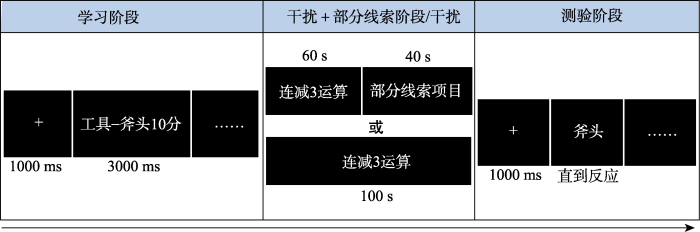
学习阶段:计算机屏幕上依次呈现80个样例词, 样例词以“类别−样例 分值”的方式呈现, 如“工具−斧头 10分”, 每个词的呈现时间为3000 ms, 刺激间屏幕中央会出现“+”字(既为注视点也为刺激间的时间间隔ISI, ISI = 1000 ms)。这80个词来自10个类别, 每个类别包含8个样例, 其中40个词分值为10分, 40个词分值为1分。告知被试每轮测验结束会呈现测验得分, 分数越高, 所得实验报酬越多, 可以通过记住更多的词或记住更多的高分值词来实现。为匹配线索词和目标词、高价值词和低价值词呈现的相对顺序, 同时为了避免相同类别内样例间的关联为随后的提取形成额外的线索, 学习时将80个样例词分为8个block, 每个block中从10个类别中各选取1个样例词。每个block中, 高、低价值词各半, 对其呈现的相对顺序进行匹配; 线索词2~3个, 对其在学习词表中呈现的相对顺序进行控制以确保其均匀分布于学习词表中。
干扰+部分线索阶段/干扰阶段:被试进行三位数连续减3的运算。为保证有线索与无线索条件下学−测间隔一致, 在高价值部分线索和低价值部分线索条件下, 被试运算时间为60 s, 运算结束后, 向被试呈现学习阶段80个学习项目中的20个作为之后测验的提取线索(高价值线索条件下呈现20个高价值词, 低价值线索条件下呈现20个低价值词; 每个类别2个), 这些项目以伪随机的方式呈现在一张图片上, 呈现时间为40 s, 要求被试按顺序认真阅读这些项目, 并把这些项目作为随后回忆目标项目的线索。在无部分线索条件下, 被试进行运算的时间为100 s。
测验阶段:屏幕上依次呈现80个测验项目, 刺激间屏幕中央会出现“+”字(既为注视点也为刺激间的时间间隔ISI, ISI = 1000 ms), 要求被试又快又好的进行新旧判断, 新旧判断分别对应键盘上的“F”、“J”键。被试做出按键反应后呈现下一个词。测验结束后, 屏幕上呈现被试获得的分数, 即正确判断出已学项目的分数总和。
2.6 结果与讨论
对各线索条件下不同价值测验项目的再认正确率和反应时进行统计, 反应时剔除 ± 3个标准差之外的极端值以及反应错误的试次, 结果见图2。
图2
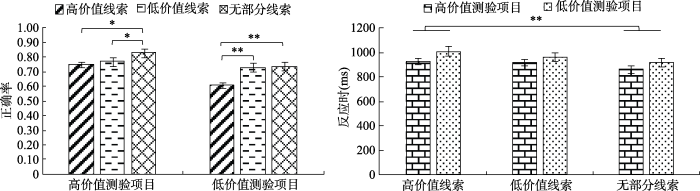
对正确率进行3 (线索条件:高价值线索/低价值线索/无线索) × 2 (测验项目价值:高/低)重复测量方差分析的结果显示:线索条件主效应显著, F(2, 58) = 8.99, p < 0.001, η2 p = 0.24, 无部分线索(p = 0.001)和低价值线索(p = 0.013)条件下的再认正确率显著高于高价值线索条件下的, 无部分线索和低价值线索条件下的再认正确率差异不显著(p = 0.082); 项目价值主效应显著, F(1, 29) = 18.99, p < 0.001, η2 p = 0.40, 高价值测验项目的再认正确率显著高于低价值测验项目; 两者交互作用显著, F(2, 58) = 4.93, p = 0.01, η2 p = 0.15, 进一步简单效应分析发现, 对于高价值测验项目(F(2, 28) = 4.16, p = 0.026, η2 p = 0.23), 无线索条件下的再认正确率显著高于低价值线索(p = 0.048)和高价值线索(p = 0.045)条件下的, 高、低价值线索条件下的再认正确率差异不显著(p = 0.859); 对于低价值测验项目(F(2, 28) = 7.48, p = 0.002, η2 p = 0.35), 无线索(p = 0.002)和低价值线索(p = 0.004)条件下的再认正确率均显著高于高价值线索条件下的, 无线索和低价值线索条件下的再认正确率差异不显著(p = 0.919); 在高价值线索条件(F(1, 29) = 19.98, p < 0.001, η2 p = 0.41)和无线索条件下(F(1, 29) = 11.78, p = 0.002, η2 p = 0.29), 高价值测验项目的再认正确率显著高于低价值测验项目, 在低价值线索条件下(F(1, 29) = 2.59, p = 0.12), 高、低价值测验项目的再认正确率差异不显著。
对反应时进行3 (线索条件:高价值线索/低价值线索/无线索) × 2 (项目价值:高价值/低价值)重复测量方差分析的结果显示:线索条件主效应显著, F(2, 58) = 4.89, p = 0.011, η2 p = 0.14, 高价值线索条件下被试对目标项目的反应时显著长于无线索条件(p = 0.004), 低价值线索和无线索条件下的再认反应时差异不显著(p = 0.064), 高、低价值线索条件下的再认反应时差异不显著(p = 0.275); 项目价值主效应显著, F(1, 29) = 8.06, p = 0.008, η2 p = 0.22, 高价值测验项目的反应时显著短于低价值测验项目。两者交互作用不显著, F(2, 58) = 2.10, p > 0.05。
实验1考察了不同价值的项目作为线索或者目标时对部分线索效应的影响。结果发现, 相较于无部分线索条件, 提供部分线索显著降低了被试的再认成绩, 且高价值线索条件下的回忆成绩显著低于低价值线索条件下的。在反应时上, 被试在无部分线索条件下的反应时显著低于有部分线索条件下的。以上结果与前人关于部分线索效应的研究结果一致(Aslan & Bäuml, 2009; Bäuml & Aslan, 2006; Bäuml & Samenieh, 2012)。在项目价值上, 被试对高价值测验项目的再认正确率显著高于低价值测验项目, 这一结果与前人关于价值导向记忆的研究结果一致(Middlebrooks & Castel, 2018; Villasenor et al., 2021)。同时, 在无线索和高价值线索条件下, 被试对高价值测验项目的再认成绩均好于低价值测验项目, 而在低价值线索条件下, 高、低价值测验项目的再认成绩差异不显著, 这表明不同价值项目作为线索, 对不同价值测验项目的再认损害大小也不同。本研究结果与前人研究结果不同之处在于在编码阶段设置了不同价值的学习项目, 结果发现在线索阶段呈现不同价值的项目作为线索, 对目标项目的干扰程度不同, 相比低价值线索, 高价值线索加强了对线索的表征, 对目标项目的干扰更强。
基于此, 我们在实验2中增加编码条件和测验时程两种条件, 进一步探讨在不同的编码条件和测验时程条件下, 不同价值的项目作为线索或者目标(测验项目)时对再认成绩的影响。
3 实验2: 部分线索诱发遗忘效应的持久性:项目价值的作用
3.1 研究目的
在实验1的基础上, 进一步探索在不同的编码条件和测验时程条件下, 不同价值的项目作为线索或者目标(测验项目)时对再认成绩的影响。研究假设:1−学条件下可能会导致高水平的项目间干扰, 当部分线索呈现时, 部分线索引发抑制机制, 此时部分线索的抑制作用是相对持久的, 部分线索效应是由提取抑制导致的; 而在2−学−测条件下可能会形成一种优先输出顺序, 当呈现部分线索时, 这种优先输出顺序极易被打乱, 在取消部分线索的呈现后, 部分线索的破坏作用消失, 此时部分线索效应是暂时的, 部分线索效应是由策略破坏导致的。
3.2 被试
3.3 实验材料
同实验1。
3.4 实验设计
2 (编码条件:1−学/2−学−测) × 3 (线索条件:高价值线索/低价值线索/无线索) × 2 (测验项目价值:高/低) × 2 (测验时程:即时测验/最终测验)混合设计。其中, 学习条件为被试间因素, 其余三个因素为被试内因素。因变量指标为测验项目的再认正确率和反应时。
3.5 实验程序
实验程序编制和练习要求同实验1。正式实验中, 每个被试接受3个block的任务, 每一个block对应一种线索条件, 三种条件下的block按照随机顺序呈现。每个block均包含学习、干扰1、即时测验、干扰2和最终测验五个阶段。实验流程如图3所示。
图3
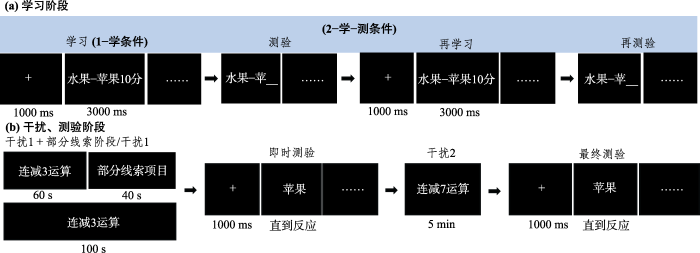
图3
实验2学习与测验阶段实验流程图。(a) 1−学和2−学−测两种编码条件下学习阶段的流程图; (b)有线索和无线索条件下干扰1、即时测验、干扰2和最终测验的流程图。
学习阶段:计算机屏幕上依次呈现80个样例词, 样例词以“类别−样例 分值”的形式呈现, 如“水果−苹果 10分”, 每个词的呈现时间为3000 ms, 刺激间屏幕中央会出现“+”字(既为注视点也为刺激间的时间间隔ISI, ISI = 1000 ms)。这80个词来自10个类别, 每个类别包含8个样例, 其中40个词分值为10分, 40个词分值为1分。告知被试每轮测验结束会呈现测验得分, 分数越高, 得到的实验报酬越多, 可以通过记住更多的词或者记住更多的高价值词来实现。为匹配线索词和目标词、高价值词和低价值词呈现的相对顺序, 同时为了避免相同类别内样例间的关联为随后的提取形成额外的线索, 学习时将80个样例词分为8个block, 每个block中从10个类别中各选取1个样例词。每个block中高、低价值词各半, 对其呈现的相对顺序进行匹配, 线索词2~3个, 对其呈现的相对顺序也进行控制。编码条件为1−学条件下, 被试在学习阶段只需完成一轮学习; 编码条件为2−学−测条件下, 则要完成2轮学−测, 即学习−测验−再学习−再测验, 其中测验和再测验以词干补笔的形式进行, 如呈现“水果−苹_”, 让被试补全屏幕上所呈现的词, 并写在纸上。测验和再测验时项目呈现顺序与学习时的顺序一致, 依次呈现, 呈现时间由被试自定步调, 即被试完成补笔之后, 按空格键呈现下一个词。
干扰1+部分线索阶段/干扰1阶段:被试进行三位数连续减3的运算。为保证有线索与无线索条件下学−测间隔一致, 在高价值部分线索和低价值部分线索条件下, 被试运算时间为60 s, 运算结束后, 向被试呈现学习阶段80个学习项目中的20个作为之后测验的提取线索(高价值线索条件下呈现20个高价值词, 低价值线索条件下呈现20个低价值词; 每个类别2个), 这些项目以伪随机的方式呈现在一张图片上, 呈现时间为40 s, 要求被试按顺序认真阅读这些项目, 并把这些项目作为随后回忆目标项目的线索, 在无部分线索条件下, 被试进行运算的时间为100 s。
即时测验阶段:屏幕上依次呈现80个测验项目, 刺激间屏幕中央会出现“+”字(既为注视点也为刺激间的时间间隔ISI, ISI = 1000 ms), 要求被试又快又好的进行新旧判断, 新旧判断分别对应键盘上的“F”、“J”键。被试做出反应后呈现下一个词。测验结束后, 屏幕上呈现被试获得的分数, 即正确判断出已学项目的分数总和。
干扰2阶段:被试完成5 min的三位数连续减7的任务。
最终测验阶段:屏幕上依次呈现80个测验项目, 刺激间屏幕中央会出现“+”字(既为注视点也为刺激间的时间间隔ISI, ISI = 1000 ms), 要求被试又快又好的进行新旧判断, 新旧判断分别对应键盘上的“F”、“J”键。被试做出反应后呈现下一个词。测验结束后, 屏幕上呈现被试获得的分数, 即正确判断出已学项目的分数总和。
3.6 结果与讨论
对各线索条件下不同价值测验项目的再认正确率和反应时进行统计, 反应时剔除 ± 3个标准差之外的极端值以及反应错误的试次, 结果见图4。
图4
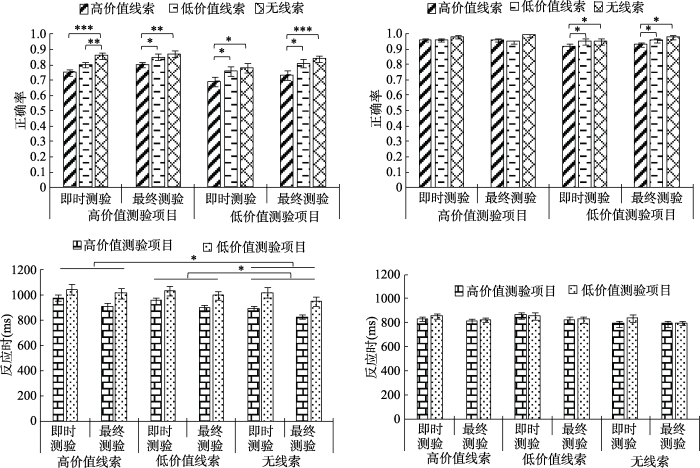
图4
实验2中各线索条件下不同价值测验项目的正确率(左上, 1−学条件; 右上, 2−学−测条件)和反应时(左下, 1−学条件; 右下, 2−学−测条件)
注:*p < 0.05, **p < 0.01, ***p < 0.001
1−学条件下, 线索条件主效应显著, F(2, 72) = 23.29, p < 0.001, η2 p = 0.39, 无线索条件下再认正确率显著高于高价值和低价值线索条件, 低价值线索条件下的再认正确率显著高于高价值线索条件。测验项目价值主效应显著, F(1, 36) = 12.68, p < 0.001, η2 p = 0.26, 高价值测验项目再认正确率显著高于低价值测验项目。测验时程主效应显著, F(1, 36) = 16.16, p < 0.001, η2 p = 0.31, 即时测验阶段再认正确率显著低于最终测验阶段。线索条件、测验项目价值与测验时程的交互作用显著, F(2, 72) = 3.89, p = 0.025, η2 p = 0.10, 进一步简单效应检验发现:
在即时测验中, 高价值线索条件(F(1, 36) = 6.52, p = 0.015, η2 p = 0.15)和无线索条件下(F(1, 36) = 11.93, p = 0.001, η2 p = 0.25), 高价值测验项目再认正确率高于低价值测验项目, 在低价值线索条件下(F(1, 36) = 1.92, p = 0.174), 高、低价值测验项目的正确率差异不显著; 在最终测验阶段, 在高价值线索条件下(F(1, 36) = 13.93, p = 0.001, η2 p = 0.28), 高价值测验项目的正确率显著高于低价值测验项目, 在低价值线索(F(1, 36) = 3.74, p = 0.061)和无线索条件下(F(1, 36) = 3.70, p = 0.062), 高、低价值测验项目的正确率差异不显著。
在高价值线索条件下, 高价值测验项目(F(1, 36) = 5.47, p = 0.025, η2 p = 0.13)和低价值测验项目(F(1, 36) = 4.75, p = 0.036, η2 p = 0.12)的即时测验再认正确率均显著低于最终测验; 在低价值线索条件下, 高价值测验项目(F(1, 36) = 12.41, p = 0.001, η2 p = 0.26)和低价值测验项目(F(1, 36) = 12.25, p = 0.001, η2 p = 0.25)的即时测验再认正确率均显著低于最终测验; 在无线索条件下, 高价值测验项目(F(1, 36) = 0.70, p = 0.409)的即时测验与最终测验差异不显著, 低价值测验项目(F(1, 36) = 9.98, p = 0.003, η2 p = 0.22)的即时测验再认正确率显著低于最终测验。
对于高价值测验项目, 在即时测验阶段(F(2, 35) = 13.50, p < 0.001, η2 p = 0.44), 无线索条件下的再认正确率显著高于高价值线索(p < 0.001)和低价值线索(p = 0.008)条件下的, 高、低价值线索条件下的再认正确率差异不显著(p = 0.172), 在最终测验阶段(F(2, 35) = 8.53, p = 0.001, η2 p = 0.33), 无线索条件下(p = 0.001)和低价值线索条件下(p = 0.014)的再认正确率显著高于高价值线索条件下的, 无线索与低价值线索条件下的再认正确率差异不显著(p = 0.577); 对于低价值测验项目, 在即时测验阶段(F(2, 35) = 6.45, p = 0.004, η2 p = 0.27), 无线索条件下(p = 0.004)和低价值线索条件下(p = 0.017)的再认正确率显著高于高价值线索条件下的, 无线索与低价值线索条件下的正确率差异不显著(p = 1.000), 在最终测验阶段(F(2, 35) = 10.59, p < 0.001, η2 p = 0.38), 无线索条件下(p < 0.001)和低价值线索条件下(p = 0.010)的再认正确率显著高于高价值线索条件下的, 无线索与低价值线索条件下的再认正确率差异不显著(p = 0.422)。
2−学−测条件下, 线索条件主效应显著, F(2, 70) = 6.07, p = 0.004, η2 p = 0.15, 无线索条件下再认正确率显著高于高价值线索条件(p = 0.004), 低价值和高价值线索条件下的再认正确率差异不显著(p = 0.262), 无线索和低价值线索条件下的再认正确率差异不显著(p = 0.168); 测验项目价值主效应显著, F(1, 35) = 7.75, p = 0.009, η2 p = 0.18, 高价值测验项目再认正确率显著高于低价值测验项目; 线索条件和测验项目价值交互作用显著, F(2, 70) = 4.09, p = 0.021, η2 p = 0.11, 进一步简单效应检验发现:对于高价值测验项目(F(2, 34) = 2.67, p = 0.084), 无线索、高价值线索、低价值线索条件下的再认正确率差异不显著, 对于低价值测验项目(F(2, 34) = 4.95, p = 0.013, η2 p = 0.23), 无线索条件下(p = 0.015)和低价值线索条件下(p = 0.020)的再认正确率均显著高于高价值线索条件下, 无线索与低价值线索条件下的再认正确率差异不显著(p = 1.000); 在高价值线索(F(1, 35) = 8.40, p = 0.006, η2 p = 0.19)和无线索(F(1, 35) = 4.10, p = 0.050, η2 p = 0.11)条件下, 高价值测验再认正确率显著高于低价值测验项目, 在低价值线索条件下(F(1, 35) = 0.04, p = 0.852), 高、低价值测验项目再认正确率差异不显著。
分别对高、低关联编码条件下的反应时进行3 (线索条件:高价值线索/低价值线索/无线索) × 2 (测验项目价值:高/低) × 2 (测验时程:即时测验/最终测验)重复测量方差分析。
1−学条件下, 线索条件主效应显著, F(2, 72) = 4.75, p = 0.012, η2 p = 0.12, 高价值线索和低价值线索条件下被试的反应时显著长于无线索条件, 高、低线索条件下反应时差异不显著; 测验项目价值主效应显著, F(1, 36) = 13.17, p = 0.001, η2 p = 0.27, 高价值测验项目反应时显著短于低价值测验项目; 测验时程主效应显著, F(1, 36) = 18.18, p < 0.001, η2 p = 0.34, 即时测验阶段反应时显著长于最终测验阶段; 其他交互作用不显著。
2−学−测条件下, 测验时程主效应显著, F(1, 35) = 4.39, p = 0.043, η2 p = 0.11, 即时测验阶段反应时显著长于最终测验阶段; 其他主效应和交互作用均不显著, Fs < 2.50, ps > 0.05。
实验2结果发现, 被试对高价值测验项目的再认正确率显著高于对低价值测验项目的再认正确率, 对高价值测验项目的反应时明显短于对低价值测验项目的反应时, 这一结果与前人关于价值导向记忆的研究结果一致(Middlebrooks et al., 2016; Murphy et al., 2022)。无线索条件下的再认正确率显著高于有线索条件, 与实验1的结果基本一致。进一步的, 实验2发现在不同编码条件下, 不同价值项目作为部分线索的持久性不同。在1−学条件下, 高价值部分线索对高、低价值目标项目的再认损害均从即时测验持续到了最终测验, 低价值部分线索对高价值测验项目的再认损害仅在即时测验中存在, 到最终测验损害作用消失, 低价值部分线索对低价值测验项目无显著损害。而在2−学−测条件下, 无论高、低价值线索项目均未显著损害对高价值目标项目的再认, 仅高价值线索项目损害了低价值测验项目的再认成绩。
4 总讨论
以往关于部分线索效应的研究通常默认所有学习项目和测验项目均为等价的, 较少考虑项目的不同价值对于部分线索效应的影响。本研究通过操纵编码阶段学习项目的重要性, 首次考察了不同价值的部分线索对不同价值测验项目再认提取的影响, 丰富了关于部分线索效应作用机制和影响因素的认识。
实验1考察了不同价值的项目作为线索或者目标(测验项目)时对部分线索效应的影响, 结果发现, 高、低价值线索均显著降低了目标项目的再认成绩, 这一结果与以往部分线索效应的研究结果一致(白学军 等, 2014; 刘湍丽 等, 2019; Aslan et al., 2007; Aslan & Bäuml, 2007; Bäuml & Samenieh, 2012; Liu et al., 2020; Wallner & Bauml, 2021), 表明部分线索会损害再认成绩。同时, 当赋予线索项目和测验项目不同的价值属性, 对于部分线索效应的影响也不同:高价值部分线索条件下的再认正确率显著低于低价值部分线索条件下, 高价值线索使高、低价值测验项目均出现再认受损, 低价值线索仅使高价值测验项目出现再认受损, 这表明相较于低价值线索, 高价值线索的干扰作用更强。高价值测验项目在高、低价值线索条件下均出现再认成绩受损, 而低价值测验项目仅在高价值线索条件下出现再认成绩受损; 相较于高价值线索条件, 低价值线索条件下的高价值测验项目的再认正确率并无显著提高, 而低价值线索条件下的低价值测验项目的再认正确率在显著提高, 并且在低价值线索条件下高、低价值测验项目再认成绩差异不显著, 这表明虽然高价值测验项目再认正确率更高, 但相较于低价值测验项目, 高价值测验项目更容易受到部分线索的干扰, 对部分线索的呈现更敏感。
已有价值导向记忆的相关研究表明, 赋予项目不同的价值将改变项目的表征强度(Elliott, McClure, et al., 2020; Knowlton & Castel, 2022; Villasenor et al., 2021), 高价值项目表征强度更高, 低价值项目表征强度较低。根据提取抑制假说, 部分线索的呈现会导致被试首先对线索项目进行内隐提取, 但此时非线索项目将对线索项目的内隐提取产生竞争, 当呈现低价值线索时, 高强度的非线索项目将对低价值线索的内隐提取产生强干扰; 而呈现高价值部分线索时, 低强度非线索项目则对低价值线索的内隐提取产生弱干扰, 甚至无干扰(Storm & Bui, 2016)。此时, 是非线索项目对线索项目内隐提取的一种“反向竞争”。进而, 为克服非线索项目的干扰以完成对线索项目的内隐提取, 启动抑制机制对非线索项目的记忆表征进行抑制, 这种抑制使得项目本身表征强度降低, 导致在随后的记忆测试中, 非线索项目的回忆受到损害(Barber et al., 2015; Crescentini et al., 2010)。因此, 当高价值项目为线索时, 由于个体对线索的表征强度较高, 线索项目对目标项目的抑制作用更强; 在低价值线索条件下, 在线索呈现阶段被强干扰过的低价值线索几乎无法对测验项目产生干扰作用, 而在线索呈现阶段高强度的非线索项目(测验项目)对线索项目的强干扰导致了非线索项目本身表征强度的受损。同时, 为克服非线索项目的干扰以完成对线索项目的内隐提取, 启动抑制机制对非线索项目的记忆表征进行抑制, 这种抑制使得高强度测验项目本身表征强度有所降低, 导致在随后的记忆测试中, 高强度测验线索项目的回忆受损。实验1中结果仅验证了提取抑制假说关于线索价值作用的预期, 而与测验项目价值的预期结果不一致。可能的原因是相较于低价值项目, 高价值项目本身具有较高的表征强度(Basden et al., 1977; Kroeger et al., 2019), 因此当其作为线索时, 对测验项目的抑制作用较强, 而当其作为测验项目时, 可能自动化的启动了对线索项目的反向竞争, 使得本身的表征强度也更易受到线索的影响。另外, 由于考察部分线索效应是通过比较相同价值测验项目在不同线索条件下的成绩差异来实现的, 即高、低价值线索对于测验项目损害与否是通过与无线索条件下相应的高、低价值测验项目再认成绩的比较得出的, 而价值效应则是比较同一线索条件下不同价值测验项目之间的成绩差异。因此, 虽然低价值测验项目仅在高价值线索下受损, 低价值线索仅使高价值测验项目在即时测验中受损, 但由于无线索条件下低价值测验项目再认成绩显著低于高价值测验项目, 因此低价值测验项目受损程度比仍然比高价值项目要高。
实验2进一步考察了在不同的编码条件和测验时程条件下, 不同价值的项目作为线索或者测验项目时对再认成绩的影响。结果发现, 在低关联编码条件下的即时测验中, 无论高、低价值线索均使高价值测验项目再认受损, 仅高价值线索对低价值测验项目再认产生损害, 这一结果与实验1的结果一致, 再次表明了线索价值和测验项目价值对部分线索效应的影响, 且这种影响是不对称的。在低关联编码条件下的最终测验中, 高、低价值测验项目在高价值线索条件下仍然受损。在实验2中, 即时测验在部分线索呈现后立即开始, 而最终测验则是在即时测验结束后5分钟开始, 因此高价值线索项目对高、低价值测验项目的干扰从即时测验持续到了最终测验阶段, 表明高价值线索项目对于测验项目的再认损伤是相对持久的, 这一结果与双机制假说的观点一致。双机制假说指出, 在低关联编码条件下, 线索项目主要基于提取抑制对目标项目的提取产生干扰, 此时部分线索的不利影响反映了目标项目激活水平的相对持久的变化, 损害作用相对持久(Aslan & Bäuml, 2007; Bäuml & Aslan, 2006; John & Aslan, 2020)。John和Aslan (2020)的研究发现, 12至14岁的儿童与成人一样, 在1−学条件下存在持久的部分线索效应, 在2−学−测条件下则表现为短暂的损害。而在两个低龄儿童组(7~8岁和9~10岁), 部分线索效应在1−学和2−学−测条件下均持续存在, 这一研究发现了部分线索效应持久性的年龄差异, 这意味着还有其他因素影响部分线索的作用及其持久性。实验2中低价值线索项目对高价值测验项目的再认损害仅在即时测验中存在, 到最终测验消失, 此时部分线索的干扰效应是短暂的, 这表明高价值测验项目虽然对于部分线索的呈现更敏感, 但由于其表征强度大更易被激活, 因而当最终测验时部分线索不再呈现或者线索与测验的间隔时间较长时, 高强度测验项目表征强度再次恢复, 这一结果与双机制假说的观点不一致。低价值线索对低价值测验项目的再认无显著损害, 这也不符合双机制假说所说的在低关联编码条件下一定表现为部分线索持久干扰效应的观点(Lehmer & Bäuml, 2018a, 2018b)。这表明, 同样在低关联编码加工要求下, 部分线索对记忆提取的影响作用并不一定是持久的, 项目价值也影响着部分线索作用的强度及持续时间。
根据双机制假说, 当刺激材料之间是较高水平的关联编码时, 被试会进行更高级的整合加工编码, 此时影响更大的是编码策略, 所以在测验时部分线索的干扰作用主要体现为策略的破坏, 再次进行测验时, 撤去部分线索的呈现这种提取成绩更差的现象就会消失(Aslan & Bäuml, 2007; Bäuml & Aslan, 2006; John & Aslan, 2020)。在实验2的高关联编码条件下, 无论是即时测验还是最终测验中, 高价值测验项目的再认正确率均不受部分线索的显著影响, 仅高价值线索使得低价值测验项目的再认受损从即时测验持续到了最终测验。这一结果也无法用双机制假说来解释。策略破坏假说认为部分线索的遗忘效应是短暂的, 并且如果线索移除, 遗忘随即消失(Basden & Basden, 1995; Reysen & Nairne, 2002)。本研究结果对高关联编码条件下策略破坏作用的质疑主要表现在两个方面, 首先, 为了考察干扰是否在线索呈现后随即产生, 实验1和2中, 设置被试在线索呈现后进行再认任务, 但实验结果发现仍存在部分线索效应。其次, 实验2中设置了第二次提取任务, 在第二次再认时, 部分线索并不重新提供给被试, 但仍存在部分线索条件下再认成绩低于无线索条件下的情况。
结合高、低关联编码条件下的结果可以看出, 在本研究中, 影响部分线索作用大小的主要是编码条件, 在高关联条件下, 有利于对材料进行深入加工编码(Basden & Basden, 1995; Lehmer & Bäuml, 2018a), 部分线索的整体干扰作用较弱、范围较小, 而在低关联编码条件下, 被试对材料的编码深度有限(John & Aslan, 2020), 部分线索的干扰作用强度较大、范围更广。而影响部分线索作用持久性的则是项目价值, 在低关联编码条件下, 高、低价值线索对高价值测验项目的再认损害均从即时测验持续到了最终测验, 低价值线索对低价值测验项目无显著损害也是从即时测验持续到了最终测验, 而低价值线索对高价值测验项目的再认损害仅在即时测验存在; 在高关联编码条件下, 高价值线索使得低价值测验项目的再认受损均从即时测验持续到了最终测验, 高价值测验项目的未受损也是从即时测验持续到了最终测验, 线索项目价值和测验项目价值共同影响着部分线索作用的持久性。这表明部分线索对记忆提取的作用, 可能并非如双机制假说所认为的, 在低关联编码条件下就一定是提取抑制导致长时受损, 在高关联编码条件也不一定表现因策略被破坏的暂时损害。更可能出现的情况是, 当线索项目具有高价值时, 其表征强度相对较高, 此时如果测验项目整体表征强度相对较弱, 则高价值线索会以提取抑制的方式相对持久的降低测验项目的表征强度, 但如果测验项目被进行高水平的加工整合(如实验2中高关联编码条件下的高价值项目), 则部分线索无法有效抑制测验项目的表征强度。当线索项目具有低价值时, 其表征强度相对较弱, 此时, 即使在低关联编码条件下, 也不能形成对测验项目表征强度的长时抑制, 而在高关联编码条件下, 也无法对测验项目的提取策略产生强有力的破坏。
5 结论
本文通过两项行为实验得到如下结论:(1)相较于低价值线索项目, 高价值线索项目对目标项目再认的破坏作用更大; 相对于低价值目标项目, 高价值目标项目的再认正确率更高, 但高价值测验项目对于线索的呈现更敏感。(2)项目价值影响部分线索的作用及其作用的持久性, 在1−学条件下, 高价值线索使得高、低价值测验项目的再认受损均从即时测验持续到了最终测验, 低价值线索仅使高价值测验项目再认在即时测验中受损。而在2−学−测条件下, 仅高价值线索使得低价值测验项目的再认受损从即时测验持续到了最终测验。以上结果部分验证了双机制假说, 也为双机制假说做了必要补充:部分线索对记忆提取的作用, 并非在低关联编码条件下就一定表现为持久的损伤, 在高关联编码条件下就一定表现为暂时的受损, 项目价值也影响着部分线索作用的强度及持续时间, 在从项目关联编码这一角度界定部分线索对记忆提取的作用时, 还需要考虑项目价值的作用。
参考文献
Prioritizing targets and minimizing distraction within limited capacity working memory: Commentary on ‘Working memory and attention; a conceptual analysis and review’ by Klaus Oberauer
Remembering can cause forgetting: Retrieval dynamics in long-term memory
The role of item similarity in part-list cueing impairment
DOI:10.1080/09658210902740886
URL
PMID:19575327
[本文引用: 1]

The presentation of a subset of studied items as retrieval cues can have detrimental effects on recall of the remaining (target) items. In three experiments we examined whether such part-list cueing impairment depends on the similarity between cue and target items. Item similarity was manipulated by making use of pre-experimental semantic similarities between cue and target items (Experiments 1 and 2), or was episodically induced through a similarity-encoding task, in which participants were asked to interrelate cue and target items in a meaningful way (Experiment 3). In all three experiments reliable part-list cueing impairment arose when the similarity between cues and targets was low, but no impairment was found when the similarity between cues and targets was high. Inhibitory as well as non-inhibitory explanations of the findings are discussed.
The role of inhibitory processes in part-list cuing
Part-list cuing with and without item-specific probes: the role of encoding
The inhibitory process of part-list cuing effect: Evidence from emotional stroop task
DOI:10.3724/SP.J.1041.2014.00143
URL
[本文引用: 1]
<p>When people are asked to recall items from a previously studied list and are given a subset of the items on that list as retrieval cues, they often do more poorly at recalling the remaining items on the list than do people asked to recall the items in the absence of such retrieval cues (Slamecka, 1968). Such part-list cuing effect has often been attributed to inhibitory executive-control processes that supposedly suppress the non-cue items′ memory representation. Our aim in the present study was to further evaluate the inhibitory executive-control account of part-list cuing effect. Using a new paradigm which combines the classical part-list cuing paradigm with emotional Stroop task, adopting a more sensitive index, the present study retested the retrieval inhibition hypothesis of part-list cuing effect. Four experiments were included. In Experiments 1, we explored whether the inhibition occurs after the presence of part-list cues by inserting the emotional Stroop task between the presence of part-list cues and the retrieval phase, In Experiments 2 and 3, we explored whether the inhibition still persist after the retrieval phase by inserting the emotional Stroop task after the retrieval phase, On the basis of Experiment 2 and 3, in Experiment 4, an inadequate retrieval time was used to further investigate the inhibition process during the retrieval phase. The findings showed that: when the emotional Stroop task was performed after the presentation of the part-list cues, the reaction time of part-list cuing recall group was shorter than free recall group; while when the emotional Stroop task was performed after the retrieval phase, no difference between part-list cuing recall group and free recall group was observed; and when the retrieval was not fulfilled, the reaction time of part-list cuing recall group was shorter than free recall group. The present findings revealed that in the part-list cuing effect, inhibition occurred as soon as the part-list cues were provided, and before the full completion of the retrieval task, the inhibition process would persist. The results support the retrieval inhibition hypothesis of part-list cuing effect, and do some supplement to the retrieval inhibition hypothesis—— the duration of inhibition was mediated by the retrieval task.</p>
部分线索效应的认知抑制过程: 情绪Stroop任务证据
Why two heads apart are better than two heads together: Multiple mechanisms underlie the collaborative inhibition effect in memory
Part-set cuing of order information in recall tests
DOI:10.1016/S0749-596X(02)00016-5 URL [本文引用: 1]
Some tests of the strategy disruption interpretation of part-list cuing inhibition
Inhibition with part-list cuing: Some tests of the item strength hypothesis
DOI:10.1037/0278-7393.3.1.100 URL [本文引用: 3]
Part-list cuing can be transient and lasting: the role of encoding
Influences of part-list cuing on different forms of episodic forgetting
DOI:10.3758/MC.38.3.366 URL [本文引用: 2]
The effects of aging on selectivity and control in short-term recall
DOI:10.3758/BF03194325 URL [本文引用: 4]
The development of memory efficiency and value-directed remembering across the life span: A cross-sectional study of memory and selectivity
DOI:10.1037/a0025623
URL
PMID:21942664
[本文引用: 1]
Although attentional control and memory change considerably across the life span, no research has examined how the ability to strategically remember important information (i.e., value-directed remembering) changes from childhood to old age. The present study examined this in different age groups across the life span (N = 320, 5-96 years old). A selectivity task was used in which participants were asked to study and recall items worth different point values in order to maximize their point score. This procedure allowed for measures of memory quantity/capacity (number of words recalled) and memory efficiency/selectivity (the recall of high-value items relative to low-value items). Age-related differences were found for memory capacity, as young adults recalled more words than the other groups. However, in terms of selectivity, younger and older adults were more selective than adolescents and children. The dissociation between these measures across the life span illustrates important age-related differences in terms of memory capacity and the ability to selectively remember high-value information.
Selecting valuable information to remember: Age-related differences and similarities in self-regulated learning
DOI:10.1037/a0030678
URL
PMID:23276210
[本文引用: 1]
It is often necessary to selectively attend to important information, at the expense of less important information, especially if you know you cannot remember large amounts of information. The present study examined how younger and older adults select valuable information to study, when given unrestricted choices about how to allocate study time. Participants were shown a display of point values ranging from 1-30. Participants could choose which values to study, and the associated word was then shown. Study time, and the choice to restudy words, was under the participant's control during the 2-minute study session. Overall, both age groups selected high value words to study and studied these more than the lower value words. However, older adults allocated a disproportionately greater amount of study time to the higher-value words, and age-differences in recall were reduced or eliminated for the highest value words. In addition, older adults capitalized on recency effects in a strategic manner, by studying high-value items often but also immediately before the test. A multilevel mediation analysis indicated that participants strategically remembered items with higher point value, and older adults showed similar or even stronger strategic process that may help to compensate for poorer memory. These results demonstrate efficient (and different) metacognitive control operations in younger and older adults, which can allow for strategic regulation of study choices and allocation of study time when remembering important information. The findings are interpreted in terms of life span models of agenda-based regulation and discussed in terms of practical applications.
Statistical Power Analysis
DOI:10.1111/1467-8721.ep10768783 URL [本文引用: 2]
Effects of aging on value-directed modulation of semantic network activity during verbal learning
DOI:S1053-8119(15)00699-0
URL
PMID:26244278
[本文引用: 1]
While impairments in memory recall are apparent in aging, older adults show a remarkably preserved ability to selectively remember information deemed valuable. Here, we use fMRI to compare brain activation in healthy older and younger adults during encoding of high and low value words to determine whether there are differences in how older adults achieve value-directed memory selectivity. We find that memory selectivity in older adults is associated with value-related changes in activation during word presentation in left hemisphere regions that are involved in semantic processing, similar to young adults. However, highly selective young adults show a relatively greater increase in semantic network activity during encoding of high-value items, whereas highly selective older adults show relatively diminished activity during encoding of low-value items. Additionally, only younger adults showed value-related increases in activity in semantic and reward processing regions during presentation of the value cue preceding each to-be-remembered word. Young adults therefore respond to cue value more proactively than do older adults, yet the magnitude of value-related differences in cue period brain activity did not predict individual differences in memory selectivity. Thus, our data also show that age-related reductions in prestimulus activity do not always lead to inefficient performance.Copyright © 2015 Elsevier Inc. All rights reserved.
Neural correlates of episodic retrieval: An fMRI study of the part-list cueing effect
DOI:10.1016/j.neuroimage.2009.12.114
URL
PMID:20060480
[本文引用: 1]
Episodic retrieval is supported by multiple forms of cognitive control that depend on prefrontal cortex. However, within prefrontal cortex, the regional specificity for different control processes is still largely underspecified. Here we used fMRI to investigate the processes involved in part-list cueing, a phenomenon entailing the reduction of memory performance when some of the "to-be-remembered items" are presented during retrieval. Retrieval inhibition and strategy disruption have been proposed as possible underlying causes of this surprising effect. Critically, different encoding conditions can dissociate these two hypotheses, as this is thought to have a different impact on strategy-related versus inhibition-related processes. Accordingly, we compared part-list versus no part-list retrieval conditions, following high versus low associative encoding conditions. This revealed activation of the left frontopolar and right dorsolateral prefrontal cortex in conditions of part-list cueing retrieval, but only following low associative encoding. These results are consistent with the inhibitory or interference resolution accounts of part-list cueing, suggesting a critical role of between-items competition and high monitoring demands at retrieval. In addition, we also examined brain activation during the encoding phase, specifying further possible anatomo-functional links between encoding and retrieval processes. The results suggest that different encoding conditions induce distinct patterns of activation at retrieval, corroborating the idea that they promote the adoption of different retrieval strategies. The implications of the results are discussed in relation to the cognitive mechanisms of inhibition, interference resolution, and encoding/retrieval strategies for episodic memory.Copyright 2009 Elsevier Inc. All rights reserved.
The impact of value-directed remembering on the own-race bias
DOI:10.1016/j.actpsy.2014.11.009
URL
PMID:25499056
[本文引用: 1]
Learners demonstrate superior recognition of faces of their own race or ethnicity, compared to faces of other races or ethnicities; a finding termed the own-race bias. Accounts of the own-race bias differ on whether the effect reflects acquired expertise with own-race faces or enhanced motivation to individuate own-race faces. Learners have previously been motivated to demonstrate increased recall for highly important items through a value-based paradigm, in which item importance is designated using high (vs. low) point values. Learners receive point values by correctly recalling the corresponding items at test, and are given the goal of achieving a high total point score. In two experiments we examined whether a value-based paradigm can motivate learners to differentiate between other-race faces, reducing or eliminating the own-race bias. In Experiment 1, participants studied own- and other-race faces paired with high or low point values. High point values (12-point) indicated that face was highly important to learn, whereas low point values (1-point) indicated that face was less important to learn. Participants demonstrated increased recognition for high-value own-race (but not other-race) faces, suggesting that motivation alone is not enough to reduce the own-race bias. In Experiment 2, we examined whether participants could use value to enhance recognition when permitted to self-pace their study. Recognition did not differ between high-value own- and other-race faces, reducing the own-race bias. Such data suggest that motivation can influence the own-race bias when participants can control encoding. Published by Elsevier B.V.
Neural correlates underlying the effect of reward value on recognition memory
DOI:10.1016/j.neuroimage.2019.116296 URL [本文引用: 2]
Divided attention selectively impairs value-directed encoding
Individual differences in value-directed remembering
DOI:10.1016/j.cognition.2020.104275 URL [本文引用: 1]
G*Power 3: A flexible statistical power analysis program for the social, behavioral, and biomedical sciences
DOI:10.3758/bf03193146
URL
PMID:17695343
[本文引用: 2]
G*Power (Erdfelder, Faul, & Buchner, 1996) was designed as a general stand-alone power analysis program for statistical tests commonly used in social and behavioral research. G*Power 3 is a major extension of, and improvement over, the previous versions. It runs on widely used computer platforms (i.e., Windows XP, Windows Vista, and Mac OS X 10.4) and covers many different statistical tests of the t, F, and chi2 test families. In addition, it includes power analyses for z tests and some exact tests. G*Power 3 provides improved effect size calculators and graphic options, supports both distribution-based and design-based input modes, and offers all types of power analyses in which users might be interested. Like its predecessors, G*Power 3 is free.
Part-set cuing of texts, scenes, and matrices
DOI:10.1111/bjop.12058
URL
PMID:24308269
[本文引用: 1]
In four experiments, we extended the study of part-set cuing to expository texts and pictorial scenes. In Experiment 1, recall of expository text was tested with and without part-set cues in the same order as the original text; cues strongly impaired recall. Experiment 2 repeated Experiment 1 but used cues in random order and found significant but reduced impairment with cuing. Experiments 3 and 4 examined the part-set cuing of objects presented in a scene or matrix and found virtually no effect of cuing. More objects were recalled from the scene than from the matrix, indicating that the scene's organization aided memory, but the cues did not assist recall. These results extend the domains in which part-set cues have either impaired or failed to improve recall. Implications for education and eyewitness accounts are briefly considered. © 2013 The British Psychological Society.
Voluntary control over prestimulus activity related to encoding
DOI:10.1523/JNEUROSCI.0915-10.2010
URL
PMID:20660262
[本文引用: 1]
A new development in our understanding of human long-term memory is that effective memory formation relies on neural activity just before an event. It is unknown whether such prestimulus activity is under voluntary control or a reflection of random fluctuations over time. In the present study, we addressed two issues: (1) whether prestimulus activity is influenced by an individual's motivation to encode, and (2) at what point in time encoding-related activity emerges. Electrical brain activity was recorded while healthy male and female adults memorized series of words. Each word was preceded by a cue, which indicated the monetary reward that would be received if the following word was later remembered. Memory was tested after a short delay with a five-way recognition task to separate different sources of recognition. Electrical activity elicited by the reward cue predicted later memory of a word. Crucially, however, this was only observed when the incentive to memorize a word was high. Encoding-related activity preceded high-reward words that were later recollected. This activity started shortly after cue onset and persisted until word onset. Prestimulus activity thus not only signals cue-related processing but also an ensuing preparatory state. In contrast, reward-related activity was limited to the time period immediately after the reward cue. These findings indicate that engaging neural activity that benefits the encoding of an upcoming event is under voluntary control, reflecting a strategic preparatory state in anticipation of processing an event.
Recognizing what matters: Value improves recognition by selectively enhancing recollection
DOI:10.1016/j.jml.2016.12.004
URL
PMID:28827894
[本文引用: 1]
We examined the effects of value on recognition by assessing its contribution to recollection and familiarity. In three experiments, participants studied English words, each associated with a point-value they would earn for correct recognition, with the goal of maximizing their score. In Experiment 1, participants provided Remember/Know judgments. In Experiment 2 participants indicated whether items were recollected or if not, their degree of familiarity along a 6-point scale. In Experiment 3, recognition of words was accompanied by a test of memory for incidental details. Across all experiments, participants were more likely to recognize items with higher point-value. Furthermore, value appeared to primarily enhance recollection, as effects on familiarity were small and not consistent across experiments. Recollection of high-value items appears to be accompanied by fewer incidental details, suggesting that value increases focus on items at the expense of irrelevant information.
Forget me not: Encoding processes in value- directed remembering
DOI:10.1016/j.jml.2019.02.001
URL
[本文引用: 1]
Valuable items are often remembered better than less valuable items, but research on the mechanisms supporting this value effect is limited. In the current study, we sought to determine how items might be differentially encoded based on their value. In Experiment 1, participants studied words associated with point-values which were followed by a cue to either "Remember" the word for a later test or "Forget" the word. While to-be-forgotten words were recognized at a lower rate than to-be-remembered words, there was a significant effect of value for to-be-forgotten words when the "Forget" cue was presented immediately after the word, suggesting a relatively automatic enhancement of encoding by value. In Experiment 2, we examined to what extent participants engage in more effective encoding strategies for high-value items. Participants studied a list of words with different point-values, and were instructed either to construct a mental image of the item, use rote rehearsal to learn the items, or were not given any study strategy. There were significant effects of value for items that were studied under rote rehearsal or when no strategy instruction was given. However, effects of value were nearly eliminated when participants used a mental imagery strategy for all items as this strategy boosted memory for low-value items. In Experiment 3, we sought to replicate Experiment 2 with an encoding manipulations that required responses on each trial as a manipulation check. Participants were instructed to generate a sentence containing each item, count the consonants in each item, or were not given any encoding instructions. Consistent with Experiment 2, these manipulations eliminated the effects of value on recognition memory. Thus, it appears that participants engage in more effective encoding strategies for high-value words because the benefit of value was substantially reduced when participants were required to use the same encoding strategy for all items. Together, these results suggest that valuable items are encoded more effectively due to strategic, and to a lesser extent, automatic mechanisms.
Competition for the focus of attention in visual working memory:Perceptual recency versus executive control
Part-list cuing effects in children: A developmental dissociation between the detrimental and beneficial effect
DOI:S0022-0965(17)30086-3
URL
PMID:28943058
[本文引用: 2]
Providing a subset of previously studied items as a retrieval cue can both impair and improve recall of the remaining items. Here, we investigated the development of these two opposing effects of such part-list cuing in children. Using listwise directed forgetting to manipulate study context access, three child age groups (7-8, 9-11, and 13-14years) and young adults studied a list of items and, after study, were asked to either forget or continue remembering the list. After presentation of a second list, participants were tested on predefined target items from the original list in either the presence or absence of the list's remaining (nontarget) items serving as retrieval cues. Results revealed that part-list cuing impaired recall of to-be-remembered target items regardless of age. In contrast, part-list cuing improved recall of to-be-forgotten target items in the adult and the oldest child groups but not in the two younger child groups. This finding suggests a developmental dissociation between the two opposing effects of part-list cuing, indicating that the beneficial effect develops later than the detrimental effect. In particular, following the view that the beneficial effect of part-list cuing arises from reactivation of the study context, the results suggest that elementary school children have difficulty in capitalizing on context reactivation.Copyright © 2017 Elsevier Inc. All rights reserved.
Age differences in the persistence of part-list cuing impairment: The role of retrieval inhibition and strategy disruption
DOI:10.1016/j.jecp.2019.104746 URL [本文引用: 9]
Spatial part-set cuing facilitation
DOI:10.1080/09658211.2015.1046382
URL
PMID:26252760
[本文引用: 1]
Cole, Reysen, and Kelley [2013. Part-set cuing facilitation for spatial information. Journal of Experimental Psychology: Learning, Memory, & Cognition, 39, 1615-1620] reported robust part-set cuing facilitation for spatial information using snap circuits (a colour-coded electronics kit designed for children to create rudimentary circuit boards). In contrast, Drinkwater, Dagnall, and Parker [2006. Effects of part-set cuing on experienced and novice chess players' reconstruction of a typical chess midgame position. Perceptual and Motor Skills, 102(3), 645-653] and Watkins, Schwartz, and Lane [1984. Does part-set cuing test for memory organization? Evidence from reconstructions of chess positions. Canadian Journal of Psychology/Revue Canadienne de Psychologie, 38(3), 498-503] showed no influence of part-set cuing for spatial information when using chess boards. One key difference between the two procedures was that the snap circuit stimuli were explicitly connected to one another, whereas chess pieces were not. Two experiments examined the effects of connection type (connected vs. unconnected) and cue type (cued vs. uncued) on memory for spatial information. Using chess boards (Experiment 1) and snap circuits (Experiment 2), part-set cuing facilitation only occurred when the stimuli were explicitly connected; there was no influence of cuing with unconnected stimuli. These results are potentially consistent with the retrieval strategy disruption hypothesis, as well as the two- and three-mechanism accounts of part-set cuing.
Memory and reward-based learning: A value-directed remembering perspective
DOI:10.1146/psych.2022.73.issue-1 URL [本文引用: 2]
On the composition of part-set cues
DOI:10.1177/1747021819838829
URL
[本文引用: 3]
Two experiments examined whether the specific composition of the set of cues might influence performance on a part-set cueing task. Although researchers traditionally have chosen their part-set cues either at random or systematically across the original set of materials, in the current study, the part-set cues comprised sets of either the most or least memorable items in the stimulus set (based on past research with the materials). With both word list (Experiment 1) and paragraph (Experiment 2) stimuli, the results showed differential effects of cue composition on part-set cueing performance. That is, part-set cueing impairment occurred following the presentation of high memorability cues, whereas there was no difference between cued and uncued performance following presentation of low memorability cues. These results suggest that the presence or absence of part-set cueing impairment can be influenced by the specific composition of the cue set.
The many faces of part- list cuing-evidence for the interplay between detrimental and beneficial mechanisms
DOI:10.3389/fpsyg.2018.00701 URL [本文引用: 4]
Part-list cuing can impair, improve, or not influence recall performance: The critical roles of encoding and access to study context at test
The effect of part-list cues on memory retrieval: The role of inhibition ability
DOI:10.3724/SP.J.1041.2017.01158 URL [本文引用: 1]
部分线索对记忆提取的影响: 认知抑制能力的作用
Part-list cuing effect in working memory: Effects of task presentation mode
工作记忆中的部分线索效应: 任务呈现方式的影响
Part-List cues hinder familiarity but not recollection in item recognition: Behavioral and event-related potential evidence
DOI:10.3389/fpsyg.2020.561899 URL [本文引用: 2]
Revisiting the multi-mechanism hypothesis of part-list cuing: The role of list-length and item presentation time
DOI:10.1080/09658211.2022.2080225 URL [本文引用: 1]
The effect of encoding-retrieval match and cue overload on part-list cuing effect
The encoding-retrieval match has been established as a means to improve memory performance. It has recently been proposed that memory performance is determined by the encoding-retrieval match and that the cue overload effect needs to be taken into account when predicting memory performance. Two experiments were conducted to explore the effect of encoding-retrieval match and cue-overload on part-list cuing effect. By adopting semantic match task, Experiment 1 examined the effect of encoding-retrieval match on part-list cuing effect. On the basis of Experiment 1, Experiment 2 Examined the combined effect of encoding-retrieval match and cue-overload on part-list cuing effect. The findings show that increasing the overall encoding-retrieval match reduces the negative influence of part-list cues, which is sensitive to cue-overload; only when the part-list cues provide the diagnostic information of target items, can the memory performance be improved. The results indicates that the combined action of encoding-retrieval match and cue-overload is a better predictor of memory performance when providing part-list cues.
编码-提取匹配和线索负荷对部分线索效应的影响
The role of reward and reward uncertainty in episodic memory
DOI:10.1016/j.jml.2017.05.003 URL [本文引用: 1]
Self-regulated learning of important information under sequential and simultaneous encoding conditions
Selectively distracted: Divided attention and memory for important information
DOI:10.1177/0956797617702502
URL
PMID:28604267
[本文引用: 1]
Distractions and multitasking are generally detrimental to learning and memory. Nevertheless, people often study while listening to music, sitting in noisy coffee shops, or intermittently checking their e-mail. The current experiments examined how distractions and divided attention influence one's ability to selectively remember valuable information. Participants studied lists of words that ranged in value from 1 to 10 points while completing a digit-detection task, while listening to music, or without distractions. Though participants recalled fewer words following digit detection than in the other conditions, there were no significant differences between conditions in terms of selectively remembering the most valuable words. Similar results were obtained across a variety of divided-attention tasks that stressed attention and working memory to different degrees, which suggests that people may compensate for divided-attention costs by selectively attending to the most valuable items and that factors that worsen memory do not necessarily impair the ability to selectively remember important information.
The value in rushing: Memory and selectivity when short on time
DOI:10.1016/j.actpsy.2016.06.001
URL
PMID:27305652
[本文引用: 1]
While being short on time can certainly limit what one remembers, are there always such costs? The current study investigates the impact of time constraints on selective memory and the self-regulated study of valuable information. Participants studied lists of words ranging in value from 1-10 points, with the goal being to maximize their score during recall. Half of the participants studied these words at a constant presentation rate of either 1 s or 5s. The other half of participants studied under both rates, either fast (1s) during the first several lists and then slow (5s) during later lists, or vice versa. Study was then self-paced during a final segment of lists for all participants to determine how people regulate their study time after experiencing different presentation rates during study. While participants recalled more words overall when studying at a 5-second rate, there were no significant differences in terms of value-based recall, with all participants demonstrating better recall for higher-valued words and similar patterns of selectivity, regardless of study time or prior timing experience. Self-paced study was also value-based, with participants spending more time studying high-value words than low-value. Thus, while being short on time may have impaired memory overall, participants' attention to item value during study was not differentially impacted by the fast and slow timing rates. Overall, these findings offer further insight regarding the influence that timing schedules and task experience have on how people selectively focus on valuable information. Copyright © 2016 Elsevier B.V. All rights reserved.
Part-set cueing and the generation effect: An evaluation of a two-mechanism account of part-set cueing
DOI:10.1080/20445911.2012.720967 URL [本文引用: 1]
Serial and strategic memory processes in goal-directed selective remembering
DOI:10.1016/j.cognition.2022.105178 URL [本文引用: 2]
Retrieval Inhibition from part-set cuing: A persisting enigma in memory research
DOI:10.3758/BF03213342 URL [本文引用: 1]
Part-list cuing in speeded recognition and free recall
DOI:10.3758/BF03193575 URL [本文引用: 1]
Search of associative memory
DOI:10.1037/0033-295X.88.2.93 URL [本文引用: 1]
Part-set cuing of false memories
DOI:10.3758/BF03196298 URL [本文引用: 1]
Working memory capacity, strategic allocation of study time, and value-directed remembering
DOI:10.1016/j.jml.2016.10.007 URL [本文引用: 1]
Remembering with gains and losses: Effects of monetary reward and punishment on successful encoding activation of source memories
DOI:10.1093/cercor/bhs415 URL [本文引用: 1]
An examination of trace storage in free recall
Free recall dynamics in value-directed remembering
DOI:10.1016/j.jml.2017.11.004 URL [本文引用: 4]
Retrieval-practice task affects relationship between working memory capacity and retrieval-induced forgetting
DOI:10.1080/09658211.2015.1117640
URL
PMID:26642868
[本文引用: 1]
Retrieving a subset of items from memory can cause forgetting of other items in memory, a phenomenon referred to as retrieval-induced forgetting (RIF). Individuals who exhibit greater amounts of RIF have been shown to also exhibit superior working memory capacity (WMC) and faster stop-signal reaction times (SSRTs), results which have been interpreted as suggesting that RIF reflects an inhibitory process that is mediated by the processes of executive control. Across four experiments, we sought to further elucidate this issue by manipulating the way in which participants retrieved items during retrieval practice and examining how the resulting effects of forgetting correlated with WMC (Experiments 1-3) and SSRT (Experiment 4). Significant correlations were observed when participants retrieved items from an earlier study phase (within-list retrieval practice), but not when participants generated items from semantic memory (extra-list retrieval practice). These results provide important new insight into the role of executive-control processes in RIF.
The development of allocation of study time on part-list cuing effect of pictures
DOI:10.3724/SP.J.1041.2014.00621
URL
[本文引用: 1]
<p>When people are asked to recall words they have studied earlier from a list, those given a subset of these words as cues recall fewer words than people who do not receive any cues. This phenomenon is the so called part-list cuing effect. This phenomenon seems to be alien from the general thought that cues can help to prompt memories. The current research examined the part-list cuing effect of participants of different ages in learning pictures, and also explored their memory monitoring and control. Adopting 3 experiments, we explored the development of part-list cuing effect of pictures, and the allocation of study time of different ages. Experiments 1 explored whether retrieval cues would have detrimental effects on participants’ recall of the remaining items after learning pictures, and Experiments 2 explored the performance of students in Grade 2 and Grade 5 of a primary school, Grade 2 of a junior high school, Grade 2 of a senior high school and Grade 2 of a university. Experiments 3 studied the development of memory control of different ages. The results showed that: (1) After participants learned a list of pictures, the presentation of a subset of learned pictures’ names as retrieval cues didn’t have detrimental effects on their recall of the remaining items significantly; (2) After participants learned a list of pictures, the presentation of a subset of learned pictures as retrieval cues had detrimental effects on their recall of the remaining items, that is to say, part-list cuing effect occurred; (3) The part-list cuing effect occurred in all age selected. And with the increase of age, its amount changed as an inverted U shape; (4) Participants’ allocation of study time was affected by the times they had practiced with part-list cueing, which was different among participants of different ages. Grade 2 of primary school students couldn’t predict the detrimental effect of part-list cues no matter how many times they had practiced. After practicing twice, Grade 5 of primary school students could realize part-list cues’ detrimental effect and effectively allocate their cognitive resources. And only after one practice, Grade 2 of junior high school and senior high school students could realize that the part-list cuing recall was more difficult compared to free recall and allocate their study time appropriately. Moreover, students in Grade 2 of senior high school did even better than those in junior high school. The present findings revealed that in the picture studying, cues presented by way of cross-domain is a boundary condition of part-list cueing effect, while age is not a boundary condition of part-list cueing effect. The development of children’s strategy on allocation of study time had a great change from Grade 2 of primary school to Grade 5 of primary school students, while the learning efficiency had a great change from Grade 2 of junior high school to Grade 2 of senior high school students.</p>
图片部分线索效应的学习时间分配的发展
Value- directed memory effects on item and context memory
DOI:10.3758/s13421-021-01153-6 URL [本文引用: 2]
Self-paced part-list cuing
DOI:10.3758/s13423-021-01910-3
URL
[本文引用: 1]
Ironically, the presentation of a subset of studied material as retrieval cues at test often impairs recall of the remaining (target) material—an effect known as part-list cuing impairment. Part-list cues are typically provided at the beginning of the recall period, a time when nearly all individuals would be able to recall at least some studied items on their own. Across two experiments, we examined the effects of part-list cuing when student participants could decide on their own when the cues were presented during the recall period. Results showed that participants activated the cues relatively late in the recall period, when recall was already close to asymptote. Critically, such delayed cuing no longer impaired recall performance. The detrimental effect of part-list cuing, as it has been demonstrated numerous times in the memory literature, thus seems to depend on presentating the cue items (too) early in the recall period.
Reward-related fMRI activation of dopaminergic midbrain is associated with enhanced hippocampus-dependent long-term memory formation
DOI:10.1016/j.neuron.2005.01.010
URL
PMID:15694331
[本文引用: 1]
Long-term potentiation in the hippocampus can be enhanced and prolonged by dopaminergic inputs from midbrain structures such as the substantia nigra. This improved synaptic plasticity is hypothesized to be associated with better memory consolidation in the hippocampus. We used a condition that reliably elicits a dopaminergic response, reward anticipation, to study the relationship between activity of dopaminergic midbrain areas and hippocampal long-term memory in healthy adults. Pictures of object drawings that predicted monetary reward were associated with stronger fMRI activity in reward-related brain areas, including the substantia nigra, compared with non-reward-predicting pictures. Three weeks later, recollection and source memory were better for reward-predicting than for non-reward-predicting pictures. FMRI activity in the hippocampus and the midbrain was higher for reward-predicting pictures that were later recognized compared with later forgotten pictures. These data are consistent with the hypothesis that activation of dopaminergic midbrain regions enhances hippocampus-dependent memory formation, possibly by enhancing consolidation.
The effect of value on long-term associative memory
DOI:10.1177/17470218211014439
URL
[本文引用: 1]
Items with high value are often remembered better than those with low value. It is not clear, however, whether this value effect extends to the binding of associative details (e.g., word colour) in episodic memory. Here, we explored whether value enhances memory for associative information in two different scenarios that might support a more effective process of binding between identity and colour. Experiment 1 examined incidental binding between item and colour using coloured images of familiar objects, whereas Experiment 2 examined intentional learning of word colour. In both experiments, increasing value led to improvements in memory for both item and colour, and these effects persisted after approximately 24 hr. Experiment 3a and Experiment 3b replicated the value effect on intentional word–colour memory from Experiment 2 while also demonstrating this effect to be less reliable when word colour is incidental to the encoding phase. Thus, value-directed prioritisation can facilitate episodic associative memory when conditions for binding are optimised through the use of appropriate to-be remembered materials and encoding conditions.
A cross-culturally standardized set of pictures for younger and older adults: American and Chinese norms for name agreement, concept agreement, and familiarity
Intact retrieval inhibition in children's episodic recall
DOI:10.3758/BF03193058 URL [本文引用: 1]


