

ISSN 0439-755X
CN 11-1911/B
主办:中国心理学会
中国科学院心理研究所
出版:科学出版社
CN 11-1911/B
主办:中国心理学会
中国科学院心理研究所
出版:科学出版社
心理学报 ›› 2025, Vol. 57 ›› Issue (10): 1715-1728.doi: 10.3724/SP.J.1041.2025.1715 cstr: 32110.14.2025.1715
吴洁( ), 车子轩
收稿日期:2025-02-20
发布日期:2025-08-15
出版日期:2025-10-25
通讯作者:
吴洁, E-mail: wuj@fjnu.edu.cn作者简介:第一联系人:吴洁和车子轩是本文的共同第一作者。
基金资助:
WU Jie(), CHE Zixuan
Received:2025-02-20
Online:2025-08-15
Published:2025-10-25
摘要:
多通道类别学习的认知特征和神经机制对揭示跨通道知识表征规律具有关键意义。本研究结合事件相关电位技术与漂移扩散模型, 系统考察多通道类别学习的认知特征和神经机制。行为结果显示, 相较于学习前期, 学习中期和后期在行为层面表现出正确率和漂移率显著提升, 反应时显著降低, 同时决策起始点向正确选项偏移。神经层面发现, 学习中期和学习后期引发N1、P1、N250、FSP (Frontal Selection Positivity)及LPC (Late Positive Component)振幅的变化; 时频分析显示Theta、Alpha及Delta频段能量显著衰减。回归分析表明N250-FSP振幅和Theta振荡共同解释漂移率变异, 而P1、N250-FSP和LPC可预测决策起始点偏移。研究表明, 学习训练通过双重机制优化决策效能:(1)信息积累速率提升与N250-FSP振幅降低及Theta频段能量衰减相关; (2)决策起始点偏移由早期感知编码(P1)、特征辨别(N250-FSP)和记忆提取(LPC)的协同作用驱动。
中图分类号:
吴洁, 车子轩. (2025). 多通道类别学习的认知特征与神经机制:EEG与DDM证据. 心理学报, 57(10), 1715-1728.
WU Jie, CHE Zixuan. (2025). The cognitive characteristics and neural mechanisms of multisensory category learning: EEG and drift-diffusion model evidence. Acta Psychologica Sinica, 57(10), 1715-1728.

图1 多通道刺激中, 4个类别刺激的示例 注:彩图见电子版, 下同

图2 学习过程的实验流程
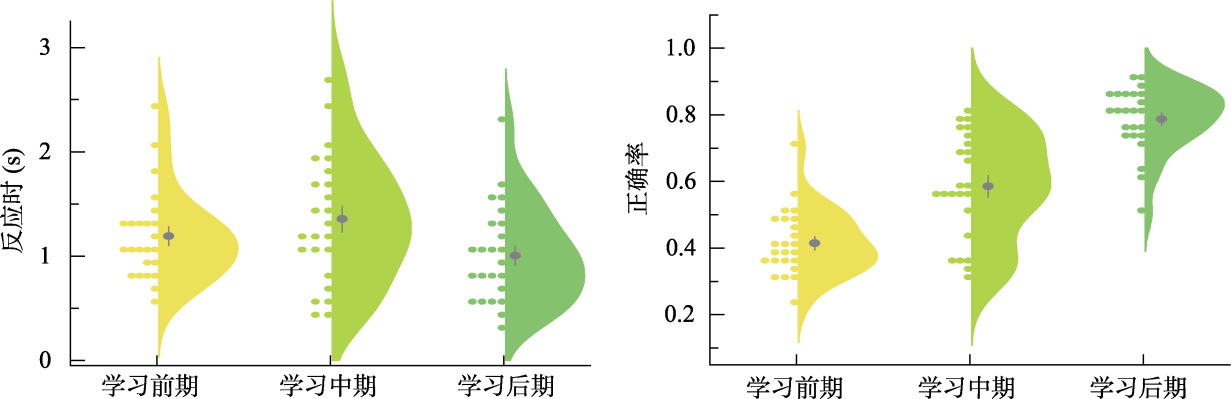
图3 学习前期、学习中期和学习后期三个条件下的正确率和反应时

图4 DDM的4个参数在多通道类别学习中的概率密度分布。图(A)代表漂移率; 图(B)代表非决策时间; 图(C)代表决策阈限; 图(D)代表起始点位置。

图5 学习前期、学习中期和学习后期的ERP波幅和条件间差异地形图。(A)CZ, CPZ, PZ, POZ和OZ振幅的均值; (B)FZ, FCZ, CZ, CPZ, PZ和POZ振幅的均值; (C)TP8, P8, PO8, O2振幅的均值; (D)CZ, CPZ, PZ和POZ振幅的均值。

图6 学习前期、学习中期和学习后期的频段能量变化: (A)学习后期−学习前期能量的变化; (B)学习中期−学习前期能量的变化。
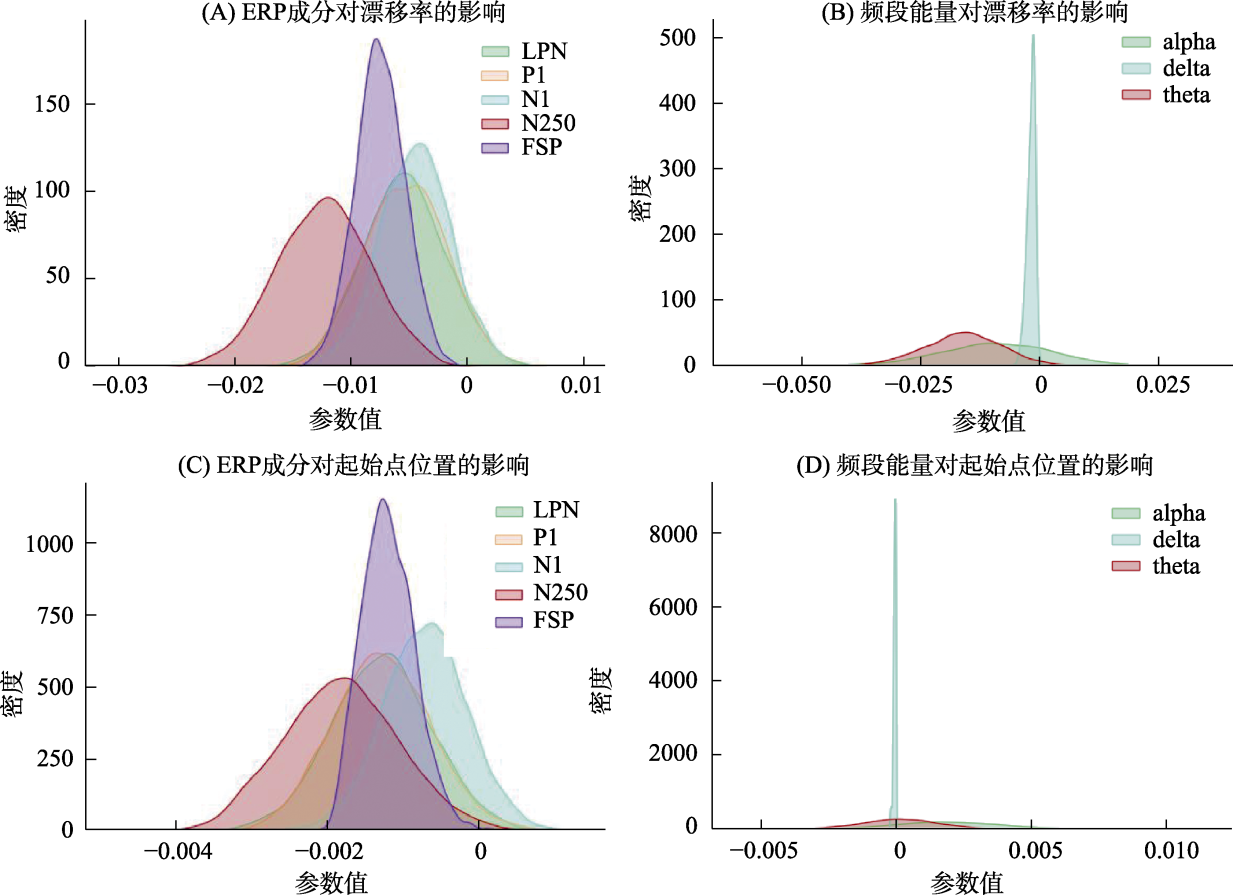
图7 ERP成分和频段能量对漂移率和起始点位置的影响。(A) ERP成分对漂移率的影响; (B)频段能量对漂移率的影响; (C)ERP成分对起始点位置的影响; (D)频段能量对起始点位置的影响。
| [1] |
Busse, L., Roberts, K. C., Crist, R. E., Weissman, D. H., & Woldorff, M. G. (2005). The spread of attention across modalities and space in a multisensory object. Proceedings of the National Academy of Sciences of the United States of America, 102(51), 18751-18756. https://doi.org/10.1073/pnas.0507704102
doi: 10.1073/pnas.0507704102 URL pmid: 16339900 |
| [2] | Bolam, J., Diaz, J. A., Andrews, M., Coats, R. O., Philiastides, M. G., Astill, S. L., & Delis, I. (2024). A drift diffusion model analysis of age-related impact on multisensory decision-making processes. Scientific Report, 14(1), 14895. https://doi.org/10.1038/s41598-024-65549-5 |
| [3] |
Cappe, C., Thelen, A., Romei, V., Thut, G., & Murray, M. M. (2012). Looming signals reveal synergistic principles of multisensory integration. Journal of Neuroscience, 32(4), 1171-1182. https://doi.org/10.1523/jneurosci.5517-11.2012
doi: 10.1523/JNEUROSCI.5517-11.2012 URL pmid: 22279203 |
| [4] | Cavanagh, J. F., & Frank, M. J. (2014). Frontal theta as a mechanism for cognitive control. Trends in Cognitive Science, 18(8), 414-421. https://doi.org/10.1016/j.tics.2014.04.012 |
| [5] |
Cavanagh, J. F., Wiecki, T. V., Cohen, M. X., Figueroa, C. M., Samanta, J., Sherman, S. J., & Frank, M. J. (2011). Subthalamic nucleus stimulation reverses mediofrontal influence over decision threshold. Nature Neuroscience, 14(11), 1462-1467. https://doi.org/10.1038/nn.2925
doi: 10.1038/nn.2925 URL pmid: 21946325 |
| [6] |
Clouter, A., Shapiro, K. L., & Hanslmayr, S. (2017). Theta phase synchronization is the glue that binds human associative memory. Current Biology, 27(20), 3143-3148. https://doi.org/10.1016/j.cub.2017.09.001
doi: S0960-9822(17)31117-X URL pmid: 28988860 |
| [7] |
Delorme, A., & Makeig, S. (2004). EEGLAB: An open source toolbox for analysis of single-trial EEG dynamics including independent component analysis. Journal of Neuroscience Methods, 134(1), 9-21.
doi: 10.1016/j.jneumeth.2003.10.009 pmid: 15102499 |
| [8] |
Faul, F., Erdfelder, E., & Lang, A.-G. (2007). G*Power 3: A flexible statistical power analysis program for the social, behavioral, and biomedical sciences. Behavior research methods, 39(2), 175-191.
doi: 10.3758/bf03193146 pmid: 17695343 |
| [9] |
Folstein, J. R., Fuller, K., Howard, D., & DePatie, T. (2017). The effect of category learning on attentional modulation of visual cortex. Neuropsychologia, 104, 18-30. https://doi.org/10.1016/j.neuropsychologia.2017.07.025
doi: S0028-3932(17)30278-6 URL pmid: 28754490 |
| [10] |
Folstein, J. R., Monfared, S. S., & Maravel, T. (2017). The effect of category learning on visual attention and visual representation. Psychophysiology, 54(12), 1855-1871. https://doi.org/10.1111/psyp.12966
doi: 10.1111/psyp.12966 URL pmid: 28776708 |
| [11] | Folstein, J. R., Palmeri, T. J., & Gauthier, I. (2013). Category learning increases discriminability of relevant object dimensions in visual cortex. Cerebral Cortex, 23(4), 814-823. https://doi.org/10.1093/cercor/bhs067 |
| [12] | Freedman, D. J., Riesenhuber, M., Poggio, T., & Miller, E. K. (2003). A comparison of primate prefrontal and inferior temporal cortices during visual categorization. The Journal of Neuroscience, 23(12), 5235-5246. |
| [13] |
Gable, P. A., & Harmon-Jones, E. (2013). Does arousal per se account for the influence of appetitive stimuli on attentional scope and the late positive potential? Psychophysiology, 50(4), 344-350. https://doi.org/10.1111/psyp.12023
doi: 10.1111/psyp.12023 URL pmid: 23351098 |
| [14] |
Ghazanfar, A. A., & Schroeder, C. E. (2006). Is neocortex essentially multisensory? Trends in Cognitive Sciences, 10(6), 278-285. https://doi.org/10.1016/j.tics.2006.04.008
URL pmid: 16713325 |
| [15] |
Giard, M. H., & Peronnet, F. (1999). Auditory-visual integration during multimodal object recognition in humans: A behavioral and electrophysiological study. Journal of Cognitive Neuroscience, 11(5), 473-490. https://doi.org/10.1162/089892999563544
URL pmid: 10511637 |
| [16] |
Goldstone, R. L. (1998). Perceptual Learning. Annual Review of Psychology, 49, 585-612.
pmid: 9496632 |
| [17] |
Gui, P., Ku, Y., Li, L., Li, X., Bodner, M., Lenz, F. A., ... Zhou, Y. D. (2017). Neural correlates of visuo-tactile crossmodal paired-associate learning and memory in humans. Neuroscience, 362, 181-195. https://doi.org/10.1016/j.neuroscience.2017.08.035
doi: S0306-4522(17)30601-2 URL pmid: 28843996 |
| [18] |
Herz, D. M., Zavala, B. A., Bogacz, R., & Brown, P. (2016). Neural correlates of decision thresholds in the human subthalamic nucleus. Current Biology, 26(7), 916-920. https://doi.org/10.1016/j.cub.2016.01.051
doi: 10.1016/j.cub.2016.01.051 URL pmid: 26996501 |
| [19] |
Hu, Z., Zhang, R., Zhang, Q., Liu, Q., & Li, H. (2012). Neural correlates of audiovisual integration of semantic category information. Brain and Language, 121(1), 70-75. https://doi.org/10.1016/j.bandl.2012.01.002
doi: 10.1016/j.bandl.2012.01.002 URL pmid: 22330797 |
| [20] | Itthipuripat, S., Wessel, J. R., & Aron, A. R. (2013). Frontal theta is a signature of successful working memory manipulation. Experiment Brain Research, 224(2), 255-262. https://doi.org/10.1007/s00221-012-3305-3 |
| [21] |
Jiang, X., Bradley, E., Rini, R. A., Zeffiro, T., Vanmeter, J., & Riesenhuber, M. (2007). Categorization training results in shape- and category-selective human neural plasticity. Neuron, 53(6), 891-903. https://doi.org/10.1016/j.neuron.2007.02.015
doi: 10.1016/j.neuron.2007.02.015 URL pmid: 17359923 |
| [22] |
Jiang, X., Chevillet, M. A., Rauschecker, J. P., & Riesenhuber, M. (2018). Training humans to categorize monkey calls: Auditory feature- and category-selective neural tuning changes. Neuron, 98(2), 405-416. https://doi.org/10.1016/j.neuron.2018.03.014
doi: S0896-6273(18)30191-0 URL pmid: 29673483 |
| [23] | Kawahara, H., & Matsui, H. (2003). Auditory morphing based on an elastic perceptual distance metric in an interference- free time-frequency representation. International Conference on Acoustics, Speech, and Signal Processing, 2003 (Hong Kong: IEEE) (pp.256-259). |
| [24] |
Keller, A. S., Payne, L., & Sekuler, R. (2017). Characterizing the roles of alpha and theta oscillations in multisensory attention. Neuropsychologia, 99, 48-63. https://doi.org/10.1016/j.neuropsychologia.2017.02.021
doi: S0028-3932(17)30068-4 URL pmid: 28259771 |
| [25] | Kwon, S., Rugg, M. D., Wiegand, R., Curran, T., & Morcom, A. M. (2023). A meta-analysis of event-related potential correlates of recognition memory. Psychonomic Bulletin & Review, 30(6), 2083-2105. https://doi.org/10.3758/s13423-023-02309-y |
| [26] | Li, K., Fu, Q., & Fu, X. (2012). Cognitive and neural mechanisms of probabilistic category learning. Progress in Biochemistry and Biophysics, 39(11), 1037-1044. |
| [27] |
Li, Z., Lei, M., & Liu, Q. (2024). Cognitive mechanisms underlying the formation of offline representations in visual working memory. Acta Psychologica Sinica, 56(4), 412-420. https://doi.org/10.3724/sp.J.1041.2024.00412
doi: 10.3724/SP.J.1041.2024.00412 URL |
|
[李子媛, 雷鸣, 刘强. (2024). 视觉工作记忆离线态表征的生成机制. 心理学报, 56(4), 412-420.]
doi: 10.3724/SP.J.1041.2024.00412 |
|
| [28] | Liu, Z., Zhang, Y., Ma, D., Xu, Q., & Seger, C. A. (2021). Differing effects of gain and loss feedback on rule-based and information-integration category learning. Psychonomic Bulletin & Review, 28(1), 274-282. https://doi.org/10.3758/s13423-020-01816-6 |
| [29] | Mąka, S., Chrustowicz, M., & Okruszek, Ł. (2023). Can we dissociate hypervigilance to social threats from altered perceptual decision-making processes in lonely individuals? An exploration with Drift Diffusion Modeling and event- related potentials. Psychophysiology, 60(12), e14406. https://doi.org/10.1111/psyp.14406 |
| [30] |
Maris, E., & Oostenveld, R. (2007). Nonparametric statistical testing of EEG- and MEG-data. Journal of Neuroscience Methods, 164(1), 177-190. https://doi.org/10.1016/j.jneumeth.2007.03.024
doi: 10.1016/j.jneumeth.2007.03.024 URL pmid: 17517438 |
| [31] | Mück, M., Ohmann, K., Dummel, S., Mattes, A., Thesing, U., & Stahl, J. (2020). Face perception and narcissism: Variations of event-related potential components (P1 & N170) with admiration and rivalry. Cognitive, Affective, & Behavioral Neuroscience, 20( 5), 1041-1055. https://doi.org/10.3758/s13415-020-00818-0 |
| [32] |
Neubauer, A. C., & Fink, A. (2009). Intelligence and neural efficiency. Neuroscience and Biobehavioral Reviews, 33(7), 1004-1023. https://doi.org/10.1016/j.neubiorev.2009.04.001
doi: 10.1016/j.neubiorev.2009.04.001 URL pmid: 19580915 |
| [33] | Oostenveld, R., Fries, P., Maris, E., & Schoffelen, J. M. (2011). FieldTrip: Open source software for advanced analysis of MEG, EEG, and invasive electrophysiological data. Computational Intelligence and Neuroscience, 2011, 156869. https://doi.org/10.1155/2011/156869 |
| [34] |
Petrov, A. A. (2011). Category rating is based on prototypes and not instances: Evidence from feedback-dependent context effects. Journal of Experimental Psychology: Human Perception and Performance, 37(2), 336-356. https://doi.org/10.1037/a0021436
doi: 10.1037/a0021436 URL pmid: 21463082 |
| [35] |
Roark, C. L., Lescht, E., Hampton Wray, A., & Chandrasekaran, B. (2023). Auditory and visual category learning in children and adults. Developmental Psychology, 59(5), 963-975. https://doi.org/10.1037/dev0001525
doi: 10.1037/dev0001525 URL pmid: 36862449 |
| [36] | Roark, C. L., Paulon, G., Sarkar, A., & Chandrasekaran, B. (2021). Comparing perceptual category learning across modalities in the same individuals. Psychonomic Bulletin & Review, 28(3), 898-909. https://doi.org/10.3758/s13423-021-01878-0 |
| [37] | Rutishauser, U., Ross, I. B., Mamelak, A. N., & Schuman, E. M. (2010). Human memory strength is predicted by theta-frequency phase-locking of single neurons. Nature, 464(7290), 903-907. https://doi.org/10.1038/nature08860 |
| [38] |
Scholl, C. A., Jiang, X., Martin, J. G., & Riesenhuber, M. (2014). Time course of shape and category selectivity revealed by EEG rapid adaptation. Journal of Cognitive Neuroscience, 26(2), 408-421. https://doi.org/10.1162/jocn_a_00477
doi: 10.1162/jocn_a_00477 URL pmid: 24001003 |
| [39] |
Scott, L. S., Tanaka, J. W., Sheinberg, D. L., & Curran, T. (2006). A reevaluation of the electrophysiological correlates of expert object processing. Journal of Cognitive Neuroscience, 18(9), 1453-1465.
pmid: 16989547 |
| [40] |
Scott, L. S., Tanaka, J. W., Sheinberg, D. L., & Curran, T. (2008). The role of category learning in the acquisition and retention of perceptual expertise: A behavioral and neurophysiological study. Brain Research, 1210, 204-215. https://doi.org/10.1016/j.brainres.2008.02.054
doi: 10.1016/j.brainres.2008.02.054 URL pmid: 18417106 |
| [41] |
Seger, C. A., & Miller, E. K. (2010). Category learning in the brain. Annual Review of Neuroscience, 33, 203-219. https://doi.org/10.1146/annurev.neuro.051508.135546
doi: 10.1146/annurev.neuro.051508.135546 URL pmid: 20572771 |
| [42] |
Senkowski, D., Saint-Amour, D., Höfle, M., & Foxe, J. J. (2011). Multisensory interactions in early evoked brain activity follow the principle of inverse effectiveness. Neuroimage, 56(4), 2200-2208. https://doi.org/10.1016/j.neuroimage.2011.03.075
doi: 10.1016/j.neuroimage.2011.03.075 URL pmid: 21497200 |
| [43] | Sinnett, S., Spence, C., & Soto-Faraco, S. (2007). Visual dominance and attention: The Colavita effect revisited. Perception & Psychophysics, 69(5), 673-686. |
| [44] |
Stevenson, R. A., Ghose, D., Fister, J. K., Sarko, D. K., Altieri, N. A., Nidiffer, A. R., ... Wallace, M. T. (2014). Identifying and quantifying multisensory integration: A tutorial review. Brain Topography, 27(6), 707-730. https://doi.org/10.1007/s10548-014-0365-7
doi: 10.1007/s10548-014-0365-7 URL pmid: 24722880 |
| [45] |
Sun, J., Osth, A. F., & Feuerriegel, D. (2024). The late positive event-related potential component is time locked to the decision in recognition memory tasks. Cortex, 176, 194-208. https://doi.org/10.1016/j.cortex.2024.04.017
doi: 10.1016/j.cortex.2024.04.017 URL pmid: 38796921 |
| [46] |
Tanaka, J. M., Curran, T., Porterfield, A. L., & Collins, D. (2006). Activation of preexisting and acquired face representations: The N250 event-related potential as an index of face familiarity. Journal of Cognitive Neuroscience, 18(9), 1488-1498. https://doi.org/10.1162/jocn.2006.18.9.1488
URL pmid: 16989550 |
| [47] |
Thelen, A., Cappe, C., & Murray, M. M. (2012). Electrical neuroimaging of memory discrimination based on single-trial multisensory learning. Neuroimage, 62(3), 1478-1488. https://doi.org/10.1016/j.neuroimage.2012.05.027
doi: 10.1016/j.neuroimage.2012.05.027 URL pmid: 22609795 |
| [48] | Thelen, A., Matusz, P. J., & Murray, M. M. (2014). Multisensory context portends object memory. Current Biology, 24(16), R734-735. https://doi.org/10.1016/j.cub.2014.06.040 |
| [49] |
Van der Burg, E., Talsma, D., Olivers, C. N. L., Hickey, C., & Theeuwes, J. (2011). Early multisensory interactions affect the competition among multiple visual objects. Neuroimage, 55(3), 1208-1218. https://doi.org/10.1016/j.neuroimage.2010.12.068
doi: 10.1016/j.neuroimage.2010.12.068 URL pmid: 21195781 |
| [50] | Wiecki, T. V., Sofer, I., & Frank, M. J. (2013). HDDM: Hierarchical Bayesian estimation of the Drift-Diffusion Model in Python. Frontiers in Neuroinformatics, 7. https://doi.org/10.3389/fninf.2013.00014 |
| [51] | Wu, J., Li, Q., Fu, Q., Rose, M., & Jing, L. (2021). Multisensory information facilitates the categorization of untrained stimuli. Multisensory Research, 35(1), 79-107. https://doi.org/10.1163/22134808-bja10061 |
| [52] | Yang, X., Ying, C., Zhu, L., & Wang, W. J. (2024). The neural oscillations in delta-and theta-bands contribute to divided attention in audiovisual integration. Perception, 53(1), 44-60. https://doi.org/10.1177/03010066231208539 |
| [53] |
Yuan, B., Wang, X., Yin, J., & Li, W. (2023). The role of cross-situational stimulus generalization in the formation of trust towards face: A perspective based on direct and observational learning. Acta Psychologica Sinica, 55(7), 1099-1114. https://doi.org/10.3724/sp.J.1041.2023.01099
doi: 10.3724/SP.J.1041.2023.01099 URL |
|
[袁博, 王晓萍, 尹军, 李伟强. (2023). 跨情境的刺激泛化在面孔信任形成中的作用:基于直接互动与观察学习的视角. 心理学报, 55(7), 1099-1114 ]
doi: 10.3724/SP.J.1041.2023.01099 |
|
| [54] | Zhou, G., Lane, G., Noto, T., Arabkheradmand, G., Gottfried, J. A., Schuele, S. U., ... Zelano, C. (2019). Human olfactory- auditory integration requires phase synchrony between sensory cortices. Nature Communication, 10(1), 1168. https://doi.org/10.1038/s41467-019-09091-3 |
| [1] | 李毕琴, 张美霞, 杨少云, 黄鹏飞, 王爱君, 党君华. 秒内不同时距下自我加工优势效应[J]. 心理学报, 2025, 57(9): 1529-1539. |
| [2] | 袁博, 赵靖实, 漆丹, 赵彤, 胡佳琪. 社会奖惩对欺骗行为的影响[J]. 心理学报, 2025, 57(9): 1622-1637. |
| [3] | 任维聪, 杨婷, 王汉林. 语言符号与知觉符号表征对外语词汇习得的影响比较:来自行为与脑电的实验证据[J]. 心理学报, 2024, 56(5): 542-554. |
| [4] | 袁博, 王晓萍, 尹军, 李伟强. 跨情境的刺激泛化在面孔信任形成中的作用:基于直接互动与观察学习的视角[J]. 心理学报, 2023, 55(7): 1099-1114. |
| [5] | 岳芳, 陈剑平, 甘可鑫, 王宇情, 刘志雅. 交叉重叠类别结构的自主学习优势和集中学习劣势[J]. 心理学报, 2023, 55(10): 1597-1607. |
| [6] | 刘洁, 李瑾琪, 申超然, 胡小惠, 赵庭浩, 关青, 罗跃嘉. 数学焦虑个体近似数量加工的神经机制:一项EEG研究[J]. 心理学报, 2020, 52(8): 958-970. |
| [7] | 卢伟, 黄尔齐, 原晋霞. 基于定量脑电图的音乐和灯光颜色对情绪的影响 *[J]. 心理学报, 2018, 50(8): 880-891. |
| [8] | 谷传华;王亚丽;吴财付;谢祥龙;崔承珠;王亚娴;王婉贞;胡碧颖;周宗奎. 社会创造性的脑机制:状态与特质的EEG α波活动特点[J]. 心理学报, 2015, 47(6): 765-773. |
| [9] | 王瑞明;林哲婷;刘志雅. 部分呈现条件下类别分类学习中的信息表征机制[J]. 心理学报, 2014, 46(8): 1052-1061. |
| [10] | 夏瑞雪;周爱保;李世峰;徐科朋;任德云;朱婧. 观点采择在内隐情绪加工中的调节作用[J]. 心理学报, 2014, 46(8): 1094-1102. |
| [11] | 修利超;谈诚;蒋依涵;周仁来;陈善广. 45天-6°头低位卧床对个体额区EEG偏侧化和情绪的影响[J]. 心理学报, 2014, 46(7): 942-950. |
| [12] | 汝涛涛;莫雷;张婷;焦鸿浩;黄玉兰. 基于规则的类别学习中言语标签和动作标签的建构[J]. 心理学报, 2013, 45(12): 1334-1344. |
| [13] | 刘志雅,黄艳利,Carol A. Seger. 知道与不知道要学多少:类别学习中样例量的预期作用[J]. 心理学报, 2012, 44(6): 754-765. |
| [14] | 刘志雅,宋晓红,Carol A. Seger. 6岁儿童的类别学习能力:类别表征、注意和分类策略[J]. 心理学报, 2012, 44(5): 634-646. |
| [15] | 徐贵平,温红博,魏晓玛,莫雷. 线索呈现位置对概率类别学习的影响[J]. 心理学报, 2011, 43(03): 264-273. |
| 阅读次数 | ||||||
|
全文 |
|
|||||
|
摘要 |
|
|||||
