



1 研究背景与问题提出
自步入21世纪以来, 以移动互联网、大数据、人工智能等数字信息与智能技术为基础的新一轮技术变革使人类从传统的农业社会和工业社会迈入“数智时代”, 传统面对面的工作模式呈现虚拟化趋势。我国企业响应党十八大提出的发展数字经济的国家战略要求以及国务院《“十四五”数字经济发展规划》提出的“以网络、云、算力为关键基础设施的‘新基建’”的国家战略任务, 积极进行数字化转型, 加速了企业团队工作的虚拟化发展。据统计, 全球80%的公司正采用虚拟或混合
形式的工作方式进行虚拟化调整, 其中64%的公司有意持久使用虚拟团队工作方式(Meluso et al., 2020)。虚拟团队是一种通过信息和通信技术进行跨地区、跨时间甚至跨组织合作来完成工作任务的团队组织形式和工作模式(Hertel et al., 2005; Minas et al., 2014)。例如, 企业员工不在一个固定的实体大楼、厂房或办公室工作, 而是延伸到居家环境或更广泛的工作环境, 如咖啡馆、云办公、SOHO办公等; 员工不是依附于一个固定的组织, 而在诸如猪八戒、零工网等网络平台上为多个雇主工作, 在多个工作团队间进行切换和流转, 这些都是团队工作虚拟化的表现。随着企业的国际化发展、数字化技术的普及、平台型组织的涌现以及零工经济的兴起, 当今时代越来越多的企业团队通过使用数智化技术进行远距离、不同步、跨组织的交流与协作, 企业及团队的组织工作模式越来越趋向虚拟化。虚拟化团队工作模式不仅成为了当前企业运作的新常态, 也成为未来组织运营的一个发展趋势(Dennis et al., 2014; Purvanova & Kenda, 2022; Raghuram et al., 2019)。
虚拟团队的发展不仅给企业工作模式带来了根本性变革, 也给员工的生活带来重大改变, 为工作−家庭平衡领域的研究提出了新的研究方向。为了促进工作−家庭平衡, 学者们对工作与家庭的关系进行了大量的研究。早期的分割主义理论研究者认为工作和家庭系统各自运转才能运作得当(例如, 男主外女主内) (Kossek & Lambert, 2004; Olsen, 1983)。此后, 基于溢出和补偿理论视角的研究者认为, 工作和家庭系统虽不同但相互影响, 在工作领域中有所损耗的就会从家庭领域中弥补, 反之亦然, 以实现工作与家庭的平衡(Edwards & Rothbard, 2000; Piotrkowski, 1979)。近年来, 研究者从增益理论的整合视角认为, 工作和家庭是一种联盟关系, 某一领域(工作或家庭)的资源可以改善另一领域中的角色绩效。工作−家庭间的资源互益可以让各自的功能都得到积极的发挥, 从而形成工作−家庭平衡(Greenhaus & Powell, 2006; 刘永强, 2016)。分割、溢出、补偿、增益这些传统理论关于工作−家庭平衡的研究都是基于一个共同的前提, 即工作与家庭是界线分明可区分的。基于这些研究思路, 学者们建议企业管理者应该采用工作−家庭区分的思路, 帮助员工建立清晰的工作−家庭界线, 才能获得良好的工作和生活状态, 实现工作与家庭的平衡(韦慧民, 刘洪, 2013)。
然而, 这些研究思路都是基于传统的面对面工作模式而提出, 而企业团队工作模式的虚拟化发展改变了工作−家庭平衡的研究前提, 工作和家庭两个领域开始变得难以区分, 两个领域的重叠成为未来的发展趋势。例如, 钉钉、飞书等线上移动办公方式的普及, 让员工随时随地都需要响应工作需求, 工作一旦上线便难以下线, 工作和家庭生活变得难以分开, 导致员工的办公时间和空间拓展到他们的家庭生活之中, 使得工作和家庭领域呈现高度重叠的状态(Middleton, 2008; Reyt & Wiesenfeld, 2015)。这一研究前提的改变, 可能意味着我们需要进一步推进以往区分工作和家庭领域的研究思路以匹配当前虚拟化发展趋势。
为此, 学者们开始探索如何在虚拟化团队工作模式中促进工作−家庭平衡。他们基于资源视角认为, 应该顺应虚拟化团队工作模式下工作−家庭领域日趋重叠的趋势, 积极推进工作和家庭的融合。一方面, 研究者建议企业进一步借助数字化技术推进工作−家庭融合。例如, 企业可以借助人工智能、机器学习等数智技术开展云办公、线上办公、远程办公等, 这些办公模式可以将员工的办公时间和空间拓展到他们的家庭生活之中, 实现工作和家庭领域的高度重叠和无缝衔接(Brown & O’Hara, 2003; Kreiner et al., 2009)。另一方面, 研究者建议员工构建无边界的工作和生活理念。例如, 有些学者提出“在工作中生活, 在生活中工作”的理念, 以促进工作和家庭生活的无缝衔接来实现工作和家庭生活的平衡(马丽, 徐枞巍, 2011)。
许多企业采取工作−家庭融合的管理思想, 实行居家办公、移动办公、智能化办公、混合办公等工作−家庭友好政策, 支持员工履行家庭职责, 希望减少员工的缺席和离职。在一定程度上, 这种家庭和工作的融合确实改善了员工的工作满意度和家庭功能(Edwards & Rothbard, 2000)。例如, 携程集团推出“3+2”混合办公的新模式以推进工作−家庭融合, 从目前的实践情况来看, 进一步提高了员工的幸福感和工作创造力。但企业采取的这种工作−家庭融合的管理变革却也损害了员工的身心健康, 引发了企业绩效的下降, 出现了事与愿违的结果。例如, Google公司为提高员工的工作效率, 鼓励员工将工作带回家, 以此推进工作−家庭融合。而这导致员工的工作和生活失去了界线, 由此形成假性敬业和拖延症, 带来工作效率的低下, 并侵占员工的家庭、休闲、娱乐等生活空间和时间, 损害员工的身心健康和家庭关系。这似乎表明, 当前基于资源视角的工作−家庭融合观点可能存在一定的局限性。
这让我们重新反思:传统的工作−家庭区分策略在工作−家庭领域日趋重叠的趋势下是否真的过时了?换句话说, 在虚拟化团队工作模式发展趋势下, 我们更适合采用以往的工作−家庭区分思路, 还是当前出现的工作−家庭融合思路, 抑或是其他新的管理思路?为了回答这一重要的研究问题, 我们需要重新审视这两种观点, 从虚拟化团队工作模式的特征入手, 深入分析团队虚拟性对员工在工作−家庭平衡上的心理和行为的影响, 在此基础上进一步探讨组织应该如何优化虚拟化团队工作模式对工作−家庭平衡的影响。
2 国内外研究现状及发展动态分析
2.1 虚拟化团队工作模式研究进展分析
2.1.1 虚拟团队的定义及其进展分析
虚拟团队研究兴起于20世纪90年代, 并于1995年之后蓬勃发展(Martins et al., 2004)。早期的研究基于与面对面(传统)团队的对比, 将虚拟团队简单定义为地理位置上分散的一起协同工作的群体(Henry & Hartzler, 1997)。随着信息和通信技术的进一步发展, 越来越多在地理位置上分散的团队借助电子和信息技术进行沟通协作。相应地, 虚拟团队的定义发生了变化, 在原来强调地理分散性的基础上进一步强调通讯技术的运用。例如, Townsend等(1998)将虚拟团队定义为通过电信和信息技术的组合使用, 将地理上分散的人员联系起来完成任务的群体。随后, 在经济全球化的加速驱动下, 越来越多的组织突破时空的限制和组织边界来组建和运作团队以整合人力资源, 由此跨越时空和组织边界成为了虚拟团队概念中的重要成分。例如, Martins等(2004)将虚拟团队定义为通过不同程度的技术使用, 跨越位置、时间和组织边界以完成相互依赖性任务的团队。
综上所述, 虚拟团队的概念随着科技进步和企业环境的发展变化而发生改变和拓展, 目前还未达成统一的定义。综合现有的定义可以认为, 虚拟团队是以数智技术为支撑, 跨越时间、空间和组织边界, 致力完成目标任务的相互协作的工作团体。其特征主要包括:技术支撑, 即虚拟团队广泛使用数智化信息技术; 边界跨越, 即虚拟团队跨越时间、空间和组织边界; 群体范畴, 即虚拟团队是具有共同目标的相互协作的群体。这些特征可以分为“团队性”和“虚拟性”两部分。“团队性”是与传统团队(或面对面团队)相同的地方, 即两者都具有共同的工作目标, 都是目标导向下互相协作的工作群体。“虚拟性”是与传统团队(或面对面团队)相区别的地方, 即虚拟团队具有时空分散性、技术依赖性、结构动态性和组织边界跨越性等典型“虚拟性”特征。
2.1.2 团队虚拟性的定义及其进展分析
团队虚拟性来源于虚拟团队概念中的虚拟性特征, 描述的是一个团队在多大程度上具备虚拟团队工作的特征(Kirkman & Mathieu, 2005; Martins et al., 2004)。随着互联网、大数据、云计算、人工智能、物联网等新一代信息技术的推进, 以及数字化经济、平台型经济、零工经济等新一代经济形式的发展, 现今组织中的大部分团队都或多或少地具备上述虚拟团队的特点, 团队虚拟性由此成为当今企业团队的一个普遍特征(Schmidtke & Cummings, 2017; 王丽平, 李忠华, 2017)。即, 当前企业中的工作团队都拥有不同程度的虚拟性。学者们的关注焦点也开始转向团队虚拟性这一描述团队虚拟程度的构念(Martins et al., 2004; Schmidtke & Cummings, 2017)。
然而, 当前学者从不同的角度对团队虚拟性这一构念进行描述, 未能达成统一的定义和认识。例如, O’Leary和Cummings (2007)认为团队虚拟性是指团队成员在时间和空间上的分散程度。George等(2022)定义团队虚拟性是成员依赖电子通信工具来开展工作的程度。而Shin (2004)提出团队虚拟性是指一个通过电子手段进行交流的群体在时间、文化、空间和组织上的分散程度, 是个由技术依赖性、时空分散性、组织边界跨越性和文化差异性构成的四维构念。这些不同角度的建构和描述导致团队虚拟性的定义、维度呈现混乱零散、不一致的状态(Gibson & Gibbs, 2006; Martins et al., 2004; Schweitzer & Duxbury, 2010)。这主要是由于缺乏基础理论的解释而导致对团队虚拟性概念的理解停留在表面。而Zheng等(2024)运用过程虚拟化理论推理出团队虚拟性的内涵及其4个结构维度, 为团队虚拟性这一构念提供了统一的定义和维度界定。
其中, 时空分散性是指团队成员在不同地方、不同时间段分散工作的程度(Hoch & Dulebohn, 2017; O’Leary & Cummings, 2007; Prasad et al., 2017)。技术依赖性是指团队成员在工作上对技术工具的依赖程度(George et al., 2022; Suh et al., 2011)。结构动态性是指团队成员根据工作需要进行变动调整的程度(Gibbs et al., 2008; Gibson & Gibbs, 2006; Shi & Weber, 2018)。而组织边界跨越性是指团队成员在工作中跨越不同组织或部门的程度(Schweitzer & Duxbury, 2010)。团队的虚拟性程度越高, 团队成员的时空分散性程度越高, 团队成员之间的同步互动就越少; 成员之间越依赖技术工具进行团队工作和沟通, 导致其获得的感官体验越少(Overby, 2008); 团队的成员组成越经常发生变动, 成员之间的关系越不稳定; 此外, 由于他们同时归属于不同的组织或部门, 成员的身份越多重而不唯一, 成员的行为也越难受到一个组织的约束(Cummings, 2004; Majchrzak et al., 2007)。
这4个维度共同描绘了团队虚拟性的一个重要特征:边界突破。时空分散性突破了传统固定工作时间(如, 早九晚五)和空间(如, 公司办公室)的时空资源边界; 技术依赖性打破了传统人与工作对象直接接触的物理资源边界; 结构动态性打破了传统工作固定人员组成的人力资源边界; 而组织边界跨越性打破了传统工作固定单位的组织资源边界。企业团队在这4个边界上的突破程度越高, 代表着该团队的虚拟性程度越高(Zheng et al., 2024)。
2.1.3 虚拟化团队工作模式、虚拟团队与团队虚拟化的关系
根据过程虚拟化理论, 虚拟(virtual)指的是人与人、人与物之间没有直接的物理交互; 虚拟化(virtualization)指的是消除人与人、人与物之间物理交互的过程; 而虚拟性(virtuality)指的是一个过程在人与人、人与物之间物理交互上的程度, 即虚拟化的程度。如果在某一活动过程中, 人与人、人与物之间物理交互程度低, 那么这一活动的虚拟性就比较高(Overby, 2008)。相应地, 虚拟团队是指通过不同程度的技术使用, 跨越位置、时间和组织关系边界以完成相互依赖性任务的团队(Martins et al., 2004)。团队虚拟化是指一个团队拥有虚拟性特征而变得虚拟的一个过程。团队通过“虚拟化”这个过程消除了直接的物理交互而成为具有“虚拟”特征的虚拟团队, 是诸多团队类型中的一种。然而, 学者们普遍认为, 现今组织中的团队多少都具有“虚拟”定义里的一些特征, 不存在纯粹的虚拟团队, 只是“虚拟化”的程度不同, 即, “虚拟性”水平有差别(Schmidtke & Cummings, 2017)。而虚拟化团队工作模式是描述团队在虚拟化过程中的工作方式, 其虚拟化的程度通过团队虚拟性来衡量。由于现实中的团队多少都具有一定的虚拟性, 我们更适合通过虚拟化团队工作模式来描述现实企业中普遍存在的一种团队工作方式。
综上所述, 虚拟化团队工作模式、虚拟团队与团队虚拟化这三者之间的关系是:虚拟团队是工作团队经过团队虚拟化这个过程后达到的最终虚拟状态。但由于当前并不存在纯粹的虚拟团队, 而是所有团队都具有一定程度的虚拟性。因此, 我们通过虚拟化团队工作模式来描述当前团队的虚拟化工作方式, 同时通过团队虚拟性来反映虚拟化团队工作模式的虚拟化程度。
2.2 工作−家庭平衡研究进展分析
2.2.1 工作−家庭平衡的定义及其进展分析
工作−家庭平衡描述的是一种工作−家庭界面的关系, 即关注个体是否能平衡工作和家庭之间的关系。目前, 学者主要从三个角度来描述工作−家庭平衡的概念, 还未达成统一的定义。基于角色满足的角度, Clark (2000)认为工作−家庭平衡是指个体在工作和家庭中都比较满足, 感受到的角色冲突最低。同样, Greenhaus等(2003)认为工作−家庭平衡是指个体能够均衡地参与工作和家庭角色, 并能从中体验到均衡的满意感。基于领域需求的角度, Duxbury (2003)将工作−家庭平衡定义为来自一个人对工作和家庭两个领域的需求是等量的一种均衡状态。而基于职责达成的角度, Grzywacz和Carlson (2007)认为工作−家庭平衡是一种角色期望的达成。当工作−家庭平衡时, 工作和家庭角色的职责都能很好地、有效地完成。
综合上述的定义可以看出, 工作−家庭平衡描述的是员工在工作和家庭两方面减少相互之间的冲突, 在两个领域都得到发展的状态(Hirschi et al., 2019)。因此, 如果员工在工作、家庭两个领域上的表现都能得到促进, 便达到了较好的工作−家庭平衡效果; 反之, 如果员工在工作或家庭某一领域上的表现受阻, 便意味着工作−家庭平衡程度较低(Hirschi et al., 2019)。基于这一原则, 本研究在工作和家庭两个领域中各自选取了其代表性结果(如, 工作领域的工作绩效和工作满意度; 家庭领域的生活质量和生活满意度), 来检验虚拟化团队工作模式下员工工作和家庭两类结果的变化, 以此反映其工作−家庭平衡程度。
2.2.2 工作−家庭平衡的研究思路进展分析
(1)工作−家庭区分思路
工作−家庭区分思路是将工作和家庭两个领域分隔开来看待, 通过两个领域间的功能溢出、补偿、增益等作用, 从而实现工作与家庭之间的平衡。这一思路主要基于分割、补偿、溢出等理论的研究。早期的分割主义研究认为, 工作和家庭应该分割对待, 男人和女人在不同的领域承担不同的责任, 女人在家里负责情感表达, 男人在工作场所负责工具性的工作, 二者各司其职才能将工作与家庭运作得当, 实现工作和家庭的平衡(Kossek & Lambert, 2004; Olsen, 1983)。基于补偿理论的研究指出, 工作和家庭是两个独立的领域, 个人会试图通过在家人身上寻找更多的满足感来弥补工作领域中缺乏的满足感, 或通过在同事身上获得更多的满足感来弥补家庭中缺乏的满足感, 以此实现工作−家庭平衡(Lambert, 1990; Piotrkowski, 1979)。基于溢出理论的研究认为, 员工在一个领域(工作或家庭)的成功经验会溢出改善他们在另一个领域的经验, 从而促进工作−家庭平衡(Grzywacz et al., 2002; Ruppanner & Pixley, 2012)。类似地, 基于增益理论的研究也指出, 一个角色(工作或家庭)的经验会提高另一个角色的表现, 从而促进工作和家庭的均衡发展(Greenhaus & Powell, 2006; Grzywacz et al., 2007)。
以上关于分割、溢出、补偿、增益的研究逻辑是基于工作−家庭区分思路。即, 这些理论观点认为在工作与家庭两个领域相互独立、可区分的基础上, 两个领域之间能够通过资源溢出、补偿、增益等方式, 满足两个领域对资源的分配需求, 从而实现工作与家庭的平衡。
(2)工作−家庭融合思路
随着数智时代的到来, 越来越多的组织和员工开始采用虚拟化团队工作模式进行办公, 工作和家庭之间的界线逐渐被打破并变得模糊, 出现了无边界的发展趋势(Milliken & Dunn-Jensen, 2005), 我们很难再将工作和家庭当做独立、可分割的两个领域来对待(Powell et al., 2019)。基于此, 学者们开始提出工作−家庭融合的观点以促进工作和家庭的平衡。工作−家庭融合思路是将工作与家庭活动视作整体, 将二者当成一个系统来看待并通过有机协调来寻找平衡。融合思路是应对当前虚拟化团队工作模式下工作和家庭领域相互融合的现实情况而出现的新观点, 主要包括工作−家庭一体化观点和工作−家庭整合观点。
工作−家庭一体化观点将工作与家庭都当成生产场所来对待, 形成工作−家庭一体化生产模型。通过工作和家庭场所一体化, 工作与家庭各自功能都得到积极发挥并相互促进, 从而实现工作和家庭的协同、平衡发展(Polk, 2008; 刘永强, 赵曙明, 2016)。而工作−家庭整合是一种以寻求工作−家庭合理平衡、共生协同的方式来兼顾工作和家庭责任的活动(Grady & McCarthy, 2008)。当员工在对工作−家庭活动进行决策时, 如果能在工作决策时兼顾家庭, 或是在做出家庭决策时已经考虑了工作, 那么他们更可能规避工作−家庭冲突, 获得工作−家庭平衡。与工作−家庭一体化不同的是, 工作−家庭整合不只是将工作与家庭生活融合在一个时间或空间中进行, 而是通过工作与家庭之间的动态协调来主动寻找平衡(Grady & McCarthy, 2008)。
(3)工作−家庭区分与融合的衡量:工作−家庭整合倾向
综合区分和融合研究思路可以发现, 工作−家庭平衡研究领域的核心理论探讨集中在对工作和家庭两个领域的区分和整合上。当将工作和家庭的资源分别分开进行使用时, 则表现为工作−家庭区分思路; 而将工作和家庭的资源同时相互整合使用时, 则表现为工作−家庭融合思路。而我们可以通过员工对资源分配的两种方式:工作对家庭整合(利用家庭领域的可用资源参与工作活动)和家庭对工作整合(利用工作领域的可用资源参与家庭活动), 来判断其更倾向于工作−家庭区分还是整合(Grady & McCarthy, 2008; Parasuraman & Greenhaus, 1997)。如果员工在两种整合上的倾向都高, 这表明员工希望工作和家庭互相融合, 资源在两个领域内可以共享, 此时在管理上更适用工作−家庭融合的思路(Edwards & Rothbard, 2000; Parasuraman & Greenhaus, 1997); 而如果员工更倾向于其中一种整合, 便意味着员工希望对工作和家庭进行区分, 从而可以将资源分配到不同的领域, 此时在管理上更适用工作−家庭区分的思路(Edwards & Rothbard, 2000; Parasuraman & Greenhaus, 1997)。因此, 本研究通过检视虚拟化团队工作模式下员工对工作−家庭整合的倾向, 以此判断员工更偏好工作−家庭融合策略还是区分策略。
2.3 当前研究缺陷
通过上述对虚拟化团队工作模式和工作−家庭平衡的研究进展分析可以发现, 虚拟化团队工作模式模糊了工作与家庭的界线, 改变了传统工作−家庭平衡领域的研究前提, 指出了新的研究方向:如何在虚拟化团队工作模式中促进工作−家庭平衡?然而, 目前虚拟化团队工作模式对员工工作−家庭平衡的影响研究才刚起步, 还存在以下突出的研究缺陷:
一方面, 虚拟化团队工作模式对工作−家庭平衡的影响还局限在技术使用维度的研究, 忽略了时空分散、结构动态、组织边界跨越性等团队虚拟性其他重要维度的影响机制探究, 阻碍了虚拟化团队工作模式对工作−家庭平衡影响研究的整体认识和系统发展。目前, 学者主要针对团队虚拟性中的技术使用维度, 进行了一些关于工作中移动技术使用对员工工作−家庭平衡影响的研究, 且得出的结论也不一致。一些研究认为工作中移动技术的使用会模糊工作与家庭的界限, 干扰员工家庭职责的履行, 损害员工的家庭关系, 增加员工的工作−家庭冲突(Butts et al., 2015; Delanoeije et al., 2019; Kotecha et al., 2014)。而另一些研究却发现, 工作中移动技术的使用能使员工更加灵活、方便地完成工作任务, 并且进一步溢出、补偿给家庭领域, 帮助员工更好地兼顾家庭生活, 促进员工的工作−家庭平衡(Johnson et al., 2020; Richardson & Thompson, 2012; 马红宇 等, 2016)。
另一方面, 关于移动技术对工作−家庭平衡影响的相关研究主要基于资源保存理论, 而从虚拟化团队工作模式的发展特点来看, 资源保存理论的解释逻辑存在不足。针对移动技术使用过程中的工作−家庭平衡的问题, 学者基于资源保存理论解释了员工是如何根据领域环境的需要, 在工作和家庭两个领域进行资源的分配, 以促进工作−家庭平衡。即, 针对资源急缺的领域进行资源投入, 针对资源丰沛的领域进行资源转出, 从而保障资源满足工作和家庭领域的各自需求, 增进工作和家庭两个领域的产出和绩效, 实现工作和家庭的平衡(ten Brummelhuis & Bakker, 2012)。尽管资源保存理论提升了我们对工作−家庭平衡关系的理解, 但它也存在一定的局限性。首先, 当前研究应用资源保存理论的基本解释逻辑是:不同领域存在不同的资源和需求, 而这些领域是基于物理边界而进行划分的。而随着虚拟化团队工作模式的发展, 工作和家庭领域的物理边界逐步重叠无法分割, 这似乎违背了资源保存理论的解释前提, 可能导致其理论解释力下降。其次, 资源保存理论只考虑了环境对资源的需求, 并根据领域环境需求进行资源分配, 忽略了人对资源需求的判断, 无法解释员工在资源分配上的动机, 即员工为何愿意将工作或家庭某一领域的资源分配到另一个领域。这意味着我们需要进一步推进工作−家庭平衡研究领域在虚拟化趋势下的理论发展, 否则将无法厘清团队虚拟性影响员工工作−家庭平衡的内在原因, 从而使得企业管理者无法采取有效的干预措施促进员工和企业的可持续、和谐发展。
3 研究构想
为回答本文研究问题, 弥补当前工作−家庭平衡研究中资源视角理论的发展缺陷, 本研究引入社会认同理论来解释团队虚拟性对员工工作−家庭平衡的影响机制。以往资源视角的研究认为, 移动技术使得员工有能力根据领域环境的需求, 在工作和家庭两个领域进行资源的移动和分配, 以促进工作和家庭的平衡。然而, 有能力做并不代表着有意愿做, 资源保存理论只考虑了环境对资源的需求, 忽略了人对资源属性的判断, 在作用机制分析上存在重要的逻辑缺失, 即缺乏解释资源在工作与家庭之间是如何实现移动的、往哪个领域方向移动以及为什么往那个领域移动。因此, 除了资源保存理论, 还亟需寻找其他更合理的理论来拓展资源保存理论研究前提的局限性, 从而形成更具有解释力的理论研究框架。
而借助社会认同理论可以有效地进一步解释资源如何在工作与家庭之间移动以及移动的内在原因。社会认同理论认为, 个体会依据身份认同行事, 会向自己认同的群体或领域付出努力和投入资源(Burke, 1991)。根据该理论逻辑, 资源会往个体所认同的领域流动, 即, 对领域身份的认同提供了资源流动的方向。这可以解释一个领域资源向另一个领域流动的原因, 从而弥补以往资源理论视角存在的逻辑缺失和不足, 帮助我们对当前的研究观点进行整合, 形成一个更具解释力的整体理论框架。因此, 社会认同理论有助于我们解决当前的研究缺陷, 可以成为本研究的理论基础。
为此, 本研究基于“社会认同理论”视角对以往的“资源保存理论”进行整合, 重新审视虚拟化团队工作模式对员工工作−家庭平衡的影响。从虚拟化团队工作模式下呈现出的“工作−家庭融合”的特征入手, 探究团队虚拟性通过员工工作−家庭整合行为影响员工工作和家庭的作用机制。本研究的总体研究框架见图1。
图1
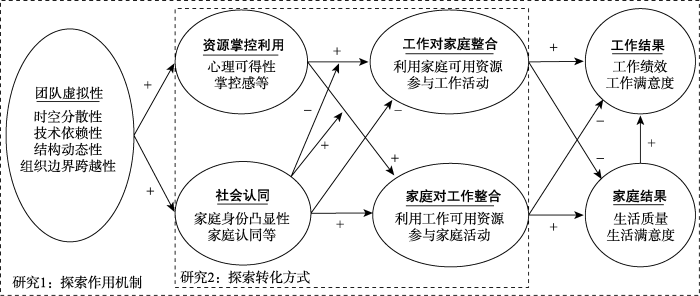
3.1 研究1:团队虚拟性对员工工作−家庭整合行为及其工作、家庭结果的双层作用机制
为了回答虚拟化团队工作模式发展趋势下应该采取怎样的工作−家庭平衡策略, 研究1从虚拟化团队工作模式下呈现出的“工作−家庭融合”的特征入手, 选择体现工作−家庭融合的核心构念“工作−家庭整合”作为核心机制, 探讨团队虚拟性对员工工作−家庭整合行为(包括工作对家庭整合和家庭对工作整合)的影响, 从而表明团队虚拟性会让员工更倾向于产生怎样的工作−家庭整合倾向, 以此回答本文的研究问题:在虚拟化团队工作模式发展趋势下, 我们更适合采用以往的工作−家庭区分思路, 还是当前出现的工作−家庭融合思路, 抑或是其他新的管理思路?
通过对资源和认同双层作用机制的探讨可以发现, 随着团队工作的虚拟化程度加深, 员工并不一定会倾向于对工作和家庭进行相互融合, 而是会更倾向于家庭对工作的整合。这意味着, 在虚拟化团队工作模式发展趋势下, 员工仍旧希望对工作和家庭进行区分, 且更倾向于将资源分配到家庭领域。因此, 基于这些研究内容可以表明, 传统的工作−家庭区分理念在虚拟化团队工作模式发展趋势下并不过时, 但管理者需要了解到员工更偏好将资源分配给家庭领域, 从而实现“为美好生活而工作”的人生理想。本部分的研究模型见图2。
图2
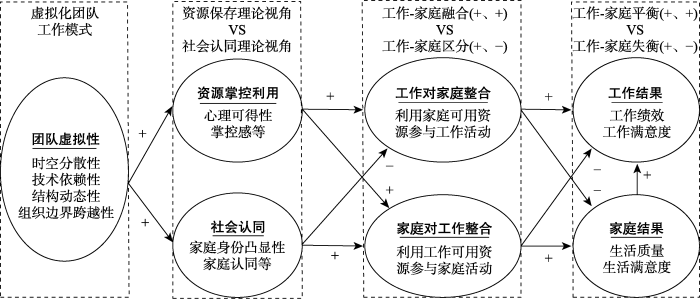
3.1.1 基于资源保存理论的团队虚拟性对员工工作−家庭融合及其工作、家庭结果的作用机制
(1)团队虚拟性与资源掌控利用
团队虚拟性有助于员工突破各种资源边界约束, 增加员工对资源的掌控利用程度(如, 掌控感、心理可得性和活力)。团队虚拟性是指一个团队拥有时空分散性、技术依赖性、结构动态性和组织边界跨越性的程度(Zheng et al., 2024), 反映了对时空、物理、人力和组织等资源边界的突破程度。一个团队的虚拟性程度越高, 意味着该团队突破的资源边界越多。资源保存理论指出, 资源产生于特定的环境, 因受环境的约束而形成资源的稀缺性。当人们能够突破环境约束, 便能获得更多的资源(Hobfoll et al., 2018)。团队虚拟性突破了时空、组织、人力等资源边界约束, 让员工对资源具有更高的掌控力, 体现在更高的掌控感、心理可得性、活力等。具体而言, 团队虚拟性突破时空、物理、人力和组织等各种资源边界约束, 可以增加员工对资源的获取程度。例如, 相关研究表明, 团队虚拟性能够帮助员工获得更多的知识、信息、社会网络、灵活性等资源 (Ahuja & Carley, 1999; Griffith & Neale, 2001; Leenders et al., 2003)。而掌控感是指个体对自身能够对周围环境施加影响和控制能力的感知(Folkman et al., 1986)。掌控感高的员工表现为其觉得更有能力控制环境, 获得和掌控更多的资源。因此, 随着团队虚拟性的提升, 员工的掌控感也会随之增强。同时, 团队虚拟性使得员工能够突破各种资源边界约束获得更多的资源, 从而提升员工的心理可得性, 即员工认为自己拥有丰富可用的资源参与相关角色活动(Binyamin & Carmeli, 2010)。此外, 团队虚拟性解除了各种资源边界限制, 增加员工对各种资源的可支配程度, 从而激发和释放员工的活力, 即员工认为自己拥有更多的资源和能力(Carmeli et al., 2009)。综上所述, 团队虚拟性突破了时空、物理、人力和组织资源边界的限制, 赋予了员工对时空、信息、灵活度、社会资本等各种资源更多的自主权和控制权, 从而提升员工对资源的掌控感、心理可得性和活力。基于此, 提出以下假设:
假设1-1:团队虚拟性程度的提升可以增强员工的资源掌控利用程度(如, 掌控感、心理可得性和活力)。
(2)资源掌控利用与工作−家庭融合
员工资源掌控利用(如, 掌控感、心理可得性和活力)程度的增加会提升其资源整合的倾向和能力, 促进工作−家庭整合。掌控感是指一个人可以直接或间接地对环境施加某种影响的信念(Thomas & Ganster, 1995), 心理可得性指的是个体对其自身拥有进入某一角色所需资源的可用感知(Binyamin & Carmeli, 2010), 而活力是指个体对身体上、情绪上和认知上的能量资源的感觉(Carmeli et al., 2009)。掌控感、心理可得性和活力都反映了员工拥有和掌控丰富资源的程度。当一个员工的掌控感、心理可得性和活力程度越高时, 员工拥有的资源就越多。资源保存理论指出, 个体努力获得和维持自身资源, 是为了能更好地从事各种活动。拥有更多资源的个体具有更强的投资倾向, 更能激发自身的积极行为(Kahn, 1990)。因此, 高掌控感、心理可得性和活力的员工认为自己拥有丰富的资源, 更有能力进行积极的行为, 对拥有的资源进行工作−家庭相互整合。基于此, 提出以下假设:
假设1-2:员工资源掌控利用程度(如, 掌控感、心理可得性和活力)的提升可以促进工作−家庭融合行为(即, 提升工作对家庭整合的同时提升家庭对工作整合)。
(3)工作−家庭整合与工作、家庭结果
资源保存理论指出, 个体所接收到的资源变化会显著地影响其随后的感受和态度(Halbesleben et al., 2014)。资源的获得有助于个体高效应对情境需求, 而资源的损耗会让人们产生压力等不良的体验和感受(Hobfoll, 2002; ten Brummelhuis & Bakker, 2012)。根据这一逻辑, 工作−家庭整合反映了员工对工作和家庭两个领域的资源调整和投入情况, 影响两个领域的资源变化。其中, 工作对家庭整合是指利用家庭领域的可用资源参与工作活动, 反映了个体将家庭领域的资源投入到工作领域。这会增加工作领域的资源, 帮助员工更好地应对工作环境和工作内容, 提升工作绩效、工作满意度等工作结果; 同时, 这也会减少家庭领域的资源, 降低员工应对家庭环境和家庭角色的能力, 降低生活质量、生活满意度等家庭结果。而家庭对工作整合是指利用工作领域的可用资源参与家庭活动, 反映了个体将工作领域的资源投入到家庭领域。这会增加家庭领域的资源, 帮助员工有效应对家庭环境和家庭角色, 提升生活质量、生活满意度等家庭结果; 同时, 这也会减少工作领域的资源, 降低员工应对工作环境和工作内容的能力, 降低工作绩效、工作满意度等工作结果。因此, 工作对家庭整合会提升工作结果的同时降低家庭结果, 而家庭对工作整合会提升家庭结果的同时降低工作结果。基于此, 提出以下假设:
假设1-3:工作对家庭整合可以提升员工工作绩效、工作满意度等工作结果, 降低员工的生活质量、生活满意度等家庭结果。
假设1-4:家庭对工作整合可以提升员工的生活质量、生活满意度等家庭结果, 降低员工工作绩效、工作满意度等工作结果。
3.1.2 基于社会认同理论的团队虚拟性对员工工作−家庭区分及其工作、家庭结果的作用机制
(1)团队虚拟性与社会认同
团队虚拟性会阻碍员工对团队身份的认知, 降低员工在团队中的内部人身份感知, 并形成社会身份的模糊和缺失, 从而转向熟悉、稳定、可接触的现实家庭群体, 积极地构建家庭身份, 提升员工的家庭认同和家庭身份凸显性。团队虚拟性由时空分散性、技术依赖性、结构动态性和组织边界跨越性构成(Zheng et al., 2024), 这些维度打破了传统固定的环境边界, 形成了一种离散、非面对面、动态、变化的虚拟环境。其中, 时空分散性打破固定时间和空间的边界, 形成一种员工相互离散的环境。技术依赖性打破固定物理边界, 形成一种非面对面的环境。结构动态性打破固定人员的边界, 形成一种成员关系动态变化的环境。组织边界跨越性打破固定组织的边界, 形成一种成员隶属不同组织的身份多样变化的环境。社会认同理论指出, 人们在群体中通过与该群体其他成员之间的交流互动, 在自我概念中形成一个群体身份, 将自我认知、价值、情感等与群体联系在一起, 并以此作为自己群体行为的依据(Stets & Burke, 2000, 2014)。团队虚拟性形成的离散、非面对面、动态、变化的虚拟环境限制了成员之间的情感联系与交流互动, 阻碍成员对于团队身份的认知, 使得员工感觉自己不是团队的内部人, 即降低内部人身份感知(Stamper & Masterson, 2002)。同时, 在这种虚拟的环境中, 员工的身份是多重、动态、变化的, 也会造成员工社会身份的模糊和缺失。
为了弥补工作上社会身份的缺失, 给自己一个积极的自我概念, 员工会转向身边熟悉、稳定、可接触的现实家庭以获得家庭身份认同。社会认同理论认为, 人们努力实现和保持积极的社会身份认同, 如果社会身份缺失或令人不满, 人们会努力加入使其自身得到积极区分、更有利的群体, 去获取令人满意的社会身份, 形成积极的自我概念(Stets & Burke, 2000, 2014)。因此, 随着团队虚拟性的提升, 员工一方面有更多机会在家庭、咖啡厅等生活场所与家人、朋友一起工作、生活, 增加与家庭成员的沟通联系和亲密关系, 增强对家庭身份的认知和情感, 提升员工的家庭认同, 即员工对家庭身份认可与接受的程度(Dumas & Stanko, 2017)。另一方面, 员工较少地接触和感知其他团队成员, 而更多地接触家庭成员的态度、情感, 这会增加员工所感受到的家庭成员相对于其他成员社会地位的重要性, 提升员工家庭身份在虚拟化团队工作模式中的凸显性(Randel, 2002)。基于以上分析, 提出以下假设:
假设1-5:团队虚拟性程度的提升会降低员工的内部人身份感知, 增强员工的家庭认同和家庭身份凸显性。
(2)社会认同与工作−家庭区分
员工的家庭认同和家庭身份凸显性会让员工对家庭投入更多的努力和资源, 促进家庭对工作整合, 并减少家庭资源的流出和损耗, 降低工作对家庭整合。家庭认同是指个人对家庭身份认可与接受的程度(Dumas & Stanko, 2017)。家庭身份凸显性是指个人家庭身份在社会情境中启动的可能性(Randel, 2002)。家庭认同和家庭身份凸显性都反映了员工对家庭身份的认可和重视程度。社会认同理论认为, 认同某个群体会表现出与该群体相一致的行为方式, 个体倾向于选择和执行与其社会身份一致的活动, 并倾向于拥护支持其社会身份的组织(Ashforth & Mael, 1989)。因此, 家庭认同和家庭身份凸显性高的员工会执行和家庭身份一致的行为, 更倾向于为家庭付出额外的精力, 努力利用工作领域的可用资源投资到家庭活动, 提升家庭对工作整合。同时, 家庭认同和家庭身份凸显性高的员工会维护自己的家庭利益, 减少家庭资源的损耗, 努力阻止自己家庭领域的资源流动到工作领域, 降低工作对家庭整合。因此, 高家庭认同、家庭身份凸显性的员工将资源更多地聚集在家庭领域而不是工作领域, 导致促进家庭对工作的整合而降低工作对家庭的整合。基于此, 提出以下假设:
假设1-6:员工家庭认同和家庭身份凸显性的提升会提升家庭对工作整合而降低工作对家庭整合。
(3)工作−家庭区分与工作、家庭结果
社会认同理论认为, 人们根据群体成员的身份来思考自己, 群体认同有助于个体维持对群体的积极态度和行为, 并激励其付出努力实现群体目标, 以实现自我提升(Rapp & Mathieu, 2019; Stets & Burke, 2000)。基于这一逻辑, 工作−家庭区分是一种维持家庭群体或工作团队群体的积极行为, 影响员工家庭身份和工作身份的自我提升结果。其中, 家庭对工作整合是指利用工作领域的可用资源参与家庭活动, 这可以增加家庭的资源投入, 是维持家庭身份的一种积极行为, 有助于实现家庭目标, 维持员工对家庭身份的认同, 提升家庭身份的自我提升效果, 如提升生活质量、生活满意度等家庭结果; 同时, 家庭对工作整合损害工作资源, 是破坏工作身份的一种行为, 不利于实现工作目标, 破坏员工对工作团队身份的认同, 降低工作身份的自我提升效果, 如降低工作绩效、工作满意度等工作结果。而工作对家庭整合是一种维持工作身份的工作资源投入行为, 有助于实现工作身份的自我提升效果, 即提升工作绩效、工作满意度等工作结果; 同时, 工作对家庭整合是一种损害家庭身份的家庭资源损耗行为, 会破坏家庭身份的自我提升效果, 即降低生活质量、生活满意度等家庭结果。因此, 家庭对工作整合会提升家庭结果的同时损害工作结果, 而工作对家庭整合会提升工作结果的同时损害家庭结果。基于此, 提出以下假设:
假设1-7:家庭对工作整合可以提升员工的生活质量、生活满意度等家庭结果, 降低员工工作绩效、工作满意度等工作结果。
假设1-8:工作对家庭整合可以提升员工工作绩效、工作满意度等工作结果, 降低员工的生活质量、生活满意度等家庭结果。
3.1.3 家庭结果与工作结果
以上分析表明, 员工在虚拟化团队工作模式下更倾向于将资源分配到家庭领域。然而, 这并不意味着这种资源分配偏好一定会损害工作结果。家庭结果的提升也有助于工作结果的提升, 从而实现工作−家庭平衡的效果。资源保存理论认为, 各个领域之间的资源是有限且相互依赖的, 资源会根据环境而在相应的领域进行流动。一个领域的资源可以流动到另一个领域, 从而同时增强一个或两个领域的发展(Hobfoll, 2001; Westman et al., 2004)。因此, 当个体在一个领域获得充足的资源后, 该领域获得的资源会根据环境流动到其他领域, 让人们有更多的机会在其他领域增加资源投入以增加资源收益, 从而形成资源增益螺旋(Mauno et al., 2007)。根据这一逻辑, 当员工在家庭上有充足的个体资源时, 即拥有高的生活质量和生活满意度, 这种家庭领域获得的充足资源和经验能够积极溢出到工作领域, 帮助员工更好地应对工作环境和工作问题, 从而形成资源的螺旋式增益, 提升员工的工作绩效、工作满意度等工作结果。
假设1-9:生活质量、生活满意度等家庭结果的提升可以促进员工工作绩效、工作满意度等工作结果。
3.2 研究2:资源理论与认同理论两个作用机制的连接与转化——家庭认同的调节作用
研究1基于资源保存理论和社会认同理论, 分别探讨了团队虚拟性通过资源掌控利用过程和群体认同过程影响工作−家庭融合/区分, 最终影响员工工作和家庭结果的双层作用机制。目前, 有些研究根据主流的资源保存理论视角表明, 团队虚拟性可能促进工作−家庭融合实现工作−家庭平衡。然而, 根据本研究的社会认同理论视角, 团队虚拟性会让员工更倾向于对家庭的认同, 将更多的资源分配到家庭领域, 形成工作−家庭区分来实现工作−家庭平衡, 从而表明在虚拟化团队工作模式下应该采取工作−家庭区分的管理思路而不是工作−家庭融合的管理思路去实现工作−家庭平衡。那么, 资源与认同这两个理论视角的研究结论是否一定是矛盾的?又或者, 这种不同研究思路的碰撞是否意味着这两种工作−家庭平衡思路存在什么联系或转换机制?更进一步, 如果本研究的思路是合理的话, 那么在何种认同情况下基于资源视角的工作−家庭融合思路更可能成立呢?为解决这一问题, 研究2在资源视角的逻辑基础上, 运用社会认同理论继续探讨社会认同如何调节资源掌控利用对员工工作−家庭融合行为的作用效果。
通过本部分的研究可以发现:员工对家庭领域的认同(如, 更高的家庭认同和家庭身份凸显性)会让员工更倾向于把资源分配到家庭领域而非工作领域。因此, 当员工对资源具有一定的掌控后, 更会促进其家庭对工作的整合行为, 而减少其工作对家庭的整合行为, 最终对工作和家庭结果造成不同的影响。通过对该部分调节效应的探讨, 不仅可以进一步回答何种策略更适合虚拟化团队工作模式发展趋势下的工作−家庭平衡问题, 也有助于解决资源与认同这两个理论视角看似矛盾的研究逻辑问题, 从而为整合这两种研究逻辑指出了新思路, 有利于为虚拟化团队工作模式发展趋势下的工作−家庭平衡研究构建一个整体的理论框架, 推动该领域理论研究的进一步发展。本部分的研究模型见图3。
图3
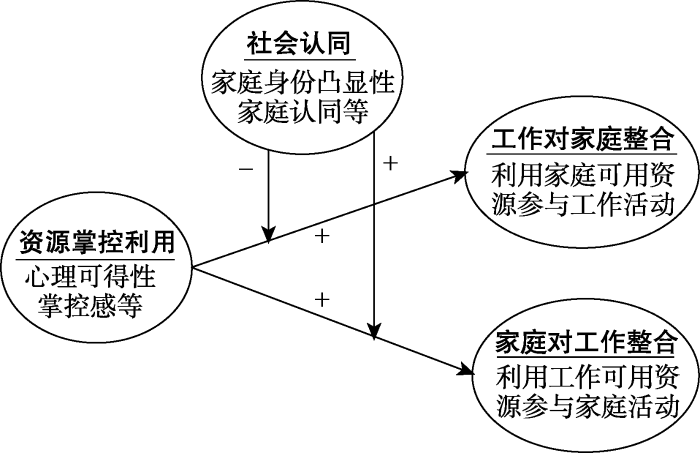
根据资源保存理论的研究逻辑, 员工对资源的掌控之所以可以促进家庭对工作整合, 是因为员工对资源拥有更强的操控能力。然而, 这并不意味着员工会将这些资源用于家庭领域。而从社会认同理论来看, 员工对家庭领域的认同, 有助于引导员工将资源更多投入到家庭领域。具体来说, 群体认同有助于个体维持对群体的积极态度和行为, 并激励个体为认同的群体付出努力和进行投入(Rapp & Mathieu, 2019; Stets & Burke, 2000)。根据这一逻辑, 家庭认同反映了个体对家庭群体或家庭领域的认可程度, 员工的家庭认同程度越高, 越有可能将拥有的资源往家庭领域进行投入。当员工的家庭认同处于较高水平时, 员工会更加清晰地意识到家庭对自己的使命和价值, 把家庭的资源开发和价值创造当作自己的责任, 家庭资源创造的决心和意志更加坚定, 并转化为更多的家庭资源投入行为, 将从团队虚拟性环境中获得的资源更多地投入到家庭领域, 从而增强家庭对工作整合的效果。所以, 员工对家庭领域的认同程度越高, 员工资源掌控利用(如, 掌控感、心理可得性、活力)对家庭对工作整合的影响会显著增强。由此推出以下假设:
假设2-1:员工对家庭领域的认同(如, 家庭认同、家庭身份凸显性)正向调节资源掌控利用(如, 掌控感、心理可得性、活力)对家庭对工作整合的正向影响, 即员工对家庭领域的认同程度较高时, 资源掌控利用对家庭对工作整合的促进作用增强。
然而, 当员工运用掌控的资源进行工作对家庭整合的时候, 家庭认同却不利于资源向工作领域的移动和使用, 从而削弱资源掌控利用(如, 掌控感、心理可得性、活力)在工作对家庭整合上的促进作用。家庭认同体现了员工对家庭群体或家庭领域的认可程度。当员工的家庭认同越高时, 越可能向家庭领域投入资源, 并为了维护家庭利益, 而减少家庭资源向工作领域的流出和损耗, 从而削弱工作对家庭整合的效果。基于此, 提出以下假设:
假设2-2:员工对家庭领域的认同(如, 家庭认同、家庭身份凸显性)负向调节资源掌控利用(如, 掌控感、心理可得性、活力)对工作对家庭整合的正向影响, 即员工对家庭领域的认同程度较高时, 资源掌控利用对工作对家庭整合的促进作用减弱。
4 理论建构与创新
本研究基于“社会认同理论”视角对以往的“资源保存理论”进行整合, 重新审视虚拟化团队工作模式对员工工作−家庭平衡的影响, 不仅为该领域的研究提供了一个新的理论视角, 拓展当前资源保存理论视角对工作−家庭平衡的研究逻辑, 推动工作−家庭平衡研究在虚拟化趋势下的理论发展, 也可以为管理实践提供新的管理思路和建议。
首先, 本研究基于工作−家庭领域的重叠趋势, 探讨了团队虚拟性对员工工作−家庭整合及其工作、家庭结果的作用机制, 有助于解决无边界情境下的工作−家庭平衡问题, 为工作−家庭平衡领域拓展了新的研究思路和研究方向。以往的工作−家庭平衡研究基于传统的面对面工作模式, 其研究思路是将工作和家庭区分开, 探讨通过资源的溢出、补偿、增益等方式进行两个领域的资源分配和协调, 从而实现工作−家庭平衡(ten Brummelhuis & Bakker, 2012)。然而, 当前数字化发展以及虚拟化团队工作模式的流行模糊了工作和家庭的界线, 二者难以区分, 呈现出工作−家庭领域重叠的无边界状态, 这使得传统工作−家庭平衡的研究前提似乎不匹配现实实践的发展情况。本研究基于工作−家庭领域的重叠趋势, 以“工作−家庭整合”的新视角切入, 在资源保存理论视角的基础上, 引入社会认同理论, 探讨团队虚拟性对员工工作−家庭整合行为的作用机制, 以及工作−家庭整合对员工工作和家庭结果的不同影响。研究结果表明员工在无边界情境下仍希望可以对自己在工作和家庭领域的身份认同进行区分, 这意味着传统基于工作−家庭区分理念的研究思路并不过时。然而, 这种区分理念却不是以往单纯的物理边界区分, 而是在工作−家庭领域重叠下促进员工的自我身份在工作和家庭界定上的区分。这为解决在虚拟化团队工作模式发展趋势下如何更好地促进工作−家庭平衡的问题明确了新的研究思路, 也为工作−家庭平衡领域指出了新的研究方向, 即从传统面向工作−家庭有边界的研究方向拓展到面向工作−家庭无边界的研究方向, 有助于进一步推进工作−家庭平衡研究领域理论的新发展。
其次, 本研究引入社会认同理论的新视角, 探讨了团队虚拟性对员工工作−家庭整合及其工作、家庭结果的影响, 解决了以往资源视角研究中工作、家庭资源分配动机不明的问题, 为工作−家庭平衡领域研究提供一个新的理论基础。以往工作−家庭平衡研究主要以资源为基础探讨工作和家庭两个领域之间的资源分配和调整。资源保存理论是解释工作−家庭平衡研究的主流理论, 该理论认为资源可以通过溢出、补偿、增益等方式在工作和家庭两个领域进行分配和调整, 使得资源可以满足工作和家庭两个领域各自的功能需要, 提升工作和家庭活动的产出和绩效, 从而实现工作−家庭平衡(ten Brummelhuis & Bakker, 2012)。然而, 资源保存理论视角只考虑了资源的分配方式, 却忽略了资源分配的动机, 无法解释资源的分配方式为什么是从家庭领域的资源分配到工作领域或为什么是从工作领域的资源分配到家庭领域, 这限制了对工作−家庭资源分配方式的深入理解, 阻碍了工作−家庭平衡领域研究的进一步发展。本研究通过社会认同理论探讨团队虚拟性对员工工作−家庭整合及其工作、家庭结果的影响, 以此挖掘虚拟化团队工作模式下如何实现工作−家庭平衡的社会认同机制。以领域认同作为切入点, 指出资源的分配动机是往个体所认同的那个领域(工作或家庭)进行转移, 这弥补了以往资源视角研究所缺失的重要理论逻辑, 解释了以往资源视角尚未解释清楚的工作−家庭关系, 从而为工作−家庭平衡研究领域提供新的理论基础。
最后, 本研究整合了资源保存理论和社会认同理论两个理论逻辑, 构建了团队虚拟性影响员工工作−家庭整合及其工作、家庭结果的双路径模型, 并通过家庭认同在资源路径中的调节作用将两个理论研究逻辑联系和整合在一起, 为工作−家庭平衡研究领域提供新的整合性理论框架。以往的工作−家庭平衡研究基于资源保存理论的视角, 将注意力集中于探究实现工作−家庭平衡的资源分配方式, 如资源溢出方式、资源补偿方式、资源增益方式等(Grzywacz et al., 2007; Lambert, 1990; Ruppanner & Pixley, 2012), 忽略和缺失对资源分配动机的探讨, 导致我们无法很好地理解员工为何愿意进行不同领域的资源分配。本研究在原来资源保存理论的基础上, 通过社会认同理论进一步挖掘了资源分配的动机, 分别探讨了团队虚拟性对员工工作−家庭整合及其工作、家庭结果的不同作用原理, 并基于资源分配利用这一共同的理论逻辑, 通过分析家庭认同在资源路径中的调节作用, 将资源视角和认同视角的研究逻辑整合在一起, 形成一个对工作−家庭平衡研究更具解释力的理论框架。这个整合性理论框架不仅可以分析虚拟化团队工作模式下资源在工作和家庭两个领域的分配过程, 还能深入分析两个领域资源的分配动机, 从而丰富和完善对工作−家庭平衡实现机制的认识, 推进工作−家庭平衡研究领域的理论发展。此外, 本研究基于社会认同理论构建了一个团队虚拟性对工作−家庭平衡的作用机制的理论框架, 可供未来在此基础上进行拓展性研究。例如, 正念、心理脱离、自我领导等个体特征能够反映员工对不同领域进行区分的思想。因此, 研究者可以借助本文的理论框架, 来进一步探讨这些个体特征在工作−家庭整合影响工作、家庭结果过程中的调节作用, 有助于进一步丰富和发展工作−家庭平衡领域的研究。
从实践上看, 本研究基于工作−家庭无边界的发展趋势, 探讨了团队虚拟性通过工作−家庭整合行为影响员工工作和家庭的作用机制, 有助于企业重新思考虚拟化团队工作模式下的管理思路, 为员工、企业和社会的和谐、可持续发展提供指引和支撑。从企业的角度来说, 以往的研究局限于数智化技术对员工工作领域影响的探讨, 这些研究引导管理者通过数智化推进员工工作在家庭生活中的融合来提升工作绩效, 并将员工的家庭生活视为私人事务而不加干预。然而, 本研究表明, 团队虚拟性让员工更加认同家庭领域的需要, 即, 增强了员工“为生活而工作”的理念。这有助于管理者意识到, 员工在虚拟化团队工作模式下反而更希望将资源分配到家庭领域, 从而导致工作−家庭融合管理效果适得其反。企业有必要将管理职责从工作领域延伸到家庭领域, 并采取相关措施促进员工的家庭生活质量, 才有助于提升企业对人才的吸引力, 让员工以更好的生活状态投入工作而提升企业绩效, 实现员工和企业的“双赢”和谐发展。另一方面, 本研究探讨的团队虚拟性通过工作−家庭整合影响员工工作和家庭的作用机制, 有助于解决当前数智化、虚拟化发展趋势下的员工工作−家庭平衡问题。这响应了国家《2035年远景目标纲要》中提出的“加快数字社会建设步伐”和“增进民生福祉”的战略目标, 呼应了习近平主席所提出的“人民对美好生活的向往就是我们的奋斗目标”, 有助于员工实现工作−家庭平衡, 提升员工的生活幸福感, 为社会主义和谐社会的建设和发展做出贡献。
此外, 本研究基于社会认同的新视角探讨团队虚拟性对工作−家庭整合及其工作、家庭结果的影响, 有助于管理者从新的角度思考当前工作−家庭日趋融合下的工作−家庭平衡管理方式, 从而更好地进行管理干预, 提升管理效能。如果单纯从资源理论逻辑来看待虚拟化趋势下的工作−家庭平衡问题, 团队虚拟性使得企业有更强的能力推动工作−家庭资源的整合, 以满足工作领域的需要, 那么管理者应该进一步促进员工工作和家庭的融合发展。然而, 资源视角研究只考虑环境(工作或家庭领域)对资源的需要, 却忽略了人在资源分配上的动机, 这可能是造成当前企业的一些做法引发社会负面效应的一个重要原因。本研究基于社会认同的新视角, 指出团队虚拟性会增加员工对家庭的认同, 从而更愿意将资源分配到家庭领域, 形成工作和家庭领域的资源分化。因此, 管理者面对当前工作−家庭领域高度重叠的现实情况, 不能盲目借助这种发展趋势将工作强行融入家庭, 而应该提供相应措施保障让员工在无边界的虚拟环境中仍然可以在自我身份上建立工作和家庭的边界, 才能更好地促进工作−家庭平衡, 从而提升管理效果。
参考文献
Network structure in virtual organizations
DOI:10.1287/orsc.10.6.741
URL
[本文引用: 1]

Virtual organizations that use e-mail to communicate and coordinate their work toward a common goal are becoming ubiquitous. However, little is known about how these organizations work. Much prior research suggests that virtual organizations, for the most part because they use information technology to communicate, will be decentralized and nonhierarchical. This paper examines the behavior of one such organization. The analysis is based on a case study of the communication structure and content of communications among members of a virtual organization during a four-month period. We empirically measure the structure of a virtual organization and find evidence of hierarchy. The findings imply that the communication structure of a virtual organization may exhibit different properties on different dimensions of structure. We also examine the relationship among task routineness, organizational structure, and performance. Results indicate that the fit between structure and task routineness affects the perception of performance, but may not affect the actual performance of the organization. Thus, this virtual organization is similar to traditional organizations in some ways and dissimilar in other ways. It was similar to traditional organizations in so far as task-structure fit predicted perceived performance. However, it was dissimilar to traditional organizations in so far as fit did not predict objective performance. To the extent that the virtual organizations may be similar to traditional organizations, existing theories can be expanded to study the structure and perceived performance of virtual organizations. New theories may need to be developed to explain objective performance in virtual organizations.
Social identity theory and the organization
DOI:10.2307/258189 URL [本文引用: 1]
Does structuring of human resource management processes enhance employee creativity? The mediating role of psychological availability
DOI:10.1002/hrm.v49:6 URL [本文引用: 2]
Place as a practical concern of mobile workers
DOI:10.1068/a34231
URL
[本文引用: 1]
In this paper we examine the spatial practices of mobile workers—how mobile workers manage their use of technology and place. Data from interviews with highly mobile workers and ‘hot-deskers’ are used to explore the reciprocal relationship between practice and place: how places change work, but also how work changes places. Mobile workers often need to configure their activities to take account of the different places in which they find themselves. This can involve considerable ‘juggling’ of their plans, humble office equipment, and their coworkers. In turn mobile workers change places, as they appropriate different sites for their work. Specifically, technology allows for the limited reappropriation of travel and leisure sites as places for work (such as trains and cafés). Time is also an important practical concern for mobile workers. Although mobile work may be seen as relatively flexible, fixed temporal structures allow mobile workers to ‘accomplish synchronicity’ with others. Although this paper focuses on the specific practices of mobile workers, it also explores how ‘grand social theory’ can help us understand the practical details of mobile work, yet how practice cannot be simply reduced to theory.
Identity processes and social stress
DOI:10.2307/2096259 URL [本文引用: 1]
Hot buttons and time sinks: The effects of electronic communication during nonwork time on emotions and work-nonwork conflict
DOI:10.5465/amj.2014.0170 URL [本文引用: 1]
How leaders cultivate social capital and nurture employee vigor: Implications for job performance
DOI:10.1037/a0016429
PMID:19916662
[本文引用: 2]
This study examined how leader relational behaviors (i.e., relational leadership) cultivate bonding social capital among organizational members and the way bonding social capital augments feelings of vigor at work. In addition, the authors examined how vigor enhances employee job performance. Using a sample of 209 participants in Israeli community centers, the results of structural equation modeling indicate a 2-stage mediation model in which leader relational behaviors are positively related to bonding social capital; this, in turn, results in feelings of vigor, which are positively associated with manager ratings of employee job performance.
Work/family border theory: A new theory of work/family balance
DOI:10.1177/0018726700536001
URL
[本文引用: 1]
This article introduces work/family border theory - a new theory about work/family balance. According to the theory, people are daily border-crossers between the domains of work and family. The theory addresses how domain integration and segmentation, border creation and management, border-crosser participation, and relationships between border-crossers and others at work and home influence work/family balance. Propositions are given to guide future research.
Work groups, structural diversity, and knowledge sharing in a global organization
DOI:10.1287/mnsc.1030.0134
URL
[本文引用: 1]
Effective work groups engage in external knowledge sharing—the exchange of information, know-how, and feedback with customers, organizational experts, and others outside of the group. This paper argues that the value of external knowledge sharing increases when work groups are more structurally diverse. A structurally diverse work group is one in which the members, by virtue of their different organizational affiliations, roles, or positions, can expose the group to unique sources of knowledge. It is hypothesized that if members of structurally diverse work groups engage in external knowledge sharing, their performance will improve because of this active exchange of knowledge through unique external sources. A field study of 182 work groups in a Fortune 500 telecommunications firm operationalizes structural diversity as member differences in geographic locations, functional assignments, reporting managers, and business units, as indicated by corporate database records. External knowledge sharing was measured with group member surveys and performance was assessed using senior executive ratings. Ordered logit analyses showed that external knowledge sharing was more strongly associated with performance when work groups were more structurally diverse. Implications for theory and practice around the integration of work groups and social networks are addressed.
Boundary role transitions: A day-to-day approach to explain the effects of home-based telework on work-to-home conflict and home-to-work conflict
DOI:10.1177/0018726718823071
[本文引用: 1]
Does working from home on a given day complicate or rather facilitate combining work and home roles that day, why and for whom? To answer these questions, we examined how a teleworking day affects daily work-to-home conflict and daily home-to-work conflict. Based on boundary theory, we expected these relationships to be mediated by daily role transitions and moderated by employees' preferences to protect their home(/work) domain from work(/home) interruptions. Hypotheses were tested through multilevel moderated mediation modeling using diary data collected during 14 consecutive workdays with 81 employees (N = 678 data points). In line with our expectations, employees were found to make more work-to-home transitions (i.e. interruptions of work activities to deal with home demands during work hours) on teleworking days, which was related to lower work-to-home conflict but higher home-to-work conflict on these days. They also made more home-to-work transitions (i.e. interruptions of home activities to deal with work demands after hours) on teleworking days, which was related to more work-to-home conflict on these days. The latter effect was stronger for employees with a home protection preference. There was no moderating impact of work protection preference. Overall, employees experienced less work-to-home conflict but more home-to-work conflict on teleworking days compared to non-teleworking days.
The new dominance of virtual teams and leaders
Married with children: How family role identification shapes leadership behaviors at work
DOI:10.1111/peps.2017.70.issue-3 URL [本文引用: 2]
Work-life conflict in Canada in the new millennium: A status report
Mechanisms linking work and family: Clarifying the relationship between work and family constructs
DOI:10.2307/259269 URL [本文引用: 4]
Dynamics of a stressful encounter: Cognitive appraisal, coping, and encounter outcomes
DOI:10.1037//0022-3514.50.5.992
PMID:3712234
[本文引用: 1]
Despite the importance that is attributed to coping as a factor in psychological and somatic health outcomes, little is known about actual coping processes, the variables that influence them, and their relation to the outcomes of the stressful encounters people experience in their day-to-day lives. This study uses an intraindividual analysis of the interrelations among primary appraisal (what was at stake in the encounter), secondary appraisal (coping options), eight forms of problem- and emotion-focused coping, and encounter outcomes in a sample of community-residing adults. Coping was strongly related to cognitive appraisal; the forms of coping that were used varied depending on what was at stake and the options for coping. Coping was also differentially related to satisfactory and unsatisfactory encounter outcomes. The findings clarify the functional relations among appraisal and coping variables and the outcomes of stressful encounters.
Shared leadership across cultures: Do traditionalism and virtuality matter?
Reconceptualizing virtual teaming from a constitutive perspective review, redirection, and research agenda
DOI:10.1080/23808985.2008.11679078 URL [本文引用: 1]
Unpacking the concept of virtuality: The effects of geographic dispersion, electronic dependence, dynamic structure, and national diversity on team innovation
DOI:10.2189/asqu.51.3.451
URL
[本文引用: 2]
To understand why the virtual design strategies that organizations create to foster innovation may in fact hinder it, we unpack four characteristics often associated with the term ‘virtuality’ (geographic dispersion, electronic dependence, structural dynamism, and national diversity) and argue that each hinders innovation through unique mechanisms, many of which can be overcome by creating a psychologically safe communication climate. We first tested the plausibility of our arguments using in-depth qualitative analysis of interviews with 177 members of 14 teams in a variety of industries. A second study constituted a more formal test of hypotheses using survey data collected from 266 members of 56 aerospace design teams. Results show that the four characteristics are not highly intercorrelated, that they have independent and differential effects on innovation, and that a psychologically safe communication climate helps mitigate the challenges they pose. We discuss the implications of these findings for theory and research.
Work-life integration: Experiences of mid-career professional working mothers
DOI:10.1108/02683940810884559
URL
[本文引用: 3]
This paper aims to explore how mid‐career professional mothers perceive themselves in relation to their work and family roles, how they experience these roles, how they merge their work, family and individual self, and what meaning they make of this integration.
The relation between work-family balance and quality of life
DOI:10.1016/S0001-8791(02)00042-8 URL [本文引用: 1]
When work and family are allies: A theory of work-family enrichment
DOI:10.5465/amr.2006.19379625 URL [本文引用: 2]
Information processing in traditional, hybrid, and virtual teams: From nascent knowledge to transactive memory
DOI:10.1016/S0191-3085(01)23009-3 URL [本文引用: 1]
Work-family spillover and daily reports of work and family stress in the adult labor force
DOI:10.1111/fare.2002.51.issue-1 URL
Conceptualizing work-family balance: Implications for practice and research
DOI:10.1177/1523422307305487
URL
[本文引用: 3]
The problem and the solution. Systematic theorizing about work—family balance has not kept pace with interest, which undermines organizations' abilities to effectively monitor work—family balance and to use work—family balance strategically. The goal of this article is to develop a better conceptual understanding of work—family balance. Work—family balance is defined as accomplishment of role-related expectations that are negotiated and shared between an individual and his or her role-related partners in the work and family domains. This article elaborates on how this definition of work—family balance addresses limitations of previous conceptualizations and describes areas for human resource development research and implications for using work—family balance strategically in management practice.
A multi-level perspective on the synergies between work and family
DOI:10.1348/096317906X163081
URL
[本文引用: 1]
In this paper we lay the conceptual foundation for work‐family facilitation. Work‐family facilitation is a process representing the synergies between the domains of work and family. We formally define facilitation as the extent to which an individual's engagement in one social system, such as work or family, contributes to growth in another social system. We develop the process through which facilitation occurs, provide a model and case studies of this process, and delineate additional theoretical and empirical research necessary to understand work‐family facilitation so that it can be managed and cultivated within organizations.
Getting to the “COR” understanding the role of resources in conservation of resources theory
DOI:10.1177/0149206314527130
URL
[本文引用: 1]
Proposed as a theory of motivation, the basic tenet of conservation of resources (COR) theory is that humans are motivated to protect their current resources and acquire new resources. Despite its recent popularity in the organizational behavior literature, several criticisms of the theory have emerged, primarily related to the central concept of resources. In this review, we address concerns regarding the conceptualization, conservation, acquisition, fluctuation, and measurement of resources. We highlight gaps in the COR literature that can be addressed by integrating research from other areas of psychology and management. In this manner, we hope to push the COR literature forward by resolving several concerns and providing suggestions for future research that might address other concerns.
Virtual teams: Today’s reality, today’s challange
Managing virtual teams: A review of current empirical research
DOI:10.1016/j.hrmr.2005.01.002 URL [本文引用: 1]
Achieving work-family balance: An action regulation model
DOI:10.5465/amr.2016.0409
[本文引用: 2]
Work and family are highly intertwined for many individuals, yet individual-level strategies for achieving effectiveness and satisfaction across work and family roles have not received sufficient attention. We address this issue by conceptualizing work-family balance from an action regulation perspective as the successful joint pursuit of work and family goals. Building on insights from the work-family literature, action regulation theory, and multiple goals research, we propose a theoretical model that explains how people can jointly attain work and family goals by using four action strategies: allocating resources, changing resources and barriers, sequencing goals, and revising goals. We address the conditions under which each strategy is used, depending on the malleability of resources and barriers for goal attainment, time to deadline of goals, and feedback and monitoring of progress across work and family goals. Our model offers new insights into and research implications for work-family balance and helps develop practical interventions that result in improved management of the work-family interface.
The influence of culture, community, and the nested-self in the stress process: Advancing conservation of resources theory
DOI:10.1111/apps.2001.50.issue-3 URL [本文引用: 1]
Social and psychological resources and adaptation
DOI:10.1037/1089-2680.6.4.307
URL
[本文引用: 1]
Psychology has increasingly turned to the study of psychosocial resources in the examination of well-being. How resources are being studied and resource models that have been proffered are considered, and an attempt is made to examine elements that bridge across models. As resource models span health, community, cognitive, and clinical psychology, the question is raised of whether there is overuse of the resource metaphor or whether there exists some underlying principles that can be gleaned and incorporated to advance research. The contribution of resources for understanding multicultural and pan-historical adaptation in the face of challenge is considered.
Conservation of resources in the organizational context: The reality of resources and their consequences
DOI:10.1146/orgpsych.2018.5.issue-1 URL [本文引用: 1]
Team personality composition, emergent leadership and shared leadership in virtual teams: A theoretical framework
DOI:10.1016/j.hrmr.2016.12.012 URL [本文引用: 1]
A review and agenda for examining how technology-driven changes at work will impact workplace mental health and employee well-being
DOI:10.1177/0312896220922292
URL
[本文引用: 1]
The mental health and well-being of employees is an increasingly important issue, both in terms of the financial costs to the Australian economy and human costs to society. This review examines two major technology-driven trends in the workplace and presents evidence for their impact on mental health, both positive and negative. First, we consider how we work, with a focus on changes which have been driven by automation and advanced technology in the workplace. Next, we consider where and when we work, with a focus on flexible work arrangements afforded by changes in telecommunication technology. Finally, we look forward with a critical lens to examine the implications for future research and for industry, government and education.
Psychological conditions of personal engagement and disengagement at work
DOI:10.2307/256287 URL [本文引用: 1]
The dimensions and antecedents of team virtuality
DOI:10.1177/0149206305279113
URL
[本文引用: 1]
Team virtuality is an important factor that is gaining prominence in the literature on teams. Departing from previous research that focused on geographic dispersion, the authors define team virtuality as the extent to which team members use virtual tools to coordinate and execute team processes, the amount of informational value provided by such tools, and the synchronicity of team member virtual interaction. The authors identify the key factors that lead groups to higher levels of team virtuality and the implications of their model for management theory and practice.
Technology and work-life conflict of academics in a South African higher education institution
Balancing borders and bridges: Negotiating the work-home interface via boundary work tactics
DOI:10.5465/amj.2009.43669916 URL [本文引用: 1]
Processes linking work and family: A critical review and research agenda
DOI:10.1177/001872679004300303
URL
[本文引用: 2]
This paper critically reviews the theoreticalframeworks currently used to explain the processes through which work and family are linked, i.e., segmentation, compensation, and spillover. In the literature, these processes are treated as competing explanations, even though evidence and logic suggests that all three operate to link work and family. Moreover, it is likely that other processes also link the two. Most notably, workers may limit their involvement in work, or in family life, so that they can better accommodate the demands of the other. Clarified causal models and suggestions for advancing knowledge in this area are presented and discussed. It is argued that a fuller understanding of the processes linking work and family life is necessary to adequately evaluate the effectiveness of the family supportive policies currently being implemented by many U.S. firms, as well as to identify additional strategies for helping workers find satisfaction in both their work and personal roles.
Virtuality, communication, and new product team creativity: A social network perspective
DOI:10.1016/S0923-4748(03)00005-5 URL [本文引用: 1]
Coordinating expertise among emergent groups responding to disasters
DOI:10.1287/orsc.1060.0228
URL
[本文引用: 1]
In the aftermath of catastrophic events, when plans for organized and timely response break down, impromptu groups often emerge to provide disaster relief. Much remains to be learned about the internal dynamics of these emergent response groups whose representatives may include members from organizations with relief missions; private sector organizations offering resources; and private citizens with the information, relationships, or physical and mental stamina to help. Organizational theories have the potential to contribute to a better understanding of emergent response groups and how they efficiently coordinate knowledge, people, resources, tasks, and technology, thereby substantially improving disaster response for future catastrophes. We apply one organization science theory toward better understanding of these groups—transactive memory systems theory—which is a theory about knowledge coordination in groups. Our application of this theory to emergent response groups requires extending the theory in three ways: the role of expertise in task assignment, how groups function when credibility in member expertise cannot be validated, and how expertise is coordinated. By demonstrating how transactive memory systems theory can be extended to the unique operating conditions of emergent response groups, we hope to inspire organization science researchers to accept the challenge of adapting their theories to study this important problem of our time.
Virtual teams: What do we know and where do we go from here?
DOI:10.1016/j.jm.2004.05.002
URL
[本文引用: 6]
In this paper, we review the research on virtual teams in an effort to assess the state of the literature. We start with an examination of the definitions of virtual teams used and propose an integrative definition that suggests that all teams may be defined in terms of their extent of virtualness. Next, we review findings related to team inputs, processes, and outcomes, and identify areas of agreement and inconsistency in the literature on virtual teams. Based on this review, we suggest avenues for future research, including methodological and theoretical considerations that are important to advancing our understanding of virtual teams.
Job demands and resources as antecedents of work engagement: A longitudinal study
DOI:10.1016/j.jvb.2006.09.002 URL [本文引用: 1]
Making virtual teams work: Redesigning virtual collaboration for the future
Do mobile technologies enable work-life balance? Dual perspectives on blackberry usage for supplemental work
In
The changing time demands of managerial and professional work:Implications for managing the work-life boundary
In
Putting on the thinking cap: Using neurois to understand information processing biases in virtual teams
The spatial, temporal, and configurational characteristics of geographic dispersion in teams
DOI:10.2307/25148802 URL [本文引用: 1]
The family and the market: A study of ideology and legal reform
DOI:10.2307/1340916 URL [本文引用: 2]
Process virtualization theory and the impact of information technology
DOI:10.1287/orsc.1070.0316
URL
[本文引用: 3]
In our increasingly virtual society, more and more processes that have traditionally been conducted via physical mechanisms are being conducted virtually. This phenomenon of “process virtualization” is happening in many contexts, including formal education (via distance learning), shopping (via electronic commerce), and friendship development (via social networking sites and virtual worlds). However, some processes are more amenable to virtualization than others. For example, distance learning seems to work better for some educational processes than others, and electronic commerce has worked well for some shopping processes but not for others. These observations motivate the central question posed in this paper: What factors affect the “virtualizability” of a process? This question is becoming increasingly important as advances in information technology create the potential for society to virtualize more and more processes. To provide a general theoretical basis for investigating this question, this paper proposes “process virtualization theory,” which includes four main constructs (sensory requirements, relationship requirements, synchronism requirements, and identification and control requirements) that affect whether a process is amenable or resistant to being conducted virtually. Recognizing that processes can be virtualized with or without the use of information technology, this paper makes explicit the theoretical significance of information technology in process virtualization by discussing the moderating effects of representation, reach, and monitoring capability. This helps explain how advances in information technology are enabling a new generation of virtual processes.
Intersecting work and family: The influence of relational beliefs and behaviors on work-family integration
Introduction to special topic forum: Advancing and expanding work-life theory from multiple perspectives
DOI:10.5465/amr.2018.0310
[本文引用: 1]
Research on the work-life interface has exploded over the past five decades because of trends in the nature of gender roles, families, work, and careers. However, work-life theory has not kept up with the explosion in research. The purpose of this special topic forum is to offer a corrective by developing new theory to make sense of the research to date and to guide future research. The six articles in this forum make substantial contributions to work-life theory individually and collectively. They provide useful guidance for future work-life theory and research from multiple theoretical perspectives that vary in their level of analysis and in their focus on decision making, diversity, and temporal dynamics. In addition, these six articles offer innovative implications for practice by employees, couples, supervisors, organizations, communities, and societies.
Dispersion beyond miles: Configuration and performance in virtual teams
DOI:10.1108/TPM-06-2016-0026
URL
[本文引用: 1]
The purpose of this paper is to understand different aspects of structural dispersion in virtual teams (VTs). The study measures five types of dispersion, their impact on VT performance and the moderating effect of electronic communication.
The impact of virtuality on team effectiveness in organizational and non-organizational teams: A meta-analysis
DOI:10.1111/apps.v71.3 URL [本文引用: 1]
Virtual work: Bridging research clusters
DOI:10.5465/annals.2017.0020
[本文引用: 1]
Virtual work is the new normal, with employees working from dispersed locations and interacting using computer-mediated communication. Despite the growth in virtual work research, it has tended to occur in siloes focused on different types of virtual work (e.g., virtual teams and telecommuting) that are grounded in different research traditions. This limits opportunities to leverage research across these different domains. We use a co-citation analysis to examine the degree of segmentation in the field of virtual work into disparate research clusters. We find the emergence of three major research clusters: telecommuting, virtual teams, and computer-mediated work (CMW). Motivated by this finding, we carry out a comparative review of the literature in each cluster with the objective of seeking ways to exploit opportunities that cut across them. Based on our review, we first develop a conceptual model using the dispersion and technology dependence dimensions of virtuality to compare different approaches to studying virtuality-related issues across clusters. Next, we use our comparative review to propose a systematic approach for developing research questions that bridge research across the clusters by considering how different approaches to studying virtuality and the ensuing problem domains addressed in one cluster might help to advance research in another. To illustrate this approach, we discuss 12 research questions for bridging across the three virtual work clusters. Finally, we discuss the research implications of our conceptual model and bridging approach. Our review and conceptual model along with the proposed bridging approach help to facilitate a forward-looking agenda for accelerating and enriching virtual work research.
Identity salience: A moderator of the relationship between group gender composition and work group conflict
DOI:10.1002/job.v23:6 URL [本文引用: 2]
Team and individual influences on members’ identification and performance per membership in multiple team membership arrangements
DOI:10.1037/apl0000344 URL [本文引用: 2]
Seeing the forest for the trees: Exploratory learning, mobile technology, and knowledge workers’ role integration behaviors
DOI:10.5465/amj.2013.0991 URL [本文引用: 1]
High tech tethers and work-family conflict: A conservation of resources approach
Work-to-family and family-to-work spillover: The implications of childcare policy and maximum work-hour legislation
DOI:10.1007/s10834-012-9303-6 URL [本文引用: 2]
The effects of virtualness on teamwork behavioral components: The role of shared mental models
DOI:10.1016/j.hrmr.2016.12.011 URL [本文引用: 3]
Conceptualizing and measuring the virtuality of teams
DOI:10.1111/isj.2010.20.issue-3 URL [本文引用: 2]
Rethinking the complexity of virtual work and knowledge sharing
DOI:10.1002/asi.2018.69.issue-11 URL [本文引用: 1]
A person-environment fit model for virtual organizations
DOI:10.1016/j.jm.2004.03.002
URL
[本文引用: 1]
While the increasing sophistication of information technology has led to the spread of virtual organizations, there has been very little research on what factors contribute to individuals’ effectiveness in such organizations. This paper argues that organizations possess different degrees of virtuality based on four dimensions of temporal, spatial, cultural, and organizational dispersion. Using a person-environment fit framework, a theoretical model that identifies individual qualities required to fit into virtual organizations, virtual teams, and virtual jobs is developed, taking into account dimensions and degrees of virtuality. Mechanisms for enhancing fit in virtual organizations as well as theoretical and practical implications of the model are addressed.
Insider or outsider? How employee perceptions of insider status affect their work behavior
DOI:10.1002/job.v23:8 URL [本文引用: 1]
Identity theory and social identity theory
DOI:10.2307/2695870 URL [本文引用: 5]
The development of identity theory
In
The influence of virtuality on social networks within and across work groups: A multilevel approach
DOI:10.2753/MIS0742-1222280111 URL [本文引用: 1]
A resource perspective on the work-home interface: The work-home resources model
DOI:10.1037/a0027974
PMID:22506688
[本文引用: 4]
The objective of this article is to provide a theoretical framework explaining positive and negative work-home processes integrally. Using insights from conservation of resources theory, we explain how personal resources (e.g., time, energy, and mood) link demanding and resourceful aspects of one domain to outcomes in the other domain. The resulting work-home resources (W-HR) model describes work-home conflict as a process whereby demands in one domain deplete personal resources and impede accomplishments in the other domain. Enrichment is described as a process of resource accumulation: Work and home resources increase personal resources. Those personal resources, in turn, can be utilized to improve home and work outcomes. Moreover, our resource approach to the work-home interface allows us to address two other issues that have thus far lacked a solid theoretical foundation. The W-HR model also explains how conditional factors such as personality and culture may influence the occurrence of work-home conflict and enrichment. Furthermore, the model allows us to examine how work-home conflict and enrichment develop over time. Finally, the model provides useful insights for other psychology subdisciplines, such as gender studies and developmental psychology.
Impact of family-supportive work variables on work-family conflict and strain: A control perspective
DOI:10.1037/0021-9010.80.1.6 URL [本文引用: 1]
Virtual teams: Technology and the workplace of the future
DOI:10.5465/ame.1998.1109047 URL [本文引用: 1]
Organizational stress through the lens of conservation of resources (COR) theory
In


