



1 引言
《商训》有言:“于已有利而于人亦有利者, 大商也”。随着“消费扶贫”、“绿色消费”和“公益联名”等聚焦社会福祉的营销热点不断出现, 企业如何与消费者、自然和其他社会成员构建互惠共利的关系已经成为消费者行为决策过程中的重要参考。作为一种在他人给予自己利益或伤害后进行类似回应的倾向(Gouldner, 1960; 张慧 等, 2018), 互惠能够推动资源的交换和流通, 是实现和维持循环关系的重要方式(André et al., 2017)。人类学(Hamilton, 1964)、社会学(Gouldner, 1960)、经济学(Kranton, 1996; 汪崇金, 聂左玲, 2015)和组织行为学(邹文篪 等, 2012)对互惠关系进行了广泛关注。近年营销领域的研究发现, 以企业为焦点行为者的互惠关系能够对道德消费(He et al., 2022)、资源交换(André et al., 2017)、溢出效应(Swoboda & Winters, 2021)和消费者的态度(Romani et al., 2013; Stäbler, 2021)等方面产生直接且显著的影响。但是, 无论是互惠相关的研究对象, 还是消费者的行为响应, 都分散于多个主题之下, 缺乏聚焦于互惠多种情境和内在机制的系统性分析框架, 导致无法为政府和相关企业在消费端的资源循环提供整合性的对策建议。因此有必要对其进行总结归纳, 以帮助研究者加深对该领域已有研究结论的理解和掌握。
有鉴于此, 本文围绕营销领域中互惠关系这一主题进行文献回顾, 构建了互惠关系影响消费者行为的概念框架(图1)。框架以相互交换、对价法则和道德规范三个视角识别和归纳相互依存情境中互惠关系影响消费者行为的前置因素, 然后从行为主体(参与者和观察者)、行为性质(积极行为和消极行为)和行为水平(行为的质量和数量)三个维度对消费者的行为进行归纳, 发现互惠关系对消费者行为具有三方面的影响力。首先, 作为二元关系, 互惠关系不仅使关系中的参与双方在属性偏好(Baskin et al., 2014)和心理意象(Briley et al., 2017)方面有所差异, 还能预测关系之外第三方观察者的态度(Romani et al., 2013; Evanschitzky et al., 2011), 体现了互惠关系影响的传递性。其次, 作为“一对一”对等的交换, 互惠关系的效价与消费者的行为性质并不一致。研究发现, 具有积极意义的互惠关系可能触发消费者消极的行为(Ioannou et al., 2022; Stäbler, 2021), 而具有消极意义的互惠关系也可能带来积极的后果(Henkel et al., 2017; Pugh et al., 2018), 体现了互惠关系影响的双面性。最后, 即使互惠关系的效价与消费者的行为性质一致, 互惠关系还会导致消费者行为水平上的不对称(Narwal et al., 2022; Su et al., 2022)。基于以上发现, 框架从意识决策和无意识决策、结果导向和道义导向、社会交换三个方面分别对互惠关系的传递性、双面性和不对称性影响进行了解释。在此基础上, 本研究引入调节互惠关系影响消费者行为的社会因素和个人因素, 对现有概念框架进一步补充。
图1
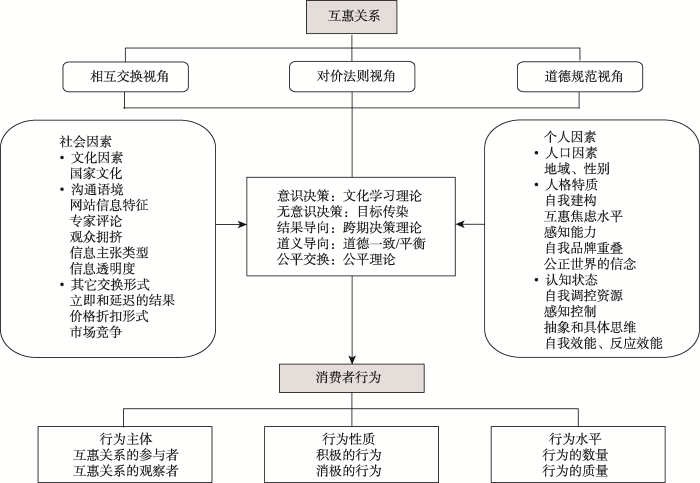
本研究贡献主要有三点。第一, 鉴于互惠关系具备多种维度和类别, 框架对互惠关系影响消费者行为的前置因素进行了系统和全面的梳理, 为探索互惠驱动消费者行为的因素提供了新的思路。第二, 该框架对互惠关系中消费者的行为响应进行了总结和提炼, 有助于系统掌握社会交换中消费者行为的规律。第三, 该框架进一步讨论了互惠关系分别与社会和个人因素同时作用个体行为的情境, 扩展了个体在相互依存情境中行为决策的传统框架。
2 互惠关系的定义、演进和操纵测量
2.1 互惠关系的定义和演进
人与人之间的关系往往存在三种形式:结果完全取决于个体自身一方努力的独立关系(independent relation), 结果完全基于另一方努力的依赖关系(dependent relation), 以及结果基于双方共努力的相互依存关系(interdependent relation) (Blau, 1964)。根据英文词典释义, 互惠既指“两个群体同意以相同的方式或给予彼此相似的好处来互相帮助的情况”, 也指“相互依赖、相互作用或相互影响”, 描述了个体与他人相互控制彼此结果的关系(Columbus & Molho, 2022), 是相互依存的情境中的重要构成(Cropanzano & Mitchell, 2005)。为了将互惠依存(reciprocal interdependence)与其它情境相区分, Gouldner (1960)论述了互惠关系的三种特质。第一, 在表现形式层面, 互惠是人与人之间偶然发生的相互交换, 即使关系双方没有明确的交易规定, 一方的行为仍能够引发另一方的响应(Gouldner, 1960)。第二, 在心理期待层面, 互惠是一种“人们会得到他们应得之物”的民间信仰, 核心在于对价法则(equivalence principle)的遵循——如果其中一方被认为未能给予相应的回报或无法达到另一方对价的期望, 则双方的互惠关系将难以建立和维持(Gouldner, 1960)。第三, 在文化使命层面, 互惠是一种道德规范和个人取向, 个体有给予和回报的义务, 不遵守者将受到惩罚(Cropanzano & Mitchell, 2005)。
Hamilton (1964)首先从人类进化的亲缘选择理论(kin selection theory)对人类的互惠关系进行解释, 认为在生物体水平上的合作行为可使基因占据优势。然而, 这并不能解释个体对于非亲缘群体构建互惠关系的动机。Trivers (1971)随后提出互惠利他主义理论(reciprocal altruism theory), 指出互惠在一定程度上被视为一种防止危机和资源匮乏的保险政策(“我现在与你分享我的食物, 将来在我缺乏食物时, 你需要回报。”)。同时, Trivers (1971)和Alexander (1987)提出并丰富了间接互惠(indirect reciprocity), 即一个个体并不期望从帮助过的人中得到相应的报答, 而是从其他人那里得到好处。间接互惠涉及到声誉和地位, 直接导致了群体中每个人将被连续被评估和再评估, 构成了人类道德系统的基础(Alexander, 1987)。从现代市场功能的角度来看, 互惠关系有助于准确预测和影响他人的行为、选择伙伴、交流社会动机以及检测情境的变化; 也有助于解决利益冲突, 避免每个人的最佳结果实际上对所有人都更差(Balliet et al., 2017)。例如, 每个企业都为自身发展专注于制定交易壁垒, 但最终的收益会远低于相互协作产生的效益。但是, 在道德层面, 互惠规范为报复等负向的交换提供了道德认可, 即使这种行为代价高昂, 并且难以在未来产生物质利益(Falk & Fischbacher, 2006)。在社会资源流通层面, 交换方为了达成给予的目的, 可能会盗窃、掠夺、抢劫、欺诈或“合法”剥夺他人的财产; 合作的一方也可能通过互惠引发的不公平关系, 利用他人的工作积累财富(Narotzky & Moreno, 2002)。以上构成了学者们对互惠演进过程的主要评述。
2.2 互惠关系的操纵与测量
多数采用模拟情景法的研究通过游戏、文字材料和视频进行互惠关系模拟。鉴于互惠关系反应了A对B的行为是B先前对A行为的响应, 根据直接互惠关系中双方回报结构的不同, 研究者常采用经典的经济游戏如囚徒博弈、信任游戏等来探究个体的直接互惠行为。囚徒博弈的具体流程为, 在每轮囚徒博弈过程中, 两个个体可进行合作或背叛的选择。信任游戏为, 在第一阶段, 委托人A决定给受托人B一定数目的金钱, 在第二阶段, B收到的金额是A给予金额的一定倍数。然后, B必须决定分配给A多少钱(Thielmann et al., 2020)。以上方法也能拓展至间接互惠策略:个体先观察对方上一轮与别人合作的情况, 然后决定是否选择合作(Flynn & Yu, 2021)。经济游戏也可以模拟成基本的市场环境, 例如Kanagaretnam等(2010)将实验设计为一个简单的双伙伴联盟的商业关系, 商业伙伴的一方担任接受者并决定利润分享规则, 而另一个合作伙伴负责向对方提供资源, 以体现互惠的过程。
阅读材料也是向受试者描述互惠关系的主要方法。Chen和Huang (2016)在实验中启动互惠规范的方法为:参与者首先阅读一篇解释互惠规范对人类进化具有重要意义的文章, 随后写下一个他们自己、家人或亲密朋友与互惠规范相关的故事。Xiong等(2018)让受试者分别阅读和想象自己处于互惠关系的场景——在日常购买时商家提供折扣券或其它额外服务以激励购买, 并通过这种方法得到了预期的结果。Fan等(2020)设计了由文字和图片组成的众筹项目网页, 受试者可以对项目予以资金支持, 待项目达到预期的筹款金额后, 可以获得众筹产品作为回报。研究的实验刺激物也可以为视频片段, 如分别描绘道德产品购买中顾客与销售人员的互动等行为(Flynn & Yu, 2021; Shang & Peloza, 2016)。
互惠的测量方式主要分为4种。第一种, 在经济游戏中观察被试的行为。例如, 研究者会观察受试者合作或背叛的选择、分配的金额和角色的判断。第二种, 采用对应的量表直接测量被试者的主观感受。根据Gouldner (1960)对互惠的概念, Hoppner和Griffith (2011)在7点利克特量表上分别开发了测量项目, 对互惠的对价性和即时性进行测量。Pervan等(2009)开发了互惠的量表, 内容包含旨在稳定关系交换的战略行为, 并在量表的维度、信度和效度方面提供了证据。Yoshikawa等(2020)制定和验证了一个评估个体对广义交换、互惠和协商交换取向的量表, 以提供一套社会交换取向的测量方法。第三种为二手数据。可以使用来自实时服务的数据, 对用于捐赠、借贷和技能分享的直接和间接互惠关系进行分析。例如, 依据拓扑网络, Harvey等(2020)以节点之间的连接数目总和与网络中所有边的比例来计算直接互惠和间接互惠关系。第四种为访谈。根据互惠关系的基本概念, Lou (2022)对访谈的内容进行编码, 确认社交媒体中网红与关注者之间的互惠关系类型。
3 互惠关系对消费者行为的影响
如前所述, 互惠关系意味着消费者需要在相互依存的情境下对另一方做出响应(Cropanzano & Mitchell, 2005)。因此我们依据Gouldner (1960)提出的相互交换、对价法则和道德规范三个视角, 分别对互惠依存情境中触发消费者行为响应的前置因素进行识别和梳理。而个体响应的三种维度对互惠关系的可持续性有重要作用。第一, 行为主体:当更多的人参与互惠交换时, 互惠才更具有可行性和更高的效用(Kranton, 1996)。第二, 行为性质:回应方是否会基于上一方的行为做出类似的回应, 决定了新一轮交换和资源循环能否得以实现(Cropanzano & Mitchell, 2005)。第三, 行为水平:高水平的个体行为响应有助于增进社会群体间信任和情感纽带, 以加强社会网络的团结性(Molm et al., 2007)。因此, 我们从行为主体、行为性质和行为水平三个方面归纳消费者的行为, 以展示互惠关系在相互依存情境中的演进过程。具体而言, 行为主体包括已有互惠关系中的参与者和关系之外的观察者, 行为性质包括合作等积极的行为和拒绝合作等消极的行为, 行为水平则包括满意度、购买意愿等体现人际关系和社会交换的质量后果, 以及行为响应发生频率等数量后果。
在回顾互惠关系影响消费者行为的主要文献后发现(表1), 从行为主体的角度, 作为“一对一”的二元关系, 互惠关系既可以影响到初始关系中的参与者, 也会对关系之外的个体产生影响。也就是说, 消费者作为第三方观察者, 仍可以对其他人之间的互惠关系做出评价和响应, 体现了互惠关系在行为主体间的传递性。从行为的性质来看, 互惠关系的效价与消费者行为的性质并不完全一致, 正向和负向的互惠关系不能成为决定消费者行为性质的关键因素。对于某一效价的互惠关系, 消费者既可能表现出相同性质的行为, 也可能表现出相反性质的行为, 体现了互惠关系影响行为性质的双面性。从行为水平来看, 对等交换的互惠关系引发的消费者行为水平并不对称。该不对称性既体现在行为质量上, 也体现在行为发生的数量层面。以下, 我们从相互交换、对价法则和道德规范三个角度出发, 对消费者响应的行为主体、行为性质和行为水平加以阐述。
表1 互惠关系影响消费者行为的主要文献
| 研究视角 | 研究对象 | 行为响应 | 行为主体 | 行为性质 | 行为水平 | 代表性文献 |
|---|---|---|---|---|---|---|
| 相互交换 | 给予者−接受者 | 属性偏好 | 参与者 | -- | 质量 | Baskin et al., 2014 |
| 给予者−接受者 | 调节导向、礼物偏好 | 参与者 | -- | 质量 | Givi & Das, 2022 | |
| 给予者−接受者 | 心理意象 | 参与者 | -- | 质量和数量 | Briley et al., 2017 | |
| 交换角色 | 满意度恢复 | 参与者 | 积极 | 质量和数量 | Roschk & Gelbrich, 2017 | |
| 代理互惠 | 合作行为 | 参与者 | 积极 | 数量 | Goldstein et al., 2011 | |
| 发起的行为 | 其它产品的支持态度 | 观察者 | 积极 | 质量 | Romani et al., 2013 | |
| 交换角色 | 社会地位 | 观察者 | 积极 | 质量 | Flynn & Yu, 2021 | |
| 交换角色 | 满意度 | 观察者 | 积极 | 质量 | Evanschitzky et al., 2011 | |
| 对价法则 | 负向互惠 | 抵制行为 | 参与者 | 消极 | 质量 | Su et al., 2022 |
| 负向互惠 | 抵制行为 | 观察者 | 消极 | 质量 | Hahn & Albert, 2017 | |
| 高质量服务 | 绿色行为 | 参与者 | 积极 | 质量 | He et al., 2022 | |
| 渠道形象 | 其它渠道形象感知 | 参与者 | 积极 | 质量 | Swoboda & Winters, 2021 | |
| 赞助赠品 | 负面态度 | 参与者 | 消极 | 质量 | Stäbler, 2021 | |
| 环保承诺 | 满意度降低 | 参与者 | 消极 | 质量 | Ioannou et al., 2022 | |
| 负向互惠 | 情感支持 | 观察者 | 积极 | 质量 | Henkel et al., 2017 | |
| 谴责 | 满意度 | 观察者 | 积极 | 质量 | Pugh et al., 2018 | |
| 对价形式和时间 | 关系质量 | 参与者 | -- | 质量 | Hoppner & Griffith, 2011 | |
| 对价形式和时间 | 关系质量 | 参与者 | -- | 质量 | Hoppner et al., 2015 | |
| 道德规范 | 互惠脱离 | 低价支付 | 参与者 | 消极 | 质量 | Narwal et al., 2022 |
| 环保产品 | 属性联系 | 观察者 | -- | 质量和数量 | Luchs et al., 2010 | |
| 互惠失败 | 补救措施 | 参与者 | 积极 | 数量 | Dahl et al., 2005 |
资料来源:根据相关文献整理。
3.1 相互交换的视角
为了与一般性的商品交易相区分, 消费情境中相互交换的视角参考了Molm (2003)的阐述。在一段互惠关系中, 企业等参与者对交易所做的贡献是独立进行的、未经协商的, 如提供折扣和赠品以刺激购买, 即使不知道对方是否、何时或在多大程度上进行回报。这是因为参与者通过为另一方执行有益的行为已经完成一方的交换, 并且启动合作方对另一个交换过程进行决策(Molm, 2003)。给予者和接受者决策的相关研究方面, Baskin等(2014)发现给予者不会考虑自己的偏好, 而接受者会想象自己体验交换物品的过程, 因此后者会在社交距离较短的情况下评价物品, 重视物品使用的可行性而非理想性。当选择的礼物是自己拥有产品的劣质版本时, 给予者赠送礼物的可能性低于接受者接受它的可能性, 因为前者在决策中更加以防御为导向(相较于促进导向) (Givi & Das, 2022)。在回应者框架下(“我将如何处理该问题?”), 个体思维更加具体, 生成的心理意象会更突出即将面临的各种问题以及相应的解决方法; 而发起者框架下(“我将如何行动?”), 个体倾向采用抽象思维, 注重以人为导向的一般性解决方案(Briley et al., 2017)。此外, 交换角色也可以因人而异。在服务失败的金钱补偿中, 以个人名义(服务人员的手写便条)比非个人名义(公司打印的便条)的互惠关系更能激发回报责任, 从而恢复顾客的满意度(Roschk & Gelbrich, 2017)。企业采用互惠代理策略(企业代表消费者支持环保)比传统互惠策略(企业劝说消费者支持环保)和激励代理策略(消费者采取环保行动之后, 企业再支持环保)更有助于激励消费者合作(Goldstein et al., 2011)。
即使在互惠关系之外, 消费者也会对观察到的偶然交换加以分析, 对被观察者的行为动机进行归因, 引发认知和行为上的差异。研究发现, 当企业发起绿色合作倡议时, 消费者会认为公司致力于解决环境问题, 提升其对其它绿色产品的支持意愿(Romani et al., 2013)。Flynn和Yu (2021)发现个体对回报者授予的社会地位低于发起者。这是因为观察者可能会将回报者帮助他人的行为理解为一种自利的初衷, 旨在减少社会规范带来的负债感和不必要的痛苦感, 而不是假设这种行为出于自发主动的帮助意愿。在小型的服务环境中, 即使服务网点的所有者不与消费者直接接触, 仍可以通过一线员工的积极表现提升其客户群的满意度和购买意向(Evanschitzky et al., 2011)。
3.2 对价法则的视角
在互惠关系的执行过程中, 对价法则会使消费者对互惠关系中的效价进行判断, 以决定自己对互惠关系的处理策略。最为典型的体现是, 个体在面对负向互惠时可能会寻求报复(Gouldner, 1960)。当服务提供商违反互惠等道德规范时, 消费者会感知到背叛, 最终采取抵制行为(Su et al., 2022)。面对公司对第三方的不公平行为, 即使消费者没有受到直接影响, 也会在负面互惠规范的驱动下进行抵制(Hahn & Albert, 2017)。游客在接受较高的服务质量后, 积极互惠规范驱使其从事对环境负责的行为(He et al., 2022)。Swoboda和Winters (2021)发现购买渠道的形象之间存在线上和线下的互惠效应, 积极的线下渠道形象会提升消费者对线上渠道的感知形象, 反之亦然。以上说明互惠关系中的对价性是消费者采用积极还是消极响应的主要依据。但是在某些情况下, 互惠关系的效价与行为性质也存在不一致的情况, 具有积极意义的互惠关系引发的结果未必正向, 例如, 低质量的赠品会使消费者对赞助商产生负面态度(Stäbler, 2021)。消费者会将企业对环保责任的过度承诺视为伪善, 对企业的满意度降低(Ioannou et al., 2022)。相反, 具有消极意义的互惠关系反而能引发一些积极的响应。研究发现, 当消费者观察另一位消费者对员工的不文明行为时, 观察者倾向优先考虑社会问题, 进而给予员工更多的情感支持(Henkel et al., 2017)。企业对服务失败的员工予以谴责, 顾客对交易的满意度会增加(Pugh et al., 2018)。
值得注意的是, 即使交换的内容是对等的, 对价的形式也会导致消费者的不同评价。Hoppner和Griffith (2011)认为, 同质对价互惠(相对于异质对价互惠), 即参与交换的东西在形式上需要具体地相似或相同(相对于不必具体地相似, 或者在形式上相同), 可能会对关系质量产生消极的影响。这是因为, 对合作方能力的较高要求和回报范围的限制不允许互惠关系从多个不同的合作中受益, 降低了交换关系的效益, 也增加了实现互惠关系的适应成本。但是, 也有研究表明, 同质对价互惠存在认知和合作方面的优势(Hoppner et al., 2015; Ouyang et al., 2018; Sun et al., 2012)。根据结构匹配模型(structural alignment model) (Gentner & Markman, 1997), 同质对价互惠比异质对价互惠的相似性更高, 因此存在较少的认知困难, 无需付出更多的认知资源和努力(Sun et al., 2012; Sun et al., 2019; 孙瑾, 王永贵, 2016)。同质对价互惠也能够阐明关系的好处, 展示了共同的价值观, 并增加了伙伴之间的交流(Hoppner et al., 2015)。从对价的发生时间来看, 长期互惠可以根据特定需求定制关系行为, 从而提高关系绩效, 创造一个更加合作的环境; 相对的, 短期互惠意味着高不确定性, 可能不符合合作方的共同目标, 提高了成本, 无法稳固关系(Hoppner & Griffith, 2011; Hoppner et al., 2015)。以上说明对价性的研究范畴不仅在于如何使给予和回报之间实现“等价”, 也在于对比实现对价性的形式和时间, 以提升互惠关系在社会交换中的效率。
3.3 个人道德规范的视角
互惠不仅是一种简单的、有条件的行为模式, 更是一种道德规范, 支配着人类文化中的非正式社会交换(Gouldner, 1960)。互惠作为个人的道德规范, 指决策者需要保证自身行为符合道德标准, 并根据其感知的公认行为规范来自我控制(Bandura, 1991)。例如, 回报是受助者将利益返还给施惠者一方的道德义务, 惩罚是违背互惠规范后道德不赞成的表达。在参与式定价中(消费者对产品和服务的价格拥有话语权), 如果企业与消费者之间存在道德上的互惠脱离, 会使消费者将自己的回报责任转移, 降低更高报价的意愿(Narwal et al., 2022)。环保产品体现了企业与自然互惠共利的关系, 消费者会将这种较高的产品道德性与温柔属性相关联, 而将较低的产品道德性与力量属性相联系(Luchs et al., 2010)。互惠关系也会对消费者行为存在持续的、长期的影响。消费者会从道德角度对自身以往经历的互惠关系进行重新评价, 以作为下一轮互惠关系决策的参考依据。例如, 当消费者与销售人员存在社会联系, 并且消费者认为其自身可以控制购买结果以达成互惠关系时, 消费者未购买可能会导致内疚感。随后, 消费者会计划在未来与销售人员的购买互动中采取补救措施, 以回报他们建立的最初关系(Dahl et al., 2005)。以上研究说明互惠关系的道德内涵会持续地影响消费者行为的数量和质量结果, 尽管消费者行为的表现形式不同, 但从本质上可以解释为互惠行为的强化或重复。
4 互惠关系影响消费者行为的解释机制回顾
那么, “一对一”的互惠关系为何会对消费的行为主体、行为性质和行为水平分别产生传递性、双面性和不对称性的影响, 其解释机制和理论基础是什么?通过对相关文献的梳理, 意识决策和无意识决策、结果导向和道义导向、公平交换可作为内在机制, 对互惠关系对消费者的复杂影响予以解释, 以此构成互惠关系影响消费者行为的理论基础。
4.1 互惠传递性意识决策和无意识决策的解释机制
4.1.1 意识决策:文化学习
文化学习理论(cultural learning theory)指出, 个体拥有文化学习账户, 用于积累一套共同的行为实践和策略, 以提高自身在特定环境中的整体适应性(Richerson & Boyd, 2005)。该理论认为, 在任何栖息地生存所需的许多信息都过于广泛和复杂, 一个人毕生都无法掌握。鉴于集体知识具有生存优势, 个体在心理上会严重依赖他人来获得大部分行为技能, 并通过观察、示范和模仿他人的行为来指导自己的行为(Bandura & National Inst of Mental Health, 1986)。因此, 互惠是文化传承和社会学习的众多参考内容之一(Jung et al., 2020)。具体而言, 个体通过对已有互惠关系的观察和学习, 未来会参与到广泛的社会交换中来, 通过创建新的互惠关系实现交换行为、利他行为和亲社会行为等。
4.1.2 无意识决策:目标传染
目标是一种理想状态的心理表征(Gollwitzer & Moskowitz, 1996)。当个体对某一行为的期望状态和结果赋予正价时, 则会从事目标导向的活动。研究发现, 目标可以通过情景线索自动设置, 然后在行为主体未意识到目标的情况下引导目标导向的行为(Aarts & Dijksterhuis, 2000; Bargh, 1990)。启动无意识的目标传染需要两个条件(Aarts et al., 2004)。首先, 对特定目标的反复和一致追求可以加强环境与目标之间的联系。第二, 当实现目标时, 重复执行某些行动会加强目标与行动的关联。其中, 环境中社会关系的存在会触发无意识目标启动的发生发展, 进而影响人们在社会关系中的合作、遵从规范等行为(廖东升 等, 2014)。例如, 当个体观察到其他人慷慨捐赠的行为后, 会在另一个不相关的背景下给与他人更多的社会帮助(Aarts et al., 2004)。因此, 目标传染(goal contagion)意味着人们可以在已有互惠交换之外, 将帮助或报复延伸到新的目标, 而不仅限于已有的关系参与者(Jung et al., 2020)。
综上, 互惠的二元关系可以通过意识决策和无意识决策加以延伸, 实现行为主体上的传递性。具体而言, 一旦某一方发起一段互惠关系, 更多的互惠关系可被触发(Jung et al., 2020), 包括(1)一致目标互惠(target match reciprocity):施惠者对受助目标给予帮助, 其他个体观察该互惠关系后, 去帮助相同的目标来创建新的互惠关系; (2)无重叠目标互惠(target over-lap reciprocity):在互惠关系被观察后, 观察者通过帮助另一个目标而创建新的互惠关系; (3)下游互惠(downstream reciprocity):观察者发现互惠关系后去帮助施惠者; (4)上游互惠(upstream reciprocity):参与者作为受助目标从施惠者中获得帮助, 然后与施惠者以外的人创建新的互惠关系。
4.2 互惠双面性结果导向和道义导向的解释机制
4.2.1 结果导向:跨期决策
跨期决策理论(intertemporal decision-making theory)可作为解释消费者接受和拒绝互惠的理论支撑之一。这是因为互惠关系从付出到回报的时间间隔使个体不可避免的要进行跨期决策, 在即时利益的得失与未来的利益得失之间做出权衡与取舍(Frederick et al., 2002)。在权衡与取舍过程中, 个体会将不同时间点上的价值以一定的比例进行折扣比较, 在认知处理中形成时间折扣(Frederick et al., 2002)。因此, 当消费者作为付出的一方评价互惠关系时, 他会比较当前的付出与未来的回报, 如果折扣后的效用小于最初的效用, 他会拒绝合作。例如, 在积极的互惠关系中, 需要决策者现在付款100元, 未来收到110元的回报, 如果决策者认为未来110元的效用小于现在100元的效用, 决策者会拒绝该合作; 但是, 如果决策者认为未来110元的效用大于现在100元的效用, 他反而会选择合作, 接受积极的互惠关系。同样, 跨期决策理论也适用于负面互惠关系的处理。因此, 跨期决策理论能够在一定程度上解释同一种互惠关系为何会引发合作和拒绝两种不同的选择, 具有行为性质上的双面性。
4.2.2 道义导向:道德一致和道德平衡
长期以来, 行为研究者认为人们会对道德自我保持关注, 人们先前的道德行为会影响随后的道德行为。那么个体在履行互惠规范后, 其是否会多次参与其它的互惠关系, 以强化自我和社会的道德规范?道德一致理论(moral consistency theory)和道德平衡理论(moral balance theory)提出了不同的观点。道德一致理论认为, 个体对自己的声誉建设有积极和长期的展望, 因此一个人的自我概念会与过去的行为保持一致(Joosten et al., 2014)。为了实现道德一致性, 个体会假设他们是一个遵守道德规范的人, 并采取相应的行动来确认和建立他们作为道德人的声誉(Joosten et al., 2014)。相对应的, 道德平衡模型认为, 个人会对自己以往的道德行为进行心理交代:是否遵从道德规范可以激活关于自我的心理表现, 从而影响对另一项道德行为的追求或拒绝(Nisan & Horenczyk, 1990; Zhong et al., 2010)。积极的自我形象会暂时将人们从培养道德自我的需求中解放出来, 允许违背道德规范的行为, 这一现象被称为道德许可(moral licensing)。另一方面, 道德自我形象的下降会激活恢复自我形象的动机, 引导更多道德行为, 这一现象被称为道德净化(moral cleansing) (朱一杰 等, 2013)。这意味着, 当消费者参与积极互惠关系后, 积累的道德信用会被概念化为一种心理资源, 用于许可未来破坏道德规范的行为。相反, 如果消费者违背了社会普遍认可的互惠规范, 会通过下一项互惠进行补偿, 进行自我“清洗” (Newman & Brucks, 2018)。两种理论既解释了为何同一效价的互惠关系具有引发积极和消极行为的双面性, 也能从长期的视角解释消费者行为水平上质量和数量的差异。
4.3 互惠不对称性的解释机制
因此, 当消费者处于互惠关系中的一方时, 公平理论可预测消费者拒绝和合作的选择。对公平的追求会使消费者有动力在交换有价值的资源时保持平衡, 从而使任何一方都不会以牺牲另一方为代价而获得超额利益(Adams, 1965; Blanchard et al., 2018):如果消费者认为自己的付出大于回报, 会减少自己对他人利益的关注和付出, 甚至实施惩罚行为, 选择合作的可能性降低; 而当消费者认为自己的回报大于付出时, 则会增加自己对他人利益的关注和付出, 提升自己的合作意愿。例如, 销售者可以通过提升交易的公平感来降低消费者的感知风险, 从而增加产品的销量(Blanchard et al., 2018)。结合以上论述可以发现, 公平理论首先能够解释消费者在面对不同的互惠时, 为何采取积极或消极行为, 即“好人有好报”、“恶有恶报”。其次, 公平的认知是一个主观过程, 即使客观上互惠关系的效价是确定的, 但是个体的主观价值评估可能会导致消费者行为的偏差。比如B拿了A的一支笔, 按照负面互惠规范, A需要拿回B的一支笔进行报复。但是, 如果A认为笔的价值极低, A可能会降级报复或者不报复; 如果A认为笔的价值极高, A可能会升级报复。由此, 公平理论进一步解释了互惠关系的不对称影响。
4.4 总结
通过以上论述可见, 文化学习等理论均认为消费者有动机去处理互惠关系, 进而影响消费行为。进一步提炼发现, 以上理论解释互惠关系影响消费者行为的驱动力是有所区分的。跨期决策理论和公平理论将个体在互惠关系中的行为响应解释为受经济奖励或惩罚刺激驱动的结果。而文化学习理论、目标传染理论、道德一致/平衡理论则表明, 即使互惠关系中的交换内容对于双方是等价的, 互惠关系传递的交换信号和道德内涵仍可以为驱动消费者的行为提供额外动力。因此, 以上理论为解释互惠关系如何从多重维度广泛地影响消费者行为提供了依据。
此外, 不同的理论对互惠关系的潜在影响提出了不一致的解释。例如, 根据公平理论, 消费者在处理消极的互惠关系时, 既可能升级报复, 也可能降级。根据道德一致和平衡理论, 消费者在完成积极的互惠关系后, 既可能通过道德行为强化互惠的道德规范, 也可能将以往的互惠关系作为未来不道德行为的依据。因此, 众多学者认为互惠关系需要背景化, 在更为具体的情境中探索其对个体行为的影响(Flynn & Yu, 2021)。为此, 有必要就消费者对互惠关系与影响消费者认知的其它因素进行全面的分析, 系统地解释互惠关系对消费者行为的心理驱动机制及边界条件, 以提升对消费者行为预测的准确性。
5 互惠关系影响消费者行为的调节因素
无论互惠关系的何种维度触发了消费者的行为, 都需要将一个给定的互惠关系转化为一个有效的情境。然而, 有限的认知资源往往限制了消费者的认知, 不能使其识别相应的互惠关系。这导致消费者难以在互动中分析互惠机会的可行性, 抵制欺骗或不合作带来的即时收益的诱惑, 进而追求自我和他人的共同利益。此外, 在主观转化的过程中, 消费者对完全相同的互惠关系认知也会存在个体间差异:一方可能关注集体合作和共同福祉, 另一方可能强调相互竞争和自身利益(Thielmann et al., 2020)。因此, 探讨哪些因素能够调节互惠关系对消费者行为的影响具有重要意义。通过对现有文献的回顾发现, 来自社会因素和个人因素的变量能够通过互惠关系影响消费者行为。
5.1 社会因素
5.1.1 文化因素
文化之所以成为互惠关系与消费者行为之间的调节因素, 是因为社会规范意味着个体往往被动的接受一定的信息, 而文化作为一种外部许可, 成为他们遵循社会规范的证据。文化会影响社会关系的规范内容、角色和期望(Samaha et al., 2014), 导致互惠关系影响的强度有所差异。根据Hofstede (1984)的国家文化理论, 集体主义比个人主义文化更加强调长期社会联系和依赖性。已有研究发现, 注重相互依赖的亚洲人倾向在礼物交换中援引互惠规范, 因此他们可能拒绝偶然相识之人的礼物, 以避免在无法回报的情况下产生负债感(Shen et al., 2011); 在面对疾病等挑战时, 该文化下的个体也更倾向采用回应者框架, 以促进恢复健康的乐观情绪(Briley et al., 2017)。相对应的, 注重独立的北美人较少考虑互惠关系中回报的义务, 因此他们更可能基于礼物的吸引力决定是否接受礼物(Shen et al., 2011); 启动发起者框架则更容易激发其乐观情绪(Briley et al., 2017)。此外, 女性主义比男性主义更加强调实现成功过程中的关系和协作(Hofstede, 1984; Samaha et al., 2014), 紧文化比宽文化在社会规范的执行上要求更高, 对偏差的容忍度更低(Gelfand et al., 2011), 以上均属于强化互惠关系的重要因素。文化也会影响个体对互惠关系类型的偏好。集体主义文化对心理距离和内群和外群之间的差异较为敏感, 因此在该文化下的个体参与下游互惠(A→B→C)的倾向低于直接互惠(A→B→A)的倾向; 这种差异在个体主义文化中则不存在(Yang et al., 2020)。高权力距离和高不确定性的文化更加注重阶级关系和风险规避, 因此个体会对互惠关系进行选择, 偏好由高阶层和专业群体构成的互惠关系(Samaha et al., 2014)。北美文化(相较于东南亚文化)更侧重促进导向(相较于防御导向), 因此当互惠被描述为积极的给与时(giving), 美国人会随着时间推移升级互惠, 而新加坡人则倾向以同样的方式维持互惠。然而, 当互惠被描述为消极的索取时(taking), 新加坡人倾向互惠升级, 而美国人则以同样的方式进行互惠(Deng et al., 2021)。
5.1.2 沟通语境
信息的提供者让互惠关系展现在何种信息环境中, 以及如何描述互惠规范, 会使个体表现出不同的态度。已有研究发现, 互惠的优势取决于特定的网站特征:当网站效用、广告信息性越高时, 越能强化互惠论调对用户广告接受度的积极影响, 而较高程度的用户生成内容则会对互惠与广告接受度的关系造成逆转(Schumann et al., 2014)。互惠驱使消费者在获取资源后更加致力于评论和打赏以回报商家, 但如果面对较多数量的专家评论(Xu et al., 2020)和较高水平的观众拥挤(Lu et al., 2021), 上述关系会被显著削弱。当企业以价格优惠来说服消费者支持互惠关系时, 消费者更偏好非主张型(如“建议”或“可以”)的无折扣广告, 以及主张型(如“必须”或“务必”)与价格折扣相结合的广告(Bang et al., 2021)。相较于不完备的信息, 提升信息透明度(即完备的信息)会显著提高参与者一次性互惠互动中的信任行为, 并且也持续存在于重复的互动中(Kanagaretnam et al., 2010)。
5.1.3 其它交换形式
鉴于社会交换具有广泛性, 营销者往往将互惠关系与其它的交换形式相匹配, 以提升消费者对互惠关系的评价。从交换的时间层面, 一些互惠关系的成果可能在长期才能显现。直接互惠倾向高的人更关注自我利益, 更喜欢直接的奖励, 因此对具有延迟结果的给予活动参与度不高; 相对应的, 下游互惠倾向更高的人注重维护公平, 因此互惠结果是否存在延迟不会影响其偏好(Yang et al., 2020)。交换形式的相关研究发现, 商家低水平的价格促销将降低消费者在结账时捐款的可能性; 然而, 当折扣用金额(相较于百分比)表示时, 该影响会被削弱(Xia & Bechwati, 2017)。买卖双方致力于共同社会责任的互惠关系会对渠道绩效产生积极影响, 当市场存在价格战等激烈的竞争时, 该关系会被强化; 但较弱的市场竞争会削弱该关系(Luo & Zheng, 2013)。
5.2 个人因素
5.2.1 人口因素
5.2.2 人格特质
在互惠关系中, 相较于重视人际关系的依存自我建构个体, 追求独特性和差异化的独立自我建构个体较少会根据他人的行为对自己的行为加以调整(Shen et al., 2011)。因此, 对于独立自我建构的个体, 企业基于互惠规范的善因营销对提升品牌形象、自我品牌联系和购买意愿的效果会被削弱(Chen & Huang, 2016)。与互惠焦虑程度低的消费者相比, 具有高度互惠焦虑的消费者更有可能避免从零售商那里获得利益, 也会在互惠机会方面更加警惕(Xiong et al., 2018)。当任务活动帮助一方的感知能力较高(相较于较低)时, 受助一方感知到的威胁状态更高(相较于更低) (Tai et al., 2022)。观察者的人格特质也同样影响其随后的行为。当消费者具有较高的自我品牌重叠时, 品牌捐款、环保等积极的(相对于消极的)行为会使消费者在经济游戏中表现出更低的(相对于更高的)慷慨行为, 以达成自身替代性的道德许可(相对于道德清洗); 相反, 当消费者与品牌的自我重叠程度较低时, 企业的给予行为不会对消费者的慷慨程度产生影响(Newman & Brucks, 2018)。如果消费者对“公正世界”的信念较高, 企业对服务失败员工的谴责会使其更满意(Pugh et al., 2018)。以上研究进一步支持了互惠情境和个人特质之间的交互范式。尤其是, 消费者的人格特质对互惠关系中参与者和观察者的行为都会产生影响。
5.2.3 认知状态
消费者会根据自身的认知状态选择道德行为, 如自我调控资源耗竭的个体比未耗竭的个体表现出更高的遵从互惠规范的意愿(Fennis et al., 2008)。在参与式定价中, 感知控制能够削弱互惠脱离与更高支付意愿之间的负相关关系(Narwal et al., 2022)。当个体以一种抽象思维(相对于具体思维)回忆自己的以往的给予行为时, 其会表现出道德一致(相对于道德补偿)的倾向(Conway & Peetz, 2012)。自我效能感是指相信个人有能力平衡非互惠的结果; 反应效能是指相信参与互惠会带来预期的结果。对于自我效能和反应效能较高的个体, 互惠感知对关系承诺的影响会提升(Davlembayeva et al., 2021)。
5.3 总结
以上研究证明, 互惠关系与消费者行为之间的关系受到社会因素和个人因素的调节作用。两者包括了消费情境中动态和多元的情境因素, 也涵盖消费者和社会具有的持续和稳定的特质。因此, 将社会因素和个人因素作为调节变量, 既能够解释一些互惠关系触发的偶然的、较不深思熟虑的行为, 也能够将互惠关系解释为无需计算推理的日常活动。这进一步证明, 在社会因素和个人因素作用的情境中, 互惠关系能够对消费者行为产生广泛和深入的影响。
6 未来研究展望
6.1 以多元视角探索与互惠关系相关的前置变量
本研究以互惠关系为核心, 构建了相互依存情境中消费者行为决策的研究框架。该研究框架不仅跳出了将自我利益最大化视为市场成员唯一目标的假设(Kranton, 1996), 而且从营销的范畴挖掘出了互惠关系影响消费者行为的内在和外在动力, 来解释消费者行为决策过程中的心理和行为差异。经济学和社会学的相关研究认为, 互惠的发展通常来自于其内部动力, 如交换的数量和规模(Kranton, 1996)、经济上的奖励和惩罚(Balliet et al., 2017)等。而越来越多营销学科的研究发现, 互惠关系能为人际关系和社会交换的发展和维持带来外部动力(Pervan et al., 2009)。本研究回顾了营销领域的相关文献, 重新梳理了互惠关系中的影响消费行为的前置变量, 发现来自相互交换、对价法则和道德规范的内部和外部驱动力均能够对消费者产生的影响, 支持了Pervan等人(2009)的观点。未来研究可以将互惠关系相关的因素分为内部动力和外部动力两个体系, 探索两者如何独立或共同作用于消费者的行为。
在市场不断变革和发展的背景下, 互惠交换在消费领域不断延伸和拓展。作为社会广泛交换的结果, 间接互惠在营销实践中大量存在, 是加强社会团结的机制之一(Takahashi, 2000)。然而, 以往研究通常基于直接交换剖析互惠关系中影响消费者行为的因素, 缺乏对间接互惠中三元及以上关系构成的探讨。Goldstein等(2011)和Romano等(2022)研究表明, 间接互惠中交换发生的次序、代理的形式和群体成员构成皆有不同的呈现形式。未来研究可继续探索间接互惠中引发消费者行为差异的前置因素。此外, 当消费者面对不同类型的社会交换时, 互惠关系中合作方生成的信号(例如, 合作方的声誉、双边沟通、关系观察)会有所波动(Kozlenkova et al., 2017)。因此, 在认知决策过程中, 消费者是否会随着互惠关系类型的变化而赋予前置因素不同的权重, 也是尚待研究的问题。
6.2 采用整合的思路研究消费者行为
互惠关系对个体行为的影响是长期以来研究者考察的对象。尽管如此, Gouldner (1960)提出的互惠在整个社会制度的形成和发展中起到的关键作用尚未得到充分支持。本研究将消费者的行为从主体、性质和水平进行阐述, 系统归纳和提炼了互惠关系对消费者行为的传递性、双面性和不对称性, 为未来聚焦个体行为规律的研究提供了理论方向。然而, 现有研究较多以参与者和观察者的其中一方为主体, 尚未探究互惠关系影响下消费者在宏观层面的行为规律, 如当某一互惠关系对参与者的行为质量存在积极影响时, 是否同时也会导致观察者在数量方面有消极的行为响应。未来研究可以在纵向研究设计上进行补充, 还可以通过大规模个体层面数据分析等研究方法, 结合实验室实验与现实消费情境, 对消费者的行为规律进行系统和宏观的总结, 并且致力于使互惠关系对个体行为三个维度的影响是协同的、正向的和持续的, 以推动社会的可持续发展。
6.3 扩展互惠关系影响消费者行为的边界因素
以往研究虽然能够通过互惠关系预测消费者行为, 但仍难以对行为偏差进行解释。本文基于互惠关系影响个体行为的作用机制, 结合互惠关系作用于个体行为调节因素的相关研究, 从社会因素和个人因素两方面出发, 进一步解释互惠关系对消费者行为效果的差异, 并补充了相互依存情境下的个体行为决策框架(Thielmann et al., 2020)。未来研究可继续从社会因素和个人因素两个层面出发, 探索两者同时作用于互惠与消费者行为之间边界条件的框架, 提升预测消费群体行为的准确性和解释消费者行为偏差的能力, 进而打造出适合中国情境的市场营销策略和干预方式。
6.4 探究不同互惠主体之间的机制
本研究关注企业为焦点行为者的互惠关系, 就企业−社会、企业−消费者和企业−自然相关的文献做了回顾, 对于互惠关系是否因交换主体有所差异这一问题, 发现了不一致的观点。一部分研究认为企业与不同主体之间的互惠关系不存在内在机制的差异(如Evanschitzky et al., 2011)。这可以解释为, 经济行为者的价值观会指引企业与消费者、社会和环境各方主体进行广泛的互惠交换, 以实现可持续性的价值创造过程(Williams & Aitken, 2011)。另一部分研究则为相反的观点提供了证据(如Kupfer et al., 2018), 即企业会基于群体选择合作伙伴, 并且存在内在机制上的差异。引发该差异的内在机制首先来自静态的因素, 如群组规模(Parks & Komorita, 1997):自然环境代表的群组规模要远大于社会和消费者代表的群组规模, 导致企业难以对该群体的互惠策略和行为主体进行清晰的识别。同时, 也存在若干动态因素, 如相互依赖的程度(degree of interdependence)、相关的程度(degree of correspondence), 相互依赖的基础(basis of interdependence)和不对称依存(asymmetric dependence) (Balliet et al., 2017)。未来研究可以从静态因素和动态因素的角度, 将互惠的焦点行为者扩展至消费者和社会组织, 探究不同行为主体间的内在机制是否存在差异以及形成差异的内在机制, 以帮助研究者更好的理解互惠关系的内涵, 并有助于探究互惠关系影响个体心理和行为的潜在机制。
参考文献
无意识目标启动的定义、机制及应用
DOI:10.3724/SP.J.1042.2014.01829
[本文引用: 1]

无意识目标与社会态度、刻板印象和图式等一样, 是行为的满意状态或结果在个体头脑中的一种表征, 包含有目标设定、追求情境和追求手段等内容。这些内容能够被环境中的刺激自动激活, 在意识不到的情况下影响人的心理和行为。无意识目标启动的概念和其他心理表征的启动不同, 无意识目标启动能够促使带有动机性的行为出现, 启动线索的影响不会随着时间的推移而消失。无意识目标启动的自变量与自身心理状态和环境中他人的影响有关, 无意识目标启动的因变量与任务表现和社会关系的处理有关。“知觉-行为模型”、“无意识行为选择模型”、“评价准备模型”和“情感因素模型”能够分别从“无意识”和“目标”两个角度对无意识目标启动的心理机制进行解释。无意识目标启动原理在商业、教育、医疗等领域当中有着广泛的应用前景, 为了更好地完善理论研究和进行实际应用, 今后应该更加重视无意识目标启动的脑机制研究。
最后通牒博弈中的公平偏好: 基于双系统理论的视角
DOI:10.3724/SP.J.1042.2018.00319
[本文引用: 1]
在最后通牒博弈中, 自利动机与公平偏好的权衡决定着个体拒绝或者接受不公平分配。根据双系统理论, 对于个体拒绝不公平分配是系统1中的自动反应还是系统2中的控制加工这一争议, 从理论假说、影响因素和脑机制三个方面进行了探讨。自动消极互惠假说和社会启发假说支持公平偏好的自动加工假说, 公平偏好控制假说则认为公平偏好是抑制自利动机的控制加工的结果。系统1通过脑岛、杏仁核和腹内侧前额叶皮层识别和评估公平行为; 系统2通过扣带回皮层、腹外侧、背内侧和背外侧前额叶皮层, 对系统1进行重新评估和调节并做出相应的决策。个体差异因素和实验任务特征可能会影响个体在系统1中的自动反应。未来研究需要进一步完善实验范式, 深入探索其中的调节变量及其神经网络。
“投桃报李”——互惠理论的组织行为学研究述评
DOI:10.3724/SP.J.1042.2012.01879
[本文引用: 2]
互惠是一种存在于各种社会文化中的人际交往规范。组织行为学中许多研究都是通过互惠理论来解释变量之间的内部作用机制。文章回顾并讨论了互惠的涵义, 不同互惠类型的特点及互惠的测量方式。此外, 还论述了不同类型互惠对社会交换方式产生的影响。依据现有的互惠研究成果, 分析了互惠发挥影响的内在作用机制是通过:互惠各方的价值观、互惠过程中各方感知到的风险、各方冲突的程度这三种途径来实现的。最后, 根据现有互惠理论的研究成果提出该领域的未来发展应从研究设计和研究内容两方面进行扩展。
Habits as knowledge structures: Automaticity in goal-directed behavior
This study tested the idea of habits as a form of goal-directed automatic behavior. Expanding on the idea that habits are mentally represented as associations between goals and actions, it was proposed that goals are capable of activating the habitual action. More specific, when habits are established (e.g., frequent cycling to the university), the very activation of the goal to act (e.g., having to attend lectures at the university) automatically evokes the habitual response (e.g., bicycle). Indeed, it was tested and confirmed that, when behavior is habitual, behavioral responses are activated automatically. In addition, the results of 3 experiments indicated that (a) the automaticity in habits is conditional on the presence of an active goal (cf. goal-dependent automaticity; J. A. Bargh, 1989), supporting the idea that habits are mentally represented as goal-action links, and (b) the formation of implementation intentions (i.e., the creation of a strong mental link between a goal and action) may simulate goal-directed automaticity in habits.
Goal contagion: Perceiving is for pursuing
Six studies examined the goal contagion hypothesis, which claims that individuals may automatically adopt and pursue a goal that is implied by another person's behavior. Participants were briefly exposed to behavioral information implying a specific goal and were then given the opportunity to act on the goal in a different way and context. Studies 1-3 established the goal contagion phenomenon by showing that the behavioral consequences of goal contagion possess features of goal directedness: (a) They are affected by goal strength, (b) they have the quality of goal appropriateness, and (c) they are characterized by persistence. Studies 4-6 show that people do not automatically adopt goals when the observed goal pursuit is conducted in an unacceptable manner, because the goal will then be perceived as unattractive. The results are discussed in the context of recent research on automatic goal pursuits.Copyright 2004 American Psychological Association
Beyond the opposition between altruism and self-interest: Reciprocal giving in reward-based crowdfunding
DOI:10.1007/s10551-017-3652-x URL [本文引用: 2]
Functional interdependence theory: An evolutionary account of social situations
DOI:10.1177/1088868316657965
PMID:27466269
[本文引用: 3]
Social interactions are characterized by distinct forms of interdependence, each of which has unique effects on how behavior unfolds within the interaction. Despite this, little is known about the psychological mechanisms that allow people to detect and respond to the nature of interdependence in any given interaction. We propose that interdependence theory provides clues regarding the structure of interdependence in the human ancestral past. In turn, evolutionary psychology offers a framework for understanding the types of information processing mechanisms that could have been shaped under these recurring conditions. We synthesize and extend these two perspectives to introduce a new theory: functional interdependence theory (FIT). FIT can generate testable hypotheses about the function and structure of the psychological mechanisms for inferring interdependence. This new perspective offers insight into how people initiate and maintain cooperative relationships, select social partners and allies, and identify opportunities to signal social motives.
Social cognitive theory of self-regulation
DOI:10.1016/0749-5978(91)90022-L URL [本文引用: 1]
Message assertiveness and price discount in prosocial advertising: Differences between Americans and Koreans
DOI:10.1108/EJM-10-2019-0791
URL
[本文引用: 1]
Prosocial advertisers widely use assertive messages to encourage prosocial attitudes and behaviors, but ironically, assertive messages may cause reactance. By applying cultural theories and the reciprocity principle, this study aims to observe whether consumers’ responses to assertive messages hold across culturally different audiences (Americans vs South Koreans) and different consumption situations (price discount vs no discount).
Auto-motives:Preconscious determinants of social interaction
In
Why feasibility matters more to gift receivers than to givers: A construal-level approach to gift giving
DOI:10.1086/675737 URL [本文引用: 3]
Specialist competitor referrals: How salespeople can use competitor referrals for nonfocal products to increase focal product sales
DOI:10.1509/jm.16.0269
URL
[本文引用: 2]
Intuition suggests that a salesperson should not refer consumers to a competitor for products that they both sell. However, myriad examples reveal salespeople doing just that. The authors study specialist competitor referrals, a sales strategy by which one increases consumers’ purchase likelihood of a focal product (e.g., a painting at an art gallery) by (1) referring consumers to a competitor (e.g., a frame warehouse store) that offers a nonfocal product (e.g., a frame) at a lower price, while (2) stating that the stores differ in their specializations (i.e., the stores concentrate their efforts on different goods). Using a study and survey with salespeople, experimental studies, an incentivized negotiation experiment, and a field study, the authors show that specialist competitor referrals can indeed benefit sellers. Specifically, they build on equity theory to show that specialist competitor referrals increase focal product sales by reducing consumers’ perceived overpayment risk for the focal product via increasing perceived equity in the exchange. The authors also show that competitor referrals for nonfocal products that do not justify the price difference on the nonfocal product are ineffective.
Cultivating optimism: How to frame your future during a health challenge
DOI:10.1093/jcr/ucx075
URL
[本文引用: 5]
Research shows that optimism can positively impact health, but when and why people feel optimistic when confronting health challenges is less clear. Findings from six studies show that the frames people adopt when thinking about health challenges influence their optimism about overcoming those challenges, and that their culture moderates this effect. In cultures where the independent self is highly accessible, individuals adopting an initiator frame (how will I act, regardless of the situations I encounter?) were more optimistic than those adopting a responder frame (how will I react to the situations I encounter?); the converse occurred for individuals from cultures where the interdependent self is highly accessible. Moreover, mediation and moderation evidence revealed that this interactive effect of culture and frame on optimism was driven by people’s ability to easily imagine the recovery process. These effects held for distinct health challenges (cancer, diabetes, flood-related illness, traumatic injury) and across single-country and cross-country samples, and they impacted positive health outcomes and decisions ranging from anticipated energy, physical endurance, and willingness to take on more challenging physical therapy to intentions to get vaccinated, stick to a doctor-recommended diet, and undertake a physically strenuous vacation.
Cause-related marketing is not always less favorable than corporate philanthropy: The moderating role of self-construal
DOI:10.1016/j.ijresmar.2016.03.003 URL [本文引用: 2]
Subjective interdependence and prosocial behaviour
DOI:10.1016/j.copsyc.2021.07.022 URL [本文引用: 1]
When does feeling moral actually make you a better person? Conceptual abstraction moderates whether past moral deeds motivate consistency or compensatory behavior
DOI:10.1177/0146167212442394
PMID:22492550
[本文引用: 1]
According to the moral licensing literature, moral self-perceptions induce compensatory behavior: People who feel moral act less prosocially than those who feel immoral. Conversely, work on moral identity indicates that moral self-perceptions motivate behavioral consistency: People who feel moral act more prosocially than those who feel less so. In three studies, the authors reconcile these propositions by demonstrating the moderating role of conceptual abstraction. In Study 1, participants who recalled performing recent (concrete) moral or immoral behavior demonstrated compensatory behavior, whereas participants who considered temporally distant (abstract) moral behavior demonstrated behavioral consistency. Study 2 confirmed that this effect was unique to moral self-perceptions. Study 3 manipulated whether participants recalled moral or immoral actions concretely or abstractly, and replicated the moderation pattern with willingness to donate real money to charity. Together, these findings suggest that concrete moral self-perceptions activate self-regulatory behavior, and abstract moral self-perceptions activate identity concerns.
Social exchange theory: An interdisciplinary review
DOI:10.1177/0149206305279602
URL
[本文引用: 5]
Social exchange theory (SET) is one the most influential conceptual paradigms in organizational behavior. Despite its usefulness, theoretical ambiguities within SET remain. As a consequence, tests of the model, as well as its applications, tend to rely on an incompletely specified set of ideas. The authors address conceptual difficulties and highlight areas in need of additional research. In so doing, they pay special attention to four issues: (a) the roots of the conceptual ambiguities, (b) norms and rules of exchange, (c) nature of the resources being exchanged, and (d) social exchange relationships.
Three Rs of interpersonal consumer guilt: Relationship, reciprocity, reparation
DOI:10.1207/s15327663jcp1504_5 URL [本文引用: 2]
Sharing economy platforms: An equity theory perspective on reciprocity and commitment
DOI:10.1016/j.jbusres.2021.01.039 URL [本文引用: 1]
Culture and patterns of reciprocity: The role of exchange type, regulatory focus, and emotions
DOI:10.1177/0146167220913694
URL
[本文引用: 1]
Reciprocity is a fundamental mechanism for sustained social relationships. Escalation-based theories suggest that reciprocity intensifies over time. In contrast, equity-based theories propose that people reciprocate behaviors in kind. We reconcile these conflicting perspectives by examining social exchanges across different cultural contexts. Using three complementary experiments, we investigate when, how, and why individuals in East Asian settings and those in North American settings differentially reciprocate positive versus negative behaviors over time. Study 1 demonstrated that in positively framed exchanges (i.e., giving) Americans escalated their reciprocity, but Singaporeans reciprocated in kind. However, in negatively framed exchanges (i.e., taking), Singaporeans escalated their reciprocity, but Americans reciprocated in kind. Study 2 replicated the results using Hong Kongers and showed that cultural differences in regulatory focus were associated with specific emotions (i.e., anxiety and happiness), which then escalated reciprocity. To establish causality, Study 3 manipulated regulatory focus within one culture and replicated the pattern of results.
How employer and employee satisfaction affect customer satisfaction: An application to franchise services
DOI:10.1177/1094670510390202
URL
[本文引用: 5]
In small-service settings, how do owner satisfaction, front-line employee satisfaction, and customer satisfaction relate to one another? The authors use generalized exchange theory (GET) to examine how satisfaction levels of these three constituents are reciprocated. The authors examine a European franchise system comprising 50 outlets, 933 employees, and 20,742 customers. Their results show two important findings. First, the effect of owner-franchisee’s satisfaction on customer satisfaction is fully mediated by front-line employee satisfaction. Thus, managers of a service outlet can strongly impact the satisfaction and behavioral intentions of their customer base, even without direct contact with them. Second, the link between customer satisfaction and purchase intention is moderated by employee satisfaction at an outlet. The link between customer satisfaction and customer purchase intentions is almost twice as strong when employees are satisfied than when they are not. Thus, there is a ‘‘doublepositive effect:’’ not only does higher employee satisfaction at an outlet directly lead to higher customer satisfaction but it also indirectly strengthens the association between customer satisfaction and their repurchase intentions.
A theory of reciprocity
DOI:10.1016/j.geb.2005.03.001 URL [本文引用: 1]
The small predicts large effect in crowdfunding
DOI:10.1093/jcr/ucaa013
URL
[本文引用: 1]
Entrepreneurs are increasingly relying on online crowdfunding—the use of online platforms to raise money from a large number of people—to finance their ventures. This research explores the proposition that the amounts contributed by the majority of funders in the early stages of a crowdfunding campaign may have a counterintuitive influence on follow-up contributions and on the campaign’s fundraising success. Findings from an analysis of real-world large-scale crowdfunding data and five experiments show that potential funders are more (vs. less) likely to contribute to a newly launched project when early contributions consist mainly of relatively small (vs. large) amounts. The results further show that this Small Predicts Large effect is driven by people’s relationship inferences: when contributions made at the early stages of a crowdfunding campaign mainly comprise relatively large amounts, consumers tend to infer that those large contributions were made by the entrepreneur’s friends or relatives. Because of this relationship inference, prospective funders perceive larger contributions as being less diagnostic of others’ true opinions of the project and this perception negatively affects their willingness to contribute. However, if a crowdfunding campaign provides sufficient justification for the early-stage large contributions, this Small Predicts Large effect will be eliminated.
Acts of benevolence: A limited-resource account of compliance with charitable requests
DOI:10.1086/593291 URL [本文引用: 1]
Vulnerable populations and individual social responsibility in prosocial crowdfunding: Does the framing matter for female and rural entrepreneurs?
DOI:10.1007/s10551-020-04712-0 [本文引用: 1]
Better to give than reciprocate? Status and reciprocity in prosocial exchange
DOI:10.1037/pspi0000349
PMID:33492155
[本文引用: 5]
Reciprocity implies equality in the giving and receiving of benefits. However, we find that reciprocity does not generate equal benefits, in terms of social status. Instead, across 7 studies (N = 3,426), observers conferred more status to individuals who initiated (i.e., initiators) than individuals who reciprocated (i.e., reciprocators) identical prosocial acts. Further, choosing not to reciprocate a prosocial act led to a more severe status penalty than choosing not to initiate a prosocial act. We find this discounting of reciprocity is driven by perceived obligation-observers view reciprocators as acting under constraint. When reciprocation appears less obligatory (e.g., given indirectly, or privately), the status discount is mitigated. Finally, we show that the discounting of a reciprocal act can be enduring-reciprocators still received less status after 2 successive, counterbalanced rounds of exchange. (PsycInfo Database Record (c) 2021 APA, all rights reserved).
Time discounting and time preference: A critical review
DOI:10.1257/jel.40.2.351 URL [本文引用: 2]
Differences between tight and loose cultures: A 33-nation study
DOI:10.1126/science.1197754
PMID:21617077
[本文引用: 1]
With data from 33 nations, we illustrate the differences between cultures that are tight (have many strong norms and a low tolerance of deviant behavior) versus loose (have weak social norms and a high tolerance of deviant behavior). Tightness-looseness is part of a complex, loosely integrated multilevel system that comprises distal ecological and historical threats (e.g., high population density, resource scarcity, a history of territorial conflict, and disease and environmental threats), broad versus narrow socialization in societal institutions (e.g., autocracy, media regulations), the strength of everyday recurring situations, and micro-level psychological affordances (e.g., prevention self-guides, high regulatory strength, need for structure). This research advances knowledge that can foster cross-cultural understanding in a world of increasing global interdependence and has implications for modeling cultural change.
Structure mapping in analogy and similarity
DOI:10.1037/0003-066X.52.1.45 URL [本文引用: 1]
Givers eschew gifts that are inferior to their own: How social norms, regulatory focus, and concerns about offending lead givers astray
Reciprocity by proxy: A novel influence strategy for stimulating cooperation
DOI:10.1177/0001839211435904
URL
[本文引用: 3]
We explored a novel reciprocity-based influence strategy to stimulate cooperation called the reciprocity-by-proxy strategy. Unlike in traditional reciprocity, in which benefactors provide direct benefits to target individuals to elicit reciprocity, the reciprocity-by-proxy strategy elicits in the target a sense of indebtedness to benefactors by providing benefits to a valued third party on behalf of the target (e.g., first making a donation to a charity on behalf of one’s employees and then later asking employees to comply with a request). We hypothesize that this strategy should be more effective than the widely used incentive-by-proxy strategy, in which one makes a request of a target, promising to provide aid to a valued third party if the target first complies with the request (e.g., offering to make a donation to charity for every employee who complies with a request). We found that hotel guests were more likely to reuse their towels when the hotel’s environmental conservation program used a reciprocity-by-proxy strategy than when it used an incentive-by-proxy or standard environmental strategy. Four additional experiments replicate this finding, rule out alternative explanations, and reveal that the reciprocity-by-proxy approach can backfire when the target audience does not support the beneficiary of the aid.
Goal effects on action and cognition
In
The norm of reciprocity: A preliminary statement
DOI:10.2307/2092623 URL [本文引用: 10]
Strong reciprocity in consumer boycotts
DOI:10.1007/s10551-015-2870-3 URL [本文引用: 2]
The genetical evolution of social behaviour. I.
DOI:10.1016/0022-5193(64)90038-4 PMID:5875341 [本文引用: 2]
Prosocial exchange systems: Nonreciprocal giving, lending, and skill-sharing
The effect of destination employee service quality on tourist environmentally responsible behavior: A moderated mediation model incorporating environmental commitment, destination social responsibility and motive attributions
The social dimension of service interactions: Observer reactions to customer incivility
DOI:10.1177/1094670516685179
URL
[本文引用: 3]
Service interactions run a gamut from an instrumental self-focus to full social appreciation. Observing another customer’s incivility toward a frontline employee can emphasize social concerns as guiding principles for the observer’s own service interaction. Five studies test these dynamics; the results reveal that an incivility incident leads observers to prioritize social over market concerns. This reprioritization becomes manifest in a subsequent service interaction through increased feelings of warmth toward the employee who experienced incivility. In turn, feelings of warmth prompt observers to provide emotional support to the affected employee. Yet such prosocial inclinations are less likely when an employee is held responsible for or reciprocates incivility. Finally, this article also examines the effects of different employee reaction strategies on observers’ inferences about the employee and the service firm, showing that observers are most positively disposed toward the employee and the firm when the former reacts to incivility with a polite reprimand. Together, the results suggest that, contrary to past theorizing, observing customers may contribute to employee well-being, contingent on appropriate employee responses. Notably, the commonly prescribed polite, submissive employee reaction that requires emotional labor may not be the most desirable reaction—neither for the employee nor for the firm.
The role of reciprocity in clarifying the performance payoff of relational behavior
DOI:10.1509/jmkr.48.5.920
URL
[本文引用: 4]
The authors theorize that the inconsistencies in prior research regarding the relational behavior–performance relationship arise from the type of reciprocity the firm internalizes. The results of a longitudinal study of 284 buyer–supplier relationships indicate that relational behavior enhances financial performance when what is exchanged does not need to be directly comparable with what was received (i.e., heteromorphic equivalence reciprocity) or can be returned over a longer time horizon (i.e., long-term immediacy reciprocity). Moreover, relational behavior diminishes financial performance when what is exchanged must be directly comparable in form (i.e., homeomorphic equivalence reciprocity) or returned over a short time horizon (i.e., short-term immediacy reciprocity). The authors further conclude that a longitudinal interaction effect model provides a more accurate understanding of the relational behavior–performance relationship when compared with a cross-sectional interaction effect model, because it minimizes the unobserved heterogeneity effect, thus strengthening causal inference.
Reciprocity in Relationship marketing: A cross-cultural examination of the effects of equivalence and immediacy on relationship quality and satisfaction with performance
DOI:10.1509/jim.15.0018
URL
[本文引用: 4]
Effective relationship marketing (RM) in a firm's global operations necessitates that the underlying aspect of reciprocity operate consistently across markets. Unfortunately, few studies have empirically examined the role of reciprocity in RM, let alone whether the effects of reciprocity in RM are universal across national cultures. To address these limitations, the authors examine reciprocity as a multidimensional norm whose dimensions of equivalence (what is exchanged) and immediacy (when the exchange occurs) influence relationship quality and satisfaction with performance in cross-border U.S.–Japanese interfirm relationships. The results indicate that the effects of reciprocity on relationship quality are conditional on national culture. Specifically, uncertainty avoidance positively moderates the positive effect of equivalence on relationship quality, while individualism and short-term orientation positively moderate the negative effect of immediacy on relationship quality. Moreover, a supplemental analysis indicates that the key mediating variable RM model may not hold across all cultures when predicting satisfaction with performance. These findings underscore the importance of adapting RM strategies across national cultures and provide managers with recommendations for developing high-quality cross-border buyer–seller relationships.
The impact of perceived greenwashing on customer satisfaction and the contingent role of capability reputation
Feel good, do-good!? On consistency and compensation in moral self-regulation
Prosocial modeling: A meta-analytic review and synthesis
DOI:10.1037/bul0000235
PMID:32406697
[本文引用: 3]
Exposure to prosocial models is commonly used to foster prosocial behavior in various domains of society. The aim of the current article is to apply meta-analytic techniques to synthesize several decades of research on prosocial modeling, and to examine the extent to which prosocial modeling elicits helping behavior. We also identify the theoretical and methodological variables that moderate the prosocial modeling effect. Eighty-eight studies with 25,354 participants found a moderate effect ( = 0.45) of prosocial modeling in eliciting subsequent helping behavior. The prosocial modeling effect generalized across different types of helping behaviors, different targets in need of help, and was robust to experimenter bias. Nevertheless, there was cross-societal variation in the magnitude of the modeling effect, and the magnitude of the prosocial modeling effect was larger when participants were presented with an opportunity to help the model (vs. a third-party) after witnessing the model's generosity. The prosocial modeling effect was also larger for studies with higher percentage of female in the sample, when other people (vs. participants) benefitted from the model's prosocial behavior, and when the model was rewarded for helping (vs. was not). We discuss the publication bias in the prosocial modeling literature, limitations of our analyses and identify avenues for future research. We end with a discussion of the theoretical and practical implications of our findings. (PsycInfo Database Record (c) 2020 APA, all rights reserved).
Trust and reciprocity with transparency and repeated interactions
DOI:10.1016/j.jbusres.2009.03.007 URL [本文引用: 2]
Online relationship formation
DOI:10.1509/jm.15.0430
URL
[本文引用: 1]
As online shopping evolves from being primarily transactional to being more relational, sellers aim to form online relationships. This article investigates online relationship formation, identifies the performance payoffs that result from forming different types of online relationships (unilateral vs. reciprocal), and tests the most effective relationship-building strategies. Study 1, based on a longitudinal buyer-level analysis of an online shopping community, reveals that buyers use community-, seller-, and buyer-generated signals to identify suitable relationship partners and reduce online shopping risk. These signals generally diminish in importance as buyers gain experience but become more important when buyers are forming reciprocal relationships. Study 2 evaluates the dynamic payoffs of online relationship formation (seller-level analysis) on sales; the effect on sales of reciprocal relationships is three times greater and lasts seven times longer than that of seller-initiated, unilateral relationships. Study 3 is a field experiment testing managerially actionable strategies for leveraging relationships to grow online sales. Tenets arising from differences between online and offline relationships, together with the results from the three studies, inform an emerging theory of online relationships.
Reciprocal exchange: A self-sustaining system
The role of the partner brand's social media power in brand alliances
Leader-member exchange theory:The past and potential for the future
In
Social media influencers and followers: Theorization of a trans-parasocial relation and explication of its implications for influencer advertising
DOI:10.1080/00913367.2021.1880345 URL [本文引用: 1]
Do larger audiences generate greater revenues under pay what you want? Evidence from a live streaming platform
DOI:10.1287/mksc.2021.1292
URL
[本文引用: 1]
This paper assesses the viability of pay what you want by examining the relationship between the popularity of a live streaming event and the revenue it generates under a pay-what-you-want scheme.
The sustainability liability: Potential negative effects of ethicality on product preference
Reciprocity in corporate social responsibility and channel performance: Do birds of a feather flock together?
DOI:10.1007/s10551-012-1582-1 URL [本文引用: 1]
Theoretical comparisons of forms of exchange
DOI:10.1111/1467-9558.00171
URL
[本文引用: 2]
A recent program comparing negotiated and reciprocal forms of social exchange offers important implications for theory development. Results of these investigations show that the form of exchange studied—negotiated or reciprocal—affects many of the processes and assumptions underlying contemporary theories of exchange. Three such effects are discussed here. First, the form of exchange affects the causal mechanisms underlying power use and the relation between network structure and power. Second, whether exchange is negotiated or reciprocal affects the relative emphasis on learning or rational-choice models and the breadth of motivations assumed for “self-interested” actors, including reward maximization, loss avoidance, and reciprocity. Third, the form of exchange affects the salience of the cooperative and competitive “faces” of exchange, influencing actors' subjective experiences with exchange. These results show the limitations of theories based on any single form of exchange and the need for greater understanding of the full range of exchange forms that characterize social life.
Building solidarity through generalized exchange: A theory of reciprocity
DOI:10.1086/517900 URL [本文引用: 1]
Reciprocity's dark side: Negative reciprocity, morality and social reproduction
DOI:10.1177/1463499602002003801
URL
[本文引用: 1]
This article proposes the concept of negative reciprocity as a necessary and substantive aspect of the general concept of reciprocity. We contend that the concept of reciprocity is useful only when conceived simultaneously in its negative and positive forms as they are articulated in historical processes. If treated in all its complexity the concept of reciprocity might help us to understand the ambivalence often present in social relationships. Reference to a moral domain is the central tenet that differentiates reciprocity from exchange. Reciprocity is based on a shared morality in its positive form and on the break, transformation or suspension of the moral order in its negative form. We base our discussion on the ethnographic account of the social relations that supported circulation of resources in the Auschwitz concentration camp. However, a comparative perspective indicates that the negative reciprocity pervading Auschwitz's social relations is an extreme example of a broader category of human interaction in no way unique.
Assessing customers' moral disengagement from reciprocity concerns in participative pricing
DOI:10.1007/s10551-021-04782-8 [本文引用: 4]
The influence of corporate social responsibility efforts on the moral behavior of high self-brand overlap consumers
DOI:10.1002/jcpy.2018.28.issue-2 URL [本文引用: 2]
Moral balance: The effect of prior behaviour on decision in moral conflict
DOI:10.1111/bjso.1990.29.issue-1 URL [本文引用: 1]
Reaching the limits of reciprocity in favor exchange: The effects of generous, stingy, and matched favor giving on social status
DOI:10.1037/apl0000288
PMID:29517253
[本文引用: 1]
Group members gain social status via giving favors to others, but why and when they do so remain unclear in the literature. Building on social exchange theory and social status literature, we identify three types of favor giving among group members (generous, stingy, and matched) and propose that an affective mechanism (i.e., gratitude) and a cognitive mechanism (i.e., perceived competence) underlie the relationship between favor giving and status attainment. Specifically, generous/stingy favor giving has a linear relationship with status attainment through both gratitude and perceived competence, whereas matched favor giving has a curvilinear relationship with status attainment only through perceived competence. An experimental study and a field study lend support to our propositions. Our study complements the literature by offering a complete picture of how three types of favor giving among group members shape their social status in different ways. (PsycINFO Database Record(c) 2018 APA, all rights reserved).
Reciprocal strategies for large groups
Reciprocal strategies have been shown to be effective in inducing long-term cooperation in social dilemmas involving small, but not large, groups. In this article, we argue that group-based reciprocal strategies (GBRS)--under which one reciprocates cooperative factions, not individuals, within the group--can induce cooperation in large groups. Results of two computer simulations of 100-member groups show that a GBRS accumulates a significantly larger payoff than do other commonly advocated mixed-motive strategies. A third simulation showed that the size of the cooperative faction is influenced by the nature of the payoff matrix; when there is considerable temptation to defect, one should cooperate only after a large number of others have done so, but if there is little temptation to defect, one should reciprocate the cooperative actions of a smaller faction. We also found that the use of a "win-cooperate, lose-defect" heuristic led to substantial total outcomes. Our results suggest several psychological factors are important in facilitating cooperation, yet need empirical study.
Reciprocity as a key stabilizing norm of interpersonal marketing relationships: Scale development and validation
DOI:10.1016/j.indmarman.2007.11.001 URL [本文引用: 3]
A customer scorned: Effects of employee reprimands in frontline service encounters
DOI:10.1177/1094670517746777
URL
[本文引用: 4]
This research examines the implications of manager reprimands of frontline employees following a service failure incident. Drawing upon social exchange theory and looking at both customer and employee reactions, three studies find that customers are more satisfied with failed service encounters when they are aware the employee was reprimanded. This effect is on par with other types of service recoveries, mediated by deontic justice perceptions and moderated by the customer’s just-world beliefs, such that high believers are more satisfied than low believers when they are told about an employee’s reprimand. Direct observation of the reprimand acts as a key boundary condition whereby customers become dissatisfied when they are present during the reprimand. Furthermore, we find that customer perceptions of frontline reprimands are tied to reprimand privacy, whereas employee perceptions are tied to reprimand civility. This research is the first to simultaneously examine the effects of workplace reprimands on customer and frontline employee satisfaction. For managers, our findings illuminate the usefulness of communicating employee reprimands to customers, thus representing a low-cost alternative to other types of recovery efforts.
Explaining consumer reactions to corporate social responsibility: The role of gratitude and altruistic values
DOI:10.1007/s10551-012-1337-z URL [本文引用: 4]
Direct and indirect reciprocity among individuals and groups
DOI:10.1016/j.copsyc.2021.08.003 URL [本文引用: 1]
Compensation revisited: A social resource theory perspective on offering a monetary resource after a service failure
DOI:10.1177/1094670517716333
URL
[本文引用: 2]
This research examines how to recompense customers, from a social resource theory perspective, which portrays financial compensation as the act of offering the resource “money” to customers during a service recovery attempt. This resource can differ in its particularism (is the money offered in a more or less personal way?) and concreteness (is the money offered in a more or less tangible way?), which are shown in two experiments to affect recovery outcomes. Specifically, personal compensation accompanied by a handwritten note from the service person (vs. impersonal: a typewritten note from the firm) fosters recovery satisfaction, mediated by justice perceptions, and reciprocal customer behavior (tipping, cross-buying), mediated by an obligation to reciprocate. Tangible compensation in the form of a banknote or banknote-like coupon (vs. intangible: a credit entry) also fosters reciprocal customer behavior via the obligation to reciprocate. In both studies, relationship strength amplifies the indirect effect of compensation’s particularism on recovery satisfaction. As a theoretical contribution, we show that the way the monetary resource is presented matters for service recovery. As a major managerial takeaway, this research presents personal (vs. impersonal) compensation as an impactful property of compensation: It increases recovery outcomes without additional monetary costs. Further, managers learn that handing over the money in a personal and tangible way can be a way to increase monetary returns to the firm in the form of tipping and cross-buying.
The role of culture in international relationship marketing
Targeted online advertising: Using reciprocity appeals to increase acceptance among users of free web services
Deciding who gets what, fairly
DOI:10.1093/jcr/ucy029 URL [本文引用: 1]
Can “real” men consume ethically? How ethical consumption leads to unintended observer inference
DOI:10.1007/s10551-015-2627-z URL [本文引用: 1]
Cross-cultural differences in the refusal to accept a small gift: The differential influence of reciprocity norms on Asians and North Americans
DOI:10.1037/a0021201
PMID:21058870
[本文引用: 3]
Asians are more likely than North Americans to refuse a small gift that is offered to them by a casual acquaintance. Five experiments confirmed this difference and explored the reasons for its occurrence. Asians, who are inclined to think of themselves in relation to others, are more likely than North Americans to invoke a reciprocity norm in exchanging gifts with casual acquaintances, and they refuse a gift in order to avoid the feeling of indebtedness they would experience if they cannot reciprocate. North Americans, however, who are inclined to think of themselves independently of others, are more likely to base their acceptance of the gift on its attractiveness without considering their obligation to reciprocate. These cultural differences are not evident when the gift is offered by a close friend with whom individuals have a communal relationship. Implications of our findings for miscommunication between members of different cultures are discussed.(PsycINFO Database Record (c) 2010 APA, all rights reserved).
Process and structure in leader-member exchange
DOI:10.2307/259332 URL [本文引用: 1]
Why cheap, low-quality giveaways are bad for brands: Quality of freebies drives consumer attitudes, but personalization can help
DOI:10.2501/JAR-2020-017 URL [本文引用: 4]
How do destination negative events trigger tourists’ perceived betrayal and boycott? The moderating role of relationship quality
The effect of attribute alignability on service evaluation: The moderating role of uncertainty
DOI:10.1086/665983 URL [本文引用: 2]
Shaping consumer preference using alignable attributes: The roles of regulatory orientation and construal level
DOI:10.1016/j.ijresmar.2018.12.001 URL [本文引用: 1]
Reciprocity within major retail purchase channels and their effects on overall, offline and online loyalty
DOI:10.1016/j.jbusres.2020.12.024 URL [本文引用: 3]
Biting the hand that feeds: A status-based model of when and why receiving help motivates social undermining
The emergence of generalized exchange
DOI:10.1086/210400 URL [本文引用: 2]
Personality and prosocial behavior: A theoretical framework and meta-analysis
DOI:10.1037/bul0000217
PMID:31841013
[本文引用: 3]
Decades of research document individual differences in prosocial behavior using controlled experiments that model social interactions in situations of interdependence. However, theoretical and empirical integration of the vast literature on the predictive validity of personality traits to account for these individual differences is missing. Here, we present a theoretical framework that identifies 4 broad situational affordances across interdependent situations (i.e., exploitation, reciprocity, temporal conflict, and dependence under uncertainty) and more specific subaffordances within certain types of interdependent situations (e.g., possibility to increase equality in outcomes) that can determine when, which, and how personality traits should be expressed in prosocial behavior. To test this framework, we meta-analyzed 770 studies reporting on 3,523 effects of 8 broad and 43 narrow personality traits on prosocial behavior in interdependent situations modeled in 6 commonly studied economic games (Dictator Game, Ultimatum Game, Trust Game, Prisoner's Dilemma, Public Goods Game, and Commons Dilemma). Overall, meta-analytic correlations ranged between -.18 ≤ ρ̂ ≤.26, and most traits yielding a significant relation to prosocial behavior had conceptual links to the affordances provided in interdependent situations, most prominently the possibility for exploitation. Moreover, for several traits, correlations within games followed the predicted pattern derived from a theoretical analysis of affordances. On the level of traits, we found that narrow and broad traits alike can account for prosocial behavior, informing the bandwidth-fidelity problem. In sum, the meta-analysis provides a theoretical foundation that can guide future research on prosocial behavior and advance our understanding of individual differences in human prosociality. (PsycINFO Database Record (c) 2019 APA, all rights reserved).
The evolution of reciprocal altruism
DOI:10.1086/406755 URL [本文引用: 2]
Reciprocity in manager-subordinate relationships: Components, configurations, and outcomes
DOI:10.1016/S0149-2063_03_00023-0 URL [本文引用: 1]
The service-dominant logic of marketing and marketing ethics
DOI:10.1007/s10551-011-0823-z URL [本文引用: 1]
The impact of price promotions on checkout donations
Reciprocity anxiety: Individual differences in feeling discomfort in reciprocity situations
DOI:10.1016/j.joep.2018.05.007 URL [本文引用: 2]
Can receiving managerial responses induce more user reviewing effort? A mixed method investigation in hotel industry
Differential effects of pay-it-forward and direct- reciprocity on prosocial behavior
DOI:10.1016/j.jbusres.2018.11.050 URL [本文引用: 2]
Generalized exchange orientation: Conceptualization and scale development
Compensatory ethics
DOI:10.1007/s10551-009-0161-6 URL [本文引用: 1]
Guanxi or justice? An empirical study of WeChat voting
DOI:10.1007/s10551-018-4053-5 [本文引用: 1]


