



1 引言
短视频指通过社交媒体平台、视频分享网站、移动应用程序等发布和分享的, 时长在几秒到几分钟之间的网络视频。短视频因具有内容丰富、交互简洁、适龄广泛等特点, 获得了广大用户的青睐。《中国互联网络发展状况统计报告》显示, 2022年上半年, 国内短视频用户增长达2805万, 总用户量在年底突破10亿之众(CNNIC, 2022)。短视频用户调查报告显示, 用户的日均使用时长超过2.5小时(QuestMobile, 2023), 未成年群体中使用短视频的比例超六成(方勇 等, 2022)。由于短视频对生活时间“侵占”以及向未成年群体“蔓延”, 短视频沉迷及其危害也逐渐引起了研究者的关注(Chen et al., 2022; Qin et al., 2022; Smith & Short, 2022; Ye et al., 2022; Zenone et al., 2021)。
在相关研究中, 短视频常被视作网络社交媒介的一种, 其对用户的独特影响并未得到足够关注。随着网络社交服务不断分化, 各类在线社交平台具有了不同的功能、用户群和社交模式(Cinelli et al., 2021)。Leung和Chen (2021)曾在综述中建议:未来与网络成瘾相关的研究应该集中在特定行为或内容类型上。也有学者呼吁, 必须关注到短视频与传统社交服务之间的差异, 才能真正地挖掘它是如何对用户产生影响的(Masciantonio et al., 2021)。相比于传统社交媒介, 短视频具有信息刺激密度高, 参与使用成本低等易沉迷属性。若模糊了短视频与一般社交媒介的差异, 可能导致短视频沉迷问题被低估, 甚至为短视频行业的发展和用户心理健康留下隐患。本文关注短视频这种信息载体及其独特属性, 通过对相关文献的梳理, 结合短视频的特点和用户使用形式, 首先从人机互动视角分析短视频沉迷的促成机制; 然后深入用户层面, 挖掘短视频沉迷的易感因素; 最后从心理和社会层面对短视频沉迷进行理论解释, 以期为这一问题提供系统见解。
2 短视频的使用与沉迷
2.1 短视频“工具性使用”与“仪式性使用”
在社交媒体领域, 用户的使用行为常被分为“主动性使用”与“被动性使用”。主动性使用是指能够创造和分享信息来促进与他人的互动的行为, 如发布动态或评论等; 被动性使用是指只查看信息而不参与互动, 如浏览他人的动态或状态等(刘庆奇 等, 2017; Scherr & Wang, 2021)。研究者发现, 在控制了性别和年龄的影响后, 主动性短视频使用会正向预测个体的幸福感, 而被动性短视频使用反之(Pan et al., 2023; Wu et al., 2021)。随着个性化推荐算法的出现, 短视频内容拥有了“主动”匹配用户的能力(Zhang & Liu, 2021)。从而短视频平台主体用户的使用形式可能是在“推荐页面”进行被动的信息消费, 也就是所谓的“被动性使用” (Wu et al., 2021)。因此就短视频使用而言, “主动性”与“被动性”的划分已经不足以揭示短视频用户由合理使用到陷入沉迷的发展过程。
在药物成瘾研究领域, 成瘾者的行为一般被认为经历了从“有目的地工具性使用”到“不受控地习惯性使用”的转换过程, 而这种转换取决于“有条件反射①(①有条件反射是指个体在经历了药物的多次使用后, 形成对刺激的条件化反应。这些条件化反应与环境、情境和学习过程有关, 逐渐形成了对药物的强化效应。)”和“无条件反射②(②无条件反射指的是个体对药物的自发反应, 包括对其产生奖励感的生理和神经化学反应。这些反应与个体的基因、生理结构和神经通路密切相关。)”之间的相互作用(Doñamayor et al., 2021; Everitt & Robbins, 2005)。换言之, 初始阶段个体对药物的使用是有目的的, 他/她们有意识地追求刺激、满足欲望或获取某种奖励。然而, 随着行为结果的不断强化, 这种行为逐渐变为习惯性的且难以控制。个体开始展现自动化的行为模式, 对药物产生强烈的渴望和依赖, 丧失了对行为的自主控制能力(Doñamayor et al., 2021; Hogarth et al., 2013)。这种由“工具性使用”到“习惯性使用”的转换蕴含着成瘾行为的发生过程, 为我们了解、预防和治疗成瘾提供了重要指导。短视频的合理使用与问题性使用之间的界限模糊性, 可能正是由这两种使用行为的潜在转换导致的。
短视频媒介应社会大众对信息多样化的需求而出现, 同时又因其高可及性、智能推荐算法而盛行(Zhao, 2021)。考虑到短视频媒介的种种易沉迷特性, 在探讨短视频沉迷问题时, 关注用户与媒介之间的交互是有必要的。在前文提及的关于药物使用的分类基础上, 笔者结合传播学者Rubin对电视观众观看行为的分类(Rubin & Perse, 1987), 将短视频使用行为分为“工具性使用(Instrumental Use)”与“仪式性使用(Ritual Use)”两类。短视频工具性使用指用户以实现某种目标或满足某种需求为导向的使用行为。此时短视频作为一种工具或手段以达到用户的特定目的。例如, 使用短视频学习新知识、获取信息或解决问题等; 短视频仪式性使用则指用户没有主观目的的使用行为。此时短视频使用成为一种与特定的场景、时间或情境相关的习惯性的行为。
相较于“主动性与被动性”强调关注用户与媒介背后社交对象的互动情况, “工具性与仪式性”划分聚焦于用户与短视频媒介之间的互动方式, 有助于揭示从短视频使用到短视频沉迷的发展过程, 同时拓展短视频沉迷研究的人机交互新思路。短视频工具性使用和仪式性使用是基于用户主观目的和意图视角的一种分类方式, 因此这两种行为在每个用户实际使用中都可能存在交叉和重叠, 同时也可能出现相互转化。例如, 某用户一开始只是在好奇心或者娱乐动机驱使下的使用短视频, 也即工具性使用; 随着用户从短视频中不断获得刺激满足, 其使用行为不断得到强化, 可能逐步发展为一种习惯性的行为甚至情感依赖(仪式性使用), 进而也更加接近沉迷。
2.2 短视频沉迷概念
对社交媒体不受控制的使用行为, 通常被认为具有成瘾倾向(Ryan et al., 2014; Smith & Short, 2022)。由于当前确未有研究指明有关短视频成瘾的症状或临床诊断标准, 为了规范表述, 减少概念混淆, 本文借鉴人民日报的提法(崔妍, 2023), 使用“短视频沉迷”③(③此处要感谢多位审稿专家的宝贵建议, 作者将原定的“短视频成瘾”规范化为“短视频沉迷”。文中在引用一些网络成瘾相关研究时, 部分仍沿用“成瘾”这种提法, 请读者注意区别与联系。)概括这种问题性使用行为。李霞等人(2021)称短视频沉迷是由重复使用短视频APP (快手、抖音等)所导致的一种慢性或周期性的着迷状态, 并产生强烈的、持续的渴求感和依赖感的心理和行为。还有一些研究中虽关注了短视频“沉迷”或“问题性使用” (如: 毛峥, 姜永志, 2022; Nong et al., 2023; Ye et al., 2022), 但并未给出相关定义。就如Facebook成瘾的研究一样, 关于概念的争议从一开始就出现了, 且目前仍存在(Griffiths, 2000; Ryan et al., 2014)。但这种争议并不影响相关研究的持续进行, 其甚至是该领域内学者开展研究的动力之一。当然, 短视频研究领域也是如此, 关于概念的争议可能还会存在较长时间, 但不影响短视频沉迷的研究逐步兴起(如Zhang et al., 2023)。客观而言, 现有研究中提及的短视频沉迷定义几乎全是对相近领域概念(如网络成瘾, Zhang et al., 2019)的借鉴, 仍没有关注到短视频沉迷行为的独特性。概念的模糊性表明当前的短视频沉迷研究仍停留在起步阶段。
1980年, 赌博成瘾被列入美国临床精神疾病诊断手册(DSM-III), 这为非物质类成瘾(如网络成瘾)在理论上的可研究性打开了大门(Griffiths, 2000)。后来, 社会公众和学术界对于网络成瘾的关注也日渐增加。2014年, van Rooij和Prause对三个广受关注的网络成瘾诊断标准(或模型) (Griffith’s components model, Young’s Internet Addiction Test (IAT)和Tao等人(2010)提出的网络成瘾诊断标准)进行比较后发现, 有三个特征是同时被提到的:对网络使用缺乏控制感, 随之而来的心理、社会或职业冲突或问题, 以及精神上的困扰。他们还呼吁学界关注具体的成瘾行为, 因为网络成瘾这一概念对于各种具体的网络不当使用行为而言已过于模糊。鉴于此, 作者在van Rooij和Prause (2014)汇总的网络成瘾的三个特征基础上, 再结合对已有研究的梳理, 提出短视频沉迷的描述性概念:短视频沉迷是一种个体因强迫性观看短视频, 导致明显的行为失控或注意力障碍, 并进一步造成人际、学习和/或工作适应困难的问题行为。有必要说明, 该描述性概念旨在促进公众和学者对短视频沉迷的关注和研究, 暂不具备任何诊断意义。
3 人机交互视角下的短视频沉迷
短视频沉迷是用户与短视频服务交互的一种可能的行为结果。为了更加全面地理解短视频使用到短视频沉迷的过程, 本文基于人机交互视角, 对现有研究进行了梳理。从信息技术、内容服务、人机互动和用户体验四个层面揭示短视频沉迷的外部发生机制, 同时对短视频媒介的易沉迷性进行阐释。
3.1 信息技术层面——“个性化”算法
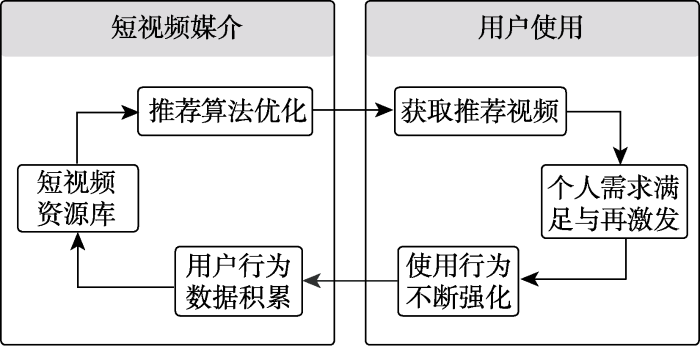
短视频迅速走红的主要原因之一是个性化推荐算法的应用(Zhao, 2021)。个性化算法能够收集用户的兴趣偏好和行为记录, 并通过内容过滤④(④内容过滤:基于先前选择的内容和可用内容之间的属性和特征相似性的内容推荐技术。)和协同过滤⑤(⑤协同过滤:基于好友关系或(某种程度上)相似用户数据的内容推荐技术。)等手段, 将短视频精准推送至用户的移动端(Geschke et al., 2019)。个性化算法对于社交媒介而言是一场巨大的变革, 因为它将人们从大量的无关信息中解放出来, 让用户不必主动搜索或选择, 而是根据算法推荐的内容进行娱乐消费。这种模式极大地降低了获取信息的成本, 并改变了人们在互联网上获取信息的习惯和体验。随着用户使用数据的积累, 算法还可以不断获得优化, 进而使得信息推送机制更加细化与精准(Bobadilla et al., 2013; Chaney et al., 2018; Zhang & Liu, 2021)。如果“个性化推送——用户需求满足——行为数据积累——算法优化——个性化推送——……”这一循环持续下去, 就会形成所谓的算法“闭环” (如图1) (Zhao, 2021)。这一循环会促使用户在一次次满足中对短视频产生依赖和难以自控, 最终可能导致短视频沉迷, 甚至成瘾(Qin et al., 2022; Smith & Short, 2022)。研究也证实, 观看个性化推荐的短视频会不断地给大脑腹侧被盖区(Ventral Tegmental Area, VTA)提供刺激, 而该区域是大脑对刺激产生快感和强化动机的神经回路, 其持续激活会使个体产生渴望和上瘾(Su et al., 2021)。
图1
3.2 内容服务层面——“多通道”满足
尽管多数短视频的时长只有几秒到几十秒, 但其包含的要素是足够丰富的(Wang, 2020)。这种丰富性可以体现在短视频的信息内容和呈现方式两方面。以抖音为例, 在信息内容方面, 短视频主题涵盖了新闻资讯、美容、烹饪、电影、教育、健康、体育和科技等多个领域, 可以满足用户的各种信息需求。在信息呈现方面, 短视频通常由明快的旋律, 醒目的文字和相应视频素材组合而成。这种“多通道式”的感官唤醒可以增强用户对信息内容的体验感, 从而进一步强化短视频使用行为。当用户与一个系统互动时, 愉快或缓解压力的体验会鼓励他们重复这种互动行为(Hernández et al., 2019; Kennett et al., 2013; Liu & Chang, 2016), 在使用短视频时同样如此。短视频丰富的刺激会激活用户的愉悦感, 缓解用户的负面情绪, 并导致用户不断增加使用频率和时长来强化这种行为(Mu et al., 2022; Tian et al., 2023)。情绪的不断重复和行为的不断强化使用户对短视频产生依赖, 最终可能导致短视频沉迷(Kennett et al., 2013)。
3.3 人机交互层面——“高收益”陷阱
简洁的交互模式和丰富的信息体验是短视频的优势和特点(Tian et al., 2023)。然而, 长期获得高可及性的刺激满足极有可能带来沉迷风险(Zhao, 2021), 从成瘾领域的相关研究中便可见一斑。研究显示, 刺激物的高可及性会使成瘾的风险增高(Gillespie et al., 2007, 2009; Volkow et al., 2019)。移动电子游戏的便携性、即时性、易用性等特点可导致更严重的游戏成瘾风险(Wang et al., 2019)。传播学学者施拉姆曾提出了一个公式用于解释人们对不同媒介的选择:选择的概率=可能的回报/需要付出的努力(威尔伯·施拉姆, 1984)。换言之, 通过使用某一媒介可能获得的满足越多、同时付出的努力越少时, 用户选择这一渠道的概率就会越高。对于短视频用户而言, 只需要单指“向上滑动”便可获得丰富不断的信息流, 这大幅降低了人们获取信息满足所需付出的成本(Huang et al., 2022; Su et al., 2021; Wu et al., 2021; Zhao, 2021)。如果以用户认知投入为成本, 以获取的刺激满足为收益, 相比于需要较高认知参与(如玩游戏)或者长时间集中注意(如看电影)的活动, 短视频使用显然是一种“低投入, 高收益”的资源交换活动。这种高收益性将不断强化短视频使用行为, 进而引起沉迷风险。
3.4 用户体验层面——“沉浸感”体验
以往关于网络成瘾的研究表明, 个体在参与使用时的沉浸感是导致沉迷的关键驱动因素之一(Kang et al., 2013; Kwak et al., 2014; Liu & Chang, 2016; Seo & Ray, 2019)。沉浸感会使得个体体验到高控制感、高意识唤醒和注意力集中, 同时还忘却周身环境和时间流逝(Michailidis et al., 2018; Yang et al., 2014; Lavoie & Zheng, 2023)。用户在与短视频这种“主动推荐, 信息丰富, 交互简洁”的媒介交互时, 他/她会更多地关注当前的刺激, 较少地考虑未来或过去, 这就是所谓的“沉浸感”。研究显示, 短视频可以通过第一人称视角的内容给用户创造沉浸感(Wang, 2020)。而且个体在观看个人账号中算法推送的短视频时, 大脑有关认知控制的区域被抑制, 以致轻易进入沉浸状态(Su et al., 2021)。而这种低成本的沉浸感可能给短视频用户带来的巨大的沉迷风险。
有必要说明, 虽有相当一部分关于网络成瘾或游戏成瘾的研究用心流来解释成瘾者的内在机理(如Chou & Ting, 2003; Huang et al., 2022; Liu & Chang, 2016; Pearson et al., 2021; Yang et al., 2014), 短视频沉迷的状态可能并非如此。心流(Flow)与沉浸感(Immersion)是有一定区别的, 而且这种区别正是区分短视频沉迷与一般网络成瘾的关键点。具体而言, 心流是指当人们完全参与一项活动时所感受到的一种整体的感觉, 是一种最佳体验(Czikszentmihalyi, 1990; Leung, 2020)。这种状态包括:高水平的能力感与控制感、高水平的挑战性与唤醒水平、注意力高度集中、内部感知愉悦感以及高目标性和成就感等。因此, 达成心流状态的一个条件是个体自身的能力与任务挑战性之间需达到平衡(Liu & Chang, 2016; Yang et al., 2014; Zhou, 2013)。在使用短视频时, 用户只需付出很低的交互成本便可获得丰富的信息刺激, 这并不满足心流体验的前提条件。而沉浸感是一种主观体验, 是主体感知自己被包围在一个提供连续刺激体验的环境中的感觉(Witmer & Singer, 1998; Xu & Tayyab, 2021)。尽管沉浸感与心流在结构上仅有细微差别, 但是两者代表了不同的心理现象(Michailidis et al., 2018)。沉浸不是一种极端状态, 不需要满足高水平的交互平衡与感知愉悦。总之, 相比于心流, 沉浸感可能更适合用于描述个体使用短视频时专注状态。
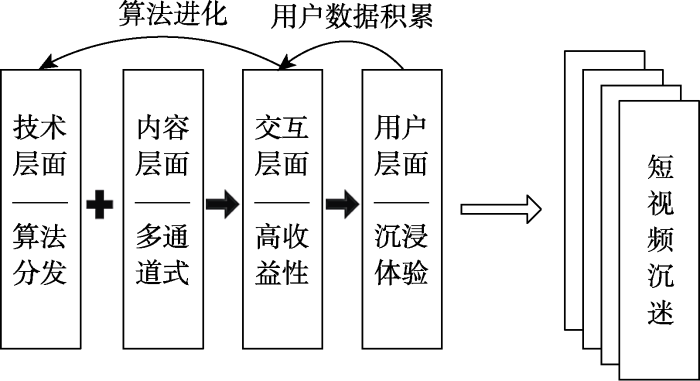
经过对现有研究的梳理, 以及全新的人机互动视角下的分析, 笔者认为短视频具有比一般社交媒介更大的致沉迷性, 值得独特关注。信息技术、内容服务、人机交互、用户体验是用户与短视频媒介交互的4个组成部分(如图2), 在框架每个层面均指出了该环节最为关键的要素(并不唯一), 以为未来研究提供了清晰的研究入口; 此外, 该框架还融入了算法“闭环”的内容, 使其整体循环实现闭合, 从而更加形象地呈现短视频沉迷的行为强化过程。要揭示短视频沉迷的发生机制, 系统梳理短视频沉迷的影响要素, 仅关注交互部分还远远不够, 短视频使用主体的易感特征也是沉迷行为的关键组成部分。
图2
4 短视频沉迷的易感特征
4.1 普遍易感特征
依据生命全程观, 个体当前的行为表现有来自遗传和成长经历的作用。研究显示, 携带特定基因型的个体更容易表现出对网络刺激的沉迷(Hahn et al., 2017); 生命早期经历的负性生活事件(Schneider et al., 2017), 以及随之产生的不安全依恋(Alvarez-Monjaras et al., 2019; Zhang et al., 2019)也可能导致个体对即时性满足的依赖; 从心理健康角度, 具有社交焦虑和较高感知社会排斥的个体更容易从网络中寻求补偿, 进而表现出沉迷行为(Ho et al., 2014); 在人格特质方面, 神经质和冲动性常常被视为沉迷的风险因素(Kayiş et al., 2016)。在生活环境方面, 同伴压力(张锦涛 等2012)和伴侣低头行为(Dong et al., 2022)会导致个体出现更多的沉迷行为。以上提及的对沉迷行为具有普遍促发作用的因素, 对诱发短视频用户的沉迷行为仍然适用。如:毛峥和姜永志(2022)研究发现, 神经质人格可以显著正向预测短视频沉迷。Zhang等人(2019)研究也发现, 具有社交焦虑和较高感知社会排斥的个体更容易产生短视频沉迷。当然, 还有一些个体因素, 如高自我控制能力(Li et al., 2021)、高感知社会支持(Lei et al., 2018)等, 被认为是沉迷行为的保护因素。未来研究者还应结合短视频的特征进行更具针对性的研究。
4.2 独特易感特征
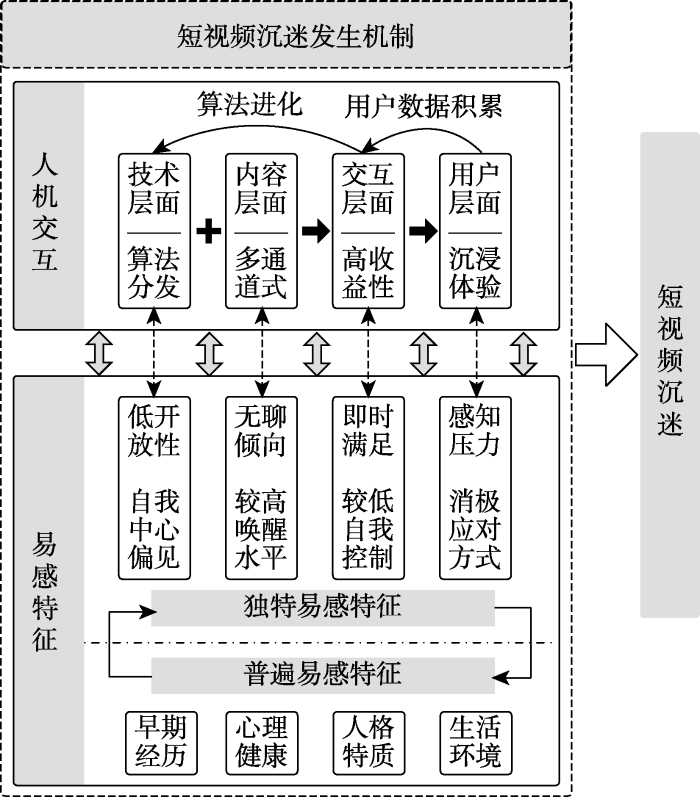
相比于传统社交媒介, 短视频具有个性化算法推荐, 内容简短且丰富, 交互成本低等诸多特征。种种特征也许会与短视频用户的某些个性或需求高度契合, 共同组成沉迷行为的“助推手”。下面从需要−动机视角, 针对短视频沉迷外部发生机制的4个方面(信息技术、内容服务、人机交互、用户体验), 提出一些潜在易感特征:1)短视频背后的个性化推荐算法使用户被个人偏好的信息所包围。因此, 具有低开放性人格特质或者自我中心偏见的个体, 可能更加适应短视频算法的信息分发机制, 从而有更大的沉迷风险; 2)短视频内容简短但要素丰富, 可以在碎片化时间给予用户刺激满足。因而具有无聊倾向、感觉寻求以及较高最佳唤醒水平的短视频用户更可能产生沉迷行为; 3)短视频作为一种信息媒介, 交互简洁和认知参与度低是其主要特征。对于那些寻求即时满足、具有较低自我控制能力的用户, 短视频沉迷是一种潜在的风险; 4)观看短视频可以让用户抽身于压力环境, 排解负面情绪。所以对压力敏感性高、当前感知压力高、持有抑郁情绪、同时采用消极应对方式的用户更可能产生短视频沉迷(Liu et al., 2021; Yao et al., 2023)。需要注意的是, 这些基于交互过程的沉迷易感因素多是基于理论的思考结果, 亟需未来研究的科学验证。
4.3 短视频沉迷的发生机制
前文基于人机交互的视角, 对短视频沉迷发生过程中的相关因素进行了归纳与梳理。主要分为短视频媒介特征及其伴随的交互特征和用户易感特征两部分。这些因素的叠加便可能将用户短视频使用行为由“工具性”推向“仪式性”, 最终导致短视频沉迷的发生。本文在此基础上构建了短视频沉迷发生机制框架, 从人机交互和易感特征两个方面进行探讨(见图3)。其中, 第一部分包括信息技术、内容服务、人机交互和用户体验四个环节, 其典型特征可以概括为技术的先进性、内容的丰富性、交互的高收益性以及用户的沉浸体验。此外, 在推荐算法的驱动下, 用户的短视频使用行为被不断强化。第二部分梳理了短视频沉迷的易感因素。独特易感特征的4个类别与交互机制的4个环节相对应, 而普遍易感特征展示的类别对一般沉迷行为均具有诱发作用。考虑到短视频沉迷与一般网络沉迷存在相似之处, 因此“独特”和“普遍”两类易感特征存在相互交叉和重叠。总体而言, 交互机制的作用在于唤醒易感特征, 从而使个体更容易受到引诱并陷入沉迷行为的循环; 而易感特征也会加大用户对诱发因素的响应程度和脆弱性。人机交互部分的各种要素, 在推荐算法的驱动下与用户的易感特征相互交织, 促使用户的短视频使用形式由“工具性”转向“仪式性”, 最终导致短视频沉迷的发生。该框架尝试阐明短视频沉迷的起因和过程, 并为该领域的研究者提供一个系统的思考框架, 以促进短视频沉迷的科学治理。
图3
5 短视频沉迷的相关理论
短视频沉迷的发生机制可以通过梳理导致沉迷的多种因素及其相互作用进行揭示。但欲更深入地理解短视频沉迷的心理机制, 还需要科学理论层面的剖析。下面将从认知、情绪、动机和社会层面对短视频沉迷进行理论阐述, 以期提升公众对短视频使用的思考, 为短视频沉迷问题的研究提供科学依据。
5.1 认知层面——双加工理论(Dual Process Theory)
双加工理论认为个体的认知与决策是在自动化加工系统和控制化加工系统协调作用下实现的(de Neys & Glumicic, 2008)。其中, 自动化加工系统依赖于环境线索, 是联想的、自动的, 可以直接控制行为而不需要注意力参与; 控制化加工系统是去情境的, 基于规则的, 需要有意注意参与(Henden, 2017)。双加工理论指出:由于认知资源有限, 当控制化加工系统较弱或受损时, 自动化加工系统对行为的影响应更大; 当控制化加工系统较强或完好时, 自动化加工系统的影响应较小。个体为了理性而有效地实现目标, 在决策过程中必须保证控制化加工系统能够发挥其监督与控制功能, 以抑制自动化加工系统的直觉冲动行为(Saunders & Over, 2009)。近些年, 双加工理论常被用于解释成瘾的内部机制。研究发现, 沉迷行为的形成与自动化加工系统的增强以及控制化加工系统的减弱有关(严万森 等, 2021; Lindgren et al., 2019), 该观点还得到了神经生理学研究的支持(Koob & Volkow, 2010)。Su等人(2021)研究也显示, 参与者在观看个性化短视频的过程中, 大脑默认网络(DMN)激活且与视觉、听觉通路的耦合增强, 但其与楔前叶和扣带皮层耦合减少。这意味着此时的注意资源被高度集中于视听信息处理, 注意力调节出现困难; 同时涉及认知控制的部位被抑制, 从而可能导致短视频使用行为失控。可以认为, 该研究从神经生物学的角度揭示了短视频使用过程中大脑的认知加工模式。在此基础上, 由于个体在与短视频媒介互动时认知参与很低, 自动化加工系统会不断获得强化, 控制化加工系统将受到限制, 结果引发强迫性使用⑥(⑥“强迫性行为”指一种重复性的, 行为主体虽意识到已经偏离总体目标, 但又“必须执行”的行为(Luigjes et al., 2019)。), 最终可能导致短视频沉迷。
5.2 情绪层面——对立过程理论(The Opponent Process Theory)
短视频主要作为一种娱乐信息媒介, 当用户与其交互时, 愉悦感就会作为刺激出现, 激活用户的积极情绪或享乐状态。此时, 正强化(或积极情绪)被激活。在现实情境中, 由于心理或外部因素, 用户往往不得不(暂时)停止使用短视频。一旦刺激停止或减少, 正强化就会丧失, 同时触发负强化(或消极情绪), 也就是愤怒和压力等不良感受。为了保持积极情绪和减少消极情绪, 用户必须反复激活短视频使用行为, 最终可能导致短视频沉迷(Tian et al., 2023)。
5.3 动机层面——使用与满足理论(Uses and Gratifications Theory)
使用与满足理论(Katz et al., 1973)是传播学领域最著名的经典理论之一, 它的提出与流行标志着传播领域媒体人的中心地位被打破, 媒体受众的使用需求转而成为了内容生产的目标向导。使用与满足理论有助于阐明人们对某一特定媒体的选择, 并理解促使人们利用该媒体的基本需求。早期的研究已经将使用与满足理论应用于许多传统媒体使用的场景, 如看电视和收听广播; 同时该理论也被广泛应用到新式媒介研究中, 如Facebook和Instagram (Omar & Dequan, 2020)。该理论认为个人受到心理、社会和文化的影响, 利用信息媒体来完成一些被认为具有满足性的目的。个体喜好的差异将引起使用内容/类型上的差异。例如:喜爱网游的青少年会关注一些分享精彩游戏瞬间的视频博主; 热衷军事和现代武器的年轻人可能常常浏览一些战场前线视频, 并以此获得满足。短视频这种新式媒介能如此盛行, 无疑是切合了社会大众的各种需求。
以往研究显示, 短视频使用可以满足用户的人际/归属需要(Tian et al., 2023; Zhang et al., 2019)、自我呈现需要(Wu et al., 2021)、娱乐需要(Liang, 2021; Lu & Lu, 2019)、压力释放(Mu et al., 2022)、新潮追求(Scherr & Wang, 2021)。同时在短视频使用过程中, 用户还会不断发现新的需要, 并激发新的使用动机(Zhang & Liu, 2021)。Zhang等人(2023)的研究也发现, 用户通过使用短视频满足各种需求的补偿性期望可能会促进其过度使用的倾向。总之, 短视频用户不同的需要会唤起不同的使用动机, 进而出现不同的短视频关注方向与使用强度。随着时代的进步和主流平台的不断更迭, 新趋势、新潮流盛行的背后, 是新型媒介对大众新需求的满足与切合, 抑或是激发与满足(Boczkowski et al., 2018)。因此, 系统论述使用与满足理论视角下短视频用户的心理需要, 厘清不同需要驱使下的使用形式和强度, 将为短视频的合理使用和管理规范提供科学的指导。
5.4 社会层面——技术社会塑造理论(Social Shaping of Technology)
技术社会塑造理论(Social Shaping of Technology)也指出, 技术的后果产生于一系列支持性因素, 是个人、技术和相关制度的结合, 这些因素共同影响了技术的发展和后续的使用(Baym et al., 2004; Scherr & Wang, 2021)。技术社会塑造理论是用来解释技术的设计和应用如何受到一系列社会和经济因素以及狭隘的技术层面的影响(Williams & Edge, 1996)。该理论是在对“技术决定论”的批判下出现的, 与以往只关注技术进步结果的传统视角不同, 该理论注重考察技术的内容和创新所涉及的特定过程。具体而言, 技术社会塑造理论的核心在于——新技术的产生和实施的每一个阶段都会涉及到不同技术方案之间的抉择(尽管不一定是有意识的选择), 而每一次抉择又直接或间接地受到了社会或人的影响, 进而再对人和社会产生相应的影响(Williams & Edge, 1996)。换句话说, 必须打开技术的“黑箱”, 揭示和分析技术创新过程中的社会经济模式, 才能明晰技术及其影响的真正本源。
短视频内容个性化推荐的实现离不开推荐算法的支持, 而推荐算法的不断“进化”并不是工程师单独完成的, 而是在用户反馈的驱动下逐步实现的。互联网应用服务水平不断提高, 用户对互联网内容的需求更加具体、精准。个性化推荐算法应运而生, 并在用户不断积累的行为数据推动下获得发展。但是在面对短视频沉迷时, 我们不能简单地将责任归因于推荐算法或者短视频平台, 而是应该从社会发展大环境和用户需求角度对技术产物(如短视频)进行理性思考。例如, 短视频媒介是否“存在即合理”?为什么不同个体对于短视频的态度不一样?如果忽略了社会或人对技术的塑造, 只单向论究技术(或产品)对个体和社会的影响, 在布置预防措施时就永远“慢一拍”。
6 现有研究不足与未来展望
6.1 研究方法单一, 应丰富研究思路
对于同一个科学问题, 不同的研究途径满足了从不同研究视角切入的方法论需求, 同时可以揭示问题的多个方面。总结发现, 现有的短视频沉迷研究多通过参与者问卷报告的形式获取研究数据(如Feng et al., 2022), 且未考虑到短视频沉迷的特异性。罗光福(2022)曾采用质性研究提出了短视频沉迷的针对性测量方法, 但该方案将用户在短视频平台的其它使用内容(如领金币)也包含进去, 而这已经超出了短视频的范畴, 更像是针对某短视频平台的沉迷测量。当然, 前人在构建网络成瘾和Facebook成瘾的测量方案时也出现过类似的情况(Lortie & Guitton, 2013; Ryan et al., 2014)。未来研究可以尝试从以下途径丰富短视频沉迷的研究思路:1)通过访谈法或专家评估(可参考Hsu et al., 2015)开发短视频沉迷量表, 以针对性地判断用户是否出现短视频沉迷; 2)使用神经影像技术(可参考Su et al., 2021), 如功能性磁共振成像(fMRI)、脑电图(EEG)等, 观察用户在观看短视频时的大脑活动, 分析用户的注意力、情绪、奖赏系统等神经机制, 从而揭示短视频沉迷的神经基础; 3)使用行为实验, 如随机控制试验(RCT)、延迟折扣任务(DDT)等, 探究用户在不同条件下的选择偏好、决策能力、自我调节策略等方面的表现, 从而理解短视频沉迷的行为特征。
6.2 技术关注不足, 应强调致沉迷技术改良
游戏成瘾、问题性社交网站使用等问题已经得到广泛的研究, 然而很少有学者从技术或设备的角度对沉迷起因进行探讨(Smith & Short, 2022; Tian et al., 2023)。短视频沉迷作为一个在技术促发下的新兴问题更是如此。短视频平台的推荐算法不断地根据市场的反馈进行更迭, 算法的具体参数也在根据用户的个人信息变化和使用行为积累而进化。用户的短视频使用行为越多, 推荐算法就会越投其所好, 进而导致用户更深的卷入(Zhang & Liu, 2021)。与一般网络社交平台相比, 短视频使用中互动的关键不在用户和他们的社交网络之间, 而是用户和所谓的算法自我之间(Bhandari & Bimo, 2020)。这提示我们, 短视频使用和算法优化之间可能存在着某种闭环(见图1), 而这种效应持续下去可能会导致更多的用户沉迷, 甚至更大的社会影响。简单地将短视频服务背后的技术支持视作黑箱不是长久之计, 因为越过个性化算法去研究短视频对用户的影响, 可能无法真正触及问题的核心。不妨从“供给侧”进行思考:如果平台一味追求用户画像的丰富性、内容推荐的精准性, 只会导致越来越多的用户出现仪式性使用行为, 甚至是短视频沉迷。短视频平台既然可利用智能算法实现对用户信息偏好的精准定位, 也应可以在人本人工智能的框架引领下不断追求短视频媒介与用户的和谐共生。在此, 本文建议短视频平台坚持以用户为中心, 开发更加负责的、透明的算法(见 Elahi et al., 2022)。算法领域研究者也应该更多地关注推荐算法可能带来的负面效应, 而不是简单以提高用户粘性为目标。如此, 短视频使用主动权便回到用户手中, 短视频媒介也因与用户形成更和谐的生态而获得广阔的发展前景。
6.3 形成机理不清晰, 应深化发生机制研究
治本之道在于深刻洞悉问题的本质。然而, 目前的研究主要关注短视频沉迷的危害, 忽视了沉迷的发生机制, 导致对该问题认识不深刻, 因而无法提出切实有效的治理方案。本文提出的短视频沉迷发生机制框架(见图3), 旨在为该领域的研究者提供系统研究的思路。信息技术、内容服务、人机交互、用户体验是短视频使用涉及的四个环节, 同时也是短视频沉迷的潜在成因。短视频服务中技术的先进性, 内容的丰富性, 交互的简洁性以及用户的体验性均与传统社交媒介有所区别。同时, 这些特性可能与用户需求及心理特性交织在一起, 促成短视频沉迷的发生。未来的研究, 在深入短视频沉迷外部的促发机制的同时, 也要进一步探究短视频用户沉迷的心理与行为因素。短视频沉迷的外部机制梳理和内部机制探讨将共同服务于厘清整个问题行为的来龙去脉, 进而为制定预防和干预措施提供科学指导。另一方面, 通过向公众普及短视频沉迷的内部机制, 有望提高公众对该潜在风险的认识和理解, 以实现“治本”之效果。
6.4 用户特征研究不足, 应重视易感因素研究
在网络成瘾领域, van Rooij和Prause (2014)曾指出:探讨导致高网络使用率的个体差异可能比诊断网络成瘾更有用。对短视频沉迷的研究亦是如此, 不仅要对短视频媒介进行研究, 还要关注短视频用户的沉迷易感性。秦浩轩(2020)通过对我国大学生进行研究发现:神经质和外向性人格可以显著正向预测短视频沉迷, 宜人性可以显著负向预测短视频沉迷。另外, Zhang等人(2019)研究发现, 具有社交焦虑和较高感知社会排斥的个体更容易产生短视频沉迷。从短视频角度出发, 个性化推荐算法是助推短视频沉迷的关键因素之一(Zhao, 2021)。也即, 推荐算法的应用, 促使更多的用户成为短视频沉迷易感群体的一部分。在用户合理应对短视频推荐算法、主动避免短视频沉迷时, 算法素养可能是的重要知识储备(Bakshy et al., 2015)。因此, 普及算法相关知识及其运作模式, 提高用户对算法的理性思考能力与应对能力, 可能实现降低用户被算法所“奴役”的可能性, 从而达到对短视频沉迷的群体预防。建议未来研究设计随机对照干预实验, 探讨提升用户算法素养对其短视频沉迷的保护作用。之后的研究者可以进一步从个体所处的环境、个体的压力感状态、社会支持系统、个体的人格特征等方面, 逐步深入短视频沉迷的易感群体和促成因素研究, 以为短视频沉迷的科学预防提供更具针对性的建议。
参考文献
合力防范青少年短视频沉迷
强迫性特征在药物成瘾行为中的易感性及其前额叶-反奖赏系统神经基础
DOI:10.3724/SP.J.1042.2021.01345
[本文引用: 1]

强迫性是一种与不顾严重后果的固着行为密切相关的神经心理结构, 大脑神经系统对强迫性行为的调控机制崩溃是导致药物成瘾的直接原因。以往研究对于奖赏系统(中脑-皮层-边缘神经环路)在成瘾行为中的作用及机制已经具有丰富的了解, 但针对药物成瘾的强迫性特征本身以及前额叶-反奖赏系统神经环路在成瘾行为中的作用机制了解有限, 尤其是缺乏对药物成瘾强迫性特征的系统考察、缺少遗传学研究以及非兴奋剂类药物的汇聚证据。项目拟结合人类成瘾行为的遗传学视角(海洛因成瘾者与其无药物使用的兄弟姐妹对照), 结合神经认知、脑电生理、神经影像等不同层面的方法和技术, 对药物成瘾强迫性的外在表征、神经生物学基础以及与个体差异有关的遗传易感性进行探索, 期在进一步识别药物成瘾的神经生物标记, 为探寻潜在的药物或非药物干预靶点提供更多证据。
A developmental model of addictions: Integrating neurobiological and psychodynamic theories through the lens of attachment
Exposure to ideologically diverse news and opinion on Facebook
DOI:10.1126/science.aaa1160
PMID:25953820
[本文引用: 1]
Exposure to news, opinion, and civic information increasingly occurs through social media. How do these online networks influence exposure to perspectives that cut across ideological lines? Using deidentified data, we examined how 10.1 million U.S. Facebook users interact with socially shared news. We directly measured ideological homophily in friend networks and examined the extent to which heterogeneous friends could potentially expose individuals to cross-cutting content. We then quantified the extent to which individuals encounter comparatively more or less diverse content while interacting via Facebook's algorithmically ranked News Feed and further studied users' choices to click through to ideologically discordant content. Compared with algorithmic ranking, individuals' choices played a stronger role in limiting exposure to cross-cutting content. Copyright © 2015, American Association for the Advancement of Science.
Social interactions across media: Interpersonal communication on the internet, telephone and face-to-face
DOI:10.1177/1461444804041438
URL
[本文引用: 1]
Two studies compared college students’ interpersonal interaction online, face-to-face, and on the telephone. A communication diary assessed the relative amount of social interactions college students conducted online compared to face-to-face conversation and telephone calls. Results indicated that while the internet was integrated into college students’ social lives, face-to-face communication remained the dominant mode of interaction. Participants reported using the internet as often as the telephone. A survey compared reported use of the internet within local and long distance social circles to the use of other media within those circles, and examined participants’ most recent significant social interactions conducted across media in terms of purposes, contexts, and quality. Internet interaction was perceived as high in quality, but slightly lower than other media. Results were compared to previous conceptualizations of the roles of internet in one’s social life.
TikTok and the “algorithmized self”: A new model of online interaction
Recommender systems survey
DOI:10.1016/j.knosys.2013.03.012 URL [本文引用: 1]
How young users deal with multiple platforms: The role of meaning-making in social media repertoires
DOI:10.1093/jcmc/zmy012 URL [本文引用: 1]
The Interaction of Person-Affect-Cognition-Execution (I-PACE) model for addictive behaviors: Update, generalization to addictive behaviors beyond internet-use disorders, and specification of the process character of addictive behaviors
DOI:10.1016/j.neubiorev.2019.06.032 URL [本文引用: 2]
Integrating psychological and neurobiological considerations regarding the development and maintenance of specific Internet-use disorders: An Interaction of Person-Affect-Cognition-Execution (I-PACE) model
DOI:10.1016/j.neubiorev.2016.08.033 URL [本文引用: 1]
How algorithmic confounding in recommendation systems increases homogeneity and decreases utility
Passive social network site use and subjective well-being: A moderated mediation model
DOI:10.1016/j.chb.2016.04.038 URL
The effect of short-form video addiction on users’ attention
The role of flow experience in cyber-game addiction
The echo chamber effect on social media
Conflict monitoring in dual process theories of thinking
Popular dual process theories have characterized human thinking as an interplay between an intuitive-heuristic and demanding-analytic reasoning process. Although monitoring the output of the two systems for conflict is crucial to avoid decision making errors there are some widely different views on the efficiency of the process. Kahneman [Kahneman, D. (2002). Maps of bounded rationality: A perspective on intuitive judgement and choice. Nobel Prize Lecture. Retrieved January 11, 2006, from: http://nobelprize.org/nobel_prizes/economics/laureates/2002/kahnemann-lecture.pdf] and Evans [Evans, J. St. B. T. (1984). Heuristic and analytic processing in reasoning. British Journal of Psychology, 75, 451-468], for example, claim that the monitoring of the heuristic system is typically quite lax whereas others such as Sloman [Sloman, S. A. (1996). The empirical case for two systems of reasoning. Psychological Bulletin, 119, 3-22] and Epstein [Epstein, S. (1994). Integration of the cognitive and psychodynamic unconscious. American Psychologists, 49, 709-724] claim it is flawless and people typically experience a struggle between what they "know" and "feel" in case of a conflict. The present study contrasted these views. Participants solved classic base rate neglect problems while thinking aloud. In these problems a stereotypical description cues a response that conflicts with the response based on the analytic base rate information. Verbal protocols showed no direct evidence for an explicitly experienced conflict. As Kahneman and Evans predicted, participants hardly ever mentioned the base rates and seemed to base their judgment exclusively on heuristic reasoning. However, more implicit measures of conflict detection such as participants' retrieval of the base rate information in an unannounced recall test, decision making latencies, and the tendency to review the base rates indicated that the base rates had been thoroughly processed. On control problems where base rates and description did not conflict this was not the case. Results suggest that whereas the popular characterization of conflict detection as an actively experienced struggle can be questioned there is nevertheless evidence for Sloman's and Epstein's basic claim about the flawless operation of the monitoring. Whenever the base rates and description disagree people will detect this conflict and consequently redirect attention towards a deeper processing of the base rates. Implications for the dual process framework and the rationality debate are discussed.
Instrumental and pavlovian mechanisms in alcohol use disorder
DOI:10.1007/s40429-020-00333-9
[本文引用: 2]
Current theories of alcohol use disorders (AUD) highlight the importance of Pavlovian and instrumental learning processes mainly based on preclinical animal studies. Here, we summarize available evidence for alterations of those processes in human participants with AUD with a focus on habitual versus goal-directed instrumental learning, Pavlovian conditioning, and Pavlovian-to-instrumental transfer (PIT) paradigms.
Parental phubbing and chinese adolescents’ SNSs addiction: Loneliness as a mediator and self-esteem as a moderator
DOI:10.1007/s12144-022-04066-y [本文引用: 1]
Towards responsible media recommendation
DOI:10.1007/s43681-021-00107-7
[本文引用: 1]
Reading or viewing recommendations are a common feature on modern media sites. What is shown to consumers as recommendations is nowadays often automatically determined by AI algorithms, typically with the goal of helping consumers discover relevant content more easily. However, the highlighting or filtering of information that comes with such recommendations may lead to undesired effects on consumers or even society, for example, when an algorithm leads to the creation of filter bubbles or amplifies the spread of misinformation. These well-documented phenomena create a need for improved mechanisms for responsible media recommendation, which avoid such negative effects of recommender systems. In this research note, we review the threats and challenges that may result from the use of automated media recommendation technology, and we outline possible steps to mitigate such undesired societal effects in the future.
Neural systems of reinforcement for drug addiction: From actions to habits to compulsion
DOI:10.1038/nn1579
PMID:16251991
[本文引用: 1]
Drug addiction is increasingly viewed as the endpoint of a series of transitions from initial drug use--when a drug is voluntarily taken because it has reinforcing, often hedonic, effects--through loss of control over this behavior, such that it becomes habitual and ultimately compulsive. Here we discuss evidence that these transitions depend on interactions between pavlovian and instrumental learning processes. We hypothesize that the change from voluntary drug use to more habitual and compulsive drug use represents a transition at the neural level from prefrontal cortical to striatal control over drug seeking and drug taking behavior as well as a progression from ventral to more dorsal domains of the striatum, involving its dopaminergic innervation. These neural transitions may themselves depend on the neuroplasticity in both cortical and striatal structures that is induced by chronic self-administration of drugs.
Analysis of “Anesthesia” Mechanism in Mobile Short Video Applications
A cognitive-emotional model from mobile short-form video addiction to intermittent discontinuance: The moderating role of neutralization
The triple-filter bubble: Using agent‐based modelling to test a meta- theoretical framework for the emergence of filter bubbles and echo chambers
DOI:10.1111/bjso.12286
PMID:30311947
[本文引用: 1]
Filter bubbles and echo chambers have both been linked recently by commentators to rapid societal changes such as Brexit and the polarization of the US American society in the course of Donald Trump's election campaign. We hypothesize that information filtering processes take place on the individual, the social, and the technological levels (triple-filter-bubble framework). We constructed an agent-based modelling (ABM) and analysed twelve different information filtering scenarios to answer the question under which circumstances social media and recommender algorithms contribute to fragmentation of modern society into distinct echo chambers. Simulations show that, even without any social or technological filters, echo chambers emerge as a consequence of cognitive mechanisms, such as confirmation bias, under conditions of central information propagation through channels reaching a large part of the population. When social and technological filtering mechanisms are added to the model, polarization of society into even more distinct and less interconnected echo chambers is observed. Merits and limits of the theoretical framework, and more generally of studying complex social phenomena using ABM, are discussed. Directions for future research such as ways of comparing our simulations with actual empirical data and possible measures against societal fragmentation on the three different levels are suggested.© 2018 The Authors. British Journal of Social Psychology published by John Wiley & Sons Ltd on behalf of British Psychological Society.
Internet addiction-time to be taken seriously?
DOI:10.3109/16066350009005587 URL [本文引用: 2]
Longitudinal modeling of genetic and environmental influences on self-reported availability of psychoactive substances: Alcohol, cigarettes, marijuana, cocaine and stimulants
Although an obvious environmental factor influencing drug use, the sources of individual differences in drug availability (DA) are unknown.This report is based on 1788 adult males from the Mid-Atlantic Twin Registry who participated in a structured telephone interview that included retrospective assessments of DA (cigarette, alcohol, marijuana, cocaine and stimulants) between ages 8 and 25. We fitted a biometric dual change score (DCS) model, adapted for ordinal data, to model latent growth and estimate the genetic and environmental components of variance over time.DA, despite being considered an environmental risk factor, is under both genetic and environmental control. For cigarette, alcohol, marijuana and cocaine availability, there was an overall increase in additive genetic variance and a decline in shared environmental variance over time. Non-shared environmental variance remained steady. Stimulant availability did not follow this pattern. Instead, there was an upswing in shared environmental effects with increasing age.We have modeled the genetic and environmental architecture of changes in DA across adolescence. The rise in additive genetic variance over time coincides with acceleration in the expression of individual differences, probably brought on by an increase in personal freedom and a reduction in social constraints. Understanding the etiology of DA is likely to reveal key components, acting directly or indirectly, in the pathway(s) leading to drug initiation, abuse and dependence.
Pathways to cannabis abuse: A multi-stage model from cannabis availability, cannabis initiation and progression to abuse
DOI:10.1111/j.1360-0443.2008.02456.x
PMID:19207351
[本文引用: 1]
Although previous twin studies have modeled the association between drug initiation and abuse, none has included the obvious risk factor of drug availability. Our aim is to determine whether the genetic and environmental risk factors for cannabis availability also generate variation in cannabis initiation and/or progression to DSM-IV symptoms of abuse.We used multi-stage modeling, also known as causal-common-contingent (CCC) analysis, to partition the genetic and environmental factors into common and stage-specific components.This report is based on data collected from 1772 adult males from the Mid Atlantic Twin Registry.The twins participated in two structured interviews which included clinical and non-clinical measures of cannabis abuse as well as retrospective assessments of perceived cannabis availability between ages 8 and 25 years.Cannabis availability explained almost all the shared environmental risks in cannabis initiation and abuse. The influence of availability on the symptoms of abuse was indirect and mediated entirely by cannabis initiation.These findings have begun to elucidate the causal processes underlying the liability to drug use and abuse in terms of putative risk factors. Specifically, our results show that the latent shared environmental factors in cannabis initiation and abuse can be explained by measured aspects of the shared environment--those responsible for variation in cannabis availability.
Internet addiction and its facets: The role of genetics and the relation to self-directedness
DOI:S0306-4603(16)30375-6
PMID:27816039
[本文引用: 1]
A growing body of research focuses on problematic behavior patterns related to the use of the Internet to identify contextual as well as individual risk factors of this new phenomenon called Internet addiction (IA). IA can be described as a multidimensional syndrome comprising aspects such as craving, development of tolerance, loss of control and negative consequences. Given that previous research on other addictive behaviors showed substantial heritability, it can be expected that the vulnerability to IA may also be due to a person's genetic predisposition. However, it is questionable whether distinct components of IA have different etiologies. Using data from a sample of adult monozygotic and dizygotic twins and non-twin siblings (N=784 individuals, N=355 complete pairs, M=30.30years), we investigated the magnitude of genetic and environmental influences on generalized IA as well as on specific facets such as excessive use, self-regulation, preference for online social interaction or negative consequences. To explain the heritability in IA, we further examined the relation to Self-Directedness as potential mediating source. Results showed that relative contributions of genetic influences vary considerable for different components of IA. For generalized IA factors, individual differences could be explained by shared and non-shared environmental influences while genetic influences did not play a role. For specific facets of IA and private Internet use in hours per week, heritability estimates ranged between 21% and 44%. Bivariate analysis indicated that Self-Directedness accounted for 20% to 65% of the genetic variance in specific IA facets through overlapping genetic pathways. Implications for future research are discussed.Copyright © 2016 Elsevier Ltd. All rights reserved.
Depressed and swiping my problems for later: The moderation effect between procrastination and depressive symptomatology on internet addiction
DOI:10.1016/j.chb.2019.02.027 URL [本文引用: 1]
The association between internet addiction and psychiatric co-morbidity: A meta-analysis
DOI:10.1186/1471-244X-14-1 URL [本文引用: 1]
Associative learning mechanisms underpinning the transition from recreational drug use to addiction
Examining the diagnostic criteria for Internet addiction: Expert validation
DOI:10.1016/j.jfma.2014.03.010 URL [本文引用: 1]
A techno- psychological approach to understanding problematic use of short-form video applications: The role of flow
DOI:10.3389/fpsyg.2022.971589
URL
[本文引用: 2]
Short-form video applications (SVAs) have been gaining increasing popularity among users, which has raised the concern of problematic SVA use. Flow—a positive experience in which individuals feel immersion, enjoyment, temporal dissociation, and curiosity—contributes to the development of problematic SVA use. Most of the prior research examined the motivations of flow and the self-traits that trigger flow, but paid limited attention to the technological affordances of smartphone applications that facilitate users' flow. Algorithm recommendation, multimodality, and low-cost interaction are three affordances of SVAs. Thus, drawing upon the stimulus-organism-response (S-O-R) framework, this study proposes a mediation model to examine how these affordances influence problematic SVA use through flow. An online survey (N = 621) showed that algorithm recommendation was negatively associated with problematic SVA use but was not significantly correlated to flow. Multimodality was directly and positively associated with problematic SVA use. Meanwhile, the relationship between these two variables were mediated by flow. Low-cost interaction had an indirect link with problematic SVA use via flow, while the direct link between them was not significant. The results suggest that low-cost interaction is the affordance that is most likely to trigger flow and problematic SVA use, followed by multimodality. However, algorithm recommendation seems to be an affordance that is less likely to facilitate flow or cause problematic SVA use. Our proposed model not only enriches the S-O-R framework in the digital environment, but also denotes a techno-psychological approach to examine problematic use of SVAs and other digital applications. Moreover, the findings offer practical implications for optimizing SVAs' technological affordances to properly manage problematic SVA use.
Internet addiction as a manageable resource: A focus on social network services
DOI:10.1108/14684521311311612
URL
[本文引用: 1]
The purpose of this paper is to reinterpret addiction to social network services (SNSs), not from the traditional clinical perspective as a disorder, but from a management perspective as consumer behaviour to examine its possibility as a manageable resource.
Uses and gratifications research
DOI:10.1086/268109 URL [本文引用: 1]
Big five-personality trait and internet addiction: A meta-analytic review
DOI:10.1016/j.chb.2016.05.012 URL [本文引用: 1]
Pleasure and addiction
DOI:10.3389/fpsyt.2013.00117
PMID:24093020
[本文引用: 2]
What is the role and value of pleasure in addiction? Foddy and Savulescu (1) have claimed that substance use is just pleasure-oriented behavior. They describe addiction as "strong appetites toward pleasure" and argue that addicts suffer in significant part because of strong social and moral disapproval of lives dominated by pleasure seeking. But such lives, they claim, can be autonomous and rational. The view they offer is largely in line with the choice model and opposed to a disease model of addiction. Foddy and Savulescu are sceptical of self-reports that emphasize the ill effects of addiction such as loss of family and possessions, or that claim an absence of pleasure after tolerance sets in. Such reports they think are shaped by social stigma which makes available a limited set of socially approved addiction narratives. We will not question the claim that a life devoted to pleasure can be autonomously chosen. Nor do we question the claim that the social stigma attached to the use of certain drugs increases the harm suffered by the user. However our interviews with addicts (as philosophers rather than health professionals or peers) reveal a genuinely ambivalent and complex relationship between addiction, value, and pleasure. Our subjects did not shy away from discussing pleasure and its role in use. But though they usually valued the pleasurable properties of substances, and this played that did not mean that they valued an addictive life. Our interviews distinguished changing attitudes towards drug related pleasures across the course of substance use, including diminishing pleasure from use over time and increasing resentment at the effects of substance use on other valued activities. In this paper we consider the implications of what drug users say about pleasure and value over the course of addiction for models of addiction.
Neurocircuitry of addiction
DOI:10.1038/npp.2009.110
PMID:19710631
[本文引用: 1]
Drug addiction is a chronically relapsing disorder that has been characterized by (1) compulsion to seek and take the drug, (2) loss of control in limiting intake, and (3) emergence of a negative emotional state (eg, dysphoria, anxiety, irritability) reflecting a motivational withdrawal syndrome when access to the drug is prevented. Drug addiction has been conceptualized as a disorder that involves elements of both impulsivity and compulsivity that yield a composite addiction cycle composed of three stages: 'binge/intoxication', 'withdrawal/negative affect', and 'preoccupation/anticipation' (craving). Animal and human imaging studies have revealed discrete circuits that mediate the three stages of the addiction cycle with key elements of the ventral tegmental area and ventral striatum as a focal point for the binge/intoxication stage, a key role for the extended amygdala in the withdrawal/negative affect stage, and a key role in the preoccupation/anticipation stage for a widely distributed network involving the orbitofrontal cortex-dorsal striatum, prefrontal cortex, basolateral amygdala, hippocampus, and insula involved in craving and the cingulate gyrus, dorsolateral prefrontal, and inferior frontal cortices in disrupted inhibitory control. The transition to addiction involves neuroplasticity in all of these structures that may begin with changes in the mesolimbic dopamine system and a cascade of neuroadaptations from the ventral striatum to dorsal striatum and orbitofrontal cortex and eventually dysregulation of the prefrontal cortex, cingulate gyrus, and extended amygdala. The delineation of the neurocircuitry of the evolving stages of the addiction syndrome forms a heuristic basis for the search for the molecular, genetic, and neuropharmacological neuroadaptations that are key to vulnerability for developing and maintaining addiction.
SNS flow, SNS self-disclosure and post hoc interpersonal relations change: Focused on Korean Facebook user
DOI:10.1016/j.chb.2013.10.046 URL [本文引用: 1]
Smartphone use, flow and wellbeing: A case of Jekyll and Hyde
DOI:10.1016/j.chb.2022.107442 URL [本文引用: 1]
Explaining the development of the excessive use of massively multiplayer online games: A positive-negative reinforcement perspective
Social support and Internet addiction among mainland Chinese teenagers and young adults: A meta-analysis
DOI:10.1016/j.chb.2018.03.041 URL [本文引用: 1]
Exploring the relationship between smartphone activities, flow experience, and boredom in free time
DOI:10.1016/j.chb.2019.09.030 URL [本文引用: 1]
A review of media addiction research from 1991 to 2016
DOI:10.1177/0894439318791770
URL
[本文引用: 1]
In this review study, a descriptive analysis was conducted of the media addiction research published from 1991 to 2016. The search of all academic output published in 13 major scientific and academic databases in 256 journals within the 26-year period yielded 1,099 Social Sciences Citation Index/Science Citation Index (SSCI/SCI) articles that were relevant to this study. The review was focused on the trends, developmental periods, study domains, themes, research methods, measurement instruments, and research purposes in the field of media addiction. The results show that most previous media addiction research in the study period were conducted from the perspectives of compulsivity and impairment. As a psychiatric disorder and a complex biopsychosocial phenomenon, the findings suggest that future media addiction research should go beyond the predominant perspectives in the prevalence, causes, and consequences of media addiction (59.7%) and extend into the effectiveness of prevention and treatment (only 3.96%) provided in both clinical and nonclinical settings. The review also shows that of the 974 studies using quantitative or mixed methods to examine media addiction, over 30% used Young’s Internet Addiction Test and Diagnostic Questionnaire as the two frequently used measurement scales, which means that they were adopted by at least 20 studies in the study period. Furthermore, over 77% of the media addiction studies employed survey and experiment methods. The implications of these findings for future media addiction research and the limitations of the study are discussed.
The relationship between self-control and internet addiction among students: A meta-analysis
DOI:10.3389/fpsyg.2021.735755
URL
[本文引用: 1]
As past studies of self-control and Internet addiction showed mixed results, this meta-analysis of 83 primary studies with 80,681 participants determined whether (a) these students with less self-control had greater Internet addiction, and (b) age, culture, gender, Internet addiction measures, or year moderated these relations. We used a random-effects meta-analysis of Pearson product-moment coefficients r with Fisher’s z-transformation and tested for moderation with the homogeneity tests. The results showed a positive link between impulsivity and Internet addiction (r = 0.371, 95% CI = [0.311, 0.427]) and a negative link between restraint and Internet addiction (r = −0.362, 95% CI = [−0.414, −0.307]). The moderation analysis indicated that the correlation between impulsivity indicators and greater Internet addiction was stronger among undergraduates (18–22 years old) than among adolescents (10–17 years old). Furthermore, the negative link between a restraint indicator and Internet addiction was greater (a) among students in East Asia than those in Western Europe/North America, (b) among males than females and (c) when using the Internet addiction measures GPIUS or IAT rather than CIAS. Hence, these results indicate a negative link between self-control and Internet addiction, and this link is moderated by age, culture, gender, and Internet addiction measure.
Research on how to perceive their behavior for international high school students based on using TikTok with semi-structured interview
A dual process perspective on advances in cognitive science and alcohol use disorder
DOI:S0272-7358(17)30400-2
PMID:29680185
[本文引用: 1]
There is a tremendous global and national (US) burden associated with alcohol misuse and alcohol use disorder (AUD). Further, of the mental health disorders, AUD has the widest treatment gap. Thus, there is a critical need for improved understanding of the etiology, maintenance, and treatment of AUD. The application of cognitive science to the study of AUD has a longstanding history of attempting to meet this need. In this selective review, we identified and focused on four domains of recent (i.e., in the last decade) applications of cognitive science to the study of AUD: implicit cognitive biases, executive function, behavioral economic approaches to alcohol decision making, and functional connectivity neuroimaging. We highlighted advances within these four domains and considered them in the context of dual process models of addiction, which focus on the contribution and interplay of two complementary neurocognitive systems (impulsive and control systems). Findings across the domains were generally consistent with dual process models. They also suggest the need for further model refinements, including integrating behavioral economic approaches and findings from functional connectivity neuroimaging studies. Research evaluating candidate interventions associated with these domains is emergent but promising, suggesting important directions for future research.Copyright © 2018 Elsevier Ltd. All rights reserved.
Model of online game addiction: The role of computer-mediated communication motives
DOI:10.1016/j.tele.2016.02.002 URL [本文引用: 4]
Perceived stress and short-form video application addiction: A moderated mediation model
DOI:10.3389/fpsyg.2021.747656
URL
[本文引用: 1]
Nowadays, short-form video applications have become increasingly popular due to their strong appeal to people, especially among college students. With this trend, the phenomenon of short-form video application addiction (SVA) also become prominent, which is a great risk for individuals’ health and adaptation. Against this background, the present study aimed to examine the association between perceived stress and SVA addiction, as well as its mechanism—the mediating role of self-compensation motivation (SCM) and the moderating role of shyness. A total of 896 Chinese college students was recruited to complete a set of questionnaires on perceived stress (PS), SCM, shyness, and short-form video applications. The results show that PS was positively associated with SVA, and SCM partially mediated this association. In addition, both the direct association between PS and SVA and the indirect effect of SCM were moderated by shyness and were stronger for individuals with higher levels of shyness. The results could not only deepen our understanding of the underlying factors of SVA but also provide suggestions for relevant prevention and intervention procedures.
Internet addiction assessment tools: Dimensional structure and methodological status
DOI:10.1111/add.12202
PMID:23651255
[本文引用: 1]
Excessive internet use is becoming a concern, and some have proposed that it may involve addiction. We evaluated the dimensions assessed by, and psychometric properties of, a range of questionnaires purporting to assess internet addiction.Fourteen questionnaires were identified purporting to assess internet addiction among adolescents and adults published between January 1993 and October 2011. Their reported dimensional structure, construct, discriminant and convergent validity and reliability were assessed, as well as the methods used to derive these.Methods used to evaluate internet addiction questionnaires varied considerably. Three dimensions of addiction predominated: compulsive use (79%), negative outcomes (86%) and salience (71%). Less common were escapism (21%), withdrawal symptoms (36%) and other dimensions. Measures of validity and reliability were found to be within normally acceptable limits.There is a broad convergence of questionnaires purporting to assess internet addiction suggesting that compulsive use, negative outcome and salience should be covered and the questionnaires show adequate psychometric properties. However, the methods used to evaluate the questionnaires vary widely and possible factors contributing to excessive use such as social motivation do not appear to be covered.© 2013 Society for the Study of Addiction.
Fifteen seconds of fame:A qualitative study of Douyin, a short video sharing mobile application in China
Defining compulsive behavior
DOI:10.1007/s11065-019-09404-9
PMID:31016439
[本文引用: 1]
Compulsive tendencies are a central feature of problematic human behavior and thereby are of great interest to the scientific and clinical community. However, no consensus exists about the precise meaning of 'compulsivity,' creating confusion in the field and hampering comparison across psychiatric disorders. A vague conceptualization makes compulsivity a moving target encompassing a fluctuating variety of behaviors, which is unlikely to improve the new dimension-based psychiatric or psychopathology approach. This article aims to help progress the definition of what constitutes compulsive behavior, cross-diagnostically, by analyzing different definitions in the psychiatric literature. We searched PubMed for articles in human psychiatric research with 'compulsive behavior' or 'compulsivity' in the title that focused on the broader concept of compulsivity-returning 28 articles with nine original definitions. Within the definitions, we separated three types of descriptive elements: phenomenological, observational and explanatory. The elements most applicable, cross-diagnostically, resulted in this definition: Compulsive behavior consists of repetitive acts that are characterized by the feeling that one 'has to' perform them while one is aware that these acts are not in line with one's overall goal. Having a more unified definition for compulsive behavior will make its meaning precise and explicit, and therefore more transferable and testable across clinical and non-clinical populations.
Don’t put all social network sites in one basket: Facebook, Instagram, Twitter, TikTok, and their relations with well-being during the COVID-19 pandemic
DOI:10.1371/journal.pone.0248384
URL
[本文引用: 1]
Prior studies indicated that actively using social network sites (SNSs) is positively associated with well-being by enhancing social support and feelings of connectedness. Conversely, passively using SNSs is negatively associated with well-being by fostering upward social comparison and envy. However, the majority of these studies has focused on Facebook. The present research examined the relationships between well-being—satisfaction with life, negative affect, positive affect—and using actively or passively various SNSs—Facebook, Instagram, Twitter, TikTok—during the COVID-19 pandemic. In addition, two mediators were tested: social support and upward social comparison. One thousand four persons completed an online survey during the quarantine measures; the analyses employed structural equation modeling. Results showed that passive usage of Facebook is negatively related to well-being through upward social comparison, whereas active usage of Instagram is positively related to satisfaction with life and negative affect through social support. Furthermore, active usage of Twitter was positively related to satisfaction with life through social support; while passive usage was negatively related to upward social comparison, which, in turn, was associated with more negative affect. Finally, TikTok use was not associated with well-being. Results are discussed in line with SNSs’ architectures and users’ motivations. Future research is required to go beyond methodological and statistical limitations and allow generalization. This study concludes that SNSs must be differentiated to truly understand how they shape human interactions.
Flow and immersion in video games: The aftermath of a conceptual challenge
Drivers and consequences of short-form video (SFV) addiction amongst adolescents in China: Stress-coping theory perspective
DOI:10.3390/ijerph192114173
URL
[本文引用: 2]
As a hedonic technology, short-form videos (SFVs) have attracted numerous users. However, one related problem that merits research is SFV addiction, especially among adolescents due to their immature self-control abilities. Although recent research has discussed the formation process of SFV addiction from psychological needs and the SFV features perspective, scarce attention has been paid to investigating the relationship between stress and SFV addiction, as well as the relationship between SFV addiction and its consequences. Therefore, the purpose of this study is to examine whether school burnout (school stress), social phobia (social stress), and parental phubbing (family stress) trigger SFV addiction based on stress-coping theory and, furthermore, whether SFV addiction leads to low levels of happiness (psychological consequence), parent–child relationship quality (relational consequence), and perseverance (behavioral consequence) among adolescents. The proposed model was tested based on data collected from 242 adolescents from across China under the age of 18 with the experience watching SFVs. A covariance-based structural equation modeling (CB-SEM) method was used for data analysis. The results showed that school burnout and social phobia significantly triggered SFV addiction, which later negatively and significantly influenced adolescents’ happiness, parent–child relationship quality, and perseverance. The study also found that SFV addiction served as a mediator between the drivers and consequences of SFV addiction. This study provides several theoretical implications. First, this study is one of the first to explain adolescents’ SFV addiction from stress-coping perspective, thereby enriching research in the field of SFV addiction. Second, prior research has rarely discussed the impacts of stresses from various environments on addiction behavior in a single study. Therefore, this study contributes to the knowledge of stress-related research in an SFV addiction context. Finally, our study enhances our understanding of the impact of SFV addiction on its consequences, in both an SFV research context and a social media research context.
The relationship between short video flow, addiction, serendipity, and achievement motivation among Chinese vocational school students: The post-epidemic era context
DOI:10.3390/healthcare11040462
URL
[本文引用: 1]
Since the COVID-19 outbreak, people have been spending more time in the online world because of restrictions on face-to-face communication due to epidemic prevention controls. This has also brought the issue of Internet addiction, including the overuse and negative effects of short videos, to the forefront of attention. Past research has found that Internet addiction has a negative impact on well-being. However, there is a special concept of positive emotion called “serendipity” (小确幸). Serendipity provides a small, fleeting but positive experience, yet it is often associated with negative perceptions from an outside perspective. However, the relationship between short video addiction and serendipity is not yet known. Based on this, a theoretical model was developed in the context of the I-PACE model. To understand the relationship between short video addiction and serendipity among college students, in this study, we conducted snowball sampling and distributed online questionnaires using the Wenjuanxing platform. The target population of the questionnaire distribution was vocational college students in China, of whom 985 valid study participants responded, yielding a valid return rate of 82.1%. Of the respondents, 410 (41.6%) were male and 575 (58.4%) were female. The results were as follows: a. short video flow had a positive relationship with serendipity, a negative relationship with achievement motivation, and a positive effect on short video addiction; b. short video addiction had a positive effect on serendipity and a negative effect on achievement motivation; and c. serendipity had a negative impact on achievement motivation. This shows that short video addiction, like other Internet addictions, can have a negative impact on students’ learning.
Female users' TikTok use and body image: Active versus passive use and social comparison processes
DOI:10.1089/cyber.2022.0169 URL [本文引用: 1]
Flow mediates the relationship between problematic smartphone use and satisfaction with life among college students
The addiction behavior of short-form video app TikTok: The information quality and system quality perspective
DOI:10.3389/fpsyg.2022.932805
URL
[本文引用: 3]
TikTok has one of the most advanced algorithm systems and is the most addictive as compared to other social media platforms. While research on social media addiction is abundant, we know much less about how the TikTok information system environment affects users’ internal states of enjoyment, concentration, and time distortion (which scholars define as the flow experience), which in turn influences their addiction behavior. To fill this gap, this study collects responses from 659 adolescents in China aged between 10 and 19 years old, and the data is then analyzed using Partial Least Square (PLS). We find that the system quality has a stronger influence than information quality in determining adolescents’ experience with TikTok and that the flow experience has significant direct and indirect effects on TikTok addiction behavior. Notably, this study finds that TikTok addiction is determined by users’ mental concentration on the medium and its content. Several theoretical insights from the stimulus–organism–response (S–O–R) model and the flow theory are used to explain the findings.
Audience activity and soap opera involvement: A uses and effects investigation
DOI:10.1111/hcre.1987.14.issue-2 URL [本文引用: 1]
The uses and abuses of Facebook: A review of Facebook addiction
DOI:10.1556/JBA.3.2014.016
PMID:25317337
[本文引用: 3]
Recent research suggests that use of social networking sites can be addictive for some individuals. Due to the link between motivations for media use and the development of addiction, this systematic review examines Facebook-related uses and gratifications research and Facebook addiction research.Searches of three large academic databases revealed 24 studies examining the uses and gratifications of Facebook, and nine studies of Facebook addiction.Comparison of uses and gratifications research reveals that the most popular mo- tives for Facebook use are relationship maintenance, passing time, entertainment, and companionship. These motivations may be related to Facebook addiction through use that is habitual, excessive, or motivated by a desire for mood alteration. Examination of Facebook addiction research indicates that Facebook use can become habitual or excessive, and some addicts use the site to escape from negative moods. However, examination of Facebook addic- tion measures highlights inconsistency in the field.There is some evidence to support the argument that uses and gratifications of Facebook are linked with Facebook addiction. Furthermore, it appears as if the social skill model of addiction may explain Facebook addiction, but inconsistency in the measurement of this condition limits the ability to provide conclusive arguments.This paper recommends that further research be performed to establish the links between uses and gratifications and Facebook addiction. Furthermore, in order to enhance the construct validity of Facebook addiction, researchers should take a more systematic approach to assessment.
Explaining the success of social media with gratification niches: Motivations behind daytime, nighttime, and active use of TikTok in China
DOI:10.1016/j.chb.2021.106893 URL [本文引用: 3]
Family factors in adolescent problematic internet gaming: A systematic review
DOI:10.1556/2006.6.2017.035
PMID:28762279
[本文引用: 1]
Background and aims Familial influences are known to affect the likelihood of an adolescent becoming a problem gamer. This systematic review examined some of the key findings in empirical research on family factors related to adolescent problem gaming. Methods A total of 14 studies in the past decade were evaluated. Family-related variables included: (a) parent status (e.g., socioeconomic status and mental health), (b) parent-child relationship (e.g., warmth, conflict, and abuse), (c) parental influence on gaming (e.g., supervision of gaming, modeling, and attitudes toward gaming), and (d) family environment (e.g., household composition). Results The majority of studies have focused on parent-child relationships, reporting that poorer quality relationships are associated with increased severity of problem gaming. The paternal relationship may be protective against problem gaming; therefore, prevention programs should leverage the support of cooperative fathers. Discussion The intergenerational effects of problem gaming require further attention, in light of adult gamers raising their children in a gaming-centric environment. Research has been limited by a reliance on adolescent self-report to understand family dynamics, without gathering corroborating information from parents and other family members. The very high rates of problem gaming (>10%) reported in general population samples raise concerns about the validity of current screening tools. Conclusions Interventions for adolescents may be more effective in some cases if they can address familial influences on problem gaming with the active co-participation of parents, rather than enrolling vulnerable adolescents in individual-based training or temporarily isolating adolescents from the family system.
Habit and addiction in the use of social networking sites: Their nature, antecedents, and consequences
DOI:10.1016/j.chb.2019.05.018 URL [本文引用: 1]
Needs affordance as a key factor in likelihood of problematic social media use: Validation, latent profile analysis and comparison of TikTok and Facebook problematic use measures
DOI:10.1016/j.addbeh.2022.107259 URL [本文引用: 4]
An opponent-process theory of motivation: I. Temporal dynamics of affect
Viewing personalized video clips recommended by TikTok activates default mode network and ventral tegmental area
DOI:10.1016/j.neuroimage.2021.118136 URL [本文引用: 7]
Proposed diagnostic criteria for internet addiction
DOI:10.1111/j.1360-0443.2009.02828.x
PMID:20403001
[本文引用: 1]
The objective of this study was to develop diagnostic criteria for internet addiction disorder (IAD) and to evaluate the validity of our proposed diagnostic criteria for discriminating non-dependent from dependent internet use in the general population.This study was conducted in three stages: the developmental stage (110 subjects in the survey group; 408 subjects in the training group), where items of the proposed diagnostic criteria were developed and tested; the validation stage (n = 405), where the proposed criteria were evaluated for criterion-related validity; and the clinical stage (n = 150), where the criteria and the global clinical impression of IAD were evaluated by more than one psychiatrist to determine inter-rater reliability.The proposed internet addiction diagnostic criteria consisted of symptom criterion (seven clinical symptoms of IAD), clinically significant impairment criterion (functional and psychosocial impairments), course criterion (duration of addiction lasting at least 3 months, with at least 6 hours of non-essential internet usage per day) and exclusion criterion (exclusion of dependency attributed to psychotic disorders). A diagnostic score of 2 + 1, where the first two symptoms (preoccupation and withdrawal symptoms) and at least one of the five other symptoms (tolerance, lack of control, continued excessive use despite knowledge of negative effects/affects, loss of interests excluding internet, and use of the internet to escape or relieve a dysphoric mood) was established. Inter-rater reliability was 98%.Our findings suggest that the proposed diagnostic criteria may be useful for the standardization of diagnostic criteria for IAD.
How short-form video features influence addiction behavior? Empirical research from the opponent process theory perspective
The benefits and dangers of enjoyment with social networking websites
DOI:10.1057/ejis.2012.1 URL [本文引用: 1]
A critical review of “Internet addiction” criteria with suggestions for the future
DOI:10.1556/JBA.3.2014.4.1 URL [本文引用: 2]
The neuroscience of drug reward and addiction
DOI:10.1152/physrev.00014.2018
PMID:31507244
[本文引用: 1]
Drug consumption is driven by a drug's pharmacological effects, which are experienced as rewarding, and is influenced by genetic, developmental, and psychosocial factors that mediate drug accessibility, norms, and social support systems or lack thereof. The reinforcing effects of drugs mostly depend on dopamine signaling in the nucleus accumbens, and chronic drug exposure triggers glutamatergic-mediated neuroadaptations in dopamine striato-thalamo-cortical (predominantly in prefrontal cortical regions including orbitofrontal cortex and anterior cingulate cortex) and limbic pathways (amygdala and hippocampus) that, in vulnerable individuals, can result in addiction. In parallel, changes in the extended amygdala result in negative emotional states that perpetuate drug taking as an attempt to temporarily alleviate them. Counterintuitively, in the addicted person, the actual drug consumption is associated with an attenuated dopamine increase in brain reward regions, which might contribute to drug-taking behavior to compensate for the difference between the magnitude of the expected reward triggered by the conditioning to drug cues and the actual experience of it. Combined, these effects result in an enhanced motivation to "seek the drug" (energized by dopamine increases triggered by drug cues) and an impaired prefrontal top-down self-regulation that favors compulsive drug-taking against the backdrop of negative emotionality and an enhanced interoceptive awareness of "drug hunger." Treatment interventions intended to reverse these neuroadaptations show promise as therapeutic approaches for addiction.
The association between mobile game addiction and depression, social anxiety, and loneliness
Humor and camera view on mobile short-form video apps influence user experience and technology-adoption intent, an example of TikTok (DouYin)
DOI:10.1016/j.chb.2020.106373 URL [本文引用: 3]
The social shaping of technology
DOI:10.1016/0048-7333(96)00885-2 URL [本文引用: 2]
Measuring presence in virtual environments: A presence questionnaire
DOI:10.1162/105474698565686
URL
[本文引用: 1]
The effectiveness of virtual environments (VEs) has often been linked to the sense of presence reported by users of those VEs. (Presence is defined as the subjective experience of being in one place or environment, even when one is physically situated in another.) We believe that presence is a normal awareness phenomenon that requires directed attention and is based in the interaction between sensory stimulation, environmental factors that encourage involvement and enable immersion, and internal tendencies to become involved. Factors believed to underlie presence were described in the premier issue of Presence: Teleoperators and Virtual Environments. We used these factors and others as the basis for a presence questionnaire (PQ) to measure presence in VEs. In addition we developed an immersive tendencies questionnaire (ITQ) to measure differences in the tendencies of individuals to experience presence. These questionnaires are being used to evaluate relationships among reported presence and other research variables. Combined results from four experiments lead to the following conclusions: the PQ and ITQ are internally consistent measures with high reliability; there is a weak but consistent positive relation between presence and task performance in VEs; individual tendencies as measured by the ITQ predict presence as measured by the PQ; and individuals who report more simulator sickness symptoms in VE report less presence than those who report fewer symptoms.
Comparative analysis of video stories and user behaviors on WeChat and Tik Tok
The relationship between social short-form videos and youth’s well-being: It depends on usage types and content categories
DOI:10.1037/ppm0000292 URL [本文引用: 4]
How the intensity of the immersive experience impels the extent of Social Streaming App dependency? An empirical assessment with mediation and moderation effects
DOI:10.1016/j.tele.2021.101661 URL [本文引用: 1]
The benefits and dangers of flow experience in high school students’ internet usage: The role of parental support
DOI:10.1016/j.chb.2014.09.039 URL [本文引用: 3]
Depression and social anxiety in relation to problematic TikTok use severity: The mediating role of boredom proneness and distress intolerance
DOI:10.1016/j.chb.2023.107751 URL [本文引用: 1]
Effects of short video addiction on the motivation and well-being of Chinese vocational college students
DOI:10.3389/fpubh.2022.847672
URL
[本文引用: 3]
While media use can be beneficial in some ways, excessive use of media has led to growing concerns about its potential negative consequences. With the popularity of Chinese video applications (apps) such as DouYin, TikTok, Kwai, and other short video apps sweeping through schools around the world. Due to the diversity and immersion principle of short videos, their popularity continues to grow, and the phenomenon of students being addicted to short videos also brings many hidden dangers to the learning effect. Among other things, the problem of excessive use of the Internet among Chinese youth has led the government to propose a series of control policies to strengthen the monitoring of harmful habits of youth in the use of online applications. In addition, the problem of youth addiction to short videos has become a major concern for education experts and the general public, thus demonstrating that short video addiction is indeed an ongoing research issue. Therefore, this study aimed to understand the causes of short-form video addiction and its impact on the psychology of learning, and to investigate the relationship between short-form video flow experience, short-form video addiction, intrinsic and extrinsic learning motivation, and learning well-being from the perspectives of flow experience theory and micro ecological systems. The questionnaire was sent via instant messaging software such as QQ and WeChat, and university students from vocational colleges in China were invited to complete the questionnaire. A total of 517 valid data were collected, including 222 (42.9%) were male students and 295 (57.1%) were female students. The collected questionnaires were analyzed for reliability and validity after removing incomplete data, followed by structural equation modeling for model verification. The findings showed that: (1) short video flow experience had a positive effect on short video addiction; (2) short video addiction had a negative effect on intrinsic and extrinsic learning motivation; (3) intrinsic and extrinsic learning motivation had a positive effect on learning well-being; (4) short video flow experience had an indirect negative effect on intrinsic and extrinsic learning motivation; (5) short video flow and short video addiction had indirect negative effects on learning well-being. According to the results, it is clear that addiction to short videos has a negative impact on learners' learning motivation and positive psychology of learning, so parents and teachers should effectively guide students to use short video apps in a self-controlled way.
Learning and sharing creative skills with short videos: A case study of user behavior in Tiktok and Bilibili
TikTok and public health: A proposed research agenda
DOI:10.1136/bmjgh-2021-007648 URL [本文引用: 1]
A commentary of TikTok recommendation algorithms in MIT Technology Review 2021
DOI:10.1016/j.fmre.2021.11.015 URL [本文引用: 4]
A cross-national study on the excessive use of short-video applications among college students
DOI:10.1016/j.chb.2023.107752 URL [本文引用: 2]
Exploring short-form video application addiction: Socio-technical and attachment perspectives
DOI:10.1016/j.tele.2019.101243 URL [本文引用: 6]
Analysis on the “Douyin (Tiktok) Mania” phenomenon based on recommendation algorithms
The effect of flow experience on user adoption of mobile TV.
DOI:10.1080/0144929X.2011.650711 URL [本文引用: 1]


