



1 问题提出
动机是一切行为的核心, 是心理和教育学关注的重点问题。如何激发动机、产生高效学习, 关乎个人前途和国家发展。然而, 由于对内外动机影响学习规律和机理认识不充分, 我国教育过于重外而轻内, 使得家庭和政府投入巨大, 学生自主动机、内在兴趣和深度学习却并不如人意(Yu et al., 2018)。许多人质疑这对培养我国长远发展所需人才可能会产生十分不利影响。记忆是学习的关键认知加工过程。加强对内外动机影响记忆的规律和机理的探究, 为提升学习质量和效率、培养人才提供科学依据, 具有重要现实意义。
青少年期是指从青春期开始到成年独立的人生阶段, 这一“疾风暴雨”的时期被认为是人生的第二个关键发展期(Fuhrmann et al., 2015), 具有独特的生理、心理特点。大脑的迅速发展使得这一时期记忆快速增长, 成为学习的关键阶段。这一时期也是动机发展的特殊时期, 动机各子系统发展的不平衡(奖赏系统的高敏感和控制系统的尚未成熟)使得这一时期成为许多适应不良行为(如, 成瘾、过度冒险行为)的高发期。系统考察青少年时期内外动机影响记忆的独特规律和机理, 从而引导青少年进行适应性行为、利用好学习关键期, 具有重要教育意义。
在此背景下, 本项目围绕“内外动机”与“青少年记忆”这一主题展开。系统揭示内外动机影响青少年记忆的独特行为规律和神经机理, 可以帮助我们合理激发动机, 减少可能损害青少年动机的因素, 创设能使青少年有效学习的环境。同时, 也有助于我们认识不同动机对记忆影响的本质, 认识动机系统与记忆系统之间的交互影响, 帮助我们理解人脑活动的模式。
2 研究现状
2.1 内外动机的相关理论
心理领域对如何提升动机和行为表现的探究已经历了上百年的历史, 学界有不同理论和主张。行为主义流派Skinner等提出的强化理论提倡以外在强化的方式(外在动机)来促进行为表现(Skinner, 1938, 1955)。强化理论认为, 正强化(奖赏)增加行为动机和发生频率, 负强化(惩罚)则减弱行为动机和发生频率, 可以通过这两种方式改变行为表现。而人本主义流派Deci等提出的自我决定理论提倡通过激发个体自主性(内在动机)来提升行为表现(Ryan & Deci, 2000b)。他们主张慎用外在激励, 认为外在动机会破坏内在动机(Deci, 1971)。自我决定理论认为, 人类具有自主、胜任和关系三大基本心理需求, 我们有天然的动力(内在动机)去进行活动来满足这三大需求。自主性/自我决定(autonomy/self-determination)是内在动机的核心要素。外在奖励会使人将行为目的归为外因、受外物所控, 以至丧失自主动机。
值得一提的是, 早在20世纪初开始, 我国研究者就开始关注内外动机的关系(张剑, 郭德俊, 2003)及二者对学业成就的影响。采用问卷调查的方式, 我国研究者进行了多项研究, 比较一致的发现内在动机与学业成就呈正相关(梁海梅 等, 1998; 王振宏, 刘萍, 2000; 张丹慧 等, 2018); 而外在动机与学业成绩的关系还有一定争议, 有研究发现二者呈负相关(王振宏, 刘萍, 2000; 曾细花, 王耘, 2011), 也有研究发现二者成正相关(周园, 2016)。近几年, 我国研究者还采用认知范式, 考察内外动机对任务的影响, 发现二者都促进了相关任务的表现(Cheng et al., 2020; Qin et al., 2021; Qin et al., 2020; Wu et al., 2021; Zhang et al., 2017)。Qin等(2020)还发现, 外在金钱奖赏提升了相关任务的表现, 却降低了无关任务的表现。这可能是外在奖赏破坏了内在动机, 从而降低了非奖赏任务的表现, 表明内外动机会交互影响行为表现(Qin et al., 2020)。
2.2 内外动机的神经机制
外在动机加工过程可能卷入了奖赏、价值和控制系统。过往研究提出, 外在动机涉及复杂的认知、情感加工过程, 卷入了多个脑结构、神经递质(多巴胺)和通路(中脑边缘、中脑皮层通路) (Reeve & Lee, 2019)。外在动机加工主要涉及三大认知过程和参与系统(Kim, 2013; 姜怡, 2016): 一是动机产生过程, 包括奖赏预期、自动化行为驱动等认知加工, 卷入了包括腹侧纹状体在内的奖赏系统; 二是动机维持过程, 包括价值计算、基于价值的决策等认知加工, 卷入了包括眶额皮层在内的价值系统; 三是动机执行过程, 包括计划、行为监控、目标导向注意等认知加工, 卷入了包括背外侧前额叶在内的控制系统。
内在动机可能也卷入了奖赏、价值和控制系统, 目前尚不清楚内外动机加工的机制具体有何异同。近年来, 研究者通过自主选择/决定来操纵自主动机, 发现当被试可以自主选择/决定时, 相比被迫选择, 奖赏和价值区域(如纹状体、眶额皮层)得到更强激活(Leotti & Delgado, 2011; Meng & Ma, 2015; Murayama et al., 2015)。也有研究者探测到脑岛是任务中自发满足感和愉悦感的关键区域(Lee & Reeve, 2017)。脑岛是大脑中两大网络——中央执行网络和默认网络的中心节点(Di Domenico & Ryan, 2017), 中央执行网络提示内在动机卷入了控制系统; 默认网络被认为与静息状态下的内化、自我认知有关, 提示内在动机可能卷入了自我加工系统, 这在外在动机研究中尚未被报道。
2.3 内外动机影响记忆的神经机制
金钱奖赏(外在动机)影响记忆的神经机制研究目前已经取得了较为丰富的成果。金钱奖赏可能通过动机与记忆系统的交互作用影响记忆效果。研究发现, 腹侧纹状体等组成的奖赏系统跟海马记忆系统之间具有功能和结构性的连接(Shohamy & Adcock, 2010), 这可能是奖赏影响记忆的关键生理基础。奖赏对记忆的影响可以发生在编码和巩固两个阶段。在编码阶段, 奖赏预期引发自动化行为驱动(奖赏系统卷入) (Adcock et al., 2006), 再经过价值计算、决策(价值系统卷入), 个体会将注意和认知资源有意识地分配给奖赏项目, 且对其使用更多的记忆策略(控制系统卷入) (Cohen et al., 2014, 2016), 使得奖赏项目能更好地编码进记忆系统, 取得更好的记忆效果(Ariel & Castel, 2014; Elliott et al., 2019; Madan & Spetch, 2012; Shohamy & Adcock, 2010)。在编码阶段, 个体对记忆项目不会进行价值计算、有意注意和目标导向的认知控制, 奖赏诱发的多巴胺神经递质不通过价值和控制系统就直接影响记忆系统, 提升记忆效果, 主要是提升长时记忆效果(Murayama & Kitagami, 2014; Patil et al., 2017; Gruber et al., 2016)。
自主选择/决定(内在动机)影响记忆的神经机制目前研究数量还较少。自主选择/决定可能也是通过动机和记忆系统的交互作用影响记忆效果。Voss等人(2011)首次考察了自主选择/决定对记忆影响的神经机制, 发现自主条件相较于被动条件, 大脑控制系统(背外侧前额叶)与记忆系统(海马)功能连接更强(Voss et al., 2011), 记忆效果更好。在这种范式中, 自主选择/决定能影响记忆过程(如, 各项目的记忆顺序和时间), 因此可能不是自主选择/决定, 而是两种条件下不同的记忆过程影响了记忆效果。Murty等人随后设计了另一种范式, 将自主选择和被迫选择两种条件在记忆内容和时间上都进行了匹配, 使得被试的自主选择/决定无法影响记忆过程, 在这种范式中依然出现了记忆的自主选择效应(Murty et al., 2015, 2019), 并且发现自主选择/决定是通过纹状体与海马在编码和巩固阶段的交互作用影响记忆效果 (Murty et al., 2015; Murty et al., 2019)。
2.4 青少年记忆、动机和脑发育
青少年时期一般是指成年以前11、12岁到18、19岁的青春发育期(Casey, 2015)。这一时期各项认知能力快速增长, 尤其是记忆快速增长, 是学习的关键时期。研究发现, 人们对青少年时期各类事件(包括自传体事件、公共事件等)的回忆优于人生的其他时期, 表明这一时期的记忆能力正快速增强(Fuhrmann et al., 2015); 其他方面的记忆(言语和视觉空间记忆)也在这一时期达到峰值(Murre et al., 2013)。这一时期记忆的发展与大脑发育密不可分。青少年时期大脑经历着突触精简及髓鞘化的过程, 突触精简使得灰质体积和厚度减小, 髓鞘化使得白质体积和密度上升, 这些生理机制带来了青少年时期整体信息处理能力和记忆能力的快速增长(Mills &Tamnes, 2014; Wierenga et al., 2014; 鞠恩霞 等, 2010)。这些变化在额叶、顶叶和颞叶尤为明显(Fuhrmann et al., 2015), 其中, 额顶网络的发展使得记忆所需的策略加工、注意力得以提升, 而内侧颞叶的发展使得记忆内容的储存得以提升(Ofen, 2012)。
青少年时期具有强烈的奖赏寻求和自主需求, 认知控制却尚不完善, 是动机发展的特殊时期。采用问卷和认知范式, 以往研究发现奖赏寻求从儿童到成人呈倒U型发展模式, 在青少年时期(14岁左右)达到顶峰(Steinberg et al., 2009; Smith et al., 2012)。青少年时期强烈的奖赏寻求与奖赏系统发育特点有关:中脑多巴胺系统对奖赏刺激的敏感性发展可能成倒U型模式, 在青少年时期达到顶峰(Galván, 2013; Casey, 2015; Murty et al., 2018; Somerville & Casey, 2010)。青少年时期不仅对外在奖赏追求增强, 内在自主需求也迅速发展。这一时期父母权威影响逐渐减低, 自主决定增加(Keijsers & Poulin, 2013; Steinberg & Silverberg, 1986; Wehmeyer & Shogren, 2017; 吴波 等, 2003)。目前对青少年自主性的考察主要是从发展教育和社会心理的角度, 对其认知神经基础的探究几乎空白, 尚不清楚这一时期自主动机的增强是否也与奖赏系统的发展有关。与奖赏系统在青少年时期发展到顶峰的模式不同, 认知控制系统(如, 前额叶)在青少年时期发育尚未成熟(Casey, 2015; Somerville & Casey, 2010)。奖赏和控制系统的发展又进而影响青少年价值系统的功能(Davidow et al., 2018), 使得青少年时期动机呈现独特特点(Gee et al., 2018)。
近年来, 研究者开始关注青少年时期动机对记忆的影响, 结果提示青少年时期动机对记忆的影响可能呈现独特的模式。相比以往研究强调这一时期特殊的脑发育(奖赏系统的过度敏感和控制系统的尚不成熟导致动机系统的失衡)引起适应不良行为的高发(Defoe et al., 2015; Somerville & Casey, 2010), 近年来关注青少年发展的研究者提出, 这一时期的生理心理特点(如高奖赏敏感性)在提升记忆、促进学习、帮助青少年走向独立方面, 具有适应性意义(Casey, 2015)。近期一项发表在Neuron上的研究发现, 青少年在强化学习中比成人表现更好, 同时对接收正强化时呈现的材料记忆效果更好, 这种效应跟青少年时期奖赏和记忆系统(纹状体和海马)具有更强功能连接有关(Davidow et al., 2016)。研究者提出, 多巴胺奖赏系统在青少年期的发展, 通过作用于海马, 促进奖赏相关的记忆(Murty et al., 2016)。
2.5 对研究现状的思考
首先, 学界对外在动机机制的研究较多, 而对内在动机机制的理解和认识还并不充分。虽然已有研究报告内外动机都卷入了相似的三大系统(奖赏、价值和控制系统), 但缺少对二者神经机制的直接分析和比较, 并不清楚在这三大系统内部, 内外动机的神经机制是否存在分离, 也不清楚其他加工系统, 如自我系统是否特异性卷入内在动机加工过程中。
此外, 学界缺少对内外动机影响记忆的认知神经机制的系统分析和比较。虽然已有研究报告金钱奖赏和自主选择可能都通过动机和记忆系统交互作用影响记忆效果, 都可以发生在编码和巩固阶段, 但并不清楚两种动机影响记忆的机制是否一致、二者如何交互影响记忆。
最后, 学界大多关注成人, 缺少对青少年时期动机影响记忆的规律和机制的考察。虽然少量研究关注了青少年时期奖赏与记忆系统的交互作用, 但对青少年时期动机如何通过动机多个子系统作用于记忆系统从而影响记忆效果还知之甚少, 对青少年时期内外动机影响记忆的行为模式和神经机制缺乏系统探究和比较。
3 研究构想
基于对研究现状的分析和思考, 本项目将通过一系列研究, 对比成人和青少年, 揭示青少年时期内外动机影响记忆的独特行为规律和神经机理。传统脑成像研究比较注重对局部脑区激活强度进行分析, 本项目拟采用神经表征分布模式、脑网络分析等先进方法分析脑区内信息表征的空间分布模式以及不同脑区间的动态交互模式。具体而言, 本项目将结合认知范式和脑成像手段, 通过金钱奖赏和自主选择操纵外在和内在动机, 分别考察外在动机影响青少年记忆的认知神经机制(研究1)、内在动机影响青少年记忆的认知神经机制(研究2)、外在动机下, 内在动机影响青少年记忆的认知神经机制(研究3)。
3.1 研究1: 外在动机影响记忆的认知神经机制
本研究通过金钱奖赏操纵外在动机, 考察外在动机影响记忆的认知行为和神经机制, 比较对成人和青少年影响的模式是否一致。大量研究表明外在动机主要影响长时后测而不是立即后测的记忆效果(Adcock et al., 2006; Gruber et al., 2016; Murayama & Kitagami, 2014; Cheng et al., 2020), 因此本研究行为层面主要关注外在动机对24小时后测记忆效果的影响。本研究神经层面主要关注编码和巩固阶段, 动机系统(奖赏、价值和控制系统)和海马记忆系统的脑区内加工模式(包括激活强度和空间分布模式)、脑区间交互活动模式以及神经模式与行为效应的关系。
3.2 研究2: 内在动机影响记忆的认知神经机制
3.3 研究3: 外在动机下, 内在动机影响记忆的认知神经机制
本研究通过自主选择/决定操纵内在动机, 同时通过金钱奖赏激发外在动机。考察外在动机下, 内外动机影响记忆的认知行为和神经机制, 比较对成人和青少年影响的模式是否一致。与研究1和研究2保持一致, 本研究行为上主要关注外在动机下, 内在动机如何影响24小时后测记忆效果。本研究神经层面主要关注编码和巩固阶段, 动机系统和记忆系统的脑区内加工模式、脑区间交互活动模式以及神经模式与行为效应的关系。研究3与研究2结合(无外在动机下内在动机的作用 vs. 有外在动机下内在动机的作用)将揭示内外动机交互影响记忆的认知神经机制。
4 理论构建与创新
首先, 以往研究多关注外在动机影响记忆的行为和神经机制, 近来领域内研究者开始关注内在动机影响记忆的机制。动机加工卷入了奖赏、价值和控制系统, 与记忆系统交互作用影响记忆效果。但目前尚不清楚内外动机加工卷入了哪些共通性和特异性的神经机制, 缺少对这两种动机影响记忆机制的对比, 也缺少对两种动机交互影响记忆的探讨。本项目的第一大特色和创新之处在于系统揭示内外动机对记忆的影响(图1), 包括直接比较外在和内在动机影响记忆的机制, 以及考察外在和内在动机如何交互影响记忆的机制。这对于我们理解动机的本质、认识动机影响记忆的内在机理有重要的理论意义。
图1
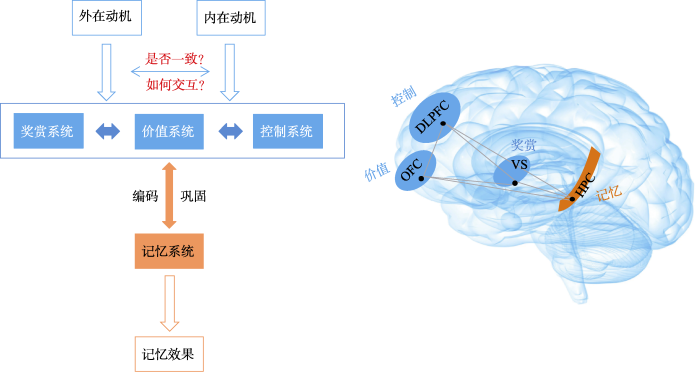
图1
动机影响记忆的认知神经机制
注:蓝色区域为动机系统(包括奖赏、价值、控制系统), 橘色区域为记忆系统, VS=腹侧纹状体, OFC=眶额皮层, DLPFC=背外侧前额叶, HPC=海马
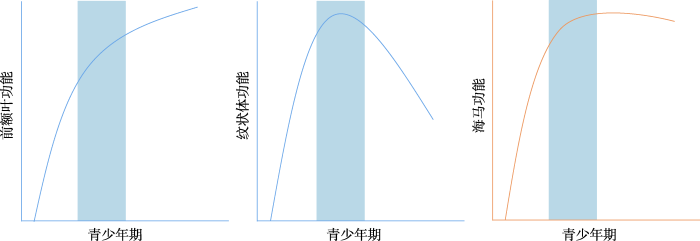
其次, 青少年时期大脑各系统(动机和记忆系统)的发育特点使得这一时期成为动机发展的特殊时期和记忆的关键期。以往研究更多关注青少年特殊的动机特点引发的适应不良行为, 较少考察青少年时期独特的动机特点如何影响记忆(学习的核心认知加工过程)。根据前人研究(Casey, 2015; Murty et al., 2016; Somerville & Casey, 2010), 我们总结出动机关键脑区(如控制相关的前额叶和奖赏相关的纹状体)以及记忆关键脑区(如海马)的功能发育规律(图2), 但尚不清楚青少年时期动机和记忆系统如何相互作用从而影响记忆效果。本项目的第二大特色和创新之处在于揭示内外动机对青少年(相比成人)记忆影响的独特规律和机理。这对于我们理解动机影响记忆的发展规律, 理解青少年脑发育有重要理论意义。
图2
最后, 以往研究大多从单一角度考察动机对记忆的影响。本项目的第三大特色和创新之处在于整合了心理和神经科学研究方法, 从认知行为、神经回路、神经系统和脑网络多个层面系统研究内外动机对青少年记忆的影响。这将极大丰富本领域研究的技术手段和提高本领域研究层次, 研究结果有利于我们全面了解动机对青少年记忆影响的规律和机制。
参考文献
Reward-motivated learning: Mesolimbic activation precedes memory formation
We examined anticipatory mechanisms of reward-motivated memory formation using event-related FMRI. In a monetary incentive encoding task, cues signaled high- or low-value reward for memorizing an upcoming scene. When tested 24 hr postscan, subjects were significantly more likely to remember scenes that followed cues for high-value rather than low-value reward. A monetary incentive delay task independently localized regions responsive to reward anticipation. In the encoding task, high-reward cues preceding remembered but not forgotten scenes activated the ventral tegmental area, nucleus accumbens, and hippocampus. Across subjects, greater activation in these regions predicted superior memory performance. Within subject, increased correlation between the hippocampus and ventral tegmental area was associated with enhanced long-term memory for the subsequent scene. These findings demonstrate that brain activation preceding stimulus encoding can predict declarative memory formation. The findings are consistent with the hypothesis that reward motivation promotes memory formation via dopamine release in the hippocampus prior to learning.
Eyes wide open: Enhanced pupil dilation when selectively studying important information
DOI:10.1007/s00221-013-3744-5
PMID:24162863
[本文引用: 1]

Remembering important information is imperative for efficient memory performance, but it is unclear how we encode important information. The current experiment evaluated two non-exclusive hypotheses for how learners selectively encode important information at the expense of less important information (differential resource allocation and information reduction). To evaluate these hypotheses, we measured changes in learners' pupil diameter and fixation durations while participants performed a selectivity task that involved studying lists consisting of words associated with different point values. Participants were instructed to maximize their score on a free recall task that they completed after studying each list. Participants' pupils dilated more when studying high-valued than low-valued words, and these changes were associated with better memory for high-valued words. However, participants fixated equally on words regardless of their value, which is inconsistent with the information reduction hypothesis. Participants also increased their memory selectivity across lists, but changes in pupil diameter and differences in fixations could not account for this increased selectivity. The results suggest that learners allocate attention differently to items as a function of their value, and that multiple processes and operations contribute to value-directed remembering.
Reinforcement, reward, and intrinsic motivation: A meta-analysis
DOI:10.3102/00346543064003363 URL [本文引用: 2]
Beyond simple models of self-control to circuit-based accounts of adolescent behavior
DOI:10.1146/annurev-psych-010814-015156 URL [本文引用: 5]
Intrinsic motivation and extrinsic incentives jointly predict performance: A 40-year meta-analysis
DOI:10.1037/a0035661
PMID:24491020
[本文引用: 1]
More than 4 decades of research and 9 meta-analyses have focused on the undermining effect: namely, the debate over whether the provision of extrinsic incentives erodes intrinsic motivation. This review and meta-analysis builds on such previous reviews by focusing on the interrelationship among intrinsic motivation, extrinsic incentives, and performance, with reference to 2 moderators: performance type (quality vs. quantity) and incentive contingency (directly performance-salient vs. indirectly performance-salient), which have not been systematically reviewed to date. Based on random-effects meta-analytic methods, findings from school, work, and physical domains (k = 183, N = 212,468) indicate that intrinsic motivation is a medium to strong predictor of performance (ρ =.21-45). The importance of intrinsic motivation to performance remained in place whether incentives were presented. In addition, incentive salience influenced the predictive validity of intrinsic motivation for performance: In a "crowding out" fashion, intrinsic motivation was less important to performance when incentives were directly tied to performance and was more important when incentives were indirectly tied to performance. Considered simultaneously through meta-analytic regression, intrinsic motivation predicted more unique variance in quality of performance, whereas incentives were a better predictor of quantity of performance. With respect to performance, incentives and intrinsic motivation are not necessarily antagonistic and are best considered simultaneously. Future research should consider using nonperformance criteria (e.g., well-being, job satisfaction) as well as applying the percent-of-maximum-possible (POMP) method in meta-analyses.PsycINFO Database Record (c) 2014 APA, all rights reserved.
The influence of rewards on incidental memory: More does not mean better
DOI:10.1101/lm.051722.120
PMID:33060283
[本文引用: 3]
Studies have revealed that rewards promote long-term memory, even in an incidental way. However, most previous studies using the incidental paradigm have included two reward levels, and it is still not clear how the reward magnitude influences memory. Adopting the incidental paradigm and three reward levels, the current study revealed that the reward magnitude impacted 1-d delayed episodic memory in a nonlinear, inverted U-shaped pattern. An additional experiment showed that there was no reward effect in immediate episodic memory. Our results support the dopaminergic memory consolidation theory and further imply that the reward magnitude needs to be considered in the theory.© 2020 Cheng et al.; Published by Cold Spring Harbor Laboratory Press.
Value-based modulation of memory encoding involves strategic engagement of fronto-temporal semantic processing regions
Effects of aging on value-directed modulation of semantic network activity during verbal learning
DOI:S1053-8119(15)00699-0
PMID:26244278
[本文引用: 1]
While impairments in memory recall are apparent in aging, older adults show a remarkably preserved ability to selectively remember information deemed valuable. Here, we use fMRI to compare brain activation in healthy older and younger adults during encoding of high and low value words to determine whether there are differences in how older adults achieve value-directed memory selectivity. We find that memory selectivity in older adults is associated with value-related changes in activation during word presentation in left hemisphere regions that are involved in semantic processing, similar to young adults. However, highly selective young adults show a relatively greater increase in semantic network activity during encoding of high-value items, whereas highly selective older adults show relatively diminished activity during encoding of low-value items. Additionally, only younger adults showed value-related increases in activity in semantic and reward processing regions during presentation of the value cue preceding each to-be-remembered word. Young adults therefore respond to cue value more proactively than do older adults, yet the magnitude of value-related differences in cue period brain activity did not predict individual differences in memory selectivity. Thus, our data also show that age-related reductions in prestimulus activity do not always lead to inefficient performance.Copyright © 2015 Elsevier Inc. All rights reserved.
An upside to reward sensitivity: The hippocampus supports enhanced reinforcement learning in adolescence
DOI:S0896-6273(16)30524-4
PMID:27710793
[本文引用: 1]
Adolescents are notorious for engaging in reward-seeking behaviors, a tendency attributed to heightened activity in the brain's reward systems during adolescence. It has been suggested that reward sensitivity in adolescence might be adaptive, but evidence of an adaptive role has been scarce. Using a probabilistic reinforcement learning task combined with reinforcement learning models and fMRI, we found that adolescents showed better reinforcement learning and a stronger link between reinforcement learning and episodic memory for rewarding outcomes. This behavioral benefit was related to heightened prediction error-related BOLD activity in the hippocampus and to stronger functional connectivity between the hippocampus and the striatum at the time of reinforcement. These findings reveal an important role for the hippocampus in reinforcement learning in adolescence and suggest that reward sensitivity in adolescence is related to adaptive differences in how adolescents learn from experience.Copyright © 2016 Elsevier Inc. All rights reserved.
Adolescent development of value-guided goal pursuit
DOI:S1364-6613(18)30116-5
PMID:29880333
[本文引用: 1]
Adolescents are challenged to orchestrate goal-directed actions in increasingly independent and consequential ways. In doing so, it is advantageous to use information about value to select which goals to pursue and how much effort to devote to them. Here, we examine age-related changes in how individuals use value signals to orchestrate goal-directed behavior. Drawing on emerging literature on value-guided cognitive control and reinforcement learning, we demonstrate how value and task difficulty modulate the execution of goal-directed action in complex ways across development from childhood to adulthood. We propose that the scope of value-guided goal pursuit expands with age to include increasingly challenging cognitive demands, and scaffolds on the emergence of functional integration within brain networks supporting valuation, cognition, and action.Copyright © 2018 Elsevier Ltd. All rights reserved.
Effects of externally mediated rewards on intrinsic motivation
DOI:10.1037/h0030644 URL [本文引用: 2]
A meta-analytic review of experiments examining the effects of extrinsic rewards on intrinsic motivation
A meta-analysis of 128 studies examined the effects of extrinsic rewards on intrinsic motivation. As predicted, engagement-contingent, completion-contingent, and performance-contingent rewards significantly undermined free-choice intrinsic motivation (d = -0.40, -0.36, and -0.28, respectively), as did all rewards, all tangible rewards, and all expected rewards. Engagement-contingent and completion-contingent rewards also significantly undermined self-reported interest (d = -0.15, and -0.17), as did all tangible rewards and all expected rewards. Positive feedback enhanced both free-choice behavior (d = 0.33) and self-reported interest (d = 0.31). Tangible rewards tended to be more detrimental for children than college students, and verbal rewards tended to be less enhancing for children than college students. The authors review 4 previous meta-analyses of this literature and detail how this study's methods, analyses, and results differed from the previous ones.
A meta-analysis on age differences in risky decision making: Adolescents versus children and adults
DOI:10.1037/a0038088
PMID:25365761
[本文引用: 1]
Despite evident heightened adolescent risk-taking in real-life situations, not all experimental studies demonstrate that adolescents take more risks than children and adults on risky decision-making tasks. In the current 4 independent meta-analyses, neurodevelopmental imbalance models and fuzzy trace theory were used as conceptual frameworks to examine whether adolescents engage in more risk-taking than children and adults and whether early adolescents take more risks than children and mid-late adolescents on behavioral risk-taking tasks. Studies with at least 1 of the aforementioned age comparisons met the inclusion criteria. Consistent with imbalance models and fuzzy trace theory, results from a random-effects model showed that adolescents take more risks (g =.37) than adults, and early adolescents take more risks (g =.15) than mid-late adolescents. However, inconsistent with both perspectives, adolescents and children take equal levels of risk (g = -.00), and early adolescents and children also take equal levels of risk (g =.04). Meta-regression analyses revealed that, consistent with imbalance models, (a) adolescents take more risks than adults on hot tasks with immediate outcome feedback on rewards and losses; however, contrary to imbalance models but consistent with fuzzy trace theory, (b) adolescents take fewer risks than children on tasks with a sure/safe option. Shortcomings related to studies using behavioral risk-taking tasks are discussed. We suggest a hybrid developmental neuroecological model of risk-taking that includes a risk opportunity component to explain why adolescents take more risks than children in the real world but equal levels of risks as children in the laboratory.PsycINFO Database Record (c) 2015 APA, all rights reserved.
The emerging neuroscience of intrinsic motivation: A new frontier in self-determination research
DOI:10.3389/fnhum.2017.00145
PMID:28392765
[本文引用: 2]
Intrinsic motivation refers to people's spontaneous tendencies to be curious and interested, to seek out challenges and to exercise and develop their skills and knowledge, even in the absence of operationally separable rewards. Over the past four decades, experimental and field research guided by self-determination theory (SDT; Ryan and Deci, 2017) has found intrinsic motivation to predict enhanced learning, performance, creativity, optimal development and psychological wellness. Only recently, however, have studies begun to examine the neurobiological substrates of intrinsic motivation. In the present article, we trace the history of intrinsic motivation research, compare and contrast intrinsic motivation to closely related topics ( flow, curiosity, trait plasticity), link intrinsic motivation to key findings in the comparative affective neurosciences, and review burgeoning neuroscience research on intrinsic motivation. We review converging evidence suggesting that intrinsically motivated exploratory and mastery behaviors are phylogenetically ancient tendencies that are subserved by dopaminergic systems. Studies also suggest that intrinsic motivation is associated with patterns of activity across large-scale neural networks, namely, those that support salience detection, attentional control and self-referential cognition. We suggest novel research directions and offer recommendations for the application of neuroscience methods in the study of intrinsic motivation.
Motivation and memory
Effects of reward on intrinsic motivation-negative, neutral and positive: Comment on Deci, Koestner, and Ryan (1999)
Neural correlates underlying the effect of reward value on recognition memory
Adolescence as a sensitive period of brain development
DOI:S1364-6613(15)00172-2
PMID:26419496
[本文引用: 3]
Most research on sensitive periods has focussed on early sensory, motor, and language development, but it has recently been suggested that adolescence might represent a second ‘window of opportunity’ in brain development. Here, we explore three candidate areas of development that are proposed to undergo sensitive periods in adolescence: memory, the effects of social stress, and drug use. We describe rodent studies, neuroimaging, and large-scale behavioural studies in humans that have yielded data that are consistent with heightened neuroplasticity in adolescence. Critically however, concrete evidence for sensitive periods in adolescence is mostly lacking. To provide conclusive evidence, experimental studies are needed that directly manipulate environmental input and compare effects in child, adolescent, and adult groups.
The teenage brain: Sensitivity to rewards
DOI:10.1177/0963721413480859 URL [本文引用: 1]
Neurocognitive development of motivated behavior: Dynamic changes across childhood and adolescence
DOI:10.1523/JNEUROSCI.1674-18.2018 URL [本文引用: 1]
Post-learning hippocampal dynamics promote preferential retention of rewarding events
DOI:10.1016/j.neuron.2016.01.017
PMID:26875624
[本文引用: 2]
Reward motivation is known to modulate memory encoding, and this effect depends on interactions between the substantia nigra/ventral tegmental area complex (SN/VTA) and the hippocampus. It is unknown, however, whether these interactions influence offline neural activity in the human brain that is thought to promote memory consolidation. Here we used fMRI to test the effect of reward motivation on post-learning neural dynamics and subsequent memory for objects that were learned in high- and low-reward motivation contexts. We found that post-learning increases in resting-state functional connectivity between the SN/VTA and hippocampus predicted preferential retention of objects that were learned in high-reward contexts. In addition, multivariate pattern classification revealed that hippocampal representations of high-reward contexts were preferentially reactivated during post-learning rest, and the number of hippocampal reactivations was predictive of preferential retention of items learned in high-reward contexts. These findings indicate that reward motivation alters offline post-learning dynamics between the SN/VTA and hippocampus, providing novel evidence for a potential mechanism by which reward could influence memory consolidation.Copyright © 2016 Elsevier Inc. All rights reserved.
Developmental changes in parent-child communication throughout adolescence
DOI:10.1037/a0032217
PMID:23477535
[本文引用: 1]
This study examined how parent-child communication regarding adolescent unsupervised activities develops over the course of adolescence. We used questionnaire data from 390 adolescents (58% girls; 90% European Canadian) who were followed from age 12 to 19. Latent growth curve modeling revealed curvilinear developmental changes that differed for boys and girls. From age 14 to 19 (but not from age 12 to 14) a linear decrease in parental control was found for both genders. For girls, parent-child communication decreased in early adolescence, as indicated by decreasing parental solicitation, decreasing adolescent disclosure, and increasing secrecy. Girls' communication with parents intensified in middle adolescence, as indicated by increasing parental solicitation, increasing adolescent disclosure, and decreasing adolescent secrecy. For boys, disclosure declined in early adolescence, but secrecy and solicitation were stable throughout adolescence. Parental knowledge decreased from age 12 to 19 for both genders but was temporarily stable for middle adolescent girls. The meaning of these developmental changes, their timing, and gender differences are discussed.PsycINFO Database Record (c) 2013 APA, all rights reserved.
Neuroscientific model of motivational process
Identifying the neural substrates of intrinsic motivation during task performance
The inherent reward of choice
DOI:10.1177/0956797611417005
PMID:21931157
[本文引用: 1]
Research suggests that the exercise of control is desirable and adaptive, but the precise mechanisms underlying the affective value of control are not well understood. The study reported here characterized the affective experience of personal control by examining the neural substrates recruited when individuals anticipate the opportunity to make a choice--in other words, when they anticipate the means for exercising control. We used an experimental paradigm that probed the value of having a choice. Participants reported liking cues that predicted a future opportunity to make a choice more than cues that predicted no choice. The anticipation of choice itself was associated with increased activity in corticostriatal regions, particularly the ventral striatum, involved in affective and motivational processes. This study is the first direct examination of the affective value of having the opportunity to choose. These findings have important implications for understanding the role of perception of control, and choice itself, in self-regulatory processes.
Is the enhancement of memory due to reward driven by value or salience?
DOI:10.1016/j.actpsy.2011.12.010
PMID:22266252
[本文引用: 1]
Past research using two levels of reward has shown that the higher-value items are remembered better than lower-value items and this enhancement is assumed to be driven by an effect of reward value. In the present study, multiple levels of reward were used to test the influence of reward salience on memory. Using a value-learning procedure, words were associated with reward values, and then memory for these words was later tested with free recall. Critically, multiple reward levels were used, allowing us to test two specific hypotheses whereby rewards can influence memory: (a) higher value items are remembered better than lower value items (reward value hypothesis), and (b) highest and lowest value items are remembered best and intermediate-value items are remembered worst (following a U-shaped relationship between value and memory; reward salience hypothesis). In two experiments we observed a U-shaped relationship between reward value and memory, supporting the notion that memory is enhanced due to reward salience, and not purely through reward value.Copyright © 2011 Elsevier B.V. All rights reserved.
Live as we choose: The role of autonomy support in facilitating intrinsic motivation
DOI:10.1016/j.ijpsycho.2015.08.009 URL [本文引用: 1]
Methods and considerations for longitudinal structural brain imaging analysis across development
DOI:10.1016/j.dcn.2014.04.004
PMID:24879112
[本文引用: 1]
Magnetic resonance imaging (MRI) has allowed the unprecedented capability to measure the human brain in vivo. This technique has paved the way for longitudinal studies exploring brain changes across the entire life span. Results from these studies have given us a glimpse into the remarkably extended and multifaceted development of our brain, converging with evidence from anatomical and histological studies. Ever-evolving techniques and analytical methods provide new avenues to explore and questions to consider, requiring researchers to balance excitement with caution. This review addresses what MRI studies of structural brain development in children and adolescents typically measure and how. We focus on measurements of brain morphometry (e.g., volume, cortical thickness, surface area, folding patterns), as well as measurements derived from diffusion tensor imaging (DTI). By integrating finding from multiple longitudinal investigations, we give an update on current knowledge of structural brain development and how it relates to other aspects of biological development and possible underlying physiological mechanisms. Further, we review and discuss current strategies in image processing, analysis techniques and modeling of brain development. We hope this review will aid current and future longitudinal investigations of brain development, as well as evoke a discussion amongst researchers regarding best practices. Published by Elsevier Ltd.
Consolidation power of extrinsic rewards: Reward cues enhance long-term memory for irrelevant past events
How self-determined choice facilitates performance: A key role of the ventromedial prefrontal cortex
DOI:10.1093/cercor/bht317 URL [本文引用: 1]
The rise and fall of immediate and delayed memory for verbal and visuospatial information from late childhood to late adulthood
DOI:10.1016/j.actpsy.2012.10.005
PMID:23261419
[本文引用: 1]
Over 100,000 verbal and visuospatial immediate and delayed memory tests were presented via the Internet to over 28,000 participants in the age range of 11 to 80. Structural equation modeling pointed to the verbal versus visuospatial dimension as an important factor in individual differences, but not the immediate versus delayed dimension. We found a linear decrease of 1% to 3% per year in overall memory performance past the age of 25. For visuospatial tests, this decrease started at age 18 and was twice as fast as the decrease of verbal memory. There were strong effects of education, with the highest educated group sometimes scoring one full standard deviation above the lowest educated group. Gender effects were small but as expected: women outperformed men on the verbal memory tasks; men outperformed women on the visuospatial tasks. We also found evidence of increasing proneness to false memory with age. Memory for recent news events did not show a decrease with age.Copyright © 2012 Elsevier B.V. All rights reserved.
The role of experience in adolescent cognitive development: Integration of executive, memory, and mesolimbic systems
DOI:10.1016/j.neubiorev.2016.07.034 URL [本文引用: 2]
The simple act of choosing influences declarative memory
DOI:10.1523/JNEUROSCI.4181-14.2015
PMID:25904779
[本文引用: 3]
Individuals value the opportunity to make choices and exert control over their environment. This perceived sense of agency has been shown to have broad influences on cognition, including preference, decision-making, and valuation. However, it is unclear whether perceived control influences memory. Using a combined behavioral and functional magnetic resonance imaging approach, we investigated whether imbuing individuals with a sense of agency over their learning experience influences novel memory encoding. Participants encoded objects during a task that manipulated the opportunity to choose. Critically, unlike previous work on active learning, there was no relationship between individuals' choices and the content of memoranda. Despite this, we found that the opportunity to choose resulted in robust, reliable enhancements in declarative memory. Neuroimaging results revealed that anticipatory activation of the striatum, a region associated with decision-making, valuation, and exploration, correlated with choice-induced memory enhancements in behavior. These memory enhancements were further associated with interactions between the striatum and hippocampus. Specifically, anticipatory signals in the striatum when participants are alerted to the fact that they will have to choose one of two memoranda were associated with encoding success effects in the hippocampus on a trial-by-trial basis. The precedence of the striatal signal in these interactions suggests a modulatory relationship of the striatum over the hippocampus. These findings not only demonstrate enhanced declarative memory when individuals have perceived control over their learning but also support a novel mechanism by which these enhancements emerge. Furthermore, they demonstrate a novel context in which mesolimbic and declarative memory systems interact. Copyright © 2015 the authors 0270-6474/15/356255-10$15.00/0.
Decision-making increases episodic memory via postencoding consolidation
DOI:10.1162/jocn_a_01321
PMID:30063181
[本文引用: 3]
The ability for individuals to actively make decisions engages regions within the mesolimbic system and enhances memory for chosen items. In other behavioral contexts, mesolimbic engagement has been shown to enhance episodic memory by supporting consolidation. However, research has yet to investigate how consolidation may support interactions between decision-making and episodic memory. Across two studies, participants encoded items that were covered by occluder screens and could either actively decide which of two items to uncover or an item was preselected by the experimenter. In Study 1, we show that active decision-making reduces forgetting rates across an immediate and 24-hr memory test, a behavioral marker of consolidation. In Study 2, we use functional neuroimaging to characterize putative neural markers of memory consolidation by measuring interactions between the hippocampus and perirhinal cortex (PRC) during a postencoding period that reexposed participants to elements of the decision-making context without exposing them to memoranda. We show that choice-related striatal engagement is associated with increased postencoding hippocampal-PRC interactions. Finally, we show that a previous reported relationship between choice-related striatal engagement and long-term memory is accounted for by these postencoding hippocampal-PRC interactions. Together, these findings support a model by which actively deciding to encode information enhances memory consolidation to preserve episodic memory for outcomes, a process that may be facilitated by reexposure to the original decision-making context.
Age-related trajectories of functional coupling between the VTA and nucleus accumbens depend on motivational state
DOI:10.1523/JNEUROSCI.3508-17.2018 URL [本文引用: 1]
The development of neural correlates for memory formation
DOI:10.1016/j.neubiorev.2012.02.016
PMID:22414608
[本文引用: 1]
A growing body of literature considers the development of episodic memory systems in the brain; the majority are neuroimaging studies conducted during memory encoding in order to explore developmental trajectories in memory formation. This review considers evidence from behavioral studies of memory development, neural correlates of memory formation in adults, and structural brain development, all of which form the foundation of a developmental cognitive neuroscience approach to memory development. I then aim to integrate the current evidence from developmental functional neuroimaging studies of memory formation with respect to three hypotheses. First, memory development reflects the development in the use of memory strategies, linked to prefrontal cortex. Second, developmental effects within the medial temporal lobes are more complex, and correspond to current notions about the nature in which the MTL support the formation of memory. Third, neurocognitive changes in content representation influence memory. Open issues and current directions are discussed.Copyright © 2012 Elsevier Ltd. All rights reserved.
Reward retroactively enhances memory consolidation for related items
Reward-driven attention alters perceived salience
The bright and dark sides of performance-dependent monetary rewards: Evidence from visual perception tasks
Motivational neuroscience
Intrinsic and extrinsic motivations: Classic definitions and new directions
DOI:10.1006/ceps.1999.1020 URL [本文引用: 1]
Self-determination theory and the facilitation of intrinsic motivation, social development, and well-being
DOI:10.1037/0003-066X.55.1.68 URL [本文引用: 1]
Intrinsic and extrinsic motivation from a self-determination theory perspective: Definitions, theory, practices, and future directions
Dopamine and adaptive memory
DOI:10.1016/j.tics.2010.08.002
PMID:20829095
[本文引用: 2]
Memory is essential to adaptive behavior because it allows past experience to guide choices. Emerging findings indicate that the neurotransmitter dopamine, which signals motivationally important events, also modulates the hippocampus, a crucial brain system for long-term memory. Here we review recent evidence that highlights multiple mechanisms whereby dopamine biases memory towards events that are of motivational significance. These effects take place over a variety of timescales, permitting both expectations and outcomes to influence memory. Thus, dopamine ensures that memories are relevant and accessible for future adaptive behavior, a concept we refer to as 'adaptive memory'. Understanding adaptive memory at biological and psychological levels helps to resolve a fundamental challenge in memory research: explaining what is remembered, and why.Copyright © 2010 Elsevier Ltd. All rights reserved.
The control of human behavior
Decision making in children and adolescents: Impaired iowa gambling task performance in early adolescence
DOI:10.1037/a0026342
PMID:22081879
[本文引用: 1]
Disadvantageous decision making is cited as one of the premier problems in childhood development, underlying risky behavior and causing adolescents to make poor choices that could prove detrimental later in life. However, there are relatively few studies looking at the development of decision making in children and adolescents, and fewer still comparing it with the performance trajectories of more typically developing cognitive functions. In the current study, we measured the affective decision-making abilities of children and adolescents 8- to 17-years-old using the Iowa Gambling Task (IGT; Bechara, 2007) in conjunction with a battery of established cognitive neuropsychological assessments. In contrast to the typical linear development of executive functions, affective decision-making abilities progressed in a J-shaped curve. Younger, more developmentally naive children performed better on the IGT than older, early-adolescent individuals, with performance becoming advantageous again toward the end of the teenage years. This trajectory is thought to coincide with asymmetric neural development in early adolescents, with relatively overactive striatal regions creating impulsive reward-driven responses that may go unchecked by the slower developing inhibitive frontal cortex. This trajectory is in stark contrast with the linear development of memory, speed of processing, and other cognitive abilities over the ages.
Developmental neurobiology of cognitive control and motivational systems
DOI:10.1016/j.conb.2010.01.006
PMID:20167473
[本文引用: 4]
One form of cognitive control is the ability to resist temptation in favor of long-term goal-oriented behavior. Historically, the development of cognitive control capacity has been described by a linear function from infancy to adulthood. However, the context in which control is required impacts behavioral regulation abilities, such that emotionally charged or rewarding contexts can diminish control. More recently, studies have begun to examine the development of cognitive control in contexts that vary in motivation. These studies suggest specific windows of development in which cognitive control capacity is more vulnerable to incentive-based modulation. In this review we highlight the most recent work on neurobiological changes supporting motivational and cognitive development, underscoring the importance of functional organization and development of the underlying circuitry implicated in these processes, and provide a theoretical perspective that moves away from discussing singular functional regions toward considering functional circuitry.(c) 2010 Elsevier Ltd. All rights reserved.
Age differences in future orientation and delay discounting
DOI:10.1111/j.1467-8624.2008.01244.x
PMID:19236391
[本文引用: 1]
Age differences in future orientation are examined in a sample of 935 individuals between 10 and 30 years using a delay discounting task as well as a new self-report measure. Younger adolescents consistently demonstrate a weaker orientation to the future than do individuals aged 16 and older, as reflected in their greater willingness to accept a smaller reward delivered sooner than a larger one that is delayed, and in their characterizations of themselves as less concerned about the future and less likely to anticipate the consequences of their decisions. Planning ahead, in contrast, continues to develop into young adulthood. Future studies should distinguish between future orientation and impulse control, which may have different neural underpinnings and follow different developmental timetables.
The vicissitudes of autonomy in early adolescence
A sample of 865 10-16-year-olds from a range of socioeconomic backgrounds completed a questionnaire battery concerning 3 aspects of autonomy: emotional autonomy in relationship with parents, resistance to peer pressure, and the subjective sense of self-reliance. The observed patterns of relations among the measures cast doubt on the notion that autonomy is a unidimensional trait manifested similarly across a variety of situations. For most boys and girls, the transition from childhood into adolescence is marked more by a trading of dependency on parents for dependency on peers, rather than straightforward and unidimensional growth in autonomy. Moreover, contrary to long-standing notions about the greater salience of autonomy to adolescent males than to females, girls score higher than boys on all 3 measures of autonomy at all age levels.
Hippocampal brain-network coordination during volitional exploratory behavior enhances learning
DOI:10.1038/nn.2693
PMID:21102449
[本文引用: 2]
Exploratory behaviors during learning determine what is studied and when, helping to optimize subsequent memory performance. To elucidate the cognitive and neural determinants of exploratory behaviors, we manipulated the control that human subjects had over the position of a moving window through which they studied objects and their locations. Our behavioral, neuropsychological and neuroimaging data indicate that volitional control benefits memory performance and is linked to a brain network that is centered on the hippocampus. Increases in correlated activity between the hippocampus and other areas were associated with specific aspects of memory, which suggests that volitional control optimizes interactions among specialized neural systems through the hippocampus. Memory is therefore an active process that is intrinsically linked to behavior. Furthermore, brain structures that are typically seen as passive participants in memory encoding (for example, the hippocampus) are actually part of an active network that controls behavior dynamically as it unfolds.
The development of self-determination during adolescence
Typical development of basal ganglia, hippocampus, amygdala and cerebellum from age 7 to 24
DOI:10.1016/j.neuroimage.2014.03.072
PMID:24705201
[本文引用: 1]
Developmental imaging studies show that cortical grey matter decreases in volume during childhood and adolescence. However, considerably less research has addressed the development of subcortical regions (caudate, putamen, pallidum, accumbens, thalamus, amygdala, hippocampus and the cerebellar cortex), in particular not in longitudinal designs. We used the automatic labeling procedure in FreeSurfer to estimate the developmental trajectories of the volume of these subcortical structures in 147 participants (age 7.0-24.3years old, 94 males; 53 females) of whom 53 participants were scanned twice or more. A total of 223 magnetic resonance imaging (MRI) scans (acquired at 1.5-T) were analyzed. Substantial diversity in the developmental trajectories was observed between the different subcortical gray matter structures: the volume of caudate, putamen and nucleus accumbens decreased with age, whereas the volume of hippocampus, amygdala, pallidum and cerebellum showed an inverted U-shaped developmental trajectory. The thalamus showed an initial small increase in volume followed by a slight decrease. All structures had a larger volume in males than females over the whole age range, except for the cerebellum that had a sexually dimorphic developmental trajectory. Thus, subcortical structures appear to not yet be fully developed in childhood, similar to the cerebral cortex, and continue to show maturational changes into adolescence. In addition, there is substantial heterogeneity between the developmental trajectories of these structures. Copyright © 2014 Elsevier Inc. All rights reserved.
Self-choice preference: The propensity to under-delegate irrespective of sense of control
Chinese education examined via the lens of self-determination
DOI:10.1007/s10648-016-9395-x URL [本文引用: 1]
Preliminary evidence for a role of the personality trait in visual perceptual learning
DOI:S1074-7427(16)30388-4
PMID:27993649
[本文引用: 2]
Recent research has shown that reinforcement can facilitate visual perceptual learning (VPL), but no study has examined the relations between individual differences in reinforcement sensitivity and VPL. This study tested the hypothesis that when monetary incentive was involved, the personality traits of harm avoidance and reward dependence (HA and RD, two measures of reinforcement sensitivity) would be linked to VPL performance. We trained two groups of subjects with a visual motion direction discrimination task for six days. The experimental group received monetary incentive feedback, whereas the control group received non-monetary feedback. As expected, the score of HA was negatively correlated with VPL for the experimental group, but not for the control group. RD was not a significant predictor. These results were discussed in terms of the role of non-perceptual factors such as reinforcement, personality, higher cognition, and motivation in VPL.Copyright © 2016 Elsevier Inc. All rights reserved.


