



1 引言
对于精神障碍疾病(disorder)与症状(symptom)之间关系的刻画, 目前存在以下两种主流观点。一种是以《精神疾病诊断和统计手册》(Diagnostic and Statistical Manual of Mental Disorders, DSM)和《国际疾病分类》(International Classification of Diseases, ICD)为代表的DSM-ICD分类诊断视角, 认为症状反映的正是其共同原因——疾病实体(McNally, 2016)。这一视角参考了传统医学的观点。就像脑部恶性肿瘤是引发头痛、健忘、视力模糊等并发症状的共同原因, 潜在的创伤后应激障碍(Post-traumatic Stress Disorder, PTSD)也被认为是闯入性思维、闪回、高警觉等症状的共同原因(如图1)。另一种是由美国国立精神卫生研究所(National Institute of Mental Health, NIMH)提出的研究领域标准RDoC (Research Domain Criteria, Insel et al., 2010)的维度取向(图2), 认为精神健康状况是多维度的连续谱, 症状反映的是认知系统、负性效价系统、正性效价系统、情绪调节系统等不同潜在维度上的功能异常, 而各种精神障碍实际上是不同症状维度相组合的结果(Adam, 2013)。
图1
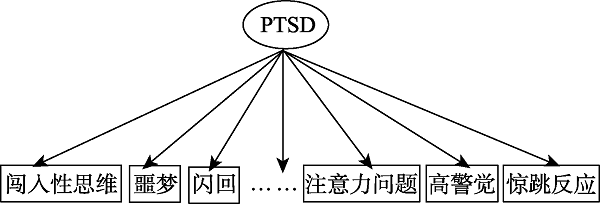
图1
分类诊断视角下, 创伤后应激障碍(PTSD)与其症状之间的关系(Borsboom & Cramer, 2013)。图顶部的椭圆形代表PTSD这一潜在疾病变量, 图底部的方框代表DSM系统中PTSD的症状:闯入性思维、噩梦、闪回等。此模型中, 箭头单向地从PTSD指向其可观测症状, 表示PTSD是引发这些症状的共同原因。
图2
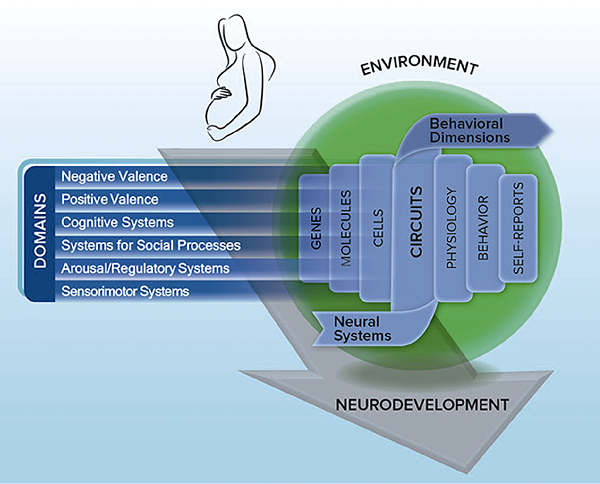
图2
RDoC倡议的精神障碍研究框架:研究应关注于负性效价系统、正性效价系统、认知系统、社会加工系统、唤起 / 调节系统和感觉运动系统这六大人类主要功能领域展开, 每个领域包含基因、分子、细胞、环路、生理、行为和自我报告这些基本分析单元。(资料来源:
上述两种观点的本质差别在于疾病究竟是按类型(即在本质上是不同的类别)还是因程度(即在维度上有所不同)而不同(Hofmann et al., 2016)。但无论是分类还是维度视角, 它们都认为症状的出现存在潜在的共同原因(无论是一个潜在疾病实体, 还是多个潜在维度)。二者本质上都是要求满足“局部独立性” (即潜变量完全解释观测变量之间的协方差)的潜变量模型, 也就要求症状之间不存在任何因果关联(Borsboom, 2008; Hofmann et al., 2016)。这就导致基于这两种理论都忽略了症状间的相互作用(Borsboom & Cramer, 2013; Schmittmann et al., 2013)。而在精神障碍的发生发展过程中, 症状间的相互作用是很常见而基本的现象。例如, 某PTSD患者因遭受丧亲打击, 处于持续的负性情绪状态而出现失眠状况, 导致白天工作时难以集中注意力, 与同事相处也容易被激惹, 久而久之对原本有兴趣的事也失去兴趣, 而这又进一步加剧了他的负性情绪。显然这些PTSD症状的发生有着明确的先后顺序, 且症状之间存在着不可忽视的因果关系。
2 心理病理学网络理论
2.1 核心观点与基本原理
与上述两种潜变量视角不同, 心理病理学网络理论将精神障碍刻画为由相互作用的症状组成的因果系统(Borsboom & Cramer, 2013); 症状也不再是疾病这一潜在共同原因的被动指标, 而成为因果系统中的动态组成部分(Robinaugh et al., 2020)。概括说来, 心理病理学网络理论的核心观点是:症状构成精神障碍, 而非反映精神障碍; 精神障碍是交互症状的动态网络, 而非产生症状的潜在实体(McNally et al., 2015)。在这种视角下, PTSD症状不再如图1中PTSD这一潜在共同原因引起, 而是如图3所示, 闪回、噩梦和高警觉等PTSD症状之间有直接的因果联系, 且正是这些PTSD症状及其关联构成了PTSD这一概念(McNally et al., 2017)。具体而言, Borsboom (2017)将心理病理学网络理论细化为以下5条原理:
图3
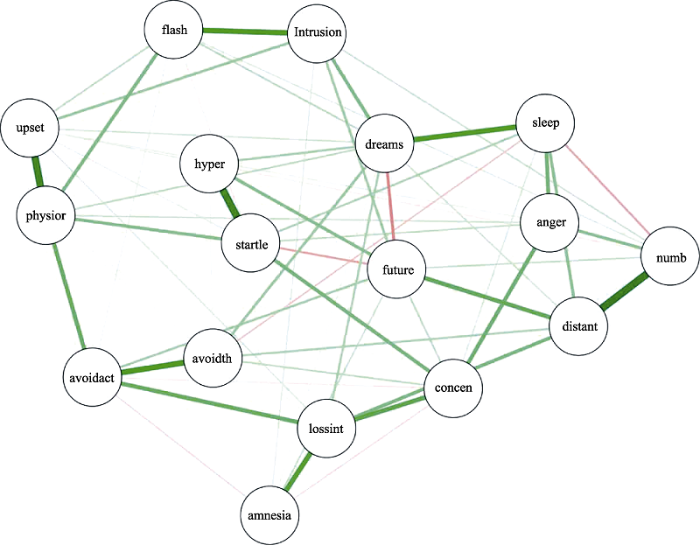
图3
心理病理学网络理论视角下的PTSD症状网络。17个节点分别代表DSM-IV中17个PTSD症状:闯入性思维、噩梦、闪回、情绪反应、生理反应、回避创伤相关想法、回避创伤提示活动、创伤相关遗忘、丧失兴趣、情感疏离、情感麻木、对未来的负性信念、睡眠问题、易激惹、注意力难以集中、高警觉、惊跳反应。节点间的绿边代表症状间的正相关, 红边代表负相关。边越粗, 相关性越高; 无边相连的节点间无相关。(资料来源:McNally et al., 2017)
原理1. 复杂性:精神障碍基于一个由大量症状组分组成的网络, 是一个不存在中央控制的复杂系统。精神障碍的本质是由该复杂系统所涌现出的一种现象。
原理2. 症状-组成成分一致性:心理病理学网络中的组成成分与诊断手册中的症状一致对应。
原理3. 直接因果联系:网络结构是由症状之间直接因果联系的图式产生的。
原理4. 精神障碍遵循网络结构:心理病理网络具有非平凡的拓扑结构:某些症状比其他症状连接更为紧密, 这些症状集团产生了精神障碍的现象——成簇的症状经常一起出现; 网络中症状地位并非等价, 即不同症状对网络的影响不同。
原理5. 滞后性:精神障碍由紧密连接的症状网络中存在的滞后现象引起, 也就是即使症状的触发原因消失了, 症状仍会继续互相激活。
原理1阐明了精神障碍的是多方面原因的复杂系统。原理2与原理3则指明了心理病理学网络的症状和症状间的联系都属于网络的基本组成元素。而原理4中提及的症状分簇现象, 则与目前将精神障碍定义为综合征这一趋势相符合:同一精神障碍的症状, 比不同精神障碍的症状之间的因果联系更紧密。而原理5的滞后性在精神障碍中很常见, 如在PTSD中, 创伤后应激症状不会随其触发条件——创伤事件的褪去而消失(Borsboom, 2017)。
2.2 精神障碍发生与维持的动态过程
上述5条原理意味着精神障碍的出现与发展可以被认为是症状在网络中激活扩散的过程(Borsboom, 2017)。在某些外部事件(如一些创伤性事件)的影响下, 出现某些症状。而这些症状的出现会影响与之相连接症状的出现概率。因此, 在网络结构中连接紧密的症状集团将趋于一起出现。当紧密相连的症状集团激活并互相维持时, 演变成一组自我维持的心理病理症状, 就产生了精神障碍(详见图4)。而原理5同样强调, 这样的动态过程仅在连接较强的网络中发生。在连接较弱的网络中不存在滞后性, 即严重的触发条件可能引起强烈的反应, 但是由于症状之间的联系较弱, 不足以自我维持, 网络将逐渐恢复至原来的无症状状态(如图5所示)。
图4
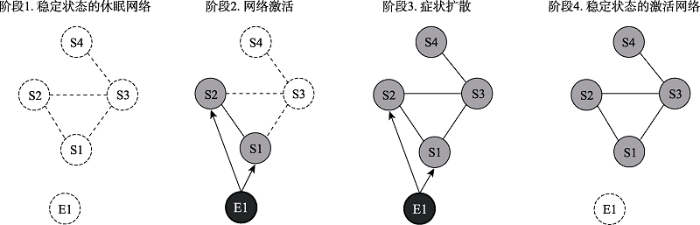
图4
网络理论中精神障碍的发展阶段。阶段1为无症状阶段, 网络处于稳定的休眠状态; 阶段2为网络初步激活阶段, 某些症状被外部事件E1直接激活; 阶段3为症状传播阶段, 阶段2中被激活的症状激活与其相连接的症状; 阶段4为稳定的网络激活状态, 若网络连接紧密, 外部事件的消失不会使网络恢复, 即网络自我维持并持续处于激活状态。[资料来源:根据Borsboom (2017)绘制]
图5
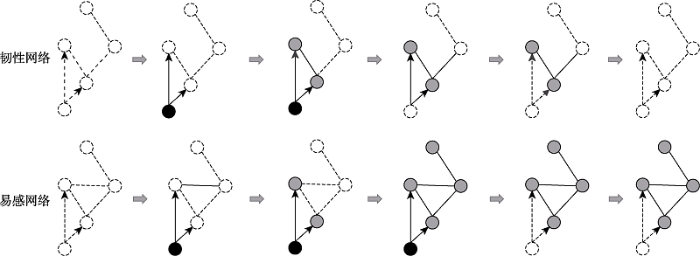
图5
连接较弱的网络(上图)具有韧性。症状可能由外部事件激活, 但症状之间的互相作用不够强, 无法导致自我维持的症状激活。相反, 连接较强的网络(下图)可以自我维持激活状态, 从而发展成为疾病状态。[资料来源:根据Borsboom (2017)绘制]
在这种网络视角下, 可将精神障碍(Mental disorder)定义为“强连接网络的稳定状态”, 而心理健康(Mental health)则对应定义为“弱连接网络的稳定状态”。心理病理学网络理论对于精神障碍与心理健康的认识, 不再以“有无症状”作为衡量标准; 它将精神状态定义为一种动态平衡状态, 而症状网络恰好可以反映这一动态过程:在外部事件的触发下, 弱连接的网络也可能表现出症状, 如亲人去世后出现正常的哀伤情绪, 但没有发展出其他症状成为重性抑郁障碍(Major Depression Disorder, MDD); 相反, 强连接的网络由于某些抑制因素(如药物使用)也可能暂时不会出现症状。在这样的动态过程中, 可类似定义强连接网络更易发展为精神障碍的性质为易感性(Vulnerablity); 而弱连接网络迅速恢复至心理健康状态的性质则可对应定义为心理韧性(Resilience)。由此看出, 心理病理学网络理论在本质上挑战了传统心理病理学理论中存在疾病实体这一说法, 将精神障碍刻画为由相互作用的症状组成的动态因果系统(Borsboom & Cramer, 2013), 症状间的相互激活直接驱动了精神障碍的发生与维持。
3 心理病理学网络分析方法
3.1 网络估计方法
目前估计心理病理学网络最常用的模型是偏相关网络(Epskamp & Fried, 2018), 也可叫做高斯图模型(Graphical Gaussian Model, GGM, Lauritzen, 1996)。在这种偏相关网络中, 构成网络的基本元素为节点(node)和边(edge), 节点表示各个症状, 节点之间相连边的权重代表节点之间的偏相关, 即控制其他节点变量的影响之后两个节点变量间的相关性(Borsboom & Cramer, 2013)。通常使用glasso (graphical least absolute shrinkage and selection operator, Epskamp & Fried, 2018; Friedman et al., 2008)算法, 通过扩展贝叶斯信息准则(Extended Bayesian Information Criterion, EBIC, Chen & Chen, 2008)选定一个惩罚参数, 对节点变量的协方差矩阵进行正则化, 将变量之间可能的虚假相关约束为零, 从而估计得到较为精简的稀疏网络结构(Epskamp et al., 2018a)。对于这种偏相关网络的估计与可视化过程, 分别可在R软件的qgraph (Epskamp et al., 2012)和bootnet (Epskamp et al., 2018a)程序包中实现。
对于经典的心理病理学症状网络, 节点对应症状, 节点之间的边对应症状之间的关联。如图3所示, 17个节点分别代表由平民版创伤后应激障碍检查表(PTSD CheckList-Civilian Version, PCL-C)测量的17个PTSD症状, 节点之间绿色的边代表症状间的正相关, 如高警觉与惊跳反应之间的边; 红色的边代表症状间的负相关, 如噩梦与对未来的负性信念之间的边。边越粗, 表示相关越高, 反之越低。如高警觉与惊跳反应之间, 情感麻木与情感疏离之间, 以及对创伤提示物的躯体反应与心理反应之间的边明显比网络中其他边更粗, 表明这三对症状在这17个PTSD症状之间具有较高的正相关, 而闯入性思维与睡眠问题之间无边相连, 可认为它们之间不存在任何直接关联。
3.2 基本网络特征
3.2.1 节点中心性
节点中心性反映节点在网络中的重要程度, 主要通过节点强度(strength)来测量1(1 连接性(betweenness)和亲近性(closeness)也曾作为考查结点中心性的指标, 但它们已被证明是不稳定的(Epskamp et al., 2017; Fried et al., 2018); 另外, EI值(expected influence, Robinaugh et al., 2016)类似于节点强度, 与强度的唯一不同是直接计算直接相连节点之间所有边的权重之和, 不取绝对值。)。某节点的强度, 由这个节点和与其直接相连节点之间所有边的权重绝对值之和来计算, 反映了这个节点与网络中其他节点直接相连的程度(Opsahl et al., 2010)。对于症状网络, 中心性高的节点可被认为是网络中的核心症状(central symptom, 如图6中X1症状), 因为中心性高(即节点强度大)的症状, 与其他症状之间关联更紧密, 而按照心理病理学网络理论, 当一个中心性高的节点被激活时, 通过它进一步激活与其相连症状的概率也相对更高; 而中心性较低(即节点强度较低)的节点可被认为是边缘症状(peripheral symptom, 如图6中X2、X3、X4及X5症状)。核心症状也被认为是可能预防个体在受到外界事件刺激后发展为精神障碍的有效干预靶点(Borsboom & Cramer, 2013; Cramer & Borsboom, 2015)。
图6
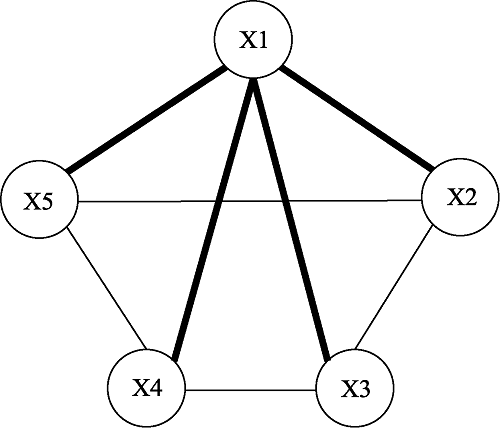
图6
由症状X1-X5组成的网络。症状X1与其他4个症状均为强连接, 为此网络中的核心症状; 症状X2-X5与其他症状的连接均只有1个强连接和2个弱连接, 为此网络中的边缘症状。
3.2.2 网络连接性
网络连接性, 主要由全局强度(global strength, 即网络中所有边的权重绝对值之和)和网络密度(density, 即所估计的网络中边的数目占网络中所有节点可以构建出的总边数的百分比)测量。全局强度和网络密度共同反映了网络整体连接的紧密程度。如上文所言, 连接性越强的网络(即全局强度越大), 刻画的是精神障碍易感性越强的状态, 反之, 连接性越弱的网络(即全局强度越小), 反映的是越具韧性的心理健康状态(Borsboom, 2017)。如图7所示, 可以将网络中的症状视为多米诺骨牌, 将症状之间的联系视为多米诺骨牌之间的距离。连接性弱的网络类似于间隔很远的多米诺骨牌(图7中的左图), 一个多米诺骨牌的倒塌不太可能导致其他多米诺骨牌的倒塌, 因为它们之间的距离相对较大。例如, 如果症状X1出现, 由它导致其他症状发展的可能性相对较小。而连接性强的网络类似于间距很小的多米诺骨牌(图7中的右图), 一个多米诺骨牌的倒塌很可能触发到其他多米诺骨牌的倒塌。例如, 症状X3的激活很可能像病毒在人群中的扩散一样, 通过网络迅速传播到其他症状。
图7
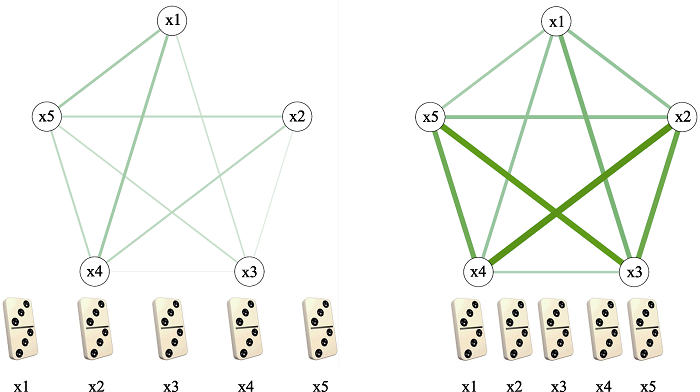
图7
由症状X1-X5组成的连接性强弱不同的网络及其类比多米诺骨牌图。左图为连接度较弱的网络, 类似于间距较大的多米诺骨牌。右图为连接度较强的网络, 类似于间距较小的多米诺骨牌。(资料来源:Cramer等, 2016)
3.3 其他估计方法
除了基本的偏相关网络之外, 还有一些其他新兴的网络模型, 如贝叶斯网络、相对重要性网络(例如Robinaugh et al., 2014)等。其中较为常用的是贝叶斯网络。
贝叶斯网络是新兴发展起来的一种可以利用横断面观测数据做出一定因果推断的网络估计方法。其常见算法有R软件的bnlearn程序包(Scutari, 2010)中的hill-climbing算法:通过不断迭代地添加边、去掉边、反转边的方向, 以确定最小BIC确定最优模型作为网络结构, 并生成有向无环图式2(2在有向无环图中, 结点之间边的方向指示着因果关系, 如结点A、B之间的A→B表示A导致B; “无环”指的是从某一节点出发的边不可以再回到自身, 如结点A、B之间不可以存在A → B → A的路径。)的网络(directed acyclic graphs, DAG, Kalisch & Bühlmann, 2007; Pearl, 2000)。贝叶斯网络应用于心理病理学网络, 可以在一定程度上探究精神障碍症状之间的因果关系, 并做到不依赖中心性指标而识别出因果意义上的驱动性症状。如Mcnally等(2017)利用贝叶斯网络探究PTSD症状间关系时, 识别出对创伤相关提示物的生理反应和心理反应, 可能是PTSD中的驱动性症状(如图8)。
图8
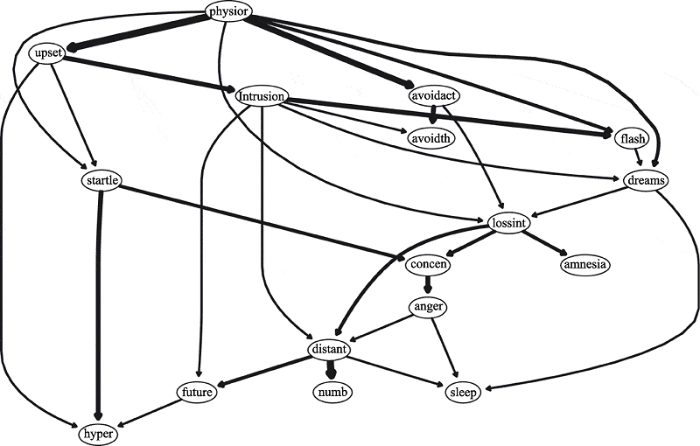
图8
PTSD的贝叶斯网络(DAG)。此网络中, 17个节点代
但是, 贝叶斯网络对横断面数据中的因果关系的统计推断力还有待进一步验证。首先, 贝叶斯网络需要满足一定的假设条件(Pearl, 2010)。一是网络中应纳入全部的相关因素。也就是说, 如果贝叶斯网络中遗漏掉其他会对网络中变量间因果关系产生较大影响的变量(如未被测量到的症状), 症状间可疑的相关关系可能会被错误地推断为因果关系; 二是必须满足因果推断的马尔科夫假设3(3马尔科夫假设是指, 对于任何变量, 在给定其父节点 (即其原因变量)的条件下, 都与其非后代节点(即不是其直接结果的变量)独立。比如, 假设变量X、Y、Z之间的因果关系为X→Y→Z, 马尔科夫假设要求当给定Y时, X与Z是统计独立的。)。而对于复杂的精神障碍, 这些假设并不那么容易满足(Bringmann et al., 2019)。其次, 贝叶斯因果推论的结果(DAG网络)仅能够推断出变量间的单向关系, 不允许反馈环路的存在。而精神障碍的症状之间非常有可能存在相互影响的双向关系, 从而相互抵消, 在贝叶斯网络中表现出无直接因果关系或较微弱的因果关系(如图8中对创伤相关提示物的生理反应通过一条较细的边指向惊跳反应(startle), 很可能是因为这两个症状之间存在相互的因果关系)。最后, 网络结果在实际的计算过程中, 不太容易确定唯一的最优贝叶斯网络, 有时结果会出现很多都可行的DAG模型。
因此, 鉴于贝叶斯网络的这些局限, 我们对于其因果推断结果应当保持谨慎的态度。我们在基于贝叶斯网络的结果做任何推论时, 应至少在确保贝叶斯网络中没有遗漏任何可能导致虚假相关的重要变量、以及多次计算均可以得到同样的稳定的贝叶斯网络模型的前提下。而面对贝叶斯推断结果中较微弱的因果关系(以较细的有向边表示)时, 除了认为反映了症状间因果关联可能较小, 也需要考虑是否存在可能部分抵消的双向因果关系。
4 心理病理学网络理论与方法的应用与价值
4.1 心理病理学网络理论与方法的应用
心理病理学网络理论与方法的发展推动了一系列相关研究的开展。据Robinaugh等(2020)的系统综述, 从2008年到2018年十年期间, 已发表363篇心理病理学网络理论与方法相关文章。其中理论研究98篇, 方法研究61篇, 实证研究204篇。心理病理学网络理论被研究者广泛应用于对MDD (Murri et al., 2018; van Borkulo et al., 2015)、PTSD (McNally et al., 2015)、焦虑障碍(Heeren & McNally, 2016)、进食障碍(Smith et al., 2018)、睡眠障碍(Blake et al., 2018)等多种心身疾病的症状表现、网络结构差异和共病机制的探讨中, 以及多种精神障碍之间关系(Cao et al., 2020)的考查。以创伤后的常见精神障碍为例, 多项PTSD网络分析研究均发现创伤相关遗忘(amnesia)在PTSD网络中具有最低的中心性, 与其他PTSD症状连接程度最低, 表明创伤相关遗忘可能是PTSD的边缘症状(Benfer et al., 2018; McNally et al., 2015, 2017; Papini et al., 2020); Cao等(2019)对比地震后青少年PTSD网络的性别差异发现, 女性的PTSD网络比男性的网络连接性更强, 在核心症状上也有所不同; Afzali等(2017)通过构建MDD和PTSD的共病网络, 识别出了对二者共病起到关键作用的桥症状, 包括睡眠问题、兴趣缺失和易激惹等重叠症状, 以及闪回、自责感和精神运动迟滞等非重叠症状; Cao等(2020)通过估计包含PTSD、MDD和广泛性焦虑等内化问题, 以及攻击行为和违纪行为的外化问题的一系列创伤后常见心理问题的网络, 在分别控制住每一种疾病考查剩余网络的结构后, 发现控制MDD对于网络连接性(尤其是内化与外化问题之间的连接)的影响最大, 表明MDD可能是创伤后多种心理问题并发的关键影响因素。
4.2 心理病理学网络理论与方法的价值
心理病理学网络理论与方法对于精神障碍的全新刻画, 具有重大的理论与临床意义。首先, 心理病理学网络理论否认疾病实体的存在, 将精神障碍刻画为由相互作用的症状组成的动态因果系统这一思想, 回应了传统DSM-ICD分类诊断系统的一个主要问题:此分类标准下确定的任何精神障碍均未找到其对应疾病实体。其次, 心理病理学网络理论与方法改进了对共病机制的研究方式。传统分类诊断系统为使分类更清晰, 在剔除各疾病的共享症状、保留各自独特症状方面做了很多尝试。这本质上相当于回避了对共病的解释, 而心理问题中的共病现象已被证明是常态而非特例(Hasin & Kilcoyne, 2012; Kessler et al., 2005)。心理病理学网络理论与方法则通过估计共病的症状网络及识别对共病疾病起到关键桥接作用的桥症状, 为共病的发生发展机制提供了有效的研究框架。另外, 心理病理学网络理论也指导着不同于传统分类诊断系统下对于精神障碍的诊断和干预方式。如对于遭遇车祸后恐惧开车的患者, 传统分类诊断系统指导下的临床评估者需要首先判定是潜在的特定恐惧症还是PTSD导致他恐惧和回避开车; 而在网络理论下, 评估者则更多需要考查还有什么其他症状被激活以及它们之间是如何关联的(Hofmann et al., 2016)。同样的, 心理病理学网络理论也提示将干预的靶点从疾病层面细化到症状层面。
5 心理病理学网络分析方法的主要局限
5.1 因果关系的推断
大多数心理病理学网络相关研究使用的都是来自横断面的观测数据, 且基本都是在探究数据间的相关关系, 虽然贝叶斯网络可以作出一定的因果推断, 但如前文所说, 其应用于复杂的心理病理学变量时的统计推断力仍需进一步验证。因此仅使用横断面数据可能无法真正说明症状间的因果关系(DeYoung & Krueger, 2018; Forbes et al., 2017)。这一问题关键在于, 心理病理学网络理论所关注的症状间的因果关系更多偏向于个体内精神障碍症状的发展机制, 而使用横断面数据发现的结论都被假设性地认为可以用来描述个体内的过程(Kievit et al., 2013)。但事实上, 仅涉及一次测量的横断面数据只能反映个体间的变量关系, 无法提供个体内的变量关系(Bringmann, 2016)。以偏头痛和睡眠之间的关系为例, 来自横断面的研究可能发现偏头痛和睡眠之间有正相关(Schmitz & Skinner, 1993)。我们可能据此得出结论:睡眠更多的人更易患偏头痛。然而这种正相关的出现可能仅因为患有偏头痛的人倾向于睡得更多以防止偏头痛的发生。相反, 基于个体的分析, 则更有可能发现二者之间的负相关:睡眠更少更可能患偏头痛。事实上, 反映了统计学中的一个著名现象:辛普森悖论(Simpson's paradox, Hamaker, 2012)。这一现象在症状网络中的直观表现为:症状A、B间形成了无向边A—B, 但没有时间的先后性, 很难确定谁是因是果, 即究竟是A→B, 还是B→A (Fried et al., 2017)。因此, 近年来越来越多的研究者提议使用纵向数据来构建网络模型。
5.2 核心症状的识别
由于上述因果推断的不明确性, 症状网络中依靠强度这一中心性指标识别出来的核心症状也欠缺明确的临床意义, 因为它们既可能是对其他症状影响最大的关键症状, 也可能是最受到其他症状影响最大的结果症状(Fried et al., 2017)。近年来研究者也确实在多种精神障碍网络中发现了识别出的核心症状的结论混杂不一(Contreras et al., 2019; Forbes et al., 2017; Ryan et al., 2019)。如MDD症状网络研究中, 精力不足、情绪低落、兴趣缺失等症状都曾被不同研究者确定为核心症状或可能的干预靶点(Fried et al., 2016; van Borkulo et al., 2015); 同样, 在PTSD症状网络中各节点强度中心性的一致性也很低(Forbes et al., 2019)。
事实上, 在使用强度等中心性指标去识别核心症状时, 应当首先明确所谓的“核心”症状究竟意味着什么, 指明有怎样表现的症状可以称之为“核心”症状。而大部分研究对这一点阐释不足(Brandes, 2016; Schoch & Brandes, 2016)。而中心性相关结论存在较大异质性的可能原因之一可能是:首先, 依靠网络中心性指标识别核心节点应首先满足一定的假设条件, 如:(1) 节点可交换性, 即网络中的节点在概念上完全等价地可以互换(Snijders, 2011)。事实上, 心理病理学网络中的中心性概念与测量指标直接借鉴社会网络, 社会网络的节点常为独立、等价的社交实体(如友情网络以人作为节点; 交易网络以公司作为节点), 很容易满足可交换性。而对于心理病理学中具有复杂关联的症状, 则似乎很难满足这一条件; (2) 网络结构及其中心性指标能够揭示一定因果关系, 必须保证所有具有相关因果关系的变量均应被网络纳入, 即网络中不会遗漏任何重要的因果变量。然而对于复杂的某种精神障碍, 找到其全部相关的因果因素都很难做到, 更不用说将其全部纳入到相应网络中(Spiller et al., 2020)。另外, 目前主要中心性指标主要被应用于横断面网络, 而横断面数据的人群异质性问题自然会导致网络结果的可重复性问题。我们也会在6.4中具体探讨这一问题。
5.3 网络的可靠性和可重复性
尽管Borsboom等(2017)提供了一定程度的实证证据以支持网络结构在样本内和样本间的可重复性和推广性, 但研究者对网络分析结果的可靠性和可重复性仍然提出较多质疑(Forbes et al., 2017; Fried et al., 2016; Fried & Cramer, 2017)。Forbes等(2019)对一些研究中的心理病理学网络特征进行量化后发现, 估计网络中边的存在与否、边的正负以及最强且最稳定边的权重等基本网络结构特征, 都存在可重复性低的问题。如MDD症状网络中边估计的结果有43.4%不可重复(即一个网络中的边在另一个网络中不存在或者符号相反); 而PTSD症状网络则更是有63.8%的边估计不一致(Forbes et al., 2019)。
网络的可靠性和可重复性问题的出现可能有以下两方面原因。一方面, 由于目前心理病理学网络主要使用数据驱动的探索性网络分析方法, 除方法的影响外, 网络结构也在很大程度上依赖于数据和样本本身。前人研究表明, 网络中节点的选取和测量对于网络结构的估计(Hallquist et al., 2019)与解释(Forbes et al., 2017)起着至关重要的作用。如Hoffman等(2018)在估计酒精使用障碍(alcohol use disorder, AUD)的症状网络时, 发现仅仅控制单个症状的划界分高低不同, 得到的网络便有显著的结构差异。Borsboom等(2018)也发现同一网络结构无法同时适用于普通人群样本和病人样本。
另一方面, 目前在方法学上欠缺跨研究的网络比较和网络整合的有效方法, 造成研究结果较为分散。目前网络的比较主要借助R语言中NetworkComparisonTest程序包(van Borkulo et al., 2017), 在网络结构、全局强度和边权重的差异上进行比较。但由于这些比较只能在2个网络间进行, 无法比较跨研究的多个网络间的差异, 导致各研究结果的差异的效应量不可知。而对于心理病理学网络分析结果的整合, 目前仅有一些综述类文章(如Contreras et al., 2019; McNally et al., 2015; Robinaugh et al., 2020等), 尚无针对心理病理学网络理论与方法研究质量进行量化的元分析。
6 心理病理学网络分析方法的展望
6.1 纵向数据的使用
事实上, 自心理病理学网络理论提出起, Borsboom和Cramer (2013)便已开始提倡研究者收集密集型时序数据, 并利用心理病理学网络模型对时序数据进行分析。目前已有可将GGM运用于时序数据和面板数据的图形向量自回归分析(vector autoregression, VAR, Borsboom & Cramer, 2013)方法, 可以使用来自个体的密集型时序数据, 同时估计出以回归系数为边的纵向网络(temporal network)和以回归残差间的偏相关为边的横向网络(contemporaneous network)。当使用包含至少3次测量的面板数据(即至少有3个测量时间点的多个个体的时序数据)时, 除纵向网络和横向网络外, 还可估计出以多个个体变量均值间的偏相关为边的个体间网络(between-subjects network, Epskamp, 2020; Epskamp et al., 2018b)。在动态纵向网络中, 可以考查症状间(包括自身)前一时间点对后一时间点的预测作用, 从而可以更深入地了解精神障碍的发展机制。如Bringmann等(2015)在使用VAR方法对贝克抑郁量表(Beck Depression Inventory, BDI-II)测量的21个MDD症状动态纵向网络模型中, 发现快感缺失症状具有对其他症状最强的预测作用, 表明快感缺失可能对于维持MDD动态网络具有相对重要的作用; 而悲伤和兴趣缺失症状可以被包括快感缺失在内的多个症状预测, 但几乎不能预测其他症状, 反映出悲伤和兴趣缺失在MDD的动态过程中可能更多是被动的反应性症状。
6.2 网络特征的拓展
随着新兴网络的发展, 网络特征也已相应从最基本的节点强度、连接性拓展至节点预测性、网络分簇性等多种指标。然而, 这些指标都只反映了症状的关联信息, 未将临床严重程度的信息考虑在内, 局限了网络结果的临床意义。如在临床严重程度不同的群体中考查网络的连接性时, 临床严重程度越高的网络连接性表现不一:分别出现越紧密(Heeren & McNally, 2018; Santos et al., 2017), 无差别(Levinson et al., 2018)和越稀疏(Southward & Cheavens, 2018)等情况。这种差异很大程度上来源于使用网络中变量的函数(如反映总体严重程度的症状得分总和)对数据进行划分, 从而为网络结果引入了选择偏差(Berkson's bias, de Ron et al., 2019)。
这一统计学难题尚无较好的解决办法。但值得思考的是, 在心理病理学网络分析方法中, 症状严重程度作为症状本身自带的属性, 似乎只发挥了估计症状之间关联性的作用, 并不直接属于网络特征之一, 也未真正参与到网络结果的讨论中。因此, 如果能够拓展出可以结合症状严重程度的指标作为网络特征, 那么网络中临床严重程度的影响便成为了网络的内在属性, 而不再作为网络外部变量的干扰因素, 就可以在一定程度上减小选择偏差出现的可能性。同时, 结合症状严重程度, 也为心理病理学网络分析方法增加了更多临床方面的量化信息, 使得网络分析的结果更具临床意义。
6.3 与现有理论的结合
可以说, 潜变量理论与心理病理学网络理论的结合有一定的理论基础和历史根源。一方面, 虽然心理病理学网络模型通过对症状之间相关性的考查, 克服了传统潜变量模型“局部独立性”的弊端; 但不可否认的是, 潜变量模型仍然拥有网络分析模型难以替代的优势(蔡玉清 等, 2020):潜变量模型(特别是广义结构方程模型)纳入了对测量误差的考查和控制(Borsboom et al., 2003), 有效规避了心理测量精确性的问题; 而且潜变量模型也提供了有效的验证性分析的框架。另一方面, 虽然潜变量模型和网络模型在理论上基于不同的对精神障碍的构念假设, 但实际上两模型之间不仅具有统计意义上的等价性(van Bork et al., 2019), 也具有一定的互补性, 并不是互斥的关系(Epskamp & Fried, 2018)。同时, 也有大量证据表明(Birkeland et al., 2020; Fried & Cramer, 2017; Moshier et al., 2018), 对于PTSD、MDD、焦虑障碍等复杂性精神障碍, 潜在的症状维度和症状维度间相互影响的网络结构可能同时存在。针对这些精神障碍的潜在症状维度网络模型则能够巧妙地将这两种视角结合, 使其相辅相成地全面刻画精神障碍的心理病理特性(Epskamp et al., 2017)。
图9
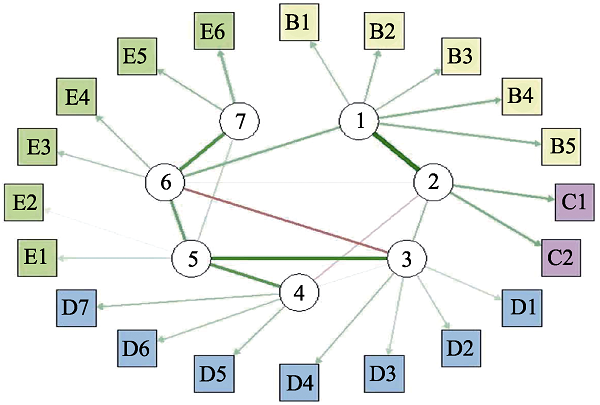
图9
PTSD潜变量网络。方块节点B1-E6分别代
6.4 人群异质性的区分
目前DSM-ICD诊断系统基于症状组合或划界分来确定是否患上精神障碍的诊断方式, 导致具有相同诊断的个体之间, 可能有极其不同的症状表现(如Fried & Nesse, 2015; Galatzer-levy & Bryant, 2013; Olbert et al., 2014)。采用一些结构方程模型(Structural equation modeling, SEM)的方法能够在一定程度上解决人群异质性的问题:潜在类别分析(Latent Class Analysis, LCA)、混合增长模型(Growth Mixture Model, GMM)等混合模型可以基于不同的症状剖面或不同发展轨迹对人群进行分类; 同一类别的个体具有相似的症状表现, 对特定治疗有相似的反应, 或有相似的生物标志物剖面(Have et al., 2016; Wardenaar et al., 2015)。心理病理学网络模型同样可以反映这一问题。如Fried和Cramer (2017)在文中所举的例子:在由600名具有相同诊断的病人组成的样本中, 由于诊断的异质性, 其中一半可能仅在症状簇A内有明显关联(见图10左图), 另一半仅在症状簇B内有明显关联(见图10中图), 然而两个子样本合起来的平均网络则显示无法反映其各自真实模型, 甚至可能据此得出毫无意义的临床结论(见图10右图)。这一方面启示着我们应该谨慎将群体的心理病理学横断面网络结果推论到个体(如针对个体干预时以某中心性高的症状为干预靶点)。另一方面也提示着我们, 本身聚焦于症状水平的心理病理学网络模型, 若能够发展出可区分人群异质性的网络混合模型, 对各精神障碍症状表现的个体差异的考查和网络结果的可靠性的验证可以起到关键作用(Fried & Cramer, 2017)。目前, 网络混合模型的一大挑战是由于估计参数的增加需要更大的样本量来确保网络的稳定性(Epskamp et al., 2018b)。
图10
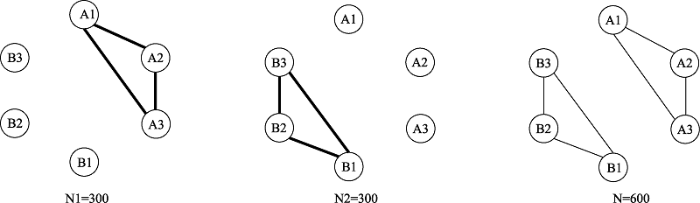
6.5 研究结果的整合
除发展用以区分个体差异的网络混合模型外, 对跨样本研究结果的整合也是未来重要的发展方向。已有一些研究借助跨样本的方法考查了网络结果的稳定性、相似性与可重复性。如Forbes等(2019)在2个大型社区样本中考查了MDD和焦虑症状网络的可重复性。Fried等(2018)针对PTSD症状网络, 在4个具有不同文化背景、创伤类型和严重程度的样本中验证了网络结果(包括症状剖面、网络结构和症状中心性)间较高的相似性。也有研究在针对同一精神障碍使用的不同测量工具所得的网络结果之间发现了较高的相似性(Moshier et al., 2018)。但这些研究所用的方法大多都是基于一般网络估计方法, 对单个样本网络分别进行估计、比较后, 将多个样本合并再次进行网络估计, 比较的样本数量与指标有限。未来应在方法学上着重发展可以比较多个网络差异的方法, 并增加更多比较的指标, 对各网络结果间的差异进行更为细致的刻画。同时应开发针对跨样本网络结果整合与比较的特定方法(如估计相同疾病的样本合并网络或者不同疾病的症状合并网络的方法Robinaugh et al., 2020), 或发展可定量整合各研究网络结果的元分析方法。为实现这样的整合方法, 需要倡议研究者共享网络分析的代码与相关数据矩阵(Contreras et al., 2019; Epskamp, Rhemtulla, et al., 2017; Robinaugh et al., 2020)。
7 总结
本文是第一篇详细介绍心理病理学理论与方法的中文文章, 概述并总结了心理病理学网络理论内容、对应的网络分析方法、理论与方法的应用及价值、目前方法的主要局限与未来可能的发展方向。心理病理学网络理论为我们提供了看待精神障碍的崭新视角, 将我们对于精神障碍的认识细化到症状水平, 为我们探索症状间的动态关联开辟了新的途径。但目前此网络方法仍面临不小的挑战, 如网络结果的可靠性与可重复性问题。未来在完善网络理论、积累实证研究证据的同时, 也应更多致力于方法上的发展, 如潜变量网络模型的进一步完善、网络混合模型的建立以及针对网络方法的元分析方法的开发等。
参考文献
Mental health: On the spectrum
A network approach to the comorbidity between posttraumatic stress disorder and major depressive disorder: The role of overlapping symptoms
Network models of posttraumatic stress symptoms across trauma types
The network approach to posttraumatic stress disorder: A systematic review
Mechanisms underlying the association between insomnia, anxiety, and depression in adolescence: Implications for behavioral sleep interventions
Issues in intraindividual variability: Individual differences in equilibria and dynamics over multiple time scales
Psychometric perspectives on diagnostic systems
The author identifies four conceptualizations of the relation between symptoms and disorders as utilized in diagnostic systems such as the Diagnostic and Statistical Manual of Mental Disorders, Fourth Edition (DSM-IV; American Psychiatric Association, 1994): A constructivist perspective, which holds that disorders are conveniently grouped sets of symptoms; a diagnostic perspective, which holds that disorders are latent classes underlying the symptoms; a dimensional perspective, which holds that symptoms measure latent continua; and a causal systems perspective, which holds that disorders are causal networks consisting of symptoms and direct causal relations between them. Advantages and disadvantages of these conceptualizations are discussed. The author concludes that the psychometric analysis of diagnostic systems is not settled, and that these systems require deeper psychometric analysis than they currently receive.
A network theory of mental disorders
In recent years, the network approach to psychopathology has been advanced as an alternative way of conceptualizing mental disorders. In this approach, mental disorders arise from direct interactions between symptoms. Although the network approach has led to many novel methodologies and substantive applications, it has not yet been fully articulated as a scientific theory of mental disorders. The present paper aims to develop such a theory, by postulating a limited set of theoretical principles regarding the structure and dynamics of symptom networks. At the heart of the theory lies the notion that symptoms of psychopathology are causally connected through myriads of biological, psychological and societal mechanisms. If these causal relations are sufficiently strong, symptoms can generate a level of feedback that renders them self-sustaining. In this case, the network can get stuck in a disorder state. The network theory holds that this is a general feature of mental disorders, which can therefore be understood as alternative stable states of strongly connected symptom networks. This idea naturally leads to a comprehensive model of psychopathology, encompassing a common explanatory model for mental disorders, as well as novel definitions of associated concepts such as mental health, resilience, vulnerability and liability. In addition, the network theory has direct implications for how to understand diagnosis and treatment, and suggests a clear agenda for future research in psychiatry and associated disciplines.© 2017 World Psychiatric Association.
Network analysis: An integrative approach to the structure of psychopathology
False alarm? A comprehensive reanalysis of “evidence that psychopathology symptom networks have limited replicability” by Forbes, Wright, Markon, and Krueger (2017)
Forbes, Wright, Markon, and Krueger (2017) stated that "psychopathology networks have limited replicability" (p. 1011) and that "popular network analysis methods produce unreliable results" (p. 1011). These conclusions are based on an assessment of the replicability of four different network models for symptoms of major depression and generalized anxiety across two samples; in addition, Forbes et al. analyzed the stability of the network models within the samples using split-halves. Our reanalysis of the same data with the same methods led to results directly opposed to theirs: All network models replicated very well across the two data sets and across the split-halves. We trace the differences between Forbes et al.'s results and our own to the fact that they did not appear to accurately implement all network models and used debatable metrics to assess replicability. In particular, they deviated from existing estimation routines for relative importance networks, did not acknowledge the fact that the skip structure used in the interviews strongly distorted correlations between symptoms, and incorrectly assumed that network structures and metrics should be the same not only across the different samples but also across the different network models used. In addition to a comprehensive reanalysis of the data, we end with a discussion of best practices concerning future research into the replicability of psychometric networks. (PsycINFO Database Record(c) 2017 APA, all rights reserved).
The theoretical status of latent variables
This article examines the theoretical status of latent variables as used in modern test theory models. First, it is argued that a consistent interpretation of such models requires a realist ontology for latent variables. Second, the relation between latent variables and their indicators is discussed. It is maintained that this relation can be interpreted as a causal one but that in measurement models for interindividual differences the relation does not apply to the level of the individual person. To substantiate intraindividual causal conclusions, one must explicitly represent individual level processes in the measurement model. Several research strategies that may be useful in this respect are discussed, and a typology of constructs is proposed on the basis of this analysis. The need to link individual processes to latent variable models for interindividual differences is emphasized.
Robustness and replicability of psychopathology networks
Network positions
What do centrality measures measure in psychological networks?
DOI:10.1037/abn0000446
PMID:31318245
[本文引用: 1]

Centrality indices are a popular tool to analyze structural aspects of psychological networks. As centrality indices were originally developed in the context of social networks, it is unclear to what extent these indices are suitable in a psychological network context. In this article we critically examine several issues with the use of the most popular centrality indices in psychological networks: degree, betweenness, and closeness centrality. We show that problems with centrality indices discussed in the social network literature also apply to the psychological networks. Assumptions underlying centrality indices, such as presence of a flow and shortest paths, may not correspond with a general theory of how psychological variables relate to one another. Furthermore, the assumptions of node distinctiveness and node exchangeability may not hold in psychological networks. We conclude that, for psychological networks, betweenness and closeness centrality seem especially unsuitable as measures of node importance. We therefore suggest three ways forward: (a) using centrality measures that are tailored to the psychological network context, (b) reconsidering existing measures of importance used in statistical models underlying psychological networks, and (c) discarding the concept of node centrality entirely. Foremost, we argue that one has to make explicit what one means when one states that a node is central, and what assumptions the centrality measure of choice entails, to make sure that there is a match between the process under study and the centrality measure that is used. (PsycINFO Database Record (c) 2019 APA, all rights reserved).
Revealing the dynamic network structure of the Beck depression inventory-II
Structured interviews and questionnaires are important tools to screen for major depressive disorder. Recent research suggests that, in addition to studying the mean level of total scores, researchers should focus on the dynamic relations among depressive symptoms as they unfold over time. Using network analysis, this paper is the first to investigate these patterns of short-term (i.e. session to session) dynamics for a widely used psychological questionnaire for depression - the Beck Depression Inventory (BDI-II).With the newly developed vector autoregressive (VAR) multilevel method we estimated the network of symptom dynamics that characterizes the BDI-II, based on repeated administrations of the questionnaire to a group of depressed individuals who participated in a treatment study of an average of 14 weekly assessments. Also the centrality of symptoms and the community structure of the network were examined.The analysis showed that all BDI-II symptoms are directly or indirectly connected through patterns of temporal influence. In addition, these influences are mutually reinforcing, 'loss of pleasure' being the most central item in the network. Community analyses indicated that the dynamic structure of the BDI-II involves two clusters, which is consistent with earlier psychometric analyses.The network approach expands the range of depression research, making it possible to investigate the dynamic architecture of depression and opening up a whole new range of questions and analyses. Regarding clinical practice, network analyses may be used to indicate which symptoms should be targeted, and in this sense may help in setting up treatment strategies.
Sex differences in global and local connectivity of adolescent posttraumatic stress disorder symptoms
Depicting the associations between different forms of psychopathology in trauma-exposed adolescents
Extended Bayesian information criteria for model selection with large model spaces
The study of psychopathology from the network analysis perspective: A systematic review
Network analysis (NA) is an analytical tool that allows one to explore the map of connections and eventual dynamic influences among symptoms and other elements of mental disorders. In recent years, the use of NA in psychopathology has rapidly grown, which calls for a systematic and critical analysis of its clinical utility.Following PRISMA guidelines, a systematic review of published empirical studies applying NA in psychopathology, between 2010 and 2017, was conducted. We included the literature published in PubMed and PsycINFO using as keywords any combination of "network analysis" with the terms "anxiety," "affective disorders," "depression," "schizophrenia," "psychosis," "personality disorders," "substance abuse" and "psychopathology."The review showed that NA has been applied in a plethora of mental disorders in adults (i.e., 13 studies on anxiety disorders; 19 on mood disorders; 7 on psychosis; 1 on substance abuse; 1 on borderline personality disorder; 18 on the association of symptoms between disorders), and 6 on childhood and adolescence.A critical examination of the results of each study suggests that NA helps to identify, in an innovative way, important aspects of psychopathology like the centrality of the symptoms in a given disorder as well as the mutual dynamics among symptoms. Yet, despite these promising results, the clinical utility of NA is still uncertain as there are important limitations on the analytic procedures (e.g., reliability of indices), the type of data included (e.g., typically restricted to secondary analysis of already published data), and ultimately, the psychometric and clinical validity of the results.© 2019 S. Karger AG, Basel.
Problems attract problems: A network perspective on mental disorders
Major depression as a complex dynamic system
Psychological networks in clinical populations: Investigating the consequences of Berkson's bias
Understanding psychopathology: Cybernetics and psychology on the boundary between order and chaos
Psychometric network models from time-series and panel data
Researchers in the field of network psychometrics often focus on the estimation of Gaussian graphical models (GGMs)-an undirected network model of partial correlations-between observed variables of cross-sectional data or single-subject time-series data. This assumes that all variables are measured without measurement error, which may be implausible. In addition, cross-sectional data cannot distinguish between within-subject and between-subject effects. This paper provides a general framework that extends GGM modeling with latent variables, including relationships over time. These relationships can be estimated from time-series data or panel data featuring at least three waves of measurement. The model takes the form of a graphical vector-autoregression model between latent variables and is termed the ts-lvgvar when estimated from time-series data and the panel-lvgvar when estimated from panel data. These methods have been implemented in the software package psychonetrics, which is exemplified in two empirical examples, one using time-series data and one using panel data, and evaluated in two large-scale simulation studies. The paper concludes with a discussion on ergodicity and generalizability. Although within-subject effects may in principle be separated from between-subject effects, the interpretation of these results rests on the intensity and the time interval of measurement and on the plausibility of the assumption of stationarity.
Estimating psychological networks and their accuracy: A tutorial paper
qgraph: Network visualizations of relationships in psychometric data
A tutorial on regularized partial correlation networks
Generalized network psychometrics: Combining network and latent variable models
We introduce the network model as a formal psychometric model, conceptualizing the covariance between psychometric indicators as resulting from pairwise interactions between observable variables in a network structure. This contrasts with standard psychometric models, in which the covariance between test items arises from the influence of one or more common latent variables. Here, we present two generalizations of the network model that encompass latent variable structures, establishing network modeling as parts of the more general framework of structural equation modeling (SEM). In the first generalization, we model the covariance structure of latent variables as a network. We term this framework latent network modeling (LNM) and show that, with LNM, a unique structure of conditional independence relationships between latent variables can be obtained in an explorative manner. In the second generalization, the residual variance-covariance structure of indicators is modeled as a network. We term this generalization residual network modeling (RNM) and show that, within this framework, identifiable models can be obtained in which local independence is structurally violated. These generalizations allow for a general modeling framework that can be used to fit, and compare, SEM models, network models, and the RNM and LNM generalizations. This methodology has been implemented in the free-to-use software package lvnet, which contains confirmatory model testing as well as two exploratory search algorithms: stepwise search algorithms for low-dimensional datasets and penalized maximum likelihood estimation for larger datasets. We show in simulation studies that these search algorithms perform adequately in identifying the structure of the relevant residual or latent networks. We further demonstrate the utility of these generalizations in an empirical example on a personality inventory dataset.
Discovering psychological dynamics in time-series data
We discuss the Gaussian graphical model (GGM; an undirected network of partial correlation coefficients) and detail its utility as an exploratory data analysis tool. The GGM shows which variables predict one-another, allows for sparse modeling of covariance structures, and may highlight potential causal relationships between observed variables. We describe the utility in three kinds of psychological data sets: data sets in which consecutive cases are assumed independent (e.g., cross-sectional data), temporally ordered data sets (e.g., n = 1 time series), and a mixture of the 2 (e.g., n > 1 time series). In time-series analysis, the GGM can be used to model the residual structure of a vector-autoregression analysis (VAR), also termed graphical VAR. Two network models can then be obtained: a temporal network and a contemporaneous network. When analyzing data from multiple subjects, a GGM can also be formed on the covariance structure of stationary means-the between-subjects network. We discuss the interpretation of these models and propose estimation methods to obtain these networks, which we implement in the R packages graphicalVAR and mlVAR. The methods are showcased in two empirical examples, and simulation studies on these methods are included in the supplementary materials.
Evidence that psychopathology symptom networks have limited replicability
Quantifying the reliability and replicability of psychopathology network characteristics
Moving forward: Challenges and directions for psychopathological network theory and methodology
Since the introduction of mental disorders as networks of causally interacting symptoms, this novel framework has received considerable attention. The past years have resulted in over 40 scientific publications and numerous conference symposia and workshops. Now is an excellent moment to take stock of the network approach: What are its most fundamental challenges, and what are potential ways forward in addressing them? After a brief conceptual introduction, we first discuss challenges to network theory: (1) What is the validity of the network approach beyond some commonly investigated disorders such as major depression? (2) How do we best define psychopathological networks and their constituent elements? And (3) how can we gain a better understanding of the causal nature and real-life underpinnings of associations among symptoms? Next, after a short technical introduction to network modeling, we discuss challenges to network methodology: (4) heterogeneity of samples studied with network analytic models, and (5) a lurking replicability crisis in this strongly data-driven and exploratory field. Addressing these challenges may propel the network approach from its adolescence into adulthood and promises advances in understanding psychopathology both at the nomothetic and idiographic level.
Replicability and generalizability of posttraumatic stress disorder (PTSD) networks: A cross-cultural multisite study of PTSD symptoms in four trauma patient samples
The growing literature conceptualizing mental disorders like posttraumatic stress disorder (PTSD) as networks of interacting symptoms faces three key challenges. Prior studies predominantly used (a) small samples with low power for precise estimation, (b) nonclinical samples, and (c) single samples. This renders network structures in clinical data, and the extent to which networks replicate across data sets, unknown. To overcome these limitations, the present cross-cultural multisite study estimated regularized partial correlation networks of 16 PTSD symptoms across four data sets of traumatized patients receiving treatment for PTSD (total = 2,782). Despite differences in culture, trauma type, and severity of the samples, considerable similarities emerged, with moderate to high correlations between symptom profiles (0.43-0.82), network structures (0.62-0.74), and centrality estimates (0.63-0.75). We discuss the importance of future replicability efforts to improve clinical psychological science and provide code, model output, and correlation matrices to make the results of this article fully reproducible.
What are “good” depression symptoms? Comparing the centrality of DSM and non-DSM symptoms of depression in a network analysis
The symptoms for Major Depression (MD) defined in the DSM-5 differ markedly from symptoms assessed in common rating scales, and the empirical question about core depression symptoms is unresolved. Here we conceptualize depression as a complex dynamic system of interacting symptoms to examine what symptoms are most central to driving depressive processes.We constructed a network of 28 depression symptoms assessed via the Inventory of Depressive Symptomatology (IDS-30) in 3,463 depressed outpatients from the Sequenced Treatment Alternatives to Relieve Depression (STAR*D) study. We estimated the centrality of all IDS-30 symptoms, and compared the centrality of DSM and non-DSM symptoms; centrality reflects the connectedness of each symptom with all other symptoms.A network with 28 intertwined symptoms emerged, and symptoms differed substantially in their centrality values. Both DSM symptoms (e.g., sad mood) and non-DSM symptoms (e.g., anxiety) were among the most central symptoms, and DSM criteria were not more central than non-DSM symptoms.Many subjects enrolled in STAR*D reported comorbid medical and psychiatric conditions which may have affected symptom presentation.The network perspective neither supports the standard psychometric notion that depression symptoms are equivalent indicators of MD, nor the common assumption that DSM symptoms of depression are of higher clinical relevance than non-DSM depression symptoms. The findings suggest the value of research focusing on especially central symptoms to increase the accuracy of predicting outcomes such as the course of illness, probability of relapse, and treatment response.Copyright © 2015 Elsevier B.V. All rights reserved.
Depression is not a consistent syndrome: An investigation of unique symptom patterns in the STAR*D study
The DSM-5 encompasses a wide range of symptoms for Major Depressive Disorder (MDD). Symptoms are commonly added up to sum-scores, and thresholds differentiate between healthy and depressed individuals. The underlying assumption is that all patients diagnosed with MDD have a similar condition, and that sum-scores accurately reflect the severity of this condition. To test this assumption, we examined the number of DSM-5 depression symptom patterns in the "Sequenced Treatment Alternatives to Relieve Depression" (STAR*D) study.We investigated the number of unique symptom profiles reported by 3703 depressed outpatients at the beginning of the first treatment stage of STAR*D.Overall, we identified 1030 unique symptom profiles. Of these profiles, 864 profiles (83.9%) were endorsed by five or fewer subjects, and 501 profiles (48.6%) were endorsed by only one individual. The most common symptom profile exhibited a frequency of only 1.8%. Controlling for overall depression severity did not reduce the amount of observed heterogeneity.Symptoms were dichotomized to construct symptom profiles. Many subjects enrolled in STAR*D reported medical conditions for which prescribed medications may have affected symptom presentation.The substantial symptom variation among individuals who all qualify for one diagnosis calls into question the status of MDD as a specific consistent syndrome and offers a potential explanation for the difficulty in documenting treatment efficacy. We suggest that the analysis of individual symptoms, their patterns, and their causal associations will provide insights that could not be discovered in studies relying on only sum-scores.Copyright © 2014 Elsevier B.V. All rights reserved.
Mental disorders as networks of problems: A review of recent insights
The network perspective on psychopathology understands mental disorders as complex networks of interacting symptoms. Despite its recent debut, with conceptual foundations in 2008 and empirical foundations in 2010, the framework has received considerable attention and recognition in the last years.This paper provides a review of all empirical network studies published between 2010 and 2016 and discusses them according to three main themes: comorbidity, prediction, and clinical intervention.Pertaining to comorbidity, the network approach provides a powerful new framework to explain why certain disorders may co-occur more often than others. For prediction, studies have consistently found that symptom networks of people with mental disorders show different characteristics than that of healthy individuals, and preliminary evidence suggests that networks of healthy people show early warning signals before shifting into disordered states. For intervention, centrality-a metric that measures how connected and clinically relevant a symptom is in a network-is the most commonly studied topic, and numerous studies have suggested that targeting the most central symptoms may offer novel therapeutic strategies.We sketch future directions for the network approach pertaining to both clinical and methodological research, and conclude that network analysis has yielded important insights and may provide an important inroad towards personalized medicine by investigating the network structures of individual patients.
Sparse inverse covariance estimation with the graphical lasso
We consider the problem of estimating sparse graphs by a lasso penalty applied to the inverse covariance matrix. Using a coordinate descent procedure for the lasso, we develop a simple algorithm--the graphical lasso--that is remarkably fast: It solves a 1000-node problem ( approximately 500,000 parameters) in at most a minute and is 30-4000 times faster than competing methods. It also provides a conceptual link between the exact problem and the approximation suggested by Meinshausen and Bühlmann (2006). We illustrate the method on some cell-signaling data from proteomics.
636, 120 Ways to have posttraumatic stress disorder
In an attempt to capture the variety of symptoms that emerge following traumatic stress, the revision of posttraumatic stress disorder (PTSD) criteria in the 5th edition of the Diagnostic and Statistical Manual of Mental Disorders (DSM-5) has expanded to include additional symptom presentations. One consequence of this expansion is that it increases the amorphous nature of the classification. Using a binomial equation to elucidate possible symptom combinations, we demonstrate that the DSM-IV criteria listed for PTSD have a high level of symptom profile heterogeneity (79,794 combinations); the changes result in an eightfold expansion in the DSM-5, to 636,120 combinations. In this article, we use the example of PTSD to discuss the limitations of DSM-based diagnostic entities for classification in research by elucidating inherent flaws that are either specific artifacts from the history of the DSM or intrinsic to the underlying logic of the DSM's method of classification. We discuss new directions in research that can provide better information regarding both clinical and nonclinical behavioral heterogeneity in response to potentially traumatic and common stressful life events. These empirical alternatives to an a priori classification system hold promise for answering questions about why diversity occurs in response to stressors. © The Author(s) 2013.
Exploratory graph analysis: A new approach for estimating the number of dimensions in psychological research
Application of network methods for understanding mental disorders: Pitfalls and promise
Galvanized with the availability of sophisticated statistical techniques and large datasets, network medicine has emerged as an active area of investigation. Following this trend, network methods have been utilized to understand the interplay between symptoms of mental disorders. This realistic approach that may provide an improved framework into understanding mental conditions and underlying mechanisms is certainly to be welcomed. However, we have noticed that symptom network studies tend to lose sight of the fundamentals, overlook major limitations embedded in study designs, and make inferences that are difficult to justify with current findings. There is concern that disregarding these flaws may halt the progress of the network approach in psychiatry. Therefore, in this paper, we first attempt to identify the pitfalls: (1) a reductionist understanding of medicine and psychiatry, thereby inadvertently reintroducing the dichotomy of medicine (lung cancer) and psychiatry (depression), (2) a shortsighted view of signs and symptoms, (3) overlooking the limitations of available datasets based on scales with embedded latent class structures, (4) overestimating the importance of the current findings beyond what is supported by the study design. By addressing current issues, the hope is to navigate this rapidly growing field to a more methodologically sound and reproducible path that will contribute to our understanding of mental disorders and its underlying mechanisms.
Problems with centrality measures in psychopathology symptom networks: Why network psychometrics cannot escape psychometric theory
Why researchers should think “within-person”:A paradigmatic rationale
Comorbidity of psychiatric and substance use disorders in the United States: Current issues and findings from the NESARC
How well do network models predict observations? On the importance of predictability in network models
The identification of symptom-based subtypes of depression: A nationally representative cohort study
A call for complexity in the study of social anxiety disorder. Commentary: The aetiology and maintenance of social anxiety disorder: A synthesis of complementary theoretical models and formulation of a new integrated model
Social anxiety disorder as a densely interconnected network of fear and avoidance for social situations
Criteria definitions and network relations: The importance of criterion thresholds
A complex network perspective on clinical science
Contemporary classification systems for mental disorders assume that abnormal behaviors are expressions of latent disease entities. An alternative to the latent disease model is the complex network approach. Instead of assuming that symptoms arise from an underlying disease entity, the complex network approach holds that disorders exist as systems of interrelated elements of a network. This approach also provides a framework for the understanding of therapeutic change. Depending on the structure of the network, change can occur abruptly once the network reaches a critical threshold (the tipping point). Homogeneous and highly connected networks often recover more slowly from local perturbations when the network approaches the tipping point, potentially making it possible to predict treatment change, relapse, and recovery. In this article, we discuss the complex network approach as an alternative to the latent disease model and its implications for classification, therapy, relapse, and recovery.© The Author(s) 2016.
Research domain criteria (RDoC): Toward a new classification framework for research on mental disorders
Estimating high-dimensional directed acyclic graphs with the pc-algorithm
Prevalence, severity, and comorbidity of 12-month DSM-IV disorders in the National Comorbidity Survey Replication
Little is known about the general population prevalence or severity of DSM-IV mental disorders.To estimate 12-month prevalence, severity, and comorbidity of DSM-IV anxiety, mood, impulse control, and substance disorders in the recently completed US National Comorbidity Survey Replication.Nationally representative face-to-face household survey conducted between February 2001 and April 2003 using a fully structured diagnostic interview, the World Health Organization World Mental Health Survey Initiative version of the Composite International Diagnostic Interview.Nine thousand two hundred eighty-two English-speaking respondents 18 years and older.Twelve-month DSM-IV disorders.Twelve-month prevalence estimates were anxiety, 18.1%; mood, 9.5%; impulse control, 8.9%; substance, 3.8%; and any disorder, 26.2%. Of 12-month cases, 22.3% were classified as serious; 37.3%, moderate; and 40.4%, mild. Fifty-five percent carried only a single diagnosis; 22%, 2 diagnoses; and 23%, 3 or more diagnoses. Latent class analysis detected 7 multivariate disorder classes, including 3 highly comorbid classes representing 7% of the population.Although mental disorders are widespread, serious cases are concentrated among a relatively small proportion of cases with high comorbidity.
Simpson's paradox in psychological science: A practical guide
Social anxiety and eating disorder comorbidity and underlying vulnerabilities: Using network analysis to conceptualize comorbidity
An exploration of the DSM-5 posttraumatic stress disorder symptom latent variable network
Can network analysis transform psychopathology?
A Bayesian network analysis of posttraumatic stress disorder symptoms in adults reporting childhood sexual abuse
Mental disorders as causal systems: A network approach to posttraumatic stress disorder
Examination of posttraumatic stress disorder symptom networks using clinician-rated and patient-rated data
The symptom network structure of depressive symptoms in late-life: Results from a European population study
Quantifying heterogeneity attributable to polythetic diagnostic criteria: Theoretical framework and empirical application
Node centrality in weighted networks: Generalizing degree and shortest paths
Pretreatment posttraumatic stress disorder symptom network metrics predict the strength of the association between node change and network change during treatment
The mathematics of causal relations
The network approach to psychopathology: A review of the literature 2008-2018 and an agenda for future research
The network approach to psychopathology posits that mental disorders can be conceptualized and studied as causal systems of mutually reinforcing symptoms. This approach, first posited in 2008, has grown substantially over the past decade and is now a full-fledged area of psychiatric research. In this article, we provide an overview and critical analysis of 363 articles produced in the first decade of this research program, with a focus on key theoretical, methodological, and empirical contributions. In addition, we turn our attention to the next decade of the network approach and propose critical avenues for future research in each of these domains. We argue that this program of research will be best served by working toward two overarching aims: (a) the identification of robust empirical phenomena and (b) the development of formal theories that can explain those phenomena. We recommend specific steps forward within this broad framework and argue that these steps are necessary if the network approach is to develop into a progressive program of research capable of producing a cumulative body of knowledge about how specific mental disorders operate as causal systems.
Network analysis of persistent complex bereavement disorder in conjugally bereaved adults
Persistent complex bereavement disorder (PCBD) is a bereavement-specific syndrome characterized by prolonged and impairing grief. Most research on this syndrome rests on the traditional latent variable model, whereby symptoms reflect an underlying entity. The network (or causal system) approach offers an alternative framework for understanding PCBD that does not suffer from limitations inherent in the latent entity approach. The network approach to psychopathology conceptualizes the relation between symptoms and disorder as mereological, not reflective. That is, symptoms do not reflect an inferred, unobservable category or dimension, but rather are themselves constitutive of the disorder. Accordingly, we propose that PCBD constitutes a causal system of mutually reinforcing symptoms that arise following the death of a loved one and settle into a pathological equilibrium. In this study, we used data from the Changing Lives of Older Couples database to identify symptoms central to PCBD, to distinguish the PCBD network from an overlapping but distinct network of depression symptoms, and to examine how previously identified risk factors may contribute to the maintenance or development of PCBD. Together, these findings provide an important first step toward understanding the nature and etiology of the PCBD network.(c) 2014 APA, all rights reserved.
The challenge of generating causal hypotheses using network models
Network structure of perinatal depressive symptoms in latinas: Relationship to stress and reproductive biomarkers
Deconstructing the construct: A network perspective on psychological phenomena
Perceived control, effort, and academic performance: Interindividual, intraindividual, and multivariate time-series analyses
Re-conceptualizing centrality in social networks
Learning Bayesian networks with the bnlearn R package
Network analysis: An innovative framework for understanding eating disorder psychopathology
Statistical models for social networks
Identifying core deficits in a dimensional model of borderline personality disorder features: A network analysis
Researchers have proposed three core deficits of Borderline Personality Disorder (BPD): emotion dysregulation, interpersonal problems, and self-identity disturbance. Previous methods for testing these deficits rest on problematic assumptions (e.g., the assumption that observable/measured features of BPD, such as chaotic relationships and affective intensity, occur independently). A network model of psychopathology assumes that observable features of disorders directly interact, and network analytic methods quantify how central each feature is. We conducted a network analysis of core deficits of BPD features using a large ( = 4386) sample of participants with a range of BPD features. The most central features of participants in the High BPD group were loneliness, recklessness/impulsivity, and intense moods, supporting models of emotion dysregulation and interpersonal problems. The networks of BPD features did not differ between men and women. We provide directions for future research to enhance our understanding of how networks of BPD features change over time.
On the validity of the centrality hypothesis in cross-sectional between-subject networks of psychopathology
Latent variable models and networks: Statistical equivalence and testability
Association of symptom network structure with the course of longitudinal depression
Symptom-specific course trajectories and their determinants in primary care patients with major depressive disorder: Evidence for two etiologically distinct prototypes
The course-heterogeneity of Major Depressive Disorder (MDD) hampers development of better prognostic models. Although latent class growth analyses (LCGA) have been used to explain course-heterogeneity, such analyses have failed to also account for symptom-heterogeneity of depressive symptoms. Therefore, the aim was to identify more specific data-driven subgroups based on patterns of course-trajectories on different depressive symptom domains.In primary care MDD patients (n=205), the presence of the MDD criterion symptoms was determined for each week during a year. Weekly 'mood/cognition' (MC) and 'somatic' (SOM) scores were computed and parallel processes-LCGA (PP-LCGA) was used to identify subgroups based on the course on these domains. The classes׳ associations with baseline predictors and 2-/3-year outcomes were investigated.PP-LCGA identified four classes: quick recovery, persisting SOM, persisting MC, and persisting SOM+MC (chronic). Persisting SOM was specifically predicted by higher baseline somatic symptomatology and somatization, and was associated with more somatic depressive symptomatology at long-term follow-up. Persisting MC was specifically predicted by higher depressive severity, thinking insufficiencies, neuroticism, loneliness and lower self-esteem, and was associated with lower mental health related quality of life and more mood/cognitive depressive symptomatology at follow-up.The sample was small and contained only primary care MDD patients. The weekly depression assessments were collected retrospectively at 3-month intervals.The results indicate that there are two specific prototypes of depression, characterized by either persisting MC or persisting SOM, which have different sets of associated prognostic factors and long-term outcomes, and could have different etiological mechanisms.Copyright © 2015 Elsevier B.V. All rights reserved.


