



1 引言
羞愧作为中国儒家传统文化中一种不可或缺的道德情绪, 被认为是帮助中国人自我反省的重要途径(Geaney, 2004)。《论语ˑ颜渊》中指出君子之道为:“内省不疚, 夫何忧何惧?”即扪心自问, 没有什么觉得愧疚的, 就能远离忧愁和恐惧。这种观点在上个世纪末遭到了心理学界的大力批判, 在Hawkins (2013)的能量层级理论中, 羞愧处于最底层, 被描述为犹如意识的自杀行为。更有研究者将羞愧视为“人类已知的最强大、最痛苦、最具潜在破坏性的经历之一” (Gilbert, 1997)。它对心理功能有着多方面的影响, 涵盖认知、行为、情感等, 不断在个人层面、人际层面和文化层面上运作(Lewis, Alessandri, & Sullivan, 1992; Tangney & Dearing, 2002)。早期大多数羞愧定义集中于现象学层面, Lewis等人(1992)将羞愧定义为个体运用内化了的标准、规则、目标对情境和总体自我进行评价后产生的消极感受。Tangney (1999)认为羞愧是个体经历失败事件或做出与道德准则相悖的行为之后察觉到自我形象受损, 并由此产生的无价值感。不同研究者提出的定义大都聚焦于自我评价与自我感受。容易与其相混淆的概念是内疚, 虽然研究显示羞愧与内疚都是由自我相关的负性行为所引发的, 但二者的评价对象不同, 羞愧更加关注自我痛苦, 而内疚则是个体内在对某一特定行为的关注(Tangney, Stuewig, & Martinez, 2014)。为了在概念上与内疚相区分, Tangney等人(2014)将羞愧与内疚分别直观地描述为:“I am a bad person”与“I did a bad thing”。由此可见, 羞愧来源于对整体自我贬值的感知(Tangney & Dearing, 2002)。
羞愧概念不仅在阐述上各不相同, 其究竟将导向怎样的行为结果也始终没有统一的认识, 近20年来, 研究者针对羞愧开展了大量实证研究, 随之而来的便是因一系列截然相反的研究结果造成的分歧不断涌现, 在羞愧引发消极行为结果的研究中, 甚至部分验证了羞愧对于中国人心理发展带来的严重影响(郭瞻予, 李阳, 2017; 汪启荣, 钱铭怡, 2010; 王玉龙, 陈慧玲, 覃雅兰, 蔺秀云, 2019), 显然这与儒家传统文化中对羞愧的阐释不尽相同。而分歧的另一方则认为羞愧可以导向建设性, 有助于人际和谐与自我改变(Brown & Cehajic, 2008; Gausel & Brown, 2012; Lickel, Kushlev, Savalei, Matta, & Schmader, 2014)。研究者们针对双方观点提出了许多有价值的理论模型, 但是, 这些理论模型的立足点也是相互矛盾的, 无法完全合理地解释生活中的不同现象。导致这些理论模型的解释力度和预测效度无法令人满意的根本原因是:羞愧究竟是导向破坏性还是建设性?或者另有路径?本文将从这一问题出发, 分别从羞愧的建设性和破坏性这两个方面进行梳理和总结, 希望能在此基础上形成更具清晰性、阐释性和合理性的理论模型, 并对未来的研究提出展望。研究羞愧有助于加深对文化视域下中国人心理发展能力的理解, 并且对如何预防羞愧带来破坏性结果具有积极的指导意义。
2 羞愧导向破坏性
羞愧导向破坏性的观点随着自我意识情绪领域研究的兴起得到了越来越多研究者的认同与支持。20世纪起, 大量研究者将焦点从基本情绪转向自我意识情绪, 羞愧是其中受到广泛关注的一种。此前相关研究显示羞愧将会激发个体的消极动机, 扰乱正在进行的活动, 促使个体难以清晰地思考、表达与行动并有损心理健康发展(Lewis, 1992)。在人际层面上, 羞愧与社交回避、抑制社交互动的倾向有关(Haidt, 2003), 个体的日常情绪行为中羞愧伴随着责备他人、愤怒和攻击倾向(Tangney, 1991; Tracy & Robins, 2006)。且相较于其他情绪, 部分高羞愧感个体存在上瘾、物质滥用等不良行为问题(Randles & Tracy, 2013)。一项对囚犯的研究表明, 羞愧感评分能够正向预测累犯率(Hosser, Windzio, & Greve, 2008), 除此之外, 在一项青少年样本的研究中发现羞愧感与身体攻击呈正相关, 并与过去3个月羞愧经历的频率有关(Aslund, Starrin, Leppert, & Nilsson, 2009), 青春期个体羞愧感的上升同样也会加剧出现心理健康问题的风险(Muris, 2015)。事实上, 作为一种潜在的情绪机制, 羞愧也在某些时刻造成了一定程度的同伴伤害(Irwin, Li, Craig, & Hollenstein, 2019)。
同时, 羞愧也与一系列心理问题密切相关, 包括进食障碍与创伤后应激障碍等(Beall & Tracy, 2017; Cunha, Matos, Faria, & Zagalo, 2012; Porter, Zelkowitz, & Cole, 2018)。高羞愧个体在一定程度上产生更多焦虑情绪以及偏执的想法(Gilbert, 2000; Tangney, Wagner, & Gramzow, 1992)。Tangney (1995)表明羞愧倾向与抑郁症有着明显的联系。综合发现, 羞愧不仅仅对个体的人际协调与社会适应产生破坏性后果, 同时对个体自身身心健康也潜在着不可忽视的破坏性影响。针对羞愧的破坏性, 影响较大的解释主要为社会威胁防御模型与羞愧调节模型。
2.1 社会威胁防御模型
社会威胁防御模型从社会自我威胁角度解释羞愧引发攻击行为的系列过程。羞愧通常伴随着一种畏缩或渺小的感觉, 以及在真实或想象的观众面前暴露的感觉(Tangney, Niedenthal, Covert, & Barlow, 1998)。Elison, Garofalo和Velotti (2014)提出羞愧与攻击性相联系的心理生物链, 这一心理生物链完整阐述了个体针对羞愧采取的防御反应。首先, 个体感受到一系列的社会威胁如个人贬值、地位下降等(De Wall, Anderson, & Bushman, 2011; Elison, 2005; Leary & Guadagno, 2011; Weisfeld & Dillon, 2012); 第二, 这一系列的社会威胁挑战了个体的基本归属需求, 并使得归属需求难以得到满足(De Wall et al., 2011); 第三, 当原本得到满足的归属需求被羞愧引发的社会威胁感剥夺时将会产生其他更为强烈的消极情绪反应如自卑(De Wall et al., 2011); 第四, 羞愧的社会威胁以及连带的消极情绪带给个体的不仅仅是情感痛苦, 更有身体痛苦的成分存在(Eisenberger, 2011; Elison, 2005); 第五, 不论是情感还是身体的痛苦都足以引发个体的愤怒(Berkowitz, 2012); 最后, 愤怒将有极大的可能在某些日常情况下激发对外攻击性(Berkowitz, 2012)。这一心理生物链解释了为何大量研究表明羞愧体验将引发暴力和攻击反应, 其中最首要的因素是个体因羞愧而感受到的社会威胁, 而这种社会威胁不一定真实存在, 所以即使在他人看上去并无异常的情境下也有可能激发个体的攻击行为。Lynd (1961)认为羞愧可以发生在对方对这种情感联系的威胁上, 但也可以发生在个体本身的“内心剧场”中, 即从他人的角度看待自我社会形象的内心独白中。同样, Gilbert和Miles (2002)提出羞愧可以是一种自我的内在体验, 包括对威胁的非自愿的情感防御反应, 也可以是一种实际的社会排斥或价值贬低的体验, 在这种情况下, 个体感受到在社会关系中丧失吸引力从而不得不采取行动展现自我力量(Gibbard, 1990)。社会威胁包括暂时或永久地丧失社会关注、社会利益和社会地位, 个体感受不到社会支持的来源, 甚至感到永久地剥夺了自我的积极目标(Kurzban & Leary, 2001)。个体觉察自己的身份受到玷污, 为了避免羞愧采取了各种防御措施, 这些防御包括了各种破坏性行为, 如责备他人、愤怒和攻击等(Tracy & Robins, 2006)。而在神经学分析水平上, 社会排斥引发身体疼痛, 身体疼痛足以引发愤怒(Eisenberger, 2011)。Berkowitz (2012)的模型中显示了身体疼痛与愤怒的紧密联系, 个体对身体疼痛与社会疼痛的防御都是快速且自动化的, 即使个体没有自发反应, 社会痛苦(或身体疼痛)也会扰乱行为调节所必需的认知资源。这些实证研究为这一心理生物链提供了强有力的支持。
2.2 羞愧调节模型
羞愧调节模型从情绪调节的视角弥补了社会威胁防御模型中破坏性仅指向外部的不足。Nathanson (1992)阐明了4种羞愧应对方式的本质, 以及它们与消极行为结果的关系, 即任何羞愧产生的指向他人的敌意与指向自我的心理痛苦都可以用情绪调节不良来解释, 故这种破坏性结果并非羞愧本身带来的影响。在羞愧调节模型中Nathanson (1992)提出个体应对羞愧的4种防御倾向, 分别为攻击他人、攻击自我、回避与退缩。从理论上讲, 攻击他人包括在情感、态度或行为上攻击他人, 个体在此过程中得以展示自我力量, 解决身份与自我概念的分歧。在攻击他人中, 通常羞愧的信息不被外界所承认, 羞愧情绪指向外部的愤怒, 行为倾向是口头或身体上对他人的攻击, 个体可能会试图提升自己的自我形象而将羞愧外化; 攻击自我包括以自我为导向的愤怒、自责, 大多数与抑郁或自卑相关的认知过程都属于自我攻击, 因此有研究表明羞愧倾向与抑郁倾向存在高相关(Kim, Thibodeau, & Jorgensen, 2011; Paulus, Vanwoerden, Norton, & Sharp, 2016), 此时羞愧信息被个体内化、接受并放大, 否定自我使得个体失去控制感与力量感, 羞愧引发自我导向的愤怒或蔑视, 行为倾向是对自己的批评与自我责备, 消极的自我认知占据主导地位; 回避包括通过否认或用其他方式来降低羞愧引起的情绪意识, 主要表现出兴奋和快乐, 在回避中, 羞愧信息通常不被个体自身承认或接受, 这种情绪可能会被否定或掩盖, 行为倾向是防止自我意识到羞愧、拒绝责任等。退缩是指将自己从感到羞愧的情境中移除的行为, 或尽量减少与类似情境的接触, 个体经历悲伤、恐惧与焦虑, 行为倾向是撤退或隐藏, 将自己从情境中孤立出来, 以限制羞愧的再次暴露(Elison, Lennon, & Pulos, 2006a)。这4种羞愧的应对方式得到了多项研究的实证支持, 并且成为一些测量内在羞愧感的问卷基础(Elison, Pulos, & Lennon, 2006), 退缩与羞愧之间的关系与通过社交孤立与社交焦虑、害羞之间的密切联系得到验证(Harder & Greenwald, 1999), 攻击自我表现为消极的自我判断与自我批评等(Elison et al., 2006), 攻击他人在愤怒、家庭暴力、囚犯累犯率研究中均得到一定的支持(Hosser et al., 2008; Kaplenko, Loveland, & Raghavan, 2018)。羞愧与回避层面的联系则在自我意识情绪测试的分离量表中有所体现(Stromsten, Henningsson, Holm, & Sundbom, 2009)。
2.3 小结
社会威胁防御模型强调了个体对社会威胁的防御模式, 在羞愧所引发的一整条心理生物链中展现了这一防御模式的基本过程, 这一单路径过程突出了个体在感受到社会威胁之后的痛苦与愤怒, 并从生理学角度解释愤怒何以引发攻击性行为。而在Nathanson的羞愧调节模型中, 从情绪调节角度阐述了个体经历羞愧体验之后的4种调节方式, 表明羞愧与情绪调节不良有关, 而不良的情绪调节模式可以解释羞愧与心理病理性症状和攻击性的关系。
3 羞愧导向建设性
一部分研究者认为羞愧的积极适应潜能常常被忽视, 羞愧可以激发积极的人际行为, 以恢复受威胁的自我(De Hooge, Zeelenberg, & Breugelmans, 2011; Gausel, Leach, Vignoles, & Brown, 2012)。针对羞愧的建设性导向, 进化理论将情绪视为最具有适应性的情感机制, 促使生理与心理对当前事件的协调与适应, 羞愧这种以自我为焦点的情绪也不例外(Beall & Tracy, 2017)。功能主义者认为羞愧通过帮助个体获得赞赏和保持社会地位来提升在其社会群体眼中的接受度(Tracy & Robins, 2004a), 研究者通过两项实验发现大多数感到羞愧的个体更倾向于与他人互动而不是回避, 因而提出羞愧感最首要的是激发个体的社交(De Hooge, Breugelmans, Wagemans, & Zeelenberg, 2018)。Gibson (2019)认为羞愧可以成为社会工作实践的重要组成部分, 可作为一种力量被激发和运用, 并尝试运用该情绪有效改变他人的行为。由于个体强烈希望避免羞愧带来的痛苦, 因此它激励着个体遵守自我期望的规范以达到适应性目的(Muris & Meesters, 2014)。
3.1 进化心理学视角
许多学者从进化论的视角解释羞愧的建设性意义, 情绪的进化往往与人类生存繁衍目的息息相关, 而人类的生存繁衍愿望又总是与群体社会关系紧密相连(Baumeister & Leary, 1995; Keltner & Gross, 1999)。情绪是协调机制, 其进化功能是协调生理与心理的各种程序, 为解决特定的适应性问题服务(Al-Shawaf & Lewis, 2017)。这类进化论学者认为羞愧很可能是通过自然选择进化而来, 以服务于人类生存的适应性功能(Fessler, 2007; Gilbert, 2007)。羞愧对人类族群在自然环境中的生存非常重要, 它能够在一定程度上提高人类族群的繁衍成功率。
Sznycer等(2012)通过他们的研究指出, 羞愧是人类进化时产生的一种功能机制, 它能抑制个体做出可能会降低自身在他人眼中价值的错误决定。人类祖先严酷的生活环境决定了他们在选择合作伙伴时需要格外谨慎, 有限的资源必须物尽其用, 故个体自身存在被排除在群体之外的可能(Fessler, 2004)。换言之, 人类之所以感到羞愧, 表面上看起来是因为自己某种错误决定或失败行为而受到的自我指责, 但其进化根源是帮助人类在族群中延续基因、保持良好的生存状态。如果个体想要获得帮助, 就需要努力优化外界对他的评价, 以避免被筛选出去, 而羞愧的作用就在于矫正个体行为, 防止自我成为他人眼中无价值的人(Fessler, 2007)。羞愧促使个体回避可能导致价值降低的行为, 并隐藏有害信息, 当发现于自我不利的信息时, 个体将会选择顺从他人并表现出安抚行为, 增加人际间的合作(Sznycer et al., 2016)。因此羞愧情绪的进化是为了保护个体的社会关系, 帮助个体满足社会归属需求, 维系人际和谐。进化论导向的羞愧研究虽然也认为羞愧是自然选择的结果, 但往往羞愧服务于族群内的文化一致性, 以保证群体内部的团结。故不仅仅是在群体内部, 只要处于有可能被他人或集体消极评估的情形, 羞愧就可以被触发。那些具有性吸引力、强壮和高地位的个体通常不易感到羞愧, 因他们在群体中较易得到认同, 但当个体感受到羞愧之后, 顺从与合作便成为了寻求他人认可的尝试(Sznycer et al., 2012)。总而言之, 羞愧不仅提醒着个体当前的行为, 也在影响着未来的行为。进化中出现的羞愧基因很容易在个体经历一些消极事件后产生, 因为它帮助个人避免因重复事件产生的社会惩罚(Jaffe, 2008)。如果羞愧能预先避免社会惩罚, 那么这种社会惩罚所涉及的成本可以保持在最低限度, 因此, 在现实的社会情境中, 当个体感受到自我危机时, 羞愧很有可能被维持下去, 并通过合作、互动对社会关系产生积极的影响, 从而使羞愧体验转化为更加具有能动性的活动(Sznycer et al., 2016)。
3.2 功能主义视角
功能主义强调积极的自我观以及在此基础上羞愧对维护群体凝聚力的建设性意义。人类拥有各种原始与后天动机, 而拥有积极的自我观是人类最基本的动机之一(Alexander & Knight, 1971), 个体的自我观很大一部分来自于个体在社会中的归属感(Leary & Baumeister, 2000), 这一点与进化理论相吻合, 同样, 功能主义者认为任何情感都是有功能的, 它们告诉个体自我中重要的部分是什么, 并赋予个体生存的意义。但与进化理论不同的是, 功能主义观点虽然肯定了羞愧本身的积极意义, 但也提出了在怎样的情况下个体将做出消极行为。羞愧虽然产生于个体当前自我与理想自我之间的感知差异, 普遍认为是消极的, 但正如恐惧, 在一定程度上阻止了个体进行危险行为或帮助个体快速从危险情境中逃离, 但当长时间过度处于恐惧状态就会产生一系列问题(Gilbert, 2000), 这为系统理解羞愧的行为结果提供了一个辩证的视角。当站在功能主义角度解释羞愧导向的行为结果时可以得出:个体最先试图通过参与恢复性行为来满足拥有积极自我观点的动机, 但是当发现恢复太困难或风险太大时, 就会转而将这一策略更改为更具保护性的行动(De Hooge, Zeelenberg, & Breugelmans, 2010)。功能主义观点肯定了羞愧本身的积极意义, 而破坏性不过是由情境与事件本身的催化导致的。
羞愧的功能一方面服务于各种社会目的, 包括提醒个体注意对社会地位的威胁(Elison, 2005; Scheff, 2000), 促进个人和群体价值观的维护(Braithwaite, 1989; Scheff, 1988), 或者通过提高自我意识来缓和与他人的距离(Probyn, 2004)。另有越来越多的研究发现, 羞愧会激发接近行为, 如亲社会行为和补偿行为(De Hooge, Breugelmans, & Zeelenberg, 2008; Tangney, Wagner, Hill-Barlow, Marschall, & Gramzow, 1996)。因此, 羞愧中自我所受到的威胁可能被解释为一个信号, 表明有必要接近他人, 以保护自我属于一个社会群体的动机, 因而羞愧的社会功能是调节个体与周围环境中其他人的关系并培养群体联结, 防止被群体或他人排斥(Jacquet, Hauert, Traulsen, & Milinski, 2011)。此外, 羞愧有助于激发个体产生恢复受损的自我观的动机, 例如通过参加社会活动或发展新技能(Lickel, Kushlev, Savalei, Matta, & Schmader, 2014)。羞愧之所以产生, 是由于当个体认为自己做得很好时, 总是倾向于积极地评价自己, 功能主义观点与传统的羞愧观相反, 它是一种防止自我膨胀的情绪, 并非肯定消极评价的道德作用, 羞愧要求个体认识到, 自我的形象并不总是自己认为的那样, 因而提供了一个内省的框架, 提醒个体未来应该或不应做什么(Leeming & Boyle, 2013)。根据情绪反馈理论, 个体会从他们的羞愧体验中学习, 学会预测在类似的未来情境或事件中会出现怎样的情绪反应, 并决定如何在这些情境中适当地表现(Baumeister & Vohs, 2004)。这在集体主义文化中经常得到运用, 印证了中国儒家思想将羞愧视为不可或缺的道德情绪, 体现的是个体善于自省的内在表现, 羞愧感的表达在日本青年中也受到鼓励, 这被认为是一种自我提高的关键意识(Heine & Lehman, 1999)。在人际功能方面, 羞愧带来了人际冲突之后的和解动机与弥补行为(Woodyatt & Wenzel, 2014), 弥补行为包括道歉, 并希望对所有受事件影响的人进行赔偿或补偿等(Gausel et al., 2012), 以更好地增进人际适应, 建立与他人的联系纽带。在假设诱导情景中经历更高程度羞愧感的儿童要比羞愧程度低的儿童更加频繁地表现出亲社会行为, 并且其同伴和老师也认为这类儿童与他人接近的程度和欲望会更高(Olthof, 2012)。
3.3 小结
进化视角下的羞愧有助于人类族群在自然环境中的生存, 其之所以存在于不同文化环境中, 是由于进化保留下来的心理保护机制, 它能够帮助个体远离那些有损他人眼中自我价值的决定, 从某种意义上说, 它提高了人类的繁殖成功率。功能主义者反对社会威胁防御理论的观点, 认为羞愧本身即是一种具有建设性意义的情绪, 内在特征就是能够促进个体的自我改变与人际协调, 而以往研究出现的破坏性结果不过是个体反复经历羞愧的情况下或修复社会形象的风险超出个体能够承受的范围时才会造成。
4 羞愧的双路径结构模型
随着羞愧的研究逐渐深入, 分歧愈加明显地显现出来:一方面支持羞愧的破坏性, 羞愧带来社会威胁, 社会威胁造成心理与身体痛苦, 继而导致愤怒和攻击性行为的线性过程, 或面对羞愧体验不良的调节模式造成了羞愧的破坏性后果; 另一方面支持羞愧与生俱来的建设性意义, 羞愧本身是具有积极价值的, 能够促进人际适应与自我提升。这一分歧抛出了一个最为关注的问题:羞愧究竟是一种怎样的情绪?以往研究者所提模型多在于解决这一概念上的矛盾, 然而却使得区分破坏性后果的羞愧与建设性意义的羞愧愈加艰难。羞愧是一种自我意识情绪, 在这一方面, Henniger和Harris (2014)认为, 情绪不能用非好即坏进行简单的定义, 更重要的是需要考虑到这种情绪在特定情境中引起了何种变化, 即情绪导致的结果取决于环境, 其实并没有本质上消极或积极之分。因此与其力图解决概念纷争, 不如将现有理论进行整合, 探索羞愧情绪与行为之间的决定性因素, 如此将更加有利于未来研究的推进与相关领域的应用。本研究将羞愧视为同时具有潜在破环性与建设性的情绪力量, 并置于社会环境中进行分析, 以社会自我形象威胁评估为分岔点提出羞愧的行为导向模型(如图1)。
图1
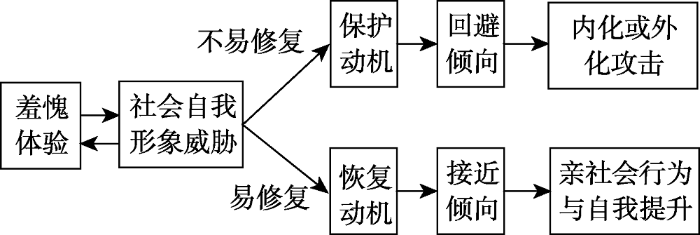
4.1 羞愧的存在条件:自我与社会的相互作用
自我聚焦是羞愧存在与产生的必要条件(scheff, 2003), 虽然大多数情绪可以仅来源于内在心理过程或外界环境, 但Cooley (1922)提出的“镜像自我”暗示了自我所具有的社会性, 并且这种自我在情绪层面上直接指向了羞愧, 他指出羞愧中的自我是由三个过程组成的连续体:(1)个体想象在别人面前的形象; (2)个体对想象中形象的判断; (3)产生羞愧情绪。因此在他人眼中消极地看待自我是羞愧得以存在的根源(Goffman, 1967), 信息威胁理论同样认为羞愧是由个体接触或感知有关他人对自我的负面信息引发的(Sznycer et al., 2016)。因此羞愧存在于自我与社会的双向作用过程之中, 个体自我觉察的同时激活自我表征, 并将现实自我与理想状态的自我进行评估比较。在不同强度和持续时间上羞愧的表现更加接近“尴尬” (低强度且短时间)、“羞愧” (强烈且持久)和“耻辱” (更强烈且更持久), 但总体而言都源于对社会关系的威胁(scheff, 2000)。
社会自我形象威胁就是自我与社会相互作用下羞愧的产物, 社会自我即个体的社会价值与地位, 因这一威胁不仅在羞愧产生之前被个体所感知, 也在体验到羞愧情绪之后得到充分关注。获得地位和被他人所接受对个体的生存和繁衍至关重要, 这也是个体拥有自我或身份的原因, 羞愧等自我意识情绪就是帮助个体增强和保护这种自我或身份的有利工具(Scheff, 2003)。Goffman (1955)指出每一个社会行为都潜藏着受到公众指责或面子丧失的可能性, 羞愧经历的外部危险是拒绝或放弃。研究表明羞愧的产生具有特定的心理生物变化模式, 对社会自我的严重威胁会增加个体促炎细胞因子和皮质醇活性, 这些生理变化与羞愧将同时发生(Dickerson, Gruenewald, & Kemeny, 2004)。威胁到社会自我将会引起个体对社会价值低下的感觉增加(Gruenewald, Kemeny, Aziz, & Fahey, 2004), 为了有效避免社会自我受到威胁, 个体能够采取行动影响观察到某种行为的他人去达到自己适应性的目的, 如限制有关自我的负面信息的传播, 从而防止由此引起的他人的负面评价和贬低(Sznycer, 2018)。因此, 羞愧情绪的产生令个体不得不直面感知到的社会威胁, 此时个体由于情绪的驱动开始对这种社会威胁的可修复性进行认知评估(Scheff, 2003)。个体要在社会中生存就不得不关注他人与自我的双向评价, 经过分析后采取合理行动以获得最优结果避免受到更大的伤害(Lewis, 1992)。羞愧与社会评价高度相关, 不论这种负面社会评价是真实存在还是内在感受, 都会令个体感受到社会自我受到威胁。Leach和Cidam (2015)通过对羞愧的meta分析表明当社会形象容易修复时, 羞愧将更有可能激发社会接近行为, 相反, 当可修复性较低时, 羞愧与社会接近呈负相关。
4.2 从羞愧到行为:双路径过程
从以往研究中可以得出结论, 导致羞愧行为的研究呈现两极化现象的一个重要区别在于个体体验到羞愧后是产生回避行为还是社会接近行为, 大量研究显示羞愧要么与接近倾向有关, 要么与回避倾向有关(Frijda, Kuipers, & Ter Schure, 1989; Scherer & Wallbott, 1994; Tangney, Miller, Flicker, & Barlow, 1996; Wicker, Payne, & Morgan, 1983), 而只有对羞愧的回避才会导致不良后果(Gausel & Leach, 2011; Muris & Meesters, 2014), 它解释了羞愧何以导向破坏性。此前诸多研究将回避项目包含在羞愧测量量表中, 作为羞愧评分高低的指标之一, 以区别于内疚与社会接近的联系, 导致了研究结论均偏向消极后果(Cohen, Wolf, Panter, & Insko, 2011)。然而并非所有的羞愧都会产生回避和退缩, 现实生活中也并不可能存在完全无内疚的羞愧或无羞愧的内疚。Hooge等(2018)在试验中给予被试选择进入社会情境还是独处的非社会情境的权利, 在两个试验中, 大多数感到羞愧的被试都选择了进入到社会情境中, 更愿意与他人进行互动, 表明羞愧激发了社交接近而非社交回避。也就是说, 虽然大量研究者认为羞愧会激发社交回避(Keltner & Harker, 1998; Lewis et al., 1992; Tangney, 1992), 但羞愧同样也可能激发人际接近行为(De Hooge et al., 2008; Gausel & Leach, 2011; Gausel et al., 2012)。此外, 有研究显示羞愧与抑郁或饮食障碍相关, 但不包括社交回避项目的羞愧量表却显示二者不相关(Allan, Gilbert, & Goss, 1994)。可以认为羞愧的结果直接取决于个体产生回避还是接近倾向, 二者将引发完全相反的行为结果。
Hooge等人(2008)在其研究中提出, 个体的恢复动机将会在羞愧程度较弱时产生, 企图通过亲社会或自我改变的形式恢复受到威胁的社会自我, 如进入以表现为导向的情境或采取补救行为等。强烈的回避退却倾向则来自于个体的自我保护动机, 因为当社会自我形象的修复是困难或危险的, 那么额外的失败将会更伤害自我, 个体为了保护受威胁的自我免受进一步伤害选择转向回避行为(Hooge et al., 2011)。因此, 社会自我将会受到怎样的伤害以及个体在多大程度上能够修复这种伤害, 个体对此的认知评估决定了接下来将以何种动机去执行何种行动, 从而形成了羞愧导向的两条相反路径。
5 总结与研究展望
“无羞恶之心, 非人也。”由于中国文化自身价值体系的发展, 羞愧的重要性是与儒家占主导地位的社会道德思想相联系的, 它构成了个体道德发展与良心的基础(Geaney, 2004)。当现实出现矛盾的结果时, 需要对此进行更加全面系统的理解。以往研究大多重在讨论羞愧的内涵以及羞愧与内疚的区别, 而这种单纯的比较无法回答现阶段矛盾的结果, 因为羞愧与外化攻击以及内化攻击都有着直接或间接的联系, 并且相关研究也验证了羞愧同样能够引发亲社会行为, 促进人际适应与个体的自我改变(Lickel et al., 2014; Stuewig et al., 2015; Tracy & Robins, 2006; Weingarden & Renshaw, 2015)。合理解释这一矛盾能够帮助研究者将焦点转向羞愧与其行为结果的中间过程并考虑如何有效干预以尽量避免破坏性结果。本文吸纳分歧双方观点, 前提是将羞愧看作同时具有潜在破坏性与建设性的自我意识情绪, 任何情绪的意义都与社会环境以及内在动力共存。作为一种自我意识情绪, 羞愧与自我和他人密不可分, 羞愧产生前后都离不开个体感受到的社会自我威胁, 正是对可能并非真实存在的威胁的认知评估促使个体产生修复或自我保护动机, 从而激发完全不同的行为。双向路径的岔口在于社会自我修复的可能性, 接下来的研究重点应是探究不同文化背景下影响社会自我可修复性诸多因素的实证证据以及干预措施, 而非局限于对羞愧概念的争论。因此, 未来研究还需要在以下方面有所推进。
5.1 羞愧模型与测量方法的改进
虽然Nathanson (1992)提出了羞愧调节的几种形式, 但都是基于消极调节, 显然不符合现阶段更多的研究结果, 目前也有研究者分析了扩展这一模型积极面的可能性(王柳生, 桑标, 2019), 然而真正完善这一模型并得到实证研究的支持还需要漫长的探索和建构。个体对羞愧情绪的积极调节对于理解个体在修复社会自我威胁中所涉及的内部与外部因素具有至关重要的作用, 因此, 未来研究可以在这一模型的基础上建构羞愧调节的积极面, 对羞愧进行深入和全面的认识, 也让个体认识到羞愧情绪破坏性以外的建设性结果的可能, 增加个体对社会自我威胁修复的自我效能并促进社会接近行为。
不仅羞愧的相关理论模型需要结合最新研究成果进行充实, 羞愧的测量一直以来也缺乏全面细致的探究。一方面, 忽略羞愧也存在社会接近倾向的量表导致了现有研究出现较大分歧, 例如在内疚与羞愧倾向量表(GASP)中, 内疚-修复、羞愧-退缩两个维度明确将二者割裂开来(Cohen, Wolf, Panter, & Insko, 2011), 某种意义上否定了羞愧也会激发社会自我修复的可能性。另一方面, 在一些情境实验研究中, 实验者将被试直接置于社会情境中, 随后观察他们的行为表现(De Hooge, 2014), 这些测量并没有给予被试自发选择回避还是接近社会群体的可能性, 只专注羞愧在其中引发的最终结果。故未来还需要考虑到羞愧测量的全面性, 将个体主观因素与社会因素共同融合在内, 并阐释如何在本土文化背景下界定它。羞愧引发的行为机制是一个复杂的过程, 需要考虑多方面的影响才能有效进行相关研究的测量工作。
5.2 社会自我形象的修复
除了全面理解羞愧的内涵, 开发出更加客观有效的测量工具, 面对上述双路径过程, 系统探究影响社会自我修复可能性的因素具有重要意义。最早研究能对此产生影响的包括羞愧的内容是否得到公开承认。Lewis (1992)的研究表明, 羞愧的愤怒循环将可能会造成持久的社会敌意和人际疏远, 而公认的羞愧感, 是维系人际关系的粘合剂。Lynd (1961)同样指出个体承认羞愧感可以加强人际关系, 反之, 不承认羞愧将会导致人际疏远。未被承认的羞愧将会受到个体的压抑, 因此个体将经受“羞愧-愤怒”的恶性循环, 产生一系列不良行为结果。另一方面, 如果这种羞愧情绪的内容是得到社会广泛承认和认可的, 那么个体将不会否认羞愧的存在, 羞愧将有利于社会适应与人际协调。除此之外, 个体的人格因素会影响社会自我威胁的修复性评定, 如自尊、自我同情等(Cȃndea & Szentágotai-Tătar, 2018; Tangney & Dearing, 2002)。那些自我评价高但却感受到社会自我受到某种威胁或挑战的个体更有可能直接采取敌对和暴力的方式(Heatherton & Vohs, 2000), 降低对社会自我威胁的修复可能性的判断。社会地位等社会因素也在某种程度上影响着个体对社会自我威胁是否容易修复的判断(Gruenewald, Kemeny, & Aziz, 2006)。综合而言, 当前研究更加注重羞愧会产生怎样的行为与心理后果, 对其中重要变量的影响因素的研究仍有所欠缺, 因此需要多方面的实证证据为羞愧的干预提供可能, 通过针对性的干预措施促进羞愧的破坏性后果向建设性方向转变。
5.3 跨文化比较
文化差异是自我意识情绪领域中不可忽视的一方面, 如上述羞愧的承认与否与文化因素密切相关, 羞愧与内疚性质的二分法也受到文化因素的调节, 使得二者并非处于绝对的位置(Sheikh, 2014)。西方国家强调个人主义文化, 也可以说内疚文化, 把羞愧视为一种私人化情绪, 具有一定的隐蔽性, 个体往往不会轻易表达(Sheikh, 2014)。其他国家多强调集体主义文化, 也可以说羞耻文化, 包括中国、印度与日本等, 个人的生活不仅仅意味着个人, 还牵涉到社会关系、集体团结等, 社会交往作为个体重要的动机, 承认羞愧是修复社会自我形象的有利途径, 有助于促进社会接纳(Yakeley, 2018), 在这些社会中, 羞愧被视为提升群体凝聚力和防止社会分化的亲社会手段。此外, 研究不同文化下羞愧的现象学与群体差异也可以帮助理解羞愧的不同发现, 例如集体主义文化中羞愧的积极价值也反映在羞愧关系现象学中, 个体的羞愧将会延伸到亲密的重要他人(Fung & Chen, 2001; Swartz, 1988), 即个体的羞愧会影响其他家庭成员, 或因为其他家庭成员的行为而产生羞愧。不同文化对羞愧有着不同的评价准则, 这将会影响特定文化环境下个体羞愧情绪的产生和对社会自我修复可能性的认知评估。未来研究需要认识到个体针对羞愧经历的认知和行为模式可能会受到文化的影响, 并且需要提供一系列实证研究的证据。
参考文献
Situated identities and social psychological experimentation
An exploration of shame measures—II: Psychopathology
Evolutionary psychology and the emotions
Social status and shaming experiences related to adolescent overt aggression at school
The need to belong: Desire for interpersonal attachments as a fundamental human motivation
Emotivational psychology: How distinct emotions facilitate fundamental motives
A different view of anger: The cognitive- neoassociation conception of the relation of anger to aggression
DOI:10.1002/ab.21432
URL
PMID:25363699
[本文引用: 3]

The common, everyday understanding of anger is problematic in a number of respects-in its inattention to the prototypic nature of this emotional state; in its failure to recognize the important role often played by the critical event's aversiveness; and in its neglect of the frequently close connection between anger arousal and aggression-related motor impulses. This article discusses all of these matters from the point of view of my cognitive-neoassociation perspective [Berkowitz, 1990, 1993, 2010; Berkowitz and Harmon-Jones, 2004]. The role of automatic, nonconscious reactions is considered, and it is also emphasized that angry feelings are linked to approach motivation-movement toward the perceived source of the anger. The article also briefly summarizes relevant research dealing with the self-regulation of anger reactions. This broad review hopefully will prompt further inquiries into the arousal, nature, and operation of anger.
Dealing with the past and facing the future: Mediators of the effects of collective guilt and shame in Bosnia and Herzegovina
The impact of self-compassion on shame-proneness in social anxiety
Introducing the GASP scale: A new measure of guilt and shame proneness
Shame memories and psychopathology in adolescence: The mediator effect of shame
The general sociometer shame: Positive interpersonal consequences of an ugly emotion
The social side of shame: Approach versus withdrawal
Not so ugly after all: When shame acts as a commitment device
Restore and protect motivations following shame
A functionalist account of shame-induced behaviour
The general aggression model: Theoretical extensions to violence
When the social self is threatened: Shame, physiology, and health
Shame and guilt: A hundred years of apples and oranges
Shame and aggression: Theoretical considerations
Investigating the compass of shame: The development of the Compass of Shame Scale
Shame-focused coping: An empirical study of the compass of shame
Shame in two cultures: Implications for evolutionary approaches
Relations among emotion, appraisal, and emotional action readiness
Across time and beyond skin: Self and transgression in the everyday socialization of shame among Taiwanese preschool children
Shame and guilt—Do they really differ in their focus of evaluation? Wanting to change the self and behavior in response to ingroup immorality
Concern for self-image and social image in the management of moral failure: Rethinking shame
Defend or repair? Explaining responses to in-group moral failure by disentangling feelings of shame, rejection, and inferiority
Guarding moral boundaries: Shame in early Confucianism
The role of pride, shame, guilt, and humiliation in social service organizations: A conceptual framework from a qualitative case study
The evolution of social attractiveness and its role in shame, humiliation, guilt and therapy
The relationship of shame, social anxiety and depression: The role of the evaluation of social rank
On face-work: An analysis of ritual elements in social interaction
Subjective social status moderates cortisol responses to social threat
Acute threat to the social self: Shame, social self-esteem, and cortisol activity
Further validation of the shame and guilt scales of the Harder Personal Feelings Questionnaire-2
DOI:10.2466/pr0.1999.85.1.271
URL
PMID:10575992
[本文引用: 1]
Previous research using the Harder Personal Feelings Questionnaire-2 has generally supported the validity of its subscales for the measurement of the traits of proneness to shame and guilt. This study extended the construct validity by investigating hypothesized relationships between scores on the questionnaire and several personality constructs not previously examined, including attachment style, the five personality factors assessed by the NEO-Five Factor Inventory, Sensation Seeking and Positive Affect (both from the Multiple Affect Adjective Check List-Revised). Shame and guilt scales were each expected to correlate inversely with secure attachment, Extraversion, Openness, Sensation Seeking (uninhibitidness), and Positive Affect, while they were predicted to correlate positively with Neuroticism from the NEO measure. Shame was expected to show stronger relationships than guilt with Extraversion, Openness, and Sensation Seeking. For the 41 college students results were mostly as predicted, even after shame and guilt scores were partialled for each other, thereby providing further evidence for the construct validity of the Personal Feelings Questionnaire-2 scales.
Interpersonal evaluations following threats to self: Role of self-esteem
DOI:10.1037//0022-3514.78.4.725
URL
PMID:10794376
[本文引用: 1]
In 2 studies, the authors used dyadic interactions to assess the influence of ego threat on likability as a function of self-esteem. In both studies, 2 naive participants engaged in a structured conversation; in half of the dyads, 1 participant received an ego threat prior to the interaction. In the 1st study, threatened high self-esteem participants were rated as less likable than were threatened low self-esteem participants. The 2nd study confirmed that ego threats are associated with decreased liking for those with high self-esteem and with increased liking for those with low self-esteem. A mediational analysis demonstrated that decreased liking among high self-esteem participants was due to being perceived as antagonistic. Study 2 also indicated that the findings could not be explained by trait levels of narcissism. These patterns are interpreted in terms of differential sensitivity to potential interpersonal rejection.
Culture, self-discrepancies, and self-satisfaction
Can negative social emotions have positive consequences? An examination of embarrassment, shame, guilt, jealousy, and envy
Guilt and shame as predictors of recidivism: A longitudinal study with young prisoners
The role of shame in the relation between peer victimization and mental health outcomes
Shame and honour drive cooperation
Evolution of shame as an adaptation to social punishment and its contribution to social cohesiveness
Relationships between shame, restrictiveness, authoritativeness, and coercive control in men mandated to a domestic violence offenders program
Functional accounts of emotions
Shame, guilt, and depressive symptoms: A meta-analytic review
DOI:10.1037/a0021466
URL
PMID:21219057
[本文引用: 1]
Recent theoretical and empirical work has facilitated the drawing of sharp conceptual distinctions between shame and guilt. A clear view of these distinctions has permitted development of a research literature aimed at evaluating the differential associations of shame and guilt with depressive symptoms. This study quantitatively summarized the magnitude of associations of shame and guilt with depressive symptoms. Two hundred forty-two effect sizes were obtained from 108 studies employing 22,411 participants. Shame showed significantly stronger associations with depressive symptoms (r = .43) than guilt (r = .28). However, the association of shame and depressive symptoms was statistically indistinguishable from the associations of 2 maladaptive variants of guilt and depressive symptoms (contextual-maladaptive guilt, involving exaggerated responsibility for uncontrollable events, r = .39; generalized guilt, involving
Evolutionary origins of stigmatization: The functions of social exclusion
When is shame linked to constructive approach orientation? A meta-analysis
Managing shame: An interpersonal perspective
Differences in shame and pride as a function of children's gender and task difficulty
Shame and the motivation to change the self
Alienation: Man's fate and man's hope
Guilt, shame, and psychopathology in children and adolescents
DOI:10.1007/s10578-014-0488-9 URL PMID:25149163 [本文引用: 1]
Small or big in the eyes of the other: On the developmental psychopathology of self- conscious emotions as shame, guilt and pride
Anticipated feelings of guilt and shame as predictors of early adolescents' antisocial and prosocial interpersonal behaviour
Emotion dysregulation, psychological inflexibility, and shame as explanatory factors between neuroticism and depression
The unique associations of self-criticism and shame-proneness to symptoms of disordered eating and depression
DOI:10.1016/j.eatbeh.2018.02.008
URL
PMID:29524786
[本文引用: 1]
This study examined the unique associations of shame-proneness and self-criticism to symptoms of disordered eating and depression among 186 undergraduate students. The study also tested the degree to which self-criticism and shame-proneness accounted for the association between disordered eating and depressive symptoms. Both shame-proneness and self-criticism were significantly related to disordered eating and depressive symptoms. Self-criticism was significantly associated with disordered eating and depressive symptoms, over-and-above shame-proneness, but the reverse was not true. Controlling for shame-proneness, self-criticism also accounted for a significant proportion of the covariance between disordered eating and depressive symptoms, suggesting that self-criticism could account for some of the comorbidity between depression and eating disorders. Findings suggest that self-criticism may have incremental utility above-and-beyond shame-proneness as part of a transdiagnostic underlying cognitive substrate for depression and disordered eating. Implications emerge for future research and clinical practice.
Nonverbal displays of shame predict relapse and declining health in recovering alcoholics
Shame and conformity: The deference- emotion system
Shame and the social bond: A sociological theory
Evidence for universality and cultural variation of differential emotion response patterning
DOI:10.1037//0022-3514.66.2.310
URL
PMID:8195988
[本文引用: 1]
The major controversy concerning psychobiological universality of differential emotion patterning versus cultural relativity of emotional experience is briefly reviewed. Data from a series of cross-cultural questionnaire studies in 37 countries on 5 continents are reported and used to evaluate the respective claims of the proponents in the debate. Results show highly significant main effects and strong effect sizes for the response differences across 7 major emotions (joy, fear, anger, sadness, disgust, shame, and guilt). Profiles of cross-culturally stable differences among the emotions with respect to subjective feeling, physiological symptoms, and expressive behavior are also reported. The empirical evidence is interpreted as supporting theories that postulate both a high degree of universality of differential emotion patterning and important cultural differences in emotion elicitation, regulation, symbolic representation, and social sharing.
Cultural variations in shame’s responses: A dynamic perspective
Assessment of self-conscious emotions: A Swedish psychometric and structure evaluation of the Test of Self-Conscious Affect (TOSCA)
Children’s proneness to shame and guilt predict risky and illegal behaviors in young adulthood
DOI:10.1007/s10578-014-0467-1
URL
PMID:24842762
[本文引用: 1]
Do shame and guilt help people avoid doing wrong? Although some research suggests that guilt-proneness is a protective factor while shame-proneness puts individuals at risk, most research is either cross-sectional or short-term. In this longitudinal study, 380 5th graders (ages 10-12) completed measures of proneness to shame and guilt. We re-interviewed 68 % of participants after they turned 18 years old (range 18-21). Guilt-proneness assessed in childhood predicted fewer sexual partners, less use of illegal drugs and alcohol, and less involvement with the criminal justice system. Shame-proneness, in contrast, was a risk factor for later deviant behavior. Shame-prone children were more likely to have unprotected sex and use illegal drugs in young adulthood. These results held when controlling for childhood SES and teachers' ratings of aggression. Children's moral emotional styles appear to be well established by at least middle childhood, with distinct downstream implications for risky behavior in early adulthood.
Shame, culture, and status among the Swahili of Mombasa
Forms and functions of the self-conscious emotions
DOI:10.1016/j.tics.2018.11.007
URL
PMID:30583948
[本文引用: 1]
Pride, shame, and guilt color our highest and lowest personal moments. Recent evidence suggests that these self-conscious emotions are neurocognitive adaptations crafted by natural selection. Specifically, self-conscious emotions solve adaptive problems of social valuation by promoting the achievement of valued actions and characteristics to increase others' valuations of the individual (pride); limiting information-triggered devaluation (shame); and remedying events where one put insufficient weight on the welfare of a valuable other (guilt). This adaptationist perspective predicts a form-function fit: a correspondence between the adaptive function of a self-conscious emotion and its information-processing structure. This framework can parsimoniously explain known facts about self-conscious emotions, make sense of puzzling findings, generate novel hypotheses, and explain why self-conscious emotions have their characteristic self-reflexive phenomenology.
Cross-cultural differences and similarities in proneness to shame: An adaptationist and ecological approach
Shame closely tracks the threat of devaluation by others, even across cultures
Moral affect: The good, the bad, and the ugly
DOI:10.1037//0022-3514.61.4.598
URL
PMID:1960652
[本文引用: 1]
The relations among 3 moral affective personality characteristics--shame-proneness, guilt-proneness, and empathic responsiveness--were examined in 4 independent studies of undergraduates. Results indicate that shame and guilt are distinct affective experiences that have important and quite different implications in the interpersonal realm. There was a substantial positive correlation between shame-proneness and guilt-proneness. Nonetheless, as predicted, other-oriented empathic responsiveness was negatively related to proneness to shame but positively correlated with proneness to guilt. In contrast, an index of more self-oriented personal distress was positively linked to shame-proneness. Taken together, these results add a new dimension to the ugliness of shame but suggest that guilt may not be that bad after all, at least in the interpersonal domain.
Situational detenninants of shame and guilt in young adulthood
Recent advances in the empirical study of shame and guilt
Are shame, guilt, and embarrassment distinct emotions?
DOI:10.1037//0022-3514.70.6.1256
URL
PMID:8667166
[本文引用: 1]
182 undergraduates described personal embarrassment, shame, and guilt experiences and rated these experiences on structural and phenomenological dimensions. Contrary to popular belief, shame was no more likely than guilt to be experienced in
Are shame and guilt related to distinct self-discrepancies? A test of Higgins's (1987) hypotheses
DOI:10.1037//0022-3514.75.1.256
URL
PMID:9686463
[本文引用: 1]
A study of 229 undergraduates examined whether specific self-discrepancies are differentially related to shame proneness and guilt proneness. Contrary to E. T. Higgins (1987), but in line with the present authors' expectations, the tendency to experience shame, but not guilt, was positively related to all types of self-discrepancies. An attempt was also made to replicate E. T. Higgins, Klein, and Strauman's (1985) findings that specific self-discrepancies are associated with distinct emotion syndromes. No support was found for the central hypotheses of self-discrepancy theory. Finally, the authors evaluated the utility of two methods for assessing self-discrepancies. Higgins's qualitative method and quantitative adjective ratings. The two methods yielded essentially identical relationships to other variables. The very high correlations among different types of self-discrepancies within each method, however, raise discriminant validity concerns.
Two faces of shame: The roles of shame and guilt in predicting recidivism
Proneness to shame, proneness to guilt, and psychopathology
DOI:10.1037//0021-843x.101.3.469
URL
PMID:1500604
[本文引用: 1]
The links between shame and guilt and psychopathology were examined. In 2 studies, 245 and 234 undergraduates completed the Self-Conscious Affect and Attribution Inventory, the Symptom Checklist 90, the Beck Depression Inventory, the State-Trait Anxiety Scale, and the Attributional Style Questionnaire. Results failed to support Lewis's (1971) notion that shame and guilt are differentially related to unique symptom clusters. Shame-proneness was strongly related to psychological maladjustment in general. Guilt-proneness was only moderately related to psychopathology; correlations were ascribable entirely to the shared variance between shame and guilt. Although clearly related to a depressogenic attributional style, shame accounted for substantial variance in depression, above and beyond attributional style.
Relation of shame and guilt to constructive versus destructive responses to anger across the lifespan
DOI:10.1037//0022-3514.70.4.797
URL
PMID:8636899
[本文引用: 1]
This study explored the relation of shame proneness and guilt proneness to constructive versus destructive responses to anger among 302 children (Grades 4-6), adolescents (Grades 7-11), 176 college students, and 194 adults. Across all ages, shame proneness was clearly related to maladaptive response to anger, including malevolent intentions; direct, indirect, and displaced aggression; self-directed hostility; and negative long-term consequences. In contrast, guilt proneness was associated with constructive means of handling anger, including constructive intentions, corrective action and non-hostile discussion with the target of the anger, cognitive reappraisals of the target's role, and positive long-term consequences. Escapist-diffusing responses showed some interesting developmental trends. Among children, these dimensions were positively correlated with guilt and largely unrelated to shame; among older participants, the results were mixed.
Putting the self Into self-conscious emotions: A theoretical model
Appraisal antecedents of shame and guilt: Support for a theoretical model
DOI:10.1177/0146167206290212
URL
PMID:16963605
[本文引用: 3]
Four studies used experimental and correlational methods to test predictions about the antecedents of shame and guilt derived from an appraisal-based model of self-conscious emotions (Tracy & Robins, 2004). Results were consistent with the predicted relations between appraisals (i.e., causal attributions) and emotions. Specifically, (a) internal attributions were positively related to both shame and guilt; (b) the chronic tendency to make external attributions was positively related to the tendency to experience shame; and (c) internal, stable, uncontrollable attributions for failure were positively related to shame, whereas internal, unstable, controllable attributions for failure were positively related to guilt. Emotions and attributions were assessed using a variety of methods, so converging results across studies indicate the robustness of the findings and provide support for the theoretical model.
Shame in the obsessive compulsive related disorders: A conceptual review
Applying the dominance hierarchy model to pride and shame, and related behaviors
Participant descriptions of guilt and shame
A needs-based perspective on self-forgiveness: Addressing threat to moral identity as a means of encouraging interpersonal and intrapersonal restoration


