



存乎人者, 莫良于眸子。眸子不能掩其恶。胸中正, 则眸子了焉; 胸中不正, 则眸子眊焉。听其言也, 观其眸子, 人焉廋哉?
——《孟子·离娄上·十五》
对瞳孔与心理关系的探讨自古有之, 但采用心理学方法进行科学研究仅有半个多世纪的历史(Laeng, Sirois, & Gredebäck, 2012)。虽然Kuntz在1929年就曾提出愉悦和恐惧的情绪通常伴随瞳孔扩张(转引自:Hess & Polt, 1960), 但缺乏实证支持。直到上个世纪60年代初, Hess和Polt (1960)让6名被试观看一系列图片:婴儿、抱着孩子的母亲、半裸男性、半裸女性和风景, 同时记录瞳孔变化, 发现瞳孔变化受个体兴趣的影响。大部分研究者将此研究作为瞳孔测量在心理学研究中应用的开端(Mathôt, 2018; Sylvain & Julie, 2014), 之后Hess又把瞳孔作为情绪、动机、味觉偏好、音乐偏好、态度及其转变等心理变量的指标并进行了一系列研究, 认为瞳孔变化是一个新兴的反映人类心理的敏感指标, 这引起了瞳孔测量研究的热潮(Goldwater, 1972; Hess, 1965)。但是, 由于Hess的研究设计不够严谨, 部分结果无法重复, 其研究结果受到了质疑(Janisse, 1973)。到了上世纪70、80年代, 以Daniel Kahneman和Jackson Beatty为代表的心理学家发现瞳孔还与记忆和心理努力等高级认知活动有关(参见:Laeng et al., 2012)。随着眼动技术的发展, 瞳孔数据更加容易获得也更可靠; 实验条件控制越来越严格, 瞳孔变化可以反映心理加工这一事实再次引起了研究者们的兴趣, 瞳孔与心理之间的关系也越来越受到研究者的关注(Mathôt, 2018)。
本综述整理并介绍了近期心理学领域有关瞳孔在心理学研究中的应用, 包括心理因素如何影响个体的瞳孔变化, 瞳孔如何影响他人心理与行为, 分析瞳孔变化的神经机制及相关理论, 最后归纳出如何更有效地测量瞳孔的方法, 以期为研究者测量瞳孔提供借鉴和参考。
1 心理因素是否影响个体的瞳孔变化?
研究者通常采用任务诱发的瞳孔变化(task- evoked pupil responses, TEPRs)来研究某一心理因素对瞳孔大小变化的影响, 将外显的瞳孔变化作为内部心理活动的指标之一(Beatty, 1982)。影响个体瞳孔变化的因素主要涉及知觉与注意、情绪与动机、心理努力和社会认知与发展四个方面。
1.1 知觉与注意
传统观点认为瞳孔光反射(pupil light response, PLR)是简单的生理反应, 即在暗环境下瞳孔扩张, 在亮环境下瞳孔缩小(Loewenfeld, 1958)。随着研究的深入, 研究者发现瞳孔变化还受到主观的亮度知觉的影响。尽管相比于物理亮度对瞳孔变化的影响(变化范围约2~8 mm) (Loewenfeld, 1993), 亮度知觉引发的瞳孔变化很微弱(直径变化小于0.5 mm) (Beatty, 1982; Beatty & Lucero-Wagoner, 2000; Sylvain & Julie, 2014), 但这一现象仍然引起了研究者的兴趣。研究发现, 即使被试看到相同物理亮度的图片, 被试主观认为是亮的图片(如:太阳、亮度错觉)引起的瞳孔收缩更明显(Laeng & Endestad, 2012; Naber & Nakayama, 2013), 甚至发现想象一张较亮的图片比想象一张较暗的图片时的瞳孔更小, 听到一个带有明亮含义的词(如:白天)比听到带有中性含义(如:房子)或暗含义(如:晚上)词语后的瞳孔更小(Laeng & Sulutvedt, 2014; Mathôt, Grainger, & Strijkers, 2017)。说明瞳孔变化不单纯是生理性条件反射, 还受到高级认知加工的影响, 无论是物理光刺激还是亮度知觉都能引起瞳孔收缩(Mathôt, 2018)。
此外, 研究还发现当大脑对信息进行选择性注意时也会引起瞳孔变化。例如, 在Mathôt, Dalmaijer, Grainger和van der Stigchel (2014)的研究中, 屏幕被左右分成亮、暗两边, 要求被试一直注视屏幕中心点, 接着左右两侧随机呈现线索来吸引被试的注意, 结果发现在线索呈现后的476~ 893ms, 当线索出现在亮侧时被试的瞳孔更小, 出现了“瞳孔线索效应” (pupillary cuing effect); 该效应也在其他研究中被证实(Binda & Murray, 2015; Binda, Pereverzeva, & Murray, 2013; Mathôt, Linden, Grainger, & Vitu, 2015; Mathôt & van der Stigchel, 2015)。这些研究表明, 虽然进入被试瞳孔的物理亮度恒定, 但线索引导的注意也能诱发类似瞳孔光反射的瞳孔变化。另外, 注意网络的三个成分——警觉网络(alerting network)、朝向网络(orienting network)和执行控制网络(executive monitoring network)也会引起不同时间和强度的瞳孔扩张。例如, Geva, Zivan, Warsha和Olchik (2013)采用注意网络任务(attention network task, ANT)来比较注意网络的三个成分差异, 并记录瞳孔变化, 结果发现线索呈现后300 ms出现瞳孔扩张(警觉网络); 相比于没有空间信息的线索, 有空间信息的线索能引起瞳孔更早的扩张(朝向网络); 并且执行控制网络引起的瞳孔变化主要受到心理努力的影响(见1.3 心理努力)。因此, 瞳孔变化或许可以作为注意网络功能的指标之一(Geva et al., 2013; Petersen & Posner, 2012; Wang, Boehnke, Itti, & Munoz, 2014)。
1.2 情绪与动机
情绪唤醒会激活自主神经系统, 进而引起瞳孔变化(Mathôt, 2018)。虽然早期Hess (1965)的研究认为情绪刺激引起瞳孔的双向变化——积极情绪引起瞳孔扩张, 消极情绪引起瞳孔缩小, 但后来大部分研究推翻了该结果。比如, 相比于中性刺激, 吓人的图片、好听或熟悉的音乐、哭声或笑声等情绪刺激都引起了瞳孔扩张(Bradley, Miccoli, Escrig, & Lang, 2008; Laeng, Eidet, Sulutvedt, & Panksepp, 2016; Snowden et al., 2016); 相比于积极情绪刺激, 人们对消极情绪刺激更加敏感, 更易产生瞳孔扩张, 且扩张持续时间更久(Babiker, Faye, & Malik, 2013; Derksen, van Alphen, Schaap, Mathôt, & Naber, 2018; Oliva & Anikin, 2018; 袁加锦, 李红, 2012)。另外, 触觉刺激也会诱发情绪, 研究发现人类抚摸比机器抚摸引起的瞳孔扩张更大, 并且抚摸速度与瞳孔扩张在一定程度上成正比关系(Ellingsen et al., 2013; van Hooijdonk et al., 2019); 在飞行模拟中, 飞行员报告的焦虑水平和瞳孔大小成正相关(Tichon, Mavin, Wallis, Visser, & Riek, 2014)。以上研究结果表明开心、悲伤、焦虑等情绪刺激可以引起瞳孔扩张, 与情绪效价无关, 但其他更为复杂的情绪(如:蔑视、哀愁、思念等)是否也能引起瞳孔扩张仍有待探究。
动机作为重要的心理变量, 它不仅影响人的内驱力也会影响瞳孔的变化。Hess的早期研究发现饥饿状态下的被试对食物图片表现出瞳孔扩张(Hess, 1965, 1975)。近期研究发现瞳孔扩张与性兴趣有关, 表现为异性恋男性对异性成人图片的瞳孔扩张最强, 同性恋男性对男性成人图片的瞳孔扩张最强, 双性恋男性对男性或者女性成人图片都出现瞳孔扩张, 而对异性和同性的儿童图片则没有表现出明显的瞳孔扩张(Attard-Johnson, Bindemann, & Ciardha, 2017), 说明生理动机与瞳孔扩张存在一定的关联。除了生理动机, 基于特殊人群的研究还发现社会动机也会引起瞳孔变化。如抑郁症患者(major depressive disorder, MDD)的主要症状为心境低落、思维迟缓、意志活动减退, 他们在问题解决任务中的焦虑会抑制其瞳孔扩张; 但是, 通过提高动机水平能够促进抑郁症患者的瞳孔扩张(Jones, Siegle, & Mandell, 2015)。有研究者也认为低动机可能是精神分裂症患者在执行双步骤任务(the double-step task)时瞳孔变化迟钝的原因之一(Thakkar et al., 2018)。需要注意的是, 动机在维度和强度上可以分为多种类型, 对瞳孔变化的影响可能也存在差异, 如趋避动机是否都会引起瞳孔扩张, 在强度上是否有差异等等。
1.3 心理努力
心理努力指在任务操作过程中为达到目的而投入的认知资源, 往往伴随着瞳孔扩张(Beatty, 1982; van der Wel & van Steenbergen, 2018)。一方面, 任务难度通过影响心理努力进而影响瞳孔变化(Beatty & Kahneman, 1966; Hess & Polt, 1964)。高难度任务需要的心理努力更多, 瞳孔扩张更大, 但是当任务难度超过认知负荷时瞳孔就不再扩张。因此以往研究通过操纵任务难度导致瞳孔变化的实质可能是心理努力在影响瞳孔变化(van der Wel & van Steenbergen, 2018)。儿童的研究也发现, 在短时记忆任务中瞳孔直径随着数字广度的增加而增加, 但是儿童在记忆广度达到最大值(6)时瞳孔直径达到峰值, 说明已达到儿童的认知上限, 随后的瞳孔直径减小说明儿童的心理努力降低(Johnson, Miller Singley, Peckham, Johnson, & Bunge, 2014)。
另一方面, 不同任务类型引起的心理努力不同, 瞳孔扩张的程度也有所不同。比如, 在Stroop任务、Flanker任务和Simon任务等冲突任务范式中, 相比于一致条件, 在不一致条件下引起的瞳孔扩张更大(Diede & Bugg, 2017; Hershman & Henik, 2018; van Steenbergen & Band, 2013; Wendt, Kiesel, Geringswald, Purmann, & Fischer, 2014)。在目标导向的视觉搜索任务中, 目标越不明显, 需要的认知努力越多, 瞳孔扩张就越大(Kleberg, Del Bianco, & Falck-Ytter, 2019; Mathôt, Siebold, Donk, & Vitu, 2015); 该现象在自闭症患者中更加明显(Blaser, Eglington, Carter, & Kaldy, 2014)。决策任务的研究发现, 被试在主动按键转换任务之前就出现了瞳孔扩张, 可能在决策准备阶段就存在心理努力(Katidioti, Borst, & Taatgen, 2014), 并且决策任务的不确定性越高(Urai, Braun, & Donner, 2017)、做决策时越谨慎(Cavanagh, Wiecki, Kochar, & Frank, 2014), 瞳孔扩张越大。在学习任务中, 学习者会对主观评定为更重要的信息投入更多的心理努力, 其瞳孔扩张更大, 记忆效果也更好(Ariel & Castel, 2014)。总的来说, 在执行任务时投入的心理努力越大, 瞳孔扩张越大。但上述研究主要通过主观报告心理努力, 未来研究可以结合心理努力的其他生理指标(如:心率、面部肌电图等), 这将有助于更好地理解心理努力与瞳孔变化的关系(van der Wel & van Steenbergen, 2018)。
1.4 社会认知与发展
个体在复杂的社会互动过程中形成的社会认知也会影响瞳孔变化, 比如:玩15分钟的暴力游戏会损害被试对暴力受害者等消极图片的感知, 导致其瞳孔扩张比玩非暴力游戏组被试的瞳孔扩张更小(Arriaga et al., 2015)。此外, 研究发现婴幼儿不同的社会认知发展水平也会影响瞳孔变化。如:在观看表情-行为一致(微笑着轻拍玩偶)或不一致(微笑着击打玩偶)的视频时, 14个月的婴儿和10个月的婴儿在注视时间上没有差异, 但在瞳孔指标上有差异, 表现为14个月的婴儿观看表情-行为不一致视频时的瞳孔扩张更大, 而10个月婴儿对两类视频则没有表现出瞳孔差异, 说明14个月婴儿能够理解情绪与行为的关系(Hepach & Westermann, 2013)。12个月的婴儿能够根据指示性手势对物体产生预期, 当不符合预期(即什么都没有看到)时会表现出明显的瞳孔扩张, 而8个月婴儿则不能理解指示性手势, 表现为有手势和无手势条件下的瞳孔大小差异不显著(Pätzold & Liszkowski, 2019)。另外, 在社会利他发展方面, 当2~3岁儿童看到他人需要帮助时, 尤其是由于自己的原因导致他人需要帮助时瞳孔扩张更大, 而在看到他人得到帮助后瞳孔会相对变小(Hepach, Vaish, Müller, & Tomasello, 2017; Hepach, Vaish, & Tomasello, 2012, 2016)。
总体上, 瞳孔变化受到自下而上加工和自上而下加工的共同作用。亮度变化能使瞳孔快速而明显地收缩或扩张, 属于自下而上加工; 同时知觉与注意、情绪与动机、心理努力、社会认知与发展等心理因素也能影响瞳孔变化, 属于自上而下加工。研究者通过巧妙的实验设计控制无关变量以探究不同心理因素对瞳孔变化的影响, 揭示了瞳孔变化的一些心理含义。
2 瞳孔是否影响他人的心理与行为?
回想我们看过的卡通形象, 狠毒的皇后常刻画为带有很小的瞳孔和眼睛, 而善良的公主往往具有大瞳孔和大眼睛, 这样的设置是否具有科学依据呢?如前文所述, 瞳孔变化受到多种心理因素的影响。换言之, 瞳孔变化在一定程度上能够反映人的心理状态, 那么瞳孔能否作为一种社会线索影响他人的心理感知甚至外在行为呢?
已有研究证实面孔会影响他人的信任、吸引力等社会感知和评价(Oosterhof & Todorov, 2008), 而进一步研究发现, 虽然瞳孔只占面孔的极小部分, 细微的瞳孔变化也较难被人觉察, 但同样会影响他人的心理感知(Hess, 1975; Kret, 2018; Kret & de Dreu, 2019)。在主观评定上, Hess早期的研究发现男性更多使用“温柔”、“更女性化”、“漂亮”来描述大瞳孔的女性图片; 而更多使用“自私”、“冷酷”来描述小瞳孔的女性图片; 即使面孔的其他方面相同, 男性仍然认为瞳孔大的女性有更高的性吸引力(Hess, 1975)。实际生活中, 17世纪的意大利妇女也会通过使用颠茄草粉(Belladonna, 含有阿托品, 可以阻断副交感神经对瞳孔肌肉的影响, 从而放大瞳孔)扩张瞳孔来增加自己的吸引力。在一项大型的实证研究中, 579名4~80岁的被试给不同情绪的面孔简笔画画上瞳孔, 虽然4~9岁孩子在高兴和生气面孔上画的瞳孔大小差异不显著, 但随着年龄的增加, 被试在高兴面孔上画的瞳孔更大, 在生气面孔上画的瞳孔更小(Kret, 2018)。这种无意识的行为说明人们在社会化的过程中逐渐形成“大瞳孔-积极, 小瞳孔-消极”的联系。在客观测量上, Harrison, Singer, Rotshtein, Dolan和Critchley (2006)让被试对不同情绪、不同瞳孔大小的面孔进行情绪强度评分, 并记录脑成像数据。结果发现小瞳孔会增强被试对悲伤情绪强度的感知, 同时带有小瞳孔的悲伤情绪面孔也显著激活了涉及社会认知的相关脑区, 如左侧杏仁核(left amygdala)、左额叶(left frontal operculum)、右前扣带回(right dorsal anterior cingulate)等, 从认知神经角度证明了瞳孔大小能影响他人的情绪感知。
不仅如此, 瞳孔还会影响他人的外在行为。瞳孔模仿(pupil mimicry), 也称瞳孔传染(pupillary contagion), 指个体瞳孔的大小会随着观察到的他人瞳孔变化而变化的现象(Mathôt & Naber, 2018; Galazka et al., 2018)。 Hess在1975年最早发现瞳孔模仿现象, 后期研究也发现在成人(Kret & de Dreu, 2017; Kret, Tomonaga, & Matsuzawa, 2014), 婴儿(Fawcett, Arslan, Falck-Ytter, Roeyers, & Gredebäck, 2017; Fawcett, Wesevich, & Gredebäck, 2016), 甚至猩猩(Kret et al., 2014)中都存在瞳孔模仿。当交流的双方达到心理耦合(mental coupling)时, 瞳孔模仿最强(Kang & Wheatley, 2017), 瞳孔模仿有助于人们了解对方的心理情绪状态, 在人际交流过程中发挥重要的社会功能。最新研究发现在观看面孔时, 虽然自闭症被试对眼睛的注视时间显著少于正常被试, 但自闭症被试和正常被试都出现了瞳孔模仿现象(Galazka et al., 2018)。因此该研究认为自闭症患者也能感知他人传递的情感并产生唤醒, 对传统认为自闭症患者对社会情感信息淡漠的观点提出了挑战。值得注意的是, 尽管上述研究将瞳孔模仿作为一种社会交流的表现, 但瞳孔模仿是否属于一种具有社会意义的模仿仍有待进一步确定(Derksen et al., 2018; Mathôt & Naber, 2018, 详见5.2展望)。此外, 瞳孔大小及变化也能影响他人的信任行为和不诚信行为。Kret, Fischer和de Dreu (2015)操纵信任投资游戏中同伴的瞳孔大小, 发现被试更愿意信任瞳孔更大的同伴并做出更多的投资(Kret & de Dreu, 2017; Prochazkova et al., 2018); 当同伴的瞳孔扩张时, 被试的不诚信行为显著降低(van Breen, de Dreu, & Kret, 2018)。有趣的是, 抑郁症患者却更加信任瞳孔变化小的同伴, 与瞳孔大小无关, 一种解释是瞳孔变化反映一个人的情绪变化, 而抑郁症患者更偏好情绪稳定的同伴, 另一种解释是瞳孔扩张被认为是一种情绪线索或表情(Bradley et al., 2008), 由于抑郁症患者的表情识别能力受损, 因此无法像健康人一样更信任大瞳孔的同伴(Wehebrink, Koelkebeck, Piest, de Dreu, & Kret, 2018)。与健康人相似的是, 抑郁患者对瞳孔扩张的模仿同样促进了更多的信任行为(Wehebrink et al., 2018)。
为什么拥有大瞳孔的人会赢得他人更多的信任, 甚至能减少他人的不诚信行为?Prochazkova等人(2018)发现同伴瞳孔扩张以及被试的瞳孔模仿能激活被试的心理理论相关的脑区, 如楔前叶(precuneus)、颞顶联合区(temporo-parietal junction)、颞上沟(superior temporal sulcus)、内侧前额叶皮层(medial prefrontal cortex)等, 进而影响行为。从实际意义来看, 相比于面部表情、手势等非言语交流信息, 瞳孔较难受到意识的控制, 能更加真实地反映内部心理状态, 因此可以作为交流过程中信任与合作的重要且可靠的信息来源(Kret et al., 2015; Kret & de Dreu, 2019)。虽然瞳孔是一个常被忽视的生理和社会线索, 但上述研究证明瞳孔能影响他人的心理感知, 甚至影响重要的社会行为(主要表现为大瞳孔引起他人更多的积极评价和行为), 说明瞳孔在社会交流中的作用不可忽视。
3 瞳孔变化的神经机制及自适应增益理论
3.1 瞳孔的神经机制
从生理结构上来讲, 瞳孔是虹膜中央的透明圆孔, 对亮度非常敏感。光线通过瞳孔投射到视网膜上, 刺激虹膜中控制瞳孔大小的平滑肌:圆环状的括约肌(constrictor pupillae)和放射状的扩张肌(dilator pupillae), 两者共同调节到达视网膜的光线量, 以产生最佳视觉。瞳孔收缩主要受到光刺激的影响, 其神经通道比较简单, 即光线投射到视网膜后产生神经冲动, 经过E-W核(Edinger- Westphal nucleus)传递信息使得括约肌收缩, 瞳孔直径减小。瞳孔扩张的神经通道主要包括:(1)光线减少导致瞳孔反射性扩张; (2)大脑认知活动激活蓝斑-去甲肾上腺素系统(locus coeruleus- norepinephrine, LC-NE)作用于扩张肌使瞳孔扩张; (3)蓝斑核(locus coeruleus, LC)的激活会抑制E-W核传递信息, 进而抑制瞳孔收缩(Mathôt, 2018) (见图1)。
图1
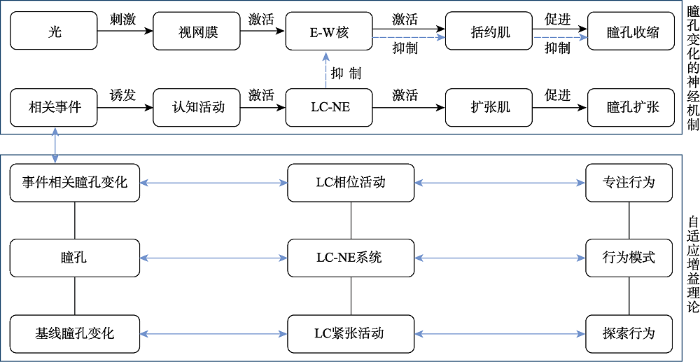
图1
瞳孔变化的神经机制及自适应增益理论
注:参考Aston-Jones & Cohen, 2005; Gilzenrat et al., 2010; Mathôt, 2018; Wang & Munoz, 2015制作
其中, LC-NE系统是影响瞳孔变化的主要神经生理机制(Costa & Rudebeck, 2016; Elman et al., 2017; Joshi, Li, Kalwani, & Gold, 2016; Liu, Rodenkirch, Moskowitz, Schriver, & Wang, 2017)。LC存在紧张(tonic)和相位(phasic)两种活动阶段, 通过释放NE作用于中枢神经系统(Aston-Jones & Waterhouse, 2016)。LC在紧张活动阶段处于持续而弥散的状态, 个体容易探测到新刺激, 在目标搜索时的瞳孔直径变化与LC紧张活动的放电频率相一致(Joshi et al., 2016; Murphy, O'Connell, O'Sullivan, Robertson, & Balsters, 2014; Murphy, Robertson, Balsters, & O'Connell R, 2011); LC在相位活动阶段处于快速而短暂变化的状态, 个体表现出高水平的相关任务加工, 瞳孔出现快速而明显的变化(Beatty, 1982)。总的来说, LC的紧张活动阶段对应瞳孔的基线状态, 而相关事件通过引起LC的相位活动进而影响瞳孔变化。此外, 瞳孔变化还与海马体活动(McGinley, David, & McCormick, 2015)、视觉皮质激活(Reimer et al., 2014)和肾上腺素能和胆碱能活性(Reimer et al., 2016)等多种控制心理活动的神经机制有关。正如Lawrence Stark所述:“瞳孔是神经控制系统的范例, 瞳孔测量则是生理学中的数学方法” (引自:Loewenfeld, 1993)。瞳孔变化作为LC-NE系统活动及其他大脑内皮层状态的指标之一, 间接又直观地反映了大脑控制下的心理活动(Murphy et al., 2014; Reimer et al., 2014)。
3.2 自适应增益理论与瞳孔
Aston-Jones和Cohen (2005)提出自适应增益理论(the adaptive-gain theory)来解释瞳孔与行为的关系, 以及LC-NE在其中的调节作用(参见图1)。该理论认为人的行为存在两种模式:专注(exploitation)和探索(exploration), 个体在两种模式间转换以获得最大的收益。LC-NE系统在两种模式间发挥着重要作用, 专注行为常常伴随着LC的相位活动, 不同的任务难度、任务反馈等事件会激活不同的LC相位活动, 从而影响瞳孔变化(Gilzenrat, Nieuwenhuis, Jepma, & Cohen, 2010)。而当不能从相关任务中获益时, 个体就会从当前任务中脱离以搜索新目标, 该行为常常伴随着LC的紧张活动, 从而影响瞳孔的基线水平(Gilzenrat et al., 2010; Jepma & Nieuwenhuis, 2011; Reimer et al., 2014)。因此研究者常将瞳孔测量作为检验自适应增益理论的方法(Thakkar et al., 2018), 而该理论也为瞳孔反映认知加工、情绪唤醒等心理活动提供了理论框架与支持(Mathôt, 2018)。
4 如何有效地测量瞳孔
探索瞳孔与心理之间的关系离不开瞳孔测量技术的发展。Hess (1965)用简单的瞳孔反应装置记录被试的瞳孔, 开始了基于瞳孔测量的心理学研究。但该设备的采样率低、记录不准确等问题也显而易见(Janisse, 1973)。随着眼动追踪技术的发展, 眼动仪能同时记录眼动时的瞳孔变化, 也发展出专门用于测量瞳孔变化的瞳孔测量仪(pupillometer)。瞳孔测量逐渐被独立应用于心理学研究并揭示了很多心理活动(如:知觉、注意、心理努力等), 具有独特的优势, 被认为是一种易操作的、可靠的、无创的、可视化的方法(Bradley, Sapigao, & Lang, 2017)。相比于常用的行为测量(如:反应时、正确率)和皮电、心率等神经活动指标, 瞳孔指标能灵敏和动态地反映人的心理变化; 相比于事件相关电位、脑成像等神经生理技术, 瞳孔测量技术的费用相对低廉, 操作简单, 对被试干扰小。但是瞳孔测量也存在一个特别的挑战, 即灵敏的瞳孔指标极易受到无关变量的干扰(如:亮度、注视位置、眨眼等), 因此如何有效而准确地测量瞳孔是很多研究者的困扰之一。总结前人的研究经验, 在应用瞳孔测量的研究中要特别注意以下几个方面:
第一, 亮度控制。亮度是影响瞳孔变化的主要物理因素(Mathôt, 2018), 因此记录瞳孔数据时必须严格控制亮度, 尤其在生态环境中应谨慎使用瞳孔指标(Peysakhovich, Vachon, & Dehais, 2017)。为了更好地控制该因素, 研究者建议在中等亮度环境中进行认知任务研究(Eckstein, Guerra-Carrillo, Singley, & Bunge, 2017; Steinhauer, Siegle, Condray, & Pless, 2004)。相比于周围环境亮度, 瞳孔受屏幕亮度的影响更大(屏幕亮度引起瞳孔的变化阈限值为1 mm; 周围亮度引起瞳孔的变化阈限值为0.4 mm) (Benedetto, Carbone, Drai-Zerbib, Pedrotti, & Baccino, 2014), 因此在控制周围亮度后, 应该对刺激的亮度进行平均化处理, 以减少亮度对瞳孔变化的干扰。
第二, 注视位置。眼动追踪研究使用较多的是基于光学记录的眼动仪器(如:瞳孔-角膜反射记录), 当摄像机固定而眼睛注视不同位置时, 虽然瞳孔实际大小可能没有变化, 但是记录到的瞳孔面积会因眼球旋转而发生变化。更有研究发现, 注视位置对瞳孔的影响也因眼动仪而异。Brisson等人(2013)让被试追踪顺时针转动的蓝点, 考察注视位置与眼动仪器对瞳孔大小的影响, 发现Tobii系统下, 瞳孔直径更易受水平位置影响(左边注视位置的瞳孔大小被高估); 而Eyelink系统下, 更容易受垂直位置影响(下方注视位置的瞳孔大小被高估)。因此, 在实际操作中最好将实验材料放到屏幕中间。
第三, 瞳孔基线校正。考虑到瞳孔震颤、瞳孔大小的个体差异等对结果的影响, 研究者必须进行基于瞳孔基线的校正或对比, 以提高统计检验力。基线的选取既可以是刺激呈现前的0.5 s或1 s (例如:Binda & Murray, 2015; Olmos-Solis, van Loon, & Olivers, 2018; Peysakhovich, Causse, Scannella, & Dehais, 2015;Chen & Westermann, 2018; Laeng & Sulutvedt, 2014), 也可以是刺激呈现后0.5 s (例如:Galazka et al., 2018)的瞳孔直径。这主要根据实验任务和目的来确定, 目前没有统一的标准。确定基线后, 研究者需要把实验条件下的瞳孔大小根据基线进行处理, 处理方法主要有2种:除法换算(瞳孔校正值 = 瞳孔大小/基线值)和减法换算(瞳孔校正值 = 瞳孔大小 - 基线值)。Mathôt等人(2018)通过模拟数据和实验数据来比较两种处理方法的优缺点, 发现减法换算受到眨眼等噪音的影响更小, 是一个较为理想的瞳孔校正方法。同时, Mathôt等人(2018)也为研究者如何更有效地进行瞳孔校正提出了5点建议: (1)对数据进行预处理(如:处理缺失值、异常值; 校正因注视位置不同而产生的瞳孔直径误差); (2)采用减法换算对瞳孔进行校正; (3)直接观察、对比校正后的数据和原始数据的差异, 确保校正后的数据没有出现本质改变; (4)如果校正后的瞳孔大小在220 ms (瞳孔变化潜伏期)内明显变大, 说明可能存在基线异常值; (5)通过基线瞳孔值画柱状图, 删除异常小的瞳孔基线值。经过基线校正后的瞳孔值能更加客观地反映实验条件操纵引起的变化, 为瞳孔测量在科学领域的应用提供了支持。
第四, 眨眼的处理。在实验过程中被试眨眼可能会导致数据缺失, 一种处理方法是在每次眨眼之前和之后(眨眼前后的100或150 ms)对瞳孔测量值进行内插法(interpolation)处理(例如:Kloosterman et al., 2015; Knapen, Gee, Hoppenbrouwers, & Theeuwes, 2016; Olmos-Solis et al., 2018)。但眨眼后进入视网膜的亮度比眨眼时更强, 瞳孔会出现轻微而快速的缩小, 甚至需要5 s才会恢复到基线水平(Knapen et al., 2016)。Knapen等人(2016)设计了FIR去卷积算法(finite impulse-response deconvolution)对眨眼产生的瞳孔变化进行一般线性模型(GLM)估计, 有助于减少因眨眼产生的瞳孔测量误差。前一种方法的计算较为简单, 使用更加广泛; 但是第二种处理方法考虑了因光线突然增强引起瞳孔收缩的影响, 更为严谨。
其他方面, 如左右眼瞳孔的选择, 由于左右眼的瞳孔差异不大(Brisson et al., 2013), 大部分研究在数据采集时选取任意一只眼的数据, 也可以对左右眼的瞳孔大小进行平均。瞳孔指标的选择, 使用最多的是基线校正过(一般是减去基线平均值)的平均瞳孔直径或峰值(van Hooijdonk et al., 2019; Wendt, Koelewijn, Ksiazek, Kramer, & Lunner, 2018), 也可以在此基础上进行Z分数标准化处理(Derksen et al., 2018), 研究者可以参考所在领域常用的瞳孔指标来选择。
5 总结与展望
5.1 总结
综上所述, 瞳孔不仅受到物理亮度的自下而上的影响, 还受到知觉与注意、心理努力、情绪动机和社会认知与发展等自上而下加工的影响, 瞳孔指标在控制好无关变量的前提下可以作为探测心理活动的重要指标之一。在社会交流过程中, 瞳孔会影响他人的心理感知与外显行为。研究证实较大的瞳孔能引起他人的积极评价和行为。瞳孔与心理的紧密联系缘于瞳孔的神经机制, 主要是蓝斑-去甲肾上腺素系统的作用。另外, 自适应增益理论揭示了瞳孔-生理机制-行为模式三者之间的对应关系。最后, 本文从如何排除或控制无关变量和如何处理瞳孔数据两方面对现有文献进行整理, 并提出操作性建议。
5.2 展望
未来研究可以在以下方面继续展开相关研究:
第一, 瞳孔在心理学研究中的应用面临的最大挑战是如何解释瞳孔变化背后的心理含义(Hepach & Westermann, 2016)。例如, 大部分研究认为瞳孔模仿是一种情感交流的社会现象(Prochazkova & Kret, 2017; Prochazkova et al., 2018); 但也有研究者提出瞳孔模仿只是简单的光反射, 没有社会信息。因为瞳孔比虹膜暗, 瞳孔扩张会降低眼睛区域的亮度, 从而使他人反射性的瞳孔扩张, 因此, 瞳孔模仿能否作为社会交流的指标仍有待商榷(Derksen et al., 2018; Mathôt & Naber, 2018)。更重要的是, 瞳孔扩张并不能直接告诉我们唤醒的是哪一部分心理过程, 因此在实验设计时应尽量避免无关因素的干扰, 尤其是实验过程中自发产生的额外情绪、认知负荷、朝向反应、疲劳等因素, 在解释结果时也应该谨慎。在撰写研究报告时也必须详细报告数据收集(如:亮度、注视位置、仪器)和数据处理(如:基线、眨眼、无效瞳孔数据)的方法, 保证研究的严谨性。
第二, 探究瞳孔大小及变化如何影响他人的心理感知与行为。Hess (1965, 1975)较早开始研究瞳孔如何影响他人的主观评价, 但后续研究进展缓慢。近年以Kret为代表的心理学家发现大瞳孔能促进他人的信任行为, 并展开了一些研究(Kret et al., 2015; Kret & de Dreu, 2019)。他们主要探究在社会互动中瞳孔大小对被试信任投资的影响是否受到同伴特点(如:同伴的瞳孔动静状态、眼睛注视方向, 同伴是否与被试来自同一群体等)和任务情境(如:被试与同伴是否有利益冲突)的影响(Kret & De Dreu, 2017; Kret & de Dreu, 2019; van Breen at al., 2018)。但人的心理与行为远不止于此, 探究瞳孔如何影响他人的其他心理过程(如:注意、情绪与动机等)和社会行为(如:助人行为、攻击行为、从众行为等)也将是未来研究者共同努力的方向。此外, 文化因素也可能是一个影响因素, 未来研究可以比较中西方文化背景下瞳孔大小对他人心理与行为的影响。
第三, 未来研究可以继续探索增加瞳孔指标解释力的途径。在测量和数据分析等技术层面, 已有研究者设计了Pupil©平台, 提供价格低、操作方便的硬件和软件设备(具体参见:Picanco & Tonneau, 2018), 也有由MATLAB编写的开源软件CHAP (Cohen and Hershman Analysis Pupil)来独立分析瞳孔数据, 包括EyeLink, Tobii等眼动仪记录的数据(Hershman, Henik, & Cohen, 2019)。在理论层面, 研究者应该把瞳孔测量提高到理论层次去解释瞳孔变化, 如自适应增益理论将神经生理活动、外显行为模式和瞳孔变化结合来探讨三者的关系, 但该理论没有区分具体的心理活动。另外, 国内研究常把瞳孔大小作为辅助指标之一来反映认知负荷(陈庆荣, 邓铸, 谭顶良, 2008)、兴趣(王福兴, 侯秀娟, 段朝辉, 刘华山, 李卉, 2016)和疲劳(李勇, 阴国恩, 陈燕丽, 2004)等心理因素, 未来研究可以将瞳孔测量结合其他技术(尤其是电生理技术)来拓宽其使用, 有助于理解瞳孔与心理-神经生理之间的关系。
第四, 使用不同的瞳孔指标进行数据分析。大部分研究以测量瞳孔大小及其变化值作为指标(闫国利 等, 2013), 但由于瞳孔大小会受到光线、距离、仪器等客观因素影响而产生误差, 有研究模仿MEG/EEG研究中的稳态视觉诱发电位(steady- state visual evoked potentials)方法, 对瞳孔震颤频率进行分析, 用快速傅里叶转换法(Fast Fourier Transform, FFT)处理数据, 发现在目标搜索任务中, 被注意到的刺激的闪烁频率与瞳孔震颤频率同步, 即被注意到的刺激的闪烁频率越高, 瞳孔震颤越强(Naber, Alvarez, & Nakayama, 2013)。该研究表明瞳孔震颤与瞳孔大小一样都能反映注意, 为瞳孔测量和注意的研究提供了新方法。未来研究也可以把瞳孔震颤作为其他心理活动的指标, 也将有助于研究者更全面地理解瞳孔与心理的关系。
第五, 拓宽瞳孔测量在科学研究和实际生活中的应用, 尤其是特殊人群的实验和临床研究。研究发现瞳孔大小能反映精神分裂症患者在做决策时的心理努力(Reddy, Reavis, Wynn, & Green, 2018), Choi等人(2017)设计了基于瞳孔的神经反馈认知训练, 根据瞳孔反映出来的心理努力及时调节任务难度, 有助于提高精神分裂症患者的加工速度和社会功能。另外, 近年来有研究通过执行任务时的瞳孔变化反映心理功能障碍, 将瞳孔的异常变化作为抑郁症、精神分裂症和自闭症的诊断和风险预测指标之一(Burley, Gray, & Snowden, 2018; Kudinova et al., 2016; Nystrom et al., 2018)。但需要注意的是, 大部分研究以接受药物治疗的患者为研究对象, 由于药物也会对瞳孔产生影响, 未来研究可以选择未接受药物治疗的患者为研究对象, 借助瞳孔测量来探究疾病对患者心理功能的影响(Thakkar et al., 2018)。瞳孔测量也为了解前语言阶段婴幼儿的社会认知、言语发展提供了一个重要的窗口(Hepach & Westermann, 2016; 王福兴, 童钰, 钱莹莹, 谢和平, 2016)。总的来说, 瞳孔测量作为一种具有高时间分辨率和良好神经基础的非侵入性、补充性认知测量方法, 有望应用于临床、发展、神经的研究(Bradley et al., 2017; Eckstein et al., 2017)。
参考文献
汉语句子-图片信息整合的眼动测量
采用眼球追踪-分析法考察了“句子-图片”验证范式下句图信息整合过程中句式和语义关系类型的作用。实验结果表明:(1)汉语句子-图片信息整合过程中,句图继时呈现没有消除语义失配效应,注视次数、总注视时间显著增加,瞳孔直径扩大。语义失配会显著干扰句法难度低的句式的句图信息整合。(2)句式影响句子-图片信息的整合过程,注视次数、总注视时间、瞳孔直径随句法难度增加而增加。(3)汉语句图信息整合过程中,语义失配效应受句式影响,表现出任务的特异性,这说明成分比较模型不具有一般性
阅读中疲劳、心理负荷因素对瞳孔大小的调节作用
以大学生为被试,探讨文本阅读过程中,疲劳和心理负荷因素对瞳孔大小的调节作用。实验一主要检验文本阅读中的疲劳效应;实验二分析不同文本加工水平者的瞳孔变化差异,以探讨疲劳和心理加工对瞳孔变化的作用。结果表明:在文本阅读中,疲劳会使瞳孔缩小,心理负荷增大会使瞳孔放大,一定的心理负荷可以起到维持瞳孔大小不变的作用;疲劳和心理负荷因素对瞳孔大小的调节存在颉颃效应。
中国象棋经验棋手与新手的知觉差异: 来自眼动的证据
DOI:10.3724/SP.J.1041.2016.00457
URL
[本文引用: 1]

为探讨中国象棋领域内的专长效应及象棋专长的知觉编码优势, 研究采用中国象棋棋局为实验材料, 对比了经验棋手和新手在观看象棋棋局时视觉搜索、变化觉察和对棋盘的记忆。实验1呈现真实棋局和随机棋局, 要求被试观看5秒后复盘, 结果发现经验棋手的复盘正确率高于新手; 经验棋手注视棋盘的眼跳幅度和瞳孔直径更大; 经验棋手更多注视棋子间而不是棋子本身。实验2采用移动窗口范式控制了观看棋盘时视野大小, 结果发现经验棋手在副中央凹呈现时复盘正确率更高, 而新手不受视野大小的影响。实验3采用闪烁范式要求棋手觉察变化的棋子, 结果发现经验棋手的觉察速度和正确率都优于新手; 而且经验棋手在报告变化前就利用中央凹和副中央凹注视到了变化的棋子。结论认为:中国象棋与国际象棋类似, 也存在专长的知觉编码优势效应; 经验棋手不仅对棋盘记忆更好, 而且可以利用存贮的组块和长期练习经验选择性加工棋盘结构信息, 利用副中央凹提取信息, 具有更大的知觉广度。研究为象棋专家可以利用副中央凹加工棋盘及具有更强的知觉编码能力提供了直接的证据。
眼动追踪技术与婴幼儿研究: 程序、方法与数据分析
眼动技术在婴幼儿研究中成为一种流行的研究工具。如何合理地选择和使用眼动仪进行数据收集及分析,是婴幼儿眼动研究者需要考虑的重要问题。本文从眼动仪使用的流程出发,主要对婴幼儿眼动研究过程中所涉及的四个方面的问题进行了梳理和分析:(1)正确选择仪器;(2)合理校准;(3)提高数据质量;(4)有效分析和挖掘数据。同时,针对这些方面提出了相应的操作性建议。
阅读研究中的主要眼动指标评述
DOI:10.3724/SP.J.1042.2013.00589
URL
[本文引用: 1]
眼跳和注视是阅读过程中的两种基本眼动现象。目前在对阅读的眼动研究中分析指标主要包括两类, 一类是与眼睛何时移动有关的时间维度的眼动指标, 具体包括以字或词为兴趣区的眼动指标, 如单一注视时间、首次注视时间、第二次注视时间、凝视时间、离开目标后的首次注视时间、回视时间和总注视时间等, 以及以短语或句子为兴趣区的眼动指标, 如第一遍阅读时间、向前阅读时间、第二遍阅读时间、回视路径阅读时间、重读时间等。另一类是与眼睛移动位置有关的空间维度的眼动指标, 具体包括眼跳距离、注视位置、注视次数、跳读率、再注视比率和回视次数等。在使用眼动指标时, 需要注意眼动指标的分类、原始数据的删除标准以及眼动指标的选择等问题。
人类对情绪事件效价强度的易感性及神经机制
人类情绪无疑有强度的差异。然而, 长期以来人类情绪强度的易感性未能引起足够关注。通过系统操纵刺激材料的效价强度, 作者及研究团队分别从情绪易感性本身, 情绪影响高级认知, 以及个体差异三个层次系统探讨了人类对情绪事件效价强度的易感性及其神经机制。结果发现:1)、相比正性刺激, 人类对负性刺激的效价强度更敏感, 这一效应可能跟右侧海马/杏仁核的警觉功能有关联。2)、与上述结果相一致, 不同效价强度的负性情绪对新异性加工、目标觉察、执行控制等高级认知过程具有显著不同的影响。3)、人类情绪强度的易感性具有显著个体差异:相比男性, 女性对轻度负性情绪事件易感性更强。相比中向人群, 外倾人群对愉悦刺激的情绪易感性更强, 而对轻度负性事件的情绪易感性更弱。
Eyes wide open: Enhanced pupil dilation when selectively studying important information
DOI:10.1007/s00221-013-3744-5
URL
[本文引用: 1]
Remembering important information is imperative for efficient memory performance, but it is unclear how we encode important information. The current experiment evaluated two non-exclusive hypotheses for how learners selectively encode important information at the expense of less important information (differential resource allocation and information reduction). To evaluate these hypotheses, we measured changes in learners' pupil diameter and fixation durations while participants performed a selectivity task that involved studying lists consisting of words associated with different point values. Participants were instructed to maximize their score on a free recall task that they completed after studying each list. Participants' pupils dilated more when studying high-valued than low-valued words, and these changes were associated with better memory for high-valued words. However, participants fixated equally on words regardless of their value, which is inconsistent with the information reduction hypothesis. Participants also increased their memory selectivity across lists, but changes in pupil diameter and differences in fixations could not account for this increased selectivity. The results suggest that learners allocate attention differently to items as a function of their value, and that multiple processes and operations contribute to value-directed remembering.
A “dry eye” for victims of violence: Effects of playing a violent video game on pupillary dilation to victims and on aggressive behavior
DOI:10.1037/a0037260 URL [本文引用: 1]
An integrative theory of locus coeruleus-norepinephrine function: Adaptive gain and optimal performance
DOI:10.1146/annurev.neuro.28.061604.135709
URL
PMID:16022602
[本文引用: 2]
Historically, the locus coeruleus-norepinephrine (LC-NE) system has been implicated in arousal, but recent findings suggest that this system plays a more complex and specific role in the control of behavior than investigators previously thought. We review neurophysiological and modeling studies in monkey that support a new theory of LC-NE function. LC neurons exhibit two modes of activity, phasic and tonic. Phasic LC activation is driven by the outcome of task-related decision processes and is proposed to facilitate ensuing behaviors and to help optimize task performance (exploitation). When utility in the task wanes, LC neurons exhibit a tonic activity mode, associated with disengagement from the current task and a search for alternative behaviors (exploration). Monkey LC receives prominent, direct inputs from the anterior cingulate (ACC) and orbitofrontal cortices (OFC), both of which are thought to monitor task-related utility. We propose that these frontal areas produce the above patterns of LC activity to optimize utility on both short and long timescales.
Locus coeruleus: From global projection system to adaptive regulation of behavior
Heterosexual, homosexual, and bisexual men's pupillary responses to persons at different stages of sexual development
DOI:10.1080/00224499.2016.1241857
URL
PMID:27925771
[本文引用: 1]
This study investigated whether pupil size during the viewing of images of adults and children reflects the sexual orientation of heterosexual, homosexual, and bisexual men (n = 100, Mage = 22). More specifically, we explored whether this measure corresponds with sexual age preferences for adults over children in nonpedophilic men. In general, results across three experiments, in which observers freely viewed or rated the sexual appeal of person images, suggest that pupil dilation to sexual stimuli is an indicator of sexual orientation toward adults. Heterosexual men's pupils dilated most strongly to adults of the other sex, homosexual men dilated most strongly to adults of the same sex, and bisexual men showed an intermediate pattern. Dilation to adults was substantially stronger than dilation to younger age groups. Sexual appeal ratings for images of adults and children also correlated with pupil responses, suggesting a direct link between pupil dilation and sexual interest. These findings provide support for pupil dilation as a measure of sex- and age-specific sexual preferences.
Pupillary behavior in positive and negative emotions
Task-evoked pupillary responses, processing load, and the structure of processing resources
Pupillary changes in two memory tasks
The pupillary system. In J. T. Cacioppo, L. G. Tassinary & G. G. Berntson (Eds.)
Effects of luminance and illuminance on visual fatigue and arousal during digital reading
Spatial attention increases the pupillary response to light changes
DOI:10.1167/15.2.1
URL
PMID:25645434
[本文引用: 2]
We measured pupil size in adult human subjects while we manipulated both the luminance of the visual scene and the location of attention. We found that, with central fixation maintained, pupillary constrictions and dilations evoked by peripheral luminance increments and decrements are larger when spatial attention is covertly (i.e., with no eye movements) directed to the stimulus region versus when it is directed to the opposite hemifield. Irrespective of the size of the attended region (focused at the center of the stimulus or spread within and outside the stimulus), the attentional enhancement is large: more than 20% of the response to stimuli in the unattended hemifield. This indicates that a sizable portion of this simple ocular behavior-often considered a subcortical
Attention to bright surfaces enhances the pupillary light reflex
Pupillometry reveals a mechanism for the Autism Spectrum Disorder (ASD) advantage in visual tasks
DOI:10.1038/srep04301
URL
PMID:24603348
[本文引用: 1]
Research on the neural underpinnings of Autism Spectrum Disorder (ASD) has focussed primarily on impairments of social interaction and communication. Less is known though about the second diagnostic criterion of restricted behaviors and interests. Uniquely in this domain, alongside impairments stands an 'ASD advantage' characterised by superior performance on many visual tasks. We recently found that 2-year-olds with ASD dramatically outperform age-matched, typically developing controls on visual search. Here we use task-evoked, phasic pupil responses--a sensitive, involuntary measure of effort and a biomarker of the locus coeruleus-norepinephrine (LC-NE) system's modulation of attention--to isolate a causal factor: a 'hyperphasic' LC-NE system compels (here, advantageously) focussed attention. However, this focussed attention in other contexts may contribute to restricted behaviors and interests.
The pupil as a measure of emotional arousal and autonomic activation
Sympathetic ANS modulation of pupil diameter in emotional scene perception: Effects of hedonic content, brightness, and contrast
DOI:10.1111/psyp.12890
URL
PMID:28481033
[本文引用: 2]
A series of studies investigated the effects of hedonic content, brightness, and contrast on pupil diameter during free viewing of natural scenes, assessing the amplitude of the initial light reflex and subsequent sustained pupil diameter change. Hedonic picture content varied from highly arousing scenes of erotica and violence to scenes depicting nature, babies, loss, contamination, food, and more. Despite equivalent overall picture brightness and contrast, pupil diameter still varied as a function of the local brightness of central vision at fixation. Statistical (Experiment 1) and methodological (Experiment 2, 3) solutions produced complementary data indicating that scenes of erotica and violence reliably attenuate the amplitude of the initial light reflex and prompt enhanced late diameter pupil changes, compared to other scene contents. A principal components analysis supported the hypothesis that a single sympathetically mediated process enhances pupil dilation during picture viewing, modulating both initial constriction and late diameter changes. Rather than being a subtle index of
Pupil diameter measurement errors as a function of gaze direction in corneal reflection eyetrackers
DOI:10.3758/s13428-013-0327-0
URL
PMID:23468182
[本文引用: 2]
Pupil dilation is a useful, noninvasive technique for measuring the change in cognitive load. Since it is implicit and nonverbal, it is particularly useful with preverbal or nonverbal participants. In cognitive psychology, pupil dilation is most often measured by corneal reflection eye-tracking devices. The present study investigates the effect of gaze position on pupil size estimation by three common eye-tracking systems. The task consisted of a simple object pursuit situation, as a sphere rotated around the display screen. Systematic errors of pupil size estimation were found with all three systems. Implications for task-elicited pupillometry, especially for gaze-contingent studies such as object tracking or reading, are discussed.
Emotional modulation of the pupil response in psychopathy
DOI:10.1037/per0000313 URL [本文引用: 1]
Eye tracking and pupillometry are indicators of dissociable latent decision processes
Different novelties revealed by infants' pupillary responses
DOI:10.1038/s41598-018-27736-z
URL
PMID:29934594
[本文引用: 1]
To account for infants' perceptual and cognitive development, the constructivist model proposes that learning a new object depends on the capability of processing simpler lower-level units, and then integrating these units into more complex higher-level units based on their relationships, such as regular co-occurrence. Here, we demonstrate that the process of associating visual and auditory attributes to build a new multisensory object representation is not only observed in the course of development, but also in the course of infants' in-the-moment information processing. After a brief familiarization session of learning two pairs of novel audiovisual stimuli, 15-month-old infants showed two components in pupil dilations over time: A rapid dilation was observed when processing perceptually novel compared to familiar stimuli, and a slower dilation was observed when processing novel combinations of familiar stimuli. However, in 10-month-old infants, only the effect elicited by novel stimuli was observed. Our results therefore demonstrate that detecting perceptual novelty occurred earlier than detecting association novelty in infants' information processing. These results support the view that infants perceive newly-learned objects by processing their constituent attributes and then integrating these components, as suggested by the constructivist model.
Pupillometer- based neurofeedback cognitive training to improve processing speed and social functioning in individuals at clinical high risk for psychosis
DOI:10.1037/prj0000217
URL
PMID:27560455
[本文引用: 1]
OBJECTIVE: Among individuals at clinical high risk (CHR) for psychosis, processing speed (PS) has been related to social and role functioning regardless of conversion to schizophrenia. This information processing dysfunction is a gateway to broader behavioral deficits such as difficulty executing social behaviors. We examined the feasibility of improving information processing relevant to social situations in CHR, including its sustainability at 2-month follow-up, and its association with concurrent social function. METHOD: This was a double-blind RCT in which 62 CHR participants were randomized to Processing Speed Training (PST) or an active control matched for training format and the same dose and duration of treatment. PST is a tablet-based program that uses pupillometry-based neurofeedback to continually adjust training parameters for an optimal neurocognitive load and to improve visual scanning efficiency by inhibiting selection of nonessential targets and discriminating figure-ground details. RESULTS: The PST group showed faster motoric and nonmotoric PS at post training and 2-month follow-up. At 2 month follow-up, the PST group reported better overall social adjustment. Changes in PS from baseline to 2 months were correlated with overall social adjustment and social avoidance in the entire sample. CONCLUSIONS AND IMPLICATIONS FOR PRACTICE: This is the first study to test focal neurofeedback-based cognitive training for PS deficits in the putatively prodromal phase of schizophrenia to address associated social morbidity. Targeting PS appears to be a promising pathway to decreasing comorbidity and mitigating a risk factor for psychosis. (PsycINFO Database Record
More than meets the eye: The relationship between pupil size and locus coeruleus activity
DOI:10.1016/j.neuron.2015.12.031
URL
PMID:26748086
[本文引用: 1]
Using both direct neural recordings and electrical microstimulation, Joshi et al. (2016) show that locus coeruleus (LC) activity closely matches moment-to-moment changes in pupil size. But what causes these two measures to be related is not straightforward.
Pupil mimicry is the result of brightness perception of the iris and pupil
DOI:10.5334/joc.34
URL
PMID:31517205
[本文引用: 4]
Recent scientific investigations suggest that people automatically mimic each other's pupil sizes during interaction. However, instead of being a social mimicry effect, it could also be the result of brightness perception. When observers look at individuals with dilated pupils, little of the brighter iris is visible, leading to the perception of a relatively low-illuminated eye region. In the current study we tested whether pupil mimicry remains present when pupils and irises are equalized for luminance values across pupil sizes. We tested several stimulus sets, including faces with static pupils that varied in size across images and dynamic pupils that changed in size over time in videos. Results showed that for traditional, not-luminance-equalized videos, participants' pupil sizes adapted to the observed pupils, showing a pattern that is roughly in line with pupil mimicry. However, no such pupil response in line with mimicry was seen for static images (regardless of whether they were equalized for luminance) nor for luminance-equalized videos. These findings suggest that only salient, dynamic stimuli attract enough attention to the luminance in the eye region to evoke a pupillary response. However, although such responses suggest pupil mimicry, the underlying factor is the change in brightness within the eye as a function of pupil size rather than social mimicry.
Cognitive effort is modulated outside of the explicit awareness of conflict frequency: Evidence from pupillometry
DOI:10.1037/xlm0000349
URL
PMID:28068124
[本文引用: 1]
Classic theories of cognitive control conceptualized controlled processes as slow, strategic, and willful, with automatic processes being fast and effortless. The context-specific proportion compatibility (CSPC) effect, the reduction in the compatibility effect in a context (e.g., location) associated with a high relative to low likelihood of conflict, challenged classic theories by demonstrating fast and flexible control that appears to operate outside of conscious awareness. Two theoretical questions yet to be addressed are whether the CSPC effect is accompanied by context-dependent variation in effort, and whether the exertion of effort depends on explicit awareness of context-specific task demands. To address these questions, pupil diameter was measured during a CSPC paradigm. Stimuli were randomly presented in either a mostly compatible location or a mostly incompatible location. Replicating prior research, the CSPC effect was found. The novel finding was that pupil diameter was greater in the mostly incompatible location compared to the mostly compatible location, despite participants' lack of awareness of context-specific task demands. Additionally, this difference occurred regardless of trial type or a preceding switch in location. These patterns support the view that context (location) dictates selection of optimal attentional settings in the CSPC paradigm, and varying levels of effort and performance accompany these settings. Theoretically, these patterns imply that cognitive control may operate fast, flexibly, and outside of awareness, but not effortlessly. (PsycINFO Database Record
Beyond eye gaze: What else can eyetracking reveal about cognition and cognitive development?
DOI:10.1016/j.dcn.2016.11.001
URL
PMID:27908561
[本文引用: 2]
This review provides an introduction to two eyetracking measures that can be used to study cognitive development and plasticity: pupil dilation and spontaneous blink rate. We begin by outlining the rich history of gaze analysis, which can reveal the current focus of attention as well as cognitive strategies. We then turn to the two lesser-utilized ocular measures. Pupil dilation is modulated by the brain's locus coeruleus-norepinephrine system, which controls physiological arousal and attention, and has been used as a measure of subjective task difficulty, mental effort, and neural gain. Spontaneous eyeblink rate correlates with levels of dopamine in the central nervous system, and can reveal processes underlying learning and goal-directed behavior. Taken together, gaze, pupil dilation, and blink rate are three non-invasive and complementary measures of cognition with high temporal resolution and well-understood neural foundations. Here we review the neural foundations of pupil dilation and blink rate, provide examples of their usage, describe analytic methods and methodological considerations, and discuss their potential for research on learning, cognitive development, and plasticity.
In touch with your emotions: Oxytocin and touch change social impressions while others' facial expressions can alter touch
DOI:10.1016/j.psyneuen.2013.09.017
URL
PMID:24275000
[本文引用: 1]
Interpersonal touch is frequently used for communicating emotions, strengthen social bonds and to give others pleasure. The neuropeptide oxytocin increases social interest, improves recognition of others' emotions, and it is released during touch. Here, we investigated how oxytocin and gentle human touch affect social impressions of others, and vice versa, how others' facial expressions and oxytocin affect touch experience. In a placebo-controlled crossover study using intranasal oxytocin, 40 healthy volunteers viewed faces with different facial expressions along with concomitant gentle human touch or control machine touch, while pupil diameter was monitored. After each stimulus pair, participants rated the perceived friendliness and attractiveness of the faces, perceived facial expression, or pleasantness and intensity of the touch. After intranasal oxytocin treatment, gentle human touch had a sharpening effect on social evaluations of others relative to machine touch, such that frowning faces were rated as less friendly and attractive, whereas smiling faces were rated as more friendly and attractive. Conversely, smiling faces increased, whereas frowning faces reduced, pleasantness of concomitant touch - the latter effect being stronger for human touch. Oxytocin did not alter touch pleasantness. Pupillary responses, a measure of attentional allocation, were larger to human touch than to equally intense machine touch, especially when paired with a smiling face. Overall, our results point to mechanisms important for human affiliation and social bond formation.
Task-evoked pupil dilation and BOLD variance as indicators of locus coeruleus dysfunction
DOI:10.1016/j.cortex.2017.09.025
URL
PMID:29096196
[本文引用: 1]
Pupillary responses during cognitive tasks are linked to functioning of the locus coeruleus (LC). The LC is an early site of abnormal tau deposition, which may contribute to key aspects of Alzheimer's disease (AD) pathophysiology. We previously found attenuation of pupillary responses to increases in cognitive load in individuals with mild cognitive impairment (MCI), suggesting pupillary responses may provide a biomarker of early risk for AD associated with LC dysfunction. The LC modulates cortical activity through two modes of operation: tonic and phasic. Early LC damage has been predicted to result in a state of persistent high tonic LC activity that may disrupt task-related phasic activity. To further examine whether pupillary responses are associated with early LC dysfunction, we measured pupil dilation during a digit span task as a measure of phasic activity, and low frequency BOLD variance (LFBV) during resting-state fMRI in key nodes of the ventral attention network (VAN) as a measure of cortical reactivity related to LC tonic activity in 358 middle-aged men. Individuals with greater LFBV in VAN nodes, i.e., higher tonic brain activity at rest, showed a smaller increase in pupil dilation from low to moderate cognitive loads. Thus, higher tonic LFBV activity at rest was related to reduced task-appropriate phasic dilation increases. The results support predictions from prominent models of LC functioning in which early LC dysfunction leads to persistent high tonic rates of activity during rest and lower signal-to-noise of phasic responses during task performance. Taken together with previous findings of early AD pathophysiology in LC and reduced phasic dilation responses to increased cognitive load in individuals with MCI, the present results suggest that pupillary responses may index early LC dysfunction and should receive further study as a potential biomarker of risk for AD.
Human eyes with dilated pupils induce pupillary contagion in infants
DOI:10.1038/s41598-017-08223-3
URL
PMID:28851872
[本文引用: 1]
Being sensitive and responsive to others' internal states is critical for social life. One reliable cue to what others might be feeling is pupil dilation because it is linked to increases in arousal. When adults view an individual with dilated pupils, their pupils dilate in response, suggesting not only sensitivity to pupil size, but a corresponding response as well. However, little is known about the origins or mechanism underlying this phenomenon of pupillary contagion. Here we show that 4- to 6-month-old infants show pupillary contagion when viewing photographs of eyes with varying pupil sizes: their pupils dilate in response to others' large, but not small or medium pupils. The results suggest that pupillary contagion is likely driven by a transfer of arousal and that it is present very early in life in human infants, supporting the view that it could be an adaptation fundamental for social and emotional development.
Pupillary contagion in infancy: Evidence for spontaneous transfer of arousal
DOI:10.1177/0956797616643924
URL
PMID:27207876
[本文引用: 1]
Pupillary contagion-responding to pupil size observed in other people with changes in one's own pupil-has been found in adults and suggests that arousal and other internal states could be transferred across individuals using a subtle physiological cue. Examining this phenomenon developmentally gives insight into its origins and underlying mechanisms, such as whether it is an automatic adaptation already present in infancy. In the current study, 6- and 9-month-olds viewed schematic depictions of eyes with smaller and larger pupils-pairs of concentric circles with smaller and larger black centers-while their own pupil sizes were recorded. Control stimuli were comparable squares. For both age groups, infants' pupil size was greater when they viewed large-center circles than when they viewed small-center circles, and no differences were found for large-center compared with small-center squares. The findings suggest that infants are sensitive and responsive to subtle cues to other people's internal states, a mechanism that would be beneficial for early social development.
Pupillary contagion in autism
DOI:10.1177/0956797618809382
URL
PMID:30444671
[本文引用: 3]
Pupillary contagion is an involuntary change in the observer's pupil size in response to the pupil size of another person. This effect, presumed to be an important adaption for individuals living in groups, has been documented in both typical infants and adults. Here, for the first time, we report pupillary contagion in individuals with autism, a disorder of social communication. We found that, compared with a typical group ( n = 63), individuals with autism ( n = 54) exhibited comparable pupillary contagion when observing pictures of emotional faces, despite less spontaneous attention toward the eye region. Furthermore, the magnitude of the pupillary response in the autism group was negatively correlated with time spent fixating the eye region. The results suggest that even with less looking toward the eyes, individuals with autism respond to the affective and arousal levels transmitted from other individuals. These results are discussed in the context of an overarousal account of socioaffective-processing differences in autism.
Alerting, orienting or executive attention networks: Differential patters of pupil dilations
DOI:10.3389/fnbeh.2013.00145
URL
PMID:24133422
[本文引用: 2]
Attention capacities, alerting responses, orienting to sensory stimulation, and executive monitoring of performance are considered independent yet interrelated systems. These operations play integral roles in regulating the behavior of diverse species along the evolutionary ladder. Each of the primary attention constructs-alerting, orienting, and executive monitoring-involves salient autonomic correlates as evidenced by changes in reactive pupil dilation (PD), heart rate, and skin conductance. Recent technological advances that use remote high-resolution recording may allow the discernment of temporo-spatial attributes of autonomic responses that characterize the alerting, orienting, and executive monitoring networks during free viewing, irrespective of voluntary performance. This may deepen the understanding of the roles of autonomic regulation in these mental operations and may deepen our understanding of behavioral changes in verbal as well as in non-verbal species. The aim of this study was to explore differences between psychosensory PD responses in alerting, orienting, and executive conflict monitoring tasks to generate estimates of concurrent locus coeruleus (LC) noradrenergic input trajectories in healthy human adults using the attention networks test (ANT). The analysis revealed a construct-specific pattern of pupil responses: alerting is characterized by an early component (Pa), its acceleration enables covert orienting, and executive control is evidenced by a prominent late component (Pe). PD characteristics seem to be task-sensitive, allowing exploration of mental operations irrespective of conscious voluntary responses. These data may facilitate development of studies designed to assess mental operations in diverse species using autonomic responses.
Pupil diameter tracks changes in control state predicted by the adaptive gain theory of locus coeruleus function
Psychological significance of pupillary movements
DOI:10.1037/h0032456 URL PMID:5021049 [本文引用: 1]
Pupillary contagion: Central mechanisms engaged in sadness processing
The relation between young children's physiological arousal and their motivation to help others
DOI:10.1016/j.neuropsychologia.2017.10.010
URL
PMID:29030228
[本文引用: 1]
Children are motivated to help others from an early age. However, little is known about the internal biological mechanisms underlying their motivation to help. Here, we compiled data from five separate studies in which children, ranging in age from 18 months to 5.5 years, witnessed an adult needing help. In all studies, we assessed both (1) children's internal physiological arousal via changes in their pupil dilation, and (2) the latency and likelihood of them providing help. The results showed that the greater the baseline-corrected change in children's internal arousal in response to witnessing the need situation, the faster and more likely children were to help the adult. This was not the case for the baseline measure of children's tonic arousal state. Together, these results suggest that children's propensity to help is systematically related to their physiological arousal after they witness others needing help. This sheds new light on the biological mechanisms underlying not only young children's social perception but also their prosocial motivation more generally.
Young children are intrinsically motivated to see others helped
DOI:10.1177/0956797612440571
URL
PMID:22851443
[本文引用: 1]
Young children help other people, but it is not clear why. In the current study, we found that 2-year-old children's sympathetic arousal, as measured by relative changes in pupil dilation, is similar when they themselves help a person and when they see that person being helped by a third party (and sympathetic arousal in both cases is different from that when the person is not being helped at all). These results demonstrate that the intrinsic motivation for young children's helping behavior does not require that they perform the behavior themselves and thus
Children's intrinsic motivation to provide help themselves after accidentally harming others
DOI:10.1111/cdev.12646
URL
PMID:27800601
[本文引用: 2]
Little is known about the flexibility of children's prosocial motivation. Here, 2- and 3-year-old children's (n = 128) internal arousal, as measured via changes in pupil dilation, was increased after they accidentally harmed a victim but were unable to repair the harm. If they were able to repair (or if they themselves did not cause the harm and the help was provided by someone else) their arousal subsided. This suggests that children are especially motivated to help those whom they have harmed, perhaps out of a sense of guilt and a desire to reconcile with them. Young children care not only about the well-being of others but also about the relationship they have with those who depend on their help.
Infants' sensitivity to the congruence of others' emotions and actions
DOI:10.1016/j.jecp.2012.12.013
URL
PMID:23454359
[本文引用: 1]
As humans, we are attuned to the moods and emotions of others. This understanding of emotions enables us to interpret other people's actions on the basis of their emotional displays. However, the development of this capacity is not well understood. Here we show a developmental pattern in 10- and 14-month-old infants' sensitivity to others' emotions and actions. Infants were shown video clips in which happy or angry actors performed a positive action (patting a toy tiger) or a negative action (thumping the toy tiger). Only 14-month-olds, but not 10-month-olds, showed selectively greater sympathetic activity (i.e., pupil dilation) both when an angry actor performed the positive action and when a happy actor performed the negative action, in contrast to the actors performing the actions congruent with their displayed emotions. These results suggest that at the beginning of the second year of life, infants become sensitive to the congruence of other people's emotions and actions, indicating an emerging abstract concept of emotions during infancy. The results are discussed in light of previous research on emotion understanding during infancy.
Pupillometry in infancy research
DOI:10.1080/15248372.2015.1135801 URL [本文引用: 1]
Dissociation between reaction time and pupil dilation in the Stroop task
DOI:10.1037/xlm0000690
URL
PMID:30816765
[本文引用: 1]
It has been suggested that the Stroop task gives rise to 2 conflicts: the information conflict (color vs. word meaning) and the task conflict (name the color vs. read the word). However, behavioral indications for task conflict (reaction time [RT] congruent condition longer than RT neutral condition) appear under very restricted conditions. We conducted Stroop experiments and measured RT and pupil dilation. The results show a clear dissociation between RT and pupil dilation. We found the regular RT pattern-large interference and small, nonsignificant facilitation. In contrast, pupil dilation showed information conflict-larger pupil dilation to incongruent than to congruent and neutral conditions-and task conflict-larger pupil dilation to the congruent than to the neutral condition. Moreover, pupil indications for task conflict appeared earlier than indications for the information conflict. These results suggest that pupil changes could indicate conflict even in the absence of behavioral indications for the conflict. (PsycINFO Database Record (c) 2019 APA, all rights reserved).
CHAP: Open-source software for processing and analyzing pupillometry data
DOI:10.3758/s13428-018-01190-1
URL
PMID:30710333
[本文引用: 1]
Pupil dilation is an effective indicator of cognitive and affective processes. Although several eyetracker systems on the market can provide effective solutions for pupil dilation measurement, there is a lack of tools for processing and analyzing the data provided by these systems. For this reason, we developed CHAP: open-source software written in MATLAB. This software provides a user-friendly graphical user interface for processing and analyzing pupillometry data. Our software creates uniform conventions for the preprocessing and analysis of pupillometry data and provides a quick and easy-to-use tool for researchers interested in pupillometry. To download CHAP or join our mailing list, please visit CHAP's website: http://in.bgu.ac.il/en/Labs/CNL/chap .
The role of pupil size in communication
DOI:10.1038/scientificamerican1175-110 URL PMID:1188340 [本文引用: 4]
Pupil size as related to interest value of visual stimuli
DOI:10.1126/science.132.3423.349
URL
PMID:14401489
[本文引用: 1]
Increases in the size of the pupil of the eye have been found to accompany the viewing of emotionally toned or interesting visual stimuli. A technique for recording such changes has been developed, and preliminary results with cats and human beings are reported with attention being given to differences between the sexes in response to particular types of material.
Pupil size in relation to mental activity during simple problem-solving
DOI:10.1126/science.143.3611.1190
URL
PMID:17833905
[本文引用: 1]
Changes in pupil size during the solving of simple multiplication problems can be used as a direct measure of mental activity. The pupil response not only indicates mental activity in itself but shows that mental activity is closely correlated with problem difficulty, and that the size of the pupil increases with the difficulty of the problem. These findings relate to recent Russian research on the pupillary reflex in connection with orienting and brain stimulation.
Pupil size and affect: A critical review of the literature since 1960
Pupil diameter predicts changes in the exploration-exploitation trade-off:Evidence for the adaptive gain theory
DOI:10.1162/jocn.2010.21548
URL
[本文引用: 1]
The adaptive regulation of the balance between exploitation and exploration is critical for the optimization of behavioral performance. Animal research and computational modeling have suggested that changes in exploitative versus exploratory control state in response to changes in task utility are mediated by the neuromodulatory locus coeruleus-norepinephrine (LC-NE) system. Recent studies have suggested that utility-driven changes in control state correlate with pupil diameter, and that pupil diameter can be used as an indirect marker of LC activity. We measured participants' pupil diameter while they performed a gambling task with a gradually changing payoff structure. Each choice in this task can be classified as exploitative or exploratory using a computational model of reinforcement learning. We examined the relationship between pupil diameter, task utility, and choice strategy (exploitation vs. exploration), and found that (i) exploratory choices were preceded by a larger baseline pupil diameter than exploitative choices; (ii) individual differences in baseline pupil diameter were predictive of an individual's tendency to explore; and (iii) changes in pupil diameter surrounding the transition between exploitative and exploratory choices correlated with changes in task utility. These findings provide novel evidence that pupil diameter correlates closely with control state, and are consistent with a role for the LC-NE system in the regulation of the exploration-exploitation trade-off in humans.
Task-evoked pupillometry provides a window into the development of short-term memory capacity
DOI:10.3389/fpsyg.2014.00218
URL
PMID:24659980
[本文引用: 1]
The capacity to keep multiple items in short-term memory (STM) improves over childhood and provides the foundation for the development of multiple cognitive abilities. The goal of this study was to measure the extent to which age differences in STM capacity are related to differences in task engagement during encoding. Children (n = 69, mean age = 10.6 years) and adults (n = 54, mean age = 27.5 years) performed two STM tasks: the forward digit span test from the Wechsler Intelligence Scale for Children (WISC) and a novel eyetracking digit span task designed to overload STM capacity. Building on prior research showing that task-evoked pupil dilation can be used as a real-time index of task engagement, we measured changes in pupil dilation while participants encoded long sequences of digits for subsequent recall. As expected, adults outperformed children on both STM tasks. We found similar patterns of pupil dilation while children and adults listened to the first six digits on our STM overload task, after which the adults' pupils continued to dilate and the children's began to constrict, suggesting that the children had reached their cognitive limits and that they had begun to disengage from the task. Indeed, the point at which pupil dilation peaked at encoding was a significant predictor of WISC forward span, and this relationship held even after partialing out recall performance on the STM overload task. These findings indicate that sustained task engagement at encoding is an important component of the development of STM.
Motivational and emotional influences on cognitive control in depression: A pupillometry study
Relationships between pupil diameter and neuronal activity in the locus coeruleus, colliculi, and cingulate cortex
DOI:10.1016/j.neuron.2015.11.028
URL
PMID:26711118
[本文引用: 2]
Changes in pupil diameter that reflect effort and other cognitive factors are often interpreted in terms of the activity of norepinephrine-containing neurons in the brainstem nucleus locus coeruleus (LC), but there is little direct evidence for such a relationship. Here, we show that LC activation reliably anticipates changes in pupil diameter that either fluctuate naturally or are driven by external events during near fixation, as in many psychophysical tasks. This relationship occurs on as fine a temporal and spatial scale as single spikes from single units. However, this relationship is not specific to the LC. Similar relationships, albeit with delayed timing and different reliabilities across sites, are evident in the inferior and superior colliculus and anterior and posterior cingulate cortex. Because these regions are interconnected with the LC, the results suggest that non-luminance-mediated changes in pupil diameter might reflect LC-mediated coordination of neuronal activity throughout some parts of the brain.
Pupil dilation patterns spontaneously synchronize across individuals during shared attention
DOI:10.1037/xge0000271 URL [本文引用: 1]
What happens when we switch tasks: Pupil dilation in multitasking
DOI:10.1037/xap0000031
URL
PMID:25347409
[本文引用: 1]
Interruption studies typically focus on external interruptions, even though self-interruptions occur at least as often in real work environments. In this article, we therefore contrast external interruptions with self-interruptions. Three multitasking experiments were conducted, in which we examined changes in pupil size when participants switched from a primary to a secondary task. Results showed an increase in pupil dilation several seconds before a self-interruption, which we could attribute to the decision to switch. This indicates that the decision takes a relatively large amount of time. This was supported by the fact that in Experiment 2, participants were significantly slower on the self-interruption blocks than on the external interruption blocks. These findings suggest that the decision to switch is costly, but may also be open for modification through appropriate training. In addition, we propose that if one must switch tasks, it can be more efficient to implement a forced switch after the completion of a subtask instead of leaving the decision to the user.
How infants’ arousal influences their visual search
DOI:10.1111/cdev.13198
URL
PMID:30597547
[本文引用: 1]
The influence of arousal on visual attention was examined in 6.5-month-old infants (N = 42) in the context of a visual search task. Phasic increases in arousal were induced with brief sounds and measured with pupil dilation. Evidence was found for an inverted U-shaped relation between pupil dilation amplitude and visual orienting, with highest likelihood of a target fixation at intermediate levels of arousal. Effects were similar for facial stimuli and simple objects. Together, these results contribute to our understanding of the relation between arousal and attention in infancy. The study also demonstrates that infants have a bias to orient to human eyes, even when presented in isolation.
Pupil size tracks perceptual content and surprise
DOI:10.1111/ejn.12859
URL
PMID:25754528
[本文引用: 1]
Changes in pupil size at constant light levels reflect the activity of neuromodulatory brainstem centers that control global brain state. These endogenously driven pupil dynamics can be synchronized with cognitive acts. For example, the pupil dilates during the spontaneous switches of perception of a constant sensory input in bistable perceptual illusions. It is unknown whether this pupil dilation only indicates the occurrence of perceptual switches, or also their content. Here, we measured pupil diameter in human subjects reporting the subjective disappearance and re-appearance of a physically constant visual target surrounded by a moving pattern ('motion-induced blindness' illusion). We show that the pupil dilates during the perceptual switches in the illusion and a stimulus-evoked 'replay' of that illusion. Critically, the switch-related pupil dilation encodes perceptual content, with larger amplitude for disappearance than re-appearance. This difference in pupil response amplitude enables prediction of the type of report (disappearance vs. re-appearance) on individual switches (receiver-operating characteristic: 61%). The amplitude difference is independent of the relative durations of target-visible and target-invisible intervals and subjects' overt behavioral report of the perceptual switches. Further, we show that pupil dilation during the replay also scales with the level of surprise about the timing of switches, but there is no evidence for an interaction between the effects of surprise and perceptual content on the pupil response. Taken together, our results suggest that pupil-linked brain systems track both the content of, and surprise about, perceptual events.
Cognitive and ocular factors jointly determine pupil responses under equiluminance
DOI:10.1371/journal.pone.0155574
URL
PMID:27191166
[本文引用: 3]
Changes in pupil diameter can reflect high-level cognitive signals that depend on central neuromodulatory mechanisms. However, brain mechanisms that adjust pupil size are also exquisitely sensitive to changes in luminance and other events that would be considered a nuisance in cognitive experiments recording pupil size. We implemented a simple auditory experiment involving no changes in visual stimulation. Using finite impulse-response fitting we found pupil responses triggered by different types of events. Among these are pupil responses to auditory events and associated surprise: cognitive effects. However, these cognitive responses were overshadowed by pupil responses associated with blinks and eye movements, both inevitable nuisance factors that lead to changes in effective luminance. Of note, these latter pupil responses were not recording artifacts caused by blinks and eye movements, but endogenous pupil responses that occurred in the wake of these events. Furthermore, we identified slow (tonic) changes in pupil size that differentially influenced faster (phasic) pupil responses. Fitting all pupil responses using gamma functions, we provide accurate characterisations of cognitive and non-cognitive response shapes, and quantify each response's dependence on tonic pupil size. These results allow us to create a set of recommendations for pupil size analysis in cognitive neuroscience, which we have implemented in freely available software.
The role of pupil size in communication. Is there room for learning?
DOI:10.1080/02699931.2017.1370417
URL
PMID:28857664
[本文引用: 2]
The eyes are extremely important for communication. The muscles around the eyes express emotional states and the size of the pupil signals whether a person is aroused and alert or bored and fatigued. Pupil size is an overlooked social signal, yet is readily picked up by observers. Observers mirror their own pupil sizes in response, which can influence social impressions. In a landmark study by Hess [1975. The role of pupil size in communication. Scientific American, 233(5), 110-119] it was shown that individuals with large pupils are perceived more positively than individuals with small pupils. In that behavioral study, participants were asked to draw pupils in line drawings of faces with empty irises and they drew large pupils in the happy face, and small ones in the angry face. The current study tested 579 participants (aged 4-80 years old) and extended this work by showing that this association between large (small) pupils and a positive (negative) impression develops over age and is absent in children. Several explanations for how individuals through interactions with close others learn that large pupils mean care, interest and attention and small pupils the opposite, are discussed. To conclude, this study shows that pupil size and emotion perception are intertwined but that their relationship develops over age.
Pupil-mimicry conditions trust in partners: Moderation by oxytocin and group membership
DOI:10.1098/rspb.2016.2554
URL
PMID:28250181
[本文引用: 3]
Across species, oxytocin, an evolutionarily ancient neuropeptide, facilitates social communication by attuning individuals to conspecifics' social signals, fostering trust and bonding. The eyes have an important signalling function; and humans use their salient and communicative eyes to intentionally and unintentionally send social signals to others, by contracting the muscles around their eyes and pupils. In our earlier research, we observed that interaction partners with dilating pupils are trusted more than partners with constricting pupils. But over and beyond this effect, we found that the pupil sizes of partners synchronize and that when pupils synchronously dilate, trust is further boosted. Critically, this linkage between mimicry and trust was bound to interactions between ingroup members. The current study investigates whether these findings are modulated by oxytocin and sex of participant and partner. Using incentivized trust games with partners from ingroup and outgroup whose pupils dilated, remained static or constricted, this study replicates our earlier findings. It further reveals that (i) male participants withhold trust from partners with constricting pupils and extend trust to partners with dilating pupils, especially when given oxytocin rather than placebo; (ii) female participants trust partners with dilating pupils most, but this effect is blunted under oxytocin; (iii) under oxytocin rather than placebo, pupil dilation mimicry is weaker and pupil constriction mimicry stronger; and (iv) the link between pupil constriction mimicry and distrust observed under placebo disappears under oxytocin. We suggest that pupil-contingent trust is parochial and evolved in social species in and because of group life.
The power of pupil size in establishing trust and reciprocity
Pupil mimicry correlates with trust in in-group partners with dilating pupils
DOI:10.1177/0956797615588306
URL
PMID:26231910
[本文引用: 3]
During close interactions with fellow group members, humans look into one another's eyes, follow gaze, and quickly grasp emotion signals. The eye-catching morphology of human eyes, with unique eye whites, draws attention to the middle part, to the pupils, and their autonomic changes, which signal arousal, cognitive load, and interest (including social interest). Here, we examined whether and how these changes in a partner's pupils are processed and how they affect the partner's trustworthiness. Participants played incentivized trust games with virtual partners, whose pupils dilated, remained static, or constricted. Results showed that (a) participants trusted partners with dilating pupils and withheld trust from partners with constricting pupils, (b) participants' pupils mimicked changes in their partners' pupils, and (c) dilation mimicry predicted trust in in-group partners, whereas constriction mimicry did not. We suggest that pupil-contingent trust is in-group bounded and possibly evolved in and because of group life.
Chimpanzees and humans mimic pupil-size of conspecifics
DOI:10.1371/journal.pone.0104886
URL
PMID:25140998
[本文引用: 2]
Group-living typically provides benefits to individual group members but also confers costs. To avoid incredulity and betrayal and allow trust and cooperation, individuals must understand the intentions and emotions of their group members. Humans attend to other's eyes and from gaze and pupil-size cues, infer information about the state of mind of the observed. In humans, pupil-size tends to mimic that of the observed. Here we tested whether pupil-mimicry exists in our closest relative, the chimpanzee (P. troglodytes). We conjectured that if pupil-mimicry has adaptive value, e.g. to promote swift communication of inner states and facilitate shared understanding and coordination, pupil-mimicry should emerge within but not across species. Pupillometry data was collected from human and chimpanzee subjects while they observed images of the eyes of both species with dilating/constricting pupils. Both species showed enhanced pupil-mimicry with members of their own species, with effects being strongest in humans and chimpanzee mothers. Pupil-mimicry may be deeply-rooted, but probably gained importance from the point in human evolution where the morphology of our eyes became more prominent. Humans' white sclera surrounding the iris, and the fine muscles around their eyes facilitate non-verbal communication via eye signals.
Pupillary reactivity to negative stimuli prospectively predicts recurrence of major depressive disorder in women
DOI:10.1111/psyp.12764
URL
PMID:27671353
[本文引用: 1]
There is a large body of research supporting the association between disrupted physiological reactivity to negative stimuli and depression. The present study aimed to examine whether physiological reactivity to emotional stimuli, assessed via pupil dilation, served as a biological marker of risk for depression recurrence among individuals who are known to be at a higher risk due to having previous history of depression. Participants were 57 women with a history of major depressive disorder (MDD). Pupil dilation to angry, happy, sad, and neutral faces was recorded. Participants' diagnoses and symptoms were assessed 24 months after the initial assessment. We found that women's pupillary reactivity to negative (sad or angry faces) but not positive stimuli prospectively predicted MDD recurrence. Additionally, we found that both hyper- and hypopupillary reactivity to angry faces predicted risk for MDD recurrence. These findings suggest that disrupted physiological response to negative stimuli indexed via pupillary dilation could serve as a physiological marker of MDD risk, thus presenting clinicians with a convenient and inexpensive method to predict which of the at-risk women are more likely to experience depression recurrence.
Music chills: The eye pupil as a mirror to music's soul
DOI:10.1016/j.concog.2016.07.009 URL [本文引用: 1]
Bright illusions reduce the eye's pupil
DOI:10.1073/pnas.1118298109 URL [本文引用: 1]
Invisible emotional expressions influence social judgments and pupillary responses of both depressed and non-depressed individuals
Pupillometry: A window to the preconscious?
DOI:10.1177/1745691611427305
URL
[本文引用: 2]
The measurement of pupil diameter in psychology (in short, "pupillometry") has just celebrated 50 years. The method established itself after the appearance of three seminal studies (Hess & Polt, 1960, 1964; Kahneman & Beatty, 1966). Since then, the method has continued to play a significant role within the field, and pupillary responses have been successfully used to provide an estimate of the "intensity" of mental activity and of changes in mental states, particularly changes in the allocation of attention and the consolidation of perception. Remarkably, pupillary responses provide a continuous measure regardless of whether the participant is aware of such changes. More recently, research in neuroscience has revealed a tight correlation between the activity of the locus coeruleus (i.e., the "hub" of the noradrenergic system) and pupillary dilation. As we discuss in this short review, these neurophysiological findings provide new important insights to the meaning of pupillary responses for mental activity. Finally, given that pupillary responses can be easily measured in a noninvasive manner, occur from birth, and can occur in the absence of voluntary, conscious processes, they constitute a very promising tool for the study of preverbal (e.g., infants) or nonverbal participants (e.g., animals, neurological patients).
The eye pupil adjusts to imaginary light
DOI:10.1177/0956797613503556
URL
PMID:24285432
[本文引用: 2]
If a mental image is a rerepresentation of a perception, then properties such as luminance or brightness should also be conjured up in the image. We monitored pupil diameters with an infrared eye tracker while participants first saw and then generated mental images of shapes that varied in luminance or complexity, while looking at an empty gray background. Participants also imagined familiar scenarios (e.g., a
Dynamic lateralization of pupil dilation evoked by locus coeruleus activation results from sympathetic, not parasympathetic, contributions
DOI:10.1016/j.celrep.2017.08.094
URL
PMID:28954227
[本文引用: 1]
Pupil size is collectively controlled by the sympathetic dilator and parasympathetic sphincter muscles. Locus coeruleus (LC) activation has been shown to evoke pupil dilation, but how the sympathetic and parasympathetic pathways contribute to this dilation remains unknown. We examined pupil dilation elicited by LC activation in lightly anesthetized rats. Unilateral LC activation evoked bilateral but lateralized pupil dilation; i.e., the ipsilateral dilation was significantly larger than the contralateral dilation. Surgically blocking the ipsilateral, but not contralateral, sympathetic pathway significantly reduced lateralization, suggesting that lateralization is mainly due to sympathetic contribution. Moreover, we found that sympathetic, but not parasympathetic, contribution is correlated with LC activation frequency. Together, our results unveil the frequency-dependent contributions of the sympathetic and parasympathetic pathways to LC activation-evoked pupil dilation and suggest that lateralization in task-evoked pupil dilations may be used as a biomarker for autonomic tone.
Mechanisms of reflex dilatation of the pupil
Pupillometry: Psychology, physiology, and function
The pupillary light response reflects exogenous attention and inhibition of return
DOI:10.1167/14.14.1
URL
PMID:25453116
[本文引用: 1]
Acuity is the most commonly used measure of visual function, and reductions in acuity are associated with most eye diseases. Metamorphopsia--a perceived distortion of visual space--is another common symptom of visual impairment and is currently assessed qualitatively using Amsler (1953) charts. In order to quantify the impact of metamorphopsia on acuity, we measured the effect of physical spatial distortion on letter recognition. Following earlier work showing that letter recognition is tuned to specific spatial frequency (SF) channels, we hypothesized that the effect of distortion might depend on the spatial scale of visual distortion just as it depends on the spatial scale of masking noise. Six normally sighted observers completed a 26 alternate forced choice (AFC) Sloan letter identification task at five different viewing distances, and the letters underwent different levels of spatial distortion. Distortion was controlled using spatially band-pass filtered noise that spatially remapped pixel locations. Noise was varied over five spatial frequencies and five magnitudes. Performance was modeled with logistic regression and worsened linearly with increasing distortion magnitude and decreasing letter size. We found that retinal SF affects distortion at midrange frequencies and can be explained with the tuning of a basic contrast sensitivity function, while object-centered distortion SF follows a similar pattern of letter object recognition sensitivity and is tuned to approximately three cycles per letter (CPL). The interaction between letter size and distortion makes acuity an unreliable outcome for metamorphopsia assessment.
Safe and sensible preprocessing and baseline correction of pupil-size data
Pupillary responses to words that convey a sense of brightness or darkness
DOI:10.1177/0956797617702699
URL
PMID:28613135
[本文引用: 1]
Theories about embodiment of language hold that when you process a word's meaning, you automatically simulate associated sensory input (e.g., perception of brightness when you process lamp) and prepare associated actions (e.g., finger movements when you process typing). To test this latter prediction, we measured pupillary responses to single words that conveyed a sense of brightness (e.g., day) or darkness (e.g., night) or were neutral (e.g., house). We found that pupils were largest for words conveying darkness, of intermediate size for neutral words, and smallest for words conveying brightness. This pattern was found for both visually presented and spoken words, which suggests that it was due to the words' meanings, rather than to visual or auditory properties of the stimuli. Our findings suggest that word meaning is sufficient to trigger a pupillary response, even when this response is not imposed by the experimental task, and even when this response is beyond voluntary control.
The pupillary light response reflects eye-movement preparation
DOI:10.1037/a0038653
URL
PMID:25621584
[本文引用: 1]
When the eyes are exposed to an increased influx of light, the pupils constrict. The pupillary light response (PLR) is traditionally believed to be purely reflexive and not susceptible to cognitive influences. In contrast to this traditional view, we report that preparation of a PLR occurs in parallel with preparation of a saccadic eye movement toward a bright (or dark) stimulus, even before the eyes set in motion. Participants fixated a central gray area and made a saccade toward a peripheral target. Using gaze-contingent display changes, we manipulated whether or not the brightness of the target background was the same during and after saccade preparation. More specifically, on some trials we changed the brightness of the target background during the saccade, thus dissociating the preparatory PLR (i.e., to the brightness of the target background before the saccade) from the regular PLR (i.e., to the brightness after the saccade). We show that preparation triggers a pupillary response to the brightness of a to-be-fixated target background already before the eyes have landed on it. We link our findings to the presaccadic shift of attention: The pupil prepares to adjust its size to the brightness of a to-be-fixated stimulus as soon as attention covertly shifts toward that stimulus. Our findings illustrate that the PLR is a dynamic movement that is tightly linked to visual attention and eye-movement preparation.
There is no evidence that pupil mimicry is a social phenomenon
Large pupils predict goal-driven eye movements
New light on the mind’s eye: The pupillary light response as active vision
DOI:10.1177/0963721415593725
URL
PMID:26494950
[本文引用: 1]
The eye's pupils constrict (shrink) in brightness and dilate (expand) in darkness. The pupillary light response was historically considered a low-level reflex without any cognitive component. Here, we review recent studies that have dramatically changed this view: The light response depends not only on a stimulus's brightness but also on whether you are aware of the stimulus, whether you are paying attention to it, and even whether you are thinking about it. We highlight the link between the pupillary light response and eye-movement preparation: When you intend to look at a bright stimulus, a pupillary constriction is prepared along with the eye movement before the eyes set in motion. This preparation allows the pupil to rapidly change its size as your eyes move from bright to dark objects and back again. We discuss the implications of these recent advances for our understanding of the subtle yet important role that pupillary responses play in vision.
Cortical membrane potential signature of optimal states for sensory signal detection
DOI:10.1016/j.neuron.2015.05.038
URL
PMID:26074005
[本文引用: 1]
The neural correlates of optimal states for signal detection task performance are largely unknown. One hypothesis holds that optimal states exhibit tonically depolarized cortical neurons with enhanced spiking activity, such as occur during movement. We recorded membrane potentials of auditory cortical neurons in mice trained on a challenging tone-in-noise detection task while assessing arousal with simultaneous pupillometry and hippocampal recordings. Arousal measures accurately predicted multiple modes of membrane potential activity, including rhythmic slow oscillations at low arousal, stable hyperpolarization at intermediate arousal, and depolarization during phasic or tonic periods of hyper-arousal. Walking always occurred during hyper-arousal. Optimal signal detection behavior and sound-evoked responses, at both sub-threshold and spiking levels, occurred at intermediate arousal when pre-decision membrane potentials were stably hyperpolarized. These results reveal a cortical physiological signature of the classically observed inverted-U relationship between task performance and arousal and that optimal detection exhibits enhanced sensory-evoked responses and reduced background synaptic activity.
Pupil diameter covaries with BOLD activity in human locus coeruleus
DOI:10.1002/hbm.22466
URL
PMID:24510607
[本文引用: 2]
The locus coeruleus-noradrenergic (LC-NA) neuromodulatory system has been implicated in a broad array of cognitive processes, yet scope for investigating this system's function in humans is currently limited by an absence of reliable non-invasive measures of LC activity. Although pupil diameter has been employed as a proxy measure of LC activity in numerous studies, empirical evidence for a relationship between the two is lacking. In the present study, we sought to rigorously probe the relationship between pupil diameter and BOLD activity localized to the human LC. Simultaneous pupillometry and fMRI revealed a relationship between continuous pupil diameter and BOLD activity in a dorsal pontine cluster overlapping with the LC, as localized via neuromelanin-sensitive structural imaging and an LC atlas. This relationship was present both at rest and during performance of a two-stimulus oddball task, with and without spatial smoothing of the fMRI data, and survived retrospective image correction for physiological noise. Furthermore, the spatial extent of this pupil/LC relationship guided a volume-of-interest analysis in which we provide the first demonstration in humans of a fundamental characteristic of animal LC activity: phasic modulation by oddball stimulus relevance. Taken together, these findings highlight the potential for utilizing pupil diameter to achieve a more comprehensive understanding of the role of the LC-NA system in human cognition.
Pupillometry and P3 index the locus coeruleus-noradrenergic arousal function in humans
Tracking the allocation of attention using human pupillary oscillations
DOI:10.3389/fpsyg.2013.00919
URL
PMID:24368904
[本文引用: 1]
The muscles that control the pupil are richly innervated by the autonomic nervous system. While there are central pathways that drive pupil dilations in relation to arousal, there is no anatomical evidence that cortical centers involved with visual selective attention innervate the pupil. In this study, we show that such connections must exist. Specifically, we demonstrate a novel Pupil Frequency Tagging (PFT) method, where oscillatory changes in stimulus brightness over time are mirrored by pupil constrictions and dilations. We find that the luminance-induced pupil oscillations are enhanced when covert attention is directed to the flicker stimulus and when targets are correctly detected in an attentional tracking task. These results suggest that the amplitudes of pupil responses closely follow the allocation of focal visual attention and the encoding of stimuli. PFT provides a new opportunity to study top-down visual attention itself as well as identifying the pathways and mechanisms that support this unexpected phenomenon.
Pupil responses to high-level image content
DOI:10.1167/13.6.1
URL
PMID:23637272
[本文引用: 1]
During development, within a specific temporal window called the critical period, the mammalian visual cortex is highly plastic and literally shaped by visual experience; to what extent this extraordinary plasticity is retained in the adult brain is still a debated issue. We tested the residual plastic potential of the adult visual cortex for both achromatic and chromatic vision by measuring binocular rivalry in adult humans following 150 minutes of monocular patching. Paradoxically, monocular deprivation resulted in lengthening of the mean phase duration of both luminance-modulated and equiluminant stimuli for the deprived eye and complementary shortening of nondeprived phase durations, suggesting an initial homeostatic compensation for the lack of information following monocular deprivation. When equiluminant gratings were tested, the effect was measurable for at least 180 minutes after reexposure to binocular vision, compared with 90 minutes for achromatic gratings. Our results suggest that chromatic vision shows a high degree of plasticity, retaining the effect for a duration (180 minutes) longer than that of the deprivation period (150 minutes) and twice as long as that found with achromatic gratings. The results are in line with evidence showing a higher vulnerability of the P pathway to the effects of visual deprivation during development and a slower development of chromatic vision in humans.
Enhanced pupillary light reflex in infancy is associated with autism diagnosis in toddlerhood
DOI:10.1038/s41467-018-03985-4
URL
PMID:29735992
[本文引用: 1]
Autism spectrum disorder (ASD) is a neurodevelopmental condition affecting around 1% of the population. We previously discovered that infant siblings of children with ASD had stronger pupillary light reflexes compared to low-risk infants, a result which contrasts sharply with the weak pupillary light reflex typically seen in both children and adults with ASD. Here, we show that on average the relative constriction of the pupillary light reflex is larger in 9-10-month-old high risk infant siblings who receive an ASD diagnosis at 36 months, compared both to those who do not and to low-risk controls. We also found that the magnitude of the pupillary light reflex in infancy is associated with symptom severity at follow-up. This study indicates an important role of sensory atypicalities in the etiology of ASD, and suggests that pupillometry, if further developed and refined, could facilitate risk assessment in infants.
Pupil dilation reflects the time course of emotion recognition in human vocalizations
DOI:10.1038/s41598-018-23265-x
URL
PMID:29559673
[本文引用: 1]
The processing of emotional signals usually causes an increase in pupil size, and this effect has been largely attributed to autonomic arousal prompted by the stimuli. Additionally, changes in pupil size were associated with decision making during non-emotional perceptual tasks. Therefore, in this study we investigated the relationship between pupil size fluctuations and the process of emotion recognition. Participants heard human nonverbal vocalizations (e.g., laughing, crying) and indicated the emotional state of the speakers as soon as they had identified it. The results showed that during emotion recognition, the time course of pupil response was driven by the decision-making process. In particular, peak pupil dilation betrayed the time of emotional selection. In addition, pupil response revealed properties of the decisions, such as the perceived emotional valence and the confidence in the assessment. Because pupil dilation (under isoluminance conditions) is almost exclusively promoted by norepinephrine (NE) release from the locus coeruleus (LC), the results suggest an important role of the LC-NE system during emotion processing.
Pupil dilation reflects task relevance prior to search
DOI:10.5334/joc.12
URL
PMID:31517185
[本文引用: 2]
When observers search for a specific target, it is assumed that they activate a representation of the task relevant object in visual working memory (VWM). This representation - often referred to as the template - guides attention towards matching visual input. In two experiments we tested whether the pupil response can be used to differentiate stimuli that match the task-relevant template from irrelevant input. Observers memorized a target color to be searched for in a multi-color visual search display, presented after a delay period. In Experiment 1, one color appeared at the start of the trial, which was then automatically the search template. In Experiments 2, two colors were presented, and a retro-cue indicated which of these was relevant for the upcoming search task. Crucially, before the search display appeared, we briefly presented one colored probe stimulus. The probe could match either the relevant-template color, the non-cued color (irrelevant), or be a new color not presented in the trial. We measured the pupil response to the probe as a signature of task relevance. Experiment 1 showed significantly smaller pupil size in response to probes matching the search template than for irrelevant colors. Experiment 2 replicated the template matching effect and allowed us to rule out that it was solely due to repetition priming. Taken together, we show that the pupil responds selectively to participants' target template prior to search.
The functional basis of face evaluation
Pupillometry reveals communication-induced object expectations in 12- but not 8-months-old infants
DOI:10.1111/desc.12832
URL
PMID:30942933
[本文引用: 1]
Several interaction-based and looking-time studies suggest that 1-year-old infants understand the referential nature of deictic gestures. However, these studies have not unequivocally established that referential gestures induce object expectations in infants prior to encountering a referent object, and have thus remained amenable to simpler attentional highlighting interpretations. The current study tested whether nonlinguistic referential communication induces object expectations in infants by using a novel pupil dilation paradigm. In Experiment 1, 12-month-olds watched videos of a protagonist who either pointed communicatively toward an occluder in front of her or remained still. At test, the occluder opened to reveal one of two outcomes: an empty surface or a toy. Results showed that infants' pupils were larger for the unexpected outcome of an empty surface following a point compared to the control condition (an empty surface following no point). These differences were not caused by differences in looking times or directions. In Experiment 2, an attention-directing nonsocial control cue replaced the referential communication. The cue did direct 12-month-olds' attention to the occluder, but it did not induce an object expectation. In Experiment 3, we tested 8-month-olds in the setting of Experiment 1. In contrast to 12-month-olds, 8-month-olds did not reveal object expectations following communication. Findings demonstrate that communicative pointing acts induce object expectations at 12 months of age, but not at 8 months of age, and that these expectations are specific to a referential-communicative as opposed to an attention-directing nonsocial cue.
The attention system of the human brain: 20 years after
DOI:10.1146/annurev-neuro-062111-150525
URL
PMID:22524787
[本文引用: 1]
Here, we update our 1990 Annual Review of Neuroscience article,
Frequency analysis of a task-evoked pupillary response: Luminance-independent measure of mental effort
DOI:10.1016/j.ijpsycho.2015.04.019
URL
PMID:25941013
[本文引用: 1]
Pupil diameter is a widely-studied cognitive load measure, which, despite its convenience for non-intrusive operator state monitoring in complex environments, is still not available for in situ measurements because of numerous methodological limitations. The most important of these limitations is the influence of pupillary light reflex. Hence, there is the need of providing a pupil-based cognitive load measure that is independent of light conditions. In this paper, we present a promising technique of pupillary signal analysis resulting in luminance-independent measure of mental effort that could be used in real-time without a priori on luminous conditions. Twenty-two participants performed a short-term memory task under different screen luminance conditions. Our results showed that the amplitude of pupillary dilation due to load on memory was luminance-dependent with higher amplitude corresponding to lower-luminance condition. Furthermore, our experimentation showed that load on memory and luminance factors express themselves differently according to frequency. Therefore, as our statistical analysis revealed, the ratio between low (0-1.6 Hz) and high frequency (1.6-4 Hz) bands (LF/HF ratio) of power spectral densities of pupillary signal is sensitive to the cognitive load but not to luminance. Our results are promising for the measurement of load on memory in ecological settings.
The impact of luminance on tonic and phasic pupillary responses to sustained cognitive load
A low-cost platform for eye-tracking research: Using Pupil© in behavior analysis
Connecting minds and sharing emotions through mimicry: A neurocognitive model of emotional contagion
Pupil mimicry promotes trust through the theory-of-mind network
Pupillary responses to a cognitive effort task in schizophrenia
Pupil fluctuations track fast switching of cortical states during quiet wakefulness
Pupil fluctuations track rapid changes in adrenergic and cholinergic activity in cortex
The pupil's response to affective pictures: Role of image duration, habituation, and viewing mode
Sympathetic and parasympathetic innervation of pupillary dilation during sustained processing
DOI:10.1016/j.ijpsycho.2003.12.005
URL
PMID:15003374
[本文引用: 1]
The contributions of separate sympathetic and parasympathetic pathways to pupillary dilation during a sustained processing task were studied through environmental and pharmacological manipulations. In Experiment 1, 22 healthy volunteers (11 female) performed a serial Subtract 7 task while pupil diameter was recorded both during moderate room light and in darkness. In a control for verbalization, subjects performed an easier Add 1 task. In all conditions, pupil diameter increased significantly during the response period as compared to a pre-verbalization baseline period. Pupillary dilation was increased for the difficult task, and further increase in dilation was associated with recording in light. This suggests a major differential contribution to task difficulty mediated through inhibition of the parasympathetic pathway. In Experiment 2, a subgroup of 12 volunteers (seven female) repeated all conditions at three additional sessions in which one eye was instilled with tropicamide (to block the parasympathetic sphincter muscle), dapiprazole (to block the sympathetic dilator muscle) or placebo. All pharmacological conditions resulted in overall dilation during task performance. Differential performance similar to the placebo condition was seen only in the dapiprazole condition, when parasympathetic activation was intact. The findings suggest that sustained performance during a difficult task is modulated by cortical inhibition of the parasympathetic pathway at the oculomotor nucleus. Moreover, modulation of both ambient light intensity and pharmacological blockade of the final pupillary musculature were observed to provide converging approaches for quantifying the activity of identifiable central autonomic pathways.
Pupillometry
Reduced pupil dilation during action preparation in schizophrenia
Using pupillometry and electromyography to track positive and negative affect during flight simulation
Pupil-linked arousal is driven by decision uncertainty and alters serial choice bias
DOI:10.1038/ncomms14637
URL
PMID:28256514
[本文引用: 1]
While judging their sensory environments, decision-makers seem to use the uncertainty about their choices to guide adjustments of their subsequent behaviour. One possible source of these behavioural adjustments is arousal: decision uncertainty might drive the brain's arousal systems, which control global brain state and might thereby shape subsequent decision-making. Here, we measure pupil diameter, a proxy for central arousal state, in human observers performing a perceptual choice task of varying difficulty. Pupil dilation, after choice but before external feedback, reflects three hallmark signatures of decision uncertainty derived from a computational model. This increase in pupil-linked arousal boosts observers' tendency to alternate their choice on the subsequent trial. We conclude that decision uncertainty drives rapid changes in pupil-linked arousal state, which shape the serial correlation structure of ongoing choice behaviour.
Pupil to pupil: The effect of a partner's pupil size on (dis)honest behavior
Pupil dilation as an index of effort in cognitive control tasks: A review
Touch-induced pupil size reflects stimulus intensity, not subjective pleasantness
Pupil dilation in the Simon task as a marker of conflict processing
Transient pupil response is modulated by contrast-based saliency
DOI:10.1523/JNEUROSCI.3550-13.2014
URL
PMID:24403141
[本文引用: 1]
The sudden appearance of a novel stimulus in the environment initiates a series of orienting responses that include coordinated shifts of gaze and attention, and also transient changes in pupil size. Although numerous studies have identified a significant effect of stimulus saliency on shifts of gaze and attention, saliency effects on pupil size are less understood. To examine salience-evoked pupil responses, we presented visual, auditory, or audiovisual stimuli while monkeys fixated a central visual spot. Transient pupil dilation was elicited after visual stimulus presentation regardless of target luminance relative to background, and auditory stimuli also evoked similar pupil responses. Importantly, the evoked pupil response was modulated by contrast-based saliency, with faster and larger pupil responses following the presentation of more salient stimuli. The initial transient component of pupil dilation was qualitatively similar to that evoked by weak microstimulation of the midbrain superior colliculus. The pupil responses elicited by audiovisual stimuli were well predicted by a linear summation of each modality response. Together, the results suggest that the transient pupil response, as one component of orienting, is modulated by contrast-based saliency, and the superior colliculus is likely involved in its coordination.
A circuit for pupil orienting responses: Implications for cognitive modulation of pupil size
Pupil mimicry and trust - Implication for depression
DOI:10.1016/j.jpsychires.2017.11.007
URL
PMID:29202275
[本文引用: 2]
Individuals suffering from depression often have difficulty trusting others. Previous research has shown a relationship between trust formation and pupil mimicry - the synchronization of pupil sizes between individuals. The current study therefore examined whether pupil mimicry is weaker in depressed individuals and an underlying factor of their low levels of trust. Forty-two patients with major depressive disorder (MDD) and 40 healthy control subjects played trust games with virtual partners. Images of these partners' eye regions were presented to participants before they had to make a monetary investment decision. Partners' pupils either dilated, constricted, or remained static over the course of 4-s interactions. During the task, participants' pupil sizes were recorded with eye-tracking equipment to assess mimicry. The results confirm that patients with MDD were somewhat less trusting than controls and used another's pupillary cues differently when deciding to trust. Specifically, whereas healthy controls trusted partners with dilating pupils more than partners with constricting pupils, patients with MDD particularly trusted partners whose pupils changed in size less, regardless of whether partners' pupils were dilating or constricting. This difference in investment behavior was unrelated to differences in pupil mimicry, which was equally apparent in both groups and fostered trust to the same extent. Whereas lower levels of trust observed in patients with MDD could not be explained by differences in pupil mimicry, our data show that pupil dilation mimicry might help people to trust. These findings provide further evidence for the important role of pupil size and pupil mimicry in interpersonal trust formation and shed light on the pathophysiology of clinically low trust in patients with MDD.
Toward a more comprehensive understanding of the impact of masker type and signal- to-noise ratio on the pupillary response while performing a speech-in-noise test
DOI:10.1016/j.heares.2018.05.006
URL
PMID:29858121
[本文引用: 1]
Difficulties arising in everyday speech communication often result from the acoustical environment, which may contain interfering background noise or competing speakers. Thus, listening and understanding speech in noise can be exhausting. Two experiments are presented in the current study that further explored the impact of masker type and Signal-to-Noise Ratio (SNR) on listening effort by means of pupillometry. In both studies, pupillary responses of participants were measured while performing the Danish Hearing in Noise Test (HINT; Nielsen and Dau, 2011). The first experiment aimed to replicate and extend earlier observed effects of noise type and semantic interference on listening effort (Koelewijn et al., 2012). The impact of three different masker types, i.e. a fluctuating noise, a 1-talker masker and a 4-talker masker on listening effort was examined at a fixed speech intelligibility. In a second experiment, effects of SNR on listening effort were examined while presenting the HINT sentences across a broad range of fixed SNRs corresponding to intelligibility scores ranging from 100% to 0% correct performance. A peak pupil dilation (PPD) was calculated and a Growth Curve Analysis (GCA) was performed to examine listening effort involved in speech recognition as a function of SNR. The results of two experiments showed that the pupil dilation response is highly affected by both masker type and SNR when performing the HINT. The PPD was highest, suggesting the highest level of effort, for speech recognition in the presence of the 1-talker masker in comparison to the 4-talker babble and the fluctuating noise masker. However, the disrupting effect of one competing talker disappeared for intelligibly levels around 50%. Furthermore, it was demonstrated that the pupillary response strongly varied as a function of SNRs. Listening effort was highest for intermediate SNRs with performance accuracies ranging between 30% and 70% correct. GCA revealed time-dependent effects of the SNR on the pupillary response that were not reflected in the PPD.
Attentional adjustment to conflict strength: Evidence from the effects of manipulating flanker-target SOA on response times and prestimulus pupil size


