

ISSN 1671-3710
CN 11-4766/R
主办:中国科学院心理研究所
出版:科学出版社
CN 11-4766/R
主办:中国科学院心理研究所
出版:科学出版社
Advances in Psychological Science ›› 2026, Vol. 34 ›› Issue (9): 1556-1576.doi: 10.3724/SP.J.1042.2026.1556
• Conceptual Framework • Previous Articles Next Articles
WANG Lei1, QIAN Caixuan1, XU Jie2( )
)
Received:2026-02-03
Online:2026-09-15
Published:2026-07-20
Contact:
XU Jie
E-mail:xujieangela@163.com
CLC Number:
WANG Lei, QIAN Caixuan, XU Jie. Dancing with AI teammates: The formation and influence mechanism of job crafting in human-AI teams from the team adaptation perspective[J]. Advances in Psychological Science, 2026, 34(9): 1556-1576.
| 代理水平 | 代理角色和能力 |
|---|---|
| 高自主水平 | 10. 可以全权决策并自主行动, 无视人类 |
| 9. 仅在自主决定时向人类通报 | |
| 8. 仅在被询问时向人类通报 | |
| 7. 自动执行后必须向人类通报 | |
| 部分自主水平 | 6. 允许人类在自动执行前有限制地行使否决权 |
| 5. 在人类批准后执行该建议 | |
| 无自主水平 | 4. 可以提出一种替代方案 |
| 3. 可以将选择范围缩小至少数选项 | |
| 2. 可以提供完整的决策/行动方案集 | |
| 1. 不提供任何协助; 人类必须承担所有决策与行动 |
| 代理水平 | 代理角色和能力 |
|---|---|
| 高自主水平 | 10. 可以全权决策并自主行动, 无视人类 |
| 9. 仅在自主决定时向人类通报 | |
| 8. 仅在被询问时向人类通报 | |
| 7. 自动执行后必须向人类通报 | |
| 部分自主水平 | 6. 允许人类在自动执行前有限制地行使否决权 |
| 5. 在人类批准后执行该建议 | |
| 无自主水平 | 4. 可以提出一种替代方案 |
| 3. 可以将选择范围缩小至少数选项 | |
| 2. 可以提供完整的决策/行动方案集 | |
| 1. 不提供任何协助; 人类必须承担所有决策与行动 |
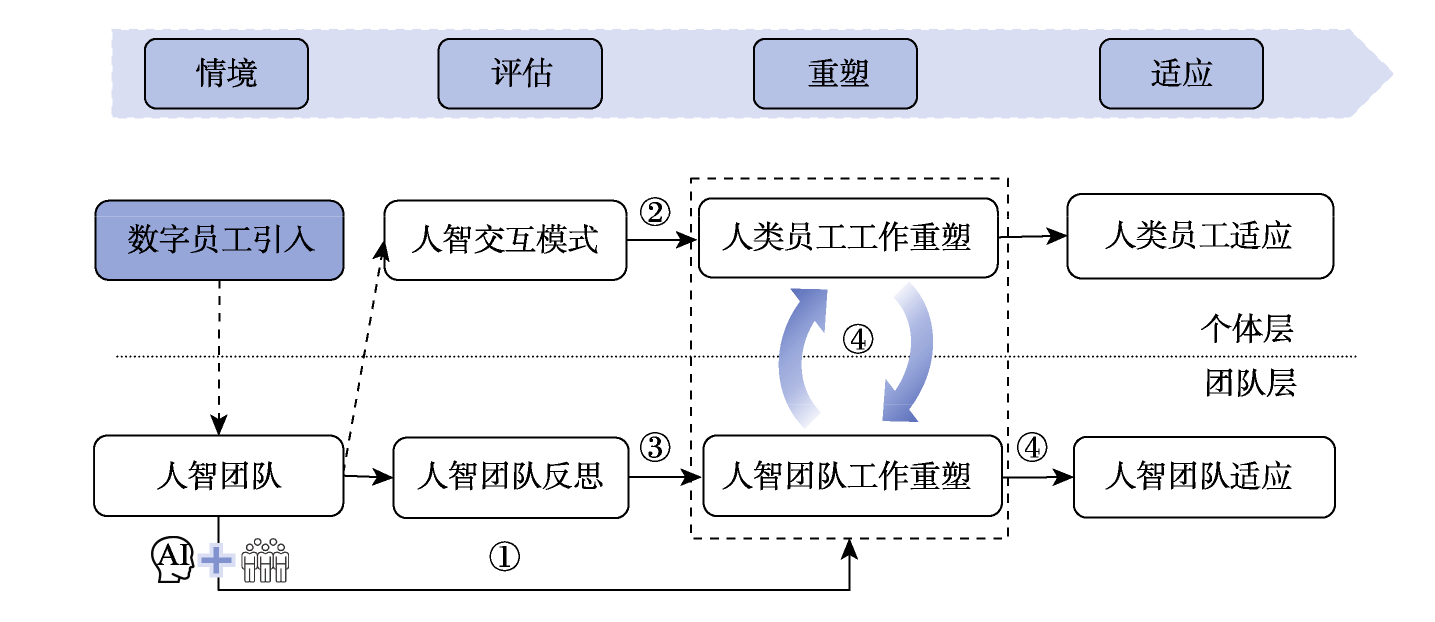
| 维度 | 传统员工工作重塑 | 人智协作情景下人类员工工作重塑 |
|---|---|---|
| 任务重塑 | 随着员工的职位或任务变化对任务范围与类型进行相对稳定的调整 | 伴随数字员工能力持续动态地更新协作的任务边界、分配与范围 |
| 关系重塑 | 员工基于人际交往的互惠性与情感性改变交际圈的范围或交往的质量 | 通过协作中数字员工可靠性输出结果, 基于自然语言指令等方式构建协作关系, 改善协作质量 |
| 认知重塑 | 改变对工作任务、关系或者整个工作本身的看法, 在工作中感知到不同的工作意义 | 在协作中拓展聚焦人智协作的意义, 不断深化对人智协作价值的理解 |
| 技能重塑 | 基于任务的新需求提升相关工作技能 | 人智协作中不断积累协作经验与协作技巧 |
| 维度 | 传统员工工作重塑 | 人智协作情景下人类员工工作重塑 |
|---|---|---|
| 任务重塑 | 随着员工的职位或任务变化对任务范围与类型进行相对稳定的调整 | 伴随数字员工能力持续动态地更新协作的任务边界、分配与范围 |
| 关系重塑 | 员工基于人际交往的互惠性与情感性改变交际圈的范围或交往的质量 | 通过协作中数字员工可靠性输出结果, 基于自然语言指令等方式构建协作关系, 改善协作质量 |
| 认知重塑 | 改变对工作任务、关系或者整个工作本身的看法, 在工作中感知到不同的工作意义 | 在协作中拓展聚焦人智协作的意义, 不断深化对人智协作价值的理解 |
| 技能重塑 | 基于任务的新需求提升相关工作技能 | 人智协作中不断积累协作经验与协作技巧 |
| 维度 | 传统团队工作重塑 | 人智团队工作重塑 |
|---|---|---|
| 重塑概念 | 团队成员通过密切协作和沟通共同决定改变团队工作的内容或方式 | 人智团队为发挥人智协作效能, 共同对团队的任务调配、关系网络、集体认知与权责归属结构性调整的过程 |
| 重塑主体 | 由团队成员共同主导 | 由团队人类成员主导, 结合数字员工的反馈与演化 |
| 重塑目的 | 为组织激发团队活力, 更好地实现团队整体利益 | 强调人智协作效能最大化; 促进人智团队有效、可靠且可持续运行 |
| 重塑内容 | 团队成员共同对团队工作的任务边界和人际边界进行实质或认知上的改变 | 充分考虑数字员工与人类员工的异质性特征, 集体对涉及团队任务调配、关系网络、团队认知与权责归属展开结构性调整 |
| 维度 | 传统团队工作重塑 | 人智团队工作重塑 |
|---|---|---|
| 重塑概念 | 团队成员通过密切协作和沟通共同决定改变团队工作的内容或方式 | 人智团队为发挥人智协作效能, 共同对团队的任务调配、关系网络、集体认知与权责归属结构性调整的过程 |
| 重塑主体 | 由团队成员共同主导 | 由团队人类成员主导, 结合数字员工的反馈与演化 |
| 重塑目的 | 为组织激发团队活力, 更好地实现团队整体利益 | 强调人智协作效能最大化; 促进人智团队有效、可靠且可持续运行 |
| 重塑内容 | 团队成员共同对团队工作的任务边界和人际边界进行实质或认知上的改变 | 充分考虑数字员工与人类员工的异质性特征, 集体对涉及团队任务调配、关系网络、团队认知与权责归属展开结构性调整 |
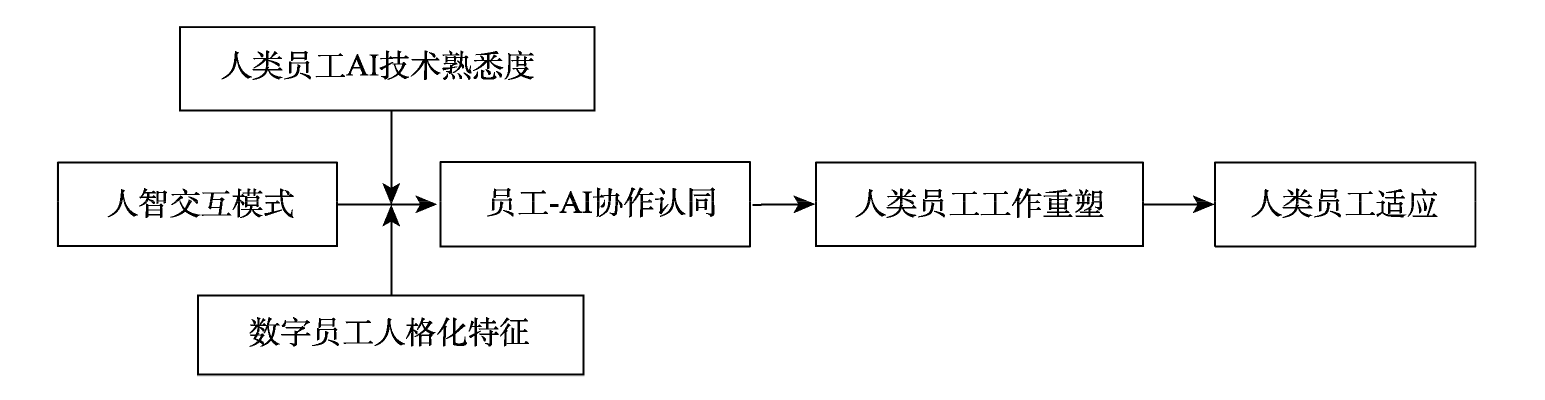
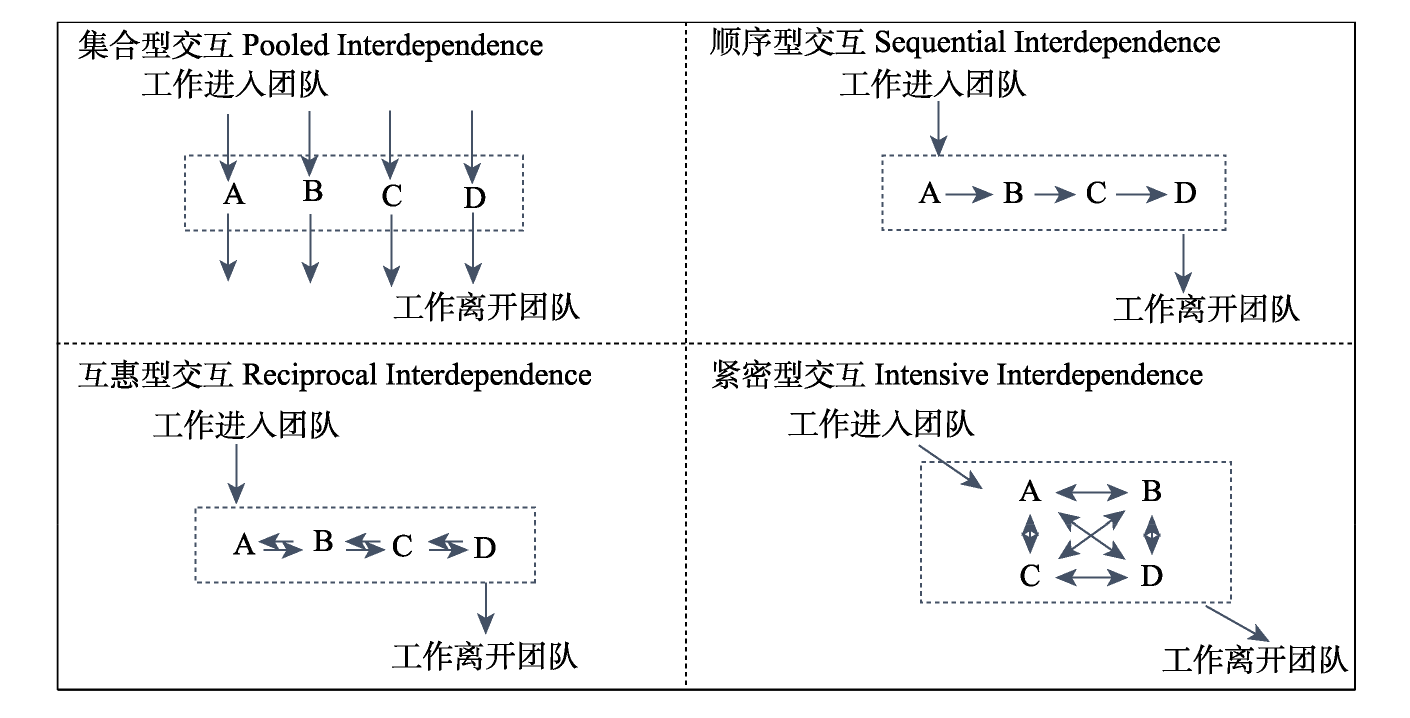
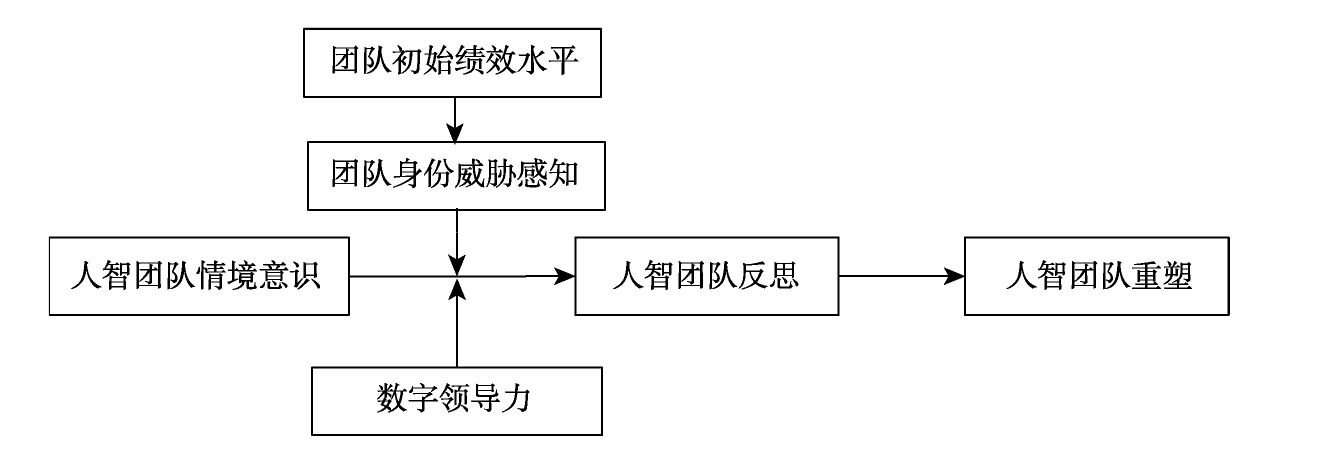
| [1] | 陈驰茵, 唐宁玉. (2017). 团队过程研究十年回顾: 2008至2017. 中国人力资源开发, (12), 47-59. |
| [2] |
陈志俊, 纪顺洪, 张辉华. (2023). 自下而上提升组织绩效的主动尝试: 基于动态过程视角的工作重塑. 心理科学进展, 31(10), 1814-1827.
doi: 10.3724/SP.J.1042.2023.01814 |
| [3] | 高中华, 徐燕. (2024). 大语言模型驱动下的员工工作重塑机制. 北京邮电大学学报(社会科学版), 26(2), 1-11. |
| [4] | 李凯, 胡方舟. (2025). 从人机协作到人智协作: 概念辨析与未来议题. 南开管理评论, 28(12), 21-60. |
| [5] | 李宁, 邓文明. (2023). 团队的未来: 领导者如何与AI携手前行. 清华管理评论, 12(9), 94-99. |
| [6] | 李燕萍, 苗力. (2020). 企业数字领导力的结构维度及其影响——基于中国情境的扎根理论研究. 武汉大学学报(哲学社会科学版), 73(6), 125-136. |
| [7] | 刘宁, 李晨, 赵波. (2024). 数字领导力研究综述与展望. 南京邮电大学学报(社会科学版), 26(2), 72-81. |
| [8] |
史燕伟, 谢菊兰, 王雅妮, 张南. (2023). 数字化工作重塑及其对工作绩效的促进作用: 基于人-任务-技术匹配视角. 心理科学进展, 31(7), 1133-1145.
doi: 10.3724/SP.J.1042.2023.01133 |
| [9] |
宋一晓, 曾铭灼, 苏涛. (2026). 机会抑或威胁? 人与AI协作系统对员工工作效能影响的元分析. 心理科学进展, 34(3), 461-486.
doi: 10.3724/SP.J.1042.2026.0461 |
| [10] |
田喜洲, 郭小东, 许浩. (2020). 工作重塑研究的新动向—基于调节定向的视角. 心理科学进展, 28(8), 1367-1378.
doi: 10.3724/SP.J.1042.2020.01367 |
| [11] |
王桢. (2020). 团队工作重塑的形成与影响机制. 心理科学进展, 28(3), 390-404.
doi: 10.3724/SP.J.1042.2020.00390 |
| [12] |
许为, 高在峰, 葛列众. (2024). 智能时代人因科学研究的新范式取向及重点. 心理学报, 56(3), 363-382.
doi: 10.3724/SP.J.1041.2024.00363 |
| [13] |
尹萌, 牛雄鹰. (2024). 与AI“共舞”: 系统化视角下的AI-员工协作. 心理科学进展, 32(1), 162-176.
doi: 10.3724/SP.J.1042.2024.00162 |
| [14] | 张钢, 岑杰. (2012). 组织适应理论扩展——组织时间适应研究探析. 外国经济与管理, 34(8), 43-49. |
| [15] | 张文勤, 刘云. (2011). 研发团队反思的结构检验及其对团队效能与效率的影响. 南开管理评论, 14(3), 26-33. |
| [16] |
郑宇, 谌怡, 吴月燕. (2025). 生成式人工智能队友如何影响团队新产品创意生成?基于团队过程的视角. 心理科学进展, 33(10), 1684-1697.
doi: 10.3724/SP.J.1042.2025.1684 |
| [17] | 钟竞, 于子淇, 罗瑾琏. (2025). 数字化变革下团队工作重塑对员工工作绩效的影响研究. 科学学与科学技术管理, 46(6), 149-163. |
| [18] |
Anthony, C., Bechky, B. A., & Fayard, A.-L. (2023). “Collaborating” with AI: Taking a system view to explore the future of work. Organization Science, 34(5), 1672-1694.
doi: 10.1287/orsc.2022.1651 URL |
| [19] |
Baard, S. K., Rench, T. A., & Kozlowski, S. W. J. (2013). Performance adaptation. Journal of Management, 40(1), 48-99.
doi: 10.1177/0149206313488210 URL |
| [20] |
Baird, A., & Maruping, L. M. (2021). The next generation of research on IS use: A theoretical framework of delegation to and from agentic IS artifacts. MIS Quarterly, 45(1), 315-341.
doi: 10.25300/MISQ/2021/15882 URL |
| [21] |
Bakker, A. B., Tims, M., & Derks, D. (2012). Proactive personality and job performance: The role of job crafting and work engagement. Human Relations, 65(10), 1359-1378.
doi: 10.1177/0018726712453471 URL |
| [22] |
Bayer, R. C., & Renou, L. (2026). Interacting with man or machine: When do humans reason better? Management Science, 72(1), 594-608.
doi: 10.1287/mnsc.2023.03315 URL |
| [23] |
Bell, S. T., Brown, S. G., Colaneri, A., & Outland, N. (2018). Team composition and the ABCs of teamwork. American Psychologist, 73(4), 349-362.
doi: 10.1037/amp0000305 pmid: 29792453 |
| [24] |
Berente, N., Gu, B., Recker, J., & Santhanam, R. (2021). Managing artificial intelligence. Management Information Systems Quarterly, 45(3), 1433-1450.
doi: 10.25300/MISQ/2021/16274 URL |
| [25] | Berg, J., M., Dutton, J. E., & Wrzesniewski, A. (2013). Job crafting and meaningful work. In B. J. Dik, Z. S. Byrne, & M. F. Steger (Eds.), Purpose and meaning in the workplace(pp. 81-104). American Psychological Association. |
| [26] |
Bermiss, Y. S., Farh, C. I., Simons, T., ter Wal, A. L., Von Krogh, G., & Gruber, M. (2025). Reengaging with the Classics. Academy of Management Journal, 68(3), 465-474.
doi: 10.5465/amj.2025.4003 URL |
| [27] |
Bigman, Y. E., Wilson, D., Arnestad, M. N., Waytz, A., & Gray, K. (2023). Algorithmic discrimination causes less moral outrage than human discrimination. Journal of Experimental Psychology: General, 152(1), 4-27.
doi: 10.1037/xge0001250 URL |
| [28] |
Bindl, U. K., Unsworth, K. L., Gibson, C. B., & Stride, C. B. (2019). Job crafting revisited: Implications of an extended framework for active changes at work. Journal of Applied Psychology, 104(5), 605-628.
doi: 10.1037/apl0000362 pmid: 30407042 |
| [29] |
Bruning, P. F., & Campion, M. A. (2018). A role-resource approach-avoidance model of job crafting: A multimethod integration and extension of job crafting theory. Academy of Management Journal, 61(2), 499-522.
doi: 10.5465/amj.2015.0604 URL |
| [30] |
Brynjolfsson, E. (2022). The turing trap: The promise & peril of human-like artificial intelligence. Daedalus, 151(2), 272-287.
doi: 10.1162/daed_a_01915 URL |
| [31] |
Burke, C. S., Stagl, K. C., Salas, E., Pierce, L., & Kendall, D. (2006). Understanding team adaptation: A conceptual analysis and model. Journal of Applied Psychology, 91(6), 1189-1207.
pmid: 17100478 |
| [32] | Chen, A., Xiang, M., Wang, M., & Lu, Y. (2023). Harmony in intelligent hybrid teams: The influence of the intellectual ability of artificial intelligence on human members’ reactions. Information Technology & People, 36(7), 2826-2846. |
| [33] |
Chen, G. (2005). Newcomer adaptation in teams: Multilevel antecedents and outcomes. Academy of Management Journal, 48(1), 101-116.
doi: 10.5465/amj.2005.15993147 URL |
| [34] |
Cheng, B., Lin, H., & Kong, Y. (2023). Challenge or hindrance? How and when organizational artificial intelligence adoption influences employee job crafting. Journal of Business Research, 164, 113987.
doi: 10.1016/j.jbusres.2023.113987 URL |
| [35] |
Choi, H. S., & Levine, J. M. (2004). Minority influence in work teams: The impact of newcomers. Journal of Experimental Social Psychology, 40(2), 273-280.
doi: 10.1016/S0022-1031(03)00101-X URL |
| [36] |
Cooper-Thomas, H., Anderson, N., & Cash, M. (2012). Investigating organizational socialization: A fresh look at newcomer adjustment strategies. Personnel Review, 41(1), 41-55.
doi: 10.1108/00483481211189938 URL |
| [37] |
Demir, M., McNeese, N. J., & Cooke, N. J. (2017). Team situation awareness within the context of human- autonomy teaming. Cognitive Systems Research, 46, 3-12.
doi: 10.1016/j.cogsys.2016.11.003 URL |
| [38] |
Dennis, A. R., Lakhiwal, A., & Sachdeva, A. (2023). AI agents as team members: Effects on satisfaction, conflict, trustworthiness, and willingness to work with. Journal of Management Information Systems, 40(2), 307-337.
doi: 10.1080/07421222.2023.2196773 URL |
| [39] | Diebel, C., Goutier, M., Adam, M., & Benlian, A. (2025). When AI-Based agents are proactive: Implications for competence and system satisfaction in human-AI Collaboration. Business & Information Systems Engineering, 68(2), 259-278. |
| [40] | Doshi, A. R., & Hauser, O. P. (2024). Generative AI enhances individual creativity but reduces the collective diversity of novel content. Science Advances, 10(28), eadn5290. |
| [41] | Erengin, T., Briker, R., & de Jong, S. B. (2025). You, me, and the AI: The role of third-party human teammates for trust formation toward AI teammates. Journal of Organizational Behavior. https://doi.org/10.1002/job.2857 |
| [42] |
Faulconbridge, J., Sarwar, A., & Spring, M. (2025). How professionals adapt to artificial intelligence: The role of intertwined boundary work. Journal of Management Studies, 62(5), 1991-2024.
doi: 10.1111/joms.v62.5 URL |
| [43] |
Flathmann, C., Schelble, B. G., McNeese, N. J., Knijnenburg, B., Gramopadhye, A. K., & Chalil Madathil, K. (2024). The purposeful presentation of AI teammates: Impacts on human acceptance and perception. International Journal of Human-Computer Interaction, 40(20), 6510-6527.
doi: 10.1080/10447318.2023.2254984 URL |
| [44] |
Flathmann, C., Schelble, B. G., Rosopa, P. J., McNeese, N. J., Mallick, R., & Madathil, K. C. (2023). Examining the impact of varying levels of AI teammate influence on human-AI teams. International Journal of Human- Computer Studies, 177, 103061.
doi: 10.1016/j.ijhcs.2023.103061 URL |
| [45] |
Frick, N. R. J., Mirbabaie, M., Stieglitz, S., & Salomon, J. (2021). Maneuvering through the stormy seas of digital transformation: The impact of empowering leadership on the ai readiness of enterprises. Journal of Decision System, 30(2-3), 235-258.
doi: 10.1080/12460125.2020.1870065 URL |
| [46] |
Fügener, A., Grahl, J., Gupta, A., & Ketter, W. (2021). Will humans-in-the-loop become borgs? Merits and pitfalls of working with AI. Management Information Systems Quarterly, 45(3), 1527-1556.
doi: 10.25300/MISQ/2021/16553 URL |
| [47] |
Gaczek, P., Leszczyński, G., Wei, Y., & Sun, H. (2025). The bright side of AI in marketing decisions: Collaboration with algorithms prevents managers from violating ethical norms. Journal of Business Ethics, 204(4), 771-794.
doi: 10.1007/s10551-025-06083-w |
| [48] | Georganta, E., & Ulfert, A.-S. (2024a). My colleague is an AI! Trust differences between AI and human teammates. Team Performance Management, 30(1-2), 23-37. |
| [49] |
Georganta, E., & Ulfert, A.-S. (2024b). Would you trust an AI team member? Team trust in human-AI teams. Journal of Occupational and Organizational Psychology, 97(3), 1212-1241.
doi: 10.1111/joop.v97.3 URL |
| [50] |
Gersick, C. J., & Hackman, J. R. (1990). Habitual routines in task-performing groups. Organizational Behavior and Human Decision Processes, 47(1), 65-97.
doi: 10.1016/0749-5978(90)90047-D URL |
| [51] |
Glikson, E., & Woolley, A. W. (2020). Human trust in artificial intelligence: Review of empirical research. Academy of Management Annals, 14(2), 627-660.
doi: 10.5465/annals.2018.0057 URL |
| [52] |
Grant, A. M. (2007). Relational job design and the motivation to make a prosocial difference. Academy of Management Review, 32(2), 393-417.
doi: 10.5465/amr.2007.24351328 URL |
| [53] | Greve, H. R. (2003). Organizational learning from performance feedback: A behavioral perspective on innovation and change. Cambridge University Press. |
| [54] |
Harris-Watson, A. M., Larson, L. E., Lauharatanahirun, N., DeChurch, L. A., & Contractor, N. S. (2023). Social perception in human-AI teams: Warmth and competence predict receptivity to AI teammates. Computers in Human Behavior, 145, 107765.
doi: 10.1016/j.chb.2023.107765 URL |
| [55] |
Hauptman, A. I., Mallick, R., Flathmann, C., & McNeese, N. J. (2024). Human factors considerations for the context-aware design of adaptive autonomous teammates. Ergonomics, 68(4), 571-587.
doi: 10.1080/00140139.2024.2380341 URL |
| [56] |
Hillebrand, L., Raisch, S., & Schad, J. (2025). Managing with artificial intelligence: An integrative framework. Academy of Management Annals, 19(1), 343-375.
doi: 10.5465/annals.2022.0072 URL |
| [57] | Hobfoll, S. E. (2011). Conservation of resource caravans and engaged settings. Journal of Occupational & Organizational Psychology, 84(1), 116-122. |
| [58] | Hu, M., Zhang, G., Chong, L., Cagan, J., & Goucher- Lambert, K. (2025). How being outvoted by AI teammates impacts human-AI collaboration. International Journal of Human-Computer Interaction, 41(7), 4049-4066. |
| [59] |
Jia, N., Luo, X., Fang, Z., & Liao, C. (2024). When and how artificial intelligence augments employee creativity. Academy of Management Journal, 67(1), 5-32.
doi: 10.5465/amj.2022.0426 URL |
| [60] | Jiang, S., Li, Z., Gao, R., Jia, J., & Cheng, B. (2025). To break or not to break? The dual effects of employee-AI collaborative identification on employee pro-customer rule breaking. Journal of Hospitality Marketing & Management, 34(8), 1123-1158. |
| [61] |
Joardar, A., Kostova, T., & Ravlin, E. C. (2007). An experimental study of the acceptance of a foreign newcomer into a workgroup. Journal of International Management, 13(4), 513-537.
doi: 10.1016/j.intman.2007.02.002 URL |
| [62] |
Jussupow, E., Spohrer, K., Heinzl, A., & Gawlitza, J. (2021). Augmenting medical diagnosis decisions? An investigation into physicians’ decision-making process with artificial intelligence. Information Systems Research, 32(3), 713-735.
doi: 10.1287/isre.2020.0980 URL |
| [63] |
Kammeyer-Mueller, J., Wanberg, C., Rubenstein, A., & Song, Z. (2013). Support, undermining, and newcomer socialization: Fitting in during the first 90 days. Academy of Management Journal, 56(4), 1104-1124.
doi: 10.5465/amj.2010.0791 URL |
| [64] | Kane, G. C., Phillips, A. N., Copulsky, J., & Andrus, G. (2019). How digital leadership is(n't) different. MIT Sloan Management Review, 60(3), 34-39. |
| [65] |
Kim, H. (2025). Beyond algorithm aversion: The impact of psychological readiness on algorithmic advice. Computers in Human Behavior, 174, 108824.
doi: 10.1016/j.chb.2025.108824 URL |
| [66] |
Kozlowski, S. W., Chao, G. T., Grand, J. A., Braun, M. T., & Kuljanin, G. (2013). Advancing multilevel research design: Capturing the dynamics of emergence. Organizational Research Methods, 16(4), 581-615.
doi: 10.1177/1094428113493119 URL |
| [67] | Kozlowski, S. W., J., & Klein, K. J. (2000). A multilevel approach to theory and research in organizations:Contextual, temporal, and emergent processes. In K. J. Klein & S. W. J. Kozlowski (Eds.), Multilevel theory, research, and methods in organizations: Foundations, extensions, and new directions (pp. 3-90). Jossey-Bass. |
| [68] |
Łabuz, M., & Nehring, C. (2024). Information apocalypse or overblown fears-what AI mis-and disinformation is all about? Shifting away from technology toward human reactions. Politics & Policy, 52(4), 874-891.
doi: 10.1111/polp.v52.4 URL |
| [69] |
Ladak, A., Loughnan, S., & Wilks, M. (2024). The moral psychology of artificial intelligence. Current Directions in Psychological Science, 33(1), 27-34.
doi: 10.1177/09637214231205866 URL |
| [70] | Larson, L., & DeChurch, L. A. (2020). Leading teams in the digital age: Four perspectives on technology and what they mean for leading teams. The Leadership Quarterly, 31(1), 101377. |
| [71] | Larson, L. E. (2021). Leading teams in the digital age: Team technology adaptation in Human-agent teams [Unpublished doctoral dissertation]. Northwestern University. |
| [72] |
Leana, C., Appelbaum, E., & Shevchuk, I. (2009). Work process and quality of care in early childhood education: The role of job crafting. Academy of Management Journal, 52(6), 1169-1192.
doi: 10.5465/amj.2009.47084651 URL |
| [73] |
Li, X., & Sung, Y. (2021). Anthropomorphism brings us closer: The mediating role of psychological distance in User-AI assistant interactions. Computers in Human Behavior, 118, 106680.
doi: 10.1016/j.chb.2021.106680 URL |
| [74] |
Li, W., Qin, X., Yam, K. C., Deng, H., Chen, C., Dong, X.,... Tang, W. (2024). Embracing artificial intelligence (AI) with job crafting: Exploring trickle-down effect and employees’ outcomes. Tourism Management, 104, 104935.
doi: 10.1016/j.tourman.2024.104935 URL |
| [75] | Lu, L., & Yan, B. (2026). Syncing minds and machines: Hybrid cognitive alignment as an emergent coordination mechanism in human-AI collaboration. Academy of Management Review. https://doi.org/10.5465/amr.2024.0546 |
| [76] |
Mahmud, H., Islam, A. N., Ahmed, S. I., & Smolander, K. (2022). What influences algorithmic decision-making? A systematic literature review on algorithm aversion. Technological Forecasting and Social Change, 175, 121390.
doi: 10.1016/j.techfore.2021.121390 URL |
| [77] |
Mallick, R., Flathmann, C., Duan, W., Schelble, B. G., & McNeese, N. J. (2024). What you say vs what you do: Utilizing positive emotional expressions to relay AI teammate intent within human-AI teams. International Journal of Human-Computer Studies, 192, 103355.
doi: 10.1016/j.ijhcs.2024.103355 URL |
| [78] |
McClelland, G. P., Leach, D. J., Clegg, C. W., & McGowan, I. (2014). Collaborative crafting in call centre teams. Journal of Occupational and Organizational Psychology, 87(3), 464-486.
doi: 10.1111/joop.2014.87.issue-3 URL |
| [79] |
McNeese, N. J., Demir, M., Cooke, N. J., & Myers, C. (2018). Teaming with a synthetic teammate: Insights into human-autonomy teaming. Human Factors, 60(2), 262-273.
doi: 10.1177/0018720817743223 pmid: 29185818 |
| [80] |
McNeese, N. J., Schelble, B. G., Canonico, L. B., & Demir, M. (2021). Who/What is my teammate? Team composition considerations in human-AI teaming. IEEE Transactions on Human-Machine Systems, 51(4), 288-299.
doi: 10.1109/THMS.2021.3086018 URL |
| [81] |
Mirbabaie, M., Brünker, F., Frick, N. R. J. M., & Stieglitz, S. (2021). The rise of artificial intelligence-understanding the AI identity threat at the workplace. Electronic Markets, 32(1), 73-99.
doi: 10.1007/s12525-021-00496-x |
| [82] | Mirowska, A., & Arsenyan, J. (2025). The A(I) Team: Effects of human-likeness and conformity to gender stereotypes on initial trust and willingness to work with an AI teammate. Journal of Organizational Behavior. https://doi.org/10.1002/job.70009 |
| [83] |
Momose, K., Mehta, R., Moukpe, J., Weekes, T. R., & Eskridge, T. C. (2025). Human-AI teamwork interface design using patterns of interactions. International Journal of Human-Computer Interaction, 41(11), 7112-7134.
doi: 10.1080/10447318.2024.2389350 URL |
| [84] |
Musick, G., O'Neill, T. A., Schelble, B. G., McNeese, N. J., & Henke, J. B. (2021). What happens when humans believe their teammate is an AI? An investigation into humans teaming with autonomy. Computers in Human Behavior, 122, 106852.
doi: 10.1016/j.chb.2021.106852 URL |
| [85] |
Noy, S., & Zhang, W. (2023). Experimental evidence on the productivity effects of generative artificial intelligence. Science, 381(6654), 187-192.
doi: 10.1126/science.adh2586 pmid: 37440646 |
| [86] |
O’Neill, T., McNeese, N. J., Barron, A., & Schelble, B. (2022). Human-autonomy teaming: A review and analysis of the empirical literature. Human Factors: The Journal of the Human Factors and Ergonomics Society, 64(5), 904-938.
doi: 10.1177/0018720820960865 URL |
| [87] |
O’Neill, T. A., Flathmann, C., McNeese, N. J., & Salas, E. (2023). Human-autonomy teaming: Need for a guiding team-based framework? Computers in Human Behavior, 146, 107762.
doi: 10.1016/j.chb.2023.107762 URL |
| [88] |
Paetzel-Prüsmann, M., Perugia, G., & Castellano, G. (2021). The influence of robot personality on the development of uncanny feelings. Computers in Human Behavior, 120, 106756.
doi: 10.1016/j.chb.2021.106756 URL |
| [89] |
Pakarinen, P., & Huising, R. (2025). Relational expertise: What machines can't know. Journal of Management Studies, 62(5), 2053-2082.
doi: 10.1111/joms.v62.5 URL |
| [90] |
Pal, D., Vanijja, V., Thapliyal, H., & Zhang, X. (2023). What affects the usage of artificial conversational agents? An agent personality and love theory perspective. Computers in Human Behavior, 145, 107788.
doi: 10.1016/j.chb.2023.107788 URL |
| [91] |
Pearsall, M. J., Christian, J. S., & Croitoru, N. (2024). A stimulus-based model of the team adaptation process: An integrated conceptual review. Journal of Applied Psychology, 110(4), 459-480.
doi: 10.1037/apl0001237 pmid: 39374145 |
| [92] |
Petrou, P., Demerouti, E., & Schaufeli, W. B. (2016). Crafting the change: The role of employee job crafting behaviors for successful organizational change. Journal of Management, 44(5), 1766-1792.
doi: 10.1177/0149206315624961 URL |
| [93] |
Phillips, K. W., Liljenquist, K. A., & Neale, M. A. (2009). Is the pain worth the gain? The advantages and liabilities of agreeing with socially distinct newcomers. Personality and Social Psychology Bulletin, 35(3), 336-350.
doi: 10.1177/0146167208328062 pmid: 19098258 |
| [94] |
Pulakos, E. D., Arad, S., Donovan, M. A., & Plamondon, K. E. (2000). Adaptability in the workplace: Development of a taxonomy of adaptive performance. Journal of Applied Psychology, 85(4), 612-624.
pmid: 10948805 |
| [95] |
Qin, X., Zhou, X., Chen, C., Wu, D., Zhou, H., Dong, C., … Lu, J. (2025). AI aversion or appreciation? A capability-personalization framework and a meta-analytic review. Psychological Bulletin, 151(5), 580-599.
doi: 10.1037/bul0000477 pmid: 40489180 |
| [96] |
Raisch, S., & Fomina, K. (2025). Combining human and artificial intelligence: Hybrid problem-solving in organizations. Academy of Management Review, 50(2), 441-464.
doi: 10.5465/amr.2021.0421 URL |
| [97] |
Rink, F., Kane, A. A., Ellemers, N., & van der Vegt, G. (2013). Team receptivity to newcomers: Five decades of evidence and future research themes. Academy of Management Annals, 7(1), 247-293.
doi: 10.5465/19416520.2013.766405 URL |
| [98] |
Rudolph, C. W., Katz, I. M., Lavigne, K. N., & Zacher, H. (2017). Job crafting: A meta-analysis of relationships with individual differences, job characteristics, and work outcomes. Journal of Vocational Behavior, 102, 112-138.
doi: 10.1016/j.jvb.2017.05.008 URL |
| [99] |
Sanneman, L., & Shah, J. A. (2023). Validating metrics for reward alignment in human-autonomy teaming. Computers in Human Behavior, 146, 107809.
doi: 10.1016/j.chb.2023.107809 URL |
| [100] |
Sarala, R. M., Post, C., Doh, J., & Muzio, D. (2025). Advancing research on the future of work in the age of artificial intelligence (AI). Journal of Management Studies, 62(5), 1863-1884.
doi: 10.1111/joms.v62.5 URL |
| [101] | Schelble, B. G., Flathmann, C., Macdonald, J. P., Knijnenburg, B., Brady, C., & McNeese, N. J. (2025). Modeling perceived information needs in human-AI teams: Improving AI teammate utility and driving team cognition. Behaviour & Information Technology, 44(9), 2069-2092. |
| [102] |
Schelble, B. G., Flathmann, C., McNeese, N. J., O’Neill, T., Pak, R., & Namara, M. (2023). Investigating the effects of perceived teammate artificiality on human performance and cognition. International Journal of Human-Computer Interaction, 39(13), 2686-2701.
doi: 10.1080/10447318.2022.2085191 URL |
| [103] |
Schmutz, J. B., Outland, N., Kerstan, S., Georganta, E., & Ulfert, A. S. (2024). AI-Teaming: Redefining collaboration in the digital era. Current Opinion in Psychology, 58, 101837.
doi: 10.1016/j.copsyc.2024.101837 URL |
| [104] | Seeber, I., Bittner, E., Briggs, R. O., De Vreede, T., De Vreede, G. J., Elkins, A., … Söllner, M. (2020). Machines as teammates: A research agenda on AI in team collaboration. Information & Management, 57(2), 103174. |
| [105] |
Seymour, M., Yuan, L., Riemer, K., & Dennis, A. R. (2025). Less artificial, more intelligent: Understanding affinity, trustworthiness, and preference for digital humans. Information Systems Research, 36(2), 1096-1128.
doi: 10.1287/isre.2022.0203 URL |
| [106] | Shaikh, S. J., & Cruz, I. F. (2023). AI in human teams: Effects on technology use, members' interactions, and creative performance under time scarcity. AI & Society, 38(4), 1587-1600. |
| [107] |
Shen, P., Zhang, F., Fan, X., & Liu, F. (2024). Artificial intelligence psychological anthropomorphism: Scale development and validation. The Service Industries Journal, 44(15-16), 1061-1092.
doi: 10.1080/02642069.2024.2366970 URL |
| [108] |
Siemon, D. (2022). Elaborating team roles for artificial intelligence-based teammates in human-AI collaboration. Group Decision and Negotiation, 31(5), 871-912.
doi: 10.1007/s10726-022-09792-z |
| [109] |
Siemon, D., Elshan, E., De Vreede, T., Ebel, P., & De Vreede, G. (2025). Beyond anthropomorphism: Social presence in human-AI collaboration processes. Journal of Management Studies, 63(2), 515-560.
doi: 10.1111/joms.v63.2 URL |
| [110] |
Spring, M., Faulconbridge, J., & Sarwar, A. (2022). How information technology automates and augments processes: Insights from artificial-intelligence-based systems in professional service operations. Journal of Operations Management, 68(6-7), 592-618.
doi: 10.1002/joom.v68.6-7 URL |
| [111] | Srivastava, D., Lilly, J. M., & Feigh, K. M. (2024). Exploring the role of judgement and shared situation awareness when working with AI recommender systems. Cognition, Technology & Work, 27(1-2), 1-18. |
| [112] |
Stelmaszak, M., Joshi, M., & Constantiou, I. (2025). Artificial intelligence as an organizing capability arising from human‐algorithm relations. Journal of Management Studies, 63(2), 335-365.
doi: 10.1111/joms.v63.2 URL |
| [113] |
Tan, S.-M., & Liew, T. W. (2020). Designing embodied virtual agents as product specialists in a multi-product category e-commerce: The roles of source credibility and social presence. International Journal of Human- Computer Interaction, 36(12), 1136-1149.
doi: 10.1080/10447318.2020.1722399 URL |
| [114] | Thompson, J. D. (1967). Organizations in action: Social science bases of administrative theory. McGraw-Hill. |
| [115] | Tims, M., & Bakker, A. B. (2010). Job crafting: Towards a new model of individual job redesign. SA Journal of Industrial Psychology, 36(2), 1-9. |
| [116] |
Tims, M., Bakker, A. B., & Derks, D. (2012). Development and validation of the job crafting scale. Journal of Vocational Behavior, 80(1), 173-186.
doi: 10.1016/j.jvb.2011.05.009 URL |
| [117] | Tims, M., Bakker, A. B., Derks, D., & van Rhenen, W. (2013). Job crafting at the team and individual level. Group & Organization Management, 38(4), 427-454. |
| [118] | Trainer, H. M., Jones, J. M., Pendergraft, J. G., Maupin, C. K., & Carter, D. R. (2020). Team membership change “events”: A review and reconceptualization. Group & Organization Management, 45(2), 219-251. |
| [119] | Tu, Y., Li, J., Chen, J., Li, C. J., & He, W. (2025). When AI becomes my teammate: Unpacking how employees perceive and collaborate with gendered AI teammates. Journal of Organizational Behavior. https://doi.org/10.1002/job.70038 |
| [120] |
Ulfert, A.-S., Georganta, E., Centeio Jorge, C., Mehrotra, S., & Tielman, M. (2024). Shaping a multidisciplinary understanding of team trust in human-AI teams: A theoretical framework. European Journal of Work and Organizational Psychology, 33(2), 158-171.
doi: 10.1080/1359432X.2023.2200172 URL |
| [121] | Wang, W., Gao, G., & Agarwal, R. (2024). Friend or foe? Teaming between artificial intelligence and workers with variation in experience. Management Science, 70(9), 5753-5775. |
| [122] |
Wrzesniewski, A., & Dutton, J. E. (2001). Crafting a job: Revisioning employees as active crafters of their work. Academy of Management Review, 26(2), 179-201.
doi: 10.2307/259118 URL |
| [123] | Wrzesniewski,, A., LoBuglio, N., Dutton, J. E., & Berg, J. M. (2013). Job crafting and cultivating positive meaning and identity in work. In A. B. Bakker (Ed.), Advances in Positive Organizational Psychology (pp. 281-302). Emerald Group Publishing. |
| [124] |
Xu, Y., Dai, H., & Yan, W. (2024). Identity disclosure and anthropomorphism in voice chatbot design: A field experiment. Management Science, 72(1), 223-241.
doi: 10.1287/mnsc.2022.03833 URL |
| [125] |
Yam, K. C., Tang, P. M., Jackson, J. C., Su, R., & Gray, K. (2023). The rise of robots increases job insecurity and maladaptive workplace behaviors: Multimethod evidence. Journal of Applied Psychology, 108(5), 850-870.
doi: 10.1037/apl0001045 URL |
| [126] | Zercher, D., Jussupow, E., Benke, I., & Heinzl, A. (2025). How can teams benefit from AI team members? Exploring the effect of generative AI on decision-making processes and decision quality in team-AI collaboration. Journal of Organizational Behavior. https://doi.org/10.1002/job.2898 |
| [127] | Zercher, D., Jussupow, E., & Heinzl, A. (2023). When AI joins the team: A literature review on intragroup processes and their effect on team performance in team-AI collaboration. ECIS 2023 Research Papers, Kristiansand, Norway, 307. |
| [128] |
Zhang, G., Chong, L., Kotovsky, K., & Cagan, J. (2022). Trust in an AI versus a Human teammate: The effects of teammate identity and performance on human-AI cooperation. Computers in Human Behavior, 139, 107536.
doi: 10.1016/j.chb.2022.107536 URL |
| [1] | CHENG Jialin, LI Jinsong. Driving mechanisms and impacts of stretch goals: An AI-enabled perspective [J]. Advances in Psychological Science, 2026, 34(10): 1733-1748. |
| [2] | CAO Wenrui, LIU Beini, ZHANG Shanshan, TIAN Zonglin. When customers are empowered by algorithms: Dynamic mechanisms and interventions in gig workers’ coping with customer mistreatment [J]. Advances in Psychological Science, 2026, 34(10): 1749-1767. |
| [3] | YUWEN Ziqi, XIAO Yubei, YAO Xiang. The dynamic process of individual career adaptation: The career construction model of adaptation [J]. Advances in Psychological Science, 2026, 34(9): 1695-1708. |
| [4] | ZHANG Xiaoyan, SU Fangguo. The influence of socially responsible human resource management on employee work outcomes: A meta-analysis [J]. Advances in Psychological Science, 2026, 34(8): 1386-1409. |
| [5] | HAI Shenyang, YANG Bo, GUO Tengfei, XIN Zhaoyang, LIU Liu, FU Anguo. The conceptualization, antecedents, and multilevel effects of leader strengths use [J]. Advances in Psychological Science, 2026, 34(8): 1330-1350. |
| [6] | CHEN Hui, FENG Chao. When employee meets AI: Research on employee-AI collaboration’s construct measurement, antecedent configuration and influence mechanism [J]. Advances in Psychological Science, 2026, 34(8): 1309-1329. |
| [7] | CHEN Yashuo, CHEN Aobo, XU Jiaqi, YANG Chunjiang. The concept, formation, cross-level evolution, and multilevel impacts of employee moral authority [J]. Advances in Psychological Science, 2026, 34(5): 856-874. |
| [8] | OUYANG Zhe, CHENG Peng, XU Zuhui. The spillover effects of corporate misconduct: An attributional cognitive process perspective [J]. Advances in Psychological Science, 2026, 34(5): 875-889. |
| [9] | WANG Haijiang, ZOU Haoyun, HE Yuheng. Pay inversion and organizational socialization: An integrated multi-theoretical framework [J]. Advances in Psychological Science, 2026, 34(4): 608-625. |
| [10] | HAN Yi, MA Zhaoyi, ZONG Shuwei. The differential perception of leaders' response to employee-GenAI advice: A multi-level study based on social comparison view [J]. Advances in Psychological Science, 2026, 34(4): 626-646. |
| [11] | ZHAO Hongdan, MA Yunshuo. The driving mechanisms of older workers’ knowledge seeking from younger coworkers [J]. Advances in Psychological Science, 2026, 34(4): 742-760. |
| [12] | ZHANG Jian, PENG Shuai, FU Ruibing. The impact mechanism of organizational emotional capability on job insecurity-driven outcomes [J]. Advances in Psychological Science, 2026, 34(3): 381-403. |
| [13] | SONG Yixiao, ZENG Mingzhuo, SU Tao. Opportunity or threat? A meta-analysis of the impact of human-AI collaboration systems on employee work effectiveness [J]. Advances in Psychological Science, 2026, 34(3): 461-486. |
| [14] | FENG Jiaojiao, LIU Yi, LIU Jun. The concept connotation, formation and impact mechanism of knowledge disruption [J]. Advances in Psychological Science, 2026, 34(2): 210-226. |
| [15] | NIE Qi, ZHANG Jie. The double-edged sword effect of micro-breaks and its boundary conditions [J]. Advances in Psychological Science, 2026, 34(1): 29-43. |
| Viewed | ||||||
|
Full text |
|
|||||
|
Abstract |
|
|||||
