

ISSN 1671-3710
CN 11-4766/R
主办:中国科学院心理研究所
出版:科学出版社
CN 11-4766/R
主办:中国科学院心理研究所
出版:科学出版社
Advances in Psychological Science ›› 2026, Vol. 34 ›› Issue (7): 1256-1268.doi: 10.3724/SP.J.1042.2026.1256
• Regular Articles • Previous Articles Next Articles
GAO Xu, XIN Ziqiang( )
)
Received:2025-10-18
Online:2026-07-15
Published:2026-05-11
Contact:
XIN Ziqiang
E-mail:xinziqiang@sohu.com
CLC Number:
GAO Xu, XIN Ziqiang. The process and confines of mental budgeting constraints on expenditure decisions[J]. Advances in Psychological Science, 2026, 34(7): 1256-1268.
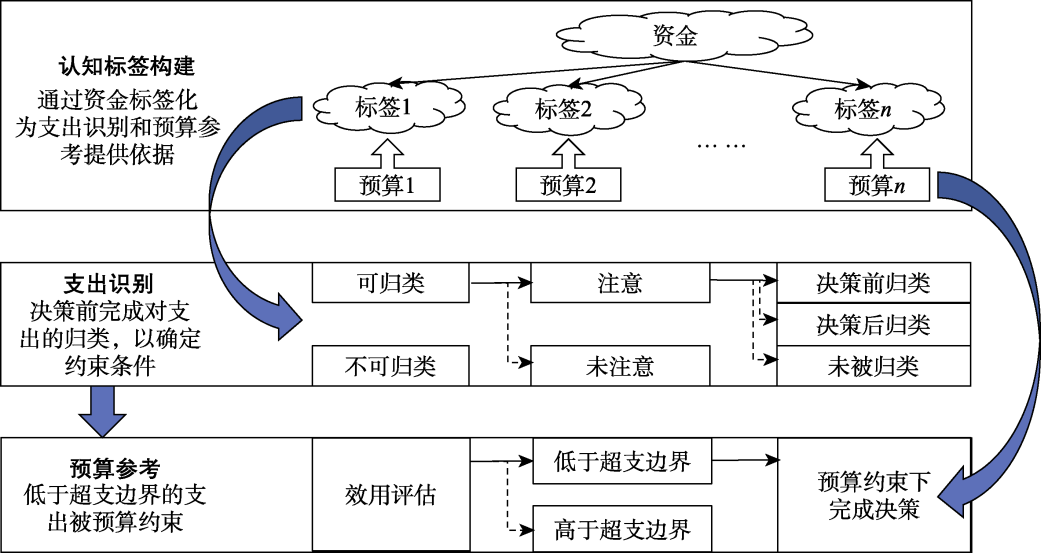
| 交易效用理论 (Thaler, | 两阶段模型 (Heath & Soll, | 心理预算系统的 约束过程模型 | |
|---|---|---|---|
| 理论定位 | 效用评估及决策权衡规则 | 心理预算的建立和管理过程 | 心理预算系统约束决策的过程和机制 |
| 核心要素 | 交易效用、获得效用、预算限制 | 预算设定、支出追踪 | 资金认知标签化、支出识别、预算参考 |
| 主要观点 | 支出决策是在预算限制下, 商品效用与保留预算效用的权衡 | 心理预算账户在建立后, 根据支出结果动态调整 | 资金标签建立后, 在决策前完成识别且低于超支边界的支出, 才可能被心理预算系统限制 |
| 是否包含支出−预算匹配过程分析 | 否 | 是 | 是 |
| 是否包含决策动因分析 | 是 | 否 | 是 |
| 是否界定适用条件 | 否 | 否 | 是 |
| 交易效用理论 (Thaler, | 两阶段模型 (Heath & Soll, | 心理预算系统的 约束过程模型 | |
|---|---|---|---|
| 理论定位 | 效用评估及决策权衡规则 | 心理预算的建立和管理过程 | 心理预算系统约束决策的过程和机制 |
| 核心要素 | 交易效用、获得效用、预算限制 | 预算设定、支出追踪 | 资金认知标签化、支出识别、预算参考 |
| 主要观点 | 支出决策是在预算限制下, 商品效用与保留预算效用的权衡 | 心理预算账户在建立后, 根据支出结果动态调整 | 资金标签建立后, 在决策前完成识别且低于超支边界的支出, 才可能被心理预算系统限制 |
| 是否包含支出−预算匹配过程分析 | 否 | 是 | 是 |
| 是否包含决策动因分析 | 是 | 否 | 是 |
| 是否界定适用条件 | 否 | 否 | 是 |
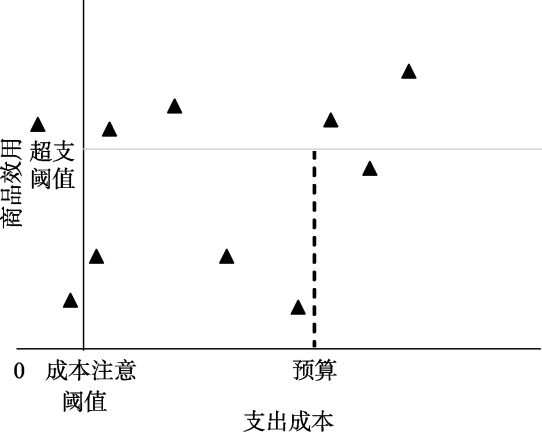
| 支出可归类性 | 支出识别 时机 | 效用与超支边界的相对大小 | 是否 被约束 | 主导机制 |
|---|---|---|---|---|
| 不可归类 | / | / | 否 | 支出项目难以匹配心理账户, 如首次遇到的异常支出。 |
| 可归类 | 未识别 | / | 否 | 决策时未参考预算信息, 如紧急支出或未引起注意的小额支出。 |
| 决策后识别 | 否 | |||
| 可归类 | 决策前识别 | 效用 ≥ 超支边界 | 否 | 促进定向的决策动机引导主动超支, 如因商品吸引力强而超预算购买某一商品。 |
| 可归类 | 决策前识别 | 效用 < 超支边界 | 是 | 项目被明确归类, 参考并基于预算额度完成的支出, 如常规生活用品消费。 |
| 支出可归类性 | 支出识别 时机 | 效用与超支边界的相对大小 | 是否 被约束 | 主导机制 |
|---|---|---|---|---|
| 不可归类 | / | / | 否 | 支出项目难以匹配心理账户, 如首次遇到的异常支出。 |
| 可归类 | 未识别 | / | 否 | 决策时未参考预算信息, 如紧急支出或未引起注意的小额支出。 |
| 决策后识别 | 否 | |||
| 可归类 | 决策前识别 | 效用 ≥ 超支边界 | 否 | 促进定向的决策动机引导主动超支, 如因商品吸引力强而超预算购买某一商品。 |
| 可归类 | 决策前识别 | 效用 < 超支边界 | 是 | 项目被明确归类, 参考并基于预算额度完成的支出, 如常规生活用品消费。 |
| [1] | 董艺佳, 张玥, 李雪, 蒋奖, 刘子双, 杜晓鹏. (2024). 物质主义者奢侈品消费行为的心理认知基础:基于心理账户的视角. 心理科学, 47(1), 187-195. |
| [2] | 李爱梅, 李斌, 许华, 李伏岭, 张耀辉, 梁竹苑. (2014). 心理账户的认知标签与情绪标签对消费决策行为的影响. 心理学报, 46(7), 976-986. |
| [3] | 李爱梅, 鹿凡凡. (2014). 心理账户的心理预算机制探讨. 统计与决策, (8), 50-53. |
| [4] |
潘孝富, 王昭静, 高飞, 徐莹. (2014). 辛苦所得与意外所得的非理性消费偏差: 基于IAT检测和ERP证据. 心理科学进展, 22(4), 596-605.
doi: 10.3724/SP.J.1042.2014.00596 |
| [5] | 沈雨田, 陆泉, 陈静. (2024). 认知视角下的非理性信息行为研究——心理账户理论及其应用. 情报学报, 43(12), 1483-1494. |
| [6] | 辛自强, 王鲁晓, 肖惠文. (2025). 心理账户进化成因及其对运作过程的影响. 心理科学进展, 34(1), 18-28. |
| [7] |
尹非凡, 王詠. (2013). 消费行为领域中的调节定向. 心理科学进展, 21(2), 347-357.
doi: 10.3724/SP.J.1042.2013.00347 |
| [8] |
Antonides, G., & de Groot, I. (2022). Mental budgeting of the self-employed without personnel. Journal of Behavioral and Experimental Economics, 98, 101852.
doi: 10.1016/j.socec.2022.101852 URL |
| [9] |
Bettman, J. R., Johnson, E. J., & Payne, J. W. (1990). A componential analysis of cognitive effort in choice. Organizational Behavior and Human Decision Processes, 45(1), 111-139.
doi: 10.1016/0749-5978(90)90007-V URL |
| [10] |
Cheema, A., & Soman, D. (2006). Malleable mental accounting: The effect of flexibility on the justification of attractive spending and consumption decision. Journal of Consumer Psychology, 16(1), 33-44.
doi: 10.1207/s15327663jcp1601_6 URL |
| [11] |
Choe, Y., & Kan, C. (2021). Budget depreciation: When budgeting early increases spending. Journal of Consumer Research, 47(6), 937-958.
doi: 10.1093/jcr/ucaa049 URL |
| [12] | Chu, T., Tian, H., Kabinga, T., & Zhu, R. (2022). Unlocking the network traffic password of the sudden popularity of oriental selection: Consumer behavior decision-making mechanism based on mental accounting theory. Psychology Research, 12(11), 879-889. |
| [13] |
Chudziak, S. (2024). Consumption modelling using categorisation- enhanced mental accounting. Computational Economics, 64(3), 1391-1442.
doi: 10.1007/s10614-023-10475-3 |
| [14] |
Chun, S., & Johnson, D. S. (2021). The effects of mental budgeting and pain of payment on the financial decision making of socially excluded people. International Journal of Bank Marketing, 39(5), 886-899.
doi: 10.1108/IJBM-09-2020-0499 URL |
| [15] |
Evers, E. R. K., Imas, A., & Kang, C. (2022). On the role of similarity in mental accounting and hedonic editing. Psychological Review, 129(4), 777-789.
doi: 10.1037/rev0000325 URL |
| [16] |
Fei, L., Bartels, D. M., & Zhang, W. W. (2025). Consumers’ mental representation of expenditures: Implications for spending and savings decisions. Journal of Consumer Research, 52(6), 1076-1101.
doi: 10.1093/jcr/ucaf031 URL |
| [17] |
Gou, Y., Jiang, Y., Li, R., Miao, D., & Peng, J. (2013). The nonfungibility of mental accounting: A revision. Social Behavior and Personality: An International Journal, 41(4), 625-634.
doi: 10.2224/sbp.2013.41.4.625 URL |
| [18] |
Heath, C., & Soll, J. B. (1996). Mental budgeting and consumer decisions. Journal of Consumer Research, 23(1), 40-52.
doi: 10.1086/jcr.1996.23.issue-1 URL |
| [19] |
Henderson, P. W., & Peterson, R. A. (1992). Mental accounting and categorization. Organizational Behavior and Human Decision Processes, 51(1), 92-117.
doi: 10.1016/0749-5978(92)90006-S URL |
| [20] |
Higgins, E. T. (1997). Beyond pleasure and pain. American Psychologist, 52(12), 1280-1300.
doi: 10.1037//0003-066x.52.12.1280 pmid: 9414606 |
| [21] |
Hitsch, G. J., Hortacsu, A., & Lin, X. (2021). Prices and promotions in U.S. retail markets. Quantitative Marketing and Economics, 19(3), 289-368.
doi: 10.1007/s11129-021-09238-x |
| [22] |
Huebner, J., Fleisch, E., & Ilic, A. (2020). Assisting mental accounting using smartphones: Increasing the salience of credit card transactions helps consumer reduce their spending. Computers in Human Behavior, 113, 106504.
doi: 10.1016/j.chb.2020.106504 URL |
| [23] |
Iyer, G. S., & Kaszak, S. E. (2022). What do taxpayers prefer: Lower taxes or a better year-end position? A research note. Journal of Accounting and Public Policy, 41(2). 106902.
doi: 10.1016/j.jaccpubpol.2021.106902 URL |
| [24] |
Khalil, E. L. (2024). Mental accounting, heuristics, and the second-best: Solving the calculator-jacket puzzle. Managerial and Decision Economics, 45(4), 2415-2427.
doi: 10.1002/mde.v45.4 URL |
| [25] |
Kőszegi, B., & Matějka, F. (2020). Choice simplification: A theory of mental budgeting and naive diversification. The Quarterly Journal of Economics, 135(2), 1153-1207.
doi: 10.1093/qje/qjz043 URL |
| [26] |
Lee, C.-Y., & Morewedge, C. K. (2023). Mental accounting of product returns. Journal of Consumer Psychology, 33(3), 583-590.
doi: 10.1002/jcpy.v33.3 URL |
| [27] | Lieder, F., & Griffiths, T. L. (2020). Resource-rational analysis: Understanding human cognition as the optimal use of limited computational resources. Behavioral and Brain Sciences, 43, e1. |
| [28] |
Loewenstein, G., & Wojtowicz, Z. (2025). The economics of attention. Journal of Economic Literature, 63(3), 1038-1089.
doi: 10.1257/jel.20241665 URL |
| [29] | Lukas, M. F., & Howard, R. C. C. (2023). The influence of budgets on consumer spending. Journal of Consumer Research, 49(5), 697-720. |
| [30] |
Maćkowiak, B., Matějka, F., & Wiederholt, M. (2023). Rational inattention: A review. Journal of Economic Literature, 61(1), 226-273.
doi: 10.1257/jel.20211524 URL |
| [31] |
Maesen, S., & Ang, D. (2024). Buy now, pay later: Impact of installment payments on customer purchases. Journal of Marketing, 89(3), 13-35.
doi: 10.1177/00222429241282414 URL |
| [32] | Mazar, N., Plassmann, H., Robitaille, N., & Lindner, A. (2016). Pain of paying? — A metaphor gone literal: Evidence from neural and behavioral science. Rotman School of Management Working Paper, 2901808. |
| [33] |
Payne, J. W., Bettman, J. R., & Johnson, E. J. (1988). Adaptive strategy selection in decision making. Journal of Experimental Psychology: Learning, Memory, and Cognition, 14(3), 534-552.
doi: 10.1037/0278-7393.14.3.534 URL |
| [34] |
Persson, E., & Tinghög, G. (2020). Opportunity cost neglect in public policy. Journal of Economic Behavior and Organization, 170, 301-312.
doi: 10.1016/j.jebo.2019.12.012 URL |
| [35] |
Sharma, D., & Pandey, S. (2020). The role payment depreciation in short temporal separations: Should online retailer make customers wait? Journal of Retailing and Consumer Services, 53, 101965.
doi: 10.1016/j.jretconser.2019.101965 URL |
| [36] |
Silva, E. M., de Lacerda Moreira, R., & Bortolon, P. M. (2023). Mental accounting and decision making: A systematic literature review. Journal of Behavioral and Experimental Economics, 107, 102092.
doi: 10.1016/j.socec.2023.102092 URL |
| [37] |
Sohn, Y. S., & Ko, M. T. (2021). The impact of planned vs. unplanned purchases on subsequent purchase decision making in sequential buying situations. Journal of Retailing and Consumer Services, 59, 102419.
doi: 10.1016/j.jretconser.2020.102419 URL |
| [38] |
Sokal, R. R. (1974). Classification: Purposes, principles, progress, prospects. Science, 185(4157), 1115-1123.
pmid: 17835456 |
| [39] | Soman, D., & Choe, Y. (2023). Behavioural interventions to improve financial wellbeing:A focus on budgeting. In C. R.Sunstein & L. A.Reisch (Eds.), Research handbook on nudges and society (pp. 129-151). Edward Elgar Publishing. |
| [40] |
Sussman, A. B., & Alter, A. L. (2012). The exception is the rule: Underestimating and overspending on exceptional expenses. Journal of Consumer Research, 39(4), 800-814.
doi: 10.1086/665833 URL |
| [41] |
Thaler, R. (1980). Toward a positive theory of consumer choice. Journal of Economic Behavior & Organization, 1(1), 39-60.
doi: 10.1016/0167-2681(80)90051-7 URL |
| [42] |
Thaler, R. H. (1985). Mental accounting and consumer choice. Marketing Science, 4(3), 199-214.
doi: 10.1287/mksc.4.3.199 URL |
| [43] |
Thaler, R. H. (1999). Mental accounting matters. Journal of Behavioral Decision Making, 12(3), 183-206.
doi: 10.1002/(ISSN)1099-0771 URL |
| [44] |
Tversky, A., & Kahneman, D. (1981). The framing of decisions and the psychology of choice. Science, 211(4481), 453-458.
doi: 10.1126/science.7455683 pmid: 7455683 |
| [45] |
Wang, J., & Li, J. (2022). High-definition transcranial stimulation over the dorsolateral prefrontal cortex alters the sunk cost effect: A mental accounting framework. Journal of Neuroscience, 42(35), 6770-6781.
doi: 10.1523/JNEUROSCI.0127-22.2022 pmid: 35853719 |
| [46] | Wang, J., Wang, Y. C., Zhang, L., & Fu, R. J. (2023). Booth attractiveness: Scale development and model testing from a mental budgeting perspective. Journal of Hospitality & Tourism Research, 47(7), 1136-1160. |
| [47] |
Zhang, C. Y., Sussman, A. B., Wang-Ly, N., & Lyu, J. K. (2022). How consumers budget. Journal of Economic Behavior & Organization, 204, 69-88.
doi: 10.1016/j.jebo.2022.09.025 URL |
| [1] | XIN Ziqiang, WANG Luxiao, XIAO Huiwen. The evolutionary origins of mental accounting and their influence on account operation processes [J]. Advances in Psychological Science, 2026, 34(1): 18-28. |
| [2] | RAN Yaxuan, CAI Hui, ZHANG Yunhan, HAN Xinying. The maximizing bias and behavioral effects of joint consumption: A perspective of group mental accounting [J]. Advances in Psychological Science, 2023, 31(8): 1429-1442. |
| [3] | LIU Pei, FENG Yidan, LI Aimei, LIU Wei, XIE Jianfei. Disclosing behavioral anomalies in economic management: Implications for mental accounting theory [J]. Advances in Psychological Science, 2019, 27(3): 406-417. |
| [4] | LIU Yongfang, FAN Wenjian, HOU Rixia. From theory, research, to applications: Richard H. Thaler and his contributions [J]. Advances in Psychological Science, 2019, 27(3): 381-393. |
| [5] | PAN Xiaofu;WANG Zhaojing;GAO Fei;XU Ying. Irrational Consumption Bias of Windfall Gains and Hard-earned Money: Based on IAT and Evidence from an ERP Study [J]. Advances in Psychological Science, 2014, 22(4): 596-605. |
| [6] | CHEN Hongmin;ZHAO Lei;WU Xinchun. The Impact of Life Events on Emotional Reactions and Behavior Options: Theory Comparison and Research Implications [J]. Advances in Psychological Science, 2014, 22(3): 492-501. |
| [7] | WANG Zhou-Lan;GUAN Yi-Jie;YU Jin-Hong;YANG Rong-Rong. Irrational Phenomena in Temporal Decision-making [J]. , 2012, 20(6): 883-893. |
| [8] | LI Ai-Mei;HAO Mei;LI Li;LING Wen-Quan. A New Perspective on Consumer Decision: Double-entry Mental Accounting Theory [J]. Advances in Psychological Science, 2012, 20(11): 1709-1717. |
| [9] | ZHOU Jing;XU Fu-Ming;LIU Teng-Fei;ZHANG Jun-Wei;JIANG Duo. Influential Factors of Basic Features of Mental Accounting [J]. , 2011, 19(1): 124-131. |
| [10] | Li Aimei;Ling Wenquan. Mental Accounting: Theory and the Application Inspiration [J]. , 2007, 15(5): 727-734. |
| [11] | Zhang Ling. How the Psychological Variable Affected the Judgment of Value in Risky Decision-making?——Discussing about Kahneman’s Contributions [J]. , 2003, 11(3): 274-280. |
| Viewed | ||||||
|
Full text |
|
|||||
|
Abstract |
|
|||||
