ISSN 1671-3710
CN 11-4766/R
主办:中国科学院心理研究所
出版:科学出版社
CN 11-4766/R
主办:中国科学院心理研究所
出版:科学出版社
Advances in Psychological Science ›› 2026, Vol. 34 ›› Issue (3): 542-556.doi: 10.3724/SP.J.1042.2026.0542
• Regular Articles • Previous Articles Next Articles
WANG Zhen, GUAN Jian( )
)
Received:2025-07-04
Online:2026-03-15
Published:2026-01-07
Contact:
GUAN Jian
E-mail:nkguanjian@nankai.edu.cn
CLC Number:
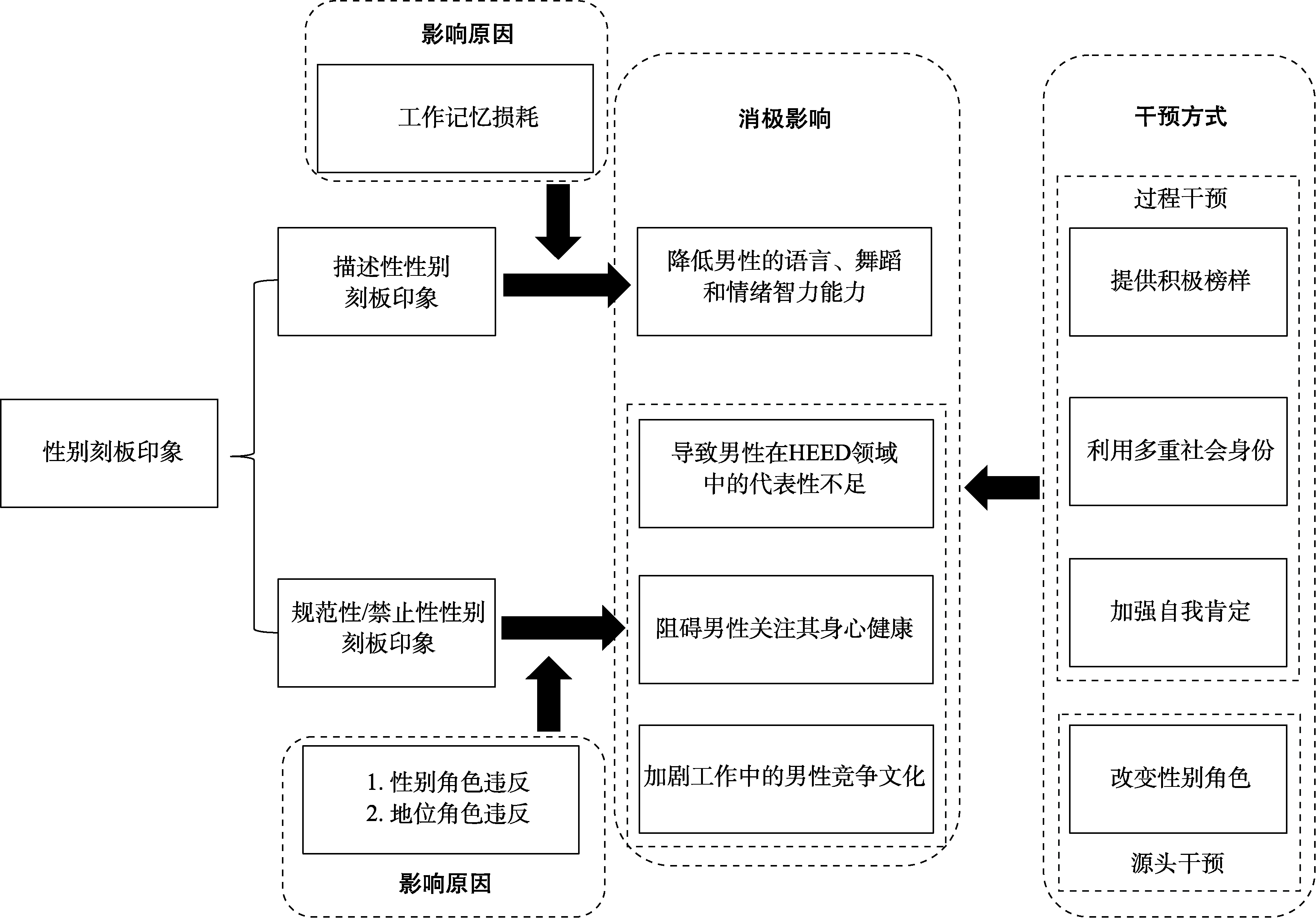
WANG Zhen, GUAN Jian. The negative effects, causes, and interventions of gender stereotypes on men: Descriptive vs. prescriptive/proscriptive[J]. Advances in Psychological Science, 2026, 34(3): 542-556.
| [1] | 陈岱云, 陈希. (2022). 社会性别视域下的人口寿命性别差异分析. 山东大学学报(哲学社会科学版), (6), 97-107. |
| [2] | 杜平. (2019). 透视流动家庭: 文化规范与生活实践互构下的性别秩序. 妇女研究论丛, (6), 32-42. |
| [3] | 黄量杰成, 闫艳, 胡寅凤, 孙鸿莉, 焦岚, 尹军. (2024). 低年段小学生的学业能力性别刻板印象及其对兴趣选择的影响: 自我肯定的作用. 心理科学, 47(4), 855-862. |
| [4] | 江红艳, 许梦梦, 陈红, 刘邦舜. (2022). 反性别刻板印象代言人性别气质和产品信号对广告效果的影响——基于男明星代言女性产品的情境. 管理评论, 34(7), 175-188. |
| [5] | 刘怡珂, 李佳玲, 李莉莉. (2024). 自我肯定和性别刻板印象威胁对大学生认知功能的影响. 校园心理, 22(5), 384-388. |
| [6] | 卢勤, 亢旭东, 李旭. (2015). 父母教养方式对男性青少年心理亚健康的影响: 性别角色冲突的中介作用. 中国特殊教育, (10), 92-96. |
| [7] | 唐卫海, 张红霞, 刘珊珊, 刘希平. (2014). 中学生性别角色观的性别差异. 基础教育, 11(4), 89-97. |
| [8] | 王祯, 管健. (2023). 性别刻板印象威胁效应: 可重复性问题与展望. 应用心理学, 29(5), 416-429. |
| [9] |
王祯, 管健. (2024). 性别刻板印象的变与不变?来自内容、方法与影响的证据. 心理科学进展, 32(6), 939-950.
doi: 10.3724/SP.J.1042.2024.00939 |
| [10] | 许玲瑞娜, 张丽. (2025). 科学、技术、工程和数学领域女性缺失现象的成因与干预述评. 心理技术与应用, 13(3), 185-192. |
| [11] | 燕道成, 蒋青桃. (2023). 性别弱势议题 “一边倒” 现象生成机制与反思——微博平台男性弱势议题可见性分析. 湖南大学学报(社会科学版), 37(6), 158-164. |
| [12] | 张慧, 周小虎, 宋迪. (2020). 从0到1: 刻板印象威胁与女性创业者机会评估. 经济管理, 42(4), 72-90. |
| [13] | 周艳, 周莲. (2023). 男性护士职业性别刻板印象与职业认同感的研究进展. 现代医药卫生, 39(4), 663-667. |
| [14] |
Abele, A. E., Ellemers, N., Fiske, S. T., Koch, A., & Yzerbyt, V. (2021). Navigating the social world: Toward an integrated framework for evaluating self, individuals, and groups. Psychological Review, 128(2), 290-314.
doi: 10.1037/rev0000262 URL |
| [15] | Bareket, O., & Fiske, S. T. (2025). Lost opportunities: How gendered arrangements harm men. Proceedings of the National Academy of Sciences, 122(5), e2320788122. |
| [16] |
Bastos, B. D. P., Chiviacowsky, S., Drews, R., & Cardozo, P. (2023). Gender stereotype threat undermines dance performance and learning in boys. Journal of Motor Behavior, 55(3), 256-261.
doi: 10.1080/00222895.2023.2166454 URL |
| [17] | Bedyńska, S., & Krejtz, I. (2023). ‘Boys don’t read poems!’Stereotype threat in the language education in boys. In P. W. St J. Watson, C. M. Rubie-Davies, & B. Ertl (Eds.), The Routledge international handbook of gender beliefs, stereotype threat, and teacher expectations (pp. 116-126). Routledge. |
| [18] |
Bedyńska, S., Krejtz, I., Rycielski, P., & Sedek, G. (2020a). Stereotype threat as an antecedent to domain identification and achievement in language arts in boys: A cross- sectional study. Social Psychology of Education, 23(3), 755-771.
doi: 10.1007/s11218-020-09557-z |
| [19] |
Bedyńska, S., Krejtz, I., Rycielski, P., & Sedek, G. (2020b). Stereotype threat is linked to language achievement and domain identification in young males: Working memory and intellectual helplessness as mediators. Psychology in the Schools, 57(9), 1331-1346.
doi: 10.1002/pits.v57.9 URL |
| [20] |
Berdahl, J. L., Cooper, M., Glick, P., Livingston, R. W., & Williams, J. C. (2018). Work as a masculinity contest. Journal of Social Issues, 74(3), 422-448.
doi: 10.1111/josi.2018.74.issue-3 URL |
| [21] | Bosak, J., Kulich, C., Rudman, L., & Kinahan, M. (2018). Be an advocate for others, unless you are a man: Backlash against gender-atypical male job candidates. Psychology of Men & Masculinity, 19(1), 156-165. |
| [22] |
Brenner, J., O’Dea, C. J., Rapp, S., & Moss-Racusin, C. (2023). Perceptions of parental responses to gender stereotype violations in children. Sex Roles, 89(1), 1-18.
doi: 10.1007/s11199-023-01377-7 |
| [23] | Brewer, M. B. (2013). Reducing prejudice through cross- categorization: Effects of multiple social identities. In S. Oskamp (Ed.), Reducing prejudice and discrimination (pp. 165-183). Psychology Press. |
| [24] |
Chaffee, K. E., Plante, I., Good, C., Aronson, J. M., Kinch, S. B., & Gauvin, I. (2024). When stereotypes disadvantage boys: Strength of stereotypes in mathematics and language arts and their relations with grades. Journal of Applied Social Psychology, 54(2), 71-82.
doi: 10.1111/jasp.v54.2 URL |
| [25] |
Charlesworth, T. E., & Banaji, M. R. (2022). Patterns of implicit and explicit stereotypes III: Long-term change in gender stereotypes. Social Psychological and Personality Science, 13(1), 14-26.
doi: 10.1177/1948550620988425 URL |
| [26] |
Chang, M. X. L., Jetten, J., Cruwys, T., Haslam, C., & Praharso, N. (2016). The more (social group memberships), the merrier: Is this the case for Asians? Frontiers in Psychology, 7, 1001.
doi: 10.3389/fpsyg.2016.01001 pmid: 27462281 |
| [27] |
Cheryan, S., & Markus, H. R. (2020). Masculine defaults: Identifying and mitigating hidden cultural biases. Psychological Review, 127(6), 1022-1052.
doi: 10.1037/rev0000209 URL |
| [28] | Cheryan, S., & Muragishi, G. A. (2025). Removing masculine defaults in the hiring process. Proceedings of the National Academy of Sciences, 122(14), e2501630122. |
| [29] |
Cohen, G. L., & Sherman, D. K. (2014). The psychology of change: Self-affirmation and social psychological intervention. Annual Review of Psychology, 65(1), 333-371.
doi: 10.1146/annurev-psych-010213-115137 URL |
| [30] |
Cortland, C. I., & Kinias, Z. (2019). Stereotype threat and women’s work satisfaction: The importance of role models. Archives of Scientific Psychology, 7(1), 81-89.
doi: 10.1037/arc0000056 URL |
| [31] |
Croft, A., Atkinson, C., Sandstrom, G., Orbell, S., & Aknin, L. (2021). Loosening the GRIP (gender roles inhibiting prosociality) to promote gender equality. Personality and Social Psychology Review, 25(1), 66-92.
doi: 10.1177/1088868320964615 pmid: 33427043 |
| [32] |
Croft, A., Schmader, T., & Block, K. (2015). An underexamined inequality: Cultural and psychological barriers to men’s engagement with communal roles. Personality and Social Psychology Review, 19(4), 343-370.
doi: 10.1177/1088868314564789 URL |
| [33] |
Cuddy, A. J., Wolf, E. B., Glick, P., Crotty, S., Chong, J., & Norton, M. I. (2015). Men as cultural ideals: Cultural values moderate gender stereotype content. Journal of Personality and Social Psychology, 109(4), 622-635.
doi: 10.1037/pspi0000027 pmid: 26414843 |
| [34] |
Diekman, A. B., & Goodfriend, W. (2006). Rolling with the changes: A role congruity perspective on gender norms. Psychology of Women Quarterly, 30(4), 369-383.
doi: 10.1111/j.1471-6402.2006.00312.x URL |
| [35] | Dovidio, J. F., Love, A., Schellhaas, F. M., & Hewstone, M. (2017). Reducing intergroup bias through intergroup contact: Twenty years of progress and future directions. Group Processes & Intergroup Relations, 20(5), 606-620. |
| [36] |
Doyle, R. A., & Thompson, A. E. (2021). The influence of stereotype threat and implicit theories of emotion on gender differences in emotional intelligence. The Journal of Men’s Studies, 29(2), 131-155.
doi: 10.1177/1060826520920878 URL |
| [37] |
Eagly, A. H., & Karau, S. J. (2002). Role congruity theory of prejudice toward female leaders. Psychological Review, 109(3), 573-598.
doi: 10.1037/0033-295x.109.3.573 pmid: 12088246 |
| [38] |
Eagly, A. H., & Koenig, A. M. (2021). The vicious cycle linking stereotypes and social roles. Current Directions in Psychological Science, 30(4), 343-350.
doi: 10.1177/09637214211013775 URL |
| [39] |
Eagly, A. H., Nater, C., Miller, D. I., Kaufmann, M., & Sczesny, S. (2020). Gender stereotypes have changed: A cross-temporal meta-analysis of U.S. public opinion polls from 1946 to 2018. American Psychologist, 75(3), 301-315.
doi: 10.1037/amp0000494 pmid: 31318237 |
| [40] |
Eareckson, H. B., & Heilman, M. E. (2024). Explaining penalties and rewards for gender norm violations: A unified theory. Sex Roles, 90, 1701-1716.
doi: 10.1007/s11199-024-01540-8 |
| [41] |
Ellemers, N. (2018). Gender stereotypes. Annual Review of Psychology, 69(1), 275-298.
doi: 10.1146/psych.2018.69.issue-1 URL |
| [42] | Fowler, S. L., & Geers, A. L. (2017). Does trait masculinity relate to expressing toughness? The effects of masculinity threat and self-affirmation in college men. Psychology of Men & Masculinity, 18(2), 176-186. |
| [43] |
Froehlich, L., Olsson, M. I., Dorrough, A. R., & Martiny, S. E. (2020). Gender at work across nations: Men and women working in male-dominated and female-dominated occupations are differentially associated with agency and communion. Journal of Social Issues, 76(3), 484-511.
doi: 10.1111/josi.v76.3 URL |
| [44] |
Giaccardi, S., Monique Ward, L., Seabrook, R. C., Manago, A., & Lippman, J. R. (2017). Media use and men’s risk behaviors: Examining the role of masculinity ideology. Sex Roles, 77, 581-592.
doi: 10.1007/s11199-017-0754-y URL |
| [45] |
Good, C., Aronson, J., & Harder, J. A. (2008). Problems in the pipeline: Stereotype threat and women’s achievement in high-level math courses. Journal of Applied Developmental Psychology, 29(1), 17-28.
doi: 10.1016/j.appdev.2007.10.004 URL |
| [46] | Haines, S., Sczesny, S., & Graf, S. (2025). Who cares? Stereotypes of and support for men working in childcare. Sex Roles, 91(3), 19. |
| [47] |
Hausmann, M. (2014). Arts versus science—Academic background implicitly activates gender stereotypes on cognitive abilities with threat raising men’s (but lowering women’s) performance. Intelligence, 46, 235-245.
doi: 10.1016/j.intell.2014.07.004 URL |
| [48] |
Hentschel, T., Braun, S., Peus, C., & Frey, D. (2018). The communality-bonus effect for male transformational leaders-leadership style, gender, and promotability. European Journal of Work and Organizational Psychology, 27(1), 112-125.
doi: 10.1080/1359432X.2017.1402759 URL |
| [49] |
Hermann, E., De Freitas, J., & Puntoni, S. (2025). Reducing prejudice with counter‐stereotypical AI. Consumer Psychology Review, 8(1), 75-86.
doi: 10.1002/arcp.v8.1 URL |
| [50] |
Heyder, A., & Kortzak, O. (2024). Backlash against women and support for men? On the perception of men and women researchers in gender stereotype-inconsistent domains. Psychology of Women Quarterly, 48(3), 411-429.
doi: 10.1177/03616843241236397 URL |
| [51] |
Himmelstein, M. S., & Sanchez, D. T. (2016). Masculinity impediments: Internalized masculinity contributes to healthcare avoidance in men and women. Journal of Health Psychology, 21(7), 1283-1292.
doi: 10.1177/1359105314551623 pmid: 25293967 |
| [52] |
Hsu, N., Badura, K. L., Newman, D. A., & Speach, M. E. P.(2021). Gender, “masculinity,” and “femininity”: A meta- analytic review of gender differences in agency and communion. Psychological Bulletin, 147(10), 987-1011.
doi: 10.1037/bul0000343 URL |
| [53] |
Iacoviello, V., Valsecchi, G., Berent, J., Borinca, I., & Falomir- Pichastor, J. M. (2021). The impact of masculinity beliefs and political ideologies on men’s backlash against non-traditional men: The moderating role of perceived men’s feminization. International Review of Social Psychology, 34(1), 1-16.
doi: 10.5334/irsp.357 URL |
| [54] | Joyce, E., Pratt, D., & Lea, J. (2024). Men’s perspectives on the relationship between masculinities and suicidality: A thematic synthesis. Psychology of Men & Masculinities, 25(3), 221-239. |
| [55] |
Koenig, A. M. (2018). Comparing prescriptive and descriptive gender stereotypes about children, adults, and the elderly. Frontiers in Psychology, 9, 1086.
doi: 10.3389/fpsyg.2018.01086 pmid: 29997558 |
| [56] |
Koenig, A. M., & Eagly, A. H. (2005). Stereotype threat in men on a test of social sensitivity. Sex Roles, 52, 489-496.
doi: 10.1007/s11199-005-3714-x URL |
| [57] | Kosakowska-Berezecka, N., Besta, T., Jurek, P., Olech, M., Sobiecki, J., Bosson, J., ... Żadkowska, M. (2024). Towards gender harmony dataset: Gender beliefs and gender stereotypes in 62 countries. Scientific Data, 11(1), 392. |
| [58] |
Kosakowska-Berezecka, N., Sawicki, A., Celikkol, G., Bosson, J. K., Van Laar, C., Van Rossum, A., ... Glick, P. (2025). Does culture moderate gender stereotypes? Individualism predicts communal (but not agentic) prescriptions for men across 62 nations. Social Psychological and Personality Science, 16(4), 359-372.
doi: 10.1177/19485506231221913 URL |
| [59] | Kozlowski, D., & Power, I. (2022). Unpacking backlash: Social costs of gender non-conformity for women and men. Journal of Research in Gender Studies, 12(2), 9-32. |
| [60] |
Lannin, D. G., Ludwikowski, W., Vogel, D. L., Seidman, A. J., & Anello, K. (2019). Reducing psychological barriers to therapy via contemplation and self-affirmation. Stigma and Health, 4(3), 247-255.
doi: 10.1037/sah0000139 URL |
| [61] |
Lau, K. (2018). Uncovering Chinese stereotypes and their influence on adolescent male makeup purchasing behavior. Journal of Social Science Studies, 5(1), 248-262.
doi: 10.5296/jsss.v5i1 URL |
| [62] |
Li, J., & McLellan, R. (2021). Is language learning a feminine domain? Examining the content and stereotype threat effect of female-language stereotypes among EFL learners in China. Contemporary Educational Psychology, 66, 101991.
doi: 10.1016/j.cedpsych.2021.101991 URL |
| [63] | Li, Y., & Wei, X. (2024). Examining the effects of male candidates’ gender nonconformity on employment decisions. Asia Pacific Journal of Human Resources, 62(1), e12363. |
| [64] |
Liu, S., Liu, P., Wang, M., & Zhang, B. (2021). Effectiveness of stereotype threat interventions: A meta-analytic review. Journal of Applied Psychology, 106(6), 921-949.
doi: 10.1037/apl0000770 URL |
| [65] |
Manzi, C., Paderi, F., & Benet-Martinez, V. (2024). Multiple social identities and well-being: Insights from a person- centred approach. British Journal of Social Psychology, 63(2), 792-810.
doi: 10.1111/bjso.v63.2 URL |
| [66] |
Manzi, F. (2019). Are the processes underlying discrimination the same for women and men? A critical review of congruity models of gender discrimination. Frontiers in Psychology, 10, 469.
doi: 10.3389/fpsyg.2019.00469 pmid: 30894831 |
| [114] |
Yu, C., Zuo, X., Blum, R. W., Tolman, D. L., Kågesten, A., Mmari, K., ... Lou, C. (2017). Marching to a different drummer: A cross-cultural comparison of young adolescents who challenge gender norms. Journal of Adolescent Health, 61(4), S48-S54.
doi: 10.1016/j.jadohealth.2017.07.005 URL |
| [113] |
Xie, L., & Zheng, Y. (2022). Masculinity contest culture and turnover intentions: The roles of work stress and coping styles. Personality and Individual Differences, 199, 111836.
doi: 10.1016/j.paid.2022.111836 URL |
| [112] | Workman-Stark, A. (2021). Countering a masculinity contest culture at work: The moderating role of organizational justice. International Journal of Organization Theory & Behavior, 24(1), 6-23. |
| [111] |
Wood, J. V. (1989). Theory and research concerning social comparisons of personal attributes. Psychological Bulletin, 106(2), 231-248.
doi: 10.1037/0033-2909.106.2.231 URL |
| [110] | Wong, Y. J., Klann, E. M., Bijelić, N., & Aguayo, F. (2017). The link between men’s zero-sum gender beliefs and mental health: Findings from Chile and Croatia. Psychology of Men & Masculinity, 18(1), 12-19. |
| [109] |
Wilson, M. J., Gwyther, K., Simmons, M., Swann, R., Oliffe, J. L., Casey, K., & Rice, S. M. (2022). Exploring teacher and parent perspectives on school-based masculinities in relation to mental health promotion. Frontiers in Psychology, 13, 864124.
doi: 10.3389/fpsyg.2022.864124 URL |
| [108] | Wellman, J. D., Beam, A. J., Wilkins, C. L., Newell, E. E., & Mendez, C. A. (2021). Masculinity threat increases bias and negative emotions toward feminine gay men. Psychology of Men & Masculinities, 22(4), 787-799. |
| [107] |
Wang, Z., Guan, J., & Zhao, L. (2022). Priming science identity elicits stereotype boost for Chinese science female students: Evidence from math performance. Basic and Applied Social Psychology, 44(3-6), 95-108.
doi: 10.1080/01973533.2022.2144315 URL |
| [106] | von Hippel, C., Kühner, C., Coundouris, S. P., Lim, A., Henry, J. D., & Zacher, H. (2024). Stereotype threat at work: A meta-analysis. Personality & Social Psychology Bulletin. https://doi.org/10.1177/01461672241297884 |
| [105] |
Vial, A. C., Muradoglu, M., Newman, G. E., & Cimpian, A. (2022). An emphasis on brilliance fosters masculinity- contest cultures. Psychological Science, 33(4), 595-612.
doi: 10.1177/09567976211044133 URL |
| [104] | Van Rossum, A., Van Laar, C., & Scheepers, D. (2025). Advancing the health and well‐being of boys and men: Lessons from the social cure and curse framework. Social Issues and Policy Review, 19(1), e12107. |
| [103] |
Van Laar, C., Van Rossum, A., Kosakowska-Berezecka, N., Bongiorno, R., & Block, K. (2024). MANdatory-why men need (and are needed for) gender equality progress. Frontiers in Psychology, 15, 1263313.
doi: 10.3389/fpsyg.2024.1263313 URL |
| [102] |
van de Rozenberg, T. M., van der Pol, L. D., van Esveld, S., Groeneveld, M. G., Kroes, A. D., & Mesman, J. (2024). The role of parents in predicting gender‐stereotypic attitudes towards HEED occupations and gender‐stereotypic interest in these careers. European Journal of Social Psychology, 54(2), 478-494.
doi: 10.1002/ejsp.v54.2 URL |
| [101] | Vandello, J. A., Wilkerson, M., Bosson, J. K., Wiernik, B. M., & Kosakowska-Berezecka, N. (2023). Precarious manhood and men’s physical health around the world. Psychology of Men & Masculinities, 24(1), 1-15. |
| [100] | Valved, T., Kosakowska-Berezecka, N., Besta, T., & Martiny, S. E. (2021). Gender belief systems through the lens of culture—Differences in precarious manhood beliefs and reactions to masculinity threat in Poland and Norway. Psychology of Men & Masculinities, 22(2), 265-276. |
| [99] | Sullivan, J., Moss-Racusin, C., Lopez, M., & Williams, K. (2018). Backlash against gender stereotype-violating preschool children. Plos One, 13(4), e0195503. |
| [98] | Sullivan, J., Ciociolo, A., & Moss-Racusin, C. A. (2022). Establishing the content of gender stereotypes across development. Plos One, 17(7), e0263217. |
| [97] |
Suh, E. Y., Apfelbaum, E. P., & Norton, M. I. (2025). How psychological barriers constrain men’s interest in gender- atypical jobs and facilitate occupational segregation. Organization Science, 36(4), 1314-1332.
doi: 10.1287/orsc.2023.17550 URL |
| [96] |
Stone, J., & McWhinnie, C. (2008). Evidence that blatant versus subtle stereotype threat cues impact performance through dual processes. Journal of Experimental Social Psychology, 44(2), 445-452.
doi: 10.1016/j.jesp.2007.02.006 URL |
| [95] |
Stern, C., & Axt, J. (2021). Ideological differences in race and gender stereotyping. Social Cognition, 39(2), 259-294.
doi: 10.1521/soco.2021.39.2.259 URL |
| [94] |
Spencer, S. J., Logel, C., & Davies, P. G. (2016). Stereotype threat. Annual Review of Psychology, 67(1), 415-437.
doi: 10.1146/annurev-psych-073115-103235 URL |
| [93] |
Song, G. (2022). “Little fresh meat”: The politics of sissiness and sissyphobia in contemporary China. Men and Masculinities, 25(1), 68-86.
doi: 10.1177/1097184X211014939 URL |
| [92] |
Sherman, D. K. (2013). Self‐affirmation: Understanding the effects. Social and Personality Psychology Compass, 7(11), 834-845.
doi: 10.1111/spc3.v7.11 URL |
| [91] |
Sczesny, S., Nater, C., & Haines, S. (2022). Perceived to be incompetent, but not a risk: Why men are evaluated as less suitable for childcare work than women. Journal of Applied Social Psychology, 52(8), 693-703.
doi: 10.1111/jasp.v52.8 URL |
| [90] |
Schmader, T., Johns, M., & Forbes, C. (2008). An integrated process model of stereotype threat effects on performance. Psychological Review, 115(2), 336-356.
doi: 10.1037/0033-295X.115.2.336 pmid: 18426293 |
| [89] |
Schlamp, S., Gerpott, F. H., & Voelpel, S. C. (2021). Same talk, different reaction? Communication, emergent leadership and gender. Journal of Managerial Psychology, 36(1), 51-74.
doi: 10.1108/JMP-01-2019-0062 URL |
| [88] |
Rudman, L. A., Moss-Racusin, C. A., Phelan, J. E., & Nauts, S. (2012). Status incongruity and backlash effects: Defending the gender hierarchy motivates prejudice against female leaders. Journal of Experimental Social Psychology, 48(1), 165-179.
doi: 10.1016/j.jesp.2011.10.008 URL |
| [87] |
Rosette, A. S., Mueller, J. S., & Lebel, R. D. (2015). Are male leaders penalized for seeking help? The influence of gender and asking behaviors on competence perceptions. The Leadership Quarterly, 26(5), 749-762.
doi: 10.1016/j.leaqua.2015.02.001 URL |
| [86] |
Roccas, S., & Brewer, M. B. (2002). Social identity complexity. Personality and social Psychology Review, 6(2), 88-106.
doi: 10.1207/S15327957PSPR0602_01 URL |
| [85] |
Roberts, L. M., & Caza, B. B. (2025). Positive identity construction in diverse organizations. Annual Review of Organizational Psychology and Organizational Behavior, 12, 423-451.
doi: 10.1146/annurev-orgpsych-110721-041934 URL |
| [84] |
Retelsdorf, J., Schwartz, K., & Asbrock, F. (2015). “Michael can’t read!” Teachers’ gender stereotypes and boys’ reading self-concept. Journal of Educational Psychology, 107(1), 186-194.
doi: 10.1037/a0037107 URL |
| [83] |
Renström, E. A. (2024). Differences between prescriptive and proscriptive gender stereotypes and gendered self‐evaluations in Sweden. Scandinavian Journal of Psychology, 65(3), 511-520.
doi: 10.1111/sjop.v65.3 URL |
| [82] |
Reeves, S. L., Nguyen, T., Scholer, A. A., Fujita, K., & Spencer, S. J. (2023). Examining beliefs about the benefits of self-affirmation for mitigating self-threat. Personality and Social Psychology Bulletin, 49(11), 1615-1632.
doi: 10.1177/01461672221120612 URL |
| [81] |
Prusaczyk, E., & Hodson, G. (2020). The roles of political conservatism and binary gender beliefs in predicting prejudices toward gay men and people who are transgender. Sex Roles, 82(7), 438-446.
doi: 10.1007/s11199-019-01069-1 |
| [80] |
Prentice, D. A., & Carranza, E. (2002). What women and men should be, shouldn’t be, are allowed to be, and don’t have to be: The contents of prescriptive gender stereotypes. Psychology of Women Quarterly, 26(4), 269-281.
doi: 10.1111/1471-6402.t01-1-00066 URL |
| [79] |
Peters, K., Ryan, M. K., & Haslam, S. A. (2015). Marines, medics, and machismo: Lack of fit with masculine occupational stereotypes discourages men’s participation. British Journal of Psychology, 106(4), 635-655.
doi: 10.1111/bjop.12106 pmid: 25469571 |
| [78] | Pennington, C. R., Heim, D., Levy, A. R., & Larkin, D. T. (2016). Twenty years of stereotype threat research: A review of psychological mediators. Plos One, 11(1), e0146487. |
| [77] |
Park, B., & Banchefsky, S. (2018). Leveraging the social role of dad to change gender stereotypes of men. Personality and Social Psychology Bulletin, 44(9), 1380-1394.
doi: 10.1177/0146167218768794 pmid: 29699443 |
| [76] |
Pansu, P., Régner, I., Max, S., Colé, P., Nezlek, J. B., & Huguet, P. (2016). A burden for the boys: Evidence of stereotype threat in boys’ reading performance. Journal of Experimental Social Psychology, 65, 26-30.
doi: 10.1016/j.jesp.2016.02.008 URL |
| [75] |
Muntoni, F., Wagner, J., & Retelsdorf, J. (2021). Beware of stereotypes: Are classmates’ stereotypes associated with students’ reading outcomes? Child Development, 92(1), 189-204.
doi: 10.1111/cdev.13359 URL |
| [74] |
Muntoni, F., & Retelsdorf, J. (2019). At their children’s expense: How parents’ gender stereotypes affect their children’s reading outcomes. Learning and Instruction, 60, 95-103.
doi: 10.1016/j.learninstruc.2018.12.002 URL |
| [73] | Moss-Racusin, C. A., Phelan, J. E., & Rudman, L. A. (2010). When men break the gender rules: Status incongruity and backlash against modest men. Psychology of Men & Masculinity, 11(2), 140-151. |
| [72] |
Moss-Racusin, C. A., & Johnson, E. R. (2016). Backlash against male elementary educators. Journal of Applied Social Psychology, 46(7), 379-393.
doi: 10.1111/jasp.2016.46.issue-7 URL |
| [71] |
Morgenroth, T., Ryan, M. K., & Sønderlund, A. L. (2021). Think manager-think parent? Investigating the fatherhood advantage and the motherhood penalty using the think manager-think male paradigm. Journal of Applied Social Psychology, 51(3), 237-247.
doi: 10.1111/jasp.v51.3 URL |
| [70] |
Moradbakhti, L., Mara, M., Castellano, G., & Winkle, K. (2023). (Counter-) stereotypical gendering of robots in care: Impact on needs satisfaction and gender role concepts in men and women users. International Journal of Social Robotics, 15(11), 1769-1790.
doi: 10.1007/s12369-023-01033-w |
| [69] |
Meeussen, L., Van Laar, C., & Van Grootel, S. (2020). How to foster male engagement in traditionally female communal roles and occupations: Insights from research on gender norms and precarious manhood. Social Issues and Policy Review, 14(1), 297-328.
doi: 10.1111/sipr.v14.1 URL |
| [68] |
Mayer, J. D., Caruso, D. R., & Salovey, P. (2016). The ability model of emotional intelligence: Principles and updates. Emotion Review, 8(4), 290-300.
doi: 10.1177/1754073916639667 URL |
| [67] |
Matos, K., O’Neill, O., & Lei, X. (2018). Toxic leadership and the masculinity contest culture: How “win or die” cultures breed abusive leadership. Journal of Social Issues, 74(3), 500-528.
doi: 10.1111/josi.2018.74.issue-3 URL |
| [1] | WANG Zhen, GUAN Jian. Have gender stereotypes changed or not changed? Evidence from contents, methods, and consequences [J]. Advances in Psychological Science, 2024, 32(6): 939-950. |
| Viewed | ||||||
|
Full text |
|
|||||
|
Abstract |
|
|||||