

ISSN 1671-3710
CN 11-4766/R
主办:中国科学院心理研究所
出版:科学出版社
CN 11-4766/R
主办:中国科学院心理研究所
出版:科学出版社
Advances in Psychological Science ›› 2026, Vol. 34 ›› Issue (2): 364-378.doi: 10.3724/SP.J.1042.2026.0364
• Regular Articles • Previous Articles Next Articles
DUAN Ying, YIN Keli( )
)
Received:2025-09-04
Online:2026-02-15
Published:2025-12-15
Contact:
YIN Keli
E-mail:yayasles@163.com
CLC Number:
DUAN Ying, YIN Keli. Mechanisms of generation, situational characteristics and positive psychological effects of collective effervescence[J]. Advances in Psychological Science, 2026, 34(2): 364-378.
| 视角 | 内涵 | 学者(年份) |
|---|---|---|
| 情绪 | 一种强烈的积极情绪体验 | Hopkins et al., |
| 共同情绪的经历, 情绪相互激活与放大的状态, 是一种高强度的共同情绪状态 | Pizarro et al., | |
| 认知 | 一种感知情绪同步 | Páez et al., |
| 注意趋同 | Pizarro et al., | |
| 社会整合和自我扩展 | 联系感与神圣感结合的心理体验 | Gabriel et al., |
| 视角 | 内涵 | 学者(年份) |
|---|---|---|
| 情绪 | 一种强烈的积极情绪体验 | Hopkins et al., |
| 共同情绪的经历, 情绪相互激活与放大的状态, 是一种高强度的共同情绪状态 | Pizarro et al., | |
| 认知 | 一种感知情绪同步 | Páez et al., |
| 注意趋同 | Pizarro et al., | |
| 社会整合和自我扩展 | 联系感与神圣感结合的心理体验 | Gabriel et al., |
| 概念 | 情绪内涵 | 发生条件 | 常见情境 | 代表性研究 |
|---|---|---|---|---|
| 集体欢腾 | 一种共同情绪状态, 涉及基本情绪和复杂情绪, 体验到一种神圣感和联系感。 | 共同集中注意力、同步行为、情绪相互感染与放大 | 宗教、世俗仪式和日常生活场景 | Rimé & Páez, |
| 集体情绪 | 一种宏观人际情绪动态模式, 核心特征为情绪一致性、群体团结感与共同意识。 | 社会认同、共同注意、情绪模仿、情绪调节、人际夹带 | 集体活动 | von Scheve, Goldenberg et al., Thonhauser, Chung et al., |
| kama muta | 一种特定的共同情绪, 伴随着积极情绪体验。 | 通过观察、回忆、思考、想象等途径体验到CSRs的骤然强化等 | 日常生活情境、各种文化实践和仪式中(如帮助他人、观看感人电影、与动物互动、婚礼等) | Fiske et al., |
| 群体心流 | 本质为群体最佳体验, 情感非关键。 | 互动同步、共同目标、高技能整合等 | 团队运动、艺术创作、工作协作等任务情境 | Csíkszentmihályi, |
| 概念 | 情绪内涵 | 发生条件 | 常见情境 | 代表性研究 |
|---|---|---|---|---|
| 集体欢腾 | 一种共同情绪状态, 涉及基本情绪和复杂情绪, 体验到一种神圣感和联系感。 | 共同集中注意力、同步行为、情绪相互感染与放大 | 宗教、世俗仪式和日常生活场景 | Rimé & Páez, |
| 集体情绪 | 一种宏观人际情绪动态模式, 核心特征为情绪一致性、群体团结感与共同意识。 | 社会认同、共同注意、情绪模仿、情绪调节、人际夹带 | 集体活动 | von Scheve, Goldenberg et al., Thonhauser, Chung et al., |
| kama muta | 一种特定的共同情绪, 伴随着积极情绪体验。 | 通过观察、回忆、思考、想象等途径体验到CSRs的骤然强化等 | 日常生活情境、各种文化实践和仪式中(如帮助他人、观看感人电影、与动物互动、婚礼等) | Fiske et al., |
| 群体心流 | 本质为群体最佳体验, 情感非关键。 | 互动同步、共同目标、高技能整合等 | 团队运动、艺术创作、工作协作等任务情境 | Csíkszentmihályi, |
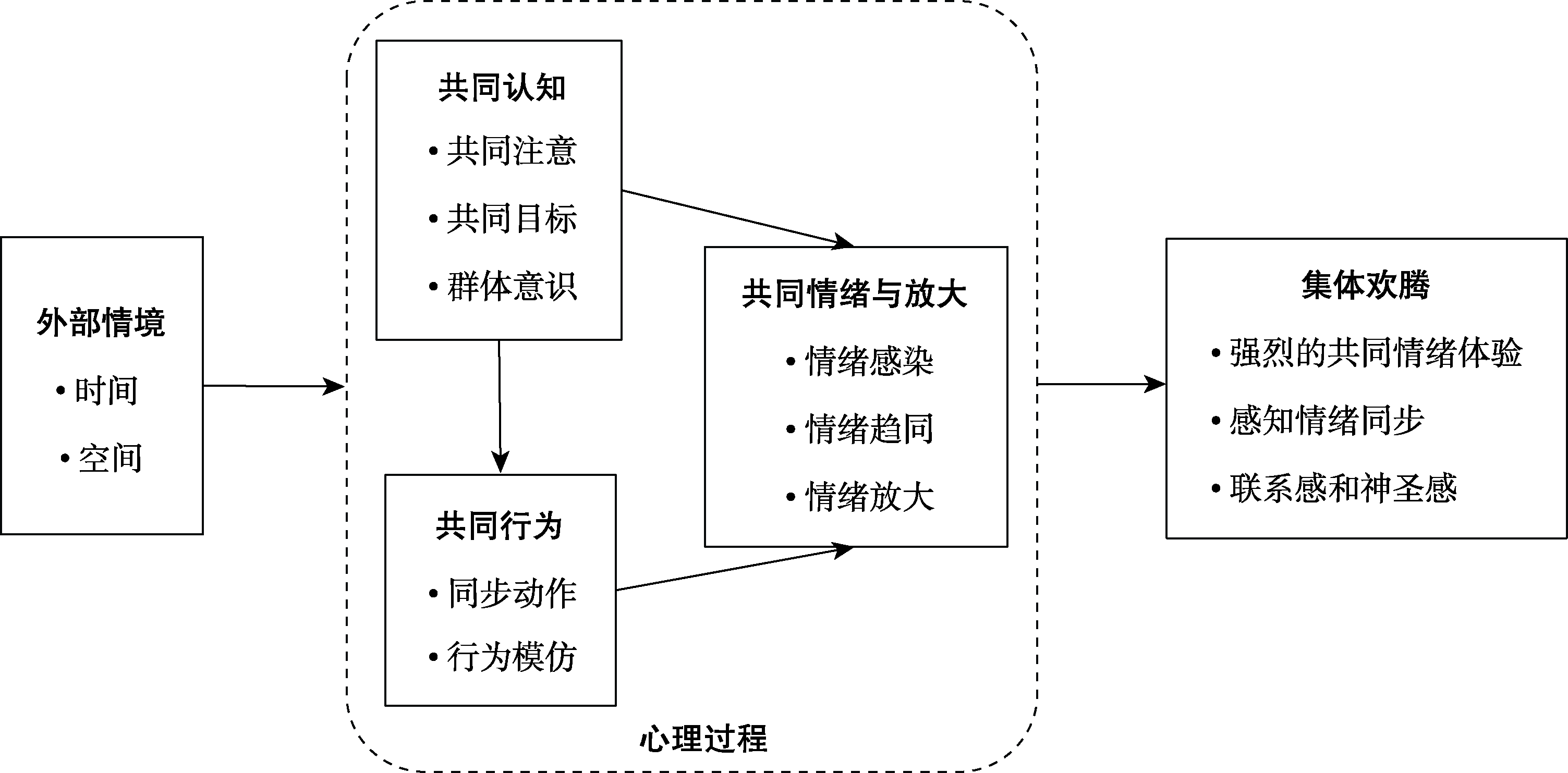
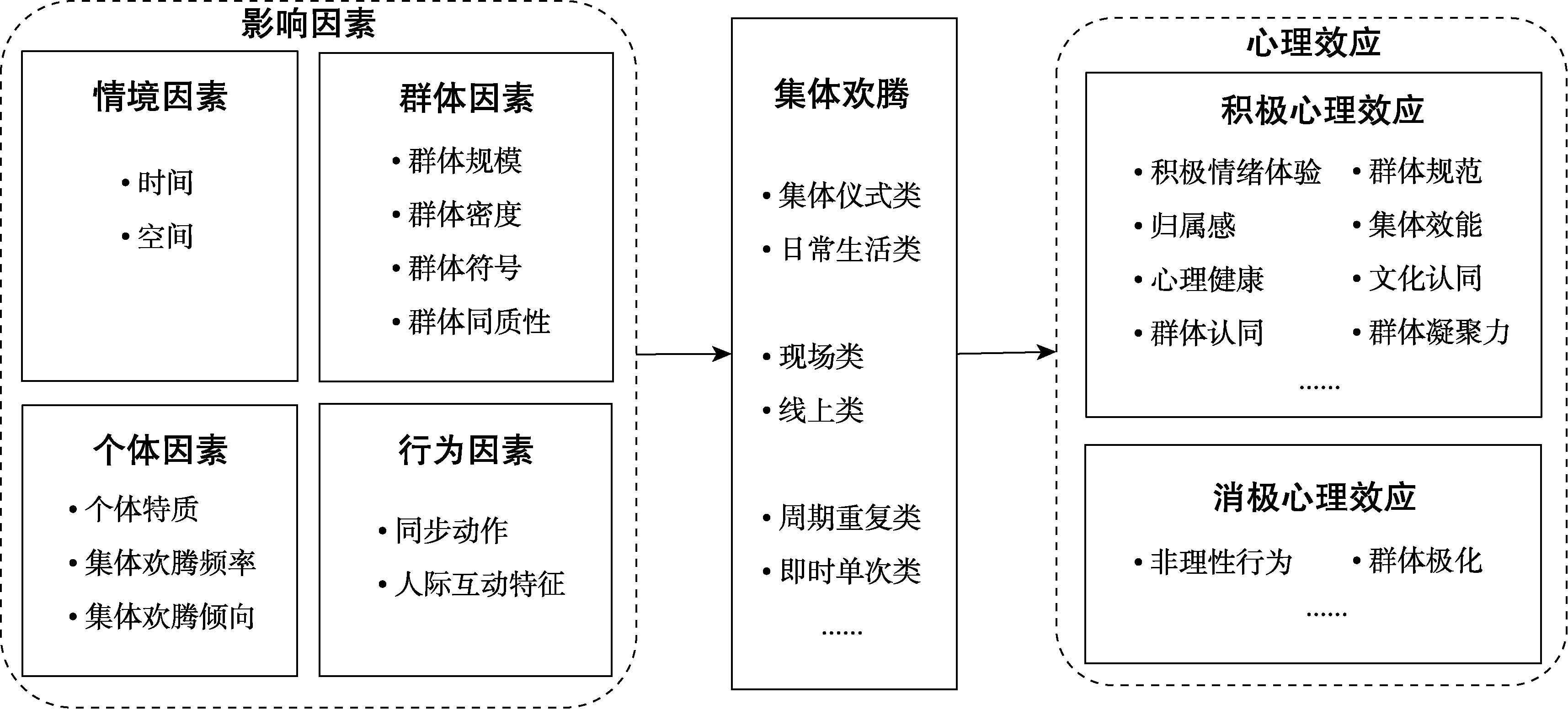
| [1] | 爱弥尔·涂尔干. (2011). 宗教生活的基本形式 (渠东, 汲喆译). 商务印书馆. |
| [2] | E·迪尔凯姆. (1995). 社会学方法的准则 (狄玉明译). 商务印书馆. |
| [3] | 李钧鹏, 许帅航. (2023). 作为集体欢腾的广场舞. 江海学刊, 1, 137-147+256. |
| [4] | 黎晓丹, 叶浩生, 丁道群. (2018). 通过身体动作理解人与环境: 具身的社会认知. 心理学探新, 38(1), 20-24. |
| [5] |
刘春晓, 刘立志, 王丹, 陈文锋. (2022). 集体仪式促进群体情绪感染的机制. 心理科学进展, 30(8), 1870-1882.
doi: 10.3724/SP.J.1042.2022.01870 |
| [6] | 汪祚军, 侯怡如, 匡仪, 唐辉一, 赵珍珍, 陈红霞. (2017). 群体共享情绪的放大效应. 心理科学进展, 25(4), 662-671. |
| [7] | 吴国栋, 殷怀刚. (2021). 训练、竞赛、观众: 疫情下竞技体育如何可能?——“没有赛事的训练”与“没有观众的赛场”工作坊综述. 体育与科学, 42(3), 112-120. |
| [8] | 伍秋萍, 冯聪, 陈斌斌. (2011). 具身框架下的社会认知研究述评. 心理科学进展, 19(3), 336-345. |
| [9] | 薛秋, 尹可丽. (2024). 同步动作对社会联结的影响: 集体欢腾的中介作用和团队规模的调节作用. 心理学报, 56(12), 1821. |
| [10] | 姚畅, 龚浩群. (2021). 欢腾式发展: 泰北乡村农家乐项目的民族志研究. 中国农业大学学报(社会科学版), 38(1), 69-82. |
| [11] | 余志远, 闫铭, 谷平平. (2023). 场域共在与集体欢腾: 节庆旅游剧场中的游客体验共睦态形成研究. 四川师范大学学报(社会科学版), 50(4), 82-88. |
| [12] | 张晓丽. (2025). 集体的欢腾: 观赏体育赛事提升中国居民幸福感的生成机制与实证检验. 武汉体育学院学报, 59(5), 19-26. |
| [13] | Afyonoğlu M. F., & Güre M. D. P. (2024). Unveiling collective grief: A qualitative study of X posts reflecting on the Kahramanmaraş earthquake anniversary in Türkiye. Death Studies. https://doi.org/10.1080/07481187.2024.2404927 |
| [14] |
Ainsworth M. S. (1989). Attachments beyond infancy. American Psychologist, 44(4), 709-716.
pmid: 2729745 |
| [15] |
Barrett L. F. (2006). Are emotions natural kinds? Perspectives on Psychological Science, 1(1), 28-58.
doi: 10.1111/j.1745-6916.2006.00003.x pmid: 26151184 |
| [16] |
Barsade S. G. (2002). The ripple effect: Emotional contagion and its influence on group behavior. Administrative Science Quarterly, 47(4), 644-675.
doi: 10.2307/3094912 URL |
| [17] |
Baumeister R. F., & Leary M. R. (1995). The need to belong: Desire for interpersonal attachments as a fundamental human motivation. Psychological Bulletin, 117(3), 497-529.
pmid: 7777651 |
| [18] | Beristain C. M., Paez D., & González J. L. (2000). Rituals, social sharing, silence, emotions and collective memory claims in the case of the guatemalan genocide. Psicothema, 12(Suppl), 117-130. |
| [19] |
Bouchat P., Rimé B., Eycken R. V., & Nils F. (2019). The virtues of collective gatherings: A study on the positive effects of a major scouting event. Journal of Applied Social Psychology, 50(3), 189-201.
doi: 10.1111/jasp.v50.3 URL |
| [20] |
Bravo D., Oriol X., Gómez M., Cortez D., & Unanue W. (2020). The effects of the 2016 Copa América Centenario victory on social trust, self-transcendent aspirations and evaluated subjective well-being: The role of identity with the national team and collective pride in major sport events. Frontiers in Psychology, 11, 591498.
doi: 10.3389/fpsyg.2020.591498 URL |
| [21] |
Bu F., Steptoe A., & Fancourt D. (2020). Who is lonely in lockdown? Cross-cohort analyses of predictors of loneliness before and during the COVID-19 pandemic. Public Health, 186, 31-34.
doi: S0033-3506(20)30274-2 pmid: 32768621 |
| [22] |
Castro-Abril P., Da Costa S., Navarro-Carrillo G., Caicedo-Moreno A., Gracia-Leiva M., Bouchat P.,... Paez D. (2021). Social identity, perceived emotional synchrony, creativity, social representations, and participation in social movements: The case of the 2019 Chilean populist protests. Frontiers in Psychology, 12, 764434.
doi: 10.3389/fpsyg.2021.764434 URL |
| [23] | Cheong J. H., Molani Z., Sadhukha S., & Chang L. J. (2023). Synchronized affect in shared experiences strengthens social connection. Communications Biology, 6(1), 1099. |
| [24] |
Chmiel A., Sienkiewicz J., Thelwall M., Paltoglou G., Buckley K., Kappas A., & Hołyst J. A. (2011). Collective emotions online and their influence on community life. PLOS ONE, 6(7), e22207.
doi: 10.1371/journal.pone.0022207 URL |
| [25] |
Chung V., Grèzes J., & Pacherie E. (2023). Collective emotion: A framework for experimental research. Emotion Review, 16(1), 28-45.
doi: 10.1177/17540739231214533 URL |
| [26] | Collins R. (2004). Interaction ritual chains. Princeton, NJ: Princeton University Press. |
| [27] | Csíkszentmihályi M. (1990). Flow: The psychology of optimal experience. New York, NY: Harper & Row Publishers, Inc. |
| [28] |
Draper S. (2014). Effervescence and solidarity in religious organizations. Journal for the Scientific Study of Religion, 53(2), 229-248.
doi: 10.1111/jssr.2014.53.issue-2 URL |
| [29] |
Evans N. D., Reyes J., Wildschut T., Sedikides C., & Fetterman A. K. (2021). Mental transportation mediates nostalgia’s psychological benefits. Cognition and Emotion, 35(1), 84-95.
doi: 10.1080/02699931.2020.1806788 URL |
| [30] |
Fattore T., Drake G., Falloon J., Mason J., & Mogensen L. (2023). Disruption, slowness, and collective effervescence: Children’s perspectives on COVID-19 lockdowns. International Journal on Child Maltreatment: Research, Policy and Practice, 6(3), 393-413.
doi: 10.1007/s42448-022-00147-4 |
| [31] |
Festinger L., Pepitone A., & Newcomb T. (1952). Some consequences of de-individuation in a group. The Journal of Abnormal and Social Psychology, 47(2), 382-389.
doi: 10.1037/h0057906 URL |
| [32] |
Fiske A. P. (1992). The four elementary forms of sociality: Framework for a unified theory of social relations. Psychological Review, 99(4), 689-723.
doi: 10.1037/0033-295x.99.4.689 pmid: 1454904 |
| [33] |
Fiske A. P. (2020). The lexical fallacy in emotion research: Mistaking vernacular words for psychological entities. Psychological Review, 127(1), 95-113.
doi: 10.1037/rev0000174 pmid: 31682141 |
| [34] |
Fiske A. P., Schubert T. W., & Seibt B. (2025). Seeking communal emotions in social practices that culturally evolved to evoke emotions: Worship, kitten videos, memorials, narratives of love, and more. Annual Review of Psychology, 76, 607-633.
doi: 10.1146/annurev-psych-020124-023338 URL |
| [35] |
Fiske A. P., Seibt B., & Schubert T. (2019). The sudden devotion emotion: Kama muta and the cultural practices whose function is to evoke it. Emotion Review, 11(1), 74-86.
doi: 10.1177/1754073917723167 |
| [36] |
Frijda N. H. (1988). The laws of emotion. American Psychologist, 43(5), 349-358.
doi: 10.1037//0003-066x.43.5.349 pmid: 3389582 |
| [37] |
Gabriel S., Naidu E., Paravati E., Morrison C. D., & Gainey K. (2020). Creating the sacred from the profane: Collective effervescence and everyday activities. The Journal of Positive Psychology, 15(1), 129-154.
doi: 10.1080/17439760.2019.1689412 URL |
| [38] | Gabriel S., Valenti J., Naragon-Gainey K., & Young A. F. (2017). The psychological importance of collective assembly: Development and validation of the Tendency for Effervescent Assembly Measure (TEAM). Psychologiccal Assessment, 29(11), 1349-1362. |
| [39] | Gabriel S., Valenti J., & Young A. F. (2016). Social surrogates, social motivations, and everyday activities: The case for a strong, subtle, and sneaky social self. Advances in Experimental Social Psychology, 53, 189-243. |
| [40] |
Gallese V. (2005). Embodied simulation: From neurons to phenomenal experience. Phenomenology and the Cognitive Sciences, 4(1), 23-48.
doi: 10.1007/s11097-005-4737-z URL |
| [41] |
Garcia D., & Rimé B. (2019). Collective emotions and social resilience in the digital traces after a terrorist attack. Psychological Science, 30(4), 617-628.
doi: 10.1177/0956797619831964 pmid: 30865565 |
| [42] | Gloor P. A., Oster D., & Fischbach K. (2013). JazzFlow— Analyzing “Group flow” among jazz musicians through “Honest Signals.” Künstliche Intelligenz, 27(1), 37-43. |
| [43] |
Goffman A. (2019). Go to more parties? Social occasions as home to unexpected turning points in life trajectories. Social Psychology Quarterly, 82(1), 51-74.
doi: 10.1177/0190272518812010 URL |
| [44] |
Goldenberg A., Garcia D., Halperin E., & Gross J. J. (2020). Collective emotions. Current Directions in Psychological Science, 29(2), 154-160.
doi: 10.1177/0963721420901574 URL |
| [45] |
Hackert B., Lumma A.-L., Raettig T., Berger B., & Weger U. (2022). Towards a re-conceptualization of flow in social contexts. Journal for the Theory of Social Behaviour, 53(1), 100-125.
doi: 10.1111/jtsb.v53.1 URL |
| [46] | Haidt J., Seder J. P., & Kesebir S. (2008). Hive psychology, happiness, and public policy. The Journal of Legal Studies, 37, S133-S156. |
| [47] |
Harlow H. F. (1958). The nature of love. American Psychologist, 13(12), 673-685.
doi: 10.1037/h0047884 URL |
| [48] |
Heider A., & Warner R. S. (2010). Bodies in sync: Interaction ritual theory applied to sacred harp singing. Sociology of Religion, 71(1), 76-97.
doi: 10.1093/socrel/srq001 URL |
| [49] |
Hochschild A. R. (2016). The ecstatic edge of politics: Sociology and Donald Trump. Contemporary Sociology, 45, 683-689.
doi: 10.1177/0094306116671947 URL |
| [50] |
Hopkins N., Reicher S. D., Khan S. S., Tewari S., Srinivasan N., & Stevenson C. (2016). Explaining effervescence: Investigating the relationship between shared social identity and positive experience in crowds. Cognition and Emotion, 30(1), 20-32.
doi: 10.1080/02699931.2015.1015969 URL |
| [51] |
Hyde C. A. (2018). Charisma, collectives, and commitment: Hybrid authority in radical feminist social movement organizations. Social Movement Studies, 17(4), 424-436.
doi: 10.1080/14742837.2018.1457519 URL |
| [52] |
Kearney M. (2018). Totally alive: The Wisconsin uprising and the source of collective effervescence. Theory and Society, 47(2), 233-254.
doi: 10.1007/s11186-018-9312-z |
| [53] |
Khan S. S., Hopkins N., Reicher S., Tewari S., Srinivasan N., & Stevenson C. (2016). How collective participation impacts social identity: A longitudinal study from India. Political Psychology, 37(3), 309-325.
doi: 10.1111/pops.2016.37.issue-3 URL |
| [54] |
Kidder J. L. (2006). Bike messengers and the really real: Effervescence, reflexivity, and postmodern identity. Symbolic Interaction, 29(3), 349-371.
doi: 10.1525/si.2006.29.issue-3 URL |
| [55] |
Koefler N., Naidu E., Gabriel S., Schneider V., Pascuzzi G. S., & Paravati E. (2026). Let the music play: Live music fosters collective effervescence and leads to lasting positive outcomes. Personality and Social Psychology Bulletin, 52(3), 546-558. https://doi.org/10.1177/01461672241288027
doi: 10.1177/01461672241288027 URL |
| [56] |
Krauss A. (2018). Luisa’s ghosts: Haunted legality and collective expressions of pain. Medical Anthropology, 37(8), 688-702.
doi: 10.1080/01459740.2018.1458308 pmid: 29693428 |
| [57] |
Labaree B. W. (1959). Review of the living and the dead: A study of the symbolic life of Americans, by W. L. Warner. The New England Quarterly, 32(4), 538-542.
doi: 10.2307/362509 URL |
| [58] | Lambert M. (1993). Ancient Greek and Zulu sacrificial ritual: A comparative analysis. Numen, 40(3), 293. |
| [59] | Levang L. E., Bye T. A., Hirrich A., Rokkum N. H. A., Torp T. U., & Tjora A. (2017). Musikkfestivalens kollektive effervesens. Tidsskrit for Samfunnsfordskning, 58(1), 62-83. |
| [60] |
Liebst L. S. (2019). Exploring the sources of collective effervescence: A multilevel study. Sociological Science, 6, 27-42.
doi: 10.15195/v6.a2 |
| [61] | Lobato R. M., & Sainz M. (2019). On the way to fusion through the pilgrims’ route: Factors that maintain identity fusion in collective rituals. Group Processes & Intergroup Relations, 23(4), 502-518. |
| [62] |
McCaffree K., & Shults F. L. (2022). Distributive effervescence: Emotional energy and social cohesion in secularizing societies. Theory and Society, 51(2), 233-268.
doi: 10.1007/s11186-021-09470-0 |
| [63] |
Mitchell J., Occhipinti S., & Oaten M. (2022). The affiliative power of others’ pain online. Journal of Applied Social Psychology, 53(4), 308-328.
doi: 10.1111/jasp.v53.4 URL |
| [64] |
Naidu E., Gabriel S., Wildschut T., & Sedikides C. (2023). Reliving the good old days: Nostalgia increases psychological wellbeing through collective effervescence. Social Psychological and Personality Science, 15(1), 22-32.
doi: 10.1177/19485506221149813 URL |
| [65] |
Naidu E. S., Paravati E., & Gabriel S. (2022). Staying happy even when staying 6 ft apart: The relationship between extroversion and social adaptability. Personality and Individual Differences, 190, 111549.
doi: 10.1016/j.paid.2022.111549 URL |
| [66] |
Nowland R., Necka E. A., & Cacioppo J. T. (2017). Loneliness and social internet use: Pathways to reconnection in a digital world? Perspectives on Psychological Science, 13(1), 70-87.
doi: 10.1177/1745691617713052 URL |
| [67] |
Páez D., Rimé B., Basabe N., Wlodarczyk A., & Zumeta L. (2015). Psychosocial effects of perceived emotional synchrony in collective gatherings. Journal of Personality and Social Psychology, 108(5), 711-729.
doi: 10.1037/pspi0000014 pmid: 25822033 |
| [68] | Pels F., Kleinert J., & Mennigen F. (2018). Group flow: A scoping review of definitions, theoretical approaches, measures and findings. PlOS ONE, 13(12), e0210117. |
| [69] |
Pizarro J. J., Alfaro-beracoechea L., Cusi O., Ibarra M. L., Zumeta L., & Basabe N. (2021). Eventos locales, efectos globales: Emociones trascendentes e identificación con toda la humanidad. Revista de Psicología, 39(2), 625-654.
doi: 10.18800/psico.202102.005 URL |
| [70] |
Pizarro J. J., Zumeta L. N., Bouchat P., Wlodarczyk A., Rime B., Basabe N.,... Paez D. (2022). Emotional processes, collective behavior, and social movements: A meta-analytic review of collective effervescence outcomes during collective gatherings and demonstrations. Frontiers in Psychology, 13, 974683.
doi: 10.3389/fpsyg.2022.974683 URL |
| [71] |
Plancke C. (2014). Affect, creativity, and community- making in a Congolese song-dance performance: Or how to follow the movement of the social. Journal of the Royal Anthropological Institute, 20(4), 653-669.
doi: 10.1111/jrai.2014.20.issue-4 URL |
| [72] |
Rai T. S., & Fiske A. P. (2011). Moral psychology is relationship regulation: Moral motives for unity, hierarchy, equality, and proportionality. Psychological Review, 118(1), 57-75.
doi: 10.1037/a0021867 pmid: 21244187 |
| [73] |
Richardson M. J., Marsh K. L., & Schmidt R. C. (2005). Effects of visual and verbal interaction on unintentional interpersonal coordination. Journal of Experimental Psychology: Human Perception and Performance, 31(1), 62-79.
doi: 10.1037/0096-1523.31.1.62 URL |
| [74] |
Rimé B., & Páez D. (2023). Why we gather: A new look, empirically documented, at Émile Durkheim’s theory of collective assemblies and collective effervescence. Perspectives on Psychological Science, 18(6), 1306-1330.
doi: 10.1177/17456916221146388 URL |
| [75] |
Rimé B., Páez D., Basabe N., & Martínez F. (2010). Social sharing of emotion, post-traumatic growth, and emotional climate: Follow-up of Spanish citizen’s response to the collective trauma of March 11th terrorist attacks in Madrid. European Journal of Social Psychology, 40(6), 1029-1045.
doi: 10.1002/ejsp.v40:6 URL |
| [76] | Saraei M., Paxton A., & Xygalatas D. (2024). Aligned bodies, united hearts: Embodied emotional dynamics of an Islamic ritual. Philosophical Transactions of the Royal Society B Biological Sciences, 379(1911), 20230162. |
| [77] |
Saweyer R. K. (2006). Group creativity: Musical performance and collaboration. Psychology of Music, 34(2), 148-165.
doi: 10.1177/0305735606061850 URL |
| [78] | Serazio M. (2013). The elementary forms of sports fandom: A Durkheimian exploration of team myths, kinship, and totemic rituals. Communication & Sport, 1(4), 303-325. |
| [79] |
Shao Q., Wang H., Zhu P., & Dong M. (2021). Group emotional contagion and simulation in large-scale flight delays based on the two-layer network model. Physica a Statistical Mechanics and Its Applications, 573, 125941.
doi: 10.1016/j.physa.2021.125941 URL |
| [80] | Simonot-Bérenger O., Chung V., Pelletier J., & Grèzes J. (2025). Collective effervescence mediates the effect of individual emotion on spectators' enjoyment of theatrical performances. Psychology of Aesthetics, Creativity, and the Arts. Advance online publication. https://doi.org/10.1037/aca0000765 |
| [81] |
Stephens N., Vrikki P., Riesch H., & Martin O. (2022). Protesting populist knowledge practices: Collective effervescence at the March for Science London. Cultural Sociology, 16(2), 212-230.
doi: 10.1177/17499755211033556 URL |
| [82] |
Stevens L. E., & Fiske S. T. (1995). Motivation and cognition in social life: A social survival perspective. Social Cognition, 13(3), 189-214.
doi: 10.1521/soco.1995.13.3.189 URL |
| [83] | Tajfel H., & Turner J. C. (1979). An integrative theory of inter-group conflict. In W. G. Austin & S. Worchel (Eds.), The social psychology of inter-group relations (pp. 33-47). Brooks/Cole. |
| [84] | Tewari S., Khan S., Hopkins N., Srinivasan N., & Reicher S. (2012). Participation in mass gatherings can benefit well-being: Longitudinal and control data from a north Indian Hindu pilgrimage event. PlOS ONE, 7(10), e47291. |
| [85] |
Thonhauser G. (2022). Towards a taxonomy of collective emotions. Emotion Review, 14(1), 31-42.
doi: 10.1177/17540739211072469 URL |
| [86] | Turner J. C. (1985). Social categorization and the self concept: A social cognitive theory of group behavior. Advances in Group Processes, 2, 77-122. |
| [87] |
van den Hout, J. J. J., Davis, O. C., & Weggeman, M. C. D. P. (2018). The conceptualization of team flow. The Journal of Psychology, 152(6), 388-423.
doi: 10.1080/00223980.2018.1449729 URL |
| [88] |
Vandenberg F., Berghman M., & van Eijck K. (2021). 'Wear clogs and just act normal': Defining collectivity in Dutch domestic music concerts. Cultural Sociology, 15(2), 233-251.
doi: 10.1177/1749975520961618 URL |
| [89] | von Scheve C. (2011). Collective emotions in rituals:Elicitation, transmission, and a “Matthew-effect”. In A. Michaels & C. Wulf (Eds.), Emotions in rituals and performances (pp. 55-77). Routledge. |
| [90] |
von Scheve C., & Ismer S. (2013). Towards a theory of collective emotions. Emotion Review, 5(4), 406-413.
doi: 10.1177/1754073913484170 URL |
| [91] |
Wakefield J. R. H., Hopkins N., Cockburn C., Shek K. M., Muirhead A., Reicher S., & Van Rijswijk W. (2011). The impact of adopting ethnic or civic conceptions of national belonging for others' treatment. Personality and Social Psychology Bulletin, 37(12), 1599-1610.
doi: 10.1177/0146167211416131 pmid: 21813780 |
| [92] | Walby K., & Cole D. (2019). Beyond emotional labour: Emotions and peer support in a Canadian prison. Emotion, Space and Society, 33, 100631. |
| [93] | White C., Morales D., Xygalatas D., Hernu M., Mathiassen A., Ainsworth A.,... Whitehouse H. (2024). How shared suffering bonded Britons witnessing the Queen's funeral. Scientific Reports, 14(1), 16620. |
| [94] |
Williams M. (2020). U2’s ‘360°’ tour: An episodic and perpetual experience of community. Leisure Studies, 39(6), 797-810.
doi: 10.1080/02614367.2020.1800803 URL |
| [95] |
Wlodarczyk A., Basabe N., Páez D., Reyes C., Villagrán L., Madariaga C.,... Martínez F. (2016). Communal coping and posttraumatic growth in a context of natural disasters in Spain, Chile, and Colombia. Cross-Cultural Research: The Journal of Comparative Social Science, 50(4), 325-355.
doi: 10.1177/1069397116663857 URL |
| [96] |
Wlodarczyk A., Basabe N., Páez D., Villagrán L., & Reyes C. (2017). Individual and collective posttraumatic growth in victims of natural disasters: A multidimensional perspective. Journal of Loss and Trauma, 22(5), 371-384.
doi: 10.1080/15325024.2017.1297657 URL |
| [97] |
Wlodarczyk A., Zumeta L., Basabe N., Rimé B., & Páez D. (2021). Religious and secular collective gatherings, perceived emotional synchrony and self-transcendent emotions: Two longitudinal studies. Current Psychology, 42(6), 4754-4771.
doi: 10.1007/s12144-021-01826-0 |
| [98] |
Wlodarczyk A., Zumeta L., Pizarro J. J., Bouchat P., Hatibovic F., Basabe N., & Rim B. (2020). Perceived emotional synchrony in collective gatherings: Validation of a short scale and proposition of an integrative measure. Frontiers in Psychology, 11, 1721.
doi: 10.3389/fpsyg.2020.01721 pmid: 32849030 |
| [99] | Xygalatas D., Konvalinka I., Bulbulia J., & Roepstorff A. (2011). Quantifying collective effervescence: Heart-rate dynamics at a fire-walking ritual. Communicative & Integrative Biology, 4(6), 735-738. |
| [100] | Xygalatas D., Lang M., Maňo P., Krátký J., & Fischer R. (2024). Emotional contagion in a collective ritual. American Journal of Human Biology, 36(12), e24111. |
| [101] |
Zabala J., Conejero S., Pascual A., Zumeta L. N., Pizarro J. J., & Alonso-Arbiol I. (2023). Korrika, running in collective effervescence through the Basque country: A model of collective processes and their positive psychological effects. Frontiers in Psychology, 14, 1095763.
doi: 10.3389/fpsyg.2023.1095763 URL |
| [102] |
Zabala J., Vázquez A., Conejero S., & Pascual A. (2024). Exploring the origins of identity fusion: Shared emotional experience activates fusion with the group over time. British Journal of Social Psychology, 63(3), 1479-1496.
doi: 10.1111/bjso.12723 pmid: 38426607 |
| [103] | Zheng W., Yu A., Fang P., & Peng K. (2020). Exploring collective emotion transmission in face-to-face interactions. PLOS ONE, 15(8), e0236953. |
| [104] | Zimbardo P. G. (1969). The human choice:Individuation, reason, and order versus deindividuation, impulse, and chaos. Nebraska Symposium on Motivation, 17, 237-307. |
| [105] |
Zlobina A., & Dávila M. C. (2022). Preventive behaviours during the pandemic: The role of collective rituals, emotional synchrony, social norms and moral obligation. British Journal of Social Psychology, 61(4), 1332-1350.
doi: 10.1111/bjso.12539 pmid: 35365893 |
| [106] |
Zumeta L. N., Castro-Abril P., Méndez L., Pizarro J. J., Włodarczyk A., Basabe N.,... Pinto I. R. (2020). Collective effervescence, self-transcendence, and gender differences in social well-being during 8 March demonstrations. Frontiers in Psychology, 11, 607538.
doi: 10.3389/fpsyg.2020.607538 URL |
| [1] | CHU Kequn, ZHU Fengshu. The inhibitory effects of exercise intervention on aggressive behavior and its mechanisms [J]. Advances in Psychological Science, 2025, 33(7): 1257-1266. |
| [2] | XUE Qiu, YIN Keli. A substitute for the collective ritual: Synchronized movement and its mechanism in the secular world [J]. Advances in Psychological Science, 2023, 31(7): 1303-1317. |
| [3] | LIU Chunxiao, LIU Lizhi, Wang Dan, CHEN Wenfeng. The mechanism of collective ritual promoting group emotional contagion [J]. Advances in Psychological Science, 2022, 30(8): 1870-1882. |
| [4] | MA Xinyue, CUI Liying. Mechanisms and models of interpersonal synchrony in promoting cooperation [J]. Advances in Psychological Science, 2022, 30(6): 1317-1326. |
| [5] | YIN Rong, ZHANG Fei-Fei, WANG Yuan-Yuan, XU Zhi-Hong. Collective guilt: Definition, psychological mechanisms, action tendency and interventions [J]. Advances in Psychological Science, 2017, 25(6): 1058-1068. |
| [6] | YIN Rong; ZHANG Feifei; WANG Yuanyuan; WEI Chenming. YIN Rong; ZHANG Feifei; WANG Yuanyuan; WEI Chenming [J]. Advances in Psychological Science, 2017, 25(1): 156-168. |
| [7] | YIN Rong; ZHANG Feifei. The Mechanism of Group Identity in Collective Action [J]. Advances in Psychological Science, 2015, 23(9): 1637-1646. |
| [8] | YIN Rong; ZHANG Feifei. The Differentiation of Different Types of Collective Actions [J]. Advances in Psychological Science, 2015, 23(1): 120-131. |
| [9] | LIU Li;YANG Xiao-Li. Psychosocial Underpinnings of Ethnic Conflict in China [J]. , 2011, 19(6): 803-808. |
| [10] | WANG Ya-Nan; ZHANG Jing-Huan. Collaborative Creativity: A New Realm of Creativity Research [J]. , 2010, 18(1): 84-90. |
| [11] | RUAN Xiao-Lin;ZHANG Qing-Lin;DU Xiu-Min;CUI Qian. A Review of Study on Stereotype Threat Effect [J]. , 2009, 17(4): 836-844. |
| Viewed | ||||||
|
Full text |
|
|||||
|
Abstract |
|
|||||
